




Introduction
Antarctica is the least anthropogenically impacted continent on Earth (Carter et al. Reference Carter, Bode, Chown, Burrows, Shaw and Walsh2025) and therefore provides a unique opportunity to study how organisms and ecosystems respond to climatic changes in the absence of the strong confounding anthropogenic factors influencing most other continents. Antarctic terrestrial biota are exposed to large natural variations in micro-environmental conditions across diurnal and seasonal scales (Peck et al. Reference Peck, Convey and Barnes2006), upon which larger-scale climatic changes are likely to be superimposed in an as-yet undocumented manner (Convey et al. Reference Convey, Coulson, Worland and Sjöblom2018). Beyond the main effects of changes in temperature and precipitation, projected climate change can influence many other environmental factors that impact Antarctic terrestrial and freshwater biota, including solar radiation receipt and composition, the frequency and magnitude of temperature extremes, freezing and thawing and the length of the active/growing season (Convey & Peck Reference Convey and Peck2019, Siegert et al. Reference Siegert, Atkinson, Banwell, Brandon, Convey and Davies2019, Davies et al. Reference Davies, Atkinson, Banwell, Brandon, Caton Harrison and Convey2026). In addition, nutrient limitation may come into play when temperature and water requirements have been met, as has also been shown for Arctic ecosystems (Hobbie et al. Reference Hobbie, Nadelhoffer and Hogberg2002). Furthermore, atmospheric CO2 concentrations have risen by 51%, from 285 to 430 ppm (2025), since the 1800s (https://climate.nasa.gov/vital-signs/carbon-dioxide/), although, to our knowledge, the impacts of these increased CO2 concentrations on Antarctic biota have not been tested, either under laboratory or field conditions. However, internal CO2 concentrations appear to differ between cushion- and turf-forming mosses and influence growth (Tarnawski et al. Reference Tarnawski, Melick, Roser, Adamson, Adamson and Seppelt1992). The scale of these climatic and environmental changes will vary greatly across microhabitats and at regional scales depending on local climates and weather conditions. Biotic responses to climate change will, therefore, vary within and across Antarctic biogeographical regions. Although the cold and arid conditions encountered in most Antarctic ecosystems limit species physiological processes, growth and reproduction (Kennedy Reference Kennedy1993, Block et al. Reference Block, Smith and Kennedy2009, Convey et al. Reference Convey, Chown, Clarke, Barnes, Bokhorst and Cummings2014), contemporary climate warming may alleviate some of these restrictions. In addition, the melting and retreat of glaciers will expose new sites for Antarctic biota to colonize, as well as potentially linking local patches of biota currently isolated by snow and ice barriers, which may affect genetic diversity (Hall & Walton Reference Hall and Walton1992, Chown & Convey Reference Chown and Convey2007, Lee et al. Reference Lee, Raymond, Bracegirdle, Chadès, Fuller, Shaw and Terauds2017, Ruiz-Fernandez et al. Reference Ruiz-Fernandez, Oliva, Nyvlt, Cannone, Garcia-Hernandez and Guglielmin2019, Siegert et al. Reference Siegert, Atkinson, Banwell, Brandon, Convey and Davies2019, Beet et al. Reference Beet, Hogg, McDonald, Cary and Sinclair2022).
Existing patterns of terrestrial and freshwater biota along latitudinal and temperature gradients (Yergeau et al. Reference Yergeau, Bokhorst, Huiskes, Boschker, Aerts and Kowalchuk2007, Convey et al. Reference Convey, Chown, Clarke, Barnes, Bokhorst and Cummings2014, Chown et al. Reference Chown, Clarke, Fraser, Cary, Moon and McGeoch2015, Nayaka & Rai Reference Nayaka, Rai and Khare2022) and across small habitat scales (Powers et al. Reference Powers, Ho, Freckman and Virginia1998, Sinclair Reference Sinclair2001, Cannone et al. Reference Cannone, Dalle Fratte, Convey, Worland and Guglielmin2017, Wlostowski et al. Reference Wlostowski, Gooseff and Adams2018) suggest that the increasing temperature and water availability predicted under climate change scenarios are likely in many cases to increase the abundance and local distribution of native Antarctic biota (Convey Reference Convey2011), although the converse can occur, especially when water availability becomes more limited (Robinson et al. Reference Robinson, King, Bramley-Alves, Waterman, Ashcroft and Wasley2018). In addition, many ecophysiological studies find that there is often ample physiological plasticity within Antarctic species to cope with predicted future climate change scenarios (Block & Convey Reference Block and Convey2001, Elnitsky et al. Reference Elnitsky, Benoit, Denlinger and Lee2008, Everatt et al. Reference Everatt, Convey, Worland, Bale and Hayward2013, Reference Everatt, Convey, Worland, Bale and Hayward2014, Giovannini et al. Reference Giovannini, Altiero, Guidetti and Rebecchi2018), but there are exceptions (Newsham Reference Newsham2024). Collectively, these patterns and physiological properties broadly support future predictions of Antarctic biota under climate change scenarios (Hogg & Wall Reference Hogg and Wall2011, Nielsen & Wall Reference Nielsen and Wall2013, Convey & Peck Reference Convey and Peck2019), but field evidence for such biological responses remains scarce. In part, this is driven by the typically slow growth rates and low physiological activity of most Antarctic biota (Peck et al. Reference Peck, Convey and Barnes2006), which makes quantifying biotic responses to climate change practically challenging and often beyond the scope of regular research funding.
Awareness of the occurrence and possible consequences of systematic anthropogenic climate change only started to receive increasing research and societal attention in the late 1980s (Smith Reference Smith, Kerry and Hempel1990, Smith & Steenkamp Reference Smith and Steenkamp1990, Kennedy Reference Kennedy1995a). Various experimental climate manipulation studies have been conducted in Antarctica with the intention of identifying the responses of species and ecosystems to the various environmental consequences associated with global climate change, in particular to warming. A large proportion of existing knowledge of the responses of Antarctic ecosystems and organisms to climate warming scenarios is based on these early experiments. Such climate manipulation studies are, however, often criticized for changing multiple environmental factors other than those ostensibly intended (Bornman et al. Reference Bornman, Barnes, Robson, Robinson, Jansen, Ballare and Flint2019), which makes it harder to identify the specific causes of any biotic responses observed. This critique is certainly justified, but, as long as appropriate micro-environmental conditions are accurately recorded, it remains realistic to identify potential drivers of change (Kennedy Reference Kennedy1995b, Bokhorst et al. Reference Bokhorst, Huiskes, Convey, Sinclair, Lebouvier, van de Vijver and Wall2011).
In addition to experimental studies, some insights into potential climate change responses have been provided through observations in situ. For example, expansion of vascular plant populations has been reported at locations along the Antarctic Peninsula (Fowbert & Smith Reference Fowbert and Smith1994), on the South Shetland Islands (Torres-Mellado et al. Reference Torres-Mellado, Jana and Casanova-Katny2011) and South Orkney Islands (Cannone et al. Reference Cannone, Guglielmin, Convey, Worland and Favero Longo2016, Reference Cannone, Malfasi, Favero-Longo, Convey and Guglielmin2022) and on some sub-Antarctic islands (Bergstrom et al. Reference Bergstrom, Turner, Scott, Copson and Shaw2006, Mazibuko et al. Reference Mazibuko, Greve and le Roux2024). Expansion of cryptogam populations is often dependent on sufficient water availability, with contractions seen where water has become scarce following local warming (Brabyn et al. Reference Brabyn, Beard, Seppelt, Rudolph, Türk and Green2006, Green et al. Reference Green, Sancho, Pintado and Schroeter2011, Cannone et al. Reference Cannone, Dalle Fratte, Convey, Worland and Guglielmin2017, Sancho et al. Reference Sancho, Pintado, Navarro, Ramos, De Pablo and Blanquer2017, Reference Sancho, Pintado and Green2019). Laboratory studies have detected changes to microbial process rates in response to warming, freeze-thaw (FT) cycles and water and nutrient manipulations (Parsons et al. Reference Parsons, Barrett, Wall and Virginia2004, Wasley et al. Reference Wasley, Robinson, Lovelock and Popp2006b, Yergeau & Kowalchuk Reference Yergeau and Kowalchuk2008), and some field climate manipulation studies have shown similar responses (Kennedy Reference Kennedy1996, Bokhorst et al. Reference Bokhorst, Huiskes, Convey and Aerts2007a, Dennis et al. Reference Dennis, Newsham, Rushton, Ord, O'Donnell and Hopkins2013). However, the responses of invertebrates, vegetation and soils often take many years or even decades to become apparent (Smith Reference Smith1994, Bokhorst et al. Reference Bokhorst, Convey, Huiskes and Aerts2016, Andriuzzi et al. Reference Andriuzzi, Adams, Barrett, Virginia and Wall2018).
In this review, we provide an overview of the current state of knowledge regarding the responses of the main biotic groups present in Antarctic terrestrial and freshwater ecosystems to both experimentally manipulated climate scenarios and contemporary climate change. To achieve this, we compiled 209 published reports of biological responses to altered temperature, water (including snow) availability, ultraviolet (UV) radiation and nutrient availability. Where possible, biological responses are synthesized separately across primary producers, microbial communities and invertebrates (arthropods, nematodes, tardigrades). Evidence of biological responses are ordered by field observations from long-term monitoring studies and across environmental gradients, followed by experimental manipulations, information on physiological plasticity and historical records and proxies that indicate the scope for the response to climate change. Biological responses were obtained from peer-reviewed articles identified from Web of Science and forward and backward searches from key review papers. To ensure coverage, we performed separate literature searches using ‘warming’, ‘temperature’, ‘water’, ‘snow’, ‘meltwater’, ‘precipitation’, ‘UV’, ‘nutrients’, ‘nitrogen’ and ‘phosphorus’ in combination with broad taxonomic groups (algae, lichens, liverworts, mosses, bryophytes, flowering plants, collembola, springtails, acari, mites, tardigrades, nematodes, bacteria, fungi, flagellates, diatoms). The primary focus was on experimental studies and was mostly limited to work from the 1970s onwards. Papers were retained if they contained quantitative data of a biological response to altered conditions in temperature, water, UV radiation or nutrients, resulting in 377 biological responses from terrestrial (171) and freshwater (38) publications. We relied on reviews to identify older biological survey and grey literature not focusing on one of these four environmental drivers. However, it remains possible that some of this literature may have been missed. This information was used to map out from where records of biological climate change responses are derived, and a qualitative comparison is made between the biological responses of taxonomic groups from experimental studies, field observations and historical proxies (e.g. peat and lake coring) as well as any information (laboratory and field data) on physiological plasticity towards climatic changes. In addition, we identify where interactions between climate change drivers are relevant, and where this has played a role in biological interactions. We conclude by proposing an integrative way forward to tackle the various challenges raised.
Terrestrial ecosystems
Initial field studies simulating climate warming were conducted using closed Perspex chambers (Kennedy Reference Kennedy1994, Smith Reference Smith1994). However, these studies were quickly criticized for their artificial nature and the complexity in disentangling the effects of warming from other microclimate impacts (Kennedy Reference Kennedy1995b). The use of various types of open-top chambers (OTCs; Fig. 1) in Antarctica, based on the Arctic ITEX (International Tundra EXperiment) model (Molau & Molgaard Reference Molau and Molgaard1996), improved upon aspects of the microclimate simulation achieved and reduced the occurrence and scale of unrealistic temperature extremes (Bokhorst et al. Reference Bokhorst, Huiskes, Convey, Sinclair, Lebouvier, van de Vijver and Wall2011, Reference Bokhorst, Huiskes, Aerts, Convey, Cooper and Dalen2013). Later, active heating, using infrared heaters above vegetation, was included in experiments on Anvers Island (Day et al. Reference Day, Ruhland, Strauss, Park, Krieg, Krna and Bryant2009), which has the benefit of focusing on only one environmental driver. However, this experimental approach remains impractical for most Antarctic field sites due to its requirement for a continuous power supply. To date, more than 350 biological effects of warming in Antarctic terrestrial ecosystems have been recorded (Figs 2 & S1), but with differences in the direction of response and many species-specific effects.
Examples of passive open-top chamber warming methodologies employed in the Antarctic: (a) Mars Oasis, Alexander Island (Newsham et al. Reference Newsham, Tripathi, Dong, Yamamoto, Adams and Hopkins2019), (b) Signy Island (Bokhorst et al. Reference Bokhorst, Huiskes, Convey and Aerts2007b), (c) the McMurdo Dry Valleys and (d) a warming experiment that flooded due to an extreme melt event in the McMurdo Dry Valleys (Nielsen et al. Reference Nielsen, Wall, Adams, Virginia, Ball, Gooseff and McKnight2012).

Figure 1 Long description
Panel a shows a grid of small, conical, translucent plastic chambers anchored with white cords to a rocky, barren ground at Mars Oasis. Panel b displays a larger, hexagonal open-top chamber made of clear panels on a mossy coastal slope at Signy Island, with icebergs in the background water. Panel c depicts a researcher in a red jacket kneeling among several conical chambers scattered across a steep, gravelly slope in the McMurdo Dry Valleys. Panel d shows a similar array of conical chambers in the McMurdo Dry Valleys, but the ground is partially submerged in water from a melt event, with a large glacier visible in the background under a clear blue sky.
Summary of climate change studies performed in the Antarctic, indicating the numbers of studies focused on terrestrial species, communities or ecosystem processes. Coloured regions within the continent delimit the current Antarctic Conservation Biogeographic Regions (ACBRs; Terauds & Lee Reference Terauds and Lee2016). Note that multiple publications relating to the same study site were not incorporated within the numbers given here unless they were reporting responses from different biological groups. Physiological work based on laboratory studies was not included in the figure. Data obtained from Web of Science, including backward and forward searches of temperature, water (including snow), ultraviolet radiation, nutrients and relevant taxonomic groups.

Figure 2 Long description
A map of the Antarctic continent and surrounding islands. The continent is divided into 16 colored Antarctic Conservation Biogeographic Regions (A C B R s).
At the center is Continental Antarctica. Moving Northwest, the Maritime Antarctic region includes the South Shetland, South Orkney, and South Sandwich Islands. Further North and East, the Subantarctic region encompasses South Georgia, Bouvet, Prince Edward, Marion, Crozet, Kerguelen, Heard, and Macquarie islands.
Brown circles represent the number of terrestrial studies. The highest concentration of large circles (24 to 31 studies) is located along the Antarctic Peninsula in the Northwest. Smaller circles (1 to 2 studies) are scattered across the continental coast and Subantarctic islands.
A legend at the bottom identifies the 16 A C B R s by color and number:
1. North-east Antarctic Peninsula (dark red)
2. South Orkney Islands (pink)
3. North-west Antarctic Peninsula (red)
4. Central South Antarctic Peninsula (yellow)
5. Enderby Land (orange)
6. Dronning Maud Land (light green)
7. East Antarctica (pale green)
8. North Victoria Land (dark green)
9. South Victoria Land (light blue)
10. Transantarctic Mountains (blue)
11. Ellsworth Mountains (grey)
12. Marie Byrd Land (dark grey)
13. Adelie Land (purple)
14. Ellsworth Land (pale blue)
15. South Antarctic Peninsula (light purple)
16. Prince Charles Mountains (dark blue)
A secondary legend for ‘No. terrestrial studies’ shows five circle sizes corresponding to ranges: 1 to 2, 3 to 5, 6 to 14, 15 to 23, and 24 to 31. A scale bar indicates 0 to 3,000 Kilometres.
Observed responses of Antarctic terrestrial communities to temperature change
Primary producers: field observations
Bank-forming moss species on Signy Island (60°S) have expanded over the last 50 years (Cannone et al. Reference Cannone, Dalle Fratte, Convey, Worland and Guglielmin2017), while colonization following glacial retreat on Livingston Island (62°S) has been surprisingly slow, with only 0.04 ha of land showing signs of new vegetation cover since 1956 (Ruiz-Fernandez et al. Reference Ruiz-Fernandez, Oliva and Garcia-Hernandez2017). Lichen assemblages in deglaciated areas of King George Island show loss of some species due to desiccation, while pioneer species have emerged on the youngest moraines (Olech & Slaby Reference Olech and Slaby2016, Rodriguez et al. Reference Rodriguez, Passo and Chiapella2018). No changes in lichen abundance and diversity were found in Dronning Maud Land (73°S) between 1991 and 2002 (Johansson & Thor Reference Johansson and Thor2008), nor at Cape Hallett (72°S) between 1961 and 2018 (Colesie et al. Reference Colesie, Pan, Cary, Gemal, Brabyn and Kim2022), indicating that current levels of regional change have been insufficient to affect the cover of lichen communities. Vegetation monitoring in Victoria Land (73–75°S) since 2000 suggests that permafrost warming has supported the expansion of moss communities with sufficient water supply, while lichen communities expand at drier micro-sites (Guglielmin et al. Reference Guglielmin, Fratte and Cannone2014). Colder and drier summers have caused declines in moss health in the East Antarctica Antarctic Conservation Biogeographic Region (ACBR; Robinson et al. Reference Robinson, King, Bramley-Alves, Waterman, Ashcroft and Wasley2018).
Local distribution expansions of the native Antarctic vascular plant species Colobanthus quitensis (Kunth.) and Deschampsia antarctica (Desv.), and changes in their reproductive output, have been reported at various locations in the Maritime Antarctic (Fowbert & Smith Reference Fowbert and Smith1994, Smith Reference Smith1994, Convey Reference Convey1996, Grobe et al. Reference Grobe, Ruhland and Day1997, Torres-Mellado et al. Reference Torres-Mellado, Jana and Casanova-Katny2011, Cannone et al. Reference Cannone, Guglielmin, Convey, Worland and Favero Longo2016, Reference Cannone, Malfasi, Favero-Longo, Convey and Guglielmin2022). In the Argentine Islands, there is a suggestion that the rapid expansion documented between the 1960s and mid-1990s (Fowbert & Smith Reference Fowbert and Smith1994) subsequently plateaued (Parnikoza et al. Reference Parnikoza, Convey, Dykyyz, Trokhymets, Milinevsky and Tyschenko2009), consistent with the temporary cessation of the regional mean air temperature warming trend documented for the western Antarctic Peninsula region since the late 1990s (Turner et al. Reference Turner, Lu, White, King, Phillips and Hosking2016). Similar temperature- and moisture-driven vascular plant responses have been reported from sub-Antarctic islands (Chown & Smith Reference Chown and Smith1993, Frenot et al. Reference Frenot, Gloaguen, Picot, Bougere and Benjamin1993, Bergstrom et al. Reference Bergstrom, Turner, Scott, Copson and Shaw2006, le Roux & McGeoch Reference le Roux and McGeoch2008, Robin et al. Reference Robin, Chapuis and Lebouvier2011, van der Merwe et al. Reference van der Merwe, Greve, Hoffman, Skowno, Pallett and Terauds2024). There are no known field observations of increased terrestrial algal growth over time.
Primary producers: environmental gradients
There are consistent species richness declines across latitudinal gradients in Antarctica (Peat et al. Reference Peat, Clarke and Convey2007, Green et al. Reference Green, Sancho, Pintado and Schroeter2011) that also correlate with physiological activity patterns (Sancho et al. Reference Sancho, Pintado and Green2019, Shelyakin et al. Reference Shelyakin, Zakhozhiy and Golovko2020, Beltrán-Sanz et al. Reference Beltrán-Sanz, Raggio, Gonzalez, Dal Grande, Prost and Green2022). However, physiological work on isolated lichen photo- and mycobionts suggests that responses to warming may vary widely between species depending on their acclimation ability and due to the fact that species with a broad ecological amplitude may be favoured (Colesie et al. Reference Colesie, Budel, Hurry and Green2018, Marín et al. Reference Marín, Barták, Palfner, Vergara-Barros, Fernandoy, Hájek and Casanova-Katny2022).
A comparison of vegetation types along elevation gradients on Marion Island indicates that warming-induced changes will probably be mediated by water availability (Smith et al. Reference Smith, Steenkamp and Gremmen2001). Notably, there were no abundance differences of D. antarctica or C. quitensis along a 147 m elevation gradient on Livingston Island (Vera Reference Vera2011). Local elevation studies have also shown clear species differentiation of crustose lichen communities in the McMurdo Dry Valleys, indicating species niche differences and, hence, scope for climate change impacts (Wagner et al. Reference Wagner, Bathke, Cary, Green, Junker, Trutschnig and Ruprecht2020). Reconstruction of lichen growth rates also indicates a match between radial growth and glacier retreat on South Georgia (Roberts et al. Reference Roberts, Hodgson, Shelley, Royles, Griffiths, Deen and Thorne2010).
Primary producers: experimental studies
Moss and algae rapidly covered entire experimental plots within 1–3 years of treatment with completely enclosed cloches on Signy Island (Kennedy Reference Kennedy1996), while the response in OTCs was limited following 10 year field experimental manipulations (Bokhorst et al. Reference Bokhorst, Convey, Huiskes and Aerts2016). However, moss cover expanded and gametangia production increased after only 2–6 years of treatment with OTCs on Fildes Peninsula (King George Island; Casanova-Katny et al. Reference Casanova-Katny, Torres-Mellado and Eppley2016, Shortlidge et al. Reference Shortlidge, Eppley, Kohler, Rosenstiel, Zuniga and Casanova-Katny2017, Prather et al. Reference Prather, Casanova-Katny, Clements, Chmielewski, Balkan and Shortlidge2019). Lichen photosynthetic capabilities appear diminished within OTCs due to increased desiccation (another micro-environmental consequence of OTCs; Casanova-Katny et al. Reference Casanova-Katny, Barták and Gutierrez2019). Lichen community responses to experimental warming also appear to be highly species-specific (Bokhorst et al. Reference Bokhorst, Huiskes, Convey and Aerts2007b, Reference Bokhorst, Convey, Huiskes and Aerts2016), in line with species ecophysiological characteristics (Colesie et al. Reference Colesie, Budel, Hurry and Green2018, Marín et al. Reference Marín, Barták, Palfner, Vergara-Barros, Fernandoy, Hájek and Casanova-Katny2022). Field and laboratory incubations of Antarctic soils under increased temperature show accelerated growth of algae, mosses and microbial soil crusts (Kennedy Reference Kennedy1996, Wynn-Williams Reference Wynn-Williams1996, Teoh et al. Reference Teoh, Chu, Marchant and Phang2004, Wong et al. Reference Wong, Teoh, Phang, Lim and Beardall2015), indicating that there is scope for increased growth of these organisms and assemblages under climate change scenarios.
Primary producers: physiological plasticity
The response of vascular plant leaf respiration to warming at sub-Antarctic Heard Island was stronger at high elevation compared with at low elevation (Schortemeyer et al. Reference Schortemeyer, Evans, Bruhn, Bergstrom and Ball2015). However, experimental warming using OTCs for 12 years did not result in species-specific responses or changes in the community composition of vascular plants on the Falkland Islands (Bokhorst et al. Reference Bokhorst, Convey, Huiskes and Aerts2017). Increased growth of D. antarctica and C. quitensis was reported on Anvers Island under infrared heaters (Day et al. Reference Day, Ruhland, Strauss, Park, Krieg, Krna and Bryant2009) and in passive warming chambers (Day et al. Reference Day, Ruhland, Grobe and Xiong1999, Reference Day, Ruhland and Xiong2008). These responses are further supported by the photosynthetic temperature response appearing to be suboptimal for D. antarctica and C. quitensis, with optimum rates at 10–14°C, suggesting that warming may promote greater carbon acquisition (Xiong et al. Reference Xiong, Ruhland and Day1999). However, warming with OTCs on King George Island resulted in no effect on the growth or photosynthesis of D. antarctica, while C. quitensis showed increased photosynthetic performance and growth (Saez et al. Reference Saez, Cavieres, Galmes, Gil-Pelegrin, Peguero-Pina and Sancho-Knapik2018a). Antarctic vascular plants exposed to field warming within OTCs showed reduced freezing resistance on King George Island (Sierra-Almeida et al. Reference Sierra-Almeida, Cavieres and Bravo2018). Laboratory studies on the photosynthetic performance of D. antarctica indicate increased photochemical activity and decreased thermal dissipation activity and specific leaf mass with warming (Saez et al. Reference Saez, Rivera, Ramirez, Vallejos, Cavieres, Corcuera and Bravo2019). However, increased growth under warming may be limited by mesophyll conductance, indicating that water limitation may counteract warming effects (Fuentes-Lillo et al. Reference Fuentes-Lillo, Cuba-Diaz and Rifo2017, Saez et al. Reference Saez, Galmes, Ramirez, Poblete, Rivera and Cavieres2018b). In addition, there is little evidence for photosynthetic temperature acclimation across temperatures from 7°C to 20°C (Xiong et al. Reference Xiong, Mueller and Day2000).
Primary producers: historical proxies
Various studies using historical proxies indicate that changes in moss growth during the last 50 years along the Antarctica Peninsula have been exceptional in a historical context, and they are expected to increase further with future climate warming (Royles et al. Reference Royles, Amesbury, Convey, Griffiths, Hodgson, Leng and Charman2013, Amesbury et al. Reference Amesbury, Roland, Royles, Hodgson, Convey, Griffiths and Charman2017, Charman et al. Reference Charman, Amesbury, Roland, Royles, Hodgson, Convey and Griffiths2018). However, this is contingent on topography controlling suitable microclimatic conditions, including water availability in particular (Stelling et al. Reference Stelling, Yu, Loisel and Beilman2018). Similar evidence has been reported from sub-Antarctic islands such as Iles Crozet (Van der Putten et al. Reference Van der Putten, Hebrard, Verbruggen, de Vijver, Disnar and Spassov2008). Additionally, lake sediment cores show increased moss remains during the Holocene ‘climate optimum’ (c. 3800–1300 years bp) at Signy Island (Jones et al. Reference Jones, Hodgson and Chepstow-Lusty2000). The remains of a peatland ecosystem re-exposed from ice cover have been found near Cape Rasmussen, Graham Coast (65°S), an ecosystem type not currently present in the Maritime Antarctic, indicating that warm periods have occurred along the Antarctic Peninsula during the last 2500 years and that future climate warming may facilitate the re-establishment and spread of such ecotypes (Yu et al. Reference Yu, Beilman and Loisel2016, Loisel et al. Reference Loisel, Yu, Beilman, Kaiser and Parnikoza2017).
Microbial responses: environmental gradients and proxies
Fungal community composition did not change with latitude across a 54–72°S gradient along the Scotia Arc and Antarctic Peninsula, with changes instead being associated with vegetation, microclimate and edaphic factors (Yergeau et al. Reference Yergeau, Bokhorst, Huiskes, Boschker, Aerts and Kowalchuk2007, Dennis et al. Reference Dennis, Rushton, Newsham, Lauducina, Ord and Daniell2012), and vegetation-soil associations for microbes have also been found in the McMurdo Dry Valley ecosystems (Lee et al. 2019). Fungal and bacterial diversity were positively correlated with mean annual surface air temperature across the 54–72°S gradient (Newsham et al. Reference Newsham, Hopkins, Carvalhais, Fretwell, Rushton, O’Donnell and Dennis2016, Dennis et al. Reference Dennis, Newsham, Rushton, O'Donnell and Hopkins2019). Comparisons across large latitudinal scales indicate the loss of microbial diversity in colder environments (Dragone et al. Reference Dragone, Childress, Vanderburgh, Willmore, Hogg and Sancho2025). Moss-inhabiting diatom species richness similarly declines with elevation on sub-Antarctic Iles Kerguelen (Gremmen et al. Reference Gremmen, Van De Vijver, Frenot and Lebouvier2007). Records of testate amoebae obtained from moss bank archives indicate increases in the abundance of these organisms associated with rising air temperatures since the 1950s (Royles et al. Reference Royles, Amesbury, Convey, Griffiths, Hodgson, Leng and Charman2013, Reference Royles, Amesbury, Roland, Jones, Convey and Griffiths2016). Diatom community changes have also been used to reconstruct historic climates on Ile de la Possession and Iles Crozet (Ooms et al. Reference Ooms, van de Vijver, Temmerman and Beyens2011).
Microbial responses: experimental studies
Warming with OTCs induced consistent increases in the abundance of fungi and bacteria, and in the Alphaproteobacteria-to-Acidobacteria ratio, in a study spanning from the Falkland Islands (54°S) to Anchorage Island (67°S) in both moss and fellfield vegetation (Yergeau et al. Reference Yergeau, Bokhorst, Kang, Zhou, Greer, Aerts and Kowalchuk2012). Similarly, a 20% increase in bacterial and fungal biomass was reported at Fildes Peninsula following warming over 7 years (Kim et al. Reference Kim, Park, Kim, Youn, Yang and Casanova-Katny2018), while plant-associated microbial communities declined in OTCs on King George Island (Perazzolli et al. Reference Perazzolli, Vicelli, Antonielli, Longa, Bozza, Bertini, Caruso and Pertot2022). OTC impacts on the concentrations of Gram-positive bacterial markers in soil were negative at Mars Oasis on Alexander Island (72°S), while no such response was observed at Signy Island (60°S), probably owing to the weaker effects of OTCs on soil temperatures at the latter site (Dennis et al. Reference Dennis, Newsham, Rushton, Ord, O'Donnell and Hopkins2013). However, using Illumina sequencing, Newsham et al. (Reference Newsham, Tripathi, Dong, Yamamoto, Adams and Hopkins2019) reported strong responses of soil bacterial communities to nutrient additions but no effects of warming with OTCs at Mars Oasis after 4 years, as well as no effects of OTCs on the Alphaproteobacteria-to-Acidobacteria ratio. Warming-induced stress, using miniature closed cloches, resulted in reduced fungal diversity and the dominance of a few species in Victoria Land (74°S; Tosi et al. Reference Tosi, Onofri, Brusoni, Zucconi and Vishniac2005). Soils from the McMurdo Dry Valleys showed declines in bacterial cell numbers in response to warming and increased FT frequency under laboratory conditions (Knox et al. Reference Knox, Andriuzzi, Buelow, Takacs-Vesbach, Adams and Wall2017). In contrast, laboratory studies using soils from Signy Island (60°S) showed that bacteria were more affected by warming than changes in FT frequency, while fungal abundance and community structure were most affected by FT frequency (Yergeau & Kowalchuk Reference Yergeau and Kowalchuk2008). Laboratory studies of Antarctic algal species show increased growth rates at higher temperatures (Teoh et al. Reference Teoh, Chu, Marchant and Phang2004, Wong et al. Reference Wong, Teoh, Phang, Lim and Beardall2015).
Microbial responses: physiological flexibility
The temperature sensitivity of Antarctic microbial process rates, as measured through Q 10 values quantified under laboratory conditions, has been shown to increase with mean annual soil temperature. This has been used to suggest that bacterial communities from colder regions are less temperature sensitive than those from warmer regions, although warming with OTCs for 3 years had no effect on the temperature relationships of the soil bacterial community in question (Rinnan et al. Reference Rinnan, Rousk, Yergeau, Kowalchuk and Baath2009). Laboratory studies of soil microbial process rates, such as respiration and nitrogen mineralization, often report increased rates with higher temperatures (Bokhorst et al. Reference Bokhorst, Huiskes, Convey and Aerts2007a, Sun et al. Reference Sun, Dennis, Laudicina, Ord, Rushton and O'Donnell2014, Laudicina et al. Reference Laudicina, Benhua, Dennis, Badalucco, Rushton and Newsham2015, Khan & Ball Reference Khan and Ball2024). However, conversely, cotton strip decomposition was not affected by experimental warming in the McMurdo Dry Valleys (Treonis et al. Reference Treonis, Wall and Virginia2002). Increased temperature fluctuation, associated in the natural environment with clear skies and high solar radiation during the summer, reduces fungal growth under laboratory conditions (Newsham Reference Newsham2024).
Invertebrate responses: field observations
Some non-native invertebrates (e.g. the beetles Merizodus soledadinus (Guerin-Ménéville) and Trechisibus antarcticus (DeJean)) have expanded their ranges on South Georgia (Convey et al. Reference Convey, Key, Key, Belchier and Waller2011, Tichit et al. Reference Tichit, Brickle, Newton, Convey and Dawson2024) and Iles Kerguelen (Ouisse et al. Reference Ouisse, Day, Laville, Hendrickx, Convey and Renault2020), which may in part have been facilitated by local environmental warming. Similarly, Ectemnorhinini weevil colonization and speciation rates appear to be linked to long-term climate variability across Southern Ocean islands along the Antarctic Polar Front (Baird et al. Reference Baird, Shin, Oberprieler, Hullé, Vernon and Moon2021). However, there are no repeat descriptions or long-term monitoring studies of terrestrial invertebrate communities in Antarctica except for nematode populations in the McMurdo Dry Valleys (Andriuzzi et al. Reference Andriuzzi, Adams, Barrett, Virginia and Wall2018). Large egg aggregations of the springtails Cryptopygus antarcticus (Willem) and Friesea grisea (Schäffer) (now reclassified to Friesea antarctica (Greenslade Reference Greenslade2018)) have been linked with very early commencement of the growing season near Palmer Station (Schulte et al. Reference Schulte, Elnitsky, Benoit, Denlinger and Lee2008).
Invertebrate responses: environmental gradients
Arthropod species richness and abundance declined with elevation on Marion Island, indicating that warming may result in increased abundance and richness (Lee et al. Reference Lee, Somers and Chown2012, Hugo-Coetzee & le Roux Reference Hugo-Coetzee and le Roux2018, Treasure et al. Reference Treasure, le Roux, Mashau and Chown2019). Seasonality and resource availability explain the size differences of weevils with elevation between Marion Island and Heard Island (Chown & Klok Reference Chown and Klok2003), indicating that lengthening of the growing season may lead to larger-sized animals with consequential outcomes for life history features such as overall egg production or offspring size. A latitudinal comparison of nematode abundance, based on gene abundance, did not indicate a consistent pattern along the Antarctic Peninsula except for considerably lower abundance on southern Alexander Island (71°S; Yergeau et al. Reference Yergeau, Bokhorst, Huiskes, Boschker, Aerts and Kowalchuk2007). However, this location supports a strikingly higher and distinct nematode diversity compared to the rest of the Maritime Antarctic region (Maslen & Convey Reference Maslen and Convey2006).
Invertebrate responses: experimental studies
Springtail abundance and alpha diversity decline under experimental warming on sub- and peri-Antarctic islands (McGeoch et al. Reference McGeoch, le Roux, Hugo and Chown2006, Bokhorst et al. Reference Bokhorst, Convey, Huiskes and Aerts2017), while the response of the dominant Maritime Antarctic springtail, C. antarcticus, shows a mixed response to experimental warming. Increased abundance was reported from active warming in combination with increased water input on Anvers Island near Palmer Station (64°S; Day et al. Reference Day, Ruhland, Strauss, Park, Krieg, Krna and Bryant2009), whereas declines in abundance were found under a passive warming manipulation experiment at the same location after 4 years (Convey et al. Reference Convey, Pugh, Jackson, Murray, Ruhland, Xiong and Day2002). These responses mostly reflect differences in warming intensity and increased growth under active warming compared to passive warming. At Signy Island (60°S), C. antarcticus increased in abundance after 8 years of warming in closed cloches (Kennedy Reference Kennedy1994) but showed a decreasing abundance trend following 2 years of warming with OTCs (Bokhorst et al. Reference Bokhorst, Huiskes, Convey, van Bodegom and Aerts2008). However, the latter pattern was not maintained, and no effect on abundance was found after 10 years of warming (Bokhorst et al. Reference Bokhorst, Convey, Huiskes and Aerts2016), possibly reflecting the timescale required for such field manipulation experiments in the Antarctic to stabilize and generate reliable community and abundance profiles. Microarthropod abundance increased in mosses warmed by OTCs over 8 years at Fildes Peninsula (62°S; Prather et al. Reference Prather, Casanova-Katny, Clements, Chmielewski, Balkan and Shortlidge2019), while no effect on microarthropod abundance associated with OTC warming over 2 years was reported on Anchorage Island (67°S; Bokhorst et al. Reference Bokhorst, Huiskes, Convey, van Bodegom and Aerts2008). Warming through the use of closed cloches at Cape Bird on Ross Island for 3 years also did not result in changes in the abundance of microarthropods (Sinclair Reference Sinclair2002).
In the McMurdo Dry Valleys, while nematode abundance did not show a response to 2 years of passive warming using OTCs (Treonis et al. Reference Treonis, Wall and Virginia2002), a 42% decline in the abundance of Scottnema lindsayae (Timm), the dominant species in this community, was reported after 8 years of warming (Simmons et al. Reference Simmons, Wall, Adams, Ayres, Barrett and Virginia2009). In a ventilated cloche study at Mars and Ares oases, Alexander Island (72°S), there were very rapid increases of two to three orders of magnitude in soil nematode population density after only 1 year of manipulation, although in subsequent years this dropped back to only two- to five-fold increases (Convey & Wynn-Williams Reference Convey and Wynn-Williams2002, Convey Reference Convey, Huiskes, Gieskes, Rozema, Schorno, van der Vies and Wolff2003). These changes appear mostly driven by the bacterivorous genus Plectus (Bastian) in response to the rapid development of surface microbial and moss communities. Although warming-induced increases in the population density of Plectus inhabiting hydrated vegetation have similarly been recorded in a 3 year study on Adelaide Island (Newsham et al. Reference Newsham, Hall and Maslen2021), no effect of OTCs was found on total tardigrade and nematode abundances after 10 years of warming on Anchorage Island (S. Bokhorst, unpublished data 2016) and after 8 years of warming on Fildes Peninsula (Prather et al. Reference Prather, Casanova-Katny, Clements, Chmielewski, Balkan and Shortlidge2019).
An exceptional warming event in the McMurdo Dry Valleys, which resulted in widespread flooding (Fig. 1d), led to the decreased abundance of the microbivorous nematode S. lindsayae, while the omnivorous Eudorylaimus spp. increased in abundance (Barrett et al. Reference Barrett, Virginia, Wall, Doran, Fountain, Welch and Lyons2008, Simmons et al. Reference Simmons, Wall, Adams, Ayres, Barrett and Virginia2009). However, 2 decades of monitoring of the soil community in the McMurdo Dry Valleys has not revealed consistent patterns in nematode abundances with respect to mean summer temperatures, although the community did respond to extreme events related to water availability, as described earlier (Andriuzzi et al. Reference Andriuzzi, Adams, Barrett, Virginia and Wall2018, Barrett et al. Reference Barrett, Adams, Doran, Dugan, Myers and Salvatore2024). Antarctic nematode responses to climate change will be largely contingent on local soil moisture and vegetation patterns (Nielsen et al. Reference Nielsen, Wall, Adams and Virginia2011, Nielsen & Wall Reference Nielsen and Wall2013, Snyder et al. Reference Snyder, Adams, Borgmeier, Jorna, Power, Salvatore and Barrett2025).
Invertebrate responses: physiological plasticity
Laboratory studies on the upper and lower thermal limits of native and invasive invertebrate species on sub-Antarctic islands (Kerguelen and Marion islands) indicate that these are likely to be exceeded more frequently in short-term events under climate warming (Klok & Chown Reference Klok and Chown1997, van der Merwe et al. Reference van der Merwe, Chown and Smith1997, Klok & Chown Reference Klok and Chown1998, Klok & Chown Reference Klok and Chown2001, Sinclair & Chown Reference Sinclair and Chown2002, Reference Sinclair and Chown2003, Smith Reference Smith2002, Sinclair et al. Reference Sinclair, Klok and Chown2004, Reference Sinclair, Terblanche, Scott, Blatch, Klok and Chown2006, Deere et al. Reference Deere, Sinclair, Marshall and Chown2006, Slabber et al. Reference Slabber, Roger Worland, Petter Leinaas and Chown2007, Lalouette et al. Reference Lalouette, Williams, Cottin, Sinclair and Renault2012, Haupt et al. Reference Haupt, Sinclair and Chown2017). Increased population growth of C. antarcticus from Anchorage Island (67°S) was reported with warming in controlled laboratory experiments (Martin et al. Reference Martin, Aerts, Convey and Bokhorst2023). Various invertebrates show great interannual variation in supercooling point, in part driven by avoidance and glycerol/glucose production (Sinclair & Sjursen Reference Sinclair and Sjursen2001a, Worland & Convey Reference Worland and Convey2001, Sjursen & Sinclair Reference Sjursen and Sinclair2002), which should allow them to survive unseasonal temperature extremes. Laboratory studies into the impact of FT cycle frequency on Continental Antarctic nematodes showed that increased FT cycles resulted in greater mortality among smaller nematodes and reduced bacterial cell numbers (Knox et al. Reference Knox, Andriuzzi, Buelow, Takacs-Vesbach, Adams and Wall2017). A similar response was observed in the field for the nematode S. lindsayae in Taylor Valley (Knox et al. Reference Knox, Wall, Virginia, Vandegehuchte, Gil and Adams2016). Laboratory incubation of the tardigrade Acutuncus antarcticus indicated more rapid development at 15°C, but that those reared at 5°C lived longer and produced more offspring (Giovannini et al. Reference Giovannini, Manfrin, Greco, Vincenzi, Altiero and Guidetti2023). Metabolic activity of the Continental Antarctic nematode Plectus murrayi increased when cultured up to 40°C under laboratory conditions, indicating a large temperature range and resource demand under future climate warming (Robinson et al. Reference Robinson, Hansen, Xue and Adams2023).
Invertebrate responses: historical records and proxies
Population expansions and declines have been reported for the oribatid mites Alaskozetes antarcticus (Michael) and Halozetes belgicae (Michael) in conjunction with a warming period in the Holocene through analysis of lake sediment cores at Signy Island (Hodgson & Convey Reference Hodgson and Convey2005).
Summary of biotic responses to temperature
Primary producer distribution patterns and physiological activity across large-scale latitudinal gradients, along with historical proxies, indicate that there is scope for community change if temperatures keep rising. However, to date, no such changes have been reported and only a limited number of local-scale primary producer population increases have been documented. Field experimental warming studies show a mixed response within and across biological groups, highlighting the context dependency of climate warming impacts (Fig. 3). While parts of Antarctica have warmed, there is as yet relatively little direct evidence of terrestrial biological responses to these changes to the climate in the natural environment. This suggests that biotic responses to warming may take longer than we anticipate to emerge, which is not unsurprising given the low physiological activity of most affected organisms, or it suggests that warming levels to date have been insufficient to generate measurable biological responses.
Heatmap of biological responses to altered levels of temperature, water, ultraviolet (UV) radiation exposure and nutrients in Antarctica. Biological responses across taxonomic groups (microbial, invertebrate and primary producers) are reported from field observational studies (obs), experimental studies (Exp.) in both field and laboratory settings, historical evidence for change (Hist.) and indications of sufficient physiological flexibility (Physiol.). Grey indicates negative impacts and white represents a lack of data. Dark colours indicate increased growth/population size or sufficient physiological flexibility and light colours indicate a mixed response (both positive and negative).

Figure 3 Long description
A four-panel heatmap. The Y-axis for all panels lists taxonomic groups from top to bottom: Fungi, Bacteria, Tardigrades, Springtails, Protozoa, Nematodes, Mites, Diptera, Vascular plants, Liverworts, Lichens, Bryophytes, and Algae. Horizontal dashed lines separate microbial, invertebrate, and primary producer groups. The X-axis for all panels lists study types: obs, Exp dot, Hist dot, and Physiol dot.
* Temperature Panel: Shows orange and red blocks. Red (increased growth) is prominent in the Physiol dot column for most groups and the Exp dot column for Vascular plants and Bryophytes. Orange (mixed response) appears in the Exp dot column for Fungi, Bacteria, Tardigrades, and Springtails.
* Water Panel: Shows light blue and dark blue blocks. Dark blue (increased growth) is concentrated in the Physiol dot column for Fungi, Bacteria, and Tardigrades, and the Exp dot column for Springtails, Vascular plants, and Bryophytes. Light blue (mixed response) is scattered across obs and Exp dot columns.
* U V Panel: Shows solid vertical bars. The Exp dot column is entirely grey (negative impact) for all taxa. The Physiol dot column is entirely purple (increased growth or flexibility) for all taxa. The obs and Hist dot columns are white (no data).
* Nutrients Panel: Shows light green and dark green blocks. Light green (mixed response) dominates the obs column for almost all taxa. Dark green (increased growth) appears in the obs column for Tardigrades, Springtails, Nematodes, and Mites, and in the Exp dot column for Bryophytes.
Response to changes in water availability
Despite the fact that water is considered to be the main limiting factor for the metabolism of most Antarctic terrestrial biota (Kennedy Reference Kennedy1993, Schroeter et al. Reference Schroeter, Green, Pintado, Turk and Sancho2017) and the driver of overall terrestrial biodiversity on the continent (Convey et al. Reference Convey, Chown, Clarke, Barnes, Bokhorst and Cummings2014), water addition or snow amendments through snowfence experiments have been conducted at relatively few locations (Convey et al. Reference Convey, Pugh, Jackson, Murray, Ruhland, Xiong and Day2002, Wasley et al. Reference Wasley, Robinson, Lovelock and Popp2006a, Day et al. Reference Day, Ruhland, Strauss, Park, Krieg, Krna and Bryant2009, Ayres et al. Reference Ayres, Nkem, Wall, Adams, Barrett and Simmons2010, Sylvain et al. Reference Sylvain, Wall, Cherwin, Peters, Reichmann and Sala2014). Water-impact studies on terrestrial biota have focused on cryptogams between 62°S and 75°S (Fig. S2), while drought effects have been the focus on sub-Antarctic islands.
Primary producers: environmental gradients
Comparison of cryptogam physiological activity shows an increase from the cold and dry McMurdo Dry Valleys to the wetter Antarctic Peninsula (Sancho et al. Reference Sancho, Green and Pintadoa2007, Schroeter et al. Reference Schroeter, Green, Pintado, Turk and Sancho2017). A key aspect here is that lichen activity in the McMurdo Dry Valleys is activated by water concurrently with potentially damaging light levels, whereas, along the Antarctic Peninsula, activity can occur throughout the year but often at lower levels. Similar contrasts in the activity levels of cryptogams have been reported from xeric and mesic sites along the Antarctic Peninsula (Schlensog et al. Reference Schlensog, Green and Schroeter2013). Comparisons along an elevation gradient indicate that water supply has a greater influence on lichen activity than temperature on Livingston Island (Schroeter et al. Reference Schroeter, Green, Pintado, Türk and Sancho2021). Physiological adaptations to submergence and desiccation tolerance correspond with the distribution of moss species (Longton Reference Longton1988, Wasley et al. Reference Wasley, Robinson, Lovelock and Popp2006b, Reference Wasley, Robinson, Turnbull, King, Wanek and Popp2012).
Primary producers: experimental studies
Experimental drying and field-water deficits have increased the mortality of Azorella species on sub-Antarctic Marion Island and Macquarie Island (le Roux et al. Reference le Roux, McGeoch, Nyakatya and Chown2005, Bergstrom et al. Reference Bergstrom, Bricher, Raymond, Terauds, Doley and McGeoch2015, Dickson et al. Reference Dickson, Baker, Bergstrom, Bricher, Brookes and Raymond2019). Similarly, drying in parts of coastal East Antarctica has led to the deterioration of moss vegetation (Robinson et al. Reference Robinson, King, Bramley-Alves, Waterman, Ashcroft and Wasley2018), while experimental water addition to moss communities increased productivity (Wasley et al. Reference Wasley, Robinson, Lovelock and Popp2006a). A similar response to water amendment was reported for moss and vascular plant biomass at Palmer Station on Anvers Island (Day et al. Reference Day, Ruhland, Strauss, Park, Krieg, Krna and Bryant2009). Increased moss and algal abundance in response to increased water availability was reported after long-term monitoring at Cape Hallett (Brabyn et al. Reference Brabyn, Beard, Seppelt, Rudolph, Türk and Green2006), but the biological response was not sustained (Colesie et al. Reference Colesie, Pan, Cary, Gemal, Brabyn and Kim2022).
Primary producers: physiological plasticity
The algal genus Trebouxia (Hildreth & Ahmadjian), a photobiont of some lichens, has been found to be susceptible to drought stress, but it recovers rapidly from freezing (Sadowsky & Ott Reference Sadowsky and Ott2012). However, large differences exist in desiccation resistance between the photobionts of various lichens (Sadowsky et al. Reference Sadowsky, Mettler-Altmann and Ott2016). The growth response of C. quitensis was found to be stronger to water additions than to warming under laboratory incubations (Fuentes-Lillo et al. Reference Fuentes-Lillo, Cuba-Diaz and Rifo2017). Species-specific morphological characteristics affect the influence of vapour pressure differences of moss and lichen species on their carbon uptake and loss (Stanton et al. Reference Stanton, Merlin, Bryant and Ball2014, Reference Stanton, Ormond, Koch and Colesie2023).
Primary producers: historical proxies
Increases in moss growth have been reported from historical archives (70–2700 years bp) in relation to greater water availability along the Antarctic Peninsula (Royles et al. Reference Royles, Amesbury, Convey, Griffiths, Hodgson, Leng and Charman2013, Royles & Griffiths Reference Royles and Griffiths2015, Amesbury et al. Reference Amesbury, Roland, Royles, Hodgson, Convey, Griffiths and Charman2017, Charman et al. Reference Charman, Amesbury, Roland, Royles, Hodgson, Convey and Griffiths2018, Stelling et al. Reference Stelling, Yu, Loisel and Beilman2018).
Microbial and invertebrate responses: environmental gradients
Microbial biomass and respiration rates were enhanced in the proximity of drainage lines in the McMurdo Dry Valleys, but these patterns were also affected by soil conditions and salinity effects, indicating that the impact of water was not consistent across the landscape (Ball & Levy Reference Ball and Levy2015, Lee et al. Reference Lee, Caruso, Archer, Gillman, Lau and Cary2018). Similar patterns have been reported for soil communities during extreme melt events in this region (Ball et al. Reference Ball, Barrett, Gooseff, Virginia and Wall2011, Nielsen et al. Reference Nielsen, Wall, Adams, Virginia, Ball, Gooseff and McKnight2012, Gooseff et al. Reference Gooseff, Barrett, Adams, Doran, Fountain and Lyons2017).
Microbial and invertebrate responses: experimental studies
Sylvain et al. (Reference Sylvain, Wall, Cherwin, Peters, Reichmann and Sala2014) reported lower nematode abundances at wetter sites in the McMurdo Dry Valleys and also in response to water additions. This response contrasts with other reports from the same location, probably reflecting differences in watering intensity and species-specific tolerance limits (Nielsen et al. Reference Nielsen, Wall, Adams, Virginia, Ball, Gooseff and McKnight2012). The abundance of the springtail C. antarcticus increased in response to water additions in the field at Palmer Station (Day et al. Reference Day, Ruhland, Strauss, Park, Krieg, Krna and Bryant2009), which corresponds with its poor control over water loss, which is broadly characteristic of springtails (Block & Convey Reference Block and Convey2001, Convey et al. Reference Convey, Block and Peat2003, Elnitsky et al. Reference Elnitsky, Benoit, Denlinger and Lee2008).
Microbial and invertebrate responses: physiological plasticity
Water additions to Antarctic biological soil crusts increased nitrogen fixation rates under laboratory conditions (Perez et al. Reference Perez, Aravena, Ivanovich and McCulloch2017). They also increased soil respiration, nitrification and the decomposition of cotton strips in McMurdo Dry Valley soils in the laboratory (Treonis et al. Reference Treonis, Wall and Virginia2002). However, extracellular enzyme activities can be impaired under enhanced water and temperature conditions (Misiak et al. Reference Misiak, Goodall-Copestake, Sparks, Worland, Boddy and Magan2021).
Snow manipulations
In contrast with Arctic and alpine regions, snow manipulation experiments are scarce in Antarctica (Wipf & Rixen Reference Wipf and Rixen2010, Cooper Reference Cooper2014). Ayres et al. (Reference Ayres, Nkem, Wall, Adams, Barrett and Simmons2010) reported shifts in the nematode communities of the McMurdo Dry Valleys, where increased snow depth resulted in altered moisture conditions. The native vascular plant flora appears to be negatively affected by deeper and more prolonged snow cover (Edwards Reference Edwards1972, Park et al. Reference Park, Ahn and Lee2013). Year-round placement of OTCs and consequential (unintended) accumulation of snow (Fig. 4) have been implicated in the decline of the lichen Usnea antarctica (Du Rietz) on Signy Island (Bokhorst et al. Reference Bokhorst, Convey, Huiskes and Aerts2016). The presence of Usnea is also used as a proxy for thinner snowpacks along the Antarctic Peninsula (Vieira et al. Reference Vieira, Mora, Pina and Schaefer2014). Bacterial activity levels are strongly regulated by snow and ice cover, as the thickness of these layers regulates light levels and UV radiation exposure (Cockell et al. Reference Cockell, Rettberg, Horneck, Wynn-Williams, Scherer and Gugg-Helminger2002).
Snow-filled open-top chambers on Signy Island (left, summer 2004) and Anchorage Island (right, winter 2005), where the thicker winter snowpack insulates the contained vegetation against freezing temperatures, with detrimental consequences for lichens such as U. antarctica (Bokhorst et al. Reference Bokhorst, Convey, Huiskes and Aerts2016).

Summary of biotic responses to water
Primary producer distribution patterns and physiological activity are strongly driven by water availability across Antarctica, as is apparent across current environmental gradients and historical proxies. Most primary producers will benefit from increased moisture levels or duration of water availability, except at locations that are already saturated. Although experimental evidence is limited, the same applies for associated microbial and invertebrate communities (Fig. 3). Despite being a continent almost completely covered by snow and ice, very few studies relating to snow and ice cover have been made in Antarctic terrestrial ecosystems, indicating that the role of snow and ice on organism physiology, growth and population sizes is largely unknown.
Responses to UV radiation
The discovery of the Antarctic ozone hole in the 1980s (Farman et al. 1984), caused by anthropogenic atmospheric pollution, catalysed a surge in research on the potential impacts of increased UV-B radiation (280–315 nm) on Antarctic biota (Roberts Reference Roberts1989). Such studies typically used filters to exclude UV radiation in the field (Montiel et al. Reference Montiel, Smith and Keiller1999, Huiskes et al. Reference Huiskes, Lud and Moerdijk-Poortvliet2001) or used lamps (Fig. 5) to enhance UV exposure (George et al. Reference George, Murray and Montiel2001, Rozema et al. Reference Rozema, Broekman, Lud, Huiskes, Moerdijk and de Bakker2001, Boelen et al. Reference Boelen, de Boer, de Bakker and Rozema2006). UV impact studies of terrestrial biota have primarily focused on cryptogam and microbial responses at locations from 60°S to 72°S (Fig. S1).
Ultraviolet radiation enhancement of Antarctic moss vegetation on Signy Island, South Orkney Islands (Boelen et al. Reference Boelen, de Boer, de Bakker and Rozema2006).

Primary producer responses to UV: environmental gradients
There appears to be a considerable shift in the type of lichen secondary compounds produced naturally, which help in protection against UV radiation, among lichen species from the northern Maritime Antarctic compared to those inhabiting more southern locations (de Jonge et al. Reference de Jonge, Convey, Klarenberg, Cornelissen and Bokhorst2025), indicating that UV exposure and lichen chemistry may affect species distribution patterns.
Primary producer responses to UV: experimental studies
Newsham & Robinson (Reference Newsham and Robinson2009) carried out a meta-analysis of studies into the responses of Antarctic and Arctic bryophytes and vascular plants to UV radiation, concluding that enhanced levels of UV increased pigmentation levels and DNA damage and reduced biomass. The underlying repair mechanisms have yet to be completely resolved (Contreras & Zúñiga Reference Contreras and Zúñiga2025). The lichens Turgidosculum complicatulum (Nyl), Stereocaulon alpinum (Laurer) and U. antarctica did not show any physiological response to 2 years of reduced UV levels on Léonie Island (Huiskes et al. Reference Huiskes, Lud and Moerdijk-Poortvliet2001, Lud et al. Reference Lud, Huiskes, Moerdijk and Rozema2001a). UV filtering reduced the concentration of UV-absorbing compounds present in moss and lichen species in East Antarctica (Gautam et al. Reference Gautam, Singh and Pant2011, Singh et al. Reference Singh, Gautam and Pant2012). Antarctic mosses show UV screening capabilities, although endemic species appear to be poorly protected compared to cosmopolitan species (Dunn & Robinson Reference Dunn and Robinson2006, Turnbull & Robinson Reference Turnbull and Robinson2009). The thalli of the liverwort Cephaloziella varians (Gottsche) lost their dark colour when placed underneath UV-filtering Mylar screens, and pigmentation was induced within 48 h of removing the screens (Snell et al. Reference Snell, Kokubun, Griffiths, Convey, Hodgson and Newsham2009). Ambient UV levels have been implicated in affecting rhizosphere microbial communities associated with D. antarctica (Avery et al. Reference Avery, Lewis Smith and West2003), while fungal symbionts appear to help protect C. quitensis against UV damage (Barrera et al. Reference Barrera, Hereme, Ruiz-Lara, Larrondo, Gundel and Pollmann2020, Acuña-Rodríguez et al. Reference Acuña-Rodríguez, Ballesteros, Gundel, Castro-Nallar, Barrera, Carrasco-Urra and Molina-Montenegro2024). Historical ozone concentrations have been tracked through flavonoid levels in herbarium specimens of the Antarctic moss Bryum argenteum (Ryan et al. Reference Ryan, Burne and Seppelt2009).
Primary producer responses to UV: physiological plasticity
Physiological plasticity responses of primary producers to UV radiation exposure have not been widely studied. However, laboratory studies show increased membrane damage and photo-inactivation in C. quitensis with exposure to high UV levels (Navarrete-Gallegos et al. Reference Navarrete-Gallegos, Bravo, Molina-Montenegro and Corcuera2012).
Microbial responses to UV radiation: experimental studies
Strong microalgal colonization was reported in ventilated cloches that also reduced UV radiation on Signy Island (Wynn-Williams Reference Wynn-Williams1996). Algae of the genus Zygnema (Bessey) showed reduced levels of photosystem II activity under high-UV conditions, while phenolic compound concentrations at the cell periphery increased (Pichrtova et al. Reference Pichrtova, Remias, Lewis and Holzinger2013). The terrestrial microalga Stichococcus bacillaris (Nägeli) showed reduced cell viability and maximum quantum yield of photosystem II under increased UV conditions (Hughes Reference Hughes2006). In contrast, the terrestrial alga Prasiola crispa (Kützing) showed limited and transient response differences between UV-sheltered and -exposed treatments (Lud et al. Reference Lud, Buma, van de Poll, Moerdijk and Huiskes2001b), although increased UV resulted in reduced photosynthetic performance (Post & Larkum Reference Post and Larkum1993). Cyanobacterial communities showed more species-specific responses to UV exposure (George et al. Reference George, Murray and Montiel2001). Fungal communities showed increased growth under reduced UV irradiance in Victoria Land (Tosi et al. Reference Tosi, Onofri, Brusoni, Zucconi and Vishniac2005), and bacterial communities similarly performed better underneath ultrathin soil layers (500 μm) compared with bacterial communities exposed to ambient UV levels (Cockell et al. Reference Cockell, Rettberg, Horneck, Scherer and Stokes2003).
Microbial responses to UV radiation: physiological plasticity
Laboratory studies on a strain of the freshwater alga Chlorella (UMACC 237) showed that high UV levels impaired the return of optimal photosystem II activity at higher temperatures (Wong et al. Reference Wong, Teoh, Phang, Lim and Beardall2015). Young vegetative algal cells adapt better to experimental UV stress exposure than older cells (> 6 months) under laboratory conditions (Holzinger et al. Reference Holzinger, Albert, Aigner, Uhl, Schmitt-Kopplin, Trumhova and Pichrtova2018). Pigmentation in various bacteria and fungi isolated from Antarctic environments increases resistance to environmental stressors such as high light and UV exposure (Arcangeli et al. Reference Arcangeli, Zucconi, Onofri and Cannistraro1997, Wong et al. Reference Wong, Chu, Marchant and Phang2007, Mojib et al. Reference Mojib, Farhoomand, Andersen and Bej2013, Reis-Mansur et al. Reference Reis-Mansur, Cardoso-Rurr, Silva, de Souza, Cardoso and Mansoldo2019). The fungus Arthrobotrys ferox (Onofri & Tosi) isolated from Antarctic soil showed better protection against UV radiation compared to temperate species (Zucconi et al. Reference Zucconi, Ripa, Selbmann and Onofri2002). Ice layers protect microbial communities of cryoconite and cryo-lake ecosystems from high light intensity (Bagshaw et al. Reference Bagshaw, Wadham, Tranter, Perkins, Morgan and Williamson2016).
Invertebrate responses to UV
Field experimental enhancements of UV radiation resulted in decreased microarthropod abundance in a study on Anvers Island, but this response may have been mediated through changes in the biochemical composition of the vegetation or litter formed (Convey et al. Reference Convey, Pugh, Jackson, Murray, Ruhland, Xiong and Day2002). The Continental Antarctic Collembola species Gomphiocephalus hodgsoni (Carpenter) showed reduced survival and moult rates when exposed to UV radiation compared to darkness and also showed upregulation of DNA repair mechanisms (Hawes et al. Reference Hawes, Marshall and Wharton2012).
Summary of biotic responses to UV radiation
Antarctic vegetation appears relatively well protected against UV radiation, but there are costs associated with this protection, which may to some extent impair physiology, growth, reproduction and distribution patterns. Similar observations have been made for microbes and invertebrates, but with fewer studies made on these organisms (Fig. 3). There have been limited comparisons across environmental gradients, local and latitudinal comparisons and historic proxies.
Responses to changing nutrient availability
Terrestrial biological studies relating to nutrient availability from the sub-Antarctic to the continent include more than 40 biological responses (Fig. S1). The largest local nutrient input for Antarctic terrestrial ecosystems along the coast (and in some instances inland) is derived from the marine environment through faecal deposition by penguins, other birds and seals.
Primary producer responses to nutrients
Except for nitrophilous algae, hardly any vegetation grows in seal and penguin colonies due to trampling and extreme levels of nutrients (Smykla et al. Reference Smykla, Wołek and Barcikowski2007, Favero-Longo et al. Reference Favero-Longo, Cannone, Worland, Convey, Piervittori and Guglielmin2011). Around the periphery of such colonies, increased vegetation development can sometimes be observed where suitable habitats are present (Zwolicki et al. Reference Zwolicki, Barcikowski, Barcikowski, Cymerski, Stempniewicz and Convey2015), although there is no Antarctic equivalent to the sometimes spectacular ‘bird cliff’ vegetation that characterizes some parts of the High Arctic (Zwolicki et al. Reference Zwolicki, Zmudczyńska-Skarbek, Wietrzyk-Pełka, Convey, Goldstein and DellaSala2019). Sub-Antarctic islands show lusher and nutrient-enriched vegetation in proximity to penguin and seal colonies (Erskine et al. Reference Erskine, Bergstrom, Schmidt, Stewart, Tweedie and Shaw1998, Smith et al. Reference Smith, Steenkamp and Gremmen2001, Vidal et al. Reference Vidal, Jouventin and Frenot2003). Cryptogam abundance and diversity was also increased near petrel nests in the Vestfold Hills and Dronning Maud Land in Continental Antarctica (Ryan & Watkins Reference Ryan and Watkins1989, Leishman & Wild Reference Leishman and Wild2001). Lichen physiological activity is affected by nutrients from penguin colonies (Crittenden et al. Reference Crittenden, Scrimgeour, Minnullina, Sutton, Tang and Theobald2015). However, aside from such observational studies on vegetation development in the proximity of vertebrate aggregations, nutrient addition studies on vegetation are scarce, although mosses respond more strongly to nutrient additions than water amendments in East Antarctica (Wasley et al. Reference Wasley, Robinson, Lovelock and Popp2006a). Moss-inhabiting diatom communities are often dominated by different taxa in the proximity of nutrient inputs from vertebrate species along the Antarctic Peninsula (Kopalova et al. Reference Kopalova, Ochyra, Nedbalova and Van de Vijver2014).
Microbial responses to nutrients
Marine-derived nutrients promote soil microbial abundance (Smith & Steyn Reference Smith and Steyn1982), microbial processes and decomposition on sub-Antarctic islands (Smith et al. Reference Smith, Steenkamp and French1993, Smith Reference Smith2003, Reference Smith2005, Reference Smith2008) and at sites along the Antarctic Peninsula (Bokhorst et al. Reference Bokhorst, Huiskes, Convey and Aerts2007a, Park et al. Reference Park, Day, Strauss and Ruhland2007, Zhu et al. Reference Zhu, Liu, Xu, Ma, Zhao and Sun2008, Reference Zhu, Liu, Ma, Sun, Xu and Sun2009, Teixeira et al. Reference Teixeira, Yeargeau, Balieiro, Piccolo, Peixoto, Greer and Rosado2013, 2014, Rampelotto et al. Reference Rampelotto, Barboza, Pereira, Triplett, Schaefer, de Oliveira Camargo and Roesch2015, Guo et al. Reference Guo, Wang, Li, Rosas, Zang and Ma2018, 2019, Ramírez-Fernández et al. Reference Ramírez-Fernández, Trefault, Carú and Orlando2019, Wang et al. Reference Wang, D'Imperio, Liu, Tian, Jia and Ambus2019), as well as at colder sites such as Ross Island (Ball et al. Reference Ball, Tellez and Virginia2015) and Dronning Maud Land (Cocks et al. Reference Cocks, Newton and Stock1998). However, field manipulation studies in the McMurdo Dry Valleys suggest that the impacts of nutrients are limited by water availability (Ball et al. Reference Ball, Adams, Barrett, Wall and Virginia2018), and high nutrient levels can result in reduced microbial biomass, process rates and bacterial diversity and community composition (Ball & Virginia Reference Ball and Virginia2014). There is also evidence that warming can both constrain and enhance certain microbial responses to additional nutrients (Dennis et al. Reference Dennis, Newsham, Rushton, Ord, O'Donnell and Hopkins2013, Newsham et al. Reference Newsham, Misiak, Goodall-Copestake, Dahl, Boddy, Hopkins and Davey2022).
Invertebrate responses to nutrients
Field surveys in the proximity of nitrogen sources from penguins and elephant seals indicate that invertebrate abundance and diversity are greatly increased compared to sites without nitrogen input along the Antarctic Peninsula and Scotia Arc (Bokhorst & Convey Reference Bokhorst and Convey2016, Bokhorst et al. Reference Bokhorst, Convey and Aerts2019). Similar patterns have been observed in Dronning Maud Land near nesting petrels (Ryan & Watkins Reference Ryan and Watkins1989). However, nematode communities within penguin colonies at much colder and drier sites on Ross Island were dominated by a single species (Porazinska et al. Reference Porazinska, Wall and Virginia2002).
Summary of biotic response to nutrients
The abundance and physiological activity of plants and associated organisms tend to respond positively to nutrient inputs, indicating that most Antarctic terrestrial ecosystems are nutrient limited. Only in some of the coldest and driest regions are nutrients not the most limiting resource. However, most such knowledge is derived from environmental gradient studies, and there is a lack of controlled field and laboratory experimentation to better understand underlying mechanisms (Fig. 3). Given the strong impacts that external nutrients tend to have on population size, any changes in marine-derived nutrient inputs from penguins, birds and seals may affect local terrestrial biodiversity patterns.
Freshwater ecosystems
Freshwater ecosystems are greatly under-researched compared to terrestrial ecosystems in Antarctica (Hawes et al. Reference Hawes, Howard-Williams, Gilbert, Hughes, Convey and Quesada2023, Pertierra et al. Reference Pertierra, Convey, Barbosa, Biersma, Cowan and Diniz2025). This is reflected in the number of climate change studies that emerged from the literature searches, with just over 60 locations (Fig. 6).
Summary of climate change studies performed in the Antarctic, indicating the numbers of studies focused on freshwater species, communities or ecosystem processes. Coloured regions within the continent delimit the current Antarctic Conservation Biogeographic Regions (ACBRs; Terauds & Lee Reference Terauds and Lee2016). Note that multiple publications relating to the same study site were not incorporated within the numbers given in this figure unless reporting responses from different biological groups.

Figure 6 Long description
The map uses blue circles of varying sizes to indicate the number of freshwater studies, with the largest concentration located on the Antarctic Peninsula.
At the center is Continental Antarctica, divided into sixteen colored A C B R zones.
* Zone 1 North-east Antarctic Peninsula is dark red.
* Zone 2 South Orkney Islands is light pink.
* Zone 3 North-west Antarctic Peninsula is bright red.
* Zone 4 Central South Antarctic Peninsula is yellow.
* Zone 5 Enderby Land is orange.
* Zone 6 Dronning Maud Land is light green.
* Zone 7 East Antarctica is bright green.
* Zone 8 North Victoria Land is dark green.
* Zone 9 South Victoria Land is light blue.
* Zone 10 Transantarctic Mountains is medium blue.
* Zone 11 Ellsworth Mountains is grey.
* Zone 12 Marie Byrd Land is dark grey.
* Zone 13 Adelie Land is purple.
* Zone 14 Ellsworth Land is pale blue.
* Zone 15 South Antarctic Peninsula is lavender.
* Zone 16 Prince Charles Mountains is dark blue.
Moving outward, a dashed line delimits the Maritime Antarctic, including Bouvet, South Sandwich, South Orkney, and South Shetland islands. A second, larger dashed line delimits the Subantarctic region, encompassing South Georgia, Prince Edward, Marion, Crozet, Kerguelen, Heard, and Macquarie islands.
The legend for freshwater studies indicates five size categories for blue circles.
* Smallest circle represents 1 to 2 studies.
* Second size represents 3 to 5 studies.
* Third size represents 6 to 14 studies.
* Fourth size represents 15 to 23 studies.
* Largest circle represents 24 to 31 studies.
A scale bar at the bottom left indicates distances up to 3,000 kilometres.
Freshwater ecosystem responses to warming
Climate-impact studies on freshwater ecosystems have been carried out at > 60 locations from the sub-Antarctic islands to Dronning Maud Land and North and South Victoria Land (Fig. S2). Reductions in lake ice and snow cover were reported across Signy Island between 1980 and 1995 (when the previous long-term year-round monitoring programme was discontinued) as a result of climate warming trends, thereby extending the open water period by up to 4 weeks and with 2- to 10-fold increases in chlorophyll concentrations in lake water (Quayle et al. Reference Quayle, Peck, Peat, Ellis-Evans and Harrigan2002, Reference Quayle, Convey, Peck, Ellis-Evans, Butler and Peat2003). In the same vein, periodic cooling trends resulted in decreases in primary production in lakes in the McMurdo Dry Valleys (Doran et al. Reference Doran, Priscu, Lyons, Walsh, Fountain and McKnight2002), indicating that these lakes are extremely sensitive to small changes in temperature. Warmer temperatures have been associated with fungal outbreaks in microbial mats of freshwater ecosystems, resulting in declines in structural properties and photobionts and nitrogen depletion (Velazquez et al. Reference Velazquez, Lopez-Bueno, de Carcer, de los Rios, Alcami and Quesada2016). Experimental warming of cyanobacterial mats in the Maritime Antarctic resulted in higher diversity, but also an increased presence of cyanobacterial toxins (Kleinteich et al. Reference Kleinteich, Wood, Kupper, Camacho, Quesada, Frickey and Dietrich2012). Photosynthesis and nitrogen fixation in cyanobacterial mats responded positively to increased temperatures on Livingston Island (Velazquez et al. Reference Velazquez, Rochera, Camacho and Quesada2011).
Oxygen consumption of the crustacean Branchinecta gaini (Daday) increased at higher temperatures under laboratory conditions (Peck Reference Peck2004, Pociecha Reference Pociecha2007), while flagellate growth was also increased by experimental warming under laboratory conditions (Newsham & Garstecki Reference Newsham and Garstecki2007). Laboratory studies imply that predatory Lancetes (Curtis) water beetles could switch from their current biennial to an annual life cycle with as little as 1°C warming on South Georgia, which would allow for rapid population increases (Arnold & Convey Reference Arnold and Convey1998). Benthic diatoms show different temperature growth optima in McMurdo Dry Valley rivers, which may affect future community composition under warming (Darling et al. Reference Darling, Garland, Stanish, Esposito, Sokol and McKnight2017).
Bacterioplankton abundance declined at increasing latitudes along a transect from southern Argentina to the Maritime Antarctic across 45 freshwater lakes, with latitude and declines in phosphate and light attenuation playing large roles (Schiaffino et al. Reference Schiaffino, Unrein, Gasol, Massana, Balague and Izaguirre2011). Algal biomass and pigments showed declining trends with latitude in Victoria Land lakes (Borghini et al. Reference Borghini, Colacevich, Caruso and Bargagli2016). However, there were no latitudinal trends of viral diversity in lake ecosystems along the Antarctic Peninsula (de Carcer et al. Reference de Carcer, Lopez-Bueno, Alonso-Lobo, Quesada and Alcami2016). Across 37 lakes in the McMurdo Dry Valleys, microbial mat communities appear to be structured by salinity, lake water depth and nutrient concentrations - variables that are all likely to be affected by climate change (Verleyen et al. Reference Verleyen, Sabbe, Hodgson, Grubisic, Taton and Cousin2010).
Biogenic productivity quantified from lake core samples on Vega Island (off the north-east Antarctic Peninsula) corresponded with climatic changes during the Holocene (Píšková et al. Reference Píšková, Roman, Bulinova, Pokorný, Sanderson and Cresswell2019, Čejka et al. Reference Čejka, Nývlt, Kateřina, Bulinova, Kavan and Juan2020). High carotenoid and chlorophyll concentrations in lake sedimentary records (Beak Island) have similarly been linked to the Holocene climate optimum, again indicating that the cyanobacterial flora is sensitive to climate warming (Fernandez-Carazo et al. Reference Fernandez-Carazo, Verleyen, Hodgson, Roberts, Waleron, Vyverman and Wilmotte2013). Environmental and climatic changes and associated diatom communities in various lakes of East Antarctica have been tracked over the Holocene period, with occasional incursions of marine diatom communities indicative of sea ice-free coastal zones (Verkulich et al. Reference Verkulich, Melles, Hubberten and Pushina2002, Tavernier et al. Reference Tavernier, Verleyen, Hodgson, Heirman, Roberts and Imura2014).
Summary of freshwater biotic responses to temperature
There is clear evidence from different methodological approaches that increased temperature results in increased physiological activity and growth in freshwater ecosystems (Fig. 7). However, this creates opportunities for algal blooms and increased cyanobacterial toxins, which could severely impact local diversity.
Heatmap of biological responses in freshwater ecosystems to enhanced levels of temperature, water, ultraviolet (UV) radiation exposure and nutrients in Antarctica. Biological responses across taxonomic groups including unicellular organisms, invertebrates and chlorophyll as a measure of productivity are reported from field observational studies (obs.), experimental studies (Exp.) in both field and laboratory settings, historical evidence for change (Hist.) and indications of sufficient physiological flexibility (Physiol.). White represents a lack of data, while dark colours indicate increased growth/population size or sufficient physiological flexibility, and light colours indicate a mixed response (positive and negative).

Figure 7 Long description
Four vertical rectangular panels. The Y-axis for all panels lists taxonomic groups from top to bottom: Flagellate, Diatoms, Bacteria, Arthropods, and Chlorophyll. Horizontal dashed lines separate unicellular organisms (Flagellate, Diatoms, Bacteria) from invertebrates (Arthropods) and productivity measures (Chlorophyll). The X-axis lists study types: obs dot, Exp dot, Hist dot, and Physiol dot.
Panel 1, Temperature: Red blocks indicate increased growth or flexibility for Flagellate (Exp dot and Physiol dot), Diatoms (Hist dot), Bacteria (all study types except obs dot), Arthropods (Exp dot and Physiol dot), and Chlorophyll (all study types except Exp dot).
Panel 2, Water: Light blue blocks (mixed response) for Flagellate, Diatoms, and Bacteria under obs dot. Dark blue blocks (increased growth) for Flagellate, Diatoms, and Bacteria under Hist dot, and for Chlorophyll under obs dot and Hist dot.
Panel 3, U V: Grey blocks (mixed response) for Bacteria, Arthropods, and Chlorophyll under Exp dot. Purple blocks (increased growth or flexibility) for Flagellate, Diatoms, Bacteria, Arthropods, and Chlorophyll under Physiol dot.
Panel 4, Nutrients: Light green blocks (mixed response) for Bacteria under obs dot. Dark green blocks (increased growth) for Diatoms (Exp dot), Bacteria (Exp dot), Arthropods (obs dot and Exp dot), and Chlorophyll (obs dot and Exp dot).
Freshwater ecosystem responses to water availability
Freshwater habitats have been infrequently studied in the context of water impacts (Fig. S2). Freshwater ecosystem responses to increased or decreased water availability mostly reflect changes in nutritional/mineral availability (dilution or concentration), which can feed back to biological responses, but this has not been addressed across multiple sites. Most Antarctic freshwater ecosystems show marked differences in community structure between winter and summer due to differences in temperature and light availability/photoinhibition (Laybourn-Parry et al. Reference Laybourn-Parry, EllisEvans and Butler1996, Butler Reference Butler1999). Intermittent flow can strongly influence diatom communities (Stanish et al. Reference Stanish, Kohler, Esposito, Simmons, Nielsen and Wall2012), while microbial planktonic groups appear stable across the diurnal cycle in Maritime Antarctic lakes (Pearce & Butler Reference Pearce and Butler2002). Long-term monitoring of microbial mats in the McMurdo Dry Valleys indicates a clear growth response with increased water availability (Kohler et al. Reference Kohler, Stanish, Crisp, Koch, Liptzin, Baeseman and McKnight2015), but comparable studies from the Antarctic Peninsula are lacking. Experimental manipulations of the hydrological cycle in freshwater ecosystems are impractical considering the scale of most lakes or catchment areas. However, natural intermittent stream flows provide insights into biotic responses to increased/decreased water availability (Stanish et al. Reference Stanish, Kohler, Esposito, Simmons, Nielsen and Wall2012), while catastrophic draining of lakes due to melting of permafrost catchments or loss of ice dams can result in large phytoplankton community composition shifts (Izaguirre et al. Reference Izaguirre, Pizarro, Allende, Unrein, Rodriguez, Marinone and Tell2012). Although such observations provide valuable insights, they are highly dependent on opportunistic sampling, which in itself is challenging and most often impractical given permitting protocols and limited logistical support.
Seasonal or short-term sampling indicates that dilution of ions in stream waters occurs following precipitation events on sub-Antarctic Marion Island (Stowe et al. Reference Stowe, Hedding, Eckardt and Nel2019), but no biological responses were measured. Evaporative losses resulted in increased ion concentrations and reduced phytoplankton biomass, through photoinhibition, in the lakes of East Antarctica (Borghini et al. Reference Borghini, Colacevich, Caruso and Bargagli2008, Reference Borghini, Colacevich, Loiselle and Bargagli2013). High levels of mercury (Hg) in lake sediment cores have been associated with melting periods on Livingston Island (Perez-Rodriguez et al. Reference Perez-Rodriguez, Biester, Aboal, Toro and Cortizas2019), which could have ecological consequences if concentrations exceed physiological thresholds.
Summary of freshwater biotic responses to water availability
The impacts of changes in water supply to freshwater ecosystems mostly influence biota through the dilution of nutrients and minerals, which can limit physiology and growth, depending on local availability. Most knowledge on this subject derives from opportunistic sampling, and more insights could be derived from the application of (field) experimental approaches (Fig. 7).
Freshwater ecosystem responses to UV radiation
The response of freshwater ecosystems to UV-B radiation exposure has mainly been quantified under laboratory conditions or through comparisons between lake ecosystems. Studies of freshwater responses to UV impacts are restricted to eight locations mostly south of 69°S (Fig. S2). The research on UV impacts on primary production in Antarctic coastal and marine habitats has been extensive (Smith et al. Reference Smith, Prezelin, Baker, Bidigare, Boucher and Coley1992, Holm-Hansen et al. Reference Holm-Hansen, Helbling and Lubin1993, Hader et al. Reference Hader, Villafane and Helbling2014), but freshwater ecosystems have been relatively little-studied (Vincent et al. Reference Vincent, Rae, Laurion, Howard-Williams and Priscu1998). Mat-forming benthic cyanobacteria decline under increased UV radiation (Quesada et al. Reference Quesada, Mouget and Vincent1995, Quesada & Vincent Reference Quesada and Vincent1997), and similar results have been reported from phytobenthic organisms from lake beds near Syowa Station in Continental Antarctica (Kudoh et al. Reference Kudoh, Tanabe, Matsuzaki and Imura2009, Tanabe et al. Reference Tanabe, Hori, Mizuno, Osono, Uchida, Kudoh and Yamamuro2019). Greater pigmentation in bacteria increases resistance to environmental stressors such as high light and UV exposure (Dieser et al. Reference Dieser, Greenwood and Foreman2010). Freshwater communities under high UV and photosynthetic active radiation conditions developed firm mat textures that were less transparent and characterized by high UV/photoprotective substance ratios with reduced photochemical efficiency (Tanabe et al. Reference Tanabe, Ohtani, Kasamatsu, Fukuchi and Kudoh2010). The Antarctic copepod Boeckella poppei (Mrázek) accumulates mycosporine-like amino acids as a form of protection against UV radiation (Rocco et al. Reference Rocco, Oppezzo, Pizarro, Sommaruga, Ferraro and Zagarese2002). Warming impacts were inversely related to those of UV radiation on bacterial functioning in Antarctic stream ecosystems (Roos & Vincent Reference Roos and Vincent1998).
Summary of biotic responses to UV radiation
UV exposure is harmful for most organisms and is evident in reduced abundance or the adaptations reported for various freshwater organisms (Fig. 7). However, it is unclear whether all such adaptations also affect growth and reproductive output for all freshwater organisms.
Freshwater ecosystem responses to nutrient availability
Assessments of freshwater biological responses to nutrients are limited to eight locations predominantly on sub-Antarctic islands and at low-latitude Maritime Antarctic sites (Fig. S2). Antarctic and sub-Antarctic freshwater ecosystems have shown large responses to eutrophication by marine vertebrates, leading to high bacterioplankton population density, increased productivity, reduced species richness and increased evenness among key groups, as well as changes in seasonal community patterns (Grobbelaar Reference Grobbelaar1974, Hawes Reference Hawes1983, Smith Reference Smith, Siegfried, Condy and Laws1985, Ellis-Evans Reference Ellis-Evans, Kerry and Hempel1990, Hansson et al. Reference Hansson, Lindell and Tranvik1993, Butler Reference Butler1999, Pearce et al. Reference Pearce, van der Gast, Woodward and Newsham2005). Lower bacterial diversity was reported from eutrophic lakes compared to oligotrophic lakes on Livingston Island (62°S; Villaescusa et al. Reference Villaescusa, Casamayor, Rochera, Velazquez, Chicote, Quesada and Camacho2010), and similar patterns were observed for fungal communities on James Ross Island (64°S; Gonçalves et al. Reference Gonçalves, de Souza, Lirio, Coria, Lopes and Convey2022). Nutrient (N and P) additions to meltwater streams in the McMurdo Dry Valleys (78°S) resulted in greater chlorophyll a concentrations, total algal bio-volume and filamentous cyanobacteria and higher proportions of diatoms and species richness (Kohler et al. Reference Kohler, Van Horn, Darling, Takacs-Vesbach and McKnight2016). Lake plankton communities also showed increased growth responses to nutrient additions at Lake Chico in Hope Bay (63°S; Allende Reference Allende2009).
Summary of biotic responses to nutrient availability
From sub-Antarctic islands to the McMurdo Dry Valleys, freshwater chlorophyll content, algal growth and microbial communities tend to respond positively to nutrient inputs, indicating that most, if not all, Antarctic freshwater ecosystems are nutrient limited (Fig. 7). This limitation may impair biological responses to climate change. More field experimental work is needed to unravel the underlying mechanisms, limitations and physiological plasticity of freshwater organism responses to nutrient inputs.
Interactions among climate change drivers
Climate change alters a range of environmental conditions other than temperature. Therefore, assessments of species and community responses to simulations of future climatic change scenarios should include multiple environmental variables. The tremendous growth of primary producers observed in the first Antarctic warming studies was in part driven by the high humidity within the closed cloches used (Kennedy Reference Kennedy1996, Wynn-Williams Reference Wynn-Williams1996), indicating that primary production can increase with higher temperature, but only under conditions of sufficient water availability (Day et al. Reference Day, Ruhland, Strauss, Park, Krieg, Krna and Bryant2009). This is further supported by evidence from historical archives in sediment and peat cores from the Antarctic Peninsula region (Royles & Griffiths Reference Royles and Griffiths2015). However, negative impacts of environmental combinations have also been reported. For instance, Dennis et al. (Reference Dennis, Newsham, Rushton, Ord, O'Donnell and Hopkins2013) found reduced microbial responses to nutrient additions under warmed conditions, while Convey et al. (Reference Convey, Pugh, Jackson, Murray, Ruhland, Xiong and Day2002) inferred that some species of microarthropods were less abundant under OTC warming treatments, probably as a result of increased desiccation. Warmer temperatures have been associated with fungal outbreaks in microbial mats in freshwater ecosystems, resulting in negative impacts on the physical characteristics of the microbial mat and nitrogen depletion (Velazquez et al. Reference Velazquez, Lopez-Bueno, de Carcer, de los Rios, Alcami and Quesada2016). This possibility has also been raised for the occurrence of oomycete- and fungal-associated ‘fairy ring’ disease in Maritime Antarctic mosses and associated epiphytic algal communities, although this has not definitively been proven (Rosa et al. Reference Rosa, de Sousa, de Menezes, Carvalho-Silva, Convey and Câmara2020, Câmara et al. Reference Câmara, Eisenlohr, Coelho, Carvalho-Silva, Amorim and Convey2021), with the high water contents of moss tissues emerging from snowpack being a probable explanation for the disease (Tojo & Newsham Reference Tojo and Newsham2012). Increased emphasis is required on the application of multiple-factor studies to simulate more realistic future climate scenarios (Wall et al. Reference Wall, Berry Lyons, Chown, Convey, Howard-Williams, Quesada and Vincent2011, Nielsen & Wall Reference Nielsen and Wall2013). These aspects are even more important in light of the potential for the establishment of non-native species (Baird et al. Reference Baird, Janion-Scheepers, Stevens, Leihy and Chown2019, Hughes et al. Reference Hughes, Pescott, Peyton, Adriaens, Cottier-Cook and Key2020, Bokhorst et al. Reference Bokhorst, Convey, Casanova-Katny and Aerts2021), which may be better suited to coping with warmer Antarctic environments. Laboratory studies show that non-native vascular plants benefit greatly from nutrient additions by penguins at 7°C, while they cannot do so at 2°C (Bokhorst et al. Reference Bokhorst, Convey, van Logtestijn and Aerts2022, Reference Bokhorst, van Logtestijn, Convey and Aerts2025).
Biotic interactions and climate change
Biotic interactions have received limited attention in Antarctic ecosystems due to the environmental restrictions imposed on Antarctic biota, although that concept has been increasingly challenged (Hogg et al. Reference Hogg, Craig Cary, Convey, Newsham, O'Donnell and Adams2006, Caruso et al. Reference Caruso, Trokhymets, Bargagli and Convey2013, Reference Caruso, Hogg, Nielsen, Bottos, Lee and Hopkins2019, Lee et al. Reference Lee, Laughlin, Bottos, Caruso, Joy and Barrett2019, Huisman et al. Reference Huisman, Liu, Cornelissen, Convey and Bokhorst2026), and vegetation models appear to achieve greater accuracy when incorporating species interactions (Rocha et al. Reference Rocha, Pinho, Giordani, Concostrina-Zubiri, Vieira and Pina2024). Increasing temperatures may release some current abiotic restrictions and allow for more species interactions (Wall Reference Wall2007). This field of research requires expansion, especially again in the context of the ever-increasing pressure that non-native species will exert on species interactions (Chown & Smith Reference Chown and Smith1993, Molina-Montenegro et al. Reference Molina-Montenegro, Bergstrom, Chwedorzewska, Convey and Chown2019, Hughes et al. Reference Hughes, Pescott, Peyton, Adriaens, Cottier-Cook and Key2020, Martin et al. Reference Martin, Aerts, Convey and Bokhorst2023, Bokhorst et al. Reference Bokhorst, Convey and Aerts2024a).
Warming of experimental microcosms reduced bacterial abundances by 75% and doubled NH4+ concentrations in mixtures inoculated with four to six flagellate species compared with mixtures of only two flagellate species, indicating that climate warming is capable of affecting Antarctic species interactions in experimental settings (Newsham & Garstecki Reference Newsham and Garstecki2007). Warming with OTCs led to a doubling in the frequency of fungal hyphal coils in liverwort tissues on Adelaide Island (Newsham Reference Newsham2021). The photobiont of the lichen U. antarctica declined in OTCs, which led to the complete disappearance of the lichen (Bokhorst et al. Reference Bokhorst, Convey, Huiskes and Aerts2016). Antarctic hairgrass (D. antarctica) grew more frequently and to larger sizes within moss carpets compared to bare ground on the South Shetland Islands (Casanova-Katny & Cavieres Reference Casanova-Katny and Cavieres2012). However, on islands near the coast of Anvers Island, field observations indicate that D. antarctica performed worse when in the presence of a neighbouring plant (moss, C. quitensis or itself) compared to growth in isolation (Krna et al. Reference Krna, Day and Ruhland2009). On sub-Antarctic Marion Island, more species occurred at higher elevation and in a consequently colder climate when grown next to the cushion plant Azorella selago (Raath-Kruger et al. Reference Raath-Kruger, McGeoch, Schob, Greve and le Roux2019).
Increasing fur seal numbers have had generally detrimental impacts on coastal cryptogam and vascular plant communities through trampling and eutrophication (Bonner Reference Bonner, Siegfried, Condy and Laws1985, Smith Reference Smith1988, Smith et al. Reference Smith, Steenkamp and Gremmen2001, Favero-Longo et al. Reference Favero-Longo, Cannone, Worland, Convey, Piervittori and Guglielmin2011, Cannone et al. Reference Cannone, Guglielmin, Convey, Worland and Favero Longo2016, Convey & Hughes Reference Convey and Hughes2022), although positive effects have been reported where nutrient input and disturbance were more limited (Cannone et al. Reference Cannone, Guglielmin, Convey, Worland and Favero Longo2016), analogous to the situation in the vicinity of, but not within, the core of penguin colonies, as well as on the occurrence of some specifically coprophilic lichens (Favero-Longo et al. Reference Favero-Longo, Cannone, Worland, Convey, Piervittori and Guglielmin2011). Considering the strong effect of eutrophication/manuring by marine vertebrates for Antarctic terrestrial and freshwater ecosystems, any changes in the abundance and distribution of these marine animals resulting from climate change or human activities (Trathan & Reid Reference Trathan and Reid2009, Clucas et al. Reference Clucas, Dunn, Dyke, Emslie, Levy and Naveen2014) will affect Antarctic terrestrial biota. In addition, invasive species may benefit more from high nutrient inputs than native biota (Bokhorst et al. Reference Bokhorst, Convey, van Logtestijn and Aerts2022), but the order in which species arrive and germination speed can influence plant community composition (Bokhorst et al. Reference Bokhorst, Convey and Aerts2024a). Understanding the interactions between nutrient availability and climate warming will require increased application of more complex multiple-factor experiments.
Future perspectives to quantify climate change impacts
Use of existing gradients
Comparative studies along elevational and latitudinal gradients are relatively scarce in the Antarctic but could provide valuable insights into the limits on, for instance, species distributions (Cannone et al. Reference Cannone, Dalle Fratte, Convey, Worland and Guglielmin2017, Sancho et al. Reference Sancho, Pintado and Green2019, Ouisse et al. Reference Ouisse, Day, Laville, Hendrickx, Convey and Renault2020) and long-term ecosystem responses to climatic variables (Sundqvist et al. Reference Sundqvist, Sanders and Wardle2013, Horrocks et al. Reference Horrocks, Newsham, Cox, Garnett, Robinson and Dungait2020, Bokhorst et al. Reference Bokhorst, Contador, Mackenzie, Convey and Aerts2024b). These are difficult to achieve with experimental manipulation studies. In line with this, there is ample scope for studies on the smaller scale (centimetres to metres) and taking advantage of temporal heterogeneity in terms of microclimate conditions (Rochera et al. Reference Rochera, Justel, Fernandez-Valiente, Banon, Rico and Toro2010, Convey et al. Reference Convey, Coulson, Worland and Sjöblom2018, Randall et al. Reference Randall, Waterman, Ashcroft, Camara, Zúñiga, Thomazini and Robinson2025), which shape biotic responses (Sinclair & Sjursen Reference Sinclair and Sjursen2001b). For example, sun-exposed lichens and bryophytes often have darker thalli than those growing in the shade (Kappen Reference Kappen1983, Sojo et al. Reference Sojo, Valladares and Sancho1997), but the implications of this plasticity for ecosystem functioning and potential climate change impacts have been rarely addressed (Snell et al. Reference Snell, Kokubun, Griffiths, Convey, Hodgson and Newsham2009), while these adaptations appears to drive species’ latitudinal distribution patterns (de Jonge et al. Reference de Jonge, Convey, Klarenberg, Cornelissen and Bokhorst2025).
Species distribution modelling
An important approach to predicting species responses to climate change is that of species distribution modelling based on fitness (e.g. survival, reproduction) in relation to climatic parameters (Elith & Leathwick Reference Elith and Leathwick2009, Jimenez-Valverde et al. Reference Jimenez-Valverde, Peterson, Soberon, Overton, Aragon and Lobo2011, Booth Reference Booth2018). These approaches are now starting to be used to estimate both range changes in native species and the threat of invasive species establishment and expansion of their range across Antarctic ecosystems (Chown et al. Reference Chown, Huiskes, Gremmen, Lee, Terauds and Crosbie2012, Duffy et al. Reference Duffy, Coetzee, Latombe, Akerman, McGeoch and Chown2017, Baird et al. Reference Baird, Janion-Scheepers, Stevens, Leihy and Chown2019, Bartlett et al. Reference Bartlett, Convey, Pertierra and Hayward2020, Contador et al. Reference Contador, Gañan, Bizama, Fuentes-Jaque, Morales and Rendoll2020, Pertierra et al. Reference Pertierra, Bartlett, Duffy, Vega, Hughes and Hayward2020, Vega et al. Reference Vega, Convey, Hughes and Olalla-Tárraga2020). Distribution modelling or niche partitioning of native Antarctic terrestrial and freshwater species based on physiological optima has been a research focus for several years (Caruso et al. Reference Caruso, Hogg and Bargagli2010, Lee et al. Reference Lee, le Roux, Meiklejohn and Chown2013, Ashcroft et al. Reference Ashcroft, Casanova-Katny, Mengersen, Rosenstiel, Turnbull and Wasley2016), but past glaciation events often affect distribution patterns in unexpected ways, thereby complicating model approaches (Caruso et al. Reference Caruso, Hogg, Carapelli, Frati and Bargagli2009, Czechowski et al. Reference Czechowski, White, Clarke, McKay, Cooper and Stevens2016, Collins et al. Reference Collins, Hogg, Convey, Barnes and McDonald2019). In addition, environmental variability does not necessarily change consistently with latitude, complicating the use of proxies such as latitude (Howard-Williams et al. Reference Howard-Williams, Hawes and Gordon2010, Hughes et al. Reference Hughes, Worland, Thorne and Convey2013). To improve the distribution modelling of Antarctic species in the light of climate change, there is a need for more detailed understanding of species associations (Longton Reference Longton1967, Mieczan & Adamczuk Reference Mieczan and Adamczuk2015, Cannone et al. Reference Cannone, Dalle Fratte, Convey, Worland and Guglielmin2017) and ecologically relevant microclimatic conditions (Convey et al. Reference Convey, Coulson, Worland and Sjöblom2018, Randall et al. Reference Randall, Waterman, Ashcroft, Camara, Zúñiga, Thomazini and Robinson2025). In addition, such distribution models require solid experimental data to support temperature-distribution associations, as experimental studies may indicate a different/greater latitudinal species range than those based on modelled assumptions (Bokhorst et al. Reference Bokhorst, Convey, Casanova-Katny and Aerts2021). A stronger collaboration between species modellers and field ecologists is required to address the mismatch between assumed environmental envelopes for Antarctic terrestrial and freshwater biota and realistic field conditions.
Long-term monitoring
Long-term monitoring has provided reliable data on species and ecosystem responses to contemporary climate change on the sub-Antarctic Kerguelen archipelago (Robin et al. Reference Robin, Chapuis and Lebouvier2011) and Marion Island (van der Merwe et al. Reference van der Merwe, Greve, Hoffman, Skowno, Pallett and Terauds2024) and in some aquatic systems in Maritime and Continental Antarctica (Quayle et al. Reference Quayle, Peck, Peat, Ellis-Evans and Harrigan2002, Laybourn-Parry & Bell Reference Laybourn-Parry and Bell2014, Kohler et al. Reference Kohler, Stanish, Crisp, Koch, Liptzin, Baeseman and McKnight2015). However, this approach has only been applied at a few sites and to a limited set of organisms, and most such programmes have regrettably been discontinued. Although not representing true monitoring programmes as such and, rather, serendipitous opportunity, elements of flowering plant and moss distributions and abundance have been resurveyed three times over a c. 60 year timespan in the Argentine Islands (Fowbert & Smith Reference Fowbert and Smith1994, Parnikoza et al. Reference Parnikoza, Convey, Dykyyz, Trokhymets, Milinevsky and Tyschenko2009) and on Signy Island (Cannone et al. Reference Cannone, Guglielmin, Convey, Worland and Favero Longo2016, Reference Cannone, Dalle Fratte, Convey, Worland and Guglielmin2017, Reference Cannone, Malfasi, Favero-Longo, Convey and Guglielmin2022), and similarly for mosses and lichens at Cape Hallett (Colesie et al. Reference Colesie, Pan, Cary, Gemal, Brabyn and Kim2022). These remain the only long-term integrations available across Antarctica, although shorter time series at locations in the South Shetland Islands and James Ross Island are in place. A notable exception here is the Long Term Ecological Research (LTER) programme funded by the US National Science Foundation in the McMurdo Dry Valleys (https://mcm.lternet.edu/), although its extremely low-biodiversity ecosystems and particularly extreme conditions do not represent the large majority of Antarctic terrestrial biodiversity, and its continuation appears to be under real threat due to contemporary internal political influences in the USA. As a baseline future requirement, long-term monitoring of various groups across contrasting habitats and ACBRs would provide a highly valuable contribution, such as that being proposed within the Scientific Committee on Antarctic Research’s (SCAR) Antarctic Near-Shore and Terrestrial Observation System (ANTOS) programme, to understanding temporal and spatial variability in Antarctic ecosystems and their responses to climate change (Robinson et al. Reference Robinson, Revell, Mackenzie and Ossola2024).
Remote sensing of vegetation trends
Recent technological advances and the increased availability of satellite imagery across various regions of Antarctica should, in theory, allow for greater assessment of current vegetation status (Walshaw et al. Reference Walshaw, Gray, Fretwell, Convey, Davey, Johnson and Colesie2024) and, over time, of the expansion or retraction of vegetation cover. However, such approaches require robust and validated ground truthing, especially if attempting to backdate the data to before 2014, when the availability of relatively low-resolution snow- and cloud-free Landsat 8 images was both limited and highly fragmented across regions of Antarctica. Interpreting satellite imagery in the context of Antarctica’s predominantly small-extent (sub-pixel) cryptogamic vegetation is complex and challenging, and accurate or even plausible reconstructions across the satellite data era may not realistically be possible; see Colesie et al. (Reference Colesie, Gray, Walshaw, Bokhorst, Kerby and Jawak2025) for a detailed consideration.
Summary
Predicting future Antarctic species and ecosystem responses in relation to climatic and other environmental changes remains a challenge, although the field has progressed considerably since the onset of manipulation studies in the 1990s. Warming-induced expansion of vegetation typically leads to increases in associated microbial and invertebrate populations, which is also reflected in latitudinal studies along the Antarctic Peninsula. While microbial communities and process rates often respond to passive warming approaches in the field (mean increases of ~1–2°C above ambient), invertebrate communities are mostly non-responsive, or not on a scale that is detectable, indicating that there is group-specific temperature sensitivity. Laboratory studies of simulated climate change impacts on Antarctic microarthropod populations are missing from the literature (but see Martin et al. Reference Martin, Aerts, Convey and Bokhorst2023), as is long-term field monitoring to assess population changes through time, with the exception of a programme monitoring the presence of non-native microarthropods on Deception Island between 2011 and 2017 (Enriquez et al. Reference Enriquez, Pertierra, Tejedo, Benayas, Greenslade and Lucianez2019). Experimental warming approaches for freshwater ecosystems using heating elements (e.g. Clark et al. Reference Clark, Villota Nieva, Hoffman, Davies, Trivedi and Turner2019 in marine ecosystems) should be feasible and may provide valuable insights into freshwater ecosystem responses to climate change.
Water additions typically benefit Antarctic cryptogams and plants, except for typically dry-adapted species. Although the influence of water availability on the physiology of primary producers is well-studied in the Antarctic, laboratory and field-based studies on the impacts of water availability in combination with warming on the growth of Antarctic cryptogams and plants are lacking. Long-term monitoring of freshwater ecosystems indicates a strong dependence on water flow by microbial mats in the McMurdo Dry Valleys, but standardized studies within the context of climate change impacts have not been conducted. Antarctic biota experience long-term but also highly variable cover by snow, which is likely to be altered by current climate change. Experimental manipulations of snow thickness and cover duration, similar to Arctic approaches (Wipf & Rixen Reference Wipf and Rixen2010, Cooper Reference Cooper2014), will provide more insights into the role of snow in shaping Antarctic communities. Manipulation of snow thickness and cover duration may also be relevant to freshwater ecosystems due to its regulatory effect on light and temperature. Stronger cross-disciplinary links between ecologists and snow scientists would improve ecologically relevant physical parameterizations of snow metamorphism and snow microstructure, which determine energy exchanges at the snow/soil and snow/air interfaces.
Most Antarctic terrestrial biota show physiological plasticity in relation to ambient and experimental UV exposure (Newsham & Robinson Reference Newsham and Robinson2009). However, there is currently little knowledge on response trends across latitudinal or elevation gradients in Antarctica with respect to UV exposure. Considering that the annual ozone hole will continue to form for multiple decades (Oram et al. Reference Oram, Ashfold, Laube, Gooch, Humphrey and Sturges2017, Montzka et al. Reference Montzka, Dutton, Yu, Ray, Portmann and Daniel2018) and the strong effects of snow and ice on light transmission, field experimental approaches that manipulate snow-ice properties and thickness (e.g. by using snow fences) may provide useful insights into the sensitivity of terrestrial and freshwater ecosystems to changes in UV exposure. In addition, most of the available studies on UV impacts deal with organismal-level responses, while the consequences for biotic interactions and ecosystem process rates have rarely been addressed, except for indirect links through litter quality traits on arthropod responses (Convey et al. Reference Convey, Pugh, Jackson, Murray, Ruhland, Xiong and Day2002), despite clear evidence of UV radiation affecting ecosystem processes in temperate regions (Moody et al. Reference Moody, Paul, Bjorn, Callaghan, Lee and Manetas2001, Austin & Vivanco Reference Austin and Vivanco2006, Zaller et al. Reference Zaller, Caldwell, Flint, Ballare, Scopel and Sala2009).
Considering the large differences in climate variability between the three broad Antarctic biological regions (sub-Antarctic, Maritime Antarctic and Continental Antarctic) and the rates of environmental change experienced to date (Siegert et al. Reference Siegert, Atkinson, Banwell, Brandon, Convey and Davies2019, Nel et al. Reference Nel, Hedding and Rudolph2023, Kurita et al. Reference Kurita, Bromwich, Kameda, Motoyama, Hirasawa and Mikolajczyk2025), there are major differences in responses to various aspects of climate change between these regions, as well as differences in the form(s) of changes being experienced. However, the geographical spread of simulated climate change manipulations is heavily biased towards the Antarctic Peninsula and Scotia Arc archipelagos, the McMurdo Dry Valleys and the Windmill Islands near Casey Station (Fig. 2). These locations are not fully representative of the currently recognized 16 distinct ACBRs within the Antarctic continent and peninsula region (Terauds & Lee Reference Terauds and Lee2016). Biotic responses to climate manipulations from studies on the Antarctic Peninsula are often not representative of Victoria Land, while studies carried out on sub-Antarctic islands are biased towards vascular plants, with little focus on cryptogams, which complicates comparisons between biogeographical regions. Any future starting up or extension of climate change manipulations would benefit from an international approach where the same methodology is used across different sites and ACBRs, as demonstrated through the long-running ITEX programme in the Arctic (e.g. Elmendorf et al. Reference Elmendorf, Henry, Hollister, Bjork, Bjorkman and Callaghan2012).
Conclusions
In conclusion, current levels of climate change experienced across Antarctica have not led to large or consistent changes in local and regional biodiversity patterns or shifts in population sizes in Antarctic terrestrial and freshwater ecosystems. While there are clear cases of local vegetation expansion or temporal shifts in freshwater primary productivity, and experimental work indicates that there is scope for expansion (physiology, growth, population size and range distributions) under various climate change scenarios, current Antarctic climatic conditions still appear to be too limiting for species to expand, in contrast to the rapid vascular plant expansion across Nordic biomes (Myers-Smith et al. Reference Myers-Smith, Kerby, Phoenix, Bjerke, Epstein and Assmann2020). However, there is a significant chance that we are simply not noticing these changes, as very few long-term monitoring or repeat visit projects are active in Antarctica. As air temperatures in Antarctica are likely to keep rising during the remainder of this century (Tewari et al. Reference Tewari, Mishra, Salunke and Dewan2022), it is even more important that we retain the opportunity to monitor such changes, especially in light of upcoming techniques that rely on proxies or machine learning (e.g. Sandino et al. Reference Sandino, Barthelemy, Doshi, Randall, Robinson, Bollard and Gonzalez2025), but which are not necessarily ground-validated (Colesie et al. Reference Colesie, Gray, Walshaw, Bokhorst, Kerby and Jawak2025), to infer changes in Antarctic biota patterns. Future research activities should ideally include standardization of experimental methodologies between Antarctic regions and continue monitoring them for a number of decades. In addition, climate change is likely to be accompanied by a greater frequency and intensity of weather extremes (Davies et al. Reference Davies, Atkinson, Banwell, Brandon, Caton Harrison and Convey2026), which even Antarctic organisms may not be able to cope with (Bahrndorff et al. Reference Bahrndorff, Convey, Chown and Sørensen2025).
Supplementary material
To view supplementary material for this article, please visit http://doi.org/10.1017/S0954102026100765.
Acknowledgements
We thank two anonymous reviewers for providing helpful comments.
Financial support
This work was funded by grants from the Netherlands Polar Programme (NPP-NWO 851.20.016 and ALWPP.2019.006) to SB, and PC and KKN are supported by NERC core funding to the British Antarctic Survey’s ‘Biodiversity, Evolution and Adaptation’ Team.
Competing interests
The authors declare none.
Author contributions
SB: collating and summarizing biological responses, writing. PC, KKN and UNN: writing - review and editing.
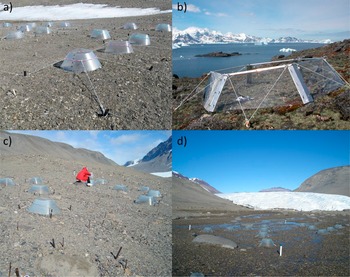
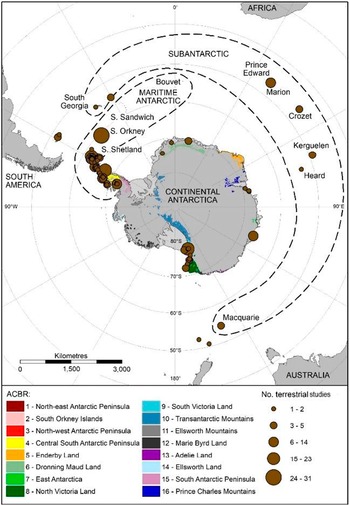
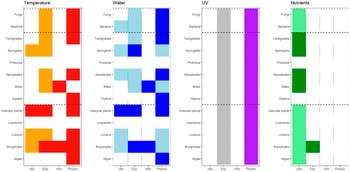
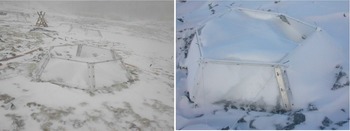
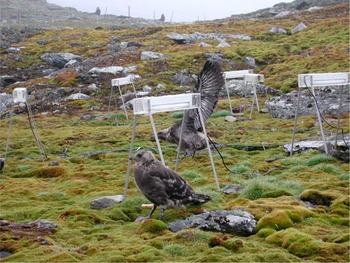
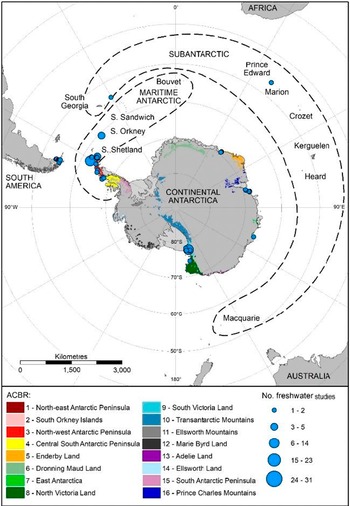


 Open access

