


Historical background: 40 years of change in the NHS
The Platt Report (1961) was the first in a series of documents that highlighted a workforce need for National Health Service (NHS) doctors with consultant-level competencies, but who were not consultants. Reference Platt1 Following discussion on the creation of ‘medical assistant’ posts, the first ‘career grade’ posts were introduced in 1964, with the term ‘associate specialist’ being introduced at the beginning of the 1980s and a new contract emerging 10 years later. 2 The vast majority of these doctors had qualified overseas, were regarded as the backbone of the NHS and were even recognised in the infamous ‘rivers of blood’ speech by health minister Enoch Powell in 1968, where it was noted that they ‘have enabled our hospital service to be expanded faster than would otherwise have been possible’. Reference Enoch Powell and Wood3
Little progress was made in addressing the continuing professional development (CPD) needs of non-consultant career grade doctors until the mid-1980s, when the title ‘staff grade’ was introduced in Achieving a Balance. 4 These doctors, as with associate specialists, were to be at a non-consultant career grade, whose job plan was predominantly one of service delivery. However, unlike associate specialists, they entered the staff grade as a senior house officer after a minimum of 3 years general professional training, where ‘provision would be made for continuing education for this grade’. 4
However, nearly another decade passed before the career structure of staff grade doctors was revisited. 5,6 Both groups noted their lack of CPD opportunities and poor career progression. Yet, it was not until the turn of the century that the main drivers for change for both staff grade and associate specialist CPD began to emerge. The first of these drivers came from the Royal College of Physicians, 7 which recommended that time be available in the job plan for CPD, agreement of a personal development plan, appointment of staff and associated specialist grade officers within deaneries, access to career advice and registration with the relevant specialty-specific College/faculty.
In the same year, A Health Service of all the Talents noted that staff and associated specialist grades had varying qualifications and skills, were often overlooked in career progression, training and continuing education and that steps should be taken to provide a proper career structure. 8 It was further recommended that staff in service posts should have better opportunities to enter training. The paper was followed closely by Choice and Opportunity, 9 which recognised the opportunity for employers to maximise the potential of staff and associated specialist grades through CPD and careers support, thereby improving job satisfaction and patient care.
The final turning point arrived with the publication of the Tooke Report, 10 in which Recommendation 38 was to ‘raise the status of the NCCG (non-consultant career grade) doctors by improving terms of service and in particular by offering opportunities for training and personal development’. Later the same year, the creation of ‘specialty doctor’ posts provided a further revision to the outdated staff grade doctor contract in Employing and Supporting Specialty Doctors - A Guide to Good Practice. 11 Specialty doctors were henceforth to be appointed by an advisory appointment committee, were to have clearly defined job that included time set aside for supporting professional activities and were required to have regular clinical supervision from a named consultant.
Non-training grades in other countries
Staff and associated specialist grades fulfil a unique role within the UK medical workforce, with no other country having a directly comparable group of doctors. In the USA, there is a group of healthcare professionals with a similar role, termed ‘hospitalists’. However, as the name suggests, these doctors work only in hospitals, also differing from UK staff and associated specialist grades in other respects. First, their role is predominantly one of providing seamless clinical service from admission to discharge in one particular clinical facility, thereby allowing residents (trainees) a greater degree of mobility between clinical settings such as office-based practice (out-patients) and carrying out diagnostic procedures. Reference Wachter and Goldman12 Hospitalists have also been seen as akin to clinical academics in the UK, having a valuable role in delivering ward-based teaching and having a strong track record in research. Reference Saint and Flanders13 A similar role to staff and associated specialist grade doctors but offered by non-medical practitioners in the USA is also fulfilled by ‘physician assistants’, with their origins in filling service shortages by training military personnel returning from Vietnam in the 1960s. These clinicians are non-medically qualified practitioners whose training is strikingly similar to a condensed medical course, Reference Mittman, Cawley and Fenn14 but they always work under supervision, with competencies limited to history taking, physical examination, ordering and interpreting blood tests and psychoeducational work with patients and families.
Breaking boundaries in CPD: the Frontier Project
In 2008, the Department of Health provided £12 million of funding for the CPD of staff and associate specialist grade doctors in England. By the end of 2009, a picture of how CPD resources have been used across English deaneries had emerged. There has also been considerable development of staff and associated specialist CPD in Wales, notwithstanding its lack of specific funding for this purpose. Data for Northern Ireland and Scotland was not available (Table 1).
National picture for staff and associated specialist grade continuing professional development by deanery (excluding Scotland and Northern Ireland)

| Associate dean | Database | Website | Aligned to specialty schools | Inclusion of primary care trust | Trust leads/tutors | SASG meetings | CESR supporta | Secondments | Support for SASGs in difficulty | |
|---|---|---|---|---|---|---|---|---|---|---|
| East Midlands | ✓ | ✓ | ✓ | ✓ | ✓ | ✓ | ✓ | ✓ | ||
| East of England | ✓ | ✓ | ✓ | ✓ | ✓ | ✓ | ✓ | |||
| Kent, Surrey and Sussex | ✓ | ✓ | ✓ | ✓ | ✓ | ✓ | ||||
| London | ✓ | ✓ | ✓ | ✓ | ✓ | ✓ | ✓ | ✓ | ✓ | ✓ |
| Mersey | ✓ | ✓ | ✓ | ✓ | ✓ | ✓ | ✓ | |||
| Northern | ✓ | ✓ | ✓ | ✓ | ✓ | ✓ | ✓ | |||
| North West | ✓ | ✓ | ✓ | ✓ | ✓ | ✓ | ✓ | |||
| Oxford | ✓ | ✓ | ✓ | ✓ | ✓ | ✓ | ✓ | ✓ | ||
| South West Peninsula | ✓ | ✓ | ✓ | ✓ | ✓ | ✓ | ||||
| Wales | ✓ | ✓ | ✓ | ✓ | ✓ | |||||
| Wessex | ✓ | ✓ | ✓ | ✓ | ✓ | ✓ | ✓ | |||
| West Midlands | ✓ | ✓ | ✓ | ✓ | ✓ | ✓ | ✓ | ✓ | ✓ | |
| Yorkshire and Humber | ✓ | ✓ | ✓ | ✓ | ✓ | ✓ | ✓ |
One response to Department of Health funding was Frontier, a London Deanery initiative to establish a strategy for identifying and meeting the CPD needs of those staff and associated specialist grade doctors working in London. The project supported the delivery of the deanery's wider strategy for managing CPD and lifelong learning and aimed to ensure that CPD is a proactive process, with the wider aim of improving patient care. Following a training needs analysis of over 700 staff and associated specialist grade doctors in the autumn of 2008, the project identified four key areas: clinical skills enhancement, knowledge updates, teaching and training skills, and leadership/management skills. By spring 2009, a staff and associated specialist grade database of over 1400 doctors had been set up, with this database also serving as means of communication and engagement with these doctors in CPD, as well as recording attendance at CPD events.
By the end of 2009, 40% of staff and associated specialist grade doctors had taken up a CPD opportunity; this increased to 50% by May 2010. Staff and associated specialist grades in psychiatry formed by far the largest specialty, with 360 staff and associated specialist grade doctors (25% of the London total), spread across nine mental health trusts in London. Psychiatrists were also overrepresented in the proportion of staff and associated specialist grade doctors who took up a Frontier CPD opportunity (46%) between 2008 and the end of 2009.
Commissioning for excellence
A London Deanery working group was set up in August 2008 to oversee the commissioning, implementation and evaluation of Frontier. The range of CPD resources is detailed in Box 1. Given the large number of staff and associated specialist grade psychiatrists, staff and associated specialist grade tutors (covering distinct geographical sectors) were recruited in late 2009, with a role that complemented existing clinical tutors, but with additional expertise in the CPD and career needs of staff and associated specialist grades. These tutors were also able to provide an important link with the College, also facilitating processes such as applications for the Certificate of Eligibility for Specialist Registration (Article 14) (CESR/Article 14) and College affiliateship. Staff and associated specialist grade doctors are also sponsored for subscription to the College CPD online resource.
CESR/Article 14
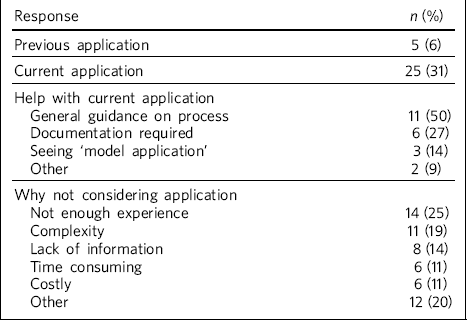
In June 2009, an online survey was carried out to ascertain interest in CESR/Article 14 from the 360 psychiatry staff and associated specialist grade doctors in London. In total, 86 doctors (24%) replied to the survey. Of these, five (6%) had previously submitted a CESR/Article 14 application. Another 25 (31%) of the remaining 81 individuals were either currently applying or planning to apply for CESR/Article 14. Those who had previously applied reported a variable level of perceived help during the process (one ‘excellent’, three ‘average’ and one ‘poor’). Table 2 shows the main areas of help that were considered relevant to a current/planned application, together with the main reasons for not considering an application (all the remaining 59 replied with comments). Those applying or considering applying for CESR/Article 14 reported the need for better general guidance on the process, with others needing better advice on the documentation required. Individuals not considering an application gave lack of experience and concerns above the sheer complexity of the process as the main reasons.
Staff and associated specialist grade Certificate of Eligibility for Specialist Registration (Article 14) survey (n = 89)
| Response | n (%) |
|---|---|
| Previous application | 5 (6) |
| Current application | 25 (31) |
| Help with current application | |
| General guidance on process | 11 (50) |
| Documentation required | 6 (27) |
| Seeing ‘model application’ | 3 (14) |
| Other | 2 (9) |
| Why not considering application | |
| Not enough experience | 14 (25) |
| Complexity | 11 (19) |
| Lack of information | 8 (14) |
| Time consuming | 6 (11) |
| Costly | 6 (11) |
| Other | 12 (20) |
Box 1 Frontier CPD: training needs and resource provision
Knowledge update
-
• E-learning
-
• Meetings/symposia/seminars
-
• CESR/Article 14 courses
-
• Critical appraisal
-
• Maintaining a portfolio
Skills update
-
• Secondment (‘top-up’ training for CESR/Article 14)
-
• Meetings/symposia/seminars
-
• CESR/Article 14 courses
-
• Critical appraisal (research methodology)
-
• Teaching skills
-
• Appraisal
-
• Workplace-based assessment
Personal development
-
• Leadership skills
-
• Mentoring skills
-
• Careers guidance
Barriers for staff and associated specialist grade CPD
In spite of the considerable progress made in the development of high-quality CPD for those in the staff and associated specialist grades, there still remain considerable barriers; this may be attributable in some part to the difficulties encountered with such a new concept for a group of doctors for whom provision of CPD funding was previously lacking. Box 2 lists the ‘top ten’ barriers to CPD for staff and associated specialist grades and the possible actions to address these barriers. The first group of these relates to engagement of these doctors in CPD, with awareness, motivation, time, access and perceived benefit all influencing the uptake of CPD resources. The second group of barriers concerns those doctors for whom progress is hampered through lack of consultant/trust support, funding/availability/range of CPD resources. Finally, those who have undertaken CPD activities may still feel ‘stuck’ in using CPD effectively or may not have the opportunity to review the outcomes of CPD through reviewing objectives set in their personal development plan.
Barriers to CPD for staff and associate specialists grade doctors

| Barrier | Suggested intervention |
|---|---|
| Lack of awareness | More effective communication from deanery |
| Lack of motivation | Mentoring, staff and associate specialists grade role models |
| Limited time | Job plan with protected time for CPD |
| Limited access | Improve trust-based CPD activities |
| Limited perceived benefit | Personal development plan in appraisal; reflective practice |
| Lack of trust/consultant support | Raising profile of revalidation within trust |
| Lack of funding/availability | Pooling of resources for more costly resources |
| Poor range of CPD resources | Project working group and staff and associate specialists grade advisors |
| Feeling ‘stuck’ in career | Mentoring; careers counselling |
| Poor or limited appraisal | Improve profile of revalidation |
The future of staff and associated specialist grade CPD
An evaluation of the project was carried out in May 2009, 15 showing an improvement in access to CPD, support for CPD from trust/College/Deanery and the local CPD contribution after the implementation of Frontier. There was also an improvement in the perceived benefit from CPD in the areas of acquiring consultant-level competencies, clinical skills, personal development, teaching, job satisfaction and patient care.
Continuing professional development (as part of lifelong learning) for staff and associated specialist grade and specialty doctors remains a cornerstone of good psychiatric practice and will play a central part in future revalidation for these doctors. 16 Frontier represents one of a number of national initiatives for meeting CPD needs. More than 40 years since the creation of the non-consultant career grade post, there is now much scope for delivering high-quality CPD to staff and associated specialist grades, for whom such resources have been long awaited but much deserved. Although the movement to and from staff and associated specialist grade/specialty doctor posts may remain in a state of flux, it is anticipated that with the provision of high-quality CPD, the number of doctors leaving these non-consultant careers grades for consultant posts (through CESR/Article 14) or for a move back into training, will continue to rise. Staff and associated specialist grade/specialty doctors in psychiatry can also continue to draw on existing resources within the College, of which a well-established equivalence committee, CESR/Article 14 training and a wide range of online CPD resources remain exemplars for CPD.
Although there remains no direct equivalent of staff and associated specialist grades in other countries, there is much to be learned from the roles of other practitioners such as hospitalists in contributing to a more clinically competent staff and associated specialist grade workforce through the commissioning and provision of CPD in the UK. The national picture also suggests that there is now a more standardised approach to the range of CPD resources available to these doctors.


 Open access


eLetters
No eLetters have been published for this article.