





1. Introduction
This paper is devoted to the study of Lévy processes which are reflected at the origin, and which have the special feature that at Poisson epochs they are subject to random collapses, jumps downward where the jump size is a random proportion of the state just before the jump. Such processes occur naturally in several different fields. We name a few as follows.
-
• Population dynamics. Population sizes may fluctuate according to birth-and-death processes, and experience disasters at random epochs. After appropriate scaling such a process may be approximated by a reflected Brownian motion subject to collapse. This case is given special attention in Example 6.1 of the current study.
-
• Geophysics. Pressure in Earth layers may fluctuate randomly between earthquakes or volcano eruptions (collapses).
-
• Transmission Control Protocol (TCP). TCP adapts the window size (transmission rate) of data transfers to the congestion in the network. The window size along a path is increased until a signal is received that the path gets too congested; the window size is then proportionally reduced (additive increase multiplicative decrease). Stochastic processes with random collapses have been studied intensively in the analysis of the TCP of the Internet (see, among many others, [Reference Altman, Avrachenkov, Barakat and Dube2, Reference Dumas, Guillemin and Robert14, Reference Guillemin, Robert and Zwart15, Reference Löpker and van Leeuwaarden26]), but typically those processes are nondecreasing (often linear) between collapses.
-
• Perishable inventories. In stochastic models of perishable inventory systems (PISs) with random input, the inventory typically increases due to production and decreases because of demand. However, in the sizable literature of such PISs (cf. the survey [Reference Boxma, Perry and Stadje11]) not much attention has been given to the modeling of incidents such as power outages, which may make a random proportion of the stored goods (e.g. food or blood) obsolete. See [Reference Kella, Perry and Stadje21] for the case of PISs with clearing, i.e. collapses in which all the goods become obsolete.
-
• Cash management. We dwell a bit longer on this particular application area, as it may be less known than those above, whereas it formed one of our main motivations for the present study. The peer-to-peer (P2P) lending platform is the practice of lending money through online services that match lenders with borrowers. The P2P firm offers a platform where individuals or businesses can lend directly to other individuals or businesses without the need for a bank as a middleman. The firm takes brokerage fees for providing this match-making platform. Compared with investment and savings products from banks, borrowers can borrow money at lower interest rates, and lenders can earn higher returns. Although the P2P lending firm applies a strict screening system, it may happen that a borrower is in arrears. If that happens, the P2P firm initiates collection procedures against the debtor. P2P systems are exposed only to the exceptional volatility caused by a severe crash in which many borrowers simultaneously go bankrupt. Historical examples of such crashes are the dot.com bubble in 2000, the sub-prime crisis in 2008 that started with the crash of Lehman Brothers, and the corona crisis of 2020. In these cases, the stock market crash was accompanied by bankruptcies in the entire business sector of small and medium businesses and even large companies. In the events mentioned here the crisis hit the entire capital market, since all those economic entities could not meet their financial obligation. In [Reference Boxma, Perry and Stadje10] a stochastic analysis of such cash management processes with crashes/collapses is presented, with a compound Poisson process between collapses. However, the cash management process generated by big businesses together with many ‘small’ individuals can be more naturally approximated by an independent sum of a compound Poisson and a Brownian component, reflected at the origin, which is a special case of the more general reflected Lévy process considered in this paper.
For some background on growth collapse processes, where, unlike in the current paper, the processes are nondecreasing between collapse epochs, one may sample, among others, [Reference Boxma, Kella and Perry7, Reference Boxma, Perry, Stadje and Zacks12, Reference van der Hofstad, Kapodistria, Palmowski and Shneer16, Reference Kella18, Reference Kella and Löpker20, Reference Löpker and Stadje27] and references therein. See also [Reference Palmowski and Vlasiou28, Reference Palmowski, Vlasiou and Zwart29] for certain (spectrally positive) Lévy queues with workload modification at exponential times and some other features.
Globally, our goals are to study the stability conditions of reflected Lévy processes with random collapses, and to determine the stationary distribution (if it exists) when the Lévy process is spectrally positive (i.e. the Lévy process itself has no negative jumps).
Our main contributions are as follows.
-
• A careful discussion of the conditions for the existence of a limiting/ergodic/stationary distribution of the reflected Lévy process with collapses.
-
• For the case of a spectrally positive Lévy process, we determine the Laplace–Stieltjes transform (LST) and moments of that limiting distribution.
-
• For the special case of a compound Poisson process with regularly varying jump sizes, we prove that the tail of the limiting distribution is just as heavy as the tail of the jump size distribution.
-
• For the special cases of Brownian motion and of a compound Poisson process with exponentially distributed jump sizes (corresponding to an $M/M/1$
queue with collapses) the LST of the limiting distribution is worked out in more detail, revealing a relation to incomplete Beta functions.
$M/M/1$
queue with collapses) the LST of the limiting distribution is worked out in more detail, revealing a relation to incomplete Beta functions.

Remark 1. There are many possible extensions of our model; we mention a few. (i) The intervals between collapses could have a general distribution (cf. [Reference Boxma, Kella and Perry7], where the resulting model is studied for the case of a compound Poisson process minus a drift). (ii) It would be interesting to study reflected Lévy processes in which workload decreases proportionally (‘shot noise’ with exponential decay or equivalently a ‘linear dam’); cf. [Reference Kella18], where the relation between collapses and such a shot noise structure is explored. (iii) In PISs, it is often assumed that items have a finite lifetime [Reference Boxma, Perry and Stadje11]. In our setting, this could give rise to doubly reflected Lévy processes with collapses. (iv) Next to proportional collapses, one might also allow state-dependent jumps upward. In cash management and the crypto exchange market, such jumps might occur, although they seem milder than the collapses.
The remainder of the paper is organized as follows. In Section 2 we introduce the model under consideration: the Lévy process, the collapse procedure that is applied to it, the reflected version of the resulting process, and its local time at zero. We also show that the process level just before successive collapses satisfies a Lindley-type recursion of an autoregressive sequence. Section 3 considers this recursion in detail. It leads to the conclusion that, if a limiting distribution for this sequence exists, then the limiting random variable can be decomposed into two independent terms. In Section 4 we discuss the conditions under which the reflected Lévy process with general [independent and identically distributed (i.i.d.)] collapses at Poisson epochs has a limiting/ergodic/stationary distribution. By Poisson Arrivals See Time Averages (PASTA), this is also the limiting distribution of the process level just before collapses. Section 5 presents the derivation of this limiting distribution. The special cases of reflected Brownian motion with collapses, of an $M/M/1$
queue with collapses, and of a heavy-tailed
$M/M/1$
queue with collapses, and of a heavy-tailed $M/G/1$
queue with collapses are discussed in Section 6.
$M/G/1$
queue with collapses are discussed in Section 6.
2. The general model
In what follows $x\vee y=\max(x,y)$
,
$x\vee y=\max(x,y)$
, $x\wedge y=\min(x,y)$
,
$x\wedge y=\min(x,y)$
, $x^+=x\vee 0$
, and
$x^+=x\vee 0$
, and $x^-=({-}x)^+$
. In addition,
$x^-=({-}x)^+$
. In addition, $\sim$
denotes ‘distributed’ or ‘distributed like’ and
$\sim$
denotes ‘distributed’ or ‘distributed like’ and $\approx$
denotes ‘asymptotic to’.
$\approx$
denotes ‘asymptotic to’.
Consider a càdlàg Lévy process $X=\{X_t \mid t\ge 0\}$
with
$X=\{X_t \mid t\ge 0\}$
with $X_0=0$
. Associated with each Lévy process is a triplet
$X_0=0$
. Associated with each Lévy process is a triplet $(c,\sigma^2,\nu)$
where
$(c,\sigma^2,\nu)$
where $c\in\mathbb{R}$
,
$c\in\mathbb{R}$
, $\sigma\ge 0$
, and
$\sigma\ge 0$
, and $\nu$
is a (sigma-finite) measure, called the Lévy measure which satisfies
$\nu$
is a (sigma-finite) measure, called the Lévy measure which satisfies $\nu(\{0\})=0$
,
$\nu(\{0\})=0$
, $\int_{\mathbb{R}}\,x^2\wedge 1\,\nu({\mathrm{d}} x)<\infty$
. Any such Lévy process can be decomposed into a sum of independent processes, where one is a Brownian motion (possibly only a drift), another is a compound Poisson process (possibly zero) with jumps in
$\int_{\mathbb{R}}\,x^2\wedge 1\,\nu({\mathrm{d}} x)<\infty$
. Any such Lévy process can be decomposed into a sum of independent processes, where one is a Brownian motion (possibly only a drift), another is a compound Poisson process (possibly zero) with jumps in $\mathbb{R}\setminus[-1,1]$
, and, finally, a convergent sum of centered compound Poisson processes of the form
$\mathbb{R}\setminus[-1,1]$
, and, finally, a convergent sum of centered compound Poisson processes of the form $\sum_{n=1}^\infty (X_{n,t}-t\mathrm{E}X_{n,1})$
, where the absolute values of the jumps of the process
$\sum_{n=1}^\infty (X_{n,t}-t\mathrm{E}X_{n,1})$
, where the absolute values of the jumps of the process $X_n$
are in
$X_n$
are in $\left({1}/({n+1}), {1}/{n}\right]$
. For background on Lévy processes and Lévy queues, see, e.g., [Reference Bertoin4, Reference Debicki and Mandjes13, Reference Kella, Perry and Stadje21, Reference Kyprianou25, Reference Sato30].
$\left({1}/({n+1}), {1}/{n}\right]$
. For background on Lévy processes and Lévy queues, see, e.g., [Reference Bertoin4, Reference Debicki and Mandjes13, Reference Kella, Perry and Stadje21, Reference Kyprianou25, Reference Sato30].
In addition, let $\tau,\tau_1,\tau_2,\ldots$
be i.i.d.
$\tau,\tau_1,\tau_2,\ldots$
be i.i.d. $\exp(\lambda)$
distributed random variables which are also independent of X and use the notation
$\exp(\lambda)$
distributed random variables which are also independent of X and use the notation $S_0=0$
and
$S_0=0$
and $S_n=\sum_{i=1}^n\tau_i$
for
$S_n=\sum_{i=1}^n\tau_i$
for $i\ge 1$
, with renewal counting (Poisson) process
$i\ge 1$
, with renewal counting (Poisson) process $N_t=\sup\{n \mid S_n\le t\}$
. Finally, let
$N_t=\sup\{n \mid S_n\le t\}$
. Finally, let $U,U_1,U_2,\ldots$
be i.i.d. with
$U,U_1,U_2,\ldots$
be i.i.d. with $\mathrm{P}(U\in[0,1])=1$
. These are thought of as random proportions and are independent of all the other random objects defined thus far.
$\mathrm{P}(U\in[0,1])=1$
. These are thought of as random proportions and are independent of all the other random objects defined thus far.
For $t\ge 0$
, denote
$t\ge 0$
, denote $L_t=-\inf_{0\le s\le t}X_s$
,
$L_t=-\inf_{0\le s\le t}X_s$
, $W_t=X_t+L_t$
, and, for
$W_t=X_t+L_t$
, and, for $x\ge 0$
,
$x\ge 0$
,
 \begin{align}L^x_t&=\left({-}\inf_{0\le s\le t}(x+X_s)\right)^+=(L_t-x)^+ , \nonumber\\W^x_t&=x+X_t+L^x_t=X_t+x\vee L_t=W_t+ (x-L_t)^+.\end{align}
This is the reflection (Skorokhod) map associated with $\{x+X_t \mid t\ge 0\}$
where
$\{x+X_t \mid t\ge 0\}$
where $(L^x_t,W^x_t)$
are the unique càdlàg processes that jointly satisfy (see [Reference Kella17]):
$(L^x_t,W^x_t)$
are the unique càdlàg processes that jointly satisfy (see [Reference Kella17]):
-
(i)
$L^x_0=0$
and
$L^x_t$
is nondecreasing in t; -
(ii)
$W^x_t\ge 0$
for each
$t\ge 0$
; and -
(iii)
$\{t \mid W^x_t=0\}\subset \{t \mid L^x_s < L^x_t\ \forall s\in [0,t)\}$
.



Now denote $\sigma_sX=\{X_{t+s}-X_s\mid t\ge 0\}$
(which is independent of the history of X until time s) and let
$\sigma_sX=\{X_{t+s}-X_s\mid t\ge 0\}$
(which is independent of the history of X until time s) and let $(\sigma_sL^x_t,\sigma_sW^x_t)$
be the corresponding reflection map associated with
$(\sigma_sL^x_t,\sigma_sW^x_t)$
be the corresponding reflection map associated with $\sigma_sX$
. Let
$\sigma_sX$
. Let $Z=\{Z_t \mid t\ge 0\}$
be defined as follows. Assume that we have already defined it on
$Z=\{Z_t \mid t\ge 0\}$
be defined as follows. Assume that we have already defined it on $[0,S_n)$
. Then for
$[0,S_n)$
. Then for $t\in [S_n,S_{n+1})$
,
$t\in [S_n,S_{n+1})$
,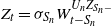 $Z_t=\sigma_{S_n}W^{U_nZ_{S_n-}}_{t-S_n}$
, where
$Z_t=\sigma_{S_n}W^{U_nZ_{S_n-}}_{t-S_n}$
, where $Z_{t-}=\lim_{v\uparrow t}Z_v$
. Namely, at time
$Z_{t-}=\lim_{v\uparrow t}Z_v$
. Namely, at time $S_n$
, which we refer to as collapse epochs, the content modeled by the process Z collapses to a fraction
$S_n$
, which we refer to as collapse epochs, the content modeled by the process Z collapses to a fraction $U_n$
of its precollapse level and continues according to a reflected Lévy process until the next collapse epoch. Here
$U_n$
of its precollapse level and continues according to a reflected Lévy process until the next collapse epoch. Here $Z_0$
may have any distribution and is assumed to be independent of everything else.
$Z_0$
may have any distribution and is assumed to be independent of everything else.
Comment 1. In fact, because of the assumptions made until now, Z is a (nonnegative) Markov process with the following generator:
 \begin{align}\mathcal{A}g(x) & = cg'(x)+\frac{\sigma^2}{2}g''(x)+\int_{\mathbb{R}}\left(g(x+y)-g(x)-g'(x)y1_{[-1,1]}(y)\right)\nu(\mathrm{d}y)\nonumber\\& \quad +\lambda(\mathrm{E}g(Ux)-g(x))\,\end{align}
for twice continuously differentiable g with $g(x)=g(0)$
for
$g(x)=g(0)$
for $x\le 0$
(hence,
$x\le 0$
(hence, $g'(x)=g''(x)=0$
for
$g'(x)=g''(x)=0$
for $x\le 0$
). In particular, for
$x\le 0$
). In particular, for $x\le 0$
it may be checked that
$x\le 0$
it may be checked that
 \begin{equation}\mathcal{A}g(x)=\int_{({-}x,\infty)}(g(x+y)-g(0))\nu(\mathrm{d}y)=\int_0^\infty g'(y)\nu({-}x+y)\,\mathrm{d}y.\end{equation}
This can be shown by applying the (local) martingales discussed in [Reference Kella and Yor24] or [Reference Kella and Boxma19] but will not be needed for what follows.
A famous result, which in particular may be found in [Reference Bertoin4, Reference Debicki and Mandjes13, Reference Kyprianou25, Reference Sato30], is that $W_\tau$
and
$W_\tau$
and $L_\tau$
are independent. By (1) this implies the following decomposition:
$L_\tau$
are independent. By (1) this implies the following decomposition:
 \begin{equation} \big(W^x_\tau,L^x_\tau \big)=(W_\tau,0)+ \big((x-L_\tau)^+,(L_\tau-x)^+ \big) ,\end{equation}
where the two random vectors on the right are independent. In particular, denoting $w(\alpha)= \mathrm{E}{\mathrm{e}}^{-\alpha W_\tau}$
, we have that, for
$w(\alpha)= \mathrm{E}{\mathrm{e}}^{-\alpha W_\tau}$
, we have that, for $\alpha,\beta\ge 0$
,
$\alpha,\beta\ge 0$
,
 \begin{equation} \mathrm{E}{\mathrm{e}}^{-\alpha W^x_\tau-\beta L^x_\tau}=w(\alpha)\,\mathrm{E}{\mathrm{e}}^{-\alpha (x-L_\tau)^+-\beta (L_\tau-x)^+}.\end{equation}
With our setup, it follows from (4) that
 \begin{equation}Z_{S_n-}=\sigma_{S_{n-1}} W_{\tau_n}+ (Z_{S_{n-1}-}U_n-\sigma_{S_{n-1}}L_{\tau_n})^+ ,\end{equation}
where $\sigma_{S_{n-1}} W_{\tau_n},Z_{S_{n-1}-},U_n,\sigma_{S_{n-1}}L_{\tau_n}$
are independent and
$\sigma_{S_{n-1}} W_{\tau_n},Z_{S_{n-1}-},U_n,\sigma_{S_{n-1}}L_{\tau_n}$
are independent and $\sigma_{S_{n-1}} W_{\tau_n},U_n,\sigma_{S_{n-1}}L_{\tau_n}$
are distributed like
$\sigma_{S_{n-1}} W_{\tau_n},U_n,\sigma_{S_{n-1}}L_{\tau_n}$
are distributed like $W_\tau,U,L_\tau$
, respectively.
$W_\tau,U,L_\tau$
, respectively.
We observe that by PASTA the ergodic distribution of the continuous time process Z is the same as that of the discrete time process $Z_{S_n-}$
and, therefore, it is important to study this latter process. With
$Z_{S_n-}$
and, therefore, it is important to study this latter process. With $\zeta_n=Z_{S_n-}$
,
$\zeta_n=Z_{S_n-}$
, $V_n=\sigma_{S_{n-1}}W_{\tau_n}$
, and
$V_n=\sigma_{S_{n-1}}W_{\tau_n}$
, and $Y_n=\sigma_{S_{n-1}}L_{\tau_n}$
we therefore have the following Lindley-style version of an autoregressive sequence:
$Y_n=\sigma_{S_{n-1}}L_{\tau_n}$
we therefore have the following Lindley-style version of an autoregressive sequence:
 \begin{equation}\zeta_n=V_n+(\zeta_{n-1}U_n-Y_n)^+,\end{equation}
where all four random variables on the right are independent with $V_n\sim W_\tau$
,
$V_n\sim W_\tau$
, $U_n\sim U$
, and
$U_n\sim U$
, and $Y_n\sim L_\tau$
. In the next section we consider this recursion in some detail.
$Y_n\sim L_\tau$
. In the next section we consider this recursion in some detail.
3. Lindley-style autoregressive recursions
Consider the recursion (for now, deterministic),
 \begin{equation}z_n=v_n+(z_{n-1}u_n-y_n)^+ , \quad n \geq 1,\end{equation}
where $v_{i-1},y_i\ge 0$
,
$v_{i-1},y_i\ge 0$
, $u_i\in[0,1]$
for
$u_i\in[0,1]$
for $i\ge 1$
. In addition, let
$i\ge 1$
. In addition, let $z_0=v_0$
. This is the same as letting
$z_0=v_0$
. This is the same as letting $z_{-1}=0$
, defining
$z_{-1}=0$
, defining $u_0\in[0,1]$
arbitrarily and starting the recursion one index earlier. Furthermore, let
$u_0\in[0,1]$
arbitrarily and starting the recursion one index earlier. Furthermore, let $\Pi_0=1$
and
$\Pi_0=1$
and $\Pi_n=\prod_{i=1}^n u_i$
for
$\Pi_n=\prod_{i=1}^n u_i$
for $n\ge 1$
.
$n\ge 1$
.
We first observe that if $z'_n=v_n+(z_{n-1}'u_n-y_n)^+$
and
$z'_n=v_n+(z_{n-1}'u_n-y_n)^+$
and $z''_n=v_n+(z_{n-1}''u_n-y_n)^+$
, for any two choices where
$z''_n=v_n+(z_{n-1}''u_n-y_n)^+$
, for any two choices where $z''_0\ge z'_0\ge 0$
, then it follows by induction that
$z''_0\ge z'_0\ge 0$
, then it follows by induction that $z''_n\ge z'_n$
for all
$z''_n\ge z'_n$
for all $n\ge 0$
. Moreover:
$n\ge 0$
. Moreover:
-
• when
$z''_{n-1}u_n\le y_n$
we have that
$z''_n-z'_n=0\le \big(z''_{n-1}-z'_{n-1}\big)u_n$
; -
• when
$z'_{n-1}u_n>y_n$
we have that
$z''_n-z'_n=\big(z''_{n-1}-z'_{n-1}\big)u_n$
; -
• when
$z'_{n-1}u_n\le y_n < z''_{n-1}u_n$
we have that(9)
\begin{equation}z''_n-z'_n=z''_{n-1}u_n-y_n\le z''_{n-1}u_n-y_n+y_n-z'_{n-1}u_n= \big(z''_{n-1}-z'_{n-1} \big) u_n .\end{equation}






Therefore, whenever $z''_0\ge z'_0\ge 0$
, for all
$z''_0\ge z'_0\ge 0$
, for all $n\ge 1$
,
$n\ge 1$
, $z''_n-z'_n\le (z''_{n-1}-z'_{n-1})u_n$
and, thus, for every
$z''_n-z'_n\le (z''_{n-1}-z'_{n-1})u_n$
and, thus, for every $n\ge 0$
,
$n\ge 0$
,
 \begin{equation} 0\le z''_n-z'_n\le \big(z''_0-z'_0 \big)\Pi_n .\end{equation}
In particular, this implies the following.
Lemma 1. If $\Pi_n\to0$
as
$\Pi_n\to0$
as $n\to\infty$
then
$n\to\infty$
then $z'_n-z_n\to 0$
as
$z'_n-z_n\to 0$
as $n\to\infty$
for any choice of
$n\to\infty$
for any choice of $z'_0\ge 0$
(smaller, equal, or larger than
$z'_0\ge 0$
(smaller, equal, or larger than $z_0=v_0$
).
$z_0=v_0$
).
We note that since we will be replacing $u_i$
by i.i.d. random variables
$u_i$
by i.i.d. random variables $U_i\sim U$
with support in [0, 1], then, unless
$U_i\sim U$
with support in [0, 1], then, unless $\mathrm{P}(U=1)=1$
, it will always hold that
$\mathrm{P}(U=1)=1$
, it will always hold that $\prod_{i=1}^nU_i\to 0$
as
$\prod_{i=1}^nU_i\to 0$
as $n\to\infty$
.
$n\to\infty$
.
We begin by assuming that $u_i>0$
for all
$u_i>0$
for all $i\ge 1$
, so that
$i\ge 1$
, so that $\Pi_n>0$
for all
$\Pi_n>0$
for all $n\ge1$
. Denoting, for
$n\ge1$
. Denoting, for $n\ge 1$
,
$n\ge 1$
,
 \begin{equation}w_n=\frac{z_n-v_n}{\Pi_n}, \quad x_n=\frac{v_{n-1}}{\Pi_{n-1}}-\frac{y_n}{\Pi_n},\end{equation}
we have that $w_0=0$
and, for
$w_0=0$
and, for $n\ge 1$
,
$n\ge 1$
, $w_n=(w_{n-1}+x_n)^+$
, which is Lindley’s recursion. Thus, with
$w_n=(w_{n-1}+x_n)^+$
, which is Lindley’s recursion. Thus, with $s_0=0$
and
$s_0=0$
and $s_n=\sum_{i=1}^nx_i$
for
$s_n=\sum_{i=1}^nx_i$
for $n\ge 1$
we have the well-known solution:
$n\ge 1$
we have the well-known solution:
 \begin{equation}w_n=s_n-\min_{0\le k\le n}s_k=\max_{0\le k\le n}(s_n-s_{n-k})\end{equation}
and, thus,
 \begin{equation}z_n=v_n+\max_{0\le k\le n} ((s_n-s_{n-k})\Pi_n).\end{equation}
For $k=0$
we have that
$k=0$
we have that $(s_n-s_{n-k})\Pi_n=0$
whereas for
$(s_n-s_{n-k})\Pi_n=0$
whereas for $1\le k\le n$
we have
$1\le k\le n$
we have
 \begin{align}(s_n-s_{n-k})\Pi_n&=\sum_{i=n-k+1}^n \left(\frac{v_{i-1}}{\Pi_{i-1}}-\frac{y_i}{\Pi_i}\right)\Pi_n\nonumber\\&=\sum_{i=1}^k \left(\frac{v_{n-i}}{\Pi_{n-i}}-\frac{y_{n-i+1}}{\Pi_{n-i+1}}\right)\Pi_n ,\end{align}
recalling that $v_0=0$
(relevant for
$v_0=0$
(relevant for $i=k=n$
). Now,
$i=k=n$
). Now,
 \begin{equation}\frac{\Pi_n}{\Pi_{n-i}}=\prod_{j=n-i+1}^nu_j=\prod_{j=1}^i u_{n-j+1}\end{equation}
and, similarly, for $i=1$
, we have that
$i=1$
, we have that $\Pi_n/\Pi_{n-1+1}=1$
and for
$\Pi_n/\Pi_{n-1+1}=1$
and for $2\le i\le k\le n$
,
$2\le i\le k\le n$
,
 \begin{equation}\frac{\Pi_n}{\Pi_{n-i+1}}=\prod_{j=n-i+2}^n u_j=\prod_{j=1}^{i-1} u_{n-j+1}.\end{equation}
This implies that we can write
 \begin{equation}(s_n-s_{n-k})\Pi_n=\sum_{i=1}^k v_{n-i}\prod_{j=1}^iu_{n-j+1}-\sum_{i=1}^ky_{n-i+1}\prod_{j=1}^{i-1}u_{n-j+1},\end{equation}
where an empty product is defined to be one and an empty sum is zero. Therefore, we finally have that
 \begin{equation}z_n=v_n+\max_{0\le k\le n}\left(\sum_{i=1}^k(v_{n-i}u_{n-i+1}-y_{n-i+1})\prod_{j=1}^{i-1}u_{n-j+1}\right) .\end{equation}
We emphasize the fact that for $n=0$
we have that (since empty sums are zero), (18) implies that
$n=0$
we have that (since empty sums are zero), (18) implies that $z_0=v_0$
as initially assumed. Finally, it is a straightforward exercise to show by induction that (18) holds also for the case where
$z_0=v_0$
as initially assumed. Finally, it is a straightforward exercise to show by induction that (18) holds also for the case where $u_i$
are allowed to be zero. For each such i we have that
$u_i$
are allowed to be zero. For each such i we have that $z_i=v_i$
and the recursion evidently restarts from that point.
$z_i=v_i$
and the recursion evidently restarts from that point.
Now, if we replace $\{(v_{i-1},u_i,y_i) \mid i\ge 1\}$
by three independent i.i.d. sequences
$\{(v_{i-1},u_i,y_i) \mid i\ge 1\}$
by three independent i.i.d. sequences $\{(V_{i-1},U_i,Y_i) \mid i\ge 1\}$
of nonnegative random variables and
$\{(V_{i-1},U_i,Y_i) \mid i\ge 1\}$
of nonnegative random variables and $\{z_n \mid n\ge 0\}$
by the random variable
$\{z_n \mid n\ge 0\}$
by the random variable $\zeta_n$
, then by taking each of the random vectors
$\zeta_n$
, then by taking each of the random vectors $V_0,\ldots,V_n$
,
$V_0,\ldots,V_n$
, $U_1,\ldots,U_n$
, and
$U_1,\ldots,U_n$
, and $Y_1,\ldots,Y_n$
in reverse order it follows that
$Y_1,\ldots,Y_n$
in reverse order it follows that
 \begin{equation}\zeta_n\sim V_0+\max_{0\le k\le n}\left(\sum_{i=1}^k (V_iU_i-Y_i)\prod_{j=1}^{i-1}U_j\right),\end{equation}
where an empty sum is zero and an empty product is one. Therefore, $\zeta_n$
is stochastically increasing and bounded above by
$\zeta_n$
is stochastically increasing and bounded above by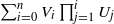 $\sum_{i=0}^nV_i\prod_{j=1}^iU_j$
and, hence, if
$\sum_{i=0}^nV_i\prod_{j=1}^iU_j$
and, hence, if $\mathrm{E}V_0<\infty$
and
$\mathrm{E}V_0<\infty$
and $\mathrm{P}(U_i=1)<1$
,
$\mathrm{P}(U_i=1)<1$
, $\zeta_n$
converges in distribution to an almost surely (a.s.) finite random variable
$\zeta_n$
converges in distribution to an almost surely (a.s.) finite random variable $\zeta$
which is distributed like an independent sum of two random variables. The first is distributed like
$\zeta$
which is distributed like an independent sum of two random variables. The first is distributed like $V_0$
and the second like
$V_0$
and the second like
 \begin{equation}\sup_{k\ge 0}\left(\sum_{i=1}^k (V_iU_i- Y_i)\prod_{j=1}^{i-1}U_j\right) .\end{equation}
This is a generalization of the setup (hence, the conclusions) considered in [Reference Boxma, Kella and Mandjes6]. See also [Reference Boxma, Löpker, Mandjes and Palmowski8] for a discussion of recursions of the form $W_n=(W_{n-1}U_n+X_n)^+$
.
$W_n=(W_{n-1}U_n+X_n)^+$
.
4. Stability of the Continuous Time Process
An important question is what are the conditions on Z that ensure that there exists a limiting/ergodic/stationary distribution. If $\mathrm{P}(U=1)=1$
then we have a reflected Lévy process, which is well understood and has been discussed many times in the literature and textbooks, and thus we will assume that
$\mathrm{P}(U=1)=1$
then we have a reflected Lévy process, which is well understood and has been discussed many times in the literature and textbooks, and thus we will assume that $\mathrm{P}(U=1)<1$
. Since the collapse epochs occur according to a Poisson process with rate
$\mathrm{P}(U=1)<1$
. Since the collapse epochs occur according to a Poisson process with rate $\lambda$
, it is clear that true collapses (with
$\lambda$
, it is clear that true collapses (with $U_i<1$
) occur according to a Poisson process with rate
$U_i<1$
) occur according to a Poisson process with rate $\lambda \mathrm{P}(U<1)$
. Therefore, without loss of generality (w.l.o.g.), let us assume that
$\lambda \mathrm{P}(U<1)$
. Therefore, without loss of generality (w.l.o.g.), let us assume that $\mathrm{P}(U=1)=0$
. If
$\mathrm{P}(U=1)=0$
. If $\mathrm{P}(U=0)>0$
then after a geometrically distributed number of trials the process jumps to zero (often called clearing), which implies that it is regenerative and therefore a proper limiting ergodic distribution clearly exists. It remains to consider the case
$\mathrm{P}(U=0)>0$
then after a geometrically distributed number of trials the process jumps to zero (often called clearing), which implies that it is regenerative and therefore a proper limiting ergodic distribution clearly exists. It remains to consider the case $\mathrm{P}(U=0)=\mathrm{P}(U=1)=0$
. In this case it is clear that
$\mathrm{P}(U=0)=\mathrm{P}(U=1)=0$
. In this case it is clear that $\prod_{i=1}^\infty U_i=0$
a.s.
$\prod_{i=1}^\infty U_i=0$
a.s.
It is easy to check that if $x\le y$
then
$x\le y$
then $W^x_t\le W^y_t$
for all
$W^x_t\le W^y_t$
for all $t\ge 0$
and that
$t\ge 0$
and that $W^y_t-W^x_t$
is nonincreasing in t. See [Reference Kella and Whitt23] for results like this in the multidimensional setting. Therefore, setting
$W^y_t-W^x_t$
is nonincreasing in t. See [Reference Kella and Whitt23] for results like this in the multidimensional setting. Therefore, setting $Z^x$
to be the process Z when started from
$Z^x$
to be the process Z when started from $Z_0=x$
we have that
$Z_0=x$
we have that
 \begin{equation}Z_{\tau_1}^y-Z_{\tau_1}^x= \big(W_{\tau_1-}^y-W_{\tau_1-}^x \big)U_1\le (y-x)U_1,\end{equation}
where the left-hand side is nonnegative. Hence, by induction it also follows that
 \begin{equation}0\le Z_{S_n}^y-Z_{S_n}^x\le (y-x)\prod_{i=1}^n U_i,\end{equation}
where the right-hand side vanishes a.s. as $n\to\infty$
. Therefore, we also have that
$n\to\infty$
. Therefore, we also have that
 \begin{equation}0\le Z^y_t-Z^x_t\le (y-x)\prod_{i=1}^{N_t}U_i\end{equation}
which vanishes a.s. as $t\to\infty$
. Therefore, it follows that if a limiting distribution exists, it does not depend on the initial distribution of
$t\to\infty$
. Therefore, it follows that if a limiting distribution exists, it does not depend on the initial distribution of $Z_0$
.
$Z_0$
.
Since $W^x_t=X_t+L_t\vee x\le x+X_t+L_t=x+W_t$
it follows that
$W^x_t=X_t+L_t\vee x\le x+X_t+L_t=x+W_t$
it follows that $Z_{S_n}$
is stochastically bounded by
$Z_{S_n}$
is stochastically bounded by $x\prod_{i=1}^nU_i+\sum_{i=1}^n V_i\prod_{j=i}^nU_j$
where all the variables on the right-hand side are independent and
$x\prod_{i=1}^nU_i+\sum_{i=1}^n V_i\prod_{j=i}^nU_j$
where all the variables on the right-hand side are independent and $V_i\sim W_\tau$
. By results from [Reference Kella18] this implies that
$V_i\sim W_\tau$
. By results from [Reference Kella18] this implies that $\{Z_{S_n} \mid n\ge 0\}$
and, hence,
$\{Z_{S_n} \mid n\ge 0\}$
and, hence, $\{Z_t \mid t\ge 0\}$
are bounded above by a process that has a stationary version. Therefore, tightness of these processes is assured. It also implies that
$\{Z_t \mid t\ge 0\}$
are bounded above by a process that has a stationary version. Therefore, tightness of these processes is assured. It also implies that $\{Z_t \mid t\ge 0\}$
has a stationary version by following the (Loynes-type) construction from [Reference Kella18] which is applied there to the case where W is nondecreasing.
$\{Z_t \mid t\ge 0\}$
has a stationary version by following the (Loynes-type) construction from [Reference Kella18] which is applied there to the case where W is nondecreasing.
Therefore, we can apply PASTA to conclude that the (unique) ergodic distribution of Z is the same as that of the discrete time process $\zeta_n=Z_{S_n-}$
, where we recall
$\zeta_n=Z_{S_n-}$
, where we recall $\zeta_n,\zeta$
from Sections 2 and 3. With
$\zeta_n,\zeta$
from Sections 2 and 3. With $Z^*=\zeta$
having the steady-state distribution of
$Z^*=\zeta$
having the steady-state distribution of $\zeta_n$
(and, hence, also of the process Z), we have that
$\zeta_n$
(and, hence, also of the process Z), we have that
 \begin{equation}Z^*\sim W^{Z^*U}_\tau\sim W_\tau+(Z^*U-L_\tau)^+,\end{equation}
where $Z^*,W_\tau,U,L_\tau$
on the right are independent. To summarize, all that is needed for stability and independence of initial conditions for the continuous time process is that
$Z^*,W_\tau,U,L_\tau$
on the right are independent. To summarize, all that is needed for stability and independence of initial conditions for the continuous time process is that $\mathrm{P}(U_1=1)<1$
and that
$\mathrm{P}(U_1=1)<1$
and that $\mathrm{E}W_\tau<\infty$
, for which it suffices that
$\mathrm{E}W_\tau<\infty$
, for which it suffices that $\int_{(1,\infty)}x\nu({\mathrm{d}} x)<\infty$
.
$\int_{(1,\infty)}x\nu({\mathrm{d}} x)<\infty$
.
5. The case where X is spectrally positive
When X is spectrally positive, that is, $\nu({-}\infty,0]=0$
, then with
$\nu({-}\infty,0]=0$
, then with
 \begin{equation}\varphi(\alpha)=\log \mathrm{E}{\mathrm{e}}^{-\alpha X_1}=-c\alpha+\frac{\sigma^2}{2}\alpha^2+\int_{(0,\infty)}\left({\mathrm{e}}^{-\alpha x}-1+\alpha x1_{(0,1]}(x)\right)\,\nu({\mathrm{d}} x) ,\end{equation}
it may be concluded (e.g. applying the martingale from [Reference Kella and Whitt22], as is done in [Reference Asmussen3, Theorem 3.10, p. 259]) that if X is not a subordinator and $\alpha_\lambda$
is the unique positive root of
$\alpha_\lambda$
is the unique positive root of $\varphi(\alpha)=\lambda$
, then
$\varphi(\alpha)=\lambda$
, then $L_\tau\sim \exp(\alpha_\lambda)$
and
$L_\tau\sim \exp(\alpha_\lambda)$
and
 \begin{equation}w(\alpha)=\mathrm{E}{\mathrm{e}}^{-\alpha W_\tau}=\frac{1-\frac{\alpha}{\alpha_\lambda}}{1-\frac{\varphi(\alpha)}{\lambda}}.\end{equation}
Therefore, it follows either by [Reference Asmussen3, Theorem 3.10, p. 259] or from (5) here that, for $\alpha\not=\alpha_\lambda$
,
$\alpha\not=\alpha_\lambda$
,
 \begin{equation}\mathrm{E}{\mathrm{e}}^{-\alpha W^x_\tau-\beta L^x_\tau}=w(\alpha)\,\frac{{\mathrm{e}}^{-\alpha x}-\frac{\alpha+\beta}{\alpha_\lambda+\beta}{\mathrm{e}}^{-\alpha_\lambda x}}{1-\frac{\alpha}{\alpha_\lambda}},\end{equation}
whereas by l’Hôpital’s rule and continuity, for $\alpha=\alpha_\lambda$
the right-hand side is
$\alpha=\alpha_\lambda$
the right-hand side is
 \begin{equation}\frac{x+\frac{1}{\alpha_\lambda+\beta}}{\varphi'(\alpha_\lambda)} \lambda {\mathrm{e}}^{-\alpha_\lambda x} .\end{equation}
In particular, for $\alpha\not=\alpha_\lambda$
,
$\alpha\not=\alpha_\lambda$
,
 \begin{equation}\mathrm{E}{\mathrm{e}}^{-\alpha W^x_\tau}=w(\alpha) \frac{{\mathrm{e}}^{-\alpha x}-\frac{\alpha}{\alpha_\lambda}{\mathrm{e}}^{-\alpha_\lambda x}}{1-\frac{\alpha}{\alpha_\lambda}}=\frac{{\mathrm{e}}^{-\alpha x}-\frac{\alpha}{\alpha_\lambda}{\mathrm{e}}^{-\alpha_\lambda x}}{1-\frac{\varphi(\alpha)}{\lambda}},\end{equation}
where the term to the right of $w(\alpha)$
is the LST of
$w(\alpha)$
is the LST of $(x-L_\tau)^+$
. The case where X is a subordinator is analyzed in [Reference Boxma, Kella and Perry7, Reference Kella18] and is thus ignored here.
$(x-L_\tau)^+$
. The case where X is a subordinator is analyzed in [Reference Boxma, Kella and Perry7, Reference Kella18] and is thus ignored here.
From (24) and (29) it therefore follows that if we set $f(\alpha)=\mathrm{E}{\mathrm{e}}^{-\alpha Z^*}$
then
$f(\alpha)=\mathrm{E}{\mathrm{e}}^{-\alpha Z^*}$
then
 \begin{equation}f(\alpha)=\frac{\mathrm{E}f(\alpha U)-\frac{\alpha}{\alpha_\lambda} \mathrm{E}f(\alpha_\lambda U)}{1-\frac{\varphi(\alpha)}{\lambda}}.\end{equation}
Noting that for $n\ge 1$
we have, with
$n\ge 1$
we have, with $\delta_{1n}=0$
for
$\delta_{1n}=0$
for $n\ge 2$
and
$n\ge 2$
and $\delta_{11}=1$
, that
$\delta_{11}=1$
, that
 \begin{align} \left(1-\frac{\varphi(\alpha)}{\lambda}\right)f^{(n)}(\alpha)-\frac{1}{\lambda}\,\sum_{k=0}^{n-1} \left(\begin{array}{l}n \\k \end{array}\right) f^{(k)}(\alpha)\varphi^{(n-k)}(\alpha)=\mathrm{E}U^{{nf}^{{(n)}}}(\alpha U)-\frac{\mathrm{E}f(\alpha_{\lambda U})} {\alpha_{\lambda} }\delta_{1n}\end{align}
from which the following recursion is immediate, once we argue that $\mathrm{E}(Z^*)^n<\infty$
whenever
$\mathrm{E}(Z^*)^n<\infty$
whenever $\varphi^{(n)}(0)$
is finite.
$\varphi^{(n)}(0)$
is finite.
Lemma 2. Assume that $\mathrm{P}(U=1)<1$
and for
$\mathrm{P}(U=1)<1$
and for $n\ge 0$
denote
$n\ge 0$
denote $m_n=\mathrm{E}(Z^*)^n=({-}1)^nf^{(n)}(0)$
, and
$m_n=\mathrm{E}(Z^*)^n=({-}1)^nf^{(n)}(0)$
, and
 \begin{equation}c_n=({-}1)^n\varphi^{(n)}(0)= \begin{cases} 0&n=0\,\\[4pt]c+\int_{(1,\infty)}x\nu({\mathrm{d}} x)&n=1\,\\[4pt]\sigma^2+\int_{(0,\infty)}x^2\nu({\mathrm{d}} x)&n=2\,\\[4pt]\int_{(0,\infty)}x^n\nu({\mathrm{d}} x)&n\ge 3. \end{cases} \end{equation}
Then, for all $n\ge 0$
,
$n\ge 0$
, $m_n<\infty$
when
$m_n<\infty$
when $c_n<\infty$
and for
$c_n<\infty$
and for $n\ge 2$
 \begin{equation} m_n=\frac{1}{1-\mathrm{E}U^n}\,\frac{1}{\lambda}\,\sum_{k=0}^{n-1} \left(\begin{array}{l}n\\k \end{array} \right)m_kc_{n-k}, \end{equation}
where $m_0=1$
and
$m_0=1$
and
 \begin{equation} m_1=\frac{1}{1-\mathrm{E}U}\left(\frac{c_1}{\lambda}+\frac{\mathrm{E}f(\alpha_\lambda U)}{\alpha_\lambda}\right). \end{equation}
Proof. Since (33) and (34) are obtained by letting $\alpha\downarrow 0$
in (31) and rearranging terms, provided that all the terms are finite, it remains to show that when
$\alpha\downarrow 0$
in (31) and rearranging terms, provided that all the terms are finite, it remains to show that when $c_n<\infty$
then
$c_n<\infty$
then $m_n<\infty$
, hence
$m_n<\infty$
, hence $c_k,m_k<\infty$
for
$c_k,m_k<\infty$
for $k\le n$
. Recall (19) which implies that
$k\le n$
. Recall (19) which implies that $\zeta_n$
is stochastically bounded by the process
$\zeta_n$
is stochastically bounded by the process $V_0+\sum_{i=1}^n V_i\prod_{j=1}^iU_j$
and, thus,
$V_0+\sum_{i=1}^n V_i\prod_{j=1}^iU_j$
and, thus, $Z^*\le_{\text{st}} V_0+\sum_{i=1}^\infty V_i\prod_{j=1}^iU_j$
, where in this case
$Z^*\le_{\text{st}} V_0+\sum_{i=1}^\infty V_i\prod_{j=1}^iU_j$
, where in this case $V_i\sim\mathrm{W}_\tau$
. One may apply Minkowski’s inequality to argue that if
$V_i\sim\mathrm{W}_\tau$
. One may apply Minkowski’s inequality to argue that if $\mathrm{E}V_0^n=\mathrm{E}W_\tau^n<\infty$
then
$\mathrm{E}V_0^n=\mathrm{E}W_\tau^n<\infty$
then
 \begin{equation} \|V_0+\sum_{i=1}^n V_i\prod_{j=1}^iU_j\|_n\le \|V_0\|_n\sum_{i=0}^n\|U_1\|_n^i\le\frac{\|V_0\|}{1-\|U\|_n}, \end{equation}
where $\|Y\|_n=(\mathrm{E}|Y|^n)^{ 1/n}$
, so that by monotone convergence we also have that
$\|Y\|_n=(\mathrm{E}|Y|^n)^{ 1/n}$
, so that by monotone convergence we also have that $\mathrm{E}(V_0+\sum_{i=1}^\infty V_i\prod_{j=1}^iU_j)^n<\infty$
and, thus,
$\mathrm{E}(V_0+\sum_{i=1}^\infty V_i\prod_{j=1}^iU_j)^n<\infty$
and, thus, $\mathrm{E}(Z^*)^n<\infty$
. To see that
$\mathrm{E}(Z^*)^n<\infty$
. To see that $\mathrm{E}W_\tau^n<\infty$
whenever
$\mathrm{E}W_\tau^n<\infty$
whenever $c_n<\infty$
we recall that
$c_n<\infty$
we recall that $X_\tau=W_\tau-L_\tau$
where
$X_\tau=W_\tau-L_\tau$
where $W_\tau,L_\tau$
are independent and
$W_\tau,L_\tau$
are independent and $L_\tau\sim\exp(\alpha_\lambda)$
has moments of all orders. Since whenever
$L_\tau\sim\exp(\alpha_\lambda)$
has moments of all orders. Since whenever $c_n<\infty$
,
$c_n<\infty$
, $\mathrm{E}X_t^n$
is a polynomial in t of order at most n, which is easy to check by first computing factorial moments via
$\mathrm{E}X_t^n$
is a polynomial in t of order at most n, which is easy to check by first computing factorial moments via $\log \mathrm{E}{\mathrm{e}}^{-\alpha X_t}=\varphi(\alpha)t$
, and since
$\log \mathrm{E}{\mathrm{e}}^{-\alpha X_t}=\varphi(\alpha)t$
, and since $\tau\sim\exp(\lambda)$
has finite moments of all orders, then
$\tau\sim\exp(\lambda)$
has finite moments of all orders, then $\mathrm{E}X^n_\tau<\infty$
and therefore necessarily also
$\mathrm{E}X^n_\tau<\infty$
and therefore necessarily also $\mathrm{E}W_\tau^n<\infty$
, which completes the argument.
$\mathrm{E}W_\tau^n<\infty$
, which completes the argument.
It turns out that when $U\sim\text{Uniform}(0,1)$
the problem of identifying
$U\sim\text{Uniform}(0,1)$
the problem of identifying $\mathrm{E}{\mathrm{e}}^{-\alpha Z^*}$
for all
$\mathrm{E}{\mathrm{e}}^{-\alpha Z^*}$
for all $\alpha\ge 0$
(in particular,
$\alpha\ge 0$
(in particular, $\mathrm{E}f(\alpha_\lambda U)/\alpha_\lambda$
), becomes tractable. For this case
$\mathrm{E}f(\alpha_\lambda U)/\alpha_\lambda$
), becomes tractable. For this case $\mathrm{E}U^n=(n+1)^{-1}$
.
$\mathrm{E}U^n=(n+1)^{-1}$
.
Theorem 1. Assume that $U\sim\text{Uniform}(0,1)$
and that X is a finite mean spectrally positive Lévy process, which is not a subordinator. Then, with
$U\sim\text{Uniform}(0,1)$
and that X is a finite mean spectrally positive Lévy process, which is not a subordinator. Then, with
 \begin{equation} b=\left(\int_0^{\alpha_\lambda} {\mathrm{e}}^{-\int_0^x\frac{\varphi(y)}{y(\lambda-\varphi(y))}\,{\mathrm{d}} y}\,{\mathrm{d}} x\right)^{-1}, \end{equation}
we have that
 \begin{equation} f(\alpha)=\mathrm{E}{\mathrm{e}}^{-\alpha Z^*}=\begin{cases}\frac{b}{1-\frac{\varphi(\alpha)}{\lambda}}\,\int_\alpha^{\alpha_\lambda} {\mathrm{e}}^{-\int_\alpha^x\frac{\varphi(y)}{y(\lambda-\varphi(y))}\,{\mathrm{d}} y}\,{\mathrm{d}} x, &\alpha\in[0,\alpha_\lambda),\\ \\ \frac{b}{\frac{1}{\alpha_\lambda}+\frac{\varphi'(\alpha_\lambda)}{\lambda}},&\alpha=\alpha_\lambda,\\ \\ \frac{b}{\frac{\varphi(\alpha)}{\lambda}-1}\,\int_{\alpha_\lambda}^\alpha {\mathrm{e}}^{-\int_x^\alpha\frac{\varphi(y)}{y(\varphi(y)-\lambda)}\,{\mathrm{d}} y}\,{\mathrm{d}} x,&\alpha\in(\alpha_\lambda,\infty). \end{cases}\end{equation}
Moreover, whenever $X_t=J_t-dt$
where J is a nonzero pure jump subordinator and
$X_t=J_t-dt$
where J is a nonzero pure jump subordinator and $d>0$
then
$d>0$
then $\mathrm{P}(Z^*=0)= {\lambda b}/{2d}$
. In all other cases
$\mathrm{P}(Z^*=0)= {\lambda b}/{2d}$
. In all other cases $\mathrm{P}(Z^*=0)=0$
.
$\mathrm{P}(Z^*=0)=0$
.
Proof. We first note that when $U\sim\text{Uniform}(0,1)$
then with
$U\sim\text{Uniform}(0,1)$
then with $F(\alpha)=\int_0^\alpha f(x)dx$
,
$F(\alpha)=\int_0^\alpha f(x)dx$
, $b=2F(\alpha_\lambda)/\alpha_\lambda^2$
and
$b=2F(\alpha_\lambda)/\alpha_\lambda^2$
and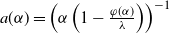 $a(\alpha)=\left(\alpha\left(1-\frac{\varphi(\alpha)}{\lambda}\right)\right)^{-1}$
, (30) becomes
$a(\alpha)=\left(\alpha\left(1-\frac{\varphi(\alpha)}{\lambda}\right)\right)^{-1}$
, (30) becomes
 \begin{equation} f(\alpha)=F'(\alpha)=\frac{F(\alpha)-\frac{\alpha^2}{2}b}{\alpha\left(1-\frac{\varphi(\alpha)}{\lambda}\right)} =a(\alpha)F(\alpha)-\frac{\alpha^2}{2}a(\alpha)b. \end{equation}
From this it immediately follows via L’Hôpital’s rule on the right-hand side and the fact that $\varphi(\alpha_\lambda)=\lambda$
, that
$\varphi(\alpha_\lambda)=\lambda$
, that
 \begin{equation} f(\alpha_\lambda)=\frac{f(\alpha_\lambda)-\alpha_\lambda b}{-\alpha_\lambda\frac{\varphi'(\alpha_\lambda)}{\lambda}}, \end{equation}
so that the case $\alpha=\alpha_\lambda$
in (37) is immediate.
$\alpha=\alpha_\lambda$
in (37) is immediate.
From (38) it now follows that, for $0<\alpha<\beta<\alpha_\lambda$
and for
$0<\alpha<\beta<\alpha_\lambda$
and for $\alpha_\lambda < \alpha < \beta$
,
$\alpha_\lambda < \alpha < \beta$
,
 \begin{equation}F(\beta){\mathrm{e}}^{-\int_\alpha^\beta a(y)\,{\mathrm{d}} y}=F(\alpha)-b\int_\alpha^\beta \frac{x^2}{2}a(x){\mathrm{e}}^{-\int_\alpha^xa(y)\,{\mathrm{d}} y}\,{\mathrm{d}} x.\end{equation}
Integration by parts gives
 \begin{equation}\int_\alpha^\beta \frac{x^2}{2}a(x){\mathrm{e}}^{-\int_\alpha^xa(y)\,{\mathrm{d}} y}\,{\mathrm{d}} x=\frac{\alpha^2}{2}-\frac{\beta^2}{2} {\mathrm{e}}^{-\int_\alpha^\beta a(y)\,{\mathrm{d}} y}+\int_\alpha^\beta x{\mathrm{e}}^{-\int_\alpha^x a(y)\,{\mathrm{d}} y}\,{\mathrm{d}} x.\end{equation}
Since for a sufficiently small neighborhood of $\alpha_\lambda$
we have that
$\alpha_\lambda$
we have that
 \begin{equation}\frac{\varphi(\alpha)-\lambda}{\alpha-\alpha_\lambda}\in (\varphi'(\alpha_\lambda)-\epsilon,\varphi'(\alpha_\lambda)+\epsilon),\end{equation}
where $0<\epsilon<\varphi'(\alpha_\lambda)$
and
$0<\epsilon<\varphi'(\alpha_\lambda)$
and $\varphi'(\alpha_\lambda)$
is finite and positive, then for every
$\varphi'(\alpha_\lambda)$
is finite and positive, then for every $\alpha\in (0,\alpha_\lambda)$
we necessarily have that
$\alpha\in (0,\alpha_\lambda)$
we necessarily have that $\int_\alpha^{\alpha_\lambda}a(x)\,{\mathrm{d}} x=\infty$
. Therefore, letting
$\int_\alpha^{\alpha_\lambda}a(x)\,{\mathrm{d}} x=\infty$
. Therefore, letting $\beta\uparrow\alpha_\lambda$
in (40), implies that
$\beta\uparrow\alpha_\lambda$
in (40), implies that
 \begin{equation}F(\alpha)=b\left( \frac{\alpha^2}{2}+\int_\alpha^{\alpha_\lambda}x{\mathrm{e}}^{-\int_\alpha^{x}a(y)\,{\mathrm{d}} y}\,{\mathrm{d}} x\right).\end{equation}
Differentiating both sides leads to
 \begin{equation}f(\alpha)= \mathrm{E}{\mathrm{e}}^{-\alpha Z^*}=b a(\alpha)\int_\alpha^{\alpha_\lambda}x{\mathrm{e}}^{-\int_\alpha^{x}a(y)\,{\mathrm{d}} y}\,{\mathrm{d}} x .\end{equation}
We now recall that $a(\alpha)=(\alpha (1-\varphi(\alpha)/\lambda))^{-1}$
and note that for
$a(\alpha)=(\alpha (1-\varphi(\alpha)/\lambda))^{-1}$
and note that for $\alpha < x < \alpha_\lambda$
we have that
$\alpha < x < \alpha_\lambda$
we have that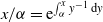 $x/\alpha={\mathrm{e}}^{\int_\alpha^x {y}^{-1}\,{\mathrm{d}} y}$
, implying that
$x/\alpha={\mathrm{e}}^{\int_\alpha^x {y}^{-1}\,{\mathrm{d}} y}$
, implying that
 \begin{equation}a(\alpha)x{\mathrm{e}}^{-\int_\alpha^x a(y)\,{\mathrm{d}} y}=\frac{1}{1-\frac{\varphi(\alpha)}{\lambda}}\, {\mathrm{e}}^{\int_\alpha^x \left(\frac{1}{y}-a(y)\right)\,{\mathrm{d}} y}=\frac{1}{1-\frac{\varphi(\alpha)}{\lambda}}\,{\mathrm{e}}^{-\int_\alpha^x \frac{\varphi(y)}{y(\lambda-\varphi(y))}\,{\mathrm{d}} y},\end{equation}
so that together with (44), the case $\alpha\in [0,\alpha_\lambda)$
in (37) follows.
$\alpha\in [0,\alpha_\lambda)$
in (37) follows.
Recalling, by assumption, that $\varphi'(0)=-\mathrm{E}X_1$
is finite then
$\varphi'(0)=-\mathrm{E}X_1$
is finite then $\int_0^x \frac{\varphi(y)}{y(\lambda-\varphi(y))}\,{\mathrm{d}} y$
is convergent for any
$\int_0^x \frac{\varphi(y)}{y(\lambda-\varphi(y))}\,{\mathrm{d}} y$
is convergent for any $x\in (0,\alpha_\lambda)$
so that, since
$x\in (0,\alpha_\lambda)$
so that, since $\varphi(\alpha)\to 0$
as
$\varphi(\alpha)\to 0$
as $\alpha\downarrow 0$
, we finally obtain (36).
$\alpha\downarrow 0$
, we finally obtain (36).
For the case $\alpha>\alpha_\lambda$
we observe that in (40) we can multiply both sides by
$\alpha>\alpha_\lambda$
we observe that in (40) we can multiply both sides by ${\mathrm{e}}^{\int_\alpha^\beta a(y)\,{\mathrm{d}} y}$
and note that for
${\mathrm{e}}^{\int_\alpha^\beta a(y)\,{\mathrm{d}} y}$
and note that for $y>\alpha_\lambda$
 \begin{equation} a(y)=\frac{1}{y\left(1-\frac{\varphi(y)}{\lambda}\right)}=-\frac{1}{y\left(\frac{\varphi(y)}{\lambda}-1\right)}.\end{equation}
The rest is a repetition of the proof for the case $\alpha\in[0,\alpha_\lambda)$
, where eventually we let
$\alpha\in[0,\alpha_\lambda)$
, where eventually we let $\alpha\downarrow \alpha_\lambda$
and replace
$\alpha\downarrow \alpha_\lambda$
and replace $\beta$
in the resulting expression by
$\beta$
in the resulting expression by $\alpha$
.
$\alpha$
.
We finally turn to $\mathrm{P}(Z^*=0)$
. Note that
$\mathrm{P}(Z^*=0)$
. Note that
 \begin{equation} \int_{\alpha_\lambda}^\alpha {\mathrm{e}}^{-\int_x^\alpha \frac{\varphi(y)}{y(\varphi(y)-\lambda)}\,{\mathrm{d}} y}\,{\mathrm{d}} x = \alpha\int_{\alpha_\lambda/\alpha}^1 {\mathrm{e}}^{-\int_x^1 \frac{\varphi(\alpha y)}{y(\varphi(\alpha y)-\lambda)}\,{\mathrm{d}} y}\,{\mathrm{d}} x,\end{equation}
and that by bounded convergence
 \begin{equation} \lim_{\alpha\to\infty}\int_{\alpha_\lambda/\alpha}^1 {\mathrm{e}}^{-\int_x^1 \frac{\varphi(\alpha y)}{y(\varphi(\alpha y)-\lambda)}\,{\mathrm{d}} y}\,{\mathrm{d}} x=\int_0^1{\mathrm{e}}^{-\int_x^1\frac{1}{y}\,{\mathrm{d}} y}\,{\mathrm{d}} x=\int_0^1x\,{\mathrm{d}} x=\frac{1}{2}. \end{equation}
Therefore,
 \begin{equation} \mathrm{P}(Z^*=0)=\frac{b}{2}\lim_{\alpha\to\infty}\frac{\alpha}{\frac{\varphi(\alpha)}{\lambda}-1}=\frac{\lambda b}{2}\,\lim_{\alpha\to\infty}\frac{\alpha}{\varphi(\alpha)}.\end{equation}
If our Lévy process is a subordinator minus a positive drift d then
 \begin{equation} \varphi(\alpha)=d\alpha-\int_{(0,\infty)}\left(1-{\mathrm{e}}^{-\alpha x}\right)\nu({\mathrm{d}} x)=\alpha\left(d-\int_0^\infty {\mathrm{e}}^{-\alpha x}\nu(x,\infty)\,{\mathrm{d}} x\right).\end{equation}
In this case the mean is finite if and only if $\int_0^\infty \nu(x,\infty)\,{\mathrm{d}} x=\int_{(0,\infty)}x\nu({\mathrm{d}} x)<\infty$
, in which case (bounded convergence)
$\int_0^\infty \nu(x,\infty)\,{\mathrm{d}} x=\int_{(0,\infty)}x\nu({\mathrm{d}} x)<\infty$
, in which case (bounded convergence) $\int_0^\infty {\mathrm{e}}^{-\alpha x}\nu(x,\infty)\,{\mathrm{d}} x$
vanishes, whence,
$\int_0^\infty {\mathrm{e}}^{-\alpha x}\nu(x,\infty)\,{\mathrm{d}} x$
vanishes, whence, $\varphi(\alpha)/\alpha\to d$
as
$\varphi(\alpha)/\alpha\to d$
as $\alpha\to\infty$
.
$\alpha\to\infty$
.
In all other cases (recalling that X is not a subordinator), that is, when there is a Brownian motion part or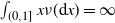 $\int_{(0,1]}x\nu({\mathrm{d}} x)=\infty$
(that is, an unbounded variation component) we have that
$\int_{(0,1]}x\nu({\mathrm{d}} x)=\infty$
(that is, an unbounded variation component) we have that $\varphi(\alpha)/\alpha\to \infty$
as
$\varphi(\alpha)/\alpha\to \infty$
as $\alpha\to\infty$
, hence the right-hand side of (49) is zero.
$\alpha\to\infty$
, hence the right-hand side of (49) is zero.
Remark 2. It is easy to check that for $\alpha\in[0,\alpha_\lambda)$
and with
$\alpha\in[0,\alpha_\lambda)$
and with
 \begin{equation} g(\alpha)\,:\!=\,\int_0^{\alpha} {\mathrm{e}}^{-\int_0^x \frac{\varphi(y)}{y(\lambda-\varphi(y))}\,{\mathrm{d}} y}\,{\mathrm{d}} x,\end{equation}
we have the following representation (when $U\sim\text{Uniform}(0,1)$
).
$U\sim\text{Uniform}(0,1)$
).
 \begin{align} f(\alpha)=\mathrm{E}{\mathrm{e}}^{-\alpha Z^*}=\frac{1-\frac{g(\alpha)}{g(\alpha_\lambda)}}{g'(\alpha)\left(1-\frac{\varphi(\alpha)}{\lambda}\right)}.\end{align}
Consequently, from (24) and (26) it follows that
 \begin{equation} \mathrm{E}{\mathrm{e}}^{-\alpha (Z^*U-L_\tau)^+}=\frac{1-\frac{g(\alpha)}{g(\alpha_\lambda)}}{g'(\alpha)\left(1-\frac{\alpha}{\alpha_\lambda}\right)}.\end{equation}
We complete this remark by emphasizing that $b=1/g(\alpha_\lambda)$
.
$b=1/g(\alpha_\lambda)$
.
Remark 3. The proof of Theorem 1 can be easily modified to allow the more general case of $U\sim\text{Beta}(\theta,1)$
. For b and the cases
$U\sim\text{Beta}(\theta,1)$
. For b and the cases $\alpha\in[0,\alpha_\lambda)$
and
$\alpha\in[0,\alpha_\lambda)$
and $\alpha\in(\alpha_\lambda,\infty)$
, the resulting expressions are the same as in (36) and (37), except that the integrals in the exponents are multiplied by
$\alpha\in(\alpha_\lambda,\infty)$
, the resulting expressions are the same as in (36) and (37), except that the integrals in the exponents are multiplied by $\theta$
. For the case
$\theta$
. For the case $\alpha=\alpha_\lambda$
,
$\alpha=\alpha_\lambda$
, $1/\alpha_\lambda$
in the denominator is replaced by
$1/\alpha_\lambda$
in the denominator is replaced by $\theta/\alpha_\lambda$
. The expression
$\theta/\alpha_\lambda$
. The expression $\mathrm{P}(Z^*=0)= {\lambda b}/{2d}$
for the case of a subordinator with a negative drift is replaced by
$\mathrm{P}(Z^*=0)= {\lambda b}/{2d}$
for the case of a subordinator with a negative drift is replaced by ${\lambda b}/{((1+\theta)\mathrm{d})}$
. One may also apply the same ideas to handle a mixture of a
${\lambda b}/{((1+\theta)\mathrm{d})}$
. One may also apply the same ideas to handle a mixture of a $\text{Beta}(\theta,1)$
distribution and an atom at zero (clearing). For the sake of brevity we refrain from working out these exercises here.
$\text{Beta}(\theta,1)$
distribution and an atom at zero (clearing). For the sake of brevity we refrain from working out these exercises here.
Remark 4. Regarding Remark 3, we mention in passing that if we consider an on/off process with $\exp(\lambda)$
distributed on times and
$\exp(\lambda)$
distributed on times and $\exp(\eta)$
distributed off times, where during on times the process behaves like a reflected Lévy process and during off times the process is a deterministic linear dam with release rate
$\exp(\eta)$
distributed off times, where during on times the process behaves like a reflected Lévy process and during off times the process is a deterministic linear dam with release rate $r>0$
(decreases at rate rx where x is a current state) then this process restricted to on times is the process Z and, hence, has the steady-state distribution of
$r>0$
(decreases at rate rx where x is a current state) then this process restricted to on times is the process Z and, hence, has the steady-state distribution of $Z^*$
with
$Z^*$
with $U\sim\text{Beta}(r/\eta,1)$
. Furthermore, by PASTA, the steady-state distribution of the process restricted to off times is the distribution of
$U\sim\text{Beta}(r/\eta,1)$
. Furthermore, by PASTA, the steady-state distribution of the process restricted to off times is the distribution of $Z^*U$
, the LST of which may be deduced from (30). Therefore, the steady-state distribution of the on/off process is a
$Z^*U$
, the LST of which may be deduced from (30). Therefore, the steady-state distribution of the on/off process is a $\left({\eta}/({\lambda+\eta}), {\lambda}/({\lambda+\eta})\right)$
mixture of the distributions of
$\left({\eta}/({\lambda+\eta}), {\lambda}/({\lambda+\eta})\right)$
mixture of the distributions of $Z^*$
and
$Z^*$
and $Z^*U$
. Thus, our analysis covers this case as well.
$Z^*U$
. Thus, our analysis covers this case as well.
6. Examples and Tail Behavior
In this section we work out the LST of $Z^*$
, and hence of Z, for the two cases of reflected Brownian motion with collapse (Section 6.1) and the
$Z^*$
, and hence of Z, for the two cases of reflected Brownian motion with collapse (Section 6.1) and the $M/M/1$
queue with collapse (Section 6.2). In both cases, collapses occur according to a Poisson process with rate
$M/M/1$
queue with collapse (Section 6.2). In both cases, collapses occur according to a Poisson process with rate $\lambda$
, and instantaneously remove a Uniform(0,1) distributed fraction of the workload present. In these two examples we use the notation g and the expression for f from Remark 2. We conclude in Section 6.3 with a discussion about the tail behavior of
$\lambda$
, and instantaneously remove a Uniform(0,1) distributed fraction of the workload present. In these two examples we use the notation g and the expression for f from Remark 2. We conclude in Section 6.3 with a discussion about the tail behavior of $Z^*$
for the compound Poisson case with a negative drift.
$Z^*$
for the compound Poisson case with a negative drift.
6.1. Reflected Brownian motion with collapse
The Laplace exponent of Brownian motion with drift c is given by (cf. (25))
 \begin{equation}\varphi(\alpha) = -c\alpha + \frac{\sigma^2}{2} \alpha^2 .\end{equation}
In order to obtain the LST $f(\alpha)$
of the steady-state level of the reflected Brownian motion with collapses, we need to determine
$f(\alpha)$
of the steady-state level of the reflected Brownian motion with collapses, we need to determine $g(\alpha)$
and its derivative, which feature in (52). First write
$g(\alpha)$
and its derivative, which feature in (52). First write
 \begin{equation} - \frac{\varphi(y)}{y(\lambda - \varphi(y))} = \frac{c - \frac{\sigma^2}{2} y}{\lambda +cy - \frac{\sigma^2}{2} y^2} = \frac{y-\frac{2c}{\sigma^2}}{(y-y_1)(y-y_2)} , \end{equation}
where
 \begin{equation} y_{1,2} = \frac{c}{\sigma^2} \pm \sqrt{\frac{c^2}{\sigma^4} + \frac{2\lambda}{\sigma^2}} . \end{equation}
It is easily verified that $y_1>0$
and
$y_1>0$
and $y_2<0$
, with
$y_2<0$
, with $y_1y_2 = -({2\lambda}/{\sigma^2})$
and
$y_1y_2 = -({2\lambda}/{\sigma^2})$
and $y_1+y_2 = {2c}/{\sigma^2}$
; and of course
$y_1+y_2 = {2c}/{\sigma^2}$
; and of course $y_1 = \alpha_\lambda$
, the unique positive zero of
$y_1 = \alpha_\lambda$
, the unique positive zero of $\lambda - \varphi(\alpha)$
.
$\lambda - \varphi(\alpha)$
.
Using a partial fraction expansion, we can rewrite (55) as follows:
 \begin{equation} - \frac{\varphi(y)}{y(\lambda-\varphi(y))} \,=\, \frac{D_1}{y-y_1} + \frac{D_2}{y-y_2} , \end{equation}
where
 \begin{equation} D_1 = \frac{-y_2}{y_1-y_2} > 0, \quad D_2 = \frac{y_1}{y_1-y_2} > 0. \end{equation}
It is now easily verified that
 \begin{equation} g(\alpha) =\int_0^\alpha \left(\frac{x-y_1}{-y_1}\right)^{D_1} \left(\frac{x-y_2}{-y_2}\right)^{D_2} \,{\mathrm{d}} x , \end{equation}
and, hence,
 \begin{equation} \frac{g(\alpha)}{g(\alpha_\lambda)} = \frac{g(\alpha)}{g(y_1)} = \frac{\int_0^\alpha (x-y_1)^{D_1} (x-y_2)^{D_2} \,{\mathrm{d}} x}{\int_0^{y_1} (x-y_1)^{D_1} (x-y_2)^{D_2} \,{\mathrm{d}} x} , \end{equation}
while
 \begin{equation} g'(\alpha) = \left(\frac{\alpha -y_1}{-y_1}\right)^{D_1} \left(\frac{\alpha -y_2}{-y_2}\right)^{D_2} . \end{equation}
Substitution in (52) shows that the LST of the steady-state level of our reflected Brownian motion with collapse is, for $\alpha \in [0,y_1)$
, given by
$\alpha \in [0,y_1)$
, given by
 \begin{align} f(\alpha) &= \frac{y_1y_2}{(\alpha-y_1)(\alpha-y_2)} \left(\frac{\alpha -y_1}{-y_1}\right)^{-D_1} \left(\frac{\alpha -y_2}{-y_2}\right)^{-D_2} \nonumber \\ \nonumber\\ &\qquad \times \left(1 - \frac{\int_0^\alpha (x-y_1)^{D_1} (x-y_2)^{D_2} \,{\mathrm{d}} x}{\int_0^{y_1} (x-y_1)^{D_1} (x-y_2)^{D_2} \,{\mathrm{d}} x} \right) \\ \nonumber\\ &= \left(\frac{y_1}{y_1 - \alpha}\right)^{1+D_1} \left(\frac{-y_2}{-y_2 + \alpha}\right)^{1+D_2} \left(1 -\frac{\int_0^\alpha (x-y_1)^{D_1} (x-y_2)^{D_2} \,{\mathrm{d}} x}{\int_0^{y_1} (x-y_1)^{D_1} (x-y_2)^{D_2} \,{\mathrm{d}} x} \right) . \nonumber \end{align}
Note that the first two terms in the last line of (62) represent the LST of the difference of two independent Gamma distributed random variables.
Remark 5. It should be observed that $g(\alpha)$
can be expressed in incomplete beta functions. The incomplete beta function
$g(\alpha)$
can be expressed in incomplete beta functions. The incomplete beta function $B(z;\,a_1,a_2)$
is defined as (e.g. [Reference Abramowitz and Stegun1, p.263])
$B(z;\,a_1,a_2)$
is defined as (e.g. [Reference Abramowitz and Stegun1, p.263])
 \begin{equation} B(z;\,a_1,a_2) \,:\!=\, \int_0^z t^{a_1-1} (1-t)^{a_2-1} \,{\mathrm{d}} t ; \end{equation}
it can also be expressed as a hypergeometric function via the identity
 \begin{equation} B(z;\,a_1,a_2) = \frac{z^{a_1}}{a_1} {}_2F_1(a_1,1-a_2;\,a_1+1;\,z) . \end{equation}
The transformation $t\,:\!=\, ({x-y_2})/({y_1-y_2})$
gives
$t\,:\!=\, ({x-y_2})/({y_1-y_2})$
gives
 \begin{eqnarray} && \int_0^\alpha (x-y_1)^{D_1} (x-y_2)^{D_2} \,{\mathrm{d}} x = ({-}1)^{D_1} (y_1-y_2)^{D_1+D_2+1} \,\int_{\frac{-y_2}{y_1-y_2}}^{\frac{\alpha-y_2}{y_1-y_2}} t^{D_2}(1-t)^{D_1} \,{\mathrm{d}} t \nonumber\\&=& ({-}1)^{D_1} (y_1-y_2)^2 \left[B\left(\frac{\alpha-y_2}{y_1-y_2};\,1+D_2,1+D_1\right) - B\left(\frac{-y_2}{y_1-y_2};\,1+D_2,1+D_1\right) \right]. \nonumber\\ \end{eqnarray}
6.2. The
$M/M/1$
queue with collapse

A second example in which one can explicitly determine the LST of the steady-state reflected spectrally positive Lévy process with collapse concerns the workload in an $M/M/1$
queue with collapse. Denote the arrival rate of customers by
$M/M/1$
queue with collapse. Denote the arrival rate of customers by $\gamma$
and the service rate by
$\gamma$
and the service rate by $\mu$
; the server works at speed d workload units per time unit. Collapses again occur according to a Poisson process with rate
$\mu$
; the server works at speed d workload units per time unit. Collapses again occur according to a Poisson process with rate $\lambda$
, and remove (and maintain) a Uniform(0,1) distributed part of the workload present.
$\lambda$
, and remove (and maintain) a Uniform(0,1) distributed part of the workload present.
The Laplace exponent of the workload process in an $M/M/1$
queue is given by
$M/M/1$
queue is given by
 \begin{equation} \varphi(\alpha) = d \alpha - \gamma \frac{\alpha}{\mu+\alpha} . \end{equation}
Very similar to the previous subsection, we can write
 \begin{equation} - \frac{\varphi(y)}{y(\lambda - \varphi(y))} =\frac{y+\mu - \frac{\gamma}{d}}{(y-z_1)(y-z_2)},\end{equation}
where
 \begin{equation} z_{1,2} = \frac{1}{2} \left[ \frac{\lambda+\gamma}{d} - \mu \pm \sqrt{\left(\frac{\lambda+\gamma}{d}-\mu\right)^2 + 4 \frac{\lambda\mu}{d} } \right].\end{equation}
It is easily verified that $z_1>0$
and
$z_1>0$
and $z_2<0$
, with
$z_2<0$
, with $z_1z_2 = - ({\lambda \mu}/{d})$
and
$z_1z_2 = - ({\lambda \mu}/{d})$
and $z_1+z_2= ({\lambda+\gamma})/{d}-\mu$
; and of course
$z_1+z_2= ({\lambda+\gamma})/{d}-\mu$
; and of course $z_1=\alpha_\lambda$
, the unique positive zero of
$z_1=\alpha_\lambda$
, the unique positive zero of $\lambda - \varphi(\alpha)$
.
$\lambda - \varphi(\alpha)$
.
Using a partial fraction expansion, we can rewrite (67) as follows:
 \begin{equation} - \frac{\varphi(y)}{y(\lambda - \varphi(y))} =\frac{F_1}{y-z_1} + \frac{F_2}{y-z_2},\end{equation}
where
 \begin{equation} F_1 = \frac{\frac{\lambda}{d}-z_2}{z_1-z_2} > 0, \quad F_2 = \frac{z_1 - \frac{\lambda}{d}}{z_1-z_2} >0.\end{equation}
It is now easily verified that
 \begin{equation} g(\alpha) = \int_0^\alpha \left(\frac{x-z_1}{-z_1}\right)^{F_1} \left(\frac{x-z_2}{-z_2}\right)^{F_2} \,{\mathrm{d}} x , \end{equation}
and, hence,
 \begin{equation} \frac{g(\alpha)}{g(\alpha_\lambda)} = \frac{g(\alpha)}{g(z_1)} = \frac{\int_0^\alpha (x-z_1)^{F_1} (x-z_2)^{F_2} \,{\mathrm{d}} x}{\int_0^{z_1} (x-z_1)^{F_1} (x-z_2)^{F_2} \,{\mathrm{d}} x} , \end{equation}
while
 \begin{equation} g'(\alpha) = \left(\frac{\alpha -z_1}{-z_1}\right)^{F_1} \left(\frac{\alpha -z_2}{-z_2}\right)^{F_2} . \end{equation}
Substitution in (52) shows that the LST of the steady-state workload in the $M/M/1$
queue with collapse is, for
$M/M/1$
queue with collapse is, for $\alpha \in [0,z_1)$
, given by
$\alpha \in [0,z_1)$
, given by
 \begin{align} f(\alpha) &= \frac{z_1z_2}{(\alpha-z_1)(\alpha-z_2)} \left(\frac{\alpha -z_1}{-z_1}\right)^{-F_1} \left(\frac{\alpha -z_2}{-z_2}\right)^{-F_2} \nonumber \\ \nonumber \\ &\qquad\times \,\left(1 - \frac{\int_0^\alpha (x-z_1)^{F_1} (x-z_2)^{F_2} \,{\mathrm{d}} x}{\int_0^{z_1} (x-z_1)^{F_1} (x-z_2)^{F_2} \,{\mathrm{d}} x} \right) \\ \nonumber\\ &= \left(\frac{z_1}{z_1 - \alpha}\right)^{1+F_1} \left(\frac{-z_2}{-z_2 + \alpha}\right)^{1+F_2} \left(1 -\frac{\int_0^\alpha (x-z_1)^{F_1} (x-z_2)^{F_2} \,{\mathrm{d}} x}{\int_0^{z_1} (x-z_1)^{F_1} (x-z_2)^{F_2} \,{\mathrm{d}} x} \right) . \nonumber \end{align}
Just as in Remark 5, one can express this LST in terms of incomplete beta functions. Furthermore, the first two terms in the last line of (74) represent the LST of the difference of two independent Gamma distributed random variables.
Remark 6. We briefly indicate another approach that basically leads to the same first-order inhomogeneous differential equation as (38). The steady-state workload distribution has an atom $p_0$
at zero and conjecture that it is absolutely continuous on
$p_0$
at zero and conjecture that it is absolutely continuous on $(0,\infty)$
with density
$(0,\infty)$
with density $h({\cdot})$
, so that
$h({\cdot})$
, so that $\mathrm{P}(Z^*\le t)=p_0+\int_0^t h(s)\,{\mathrm{d}} s$
. Level crossing arguments lead to the following equation:
$\mathrm{P}(Z^*\le t)=p_0+\int_0^t h(s)\,{\mathrm{d}} s$
. Level crossing arguments lead to the following equation:
 \begin{equation}d h(x)+ \lambda \int_x^\infty h(y) \frac{x}{y}\,{\mathrm{d}} y= \gamma \int_0^x {\mathrm{e}}^{-\mu(x-y)}\,{\mathrm{d}} \mathrm{P}(Z^* < y) .\end{equation}
Here the first term in the left-hand side corresponds to downcrossings of level x due to serving, and the second term in the left-hand side reflects downward jumps due to a uniform collapse with rate $\lambda$
. The term in the right-hand side corresponds to a jump through level x due to a customer arrival: either a jump from zero or from some level
$\lambda$
. The term in the right-hand side corresponds to a jump through level x due to a customer arrival: either a jump from zero or from some level $y \in (0,x)$
. Multiplying both sides of (75) by
$y \in (0,x)$
. Multiplying both sides of (75) by ${\mathrm{e}}^{-\alpha x}$
and integrating from zero to infinity yields, with
${\mathrm{e}}^{-\alpha x}$
and integrating from zero to infinity yields, with $f(\alpha) = \mathrm{E}{\mathrm{e}}^{-\alpha Z^*} = p_0 + \int_0^\infty {\mathrm{e}}^{-\alpha x} h(x) \,{\mathrm{d}} x$
:
$f(\alpha) = \mathrm{E}{\mathrm{e}}^{-\alpha Z^*} = p_0 + \int_0^\infty {\mathrm{e}}^{-\alpha x} h(x) \,{\mathrm{d}} x$
:
 \begin{equation}d (f(\alpha) -p_0) + \lambda \int_{y=0}^\infty \frac{h(y)}{y} \int_{x=0}^y x {\mathrm{e}}^{-\alpha x} \,{\mathrm{d}} x \,{\mathrm{d}} y = \frac{\gamma}{\mu+\alpha} f(\alpha) .\end{equation}
The second term in the left-hand side can be rewritten as
 \begin{align} \lambda \int_{y=0}^\infty h(y)\, \frac{1 - {\mathrm{e}}^{-\alpha y} -\alpha y {\mathrm{e}}^{-\alpha y}}{\alpha^2 y} \,{\mathrm{d}} y &= \frac{\lambda}{\alpha^2} \int_{u=0}^\alpha (f(u)-p_0) \,{\mathrm{d}} u - \lambda\, \frac{f(\alpha)-p_0}{\alpha}\nonumber\\ &= \frac{\lambda}{\alpha^2} F(\alpha) - \frac{\lambda}{\alpha} f(\alpha) ,\end{align}
where $F(\alpha) = \int_0^\alpha f(x) \,{\mathrm{d}} x$
, cf. above (38), and, hence, we have
$F(\alpha) = \int_0^\alpha f(x) \,{\mathrm{d}} x$
, cf. above (38), and, hence, we have
 \begin{equation} F'(\alpha) \left(\frac{\lambda}{\alpha} -d + \frac{\gamma}{\mu+\alpha}\right) = \frac{\lambda}{\alpha^2} F(\alpha) - d p_0 . \end{equation}
Dividing both sides by ${\lambda}/{\alpha} -d + {\gamma}/({\mu+\alpha})$
results in (38), with
${\lambda}/{\alpha} -d + {\gamma}/({\mu+\alpha})$
results in (38), with $b=2dp_0/\lambda$
; which is in agreement with Theorem 1.
$b=2dp_0/\lambda$
; which is in agreement with Theorem 1.
6.3. Tail behavior for compound Poisson with negative drift
Consider the special case in which the spectrally positive Lévy process consists of a compound Poisson process minus a positive drift. We denote the arrival rate of the Poisson jumps by $\gamma$
, and a generic jump size by B, with distribution
$\gamma$
, and a generic jump size by B, with distribution $B({\cdot})$
and LST
$B({\cdot})$
and LST $\beta({\cdot})$
; the drift is denoted by d. The resulting model is an
$\beta({\cdot})$
; the drift is denoted by d. The resulting model is an $M/G/1$
queue with arrival rate
$M/G/1$
queue with arrival rate $\gamma$
, generic service requirement B, service speed d, and uniformly distributed collapses occurring according to a Poisson process with rate
$\gamma$
, generic service requirement B, service speed d, and uniformly distributed collapses occurring according to a Poisson process with rate $\lambda$
.
$\lambda$
. $Z^*$
represents the steady-state workload of this queue; its LST is for
$Z^*$
represents the steady-state workload of this queue; its LST is for $\alpha \in [0,\alpha_\lambda)$
given by (52), with
$\alpha \in [0,\alpha_\lambda)$
given by (52), with $\varphi(\alpha) = d\alpha - \gamma(1-\beta(\alpha))$
.
$\varphi(\alpha) = d\alpha - \gamma(1-\beta(\alpha))$
.
We now demonstrate how (52) can be used to determine the tail behavior $\mathrm{P}(Z^* > t)$
for large t, in the case of regularly varying jump sizes of index
$\mathrm{P}(Z^* > t)$
for large t, in the case of regularly varying jump sizes of index $-\delta \in ({-}2,-1)$
. In this case, the mean service requirement is finite but the variance is infinite. The Bingham–Doney lemma (cf. [Reference Bingham, Goldie and Teugels5, Theorem 8.1.6]) states that the following two statements are equivalent:
$-\delta \in ({-}2,-1)$
. In this case, the mean service requirement is finite but the variance is infinite. The Bingham–Doney lemma (cf. [Reference Bingham, Goldie and Teugels5, Theorem 8.1.6]) states that the following two statements are equivalent:
-
(i)
$\mathrm{P}(B>t) \approx ({-1}/{\Gamma(1-\delta)}) t^{-\delta} l(t)$
, as
$t \rightarrow \infty$
; -
(ii)
$\beta(\alpha) -1 +\mathrm{E}B \alpha \approx \alpha^{\delta} l(1/\alpha)$
, as
$\alpha \downarrow 0$
.




Here $l({\cdot})$
is a slowly varying function at infinity. If (i) holds, and hence so does (ii), then we have, for
$l({\cdot})$
is a slowly varying function at infinity. If (i) holds, and hence so does (ii), then we have, for $\alpha \downarrow 0$
,
$\alpha \downarrow 0$
,
 \begin{align} \frac{\lambda}{\lambda - \varphi(\alpha)} - 1 - (d-\gamma \mathrm{E}B)\alpha \approx \frac{\gamma}{\lambda} \alpha^{\delta} l(1/\alpha) , \\[-28pt] \nonumber \end{align}
 \begin{align} \int_0^\alpha \frac{\varphi(y)}{y(\lambda - \varphi(y))} \,{\mathrm{d}} y - \frac{d-\gamma \mathrm{E}B}{\lambda} \alpha \approx \frac{\gamma}{\delta \lambda} \alpha^{\delta} l(1/\alpha), \\[0pt] \nonumber \end{align}
and, hence, recalling Remark 2, for $\alpha \downarrow 0$
,
$\alpha \downarrow 0$
,
 \begin{align} g'(\alpha) -1 + \frac{d-\gamma \mathrm{E}B}{\lambda} \alpha \approx - \frac{\gamma}{\delta \lambda} \alpha^{\delta}, \\[-28pt] \nonumber \end{align}
 \begin{align} g(\alpha) - \alpha \approx - \frac{d - \gamma \mathrm{E}B}{2 \lambda} \alpha^2 . \\[0pt] \nonumber \end{align}
Combining these asymptotic expansions with (52) shows that
 \begin{equation}\mathrm{E}{\mathrm{e}}^{-\alpha Z^*} - 1 + \left(\frac{1}{g(\alpha_\lambda)} -2 \frac{d - \gamma \mathrm{E}B}{\lambda} \right) \alpha \approx \frac{\gamma}{\lambda} \frac{\delta+1}{\delta} \alpha^{\delta} l(1/\alpha), \quad \alpha \downarrow 0. \end{equation}
Now observe, using (34), that ${g(\alpha_\lambda)}^{-1} - 2 ({d-\gamma \mathrm{E}B})/{\lambda}$
equals
${g(\alpha_\lambda)}^{-1} - 2 ({d-\gamma \mathrm{E}B})/{\lambda}$
equals $\mathrm{E}Z^*$
. Indeed,
$\mathrm{E}Z^*$
. Indeed, ${g(\alpha_\lambda)}^{-1} = b$
, and on the other hand the term
${g(\alpha_\lambda)}^{-1} = b$
, and on the other hand the term $({1-\mathrm{E}U})^{-1} ({\mathrm{E}f(\alpha_\lambda U)}/{\alpha_\lambda})$
in (34) can be rewritten in the Uniform(0, 1) case as
$({1-\mathrm{E}U})^{-1} ({\mathrm{E}f(\alpha_\lambda U)}/{\alpha_\lambda})$
in (34) can be rewritten in the Uniform(0, 1) case as $({2}/{\alpha_\lambda^2}) \int_0^{\alpha_\lambda} f(y) \,{\mathrm{d}} y = ({2}/{\alpha_\lambda^2}) F(\alpha_\lambda)$
, which equals b (see the text preceding (38)). Hence, we have
$({2}/{\alpha_\lambda^2}) \int_0^{\alpha_\lambda} f(y) \,{\mathrm{d}} y = ({2}/{\alpha_\lambda^2}) F(\alpha_\lambda)$
, which equals b (see the text preceding (38)). Hence, we have
 \begin{equation} \mathrm{E}{\mathrm{e}}^{-\alpha Z^*} - 1 + \mathrm{E}Z^* \alpha \approx \frac{\gamma}{\lambda} \frac{\delta+1}{\delta} \alpha^{\delta} l(1/\alpha), \quad \alpha \downarrow 0. \end{equation}
Applying the Bingham–Doney lemma in the reverse direction reveals that
 \begin{equation} \mathrm{P}(Z^*>t) \approx \frac{-1}{\Gamma(1-\delta)} \frac{\gamma}{\lambda} \frac{\delta+1}{\delta} t^{-\delta} l(t), \quad t \rightarrow \infty . \end{equation}
In an ordinary $M/G/1$
queue with regularly varying service requirements, the workload tail is one degree heavier than the tail of the service requirement, whereas in this
$M/G/1$
queue with regularly varying service requirements, the workload tail is one degree heavier than the tail of the service requirement, whereas in this $M/G/1$
queue with uniform collapses,
$M/G/1$
queue with uniform collapses, $Z^*$
is regularly varying of index
$Z^*$
is regularly varying of index $-\delta$
, just as B :
$-\delta$
, just as B : $\mathrm{P}(Z^*>t) \approx ({\gamma}/{\lambda}) (({\delta+1})/{\delta}) \mathrm{P}(B>t)$
. In the
$\mathrm{P}(Z^*>t) \approx ({\gamma}/{\lambda}) (({\delta+1})/{\delta}) \mathrm{P}(B>t)$
. In the $M/G/1$
shot-noise queue (an
$M/G/1$
shot-noise queue (an $M/G/1$
queue with service speed proportional to the workload) the same phenomenon was observed in [Reference Boxma and Mandjes9]. This is not so surprising, as uniform collapses can also be seen as proportional (shot-noise) decrements during an exponentially distributed amount of time.
$M/G/1$
queue with service speed proportional to the workload) the same phenomenon was observed in [Reference Boxma and Mandjes9]. This is not so surprising, as uniform collapses can also be seen as proportional (shot-noise) decrements during an exponentially distributed amount of time.
Funding information
OB was partially funded by the NWO Gravitation project Networks, grant number 024.002.003. OK was partially supported by ISF grant 3336/24 and the Vigevani Chair in Statistics. DP was partially supported by ISF grant 3336/24.
Competing interests
There were no competing interests to declare which arose during the preparation or publication process of this article.

 Open access

