




1. The Anthropocene calls for unprecedented collaboration
The age of the Anthropocene had led us to surpass planetary and social boundaries and place societies in a position where urgent changes are required (Rockström et al., Reference Rockström, Gupta, Qin, Lade, Abrams, Andersen, Armstrong McKay, Bai, Bala, Bunn, Ciobanu, DeClerck, Ebi, Gifford, Gordon, Hasan, Kanie, Lenton, Loriani and Zhang2023). Scientific concerns range from developing improved monitoring of biogeochemical cycles and their feedback across biophysical systems to ways of connecting them to modeling and data analysis. Pressing questions also center around different governance systems and their effectiveness, legitimacy, and justice in the light of necessary societal transformations (Gupta et al., Reference Gupta, Liverman, Bai, Gordon, Hurlbert, Inoue, Jacobson, Kanie, Lenton, Obura, Otto, Okereke, Pereira, Prodani, Rammelt, Scholtens, Tàbara, Verburg, Gifford and Ciobanu2021; Scoones et al., Reference Scoones, Stirling, Abrol, Atela, Charli-Joseph, Eakin, Ely, Olsson, Pereira, Priya, van Zwanenberg and Yang2020). Increasingly, efforts are pointing toward a need to move away from building theory around the planetary crisis to applied action orientation that contributes to theory-building but does not make that its main or singular aim (Williams & Whiteman, Reference Williams and Whiteman2021). Yet, many of today's organizations remain disciplinary and sector focused (Harris et al., Reference Harris, Lyon, Sioen and Ebi2024), hampering transformations for sustainable resilient development (IPCC WGII Ch. 18, 2023) as well as research that cuts across these boundaries. Increasingly researchers are calling for connecting the biophysical and the socio-cultural with interdisciplinary and transdisciplinary approaches (Lawrence et al., Reference Lawrence, Williams, Nanz and Renn2022).
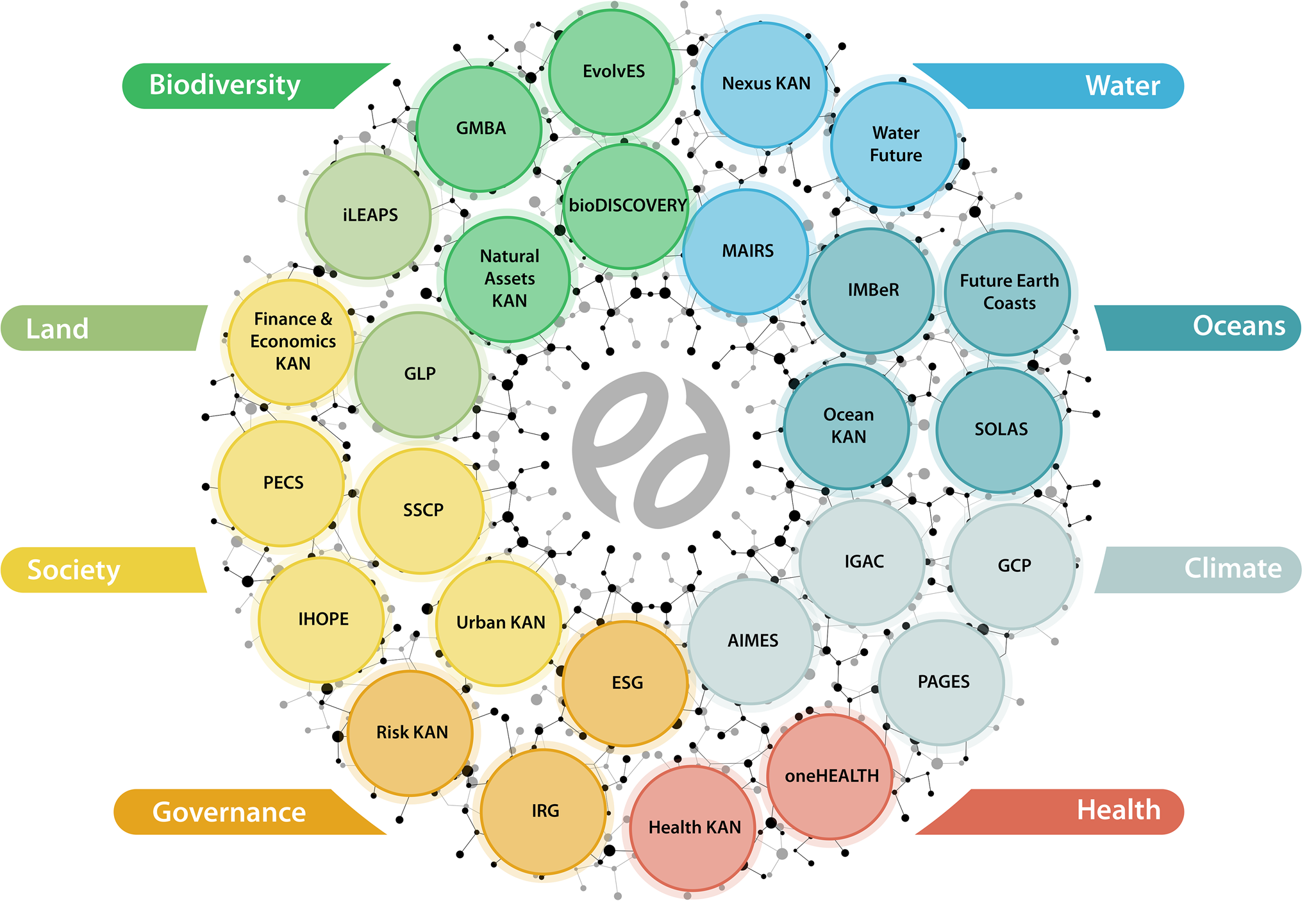
Future Earth focuses on opportunities, as well as tensions for research and changemaking. The exploration in this Special Collection included developing cross-cutting, interdisciplinary questions regarding new methods of data collection and analysis critical to understanding socio-economic and environmental dynamics and interactions. Future Earth convenes researchers, scientists, and scholars from all parts of the world, across different societal and academic sectors, and across the natural and social sciences and humanities. This allows the organization to represent the broad voice of researchers and innovators around the world. The organization is a consolidation of the former renown International Geosphere–Biosphere Programme (IGBP), International Human Dimensions Programme (IHDP), Diversitas (a program that focused on biodiversity science for human well-being), and a partnership initiative called The Earth System Science Partnership (ESSP), which included among those listed above the World Climate Research Programme (WCRP). Future Earth has been facilitating and bridging disciplinary knowledge across the topic-based networks of these former organizations (Global Research Projects) and newly developed networks by Future Earth (Knowledge-Action Networks) since 2015, when it formally established its secretariat. These networks have since 2022 collectively been called Global Research Networks (Figure 1) and consist of diverse groups of researchers, innovators, and other stakeholders.
Illustration of Future Earth's Global Research Networks and a selection of diverse thematic areas they encompass (as of September 2024). Each Global Research Network (full names in Supplementary material Table S1) has its own governance and resources which they utilize to advance research and innovation on both their prioritized topics and a broader set of shared efforts within the Future Earth network. The Global Research Networks are interconnected with support by the Global Secretariat. Further purpose-driven connections are with regional committees, and national or local committees.
From its inception, Future Earth has sought to advance and answer basic scientific questions regarding global environmental change. It has championed the convergence of natural and social sciences with the humanities and is committed to fortifying the nexus between science and policy via transdisciplinary methodologies (Smith et al., Reference Smith, Cook, Sokona, Elmqvist, Fukushi, Broadgate and Jarzebski2018). Future Earth benefits from its global distribution and diversity, allowing integrated advancements beyond institutional- and country-specific priorities (e.g. see expert report that informs Horizon Europe's funding priorities (DG RTD European Commission, Reference Edwards, Juhola, Saxena, Balag'kutu, Bastos, Capon, DeClerck, DeWitt, Niamir, Roco, Sioen and Ungvari2024)), with members in its expansive networks actively working on critical issues within the domain of sustainability science. This involves discerning the imminent global changes and exploring how societies can respond effectively.
In its present form, with a governance structure and an agenda co-designed by its wide network of researchers and innovators, Future Earth is well positioned to tackle interdisciplinary and transdisciplinary questions thanks to its design as ‘a global initiative focused on advancing sustainability science’. Future Earth envisions ‘a sustainable and equitable world for all, where societal decisions are informed by openly accessible and shared knowledge’ with a mission to ‘advance research in support of transformations to global sustainability’. The integrated scientific advances by Future Earth are in a crucial position to support high level policy fora and processes. Reflecting its magnitude, the Future Earth community collectively generated 1229 publications during the fiscal year 2022 (April 2022–March 2023). This comprehensive output encompasses peer-reviewed articles, non-peer-reviewed works, conference proceedings, books, among others, all contributing to the organization's unified vision and mission (Future Earth, 2023).
Future Earth also makes the whole greater than the sum of its parts. One example of an integrated science–policy initiative is the annual 10 New Insights in Climate Science report. Together with The Earth League and WCRP, the 10 most important new findings from science of the year have been identified through a consultation with the research community. Then, a diverse and expert editorial board helps to cluster and distill the 10 most important scientific advancements. We invite authors from key studies to write a synthesis review on each insight. First, this work is peer-reviewed and published in a journal (see Bustamante et al., Reference Bustamante, Roy, Ospina, Achakulwisut, Aggarwal, Bastos, Broadgate, Canadell, Carr, Chen, Cleugh, Ebi, Edwards, Farbotko, Fernández-Martínez, Frölicher, Fuss, Geden, Gruber and Zscheischler2023). Next, a science–policy report (see Future Earth et al., 2023) is derived from it with accessible figures, language, and illustrative case studies. The report also contains implications relevant for negotiators at the United Nations Framework Convention on Climate Change Conference of the Parties (UNFCCC COP) to work with. The report is launched and shared to directly inform the decision makers of the latest relevant science.
2. Charting the course
Several contributions in the Special Collection expand the frontiers of scientific understanding and point toward the directions we aim to pursue tomorrow. These efforts have the potential to propel novel scientific advancements in sustainability science and influence the trajectory of funding allocations and policymaking. Overall, the Special Collection gathers manuscripts on state-of-the-art knowledge and a forward-looking view on the most pressing interdisciplinary and transdisciplinary sustainability research questions for the next decade. A description of how the Special Collection was designed and the themes solicited can be found in Supplementary material S2: Democratic Development of the Special Collection.
The contributions highlight the expertise within Future Earth, covering natural and social systems and the interactions between them (Supplementary material S3: Who contributed?). They also take a critical look at the methodologies and practices of sustainability science. Based on the contributions, we identify four themes in this Special Collection. First, the Evolutionary and Ecological Processes theme brings together papers that focus on the dynamics of change within natural systems, stressing the need to further understand feedback between biogeophysical systems. Second, the Governance and Policy theme highlights the challenges embedded in social systems when identifying solutions for a more sustainable future. The third theme Land Use and Climate Change illustrates the linkages between the natural and social systems, demonstrating the need to bridge across sciences to gain a comprehensive and an integrated understanding of systems interactions. The fourth theme, Interdisciplinary and Transdisciplinary Research, discusses the need to critically reflect on the challenges of engaging in new ways of doing science and the ways it may contribute to advancing sustainability.
2.1 Evolutionary and ecological processes
The work highlighted here discusses the importance of understanding evolutionary changes, in particular for adaptation to environmental change. Vázquez-Domínguez et al. (Reference Vázquez-Domínguez, Kassen, Schroer, De Meester and Johnson2024) describe examples of contemporary, rapid evolutionary changes of concern for sustainability. They also consider how urban development accelerates evolutionary processes such as altered phenotypic and physiological changes and the spread of infectious and zoonotic diseases. The authors concluded with a need for stronger collaboration between evolutionary biologists and the sustainability community (e.g. in the context of health). Edwards et al. (Reference Edwards, Nelson, Le Clec'h, Luu, Coast, Futakuchi and Kok2024) bring forward research priorities for sustainable rice systems by 2050. They conduct a horizon beyond the conventional disciplinary focus of food production, incorporating preservation of natural capital and ensuring sustainable food security. Expanding the focus enables them to consider broader sustainability issues related to rice production now and into the future.
2.2 Governance and policy
Advocacy for policy shifts from climate science to action, emphasis on transdisciplinary research to tackle emerging challenges of climate issue and displacement, impact of sustainable development goals (SDGs) on governance, as well as recommending strategies for local SDG advancement through institutional support and community engagement are explored in this section.
Shrivastava et al. (Reference Shrivastava, Kasuga and Grant2023) make several recommendations to move from climate science to climate action. These include encouragement for governments to improve taxation on goods and activities based on carbon emissions and handling excess deaths by carbon pollution as homicide. Shrivastava et al. (Reference Shrivastava, Kasuga and Grant2023) further illustrate how climate violence of emerging ‘new politics’ and increased global population displacement will create greater challenges for people and suggest that the role for science is to embrace transdisciplinarity for research to effectively engage with this new emergence. Hickmann et al. (Reference Hickmann, Biermann, Sénit, Sun, Bexell, Bolton, Bornemann, Censoro, Charles, Coy, Dahlmann, Elder, Fritzsche, Gehre Galvão, Grainger-Brown, Inoue, Jönsson, Koloffon Rosas, Krellenberg and Weiland2024) illustrate five governance areas where some effects of the SDGs have been observable: (1) global governance, (2) national policy integration, (3) subnational initiatives, (4) private governance, and (5) education and learning for sustainable development. However, Hickmann et al. (Reference Hickmann, Biermann, Sénit, Sun, Bexell, Bolton, Bornemann, Censoro, Charles, Coy, Dahlmann, Elder, Fritzsche, Gehre Galvão, Grainger-Brown, Inoue, Jönsson, Koloffon Rosas, Krellenberg and Weiland2024) question the effectiveness of goal setting and delve deeper to draw lessons and guide empirical research on the promises and pitfalls of accelerating SDG implementation. Further advancements to enable local SDG action emerged from the study by Ningrum et al. (Reference Ningrum, Malekpour, Raven, Moallemi and Bonar2024). In the study, the authors recognize there are many contextual and capacity differences for advancing on the SDGs but overall recommend (1) institutional embeddedness, (2) support stakeholder coordination, and (3) support community engagement.
2.3 Land use and climate change
The intricate connections between climate change and human development are irrefutable. Contemplating strategies to pivot away from greenhouse gas emissions, particularly those stemming from human activities like land-use changes, is more crucial now than ever before.
Hayman et al. (Reference Hayman, Poulter, Ghude, Blyth, Sinha, Archibald, Ashworth, Barlow, Fares, Feig, Hiyama, Jin, Juhola, Lee, Leuzinger, Mahecha, Meng, Odee, Purser and Wolff2024) describe in their manuscript how afforestation, reforestation, or growing bioenergy crops (with carbon capture and storage) are important land-based strategies to achieve the goals of the Paris Climate Agreement and to enhance biodiversity. The effectiveness of these actions depends on terrestrial ecosystems and their role in controlling or moderating the exchange of water, heat, and chemical compounds between the land surface and the atmosphere. Co-benefits are increasingly brought forward for the utilization of various practices. Asokan et al. (Reference Asokan, Sioen and Kawazu2024) argue for the need to utilize design approaches that incorporate community needs when implementing environmental infrastructure essential for sustainable development. Derived from a select number of case studies, the work provides learnings that could prevent NIMBY-syndrome and better serve local communities, thus accelerating adaptation and mitigation efforts.
2.4 Interdisciplinary and transdisciplinary research
Many of our contributions call for interdisciplinary and transdisciplinary research to achieve better uptake of knowledge for transformations. The manuscripts touch upon some of the tensions that have been arising as institutions and incentives have not been able to keep up with this increasingly complex and inter-contextual knowledge. Schulte et al. (Reference Schulte, Yowargana, Nielsen, Kraxner and Fuss2024) called for incorporating social aspects in integrated assessment modeling, commonly used in climate and biophysical scenario making. Although this integration effort is already happening to some extent, there is no shared understanding of how to do this for different contexts and research questions. Schulte et al. (Reference Schulte, Yowargana, Nielsen, Kraxner and Fuss2024) concluded that increasing the connection between natural and social science communities and sharing goals around complementary efforts from the broader research community may advance integration. Harris et al. (Reference Harris, Lyon, Sioen and Ebi2024) reviewed transdisciplinary literature and outlined tensions at each stage of the innovation/research process. They proposed several strategies for managing tension by recognizing the challenges, learning how to work with tensions, and building capabilities for future careers involving transdisciplinary research. The paper shows a key competence for transdisciplinarians’ ability to develop complex collaborative relationships for sustainability drawing together different institutional logics, approaches, methods, goals, and values. Similar observations are made by the Future Earth Pathways Initiative in which Marciniak et al. (Reference Marciniak, Urbach, Schneider, Krug, De Bremond, Stafford-Smith, Selomane, Fenn, Chong and Paillard2024) describe a lack of skills and competencies, relatively unmatured transformative methods and concepts, and an institutional landscape still geared toward disciplinary and descriptive-analytical research which is hindering the sustainability science community. Wardani et al. (Reference Wardani, Bos, Ramirez-Lovering and Capon2024) illustrated a practice framework that focuses on the stakeholder collaboration process. The framework incorporates reflexivity and co-learning for all stakeholders of co-design processes. Works like this could inform process design by reflecting on stakeholder contributions, interactions, integration, and expected outcomes. Although each relevant manuscript highlights promising developments for conducting transdisciplinary sciences (Harris et al., Reference Harris, Lyon, Sioen and Ebi2024; Marciniak et al., Reference Marciniak, Urbach, Schneider, Krug, De Bremond, Stafford-Smith, Selomane, Fenn, Chong and Paillard2024; Wardani et al., Reference Wardani, Bos, Ramirez-Lovering and Capon2024), Matias (Reference Matias2024) emphasizes the need for epistemic humility and authentic interest to learn from other actors such as Indigenous communities on the frontlines of human–wildlife interfaces and cites on the Health Knowledge-Action Network research agenda that promotes research approaches that are transdisciplinary, multi-scalar, inclusive, equitable, and broadly communicated (Ebi et al., Reference Ebi, Harris, Sioen, Wannous, Anyamba, Bi, Boeckmann, Bowen, Cissé, Dasgupta, Dida, Gasparatos, Gatzweiler, Javadi, Kanbara, Kone, Maycock, Morse, Murakami and Capon2020).
3. Integrated summary
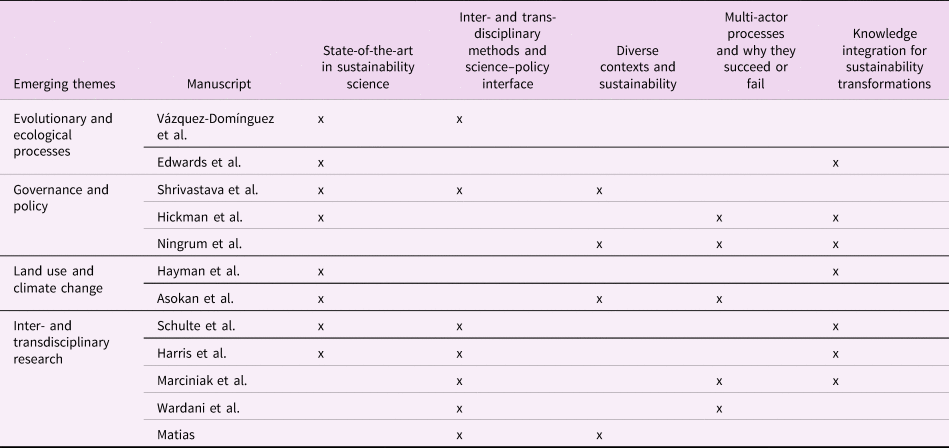
We summarize the papers featured in the Special Collection and how they address the Special Collection themes in Table 1. All papers cover more than two themes and many cover three, which points to the highly integrated nature and nuance needed by science to address sustainability challenges.
Special Collection papers of charting the course, their observed emerging themes, and their emphasis on the central themes of the call
Considering that the manuscripts were challenged to be forward-looking in their approaches, identifying crucial research questions, across different societal and academic sectors, and across the natural, social, and human sciences, this Special Collection truly brings forward a unique view on research and innovation for global sustainability.
4. Insights to address the sustainability crisis
Addressing the sustainability crisis requires a diverse and multi-faceted approach that draws upon the best knowledge of humankind. Future Earth is well positioned to gather scientific insights through both conventional scientific methods as well as the emerging interdisciplinary and transdisciplinary approaches that include strategies for co-designing pathways for sustainable and resilient development. This Special Collection not only captures the state-of-the-art in sustainability science but also charts a course for how better and more socially robust knowledge can emerge from diverse contexts and be acted upon effectively. Improving the governance of complex sustainable development and multi-stakeholder policymaking processes, successfully bridging the knowledge silos and barriers between science and society, better understanding evolutionary change and better managing transformational change, as well as reconsidering the ways technology, urban–rural space, and land use might be patterned to mitigate and adapt to climate breakdown are just some of the key messages of the Special Collection. Although this Special Collection does not encompass all the work being undertaken within Future Earth, we hope these insights contribute to shaping our collective response as an international scientific community and interconnected society for the coming decade, ensuring a sustainable future for our planet.
Supplementary material
The supplementary material for this article can be found at https://doi.org/10.1017/sus.2024.41.
Acknowledgments
The authors would like to acknowledge the decades of scientific advancements, the knowledge, community, and space to discuss the development of this editorial and the manuscripts that formed this Future Earth Special Collection in Global Sustainability. We further thank those that contributed to the call for Special Collection ideas within Future Earth and those that dedicated substantial time to share and document their findings in one of the many manuscripts.
Author contributions
All authors designed and ran the Special Collection for this editorial. G. B. S. wrote the first draft and S. M., J. U., F. A.-B., and S. J. contributed to the further development. All authors read and approved the final manuscript.
Competing interests
None.


 Open access

