


1. Introduction
Under the 2015 Paris Agreement the international community has committed to holding global average warming to well below 2 °C above pre-industrial levels and to pursue efforts to limit warming to 1.5 °C (Art. 2.1[a]) [1]. A key challenge for the Agreement is the stated intention to achieve this goal “in the context of sustainable development and efforts to eradicate poverty” (Art. 4.1) and “in a manner that does not threaten food production” (Art.2.1[b]) [1].
Modelled pathways using Integrated Assessment Models (IAMs) are increasingly relied upon to define mitigation scenarios. Most IAM scenarios compatible with the Agreement's temperature goal factor in significant use of negative emissions technologies (NETs) to remove CO2 from the atmosphere [Reference Anderson and Peters2]. This accords with the objective to achieve a “balance between anthropogenic emissions by sources and removals by sinks of greenhouse gases” (GHG) (Art.4.1) [1]. IAM scenarios assume these removals will be achieved through land-based NETs – afforestation and bioenergy with carbon capture and storage (BECCS) [Reference Williamson3] – measures that require appropriating extensive areas of land.
Questions surround the feasibility of large-scale land-based carbon removal, given the potential impacts of increased land demand on food security and biodiversity [Reference Williamson3–Reference Smith, Davis, Creutzig, Fuss, Minx, Gabrielle, Kato, Jackson, Cowie, Kriegler, van Vuuren, Rogelj, Ciais, Milne, Canadell, McCollum, Peters, Andrew, Krey, Shrestha, Friedlingstein, Gasser, Grübler, Heidug, Jonas, Jones, Kraxner, Littleton, Lowe, Moreira, Nakicenovic, Obersteiner, Patwardhan, Rogner, Rubin, Sharifi, Torvanger, Yamagata, Edmonds and Yongsung5]. The social and environmental implications of such measures have not yet been fully assessed [Reference Vaughan and Gough4,Reference Buck6]. However, the technology and energy futures depicted by IAMs are increasingly being scrutinized [Reference Anderson and Peters2,Reference Anderson7,Reference Stern8]. There is growing concern that IAMs may offer an unrealistically high estimate of the potential for land-based NETs. This in turn could serve to mislead policymakers into believing that rapid emission reductions can be delayed, creating a ‘lock-in’ situation where dependence on NETs can no longer be avoided after exceeding the carbon budget [Reference Vaughan and Gough4,Reference van Vuuren, Hof, van Sluisveld and Riahi9,Reference Dooley and Kartha10].
It is in relation to these concerns that this paper evaluates the latest generation of scenarios for limiting warming to below 2 °C, harmonized under a set of policy and developmental assumptions known as the Shared Socio-economic Pathways (SSPs) [Reference O'Neill, Kriegler, Ebi, Kemp-Benedict, Riahi, Rothman, van Ruijven, van Vuuren, Birkman, Kok, Levy and Solecki11]. We take three already agreed and potentially competing societal goals enshrined in the UN Sustainable Development Goals (SDGs) as relevant markers of global objectives reliant on land [Reference Dooley and Kartha10]: not threatening food production (SDG 2), biodiversity protection (SDG 15) and climate action (SDG 13). We assess the sustainability of land-based carbon removals intended to mitigate climate change according to these three objectives, by comparing IAM outputs to literature related to food production and biodiversity goals.
Finding that the amount of land used for mitigation in IAM outputs in 2100 exceed reported constraints to protect food production and biodiversity, we consider how land-based NETs have been legitimized as key mitigation options in IAM scenarios. The concept of scientific co-production [Reference Jasanoff12] illuminates how knowledge is developed and gains authority at the science–policy interface. We ask how model-based knowledge is co-produced with policy demands, and to what extent political choices inherent in the production of IAM scenarios may be obscured by scientific framings.
Section 2 outlines the analytical framework of co-production and provides a background on climate models in general and IAMs in particular, reviewing existing analyses of how these models came to inform climate policy. Section 3 describes the methodology used to analyze relevant data from IAMs, and to gather views from modellers and experts in the field. In section 4 we assess the sustainability of land-based carbon removal in light of food production and biodiversity goals. Section 5 examines how model-based knowledge is co-produced with policy demands and considers how land-based NETs have been legitimized as key mitigation options in IAM scenarios. Section 6 concludes that systematic negotiation between knowledge makers and knowledge producers could offer more policy-relevant results based on open debate of the social values and their trade-offs embedded in models.
2. Co-production and climate modelling
2.1. Co-production of knowledge
While in public policy the term ‘co-production’ often refers to an iterative process of top-down and bottom-up decision-making [Reference Brandsen and Pestoff13], in this paper we use the term in the context of Science and Technology Studies (STS), as an analytical tool to understand the process of scientific knowledge production [Reference Miller and Edwards14]. This approach highlights the engagement between science and politics, in which science is seen neither as an objective truth, nor as only driven by social interests, but as being co-produced through the interaction of natural and social orders [Reference Jasanoff12].
Jasanoff has distinguished science for policy-making as ‘regulatory science’, which “straddles the dividing line between science and policy” (p. 14 [Reference Jasanoff15]), as scientists and regulators try to provide answers to policy-relevant questions [Reference Jasanoff12]. Distinct from pure ‘research science’, regulatory science represents a negotiated and constructed model of knowledge production, where boundary-work (maintaining sharp boundaries between facts and values) is critical to the authority of scientific knowledge. By contrast, Jasanoff suggests that more robust outcomes are achieved when scientists and policymakers share the responsibility of providing the ‘best answers’ to difficult questions. Jasanoff has termed this ‘serviceable truth’ – a state of knowledge that satisfies tests of scientific acceptability and supports reasoned decision-making [Reference Jasanoff15].
Co-production views scientific endeavours as constitutive and/or interactional [Reference Jasanoff12,Reference Hilgartner, Miller and Hagendijk16]. While constitutive approaches to co-production often focus on emerging technologies and knowledge, interactional approaches look at points of knowledge conflict and resolution within existing structures and institutions to identify the normative dimensions of expertise [Reference Jasanoff12]. Here we will focus on what we see as knowledge controversies around the scale of NETs in IAM mitigation pathways. We will examine the interactional aspects of co-production between climate modellers and policymakers to explain how model results are produced, gain authority and are institutionalized in the policy process.
2.2. Global climate models and technocratic visions
Climate models have significantly advanced scientific understanding of future climate impacts. General Circulation Models (GCMs) are coupled atmosphere–ocean models that mathematically simulate changes in climate in response to altered boundary conditions (representing the earth's surface and atmosphere). They have evolved over time to include changes in GHG emissions levels. However, as far back as the late 1990s, Shackley et al. [Reference Shackley, Young, Parkinson and Wynne17] questioned the policy-usefulness of GCMs because of their limitations in dealing with uncertainty. They argued that the dominance of models – widely perceived as the ‘best science’ available for climate policy input – leads to a technocratic policy orientation, which tends to obscure political choices that deserve wider debate.
There is now an established body of literature critiquing the implications of this expert-led modelling approach to climate policy [Reference Miller and Edwards14,Reference Shackley, Young, Parkinson and Wynne17–Reference Wynne20]. In 2001, Demeritt retraced the history of climate modelling to reveal underlying social and epistemic commitments, unmasking how politics gets built into science, enabling a technocratic and global framing of climate change, devoid of people and impacts [Reference Demeritt18].
Demeritt suggested “a more reflexive politics of climate change and of scientific knowledge based on active trust” (p. 307 [Reference Demeritt18]). This can be likened to Jasanoff's ‘serviceable truth’, where the aim is not an objective verifiable truth, but a transparent and negotiated outcome of science sufficient to inform policymaking while assuring those exposed to risk that “their interests have not been sacrificed on the altar of an impossible scientific certainty” (p. 250 [Reference Jasanoff15]).
2.3. Knowledge production through Integrated Assessment Models
More recent critiques [Reference Beck and Mahony21–Reference Wolf, Schütze and Jaeger24] have focused on IAMs, which combine economic and social assumptions with observations from GCMs to achieve cost-optimal mitigation outcomes. IAMs minimize the economic cost of climate solutions, unless they are specifically constrained to do otherwise [Reference Pachauri and Meyer25].
Initially, model-based scenarios used in climate research were developed through iterative approaches where IAMs were used to determine possible emissions pathways under a given set of assumptions about the future, with the outcomes fed into GCMs to determine warming levels [Reference Moss, Edmonds, Hibbard, Manning, Rose, van Vuuren, Carter, Emori, Kainuma, Kram, Meehl, Mitchell, Nakicenovic, Riahi, Smith, Stouffer, Thomson, Weyant and Wilbanks26]. Storyline narratives, such as the Special Report on Emissions Scenarios (SRES) used in the Intergovernmental Panel on Climate Change (IPCC)'s 2007 Fourth Assessment Report, were based on scenarios of future emission development trajectories, without consideration of climate policy intervention. The results from IAMs produced under SRES provided further inputs to GCMs to determine warming levels for different scenarios of possible future development, giving high and low warming outcomes [Reference Moss, Edmonds, Hibbard, Manning, Rose, van Vuuren, Carter, Emori, Kainuma, Kram, Meehl, Mitchell, Nakicenovic, Riahi, Smith, Stouffer, Thomson, Weyant and Wilbanks26].
Changes in the way scenarios were developed for the IPCC Fifth Assessment Report (AR5) have changed the way IAMs are used to inform climate policy. In 2008, the IPCC requested the modelling community to develop a new set of scenarios, resulting in the four ‘representative concentration pathways’ (RCPs) subsequently used in 2014 for AR5 [Reference Moss, Edmonds, Hibbard, Manning, Rose, van Vuuren, Carter, Emori, Kainuma, Kram, Meehl, Mitchell, Nakicenovic, Riahi, Smith, Stouffer, Thomson, Weyant and Wilbanks26]. Under the RCP approach, different ‘target’ atmospheric concentrations of GHGs corresponding to different global average temperature outcomes were established. IAMs were subsequently used to determine combinations of future policy and technology measures to produce mitigation pathways for each target atmospheric concentration.
The move from SRES to RCPs represents a critical change in how models are used to inform climate policy: from ‘what climate outcomes would future emissions produce?’ to ‘what are the measures and actions needed to reach particular warming outcomes?’. IAMs originally designed for exploratory research were applied as decision-making tools [Reference Girod and Flueler27,Reference Kopp, Hsiang and Oppenheimer28]. The use of models had shifted from being about showing what level of emissions (and hence warming) different future development scenarios would result in, to determining what technology choices and policies are required to achieve a specific warming ‘target’. This shift from predictive to determinative places IAMs in a position of considerable authority regarding future climate policy, warranting an exploration of how modelled outputs are co-produced with policy demands, and which views gain authority.
IAMs can be understood as what Jasanoff has referred to as an emerging body of regulatory science responding to societal concerns over the environment – including sustainability science, impact assessment and integrated assessment – which are framed by objective, quantified decision-making techniques [Reference Jasanoff15]. Co-production allows us to examine how modellers have used notions of objectivity to enact boundaries, which are key to maintaining scientific credibility: “the creation of boundaries is critical to the political acceptability of advice” (p. 236 [Reference Jasanoff15]). How objectivity is understood and institutionally embedded in political systems has implications for legitimating policy and gaining social credibility and authority, determining “whose testimony should be trusted and on what basis” (p. 29 [Reference Jasanoff15]).
3. Methodology
This paper aims to examine the sustainability of land-based carbon removal in light of food production and biodiversity goals; to examine how model-based knowledge is co-produced with policy demands; and to consider how land-based NETs have been legitimized as key mitigation options in IAM scenarios. To answer the first research question, we used a quantitative analysis of SSP scenarios to identify the extent of land-use change in mitigation scenarios. For the latter two questions, we conducted semi-structured interviews with modellers and policy experts to explore the associated co-production and legitimation of model-based knowledge in climate policy.
Using the five SSPs, a new generation of IAM scenarios was made available in October 2016Footnote i [Reference Riahi, van Vuuren, Kriegler, Edmonds, O'Neill, Fujimorif, Bauer, Calvin, Dellink, Fricko, Lutz, Popp, Crespo Cuaresma, KC, Leimbach, Jiang, Kram, Rao, Emmerling, Ebi, Hasegawa, Havlik, Humpenöder, Da Silva, Smith, Stehfest, Bosetti, Jiyong Eomd, Gernaat, Masui, Joeri Rogelj, Strefler, Drouet, Krey, Luderer, Harmsen, Takahashi, Baumstark, C.Doelman, Kainuma, Klimont, Marangoni, Lotze-Campen, Obersteiner, Tabeau and Tavoni29]. From this set of scenarios, we used the RCP2.6 mitigation pathway, as the only pathway compatible with the ‘well below 2 °C’ temperature goal of the Paris Agreement at the time of analysisFootnote ii [Reference Riahi, van Vuuren, Kriegler, Edmonds, O'Neill, Fujimorif, Bauer, Calvin, Dellink, Fricko, Lutz, Popp, Crespo Cuaresma, KC, Leimbach, Jiang, Kram, Rao, Emmerling, Ebi, Hasegawa, Havlik, Humpenöder, Da Silva, Smith, Stehfest, Bosetti, Jiyong Eomd, Gernaat, Masui, Joeri Rogelj, Strefler, Drouet, Krey, Luderer, Harmsen, Takahashi, Baumstark, C.Doelman, Kainuma, Klimont, Marangoni, Lotze-Campen, Obersteiner, Tabeau and Tavoni29]. SSP3 is excluded because no SSP3 scenario achieved RCP2.6. Fifteen scenarios were examined from across the remaining SSPs for five models: AIM, IMAGE, REMIND-MAGPIE, GCAM4 and MESSAGE (WITCH was excluded due to incomplete datasets on land-use). Table 1 provides a summary of key land-use characteristics for each of the SSPs and shows which IAM scenarios were analyzed here.
Overview of SSP scenarios and land-use characteristics of SSPs (summarized from [Reference Popp, Katherine Calvin, Shinichiro Fujimori, Havlik, Humpenöder, Stehfest, Bodirsky, Dietrich, Doelmann, Gusti, Hasegawa, Kyle, Obersteiner, Tabeau, Takahashi, Valin, Waldhoff, Weindl, Wise, Kriegler, Lotze-Campen, Frickod, Riahi and van Vuuren30]). The land-use characteristics differ between SSPs and these underlying characteristics are treated differently across the IAM models. For this study, we analyzed five IAMs across the SSPs that achieved RCP2.6 (which excludes SSP3), for a total of 15 scenarios, as shown in row 2.
IAM, Integrated Assessment Model; SSP, Shared Socio-economic Pathway.

We assessed the scale of bioenergy (measured in joules) and land-use change (measured in hectares) in RCP2.6 by examining the results for these variables for the 15 scenarios analyzed. We performed a simple comparison of model results for primary bioenergy demand in 2050 and 2100 to literature assessing sustainable bioenergy supply potentials.
We examined land-use change according to the five categories in the SSP database: urban area, cropland, pastureland, forestland (undifferentiated between plantation and natural forest) and ‘other natural land’ (non-agricultural and non-forested ice- and desert-free land). The extent of land-use change in mitigation scenarios was determined by comparing the difference between 2010 and 2100 for RCP2.6. Since SSP cropland data do not distinguish between food/feed and energy crops, we took the difference in cropland between the baseline and mitigation scenarios in 2100 as a proxy value for energy crop area (assuming additional cropland expansion was driven by mitigation demand). Land-use change in 2100 was then compared to literature on land demand for agriculture, and land-conversion impacts on food production and biodiversity goals.
Ten semi-structured interviews with relevant experts were used to illuminate the process of knowledge legitimization in IAMs. These provided insights that could not be derived from technical documentation, into “how knowledge making [from IAMs] is incorporated into practices of… [climate] governance…, and… how practices of [climate] governance influence the making and use of [model-based] knowledge” (p. 3 [Reference Jasanoff15]). The interviews informed our analysis of how land-use constraints are considered, and how different types of knowledge are included or excluded in IAMs.
We requested interviews from each of the modelling groups represented in Table 1. Policy experts were selected from those engaged in developing the land-use elements of countries’ long-term low emissions strategiesFootnote iii. Experts from four modelling groups and three countries agreed to be interviewed. Respondents are anonymously identified in the text as m(1, 2, 3, etc) for modellers and p(1, 2, 3, etc) for policy experts.
4. Mitigation-driven land-use change
In this section we present results on the type and scale of NETs found in IAM scenarios under evaluation. Below 2 °C scenarios in the SSP database rely on BECCS and afforestation for NETs, which is consistent with the larger database of scenarios used in AR5 [Reference Anderson and Peters2]. We compare the scale of bioenergy demand and the associated land-use change in these mitigation scenarios to constraints related to food and biodiversity presented in the literature.
4.1. Bioenergy demand
The demand for primary bioenergy differs across scenarios and models. All mitigation scenarios show an increase in demand for bioenergy when carbon capture and storage (CCS) is introduced as a mitigation measure [Reference Popp, Katherine Calvin, Shinichiro Fujimori, Havlik, Humpenöder, Stehfest, Bodirsky, Dietrich, Doelmann, Gusti, Hasegawa, Kyle, Obersteiner, Tabeau, Takahashi, Valin, Waldhoff, Weindl, Wise, Kriegler, Lotze-Campen, Frickod, Riahi and van Vuuren30]. Three-quarters of bioenergy demand in <2 °C pathways under the SSPs is driven by BECCS (Fig. 1). Bioenergy supply in these scenarios is assumed from dedicated (second generation) energy crops – information on residue utilization is not provided [Reference Popp, Katherine Calvin, Shinichiro Fujimori, Havlik, Humpenöder, Stehfest, Bodirsky, Dietrich, Doelmann, Gusti, Hasegawa, Kyle, Obersteiner, Tabeau, Takahashi, Valin, Waldhoff, Weindl, Wise, Kriegler, Lotze-Campen, Frickod, Riahi and van Vuuren30]. Estimates for primary bioenergy supply in the literature span three orders of magnitude [Reference Haberl, Erb, Krausmann, Running, Searchinger and Smith31] and have engendered debate over the sustainability and carbon-neutrality of bioenergy use [32]. One difficulty in comparing estimates between sources is the inclusion of different bioenergy sources. More recent assessments have narrowed the range of what is considered technologically feasible for biomass production to 100–300 EJ/year by 2050, when utilizing all biomass sources, including residues [Reference Smith, Ahammad, Clark, Dong, Elsiddig, Haberl, Harper, House, Jafari, Masera, Mbow, Ravindranath, Rice, Robledo Abad, Romanovskaya, Sperling, Tubiello, Edenhofer, Pichs-Madruga, Sokona, Farahani, Kadner, Seyboth, Adler, Baum, Brunner, Eickemeier, Kriemann, Savolainen, Schlömer, von Stechow, Zwickel and Minx33,34].
Bioenergy demand (total and with CCS) in 2050 and 2100 under RCP2.6.
Range is shown for all 15 SSP scenarios available for RCP2.6, as modelled by five IAMs (see Table 1); top of bar = maximum, bottom of bar = minimum, horizontal line represents median for total bioenergy (grey) and bioenergy with CCS (red). Model-specific values are shown with symbols for SSP2 (middle of the road development pathway) as an illustration. Dashed lines refer to potential primary bioenergy production assessments from the literature. Bioenergy demand in climate mitigation scenarios increase dramatically after 2050, with very few assessments of production potential after 2050. Data source: SSP Database (Note i), see supplementary Information.
CCS, carbon capture and storage; IAM, Integrated Assessment Model; RCP, Representative Concentration Pathway; SSP, Shared Socio-economic Pathway.
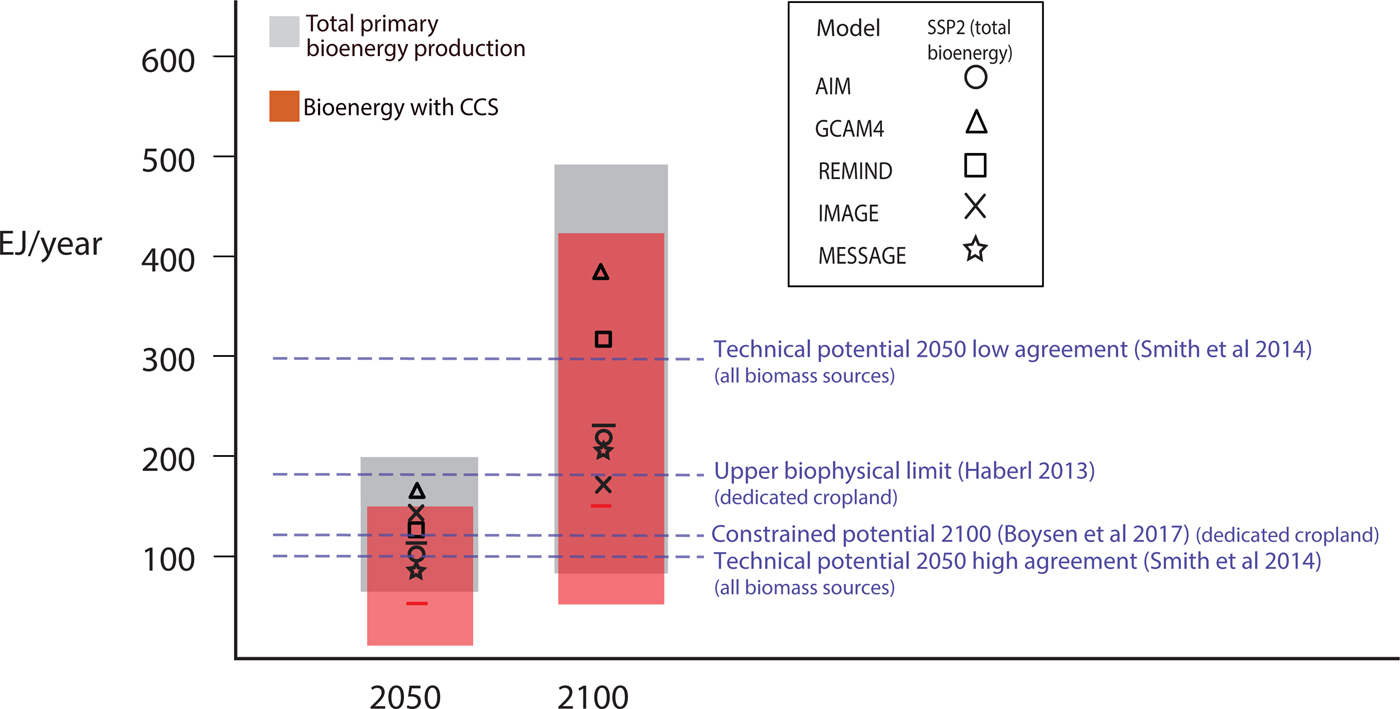
When considering only dedicated cropland as a source for bioenergy, the IPCC indicates high agreement in the literature of a global technical bioenergy potential of below 50 EJ/year by 2050, with declining agreement for higher technical potentials (Fig. 11.20 [Reference Smith, Ahammad, Clark, Dong, Elsiddig, Haberl, Harper, House, Jafari, Masera, Mbow, Ravindranath, Rice, Robledo Abad, Romanovskaya, Sperling, Tubiello, Edenhofer, Pichs-Madruga, Sokona, Farahani, Kadner, Seyboth, Adler, Baum, Brunner, Eickemeier, Kriemann, Savolainen, Schlömer, von Stechow, Zwickel and Minx33]). When including all sources (crops, residues, etc) the IPCC indicates high agreement on a technical bioenergy potential of around 100 EJ/year by 2050, with low agreement for “possibly 300 EJ and higher” (p. 835 [Reference Smith, Ahammad, Clark, Dong, Elsiddig, Haberl, Harper, House, Jafari, Masera, Mbow, Ravindranath, Rice, Robledo Abad, Romanovskaya, Sperling, Tubiello, Edenhofer, Pichs-Madruga, Sokona, Farahani, Kadner, Seyboth, Adler, Baum, Brunner, Eickemeier, Kriemann, Savolainen, Schlömer, von Stechow, Zwickel and Minx33]). Based on net primary production, an upper biophysical limit for bioenergy from dedicated crops only (excluding residues) has been estimated at 190 EJ/year [Reference Haberl, Erb, Krausmann, Running, Searchinger and Smith31]. Yet achieving this scale of crop-based bioenergy production would require conversion of pasture, grasslands and natural land to energy crops on a scale that would have a significant impact on food production and biodiversity [Reference Haberl, Erb, Krausmann, Running, Searchinger and Smith31]. Constraining biomass harvest to protect food production and biodiversity suggests much lower limits to bioenergy from dedicated cropland (≈50–110 EJ/year in 2100) [Reference Boysen, Lucht and Gerten35] although estimates are highly dependent on assumptions related to productivity, conversion efficiencies and food demand [Reference Boysen, Lucht and Gerten35].
The total energy value of current global biomass harvest (food, feed, fibre and energy) is 230 EJ/year [Reference Haberl, Erb, Krausmann, Running, Searchinger and Smith31], of which current primary bioenergy production is ≈50 EJ/year [Reference Smith, Ahammad, Clark, Dong, Elsiddig, Haberl, Harper, House, Jafari, Masera, Mbow, Ravindranath, Rice, Robledo Abad, Romanovskaya, Sperling, Tubiello, Edenhofer, Pichs-Madruga, Sokona, Farahani, Kadner, Seyboth, Adler, Baum, Brunner, Eickemeier, Kriemann, Savolainen, Schlömer, von Stechow, Zwickel and Minx33]. Compared to current bioenergy production, the median value of bioenergy demand in the SSP database for RCP2.6 (black horizontal line in Fig. 1) suggests approximately a doubling in primary bioenergy demand by 2050, and more than a four-fold increase by 2100 (Fig. 1). Looking at specific scenarios, only six of the 15 analyzed are at levels with high agreement on technical potential (under 100 EJ/year) in 2050 (Supplementary Information). One mitigation scenario is under the constrained potential estimate of 100 EJ/year in 2100 (AIM SSP1) (Supplementary Information), although this estimate is for bioenergy from dedicated land-use only. As technical potential is presumably higher than socio-economic or sustainable supply potential, we suggest that the level of bioenergy demand across all scenarios studied in 2100 is higher than what the scientific literature would suggest can be supplied without negative impacts on food production and biodiversity (Fig. 1).
This unsustainably high expectation for bioenergy production appears better explained by individual model assumptions than SSP narratives. When looking at expected bioenergy in 2100, demand varies more across models than across SSPs, with GCAM4 and REMIND-MAGPIE showing particularly high levels of bioenergy demand across all SSPs. Achieving these high levels of bioenergy production relies on optimistic assumptions for increased agricultural productivity, reduced food waste and shifts to less meat-intensive diets [Reference Popp, Katherine Calvin, Shinichiro Fujimori, Havlik, Humpenöder, Stehfest, Bodirsky, Dietrich, Doelmann, Gusti, Hasegawa, Kyle, Obersteiner, Tabeau, Takahashi, Valin, Waldhoff, Weindl, Wise, Kriegler, Lotze-Campen, Frickod, Riahi and van Vuuren30], all of which free land from agricultural production to be used for energy crops. In the next section we assess the scale of this assumed land conversion.
4.2. Land-use change
Popp et al. [Reference Popp, Katherine Calvin, Shinichiro Fujimori, Havlik, Humpenöder, Stehfest, Bodirsky, Dietrich, Doelmann, Gusti, Hasegawa, Kyle, Obersteiner, Tabeau, Takahashi, Valin, Waldhoff, Weindl, Wise, Kriegler, Lotze-Campen, Frickod, Riahi and van Vuuren30] report that all SSP scenarios for RCP2.6 show the same trend in land-use change: the area devoted to food and feed crops decreases, while land area devoted to energy crops increases; pastureland and other natural land decreases; and forest cover increases. While this trend is consistent across models and SSPs, our discussion here focuses on the scale (spatial extent) of land-use change as most relevant when considering the sustainability of modelled mitigation pathways.
Fig. 2 shows that both the range and extent of land-use change across all land types in the mitigation scenarios are large – in many scenarios some 500–1000 Mha pastureland and other natural land are converted by 2100 to allow expansion of forestland and total cropland (food/feed and energy crops combined) at similar scale. Energy crop area presented in Fig. 2 is based on our own calculations, as data are not available in the SSP database, and are the primary driver of cropland expansion in mitigation scenariosFootnote iv. Our ‘proxy data’ reading of energy crop area is confirmed by Popp et al. [Reference Popp, Katherine Calvin, Shinichiro Fujimori, Havlik, Humpenöder, Stehfest, Bodirsky, Dietrich, Doelmann, Gusti, Hasegawa, Kyle, Obersteiner, Tabeau, Takahashi, Valin, Waldhoff, Weindl, Wise, Kriegler, Lotze-Campen, Frickod, Riahi and van Vuuren30] who report an increase in energy crop area of between 270 Mha (SSP1) and 1517 Mha (SSP4) in RCP2.6. Hence the projection to increase global cropland (shown as cropped land in Fig. 2), up to nearly double that of today's extent of 1500 Mha [36], is predominantly for energy crops rather than crops to be used for food production.
Land-use change (Mha) in 2100 relative to 2010 under RCP2.6.
Horizontal lines represent the range across all available mitigation SSPs (1, 2, 4, 5) for each land-use type across five IAMs; vertical lines represent the median. Two SSPs are shown as examples: open symbols represent SSP2 (middle of the road), closed symbols represent SSP5 (fossil fuelled) development scenarios. Energy crops represented here are a subset of total cropland and inferred as the difference between cropland in the baseline scenario in 2100, and cropland in the mitigation scenario in 2100, taken to mean mitigation-driven cropland expansion. Data source: SSP Database (Note i). See Supplementary Information.
IAM, Integrated Assessment Model; SSP, Shared Socio-economic Pathway.
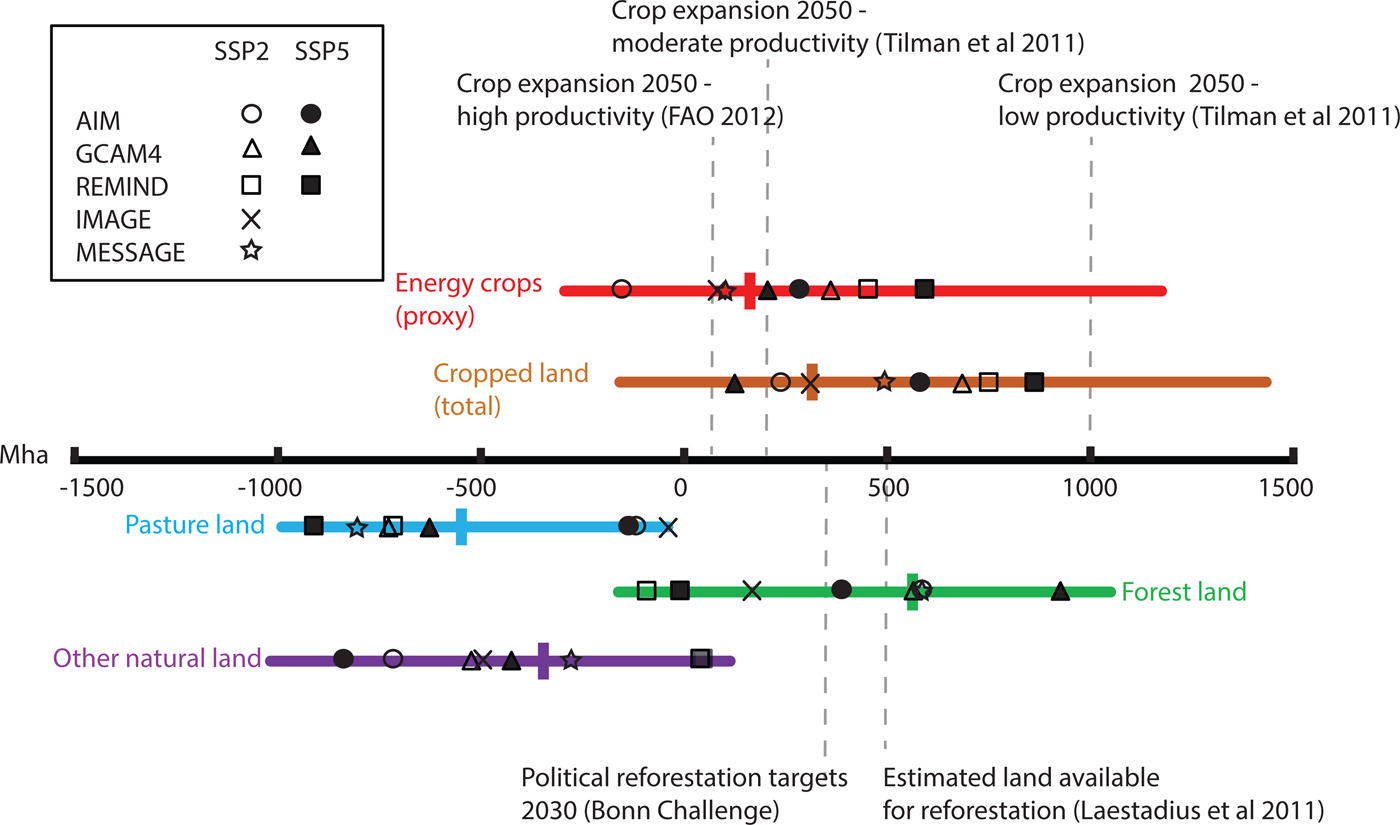
Expansion in cropland area also comes at the expense of pastureland and ‘other natural land’, which show significant decreases of up to one billion ha (representing approximately 25% loss for each land category (from current extent of ≈3.4 billion ha of pasture land and ≈4 billion ha of other natural land)) [Reference Alexandratos and Bruinsma39], see also Note i. Land-use trade-offs are evident in mitigation scenarios. For example, natural land and forest protection result in loss of pasture land (MESSAGE), restricted cropland expansion results in higher loss of natural land (AIM) or forest protection driving loss of other natural land (IMAGE) (Supplementary Information). Assumptions around land-availability are also a key determinant of the cost of BECCS [Reference Azar, Johansson and Mattsson37,Reference van Vuuren, den Elzen, Lucas, Eickhout, Strengers, van Ruijven, Wonink and van Houdt38].
Estimates of demand for cropland in 2050 span a large range, compared with today's cropland extent of 1500 Mha [36]. Predictions for additional land needed by 2050 for food production range from as little as 70 Mha, assuming most future food demand is met through yield and efficiency increases rather than land expansion [Reference Alexandratos and Bruinsma39]; to 200 Mha by 2050 under more moderate productivity increase assumptions for agriculture [Reference Tilman, Balzer, Hill and Befort40]; to up to 1000 Mha under low productivity assumptions (involving a continuation of current trends) [Reference Tilman, Balzer, Hill and Befort40]. These projections highlight the challenge of meeting future agricultural food demand, excluding considerations of land for mitigation purposes, and the importance of productivity increases as well as demand-side measures in reducing agricultural land needs.
To assess end-of-century scenarios, the Planetary Boundaries concept, which defines a ‘safe operating space for humanity’ without compromising earth system function [Reference Rockström, Steffen, Noone, Persson, Chapin III, Lambin, Lenton, Scheffer, Folke, Schellnhuber, Nykvist, De Wit, Hughes, van der Leeuw, Rodhe, Sörlin, Snyder, Costanza, Svedin, Falkenmark, Karlberg, Corell, Fabry, Hansen, Walker, Liverman, Richardson, Crutzen and Foley41], can be used. The planetary boundary for land-use change was originally defined as cropland not covering more than 15% of ice-free land [Reference Rockström, Steffen, Noone, Persson, Chapin III, Lambin, Lenton, Scheffer, Folke, Schellnhuber, Nykvist, De Wit, Hughes, van der Leeuw, Rodhe, Sörlin, Snyder, Costanza, Svedin, Falkenmark, Karlberg, Corell, Fabry, Hansen, Walker, Liverman, Richardson, Crutzen and Foley41]. With current cropland covering 14% of ice-free land [Reference Canadell and Schulze42], further expansion of cropland risks crossing a safe land-use boundary. A broader land-systems change boundary was later defined as 75% of original global forest cover remaining. This is 13% higher than current levels [Reference Steffen, Richardson, Rockström, Cornell, Fetzer, Bennett, Biggs, Carpenter, de Vries, de Wit, Folke, Gerten, Heinke, Mace, Persson, Ramanathan, Reyers and Sörlin43], implying that at least 500 Mha of forests need to be restored in order to remain within the boundary. This area is estimated to be available for reforestation [Reference Laestadius, Maginnis, Minnemeyer, Potapov, Saint-Laurent and Sizer44], and is broadly compatible with current political commitments, such as the Bonn ChallengeFootnote v. In an analysis of impacts of BECCS on four planetary boundaries, Heck et al. (p. 2 [Reference Heck, Gerten, Lucht and Popp45]) find that “almost no biomass plantations can be implemented” without increasing pressure on (already stressed) planetary boundaries related to biosphere integrity, land-system change, biogeochemical flows and freshwater use.
Taken together, this analysis shows that the scale of currently modelled 21st century land-use change for climate mitigation exceeds what may be considered sustainable with relation to food production needs and biodiversity protection, with no evidence to suggest supply could sustainably increase after 2050. Median outputs show primary bioenergy demand at more than double estimates constrained for food and biodiversity protection by 2100, with upper ranges almost five times higher, requiring a doubling of global cropland, and potential losses of up to a quarter of current pasture and other natural lands. The upper-range of forest cover increase, of one billion ha, is double the estimated land availability for reforestation (Fig. 2). IAM literature highlights the trade-offs inherent in land-based mitigation, reporting negative emissions as the main driver of land-use change across all SSP mitigation scenarios, with large-scale bioenergy production and afforestation reducing land for food/feed production and pasture [Reference Popp, Katherine Calvin, Shinichiro Fujimori, Havlik, Humpenöder, Stehfest, Bodirsky, Dietrich, Doelmann, Gusti, Hasegawa, Kyle, Obersteiner, Tabeau, Takahashi, Valin, Waldhoff, Weindl, Wise, Kriegler, Lotze-Campen, Frickod, Riahi and van Vuuren30]. We now examine how these trade-offs are translated into climate policy.
5. Co-production of integrated assessment mitigation pathways
The trade-offs apparent in modelled outputs indicate the need for a deeper understanding of whether and how such results gain political legitimacy. Using the analytical lens of co-production allows us to contrast the views of knowledge users (policymakers) and knowledge producers (modellers) to identify how land-based NETs have been legitimized as key mitigation options in IAM scenarios, assess the normative implications and propose ways forward. We identified four emergent themes from interviews relevant to concerns about land-based mitigation: uncertainty, feasibility, constraints and responsibility.
5.1. Uncertainty
The handling of uncertainty demonstrated the science-for-policy (regulatory science) nature of IAMs. The potential for land-based mitigation remains among the largest uncertainties in model outputs [Reference Popp, Katherine Calvin, Shinichiro Fujimori, Havlik, Humpenöder, Stehfest, Bodirsky, Dietrich, Doelmann, Gusti, Hasegawa, Kyle, Obersteiner, Tabeau, Takahashi, Valin, Waldhoff, Weindl, Wise, Kriegler, Lotze-Campen, Frickod, Riahi and van Vuuren30,Reference Alexander, Prestele, Verburg, Arneth, Baranzelli, Silva, Brown, Butler, Calvin, Dendoncker, Doelman, Dunford, Engstrom, Eitelberg, Fujimori, Harrison, Hasegawa, Havlik, Holzhauer, Humpenoder, Jacobs-Crisioni, Jain, Krisztin, Kyle, Lavalle, Lenton, Liu, Meiyappan, Popp, Powell, Sands, Schaldach, Stehfest, Steinbuks, Tabeau, Van Meijl, Marshall, Wise and Rounsevell46], and respondents referred to uncertainty regarding the extent of currently available land, projected future land-use demands and how these data limitations are dealt with in model assumptions. Many mitigation scenarios rely on pastureland, degraded land and grassland for energy crops, despite great uncertainties about the extent and availability of these lands [Reference Gibbs and Salmon47]. When land availability is looked at in aggregate, overlapping and competing demands create a picture of land scarcity, and at the global scale land availability is often overestimated [Reference Canadell and Schulze42,Reference Creutzig48–Reference Lambin, Gibbs, Ferreira, Grau, Mayaux, Meyfroidt, Morton, Rudel, Gasparri and Munger50]. These empirical uncertainties make sustainable extents for land-use change difficult to determine.
Empirical uncertainty is often dealt with in models by drawing on expert judgment. As m1 reported during interviews: “in any modelling, there is an element of expert judgment”. Yet relying on expert judgment means crucial underlying assumptions may remain unquestioned. M1 for example described determining technology availability as “what we can glean from published literature, uncertainty analysis and ‘best guess’”, but at the same time dismissed concerns of land scarcity, stating “we believe there is enough land for bioenergy”. Another respondent (m4) described limiting bioenergy production to land not currently forested or used for agricultural crops, resulting in a greater extent of conversion of pasture land, grasslands and other natural lands – despite considerable uncertainty over how much land is available in these categories.
Policy experts (p1, p3, p4) recognized that while many of the model assumptions were largely ‘unknowable’, land availability arose as a key constraint on using bioenergy or forests for mitigation. As p3 put it: “the biggest question we kept running into is ‘how much land is needed?’”.
Interviews indicate that empirical uncertainty in IAM baseline assumptions is dealt with in a way that combines “elements of scientific evidence and reasoning with scientific and political judgment” (p. 229 [Reference Jasanoff15]). This hybrid approach is typical of regulatory science, where results (and policy advice) are needed regardless of uncertainties. Yet in a context of uncertainty around global land availability, the use of technocratic expert judgment may risk overestimating the availability of potentially productive land for mitigation in modelled scenarios if it excludes consideration of social, cultural and political goals.
5.2. Feasibility
Model results determine technical and economic feasibility, which may not be consistent with ‘real-world’ constraints. The IAM community has been at pains to point out that IAM scenarios show multiple mitigation options that are not policy prescriptive, with assumptions and caveats carefully presented in publications. Riahi et al., for example, state techno-economic assumptions “need to be strictly differentiated from the feasibility of the transformation in the real world, which hinges on a number of other factors, such as political and social concerns that might render feasible model solutions unattainable” (p. 13 [Reference Riahi, van Vuuren, Kriegler, Edmonds, O'Neill, Fujimorif, Bauer, Calvin, Dellink, Fricko, Lutz, Popp, Crespo Cuaresma, KC, Leimbach, Jiang, Kram, Rao, Emmerling, Ebi, Hasegawa, Havlik, Humpenöder, Da Silva, Smith, Stehfest, Bosetti, Jiyong Eomd, Gernaat, Masui, Joeri Rogelj, Strefler, Drouet, Krey, Luderer, Harmsen, Takahashi, Baumstark, C.Doelman, Kainuma, Klimont, Marangoni, Lotze-Campen, Obersteiner, Tabeau and Tavoni29]). The feasibility of model results are only now being evaluated in terms of real world impacts [Reference Anderson and Peters2,Reference Smith, Davis, Creutzig, Fuss, Minx, Gabrielle, Kato, Jackson, Cowie, Kriegler, van Vuuren, Rogelj, Ciais, Milne, Canadell, McCollum, Peters, Andrew, Krey, Shrestha, Friedlingstein, Gasser, Grübler, Heidug, Jonas, Jones, Kraxner, Littleton, Lowe, Moreira, Nakicenovic, Obersteiner, Patwardhan, Rogner, Rubin, Sharifi, Torvanger, Yamagata, Edmonds and Yongsung5,Reference Fuss, Canadell, Tavoni, Andrew, Ciais, Jackson, Jones, Kraxner, Nakicenovic, Le Quéré, Raupach, Sharifi, Smith and Yamagata51].
Modeller respondents unanimously reflected the views of the IAM community, that model outputs do not ‘imply’ real-world feasibility. As one put it: “models are focused on the mitigation objective, and to some degree the feasibility depends on if we choose to do that level of mitigation. The models … can answer whether RCP2.6 is technologically possible, and say something about the cost, but we don't say it is feasible or not” (m2).
In response to questions on the reliance of modelled <2 °C pathways on BECCS, policy demand for deeper mitigation scenarios, as well as technological feasibility, proved key. Growing understanding of climate impacts consolidated policy around 2 °C. Improved understanding of the emission limits for these targets, along with international political commitments, drove policy demand for deep mitigation scenarios that achieve temperature targets of 2 °C and below [Reference Meinshausen, Meinshausen, Hare, Raper, Frieler, Knutti, Frame and Allen52,Reference Meinshausen, Hare, Wigley, van Vuuren, den Elzen and Swart53]. Combining CCS with bioenergy to remove emissions from the atmosphere was first proposed in 2001 [Reference Obersteiner, Azar, Kauppi, Möllersten, Moreira, Nilsson, Read, Riahi, Schlamadinger, Yamagata, Yan and van Ypersele54], and integrated assessment modellers subsequently found that it was ‘logical’ to include BECCS in 2 °C and below pathways, with “no real technological or ecological constraints to combining bioenergy and CCS” (m3). In fact, the availability of BECCS proved critical to the cost-efficiency, and indeed the theoretical possibility, of these deep mitigation scenarios [Reference van Vuuren, den Elzen, Lucas, Eickhout, Strengers, van Ruijven, Wonink and van Houdt38,Reference Azar, Lindgren, Larson and Möllersten55], leading to systemic inclusion of BECCS in RCP2.6 scenarios included in AR5. For the more recent SSP scenarios, assumed technology costs continue to be highlighted. As m1 said: “what happens in those models is going to be completely dependent on your assumptions about the costs associated with different technologies”. BECCS was justified as “assumed availability based on the SSP storyline and existence of bioenergy supply” (m2).
BECCS was therefore introduced to models because it was considered technically feasible and cost-effective. Policy experts (p2, p3, p4), while agreeing that modelled outputs were not intended to be policy prescriptive, expressed concern over the feasibility of the scale of bioenergy and land-use change assumed. Hence technological, rather than real-world feasibility, led to including large-scale BECCS in models. Critiques of NETs reliant pathways assert this scale of land-based mitigation poses unacceptable trade-offs [Reference Vaughan and Gough4,Reference Dooley and Kartha10].
5.3. Constraints
‘Constraints’ refers to the inclusion of assumptions in the baseline to limit model options for ways to meet the desired target. Relatively few constraints to land-based mitigation were identified beyond the SSP storylines, based on interviews and SSP model documentationFootnote vi. Policy constraints were described by m1, m2 and m4 as being translated into IAMs through price (consumer demand) and subsidies (policy demand). Certain models had specific constraints, such as the protection of cropland for food production in IMAGE (inclusion of food demand in the baseline and no bioenergy production on agricultural or forested land). Other models allow food production to compete for land based on cost. Reducing forest loss (through protected area constraints or limiting the rate of deforestation) is used as a proxy for biodiversity protection in many models, while other natural lands are subject to competing demands.
When trying to balance competing land-use demands, p3 commented that “the real victim in all of this is grasslands… the only way we can achieve [bioenergy expansion] is by encroaching on, ideally, low productivity pasture lands” (p3). Similar dynamics can be seen in global-scale IAM scenarios, where both pastureland and ‘other natural land’ decline in all mitigation scenarios, often substantially (Fig. 2). This raises questions of who may be impacted by the assumed availability of ‘low productivity’ or degraded land, which often has high biodiversity and existing social and cultural value [Reference Gibbs and Salmon47,Reference Lambin and Meyfroidt56]. Gibbs and Salmon note, “even a precise map of the physical area of degraded land would significantly overestimate its potential by neglecting its myriad social, environmental, and political constraints” (p. 19 [Reference Gibbs and Salmon47]).
Some modellers reported that normative constraints were minimized or excluded due to concerns that including value-based assumptions undermines the objectivity of model outputs. For example, m3 expressed the view that including constraints in baseline assumptions would add an unacceptable layer of political or ‘value-based’ judgment, making model results in-transparent and unacceptable to peer review. This reflects an epistemic commitment where “peer review plays a significant role in establishing the credibility of expert knowledge” (p. 233 [Reference Jasanoff15]). Acknowledging the lack of baseline constraints, m4 felt additional policy measures were needed for food security and biodiversity protection.
By contrast, policy experts felt models should include explicit constraints for more realistic outcomes. P4 expressed concern over the lack of model structures to accommodate “concerns that cannot be monetized or quantified”. P3 highlighted the importance of the ‘practitioner perspective’, noting how infrequently modellers “had encountered sector specific practitioners… who have a granular understanding of cost points, opportunity costs for landowners, cultural considerations, etc.” When using IAMs for national modelling, policy experts and modellers had to find new ways of dealing with model assumptions to achieve more realistic results. Describing the need to ‘force’ a different price on the land sector to prevent unrealistically high afforestation levels, p3 noted that modellers found it ‘unscientific’ to introduce constraints to achieve a desired output: “from a modelling perspective they thought – ‘this is not scientific, this is not how we do things’”. The reluctance to include societal objectives as baseline constraints can be seen as a form of boundary work, defining IAMs as objective science that confers results with “unshakeable authority” (p. 236 [Reference Jasanoff15]).
5.4. Responsibility
While IAM scenarios suggest that a below 2 °C pathway relying heavily on land-based NETs is theoretically possible, closer examination of the assumed scale of land-use change indicates that choosing this path could exacerbate significant problems of land scarcity, food insecurity and biodiversity loss. Can these caveats and trade-offs be effectively communicated in the ‘up-take’ of results into climate policy? Whose responsibility is it to do so?
All modellers interviewed viewed the identification and communication of such complexities, links and impacts as responsibilities for the modelling community. However, as m3 observed, while “we do our best” to communicate the complexities and trade-offs inherent in model assumptions, this is often ‘lost in translation’ between the modelling and policy worlds. Others (m1, m2) described how the complexities of SSP scenarios themselves raise problems, pointing to non-evident results and the number of interacting variables as barriers to clear communication and understanding of model outputs.
While the modelling community is careful to communicate potential impacts and consequences of modelled options, published literature [Reference Carlsen, Klein and Wikman-Svahn57] and interview responses (m1, m2, m3, m5) strongly defend the position that models provide objective input to the climate policy debate. For example, m3 suggested that “running [a model] on current political feasibility is not transparent. It involves making many assumptions”. Yet the context and assumptions communicated in the scientific literature are often lost when used in political contexts, as acknowledged by p1: “I see modellers saying ‘you have to interpret this in the context of all these assumptions…’ but for the most part, policymakers are not good users of modelled outputs”.
How model results are communicated and to what degree trade-offs are recognized and accepted is of critical importance, given that negative emission scenarios dominate the international climate policy landscape, a point that can be illustrated in the uptake of NETs add hyphen (NETs-reliant) reliant scenarios into the 2015 Paris Agreement.
Crucial details and qualifications present in longer publications are often omitted from pithier policy statements. For instance, the IPCC AR5 Summary for Policymakers clearly states that below 2 °C scenarios are reliant on NETs: “characterized by lower global GHG emissions in 2050 than in 2010, 40 to 70% lower globally, and emissions levels near zero GtCO2eq or below in 2100” (p. 10, emphasis added [Reference Edenhofer, Pichs-Madruga, Sokona, Farahani, Kadner, Seyboth, Adler, Baum, Brunner, Eickemeier, Kriemann, Savolainen, Schlömer, von Stechow, Zwickel and Minx58]). Uncertainties were highlighted in the next paragraph: “There is uncertainty about the potential for large-scale deployment of BECCS, large-scale afforestation, and other CDR technologies and methods” (p. 11 [Reference Edenhofer, Pichs-Madruga, Sokona, Farahani, Kadner, Seyboth, Adler, Baum, Brunner, Eickemeier, Kriemann, Savolainen, Schlömer, von Stechow, Zwickel and Minx58]). By contrast, during the lead-up to the Paris climate summit, a critical G7 statement merely included an unqualified commitment to “40 to 70% [GHG emissions] reductions by 2050 compared to 2010” (p. 12 [59]). This helped pave the way for these same (NETs reliant) pathways to be included in the decision adopting the Paris AgreementFootnote vii without acknowledging the reliance of less ambitious 2030 emission reduction targets on future availability of NETs.
Whether the absence of reference to NETs in the Paris Agreement reflects a lack of understanding among high level policymakers or their deliberate avoidance of this politically contentious issue is impossible to know, but the adoption of these targets signals an acceptance of large-scale NETs, without any critical policy or public debate over potential impacts and lock-in effects, or discussion of more ambitious mitigation pathways that would reduce the need for NETs. Greater transparency around the normative choices being made in modelled mitigation pathways would contribute to a more open debate.
6. Conclusions
After comparing model results for deep mitigation pathways with the literature on bioenergy supply and land availability, we suggest that the level of land-based mitigation in current IAMs is likely to negatively impact food production and biodiversity, due to extensive land-use change. The introduction of BECCS into modelled scenarios is constrained by modellers using techno-economic feasibility, rather than real-world feasibility, with boundaries carefully enacted to maintain authority of model results and legitimize the inclusion of BECCS and other land-based NETs in future mitigation pathways. While the potential for risks to food production and biodiversity are communicated by modellers, this is often lost in the political uptake of model results.
Integrated assessment modelling is simultaneously scientific and political, and can be seen to have had substantial policy impacts leading up to the Paris Agreement. It continues to have significant influence in international and national climate policies. While IAM scenarios generate valuable knowledge for climate policy, paradoxically, the intention for modelled scenarios to be non-determinative is undermined if NETs-reliant pathways are used to justify higher near-term emissions, assuming these can be removed at a later date to achieve a <2 °C pathway. This ‘lock-in’ potential of mitigation pathways reliant on large-scale carbon removal requires more critical examination by decision-makers and other stakeholders. Highlighting the shift from predictive to determinative use of models that has occurred (with IAM outputs treated as regulatory science) could open the way for more serviceable knowledge production.
A process in which modelling teams and policy experts systematically negotiate model assumptions that better account for real world constraints could produce what one policy expert (p3) described as ‘purposeful modelling’. Purposeful modelling embodies a reflexive approach to the co-production of scientific knowledge. Closer negotiation between knowledge producers and knowledge users could lead to a more informative set of mitigation scenarios by explicitly including social and environmental goals in models, and contrasting the use of these ‘constrained’ and ‘unconstrained’ scenarios in the scientific and policy-oriented literature. This would come closer to Jasanoff's ‘serviceable truth’ by opening key assumptions for consideration, rather than embedding contestable normative assumptions within scientific authority. While this may come at the expense of the perceived scientific objectivity of modelled scenarios, it would allow for a more critical interrogation of the value-based and ethical choices inherent in any scenario-building exercise.
Supplementary material
To view supplementary material for this article, please visit https://doi.org/10.1017/sus.2018.6
Acknowledgments
The authors gratefully acknowledge the time generously given by interview respondents. The authors thank Anita Talberg for valuable feedback on an earlier draft of this paper, and Dimitri Lafleur, Simon Mentz and Martin Wainstein for assistance with the figures.
Author contributions
K. D. conceived and designed the study with input from P. C. and K. N. K. D. conducted data gathering and analysis of IAM scenarios and interviews (IAM data analysis supported by K. N.). K. D. led the writing process with contributions from P. C. and K. N.
Financial support
This research received no specific grant from any funding agency, commercial or not-for-profit sectors.
Conflict of interest
None.
Ethical standards
The authors assert that all procedures contributing to this work comply with the ethical standards of the relevant national and institutional committees on human experimentation and with the Helsinki Declaration of 1975, as revised in 2008.


 Open access

