


Introduction
In the face of the recurrent criticism of democratic deficit in the European Union (EU), scholars and practitioners alike have discussed institutional reforms of the EU (e.g., Weiler et al. Reference Weiler, Haltern and Mayer1995; Scharpf Reference Scharpf1999; Moravcsik Reference Moravcsik2002; Follesdal & Hix Reference Follesdal and Hix2006). Critics contend that the institutional structure of EU decision making and, in particular, the weakness of the European Parliament (EP) allows for only limited accountability and responsiveness to the public, undermining the legitimacy of the EU. In response, successive treaty reforms have increased the powers of the EP – the only EU institution directly elected by citizens.Footnote 1 With a further transfer of policy competencies (Hooghe & Marks Reference Hooghe and Marks2009) and the effective application of majority voting rule in the Council (Tsebelis & Garrett Reference Tsebelis and Garrett2001), the co‐decision procedure introduced a bicameral procedure, in which the EP has equal legislative veto powers with the Council. The most recent Lisbon Treaty has extended the EP's co‐decision powers to most areas of EU legislation. The EP was considered to increase responsiveness and accountability, improve transparency and ameliorate the democratic deficit by balancing representational asymmetry against executive dominance (Rittberger Reference Rittberger2003, Reference Rittberger2005; Follesdal & Hix Reference Follesdal and Hix2006). However, despite the empowerment of the EP, public support has declined in the post‐Maastricht period, manifested by decreasing turnout in EP elections and the rise of Eurosceptic parties. In this study, we seek to address this puzzle by combining the insights from the institutionalist literature on EU decision making and behavioural studies on public attitudes toward the EU. While the link between institutional design and public support has been at the heart of the discourse on EU reform, little is known about whether and how the institutional design of EU decision making influences public support.
According to the institutionalist literature, EU decision making comprises multiple dimensions by granting specific powers to different EU institutions at distinct stages (e.g., Steunenberg Reference Steunenberg1994; Tsebelis Reference Tsebelis1994; Crombez Reference Crombez1996; Garrett & Tsebelis Reference Garrett and Tsebelis1996; Pollack Reference Pollack2003; Jupille Reference Jupille2004; Tsebelis & Garrett Reference Tsebelis and Garrett2001). To implement the goal of European integration, the Commission has monopoly power to initiate policy proposals, which need approval by the Council to become EU law. To facilitate the completion of the internal market in the EU, the governments increasingly made decisions by majority voting rule in the Council. In the case that a member state fails to implement EU law, the Court of Justice of the European Union (CJEU) has the power to settle disputes and, in certain cases, to impose penalties. While institutional design has been expected to enhance the credibility of commitments by reducing the possibilities for ex‐post opportunism (Moravcsik Reference Moravcsik1998), institutionalist scholars have argued that it is essential to take into account the specific powers of the different EU institutions and their dynamic interactions to fully understand the implications of EU decision making (Tsebelis & Garrett Reference Tsebelis and Garrett2001). Institutionalist research has made significant contributions to further understanding the multidimensionality of EU decision making by exploring the specific power distribution among EU institutions. However, this literature has paid little attention to its implications for public support, downplaying the broader social determinants of institutional choice in the EU.
On the other hand, behavioural research on public attitudes toward the EU rarely investigates whether and how the specific design of EU decision making influences public support. Instead, most studies largely adopt three main approaches to explaining public support for the EU: utilitarian, identity and informational accounts. The utilitarian approach posits that citizens are more likely to support the EU when they perceive net personal or national benefit from the EU (Eichenberg & Dalton Reference Eichenberg and Dalton1993; Anderson & Reichert Reference Anderson and Reichert1995; Gabel & Palmer Reference Gabel and Palmer1995; Anderson & Kaltenthaler Reference Anderson and Kaltenthaler1996; Gabel Reference Gabel1998), while the identity approach highlights the importance of national attachment or identity in shaping support (Carey Reference Carey2002; Hooghe & Marks Reference Hooghe and Marks2005; Risse Reference Risse2010). Despite their different accounts for the formation of EU attitudes, these studies have in common that they focus on relatively fixed, pre‐defined individual attributes (commonly measured by the level of skills and national attachment). The third approach on informational accounts notes that European integration is too complex and remote from the daily lives of most citizens for them to have sufficient interest and awareness, and stresses that citizens rely on proxies or cues to overcome their information shortfalls. In particular, studies show that citizens use the performance of their national governments (Anderson Reference Anderson1998; Sánchez‐Cuenca Reference Sánchez‐Cuenca2000; Kritzinger Reference Kritzinger2003; De Vries Reference De Vries2018) or the positions of the political parties they support (De Vries & Edwards Reference De Vries and Edwards2009; Helbling et al. Reference Helbling, Hoeglinger and Wüest2010)Footnote 2 as a heuristic in shaping their support for the EU. However, these studies have still not directly investigated the critical link between the institutional design of EU decision making and public support, which underlies the longstanding discussion of democratic deficit and institutional reform in the EU.Footnote 3
In this study, we investigate whether and how the institutional design of EU decision making shapes public support by linking the institutional literature to behavioural studies on EU attitudes. The multidimensionality of EU decision making involving different institutions with specific powers at distinct stages (such as the existing institutional design that grants the proposal power to the Commission, approval and voting power to the Council and the EP, and sanctioning power to the CJEU) makes it difficult to investigate public attitudes toward this process and institutional reform with the conventional methods of survey research. Most of the existing studies rely on standard survey questions measuring either an abstract and broad concept of support for EU membership (e.g., Dalton & Eichenberg Reference Dalton, Eichenberg, Sandholtz and Stone Sweet1998; Gabel Reference Gabel1998) or trust in individual EU institutions such as the CJEU or the EP (e.g., Caldeira & Gibson Reference Caldeira and Gibson1995; Gibson & Caldeira Reference Gibson and Caldeira1998; Gabel Reference Gabel2003), without taking into account their specific roles or interactions in the decision‐making process, and thus cannot explore the multidimensionality of public attitudes toward EU decision making.Footnote 4 To address this challenge, we design a novel conjoint experiment that closely captures the EU decision‐making process by taking into account its distinct stages and the specific powers of EU institutions. Our study randomly displays alternative institutional designs by simultaneously varying four distinct institutional attributes such as proposal, adoption, voting and sanctioning power in EU decision making to evaluate individuals’ relative preferences across multiple dimensions of this process. We embed our experiment in a large‐scale online survey fielded in 13 EU member states (Austria, Czech Republic, Denmark, France, Germany, Greece, Hungary, Ireland, Italy, Netherlands, Poland, Spain and Sweden) that largely represent different characteristics of the current EU member states. This design allows us to evaluate the relative effects of multiple institutional attributes on public support and how these effects vary across different groups of citizens, countries and different institutional configurations.
We find that specific institutional designs of EU decision making significantly shape public support. Interestingly, there exists a notable consensus about a preferred institutional reform among European citizens in different countries, except in one dimension, which involves actions against member states that fail to implement EU law. Respondents across all countries indeed prefer the existing bicameral procedure and the majority voting rule, while they show broad opposition to the Commission's exclusive proposal power. Thus, and to some surprise, the empowerment of the EP does not always lead to more public support, and further enhancement of public support can be achieved only in the institutional dimension involving proposal power. This finding varies neither across countries nor respondents’ key characteristics such as their perceived benefits of the EU, national attachment, political knowledge and party support. On the other hand, we find notable dissent over the dimension of sanctioning power. In particular, respondents in Austria, the Czech Republic, Denmark and Sweden prefer national courts, while the other countries prefer the existing CJEU as a sanctioning institution. Also, we find empirical evidence that this dissent over the sanctioning institution is largely driven by respondents’ utilitarian assessments of the EU benefits and political parties they support.
Compared to existing research on EU attitudes, our findings highlight the multidimensionality of EU decision making and how public support varies across these dimensions. We also find that citizens organise their attitudes toward EU decision making in systematic and meaningful ways and this structure of citizens’ preferences has important implications for the discourse on the democratic deficit and institutional reform of the EU. Notably, our results reveal both the possibilities and the limits of institutional reform as a solution to legitimacy concerns by specifying how and to what extent specific institutional design can increase or decrease public support.
In what follows, we first introduce the overview of studies to understand the EU decision‐making process with a connection to its implications for public support. Next, we propose our research design to address the limitations of existing literature and standard survey methods. We then report the results of our analysis and the concluding section summarises our main findings and discusses their theoretical and practical implications.
Dimensions of EU decision making
European integration has been explained from competing perspectives, such as intergovernmentalism and supranationalism (Moravcsik Reference Moravcsik1998; Sandholtz & Stone Sweet Reference Sandholtz and Stone Sweet1998). According to intergovernmentalism, the governments are the masters of the treaties on European integration (Alter Reference Alter1998). They pursue socioeconomic interests in interstate bargains and delegate powers to EU institutions to enhance the credibility of their commitments (Moravcsik Reference Moravcsik1993). In contrast, the supranational/neofunctionalist approach posits that the EU institutions are the drivers of European integration, which attempt to implement a federal ideology (Haas Reference Haas1958) or centralised technocratic management (Majone Reference Majone1996). In addition to intergovernmentalism and supranationalism, institutionalist scholars draw attention to the power distribution among EU institutions (Steunenberg Reference Steunenberg1994; Tsebelis Reference Tsebelis1994; Crombez Reference Crombez1996; Tsebelis & Garrett Reference Tsebelis and Garrett2001). On closer inspection of this power distribution, originally developed by Jean Monnet for the European Coal and Steel Community among six member states, supranational EU institutions, such as the Commission with exclusive proposal power and the CJEU with sanctioning power, have attempted to avoid intergovernmental competition and conflict in EU decision making to enhance European integration. On the contrary, the Council has been considered to provide for intergovernmental responsiveness, while the EP has gained more legislative powers in EU decision making due to the effective application of the majority voting rule in the Council and a further transfer of policy competences from the national to the supranational level of the EU in the post‐Maastricht period (König Reference König2018). Accordingly, we expect that the institutional design of EU decision making has significant implications for the way citizens perceive and evaluate the EU.
Proposal
We incorporate the institutional framework that characterises multiple EU institutions playing different roles at distinct stages to distinguish four main dimensions of EU decision making: proposal, adoption, voting rules and sanctioning. First, for any decision to be made, an issue must be placed on the agenda. Agenda‐setting concerns the strategic choice or selection of policy alternatives from a set of all possible outcomes on which individual or collective actors finally decide. Thus, agenda‐setting power has been understood as a means to manipulate the decision‐making process and collective outcomes (e.g., McKelvey Reference McKelvey1976; Romer & Rosenthal Reference Romer and Rosenthal1978; Shepsle & Weingast Reference Shepsle and Weingast1984; Ordeshook & Schwartz Reference Ordeshook and Schwartz1987). In parliamentary democracies, the right to draft a proposal is usually shared between government and parliament, often with a required threshold of parliamentary support to submit a policy proposal to the legislature. In addition, the right to propose policy can also be provided to a second chamber, or in some cases to popular initiatives. Sharing the right to propose policy may promote responsiveness to the public by creating competitive agenda‐setting, in which different actors can submit alternative proposals to the legislature. Independent from the success of proposals, competitive agenda‐setting may overcome policy gatekeeping (Crombez et al. Reference Crombez, Groseclose and Krehbiel2006) and generate position‐taking benefits by signaling responsiveness to public concerns (Mayhew Reference Mayhew1974; Bevan & Jennings Reference Bevan and Jennings2014).
In contrast, in the EU, the Commission with the responsibility to promote European integration has the exclusive right to initiate so‐called ‘secondary legislation’, and scholars have debated over how different institutional reforms influence this role and procedural interactions with other institutions.Footnote 5 According to Pollack (Reference Pollack1997), the member states have delegated this agenda‐setting monopoly to the Commission to ensure high‐quality proposals while avoiding intergovernmental competition and biases in agenda‐setting. With the introduction of the co‐decision procedure in the 1993 Maastricht Treaty and its revision by the 1999 Amsterdam Treaty, Commission proposals require bicameral approval by a (qualified) majority in the Council and the EP. Under the 2009 Lisbon Treaty, this bicameral procedure has become the standard procedure. Although the additional parliamentary veto may decrease the agenda‐setting power of the Commission in secondary legislation, it may also increase the discretion of the European Commission in tertiary legislation (Junge et al. Reference Junge, König and Luig2015) and the CJEU in preliminary rulings (Larsson & Naurin Reference Larsson and Naurin2016). As a supranational organ that is committed to a pro‐integrationist agenda, the Commission's proposal power may introduce a pro‐integrationist bias (Steunenberg Reference Steunenberg1994; Crombez Reference Crombez1996; Schmidt Reference Schmidt2000; Tsebelis & Garrett Reference Tsebelis and Garrett2000).Footnote 6
The Commission's monopoly of agenda‐setting power has come under scrutiny for two reasons. First, with the accession of new member states, the heterogeneity of interests has increased. While the monopoly of the Commission has been introduced to pursue the goal of European integration for the six founding member states, the EU currently consists of 28 member states, covering the heterogeneous interests of Western, Northern, Southern and Eastern regions of Europe. Second, with a further transfer of policy competences from the national to the EU level, the interests in the EU have become more diverse, covering not only the areas of agriculture and economic integration, but also internal and external affairs, environment, energy, competition, monetary and immigration policies. This higher heterogeneity and diversity in preferences have raised a question of whether the existing agenda‐setting monopoly is effective and sustainable. We expect that public opinion would reflect this tension between Commission monopoly and more competitive modes of agenda‐setting. Accordingly, we focus on to what extent this monopoly to make proposals should stay with the Commission, or should be shared with, or even exclusively assigned to, the member states in the Council and/or the EP.
Adoption
The procedures for EU decision making were transformed from unicameral to bicameral approval in the post‐Maastricht period. According to the literature on bicameralism, the existence of a second chamber alone affects policy outcomes, no matter how power between the chambers is distributed (Tsebelis & Money Reference Tsebelis and Money1997: 11). For Tsebelis and Garrett (Reference Tsebelis and Garrett2001: 372), the endowment of the EP with veto power is ‘a key institutional development in the modern history of European integration’. The normative motivation for strengthening the EP was to address the criticism of the EU's democratic deficit, which results from executive dominance (Andersen & Burns Reference Andersen, Burns, Andersen and Eliassen1996; Raunio Reference Raunio1999), weak parliamentary control (Williams Reference Williams, Keohane and Hoffman1991; Lodge Reference Lodge1994; Crombez Reference Crombez2003), little electoral party competition (Hix Reference Hix1999; Marks et al. Reference Marks, Wilson and Ray2002), the complex decision‐making processes that are difficult to understand (Wallace & Smith Reference Wallace and Smith1995) and policy drift from voter preferences (Streeck & Schmitter Reference Streeck, Schmitter, Thompson, Frances, Levacic and Mitchel1991; Scharpf Reference Scharpf1999). In response, in 1993, the Maastricht Treaty introduced the co‐decision procedure.Footnote 7 Later, the Lisbon Treaty established the co‐decision procedure as the ordinary legislative procedure and extended its application to almost all policy areas.
Despite many existing studies examining the implications of the co‐decision procedure (Garrett Reference Garrett1995; Crombez Reference Crombez2000; Tsebelis & Garrett Reference Tsebelis and Garrett2000; Tsebelis Reference Tsebelis2002; Napel & Widgren Reference Napel and Widgren2003), there is an almost universal consensus among scholars that the EP has increasingly gained power in EU decision making. Studies find that the empowerment of the EP decreases the legislative decision‐making efficiency (Schulz & König Reference Schulz and König2000; Golub & Steunenberg Reference Golub and Steunenberg2007) and effectiveness (Crombez & Hix Reference Crombez and Hix2015). Also, the veto role of the EP increases the risk of gridlock in the bicameral legislature, which may increase the discretionary power of the Commission and the CJEU (e.g., Hammond & Miller Reference Hammond and Miller1987; Tsebelis & Garrett Reference Tsebelis and Garrett2001; Junge et al. Reference Junge, König and Luig2015). This suggests that empowering the EP may fail to achieve the normative goals it has been justified with and hamper the efficiency and effectiveness of the decision‐making process, which might dampen public support. Hence, in our empirical design, to evaluate the effects of alternative institutional attributes concerning adoption, we distinguish between the bicameral status quo from unicameral alternatives, favouring either the Council or the EP. We also include adoption of policy proposals by the Commission, which is the case already in tertiary legislation (Junge et al. Reference Junge, König and Luig2015).
Voting
Scholars have investigated the implications of different voting rules for member states and institutional power distribution in EU decision making (Brams & Affuso Reference Brams and Affuso1985; Hosli Reference Hosli1995; König & Bräuninger Reference König and Bräuninger1998; Barr & Passarelli Reference Barr and Passarelli2009). Under the unanimity rule, all member states are equally powerful and can secure intergovernmental responsiveness, as a negative vote from any of the member states will prevent legislation from being adopted. Under qualified majority voting (QMV), however, larger member states are more likely to influence outcomes than smaller ones. Ever since the 1986 Single European Act, the Council has increasingly made decisions under QMV rather than under unanimity voting. As a result, the effective removal of national vetoes in the Council rendered the Commission the prime mover behind European integration (Tsebelis & Garrett Reference Tsebelis and Garrett2001). With the accession of new member states, QMV thresholds were re‐defined several times, and the current rules were introduced in the 2009 Lisbon Treaty, with QMV requiring a 65 per cent share of the EU's population and a 55 per cent share of the member states.
The member states have been acutely aware of how their voting weights and the QMV threshold will affect their relative power (Hix & Høyland Reference Hix and Høyland2013). While larger member states profit from an allocation of voting rights proportional to population size, smaller member states advocate a procedure that further secures their influence (Raunio & Wiberg Reference Raunio and Wiberg1998). Studies on EU decision making also emphasise that the relative location of preferences determines the risk of being outvoted under (qualified) majority voting (Thomson et al. Reference Thomson, Stokman, Achen and König2006). This suggests that preferences over the voting rule are informed by expectations over whether they help realise an actor's policy preferences. König and Bräuninger (Reference König and Bräuninger1998) make clear the tradeoffs: on the one hand, lowering the voting threshold makes policy change more likely; on the other, it also increases the risks that one's own preferences are being excluded. These risks are relatively negligible for members with centrist positions that are closer to the bargaining outcomes (Arregui & Thomson Reference Arregui and Thomson2009).
Given this tradeoff, our analysis focuses on the distinction between unanimity and majority voting. The literature suggests that unanimity voting could be preferred in particular by respondents from smaller member states with more extreme policy preferences, who would perceive a greater risk of their concerns being excluded under majority voting rules.
Sanctioning
Finally, the CJEU is responsible for the interpretation and application of the treaties and EU law that implement the goal of European integration. The court rules on whether members have failed to fulfill obligations set out in the treaties and EU law; considers the legality of acts of the Commission, Council or EP; and interprets the meaning of the treaties and EU law in preliminary rulings. The literature attributes a critical role to the CJEU in ensuring the credibility of the commitments which member states agreed upon in treaties and EU law (Carrubba & Gabel Reference Carrubba and Gabel2014). The court serves as a fire alarm by detecting and signaling possible violations of agreements, and as an information clearing house by providing a venue in which the facts of the case can be investigated (Carrubba Reference Carrubba2009; Carrubba & Gabel Reference Carrubba and Gabel2014). In this view, the CJEU performs adjudicating and sanctioning functions that are vital to the acquis communautaire.
Scholars have explored the role of the CJEU and the political implications of the court's judgments. Similar to other courts, there is an ongoing debate as to what extent the judges of the CJEU follow political preferences rather than purely legal considerations to promote European integration (e.g., Burley & Mattli Reference Burley and Mattli1993; Weiler Reference Weiler1994; Alter Reference Alter1998; Stone Sweet & Brunell Reference Stone Sweet and Brunell2012). Scholarship on the separation of powers has investigated extensively whether the CJEU can make decisions independently from national governments in the face of the threats of override and noncompliance (e.g., Garrett et al. Reference Garrett, Kelemen and Schulz1998; Pollack Reference Pollack2003; Carrubba et al. Reference Carrubba, Gabel and Hankla2008; Stone Sweet & Brunell Reference Stone Sweet and Brunell2012; Larsson & Naurin Reference Larsson and Naurin2016).
In particular, recent studies pay attention to the role of the public who can act as an indirect enforcement mechanism for the court at both national (Stephenson Reference Stephenson2004; Vanberg Reference Vanberg2005; Staton Reference Staton2006; Carrubba & Zorn Reference Carrubba and Zorn2010) and international levels (Mansfield et al. Reference Mansfield, Milner and Rosendorff2002; Carrubba Reference Carrubba2009; Chaudoin Reference Chaudoin2014; Fjelstul & Carrubba Reference Fjelstul and Carrubba2018). Facing enforcement problems, the likelihood of government compliance with adverse rulings depends on the public support and legitimacy the court enjoys (Vanberg Reference Vanberg2005; Carrubba Reference Carrubba2009). Accordingly, whether the current CJEU enjoys public support is an important empirical question, which has implications for successful enforcement action and the overall EU decision‐making process. Our analysis distinguishes the status quo that grants the CJEU sanctioning powers from two alternatives: national courts, and a solution moderated by representatives of the EU and affected member states. It has been more than two decades since Caldeira and Gibson (Reference Caldeira and Gibson1995; see also Gibson & Caldeira Reference Gibson and Caldeira1998) found that the CJEU enjoys lower levels of support than many national courts based on the analysis of cross‐national surveys in 1992 and 1993. We juxtapose alternative options for adjudication and sanctioning together with the other institutional attributes at different stages and make an empirical assessment of public support for EU decision making.
Research design
Conjoint experiment analysis
Based on a large‐scale sample in 13 EU member states, we design and conduct a novel cross‐national conjoint experiment to evaluate the multidimensionality of public attitudes toward EU decision making. Compared to standard experimental designs, conjoint analysis enables us to estimate the causal effects of multiple treatment components and assess several hypotheses simultaneously (Hainmueller et al. Reference Hainmueller, Hopkins and Yamamoto2014). Our conjoint experiment varies different institutional attributes simultaneously to evaluate individuals’ relative preferences across multiple dimensions of EU decision making. This experimental design is particularly useful for our study on public support as it allows us to compare the relative impact of different institutional dimensions on attitudes toward the EU. Moreover, validation studies have shown that conjoint experiments perform remarkably well in predicting real‐world behaviour, maximising the external validity of our findings (Hainmueller et al. Reference Hainmueller, Hangartner and Yamamoto2015).
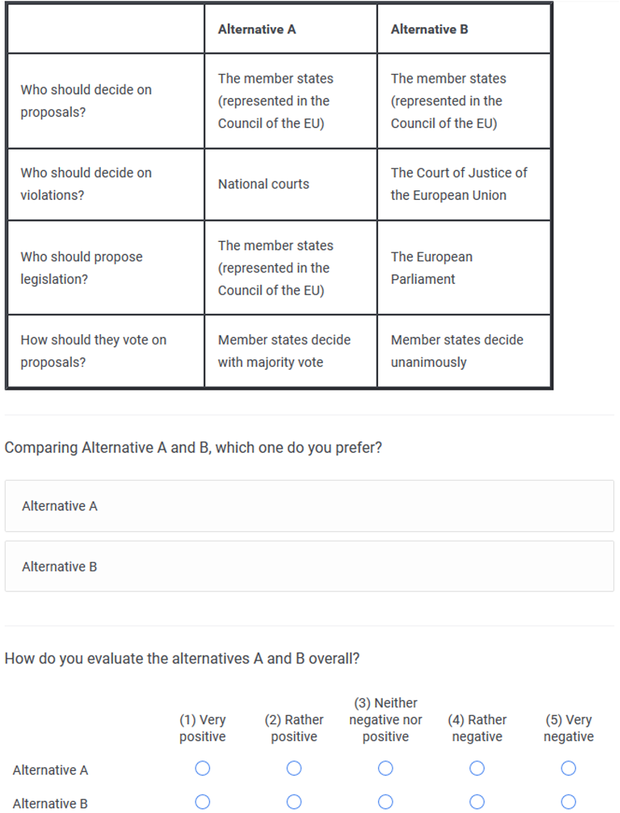
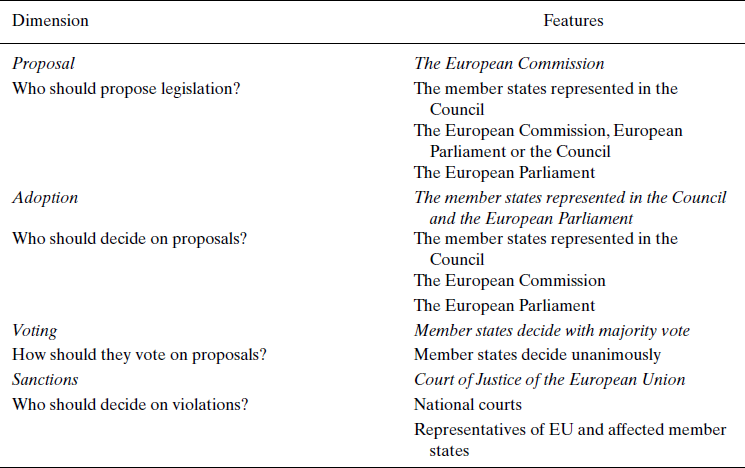
Relating to the literature on EU decision making, we distinguish between four main dimensions: proposal, adoption, voting rule and sanctioning. Following a short background introduction and the instruction about the conjoint task, we show respondents a screen with profiles of two institutional designs of EU decision making, as displayed in Figure 1. Table 1 provides a list of all institutional dimensions and their potential values.Footnote 8 We ask each respondent to evaluate four comparisons between two institutional design profiles. In each comparison, we use two questions to measure multidimensional preferences toward institutional designs. The first question asks respondents to report a preference for one of the two profiles. This question has the advantage that it forces respondents to focus on the attributes that make them support institutional designs (Hainmueller et al. Reference Hainmueller, Hopkins and Yamamoto2014). As an alternative measure for a robustness check, we also ask respondents to rate each institutional profile on a five‐point scale. We use these ratings to code a binary variable as 1 if the rating is above the midpoint and 0 otherwise.Footnote 9
Experimental design. [Color figure can be viewed at wileyonlinelibrary.com]

Dimensions of conjoint experiment

The survey experiment was fielded in 13 EU member states from December 2017 to March 2018. We recruited 13,000 respondents (about 1,100 respondents per country) from 13 EU member states that largely represent different characteristics of the current 28 member states using Survey Sampling International (SSI) (see Figure A3 in the Online Appendix). The sample includes Austria, the Czech Republic, Denmark, France, Germany, Greece, Hungary, Ireland, Italy, the Netherlands, Poland, Spain and Sweden. SSI recruits panel members through various opt‐in methods (including website banners, television advertisements, e‐mails, apps, social media and websites) and employs a probability‐weighted random process to select panel members. For our study, quotas were established based on respondent age and gender to ensure that the sample was representative of each country. The sampling algorithm continued to recruit SSI participants until all quotas were reached.
This sample design is important to serve our goal of obtaining a more comprehensive evaluation of individuals’ multidimensional attitudes toward EU decision making and public support for institutional reform in the EU. We are interested in estimating treatment effects that may differ due to a broad range of individual‐level factors for which non‐probability samples may be less representative. As an additional robustness check, we also re‐estimated our models by using entropy balancing (Hainmueller Reference Hainmueller2012) to reweight our sample to match the demographic margins from the population (see Figure A4 in the Online Appendix).
Our research design and data allow us to examine how specific attributes of EU decision making generate public support or opposition, and how public preferences over institutional reform vary across different EU member states. Moreover, our experiment enables us to assess our central argument, juxtaposed with existing explanations that emphasise different individual‐level attributes. To this purpose, we also include a series of questions to measure the respondents’ utility calculations, national attachment, information and other factors to evaluate plausible mechanisms to explain our findings.
Results
To explore the structure of public support for institutional reform, we first examine whether and how specific features of EU decision making shape public attitudes. To answer this question, we follow the approach proposed by Hainmueller et al. (Reference Hainmueller, Hopkins and Yamamoto2014) and estimate the average marginal component effects (AMCEs) of the decision‐making attributes, using their regression‐based estimator. The AMCE expresses the average effect of an institutional attribute on the probability that an individual supports the institutional design, where the average is computed on the basis of all the other attributes. We estimate the AMCEs by regressing the binary choice variable on indicator variables for the levels of the attributes. For all estimations, we calculate clustered standard errors by respondents because they participate in four conjoint comparisons. When we assume that there are no carryover, profile‐order, or randomisation effects, the AMCE can be nonparametrically identified. The Online Appendix includes additional material on the robustness and validity tests. We also analyse the data using an alternative specification of the dependent variable and we implement diagnostic tests to check the main assumptions of our analysis (see the Online Appendix).
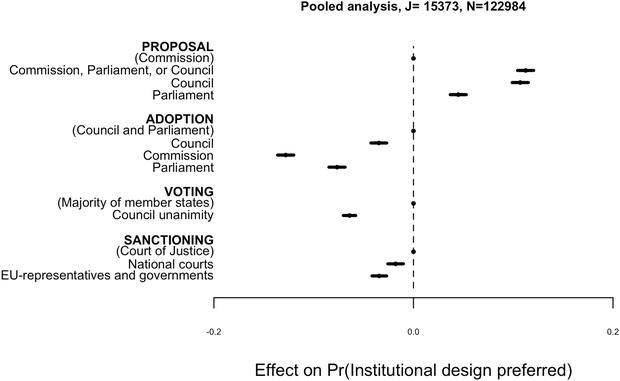
The effects of the institutional designs on the probability of public support, pooling across all respondents, are plotted in Figure 2. The AMCE estimates are the dots and the lines show the confidence intervals. The experiment considers the dimensions of proposal, adoption, voting and sanctioning. Note that the estimates for each institutional attribute are calculated relative to a reference value. Capturing the status quo in EU decision making, the reference category for the dimension of proposal is ‘the Commission’, and for the dimension of adoption the reference is ‘the Council and the European Parliament’. The estimates on different voting rules use ‘majority voting’ as a reference category and the estimates on sanctions take the ‘Court of Justice’ as a reference.
Effects of institutional attributes on the probability to prefer an institutional design.
Notes: Pooled analysis. J = 15373; N = 122,984. The figure illustrates estimates of the effects of the randomly assigned institutional attributes on the probability of being preferred. The bars capture 95 per cent confidence intervals. The points without horizontal bars refer to reference categories.

The results demonstrate that specific institutional designs of EU decision making significantly shape public support. European citizens oppose the Commission's exclusive proposal power, while they prefer the existing bicameral procedure and majority voting. Interestingly, different from common expectations, the empowerment of the EP does not always increase public support. On the other hand, we find that European citizens’ support for the existing CJEU is higher than that for national courts as an alternative reform option. Further enhancement of public support can be made only in the institutional dimension involving proposal power. These results also hold for the alternative rating measure.Footnote 10
In our rating measure, respondents can support both proposals, oppose both or support/oppose only one or the other. Thus, this collection of ratings allows us to specify the extent to which institutional designs shape public support. We differentiate respondents who vary their support as a function of the specific institutional design from those who categorically reject or accept all proposals that they are asked about, regardless of the attributes of the proposals. We find that only about 2 per cent of the respondents categorically oppose all eight institutional designs presented to them, and about 8 per cent of the respondents categorically support all institutional proposals. In contrast, about 90 per cent of the respondents vary their support as a function of the specific institutional designs.
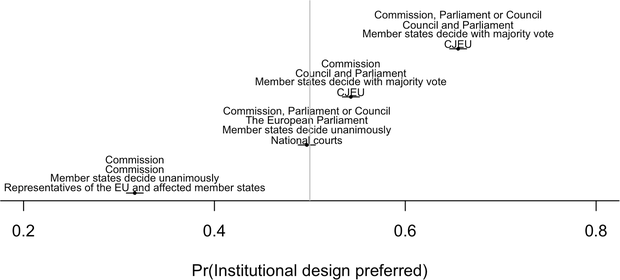
To represent the substantive implications of our results for institutional reform, we plot the expected public support for four different institutional designs in Figure 3. As we force the respondent to choose one of the two institutional designs, the baseline probability of choosing a randomly drawn institutional proposal is 0.5 where the expected public support for the third (from the top) institutional design (proposal: Commission, Parliament or Council; adoption: Parliament; voting rule: unanimity vote; sanctioning: national courts) is located. The first institutional reform proposal (proposal: Commission, Parliament or Council; adoption: Council and Parliament; voting rule: majority vote; sanctioning: CJEU) located at the top captures an institutional design that wins the highest support of 66 per cent of the respondents, while the fourth institutional reform proposal at the bottom reflects the institutional design that wins the lowest support of 32 per cent. Another institutional design that captures the existing structure of EU decision making (proposal: Commission; adoption: Council and Parliament; voting rule: majority vote; sanctioning: CJEU) wins support of 54 per cent of the respondents. Together, while our results suggest that specific institutional design can have a critical effect on public support, they also highlight the upper bound of public support that institutional reform can generate. Indeed, there exists no institutional reform that can garner more than public support of 66 per cent.
Expected public support for an alternative institutional design.
Notes: The figure illustrates estimates of public support for alternative institutional designs. The bars capture 95 per cent confidence intervals. Note that the baseline probability of choosing a randomly drawn institutional profile is 0.5 as we force the respondent to choose one of the two profiles.

Country‐specific results
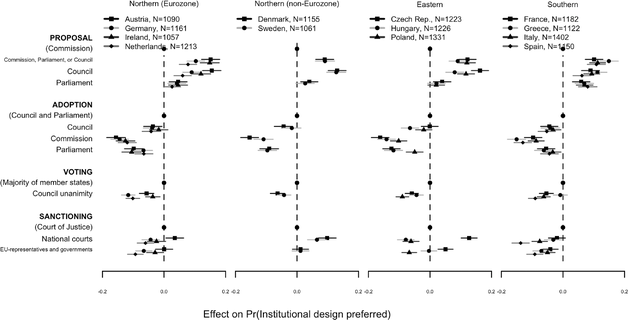
From a comparative perspective, our analysis allows us to examine country‐specific evaluations of institutional designs, which may be hidden in our pooled analysis. In particular, we further examine whether the reform preferences follow a similar pattern across the 13 EU member states. The 13 surveyed countries vary significantly with regard to several potentially relevant factors for structuring public preferences over the EU decision‐making process, such as the size of the population, their economic strength, government position on the EU, and other political and social conditions that influence their positions in the EU. Despite these differences, the institutional preferences show a similar pattern, except in one dimension, which involves actions against member states that fail to implement EU law. In Figure 4, to facilitate an overview, we group our country‐specific findings into four EU regions: Northern Eurozone, Northern non‐Eurozone, Eastern and Southern countries.Footnote 11
Effects of institutional attributes across country.
Notes: The figure illustrates estimates of the effects of the randomly assigned institutional attributes on the probability of being preferred. The bars capture 95 per cent confidence intervals. The points without horizontal bars refer to reference categories.

Figure 4 shows that there exists a notable consensus among European citizens in different countries on which institutional reform is preferred, regarding the three dimensions: proposal, adoption and voting rules. It is notable that respondents across all countries show broad opposition to the Commission's exclusive proposal power, while they prefer the existing bicameral procedure and majority voting. In contrast, we find that there exists dissent over the sanctioning dimension among respondents in different EU member states. Specifically, respondents in Austria, the Czech Republic, Denmark and Sweden prefer national courts, while the other countries prefer the existing CJEU. This dissent suggests that the dimension of sanctioning can be the potentially most contentious issue of debate over institutional reform, which needs to be ratified in all member states.
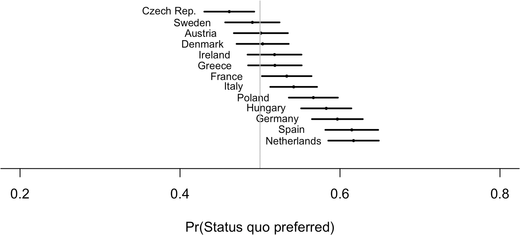
To better understand the structure of public support, we specify and compare aggregate levels of public support for the existing EU decision‐making process and respondents’ most preferred institutional designs in the 13 surveyed countries. Figure 5 shows that there is country‐specific variation in the level of support while respondents in the majority of the surveyed member states are relatively supportive of the institutional design that is the most similar to the current EU decision‐making process (proposal: the Commission adoption: Council and Parliament; voting rule: majority vote; sanctioning: CJEU), given that the highest level of public support that can be achieved through institutional reform is 66 per cent (refer to Figure 2). The respondents in the Netherlands show the highest level of public support for the existing institutional design followed by Spain and Germany, while the Czech Republic shows the lowest, followed by Sweden and Austria.
Expected public support for the existing institutional design by country.

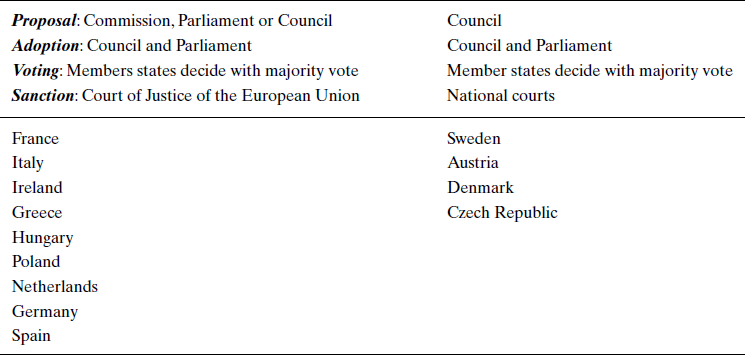
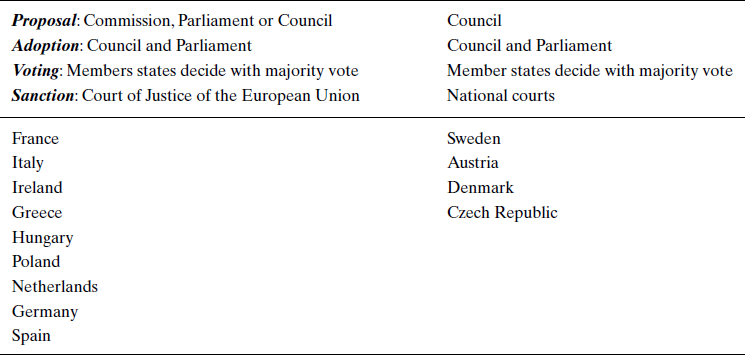
Moreover, we identify the institutional designs that are the most preferred by respondents in 13 countries. Table 2 reveals that there are two distinct institutional designs that the respondents in the surveyed countries support the most. Interestingly, respondents’ preferences for institutional reform are grouped into two distinct types, which feature alternative approaches to EU decision making in the dimensions of proposal and sanctioning. As in the previous analysis, we find broad support for the existing bicameral procedure and majority voting in both groups. Both groups also oppose the Commission's existing proposal monopoly, but with different reform alternatives. However, the difference in two groups’ preferences for competitive agenda‐setting (by the Commission, the Council or the EP) over the Council's exclusive agenda‐setting is not statistically significant. In contrast to these dimensions, we find a notable dissent about the sanctioning dimension among respondents in different EU member states. Specifically, respondents in Austria, the Czech Republic, Denmark and Sweden prefer national courts, while those in the other countries prefer the CJEU. Moreover, this difference in preferences for the CJEU over national courts is substantively large and statistically significant (see the Online Appendix).
Most preferred institutional designs by country
Do the effects of the institutional attributes vary depending on the other dimensions of EU decision making? For example, we might expect that respondents’ preferences for a certain attribute in the adoption dimension can depend on the institutional attribute in the proposal dimension. However, we find no substantively meaningful interactions among different combinations of the institutional attributes, regardless of the alternative methods of analysing the possible interactions (see the Online Appendix). The lack of interaction suggests that our findings hold across alternative designs of the EU decision‐making process.
Interactions with respondent characteristics
Our empirical design allows us to assess the robustness of our main findings and examine possible interactions between institutional attributes and respondents’ characteristics. In particular, most of the existing studies on EU attitudes have stressed the importance of key individual‐level attributes such as individuals’ utilitarian evaluations of the EU benefits, national attachment, political knowledge and the position of the parties they support, among others, in explaining attitudes toward the EU.
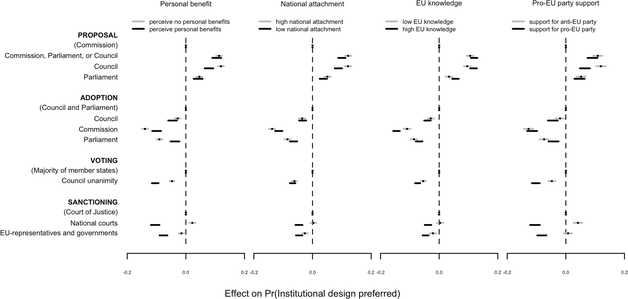
To examine the impact of key individual‐level attributes toward EU decision making, we follow the suggestions of Hainmueller et al. (Reference Hainmueller, Hopkins and Yamamoto2014; see also Hainmueller & Hopkins Reference Hainmueller and Hopkins2015). Specifically, we split the sample and estimate the average of the institutional attribute's marginal effect conditional on the respondent characteristic of interest, which is called the ‘conditional AMCE’.Footnote 12 This approach enables us to compare the effects of different institutional characteristics across subsets, as shown in Figure 6.
Effects of institutional attributes on the probability to prefer an institutional design across subgroups of respondents.
Notes: The figure illustrates estimates of the effects of the randomly assigned institutional attributes on the probability of being preferred. The bars capture 95 per cent confidence intervals. The points without horizontal bars refer to reference categories.

Overall, we find that the effects of the institutional attributes are broadly similar across the different subgroups, except in one dimension: sanctioning. It is clear from the current analysis that most of our major findings, particularly regarding how a proposal is made, adopted and voted on, stay the same, regardless of whether respondents perceive more benefits from the EU or not, whether they have national attachment or not, and whether they have sufficient knowledge about the EU or not.Footnote 13 If anything, the positive effect of institutional reform in the direction of intergovernmentalism (such as the empowerment of the Council in the proposal dimension), or the negative effect of the reform toward supranationalism in the adoption dimension is relatively stronger among those who perceive fewer benefits from the EU and who support anti‐EU parties. Similarly, the negative effect of institutional reform in the direction of intergovernmentalism in the voting rule is much stronger among those who perceive more benefits from the EU and who support pro‐EU parties. With respect to these three dimensions (proposal, adoption and voting rule), national attachment and knowledge about the EU play a relatively limited role in moderating the effects of institutional attributes. However, despite these meaningful implications of intergovernmental and supranational features for public support, the institutional preferences follow a similar pattern across key subgroups and different EU countries.Footnote 14 In particular, given that people are unlikely to possess detailed knowledge of EU institutions and how they work, it is notable to find that there exists a striking consistency across different member states and key individual‐level characteristics that account for public attitudes toward EU decision making. Our results confirm that public attitudes toward EU decision making are structured in a systematic way.
However, there is an important exception to this effect homogeneity: Figure 6 shows that respondents who do not perceive personal benefits of the EU and support Eurosceptic parties are more likely to prefer national courts than the CJEU. Indeed, national courts are the least preferred option for respondents who perceive positive benefits from the EU and who support pro‐EU parties, while they are the most preferred option for those who do not perceive these benefits and those who support Eurosceptic parties. The effect of the sanctioning institution on public support significantly changes as a function of respondents’ utility calculations and party support. Such economic and political considerations may also help us to understand the country‐specific variation where Austria, the Czech Republic, Denmark and Sweden, in contrast to the other member states, prefer the approach that grants sanctioning power to national courts.
Concluding remarks
In this study, we evaluate specific institutional designs that determine public attitudes toward EU decision making. In the post‐Maastricht period, there have been ongoing discussions of institutional reforms that can address declining public support and the democratic deficit of EU decision making. Most reform proposals include, for example, the empowerment of the EP that can provide an ‘electoral connection’ in European integration (Carrubba Reference Carrubba2001; Follesdal & Hix Reference Follesdal and Hix2006). Nevertheless, studies of public attitudes toward the EU have mostly focused on individual‐level factors such as citizens’ utilitarian assessment of the EU, national attachment, political knowledge and their party support.
Based on a large‐scale cross‐national survey in 13 EU member states, we combined insights from the institutional literature on EU decision making and behavioural studies on EU attitudes. We evaluated whether and how the specific design of EU decision making shapes public support. For this purpose, we designed a novel cross‐national conjoint experiment to estimate the multidimensionality of public attitudes by taking into account the specific roles of the institutions at distinct stages of EU decision making. We find that the specific design of decision making significantly shapes public support. Interestingly, there exists a notable consensus about preferred institutional reform among European citizens in different countries, except in one dimension, which involves actions against member states that violate or fail to implement EU law.
Respondents across all surveyed countries indeed prefer the existing bicameral procedure and majority voting in EU decision making, while they show broad opposition to the Commission's exclusive proposal power. This finding varies neither across countries nor respondents’ key characteristics such as their perceived benefits of the EU, national attachment, political knowledge and party support. In contrast, we find notable dissent over the dimension of sanctioning power, which may impede the success of institutional reform. In particular, respondents in Austria, the Czech Republic, Denmark and Sweden prefer national courts, while those from other countries prefer the existing CJEU as a sanctioning institution. On closer inspection, this dissent over the sanctioning institution is largely driven by respondents’ utilitarian assessments of their EU benefits and political parties they support. In contrast, individuals’ level of knowledge about the EU and national attachment are only weakly associated with their stance on institutional reform. To further check the robustness of our findings, we conducted a series of additional analyses and validity tests using an alternative specification of the dependent variable and diagnostic tests to check the main assumptions of our analysis.
Our results highlight the underlying nature of public support for EU decision making and institutional reform. Until now, the literatures on EU institutions and public attitudes have been developed in isolation from each other. The institutionalist literature has outlined the multidimensionality of EU decision making and the effects of the power distribution on outcomes, without carefully considering their implications for public support. Behavioural research has largely adopted utilitarian, identity and informational accounts that focus on relatively fixed, pre‐defined individual attributes to explain public attitudes toward the EU, often measured by either abstract/broad support for EU membership or trust in individual EU institutions. Our analysis investigated the multidimensionality of public attitudes toward EU decision making by taking into account the specific powers of EU institutions and the distinct dimensional stages in the decision‐making process.Footnote 15 Given the multidimensionality of EU decision making, our findings suggest that the aggregate level of public support for institutional reform would vary depending on the specific design and the reform dimension which prevails in the dynamic process of public debate. Some reform dimensions, such as the distribution of proposal power, adoption and voting rules generate a relatively large consensus, while in particular, the dimension of sanctioning power may raise public controversies. This finding may also provide insights into the discussion of institutional reform in the EU by specifying the extent to which institutional reform can shape public support.
The findings of this study have important implications that contribute to the broader literature in political science. Democratic institutions require broader public support to be politically sustainable and effective. While most often used in the context of the EU, the issue of democratic deficit and democratic legitimacy has been increasingly contested in both domestic and international institutions. Evaluations of democratic deficit focus on the procedural aspects of democracy, reflected in the mechanisms of decision making, and institutional reforms have been proposed as a popular solution. With respect to the central question of whether and to what extent institutional design affects public support and eventually legitimacy,Footnote 16 our study first shows that the public's institutional preferences are stable and well‐structured, in contrast to the traditional and pessimistic view of public opinion. If public attitudes are random or unstructured, or if they are simply a reflection of positions of political parties or the media, the public's ability to constrain policy makers would be limited.Footnote 17 Moreover, we find that public support systematically varies according to the specific design of decision making and institutional features. Researchers have made significant progress over the past years in exploring how well‐known institutional features affect citizens’ attitudes and behaviour. However, most of the existing studies are limited to either estimating the composite effects of broad institutional arrangements, or the effects of individual institutions that are often confounded with other correlated components. Our study incorporates the institutional framework that characterises the multidimensionality of the decision‐making process, which involves the interactions of multiple actors with different roles at distinct stages. In particular, we believe that conjoint analysis is particularly useful for decomposing the composite effects of various institutional arrangements. We demonstrated how conjoint experiments can identify various component‐specific causal effects by randomly manipulating multiple attributes of institutional alternatives simultaneously. Future research may extend this method to advance our understanding of the multidimensional nature of democratic institutions and processes and the dynamic interactions of institutional context and political behaviour.
Online Appendix
Additional supporting informationmay be found in the Online Appendix section at the end of the article:
Table A1: Descriptive information on variables
Table A2: Response patterns
Figure A1: Computing Average Component Interaction Effects (ACIEs) for first‐order interaction effects among the four dimension.
Figure A2: Subgroup‐specific difference in conditional AMCEs.
Table A3: Official demographic statistics from Eurostat (2018), compared to the sample distribution
Figure A3: Country representativeness by dimension.
Figure A4: Before and after entropy balancing.
Figure A5: AMCEs estimated separately for two cases: whether a profile is shown first (on the left) or second (on the right).
Figure A6: Analysis split by successive rounds.
Table A4: Balance tests using (multinomial) logit models to regress shown attributes on respondent characteristics
Figure A7: By consistency of answer patterns.
Figure A8: By reading check.
Figure A9: By response speed.
Figure A10: Alternative dependent variable I: Binary coding of rating scale.
Figure A11: Alternative dependent variable II: Ordinal coding of rating scale.


 Open access

