





Introduction
Family members of cancer patients are known to experience various stresses following a diagnosis of cancer in a relative. As a result, psychological issues such as depression and suicide attempts (Braun et al. Reference Braun, Mikulincer and Rydall2007; Ishida et al. Reference Ishida, Ooya and Kawanishi2026) and physical issues such as loss of appetite (Onishi et al. Reference Onishi, Ishida and Uchida2019) have been reported. Therefore, family members are referred to as “second patients” and are considered subjects of treatment and care (Lederberg Reference Lederberg and Holland1998).
Among these, families of adolescent and young adult (AYA) cancer patients experience particularly high stress due to issues such as the child’s developmental stage, academic challenges, and social adaptation. As a result, psychological problems such as depression and physical symptoms such as fatigue and loss of appetite are known to occur (Reuvers et al. Reference Reuvers, Gedik and Way2023).
Loss of appetite is related to nutritional problems, and one condition to watch for in this context is thiamine deficiency (TD). Thiamine is an essential coenzyme for carbohydrate metabolism; however, as physiological stores last only about 18 days, deficiency can easily develop if appetite is reduced for 2–3 weeks (Sechi et al. Reference Sechi, Sechi and Fois2016). A neuropsychiatric disorder that can result from prolonged TD is Wernicke encephalopathy (WE). The classical clinical triad consists of mental status changes, ocular abnormalities, and incoordination of gait, but these symptoms are not disease-specific. Moreover, only 16% of patients pathologically diagnosed with WE present all 3 classical signs, while 19% show none of them, making WE a frequently overlooked condition. Considering that families of AYA cancer patients often experience depression and appetite loss during caregiving (Reuvers et al. Reference Reuvers, Gedik and Way2023), it is plausible that some may develop TD, yet no cases have been reported to date.
At our hospital, we have established a family outpatient clinic for relatives of cancer patients, addressing the physical and psychological challenges they face (Ishida and Onishi Reference Ishida and Onishi2021; Ishida et al. Reference Ishida, Uchida and Yoshioka2022). Here, we report a case of TD observed during the treatment course of a mother caring for her AYA son with leukemia who attended this family clinic.
Case report
The patient was a 49-year-old woman, whose son was diagnosed with acute myeloid leukemia 20 months earlier and achieved remission after chemotherapy. However, relapse occurred 8 months ago, and he underwent chemotherapy again, followed by hematopoietic stem cell transplantation after achieving second remission. He subsequently developed severe acute graft-versus-host disease, and despite treatment, his overall condition worsened. The hematologist repeatedly provided the mother with detailed explanations of the serious nature of her son’s condition. The mother visited the ward daily to care for her son and witnessed him having a seizure during a visit. Following this event, she reported experiencing flashbacks of the seizure. Concerned about the mother’s mental state, the hematologist referred her to the psycho-oncology family outpatient clinic (Ishida and Onishi Reference Ishida and Onishi2021).
At the initial visit, she reported recurrent memories of her son’s seizure and expressed anxiety about his physical and mental condition. Her psychiatric profile met the Diagnostic and Statistical Manual of Mental Disorders, 5th edition text revision, criteria for adjustment disorder with anxiety (American Psychiatric Association 2022).
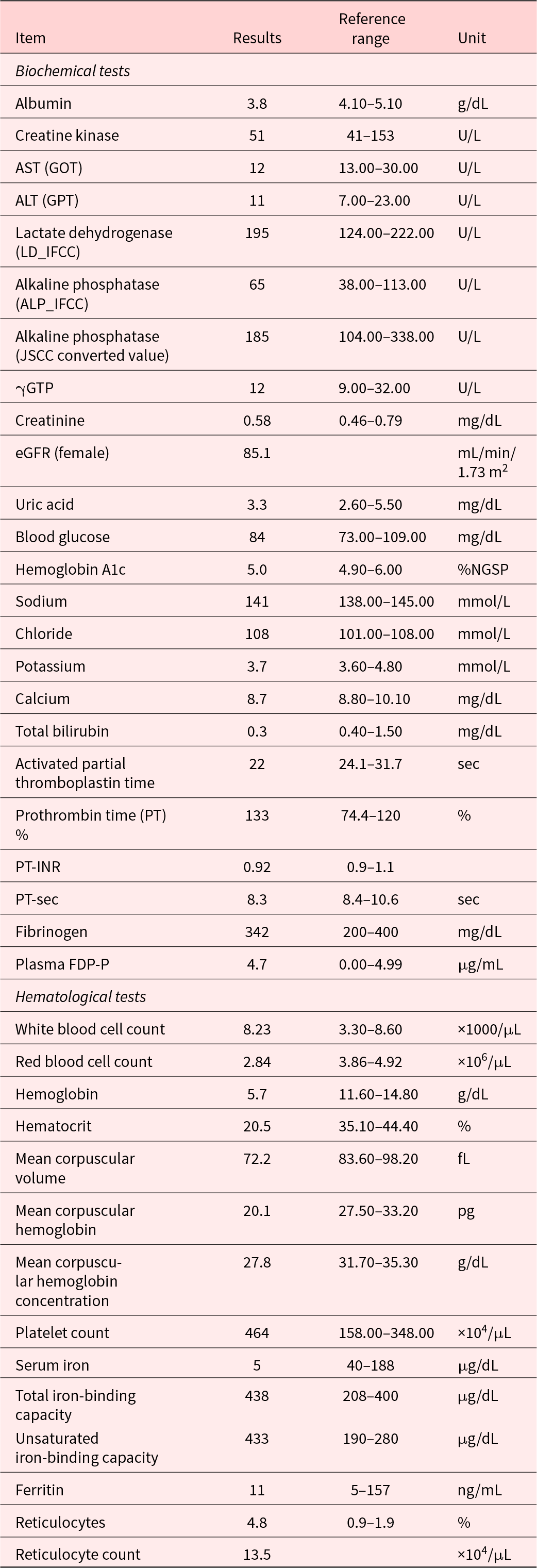
Regular outpatient visits continued thereafter. Thirteen months after the initial visit, she continued visiting the hospital daily to care for her son. During outpatient visits, she reported palpitations and shortness of breath after hearing the attending physician’s explanations of her son’s condition, and she also experienced difficulty climbing stairs. Given these mental and physical symptoms, and considering previous reports of TD in family members of cancer patients (Onishi et al. Reference Onishi, Ishida and Uchida2019), blood tests including thiamine were performed to assess her overall condition, revealing a markedly low hemoglobin level of 5.7 g/dL (Table 1). Further anemia workup showed low serum iron at 5 μg/dL (reference range: 40–188 μg/dL), elevated unsaturated iron-binding capacity at 433 μg/dL (reference range: 190–280 μg/dL), and ferritin at 11 ng/mL (reference range: 5–157 ng/mL), near the lower limit of normal. Endoscopic examination of the upper and lower gastrointestinal tract revealed no abnormalities. Gynecological evaluation identified uterine fibroids, raising suspicion of anemia due to menorrhagia. Treatment with iron supplementation and pseudo-menopausal therapy led to improvement in anemia.
Patient blood chemical findings

Table 1 Long description
Blood chemistry and hematology results are listed with reference ranges and units. Hematology shows marked anemia: red blood cells 2.84, hemoglobin 5.7, and hematocrit 20.5, all well below range, with low mean cell volume 72.2 and low mean cell hemoglobin 20.1 indicating microcytosis and hypochromia. Iron studies support iron deficiency: serum iron 5 is very low, while total iron-binding capacity 438 and unsaturated iron-binding capacity 433 are above range; ferritin 11 is low-normal. Platelets are elevated at 464, and reticulocytes are increased at 4.8, suggesting a marrow response. White blood cell count 8.23 is within range. Most biochemical tests are within range, but albumin 3.8, calcium 8.7, total bilirubin 0.3, and AST 12 are slightly below their reference ranges; chloride 108 is at the upper limit. Coagulation results show shortened activated partial thromboplastin time 22 and elevated prothrombin time percent 133, while PT-INR 0.92 is within range and PT seconds 8.3 is slightly low. Estimated glomerular filtration rate is 85.1 with no reference range provided, so interpretation depends on local lab standards and clinical context.
Five days later, thiamine was found to be low at 19 ng/mL (reference range: 24–66 ng/mL) (Table 2). She was administered 75 mg of thiamine orally and did not subsequently develop any symptoms or signs of WE. One month later, blood tests showed the thiamine level had increased to 151 ng/mL.
Vitamin data

Table 2 Long description
Vitamin measurements are listed for Vitamin B1 and Vitamin B12, each with a reported value, a reference interval, and units. Vitamin B1 is 19 ng/mL, which is below the reference interval of 24.0 to 66.0 ng/mL. Vitamin B12 is 217 pg/mL, which falls within the reference interval of 180.0 to 914.0 pg/mL. Compared with their respective ranges, B1 is the only result outside the interval and may indicate a low B1 status. Interpretation should consider clinical context, symptoms, and that reference intervals can vary by laboratory and testing method.
When asked about her recent dietary intake, the mother reported that her appetite decreased whenever her son’s overall condition worsened, and she had been so focused on caring for him that she had paid little attention to her own meals. She also noted that even when she felt unwell, she attributed it to fatigue from caregiving.
Discussion
TD was identified in a family member caring for an AYA leukemia patient, and appropriate treatment successfully prevented the progression of TD-related symptoms.
Repeated distressing updates regarding the child’s condition caused significant stress for the mother, resulting in decreased appetite. However, because she was fully devoted to caring for her son, she was unable to attend to her own nutritional needs, which likely led to TD. It is therefore unsurprising that caregivers of children with life-threatening cancer may become unable to attend to their own mental and physical condition, and may attribute their own ill health solely to caregiving fatigue. Accordingly, comprehensive assessment (psychological, physical, social, and existential) should also be provided to family members caring for AYA cancer patients.
In this case, TD was suspected because she developed difficulty climbing and descending stairs (Onizawa et al. Reference Onizawa, Ishida and Uchida2022), together with prior reports of TD in family members (Ishida et al. Reference Ishida, Uchida and Yoshioka2022). However, given the markedly low hemoglobin level, the symptoms affecting stair ambulation may have been attributable to anemia, or to a combination of anemia and TD. Both conditions may, in turn, reflect generalized malnutrition arising from chronic reduced intake linked to caregiving stress. In any event, this case underscores the need for regular physical assessment not only of patients but also of their family caregivers.
Conclusion
We identified TD in a parent caring for an AYA cancer patient. Parents of AYA patients are profoundly affected both physically and mentally by their child’s illness. As they often prioritize caregiving over their own well-being, they may be unaware of their physical or psychological deterioration. Prolonged loss of appetite could easily lead to TD. Going forward, attention should be paid to the nutritional status of family caregivers of AYA cancer patients, as this may contribute to improving quality of life (QOL) for both patients and their families.
Acknowledgments
This work was supported by JSPS KAKENHI Grant Number JP25K08983.


 Open access

