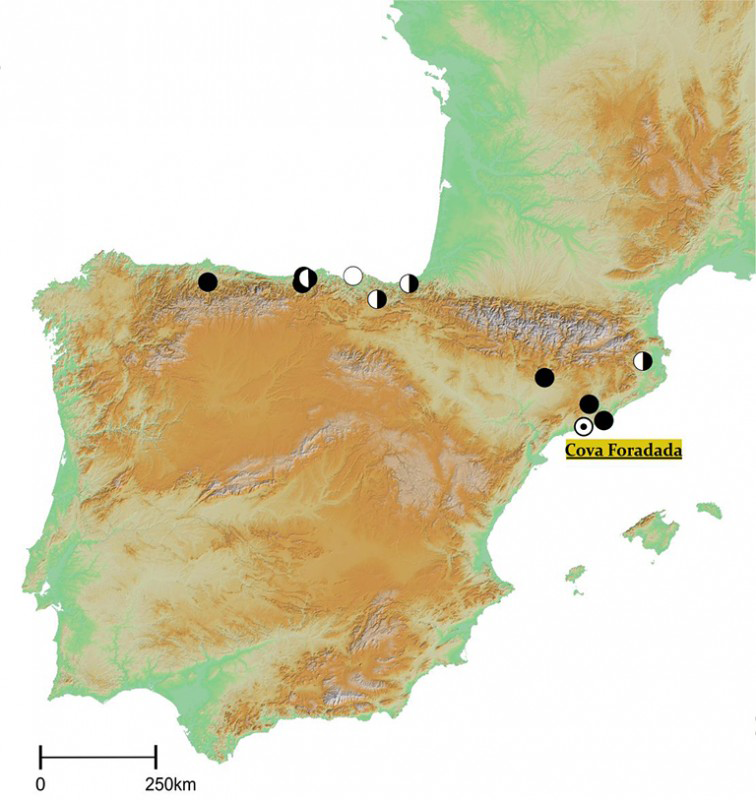


Foradada Cave (Calafell, Tarragona, Spain) is a small karstic system developed in the biomicritic calcarenites of the littoral Mediterranean ranges in north-eastern Iberia, 50km south of Barcelona (Figures 1 & 2).
Location of Cova Foradada and the main Middle–Upper Palaeolithic sites in the Iberian Peninsula. Black dots are sites with Early Upper Paleaeolithic evidence; white dots are sites with transitional layers; black-and-white dots indicate the presence of both complexes.

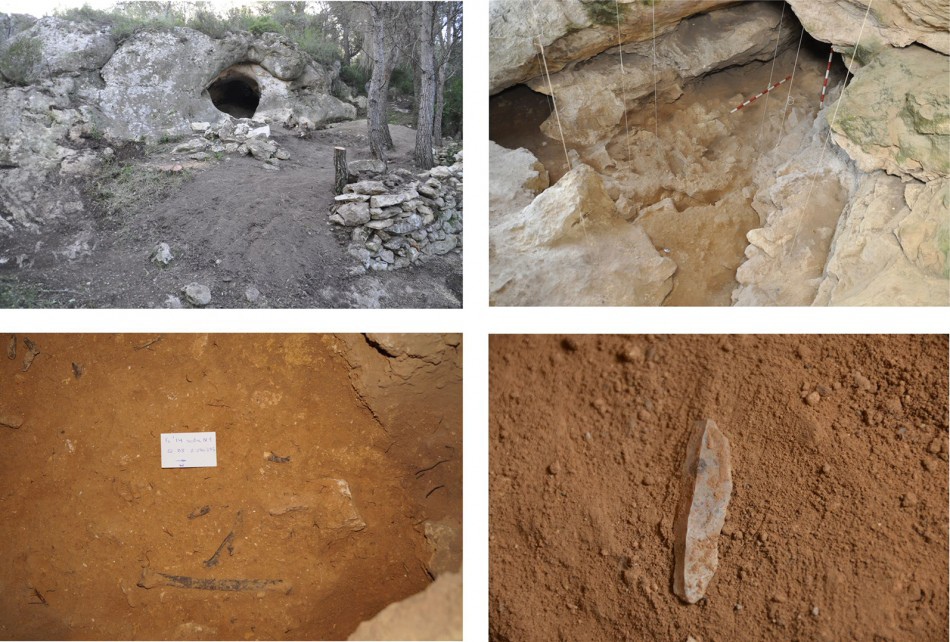
Views of the Cova Foradada and in situ finds.

The accidental discovery of the remains of a third-millennium BC collective burial in the cave led to the launch of an archaeological project in 1997. To date, 12 non-consecutive field seasons have been carried out within the main chamber of the system: a small space of 10–12m2. During this time, including the most recent 2015 field season, a complex 3m-thick stratigraphy has been uncovered. This sequence displays a succession of evidence for human use of the cave for funerary practices during the third millennium and Early Neolithic (layers IA and IB), and a succession of very brief human activities during the Late Magdalenian (layer II) and between, at least, Heinrich events three and four.
The earliest evidence of human frequentation has been documented in the litho-stratigraphic layers III-n, III and IV (top to base). Layer III-n has been only partially preserved in a small sector of the cave with excavations of about 2m2. A perforated and ochred shell of Homalopoma sanguineum provides a first approximation of the layer chronology to 30–31 kyr cal BP.
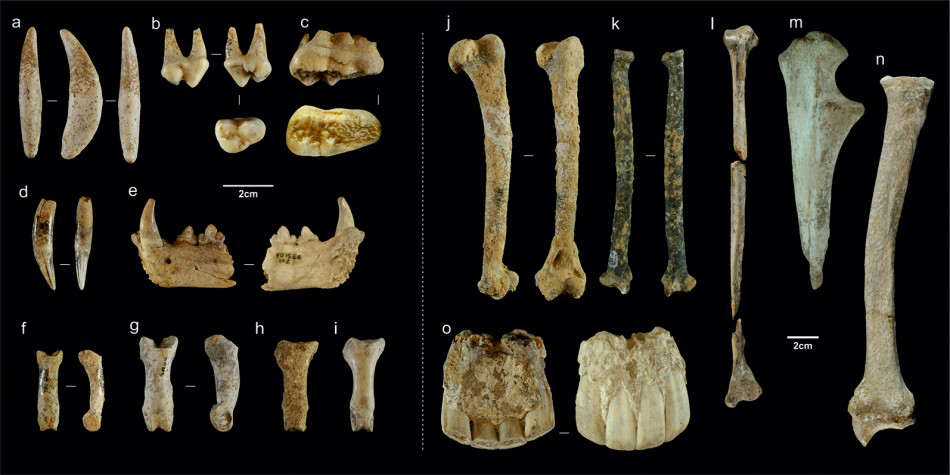
Faunal remains from Cova Foradada lower layers: wolf (a); brown bear (b & c); lynx (d, e, f, j, k); leopard (g & l); spotted hyena (m & n); large birds of prey (h& i); and horse (o).

Layers III and IV display greater integrity and are almost continuous across the cave’s full extent. Both stratigraphic units indicate the dominant presence of carnivores, where the Lynx sp. seems to be the main agent of bone accumulation and modification, notwithstanding skeletal remains of Crocuta crocuta, Panthera pardus, Canis lupus, Vulpes vulpes and Ursus arctos and abundant large raptors that have also been identified (Figure 3). Despite this pattern, at least two brief and isolated anthropic impacts can be identified: one corresponding to the mid-phase of layer III, and the second to the top of layer IV. The first chronological reports locate the formation of layer III post-34kyr cal. BP.
New research is working on the characterisation of the human and carnivore activities evidenced in layers III and IV, first excavated during the 2013 field season, and a multi-method dating project is also underway. Preliminary data and techno-typological analysis seem to correlate layer III with the Early Aurignacian; this is the first such evidence in the south of the Pyrenean influence area since the excavation of the Abric Romani’s layer A, undertaken at the beginning of the twentieth century (Bischoff et al. 1988).
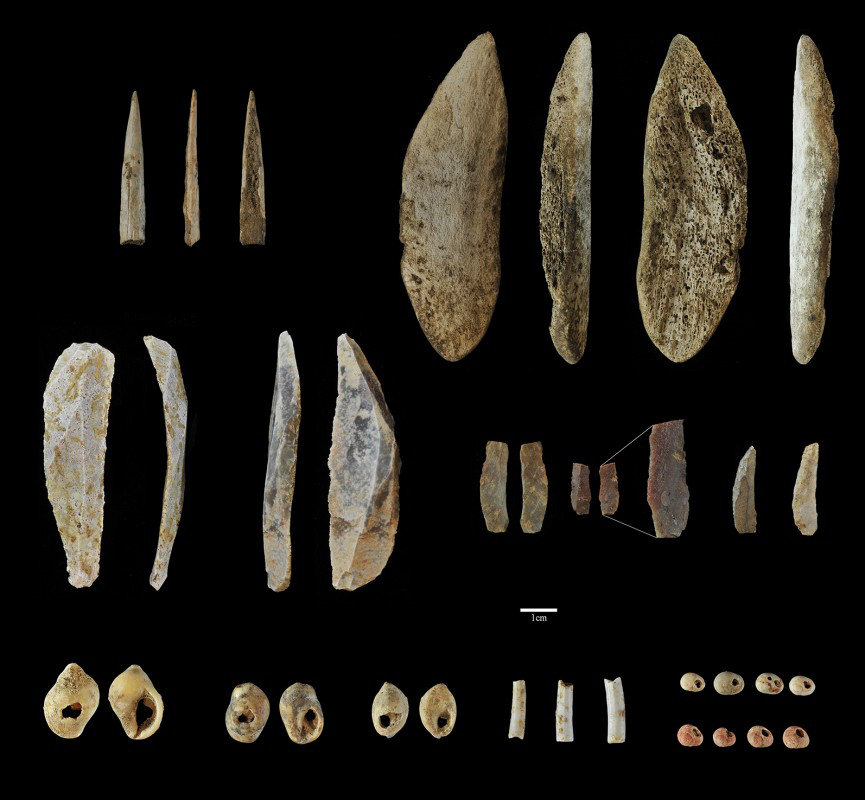
Archaeological finds dating to the Middle–Upper Palaeolithic transition.

In particular, the presence of two antler split-based points (SBP) reinforces the chrono-cultural attribution of layer III. There is a broad consensus that SBPs are associated with the Early Aurignacian (Liolios 1999; Tejero 2014; Tejero & Grimaldi 2015). Further, we have documented the longitudinal splitting procedure for the extraction of antler blanks. Although this practice is also associated with Gravettian contexts (Goutas 2004), this type of debitage is especially characteristic of the Early Aurignacian, and it is the only debitage procedure employed for obtaining the blanks on which the SBPs were produced during the Aurignacian (Tejero et al. 2012). These diagnostic features provided by the antler tools are also supported by the main characteristics of the scarce lithic remains, particularly the presence of twisted Dufour and backed bladelets and an Aurignacian-like endscraper (Figure 4).
The same regional features can be seen in the occupations of layer IV, producing some typological features closely related with the so-called transitional techno-typological traditions of the French and Cantabrian territories (cf. Chatelperronian; Zilhão 2013; Higham et al. 2014; Roussel & Soressi 2014; Hublin 2015), and with a stratigraphic position fully coherent with that possibility.
The Cova Foradada project provides new evidence for the Middle–Upper Palaeolithic transition in southern Europe and shows that it occurred across a broader territory than previously thought. The ongoing research will contribute to an understanding of how the replacement of Neanderthals by Homo sapiens occurred in areas outside the classic Franco-Cantabrian region, both in temporal and cultural terms, and will illuminate the kind of connections, if any, that existed with the Iberian Late Middle Palaeolithic populations.
More broadly, the results from Cova Foradada emphasise the necessity of locating other new c. 50–30 kyr BP stratigraphic sequences south of the Pyrenees, especially in the northern Mediterranean region. Only with survey intensification and the excavation of new sites will it be possible to understand how the isolated evidence of Cova Foradada and Abric Romaní fits into the wider picture of the Middle Palaeolithic decline and the expansion of the Upper Palaeolithic.
Acknowledgements
The Cova Foradada excavation is funded by the 2014/100482 project of the Culture Department of the Generalitat de Catalunya. Funds and support are also provided by the AGAUR projects 2014SGR-108 (SERP, Universitat de Barcelona, Josep M. Fullola) and 2014SGR-900 (IPHES, Manuel Vaquero), and by Spanish MINECO projects HAR2013-41197-P (Francesc Burjachs & Javier Fernández-López de Pablo) and HAR2014-55131 (Josep M. Fullola & José Miguel Tejero).