


Americans have never exercised any direct say over the way the federal courts are structured or operate. As a result, we know little about their preferences on such matters. In contrast, through voting on ballot measures, they have had many opportunities to shape the way state courts function. To gain insight into how Americans have viewed courts historically, I analyze votes on 364 measures targeting state courts of last resort that appeared on ballots between 1792 and 2024. By examining the debates that preceded votes on these measures, election results reveal the public’s preferences regarding court structures and operations by showing which arguments they found persuasive, which they rejected, and how their views changed over time.
I find that until the mid-twentieth century, voters grappled mainly with questions on the size of their courts of last resort and how much the justices should be paid. Debates on these topics balanced state budget considerations against concerns about court efficiency and effectiveness. Voters slowly and grudgingly agreed to add justices and to raise their pay. From the mid-twentieth century on, voter attention was redirected toward judicial ethics rules and regulations and the methods to be used to put people on the bench. Ethics measures proved popular with the public, but no consensus emerged on preferred selection schemes.
1. Data on ballot measures targeting state courts of last resort
Assembling the ballot measure data analyzed here involved gathering information from state websites, state statistical abstracts and manuals, official state election reports, annotated state constitutions, state session laws, state legislative journals, government and academic studies, and newspaper reports. Measures were included when their provisions affected the state court of last resort and would, if adopted, have a substantive impact on the way it was structured or operated. A few related propositions were excluded. Those to restructure state judicial systems by creating intermediate appellate courts or redesigning local courts were omitted because the court of last resort was not their primary focus. Measures dealing with the drawing of judicial districts were not included because they centered on partisan and regional considerations rather than court reform. Votes on new state constitutions were left out because it would be impossible to isolate the public’s stance on any specific changes proposed for the court of last resort.
The measures studied here appeared on ballots in forty-nine states. The exception was Delaware, which always permitted its legislature to amend the constitution without putting proposed changes to the voters. California and Nevada had the most measures, with eighteen, while Indiana, Kentucky, New Jersey, Tennessee, and Virginia each only had a single one. The median state had seven ballot measures.
Just under 90 percent of the measures were constitutional amendments placed on the ballot by the state legislature.Footnote 1 State constitutional conventions (and a Florida commission that spawned one measure) proposed 5 percent of them. Over half of the convention measures were concentrated in New Hampshire and Rhode Island.Footnote 2 The final 5 percent were direct democracy products, with most being constitutional amendments proposed by initiatives.
It matters that almost all the measures were generated by state legislatures. They reflected lawmakers’ presumably informed preferences regarding court reforms, and many voters may have deferred to the legislature because they thought lawmakers better understood the impact of the proposals than the general public did. Such an assumption is supported by an experimental study that found a legislature’s imprimatur on a ballot measure enhanced its electoral prospects, even when voters held the legislature itself in low esteem.Footnote 3 As a Georgian lamented about such measures, “The legislators vote for their passage because they say ‘its [sic] up to the people’ and the people who vote for their adoption say ‘the Legislators in their wisdom passed it.’”Footnote 4
Over 85 percent of the measures in the data set contained only a single major provision targeting court reform. This is expected because many states operated under rules that precluded offering proposals containing more than one major provision. Having only a single provision is analytically advantageous for this study because it makes isolating the public’s views on a proposal clear-cut. Multiple provisions complicate the analysis because it is problematic to parse how each provision played into voter decisions. The more provisions a measure contained, the more resistance it potentially encountered. In this study, those who had one major provision received a median vote of 60.5 percent, while those with two major provisions got 57.9 percent, and those with three or more earned 57.4 percent. Though the differences are slight, this relationship’s ordering makes sense. Commenting on an 1890 Colorado proposal, an editorial stressed that “Had the legislative assembly contented itself with passing a simple amendment permitting an increase of the supreme court judges, the CHIEFTAIN is confident there would have been no opposition, but they went so far as to provide not only should the supreme court judges be increased in number, but that their term of office and their emoluments of office might also be increased.”Footnote 5 Coloradoans rejected the measure. Such outcomes often compelled legislatures to split up complex proposals into separate propositions.Footnote 6 To be sure, on occasion, legislatures successfully tacked on an additional provision as a sweetener to entice voters to swallow a more controversial reform.Footnote 7 But that tactic did not guarantee success.
I contend that how voters arrived at their ballot measure decisions can be gauged by looking at the arguments for and against the proposals made in the period prior to election day. These were gathered from two sources. One was state voter pamphlets, a wellspring of ballot information found mostly in western states. They usually provided arguments for and against measures and can be assumed to have reached every household. Newspapers were the second source. I consulted only those published in the state where the measure appeared on the ballot. Editorials gave reasons for a paper’s stance on a measure. News stories often distilled the arguments offered by each side. Opinion columns, letters to the editor, and appraisals by civic and business organizations all furnished rationales for backing or opposing propositions.
2. The public’s preferences on state courts of last resort
Not much is known about attitudes regarding the way state courts of last resort are structured and operate. There have been occasional assessments of public support for them.Footnote 8 And attention has been given to the impact of public opinion on the justices’ decision-making.Footnote 9 But there has been little work examining what Americans think about matters involving state court structures and operations.Footnote 10
Some might question whether the arguments made for or against state ballot measures in voter pamphlets and newspapers should be used to gauge public preferences on such matters. Ballot measures asked voters to make concrete choices about court structures and operations. Their decisions had direct consequences for the institution. It is conceivable that there were some issues on which the public held prior stances, perhaps on judicial pay or ethics rules. But voters were unlikely to have established positions on most of the issues presented in ballot measures. The information provided in voter pamphlets and newspapers was likely advised by commentaries from the legal community and political figures. But the pamphlets and news items were the sources easily accessed by people, and the analyses they provided were presumably the basis on which voters made their ballot decisions. The votes they cast in support or opposition indicate which arguments they found persuasive and which failed to reflect their preferences. It seems reasonable to conclude that they revealed the rationales behind the voters’ decisions.Footnote 11
3. Court of last resort reform ballot measures, 1792–2024
The 364 court reform measures that appeared on state ballots between 1792 and 2024 contained a total of 432 major provisions. I sorted the provisions into three broad subject categories, each of which in turn was subdivided. The first broad category involves court structures and incorporates measures on how many members the court should have (64 provisions), the method by which justices should be put on the bench (67 provisions), and how vacancies were to be filled (18 provisions). The second broad category captures court service, including the term of office the justices were to serve (72 provisions), their compensation (74 provisions), and the ethics rules and procedures under which they were to operate (101 provisions). The final broad category centers on court operations, capturing how chief justices were selected and the powers accorded them (22 provisions), and how court clerks and administrators were picked (14 provisions).Footnote 12
Over time, the proportion of provisions that fell into each category and subcategory shifted. The period from 1792 to 1860 saw by far the fewest court reform ballot measures. That is expected because there were few measures of any sort during this time, largely because most state constitutions were left untouched. When amendments were needed, some states allowed the legislature to adopt them without giving the voters any say. If major revisions were required, the constitution was replaced.Footnote 13
Of the twelve ballot provisions targeting state courts of last resort during this period, four were put to New Hampshire voters in 1792. They were a small slice of the seventy-two amendments proposed by a state constitutional convention that New Hampshirites voted on in town meetings. They adopted all four.Footnote 14 Alabamians were confronted by two provisions on terms of office; they passed the first one in 1828, only to have the results tossed out because of voting irregularities in a few counties. They adopted a revised version the following year.Footnote 15 Overall, nine of the twelve provisions put to the voters concerned court service: seven affected the term of office granted to justices, and two involved judicial ethics rules and procedures.
Between 1861 and 1940, there was a sizeable increase in the number of ballot measures and provisions. Court structures became a central concern, in particular the number of justices. Court service also proved important, with multiple provisions targeting judicial pay. By far the most active period for court reform was between 1941 and 1980, with court service the dominant focus. Pay and term lengths got some attention, but they were eclipsed by provisions on ethics rules and procedures. Among court structures, selection methods were widely contested.
The final period from 1981 to 2024 saw the number of measures and provisions revert to levels seen during the twentieth century’s first decades. The mix of measures changed yet again. While court service provisions on judicial ethics and term lengths continued to dominate, judicial pay was largely a settled matter. Court structure measures mostly targeted selection methods and how vacancies got filled; court size questions virtually disappeared from ballots.
The overall rise and retreat in the number of court reform ballot measures tracks that seen with state legislative reform measures.Footnote 16 More noteworthy is the shift in judicial issues addressed. Through the first half of the twentieth century, provisions on court structures were the most numerous. After that, those on court service took prominence. Court operations provisions were always few in number and scattered over the time frame studied here.
4. Ballot measures on court structures
Over 80 percent of all the measures to increase the size of state courts of last resort appeared on ballots between 1862, when the first such proposition appeared, and 1940. The number of justices proposed to be added varied, but the arguments made in favor of doing so were always the same. Supporters emphasized a need for additional personnel to handle heavier workloads.Footnote 17 This assertion had two angles. The first was that courts were tardy in handing down decisions. Endorsing a 1915 Texas amendment, the Houston Post reckoned that “the court is practically three years behind with its docket … Three men cannot perform the task of five men.”Footnote 18 Nationally, long delays were routinely cited as a reason to support adding justices.Footnote 19
The second angle was that with more members, the quality of court decisions would improve. In 1862, San Francisco’s Daily Alta California contended that, “Three Justices of the Supreme Court are not enough to properly attend to the business before that tribunal. By increasing that number to five we shall have opinions more carefully prepared, and more consistency and steadiness in the tone of the decisions.”Footnote 20 Such a benefit was mentioned in other places at other times.Footnote 21
Enlargement advocates occasionally offered comparisons to court sizes elsewhere. Georgia’s Rome Tribune reported in 1894 that “The only Southern States, besides Georgia, having only three Supreme Court Judges each are South Carolina, Florida and Mississippi. But Georgia’s Supreme Court decides as many cases per annum [as] the Supreme Courts of these three other States combined.”Footnote 22 Others pointed out similarly sized states had larger courts.Footnote 23
Occasionally, there was a pragmatic reason given for adding members. Some courts had an even number of justices, prompting proposals to shift to an odd number. The rationale was obvious; as the West Virginia Argus explained, “The third amendment proposes to have five Judges of the Supreme Court instead of four, so that they can decide questions without hanging them up and no decision at all, as at present.”Footnote 24 While agreeing on a need for an odd number, some observers suggested that a cut rather than an addition would do the trick and save money.Footnote 25
Opponents of adding seats argued that laziness caused delayed decisions. The Ocala Banner fumed that “the supreme court of Florida is the slowest court on earth … it is congested purely for lack of industry on the part of its members … The remedy seems to lie in the members of the court being made somewhat acquainted with the ‘strenuous life’ and getting down to solid work, and not in the appointment of additional judges.”Footnote 26 Nebraska’s justices were admonished to work harder: “From the best information we can get, our present court holds not to exceed 100 days in a year. Now by putting in 200 days time and 10 hours in the day, instead of four they would clean up the docket in one year without any extra judges.”Footnote 27 North Carolina’s News and Observer prodded its court to work more efficiently, complaining that “The amendment to increase the number of Supreme court judges is entirely unnecessary. If the present five Supreme Court justices will only refrain in future from writing such long winded opinions and cultivate the virtue of brevity they will have ample time to consider all matters of importance that may be brought before them.”Footnote 28
At times, lawyers were accused of self-interest in advocating for more justices. “An Open Letter to the Tax-Payers of Nebraska” griped that “There exists no good reason for this … except to make fat places for more lawyers, of which the state is overrun.”Footnote 29 A proposed increase in West Virginia was labeled “a ‘lawyer scheme’ to … create more offices to fill.”Footnote 30 A Kansas editor warned that any additions “would bring a horde of lawyers, aspiring to be judges, to lobby laws through the legislature making places for themselves.”Footnote 31
The most common objection to adding justices, however, was the cost. Florida’s Tampa Daily Times urged its readers to “Defeat the amendment. Its ratification will accomplish no good purpose, but will increase the state’s annual expenses—and increase them indefinitely.”Footnote 32 Other detractors said the current number of justices sufficed.Footnote 33 Texas’s governor even sniped, “I think three judges can dispatch business and come to a decision quicker than five.”Footnote 34
Voters split almost evenly on the issue, as Table 1 reveals. Only 54 percent of the measures where increasing the number of seats was the sole provision got a majority of the vote. States responded to rejections in two ways. Some supplemented their courts by appointing commissioners who were empowered to hear cases and draft opinions, but not vote on them.Footnote 35 Voters were later asked to convert some commissioners into justices.Footnote 36 States also persisted in pushing measures to add members. Colorado, Georgia, and Kansas succeeded on their third tries; Arkansas, Minnesota, and Nebraska on their fourth, and Texas on its sixth. Although reluctant to increase court sizes, voters eventually conceded the need to respond to swollen workloads.
Ballot Measure Outcomes on Court Membership Size

Table 1 Long description
The table examines ballot measures on court membership size, focusing on the number of measures, majority vote percentages, and median yes votes. Between 1862 and 1976, 61 measures aimed to increase court size, with 38 achieving majority votes, representing 62.3%. In contrast, from 1894 to 1995, only 3 measures sought to decrease court size, with 2 receiving majority votes, equating to 66.7%. The median yes vote for increasing court size was 56.0, while for decreasing court size, it was 57.9. Sole provision measures had lower majority vote percentages and median yes votes compared to the overall measures. These data suggest a historical trend favoring increases in court size over decreases, with higher median yes votes for decreasing court size measures.
Only three measures to reduce the number of justices ever appeared on ballots. They were a disparate lot and revealed little about voter preferences. The first was an unconventional 1894 measure proposed by Nevada’s legislature as a way to save money. A newspaper explained that, “if adopted … there will be but one Justice of the Supreme Court … and he will have the power to complete the court by selecting two of the four District Judges … This is practically a one man power.”Footnote 37 Another paper counseled that “The question of economy should not influence the people of Nevada to place themselves in the hands of a designing Chief Justice.”Footnote 38 Nevadans agreed; only 13.5 percent of them backed the proposal. The second measure was a 1944 Maryland plan to restructure the state judicial system, technically reducing the size of their court in the process.Footnote 39 Marylanders approved it by an overwhelming margin. The third measure was a 1995 Washington proposal that included a provision allowing the legislature to slash the court’s size if it chose to do so. Proponents maintained it would “save tax dollars” while opponents warned that with any reduction “the supreme court’s efficiency will decrease—the court will become more backlogged and its decisions less thorough.”Footnote 40 Washingtonians passed it, but the legislature never availed itself of the power to cut the number of justices.
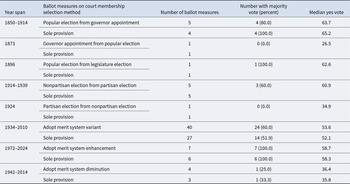
Voters had plenty of chances to choose among different methods to place justices on the court. Over time, the menu of options offered changed, as shown in Table 2; but they almost always pit judicial independence against judicial accountability.Footnote 41 Between 1850 and 1914, five measures asked voters if they wished to switch to electing justices or to continue allowing the governor to appoint them. They opted for elections in four cases, all of which posed the question as the sole provision and all of which carried by large margins. Only New Hampshire voters opted to keep gubernatorial appointment, but that particular amendment included another provision that would have significantly altered the justices’ term of office.
Ballot Measure Outcomes on Court Membership Selection Method
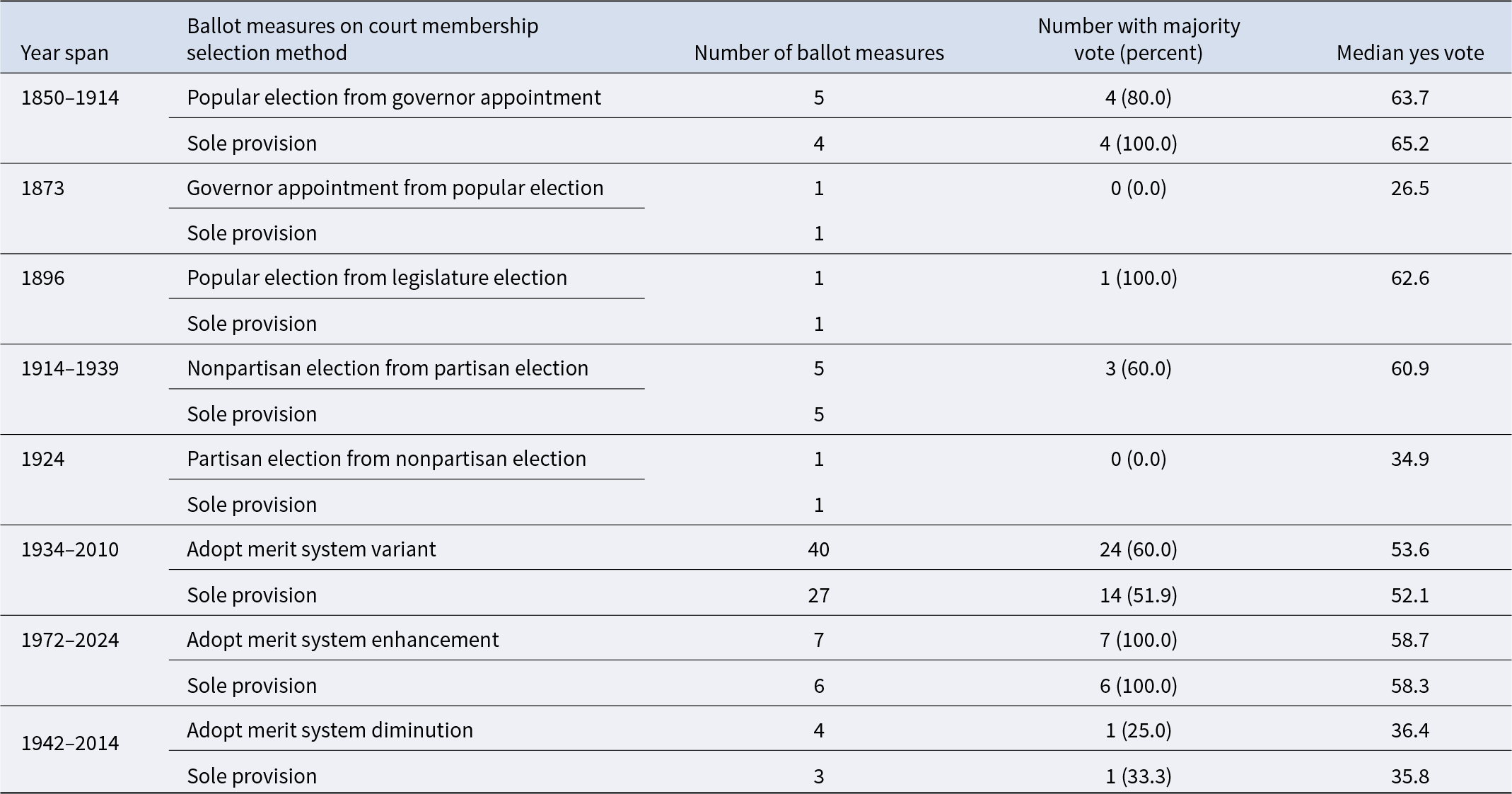
Table 2 Long description
The table examines ballot measures on court membership selection methods from 1850 to 2024, highlighting the number of measures proposed, those receiving majority votes, and median yes votes. The most successful category was adopting merit system enhancements, with all seven measures receiving majority approval. In contrast, measures to adopt merit system diminution had the lowest success, with only one out of four measures passing. The data also shows a slight trend towards adopting merit systems, with 40 measures proposed from 1934 to 2010, of which 24 received majority support. The table provides insights into the evolving preferences for judicial selection methods over time, with varying levels of public support.
Note: Four miscellaneous selection method measures were not included in this table. One established a process where the governor nominated justices with the legislature retaining the power to accept or reject the nomination (Connecticut, 1880). Two involved the use of judicial districts in court of last resort elections (Nebraska,1920 and 1998). The other was to allow cumulative voting in elections for the court of last resort judges (Ohio, 1874).
The notion that elections would liberate courts from gubernatorial influence was widely hyped.Footnote 42 In Pennsylvania in 1850, Philadelphia’s Public Ledger proclaimed that “this important Constitutional Reform, [would] render the Bench truly independent, and effectually prevent the elevation of pettifoggers and jockeys through corrupt Executive patronage.”Footnote 43 That measure’s opponents leaned on a belief that the courts should be untainted by any hint of partisanship, with one editorial fretting that voting on judges would inevitably “drag the ermine of justice into the contests of party politics—will endanger the purity of the judiciary, and will fill with demagogues and intriguing politicians the places which should only be filled with men distinguished for professional ability and conscientious uprightness.”Footnote 44 But judicial elections eventually proved so popular that by 1914, Mississippi’s Vicksburg Evening Post could write that “in nearly all the states, north and south, [justices] are elected by the people, and it is futile to attempt to stop this reform in the fact of almost universal concurrence in the view that the judges … should be elected by the people.”Footnote 45 Valuing accountability over independence, voters opted to choose the justices themselves.
That conclusion is reinforced by the results of two related measures. In 1873, New Yorkers were asked whether they wished to switch to gubernatorial appointment in place of elections. The Brooklyn Daily Union wrote “The fundamental question which underlies this proposition, is whether the judiciary shall represent the popular will, and the judges be dependent upon the majority of the electors for their office, so that failure or success in satisfying the majority determines their reelection, or whether judges shall be as independent as far removed from the changing favor of political parties, the reach of partisan influences, and sudden popular impulse, as the nature of humanities under the condition of our civil organization will allow.”Footnote 46 The Brooklyn Daily Eagle took the opposite stance, asserting that “a democratic-republican form of government presupposes a government by the people. If Judges can or should be appointed, why not apply the principle to every position within the gift of the people … The appointment of Judges is dangerous in that it leads to … centralization of power.”Footnote 47 Almost three-quarters of New Yorkers voted against turning over the selection of justices to the governor. The second measure was an 1896 Georgia proposal to take away the legislature’s power to pick the justices and give it to the voters, which the Atlanta Constitution predicted was apt to be so popular that it would “receive the support of a large majority.”Footnote 48 That forecast proved accurate.
With any election of justices, another question had to be answered: should they be partisan or nonpartisan contests. Between 1914 and 1944, there were five measures to turn partisan judicial elections into nonpartisan ones. Voters supported doing so in three cases, and in one of the losses, Michiganders later reversed their decision. Debates on the question were familiar. In 1944, a Salt Lake Tribune editorial asserted that it was important to “release all judges of the supreme court … from every obligation, either actual or imaginary, to any political party or faction, and to make characters and reputations, as well as qualifications and experience, the test of fitness to sit in judgment upon the rights and wrongs of litigants or defendants.”Footnote 49 The other side worried that judicial candidates would find it hard to run without party assistance. In Idaho, “the argument was advanced that the cost of campaigning for a judge on his own was prohibitive.”Footnote 50 A view that voters preferred nonpartisan contests was bolstered when, in 1924, South Dakotans were given a chance to turn their nonpartisan elections into partisan ones. A strong majority concurred with the Dakota Republican in the belief that “The state is cursed with too much politics now without making the selection of judges a part of the game.”Footnote 51
The most extensive debate on judicial selection methods took place during the mid-twentieth century with the advent of the merit plan. As proposed by a Northwestern University law professor, the basic idea involved a nonpartisan commission empowered to select a small number of qualified applicants to be considered for appointment by the governor. After serving for a brief time, a newly appointed justice would then face a retention election, where voters would decide whether he or she should continue to serve on the bench.Footnote 52
The first four measures proposing a merit plan variant were put on ballots through the initiative process. In 1934, California voters passed a proposition allowing the governor to appoint justices subject to their confirmation by a “commission on qualifications.” Once confirmed, a retention election would follow within 2 years.Footnote 53 Ohio and Michigan voters rejected merit plans in 1938. In 1940, Missourians approved an amendment to create a commission to solicit applications and select a small pool of qualified candidates from which the governor would make an appointment. A new justice would subsequently face a retention election. This sequencing became the national model, referred to as the “Missouri Plan.”
Attempts to follow in Missouri’s footsteps languished for more than a decade. In the 1950s, state legislatures began placing merit plans on the ballot, with most appearing from the 1960s through the 1980s.Footnote 54 As revealed in Table 2, when they were the sole provision put to the voters, just 51.9 percent earned majority support.
Arguments in favor of merit plans remained consistent over time. The Los Angeles Times encapsulated their main thrust during the 1934 California campaign: “This is an initiative proposal designed to lift the judiciary out of politics [promising a] positive guarantee of the integrity, professional training and experience and temperamental fitness of those selected for judicial service.”Footnote 55 Purging partisan politics from the selection process was always a prime selling point.Footnote 56 Placing qualified people on the bench was also repeatedly plugged.Footnote 57
Opponents countered that merit plans violated a fundamental democratic principle, with the San Francisco Examiner declaring that they “would take from the voters the right to select judges of the State Supreme [Court] … Selection of judges should rest with the people.”Footnote 58 Two other reservations were later added. One was that merit plans made it onerous to remove bad judges.Footnote 59 The other was a widely circulated complaint that, as asserted in Nevada, such a process would “give the lawyers of the state an absolute lock on the state’s judicial system.”Footnote 60
Election outcomes document that neither merit plan proponents nor their opponents managed to persuade more than half of the electorate to embrace their positions. Once such plans were in place, however, voters supported measures that were marketed as enhancing them. Supporters promised that their proposals would further improve the quality of candidate pools, promote greater public participation in the process, and increase transparency.Footnote 61 Those against the proposed augmentations were unsuccessful in convincing voters that the current system was satisfactory and that the changes might actually weaken the merit system by making it harder to attract top applicants.Footnote 62
Voters rebuffed three of the four overt attempts to weaken merit plans. Missouri accounted for two of the rejections. The first was a 1942 measure the legislature placed on the ballot seeking to overturn the plan voters had adopted through an initiative 2 years earlier. Repeal backers wrapped their reasoning in wartime rhetoric: “Amendment No. 4 seeks to throw away this Nazi ‘Ja’ or ‘Nein’ business in the discard and restore the good old American plan of nominating and electing judges the regular democratic way, so that when election day rolls around the people will have their choice.”Footnote 63 Almost two-thirds of Missourians rejected that stance; instead they preferred “keeping the courts out of politics.”Footnote 64 Their fondness for the “Missouri Plan” held well into the future. In 2012, 76 percent cast ballots against giving the governor greater input in selecting the candidate pool.Footnote 65 The only successful effort to enervate a merit plan occurred in Tennessee in 2014. A majority of Tennesseans voted for a proposed change that “incorporates new checks and balances by having our elected representatives in the Legislature confirm or reject the governor’s appointees.”Footnote 66
As documented in Table 3, measures targeting procedures used to fill judicial vacancies began appearing on ballots in the twentieth century. There were six proposing to grant the governor the power to appoint people to fill openings. Most received the majority of votes. Arguments for them emphasized that allowing the governor to do so promoted efficiency and reduced costs. In Michigan, it was said that “Vacancies have created a serious problem. Under the present system vacancies must be filled at a general or special election. This has frequently resulted in inoperative courts over long periods of time.”Footnote 67 Supporters added they were confident that any governor would make suitable selections because “his appointments are subject to sufficient public scrutiny that he must take pains to name well qualified people.”Footnote 68 Opponents doubted such would be the case.Footnote 69
Ballot Measure Outcomes on Procedures for Filling Court Vacancies

Table 3 Long description
The table examines ballot measures related to procedures for filling court vacancies over various time spans. Between 1914 and 2018, six measures aimed at increasing governor power to fill court vacancies were proposed, with four receiving majority support, equating to 66.7%, and a median yes vote of 58.6%. In the same period, five measures were proposed as sole provisions, with three passing, representing 60% approval and a median yes vote of 55.9%. From 1915 to 2022, twelve measures sought to extend the term served by appointed judges, with seven achieving majority support, or 58.3%, and a median yes vote of 58.9%. These data suggest a moderate level of support for these measures, with slight variations in approval rates and median yes votes across different proposals.
Other vacancy measures proposed extending the terms that appointees could serve. Voters usually agreed to them. Some of these measures aimed at doing away with inefficiencies associated with “short term” appointments. As explained in Ohio, “Under the present arrangement a judicial vacancy is filled by appointment that extends only until the next election, which results in the expense and confusion of having ‘short term’ candidates of questionable qualifications.”Footnote 70 Other measures were marketed as a means to save the state money.Footnote 71 It was noted too that extended terms gave voters a more substantial record on which to evaluate judicial performance, which in turn would likely entice better candidates to seek appointments.Footnote 72
A desire to force appointees to face voters sooner rather than later drove resistance to extension proposals. Pennsylvania’s Pottsville Republican maintained that “The principle that an appointee to an unexpired term must stand for election in the year the term expires has been accepted by voters in all other classes of public office. There is no reason why a … judge should be an exception to that custom.”Footnote 73 Voters usually opted for greater efficiencies and lower costs.
5. Ballot measures on court service
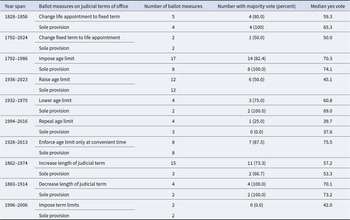
Judicial terms of office measures featured frequently on state ballots. As Table 4 details, between 1828 and 1856, there were five proposals to replace life tenures of the sort enjoyed by federal judges with fixed terms. When offered as the measure’s only provision, they secured strong majorities. The one that fell short was a New Hampshire amendment saddled with a second provision to institute a controversial change in the way justices were to be selected.
Ballot Measure Outcomes on Judicial Terms of Office
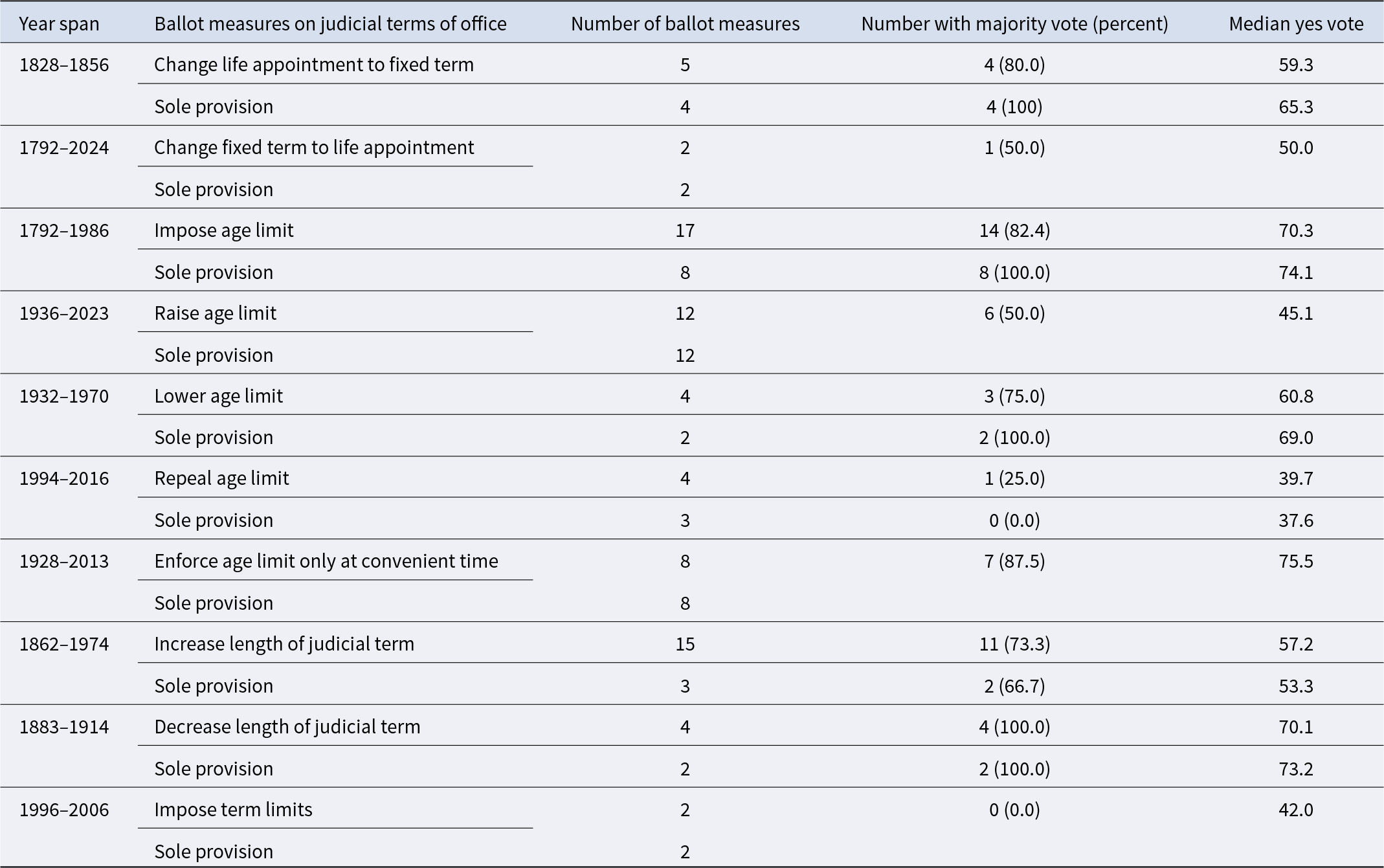
Table 4 Long description
The table presents data on ballot measures concerning judicial terms of office, spanning various years. It includes the number of measures, those with majority votes, and median yes votes. 'Impose Age Limit' had the highest number of measures with majority votes, achieving 82.4 percent, while 'Repeal Age Limit' had the lowest at 25 percent. Measures to change life appointments to fixed terms and decrease judicial term lengths consistently received majority support. Trends indicate a general favor towards imposing age limits and fixed terms over life appointments. However, measures to repeal age limits and impose term limits showed less support
Debates over these proposals again set judicial accountability (through fixed terms and elections) against judicial independence (through life terms).Footnote 74 Arguing in favor of fixed terms, Connecticut supporters stressed that “A Judge who holds the office for eight years, and proves himself competent and faithful, will be morally certain of a re-appointment; the incompetent or the indolent Judge will be dropped.”Footnote 75 Opponents in Maine forecasted that “The natural consequences will be, that our Courts of Law, will no longer have to decide, what is the Law?—what is Equity?—or Justice?—but only, ‘What is the will or caprice of the MAJORITY, or of the constituency by which the Judge is placed on the bench?’”Footnote 76 Most nineteenth-century voters picked judicial accountability (and fixed terms) over judicial independence (and life terms).
Only two measures ever proposed replacing fixed terms with life appointments. They bookend the time frame here. In 1792, 78 percent of New Hampshirites backed moving to life appointments, though another amendment adopted at the same time negated its full impact by imposing a retirement age of 70. In 2024, fixed-term advocates held that, “We Arizonans value our freedom and power to hold accountable those in government who do the wrong thing in our view. So why would we want to grant what are essentially LIFETIME APPOINTMENTS to judges who rule over us?”Footnote 77 At the polls, only 22 percent approved of lifetime tenures.
New Hampshire’s 1792 vote on a mandatory retirement age had put such a question to voters far in advance of the rest of the states. Other efforts to impose one through the ballot box occurred between 1951 and 1986. Oregon enthusiasts argued that “Not all judges who reach an advanced age slacken off in their capacity for work. Most of them do, however. Experience in this state’s court system and experience in business and government generally demonstrate beyond doubt that a voluntary retirement system simply will not work.”Footnote 78 More bluntly, Salem’s Capital Journal groused that “Oregon has been plagued with court problems because of senility.”Footnote 79 Worries that elderly justices could no longer manage the job were widespread.Footnote 80
That concern received pushback. It was routinely noted, as in a Massachusetts editorial, that “Mandatory retirement would remove able and experienced judges from the bench.”Footnote 81 Voters, however, were untroubled by any potential negative consequences and passed mandatory retirement ages by wide margins.Footnote 82
Subsequent measures proposed altering a mandatory age limit, some to raise the age, others to lower it, and a few to repeal it. The arguments surrounding each reprised those made during campaigns to impose limits. Voters split on whether to raise retirement ages. Supporters favored “allowing seasoned and experienced judges to remain on the bench and avoid forced retirement.”Footnote 83 Opponents expressed fears about those who could no longer do the job, adding that “the age limit helps bring in younger justices and with them, fresh ideas.”Footnote 84 Voters almost always backed measures to lower retirement ages, again stirred by qualms about “judges of manifestly frail ability.”Footnote 85 Only a 1948 Louisiana amendment aimed at the governor’s political rival failed to earn majority support.Footnote 86 Voters also opposed measures to abolish mandatory retirement ages, rejecting appeals that “The length of judges’ terms should be based on performance, not age” in favor of addressing angsts that “old judges too often misjudge their ability to serve.”Footnote 87
While voters approved of mandatory retirement ages, they demonstrated a pragmatic streak when confronted by measures to allow justices hitting age limits to continue serving until a convenient time to select their replacements. Short extensions found favor with three-quarters of the voters. Louisianans backed stretching terms, “thus preventing a sudden vacancy on the bench … and obviating the necessity of an inopportune irregular election when any judge becomes 75 years old.”Footnote 88 Only a 2013 New York postponement lost; there were worries that it could prolong a justice’s term as much as 10 years past the retirement age of 70.Footnote 89
As detailed in Table 4, voters always supported decreasing judicial term lengths while in most instances also backing increases in them. This behavior might appear inconsistent. But there is a mundane explanation for the contradictory verdicts. All of the measures to reduce term lengths and many of those to stretch them were alterations to accommodate changes in court membership sizes and election cycles. Advocates of a 1914 Mississippi amendment noted that “The term is made eight years because elections are held in this state every four years, and if the term should remain nine years the tenure of office could not be made to begin in all instances at a time after the election.”Footnote 90 When a need for such adjustment was absent, supporters of lengthier terms argued that, “The security of judges and the stability of the judiciary would be increased through longer terms and without turning to the lifetime tenure system used at the federal level.”Footnote 91 They noted too that the reform would “tend to make judicial positions more attractive to men of the highest type.”Footnote 92 Opponents responded, as in North Dakota where it was proposed to increase the term to 10 years, that “if the judge be able, faithful and honest he will be re-elected by the people at the end of six years, and if he is not, six years is all the time he should be tolerated on the bench.”Footnote 93 Voters split down the middle on such questions.
At the turn of the twenty-first century, the movement to impose term limits on state legislators spilled over onto judges in Colorado (2006) and Nevada (1996). Proponents offered assurances that “There are many fine legal minds in this community capable of serving on the bench for a given period of time. Knowing that their service is limited … would insure independent opinion.”Footnote 94 But voters aligned with the argument that “Judges get better with experience on the bench. Term limits would remove our best judges just as they are reaching their fullest potential.”Footnote 95 In sharp contrast to the easy term limit wins when targeting legislators, measures to impose them on justices were soundly defeated.Footnote 96
Proposals to increase judicial pay were plentiful from the end of the nineteenth century through the middle of the twentieth century. Supporters always stressed that higher salaries were needed to attract and retain the best legal talent.Footnote 97 In 1887, the Los Angeles Daily Herald reasoned that “Lawyers, like other people, seek the most advantageous market for what they have to offer. If sufficient inducement is not offered to them on the bench, the best lawyer will not go there.”Footnote 98 Backers also produced comparisons showing that their state’s justices were paid less than their counterparts elsewhere.Footnote 99 In 1928, the Aspen Times reported that, “Forty-two states pay their judges more than Colorado does and only one pays less.”Footnote 100 In a few cases, they drew attention to salary inversions. A Missouri newspaper noted that a proposed amendment would fix supreme court justices’ “annual salaries at $5,500, just what is now paid the judges of the St. Louis court of appeals, a court of inferior jurisdiction to the supreme court.”Footnote 101 A similar situation obtained in New York, with the Brooklyn Daily Eagle editorializing that “It is absurd that judges sitting in the highest court in the State should receive about $3,800 less than judges over whose decisions they exercise the power of review.”Footnote 102 (In both instances, voters proved unsympathetic to their justices’ plight.)
Opponents consistently protested that pay raises would increase government costs.Footnote 103 Occasionally, it was observed that an increase would be out of line with what neighboring states paid.Footnote 104 Some insisted raises were unnecessary, because, as the San Jose Mercury reckoned in 1887, “no difficulty has yet been found in obtaining the best material in the profession for the bench at the present pay.”Footnote 105 A few even swore they were altogether unmerited, with an 1890 Nebraska letter writer ranting, “The present salary of the supreme judge is three thousand dollars per annum or ten dollars a day for 300 working days in a year and they do not work half the time, and ride on free transportation, and render their decisions in favor of the corporations and against tillers of the soil and laborers who pay their salaries.”Footnote 106
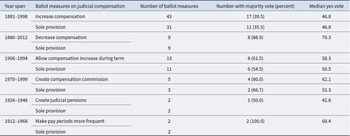
As Table 5 shows, taken together, measures to increase judicial salaries received a median vote of 47 percent, and under 40 percent of them secured a majority. Justices were not singled out for harsh treatment; measures to increase the pay of state legislators got even less support.Footnote 107 But by the middle of the twentieth century, voters became more sympathetic to raising judicial salaries. The eight measures put to them from 1942 on received a median vote of 59.4 percent, and five passed (62.5 percent).Footnote 108
Ballot Measure Outcomes on Judicial Compensation
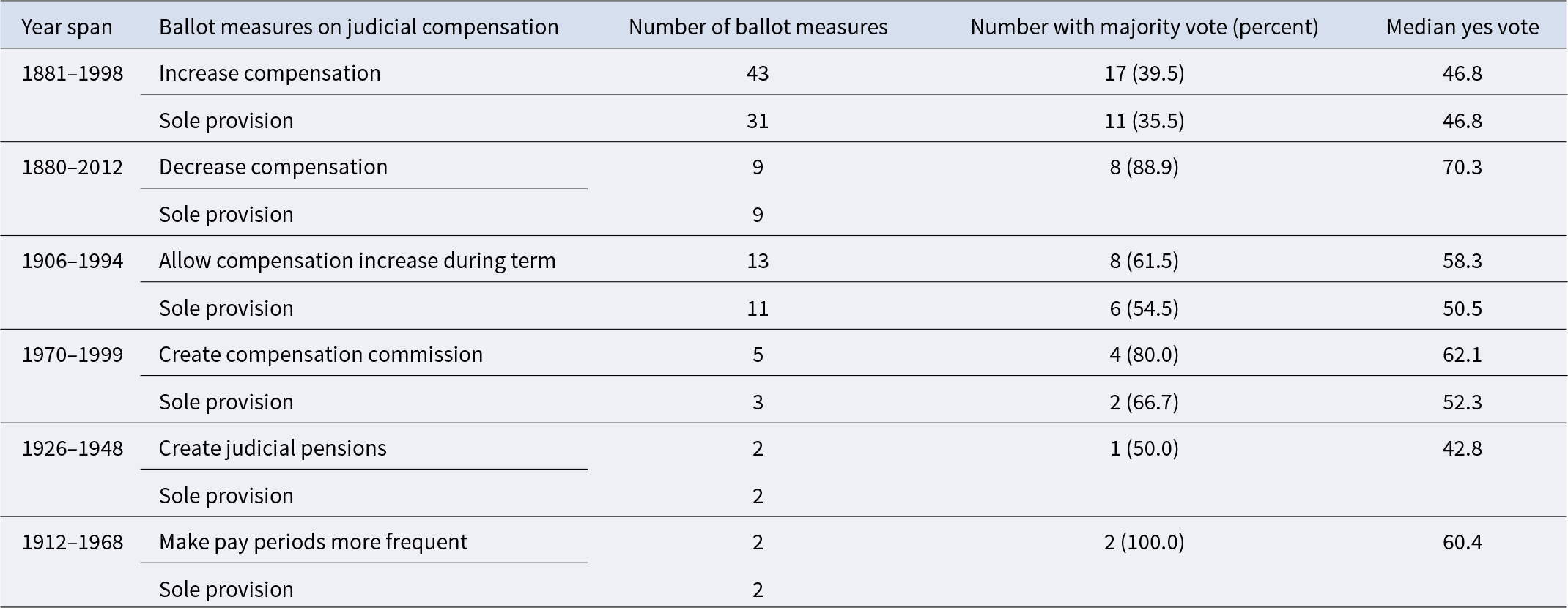
Table 5 Long description
The table examines the outcomes of ballot measures on judicial compensation from various time periods. Notably, measures to decrease compensation had a high success rate of 88.9%, with a median yes vote of 70.3%. In contrast, only 39.5% of measures to increase compensation passed, with a median yes vote of 46.8%. Measures allowing compensation increases during a term had a 61.5% success rate. Creating compensation commissions and making pay periods more frequent also saw high approval rates, at 80% and 100% respectively. These data suggest a historical reluctance to increase judicial compensation, except when it involved structural changes like commissions or pay frequency adjustments.
Nine measures were proposed to reduce judicial compensation. Some were straight bids to slash salaries. Voters almost always backed them. Others involved treating judges like other public employees on such matters as having to pay state income taxes and making required pension contributions. Solid majorities agreed that justices should not receive special treatment.
Voters could also be stingy on narrower compensation matters. One involved bans on allowing justices to accept pay raises during their current term of office. As was pointed out during debate on a 1948 Kansas measure, equity demanded that every justice immediately get any raise the legislature granted because, “If the amendment is not adopted, two justices of the supreme court will be receiving $8,000 a year starting in 1949, two will get $7,500 and two $6,000.”Footnote 109 Those who wanted to force justices to wait until their next term to receive a raise took a hard line. Nevada opponents contended that “When a person runs for a public office, he or she is aware of the compensation for that office and should accept that salary for the full term.”Footnote 110 The Elko Daily Free Press even taunted, “We don’t imagine any judges are going to quit midterm should a recently elected or re-elected colleague get a bigger paycheck. So why spend the extra money?”Footnote 111 Once again, voters were divided evenly on the question. But their resistance sometimes waned; Wisconsin passed the reform on its second try, Ohio on its third.
Toward the twentieth century’s conclusion, a handful of states asked voters to create compensation commissions to set judicial pay. They usually agreed to do so, particularly when it was packaged with other reforms. Proponents thought, as Texas’s Waco Tribune-Herald wrote, “judges should be adequately compensated independent of political considerations and commensurate with private attorneys. Only then can the state attract and retain qualified judges.”Footnote 112 Opponents retorted that “The Legislature levies taxes and decides where the money will be spent. There is no compelling reason to duck that responsibility in the matter of judicial compensation.”Footnote 113
Two other compensation issues were put to the voters to resolve. In 1926, Californians rejected a measure to establish a judicial pension system; in 1948, Texans passed one. Each was marketed as “a measure designed to encourage able and experienced men to seek judicial office and devote themselves to a judicial career.”Footnote 114 Those who disagreed disparaged the idea, saying that, “The salaries of these jobs are better than the salaries paid to other state … officials. The lawyers who run for these jobs are not sacrificing anything.”Footnote 115 The other measures involved the schedules on which judges received their salaries. In both cases (Wisconsin in 1912 and Nevada in 1968), voters agreed to alter the timetables to allow for more frequent payments.
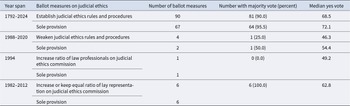
The biggest category of court service measures revolved around judicial ethics rules and procedures. Although they spanned the entire time frame examined here, they were primarily pursued from the mid-twentieth century on—eighty of the ninety ethics measures appeared on ballots after 1946. They were well received by the public, as shown in Table 6.
Ballot Measure Outcomes on Judicial Ethics Rules and Procedures
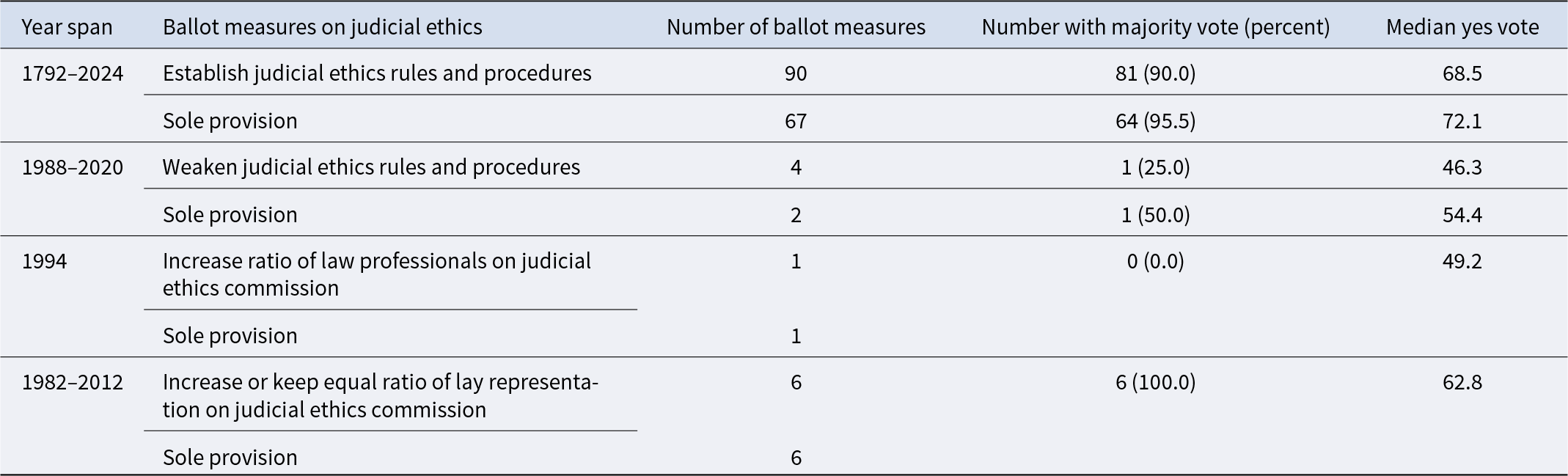
Table 6 Long description
The table presents data on ballot measures related to judicial ethics rules and procedures from 1792 to 2024. It highlights that 90 measures aimed to establish such rules, with 81 receiving majority votes, indicating a 90% success rate. In contrast, from 1988 to 2020, only 4 measures sought to weaken these rules, with just 1 achieving a majority vote, reflecting a 25% success rate. The median yes vote for establishing rules was 68.5%, while for weakening rules, it was 46.3%. Additionally, measures to increase or maintain lay representation on judicial ethics commissions had a 100% success rate, with all 6 measures receiving majority votes. These data suggest a strong historical preference for establishing and maintaining judicial ethics rules and lay representation on commissions.
A handful of measures targeted judicial conduct. New Yorkers adopted an 1869 amendment to restructure the state’s court system so “that no Judge shall sit … in the Court of Appeals in review of any decision in the making which he has taken part.”Footnote 116 Several others sought to regulate election-related behavior, as with a 1950 proposal Nevadans adopted to make “justices … ineligible to any office, other than a judicial office, during the term they shall have been elected or appointed.” The thinking behind it was that “those elected to these offices of trust should devote their entire time to the welfare of the people they represent.”Footnote 117
The bulk of the ethics measures proposed creating official bodies empowered to discipline or remove judges when they violated standards.Footnote 118 An endorsement of a 1947 New York amendment asserted it would provide “an easier method for removal of corrupt or dissolute judges and a system to force retirement of judges physically or mentally disabled. As it is, judges can be removed only by action of the Legislature in impeachment proceedings, which present so many difficulties that the method is seldom employed.”Footnote 119 Comparable rationales circulated in support of other such proposals.Footnote 120
Opposition to ethics measures was sparse. Some complained that a proposed disciplinary process would be too opaque, leaving the public with little information about why a justice had been punished or removed.Footnote 121 Others thought the reforms pointless because “Present laws are adequate for removal of judges.”Footnote 122 Most voters were unmoved by such objections.
Given the broad backing judicial ethics measures received, it was predictable that the few attempts to weaken them would fare poorly. The only one that received a majority vote was a benign California proposition to allow justices to teach public university courses, on the assumption that it could “help students without hurting the judicial system.”Footnote 123 Although it passed easily, the idea raised some hackles, with one editorial grumbling that “Judges … are paid handsomely to be judges. If they want to be college or university instructors, they should take off the robe and join a faculty.”Footnote 124 Elsewhere, Wisconsinites defeated a measure because “judges who are permitted to anticipate resignation and subsequent service in another public capacity might risk a potential conflict of interest,” while Floridians turned down one that would allow “the Legislature to take control over the discipline and oversight of Florida … justices.”Footnote 125 Alabama voters snubbed an amendment to weaken the state’s Judicial Inquiry Commission’s powers; it was alleged to have resulted from legislative “negotiations with individuals who wanted to do away with the commission entirely.”Footnote 126
Finally, there were measures to reconfigure judicial disciplinary bodies’ memberships. Only one of them proposed increasing the ratio of legal professionals to lay members. It failed with a slim majority of Alabamians agreeing that it “would upset the [existing] balance between lay and professional members.”Footnote 127 The other measures sought to either increase the ratio of lay people or keep their representation level with that of legal professionals. They all passed, usually by wide margins. When the ratio of lay members was to be increased, supporters asserted that “The courts belong to all of us; all of us should be represented … not just those in the legal profession,” adding that it would make “the group less of an insiders’ club.”Footnote 128 Opponents of more lay members claimed that it would increase costs without any commensurate benefit.Footnote 129
6. Ballot measures on court operations
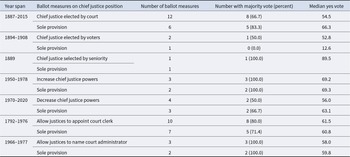
Court operations measures were lightly sprinkled across the years between 1792 and 2020. As shown in Table 7, there were two categories of measures touching on chief justices: the process by which they were to be selected and the powers they were to be accorded. Most of the selection measures set allowed the justices to pick their chief against a variety of other methods: election by the voters, seniority on the bench, rotation, and by lot. Supporters argued, as in the San Diego Union in 1887, that “The Justices of the Supreme Court are better able to judge the ability of one of their number as Chief Justice than are the people who are unfamiliar with legal matters.”Footnote 130 Those who did not want justices making the selection raised several objections. The Inyo Independent preferred that the power be put in the people’s hands, figuring “If the voters are capable of selecting the Justices who are to elect from among themselves a Chief Justice, there appears no valid reason why the same voters are not competent to elect a Chief Justice.”Footnote 131 Others worried that the justices might succumb to intramural warfare, with a Wisconsin commentary speculating, “Instead of spending time resolving cases, the court will be bogged down every two years in a battle for chief justice, creating discord and inviting factions to form and grow.”Footnote 132 And some simply saw no reason to change the current arrangement.Footnote 133 But when selection by the justices was a measure’s only provision, two-thirds of the voters agreed to it.Footnote 134
Ballot Measure Outcomes on Chief Justice Position, Court Clerks, and Administrators
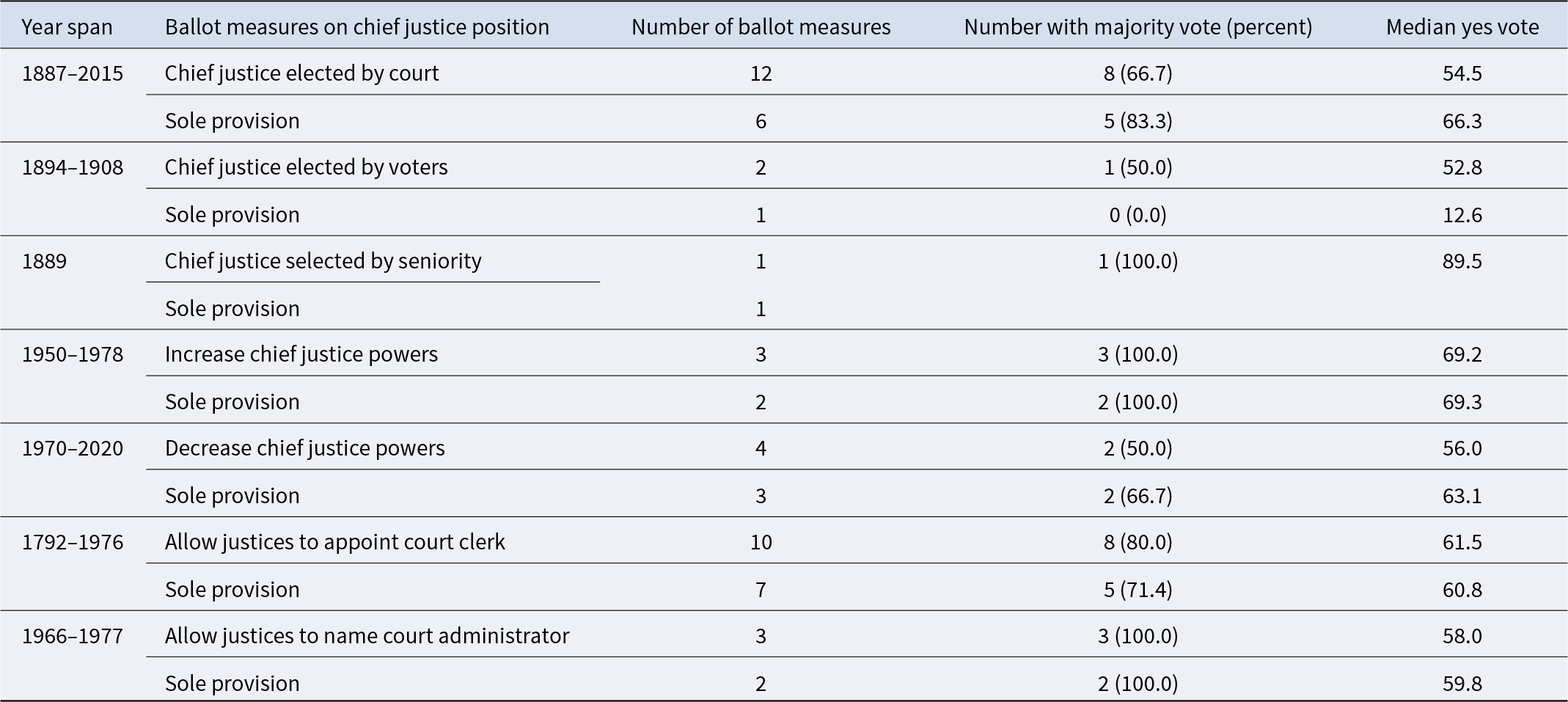
Table 7 Long description
The table compares ballot measures related to the Chief Justice position, court clerks, and administrators over various time spans. Measures for election of the Chief Justice by the court had a higher success rate, with 66.7% receiving a majority vote, compared to 50% for voter-elected measures. Measures to increase Chief Justice powers consistently received majority votes, while those to decrease powers had mixed results. Allowing justices to appoint court clerks and administrators generally received strong support, with majority votes in most cases. These data suggest a preference for court-elected selection methods over voter-elected methods.
Note: An 1883 Minnesota measure to make the clerk’s term 4 years instead of 3 years in order to fit with a shift to biennial elections from annual elections is not included in this table.
There were three instances where voters were offered other options for changing the selection process. Wisconsinites overwhelmingly backed an 1889 amendment to take the power to name the chief justice away from the governor in favor of a system rewarding the justice who “by reason of long service on the bench shall have earned it.”Footnote 135 The other two measures sparked no debate. As part of their rout of all the 1894 ballot measures, Nevadans rejected a switch to a statewide election from a seniority system. In 1908, Nebraskans approved an amendment containing, among other provisions, one to replace a rotation rule with a statewide election.
A handful of measures proposed altering the powers conferred on chief justices. The three proposals to increase the position’s authority were promoted as a means to allow the court to operate more efficiently. They encountered no dissent and passed by wide margins.Footnote 136 Reducing the position’s powers proved more problematic. A 1970 amendment stipulating that Alaska’s court administrator served at the pleasure of the full court rather than just the chief justice met little resistance and passed easily.Footnote 137 But a similar 2020 Alabama proposal lost by a narrow margin. In 2002 and 2012, New Hampshirites voted on amendments to reduce their chief justice’s powers by granting the legislature greater say over court procedures. Both were opposed on separation of powers grounds.Footnote 138 In the wake of the chief justice’s contentious impeachment and acquittal in 2000, the 2002 measure got 63 percent of the vote, an impressive total but one below the state’s two-thirds threshold for adoption. After memories of the court controversy faded, the 2012 measure fell short of a majority.Footnote 139
Some state constitutions dictated how the court’s clerk was to be selected. As a result, between 1792 and 1976, there were ten measures to allow the justices to make the choice. They almost always won a majority. Supporters cited an obvious argument, one articulated by California’s Berkeley Daily Gazette in 1911: “only the neighbors of candidates for such an office as that of clerk of the supreme court get any accurate information as to the qualifications of such candidates. The justices of the supreme court are practically the only ones who have an opportunity of observing whether or not the clerk of the court is efficiently carrying out the duties of his office.”Footnote 140 Opponents protested, as in Oklahoma, that “to take away the right of the people to elect their own Supreme Court clerk … is undemocratic.”Footnote 141 But voters were usually content to allow the justices to name their court’s clerk.
Where state constitutions touched on such details, voters were willing to permit the justices to name a court administrator and to increase that post’s powers. All three measures along those lines—Louisiana in 1966, Missouri in 1970, and New York in 1977—passed comfortably. Backers peddled them as means to make courts more efficient.Footnote 142 Opponents feared they would vest too much power in the chief justice’s hands.Footnote 143 Voters were unfazed by that prospect.Footnote 144
7. Voters and courts of last resort reform
Through the nineteenth century, Americans typically evaluated proposed court reforms, particularly those to increase the number of justices and their compensation, in terms of their impact on state budgets and taxes. It took decades for voters to discount the budgetary implications in favor of endorsing changes projected to improve how the courts functioned. Enhanced efficiency and effectiveness emerged as one of the twentieth century’s two major court reform themes. In addition to larger courts and better-paid justices, voters backed measures to allow governors to quickly fill vacancies, to give those appointees longer terms before facing the voters, and to increase the chief justices’ powers. They did so because they thought those reforms would improve the way their courts operated and decided cases.
The twentieth century’s other major theme exposed a second side to voters’ attitudes on their state courts. Few measures proved as popular as those imposing ethics rules and regulations on the courts. Indeed, opinions registered on a host of issues signaled voters’ skepticism about their justices’ behavior. They not only voted to create judicial disciplinary commissions, but they also wanted lay persons to, at a minimum, serve in equal numbers with legal professionals, so as to allow the public to keep a close eye on those serving on the bench.
Voters struggled with the trade-offs implicit in the judicial selection options offered them. They appreciated the accountability inherent in electing justices. At the same time, they prized the decision-making independence granted by gubernatorial appointment and longer judicial terms. Merit plans represented an attempt to meld those values, but voters were never fully persuaded by that method. As a result, by the twenty-first century, justices were put on state benches through a range of different mechanisms, though almost none of them mirrored those used for the federal courts.
By the twenty-first century, it was clear from the voters’ many ballot decisions that they wanted their courts of last resort to have the capacity necessary to render decisions efficiently and effectively. At the same time, they harbored doubts about the justices’ motives and behavior in office. This was akin to their conflicted attitudes toward state legislators.Footnote 145 Americans thought it necessary to be vigilant about the way their courts were structured and operated. Notably, however, the choices they made at the ballot box rarely reflected any desire for their state courts to resemble the federal courts.
Competing interests
The author declares none.



 Open access

