


Introduction
Reliable measurements of the energy balance of glacier surfaces are few in number, and generally of short duration and restricted to one spot. It is often desirable to extrapolate these data in both time and space and to relate them to large-scale atmospheric processes. For this purpose the terms of the energy balance must be expressed in a way that minimizes the number of parameters referring to the glacier surface and relies more on synoptic data.
If the energy balance of the glacier could be expressed by variables that describe the state of the free atmosphere, a first step would have been accomplished in the interrelation of general circulation and glacier mass balance. The problem then would be to find a parameter of heat transfer that is valid for synoptic as well as for micrometerological applications, i.e. for the upper and lower limit of that shallow layer in which the glacier influences the temperature and stability of the atmosphere.
The atmospheric variables and parameters can be chosen as solar radiation, terrestrial radiation emitted from atmospheric constituents and clouds, and air temperature T a that prevails at the level of the glacier but outside its thermal influence. The surface parameters that need to be retained are albedo a and temperature T 0. By considering only melting surfaces one can further reduce the number of variables. While a and T 0 link the glacier to the atmospheric radiation field in a physically obvious manner, the heat transfer from atmosphere to surface is parameterized less clearly. The heat transfer coefficient applied to the value of T a−T 0 implies several variables determining the turbulent energy exchange in the boundary layer.
This paper attempts to establish a value of the heat transfer coefficient α that fulfills the needs mentioned above. While α should be applicable to daily means of T a and T 0 without further restriction, its derivation is easier when the surface is at the melting point and the latent heat flux is small compared to the sensible one. Given the uncertainty of daily values of energy fluxes and ablation measurements, the significance of α is even less certain and should be tested by longer records of the heat balance at one particular altitude as well as its vertical derivative.
The Energy Balance
The balance of energy fluxes passing through any surface is zero. Fluxes directed towards the surface have a positive sign and those leaving the surface are negative. In particular, for a melting surface,

where the subscripts R, S, L, M respectively refer to radiation balance, sensible heat flux, and latent heat fluxes of evaporation and melting.
There are many ways of describing these fluxes in a manageable form. For the present purpose we shall choose

where G is the global radiation, and A the downward and E the upward terrestrial radiation, all in units of W m−2.
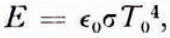
with ε 0 ≈ 0.98, σ = 5.67 × 10⁻⁸ W M−2 K−4.
Values of the terrestrial downward radiation are difficult to synthesize, and therefore actual measurements of A are particularly desirable over glaciers, where the vertical distribution of humidity and temperature deviates from standard values. However, for extrapolation over the glacier area, it is desirable to evaluate from the measurements an effective emissivity ε* defined so that

Previous investigations have shown that over alpine glaciers Q L ˂ Q S by an order of magnitude (Reference LaChapelleLaChapelle, 1959; Reference AmbachAmbach and Hoinkes, 1963; Lebedeva as quoted in Reference Hoinkes and UntersteinerHoinkes, [c1964]), whereas they are of comparable magnitude over sub-polar glaciers (Reference Streten and WendlerStreten and Wendler, 1968; Reference SmithSmith, 1960). The flux of latent heat of evaporation will, therefore, be omitted from the present considerations.
The heat flux available for melting is

where L = 335 J g−1 (80 cal g−1), ∂M/∂t or Ṁ is the rate of melt expressed as mass per unit area and time.
The sensible heat flux can be expressed alternatively in several ways, among which are: a flux-gradient relation

and a bulk transfer

where ρ is air density, cp specific heat of air at constant pressure, g acceleration of gravity, −g/cp the adiabatic temperature gradient, and K H is the height-dependent eddy diffusion coefficient for heat. Attempts to express K H(z) analytically generally rest on very restrictive assumptions, they have been summarized by Reference BrownBrown (1974).
The Physical Nature of the Transfer Coefficient
Equation (7) implies a linear relation between Q S and (T a—T 0) despite the inherently turbulent character of the surface layer. By necessity α has to absorb all the effects of stability and turbulence and so will exhibit diurnal changes as well as depending on daily means of the synoptic conditions. The use of a constant bulk-transfer coefficient is therefore justified only if it is applied to periods long compared with those of the characteristic variations of the boundary-layer transfer parameters. In this paper two records, of 14 d and 100 d, from Hintereisferner can be interpreted as showing that over these periods the boundary layer behaved thermodynamically in a similar way.
Nonetheless it is of interest to investigate which parameters determine α and what are their magnitudes and ranges as found in previous investigations. In order to do this we shall integrate the flux-gradient relation over a height where the vertical divergence of coefficients of momentum and heat fluxes are negligible, e.g. 0–1 m (Reference Munro and DaviesMunro and Davies, 1977; Reference KuhnKuhn, 1978). In such a layer, logarithmic profiles can be expected with the form

where φ M(z) is a function of stability equal to unity in neutral stratification (Reference Businger, Businger, Wyngaard, Izumi and BradleyBusinger and others, 1971; Reference KrausKraus, [1975]). The friction velocity u * is a measure of turbulent fluctuations of momentum, von Kármán’s constant κ is approximately 0.4. If Equation (8) is integrated for neutral conditions (φ M = 1) and for constant stress (∂u */∂z = 0) from the roughness height z 0 (where the mean momentum vanishes) to height z, three simple relations appear


For the general case, a diffusion coefficient for heat can be derived

where φ H(z) is defined in a similar way to φ M(z) and has values φ H(z) = (0.74 + 4.7z/L) in stable stratification, L being a measure of stability in units of length indirectly proportional to sensible heat flux Q S (see, e.g. Businger and others, 1971).
For comparison with the bulk transfer (Equation (7)) the flux-gradient relation (Equation (6)) has to be integrated to that height Z where T(z) = T a. Since, however, at Z flux divergence of the katabatic wind regime precludes the use of logarithmic computation (Reference KuhnKuhn, 1978), a rigorous formulation of α would require knowledge of the actual profiles of T and K H. Under these circumstances only an approximate relationship can be derived analytically and this is done conveniently by integration to a height z ⪢ z 0 and z ⪡ L. In this case Z and T a in Equations (14) to (16) need to be replaced by z and T(z).
Noting that above a melting glacier very often ∂T/∂z ⪡ g/cp , the flux-gradient relation (Equation (6)) can be simplified. K H is incorporated according to Equation (12) and Equation (6) is then rearranged:

An upper limit of integration z = Z is defined by the condition that T(Z) = T a, whereas at the lower limit T(z 0) = T 0. In order to avoid unnecessary complications in trying to show the relation between α and the surface-layer profile characteristics, φ H(z) may be treated as a constant


and

Comparison of the right-hand sides of Equations (15) and (7) yields

which expresses the significance of the surface-layer parameters u * and z 0 in the bulk transfer coefficient.
Consider first the effect of surface roughness z 0. If all other quantities in Equation (16) are kept constant the value of α should vary proportionally to 1/ln(Z/z 0). Table Ia lists values of the transfer coefficient valid for wind speeds at 2 m of 5 m s−1 for various surfaces whose roughness characteristics have not been described in any greater detail by the respective authors. The relative magnitude of the z 0 in these three examples can be determined for Z = 200 cm from Table Ib.
Values of the transfer coefficient valid for wind speed at 2 m of 5 m s−1 for various surfaces

Values of the term I /In (Z/Z o) for Z = 200 cm

The small difference of the transfer coefficient for Frankenberger’s grass and de Quervain’s snow implies respective values of z 0 that differ only by a factor of two. For comparison, a summary of z 0 by Reference Deacon and FlohnDeacon (1969) shows that rough snow and mown grass do indeed have similar roughness parameters. The unspecified “smooth surface” of Hofmann would correspond to sand or extremely smooth snow. Thus while an increase of z 0 by two orders of magnitude only doubles α, Equations (10) and (16) show that α varies linearly with wind speed at a specified level in a logarithmic profile. Examples of profile parameters as measured over melting glaciers by α various authors are presented in Table II. In most cases in this table, u * and z 0 were evaluated according to Equations (10) and (11) after logarithmic regression of u(z) at three heights. Additional information on the variation of u * with wind speed can be found in Reference PoggiPoggi ([1978]).
Examples of u * and z 0 Over Melting Glaciers

Thus from a comparison of gradient and bulk transfer it appears that for a melting glacier surface (characterized by z 0), the use of one typical value of α for arbitrary periods of melting is meaningful as long as the wind speed at a specified level is comparable from one period to another.
A Quantitative Example
Using Equations (1), (2), (5), and (7) gives

where the first two terms are the short- and long-wave radiation balance, respectively, of which a, G, and A need to be measured, while E can he computed fora melting surface. The third and fourth terms involve the rale of melting and sensible heat transfer, respectively. Ṁ is determined by standard methods, T a requires extrapolation from nearby stations, and α is the quantity to be determined from Equation (17). Practical limitations in the measurement of melting rate and the diurnal change of stability in the boundary layer preclude the application of Equation (17) to periods other than integral numbers of days.
An example for the absolute values of the terms in Equation (17) will show that absorption of solar radiation accounts for most of the melting on the longue of Hintereisferner. The data are taken from Wagner (unpublished), the value of (A−E) was adjusted to the lower altitude according to Equation (20).
Tongue of Hintereisferner, 2500 m a.s.l.
Data of 18 August 1971

Since the convective term is the small difference between two large quantities that may be affected by several per cent error, the determination of α from Equation (17) suffers from a large uncertainty. However, when vertical derivatives of Equation (17) are considered, the relative magnitude of the individual terms is changed.
Vertical Gradients of the Balance
When changing the altitude h without changing the distance z from the surface, the derivatives with respect to the vertical coordinate become

where the tilde denotes an average over the altitude interval which should be weighted according to the vertical derivatives of the products aG and αT and, if these are unknown, can be approximated by linear averages. For a melting glacier surface ∂T 0/∂h = 0, and from Equation (3) ∂E/∂h = 0 also. The value of ∂α/∂h, or the change of the transfer coefficient along the glacier surface, has not been measured to date. From the outline in the previous section, however there is little reason to expect a large, systematic variation of u * and z 0 with altitude over a regularly-shaped glacier tongue. Until better information is available any possible ∂α/∂h must be neglected.
Typical values of the derivatives will be presented for alpine conditions. From comparison of global radiation simultaneously measured on 7 July 1971 at Hintereisferner and in Innsbruck ∂G/∂h is as follows:

The change of albedo is not linear with height. Typically there is a rapid transition from firn to ice albedo at the firn edge followed by a gradually decreasing albedo along the tongue that depends on the amount of debris covering the ice. A typical example of a transition zone on Hintereisferner is seen in Reference Hoinkes and RudolphHoinkes and Rudolph (1962, fig. 6, p. 273). Glaciers that extend far below the equilibrium line may exhibit a transition zone of several hundred metres elevation separating two zones of uniform albedo on the tongue and in the névé.
Values of albedo are therefore problematic to average. A linear average was taken for the ablation period (τ ≈ 100 d) of Hintereisferner.

Actual values supplied by Wagner’s measurements (unpublished) with 0.75, 0.50, 0.30, and 0.20 in the order of appearance in Equation (19) yield an albedo gradient of 0.1 per 100 m. Intuitively one expects lower values of the albedo gradient outside the transition zones, during short periods, and over smaller areas. There are, however, few data available to substantiate this impression. For the 14 d period discussed at the end of this paper, a value of 0.05± 0.02 per 100 m was adopted from measurements by Reference Dirmhirn and TrojerDirmhirn and Trojer (1955, p. 413, fig. 5e) and unpublished records of W. Nairz of 30 July 1971.
The altitudinal gradient of terrestrial downward radiation A was determined by two independent methods. First, the effective emissivity in Equation (4) was evaluated from measurements at Hintereisferner on 18 August 1971 (Wagner, unpublished)

Next, Equation (4) is differentiated with respect to h and expanded in terms of T

The free-air gradient ∂T a/∂h ranges between −0.5 and −1.0 K/100 m, the most frequent value being −0.6 K/100 m. Higher values are associated with atmospheric subsidence in fair-weather periods.
The radiative transfer coefficient defined from Equation (20)

has an approximate value of 5 W m−2 K−1 at T = 273 K (0.42 MJ d−1 m−2 K−1 or 10 ly d−1 K−1). A value of −0.18 MJ d−1 m−2/100 m or −4 ly d−1/100 m is used for ∂A/∂h in this paper, corresponding to a temperature gradient of −0.6 K/100 m and an effective emissivity of 0.7.
An independent check of this value can be made using the data of Reference StaudingerStaudinger (1978) who measured the radiation balance at Hohe Mut (2 600 m) and Wiese (2 000 m) in the neighbouring valley of Obergurgl (Table III).
Mean Monthly Gradients of Atmospheric Radiation ∂A/∂h Between Hohe Mut (2600 m) and Wiese (2000 m) Near Obergurgi, Ötztal. From Staudingcer (1978)

For the ablation gradient a value of −1 m water equivalent/100 m can be regarded as typical for the zone below the equilibrium line of Alpine glaciers (Reference HaefeliHaefeli, 1962; Reference SchyttSchytt, 1967; Reference DugdaleDugdale, 1972). Assuming an ablation period of 100 d,

When integrating Equation (21) over longer time intervals, the change of the length of the ablation period with altitude may have to be taken into account. Note that in contrast to Q M < 0 one finds ∂Q M/∂h > 0 for melting conditions.
The value of α can now be determined from Equation (18). Introducing the operator ∆ ≡ ∂/∂h expressed per 100 m, and setting ∆E = 0 and ∆T 0 = 0 as explained before, we can rewrite Equation (18)

The relative importance of the individual terms of Equation (22) is demonstrated in Table IV on examples of the entire ablation period and a 14 d sunny period in August 1971, on Hintereisferner.
Altitudinal Gradients of the Energy Balance at Hintereisferner, for the Entire Ablation Period and for 14 Clear days in August 1971

The mean of the two transfer coefficients given in Table IV (1.7 MJ m−2 d−1 K−1) agrees well with the value of 1.6 derived from the energy balance of 18 August. The difference of the two values derived from altitudinal balance gradients, 25% of their mean, is a fair representation of the uncertainties in the input to Equation (22). Rather than attempting to give an overall error estimate, one should individually value the contributions of the errors in each term. A realistic error of 10% in the albedo gradient causes a 20% error in the transfer coefficient. On the other hand, the example of a gradient of α of 20% over the glacier tongue (2500–2900 m) is little more than guesswork, but it has such a large effect that a final test should be performed at the lowermost part of the tongue (2400 m).
Consider the maximum ablation values encountered at Hintereisferner, 7 × 10⁶ g m−2 in 100 d, associated with albedo minima of 0.15. Values of global radiation for the months of July to September, supplemented by an estimated 200 MJ m−2 for the last eight days of June, yield a short-wave radiation balance of 1.75 GJ m−2 for the 100 d ablation period. During that time the ice emits 2.72 GJ m−2 and receives 2.30 GJ m−2 of terrestrial radiation, as extrapolated from Wagner’s (unpublished) 85 d of measurements at 2900 m. In order to melt 7 × 10⁶ g m−2 an amount of 2.35 GJ m−2 is required and energy fluxes are balanced by a residual Q S of 1.01 GJ m−2. From long-term averages (1936–65) of the weather station at Vent (1 900 m, Lauffler, unpublished) a mean temperature for July to September of 6.0°C is extrapolated for T a (2400 m). These values result in a transfer coefficient of 1.68 MJ m−2 d−1 K−1 (40 ly d−1 K−1) which is again close to the mean of the previous three examples:

Conclusions
The value of the bulk heat transfer coefficient for sensible heat has been determined from the residual of the heat balance (Equation (17)) and of its vertical gradient (Equation (22)), for the entire ablation season as well as for short terms. The four coefficients thus computed yield an average of 1.68 MJ m−2 d−1 K−1 (40 ly d−1 K−1) ±14%. The good agreement of the four examples justifies the simplifications involved in the two basic equations.
A comparison of the bulk-transfer concept and the flux–gradient relation in the surface layer reveals the dominant effect of friction velocity and a minor effect of the surface roughness on the magnitude of the transfer coefficient. Since previous investigations have shown that u⋆ increases with the surface-layer wind speed, a similar variation of α must be expected. However, when using different lengths of records (1 d, 14 d, and 100 d) one finds that thermo-dynamic and dynamic conditions in the surface layer over Hintereisferner attain similar mean values and that the transfer coefficients thus derived are applicable to the averages of (T a–T 0) of integral numbers of days and multiples thereof as long as portions of the relatively flat tongue are considered. The effects of strongly convex or concave shapes need to be determined in future studies.



