


Introduction
Since the end of the 1994 genocide, the RPF government led by President Paul Kagame (who formally assumed the presidency in 2000) has overseen the country’s economic recovery. Though data regarding Rwanda’s growth and poverty reduction is contested, critics and supporters alike agree that the RPF government has made substantial achievements in socio-economic indicators (Ansoms & Rostagno Reference Ansoms and Rostagno2012; Diao & Mcmillan Reference Diao and Mcmillan2018). Three narratives dominate discussions about RPF rule. First, one positive narrative (often encouraged by donors, international financial institutions and celebrities) highlights Rwanda’s progress in economic growth, through market-led reforms, and investments in health, environmental and gender policies (Kinzer Reference Kinzer2008). Second, another positive narrative – though more from a heterodox economics stance – focuses on the extent of state intervention and political commitment to achieving development (Booth & Golooba-Mutebi Reference Booth and Golooba-Mutebi2012). Third, and possibly the most influential narrative, highlighted by the RPF’s critics (like Michela Wrong), organisations (like Human Rights Watch and the Enough Project) and many scholars (like Filip Reyntjens), directs attention to the RPF’s authoritarian rule, human rights record domestically, interference with its neighbours and its ongoing support of violence in the DRC (Reyntjens Reference Reyntjens2013; Wrong Reference Wrong2021). There is truth in all these narratives. Yet no dominant narrative about Rwanda analyses the effects of services-first development and why structural transformation remains so elusive.
Some literature has highlighted continuities with past independent Rwandan governments. Juvénal Habyarimana’s government, which ruled from 1973 to 1994, was also hailed as an economic success in the 1970s (Uvin Reference Uvin1998). It was also equally coercive (Verwimp Reference Verwimp2013). Desrosiers and Thomson (Reference Desrosiers and Thomson2011, p. 430) argue that both the Habyarimana and Kagame-led governments have aimed to project a similar image of ‘benevolent leadership’, with such images used to restructure ‘relationships with international and domestic audiences’. Existing studies do not acknowledge the differences between the kinds of economic strategies pursued by preceding governments and the strategy currently being pursued by the RPF government. In contrast to preceding Rwandan governments, the RPF government has achieved significant export diversification and reduced the dependence of the economy on unprocessed coffee exports. Additionally, the RPF government has prioritised becoming a services hub while preceding governments primarily focused on the agriculture sector.
Many scholars have suggested that an impending civil war is inevitable in Rwanda because of the authoritarianism and inequality that have characterised RPF rule. However, horizontal inequalities or authoritarian governance alone have not automatically led to civil war or large-scale violence. It is more pertinent to examine why excluded elites are unable to mobilise the rural population to threaten RPF rule despite the significant inequalities characterising Rwanda’s development trajectory. This chapter begins by providing a brief discussion of Rwanda’s structural vulnerabilities. It then provides a snapshot of Rwanda’s economic development trajectory, highlighting the key vulnerabilities facing the RPF and how it has sought to address those vulnerabilities. It then provides a PSA of present-day Rwanda, highlighting how development is being contested transnationally, pointing to the key vulnerabilities characterising its hub-based strategy.
Political Vulnerabilities in Rwanda
PSA can be used to analyse how power relations shape how late-developing countries contend with their subordinate positions within the global political economy. Every country must navigate its own historical political legacies (including legacies from colonialism), as well as the economic legacies associated with colonial rule (including primary commodity dependency). Geography shapes both a country’s natural endowments and its locational vulnerabilities (including high transportation costs if countries are isolated or landlocked). This section describes several political vulnerabilities within Rwanda related to (1) ethnicity; (2) historical divisions associated with the power of the royal family, as well as clan identity; (3) refugee identities; (4) horizontal inequalities and inadequate employment opportunities, especially among the youth; and (5) regional inequalities. Then the section introduces the salience of geographical inequalities, as well as the structural challenges associated with primary commodity dependence.
In the study of Rwanda, the most widely discussed political challenge has been the politicisation of ethnic identities. Wimmer (Reference Wimmer2008) distinguishes between primordialist, instrumentalist and social constructivist conceptions of ethnic identity. Primordialist views conceptualise ethnic identity as a fixed or static category. Instrumentalist views conceptualise ethnic identity as a category that individuals or groups draw on to further their interests. Social constructivist views conceptualise identity as more fluid and negotiable, highlighting how colonial administrators and ruling elites, as well as rival leaders, manipulate ethnic identity to mobilise support based on ethnic division. Some scholars, as well as some ruling parties with Marxist-Leninist origins (including the RPF), reject the notion of ethnicity as a distinguishing category, instead highlighting the salience of other social divisions such as class (Roessler & Verhoeven Reference Roessler and Verhoeven2017). As Mkandawire (Reference Mkandawire2009, p. 142) writes, for those who promoted ‘national’ rather than ethnic identities, ‘ethnicity was seen as inimical to nation building because it weakened the state by the conflicts it engendered, and the multiplicity of its claims simply denied the new countries a national image’.
In the study of Rwanda, scholars have taken varied stances on ethnic identities. This is also true of Rwanda’s political elites. This includes primordialist, instrumentalist and social constructivist views, as well as the rejection of ethnic identity in favour of a national identity (Ndi Umunyarwanda). The Hutu ethnic group comprises around 70–80 per cent of Rwanda’s present-day population, with the Tutsi population numbering about 15–20 per cent and a small group of Twa population comprising most of the remainder. There are currently no clear numbers on the exact population comprising each ethnic group, as the RPF government has criminalised genocide ideology, sectarianism and divisionism. There are at least three different positions regarding the historical salience of ethnicity within Rwandan society. First, there is a view, which is also popular among RPF leadership, that until colonialism, Hutu, Tutsi and Twa were flexible and harmonious social categories within a broader Rwandan nation (Chrétien Reference Chrétien2010). The Belgian colonial administration previously required ethnic identity to be listed in identity cards, with Hutus often not allowed access to education and political power based on their ethnicity. Others make the case that even in pre-colonial times, ethnic identity groups exhibited different features and historical roots, with Tutsis remaining in a dominant position over Hutus in feudal-like relationships (Newbury Reference Newbury1988). Lastly, there are those who highlight that pre-colonial ethnic identities and divisions were salient but during colonial rule, ethnic identities were more politicised (Mamdani Reference Mamdani2001).
There is significant debate within scholarship on Rwanda, which takes either a primordialist or social constructivist approach to analysing ethnicity. Some take the view that ethnic distinctions were rooted in labour arrangements, including ubuhake – an unequal clientship contract where a Tutsi patron would give a cow to a Hutu client, and in return the Hutu would be tied to his patron.Footnote 1 The RPF’s own revised ‘ethnicity’ narrative focuses on the ‘social mobility’ and ‘mutual benefits’ of ubuhake cattle clientship. Such claims were repeated by influential scholars like Prunier (Reference Prunier1995). However, others argue that social mobility was not pervasive and was an exception, rather than the norm. Recent work by historians of Rwanda (Jessee Reference Jessee2017; Mwambari Reference Mwambari2023) agrees that the history of ethnicity in Rwanda is messier than is presented and was politically mobilised by all actors, including former colonisers, the RPF and the RPF’s opponents.
Even prior to taking power, the RPF called for rejecting ethnicity as a way of defining identity (Chemouni & Mugiraneza Reference Chemouni and Mugiraneza2020), a move that was part of a ‘de-ethnicisation’ policy and the promotion of Ndi Umunyarwanda or ‘Rwandanicity’ as a national identity (Baldwin Reference Baldwin2019; Purdekova Reference Purdekova2015). This is in stark contrast to neighbouring country, Burundi, where ethnic representation was ensured through power-sharing agreements (Lemarchand Reference Lemarchand2007; Vandeginste Reference Vandeginste2014).Footnote 2 The RPF’s stance regarding ethnicity is also starkly different from pre-1994 governments. Ethnic identification continued during independent governments in Rwanda, led by Hutu leaders Grégoire Kayibanda from 1962 to 1973 and Juvénal Habyarimana from 1973 to 1994. There is debate regarding the extent to which Tutsis were marginalised based on their ethnic identity. However, ethnicity remained a matter of political significance both regarding accessing social services, public office and owning land domestically. Ethnicity was salient externally, with neighbours continuing to host large numbers of Rwandan Tutsis.
A second key issue, closely related to ethnicity, is the evolving political standing of the Tutsi monarchy and the actors aligned to it, particularly post-independence. Family members of the Tutsi monarchy have faded from relevance since the 1960s. The last Rwandan king died without much press coverage. However, the politicisation of the monarchy remains linked to the glorification of Rwandan national identity. Significantly, in pre-colonial Rwanda, regions such as the Northwest were never under Tutsi rule. Juvénal Habyarimana, who was president from 1973 to 1994, was from the Northwest. The Northwest was also the last region to come under RPF rule. Many scholars agree that royalty and aristocratic lineage remains salient in some ways. For example, the Abega lineage of Paul Kagame’s wife, Jeannette Kagame, is often mentioned, likening her to an influential Queen Mother (Kanjogera) in Rwandan history (Watkins & Jessee Reference Watkins and Jessee2020). In 2023, an Abakono clan meeting, which was held to unofficially appoint a head of the clan, was attended by senior RPF officials. This was widely discussed in social media and in newspapers, with suggestions that this may lead to increased elite factionalism and divisionism (Mugisha Reference Mugisha2023). President Kagame himself discussed the meeting openly, warning of the dangers of holding such events (Kagire Reference Kagire2023a).
Just as the monarchy was often villainised by Hutu leaders and movements, ‘refugees’ (both Tutsi and Hutu) – as a category – have been presented as both saviours and threats by all of Rwanda’s independent governments. Population flows in the region, as is the case all over the world, have existed for centuries. The concept of a nation in post-independent Rwanda, as with other countries, gave ‘a novel meaning to mobility’ because of the ‘rigidity of imposed state boundaries’ (Newbury Reference Newbury2005, p. 259). There have been several waves of refugees fleeing the country during different periods of violence, often coinciding with the targeting of ethnic groups within Rwanda. Rwandan refugees have also often been targeted in neighbouring countries. Rwandan refugees have often occupied an uneasy relationship with citizenship in neighbouring countries, despite families settling in some countries like the DRC, Uganda and Tanzania for decades (Mamdani Reference Mamdani2001). The RPF’s senior leadership grew up as refugees, contributing to many military and political leaders highlighting a ‘refugee consciousness’ and the fear of becoming a refugee again. RPF leaders’ lives in refugee camps have been consistently discussed, with anecdotes of their parents reminding them of the importance of returning to Rwanda (Longman Reference Longman2017; Prunier Reference Prunier1995). At the same time, large populations in the Great Lakes region remain internally displaced or have refugee status. For example, just within Rwanda, over 134,000 refugees and asylum seekers are registered, 62 per cent of whom originate from the DRC.Footnote 3 About 91 per cent of Rwanda’s total refugee population lives inside five camps within the country in highly vulnerable living conditions.
The RPF presents itself as a haven for refugees because of its own ‘refugee consciousness’ as an armed movement and political party. The RPF government justified the controversial UK–Rwanda Asylum Partnership Treaty, as well as similar deals with other European countries, on these grounds (Kagire Reference Kagire2023b). Yet at the same time, Rwandan critics highlight that many Rwandan refugees refuse to return to or continue to flee Rwanda, seeking asylum (Betts & Jones Reference Betts and Jones2016; Reyntjens Reference Reyntjens2013). The RPF’s refugee identity has been mobilised not only to seek money, as part of the deal – amounting to 300–400 million GBP – but also to gain leverage in its external relationships. At the same time, refugees are both a source of threat to the RPF and are presented as a reason to intervene in the affairs of neighbouring countries (such as the DRC).
Post-independence Rwandan leadership has also had to deal with the challenge of increasing inequality and the fear associated with poor populations of society mobilising against them. Prior to independence, in 1959, Hutu radicals successfully mobilised widespread rural grievances against an intransigent Tutsi monarchy (Newbury Reference Newbury1995). ‘The result was a radical shift of power from Tutsi to Hutu and the exodus of thousands of Tutsi families to neighbouring territories’ (Lemarchand Reference Lemarchand1995, p. 8). The Rwandan Revolution of 1959, also known as the Hutu Revolution, which was the result of this conflict, has often been characterised as a class-based rural movement rather than just being ethnicity-based (Newbury Reference Newbury1998). Hutu radicals, along with support from segments of the church and the Belgian colonial administration, capitalised on widespread anti-Tutsi Monarchist sentiment to mobilise rural grievances against Tutsis. Both the Kayibanda and Habyarimana governments employed strategies of presenting Tutsi refugees as an external threat to demobilise rural rebellion in times of economic crisis (Verwimp Reference Verwimp2013). At the same time, both governments argued that national Rwandan identities were linked to the promotion of agriculture and rural livelihoods. Yet, in practice, these governments ruled rural society through very coercive policies (Uvin Reference Uvin1998; Verwimp Reference Verwimp2013).
In comparison, the RPF government has always been conscious of a distrustful rural population and the need to create new forms of employment while being less reliant on coffee exports. Rwanda’s hub-oriented strategy is characterised by severe underemployment and unmet aspirations for an ever-growing youth segment of the population (with few job opportunities within the formal sector). There are varied estimates about the number of Rwandans entering the labour force annually, with most highlighting the number at between 130,000 and 200,000 youth. To address high levels of unemployment and underemployment, the Rwandan government’s national development plan (2013–2018), the Economic Development and Poverty Reduction Strategy (EDPRS) 2, called for the creation of 200,000 decent and productive jobs annually (MINECOFIN 2013). The plan that followed – the National Strategy for Transformation 1 (NST 1) (2017–2024) – raised the target to 214,000 jobs (GoR 2017). Officially, labour force participation has increased from 53.4 per cent in 2019 to 59.3 per cent in 2023 (GoR 2024a). Unemployment has usually been under about 20 per cent in most years over the last decade (NISR 2024). However, in 2023, unemployment was 17.2 per cent, well above the government’s target of 7 per cent. This data still masks the precarious, low-wage characteristics of employment in Rwanda. Time-related underemployment was between 23 and 43 per cent between 2018 and 2023, with the combined rate of underemployment and unemployment between 33 and 56 per cent between 2018 and 2023 (NISR 2024). For the RPF government, this remains a significant concern, with the hub-oriented development strategy unable to yield adequate opportunities for the population.
While primary school enrolment is high (at above 94%), the quality of education has been concerning for some time (Williams Reference Williams2019). Secondary school enrolment also drops off dramatically, with comparatively less investment in secondary education. Investments have been made in Technical, Vocational and Educational Training (TVET) programmes. However, only half of those enrolled in TVET programmes gain employment (Newfarmer & Twum Reference Newfarmer and Twum2022). Rwanda has been hailed as one of the few African countries where ‘flagship’ unconditional cash transfers (UCTs) have been provided. While the Rwandan government does relatively well as compared to its regional neighbours regarding the implementation of such programmes, its expenditure on UCTs remains low, just increasing from 0.02 per cent of GDP to 0.22 per cent of GDP between 2009 and 2019 (Habimana et al. Reference Habimana, Haughton, Nkurunziza and Haughton2021). However, the government does prioritise some social programmes, including universal health coverage. Rwanda has the highest enrolment in community-based health insurance on the continent and performs well on several other social indicators (Abbott et al. Reference Abbott, Sapsford and Binagwaho2017; Chemouni Reference Chemouni2018; Habimana et al. Reference Habimana, Haughton, Nkurunziza and Haughton2021).
Containing rural and urban rebellion remains a concern for the RPF security apparatus. The RPF contains popular dissent through four strategies: maintaining a high military and police presence; controlling popular organisation through institutionalising the reach of the state; showcasing its developmental achievements; and, lastly, incorporating youth ideologically as being central to Rwanda’s future. The RPF’s coercive state apparatus as well as the immense powers of the military and the police have been highlighted within existing literature (Jowell Reference Jowell2014; Purdekova et al. Reference Purdekova, Reyntjens and Wilen2018).
While the RPF’s heavy surveillance, as well as the high degree of military and police presence across Rwanda, has already been mentioned, it is worth briefly describing some of the other ways the RPF contains popular resistance. The RPF government has adopted decentralisation while also ensuring the RPF’s reach has been extended within local governance structures. The RPF’s decentralisation strategy was initiated in 2000 with the goal of fostering local participation. While decentralisation creates some space for popular agency, it has also been central to enhancing the party’s control over society (Chemouni Reference Chemouni2014; Ingelaere Reference Ingelaere2014). Chemouni (Reference Chemouni2016) argues that the RPF maintains political order through its elite commitment to output legitimacy. He uses the Organisation of Economic Cooperation and Development (OECD 2010, p. 23) definition of output legitimacy ‘defined in relation to the performance effectiveness and quality of services and goods that the state delivers’. In reality, Rwanda’s capacity to deliver services is variable. According to Chemouni (Reference Chemouni2016), there have been key achievements: the provision of security and advancing citizen welfare. Still, many citizens have been at the receiving end of Rwanda’s security apparatus. Chemouni’s arguments are perhaps more relevant if we highlight how Rwanda’s development has been presented (to the domestic population and external audiences) rather than necessarily being achieved given the significant inequality that persists.
Despite significant youth underemployment, the youth – as a group – have been presented as being central to the RPF’s development strategy (Pells et al. Reference Pells, Pontalti and Williams2014). Consistently, in his speeches, President Kagame refers to youth as a group that is both driving development and for whose benefit development is being prioritised. For example, in a speech in 2015, he called for them to work together collectively, bound by national rhetoric through evoking the importance of unity through the symbolic use of the Agaciro concept, which means self-reliance. He said:
Young people. When I see you, I see Rwanda. Your generation makes up 70% of our population. Imagine how much strength there is, in these millions of Rwandans, working towards the same goals. Solving difficult problems is part of us now. We are always thinking of how to do much more and better, to build a strong nation of strong individuals. Rwanda has very high ambitions, and few resources, but we must get there because we have you. There are no apologies to be made about this. This is the mindset of a nation, that has chosen agaciro for itself.
At the same time, the RPF recognises the threat that could be posed by the mobilisation of youth grievances. Youth groups and radical Hutu youth militia are often highlighted as having committed most of the violence and killings during the 1994 genocide (Kimonyo Reference Kimonyo2016; Mwambari Reference Mwambari2021). Others argue that prior to the 1994 genocide, teachers and other Hutu adults inculcated children and youth with ethnic hatred, building the ideological foundation for the formation of Hutu youth militias (Purdekova Reference Purdekova2015). This fear contributed to the RPF placing a moratorium for over a decade on teaching national history curricula. Instead, the RPF initiated state-sponsored commemorations and cultural events, and used news media to present itself as ‘the liberating force of a nation (previously) possessed by a colonial ideology, but also the reincarnation of the benevolent pre-colonial polity’, which was recast as being characterised by the trans-historical unity of the Rwandan people (Berman Reference Berman2023, p. 784). The RPF has also invested significantly in national re-education programmes such as Ingando, which circulated standardised stories of Rwanda’s history and characterised the RPF (and Kagame) as a liberator. The Iwawa Island ingando camp is an extreme example of this practice, which officially ‘attempts to transform young men in the margins of Rwandan society into disciplined, patriotic citizens’ (Lovgren & Turner Reference Lovgren and Turner2018, p. 28). The RPF argues that such programmes are central to building a national identity, and, in some cases, such programmes are presented as providing ‘hands on entrepreneurial skills to street children and drug addicts who are taken there’ (Malunda Reference Malunda2014, p. 6). Yet most literature highlights how the RPF’s attempt at imposing a single version of history and advancing its own ideas of national unity are an instrument of imposing order on society and containing resistance (Mwambari Reference Mwambari2021; Pells et al. Reference Pells, Pontalti and Williams2014; Purdekova Reference Purdekova2015).
Additionally, land scarcity and tensions over land ownership, as well as increased inequalities in land ownership, have all been contentious issues in Rwanda. Some scholars have argued that it has been the most significant driver of conflict within Rwanda (André & Platteau Reference André and Platteau1998). According to one estimate, in the early 1960s, Rwanda had the highest population density in Africa (245 persons per square mile) and the lowest recorded per capita income (under $50 per year). Rwanda’s population is expected to increase from 10.5 million in 2012 to 16.3 million by 2032 (RSSB 2020). With many Rwandans returning from neighbouring countries and other Rwandans leaving at different points (and later returning), land has remained contested and continues to be central to discussions around justice in post-genocide Rwanda (Bisoka et al. Reference Bisoka, Giraud and Ansoms2020). Chapter 4 discusses this in more detail.
Regional inequalities have also been a source of contention historically in Rwanda. Kayibanda’s rule was often contested by elite Hutu leaders from Northwestern Rwanda (including Habyarimana). When the RPF assumed power in 1994, it took them several years before they could retake control of Northwestern Rwanda. Under RPF rule, regional inequality remains a significant challenge, both in relation to urban–rural inequalities and regional differences (Bundervoet et al. Reference Bundervoet, Lakner and Geli2015; Mckay & Verpoorten Reference McKay, Verpoorten, Arndt, McKay and Tap2016). While most investments and job opportunities remain concentrated in Kigali, the RPF government has consistently attempted to spread investments throughout the country with limited success. Conscious of the threat posed by youth mobilisation, the government also closely monitors in-country youth migration.
Existing literature tends to focus on these political vulnerabilities when analysing conflict dynamics historically and in present-day Rwanda. The next section describes the structural determinants of Rwanda’s political settlement, highlighting how both geographical and economic vulnerabilities have shaped the RPF government’s chosen development trajectory and contributed to the transnational contestation of its development strategy.
Rwanda’s Evolving Economic Strategy
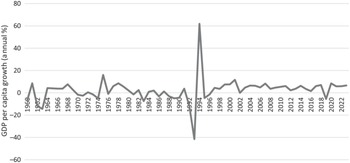
Rwanda has been one of Africa’s most rapidly growing countries over the last two decades. Official statistics indicate that annual GDP per capita growth rates have been over 7 per cent for most years since 1994 (although there has been some fluctuation) (Figure 3.1). Politically, there have been substantial challenges and threats posed by former enemies (remnants of Hutu-led groups outside the country, including rebel groups and exiles abroad), Rwanda’s neighbours (DRC, Burundi and, at times, Uganda) and even from former RPF cadres (who have become Rwanda’s most wanted exiles). Western donors and increasingly important Asian partners (like China and Gulf states) have been generally supportive of the RPF but their support has sometimes wavered. European and North American donors have withdrawn support on occasions, especially when they have accused the RPF of supporting rebel groups in the DRC. Domestically, the RPF-led government has ruled with an iron fist, with persistent inequality sustained through a visible military presence throughout the country. In Rwanda, the richest 1 per cent of the population earns 20 per cent of the national income, nearly double that of the bottom 50 per cent (Kamande & Martin Reference Kamande and Martin2022). According to several reports over the last decade, Rwanda has been listed as one of the most unequal countries in East Africa, according to both the GINI and Palma indexes (Kamande & Martin Reference Kamande and Martin2022; Orrnert Reference Orrnert2018).
GDP per capita growth in Rwanda (annual percentage): 1960–2023.

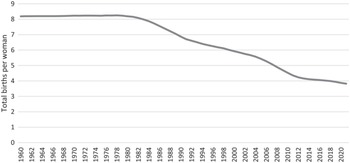
As the previous section shows, most existing literature has highlighted the dangers that may accompany horizontal inequalities, as well as increasing youth underemployment. The RPF, too, has been very conscious about managing the threat posed by younger segments of the population. Since the RPF took power, they prioritised investments in family planning, anxious about popular assumptions that increases in population may lead to increased political conflicts over land, which may result in violence (André & Platteau Reference André and Platteau1998). Rwanda has not only experienced large reductions in maternal and infant mortality but has also dramatically reduced its fertility rate. In the 1980s, each woman had 8.5 children during her reproductive life. Contraceptive use increased from 17 per cent to 64 per cent between 2005 and 2020, and in 2023, the fertility rate was 3.8, the lowest in the region (Figure 3.2). During demographic transitions, a youth bulge occurs when most of the population is concentrated within working ages and the dependency ratio is low (when there are fewer young and elderly dependents). Rwanda is currently experiencing a ‘youth bulge’, which has been a result of government investments in family planning and health services (Westoff Reference Westoff2012).
Fertility rate (total births per woman): 1960–2020.

The remainder of this section describes the RPF’s strategy to transform the economy, create employment and achieve its paradigmatic ideological goal (self-reliance). After the genocide, government officials highlighted that rebuilding the economy was a monumental task. Rwanda was among the poorest countries in the world in 1994. As the former Minister of Finance said:
You have to realise that there was nothing. We had to do everything and we didn’t have the population’s support. Food. Security. Jobs. And land – everyone wanted land. We knew this would cause conflict. Something had to be done.Footnote 4
RPF officials regularly stated that they were aware that employment needs of the population could not be met in the short term. As a result, there was an emphasis on increasing policy space ‘so we could try policies that we think was right’ while ‘showing the Europeans and Americans we were doing what they wanted’.Footnote 5 The RPF presented that increasing policy space was a way to achieve ‘self-reliance’, the party’s paradigmatic ideological goal. For the RPF, self-reliance was generally presented as being achieved through export diversification and increasing the range of foreign partners with which it works (a wider range of foreign governments, philanthropists and foreign investors). Cognisant of the historical experience of Rwanda, where ‘the political stability of the regime followed exactly the curve of those (coffee) prices’ (Prunier Reference Prunier1995, p. 84), the RPF diverged from previous governments in prioritising export diversification and value addition within primary commodity sectors. This was also motivated by the fact that the RPF was keen to reduce its dependence on coffee farmers and rural society (whom they perceived to be loyal to the previous government). It was also politically possible because some large coffee landowners had fled the country (like Habyarimana’s close ally, Félicien Kabuga). In its traditional export sectors – coffee, tea, mining and pyrethrum – there has been a focus on exporting ‘processed’ rather than ‘unprocessed’ commodities, hoping to control more of the production in-country and gaining more export revenues. Notably, there is less focus on a crucial aspect of structural transformation: building effective relationships with domestic firms to invest in learning and the acquisition of technological capabilities.
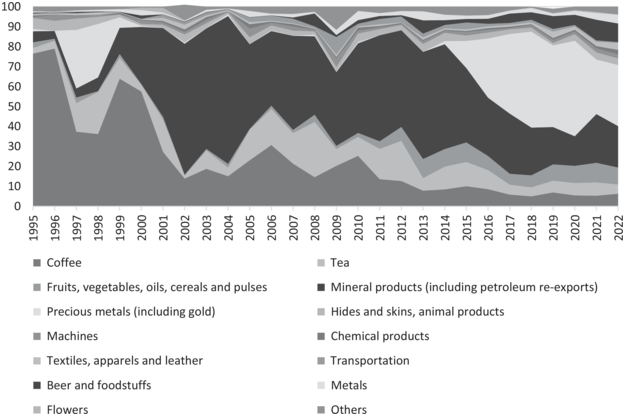
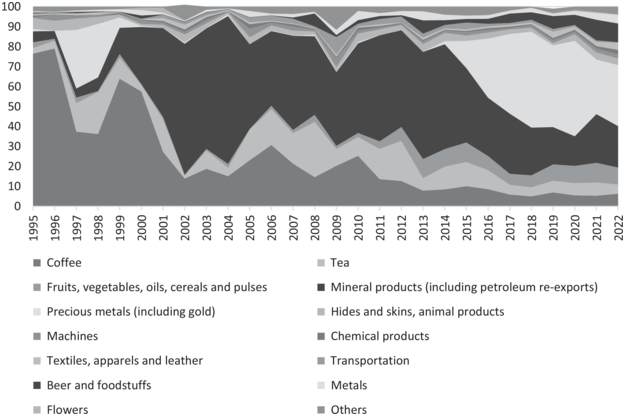
This strategy has been shaped by reminders of the country’s violent past. Primary commodity dependence has been associated with periods of political turmoil, often resulting in preceding governments facing political challenges (Prunier Reference Prunier1995). In the 1980s, commodity price fluctuations forced increasing reliance on donor funding and contributed to decisions to hold elections. According to some scholars (Uvin Reference Uvin1998), political liberalisation contributed to politicians increasingly appealing to ethnic divisionism to mobilise support, augmenting Hutu Power rhetoric and increased targeting of Tutsis. The RPF’s predecessors did not prioritise export diversification as much. Both Grégoire Kayibanda and Juvénal Habyarimana consistently appealed to rural populations regarding the importance of growing coffee (Verwimp Reference Verwimp2013). The RPF government has made tremendous strides in reducing its reliance on coffee (Figure 3.3). Coffee comprised more than 70 per cent of exports in 1995 and now barely contributes 10 per cent of foreign exchange revenues. Part of this is also because of increases in the re-export of minerals from the DRC (both legal and illegal), which will be discussed in Chapter 8. In line with Rwanda’s services-based strategy (although not reflected in Figure 3.3), tourism has been the highest foreign exchange earner for Rwanda over the last two decades.Footnote 6
Composition of exports in Rwanda: 1995–2022.
In 1962, the first independent Rwandan president, Kayibanda, inherited an economy that was heavily dependent on coffee and minerals exports. Kayibanda’s ruling coalition also retained a close partnership with the former Belgian colonial administration. Many of the old colonial relationships remained in place, and there were limited attempts to diversify the economy or develop new partnerships. Though Asian investment entered the manufacturing sector, and Kayibanda made some attempts at import substitution, coffee, tea and minerals accounted for nearly all exports. There was barely any export diversification during Kayibanda’s successor, Habyarimana’s reign (1973–1994). From 1962 to 1994, Rwanda’s main donors and closest allies were Belgium, Germany and France. European donors promoted 1970s/1980s Rwanda as a ‘model’ for other countries (Uvin Reference Uvin1998). Donors also provided support for the Habyarimana regime during the 1990s civil war, providing legitimacy to Rwandan leadership that later carried out the genocide (Des Forges Reference Des Forges1999; Verwimp Reference Verwimp2003).
Strikingly, the RPF altered its diplomatic relations, with the United Kingdom and the United States becoming the largest donors to Rwanda (Desrosiers & Swedlund Reference Desrosiers and Swedlund2019), although Germany continued to remain significant. Until recently, the United States was Rwanda’s largest bilateral donor, though it has rarely provided direct budget support, instead focusing its funding on health, education and agriculture. In contrast, the European Union and the United Kingdom have provided direct budget support. Over the years, bilateral donors have often withdrawn aid to pressure Rwanda to row back support for rebel groups in DRC or for other humanitarian concerns. The RPF government remains particularly cognisant of the dangers of fluctuating access to foreign aid. The government established the Rwanda Revenue Authority (RRA) in 1997, with increasing amounts of tax collected for the government’s coffers (Mascagni & Nell Reference Mascagni and Nell2022), with tax as a share of GDP at 17 per cent in 2021 compared to 8.5 per cent in 2000. Yet, despite these efforts, the Rwandan government’s budget remains 40 per cent dependent on foreign aid.
Rwanda faces geographical disadvantages associated with being a landlocked country, with concomitant high transport costs. Under contemporary globalisation, firms are forced to compete with global competitors (often with very limited protection using tariffs) even to tap into domestic and regional markets. Transport costs are a substantial impediment for landlocked or isolated countries. Faced with this challenge, the RPF government sought to adopt a different strategy compared to most past successful late developers. The RPF government aimed at turning its landlocked disadvantages into a land-linked advantage.
We are not land-locked. We prefer to say we are land-linked. We are very aware of the disadvantages to do with our location and size. But that is not how we want to see it. For us, our location can be turned into an advantage. We are in the centre of Africa, which will be the fastest growing continent in the world. So we, as Rwandans, can make this country a hub for the future of Africa.Footnote 7
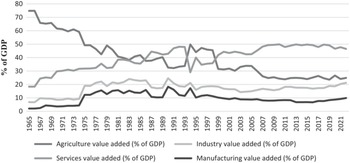
To address these geographical disadvantages, Rwanda has focused on becoming a services-first (tourism, finance, transport) hub-based development strategy. For the last two decades, as Figure 3.4 shows, services have comprised nearly half of Rwanda’s GDP, with agriculture dropping from around 75 per cent of GDP in 1965 to less than 30 per cent. Industry (and manufacturing, as a sector within the broader category of industry) has rarely contributed more than 20 per cent of GDP. Senior RPF leaders emphasised the need to ‘learn from mistakes’ of previous Rwandan governments and redirect the economy in a very different way.Footnote 8 Driven by the ideological goal of achieving self-reliance to avoid the external vulnerability associated with commodity dependency, the RPF consistently states its desires to reduce its reliance on external relationships. In the immediate aftermath of the genocide, this was justified in view of the failure of the United Nations and European/North American actors to intervene to stop the genocide. The RPF’s foreign policy has often capitalised on the ‘genocide guilt’ of foreign countries to capture investment, while domestically, reminders of the genocide are used to demobilise ethnicity-based political mobilisation (Beloff Reference Beloff2020; Clark & Kaufman Reference Clark and Kaufman2008; Straus & Waldorf Reference Straus and Waldorf2011).
Composition of GDP in Rwanda: 1965–2022.

As part of the government’s VISION 2020 strategy, the RPF government highlighted its intention to champion regional and continental integration, fitting with its hub strategy. The RPF’s strategy to maintain political order has also focused on presenting Kagame as a leader of Pan-African futures, leading regional and continental integration efforts. This has been further enhanced with the appointment of senior RPF officials like Donald Kaberuka, Louise Mushikiwabo, Monique Nsanzabaganwa, Claver Gatete and Richard Sezibera all occupying positions at leading regional and global organisations, including the African Development Bank (AfDB), East African Community (EAC), United Nations Economic Commission for Africa (UNECA), African Union (AU) and the Organisation Internationale de Francophonie. The appointment of these officials, as well as the RPF’s consistent attempts at ensuring Rwanda is represented at high-profile global forums, is central to portraying Rwanda as a leader of Pan-African ideals and a champion of global cooperation. The government has invested heavily in making ‘nation branding’ a priority, cognisant that dissidents and critics of the government would question the RPF’s legitimacy (and therefore the entire development strategy) abroad. Nation branding is defined as a communications, reputation management and diplomatic relations strategy to represent the state to other states and external actors within the global political economy (Holmes & Buscaglia Reference Holmes, Buscaglia, Grayson and Hitchcott2019; Szondi Reference Szondi2007). The RPF’s goal is to transform Rwanda’s ‘brand’ as one from a failed state, devastated by genocide, to a ‘hub’ for tourism, financial services and sports. Additionally, the RPF presents itself as a leader, which champions progressive and Pan-African ideals: contributing to global peacekeeping, gender and environmental policy leadership and being at the centre of continental and regional initiatives. These portrayals are consistently in tension with the more negative image of Rwanda, with the RPF accused of human rights abuses, war with its neighbours and authoritarian governance.
RPF leadership has devoted significant investment to public relations and communications, both within the Office of the President and through employing foreign public relations agencies to strengthen Rwanda’s brand abroad. To a lesser extent, the Rwanda Development Board (RDB) and the Ministry of Foreign Affairs and International Cooperation (MINAFFET) are also tasked with managing Rwanda’s external image with both foreign governments and international financiers. MINAFFET also has departments dedicated to organising Rwandan diaspora initiatives abroad. All foreign Rwandan consulates are tasked with mobilising support and managing dissent against Rwanda abroad. The RPF recognises the importance of the online political contestation over its version of collective memories, as well as its domestic performance and external reputation. The RPF’s control of popular mobilisation against its rule extends to the online sphere where the ‘born digital’ generation (Mwambari Reference Mwambari2023) – which encompasses most of Rwanda’s youth – has often raised questions of key issues, including by memorialising Hutu refugees and other victims during the 1990–1994 civil war, Rwanda’s human rights record domestically and interventions in neighbouring countries abroad (Kuradusenge Reference Kuradusenge2016; Mwambari Reference Mwambari2021, Reference Mwambari2023).
The RPF’s post-genocide governance – and its goal of becoming a services hub – is characterised by attempting to control the dissemination of knowledge about Rwanda. As a result, the government invests significantly in ensuring the online perception of the RPF is defended (with both foreign and domestic audiences in mind) (Mwambari Reference Mwambari2017). Domestically, the use of the internet is concentrated in Kigali, with urban elites having more access than the urban poor (Purdekova & Mwambari Reference Purdekova and Mwambari2022). The RPF uses the internet to present the RPF’s achievements and strengthen collective memories. This is often advanced through official government social media profiles and media channels, as well as loyal youth (and sometimes fake profiles), which combat criticisms online. However, online platforms can be a space for Rwandan youth (of different classes, within and outside the country) to discuss their opinions on taboo topics (Purdekova & Mwambari Reference Purdekova and Mwambari2022). Crucially, social media can be a space where the RPF’s dissidents and opponents criticise the RPF or contest its achievements, as well as its collective memory. Thus, the RPF has consciously used online spaces to mobilise support to strengthen the collective memories it advances, as well as the progressive external image necessary to support its services-based hub strategy. Though it uses online state surveillance (Grant Reference Grant2019) to combat any criticisms, online spaces operate as routes through which dissidents can mobilise support to attack the RPF’s image. Negative publicity can threaten the RPF’s capacity to finance its political settlement, as well as its development strategy (if donors withdraw aid or if it discourages foreign investors or tourists). Crucially, contestation of Rwanda’s image online is a way dissidents and critics at home and abroad can reach audiences domestically within Rwanda (where it is less possible to do so).
The RPF and President Kagame have been champions of regional economic integration, as well as continental economic integration. Kagame and the Rwandan government have been at the forefront of advocacy for East African economic integration, lobbying for the growth of the EAC. Additionally, through leadership at the AU, Kagame was among the initiators of the African Continental Free Trade Area (AfCFTA). However, historically, regional integration has favoured those countries that have firms with higher industrial capabilities. Even within the EAC, Kenya, Tanzania and Uganda have larger and more successful industrial firms, the Rwandan government has staked its bets on ‘stronger governance to beat out competition’ when market integration increases.Footnote 9 Rwanda also retains a divisive relationship with some of its neighbours (particularly the DRC but also Uganda and Burundi). The RPF supported Laurent-Désiré Kabila’s forces against Congolese president Mobutu Sese Seko in the First Congo War (1996–1997) and then fought against Kabila in the Second Congo War, which began in 1998.
Before 1994, the Rwandan governments – under Kayibanda and Habyarimana – did not assume positions of regional leadership. Both the Kayibanda and Habyarimana governments were primarily concerned with the threats posed by Tutsi refugees in neighbouring countries. In 1988, Habyarimana even asked Ugandan president Museveni to naturalise Tutsi refugees residing in Uganda (Khadiagala Reference Khadiagala1993). At the same time, Habyarimana maintained a close relationship with the DRC’s Mobutu and, to a lesser extent, Uganda’s Milton Obote. Tutsi refugees and the RPF were long supported by Uganda’s Yoweri Museveni (before and after he became president of Uganda) and Julius Nyerere in Tanzania (Roessler & Verhoeven Reference Roessler and Verhoeven2017). Economically, pre-1994 governments did not prioritise regional integration.
The Post-1994 RPF government has also been concerned about the threats posed by former combatants in neighbouring countries, including the DRC, Burundi and Uganda. Though several senior RPF officials fought alongside Museveni in Uganda’s National Resistance Army (NRA), the relationship has soured at times over the last two decades (Bareebe & Khisa Reference Bareebe and Khisa2023). Uganda and Rwanda both accused each other of intervening in domestic politics, as well as harbouring high-profile dissidents. Uganda and Rwanda have, at times, also supported rival rebel groups in the DRC and senior military generals have sometimes led forces against each other. However, Rwanda–Uganda diplomatic relationships have oscillated between cooperation and tension. The two countries have supported the same rebel groups in the DRC and even fought alongside each other when their interests aligned. Similarly, Burundi has, at times, accused Rwanda of supporting rebel groups and interfering in its domestic politics. Rwanda has also often been at outright war with the DRC government or has been accused of supporting rebel groups in the DRC.
Rwanda’s foreign military interventions have increased, becoming a significant contributor to UN Peacekeeping operations and even becoming Mozambique’s chosen security partner to act against jihadist insurgency in Cabo Delgado. The RPF has mobilised its own past to present itself as a military and peacekeeping leader, which can contribute to ‘African solutions to African problems’. At the same time, Rwanda has benefited significantly from military aid. The United States and France have been supportive of Rwandan peacekeeping and security efforts elsewhere (Shield Reference Shield2023). Such presentations of Rwanda’s leadership on the continent – as a haven for refugees and as advocating for ‘African solutions to African problems’ – strengthens the promotion of Rwanda as a symbol of Pan-African leadership.
Rwanda’s economic dependence is often understood in a limited way through its reduced dependence on aid. Aid continues to comprise around 40 per cent of Rwanda’s budget and has done so for most of the last decade (although reliance on aid reduced substantially between 1994 and the early 2010s). However, dependence on external actors still exists in different ways. Rwanda’s services-based strategy leaves it vulnerable to whether potential tourists view it as a safe and attractive destination. This also requires a favourable external reputation. More crucially, it also leaves the economy vulnerable to global economic downturns or even pandemics, as was the case with the Covid-19 pandemic when tourism revenues went down to zero. Additionally, though many countries may not be aid-dependent, they are still vulnerable to the perceptions and views of credit ratings agencies, as well as IFIs. For example, many countries have been forced to approach the IMF for credit facilities and loans, as debt spiralled after the Covid-19 pandemic (Laskaridis Reference Laskaridis2021).
A Snapshot of Rwanda’s Political Settlement
This book elaborates the multi-scalar aspects of ‘structuralist’ PSA. Some developmental states literature focused on how geopolitical competition between powerful countries contributed to increased policy space (Amsden Reference Amsden2007; Beeson Reference Beeson2007; Stubbs Reference Stubbs1999). Where existing PSA literature has focused on multi-scalar relationships, it has done so in terms of how donors or other groups influence the implementation of policies through encouraging policy transfer (Bebbington et al. Reference Bebbington, Abdulai, Bebbington, Hinfelaar and Sanborn2018; Hickey & Izama Reference Hickey and Izama2017). Some literature (Whitfield et al. Reference Whitfield, Therkildsen, Buur and Kjaer2015) has also highlighted how investing in structural transformation is inevitably multi-scalar because it requires firms to invest in technological capabilities to become competitive while exporting through GVCs. This book focuses on how multi-scalar relationships have shaped how Rwanda has integrated into the world economy and how that has resulted in specific constraints and possibilities.
The book shows that late development under contemporary globalisation is inevitably challenged transnationally. The most significant threat to sustaining political stability is to ensure excluded elites are unable to mobilise groups based on collective grievances (Cramer Reference Cramer2006; Keen Reference Keen2012; Tilly Reference Tilly2003). Thus, the book’s analysis of the contemporary vulnerabilities of late development focuses on how ruling coalitions fend off rival coalitions, comprised of groups (including domestic and foreign actors) who can finance rivals and mobilise popular support. These contentious aspects of late development are what this book sets out to highlight, particularly since literature analysing Rwandan politics has not paid enough attention to the economic dimensions of such vulnerabilities. Where PSA has been employed to study Rwanda, it has usually analysed outcomes within sectors. Studies have focused on a range of sectors, including macro-level politics (Behuria Reference Behuria2016a; Golooba-Mutebi Reference Golooba-Mutebi2013), urban policies (Goodfellow Reference Goodfellow2014), education (Williams 2017, Reference Williams2019) and health (Chemouni Reference Chemouni2018).
PSA literature on Rwanda generally begins its analysis, employing Khan’s 2 × 2 basis as a foundation for analysing outcomes. Rwanda is usually categorised as a ‘potential developmental coalition’ within existing literature, meaning that the RPF is argued to have a long-term horizon and high implementation capabilities. This is because the ruling coalition is argued to have more relative holding power than both excluded groups, as well as lower-level groups within its coalition. While this would lead us to assume that the Rwandan government is generally effective in its policymaking, this has been consistently shown not to be the case (Behuria Reference Behuria2018a; Chemouni & Dye Reference Chemouni and Dye2024). Khan’s (Reference Khan2010) second 2 × 2 matrix, focusing on technological capabilities and the strength of domestic capitalists, would partly explain variation across sectors. Yet it is most useful for sector-specific analysis. On its own, it does not explain how macroeconomic strategy, as well as the financing of the political settlement, can help explain specific outcomes.
Instead, this book elaborates the structuralist elements of PSA both at the macro-level and across several sectors. In line with a structuralist understanding of development, the book argues that domestic politics and external dependencies are shaped by what a country produces and exports, as well as which firms do the producing and exporting and how the economy accesses foreign exchange. Chapter 4 discusses how successive Rwandan governments have developed strategies to sustain political order. Though in very different ways, the three regimes that we discuss (under Kayibanda, then Habyarimana and then the present-day RPF) have maintained political order through navigating political, economic and geographical vulnerabilities through using three instruments: rents, ideas/ideology and violence/coercion. As the present-day RPF has sought to sustain political order domestically, it has done this by first reducing its dependency on internal and external actors who had links with previous regimes and then to deepen (but diversify) its integration in the global economy at the cost of marginalising domestic capitalists.
The remainder of this chapter provides a snapshot of how the RPF mobilises ideology, rents and violence to sustain political order.
The RPF Ideology
Khan’s PSA – and others working within structuralist PSA traditions – retain capitalist accumulation as a focal point of analysis. Thus, ideas and ideologies are employed to mobilise support for RPF policies. Rivals that disagree with RPF policies can be publicly admonished for working against ideological goals. In the Rwandan case, the RPF built elite cohesion around the paradigmatic ideological goal of achieving self-reliance, which was held together by highlighting: (1) the collective memories of generations of violence against RPF leaders (many of whom were Tutsi and were targeted during the 1994 genocide and earlier violence that was publicly justified based on ethnic difference); (2) the salience of an external threat – former genocidaires or opponents in the DRC and particularly the armed rebel group (the Democratic Forces for the Liberation of Rwanda – FDLR) – as well as reminders of the need for national unity and the dangers of relying on fluctuating foreign support; (3) the need to commit resources to collective goals rather than act out of personal self-interest. The RPF publicly presented ‘zero tolerance for corruption’ as its principal ideal, priding ‘itself on history and incorruptibility’ (Verhoeven Reference Verhoeven, Campioni and Noack2012, p. 275).
The RPF strategically employs rhetorical commonplaces to demobilise political challenges and strengthen elite cohesion. Rhetorical commonplaces are words and phrases that have a shared meaning among groups, with those meanings having developed as a source of historical social relations within specific contexts (Jackson Reference Jackson2006). In the early 2010s, after foreign aid was cut, President Kagame employed a rhetorical commonplace, Agaciro (which refers to dignity, self-worth or self-reliance), to unite RPF elites at a time of political and economic fragility when Rwanda was accused of supporting rebel groups in the DRC. Kagame accused his rivals of working against Agaciro and ideological goals of self-reliance, using such ideas to legitimise punishing and marginalising them (Behuria Reference Behuria2016a). Symbolically, Agaciro was tied to the paradigmatic ideological goal of committing to self-reliance. Appealing to Agaciro helped demobilise opposition, as well as legitimise actions taken against senior RPF elites. Later, a sovereign wealth fund – named the Agaciro development fund – was established (discussed in detail in Chapter 5). Through the fund, the use of Agaciro helped the RPF justify the call for pooling together the finances of private individuals to meet national budgetary deficits.
President Habyarimana, who ruled the country from 1973 to 1994, firmly based his party’s ideology around coffee farming, with coffee comprising around 60–70 per cent of exports for most of that period (Verwimp Reference Verwimp2003). It is no surprise that the RPF government then broke away from this reliance, and its ideology was based on diversifying away from coffee. The RPF’s ideological goal was to break away from the past, and in so doing, it also broke away from economic relations with foreign firms and donors on which it was historically dependent. The RPF has enhanced its policy autonomy through diversifying these relationships with foreign actors. At the same time, appeals to the urgent need to adhere to national development visions (and the achievement of self-reliance) are used to justify sanctioning elites and other organised groups who are presented as acting against national interests. The RPF government has criminalised genocide ideology, sectarianism and divisionism, highlighting its continued fear of mobilisation based on ethnic divisionism. Such policies are legitimised through consistent reminders of Rwanda’s violent past, not just in terms of the violence during the genocide but decades of violence, which resulted in consistent migration of Tutsis out of Rwanda into neighbouring countries.
Acknowledging its geographical disadvantages of being a landlocked country in Central Africa, the RPF prioritised services-oriented development to become a ‘hub’, hoping to capitalise on Africa’s future economic growth. The RPF directly links the achievement of economic development to the necessity of avoiding a return to its violent history (Behuria Reference Behuria2016a; Chemouni & Mugiraneza Reference Chemouni and Mugiraneza2020; Reyntjens Reference Reyntjens2016). Thus, highlighting the perception of threat has been central to both building elite cohesion within the RPF but also attempting to strengthen a broader national commitment to its hub-based strategy. Unlike existing literature, however, this book highlights how Rwanda’s political rhetoric related to achieving self-reliance is imagined as being achieved through an economic strategy of transforming its landlocked geographical vulnerabilities into a land-linked hub for African economic activity. Yet this strategy is beset with contradictions. A focus on services-first development requires deepening relations externally, leaving the country vulnerable to changes in the global economy (and changes in tourist perceptions). Thus, the pursuit of a services-based strategy actually makes Rwanda more dependent in the short and medium term.
A focus on presenting Rwanda as the centre of a Pan-African political future and President Kagame as leading African economic integration is also easily contested. The Rwandan government and President Kagame have been at the heart of initiatives of economic integration at the EAC, AU and through the AfCFTA. Kagame’s leadership is perhaps best symbolised by the Kagame report to reform the AU in Reference Kagame2017 (discussed in Chapter 8). Rwanda has also led African peacekeeping operations (Beswick Reference Beswick2010) and is a significant contributor to troops. Rwanda is also among several countries that have strategically employed the rhetoric of ‘African solutions to African problems’, arguing against international forces leading peacekeeping efforts and, instead, advocating for regional or continental peacekeeping forces. Yet Rwanda remains at war with its neighbours (the DRC) and has had tense diplomatic relations with other countries (such as South Africa).
Opponents of the RPF abroad (including diaspora groups, as well as foreign countries and human rights organisations) all contest the progressive identity that Rwanda presents to the world. This is crucial, as presenting a progressive identity externally is prioritised to bring in investment to support Rwanda’s services-first strategy. This will be discussed in more depth in Chapter 8. A significant vulnerability associated with Rwanda’s externally oriented strategy is the RPF’s rent management strategy, which will be discussed next.
Contestation over the Distribution and Centralisation of Rents
During RPF rule, different kinds of rents have been employed to achieve different purposes. Some have also been employed unproductively, although the incidence of petty corruption is particularly low in Rwanda compared to other African countries (Chemouni Reference Chemouni2017). The RPF’s ‘zero-tolerance’ approach to corruption altered bureaucratic norms (Chemouni Reference Chemouni2017), with government officials fearing corruption charges. The RPF government has distributed rents to firms, specific groups of farmers and even individual agrarian capitalists with the goal of both building elite cohesion for economic development and investing in strategic sectors. The book shows that the distribution of rents has often been contentious, leading to the RPF increasingly relying on its own government-affiliated investment groups rather than individual capitalists. Yet wealthier Rwandan elites are provided with some protected and assured rents through owning urban property, with limited progress in collecting property tax despite increasing evidence of domestic inequality (Kangave et al. Reference Kangave, Byrne and Karangwa2020). Though the RPF has centrally managed commercial trading networks (including minerals) with the DRC, there is evidence of individual military and business elites benefiting from their position within these networks. At times, allowing such individual accumulation has contributed to elite cohesion. However, when such accumulation was threatened, it also contributed to increased inter-elite tensions (Behuria Reference Behuria2016a).
During RPF rule, decision-making and investments have been largely centralised domestically. The RPF’s preferred strategy has been to rely on government-, party- or military-owned firms, where rents can be centralised and reinvested in line with the government’s strategic priorities. Crucially, the government has not extended significant support to most domestic firms (especially manufacturers) who largely produced for domestic and regional markets during the pre-1994 governments. This distrust of Rwandan capitalists, including those of Asian–East African origin (because of their association with pre-1994 governments), has also partially contributed to the RPF’s neglect of manufacturing (Chapter 9). This is not to say that domestic capitalists do not exist. Many who funded the RPF’s liberation effort were provided with first-mover advantages in several sectors as the economy was rebuilt. Over time, however, the RPF government sanctioned these capitalists either with corruption charges or because of their links with opponents. Chapter 4 provides details of the frictions that developed between past funders of the RPF and Kagame’s ruling coalition. Many Asian-Rwandan capitalists remain in Rwanda but have not diversified their investments significantly, usually producing for the domestic market and often only retaining a minority share of the market in certain sectors. Instead, closely affiliated RPF companies or foreign companies dominate market shares of most sectors of the Rwandan economy.
The RPF retains a contentious relationship with domestic capitalists and appears anxious about the possibility that independent domestic capitalists may become threats in the future. Domestic capitalists can be a threat because they can provide funding for rivals, and, in doing so, they can enable those rivals to mobilise popular grievances across society. This is particularly worrying given that the Rwandan Patriotic Army (RPA) (between 1990 and 1994) itself was also funded by domestic capitalists who resided in Rwanda during Habyarimana’s reign. Due to this perceived vulnerability, the RPF’s strategy has been to increasingly rely on its closely affiliated firms and on foreign investors.
To some extent, it is always necessary to rely on foreign investors, particularly for domestic firms to access technology so they can invest in capabilities to make them competitive in foreign markets. In small countries – like Rwanda – it is even more urgent to rely on foreign investors to find ways to learn from and acquire technological capabilities, as Lall (Reference Lall2005) discusses in the case of Lesotho. Yet, in Rwanda (as with most African countries), there has been limited support for domestic firms to invest in learning and acquiring technological capabilities. A crucial challenge remains in providing rents for learning to domestic capitalists. Even when rents are provided to party- and military-owned enterprises for strategic investments, the government has often lost patience.Footnote 10 Given that industrial policy is difficult and is characterised by experimentation and failure, providing time to ensure ‘rents for learning’ are used productively remains a significant weakness of the current development strategy. This book argues that this failure is because of the elite vulnerability that the RPF faces. Instead, the RPF maintains its control over rent management partially through using violence, as well as the threat of violence.
Violence and the Challenge of Containing Potential Conflict
Existing academic literature on the drivers of conflict has largely focused on highlighting the main determinants of large-scale conflict as being purely inter-elite or because of ‘horizontal inequalities’ (inequalities that occur between groups rather than individuals) (Cederman et al. Reference Cederman, Gleditsch and Buhaug2013; Collier & Hoeffler Reference Collier and Hoeffler2004). Inter-elite arguments highlight how contestation and conflict among elites are the most salient for larger-scale violence. Those focusing on ‘horizontal inequalities’ argue that tensions between different distinctive groups organised around regional, racial or gender identities are the most significant drivers of large-scale violence. This is often discussed within greed versus grievance debates regarding drivers of conflict (Keen Reference Keen2012). In line with more relational understandings of conflict, this book argues that any large-scale conflict depends on the capacity of political opponents to finance the mobilisation of the grievances of organised groups among the domestic population (Cramer Reference Cramer2006).
Giustozzi (Reference Giustozzi2011, p. 15), influenced by the work of Khan (Reference Khan2010) and other PSA work, argues that controlling the ‘monopoly of violence’ is ‘the ultimate claim to power’. This includes two different processes. The first process is the primitive accumulation of coercive power, characterised by untamed, indiscriminate violence. In the Rwandan case, this could be viewed as the 1994 genocide, particularly since when the RPF took power, it had an opportunity to completely break away from most relationships on which the Habyarimana government depended. The second process is the consolidation of the monopoly of large-scale violence. This process is ongoing in all countries (aside from when there is a large-scale conflict). Ruling coalitions are consistently threatened by rivals during capitalist accumulation. Since capitalist accumulation always results in intrinsically unequal and violent processes, they are also often open to contestation and are often backed up by the threat of violence. Since 1994, the RPF’s attempt to gain more control over the monopoly of violence has continually been subject to resistance (and violence by rivals) while also being legitimised by its ideology (backed up by the threat of initiating its own violence).
As the RPF has sought to centralise control over rents and develop more control over the monopoly of violence, elite frictions have developed. There are many reasons that such frictions exist. One reason is that senior RPF cadres have been increasingly excluded or marginalised. Another is that they have been charged with going against the RPF ideology, either because of corruption, collaborating with enemies or advancing personal interests above collective ideological goals. The RPF’s ruling coalition has maintained elite cohesion in a broader environment of elite vulnerability by publicly highlighting the need to adhere to RPF ideology and using the threat of violence to discourage elites from contesting the status quo. For example, even in the military and military-owned firms, individuals are often charged with corruption or going against the party line (Behuria Reference Behuria2016b). Though these charges are sometimes perceived to be politically motivated rather than being necessarily true, they serve to discredit those who are charged. In doing so, the threat of violence backs up any action taken against those who are charged but also discourages disenchanted elites from mobilising against the status quo.
Similarly, as this book shows, during ongoing processes of rural differentiation (and in some cases, even where the military has owned farms), policies have not only been justified by the RPF’s ideology but also backed up by the military and security apparatus. This is shown across several sectors (Chapter 6). Agrarian capitalist transformation is never a neutral process. As Byres (Reference Byres1996) argues, it has always been predicated on class struggle, rural differentiation and the contestation over accumulation process. In Rwanda, evidence of rural resistance is often highlighted (Van Damme et al. Reference Van Damme, Ansoms and Baret2014). The reason such resistance does not evolve into larger-scale violence is because of the RPF’s relative holding power compared to excluded groups. The RPF – through its security apparatus – demobilises threats and legitimises policies because of its appeals to ideology and appeals to collective memories of a violence past, which is bolstered by a threat of violence.
Conclusion
This chapter has provided a snapshot of Rwanda’s economic achievements since the 1994 genocide, as well as highlighted the current vulnerabilities of Rwanda’s political settlement. Though Rwanda has achieved growth and even export diversification, structural transformation has remained elusive. This is primarily because of the elite vulnerability the RPF has faced as it has embarked on its services-first development strategy. This services-first strategy is increasingly making the domestic vulnerabilities of this strategy more evident, particularly its failure to build effective state–business relations with domestic capitalists. Existing literature has continually highlighted the significant challenges associated with increasing horizontal inequalities. Yet the RPF continues to sustain its rule, primarily because it has managed to negate the potential for its opponents abroad to finance and mobilise popular grievances in a way that would threaten the RPF’s development trajectory.
Chapter 4 will illustrate the historical evolution of Rwanda’s political settlement, bringing the transnational aspects of the contentious nature of its late-development trajectory into clearer focus.

 Open access