


1. Introduction
The North American countries have renegotiated North American Free Trade Agreement (NAFTA), which culminated with the United States–Mexico–Canada Agreement (USMCA).Footnote 1 Since the implementation of NAFTA in 1994, many sectors of the U.S., Mexican, and Canadian economies have been interconnected. If USMCA is not ratified, these economic interlinkages will be eroded. Furthermore, labor-intensive sectors in the United States, such as fruit and vegetable production and service and construction industries, have relied heavily on immigrant workers from Mexico.Footnote 2 This study examines the economy-wide impacts of USMCA on sectoral bilateral trade, production, consumption, prices, and domestic and cross-border labor markets.
NAFTA has significantly impacted the U.S., Mexican, and Canadian economies. For example, Caliendo and Parro (Reference Caliendo and Parro2015) found that, between 1994 and 2005, NAFTA improved the U.S. and Mexican real income by 0.08% and 1.31%, respectively, whereas Canadian real income declined by 0.06%.Footnote 3 Trade between the member countries has expanded considerably from $293 billion in 1993 to $1.1 trillion in 2016 (McBride and Sergie, Reference McBride and Sergie2017).Footnote 4 In agricultural trade, based on Johnson (Reference Johnson2017) and St. Louis Fed import and export price deflators, U.S. exports to the NAFTA partners increased, in 2016 dollars, from $10.83 billion in 1992 to $38.1 billion in 2016, and imports from Mexico and Canada rose from $8.21 billion to $44.5 billion, over the same period. Despite the positive influences, NAFTA has also been heavily scrutinized in the United States because of (1) a continued increase in the U.S. trade deficit with Mexico, (2) potential loss in employment and firm profits in import-competing sectors, and (3) concern about undocumented immigration from Mexico to the United States (Burak, Baylis, and Coppess, Reference Burak, Baylis and Coppess2017; Burfisher, Robinson, and Thierfelder, Reference Burfisher, Robinson and Thierfelder2001; Johnson, Reference Johnson2017; Villareal and Fergusson, Reference Villareal and Fergusson2017). Both the benefits and concerns have made NAFTA a complex and controversial issue in the United States since its formation. Focusing on the concerns, the Trump administration aggressively pursued renegotiation of NAFTA, which culminated in the USMCA in late 2018.Footnote 5 As USMCA largely continues NAFTA policies, the impacts of USMCA will likely be fairly small. Consequently, our study focuses on what the impacts on sectoral production and trade would have been had the renegotiations failed vis-à-vis USMCA and tariffs reverted to most favored nation (MFN) levels.
In spite of the interconnections of all three economies through NAFTA, huge economic disparity continues to exist between Mexico and the other two countries. Close proximity and wide wage inequality between the United States and Mexico have led to a large number of undocumented Mexican laborers working in the United States, which peaked at 12 million in 2007 (Luckstead, Devadoss, and Rodriguez, Reference Luckstead, Devadoss and Rodriguez2012; Martin, Reference Martin2005a; Martin and Zürcher, Reference Martin and Zürcher2008; Passel and D’Vera Cohn, Reference Passel and D’Vera Cohn2011). Most of the undocumented workers have minimal education and are employed in low-skilled U.S. industries such as farm, service, and construction sectors (Boucher and Taylor, Reference Boucher and Taylor2007; Taylor et al., Reference Taylor, Boucher, Smith, Fletcher and Yúnez-Naude2012). Because of the 12 million undocumented workers residing in the United States, immigration reform has been extensively debated in the U.S. Congress for several decades. The 1986 Immigration Reform and Control Act was the last major legislation on immigration (Gunter, Jarrett, and Duffield, Reference Gunter, Jarrett and Duffield1992). However, with wide U.S.-Mexican wage disparity, large numbers of undocumented workers continued to enter the United States through the late 2000s (Devadoss and Luckstead, Reference Devadoss and Luckstead2011). However, with heightened enforcement following the USA Patriot Act coupled with improved economic conditions in Mexico, unauthorized immigration into the United States from Mexico has been falling steadily since the Obama presidency, and this declining trend has been exacerbated under the intensified enforcement policies of the Trump presidency. The fall in undocumented workers has strained low-skilled U.S. industries (Charlton and Taylor, Reference Charlton and Taylor2016; Hertz and Zahniser, Reference Hertz and Zahniser2013; Jordan and Pérez, Reference Jordan and Pérez2016). Given this background, in addition to analyzing commodity markets, this study also explores the indirect impact of USMCA on the labor shortages in these industries.
Many studies have found that freer trade under NAFTA has not only increased trade among North American countries, but also exerted a significant impact on Mexican immigration to the United States. For example, Martin (Reference Martin2005b), using econometric analysis and extensive literature review, posits that NAFTA should reduce the economic motivation for Mexican migration to the United States after 2010. Taylor et al. (Reference Taylor, Boucher, Smith, Fletcher and Yúnez-Naude2012) utilize the Mexico National Rural Household Survey data to provide econometric evidence that NAFTA has intensified Mexican immigration to the United States as Mexican agriculture has become less labor intensive with NAFTA and displaced farm workers sought to migrate to the United States. Luckstead, Devadoss, and Rodriguez (Reference Luckstead, Devadoss and Rodriguez2012) employ simulation analysis using a partial equilibrium model of agricultural and labor markets to show that NAFTA trade liberalization expanded the undocumented labor flow to U.S. agriculture by about 3,092 laborers and increased agricultural trade value by $17.10 billion. Taylor and Charlton (Reference Taylor and Charlton2014) use a conceptual framework to argue that NAFTA has had an ambiguous impact on the supply of Mexican immigrants to California.
Chepeliev, Tyner, and van der Mensbrugghe (Reference Chepeliev, Tyner and van der Mensbrugghe2018) use the Global Trade Analysis Project (GTAP) computable general equilibrium model to quantify the effects of improved market access resulting from USMCA on U.S. dairy and poultry exports to Canada. Their results show dairy and poultry exports expand by $450 million because of USMCA. Burfisher, Lambert, and Matheson (Reference Burfisher, Lambert and Matheson2019) also employ the GTAP model to analyze changes in rules of origin in the automotive, textiles, and apparel sectors and lower trade barriers resulting from USMCA. Their results indicate USMCA negatively affects automotive, textiles, and apparel sectors and leads to modest aggregate welfare gains. In the aforementioned general equilibrium models, the endogenous choice of Mexican low-skilled laborers working in Mexico or in the United States as temporary workers is not captured. Thus, with the new USMCA, which is still pending legislative approvals in the three countries, and the intense debate over undocumented immigration, we develop and calibrate a tractable general equilibrium model to study the cross-border migration, in addition to commodity and domestic labor markets.
The goal of this study is to analyze the direct effect of USMCA policies on commodity markets and the indirect effects on labor markets and immigration flows. The specific objectives of this study are to (1) develop a four-region (United States, Mexico, Canada, and the rest of the world [ROW]) and four-sector (manufacturing, capital-intensive agriculture, labor-intensive agriculture, and service and construction)Footnote 6 general equilibrium model; (2) calibrate the model to the U.S., Mexican, Canadian, and ROW economies; and (3) simulate the model to assess the impacts of USMCA versus no agreement on sectoral production, consumption, trade, wage rates, cross-sector labor movement, undocumented immigration, and welfare. Thus, we are evaluating the inefficiency of losing NAFTA versus the benefits of freer trade under USMCA. We contribute to the literature by quantifying the effects of USMCA to a scenario where NAFTA negotiation had failed on not only trade, domestic markets, and intersector labor mobility, but also unauthorized entry from Mexico to the United States. In doing so, we highlight the impacts of the USMCA relative to no North American trade deal on a key political issue in the United States of the last two decades: undocumented workers. A key finding of the study is that had NAFTA renegotiation failed, the ensuing economic conditions would have created incentive for more, not fewer, migrant workers to enter the United States.
2. Model
The general equilibrium model consists of four regions (the United States [U], Mexico [M], Canada [C], and ROW [R]), two types of workers (low-skilled [N] and skilled [E]), and four production sectors (manufacturing [Y], capital-intensive agriculture [X 1], labor-intensive agriculture [X 2], and service and construction [V]).Footnote 7 We differentiate the production side of the economy based on patterns of trade and labor use. The manufacturing goods and capital- and labor-intensive agricultural commodities are traded internationally, but the service and construction products are not traded and sold only within domestic markets. Because the majority of undocumented migrants have low levels of formal education and compete with low-skilled domestic workers, particularly in the service and construction sector, we differentiate labor based on education (low-skilled and skilled). Because of wage rate differences between Mexican low-skilled workers and U.S. undocumented workers, low-skilled unauthorized workers cross the U.S. border illegally and seek employment in the labor-intensive U.S. agricultural and service and construction sectors.
2.1. USMCA consumers
This section presents consumer preferences and describes budget constraints with a detailed discussion on the wage mechanism behind the cross-border labor movement.
2.1.1. Utility function
In each USMCA member country, representative low-skilled and skilled consumers derive utility by consuming goods from each of the four sectors (DY, DX 1, DX 2, and DV) and leisure (DL) based on constant elasticity of substitution (CES) utility functions:
 $${U^{ij}} \& = [\beta _{DY}^{ij}{\left( {D{Y^{ij}}} \right)^{{\rho ^{ij}}}} + \beta _{D{X_1}}^{ij}{\left( {DX_1^{ij}} \right)^{{\rho ^{ij}}}} + \beta _{D{X_2}}^{ij}{\left( {DX_2^{ij}} \right)^{{\rho ^{ij}}}} + \beta _{DV}^{ij}{\left( {D{V^{ij}}} \right)^{{\rho ^{ij}}}} + \beta _{DL}^{ij}{\left( {D{L^{ij}}} \right)^{{\rho ^{ij}}}}{]^{{1 \over {{\rho ^{ij}}}}}} \& = U,M,C; \ j = N,E,$$
where $\beta _{DY}^{ij},\,\beta _{D{X_1}}^{ij},\,\beta _{D{X_2}}^{ij},\,\beta _{DV}^{ij},\,{\rm{and}}\,\beta _{DL}^{ij}$
are the utility share parameters with
$\beta _{DY}^{ij},\,\beta _{D{X_1}}^{ij},\,\beta _{D{X_2}}^{ij},\,\beta _{DV}^{ij},\,{\rm{and}}\,\beta _{DL}^{ij}$
are the utility share parameters with $\beta _{DY}^{ij} + \beta _{D{X_1}}^{ij} + \beta _{D{X_2}}^{ij} + \beta _{DV}^{ij} + \beta _{DL}^{ij} = 1$
, and ρ
ij
is the CES parameter with elasticity of substitution
$\beta _{DY}^{ij} + \beta _{D{X_1}}^{ij} + \beta _{D{X_2}}^{ij} + \beta _{DV}^{ij} + \beta _{DL}^{ij} = 1$
, and ρ
ij
is the CES parameter with elasticity of substitution ${\sigma ^{ij}} = {1 \over {1 - {\rho ^{ij}}}}$
.
${\sigma ^{ij}} = {1 \over {1 - {\rho ^{ij}}}}$
.
Based on the Armington assumption, consumers consider goods of a given sector from different regions as imperfect substitutes. The consumption of traded goods (DY
ij
,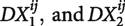 $DX_1^{ij},\,{\rm{and}}\,DX_2^{ij}$
) is equal to CES composites of domestic goods and imported goods by the source country. For the manufacturing sector,
$DX_1^{ij},\,{\rm{and}}\,DX_2^{ij}$
) is equal to CES composites of domestic goods and imported goods by the source country. For the manufacturing sector, $D{Y^{ij}} = {\left[ {\sum\nolimits_k \beta _{DY}^{ijk}{{\left( {D{Y^{ijk}}} \right)}^{\rho _{DY}^{ij}}}} \right]^{{1 \over {\rho _{DY}^{ij}}}}}$
, where i = U, M, C location of consumption; j = N, E is labor type; k = U, M, C, R is location of production;
$D{Y^{ij}} = {\left[ {\sum\nolimits_k \beta _{DY}^{ijk}{{\left( {D{Y^{ijk}}} \right)}^{\rho _{DY}^{ij}}}} \right]^{{1 \over {\rho _{DY}^{ij}}}}}$
, where i = U, M, C location of consumption; j = N, E is labor type; k = U, M, C, R is location of production; $\beta _{DY}^{ijk}$
are the share parameters; and
$\beta _{DY}^{ijk}$
are the share parameters; and $\rho _{DY}^{ij}$
are the CES parameters. There are similar functions for
$\rho _{DY}^{ij}$
are the CES parameters. There are similar functions for $DX_1^{ij}$
and
$DX_1^{ij}$
and $DX_2^{ij}$
. The region-specific prices for these traded goods are
$DX_2^{ij}$
. The region-specific prices for these traded goods are $P_Y^{ik}$
,
$P_Y^{ik}$
, $P_{{X_1}}^{ik}$
, and
$P_{{X_1}}^{ik}$
, and $P_{{X_2}}^{ik}$
. For the composite traded goods Y, X
1, and X
2, the corresponding CES price indices are
$P_{{X_2}}^{ik}$
. For the composite traded goods Y, X
1, and X
2, the corresponding CES price indices are $P_Y^i$
,
$P_Y^i$
, $P_{{X_1}}^i$
, and
$P_{{X_1}}^i$
, and $P_{{X_2}}^i$
, discussed in detail in Appendix A (see the online supplementary material). For the nontraded good V, the domestic price is
$P_{{X_2}}^i$
, discussed in detail in Appendix A (see the online supplementary material). For the nontraded good V, the domestic price is $P_V^i$
.
$P_V^i$
.
2.1.2. Budget constraint and migration of undocumented workers
Consumers own all firms and capital endowment ( $\bar K$
). Transfers occur between consumers and the government.Footnote 8 Hence, total income of consumers in each country includes wage income, profits (Π), capital returns
$\bar K$
). Transfers occur between consumers and the government.Footnote 8 Hence, total income of consumers in each country includes wage income, profits (Π), capital returns $\left( {r\bar K} \right)$
, and transfers (G
i
). The budget constraints of U.S. and Canadian low-skilled and skilled consumers and Mexican skilled consumers are
$\left( {r\bar K} \right)$
, and transfers (G
i
). The budget constraints of U.S. and Canadian low-skilled and skilled consumers and Mexican skilled consumers are
 $$\eqalign{ {\Psi ^{ij}}\left( {\Pi _Y^i + \Pi _{{X_1}}^i + \Pi _{{X_2}}^i + \Pi _V^i + {r^i}{{\bar K}^i} + {G^i}} \right) + {w^{ij}}L_S^{ij} = P_Y^iD{Y^{ij}} + P_{{X_1}}^iDX_1^{ij} \cr & + P_{{X_2}}^iDX_2^{ij} + P_V^iD{V^{ij}}, i = U,M,C; \ ij = UN,UE,CN,CE,ME,$$
where Ψ
ij
is the portion of profits and capital returns going to low-skilled and skilled consumers (Ψ
iN
+ Ψ
iE
= 1), G
i
is the total government transfers, w
ij
is wage rate, and $L_S^{ij}$
is labor supply.
$L_S^{ij}$
is labor supply.
Although Mexican skilled workers only work in Mexico, low-skilled Mexican workers work in Mexico or in the United States as either undocumented workers or guest workers. Low-skilled workers endogenously choose between leisure, working in Mexico, or working in the United States as undocumented workers or guest workers. Undocumented and guest workers earn income in the United States but spend in Mexico, which can be thought of analogous to remittances.Footnote 9 Because the illegal wage, w I , in the United States is higher than the low-skilled workers’ wage in Mexico, unauthorized migrants pay a smuggling fee, g, to enter the United States.Footnote 10 Mexican low-skilled workers’ budget constraint is defined as
 $${\Psi ^{MN}}\left( {\Pi _Y^M + \Pi _{{X_1}}^M + \Pi _{{X_2}}^M + \Pi _V^M + r{{\overline K }^M} + {G^M}} \right) + {w^{MN}}L_S^{MN} + {w^I}{L^{UI}} + {w^{UG}}{L^{UG}} = g{L^I} + P_Y^MD{Y^{MN}} + P_{{X_1}}^MDX_1^{MN} + P_{{X_2}}^MDX_2^{MN} + P_V^MD{V^{MN}},$$
where $L_S^{MN}$
is the low-skilled labor supply to Mexican production sectors, L
UG
is the number of Mexican workers that enter the United States legally through the H-2A guest-worker program, and w
UG
is the guest-worker wage rate. From the Mexican low-skilled workers’ perspective, the number of guest worker visas is exogenous and not a choice variable. L
I
is the number of Mexican low-skilled workers that attempt to enter the United States illegally. Because of the U.S. government’s border control, portion b of L
I
is caught at the border and returned back to Mexico, whereas the remaining portion, 1 – b, successfully enters the United States. L
UI
is the total number of successful migrant entrants that are currently residing in the United States. Of the unauthorized workers residing in the United States, fraction d is deported by U.S. domestic enforcement. In equilibrium, the number of deported undocumented laborers equals the number of successful immigrants crossing the U.S.-Mexico border: dL
UI
= (1 – b)L
I
(see Bandyopadhyay and Bandyopadhyay, Reference Bandyopadhyay and Bandyopadhyay1998; Devadoss and Luckstead, Reference Devadoss and Luckstead2018). This is a key equation in the model that connects the number of undocumented workers residing in the United States to the number of undocumented workers entering the United States (or voluntarily returning to Mexico if L
I
is negative) through border and domestic enforcement.
$L_S^{MN}$
is the low-skilled labor supply to Mexican production sectors, L
UG
is the number of Mexican workers that enter the United States legally through the H-2A guest-worker program, and w
UG
is the guest-worker wage rate. From the Mexican low-skilled workers’ perspective, the number of guest worker visas is exogenous and not a choice variable. L
I
is the number of Mexican low-skilled workers that attempt to enter the United States illegally. Because of the U.S. government’s border control, portion b of L
I
is caught at the border and returned back to Mexico, whereas the remaining portion, 1 – b, successfully enters the United States. L
UI
is the total number of successful migrant entrants that are currently residing in the United States. Of the unauthorized workers residing in the United States, fraction d is deported by U.S. domestic enforcement. In equilibrium, the number of deported undocumented laborers equals the number of successful immigrants crossing the U.S.-Mexico border: dL
UI
= (1 – b)L
I
(see Bandyopadhyay and Bandyopadhyay, Reference Bandyopadhyay and Bandyopadhyay1998; Devadoss and Luckstead, Reference Devadoss and Luckstead2018). This is a key equation in the model that connects the number of undocumented workers residing in the United States to the number of undocumented workers entering the United States (or voluntarily returning to Mexico if L
I
is negative) through border and domestic enforcement.
Next, we consider cross-border and U.S. domestic wage-linkage equations. Using the first-order conditions for utility maximization, we can derive the linkage between the Mexican wage rate and the U.S. undocumented wage rate (Devadoss and Luckstead, Reference Devadoss and Luckstead2018):
 $${w^{UI}} = {w^{MN}}\left( {1 + {d \over {1 - b}}} \right) + {d \over {1 - b}}g.$$
This equation entails that the undocumented wage rate is a weighted average of the Mexican wage rate and the migration cost. The weight on w MN captures the effects of border and domestic control on the wedge between w UI and w MN . An increase in w MN and g will cause immigrant workers to expect higher w UI . Larger d and b cause the wedge to be larger as unauthorized workers would expect higher w UI because of the larger risk of getting caught and deported through domestic and border enforcement. Similarly, stricter border and domestic enforcement also increases the wedge between w UI and g. Within the United States, the U.S. guest-worker wage rate is equal to the undocumented wage rate plus the probability of getting caught times the fine (c) domestic employers pay for hiring unauthorized workers (see Bond and Chen, Reference Bond and Chen1987):
 $${w^{UG}} = {w^{UI}} + dc.$$
Demand functions for various goods in each country are obtained from the first-order conditions of utility maximization (see Appendix A, subsection A.1 in the online supplementary material). Because utility functions (equation 1) are homogeneous of degree one, they measure the real income index, which represents welfare.
2.2. USMCA producers
Each USMCA country has four sectors producing manufacturing, capital-intensive agricultural, labor-intensive agricultural, and service and construction outputs. A representative firm in each sector uses CES production technology.Footnote 11 Because these production functions are standard, we include the functional forms and the variable definitions in Appendix A (see the online supplementary material). Here, we briefly state the various inputs used in each of the production sectors. The U.S., Mexican, and Canadian manufacturing sectors utilize capital and skilled labor. The U.S., Mexican, and Canadian capital-intensive agricultural sectors employ capital and low-skilled labor. In Mexico and Canada, the labor-intensive agricultural sectors utilize capital and low-skilled labor. The Mexican and Canadian service and construction sectors employ capital, skilled labor, and low-skilled labor. In the United States, given the contiguous location and U.S.-Mexican wage differentials, the labor-intensive agricultural sector employs, in addition to capital and domestic labor, temporary workers, which include undocumented workers and guest workers. The U.S. service and construction sector also utilizes undocumented labor along with capital, skilled labor, and low-skilled labor.
The representative firm in each sector maximizes profits by optimally choosing the variable inputs. Note that firms that hire undocumented workers could incur additional fines equal to the product of the probability of being caught (d), the fine levied for hiring one undocumented worker (c), and the number of undocumented workers employed (L UI ): FC U = dcL UI (see Bond and Chen, Reference Bond and Chen1987).
2.3. Demand and supply from the rest of the world
Because North American countries trade with ROW, we include reduced-form excess supply functions for ROW exports to the three USMCA countries and excess demand functions for ROW imports from USMCA countries. See Appendix A (in the online supplementary material) for the functional forms and variable definitions for these equations.
2.4. Government
The government for each region imposes ad valorem tariffs on imported goods and incurs nondistortionary transfers to consumers. The U.S. government also collects fines for hiring undocumented workers.
2.5. Market-clearing conditions
To close the model, we define market-clearing conditions for commodities and inputs. For traded commodities, given the Armington assumption, the market-clearing condition for each good from each country entails supply in each region equals the summation of demands across labor types and regions. The price for each traded good from each country is endogenously determined through its market-clearing condition. From these prices, the CES price indexes are computed.Footnote 12 For the nontradable service and construction sector, autarky prevails in each country (i.e., supply equals low-skilled and skilled workers’ demand).
Since the implementation of NAFTA in 1994, the U.S., Mexican, and Canadian economies have been highly integrated and capital has been freely mobile among the three countries. Therefore, capital-market clearing entails that total capital endowments in the United States, Mexico, and Canada equal the aggregate capital utilization in all sectors of the three countries.
For the labor markets, U.S. and Canadian low-skilled and skilled workers and Mexican skilled workers allocate their labor endowment between working domestically and leisure. However, the Mexican low-skilled workers’ labor endowment is allocated between unauthorized migration, working in the United States as undocumented workers and guest workers, domestic work in Mexico, and leisure. The U.S., Mexican, and Canadian total domestic skilled-labor supply equals total labor demand by the manufacturing and service and construction sectors. Similarly, the U.S. and Canadian total domestic low-skilled labor supply equals aggregate demand of low-skilled labor in the capital- and labor-intensive agricultural sectors and the service and construction sector.
2.6. Summary
Utility maximization yields 84 first-order conditions and profit maximization results in 27 first-order conditions (see Appendix A in the online supplementary material). Simplifying the first-order conditions, solving endogenous variables, and substituting into the market-clearing conditions lead to a system of 22 equations with 22 endogenous variables that we solve numerically.
3. Data and calibration
This section discusses the data and sources and an overview of calibration of the model. Appendices B and C (in the online supplementary material) contain additional details on the data and calibration method.
3.1. Data
The data sources are the GTAP 9 database (Aguiar, Narayanan, and McDougall, Reference Aguiar, Narayanan and McDougall2016), the U.S. Department of Labor’s National Agricultural Workers Survey (U.S. Department of Labor, Employment and Training Administration, 2016), and the Organization for Economic Cooperation and Development (OECD iLibrary, 2018). Consistent with the theoretical model, we aggregate the GTAP 9 database (2011 data) into four sectors (manufacturing, capital-intensive agriculture, labor-intensive agriculture, and service and construction), three factors (low-skilled labor, skilled labor, and capital), and four regions (the United States, Mexico, Canada, and ROW). From the GTAP 9 database, we collect data on tariffs, sectoral input use and outputs, output demand, and population.
We obtain data for U.S. low-skilled and undocumented wages from the National Agricultural Workers Survey. For Canada, we consider the low-skilled wage to be comparable to the U.S. wage rate. The Mexican low-skilled wage comes from Marosi (Reference Marosi2015). The U.S.-Mexican exchange rate, collected from International Monetary Fund (2016), is used to convert the wage rate to U.S. dollar value. For skilled workers, the U.S., Mexican, and Canadian adult population with education beyond high school is obtained from the OECD. The guest-worker data are collected from the U.S. Department of State (2015).
Because the GTAP data are for 2011, the calibration utilizes NAFTA policies. Consistent with general equilibrium modeling (Kehoe and Ruhl, Reference Kehoe and Ruhl2009), we define quantities such that commodity prices and capital rent are one in the baseline.
3.2. Calibration
With the aforementioned data for the endogenous variables, commodity prices, and capital rental rate, we calibrate the parameters in utility and production functions, smuggling fee, domestic enforcement fines, and share of low-skilled and skilled populations in each country. Following Rutherford (Reference Rutherford2002), the CES utility and production function share parameters are calibrated as a share of the expenditure. The returns to scale parameter for production is the ratio of total cost of production to total value of production. We assume a low elasticity of substitution of 0.35 for the U.S., Mexican, and Canadian capital- and labor-intensive agricultural sectors and an elasticity of substitution of 1 (Cobb-Douglas) for the manufacturing and service and construction sectors. Given the calibrated share form, the productivity parameters equal total output in the baseline. Based on data in Gonzalez (Reference Gonzalez2016), the fraction of undocumented workers deported by the U.S. government (d) is 1.5%, and the percentage of unauthorized immigrants caught at the border and returned back to Mexico is (b) 50%. Using the U.S. illegal wage rate, Mexican low-skilled wage rate, and the values of b and d, the smuggling fee g is calibrated using equation (4). We utilize the values of b and d, U.S. undocumented wage data, and U.S. low-skilled wage data to calibrate the fine levied by domestic enforcement for hiring an undocumented worker (c) by using equation (5). Utilizing total population, labor value, low-skilled wage, and percentage of adult population with education beyond high school, we calibrate skilled wage in each USMCA country.
4. Simulation, results, and discussion
We solve the model numerically and run three simulations: baseline, failed NAFTA renegotiation, and USMCA scenario. Because calibration is based on the data and policies from the NAFTA period, the baseline simulation with all NAFTA policies in place replicates the data. Given the uncertainty and contentious nature of the 2018 NAFTA renegotiation, we study the impacts of the USMCA relative to a “what if” scenario of failed NAFTA renegotiation. To predict the results for the failed NAFTA scenario, we first simulate the model by raising all tariffs to their MFN level applicable to ROW under World Trade Organization rules. Second, for the USMCA scenario, we incorporate the recently renegotiated trade policies.Footnote 13 Comparison of the results of the USMCA scenario with those under the failed NAFTA scenario quantifies the potential impacts of USMCA on price, production, bilateral trade, labor markets, and welfare of North American economies.Footnote 14
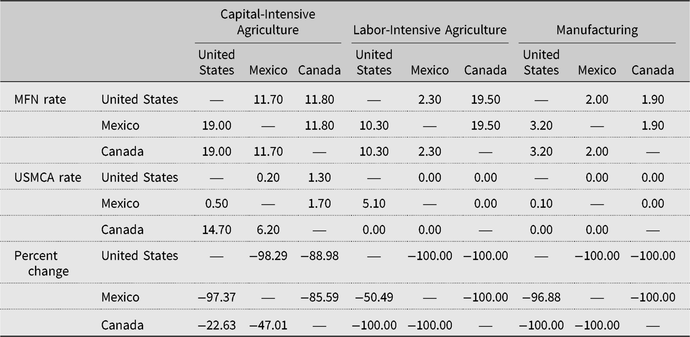
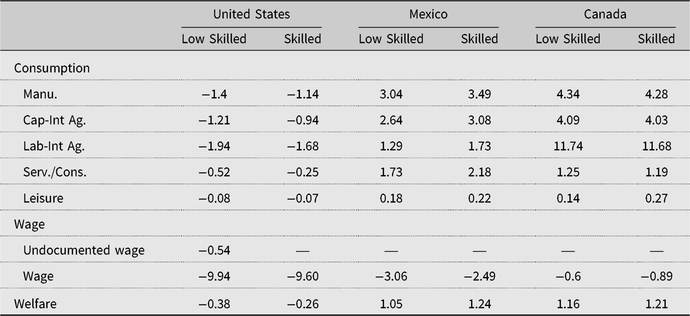
Table 1 reports tariff changes of USMCA countries compared with the scenario without the agreement. Table 2 presents the impact of USMCA on domestic sales, bilateral trade flow, total production, and total consumption. The exporting countries are listed in the first column, and importing countries are listed in the top row. Table 3 includes the impacts on commodity prices. Table 4 reports the percent changes in labor employment. Table 5 presents the result for consumption, wages, and welfare of low-skilled and skilled workers. The tables in Appendix D (see the online supplementary material) provide baseline values for the percent changes in endogenous variables.
Percentage changes in bilateral tariff from most favored nation (MFN) to United States–Mexico–Canada Agreement (USMCA)
Source: GTAP 9 database (Aguiar, Narayanan, and McDougall, Reference Aguiar, Narayanan and McDougall2016).
Impacts of United States–Mexico–Canada Agreement (USMCA) on domestic sales and bilateral trade in percent changes a

Notes: Cap-Int Ag., capital-intensive agriculture; Lab-Int Ag., labor-intensive agriculture; Manu., manufacturing; ROW, rest of the world; Serv./Cons., service and construction.
a Percent changes in results from comparison of USMCA scenario with most favored nation tariff rates scenario.
Impacts of United States–Mexico–Canada Agreement (USMCA) on prices, in percent changea

Notes: Simulation results under most favored nation (MFN) tariff rates. Cap-Int Ag., capital-intensive agriculture; Lab-Int Ag., labor-intensive agriculture; Manu., manufacturing; ROW, rest of the world; Serv./Cons., service and construction.
a Percent changes in results from comparison of USMCA scenario with MFN tariff rates scenario.
Impacts of United States–Mexico–Canada Agreement (USMCA) on labor employment in percent change a

a Percent changes in results from comparison of USMCA scenario with most favored nation tariff rates scenario.
Impacts of United States–Mexico–Canada Agreement (USMCA) on Consumption, Wage Rates, and Welfare in Percent Change a
Notes: Cap-Int Ag., capital-intensive agriculture; Lab-Int Ag., labor-intensive agriculture; Manu., manufacturing; Serv./Cons., service and construction.
a Percent changes in results from comparison of USMCA scenario with most favored nation tariff rates scenario.
4.1. Impacts of USCMA scenario
Relative to the failed NAFTA scenario with tariffs at their MFN level, the USMCA scenario lowers bilateral tariffs between the United States, Mexico, and Canada by 80.42% on average. These trade policy changes have significant economic repercussions for both commodity and labor markets because of (1) interconnectedness of the three North American economies through trade, (2) cross-border labor movements between Mexico and the United States, (3) free capital flow among the three countries, and (4) resource reallocation among the sectors in each country. Next, we discuss key impacts of the trade policies on commodity and labor markets.
4.1.1. Commodity markets
The decrease in bilateral tariffs reduces the wedge between import and export prices and causes bilateral trade between USMCA countries to rise in general, which leads to production and consumption changes in all four sectors of the North American economies.
The United States has comparative advantage in capital-intensive agricultural production, and the tariff reduction enhances this comparative advantage, leading to an increase in exports from the United States to Mexico by 41.95% and to Canada by 41.15%. Mexico also increases its exports of capital-intensive agricultural goods to the United States and Canada. However, Canadian capital-intensive agricultural exports to Mexico rise modestly but to the United States fall slightly. The rise in Mexican, but fall in Canadian, exports to the United States highlights that the relative size of the tariff reduction matters. The tariff imposed by the United States on Mexican goods falls by 97.37%, whereas the tariff imposed by the United States on Canadian goods falls by only 22.63%, giving Mexican goods a price advantage over Canadian goods in the United States. As a result, the price U.S. consumers pay for Mexican goods falls by 19.83%, whereas the price for Canadian goods falls by only 8.09% (Table 3). Thus, for capital-intensive agricultural goods, U.S. consumers substitute Mexican products for Canadian products. Despite no change in the ROW tariff rate, U.S. and Mexican exports to ROW expand modestly because the efficient reallocation of resources increases the U.S. and Mexican production, which lowers the world price of capital-intensive goods. This lower world price plus ROW tariff is less than the prevailing price in ROW before the policy changes, causing ROW to import more from the United State and Mexico. However, domestic sales in all three countries fall slightly because of import competition, a reduction in consumers’ income, and a decline in cross-prices of competing goods (discussed in detail in the subsequent paragraphs). In the United States and Mexico, the domestic capital-intensive good prices fall by 8.38% and 5.07% (Table 3), respectively, because of expanded domestic production, increased imports, and the decline in consumption. On the production side, wage and rental rates fall (also discussed in detail in Section 4.1.2), which shifts the supply curve out. The results also indicate that, because the U.S. domestic market is large relative to the export markets, the contraction in the U.S. demand offsets the rise in exports, and net demand falls. The outward shift in supply offsets the inward shift in demand, causing a slight rise in total production by 0.27% and a large fall in price by 8.38%. Similar results hold for Mexican capital-intensive agriculture, with exports to the United States and Canada rising by 38.09% and 27.89%, total production increasing by 0.98%, and the domestic price falling by 5.07%. Despite an outward shift in the Canadian supply curve as input prices fall, the reduction in domestic sales and exports to the United States outweighs the increase in exports to Mexico and ROW, causing Canadian production to fall minimally by 0.06% and the price in Canada to decline by 4.65%.
U.S.-Mexican bilateral tariff reductions are smaller in the labor-intensive agricultural sector than in the capital-intensive agricultural sector (see Table 1). Consequently, bilateral trade flows between these two countries are less pronounced in labor-intensive agriculture than in the capital-intensive agricultural sector. An interesting prediction of the simulation is that Canadian labor-intensive agricultural exports to the United States increase, rather than decrease as in the capital-intensive agricultural sector. This increase occurs because the reduction of the U.S. tariff on labor-intensive agricultural imports from Canada is larger than the reduction of the U.S. tariff on capital-intensive agricultural goods, giving Canadian labor-intensive agricultural producers a price advantage. U.S. domestic sales of labor-intensive agricultural goods decline, which offsets the increase in exports to Mexico, Canada, and ROW, leading to a small decrease in total U.S. production. As in the United States, total Canadian labor-intensive agricultural production falls marginally. By contrast, the increase in Mexican export sales dominates the fall in domestic sales, resulting in an increase in Mexican labor-intensive agricultural production.
For the U.S. and Mexican manufacturing sectors, the results are directionally consistent with their respective capital-intensive agricultural sectors, but the impacts are generally lower, which is because of smaller changes in tariff rates and the manufacturing sector being larger than the agricultural sectors. The impacts in the Canadian manufacturing sector are generally small.
The nontraded service and construction sector is indirectly affected by USMCA policies through changes in input prices on the supply side and income of the demand side. Domestic sales in the United States fall slightly, but rise marginally in Mexico and Canada. For the United States, the wage and rental rates decline (discussed in Section 4.1.2), which shifts the supply curve to the right. Simultaneously, real income declines because lost tariff revenues and lower profits offset the fall in prices, causing the demand curve to shift to the left. These offsetting effects cause sales of service and construction goods to fall minimally, while the price declines by 9.35%. For Mexico and Canada, the results indicate that the inward shift in the demand curve is not as dramatic as in the United States and does not offset the outward shift in the supply curve. Consequently, sales in Mexico and Canada rise slightly, and price declines by 5.28% and 2.24%, respectively.
4.1.2. Labor markets
An important feature of the general equilibrium model is the capability to analyze the indirect impacts of trade policies on undocumented and domestic labor markets. As elaborated previously, total U.S. production in the two sectors (labor-intensive agriculture and service and construction) that hire undocumented workers falls, causing demand for and the wage rate of undocumented workers to decline. Furthermore, the expansion of Mexican production in each sector increases labor demand, which puts upward pressure on Mexican wages and incentivizes low-skilled Mexican workers to remain in Mexico as opposed to entering the United States illegally and undocumented workers residing in the United States to return to Mexico. The combined effect of lower demand for and wage rate of undocumented workers in the United States and higher labor demand in Mexico is that the number of undocumented workers residing in the United States declines (–2.62% for labor-intensive agriculture and –9.23% for service and construction;Footnote 15 see Table 4).
As lower tariffs cause undocumented employment to decline in U.S. labor-intensive agricultural and service and construction sectors, U.S. domestic low-skilled workers are substituted for the undocumented workers. Consequently, the employment of U.S. low-skilled workers increases by 0.86% and 0.32%, respectively, in these sectors. However, the labor substitution is small, and the fall in the undocumented workers outweighs the increase in domestic workers, leading to a decline in the net composite of low-skilled labor and production in both sectors. Because the U.S. capital-intensive agricultural sector does not employ undocumented workers and experiences a production increase, domestic low-skilled worker employment increases more (1.36%) in this sector than in the labor-intensive agricultural and service and construction sectors. This demand-side effect exerts upward pressure on wage rates.
The U.S. supply of both low-skilled and skilled labor rises. This occurs because, even though trade liberalization expands foreign markets for U.S. goods, the loss of domestic market shares is relatively large, which dampens the profitability of U.S. firms. Because profits and tariff revenues are a part of total income, to offset these losses, U.S. consumers reallocate their time from leisure to work to earn higher labor income, which increases labor supply and puts downward pressure on wages. In equilibrium, despite the increase in demand for U.S. domestic low-skilled workers in all sectors and for skilled labor in the manufacturing sector, the increase in labor supply causes both U.S. domestic low-skilled and skilled wages to decline by 9.94% and 9.60%, respectively (Table 5). As wages fall, U.S. firms substitute labor for capital, which lowers demand for capital, causing the U.S. capital rental rate to fall by 7.90%.
With the United States dominating North American production (accounting for 68.31% of the total North American production in manufacturing, 73.97% in capital-intensive agriculture, and 66.36% in labor-intensive agriculture), the deterioration of the terms of trade outweighsFootnote 16 the gain from higher trade causing U.S. welfare to fall by 0.38% for skilled workers and 0.26% for low-skilled workers.Footnote 17
In Mexico, counteracting forces affect both labor demand and supply. On the demand side, in contrast to U.S. firms, Mexican producers substitute capital for low-skilled and skilled workers as the capital rental rate declines more than the Mexican wage rates, which puts downward pressure on demand for Mexican low-skilled and skilled workers. However, expansion of production in all four sectors puts upward pressure on demand for Mexican low-skilled and skilled workers. Thus, the net impact on labor demand in Mexico is ambiguous. On the supply side, with fewer workers departing to the United States and migrants returning back, more low-skilled labor is available for production in Mexico. However, the fall in commodity prices in Mexico offsets the decrease in nominal income as profits and tariff revenues decline, leading to an increase in real income. With greater purchasing power, Mexican workers spend more time at leisure, lowering Mexican low-skilled and skilled labor supplies. Thus, the net impact on low-skilled labor supply is also ambiguous. With the total number of available skilled workers in Mexico unaffected by USMCA, the income effect on increasing leisure implies Mexican skilled-labor supply contracts. These simultaneous demand and supply forces cause equilibrium employment of low-skilled workers to fall modestly in the Mexican capital- and labor-intensive agricultural sectors and service and construction sector. Because higher real income causes Mexican demand for service and construction goods to expand more than demand for Mexican manufacturing exports, the fall in employment of skilled workers in the service and construction sector is less than the decrease in the manufacturing sector. The net effect in Mexico is for low-skilled and skilled wage rates to decline by 3.06% and 2.49%, respectively. With consumption and leisure both expanding, the welfare of Mexican low-skilled workers rises by 1.05%, and the welfare of skilled workers increases by 1.24%.
The aforementioned results highlight that lower tariffs reduce the wage disparity between the United States and Mexico and lessen the incentive for undocumented workers to migrate to and remain in the United States. This result is consistent with the findings of Luckstead, Devadoss, and Rodriguez (Reference Luckstead, Devadoss and Rodriguez2012) who conclude that the 1994 NAFTA reduced the wage gap between the undocumented workers in the United States and Mexican low-skilled workers, leading to a modest reduction in undocumented workers in labor-intensive agricultural production.
In Canada, as the production in the manufacturing and capital- and labor-intensive agricultural sectors falls, demand for both low-skilled and skilled labor in these sectors declines. The fall in capital rental rate exacerbates the decline in labor demand as Canadian firms use more capital and hire fewer workers, putting downward pressure on wages. However, the increase in production in the service and construction sector raises demand for both types of labor, putting upward pressure on wages. Furthermore, as in Mexico, the decrease in commodity prices increases Canadian purchasing power, which exerts downward pressure on Canadian low-skilled and skilled labor supplies as consumers spend more time at leisure. The decline in demand for Canadian labor outweighs the decline in labor supply, causing equilibrium employment of low-skilled and skilled workers in all Canadian sectors to decrease and wage rates to fall by –0.89% and –0.60%, respectively. With commodity prices falling more than wages, Canadian low-skilled and skilled workers enjoy higher welfare (1.16% and 1.21%, respectively) with increased consumption and leisure.
4.2. Sensitivity analysis
We conducted sensitivity analysis for different values of key parameters to gain insights into the impacts of trade policies. We first consider the CES parameter, $\lambda _{{X_2}}^{US}$
, in the U.S. labor-intensive agricultural production function. This parameter governs the elasticity of substitution between undocumented workers and U.S. low-skilled workers and sheds light on how much low-skilled domestic workers substitute for undocumented workers and the resulting implications for production. In the main analysis, undocumented workers and domestic workers have a low elasticity of substitution (elasticity of substitution of 0.35 with a CES parameter of
$\lambda _{{X_2}}^{US}$
, in the U.S. labor-intensive agricultural production function. This parameter governs the elasticity of substitution between undocumented workers and U.S. low-skilled workers and sheds light on how much low-skilled domestic workers substitute for undocumented workers and the resulting implications for production. In the main analysis, undocumented workers and domestic workers have a low elasticity of substitution (elasticity of substitution of 0.35 with a CES parameter of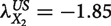 $\lambda _{{X_2}}^{US} = - 1.85$
) in the U.S. labor-intensive agricultural sector. USMCA causes production in this sector to decline because the loss in domestic sales exceeds the gain in exports, leading to fewer undocumented workers employed in this sector, and because of the low elasticity of substitution, fewer domestic workers enter into this sector. When we increase the elasticity of substitution, the declines in the labor-intensive agricultural production and employment of undocumented workers are more pronounced, which increases the number of domestic workers employed in this sector. For example, with
$\lambda _{{X_2}}^{US} = - 1.85$
) in the U.S. labor-intensive agricultural sector. USMCA causes production in this sector to decline because the loss in domestic sales exceeds the gain in exports, leading to fewer undocumented workers employed in this sector, and because of the low elasticity of substitution, fewer domestic workers enter into this sector. When we increase the elasticity of substitution, the declines in the labor-intensive agricultural production and employment of undocumented workers are more pronounced, which increases the number of domestic workers employed in this sector. For example, with $\lambda _{{X_2}}^{US} = 0$
(i.e., an elasticity of substitution equal to 1 implying a Cobb-Douglas production function) production falls by –0.20%, the number of undocumented workers falls by –6.69%, and the employment of domestic low-skilled workers rises by 3.17%. Because the U.S. labor-intensive agricultural sector employs about 70% of undocumented workers, the loss of undocumented workers (6.69%) is considerably more than the addition of U.S. low-skilled workers (3.17%), and the production in this sector falls. We would like to point out that the higher elasticity of substitution of 1 used for this sensitivity analysis is a bit unrealistic given that U.S. low-skilled workers are not willing to perform physical, hard labor in this sector.
$\lambda _{{X_2}}^{US} = 0$
(i.e., an elasticity of substitution equal to 1 implying a Cobb-Douglas production function) production falls by –0.20%, the number of undocumented workers falls by –6.69%, and the employment of domestic low-skilled workers rises by 3.17%. Because the U.S. labor-intensive agricultural sector employs about 70% of undocumented workers, the loss of undocumented workers (6.69%) is considerably more than the addition of U.S. low-skilled workers (3.17%), and the production in this sector falls. We would like to point out that the higher elasticity of substitution of 1 used for this sensitivity analysis is a bit unrealistic given that U.S. low-skilled workers are not willing to perform physical, hard labor in this sector.
Second, we consider sensitivity analysis for changes in ROW’s elasticities of excess supply $\theta _O^S$
and excess demand
$\theta _O^S$
and excess demand $\theta _O^D$
. Doubling the value of
$\theta _O^D$
. Doubling the value of $\theta _O^S$
and
$\theta _O^S$
and $\theta _O^D$
does not have significant impacts on changes in most of the endogenous variables. However, the changes in U.S., Canadian, and European Union exports to ROW are twice as large with greater excess supply and excess demand elasticities. For instance, the change in U.S. exports of labor-intensive agricultural products to ROW increases from 2.18% to 4.24%. This expansion in exports to ROW and the increase in exports to Mexico and Canada, following the USMCA tariff reduction, offset the decrease in domestic sales, and total U.S. production of labor-intensive agricultural commodities rises slightly. Thus, higher elasticities of ROW excess supply and excess demand benefit the North American countries’ export sectors. With more resources reallocated to the export sectors, the decline in production of the service and construction sector is more pronounced. These results highlight the important role that trade with ROW plays in influencing the North America economies.
$\theta _O^D$
does not have significant impacts on changes in most of the endogenous variables. However, the changes in U.S., Canadian, and European Union exports to ROW are twice as large with greater excess supply and excess demand elasticities. For instance, the change in U.S. exports of labor-intensive agricultural products to ROW increases from 2.18% to 4.24%. This expansion in exports to ROW and the increase in exports to Mexico and Canada, following the USMCA tariff reduction, offset the decrease in domestic sales, and total U.S. production of labor-intensive agricultural commodities rises slightly. Thus, higher elasticities of ROW excess supply and excess demand benefit the North American countries’ export sectors. With more resources reallocated to the export sectors, the decline in production of the service and construction sector is more pronounced. These results highlight the important role that trade with ROW plays in influencing the North America economies.
Third, modest changes in the CES parameters, ρ ij , in the upper-level utility functions do not have significant impacts in the results. However, a decrease in ρ ij implies workers spend slightly less time in leisure.
Fourth, the CES parameters in the composite good functions, $\rho _{DO}^{ij}$
, tend to affect the results as they exert larger influence on the consumption patterns among goods from different countries. For example, when we lower
$\rho _{DO}^{ij}$
, tend to affect the results as they exert larger influence on the consumption patterns among goods from different countries. For example, when we lower $\rho _{DO}^{ij}$
by 20% (i.e., reduce the elasticity of substitution, indicating that consumers substitute less between domestics products and imported products), bilateral trade between the United States, Mexico, and Canada is less pronounced. The percentage changes in U.S. exports of labor-intensive agricultural commodities to Mexico, Canada, and ROW are 7.61%, 25.64%, and 0.74%, respectively, which are lower than the main results reported in Table 2. The decline in domestic sales is also less pronounced. In the U.S. labor-intensive agricultural sector, with 80% of production sold domestically, the increase in exports now dominates the decrease in domestic sales and production increases.
$\rho _{DO}^{ij}$
by 20% (i.e., reduce the elasticity of substitution, indicating that consumers substitute less between domestics products and imported products), bilateral trade between the United States, Mexico, and Canada is less pronounced. The percentage changes in U.S. exports of labor-intensive agricultural commodities to Mexico, Canada, and ROW are 7.61%, 25.64%, and 0.74%, respectively, which are lower than the main results reported in Table 2. The decline in domestic sales is also less pronounced. In the U.S. labor-intensive agricultural sector, with 80% of production sold domestically, the increase in exports now dominates the decrease in domestic sales and production increases.
5. Discussion and conclusions
We construct and calibrate an Armington trade model with four regions, four production sectors, two types of workers, and undocumented labor movement from Mexico to the United States to assess the impact of USMCA relative to a scenario of failed NAFTA renegotiation on trade, production, consumption, labor markets, cross-border migration, wage rates, and other economic variables in the North American countries.
With USMCA negotiated policies, U.S. labor-intensive agricultural production decreases because of higher imports from Mexico, even though the U.S. exports to Mexico and Canada expand. Similarly, U.S. service and construction production also declines because of the labor shortages. By contrast, production in U.S. export-oriented manufacturing and capital-intensive agriculture increases as these sectors draw resources from the labor-intensive agricultural and service and construction sectors. Production in Mexico in all four sectors expands, which is consistent with a small country having access to large combined U.S. and Canadian markets. In addition, the employment of low-skilled workers in Mexico increases largely because returning migrants help to expand production in Mexico.
Our analysis suggests that, if USMCA policies are not ratified and tariffs increase among North American countries, the labor shortages in labor-intensive agricultural and service and construction sectors would be more severe as U.S. labor-intensive production would rise and Mexican labor-intensive production would fall. This would exacerbate the gap between the U.S. and Mexican low-skilled wage rates and create incentive for more, not fewer, workers to migrate from Mexico to the United States. By contrast, tariff reduction under this agreement expands labor-intensive production in Mexico and reduces labor-intensive production in the United States, which curtails migration from Mexico to the United States. This result corroborates the findings of past studies (Luckstead, Devadoss, and Rodriguez, Reference Luckstead, Devadoss and Rodriguez2012) that free trade among North American countries improves economic growth for Mexico, which lowers migration to the United States. The current U.S. government advocates both stricter immigration policy and protective trade policy. Our findings show that restrictive trade policies contradict the U.S. goal of lowering undocumented workers.
The United States incurs a small welfare loss and Mexico and Canada gain from the regional trade agreement. Because the United States is large relative to Mexico and Canada, the loss in welfare arises from the U.S. terms of trade deterioration, which exceeds the gain in welfare from the increase in trade. The loss in U.S. domestic profits outweighs the gains in U.S. export profits, which, coupled with the fall in tariff revenue, causes U.S. consumers’ income to fall. The results show that the negative income effect dominates the positive benefits of import price decreases. To offset some of the profit and tariff revenue income loss, U.S. consumers reduce leisure to work more and earn additional wage income, but the net effect is a loss in consumption. With less leisure and consumption declining, the welfare of U.S. consumers falls slightly. The gains in Mexican and Canadian terms of trade with the United States, along with the rise in trade volume, contribute to higher welfare. The decrease in commodity prices outweighs the fall in wage rates and real income increases, leading to a rise in consumption, leisure, and welfare in Mexico and Canada. Although regional trade agreements can lead to lower welfare for a large nation (as is the United States in this case), these agreements—as is well established in the international trade literature—do lead to a more efficient allocation of resources, and global welfare does rise.
Supplementary material
To view supplementary material for this article, please visit https://doi.org/10.1017/aae.2019.31.
Acknowledgments
We gratefully acknowledge the valuable comments of three anonymous reviewers and editor Mike Reed.


 Open access

