

Introduction
The ontological turn blurred boundaries between beings, things and places (Descola & Lloyd Reference Descola and Lloyd2013; Gell Reference Gell1998; Kelly Reference Kelly2014; Latour Reference Latour1993; Layton Reference Layton2003; Viveiros de Castro Reference Viveiros de Castro1998), complexifying archaeological interpretations of materiality (summarized in Henare et al. Reference Henare, Holbraad and Wastell2007). Archaeologists have oscillated between understanding past epistemologies (worldviews) to realizing ontologies (worlds)—staking out nuanced ground between relational archaeologies (e.g. Alberti Reference Alberti2016; Alberti & Marshall Reference Alberti and Marshall2009; Watts Reference Watts2014; Zedeño Reference Zedeño2014), symmetrical archaeology (Olsen & Witmore Reference Olsen and Witmore2015; Shanks Reference Shanks2007), entanglement (Hodder Reference Hodder2011; Reference Hodder2024) and archaeologies of animism or relational ontology (Alberti Reference Alberti2016; Brown & Walker Reference Brown and Walker2008; Groleau Reference Groleau2009; Janusek Reference Janusek2015; Sellers Reference Sellers2010). Ethnographers and archaeologists have artfully debated the distinctions, implications and limitations of these approaches (Alberti Reference Alberti2016; Reference Alberti2018; Descola & Lloyd Reference Descola and Lloyd2013; Holbraad Reference Holbraad2009; Kosiba et al. Reference Kosiba, Janusek and Cummins2020; Sahlins Reference Sahlins2014; Swenson Reference Swenson2015b), which is beyond the scope of this paper’s objectives. Instead, Andean ontology related to geographic distance frames how the elemental and isotopic compositions of humans, animals and artifacts assembled in the tombs of a pre-Hispanic cemetery in southern Peru are understood. This Andean example contributes to understanding how geographical distance, social alterity and animistic ontologies are useful for thinking through the embodiment of landscapes mineralized in skeletal tissues (Velasco et al. Reference Velasco, Kamenov and Krigbaum2024) and plants assembled at burial sites—bringing ontological interpretation to bear on biogeochemical data from contexts around the world.
In this paper, animistic Indigenous ontologies are taken seriously (sensu Henare et al. Reference Henare, Holbraad and Wastell2007) by emphasizing ‘matter’s inherent dynamism’ (Alberti & Marshall Reference Alberti and Marshall2009, 349) with respect to isotopic studies. Barad (Reference Barad2007, 145–6) explains that matter is differentiable only relative to other matter, requiring practice-based ‘apparatuses of bodily production’ to create and maintain matter’s divisions. This rings familiar to researchers of the Andes, where becoming and (un)becoming are infinitely mutable and unstable processes comprising the ‘reciprocal interdependencies’ that bind ‘the human, animal, ancestral, and material into an integrative agentive field’ (Swenson Reference Swenson2015b, 682). Most would agree that Andean forms of animism were and are not identical to those of the Amazon or broader Amerindian cosmologies (see e.g. Kosiba Reference Kosiba2020). Descola (Reference Descola2014, 276) ties an analogistic form of animism to the pre- and early state Andes, identifiable by the ‘multiplication of the elementary pieces of the world echoing within each of its parts—including humans, divided into numerous components partially located outside of their bodies’. Salomon (Reference Salomon2018) and Mattina (Reference Mattina2019), among others, have emphasized how analogistic orders in the Andes were critical to ordering relationships at scales from the body, to the house, community, regional geopolitics and the universe. Andean forms of animacy were therefore intertwined with social authority, so that assembling (sensu Deleuze & Guattari Reference Deleuze and Guattari1988) or bundling (Pauketat Reference Pauketat2012; Swenson Reference Swenson2015a; Zedeño Reference Zedeño2008) humans and objects in particular places endowed those assemblages and their assemblers with power and authority that set the stage for broader socio-political differentiation.
Rather than fully parsing the many distinctions between Andean and Amazonian animism, it is simply taken as fact here that Andean bodies, things and landscapes were mutually constituted through exchange of vital energies through time and space (Pauketat Reference Pauketat2012; Zedeño Reference Zedeño2008). This conceptualization emerges from the premise of taking material remains as meanings, rather than human-mediated reflections of meanings, and opens interpretive possibilities (Bray Reference Bray2009; Henare et al. Reference Henare, Holbraad and Wastell2007); as Mannheim (Reference Mannheim2019, 249) puts it, animated forces in the Andes are not metaphors, but rather, they are ‘truly the world’. However, even if one takes the ‘leap of faith’ (Alberti & Marshall Reference Alberti and Marshall2009, 346) required to see the world through animism, the limitations of the archaeological record make it more productive to consider how and why vital forces became (dis)animated and how those transformations were materialized by society (Groleau Reference Groleau2009, 404; Kosiba Reference Kosiba2020, 13) within the ‘constellation of practices’ (Mannheim Reference Mannheim2019, 249) of past people.
In these animistic ontologies, corporeal bodies, material things, landscapes and the supernatural are subject to animation by vital, interconnected and interchangeable life forces, incrementally and relationally (re)made through interactions with human and non-human others (Bird-David Reference Bird-David1999; Descola & Lloyd Reference Descola and Lloyd2013; Harvey Reference Harvey2014; Viveiros de Castro Reference Viveiros de Castro2019). Assemblage theory (Deleuze & Guattari Reference Deleuze and Guattari1988), Strathern’s (Reference Strathern1988) ‘dividual’ body, Gell’s (Reference Gell1998) distributed personhood, Bird-David’s bodily constitution through ‘nested relatedness’ (Reference Bird-David1999, 78), and Ingold’s meshworks (Reference Ingold2015) and correspondences (Reference Ingold2017) are some of the frameworks through which archaeologists have grappled with animism’s intersubjectivity of materiality, space and time. Kosiba (Reference Kosiba2019; Reference Kosiba2020), Tantaleán (Reference Tantaleán2019), Alberti and Laguens (Reference Alberti and Laguens2019) and their respective collaborators have led the charge to consider animistic ontologies in Andean archaeology, but these works have focused mostly on localized aspects of ontologies—personhood and sacred landscapes—which limits understandings of supra-local distance in the production of people and place through mobility and trade.
To understand the role of geographic distance in generating matter, it is helpful to look to Mary Helms, who proposed that in animistic worlds where all life is consubstantial, spatiotemporal distance is the primordial mechanism defining materiality and relationality: ‘In the beginning were animals, ancestors, and other people’, separating ‘Us’/‘here-and-now’ from ‘Other’/‘there-and-then’, graded by spatiotemporal or spiritual distance from the family house (Helms Reference Helms1998, 34–5). According to Helms (Reference Helms1998), connecting to powerfully generative and destructive alterity is the central aim of animists. Geographic distance, then, functions as an ‘engine for personhood’ (Lau Reference Lau2012, 120) to define the other, while the process of ‘othering’ creates people, things and places of a particular kind. This multidimensional tapestry of disambiguated energy and potentialities connects all life forces but requires vigilant and constant difference-making. All matter (us and others) must constantly be tended to; these differences must continuously be asserted to exist (Alberti Reference Alberti2018; Alberti & Laguens Reference Alberti and Laguens2019).
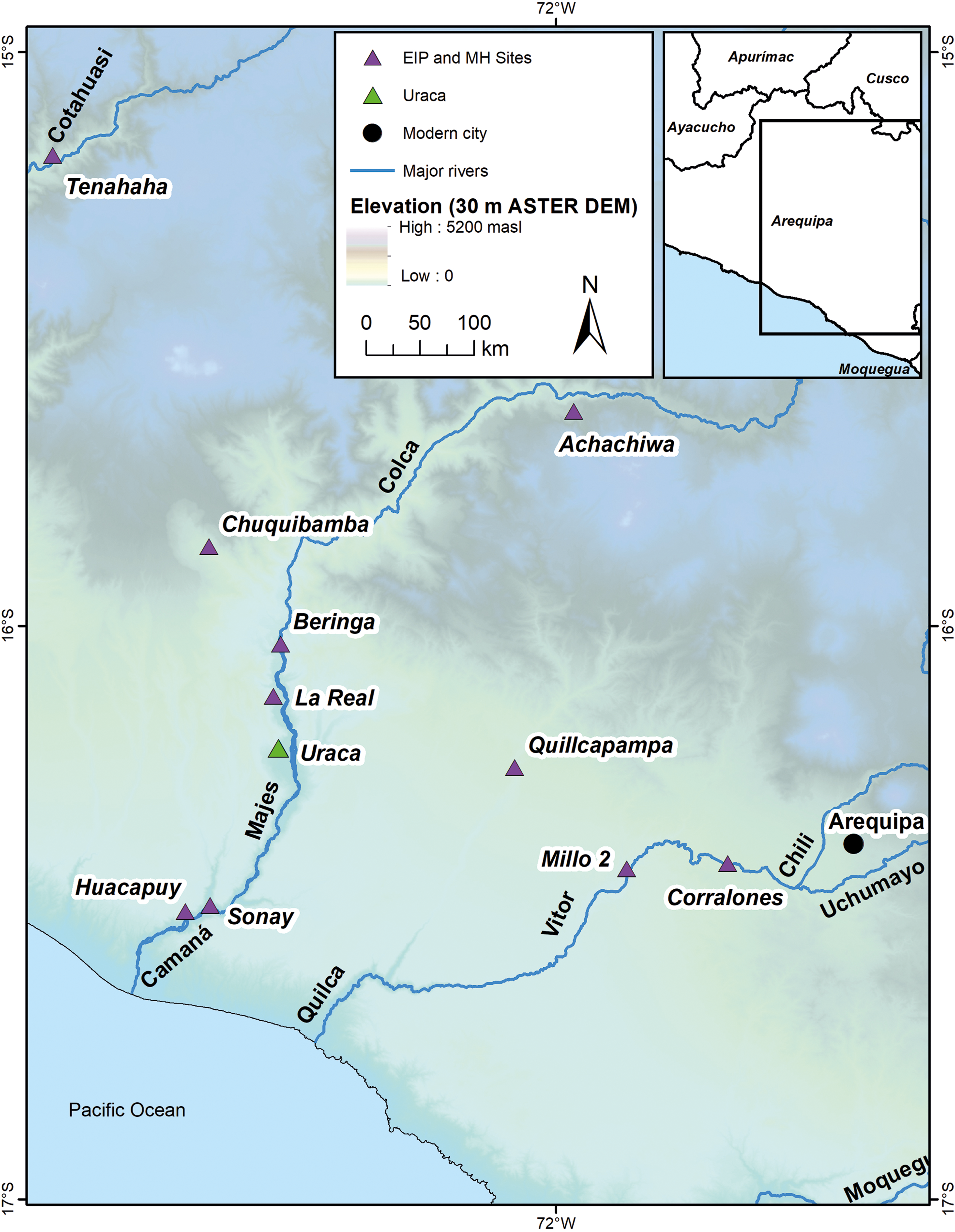
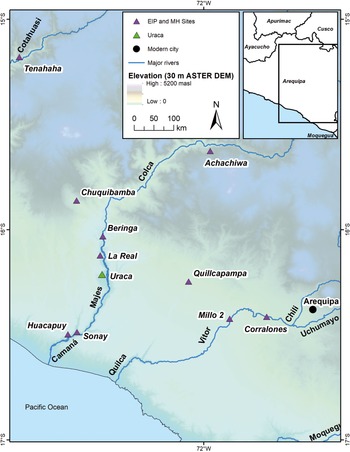
This paper leverages biogeochemical analysis to explore the geographic otherness of human and non-human beings and things assembled in mortuary landscapes around the pre-Hispanic cemeteries at Uraca, Arequipa, Peru (Fig. 1). The first section explores distance and alterity through Helms’ classes of others applied to Andean ontology and describes examples of the human and non-human beings and things excavated as grave goods from the Uraca contexts. The next section briefly summarizes core principles of biogeochemical detection of non-locals and then reports new 87Sr/86Sr results for each group of grave goods relative to published 87Sr/86Sr for the site. Finally, these findings are connected with global animistic examples to explore how assembling local and non-local beings and things would have crystallized networks of vitality woven together through time and space at mortuary places.
Uraca in the Lower Majes Valley, Arequipa, Peru, relative to elevation and nearby contemporaneous sites dating to the EIP and Middle Horizon (UTM 18S, WGS 1984 datum).
Distance and alterity
Prestige item control has long been considered essential for maintaining social power (Brumfiel & Earle Reference Brumfiel and Earle1987; Earle Reference Earle1997; Reference Earle2000; Goldstein Reference Goldstein2000; Junker Reference Junker1993), but Helms (Reference Helms1979) provided a mechanism for operationalizing this power by observing that prestige corresponds to spatiotemporal distance. Special things and beings are imbued with ‘an aura of exceptionality’ (Helms Reference Helms1993, 101) tied to ‘outside’ places like other communities, sacred places like caves, mountains and waterfalls, or cosmic realms lying above, below, or beyond the earth—including temporal realms distant from the present. Animals, the dead, ancestors and other people and things are key types of geographically distant materials and thus, cosmologically powerful entities that must be dealt with as they come inside communities and houses (Helms Reference Helms1998). These others are perhaps even more vexing in ontologies where vital forces can flux between animal, human and spirit form. Animals dwell with spirits in outside places, so that ritual emphasizes proper animal consumption to preserve the regenerative power of their essences (summarized in Helms Reference Helms1998, 29). In analogistic or animistic ontologies, animal essences can be somewhat indistinguishable from humans, with their organization and lifeways either mirroring human social structures or reinforcing them (Helms Reference Helms1998, 29–30). The dead and ancestors are also especially generative or destructive kinds of ‘spatial/temporal Others’ (Helms Reference Helms1998, 35), whose vitality is crystallized in durable, dry and ‘relatively imperishable’ (Helms Reference Helms1998, 28) bones. This ossified vitality is strongest in important people like warriors, chiefs and those who have died a good death (Helms Reference Helms1998, 34–6). Decorating dead bodies and body parts is a social project that transforms individual bodies into artifacts as idealized, communal ancestors—a special kind of dead even further removed from the freshly dead and living (Helms Reference Helms1998, 36). As Helms acknowledges (Reference Helms1998, 35), mortuary ritual connects the living to these others, (un)balancing energies and outcomes.
Acquiring objects from afar requires specialized knowledge and skill necessary to succeed in the dangerous journey, navigate unfamiliar customs to complete a tense exchange (or outright taking) and incorporate powerful outside forces into home communities. Outside things and people reflect wealth gained and treacherous terrain travelled (Ashley & Thunen Reference Ashley and Thunen2020; Helms Reference Helms1993; Reference Helms1998; Trubitt Reference Trubitt2003) inasmuch as they reflect esoteric and mythical knowledge acquired. However, Helms also contends that travellers acquire supernatural power of places, people and things encountered: as one moves ‘away from the social center geographically, one moves toward places and people that are increasingly different; and, therefore, regarded as increasingly supernatural, mythical, and powerful’ (Helms Reference Helms1993, 7). Several categories of specialists achieve prestige by passing through or engaging with the outside or temporarily transitioning to outside status to ‘activate links with the wider cosmos’ (Helms Reference Helms1998, 8). Shamans or priests travel to realms outside their physical body in trances, pilgrims voyage on spiritual quests and hunters and warriors travel to kill, raid and capture booty. Traders also navigate perilous outside landscapes, while artisans masterfully craft outside materials into communal works of art. Considering distance via Andean analogistic ontologies demonstrates how engaging alterity materially altered individuals and communities.
Pacha and camay in the Andes
Andean ontologies inform how the archaeological record is understood, as illustrated by a rich, growing corpus (Arnold & Hastorf Reference Arnold and Hastorf2008; Bray Reference Bray2015; Groleau Reference Groleau2009; Jennings et al. Reference Jennings, Berquist and Spence-Morrow2018; Kosiba et al. Reference Kosiba, Janusek and Cummins2020; Lau Reference Lau2012; Lozada & Tantaleán Reference Lozada and Tantaleán2019; Swenson Reference Swenson2015b; Weismantel Reference Weismantel2015a). Two oft-cited Quechua terms are especially relevant to understanding the ontology of alterity, distance and mortuary practices. First, pacha unifies time, earth and place—it is simultaneously ‘a moment or interval in time and a locus or extension in space’ that can exist at any scale (Salomon & Urioste Reference Salomon and Urioste1991, 14). Andean people situated the past in front of their bodies as they moved through ‘a world pregnant with the past’ (VanValkenburgh Reference VanValkenburgh2017, 124). Sacred places, things and bodies collapsed embodied experience with time, enabling people to tap into the powerful and ancestral past to influence the future (Bray Reference Bray2018; Chase Reference Chase2015; Janusek Reference Janusek2020; Seoane & Culquichicón-Venegas Reference Seoane and Culquichicón-Venegas2018; Wilkinson & D’Altroy Reference Wilkinson and D’Altroy2018). Second, camay/kamay, or sami (Allen Reference Allen2002), is the vital animating essence perpetually flowing between bodies, things, places and pacha (Arnold Reference Arnold2018; Bastien Reference Bastien1985b; Bray Reference Bray2009, 200; Tantaleán Reference Tantaleán2019). This essence is partible, and can be harnessed to bring things or people into and out of living or animated states by transforming extant vitality in the universe (Salomon & Urioste Reference Salomon and Urioste1991, 16–17). Raw, unworked materials like stone (Bray Reference Bray2009; Dean Reference Dean2010), raw human bodies from other places (Janusek Reference Janusek2020), and hardened bones or mummified dead (Allen Reference Allen1982; Reference Allen2002; Canessa 2000; Gose Reference Gose2018; Ødegaard Reference Ødegaard2018) have powerful and potentially dangerous camay that must be carefully mediated. Pacha and camay help clarify how mortuary rituals used these hardened substances as means of connecting to others of many kinds, collapsed into a unified space-time.
Camay explains how bodies, places and things are relationally and incrementally made (Allen Reference Allen1982; Reference Allen2002; Sillar Reference Sillar1996), while pacha blurs together life and death, past and present (Armando Muro et al. Reference Armando Muro, Jaime Castillo and Tomasto-Cagigao2019; Villanueva Criales Reference Villanueva Criales2019, 273) to link bodies and places metaphorically and metaphysically. The ‘geographic body’ (Bastien Reference Bastien1985b) serves as a metaphor for animated landscape features. The head represents all-seeing mountain peaks (Arnold & Hastorf Reference Arnold and Hastorf2008; Glowacki Reference Glowacki2019; Hamilton Reference Hamilton2018; Lozada Reference Lozada2019; Weismantel Reference Weismantel2015b), the circulatory system represents waterways and infrastructure linking settlements (Bastien Reference Bastien1985a,b; Gose Reference Gose2018) or the cosmos (Classen Reference Classen1993), and joints and cracks of the body represent ruptures and transitional features like rifts, quebradas, caves and rivers (Dean Reference Dean2010). The hardened, mummified bodies of important leaders referenced their ancestral pacarinas or origin places (Kelly Reference Kelly2001; Lau Reference Lau2008; Salomon Reference Salomon1995), just as capacocha sacrifices of beautiful children on mountain peaks connected communities with Inca officials and ancestral mountain deities (apus). These bodily analogies are often extended and vitalized by camay which can bring humans, animals or things into being. As one of myriad examples, Swenson (Reference Swenson2020) summarizes how mask wearing in Amazon served as a bodily portent for shifting into other relational perspectives, while in the Andes, masks communicated ethnic identity while extending camay/camac to the wearer and their community. In these ways, Andean bodies and cemeteries inscribe(d) social memory on the landscape (sensu Buikstra & Nystrom Reference Buikstra and Nystrom2015; Connerton Reference Connerton2014), constituting relationships between the living, dead, ancestors, communities and landscapes (Nielsen Reference Nielsen2009; Velasco Reference Velasco2014) along with the atomic fabric of and between those beings. Fortunately, biogeochemical analysis permits us to identify the incorporation of camay from distant people, places and things into communities through mortuary ritual.
Archaeological background: mortuary landscapes and grave offerings at Uraca
Mortuary landscapes at Uraca were used for nearly a millennium or more, across the Early Intermediate Period (EIP) and early Middle Horizon (c. 100 bce–750 ce) (Scaffidi & Tung Reference Scaffidi and Tung2020). The presence of exotic grave goods, high violence-related trauma (67 per cent of adults experienced cranial trauma) and overrepresentation of adult males at the elite sector of the Uraca cemetery suggests it was a special burial ground for injured elite male combatants and select female and subadults associated with them (Scaffidi & Tung Reference Scaffidi and Tung2020). The fact of sector-based differences and absence of centralized structures of any kind suggest those buried at Uraca belonged to hierarchical chiefdoms that may have been linked into broader networks spanning the Majes Valley and possibly the region. Like many southern Peruvian desert sites, however, all sectors of the cemetery were intensely looted and no domestic areas were preserved. Individual human mummy bundles were placed in unlined shafts in the sand, so they were easily torn apart and commingled, precluding the association of any individual with their grave offerings. Nonetheless, sectors are divided by approximately 3 km and modern housing complexes, so broad elite versus sub-elite sector comparisons prove meaningful despite the looting damage.
Uraca was likely chosen for sacred burial rites because of the inherent contrasts between sector landscapes. The elite southern burial promontory is bounded by rusty red geological uplift layers angling inward to point toward its gleaming fine, white sands. Underneath this high, visually dominating alluvial fan, the lush Majes Valley spills out to its widest point. The elite sector is highly visible from the valley floor, casting watchful eyes on passers by. Viewshed analysis confirms the elite sector is quantitatively greater than the sub-elite sector, further substantiating its sacrality (Scaffidi Reference Scaffidi2018). The sub-elite sector to the north is also visually demarcated—but instead, by dark stone and soil, cloaked in the curving hillside and obscured from seeing and being seen. Especially from the elite sector, the dead and living mourners could survey a near-360° view of the river’s undulations and canals, oncoming travellers navigating river or high desert paths, and the high, sandy plain now called Toro Muerto just to the south, filled with hundreds of boulders carved with thousands of intricate and animated rock-art scenes.
Uraca burials are centred along the axis mundi of arguably the largest interconnected concentration of rock art in South America—a broad southern Peruvian petroglyph tradition that converges in the Lower Majes Valley at the immense Toro Muerto petroglyph field. This ethereal and otherworldly field of carved igneous dacite boulders was a centralized ritual gathering place where scenes of daily, ritual and supernatural life were created and worshipped, as evidenced by the many camelid and stone offerings recently excavated underneath them (Wołoszyn et al. Reference Wołoszyn, Ruiz and Rozwadowski2019). Here, and throughout the region, stone carvings emphasize animal and humanoid beings participating in death rituals, interweaving a sacred transit network that simultaneously facilitated travel and exchange of materials, people and cosmologies related to life and death.
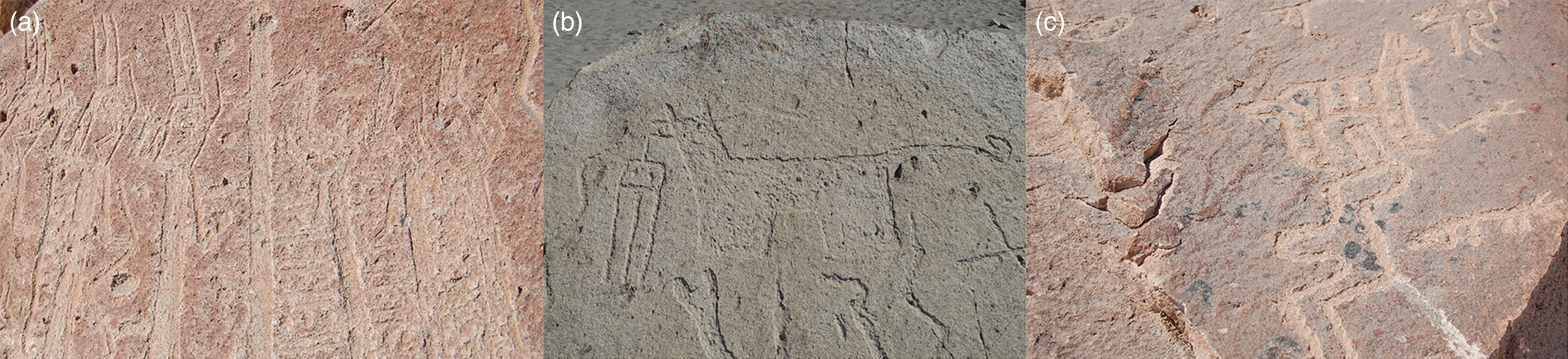
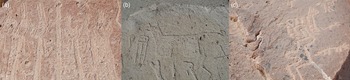
The Toro Muerto scenes portray many of the materials excavated from the Uraca cemetery—felines, trophy heads, feathered headdresses, mummy bundles and camelid sacrifices—as well as dancing, drumming, musical performances and communication with the non-human world (Fig. 2). Uraca’s people may have controlled communal access to Toro Muerto and sacred lands within their community’s geographic wingspan, and the nearby elite sector of Uraca may have been reserved for esteemed combatants or caretakers of this sacred corridor (Scaffidi & Tung Reference Scaffidi and Tung2020). These visually linked contexts uniquely illustrate how at least some petroglyph abstractions connected real-life practices, beings and things between these powerful places.
Examples of mortuary scenes from Toro Muerto: (a) masked dancers with headdresses; (b) feline consuming a human head; (c) camelid sacrifices.
Human and feline trophy heads
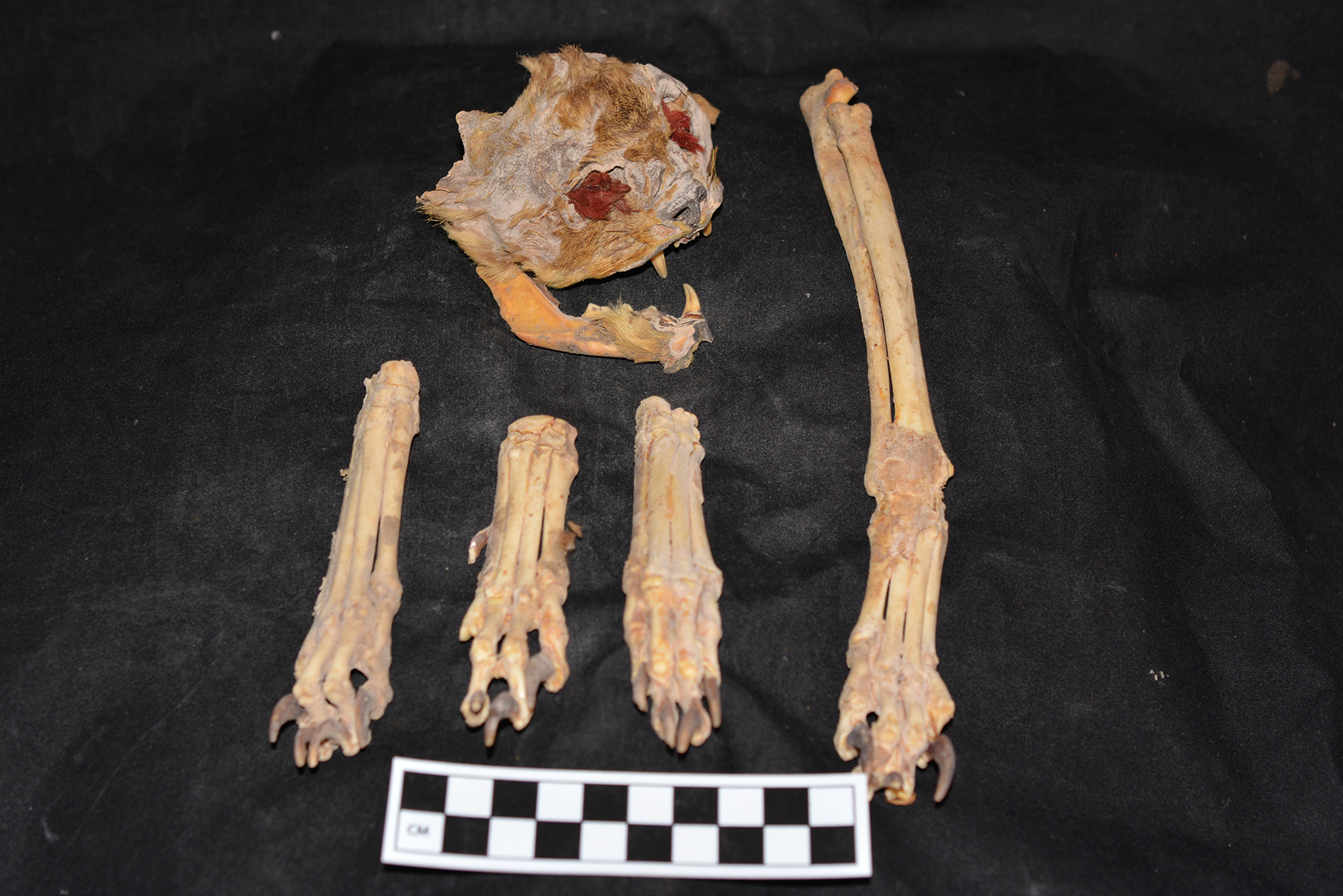
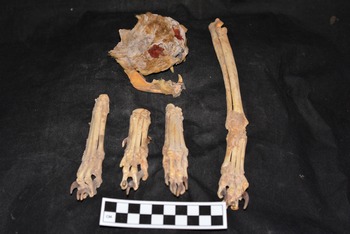
For example, the excavation team recovered 20 adult male trophy heads (12 severed, injured crania or skulls and 8 disarticulated mandibles presenting the masseter muscle removal typical of trophies from southern Peru) from both the elite and sub-elite sectors (Scaffidi Reference Scaffidi2020; Scaffidi et al. Reference Scaffidi, Tung and Knudson2021). These trophies all dated to the EIP and early Middle Horizon and likely comprised combatant males captured and killed by Uraca’s people or were stolen from trophy caches during raids on other settlements. The crania of these individuals were intensely and violently defleshed and manipulated after death, which included extracting soft tissues of the eye orbits and recreating new eyes of animal hides or textiles stretched over cotton balls. Excavators also recovered a pampas cat cranium along with half of its mandible and four paws (Scaffidi Reference Scaffidi2020) in the sub-elite sector, together with a cache of three human trophy skulls. Like the human trophies (pictured in Scaffidi Reference Scaffidi2020), its eyes were extracted and reformed, but with bright red fringed textile (Fig. 3) instead of the neutrally coloured materials used in the human trophies’ eye orbits. Given Uraca’s location between the highlands and the coast alongside the interregional hub at Toro Muerto, it was unsurprising that 87Sr/86Sr of at least six of the decapitated adult male trophy heads and at least one of the non-trophy adult males originated beyond the Majes Valley, although the feline trophy was not yet analysed (Scaffidi et al. Reference Scaffidi, Tung and Knudson2021). These findings demonstrated exchange interactions between Uraca’s people and non-locals and prompted additional testing of the feline trophy and grave goods to elucidate whether other non-local beings and things were integrated into Uraca’s mortuary landscapes.
Feline trophy head and paws from sector IIC at Uraca; note the bright red textile placed in the eye sockets.
Animal remains
The absence of domestic components at Uraca suggests the animals recovered from the tombs were either offerings for the dead or funerary foods for mourners—although the absence of communal structures, burning, or processing marks on the animal bones makes the latter unlikely. Animal remains were only recovered from the elite sector, including three fragments of river prawns (Cryphiops caementarius), a raptor claw of an unknown species, several bags of unspecified bird bone and two complete skeletons from members of the Anura family (frogs or toads which could have been Rhinella spinulosa, Pleurodema marmoratum, Telmatobius arequipensis or Telmatobius peruvianus) (Scaffidi Reference Scaffidi2018)—the latter are similar to the anurans deposited in similar contexts at contemporaneous mid-elevation sites to the south in Moquegua (Rubinatto Serrano et al. Reference Rubinatto Serrano, Vallejo-Pareja, deFrance, Baitzel and Goldstein2022). Since the anurans and prawn were recovered from the same unit at the highest elevation of the elite sector, commingled with human mummy bundles, it is unlikely they ascended of their own volition to the tombs. However, the fact that none of these anuran species is currently distributed below 1000 masl (Rubinatto Serrano et al. Reference Rubinatto Serrano, Vallejo-Pareja, deFrance, Baitzel and Goldstein2022), at Uraca’s elevation raises the possibility that they or other animal grave offerings may have been gathered from other places for mortuary deposition.
Additionally, there were over 500 pounds of bone and hides from domesticated camelids (Llama sp.), surface-collected or excavated from both sectors (Scaffidi Reference Scaffidi2018). Llamas and alpacas were deposited whole and eventually commingled with human mummy bundles—their fur, hides and limbs were all fully preserved. Deep cutmarks at the leg joints without evidence of further butchering or burning suggests these animals were not consumed as food but instead were sacrificed as offerings or retainers beside mummies. The joint cutmarks may have been necessary to fold them into flexed positions for interment. While camelids were inherently mobile throughout the ancient Andes, strontium isotope analysis of contemporaneous camelids used as food at the Middle Horizon Wari colony of Quilcapampa in the neighboring Sihuas Valley (Melton et al. Reference Melton, Alaica and Biwer2023) suggest that routine (whether seasonal or annual) movements of these animals can indeed be delineated across key corridors running from the highlands through mid-elevation yunga zones and on to the coast.
Musical instruments
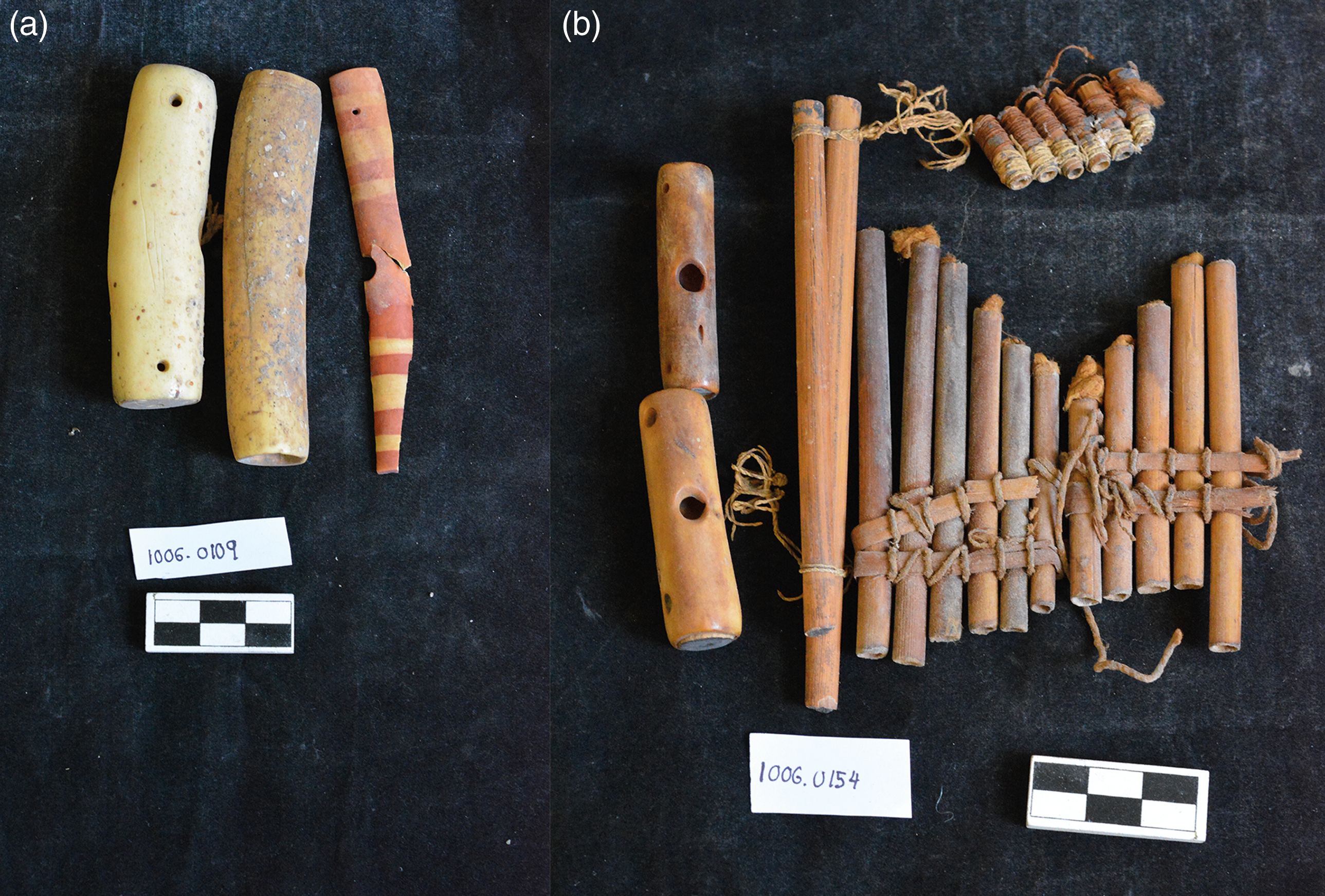
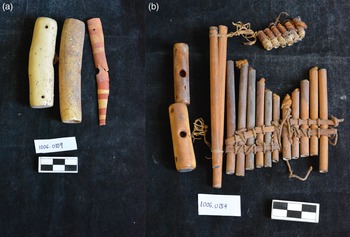
Musical instruments made up a significant part of the grave goods at Uraca, but only in the elite sector. The corpus of at least 54 instruments included short whistles made of camelid long bones, slender flutes of painted raptor long bones, one stretched animal-hide drumskin (possibly from a camelid) and non-functional miniature reed panpipes (Fig. 4). Together with the omnipresent dancing scenes from Toro Muerto, it is likely that pitched blasts, sustained notes and rhythmic drumming filled the mortuary soundscape of the elite sector, just like at La Real upriver where similar instruments were recovered (Alaica et al. Reference Alaica, González La Rosa, Yépez Álvarez and Jennings2022; Jennings et al. Reference Jennings, Tung, Yépez Álvarez, Lucano and Hurtado2015). Indeed, these musical practices connected Uraca mortuary ritual to other places within the Majes Valley and beyond, but where did these instruments and the raw materials they were made of originate? Furthermore, it is unclear whether the camelid whistles were made from the same or different individuals. Isotopic analysis can begin to shed light on the geographic locations of these animals when they were killed to harvest bone for carving.
Instruments from Uraca’s elite sector: (a) camelid bone whistles (left) and raptor bone flute (right); (b) miniature reed panpipes.
Woven river cane objects
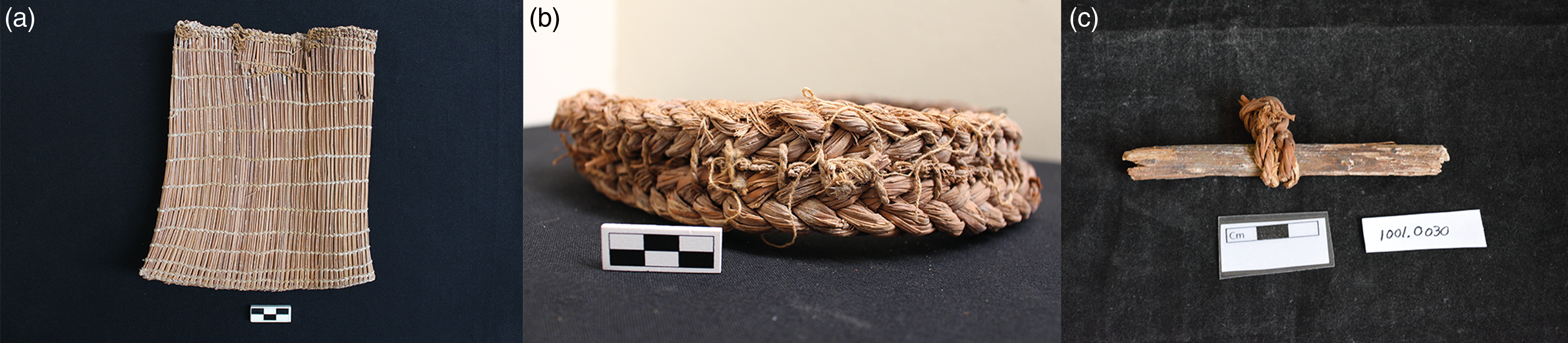
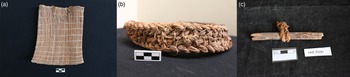
The grave good assemblage demonstrates Uraca’s people were skilled textile artisans, as elaborate cotton and wool burial shrouds, yarn balls, raw cotton and weaving implements were omnipresent finds at both sectors (Scaffidi Reference Scaffidi2018). Nearly as common were woven grave offerings made of river cane like baskets and headdresses (tocados) (Fig. 5). While the species of grasses and river cane present in the Uraca materials have not been confirmed, it is likely they were any of the locally abundant species that grew along ancient river margins, such as stems of totora (Shoenoplectus californicus), junco (Shoenoplectus sp.), carrizo (Phragmites australis) and members of the Cyperaceae and Magnoliopsida species commonly used in contemporaneous archaeological contexts from the Ica Valley to the north (Roque et al. Reference Roque, Cano and Cook2003). These species are used today in the Majes Valley and neighbouring valleys and Uraca’s baskets and headdresses may have been crafted from local plants or plants imported from nearby or distant coastal valleys.
Examples of woven river cane items: a) basketry, b) headdress or tocado, and c) human trophy head carrying cord fragments.
Materials and methods: the biogeochemistry of geographic alterity
Because beings are made of the same substances as the places they lived (Bastien Reference Bastien1985a; Gose Reference Gose2018; Weismantel Reference Weismantel1995), testing strontium isotopes (87Sr/86Sr) from skeletons, grave offerings and their burial locales potentially enables the identification of geological or geographic others. Bedrock 87Sr/86Sr varies according to geological composition and age, so that 87Sr/86Sr is crystallized in biomaterials as bedrock weathers and passes into soil (and water) substrates of food webs. Then, bioavailable strontium from the food web follows calcium pathways virtually unchanged into the inorganic component of skeletal tissues (Beard & Johnson Reference Beard and Johnson2000; Bentley Reference Bentley2006; Knudson et al. Reference Knudson, Price, Buikstra and Blom2004; Price et al. Reference Price, Johnson, Ezzo, Ericson and Burton1994). 87Sr/86Sr differences from other individuals in the burial community greater than approximately 0.0001 to 0.001 (Hrnčíř & Laffoon Reference Hrnčíř and Laffoon2019; Knudson et al. Reference Knudson, Stanish, Cerna, Faull and Tantaleán2016) or 87Sr/86Sr beyond an established ‘local’ food web (or baseline) range likely indicate that an individual lived beyond their burial location during the period when the sampled tissue formed (Burton & Price Reference Burton and Price2013; Ezzo et al. Reference Ezzo, Johnson and Price1997; Knudson et al. Reference Knudson, Price, Buikstra and Blom2004; Price et al. Reference Price, Johnson, Ezzo, Ericson and Burton1994). Globally and within the Andes, 87Sr/86Sr tends to be the best isotopic marker for identifying non-local samples within a burial population or assemblage (Scaffidi & Knudson Reference Scaffidi and Knudson2020).
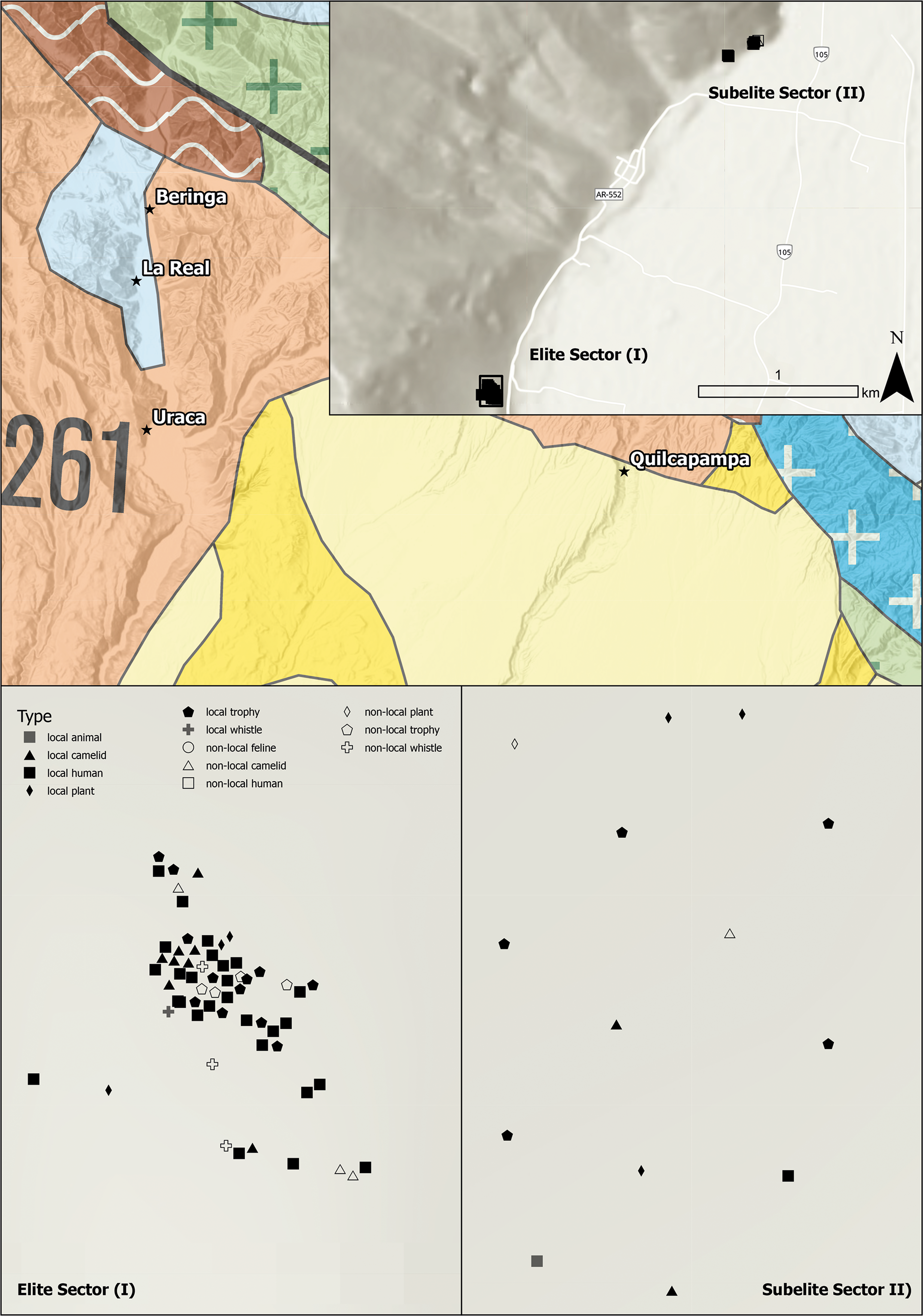
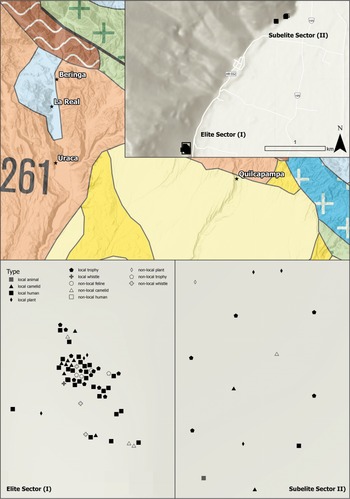
87Sr/86Sr analysis thus permitted the identification of grave goods and individuals from geographically distant regions interred at the Uraca cemeteries. Excavation, sample export and destructive analysis were authorized by permission of the Peruvian Ministry of Culture (Resoluciónes: #082- 2014, #067-2015-VMPCIC-MC, #212-2018-VMPCIC-MC) and carried out together with local community members and governmental authorities in the Municipality of Uraca-Corire. Sampling efforts reported in this paper were focused on the animal and basketry remains recovered from the excavation units delineated in Figure 6. From the feline trophy associated with the sub-elite sector trophy head cache, the keratinous claw was analysed for 87Sr/86Sr, while bone collagen of the middle paw phalanx was cut for AMS dating at the University of California, Irvine. Distal shafts of two right femora of the frog or toad skeletons and the rostrum of the cephalothorax (head) of one river prawn were prepared for analysis. Eight camelid first molars from the sub-elite sector and 11 from the elite sector were sampled from at least 19 different animals. Four camelid long bone whistles from four distinct excavation units in the elite sector were also tested—variable colouration and preservation suggest these were from different animals or at least prepared at different times from batches of raw bone material. Three woven basket fragments from the elite sector and four from the sub-elite sector (all from different excavation units) were sampled. One fragment of woven vegetal material carrying cords from each of two trophy heads in the sub-elite sector was also sampled to determine whether the human heads and cords were of similar geographic origins. Neither of these two human trophies was AMS dated, but both were likely from the Majes Valley or similar geological regions: for Individual 7010, first premolar 87Sr/86Sr = 0.70840, and Individual 7009 did not likely move between childhood (first molar 87Sr/86Sr = 0.70862) and middle childhood (second molar 87Sr/86Sr = 0.70858).
Location of looted excavation contexts for the objects and animals reported herein: inset shows distinct bedrock geology and the location of neighbouring sites referenced in the text. Lower left: materials recovered from the elite (southern) sector; Lower right: materials recovered from the subelite (northern) sector.
Uraca samples were prepared following established methods of the Archaeological Chemistry Laboratory (Center for Bioarchaeological Research, Arizona State University) for analysing 87Sr/86Sr of biological tissues and baseline samples (Marsteller et al. Reference Marsteller, Knudson, Gordon and Anbar2017; Stanish et al. Reference Stanish, Tantaleán and Knudson2018). Briefly, teeth, bone, prawn chitin and the feline claw keratin were mechanically ablated with a hand-held manicurist’s drill and 6 mg of enamel powder or 10–15 mg of bone, chitin, or claw chunks were collected. Powder or sample chunks were chemically cleaned through sonication with alternating rinses of Millipore water and soaks of 0.8 M acetic acid (CH3COOH). The rinsed powder was heated until dry in the oven at 50°C, and bone, chitin, claw and plants were ashed in the furnace at 800°C for 10 hours to release bioavailable Sr. Enamel and ashed samples were then dissolved in concentrated nitric acid, elemental concentrations were measured (Q-ICP-MS) to assess contamination from the burial environment, and Sr was collected through ion chromatography on the PrepFast autosampler system. Finally, measured 87Sr/86Sr was measured on the Neptune-MC-ICP-MS, and measurements were corrected for instrumental precision against an international strontium carbonate standard (SRM-987, 87Sr/86Sr = 0.710089±0.00009, n = 12). The feline bone collagen was analysed by the Keck Carbon Cycle AMS laboratory at University of California, Irvine following established protocols (Southon et al. Reference Southon, Santos and Druffel-Rodriguez2004) and calibrated with OxCal 4.4 using the SHCal 2020 curve (Hogg et al. Reference Hogg, Heaton and Hua2020).
Sampling local landscapes—small-home range (SHR) fauna and plants—is the preferred method of determining local 87Sr/86Sr ranges, but in the absence of those data, the local range is defined simply as the mean of all archaeological human and faunal individuals ±2SD (Knudson et al. Reference Knudson, Price, Buikstra and Blom2004; Scaffidi & Knudson Reference Scaffidi and Knudson2020). The human non-trophy individuals from Uraca tested prior to this study, 87Sr/86Sr = 0.70812–0.70838 (n = 33) (Scaffidi et al. Reference Scaffidi, Kamenov, Sharpe and Krigbaum2022), are consistent with human skeletal individuals at Beringa upriver, 87Sr/86Sr = 0.70802–0.70960 (n = 60) (Knudson & Tung Reference Knudson and Tung2011). Both ranges are consistent with Majes Valley water, 87Sr/86Sr = 0.70781–0.70893 (n = 12) (Scaffidi et al. Reference Scaffidi, Kamenov, Sharpe and Krigbaum2022); however, the Majes Valley food web has not yet been systematically sampled, so anthropologically meaningful geological variability in the landscape and local foods cannot be robustly assessed. Given that Uraca human non-trophy head 87Sr/86Sr variability falls within the range of SHR fauna and plants analysed in this paper (see results below), the local range is defined here as conservatively as possible without environmental baseline materials—as the mean ±2σ of Uraca’s archaeological SHR fauna, plants and non-trophy head human individuals. Finally, while it remains unclear how bedrock 87Sr/86Sr relates to food web 87Sr/86Sr in the Majes and neighbouring valleys, the most recent geological model for South America (Alcárcel-Gutiérrez et al. Reference Alcárcel-Gutiérrez, Gómez Tapias, Montes Ramírez and Almanza-Meléndez2023; Gómez Tapias et al. Reference Gómez Tapias, Jorge and Ramírez2019) is provided in Figure 6 to demonstrate expectations (that remain to be tested) for geological similarities and dissimilarities in the region.
Geographic origins of beings and things buried at Uraca
87Sr/86Sr results: probable non-local camelids, instruments, trophies and basketry
The combined new and published datasets range from 87Sr/86Sr = 0.70609–0.70954, mean = 0.70818, median = 0.70832, and 1σ = 0.00058 (n = 91). New 87Sr/86Sr results are reported in Supplemental Table 1 along with burial context and AMS dates where available. Elemental concentrations (Supplemental Table 2) do not indicate diagenetic contamination of bone or enamel according to Kamenov’s minimum thresholds (Kamenov et al. Reference Kamenov, Lofaro, Goad and Krigbaum2018). Because the range of the SHR fauna and plants (87Sr/86Sr = 0.70756–0.70954) fully encompasses the range of the teeth from human non-trophy individuals previously identified as local (Scaffidi et al. Reference Scaffidi, Kamenov, Sharpe and Krigbaum2022) (87Sr/86Sr = 0.70812–0.70838, n = 33), the local range is defined here by the mean ±2σ of the non-trophy human individuals, SHR fauna and plants (87Sr/86Sr = 0.70771–0.70890). Numbers and proportions of probable locals and non-locals based on this range are compared in Figure 7 and Table 1.
Published and new Uraca 87Sr/86Sr data (n=91). Reference lines indicate the local range based on the mean ±2σ of the human non-trophy heads and small home range animals (SHR)—the frogs, feline and prawn. The SHR low outlier is the feline trophy head.
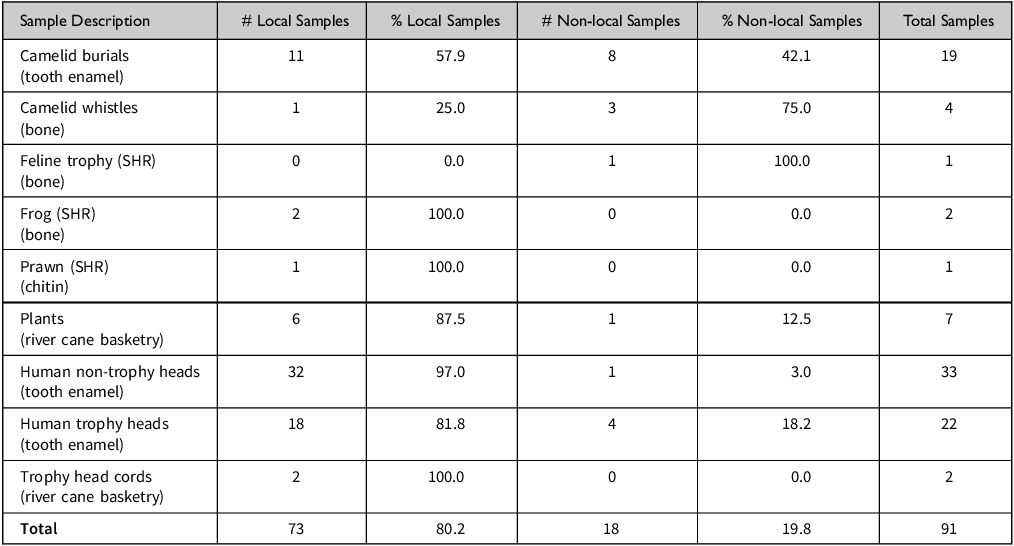
Counts and proportions of beings and things of probable local and non-local origins, with the total proportions calculated on the bottom row. For human individuals, counts reflect the number of teeth sampled, which is greater than the number of individuals for humans.
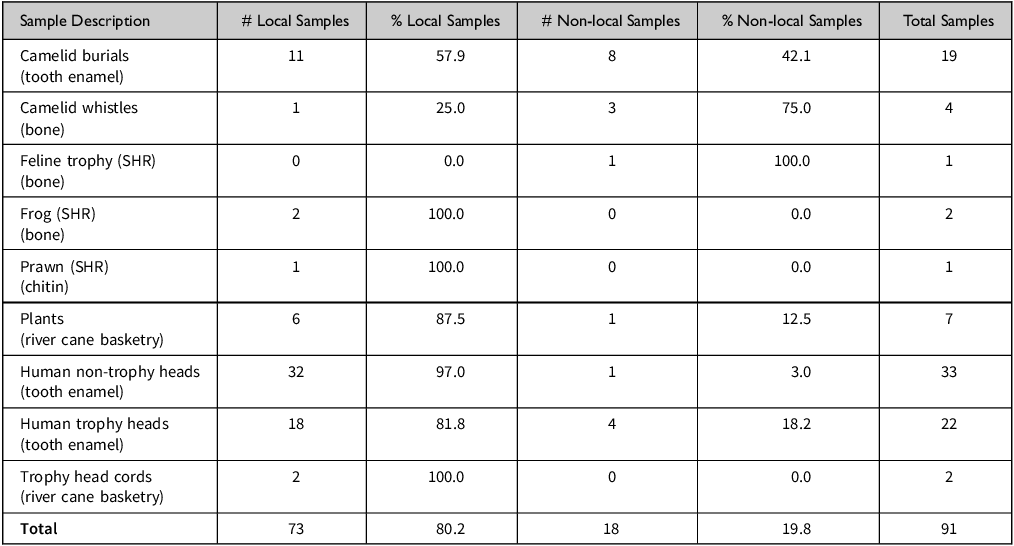
The Uraca camelids and camelid bone whistles ranged from 87Sr/86Sr = 0.70609–0.70942 (n = 23). Just under half (11/23 = 47.8 per cent) are non-local, while the remainder are likely from the Lower Majes Valley or geologically similar areas. Of the non-local camelids, eight show low 87Sr/86Sr consistent with less radiogenic near-coastal regions, the neighbouring Sihuas Valley or pockets of lower 87Sr/86Sr in the heterogenous geologies of nearby highlands (Gómez Tapias et al. Reference Gómez Tapias, Jorge and Ramírez2019; Scaffidi & Knudson Reference Scaffidi and Knudson2020; Schenk et al. Reference Schenk, Viger and Anderson1999). Three of four camelid bone whistles have 87Sr/86Sr higher than the local range, suggesting they were either produced in the highlands or locally from highland-originating camelids. The similarity in 87Sr/86Sr for these whistles could indicate production from the same herd, or from bones of the same animal that remodelled during different years—bone remodelling rates for camelids are not well understood. The frogs (n = 2) and the river prawn (n = 1) were local and likely gathered from the banks of the Majes River as offerings, possibly to enable watery passages for the dead. The trophy feline claw 87Sr/86Sr is non-local, consistent with more coastal locations.
The woven vegetal material samples (n = 10, including two trophy head carrying cords) tend toward the lower end of the local range. This could reflect the more constricted bioavailable Sr in the riverine environment than in the broader food web averaged by human and animal diets. However, one basket sample showed the highest 87Sr/86Sr of all (0.70954)—clearly of non-local origin and not likely to be from yunga zones in any neighbouring valleys. Both trophy head carrying cords are also consistent with local 87Sr/86Sr (just as were the trophy individuals they bound). The maximum difference in 87Sr/86Sr between human trophies and their carrying cords are minimal: only 0.00050 for individual 7009, and 0.00020 for individual 7008. This suggests that, whether the heads were taken from the Lower Majes Valley or non-local males from geologically similar areas, their carrying cords seem to have been woven from locally available plants, perhaps as the trophy makers or takers integrated their sami into the community through this weaving and binding.
More non-local animals and craft objects relative to non-trophy human burials
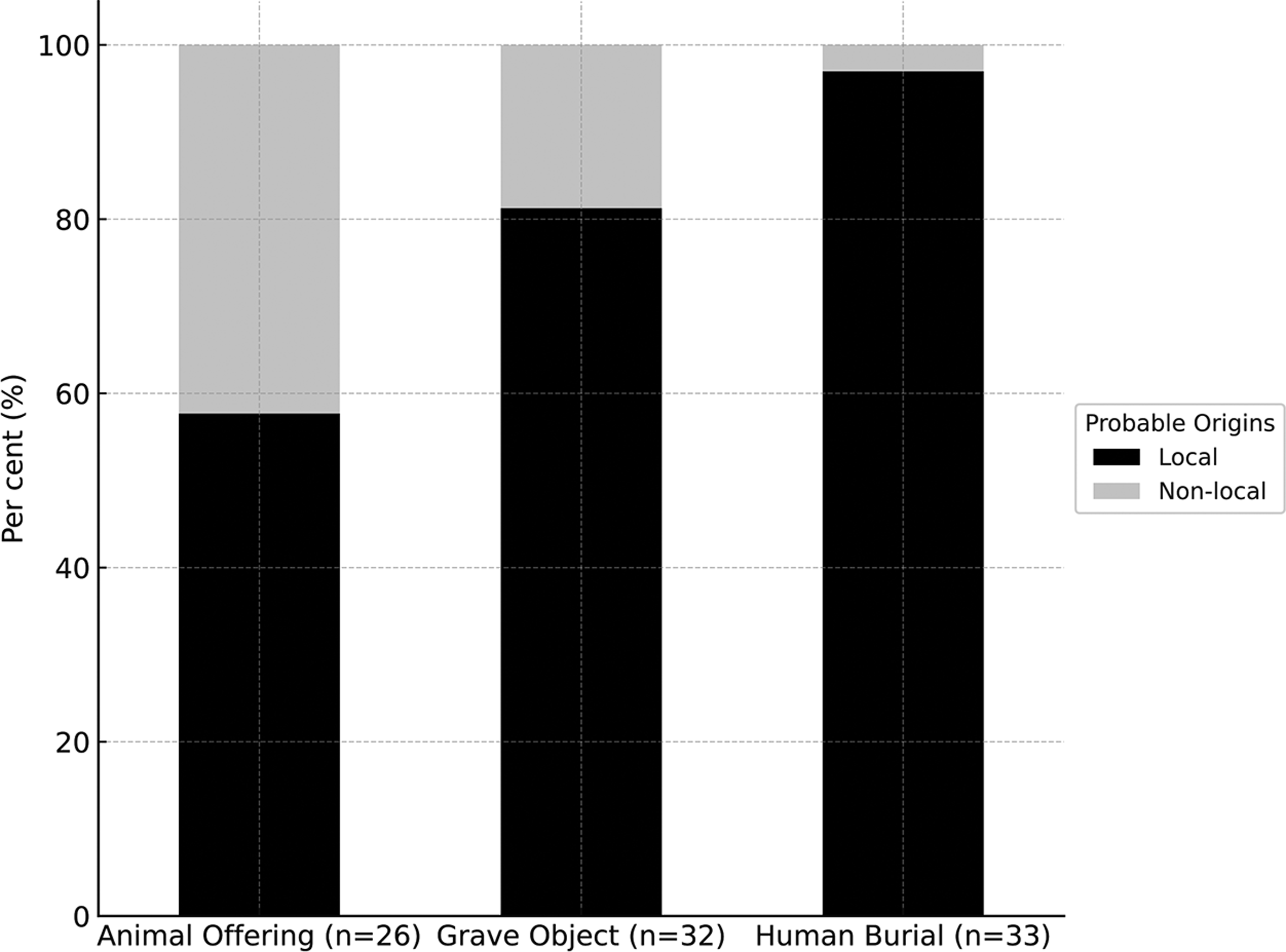
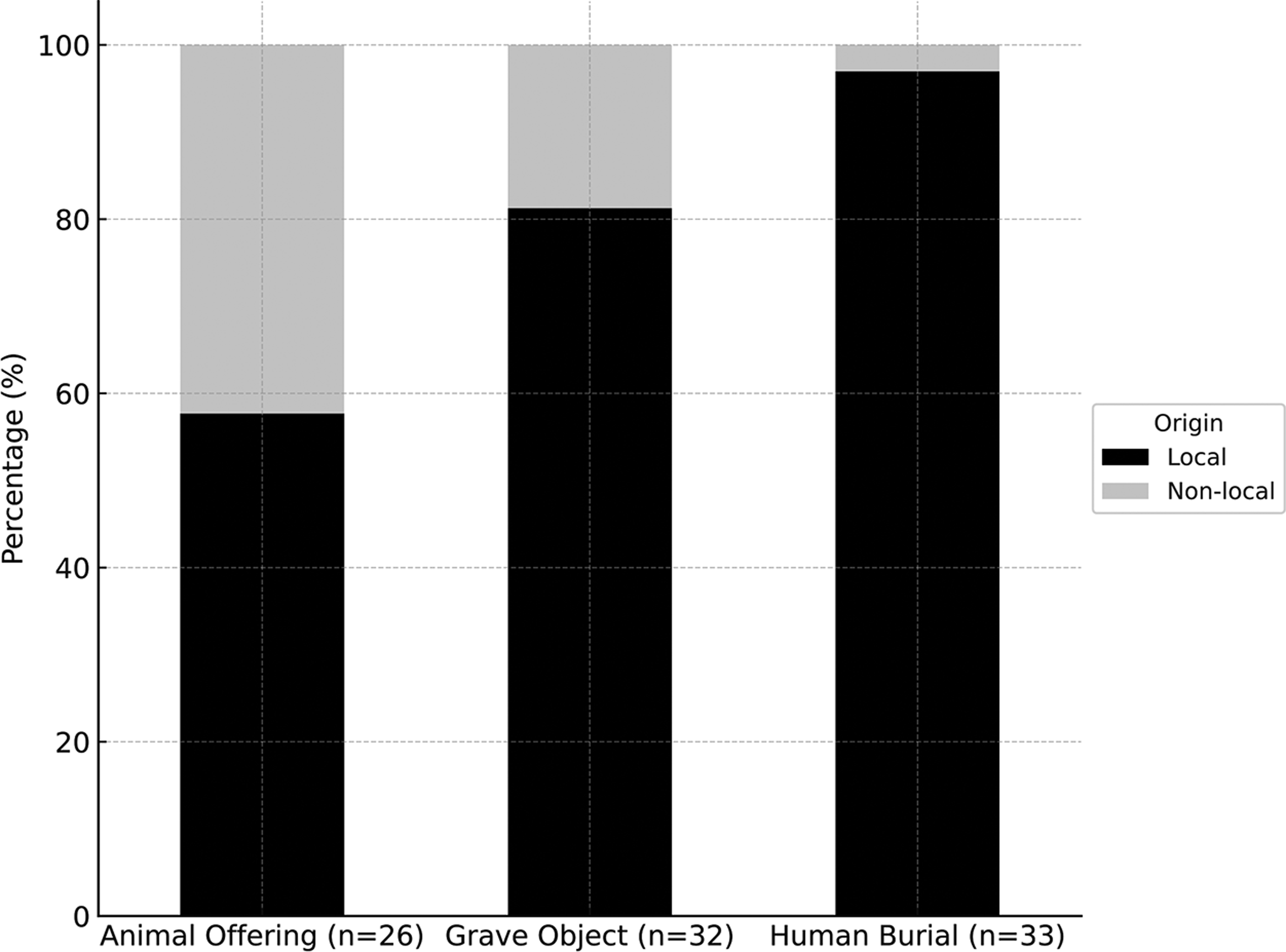
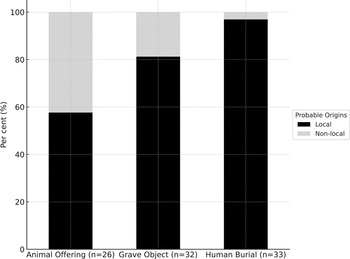
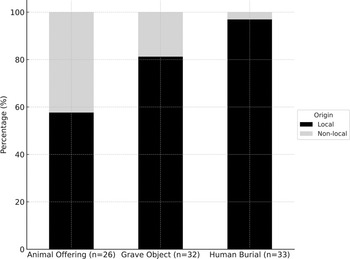
Supplemental Table 1 shows burials and offerings coded according to three functional groupings: (1) art or craft objects (basketry, human and feline trophy heads, and camelid whistles); (2) animal offerings not transformed into craft objects; and (3) non-trophy human individuals. This classification demonstrates clear distinctions in the origins of functional subgroups (Fig. 8). The animal grouping shows the highest proportion of non-local samples (9/23 = 39.1 per cent), relative to art or craft objects (8/36 = 22.1 per cent) and human non-trophy burials (1/33 = 3.1 per cent) (Fig. 8). Furthermore, animal interments—driven by the camelids—are significantly more variable (1σ = 0.00079) than art or craft objects (1σ = 0.00051) and non-trophy humans (1σ = 0.00021), Kruskal-Wallis Squared Ranks, H(2) = 17.246, p<.001. Finally, there is a greater proportion of non-local trophy samples (4/22 = 12.2 per cent) than non-local human burial samples (1/33 = 3.0 per cent), although this difference is not quite statistically significant, X 2 (df = 1, N =55) = 3.67, p = 0.055.
Comparison of proportions of probable non-local offerings and burials at Uraca by object or being types.
Long-term and long-distance trophy practices
One new AMS date is reported here along with strontium isotope data for the feline trophy from the commoner sector, which establishes it lived from 787 to 870 ce (SHCal20, 2 sigma). Thus, the feline trophy lived about a century after the latest elite sector human trophy and over 500 years after the one dated sub-elite sector human trophy the feline was cached with (61 bce–56 ce) (Supplemental Table 1). This feline from another valley was transported to the sub-elite sector of Uraca, its eyes were removed and recreated from red textile fringe, and then it was deposited with three already ancient human trophies approximately half a millennium after they either died or were assembled in the tombs there.
Discussion: world-making through mortuary incorporation of alterity
Camelids, the wild feline, and riverine animals were key types of animal others recovered from Uraca tombs that mediated camay from other places through mortuary ritual. Andean animals are sentient ‘earth beings’ with human-like personhood, consciousness, agency, desires and perspectives (Bray Reference Bray2009; Hill Reference Hill2013; Ødegaard Reference Ødegaard2018), with camay that infuses their ‘species power’ (Salomon & Urioste Reference Salomon and Urioste1991, 16) to transform humans into animals and vice versa. The ritual use of animals in the Andes echoes Helms’s (Reference Helms1998, 164–6) contention that collecting, manipulating and wearing durable, portable animal parts (e.g. pelts, teeth, claws and feathers) channelled ancestral power for future durability. The Andean archaeological record is replete with depictions of human–animal transformations (Arnold Reference Arnold2018; Cordy-Collins Reference Cordy-Collins1998; DeMarrais Reference DeMarrais2018; Groleau Reference Groleau2009; Lau Reference Lau2017) and animal impersonation (Hastorf & Kyriakidis Reference Hastorf and Kyriakidis2007; Nielsen Reference Nielsen2009; Paul Reference Paul1990; Proulx Reference Proulx2001) that demonstrate linkages between species power and places of the dead.
Since domesticated camelids were essential sources of food, fleece and transportation, they were commonly sacrificed to balance cosmic vitality (Bolin Reference Bolin2010; Prieto et al. Reference Prieto, Verano and Goepfert2019; Valdez et al. Reference Valdez, Bettcher and Huamaní2020). Camelids have human-like social organization (Goepfert et al. Reference Goepfert, Dufour, Prieto and Verano2020; Sallnow Reference Sallnow1987) and can speak with and lead their herders (Mannheim Reference Mannheim2020). In contrast to wild animals (e.g. deer and wild camelids) controlled by the apus, domesticated camelids embodied humans and could stand in for them in rituals (Alaica Reference Alaica2018; Goepfert Reference Goepfert2010). Also, as the only long-distance transportation in the pre-Hispanic Andes, camelids connected space and time—they might be viewed as time-travellers (Lazzari Reference Lazzari2005, 131). Camelids were transitional agents, moving the living through space-time, nourishing the dead and transporting their things throughout the journey to their pacarinas. Consistent with this mediating role, camelids were sometimes depicted as decapitators (Baitzel & Rodríguez Reference Baitzel and Rodríguez2019; Janusek Reference Janusek2020; Nielsen Reference Nielsen2009), dispersing camay from freshly dead to nourish the world.
At Uraca, biogeochemical results suggest interred camelids were intentionally selected from animals that moved between broad geographies including nearby yunga, coastal and near-highland origins, similar to contemporaneous camelids from Quilcapampa in the neighboring Sihuas Valley, where camelids from domestic food trash heaps ranged from 87Sr/86Sr = 0.70594–0.70918 (n = 10) (Melton et al. Reference Melton, Alaica and Biwer2023). These broad ranges beg the question of how to define local and non-local camelids—they were presumably and inherently mobile, grazing and foddering beyond village centres and probably moving seasonally to access patchy resources. Camelid tooth enamel development and weaning rates are not well understood, so tooth samples will always average variable food 87Sr/86Sr over an unclear period. Nonetheless, high and low outliers indicate Uraca’s camelid moved to foddering or grazing zones beyond core Majes valley sites, thereby functionally connected living and dead humans between those outlying places. Furthermore, since most of the camelid bone whistles are from distant geographic origins, there may have been an intentional effort to use raw materials from distant geographies to endow musical performances with connective capacity.
In contrast to human-like camelids, felines were wild and powerful killers controlled by the apus and may have been stand-ins for human or non-human agents in mortuary ritual at Uraca. Building on Viveiros de Castro’s Amazonian examples, Lau argues that Andean hunters could occasionally slip into feline form to hunt game or warrior heads, serving as mediators between ‘the familiar village world and the strange vital outside’ and between life and death (Lau Reference Lau2012, 121). Myriad Paracas and Nasca ceramic and textile scenes depict the native pampas cat (Leopardus colocolo) decapitating or consuming the vital energies of human heads, standing at the nexus between living and dead. These violent negotiations between opposing forms are exemplified at Tiwanaku, where Janusek (Reference Janusek2020) argues that living stone monoliths of feline chachapumas served as sacrificial gods that transformed ‘raw’ people from other places into Tiwanaku people as they processed into the city. Pampas cats are omnipresent in the rock art of lowland Arequipa valleys, including at Toro Muerto, where they may have marked village boundaries as chachapumas. Since pampas cats have small home ranges of approximately 20–50 km (Villalba et al. Reference Villalba, Bernal, Nowell and Macdonald2012), and the only similar 87Sr/86Sr appears in skeletons from Beringa and Quilcapampa, the pampa cat trophy was very likely carried in from beyond the lower Majes Valley. This, combined with the fact that the feline dates to several hundred years later than at least one of its cache-mates suggests both geographic and temporal distance were aspects of its cosmological power critical to the living who interred them across many generations.
Since water bodies divided the dead from the living (Cortés Reference Cortés2020; Harris Reference Harris1982), riverine creatures may have mediated between life and death like camelids and felines. While taphonomic analysis of hundreds of toads (Bufonidae) and frogs (Leptodactylae) from Khonkho Wankane suggests they were the result of natural die-offs in the margins of Lake Titicaca (Pokines Reference Pokines2013), other specimens excavated from high or dry desert sites like Beringa in the Majes Valley (Tung & Knudson Reference Tung and Knudson2018), Cerro Baúl (deFrance Reference deFrance2014) and Cahuachi in Nasca (Orefici Reference Orefici2011) demonstrate that amphibians were often used in ritual or as grave offerings. In contrast to amphibians which were likely not eaten, freshwater shrimp (Cryphiops caementarius) were a main protein source in low- to mid-elevation southern Peruvian valleys. The often-looted contexts of lowland sites can preclude clear identification of funerary versus domestically consumed foods, but intact Otoro Valley tombs demonstrate that shrimp were sometimes offered as foods for the dead (Stanish Reference Stanish2012). It is not surprising that local riverine animals were used at Uraca, as their watery origins were likely perceived as a characteristic of supernatural distance.
Similarly, given the watery origins and abundance of local river cane, it is surprising to find any possible non-local specimens in the Uraca assemblage. However, there are examples (Acuto et al. Reference Acuto, Kergaravat and Amuedo2014) in the southern Andes of non-local objects and woods used as grave offerings to integrate plants from different moieties (family lineages) into mortuary landscapes. While the trophy carrying cords made of river cane were both of local origins, one of the trophy’s carrying cords (from Individual 7008) was made of human hair, which was probably non-local according to late-life diet (Scaffidi et al. Reference Scaffidi, Tung and Knudson2021). This geographic diversity suggests that woven mortuary arts were crafted from materials special to the deceased, place of ancestral origins, as well as local materials—weaving the dead into the fabric of local landscape power.
Finally, the human trophies, whether from the Majes Valley, geologically similar outside places, or geographically distant places, were selected from the same general network of human interaction as the non-trophies and the broader grave goods assembled at Uraca. Trophy-taking and grave good procurement may have been constricted to the same near-neighbouring communities and regions that Uraca’s people commonly interacted with through trade, marriage, or other travel or relationships. Mastering distance by assembling distant people, animals and things probably yielded power for human and non-human agents alike. Just as the apus have more power the broader their geographic reach is (Skar Reference Skar1994), mortuary places probably had more communal power when things and beings from other places were carefully assembled at those mortuary landscapes.
This study is, however, limited by the degree of looting at Uraca—artifacts, trophy heads and camelid interments cannot be associated with human burials—as well as the limited isotopic reference material available in the region. Baseline studies of bioavailable Sr in Majes Valley plants and fauna are ongoing and will continue to clarify expected 87Sr/86Sr values for local inhabitants. Nonetheless, the fact that trophy heads dated hundreds of years before other trophy heads, grave goods, and camelid burials were continuously bundled and re-bundled together illustrate the importance of assembling things and beings from contexts that extended beyond the space and time of the Lower Majes Valley in the late EIP to early Middle Horizon.
Conclusion
Thinking through mortuary beings and things through the lens of animistic ontology permits us to understand the material record in complex and nuanced ways. This study follows others in concluding that mastering vitality enabled socio-political or cosmological authority in the ancient Americas (DeMarrais Reference DeMarrais2018; Janusek Reference Janusek2020; Kosiba Reference Kosiba2020). However, reading the present data through Andean ontologies and Helms’ (1979; 1993 Reference Helms1998) corpus on geographic distance and alterity, leads to the proposition that incorporating local and non-local bodies and things into tombs were world-making acts that interwove powerful geographic alterity into the potent space-time (sensu Munn Reference Munn1992) of cemeteries. At the Uraca cemetery, empirical evidence of incorporating beings and things from within and beyond the Lower Majes Valley reveals that burial placement did not merely represent or contest social or cosmological order. Instead, burial placement of non-local things changed meaning and matter in the multi-dimensional convergence of life-forces from local, nearby and distant geographies woven together there.
As others have demonstrated (Buikstra et al. Reference Buikstra, DeWitte and Agarwal2022; Gregoricka Reference Gregoricka2021; Velasco et al. Reference Velasco, Kamenov and Krigbaum2024), biogeochemical studies in bioarchaeology and archaeology have been undertheorized in favour of technological advances. While local/non-local binaries are essential heuristics for assessing patterns in assemblages of brings and things at grave sites, we must remember to ask critical questions about the nature of geographic otherness and its social meanings. What did it mean to be non-local, and how were local and non-local bodies and things created, experienced, contested and remixed? How did interactions with geographic others affect the people who handled them, and how did assemblage of outsider and insider vital energies at burial locations shape associated landscapes and settlements and the broader web of regional and interregional interactions? Personhood and individual and communal identity are inextricably intertwined with origins, and those identities are constantly being recursively transformed through interaction with the landscape. Andean bodies constantly change (Allen Reference Allen2002) so there are no individual bodies, but rather a multiplicity of embodiments (Armando Muro et al. Reference Armando Muro, Jaime Castillo and Tomasto-Cagigao2019) linked through corporeal-energetic networks. While ongoing research will begin to reveal the topologies of some of these networks, this study models how taking a relational perspective on embodied landscape biogeochemistry data can build bridges for understanding social and bodily borders and attendant belief systems relevant to studies of ancient burial practices around the world.
Acknowledgements
If we are indeed constituted relationally, the first author is proud to have been constituted by the Vanderbilt University South American Reading Group—especially John Janusek—who shaped her thinking on materiality in the Andes and beyond. Aleksa Alaica verified family-level taxonomic identification for the camelid whistles, and Matt Biwer suggested the taxonomic classifications for the basketry samples. The METAL laboratory at Arizona State University assisted with isotopic analysis (including Trevor Martin, Tyler Goepfert and Natasha Zolotova). The Peruvian Ministry of Culture and Majes Valley inhabitants graciously permitted the Lower Majes Archaeological Project to excavate and export samples. Finally, we are thankful for the anonymous reviewers’ comments which greatly improved this manuscript. NSF-SBE Postdoctoral Fellowship (#809470) to Beth K. Scaffidi permitted analysis, while the Wenner-Gren Dissertation Fieldwork Grant (#8680) permitted excavation.

 Open access

