

Chapters 4 and 5 leave poetry behind to discuss the writings of Charles Darwin. We will see that instinctual or automatic behaviour and expressions, like birdsong, preoccupied Darwin throughout his work. In the first of these two chapters on Darwin, consideration of this topic will begin with the notebooks from 1838, in which he first formulated what became the theory of natural selection. In these notebooks, Darwin treats instinct as a psychological problem, related to what he believed to be the possibility of inherited or unconscious memory. As the chapter proceeds, however, my concern will not principally be with Darwin’s psychological work, but with the way the two problems Darwin works on in these notebooks bleed into one another, so that the solution to the problem of species is figured here and throughout his writing as a memory that the naturalist works to uncover. In The Origin of Species (1859), the work of understanding natural selection is represented as a psychomachia, in which different mental faculties struggle for dominance: Darwin writes that in the reader who follows his argument, “reason ought to conquer his imagination” (Darwin, Origin, 141). In writing on taxonomists and morphologists who precede him and whose work he cites as evidence, he suggests that they already recognize the genealogical affinities between species “unconsciously,” and that his work is therefore less one of new discovery than of overcoming a resistance (Darwin, Origin, 313).
In this respect, I will argue, Darwin’s thought resembles Freud’s, and indeed the affinities between them are a central topic of this book’s remaining two parts. In the next chapter, we will discuss how Darwin’s work on the expression of the emotions, and more generally his mode of interpreting residual and de-functioned physiological traits, influenced Freud’s concept of the symptom. In this chapter, my concern will not be with any direct influence of Darwin on Freud, but rather with problems, especially in epistemology, that are readily associated with Freud but seem surprising to encounter in Darwin. These problems arise in connection with the term “unconscious” and, as just stated, Darwin was interested in the topic of unconscious knowledge from an early date, apparently independently of his interest in species. We will begin with his notes on persons who have knowledge without knowing that they have it, including a literary character – and I will argue that these passages from the notebooks presage a difficulty in distinguishing between knowing and not knowing that pervades Darwin’s work. Besides his scientific precursors, we will see that Darwin relies on breeders and fanciers for evidence of how great changes may be made in living organisms by selective breeding for small variations – which, he tells us, “not one man in a thousand has the accuracy of eye” to perceive (Darwin, Origin, 27). The authorities on selective breeding from whom Darwin derives his information of course do not know the theory to which they are contributing – moreover, he argues, the very attention they pay to minor differences in the varieties they breed prevents them from perceiving their shared descent.
The same eye is in one sense a source of knowledge and in another a bar to it. The eye, moreover, is in The Origin of Species not only a means of recognizing or misrecognizing the significance of variation in living organisms. It is itself an organ subject to variation – and in this respect also, as we will see, it plays a double part in Darwin’s argument, appearing both as an obstacle to acceptance of this theory and as evidence for it. The doubling of knowing and unknowing in Darwin’s thought is itself doubled as a doubling of the subject and object of knowledge.
I will not be discussing Freud’s writings on analytic technique in this book, but they display similar dialectical turns. In Freud’s early analytic writing, he presents the analysis as confronting various obstacles: the censorship that allows dreams to fulfill wishes only in a disguised way, the resistances the patient puts up in the course of the analysis, and the transference by which Freud’s patients re-enacted in analysis the family dramas that made them sick in the first place. As psychoanalytic technique developed, however, the obstacles to analysis themselves became its objects, as analysis of the transference and of resistance became central to therapeutic practice.1
My topic in these chapters will thus be the doublings of knowing and unknowing and of subject and object in Darwin’s work, and, in Chapter 5, the work’s tendency to become self-referential by constituting its own object. In parts of what follows, I will aim to specify aspects of Darwin’s influence on Freud that in my view have not been well understood. But the larger claim to be made in these chapters is that the work of both Darwin and Freud is shaped by the emergence into history of the biological species as a subject constitutively incapable of recognizing itself.
***
During 1838, the momentous year in which he first formulated what was to become the theory of natural selection and also resolved to marry his cousin Emma Wedgwood, Darwin’s reading included a significant engagement with the life and work of Sir Walter Scott. This engagement may have been prompted by the recent appearance of John Gibson Lockhart’s biography of Scott, which included substantial extracts from its subject’s journal; Darwin read the first three volumes in 1838 and the remainder, except for volume 5, early in 1839 (Darwin, Notebooks, 322; notebook C, 269–70. See also his letter to Emma Wedgwood, January 6, 1839). The notebooks for 1838 include several references to the biography and also at least five to Scott’s fiction – one to Guy Mannering (1815) and the other four to The Antiquary (1816). As well as observations and theoretical speculations on a variety of subjects, the notebooks refer extensively to Darwin’s reading; Scott’s are the only novels he mentions during 1838.
With one exception, Darwin’s mentions of The Antiquary all refer to a single character, Elspeth Mucklebackit, whose role in the novel as a bearer of involuntary memory preoccupies Darwin in the reflections on consciousness, instinct, and heredity that he pursues throughout 1838. Here is a passage from Notebook M in which Darwin refers to Elspeth:
Now if a memory ≪of a tune & words≫ can thus lie dormant, during a whole life time, quite unconsciously of it, surely memory from one generation to another, as instincts are, is not so very wonderful. – … Miss Cogan’s memory of the tune, might be compared to birds singing, or some instinctive <or> sounds. – Miss. C memory cannot be called memory, because, she did not remembered, it was a habitual action of thought-secreting organs, brought into play by morbid action. – Old Elspeth ≪in Antiquary≫ power of repeating poetry in her dotage is fact of same sort. (Darwin, Notebooks, 521; notebook M, 7–8)
Five or six months later, in Notebook N, Darwin recalls the same character in a related context:
Old people – (Antiquary Vol II p.77) remembering things of youth, when new ideas will not enter. is something analogous. to instinct, to the permanence of old heredetary [sic] ideas. – being lower faculty than the acquirement of new ideas. – (Darwin, Notebooks, 575; notebook N, 46)
The romance plot of The Antiquary involves a protagonist with a forgotten past; though she is a relatively minor character in the novel, it is Elspeth Mucklebackit who reveals the secret of his identity. She also reveals that his parents were not half-siblings, as they had been led to believe, and thus erases the taint of incest which had been the original reason for his being brought up in secret and under an alias.2
Besides the narrative of the protagonist’s birth, Elspeth Mucklebackit is also responsible for bringing to light memories and artifacts from the more distant past. As Darwin notes, Scott represents her as senile and frequently unaware of events taking place around her, but also as having a powerful memory for old ballads and tales which she is described as speaking “like a prent buke.”3 Her connection to the past is symbolized by the yarn it is her “habitual and mechanical occupation” to spin.4 As she spins, she sings, to be overheard in the last moments of her life by the antiquary of the novel’s title, who transcribes her song in the service of his genealogical and historical research. It is the antiquary who eventually uses what he learns from Elspeth to work out the identity of the novel’s hero and restore him to his birthright.
Elspeth appears in Scott’s novel as part of a sustained allegorical representation of the relation between Scotland’s commercial, Protestant present – embodied in the antiquary, Jonathan Oldbuck – and its Catholic and feudal history. The novel makes an explicit figural link between the condition of Elspeth’s mind and that of the material remains of this history:
auld Elspat is like some of the ancient ruined strengths and castles that ane sees amang the hills. There are mony parts of her mind that appear … laid waste and decayed, but than there’s parts that look the steever [firmer], and the stronger, and the grander, because they are rising just like to fragments amang the ruins o’ the rest.5
Scott’s entire conception of Elspeth’s psyche is shaped by the allegory in which she features. In this passage, the unimpaired parts of her mind are figured as feudal remainders; her memory brings the past into the present, but in a decontextualized and fragmentary form, in the mode of automatic repetition, whose lack of reference to its context Scott figures by making her memory not an organic faculty but a text – “a prent buke.”
In Scott’s novel, the transformation of the past into a dead letter is not an organic process but a social one; Darwin’s interest in his representation of Elspeth comes or appears to come without any interest in the concept of historical periodicity Scott uses it to convey. This book argues, however, that Darwin’s work was part of a long process in which biology entered history, and in the final section of this chapter, I will argue that his career-long preoccupation with the topic of unconscious ideas and agency is a displaced form of historical argument. For much of the chapter, however, our concern will be with epistemology rather than history. In the first section, we will see how Darwin’s representations of automatic behaviour and unconscious memory work to stabilize the relations between the subject and object of knowledge in the notebooks. In the second section, we will turn to Darwin’s representation of the eye and scepticism regarding the faculty of vision in The Origin of Species (1859) as a symptom of the internal differences in Darwin’s species concept that arise from a contradiction between thinking about species and belonging to one. In the final section, however, we will return to history to see how the figures of unconsciousness and blindness we have traced help explain Darwin’s claims about the unconscious knowledge of natural selection to be found in the work of his scientific precursors, and ultimately to propose the existence of an historical unconscious in The Origin of Species itself.
In both of the passages I quoted earlier from the notebooks, Darwin links the individual mind’s ability to retain memories “unconsciously” with what he believes is the possibility that memories can be transmitted between individuals of different generations by inheritance. In the earlier of the two passages, Darwin supports his view that memories can be inherited with an analogy to inherited instincts; in the latter, the two ideas are conflated so that instinct itself becomes “an old heredetary [sic] idea.” In the next chapter, we will discuss Darwin’s view that instincts can be formed by a process in which functional actions become habits, and then as habits are transmitted through inheritance. Nothing in the theory of natural selection required this position and indeed Darwin’s initial account of instincts in The Origin of Species opens by arguing that instincts are less commonly formed in this way than by accidental variation:
As modifications of corporal structures arise from, and are increased by, use or habit, and are diminished or lost by disuse, so I do not doubt it has been with instincts. But I believe that the effects of habit are of quite subordinate importance to the effects of the natural selection of what may be called accidental variations of instincts.
In his later works, however, Darwin’s emphasis on accidental variation as the origin of instincts diminished and he became progressively more interested in understanding them as originating in voluntary behaviours. In the sixth edition of The Origin, he altered this passage to assert only that effects of habit are “in many cases” subordinate to those of natural selection in the formation of instincts.6 In The Descent of Man, he describes instincts originating in voluntary behaviours as degraded: “Some intelligent actions, after being performed during several generations, become converted into instincts and are inherited, as when birds on oceanic islands learn to avoid man. These actions may then be said to be degraded in character, for they are no longer performed through reason or from experience” (Darwin, The Descent of Man, 88). In The Expression of the Emotions in Man and Animals, the transformation of a functional behaviour into a habit provides the first of the three principles by which the work accounts for human and animal expressions: “Certain complex actions are of direct or indirect service under certain states of mind, or serve to relieve or gratify certain sensations, desires, etc.; and when the same state of mind is induced, however feebly, there is a tendency through the force of habit and association for the same movements to be performed, though they may not be of the least use” (Darwin, The Expression of the Emotions, 34). Such habitual actions constitute the expression of a state of mind associated with them. Darwin goes on to treat them, as he does all habits, as heritable.
The growth during Darwin’s career of his interest in behaviours that with the passage of time have lost their function derives from his increasingly explicit rejection of theology. Believers in the independent creation of each species like William Paley or Georges Cuvier described a world in which every trait of every organism is adapted by the creator to the organism’s conditions of existence. Darwin’s argument for descent with modification relies for evidence on traits that are maladapted or useless and thus suggest descent from earlier forms in which they served a purpose. In The Origin of Species, Darwin thus compares rudimentary organs, which have not been much affected by natural selection, to “letters in a word, still retained in the spelling, but become useless in the pronunciation, but which still serve as a clue in seeking for its derivation” (335). I will return to the topic of rudimentary organs in Chapter 5; Darwin’s study of these had the same rationale as his interest in involuntary expressions of emotion, which, unlike psychologists in our own time, he viewed as having no adaptive value. He treats them therefore above all as evidence of biological kinship. The erection of the hair as a response to fright in human beings has no function, but gives evidence of our kinship to other animals – such as cats – in which the puffing up of the fur under threat serves to terrify potential predators or adversaries. The blush as an expression of shame serves similarly, not to demonstrate human kinship with other animals, but as evidence of the shared humanity of different races of human beings.
Instincts and other kinds of involuntary behaviour, when they have been de-functioned, thus play the same role in Darwin’s argument as residual and rudimentary organic structures, attesting to the descent and affinities of the organisms they affect. We have seen, though, that from Darwin’s earliest notebook entries on evolution to the 1870s, in his writing on involuntary behaviours, he consistently views them as the remainders of “intelligent actions,” as he puts it in The Descent of Man (Darwin, The Descent of Man, 88), or as “hereditary ideas,” to use the term of the notebooks. When Darwin takes this view of involuntary behaviours, I suggest that he engages in a form of projection, by which a trait that enables the naturalist to understand an organism’s past is treated as an embodied memory of the past belonging to the organism itself. Hence Darwin’s view in the notebooks that the heritability of instincts is evidence for a theory of inherited memory and his personification of the useless trait that has outlasted its function as an old person, like Elspeth Mucklebackit, who has lived long enough to become an anachronism.
My claim that Darwin engages in projection when he represents involuntary behaviour as a form of memory is, however, complicated by that representation’s internal contradictions. He introduces one of his references to Elspeth Mucklebackit by discussing the case of a woman in her “second childhood” whose recall of the songs of her youth he likens to the instinctive song of birds: “Miss C. memory cannot be called memory, because she did not remembered, it was a habitual action of thought-secreting organ, brought into play by morbid action” (Darwin, Notebooks, 524, 521; notebook M, 21, 8). Miss Cogan’s memory that “cannot be called memory,” like Elspeth’s capacity to repeat old ballads, is thus an automatic behaviour – a “habitual action” of the mind – which takes the place of what had once been an effect of conscious intention. If we begin with the suggestion that Darwin’s idea of instincts and automatic behaviours as a form of memory arises from a projection of his own scientific knowledge onto the object of that knowledge, then we need to add that what is projected onto the object is more precisely its own difference from the subject. That is to say, the difference between the scientist who knows the past and the organism that unknowingly provides the scientist’s evidence is transformed into a contradiction within the latter – a “memory [that] cannot be called memory.”
In the passages we have been discussing, an epistemological difference is figured as a temporal or even historical one. The need for this figuration arises because in Darwin’s theory of descent, the subject and the object are in fact the same. In the absence of a transcendental object outside nature whose purposes or ideas natural history can understand itself as uncovering, the field comes to be characterized by self-reflexivity. As the distance between the subject and object of knowledge collapses, the difference between knowing and not knowing is obscured – an inevitable effect of characterizing the human being as bearer of an inherited “thought-secreting organ.” Hence Darwin’s preoccupation in the notebooks with characters formed by a history of which with the passage of time they have become unconscious.
In the next section of this chapter, we will see how in The Origin of Species, Darwin describes natural selection as a principle that, as it forms species, does so in ways that conceal its own operation. The result is that, in Darwin’s dialectical account, even his predecessors’ failure to recognize natural selection becomes evidence for his case. To close this section, however, I will consider some further passages on instinct and involuntary action from the notebooks in which, as in those we have already discussed, besides serving as evidence for the theory of descent with modification, they also trigger Darwin’s self-reflexive preoccupation with his own position as theorist. In a passage I have already cited, he characterizes the ability of old age to remember “things of youth, when new ideas will not enter,” as analogous “to instinct, to the presence of heredetary [sic] ideas,” and then observes that this is a “lower faculty than the acquirement of new ideas” (Darwin, Notebooks, 575; notebook N, 46). Throughout his work, Darwin understands the development of intelligence as entailing the gradual loss of instincts and their replacement by learned and voluntary behaviours. This he views, with some qualification, as a form of progress: “We must believe, that it requires a far higher & far more complicated organization to learn Greek, than to have it handed down as an instinct” (Darwin, Notebooks, 576; notebook N, 48). Though both intelligence and instinct are modes of adaptation, they differ in that one is a form of memory – of “heredetary [sic] ideas,” while the other comes into being as an erasure of the past. Paradoxically, the very faculty by which Darwin discovers human descent – the faculty that acquires new ideas – comes into existence only where evidence for that descent has vanished: “Man having some instincts of revenge ≪& anger≫, which experience shows it must for his happiness to check … nor is it odd he should have had them. – with lesser intellect they might be necessary and no doubt preservative, & are now, like all other structures slowly vanishing – the mind of man is no more perfect, than instincts of animals to all & changing contingencies, or bodies of either” (Darwin, Notebooks, 549–50; notebook M, 122–3). In this passage, in the form of conflict between human intellect and residual instincts, we find another version of the antithesis between consciousness and involuntary action with which we began. The antithesis between the subject who knows the past and the object-body in which the past is materialized is re-enacted and internalized in Darwin’s concept of human nature as such.
In this passage, as in many others throughout his work, Darwin denies that there is any absolute scale of development on which species can be ranked. The human mind is not more perfect than the instincts that direct animal behaviour; each is a response to different contingencies. As we’ve seen, however, Darwin in other passages asserts without apparent reservation that it requires a “far higher” mental organization to learn skills like language, as human beings must, than to inherit them as instincts, as birds in Darwin’s view inherit the ability to sing. Versions of these irreconcilable positions coexist throughout Darwin’s evolutionary writings and constitute a major crux in their interpretation.7 For his own framing of the problem, we turn to a final passage from the notebooks: “It is absurd to talk of one animal being higher than another. – We consider those where the [cerebral structure] most developed, as highest. – A bee [intellectual faculties] doubtless would where instincts were” (Darwin, Notebooks, 189; notebook B, 74).8 With some degree of irony, Darwin here represents speciation as determining consciousness as well as structure. Human beings’ intellects and the instincts of bees are equally adapted to their respective conditions of existence; their different adaptations, however, produce a difference in consciousness, by which both bees and human beings make their specific organization into a universal standard. Even after Darwin develops the theory of natural selection to account for adaptation, as we shall see in The Origin of Species, he consistently represents the power that produces useful adaptations as also producing a kind of blindness or misrecognition. Here, in what amounts to a miniature beast fable, Darwin rebukes the anthropocentrism that makes a specifically human faculty into a universal standard by arguing that, given their different faculties, bees would have a different standard. The bees’ consciousness in this argument is surely something of a heuristic fiction – but then so is that of human beings themselves, even though Darwin identifies it as his own with an underlined “we.” For in the first sentence of the note Darwin flatly contradicts what he says in the second that “we” consider to be true. While the whole point of the analogy between human beings and bees is to show that the error it denounces is not just an absurd view held by some people, but is rather proper to humans as a species, as the analogy’s author, Darwin occupies an ambiguous position. At once inside and outside an illusion, Darwin’s position in this note is divided by a contradiction homologous with others we have discussed in this section: on the one hand, a position of blindness that he defines by analogy to the blindness to its own motives of a creature acting by instinct; on the other, a position of knowledge, somehow located outside the history of material bodies and dispositions that limits the first. The problem of this difference within the Darwinian observer remains in The Origin of Species, none the less because in that work the development of human beings is almost excluded from explicit consideration.
***
Because of the absence of a transcendental or theological ground for natural selection, I have claimed, Darwin’s theory is necessarily self-referential. In his writing on the subject, in consequence, it is often difficult to distinguish between scientific claims that refer to the natural world and epistemological or historical claims regarding the conditions under which that world is available to knowledge. In this section, we will examine the dialectical treatment of vision and images in The Origin of Species, a text in which, both as an object and as a medium of perception, the eye is a stumbling block to the argument. Paradoxically, as we will see, it is the eye’s perfection that most conceals the process of modification by which Darwin argues it was formed.
The apparent perfection of some instincts and structures in animals and the difficulty of understanding how they could have come into being by a process of gradual modification is one of the major obstacles to his theory that Darwin discusses in The Origin. Of such structures, the one on which he spends the most time is the eye:9
To suppose that the eye, with all its inimitable contrivances …, could have been formed by natural selection, seems absurd in the highest possible degree. Yet reason tells me, that if numerous gradations from a perfect and complex eye to one very imperfect and simple, each grade being useful to its possessor, can be shown to exist; if, further, the eye does vary ever so slightly, and the variations be inherited, which is certainly the case; and if any variation or modification in the organ be useful to an animal under changing conditions of life, then the difficulty of believing that a perfect and complex eye could be formed by natural selection, though insuperable to our imagination, can hardly be considered real.
In this passage, the principal obstacle to recognizing the action of natural selection is the imagination. This idea appears elsewhere in The Origin, and also recurs at the close of the discussion of the eye, where Darwin writes of anyone who has followed his argument that “his reason ought to conquer his imagination; though I have felt the difficulty far too keenly to be surprised at any degree of hesitation in extending the principle of natural selection to such startling lengths” (141). This cluster of references to the imagination as incapable of grasping natural selection around Darwin’s discussion of the eye suggests that he conceives imagination primarily as a faculty of visualization. The logic of natural selection can be grasped by reason, but its operation is not amenable to visual representation. The eye is thus an obstacle to Darwin’s argument in a double sense: not only does its perfection make it difficult to understand how it could have been gradually evolved, but it also produces a picture of the world in which evolution remains hidden.
The eye’s reliability is in fact called into question throughout The Origin. The dialectical form of Darwin’s argument runs, the better the eye, the more deceptive. On the one hand, he founds his argument for the power of natural selection on the demonstrated possibility of modifying species under cultivation by selective breeding. “The great power of this principle of selection is not hypothetical. It is certain that several of our eminent breeders have, even within a single lifetime, modified to a large extent some breeds of cattle and sheep.” The principles breeders follow provide a model for Darwin’s understanding of natural selection, moreover, because they principally operate not by crossing different breeds, nor by inbreeding, but selecting for variations in a particular trait. To succeed in this requires a trained eye:
If selection consisted merely in separating some very distinct variety, and breeding from it, the principle would be … obvious … ; but its importance consists in the great effect produced by the accumulation in one direction, during successive generations, of differences absolutely inappreciable by an uneducated eye – differences which I for one have vainly attempted to appreciate. Not a man in a thousand has accuracy of eye and judgment sufficient to become an eminent breeder.
The selective power of the breeder’s eye thus provides Darwin with a paradigm for the power of natural selection itself as his argument unfolds in the opening chapters of The Origin.
On the other hand, the very accuracy of the breeder’s eye, its training in the recognition of differences, prevents it from recognizing the similarities among the breeds it works on as evidence of kinship:
[A]ll the breeders of the various domestic animals and the cultivators of plants, with whom I have ever conversed, or whose treatises I have read, are firmly convinced that the several breeds to which each has attended, are descended from so many aboriginal species. Ask, as I have asked, a celebrated raiser of Hereford cattle, whether his cattle might not have descended from long-horns, and he will laugh you to scorn. I have never met a pigeon, or poultry, or duck, or rabbit fancier, who was not fully convinced that each main breed was descended from a distinct species. … Innumerable other examples could be given. The explanation, I think, is simple: from long-continued study they are strongly impressed with the differences between the several races; and though they well know that each race varies slightly, for they win their prizes by selecting such slight differences, yet they ignore all general arguments, and refuse to sum up in their minds slight differences accumulated during many successive generations.
Darwin’s point here is to urge modesty on readers who, unlike the expert breeder, recognize that different domestic varieties can descend from a single species – but yet deny the possibility of the transmutation of species. But there is a remarkable dialectical irony in Darwin’s using as his negative example of blindness to transmutation the very authorities he also uses to show its possibility.
Given this irony and the idea elsewhere in the book that the visual image is an obstacle to understanding that reason must conquer, it is not surprising that The Origin of Species is the most sparsely illustrated of Darwin’s books.10 It contains only one figure, the schema of divergent evolution that Darwin termed a “great Tree of Life” (Figure 4). Nor should we be surprised, given the equivocal meanings of the eye and the visual image throughout The Origin, that the book gives its single figure several divergent explanations.
Lithograph from Charles Darwin, The Origin of Species (1859).
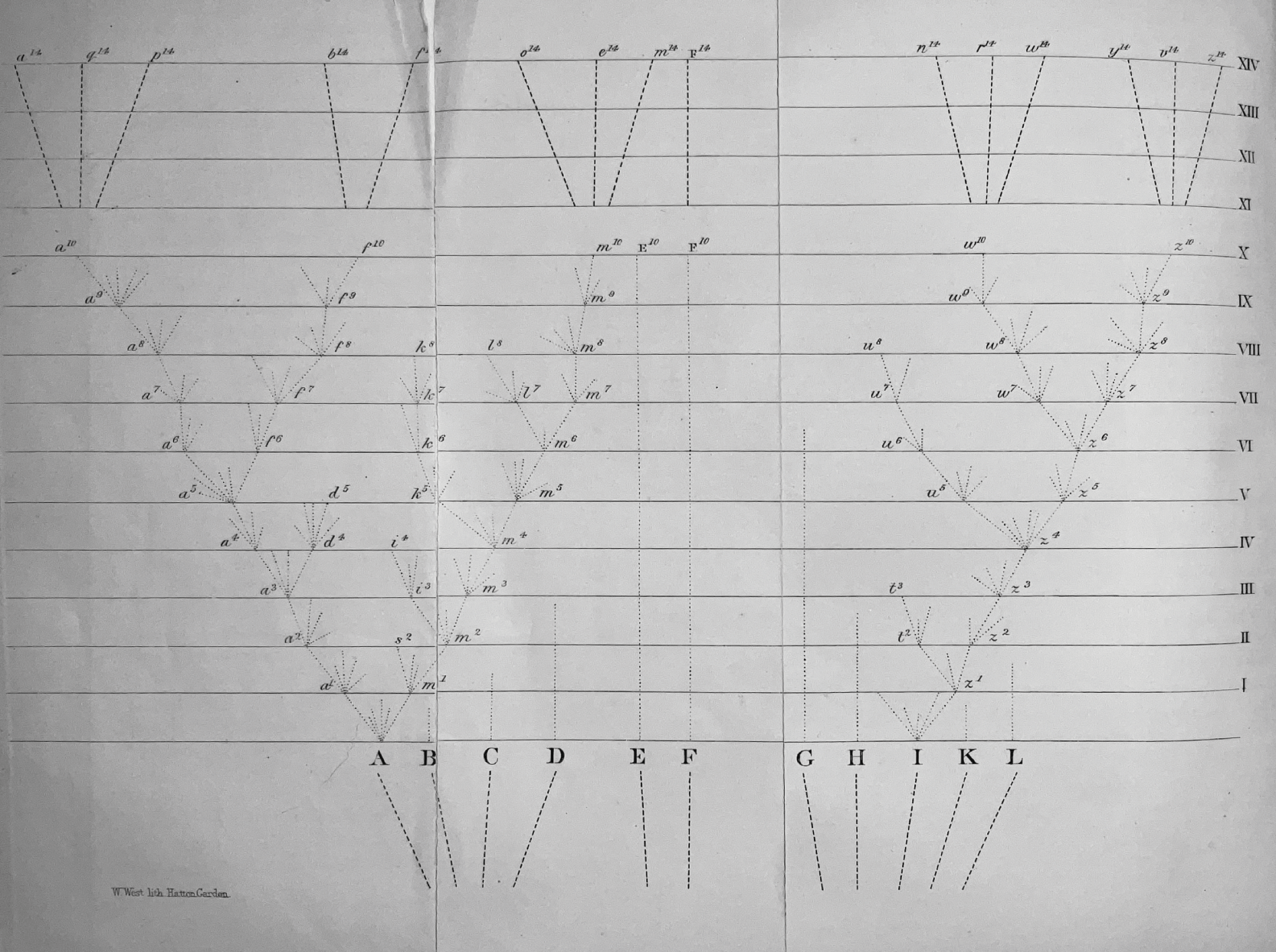
As Darwin emphasizes, the figure of the tree was not unique to his work: “The affinities of all the beings of the same class have sometimes been represented by a great tree. I believe the simile largely represents the truth” (59). Darwin reworks a figure from the existing literature because what he means it to illustrate is, in part, the current state of knowledge:
It is a truly wonderful fact – the wonder of which we are apt to overlook from familiarity – that all animals and all plants throughout all time and space should be related to each other in group subordinate to group, in the manner which we everywhere behold – namely, varieties of the same species most closely related together, species of the same genus less closely and unequally related together, forming sections and sub-genera, related in different degrees, forming sub-families, families, orders, sub-classes, and classes.
Darwin’s figure thus illustrates in the first instance a taxonomy characterized by varying degrees of affinity between organisms of the same class. To the extent that it represents the state of knowledge before Darwin wrote,11 it represents abstractions: relations of affinity that could be understood as understood as arising from a concept or from a transcendental schema.12 Darwin’s theory gives these affinities a material and historical existence by recognizing them as relations of biological kinship. In his theory, the subordination of group to group refers literally to a chronological and genealogical sequence of events and not to a purely conceptual subordination.
Given that Darwin’s argument here aims to transform a conceptual schema into an historical one, however, his own version of the tree is strikingly abstract and lacking in historical referents. Darwin does not, for instance, choose to speculate about affinities between members of any actual class of organism. The eleven letters at the base of his diagram may represent any eleven species whatsoever having varying degrees of affinity with each other, as may all of the letters designating their descendants. Later in The Origin, moreover, Darwin argues that the relations among genera have the same formal properties as those among species, and illustrates his argument by referring back to the figure from earlier in the book, suggesting now that the eleven letters from A to L be thought of as referring to genera rather than to species. As this retrospective revision of his earlier explication shows, Darwin understands the relations of affinity represented by his figure as formally similar at different scales; since these relations are determined by the unfolding of kinship relations in time, the fact that the figure can be viewed at different scales means that it can be viewed as representing different periods of time. Darwin is explicit about this: “The intervals between the horizontal lines in the diagram, may represent each a thousand generations, but it would have been better if each had represented ten thousand generations” (91). Darwin’s sense of constraint in the interpretation of his own figure here is odd, and is belied a few pages later when he expands its temporal scale of reference: “In the diagram, each horizontal line has been hitherto been supposed to represent a thousand generations, but each may represent a million or a hundred million generations, and likewise a section of the successive strata of the earths crust including extinct remains” (96). On the one hand, scaling up the period of time the figure encompasses emphasizes its nature as a representation of a concept rather than of particular historical events and organisms. On the other, the analogy between the figure’s horizontal lines and those of geological strata in the earth’s crust reattaches the figure to the material world, implying that its spatial articulation of time has a geological prototype and that the tree itself might actually picture the spatial relations among fossils found at different depths.
Recalling the scepticism towards images that we have noted elsewhere in The Origin, however, we need to wonder if here too the image, the figure of the tree in its pictorial dimension, might be an obstacle to be overcome in grasping what for Darwin is the reality of his theory. And indeed, a few paragraphs before suggesting that the horizontal lines in his figure “may represent” geological strata, Darwin tells us that they are “imaginary, and might have been inserted anywhere, after intervals long enough to have allowed the accumulation of sufficient variation” (92). Even here, Darwin downplays the purely virtual and heuristic character of his figure’s representation of temporal articulation. In the figure, the horizontal lines mark the moments at which variation occurs in the different lineages it traces. But in fact, Darwin’s theory clearly represents variation as occurring continuously. Not only could the horizontal lines that locate the moment of variation appear “anywhere”; in strict logic they should be everywhere, covering the entire figure. To produce a schema representing natural selection’s operation through time, Darwin must exclude much of that operation from representation, transforming a continuous process into a series of discontinuous events. This transformation is emphasized by his representation of the appearance of new variations as occurring not only punctually but also simultaneously on every branch of the tree. Nothing in his theory suggests that new variations appear in this coordinated way; that his figure shows them doing so is an effect of its representation of natural selection as an event transecting an otherwise empty homogeneous time.
One way to understand the exclusions in Darwin’s figure is by considering its representation of intermediate forms between existing classes. On one axis, the figure denies the extinction of these forms, while on the other, their extinction is presupposed. On its vertical axis, the whole point of the figure is to represent simultaneously the progenitors of a class of organism and their generations of modified successors. In this simultaneous representation, the extinction of earlier forms is ignored. On its horizontal axis, however, the blank spaces between the figure’s lines and points are constituted by extinction. When he returns to a new discussion of the figure in his chapter on “Mutual Affinities of Organic Beings,” Darwin shows how extinction “has played an important part in defining and widening the intervals between the several groups in each class.” Though extinction has only separated groups originating from shared descent, he writes, nonetheless, “if every form which has ever lived on this earth were suddenly to reappear … it would be quite impossible to give definitions by which each group could be distinguished from all other groups, as all would blend together by steps as fine as those between existing varieties” (317–18). As an array of points and lines, the tree of life represents Darwin’s concept of how species diverge as they evolve from a common origin. It appears, though, on a blank ground which, in the form of space between the figure’s lines, represents what it excludes: the extinction of the intermediate forms without which species would not exist.
The dialectical relation between what is visible and what is invisible is a recurrent topic in The Origin of Species and structures some of the work’s best-known passages:
We behold the face of nature bright with gladness, we often see superabundance of food; we do not see, or we forget that the birds which we see idly singing round us mostly live on insects or seeds, and are thus constantly destroying life; or we forget how largely these songsters, or their eggs, or their nestlings, are destroyed by birds and beasts of prey; we do not always bear in mind, that though food may now be superabundant, it is not so at all seasons of each recurring year.
There is nothing in this passage’s description of the natural world that explains or requires its pervasive distinction between what can be represented by sight or memory and what remains invisible or forgotten. The distinction belongs not to the object but to the subjects of knowledge, the “we” who see only the “face” of nature while Darwin’s text works to make us aware of its relation to other parts that remain unseen. This division within the knowledge conveyed by Darwin’s work also structures the tree of life figure, where it is again allegorized by a difference between what is visible and what is invisible. Here there is no external object of representation; as I have noted, Darwin’s figure does not refer to any particular period of time or class of living things. The figure rather represents a concept, one whose internal divisions it stages allegorically by the negative but mutually constitutive relation of figure to ground. This staging, though, is only one instance of a general pattern in The Origin by which the power of vision or of visual representation is repeatedly linked to a failure to see or to an exclusion from representation. In its broadest meaning, this pattern registers in the form of Darwin’s work the impossibility of any point of view affording a unified or totalizing concept of natural selection.
Where or when might such a point of view be located? The point of Darwin’s illustration is to represent the emergence of new classes of organism by the selection over time of favourable variations. To do so, he presents a figure where the process of variation is shown as occurring in a sequence of presents – a linear series of nows, graphically rendered by horizontal lines linking events supposed to occur at the same moment. As Darwin allows, these presents are imaginary. This would be as true for the figure’s topmost line as for any other, even though this one does double duty as both an element in the diagram and as its external border. Not only are the presents represented by the figure imaginary, so too is the present it occupies. Though in all other respects, the diagram represents a schema rather than any specific dates or temporal intervals, its upper line marks its intersection with the historical present. Darwin says as much in chapter 13 when he writes that “the present day” is represented by “the uppermost horizontal line” (310). In this one instance where it represents a specifiable historical moment, though, the diagram radically limits the amount of information it conveys. At its uppermost limit, the schematic representation of the secular history of variation and extinction disappears and the diagram is left to represent only the variously related types of organism that that history has produced, variation and extinction themselves being impossible to know as events with a specific historical location.
***
In the first section of this chapter, I read passages from his notebooks to argue that Darwin’s long-standing preoccupation with the topics of unconscious memory and automatism is the temporal projection of an epistemological problem. The problem is to distinguish between thinking about natural selection and unconsciously undergoing its effects, and it arises because the same body does both. To stabilize the distinction between his own consciousness and the objects about which he thinks, Darwin tends to present the latter as bereft of consciousness, like old Elspeth in Scott’s The Antiquary. Nonetheless, the difficulty of distinguishing between the subject of knowledge and its object – and more generally between knowing and not knowing – remains acute in The Origin of Species. The puzzle of Darwin’s attribution of agency to nature and natural selection has been extensively discussed; an especially strange aspect of that puzzle is the way The Origin projects onto nature responsibility, sometimes for Darwin’s discovery of natural selection, but more often for his precursors’ failure to discover it.13 In the book’s conclusion, as Darwin reviews the evidence he has marshalled, he writes that “Nature may be said to have taken pains to reveal, by rudimentary organs and by homologous structures, her scheme of modification, which it seems that we wilfully will not understand” (353). Homologous and rudimentary structures, however, show modification by contrast; they demonstrate the natural “scheme of modification” by showing the affinity of organisms which have in other respects been rendered dissimilar by natural selection. Nature could thus with as much reason be seen to conceal “her” scheme as to reveal it – and indeed Darwin suggests as much in his chapter on the imperfection of the geological record, where he argues that because new species are least likely to be formed in geological eras of subsidence, when fossil beds are laid down, nature “may almost be said to have guarded against the frequent discovery of her transitional or linking forms” (216). Underlying the apparent contradiction between these two passages is the dialectical logic of Darwin’s theory of development, which aims to account both for positive data, such as homologous traits in related species, and also for negative, such as the limitations of the geological record. The contradiction only arises when Darwin projects his own theory, as a product of consciousness, onto a personified nature. The result is that the data the theory explains, instead of being its cause, are imagined as its effects. Nature, that is to say, is imagined as already knowing what Darwin knows, and as acting with intent either to reveal or to conceal her knowledge.
The dialectical structure of Darwin’s thought does not only appear in The Origin of Species as projected onto a personified nature; it pervades the work and makes it extraordinarily difficult to characterize the relation of Darwin’s argument to what one might term his sources and authorities. As we saw in the previous section, for instance, Darwin’s information regarding plasticity of animal and plant varieties under selection came largely from breeders and cultivators. An important part of the drama of his work arises from the confrontation it stages between establishment science and the unofficial knowledge Darwin obtained from these sources. As well as providing his authorities on the subject of artificial selection, though, we have seen that the breeders and cultivators he cites also serve Darwin as examples of how knowledge can coexist with and depend on blindness. And, finally, notwithstanding the importance of the encounter between official and unofficial knowledges to Darwin’s argument, we recall that the effectiveness of artificial selection does not appear in The Origin principally as evidence that Darwin’s scientific peers have something to learn from animal breeders and horticulturalists, but to provide an analogy for what he goes on to say about the effectiveness of natural selection. This analogy, to which we will return, thus provides yet another example of how The Origin tends to represent objects of knowledge, like nature, as doubles of the subjects who know them.
In the first part of this chapter, I argued that Darwin’s notebooks invoke the figure of unconsciousness in order to stabilize these distinctions – between knowing and not knowing; between subject and object – that his theory threatens to collapse. The term reappears, though with significantly different associations and meanings, in The Origin of Species. In the later parts of the work, which I will consider first, Darwin uses it to characterize, not material evidence of development unknowingly conveyed from the past, but another kind of evidence for his theory whose bearers also do not know it as such. This evidence appears in the work of Darwin’s precursors in natural history. In his chapters on morphology, Darwin returns to his earlier discussion of taxonomy, observing of “the grand fact in natural history of the subordination of group under group” that from “familiarity” it “does not sufficiently strike us” (304). His task here is thus not to present new knowledge but to “strike” his readers with knowledge they already possess. This task Darwin describes elsewhere as one of taking ideas on which naturalists already unconsciously base their work and raising them to consciousness. Thus he argues that the “rules and guides” for classification followed by the “best systematists” have led them “unconsciously” to use the “element of descent … in grouping species under genera, and genera under higher groups” (313). Or he writes that in defining principles of classification, such as that which disregards the functional value of a trait for classification but rather considers whether it appears unchanged in a great number of forms or in invariable correlation with another trait, naturalists have shown themselves to be “unconsciously seeking” a genealogical classification, “not some unknown plan of creation, or the enunciation of general propositions” (308–9).
Darwin’s argument in The Origin thus concerns not only the history of species but also the history of thought. He is able to use existing ideas about taxonomy as evidence for his theory because he views these ideas not as mere errors but as unconscious truths, presented in the inverted form that Marx characterized as ideological. When Darwin describes his precursors as “unconsciously seeking” a genealogical classification, he assumes that a genealogy showing the development of species in secular time is the reality of which the idea of “an unknown plan of creation” appears as a distorted representation. This pattern is familiar to us from Darwin’s Tree of Life figure, which adapts a schema designed to express purely conceptual relationships and shows that, when properly interpreted, it actually represents a historical process. The manner of interpreting his precursors that Darwin adopts in these examples was moreover not limited to their ideal representations of relations between different forms: we also find it exemplified in his response to Richard Owen’s concept of the vertebrate archetype. Owen’s main field was vertebrate morphology, and he was the preeminent naturalist in Britain during the 1840s and 1850s, when he and Darwin were on cordial terms. His major work during this period was on the homologies between different vertebrate skeletons; this work led him to postulate what he termed the vertebrate archetype, a basic skeletal plan of which he held that all existing and fossil vertebrates were variations.14 Owen followed Cuvier in accepting the fossil evidence of extinction, and also in believing that places in the natural order vacated by extinct species were filled by successive new creations; like his peers in the early Victorian scientific establishment – including William Whewell and Charles Lyell – however, he rejected absolutely the idea that new species could come into being by descent with modification or by any other mechanism of transmutation. His vertebrate archetype thus had no material historical existence. Rather, its recurrence as the basic pattern of which every historical vertebrate skeleton is a variation demonstrates, for Owen, the existence of a divine mind possessing foreknowledge of each of the variations that the archetype has made possible.15
Owen presented his final version of the archetype in lectures published in 1849 as On the Nature of Limbs; in his copy of this work, Darwin wrote what seems like an admiring note: “I look at Owen’s Archetype as more than ideal, as a real representation as far as the most consummate skill and loftiest generalization can represent the parent form of the Vertebrata.”16 In light of Darwin’s theory, Owen’s “ideal” becomes “real,” in the same way that in The Origin of Species the traditional figure of the tree of life becomes a “simile” that “largely speaks the truth” (99) and the metaphorical language naturalists use in referring to the skull “as formed of metamorphosed vertebrae” turns out to apply “literally” (322–3).
Darwin’s habit of finding in the work of earlier naturalists unconscious representations of the historical reality described by his theory can be understood in part as evidence of real intellectual indebtedness and affinity.17 As it appears in The Origin of Species, it has also been read as an attempt to disarm criticism by minimizing the break Darwin’s theory makes with existing work in the field. Owen, it should be said, was not disarmed; his sneering and obscurantist review of The Origin was among the most damaging it received and it ended at a stroke the two men’s friendship.18 Nor, in my view, was Owen wrong to see Darwin’s work as making a break with his; the distinction between the two is at once as fundamental and as difficult to characterize as that between Marx and Ricardo.19
My aim here is not to address this problem in intellectual history, but rather to read a logic internal to Darwin’s work. To the intellectual-historical problem, though, my reading contributes evidence that the difficulty of Darwin’s relation to his precursors is only one instance of a more general difficulty in his thinking of distinguishing between knowledge and non-knowledge of species transmutation. The result is that the origin of descent with modification as a theory is as impossible to specify as the origin of a species, or as the other events to which, using terms such as adaptation and selection, Darwin’s theory refers.
I began by arguing that the fascination Darwin reveals in his notebooks with unconscious memory and inherited ideas was the historical projection of an epistemological problem, the problem being that of establishing a relation between the subject who recognizes natural selection and the one who undergoes it. Instincts, Darwin believes, appear where reason once was; this belief makes it possible to represent the task of reason in the present as one of restoring a version of itself that has been lost in the past. Nothing in Darwin’s theory requires him to understand instincts as the inherited remainders of ideas that have become unconscious. That this understanding might be overdetermined by the broader structure of Darwin’s thought is suggested by its recurrence in inverted form as a way of representing his relation to his precursors: as well as reading evolutionary remainders like instincts as unconscious ideas, Darwin also reads ideas as unconscious representations of evolutionary remainders. In both cases, the theory of descent is understood as a raising to consciousness of what had been unconscious.
Darwin’s theory itself takes a rarely noted detour through the concept of unconsciousness. As is well known, Darwin represents natural selection, and seems to some extent to have come to understand it, by analogy with the practice of scientific breeding, which he termed artificial selection. In between his discussions of artificial and natural selection in The Origin, though, Darwin interposes as a third term what he calls unconscious selection (29–33). Unconscious selection, like artificial selection, is effected by human agency; the two kinds of selection differ, however, in that unconscious selection has no intended result and indeed occurs without any intention at all:
At the present time, eminent breeders try by methodical selection, with distinct object in view, to make a new breed or sub-breed … But, for our purpose, a kind of Selection, which may be called Unconscious, and which results from every one trying to possess and breed from the best individual animals, is more important. Thus, a man who intends keeping pointers naturally tries to get as good dogs as he can, and afterwards breeds from his own best dogs, but he has no wish or expectation of permanently altering the breed. Nonetheless, I cannot doubt that this process, continued during centuries, would improve and modify any breed. … Slow and insensible changes of this kind could never be recognized unless actual measurements or careful drawings of the breeds in question had been made long ago, which might serve for comparison.
In unconscious selection, then, the unconsciousness refers less to the act of selection than to its effects over time. Darwin illustrates this with historical examples, first, of how unconscious selection can operate without the kind of future object envisioned by breeders who practice artificial selection:
The pear, though cultivated in classical times, appears, from Pliny’s description, to have been a fruit of very inferior quality. I have seen great surprise expressed in horticultural works at the wonderful skill of gardeners, in having produced such splendid results from such poor materials; but the art, I cannot doubt, has been simple, and, as far as the final result is concerned, has been followed almost unconsciously. … But the gardeners of the classical period, who cultivated the best pear they could procure, never thought what splendid fruit we should eat; though we owe our excellent fruit, in some small degree, to their having naturally chosen and preserved the best varieties they could anywhere find.
Another historical example follows, giving evidence that unconscious selection has proceeded in the past, while remaining unrecognized even in retrospect:
A large amount of change in our cultivated plants, thus slowly and unconsciously accumulated, explains, as I believe, the well-known fact, that in a vast number of cases we cannot recognize, and therefore do not know, the wild parent-stocks of the plants which have been longest cultivated in our flower and kitchen gardens. If it has taken centuries or thousands of years to improve or modify most of our plants up to their present standard of usefulness to man, we can understand how it is that neither Australia, the Cape of Good Hope, nor any other region inhabited by quite uncivilized man, has afforded us a single plant, worth culture.
In his redescription of nature, culture, and history in these remarkable passages, Darwin resembles no one so much as the Wordsworth of “Tintern Abbey” and “Michael,” who represents a nature haunted by the remains of culture and history. In the natural world around them, Darwin tells his readers, they see without recognizing the wild parent-forms that have been transformed to produce culture, by a historical process which itself remains unrecognized. Even the antithesis between nature and culture on which this idea rests, though, is deconstructed in the next sentence, which argues that Europeans think of nature as different at home and in the antipodes because they do not recognize that in Europe nature is already a culture that does not know itself as such.20
When he shows how by unconscious selection human agency can modify species without intending to do so and without recognizing its work in retrospect, Darwin is preparing the way for his description of natural selection, as he is in his demonstration of the power of artificial selection. The analogy between the two kinds of human agency that have modified species over time and the agency of natural selection is stated in the rhetorical question with which Darwin opens his treatment of the latter: “As man can produce and certainly has produced a great result by his methodical and unconscious means of selection, what may not Nature effect?” (65). Darwin’s analogy between selection by “Nature” and selection by human agency requires him, having demonstrated the principle of selection, to show first that it can operate without intent and second that it need not be teleological. Though the argument is not made explicit, this is what he achieves by introducing unconscious selection as a third term between artificial and natural selection. Without any intention of doing so, by unconscious selection human actors modify species over time in ways that serve their interests. To make the analogy complete, having produced a concept of agency without intentionality, Darwin then goes on to imagine one without interests. Natural selection works in the same way as selection by human agency – but it has no interests of its own to serve: “Man selects only for his own good; Nature only for that of the being which she tends” (65).21 The concept of natural agency in this argument is produced by negation: by deleting the traits of intention and interest that constitute the subject who acts in artificial and unconscious selection, Darwin theorizes a form of agency without a subject, or with the no-subject he personifies as Nature. In the most schematic reading of his argument, Darwin establishes the possibility of this kind of negative concept by his use of the mediating term un-conscious, which supplies a model for the work of the negative in everything that follows.
Mediating third terms, though, often destabilize the arguments in which they appear. As we have seen, by introducing the concept of unconscious selection, Darwin radically undermines the antithesis between nature and culture upon which rests the entire distinction between human and natural agency in the selection and modification of living forms. Unconscious selection is defined by its blindness to its own agency; it thus has a standpoint from which it is impossible to distinguish between the agency of human beings and that of nature. This standpoint of blindness is actually the correct one; it can be shown to be the unacknowledged standpoint adopted in The Origin of Species. For the human species is in Darwin’s view part of nature. And unconscious selection in the broadest sense is natural selection: of all the players in the infinitely complex system of mutually dependent forms of life Darwin describes, it could be said that they are mutually and unconsciously selecting one another. Darwin distinguishes between natural selection and selection by human agency with the claim that only the former acts purely for the benefit of the organism under selection; but the dialectical logic of his own argument makes this distinction unsustainable. If we consider his example of the improvement of pears by unconscious human agency as it were from the pears’ point of view, it turns into the story of a fruit’s becoming adapted to human tastes so as to give itself a competitive advantage. The concept of unconscious selection disallows the privileging of the human point of view by making it as much an interpretative construct as any other. And without such a privilege, the evolution of the pear becomes indistinguishable from that of any fruit that evolves by making itself progressively more palatable to the organisms that feed on it. Darwin himself discusses as a kind of natural selection the mutual adaptation of plants and the insects that pollinate them, each of which benefits itself by becoming fitted to the needs of the other (Darwin, On the Origin of Species, 71–4).
The concept of unconscious selection thus provides a way of understanding human agency as a part of natural selection. Why, we need to ask, does Darwin use it to distinguish the two? His decision not to write about the human species as a product of natural selection in The Origin of Species is well known and widely understood as arising from a wish to present his theory in the least controversial way possible. Less easy to understand but perhaps more fundamental is the book’s non-discussion of human beings’ agency in natural selection. I have argued in this chapter that Darwin’s work represents knowledge of natural selection as constitutively incomplete because faculties shaped by natural selection will necessarily tend to conceal its operation. Natural selection cannot be fully known from within; I thus argued that in Darwin’s notebooks, the work of knowing is divided between, on the one hand, subjects who embody unconscious ideas of the past in the form of hereditary instincts and, on the other, the disembodied scientist in whom these ideas are raised to consciousness.
To understand the figure of unconsciousness in Darwin’s later writing, I now want to suggest, we need to turn this view of it as the projection of an epistemological problem upside down. I’ve argued that what Darwin in The Origin of Species terms natural selection is conceived by analogy with but also as the negation of forms of selection involving human agency. Only by this negation is Darwin able to produce natural selection as an object that can be comprehended from outside. From the moment when it incorporated human agency, natural selection would cease to exist as such. Instead of being an object available to knowledge, it would be a practice freighted with libidinal and political investments. Foucault argues that species became political in the century when Darwin wrote; in a broader sense, forming and classifying life have always been political projects. What Darwin in The Origin terms unconscious selection is indistinguishable from natural selection except from the standpoint of anthropocentrism. It is not too much to say that the historical interpenetration of human agency and natural selection constitutes the unconscious of Darwin’s ideas, just as a certain material and historical reality constituted the unconscious truth his work revealed in the ideas of his precursors. We know this not only from the instability of the concept of unconscious selection in The Origin itself and the ease with which it can be shown to coincide with its apparent antithesis, but also because of the recurrence throughout Darwin’s work of figures of unconscious agency, most notably when he discusses habits that have become hereditary in the form of instincts. In these discussions, he represents forms of agency that cannot recognize themselves as such, and, being as they are the traces or remainders of past history, cannot properly be represented as present at all. These figures, I suggest, allegorize in Darwin’s writing certain traits of natural selection that elude representation as such: notably, its invisibility in the present as a process that becomes recognizable only in retrospect, and even then not in its actual effects but only in the unassimilated remainders that its operation has left behind. Among these figures is a character who haunts Darwin’s earliest writing on natural selection, Elspeth Mucklebackit from Scott’s The Antiquary. With her yarn, spindle, and unceasing work, Elspeth already appears in Scott not only as a figure typifying a specific period in past history, but also as an allegory of something like destiny as a general and transhistorical agency. In Darwin she not only exemplifies history’s power to shape human action and consciousness in particular ways, but also, and more uncannily, the alienated and misrecognized form under which human agency in biohistory appears in any imaginable present.
A recurrent analogy in Sigmund Freud’s work characterizes the symptom as a foreign body.1 Its first use dates from 1893, when it appears in the “Preliminary Communication” that Freud and Josef Breuer published two years before the Studies on Hysteria. Here, to present the thesis that hysterical symptoms embody traumatic memories, they write that “the psychical trauma – or more precisely the memory of the trauma – acts like a foreign body [Fremdkörper] which long after its entry must continue to be regarded as an agent that is still at work” (Freud, 2:6; see also 2:290). The comparison of the hysterical symptom to a foreign body embedded in living tissue persists in Freud’s writing long after he abandons his initial theory that hysteria is caused by trauma. The figure recurs as late as the New Introductory Lectures on Psychoanalysis of 1932, where Freud uses it to characterize the relation of the symptom to the ego (22:57). The fullest and most self-conscious use of this figure in Freud’s late work, however, comes in 1926 from Inhibitions, Symptoms, and Anxiety, where he begins a discussion of the symptom as a compromise formation between the ego and the id by recalling that “an analogy with which we have long been familiar compared the symptom to a foreign body which was keeping up a constant series of stimuli and reactions in the tissue in which it was embedded” (20:98).
The first section of this chapter will provide a genealogy for this conception of the symptom by showing its relation to the work of Charles Darwin.2 Subsequent sections, however, will be concerned not with Freud, but with Darwin himself, whose influence on Freud has been misunderstood because it arises from aspects of his work that are themselves poorly understood and that today might even be said to appear foreign to it. These include theories of involuntary behaviour and unconscious agency. My ultimate aim in reading Darwin through Freud, though, goes beyond explaining some difficult points in one as a key to understanding the other. Freud’s theory of the symptom emerges from cruxes in Darwin’s thought that themselves require a symptomatic reading. Darwin’s concerns with suspended or unconscious agency appear at moments where his work encounters the risk of producing what it purports to describe. Examples of this pattern to be discussed include somatic expressions, such as the blush, and concepts, such that of human species identity. Like symptoms in psychoanalysis, these objects of Darwin’s thought make visible the libidinal structure of the analytic situation itself.
***
An identification – perhaps wishful – of his own work with that of Darwin recurs both in Freud’s writing and in that of his earliest followers. One instance appears in his well-known list of the three blows that science has administered to human narcissism. The first of these, which Freud terms the cosmological blow, is “associated … with the name and work of Copernicus,” whose astronomical system displaced humankind from its position at the center of the universe (17:140). The second blow, the biological, was, according to Freud, administered by “Charles Darwin and his collaborators and forerunners,” who showed that “Man is not a being different from animals or superior to them,” but is “himself … of animal descent” (17:143). The third blow of science to human narcissism Freud terms the psychological; this has been administered by psychoanalysis itself, which showed, as he put it, that “the ego is not master in its own house” (17:143).3 In this list, Freud’s identification of his work with Darwin’s is explicit, as is his identification of the resistance to psychoanalysis with resistance to Darwinian evolution. Many signs of Freud’s admiration for Darwin appear elsewhere in his writing; in a partial autobiography of 1924, he recalls the role played by his attraction to “the theories of Darwin” in his decision to study medicine (20:8); in a letter of 1907, he characterizes The Descent of Man, and Selection in Relation to Sex (1871) as one of history’s “ten most significant books.”4 That Freud understood his achievement as analogous to Darwin’s emerges again after his death, when Ernest Jones in his authorized biography terms him “the Darwin of the mind.”5
Notwithstanding this characterization, Jones also finds in the relation of Freud’s ideas to Darwin’s “a baffling problem.”6 The problem is Freud’s belief in the heritability of acquired characteristics, a position Jones associates with Darwin’s precursor Jean Baptiste Lamarck, which was contradicted by the genetic understanding of heredity that became available to science in the early twentieth century. The reason for his biographer’s exasperated tone in discussing this aspect of Freud’s thought, it gradually emerges, is that the subject is one on which he and Jones had disagreed in the last year of Freud’s life, when Jones had explained to him that his position conflicted with biology and “begged” him to modify it in the forthcoming Moses and Monotheism (1939). Freud, however, did no such thing, incorporating Jones’s arguments in the book only with the observation that in its “present attitude … biological science … refuses to hear of the inheritance of acquired characters by succeeding generations. I must, however, in all modesty confess that nevertheless I cannot do without this factor in biological evolution” (23:100).
From the standpoint of mid-twentieth-century biology, Jones had right on his side in this dispute.7 His intellectual history, however, requires some correction, which is worth making because the picture he gives of Freud’s views remains influential to this day.8 Here is a condensed version of that picture: “Before Darwin, the only serious explanation of evolution that had any vogue was Lamarck’s doctrine of inherited characteristics. … This doctrine has been completely discredited for more than half a century” – to support which position Jones gives a long quotation from Julian Huxley and then concludes that “in spite of innumerable … strictures Freud remained from the beginning to the end of his life what one must call an obstinate adherent of this discredited Lamarckism.”9 As Lucille Ritvo has shown, however, Freud’s psychological publications contain no references to Lamarck; his correspondence suggests that he did not read Lamarck’s evolutionary work until about the time of World War I.10 Freud certainly had an early and comprehensive knowledge of Darwin, however – apparently more so than his biographer. He therefore knew, as Jones seems not to, that Darwin never rejected the idea that some acquired traits could be inherited and particularly that habits developed by an individual organism could appear as native instincts in its offspring. This idea appears only in passing in The Origin of Species (1859) but plays a much larger role in The Descent of Man and The Expression of the Emotions in Man and Animals (1872), the later works in which Darwin treats human evolution.
Darwin’s understanding of how the inheritance of acquired traits affected a species’ development, however, differed from Lamarck’s, and, as we shall see, Freud’s ideas on the subject were shaped by Darwin.11 They may indeed have been Darwin’s greatest influence on Freud; it is thus an irony of intellectual history that they led to his characterization as a Lamarckian. In Freud’s psychological writings, the earliest citations of Darwin occur in the Studies on Hysteria, where Freud twice refers to The Expression of the Emotions: “When a hysteric creates a somatic expression for an emotionally-coloured idea by symbolism … these sensations and innervations belong to the field of ‘The Expression of the Emotions’, which, as Darwin [1872] has taught us, consists of actions which originally had a meaning and served a purpose” (2:180–1). In this passage, Freud represents the hysterical symptom as a sensation that at one time had a cause in external reality but now remains without a cause as what he terms a “menemic symbol.” Preserved by an unconscious libidinal investment, the symptom is a sort of organic remainder, as Freud implies by his reference to Darwin’s theory that certain innate bodily expressions of emotions are the recurrence of actions that had once been functional, occasioned by an unconscious mental association with the long-ago situation in which the action had been useful. Such associations may refer to the early life of the individual organism, as in this passage, where we see the Darwinian basis for the theory of neurosis as regression that Freud was to develop after the Studies:
Kittens, puppies, young pigs and probably many other animals alternately press their fore-feet against the mammary glands of their mothers, to excite a freer secretion of milk, or to make it flow. Now it is very common with young cats, and not at all rare with old cats … when comfortably lying on a warm shawl or other soft substance, to pound it quietly and alternately with their fore-feet; their toes being spread out and claws slightly protruded, precisely as when sucking their mother.
More typically, however, Darwin theorizes expressions of emotion as remainders of functional behaviours not from an individual’s history, but from that of a species:
The involuntary bristling of the hair … in the case of animals … serves, together with certain voluntary movements, to make them appear terrible to their enemies; and as the same involuntary and voluntary actions are performed by animals nearly related to man, we are led to believe that man has retained through inheritance a relic of them, now become useless. It is certainly a remarkable fact, that the minute unstriped muscles, by which the hairs thinly scattered over man’s almost naked body are erected, should have been preserved to the present day; and that they should still contract under the same emotions, namely, terror and rage, which cause the hairs to stand on end in the lower members of the Order to which man belongs.
By citing Darwin on the general theory of emotional expression in Studies on Hysteria, Freud implies that the embodiment of memory in the hysterical symptom is only a special case of a process to be found at work in all kinds of affect. He also implicitly accepts Darwin’s conflation of the retention of functional acts as habits in individual organisms with their supposed transformation into instincts transmitted by inheritance between the generations of a species. These implications are drawn out only in Freud’s later work, in a treatment of affect in the Introductory Lectures of 1917 that is subsequently elaborated in Inhibitions, Symptoms, and Anxiety of 1926. I quote here from the Introductory Lectures:
An affect includes in the first place particular motor innervations or discharges and secondly certain feelings. … The core which holds the combination we have described together is the repetition of some particular significant experience. This experience could only be a very early impression of a very general nature, placed in the prehistory not of the individual but of the species. To make myself more intelligible – an affective state would be constructed in the same way as a hysterical attack and, like it, would be the precipitate of a reminiscence. A hysterical attack may thus be likened to a freshly constructed individual affect, and normal affect to the expression of a general hysteria which has become a heritage.
As a generalized hysteria, then, affect is in itself pathological. Freud terms the affective state, like the hysterical symptom, “the precipitate of a reminiscence,” using a figure that presents the embodied feeling as the trace or remainder of a memory. As in Darwin, the memory that survives only as an embodied trace is ultimately theorized as an inheritance whose origin is located not in the past of the individual, but in that of the species. The figure we began with of the foreign body within the body turns out to characterize not only the hysterical individual, but also the human species as a whole in relation to its prehistory.
***
The idea that the species body is by inheritance partly foreign to itself is indeed quintessentially Darwinian. Though current evolutionary science is principally concerned with natural selection as it promotes adaptation,12 as Gillian Beer writes, in Darwin and Freud “maladaptation is part of the nature of both mental and physical world.”13 The data that most preoccupied Darwin concerned structures either imperfectly adapted or wholly useless, and The Origin of Species explains the reason for this preoccupation on many occasions. To demonstrate the shared ancestry of different creatures “we choose those characters which … are the least likely to have been modified in relation to the conditions of life to which the species has been recently exposed. Rudimentary structures on this view are as good as, or even sometimes better than, other parts of the organization” (408). For the purpose of classifying an organism, the most valuable traits are those that have not been adapted to its environment:
Analogical or adaptive character[s], although of the utmost importance to the welfare of the being, are almost valueless to the systematist. For animals, belonging to two most distinct lines of descent, may readily become adapted to similar conditions, and thus assume a close actual resemblance; but such resemblances will not reveal – will rather tend to conceal their blood-relationship to their proper lines of descent.
In the philological metaphor that runs throughout the Origin, “rudimentary organs may be compared with the letters in a word, still retained in the spelling, but become useless in the pronunciation, but which serve as a clue in seeking for its derivation” (432). The trait that renders the organism’s past history legible is thus the one that has not been modified to its conditions of life, whose uselessness leads Darwin to figure it as an unvoiced letter.
I have already noted Darwin’s belief that animals’ inherited traits could be modified by habit as well as by natural selection. In accepting this idea, however, he consistently distinguished his position from that of Lamarck, for whom the inheritance of acquired traits was an indispensable mechanism of evolution. Darwin treats the question in the Origin’s chapter on instincts, which he opens by premising that though it “does sometimes happen” that habitual actions are inherited, “it would be the most serious error to suppose that the greater number of instincts have been acquired” in this way (235). The transformation of habits into instincts is nonetheless a recurring topic in Darwin’s writing. It becomes more prominent in the works after the Origin in which he treats human evolution, and, as we have seen, he even revised his last edition of the Origin itself to give it greater emphasis. Though the case is never made explicit, Darwin characteristically represents instincts acquired from habits as useless to the species that bears them, and sometimes as actually maladaptive.14 He differs from Lamarck, then, not only in believing that instincts can arise from the natural selection of advantageous traits, but also in his view that those instincts which are acquired from habits tend not to be advantageous. In The Descent of Man, when a habit is transformed into an instinct and becomes hereditary, it is degraded: “Some intelligent actions, after being performed during several generations, become converted into instincts and are inherited, as when birds on oceanic islands learn to avoid man. These actions may then be said to be degraded in character, for they are no longer performed through reason or from experience” (88). Many other examples also appear in the Descent:
In many instances … it is probable that instincts are persistently followed from the mere force of inheritance, without the stimulus of either pleasure or pain. A young pointer, when it first scents game, apparently cannot help pointing. A squirrel in a cage who pats the nuts which it cannot eat, as if to bury them in the ground, can hardly be thought to act thus, either from pleasure or pain. (128)
Such automatic behaviours govern large areas of human and animal behaviour; they organize, for instance, the entire process of sexual selection, Darwin’s principal topic in the Descent, to be treated at more length later in this chapter:
With the great majority of animals … the taste for the beautiful is confined, as far as we can judge, to the attractions of the opposite sex. … If female birds had been incapable of appreciating the beautiful colours, the ornaments, and voices of their male partners, all the labour and anxiety exhibited by the latter in displaying their charms before the females would have been thrown away; and this it is impossible to admit. Why certain bright colours should excite pleasure cannot, I presume, be explained, any more than why certain flavours and scents are agreeable; but habit has certainly something to do with the result, for that which is at first unpleasant to our senses, ultimately, becomes pleasant, and habits are inherited.
The term “habit” thus designates for Darwin traits supplemental to the theory of natural selection, which he represents either as irrational automatism or as pure aestheticism.
Precisely because they have not been shaped by natural selection, however, inherited habits belong to the class of residual traits that, in Darwin’s theory, are of the greatest value for categorization. This is the fundamental premise of Darwin’s argument in The Expression of the Emotions in Man and Animals, originally planned as part of The Descent of Man. Here Darwin presents acquired habit as one of the three principles that account for the involuntary expressions and gestures used by human beings and other animals under the influence of various emotions and sensations. His overarching argument in this work is that these expressions and gestures are evidence of inherited relationships among the species in which they appear. One important strand of this argument relies on the hypothesis that functional behaviours can become hereditary as habits; Darwin frequently explains expressions that are useless to the organisms they affect by showing their resemblance to functional behaviours in related species. We have seen an example of this argument in his discussion of the involuntary bristling of hair as a response to terror. Though such acquired habits make up the largest number of the behaviours studied in The Expression of the Emotions, some of the expressions it treats arise in other ways. The most notable instance occupies the last substantive chapter on the expressions characteristic of shame and self-attention, especially blushing. Here Darwin’s belief in the special value for categorization of useless and non-adaptive traits is especially clear; he presents the blush as the only involuntary human expression that has no equivalent in other animals. His argument thus makes it a unique trait marking the human being as such, and uses evidence of blushing in all of what he terms “the so-called races” to argue for humankind’s shared species identity, in opposition to polygenetic racial science, which held that the human races constituted distinct species.
The counterintuitive nature of Darwin’s account of emotional expression emerges in a valuable modern critical edition by the psychologist Paul Ekman. In his commentary, Ekman repeatedly expresses surprise at Darwin’s refusal to consider the expression of emotion as a form of communication, which would presumably confer an evolutionary advantage on the species that developed it (Darwin, Expression, xxxiii, 53, 63). As we have seen, though, for Darwin, a species’ identity is recognized not by the advantageous characteristics it has acquired, but by the useless ones it has retained. And it is in this light that Darwin considers the involuntary gestures and expressions that accompany human feelings. The examples he discusses are never actually communicative; Darwin is rather inclined to argue that the expression of emotion actually inhibits communication, as in the anecdote he relates of an “extremely shy man” whose embarrassment before an audience rendered him mute.15
Rather than treating human expressions of emotion as communications bearing a specific message to a specified addressee, Darwin views them as independent of context, stereotyped, and automatic. They appear de-functioned in his work, in the same way as some of the animal behaviour we have discussed. This de-functioning is in some cases, like that of the bristling hair that expresses terror, the result of the species’ evolution. In many others, though, it is an artifact of Darwin’s method. To establish the physiological rather than cultural basis of human expressions, Darwin inquired by means of questionnaires whether particular gestures and behaviours were universally legible as expressions of specified emotions. This method required that any expression under study be reproducible; to meet this requirement, Darwin became a pioneer in the use of photographs for scientific research.16 In producing and selecting the photographs he circulated, some of which he also used to illustrate his book, Darwin made no distinction between expressions of actual emotions and simulated expressions. In the most striking of these images, obtained from Guillaume B. Duchenne de Boulogne’s Mechanism of Human Facial Expression (1862), the expressions Darwin asked his subjects to recognize were produced in medical patients by the application of electricity to the muscles of the face (Figures 5–7). In others, they were performed for the camera by actors (Figure 8). The mechanisms that produce human expressions as an object of study thus also estrange them and render arbitrary their relations with the emotions they putatively express. Who could say, after all, what were the actual emotions of the “old, toothless man” of “inoffensive character and … restricted intelligence,” as Duchenne described him (Darwin, Expression, 405), undergoing electrocution in the images reproduced here?
Photograph from Guillaume B. Duchenne de Boulogne, Mécanisme de la Physionomie Humaine ou Analyse Électro-Physiologique de l’Expression des Passions. Courtesy Bibliothèque nationale de France. Darwin describes this image as one in which “the muscles of half the face are galvanized in order to represent a man beginning to cry, with the eyebrow on the same side rendered oblique, which is characteristic of misery” (Darwin, Expression, 151). In the course of his research, he showed it to twenty-three subjects and asked them to identify the emotion being represented; he did not, however, reproduce the photograph in his book.
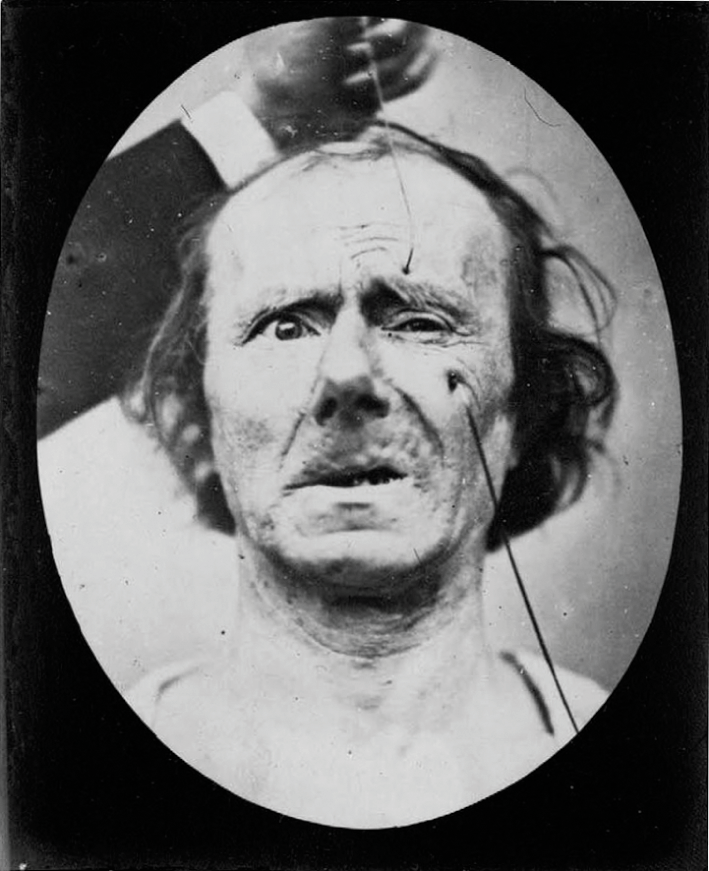
Photograph from Guillaume B. Duchenne de Boulogne, Mécanisme de la Physionomie Humaine ou Analyse Électro-Physiologique de l’Expression des Passions.
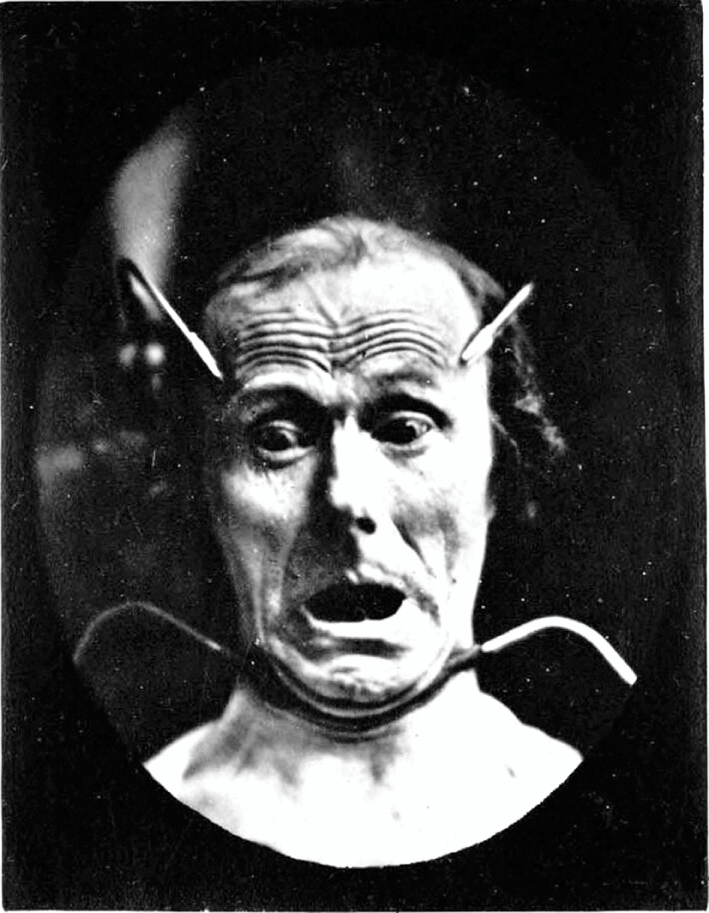
“Terror, from a photograph by Dr. Duchenne,” engraving from Charles Darwin, The Expression of the Emotions in Man and Animals (1872). Courtesy D. B. Weldon Library, Western University.
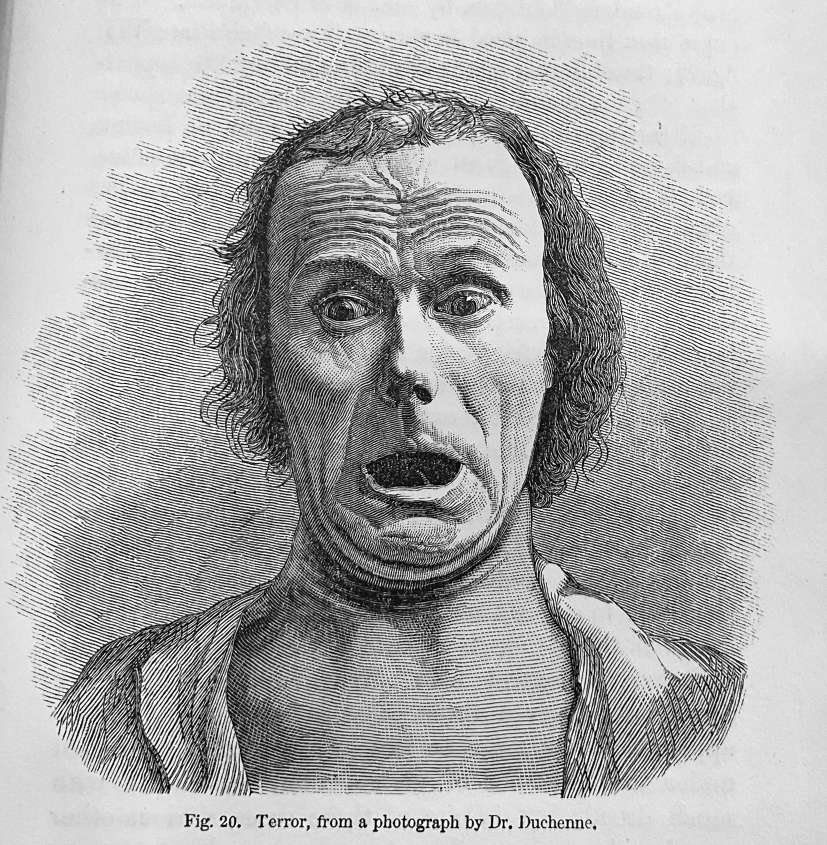
“Men simulating indignation,” photograph from Charles Darwin, The Expression of the Emotions in Man and Animals (1872).
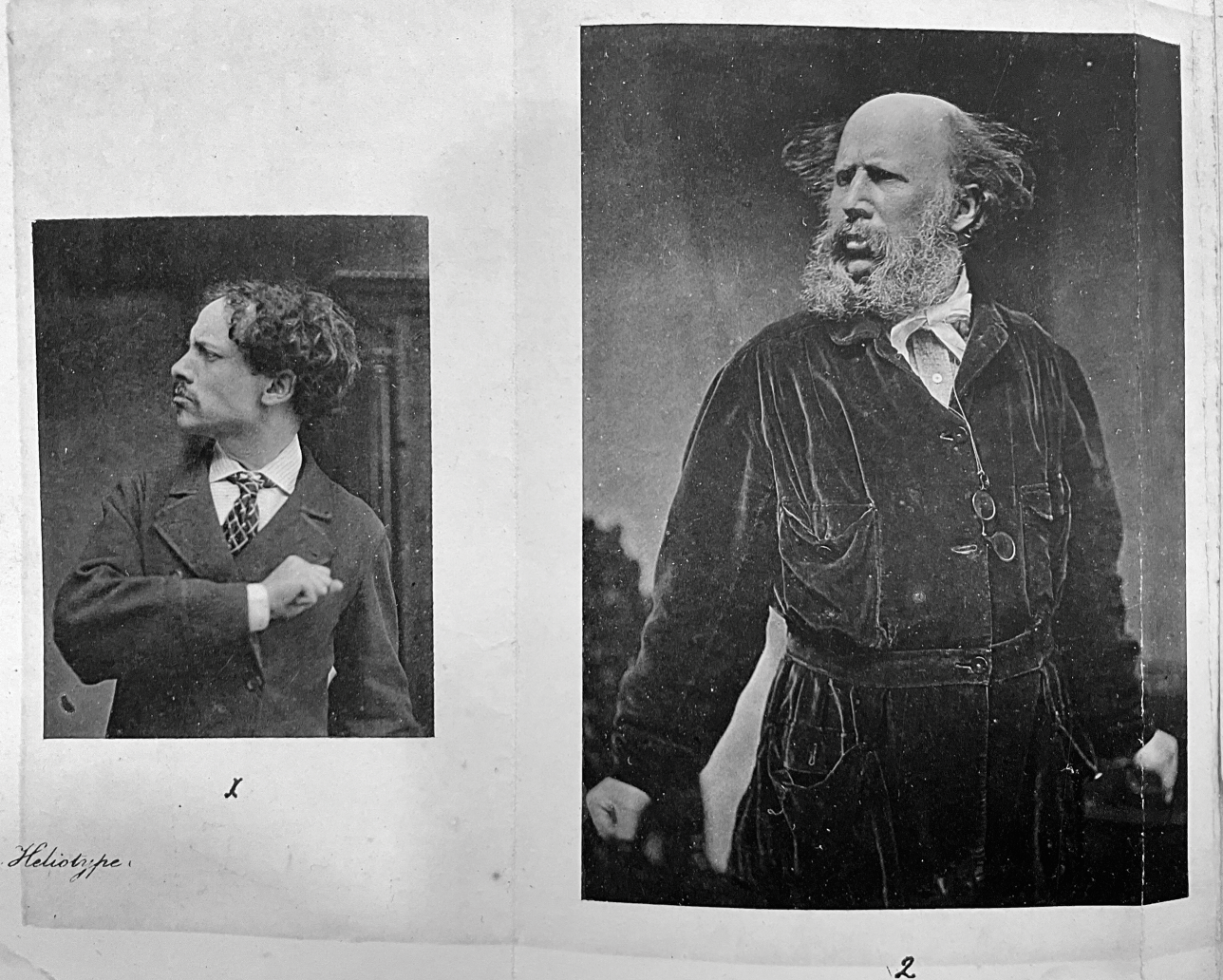
The mechanisms that enable Darwin’s study, moreover, include not only photographic and electrical technology, but also the social institutions of painting, medicine, and imperial administration. To gather evidence of expressive behaviour that he was unable to obtain for himself, Darwin consulted other male professionals, such as doctors and artists, and circulated a questionnaire to missionaries and colonial functionaries. The chapter on blushing, in particular, provides rich examples of somatic expressions implanted by the very institutions used to record them. Here, Darwin’s tendency to study expressive behaviour as automatism takes a less dramatic form than in the earlier chapters, where he used photographs of subjects undergoing galvanism for his examples. Now it manifests itself in a rigorous and reductive formalism that renders immaterial any substantive content the blush might be thought to communicate. Darwin’s thesis on blushing is that a blush expresses “the thought that others are thinking about us” (335; for other versions of this formulation with slightly different phrasing, see 324, 333, and 343); that is to say that it expresses any thought whatsoever that iterates or refers to someone else’s thought about the thinker. A blush expresses a thought about a thought about us; the citational structure of this claim opens the possibility of an indefinite series of iterations, in which we would blush at the thought that someone else is thinking about our thought about their thought … and so forth. Darwin does not discuss this possibility, which I will nonetheless shortly argue haunts his argument; nor does he follow his sources in discussing how blushing can be communicated mimetically from one person to another in the manner of hysterical symptoms.17
Darwin’s lack of interest in the cognitive significance of blushing, or in the content of the thoughts it expresses, is of a piece with his reading of the blush as the token of a general human species identity. “Blushing,” his chapter begins, “is the most peculiar and the most human of all expressions. Monkeys redden from passion, but it would require an overwhelming amount of evidence to make us believe that an animal could blush” (Expression, 310). Alone among the expressions treated in Darwin’s book, blushing distinguishes human beings from other animals. It is also a trait whose uniform occurrence among human beings regardless of race or sex Darwin adduces to mount an argument against the racist science of the 1860s.
Darwin’s stress on the universality of blushing as a form of expression, however, is in one respect at odds with the cases of blushing he actually describes. These take place in settings where differences of sex and race, far from vanishing, are obtrusively in evidence. There is something embarrassing – even blush-inducing – about the scenes Darwin represents that is not accounted for by the argument in whose service they appear.
Three examples will show what I mean. In investigating how far blushing extends down the body and in demonstrating that it is hereditary, Darwin has recourse to information gathered from a friend who as a doctor “necessarily has frequent opportunities for observation”:
Even peculiarities in blushing seem to be inherited. Sir James Paget, whilst examining the spine of a girl, was struck at her singular manner of blushing; a big splash of red appeared first on one cheek, and then other splashes, various[ly] scattered over the face and neck. He subsequently asked the mother whether her daughter always blushed in this peculiar manner; and was answered, “Yes, she takes after me.” Sir J. Paget then perceived that by asking this question he had caused the mother to blush; and she exhibited the same peculiarity as her daughter.
From the gendering of the relation between the medical gaze and its object in this passage, it is only a short step to the orientalist fantasy of the light-skinned slave whose capacity to blush enhances her price in the seraglio, which Darwin duly cites a few pages later from Dr. Thomas Burgess, his predecessor in the study of the blush, and Mary Wortley Montagu (335). A more disturbing racial structuring of the relation between the researcher’s gaze and the blush appears in passages where Darwin writes about blushing in non-whites:
The Polynesians blush freely. The Rev. Mr Stack has seen hundreds of instances with the New Zealanders. The following case is worth giving, as it relates to an old man who was unusually dark and partly tattooed. After having let his land to an Englishman for a small yearly rental, a strong passion seized him to buy a gig, which had lately become the fashion with the Maoris. He consequently wished to draw all the rent for four years from his tenant, and consulted Mr Stack whether he could do so. The man was old, clumsy, poor, and ragged, and the idea of his driving himself about in a carriage for display amused Mr Stack so much that he could not help bursting out into a laugh; and then “the old man blushed up to the roots of his hair.”
This anecdote represents the blush as a token that identifies the humanity of its bearer. In so doing, however, it also attaches the blush to a wound – literally so in a final example, again cited by Darwin from Burgess: “Cicatrices of the skin remain for a long time white in the negro, and Dr. Burgess, who had frequent opportunities of observing a scar of this kind on the face of a negress, distinctly saw that it ‘invariably became red whenever she was abruptly spoken to or charged with any trivial offense’” (318). The blush provoked in this woman by the figure who observes her is offered as a token of their shared humanity.18 It appears through a scar, though, and is itself the mute expression of racial and sexual subjugation. When affect is made a token, it becomes traumatic, being implanted, as Freud saw it, as a foreign body in its bearer.
***
Reading and writing are bodily acts; writing about the body is thus prone to a special kind of self-reflexivity.19 As we have seen, The Expression of the Emotions in Man and Animals was a trailblazing work in its use of photography for scientific purposes, and its verbal representations, like those I have already discussed, characteristically follow the logic of the photograph by making bodies available to sight from the point of view of an apparatus that itself remains unseen. On occasion Darwin breaks this convention and asks his readers to test his claims on their own bodies, as in this passage where the reader’s eye itself becomes an object of attention: “Any one who will gradually contract the muscles round the eyes, will feel, as he increases the force, that his upper lip and the wings of his nose (which are partly acted on by one of the same muscles) are almost always a little drawn up” (Darwin, Expression, 150). Nonetheless, Darwin’s usual practice is to take no account of what might be his reader’s somatic response to his writing, though – as I have said – I think we blush to read the chapter on blushing, and I doubt if anyone has ever read the sections of The Origin of Species on the homologous structure of arms, wings, and flippers without a heightened attention to their own bone structure. Still less does Darwin refer to his own embodiment or to that of his collaborators. The omission is particularly striking in the chapter on blushing, given the recursive structure that he argues causes the blush. If blushes arise from the “thought that someone else is thinking of us,” we would expect them not only in the blushing subjects the chapter represents, but also in the investigators who prompt and report their blushes. Nonetheless, in spite of his concern with “self-attention,” Darwin shows us no blushing scientists, doctors, or painters.
Even so, the chapter on blushing is exemplary among Darwin’s writings for the way it makes legible in spite of itself what Lacan would call the desire of the analyst. Though at one remove, as thoughts of thoughts, the blushes it describes bear witness to the emotions of the figures who record them: to the desire of the painter as he views his model; surely to scopophilia, not to say sadism, in the colonial administrators’ and missionaries’ inspection of their Polynesian and African subjects’ skins; to class ressentiment in the doctor who relates how one of his patients, a young duke, blushed on giving him his fee. In these episodes and elsewhere in the chapter, the institutional and affective context in which Darwin’s evidence was gathered becomes part of that evidence. The scientific frame is incorporated by its own object of study.
A relation of this kind between the object of study and the institutional and technical means by which it is observed and represented characterizes the whole of The Expression of the Emotions, as I have already implied. Though it is a larger claim than I can properly defend here, I think it could be shown that involutions of Darwin’s methods of observation and representation into his objects of study throughout his work account for some recurrent problems in its interpretation, such as the significance of personification in the representation of natural selection and the relation between the specific intellectual-historical context in which Darwinian theory originated and the universal claims it makes.20 I will close with only one further example, in which, as in The Expression of the Emotions, Darwin links an anti-racist argument about human species identity to an analysis of habits that, as he believes, have by repetition become hereditary.
In the much longer work of which the Expression was an offshoot, The Descent of Man, Darwin announces at the outset that he will have three topics, of which the first two, human descent from earlier forms of life and the manner of human development, are implied by the main title. The third topic, “the value of the differences between the so-called races of man” (18), however, is not so implied. Of the book that follows, moreover, less than a third is actually spent on human origins and development. Far more space is devoted to Darwin’s theory of sexual selection, first as it operates in non-human animals and, in the book’s last section, in relation to human beings. Only with the publication of Adrian Desmond and James Moore’s Darwin’s Sacred Cause (2009) did it become apparent how close was the link between Darwin’s development of the theory of sexual selection and his objection to scientific racism. Sexual selection, Desmond and Moore show, provided Darwin with a means to account for racial differences without linking them to function or representing them as the result of a useful adaptation.21 Though Desmond and Moore do not discuss the Expression at any length, there too we see the connection between Darwin’s belief in classification on the basis of useless modifications and his racial politics. In the Descent, he argues that sexual selection has been the “most efficient” cause of “the differences in external appearance between the races of man” (675); the entire seeming digression on sexual selection thus has race as its implicit topic.22 The unifying topic of this apparently loosely structured work is in fact Darwin’s rejection both of polygenetic theories of race and of racialist theories of human evolution that emerged in the 1860s in work by Herbert Spencer and even by natural selection’s co-discoverer Alfred Wallace.23
The distinction between natural and sexual selection – that is, the idea that non-adaptive modifications from the point of view of survival can be retained for other reasons – is by no means generally accepted among evolutionary theorists in our own day.24 Some of Darwin’s data are clearly weakened by historically specific assumptions about sex and gender that he brought to his research, and some can be explained in other ways. Nonetheless, his development of a theory of sexuality in which it is divorced from function is one of the now-unrecognized points of affinity between Darwin’s work and Freud’s. His insistence on the point is of a piece with the general refusal to make natural selection a totalizing theory that informs all of his work. In the Origin, the idea that every organism and structure is perfectly adapted to its function is rejected as theological; the world Darwin describes is one where adapted structures coexist with residual and rudimentary ones, and which is only rendered intelligible by the differences between them.
Darwin briefly introduced the distinction between natural and sexual selection in the first chapter of the Origin (136–8); only, however, with the publication of the Descent twelve years later did he treat the latter in an extended discussion. He remained committed throughout his work to the distinction between the two: natural selection operates by favouring individuals fitted to succeed in the struggle for survival; sexual selection, however, “depends on the advantage which certain individuals have over others of the same sex and species solely in respect of reproduction” (Darwin, Descent, 243). Sexual selection as Darwin theorizes it can operate in innumerable ways, for instance by modifying organisms’ powers of locomotion or prehension, or their ability to defend themselves against competition. In many cases such as these, as he notes, it is impossible to distinguish between the effects of sexual and natural selection (245). Nonetheless, Darwin always insisted that the two forms of selection tend to effect modifications of quite different and potentially conflicting kinds:
There are many … structures and instincts which must have developed through sexual selection – such as the weapons of offense and the means of defence of the males for fighting with and driving away their rivals – their courage and pugnacity – their various ornaments – their contrivances for producing vocal or instrumental music – and their glands for emitting odours, most of the latter structures serving only to excite the female. It is clear that these characters are the result of sexual and not of ordinary selection, since unarmed, unornamented, or unattractive males would succeed equally well in the battle for life and in leaving numerous progeny, but for the presence of better endowed males. We may infer that this would be the case, because the females, which are unarmed and unornamented, are able to survive and procreate their kind.
Sexually selected characteristics thus need confer no advantage in the struggle for survival; in some cases, indeed, they can actually be disadvantageous – the well-known examples from the Descent are the colouring of birds, particularly when displayed in elaborate plumage such as that of the peacock and the argus pheasant, and the development of horns in the stag, which in some cases has been carried “to an extreme which, as far as the general conditions of life are concerned, must be slightly injurious” (Darwin, Descent, 262).
Of all the effects of sexual selection, Darwin claims that the most powerful are those that confer an advantage in courtship. And it is to modifications of this sort that he attributes the differentiated physical appearance of the human races. Whereas with most non-human animals, the selection of mates belongs to the female, Darwin believes that in humans, it has generally been the privilege of men. The historical development of human appearance is thus driven by the preservation of female traits that prove attractive to men. This development, Darwin argues, has unfolded differently in different human populations with differing ideals of beauty:
It is certainly not true that there is in the mind of man any universal standard of beauty with respect to the human body. It is, however, possible that certain tastes may in the course of time become inherited, though there is no evidence in favour of this belief; and if so, each race would possess its own innate ideal standard of beauty. … The men of each race prefer what they are accustomed to; they cannot endure any great change; but they like variety, and admire each characteristic carried to a moderate extreme. Men accustomed to a nearly oval face, to straight and regular features, and to bright colours, admire, as we Europeans know, these points when strongly developed. On the other hand, men accustomed to a broad face, with high cheek-bones, a depressed nose, and a black skin, admire these peculiarities too when strongly marked.
The process of racial differentiation for Darwin thus takes the form of a feedback loop, where an arbitrary difference in appearance between two populations shapes their different ideals of beauty, which in turn reinforces the original difference by sexual selection.25 Separate populations,
exposed to slightly different conditions and habits of life, would sooner or later come to differ in some small degree. As soon as this occurred, each isolated tribe would form for itself a slightly different standard of beauty; and then unconscious selection would come into action through the more powerful and leading men preferring certain woman to others. Thus the differences between the tribes, at first very slight, would gradually and inevitably be more or less increased.
Darwin’s argument in these chapters presents some of the same difficulties as that of The Expression of the Emotions. Here again we find him treating as non-adaptive traits that might be – and subsequently have been – explained by means of natural selection. Why not assume that sexual selection will ultimately promote adaptation as individuals with the power of selection choose partners who either themselves possess useful traits or appear likely to transmit such traits to their offspring? I have already noted a political reason for Darwin’s choice, but the question nonetheless remains. Here, as in the Expression, we find recourse to the theory that habitual actions or preferences can be transformed – or degraded – into instincts and become heritable, in that case as emotional expressions, and in this as a predisposition toward a particular ideal of beauty.
Darwin’s claim in The Expression of the Emotions that the behaviours he describes are the remainders of long-ago voluntary acts bespeaks, I think, his awareness that they embody a problem of agency. My claim is that he misunderstands this problem by framing it historically; the agency of his subjects in the book is not compromised by their heredity but by the contexts in which they are studied and represented. The same holds, moreover, though in a somewhat different and broader sense, for the subject of sexual selection. In representing sexual selection’s way of acting, Darwin begins, as he had in the case of natural selection, with an analogy to selection under domestication, and in particular to what he termed unconscious selection. As we saw in Chapter 4, this is the historical process by which species under cultivation will change over time, with separate populations diverging from one another, owing to the uncounted individual selections made by their cultivators. The analogy has a double force: it at once illustrates the operation of modification by selection over many generations and shows how such modification can take place unobserved. Of the actors in unconscious selection, Marx might say, they do not know what they are doing, but yet they are doing it. Here is Darwin from the first chapter of the Origin: “A large amount of change in our cultivated plants … slowly and unconsciously accumulated, explains, as I believe, the well-known fact, that in a vast number of cases we cannot recognize, and therefore do not know, the wild parent-stocks of the plants which have been longest cultivated in our farms and household gardens” (95). If we cannot recognize our own work, Darwin wants us to see, how much more difficult will it be to recognize the impersonal operation of natural selection?
The agency of human beings in Darwin’s discussion of unconscious selection thus operates as a personification, a heuristic device that helps us to envision the operation of natural selection. Natural selection itself, though, does not serve the interest of any agent other than the species it works on; to understand natural selection correctly thus entails passing through this personification, retaining it only as a representation that has been superseded by the argument that follows.
Nonetheless, the personification of nature and natural selection of course never entirely disappears from the Origin. Moreover, the figure is reintroduced and in a certain sense loses its figural quality in The Descent of Man. As George Levine puts it, “intention, that central motif of natural theology, went out with the Origin, only to return with the Descent.”26 Here the theory of sexual selection is also explained with reference to what Darwin continues to call unconscious selection, but in this case, we cannot exactly speak of a personification, but only of an analogy between what emerge as two actual forms of unconscious agency:
When a foreign breed of our domestic animals is introduced into a new country, or when a native breed is long and carefully attended to, either for use or ornament, it is found after several generations to have undergone a greater or lesser amount of change. … This follows from unconscious selection … without any wish or expectation of such a result on the part of the breeder. So again, if during many years two careful breeders rear animals of the same family, and do not compare them together or with a common standard, the animals are found to have become, to the surprise of their owners, slightly different. Each breeder has impressed … the character of his own mind – his own taste and judgment – on his animals. What reason, then, can be assigned why similar results should not follow from the long-continued selection of the most admired women by those men of each tribe who were able to rear the greatest number of children? This would be unconscious selection, for an effect would be produced, independently of any wish or expectation on the part of the men who preferred certain women to others.
In the subject of sexual selection, then, an explanatory trope from the Origin takes on substance and enters evolutionary theory as a real agent. Here is another case of the incorporation of the theory’s discursive frame by its object. The difference between the breeder or cultivator who is responsible for the unconscious selection of domesticated species and the subject of sexual selection, moreover, is that the species cultivated by the latter is his own; as Desmond and Moore write, sexual selection makes animals into “self-breeders.”27
Darwin’s theory of sexual selection thus enters his work as the embodiment of his own rhetorical figure and as evidence of the recursive structure of his discourse.28 In his theory, sexual desire is attached to arbitrarily chosen and useless variations; leaving aside such incidental moments of self-revelation as his concern for the reproductive success of the “unarmed, unornamented, or unattractive male” (Darwin, Descent, 245), the theory as a whole incorporates into Darwin’s work an image of the taxonomical drive that produced it. Recall Darwin’s rigorous distinction in the Origin between useful structures that have been perfected by natural selection and the useless or rudimentary parts, compared to unvoiced letters, which are most useful to the taxonomist. Natural selection, in short, cares nothing for taxonomy; scientists who study taxonomy and the kinship relations among organic beings set themselves in opposition to it and seek to discover what it tends to conceal. This is why the structures most useful to the taxonomist are those which natural selection has least affected. Given this antithesis between natural selection and the method by which it is studied – between what we might call the interest of natural selection and that of the scientist – there is a deep dialectical irony to the emergence in Darwin’s work of sex as another mode of selection that is said to operate principally on useless traits and that seems under the sign of racial difference to produce structures designed to attract the taxonomist.29
Current debates notwithstanding, for Darwin the crucial problem posed by natural selection was not that it left no room for God, but that it left no room for what he termed “man.” In the Origin, he came to the conclusion that the term “species” itself was necessarily arbitrary; George Levine notes the irony that in a work entitled The Origin of Species, “species … have no real existence.”30 Darwin saw that after his work, species could only be viewed as “artificial combinations made for convenience. This may not be a cheering prospect,” he wrote, but by it “we shall at least be freed from the vain search for the undiscovered and undiscoverable essence of the term” (Darwin, Origin, 456). Once the concept of species as such no longer had a metaphysical basis, neither did the human as a particular instance of speciation.31 And yet long after he had abandoned the Christian belief in the universal brotherhood of human beings created in God’s image, Darwin remained committed to the concept of species, not least as providing a ground for anti-racism.32
In Darwin’s work, species identity in general, and human identity in particular, are conferred by the arbitrarily selected, residual, and otherwise purposeless traits that define an organism’s relations with members of other species and with members of its own. In The Descent of Man and The Expression of the Emotions, this logic determines Darwin’s focus on sexual selection, aesthetic preference, and affect as the symptoms of being human. These works were the source of Freud’s early understanding of the symptom, which thus reflects the emergence of a biological species from the ruins of a metaphysical idea of “man.”33 Indeed, Freud’s symptom was more than a reflection. Neither his work nor Darwin’s was only an event in intellectual history. Because they produce symptoms and affects in their own right they also belong to the history of the body. The same will prove true of the anthropological and medical writing to be discussed in Part III. The result is a recurrence of problems of reference like those we have studied in Darwin, where de-functioned or symptomatic habits and traits are studied as inherited remainders of the evolutionary process, but are also recognizable as implanted and invested with meaning by the very apparatus used to study them.34 From this standpoint, Darwin may be less important as an influence on Freud than as the figure who made our species body foreign to itself.
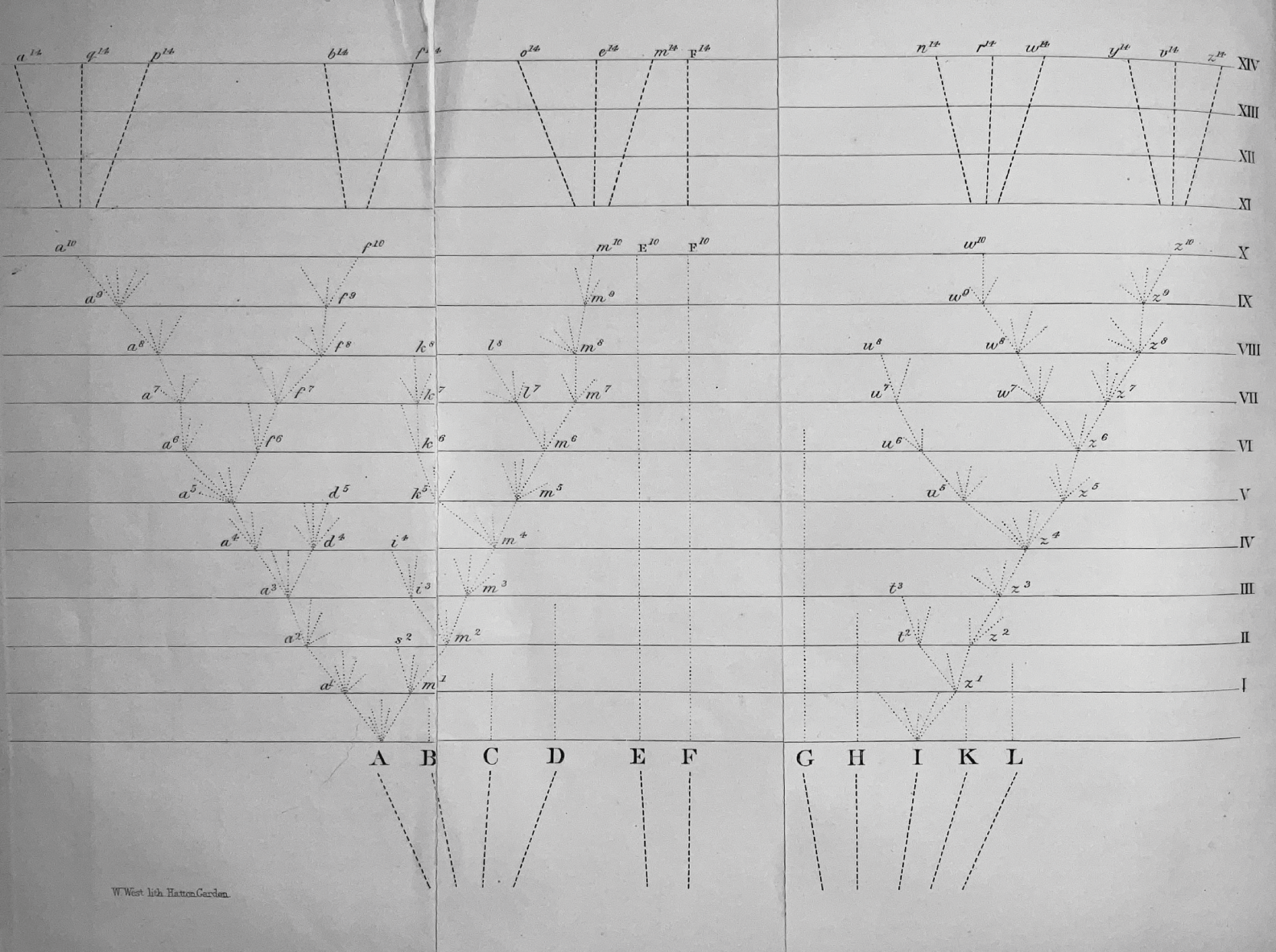
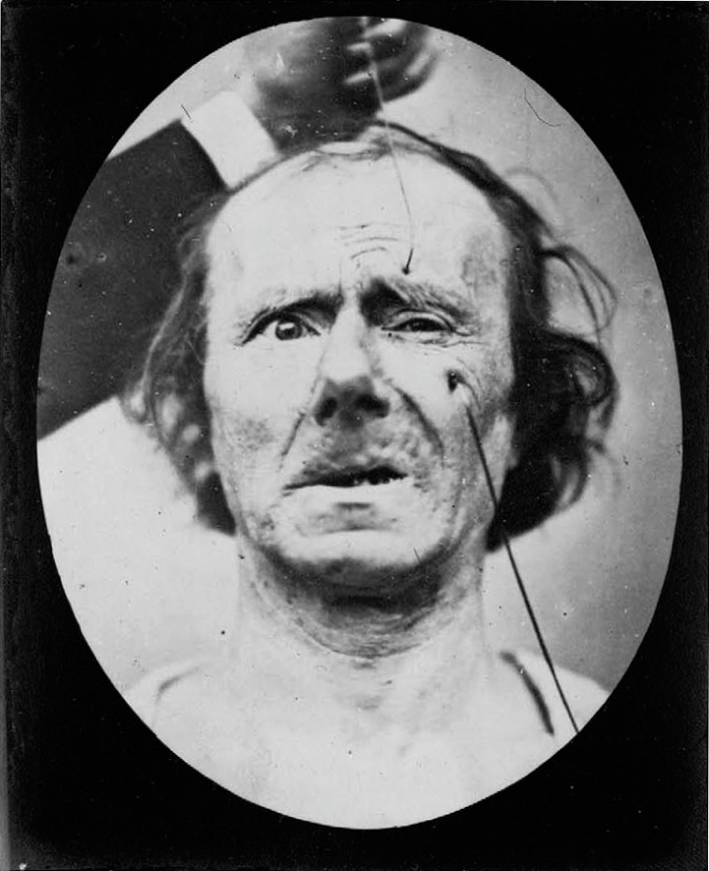
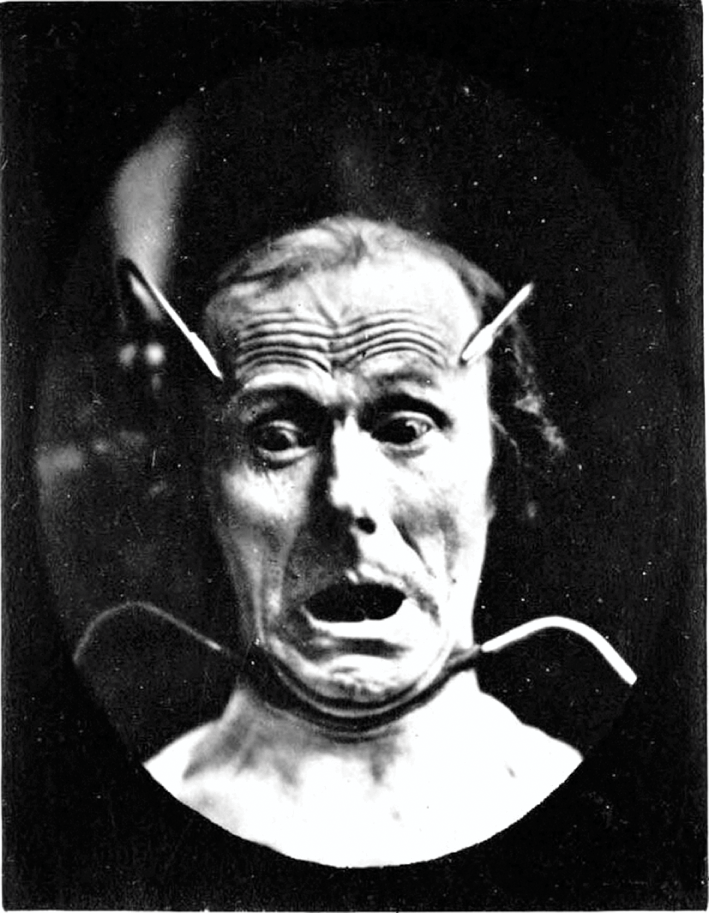
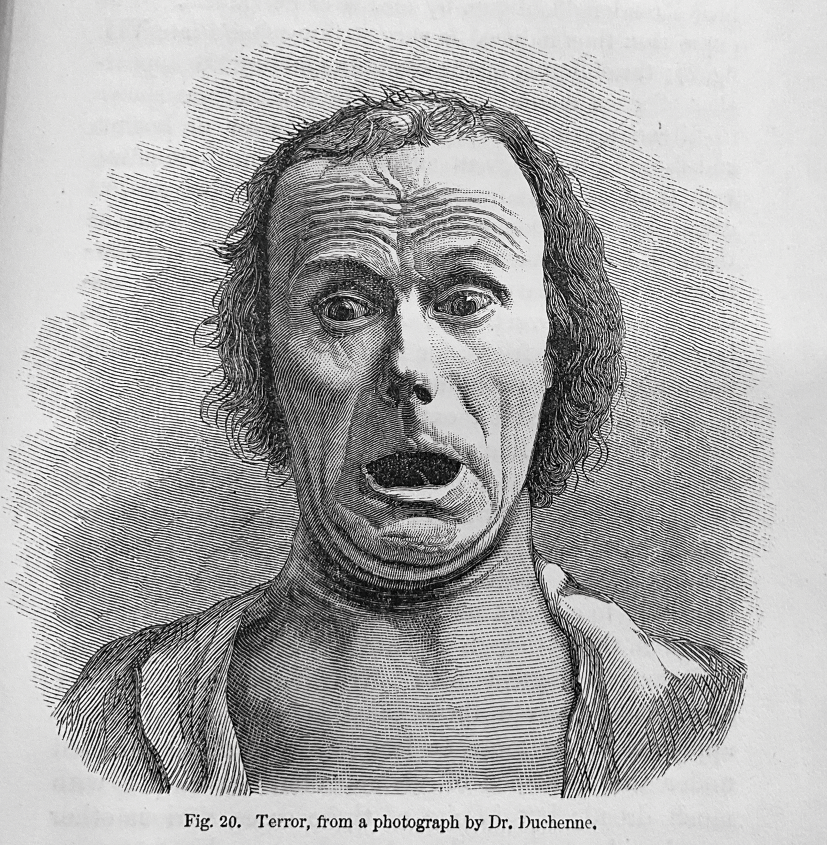
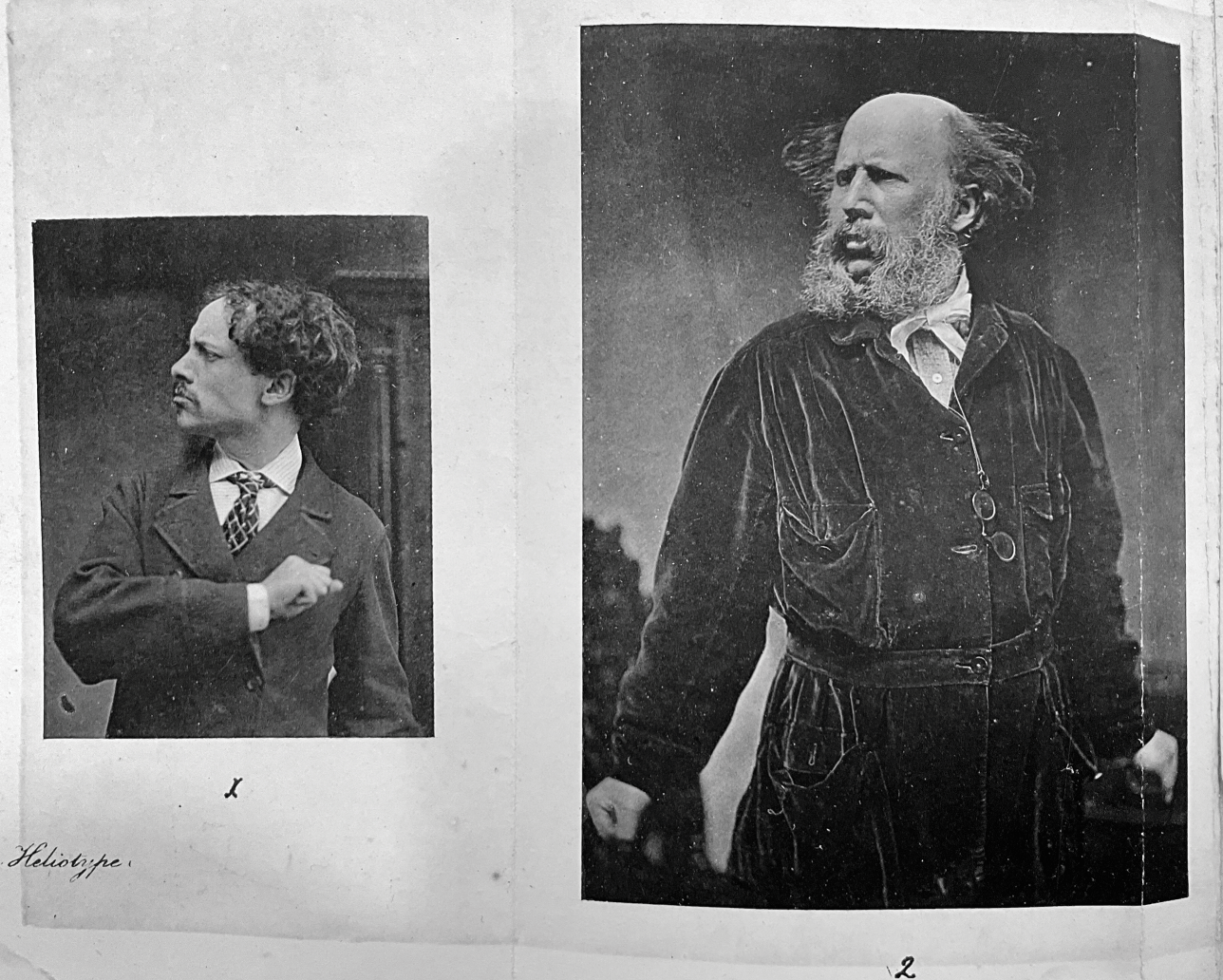

 Open access