


Introduction
Vultures play an important role in ecosystems since they are responsible for eliminating large amounts of decomposing matter that otherwise could act as a focus of harmful diseases (Whelan et al. Reference Whelan, Wenny and Marquis2008, Ogada et al. Reference Ogada, Keesing and Virani2012). Nonetheless, they are one of the most globally threatened scavenger groups, with at least 81% of vulture species listed as threatened or ‘Near Threatened’ on the IUCN Red List (Ogada et al. Reference Ogada, Keesing and Virani2012, Margalida and Ogada Reference Margalida, Ogada, Sarasola, Grande and Negro2018, Safford et al. Reference Safford, Andevski, Botha, Bowden, Crockford, Garbett and Williams2019). Both the serious modifications that ecosystems have undergone, and contemporary human activities, have altered the natural supply of carrion, thereby modifying food resource selection (Oro et al. Reference Oro, Genovart, Tavecchia, Fowler and Martínez-Abraín2013) and affecting vulture-related ecosystem services (Moleón et al. Reference Moleón, Sánchez-Zapata, Margalida, Carrete, Owen-Smith and Donázar2014). In Europe, the establishment of sanitary regulations by the European Parliament and the European Council (Regulation EC 1774/2002) in response to the appearance of Transmissible Spongiform Encephalopathies (TSE) in cattle in the late 1990s, which banned the abandoning of cattle carcasses in the wild and in supplementary feeding sites, led to a significant decrease in the main food source for vultures (Martí Reference Martí, Martí and Del Moral2003, Margalida et al. Reference Margalida, Donázar, Carrete and Sánchez-Zapata2010). Although new regulations (Directive 2009/147/CE and Regulation (EU) No 142/2011) were later enacted to maintain authorised supplementary feeding sites to assist the conservation of scavengers, this important loss in food supplies obliged vultures to exploit other food resources such as landfills (Donázar et al. Reference Donázar, Cortés-Avizanda and Carrete2010), another predictable source of food commonly used by these species (Garrido et al. Reference Garrido, Sarasa, Fernández-Cruz, Yosef, Miller and Pepler2002, Plaza and Lambertucci Reference Plaza and Lambertucci2017).
A large number of opportunistic animal species congregate in landfills due to food availability (see Plaza and Lambertucci Reference Plaza and Lambertucci2017). Nowadays, for several vulture species, landfills constitute an important food resource (Tauler-Ametller et al. Reference Tauler-Ametller, Hernández-Matías, Pretus and Real2017). This food subsidy exists alongside other predictable feeding sites such as vulture feeding stations and helps strengthen vulture populations in certain regions (Oro et al. Reference Oro, Genovart, Tavecchia, Fowler and Martínez-Abraín2013, Plaza and Lambertucci Reference Plaza and Lambertucci2017). In some areas, food from landfills represents up to 50% of the diets of rare and endangered vulture species (Tauler-Ametller et al. Reference Tauler-Ametller, Hernández-Matías, Parés, Pretus and Real2018), although they are also a source of low-quality and dangerously polluted food (Genovart et al. Reference Genovart, Negre, Tavecchia, Bistuer, Parpal and Oro2010, Tauler-Ametller et al. Reference Tauler-Ametller, Pretus, Hernández-Matías, Ortiz-Santaliestra, Mateo and Real2019, Ortiz-Santaliestra et al. Reference Ortiz-Santaliestra, Tauler-Ametller, Lacorte, Hernández-Matías, Real and Mateo2019).
Despite the benefits provided by this unlimited source of food, landfills also influence the demographic parameters of several species that use them and even trigger cascade effects in ecosystems as a result of the boom in opportunistic and generalist bird and mammal species, leading to human-wildlife conflicts in consequence (see Plaza and Lambertucci Reference Plaza and Lambertucci2017). In order to reduce the environmental impact of landfills, and encompassed within the framework of the circular economy, developing and developed countries are adopting new policies for reducing waste production and the amount of organic waste and other useful materials that are dumped in landfills, incinerators, and oceans (Hoornweg et al. Reference Hoornweg, Bhada-Tata and Kennedy2013, Thi et al. Reference Thi, Kumar and Lin2015, Stahel Reference Stahel2016, Jurgilevich et al. Reference Jurgilevich, Birge, Kentala-Lehtonen, Korhonen-Kurki, Pietikäinen, Saikku and Schösler2016). In Western Europe, European directives (Directive 2008/98 /EC and Directive (EU) 2018/850) exhort member states to treat waste before its landfilling in an attempt to promote by 2035 a transition to a circular economy and reduce to less than 10% the amount of waste that reaches landfills. However, the application of this directive might imply a decrease in food availability in landfills that could have negative effects not only for opportunistic and generalist species but also species of conservation concern that exploit this resource. To date, few studies have assessed the effect of food reduction in landfills or the effect of landfills closure on local demographic parameters of certain opportunistic and generalist species (Kolowski and Holekamp Reference Kolowski and Holekamp2007, Bino et al. Reference Bino, Dolev, Yosha, Guter, King, Saltz and Kark2010, Payo-Payo et al. Reference Payo-Payo, Oro, Igual, Jover, Sanpera and Tavecchia2015), and for vultures is scarce (Katzenberger et al. Reference Katzenberger, Tabur, Şen, İsfendiyaroğlu, Erkol and Oppel2019).
Here, we focused on determining the visitation probability and abundance of a Eurasian Griffon Vulture Gyps fulvus population in Central Catalonia, where a long-term capture-mark-recapture (CMR) scheme involving thousands of individuals has been carried out in a landfill that shifted organic waste management during the study period (2012–2018). Since recyclable, non-recyclable, and organic waste is not separated effectively by households, organic matter and other recyclable material may end up in this landfill. As a mitigating measure, a waste treatment centre (WTC) was built in June 2015 to improve the separation of organic and recyclable materials from the remaining waste fraction in the municipal selective rubbish collection (hereafter WASTE) before dumping in the landfill. With the WTC, the organic fraction of municipal selective collection (hereafter ORGAN) is also received and treated before its landfilling. Our main interests are two-fold. First, from a conservation perspective, our example may help to understand how a population of an abundant vulture species responds to a local reduction of food accessibility in terms of landfill visitation probability and abundance. While the current conservation status of Griffon Vulture is ‘Least Concern’, increasing evidence suggest that several threats make this population vulnerable in the future (Arrondo et al. Reference Arrondo, Sanz-Aguilar, Pérez-García, Cortés-Avizanda, Sánchez-Zapata and Donázar2020); it is worth remembering that Asian vultures were very abundant before the unexpected crash in the 1990s that led them near to extinction (Prakash et al. Reference Prakash, Pain, Cunningham, Donald, Prakash, Verma, Rana, Sivakumar and Rahmani2003, Oaks et al. Reference Oaks, Gilbert, Virani, Watson, Meteyer, Rideoutet and Khan2004). Second, from the perspective of the management of landfills and the conflict that vultures attending them generate (Oliva-Vidal et al. Reference Oliva-Vidal, Hernández-Matías, García, Colomer, Real and Margalida2022), a reduction of organic waste is a reasonable measure to reduce the use of these infrastructures by conflicting species. Nonetheless, little information exists on whether available methods of organic waste reduction allow reducing the amount of organic waste to levels that ensure the reduction of the conflict. For example, organic waste after the implementation of measures may be still enough to sustain a large population of conflicting species (Payo-Payo et al. Reference Payo-Payo, Oro, Igual, Jover, Sanpera and Tavecchia2015). In addition, few studies have addressed the importance of regional population trends on the local dynamics of species attending these infrastructures, so that local measures may be partially ineffective. Based on these ideas, we expect that the reduction of organic matter dumped in the landfill negatively affects the visitation probability. In fact, our visitation probability is an apparent survival estimate in a capture recapture analysis. A reduction in apparent survival can result from a mixture of mortality and permanent emigration (Lebreton et al. Reference Lebreton, Burnham, Clobert and Anderson1992). Given that this species can adapt its foraging movements as a behavioural response to food availability (Donázar et al. Reference Donázar, Cortés-Avizanda and Carrete2010, Zuberogoitia et al. Reference Zuberogoitia, González-Oreja, Martínez, Zabala, Gómez and López-López2013), we expect a reduction of apparent survival due to a permanent emigration from the site in response of food shortage in the landfill. We interpret our apparent survival probability as a probability of vultures visiting the landfill and not as survival per se. For this reason, and from now on we refer to this parameter as ‘landfill visitation probability’. As for abundance, we expect that it will increase due to population processes occurring at larger spatial scales irrespective of local food availability. Given that vultures can visit several feeding sites and fly enormous distances daily to forage (García-Ripollés et al. Reference García-Ripollés, López-López and Urios2011, Monsarrat et al. Reference Monsarrat, Benhamo, Sarrazin, Bessa-Gomes, Bouten and Duriez2013, Harel et al. Reference Harel, Duriez, Spiegel, Fluhr, Horvitz, Getz, Bouten, Sarrazin, Hatzofe and Nathan2016), we expect that individuals from a regional population visit the landfill at some point, irrespective of food reduction since there is still enough to attract them to the site. In this case, we considered the growing Catalonian population (Del Moral and Molina Reference Del Moral and Molina2018) as the most representative scale of a regional population, so we would expect the abundance of vultures at the landfill to increase as well. In order to assess these predictions, we first analysed the amount of organic matter dumped in the landfill before and after the WTC was installed, then we estimated the demographic parameters of the local Griffon Vulture population, and finally, we tested if a higher population-scale such as the Catalonian reproductive pair censuses explains the abundance estimated despite the reduction of organic matter in the landfill.
Methods
Study species
The Griffon Vulture is a long-lived avian scavenger species that can live for up to 35 years (Chantepie et al. Reference Chantepie, Teplitsky, Pavard, Sarrazin, Descaves, Lecuyer and Robert2015). In Catalonia, the population increased from 1,115 pairs in the 2008 census (Del Moral Reference Del Moral2009) to 1,628 in 2018 (Del Moral and Molina Reference Del Moral and Molina2018). Despite declining populations in North Africa and Turkey, the overall population trend appears to be upwards and this species is now assessed as ‘Least Concern’ on the IUCN Red List (BirdLife International 2017). Home-range covers ~4,000 km2 (Arrondo et al. Reference Arrondo, Moleón, Cortés-Avizanda, Jiménez, Beja, Sánchez-Zapata and Donázar2018) and birds will fly up to 120–300 km daily to forage (García-Ripollés et al. Reference García-Ripollés, López-López and Urios2011, Harel et al. Reference Harel, Duriez, Spiegel, Fluhr, Horvitz, Getz, Bouten, Sarrazin, Hatzofe and Nathan2016). Juveniles seem to be less site-dependent (i.e. they disperse longer distances and have less site fidelity) than adults and are often attracted by congregations of feeders at predictable feeding sites (García-Ripollés et al. Reference García-Ripollés, López-López and García-López2004, Duriez et al. Reference Duriez, Herman and Sarrazin2012, Peshev et al. Reference Peshev, Stoynov, Parvanov and Grozdanov2018). In Europe and other Old-World regions, Griffon Vultures specialize in consuming medium-to-large vertebrate carcasses, mainly ungulates (cattle and wild deer) (Fernández Reference Fernández1975, Donázar Reference Donázar1993, del Hoyo et al. Reference del Hoyo, Elliot and Sargatal1994, Xirouchakis Reference Xirouchakis2005). However, some vultures frequent landfills and individual survival rates may increase since feeding at these sites is easier than searching for carcasses and competing with others for food (Garrido et al. Reference Garrido, Sarasa, Fernández-Cruz, Yosef, Miller and Pepler2002).
Study area and data collection
In 2012–2018, a Griffon Vulture banding scheme was carried out by the Grup d’Anellament de Calldetenes-Osona at the landfill of Orís municipality (42.07°N, 2.20°E, Central Catalonia, Spain; Figure 1), which receives waste from up to 68,868 households of Osona and El Ripollès counties (https://www.idescat.cat). The CMR sessions were performed once or twice a month on ~17 occasions a year (minimum = 9, maximum = 23) (Table S1; Appendix S1 in the online supplementary material). Captures were made using a permanent walk-in trap (see Bloom et al. Reference Bloom, Clark, Kidd, Bird and Bildstein2007) placed ~200 m from the landfill and with a capacity for up to 300 vultures. Pig lungs, and decomposing sheep and cattle parts were supplied regularly (30–50 kg weekly) to attract the vultures. Once captured, each vulture was ringed with a metal band and a plastic distance-reading band (Garrido and Pinilla Reference Garrido, Pinilla and Pinilla2000). For this study, data from recaptured vultures only was used, since re-sightings were few and come from opportunistic records by naturalists with some discrepancies in the areas and periods covered.
Orís landfill location (triangle) and distribution of Griffon Vulture Gyps fulvus nesting sites (white circles) in Catalonia. The distribution of nesting sites is based on data of 10x10 km UTM squares (data provided by Servei de Fauna i Flora, Generalitat de Catalunya 2018). Olive green gradient represent altitude from 0 m (light green) to >3,300 m (dark green). Map was developed in ArcMap 10.3 (ESRI 2014).

Landfill waste management effect on food availability
In compliance with European directives (Directive 2008/98/EC and Directive (EU) 2018/850), a waste treatment centre (WTC) was built at Orís landfill, in May 2015, whose aim was to reduce the accessibility of scavengers to organic waste dumped into the open landfill. Before the WTC was opened, untreated WASTE (i.e. waste fraction of the municipal selective rubbish collection) was dumped in the landfill, which would suggest that up to that date more organic matter was available and accessible as food. After the WTC became operational, both ORGAN (organic fraction of the municipal selective rubbish collection) and WASTE pass through two different treatment lines to separate the content (recyclable, non-recyclable, and organic matter from both sources). Thus, two main sources of organic matter are deposited into the landfill and are available and accessible as food for vultures after triage in the WTC. Of the ORGAN, scrap >12 cm is dumped and is the main source of food for vultures, while scrap <12 cm is transported to an aerobic biological reactor for composting. After the composting treatment, a residual fraction is tipped into the landfill. Of the WASTE, three main residuals are separated: first, materials >18 cm are dumped in the landfill (including food scraps not properly separated in households); the second residue consists of recycled material such as aluminium, light packaging, and iron; and the third residue is biostabilised organic matter which is used as soil for covering the landfill (for more detailed information see https://www.residusosona.cat/circuit-planta/).
We estimated the amount of organic matter tipped in the landfill accessible and available for vulture consumption (hereafter OMA) by quantifying the different types of waste before and after the WTC triage from samples of c.1000 kg, three or four times a year (See Table S2 and Appendix S2 for details). We assessed whether food availability differed between the periods before and after the WTC performing a t-test using log-transformed OMA in R version 3.6.3 (R Development Core Team 2020). The yearly OMA values were also used as covariates in the following analyses.
Landfill waste management effect on population parameters
We used a CMR database of Griffon Vultures using the period 2012–2018. Since we aimed to evaluate the effect of the OMA reduction in the Orís landfill on annual visitation probability and abundance, captures were pooled for each year and were treated as a single sampling occasion. We proceeded this way to guarantee the presence of all vultures captured throughout the year to avoid the potential bias of considering the fraction of birds that use the landfill in a given season (see Discussion; and Smith and Anderson Reference Smith and Anderson1987, Hargrove and Borland Reference Hargrove and Borland1994, O’Brien et al. Reference O’Brien, Robert and Tiandry2005). Despite this, and following other studies based on year-round captures and where part of the data was omitted (Peach et al. Reference Peach, Hammer and Oatley2001, Boys et al. Reference Boys, Oliveria, Pérez-Jorge, Prieto, Steiner and Silva2019), we performed the same models using half-year (six months) of captures as a sampling occasion in order to explore the effect on our estimates of shortening the pooling interval (see Appendix S3 for the results of this analysis).
To test whether our data met the model assumptions, we ran the version of the RELEASE test (Burnham et al. Reference Burnham, Anderson, White, Brownie and Pollock1987) performed in program U-CARE (Choquet et al. Reference Choquet, Lebreton, Gimenez, Reboulet and Pradel2009) to detect possible sources of heterogeneity in both visitation and capture probabilities, using a live-encounter Cormack-Jolly-Seber-type (CJS) capture histories structure. Since both Test3.SR and Test2.Ct were significant (see Results), and following Sanz-Aguilar et al. (Reference Sanz-Aguilar, Tavecchia, Genovart, Igual, Oro, Rouan and Pradel2011), our initial model had to account for both sources of heterogeneity using constraints on visitation and capture probability for transients and trap-dependence, respectively.
We used the Schwarz and Arnason (Reference Schwarz and Arnason1996) parameterization of the Jolly-Seber model (or POPAN model), which estimates open-population abundance in terms of a super-population (N) and probability of entry (pent). The estimated parameters from the POPAN model that we used for inference are: 1) super-population of Griffon vultures (Nsuper ), a hypothetical number of vultures entering the study site and available for capturing; 2) visitation probability (ϕ i ), the probability that a vulture alive in year i will be alive and present on the landfill in year i+1; 3) capture probability (p i), the probability of capturing a vulture in year i given that it is alive and present on the landfill; 4) the probability of entrance (penti ), the probability that a vulture from the super-population entered the study site between year i and i+1; and 5) the abundance of vultures per year (Ni ) as a derived parameter. The visitation (ϕ), capture (p), and entry (pent) probabilities are the modelling parameters and were modelled as constant (.) or time-dependent (t).
To model transient and trap-dependence effects, the PriorCapL function in program MARK 9.0 (White and Burnham Reference White and Burnham1999) was used. The covariate PriorCapL function was applied to differentiate whether or not a vulture had been previously captured between specified years. To account for transients, PriorCapL (i,j) applied to ϕ took the value of 0 if a vulture was not previously captured on years i, i+1, …, j, and 1 if the animal was captured during this set of years. To account for trap-dependence, in capture probability, PriorCapL (i) was 1 for vultures seen on the preceding occasion i-1 and 0 for those not seen on that occasion.
The effect of landfill management was modelled as an additive effect and assessed separately considering two variables: first, the “Landfill Effect” (LE) was coded as a dummy variable indicating two periods, before the WTC (2012 to May 2015) and after (June 2015 to 2018) and was applied to visitation, capture, and entry probabilities. Second, the OMA variable was used to model the effect of landfill management using the OMA values calculated for each year (Table S2, Appendix S2). We modelled the capture probability taking into account the sampling effort. The covariate “Effort” was the total number of sampling days per year (Table S1, Appendix S1). A full explanation of each parameterized component model is shown in Appendix S4.
All the models were fitted with program MARK 9.0 (White and Burnham Reference White and Burnham1999) and model selection was carried out using Akaike’s information criterion corrected for small sample sizes (AICc; Burnham and Anderson Reference Burnham and Anderson2002) with ĉ adjusted for overdispersion (quasi-likelihood AICc, QAICc). Models with ΔQAICc<2 were model-averaged in MARK 9.0 (White and Burnham Reference White and Burnham1999) and used for inferences (mean ± SE).
Determinants of vulture populations present at the landfill
Since the abundance per year (Ni ) is not a modelable parameter in POPAN, we conducted a post-hoc analysis to evaluate the factors that could determine this parameter in the landfill. We ran linear regressions in R version 3.6.3 (R Development Core Team 2020) using the estimated POPAN model abundance (Ni ) as a response variable with two predictive variables: 1) the annual metric tons of OMA discharged into the landfill and 2) the number of breeding pairs of Griffon Vultures estimated in Catalonia in 2012–2018 (N-Census). We evaluated a third model considering the additive effect of both N-Census and OMA. The AICc was used for model selection (Burnham and Anderson Reference Burnham and Anderson2002). The Catalan Griffon Vulture census is only performed every decade and it was provided by Del Moral (Reference Del Moral2009) in 2008 and by the wildlife service of the local government in 2018 (Servei de Fauna i Flora, Generalitat de Catalunya). N-Census for each year was estimated by regressing the number of breeding pairs against the number of years in each 10x10 UTM square in Catalonia and then summing the values of all grids. For each grid, we only have two observations of the dependent variable and we assumed that number of pairs changed linearly through the period. The first census was completed in 2008 and 2009 so we assumed the same numbers of vultures for these two years and we considered a 9-year period to estimate the yearly increment of pairs (estimate ± SE). By proceeding this way, we also assumed that the number of breeding pairs in Catalonia represents a good measure of the overall population of the individuals at the study site.
Results
Effect of landfill waste management on food availability
During the study period (2012–2018), 234,717.57 metric tons (t) of residuals were received, of which 66,684.15 t of OMA were deposited in the Orís landfill. At least 42% of OMA was dumped into the landfill before WTC (2012–May 2015), followed by a significantly progressive reduction from 27% (2015) to 4% (2018) after it became operational (t = 18.37, n = 7, P <0.01; Figure 2).
Total metric tonnes (t) of ORGAN+WASTE (the waste fraction and organic fraction of the municipal selective rubbish collection) (white bars) and OMA (organic matter available as food for vultures) (black bars) in Orís landfill during the study period (2012 to 2018). Before the WTC (2012 to mid-2015), WASTE with organic matter were poured into the landfill without separation. After WTC (mid-2015 to 2018), organic matter from WASTE and ORGAN was separated before being poured into the landfill. Arrow indicates the year WTC was implemented.

Landfill waste management effect on population parameters
Our data set consisted of 2,937 marked individuals, of which 604 (20%) were recaptured twice or more. As expected, the most general CJS model with visitation and capture probabilities dependent on time (ϕt pt ) fitted the data poorly (ĉ = 3.83, χ2 = 80.53, df = 21, P <0.001). This lack of fit was due to visitation and capture heterogeneity caused by the presence of transients (Test3.SR: P <0.001) and trap-happiness (Test2.Ct: P = 0.004). The other two components (Test3.Sm and Test2.Cl) were not significant (Appendix S5). In order to correct both sources of heterogeneity, our initial model included transience and trap-response constraints in both the visitation and capture probabilities, allowing us thus to greatly decrease overdispersion (ĉ = 1.16, χ2 = 13.93, df = 12, P = 0.30) (Appendix S5).
Yearly-capture pooling models performed better than half-year pooling models, where the lasts showed lower estimates (and two pent equal to zero) and precision (see results of half-year pooling models in Appendix S3). Fourteen models represented the total QAICc weight (Table 1 and Appendix S6). The most parsimonious model had 43% support from the data and was 2.53 times greater than the second one (17% of QAICc weight). However, both models performed similarly (ΔQAICc <2), therefore they were averaged to make inferences about population parameters (Appendix S7). Both models indicated that there is a negative effect on visitation probability due to the decrease in the amount of organic matter dumped in the landfill after the WTC was opened, and that it was modelled by the Landfill Effect (LE) (Table 1). Newly marked vultures had lower visitation probability rates (0.45 ± 0.03) than vultures captured more than once (hereafter residents). Resident vultures experienced a decrease in visitation rates associated to the change in landfill waste management, from 0.82 ± 0.03 in 2012–2015 to 0.76 ± 0.03 in 2015–2018. Applying Pradel et al.’s (Reference Pradel, Hines, Lebreton and Nichols1997) formula, the proportion of transients in newly marked vultures for both periods were 0.45 ± 0.08 and 0.41 ± 0.05, respectively. The capture probability of vultures not captured at previous periods was lower (0.26 ± 0.03) than those captured at the previous period (0.35 ± 0.02). The super-population size estimated was 5,034 ± 179, while annual abundance increased from 1,520 ± 211 to 2,304 ± 172 during the study period (Figure 3).
Most parsimonious POPAN models that best fit Griffon Vulture Gyps fulvus capture-recapture data of Orís landfill during the study period (2012–2018) at Catalonia, Spain (NE Iberian Peninsula). Models in bold were used for parameters inference using model averaging.

wi = QAIC weight, k = number of parameters. Model parameters are: ϕ, landfill visitation probability; p, capture probability, pent, probability of entry; t, variation over time; ., constant over time; PriorCapL, previous capture function; Effort, days of sampling effort per year; LE, effect in time due to change landfill waste management (period 1: 2012 to mid-2015 and period 2: mid-2015 to 2018); and OMA, organic matter available for vulture consumption.
Estimated total abundance per year of the Griffon Vulture population in the Orís landfill based on the model average of the two most fitted POPAN models. Error bars represent the 95% CI.

Determinants of the vulture population at the landfill
An increase of 720 new breeding pairs of Griffon Vultures was estimated in Catalonia between the two census dates (2008/9 and 2018) (average increase of 80 ± 1.81 pairs/year). The most parsimonious model took the N-Census covariate as the best predictor of annual abundance estimated from POPAN, with 54% of AICc weight (Table 2). Both variables were strongly positively related (Intercept = 150.19 ± 605.59, Slope = 1.12 ± 0.38, r = 0.79, r2 = 0.63, P = 0.03). The second-best model included the OMA covariate as predictor (35% AICc weight) and had a strong negative relation with N-POPAN (Intercept = 2150.15 ± 107.5, Slope = –0.02 ± 0.01, r = –0.75, r2 = 0.57, P = 0.05). The best model coefficient estimates indicate that for every additional breeding pair in the N-Census we can expect the POPAN abundance estimate to increase by an average of 1.12 individuals (y = 150.19 + 1.12N-Census) (Figure 4).
Linear regression models constructed with estimated abundance of POPAN model as response variable and N-Census (number of breeding pairs census) and organic matter available (OMA) in Orís Landfill as predictive variables.
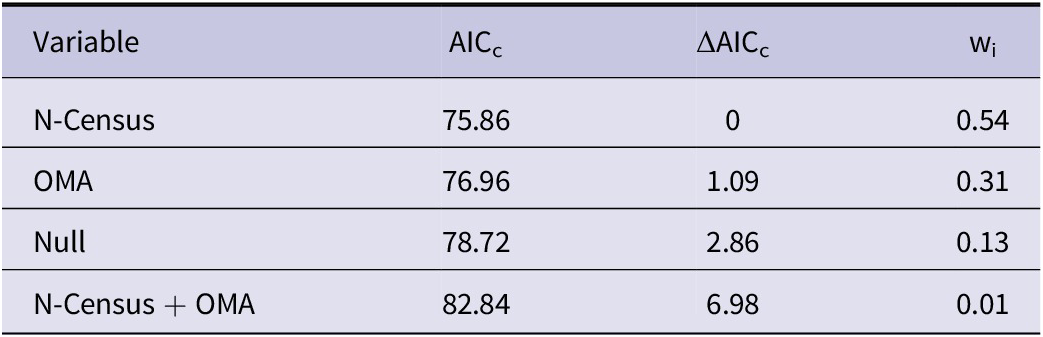
AICc = Akaike’s information criterion corrected for small sample sizes, wi = AICc weight.
Relation between the estimated POPAN model abundance of vultures attending the landfill (N-POPAN) and number of breeding pairs in Catalonia (N-Census). The relationship trend line between the two variables is shown and the shadowed area represents the 95% CI.

Discussion
We analysed the effect of the amount of organic matter dumped in a landfill on the population parameters of the Griffon Vultures that frequented the site both before and after the installation of a WTC. The amount of organic matter tipped in the landfill fell greatly after the WTC came into operation (from 17,942.03–17,775.45t before WTC to 8,285.73–1,155.06t after WTC). Our results shows that the number of vultures attending the site is high (between 1,520 and 2,304 per year; super-population size = 5,034 individuals) and relevant at a Catalan local population scale (1,628 breeding pairs in 2018; Del Moral and Molina Reference Del Moral and Molina2018) and close regions (some transients from Spain and France). In agreement with our expectations, the landfill visitation rates of the vultures fell and the overall number of vultures at the landfill increased during the study period. Achieving these results was possible using a remarkable combination in our study: the implementation of a seven-year ringing scheme of c.3,000 captured birds in a landfill where waste management varied drastically the food availability during the study period. In addition, the application of POPAN models allowed us to jointly estimate visitation probability and local abundance while correcting the effects of transience and trap-dependence, two common sources of bias for parameter estimation in capture-recapture studies.
Previous studies on vulture species have shown positive effects of supplementary food (Piper et al. Reference Piper, Boshoff and Scott1999) as well as negative effects of food shortage as a consequence of either declines in ungulate populations (Virani et al. Reference Virani, Kendall, Njoroge and Thomsett2011) or the closure of feeding stations (Martínez-Abraín et al. Reference Martínez-Abraín, Tavecchia, Regan, Jiménez, Surroca and Oro2012). Griffon Vultures are known to forage opportunistically and concentrate near reliable food sources such as landfills. It has been also suggested that the survival probabilities of inexperienced Griffon Vultures may increase as they learn to frequent landfills during migration periods characterized by food shortages as it is ‘easier’ to feed here than forage for carcasses (Garrido et al. Reference Garrido, Sarasa, Fernández-Cruz, Yosef, Miller and Pepler2002). Our results suggest that the residents’ visitation rate was modulated by the decrease in food resources available at the landfill that caused a permanent emigration of individuals. Previous studies have evaluated responses in population parameters of opportunistic species after a decrease in food availability in landfills. For example, after the closure of an open-air rubbish dump in Kenya, spotted hyenas Crocuta crocuta tended to increase their home range size and diminish their near-dump core area groups (i.e. an increase in daily dispersion and a decrease in core-size groups) when foraging for food (Kolowski and Holekamp Reference Kolowski and Holekamp2007). Similarly, another over-abundant opportunistic species (Red Fox Vulpes vulpes) showed an increase in home range size after a drastic reduction in anthropogenic food availability (Bino et al. Reference Bino, Dolev, Yosha, Guter, King, Saltz and Kark2010). Payo-Payo et al. (Reference Payo-Payo, Oro, Igual, Jover, Sanpera and Tavecchia2015) analysed the same effect on Yellow-Legged Gull Larus michahellis and showed that after the closure of a landfill, the immediate behavioural response of the species was to disperse and exploit other food resources. On the contrary, Katzenberger et al. (Reference Katzenberger, Tabur, Şen, İsfendiyaroğlu, Erkol and Oppel2019) found no short-term effect of a landfill closing on reproductive parameters of a local Egyptian Vulture Neophron percnopterus population and was explained by the sufficient alternative food sources available around. Griffon Vultures show large home ranges, can travel long distances on foraging trips and visit several feeding sites by day (García-Ripollés et al. Reference García-Ripollés, López-López and Urios2011, Monsarrat et al. Reference Monsarrat, Benhamo, Sarrazin, Bessa-Gomes, Bouten and Duriez2013). The reduction of food availability in a small scale (e.g. a landfill) can lead to increased individual dispersion rates since this species tends to broaden its diet and adapt its foraging movements as a behavioural response to food availability (Donázar et al. Reference Donázar, Cortés-Avizanda and Carrete2010, Zuberogoitia et al. Reference Zuberogoitia, González-Oreja, Martínez, Zabala, Gómez and López-López2013). Therefore, the decrease in the visitation probability we observed is probably explained by a higher permanent emigration rate in search of other food resources as food supply declined in Orís landfill.
One of the expected benefits of a reduction of dumped organic matter is a decrease in the local abundance of opportunistic species that may in turn be involved in wildlife-human conflict, such as vultures (Margalida et al. Reference Margalida, Campión and Donázar2014). Interestingly, our results suggest that the methods of waste management applied at Orís landfill, despite drastically reduced available food for scavengers, did not by themselves reduce the local abundance of vultures. One possible explanation is that the process of waste triage at the WTC is inefficient at separating large pieces of organic matter (all fragments >18 cm of the WASTE and >12 cm of the ORGAN is dumped). These large pieces of food can still be used by very large species like Griffon Vultures. In fact, numbers of smaller scavenger species such as Yellow-legged Gull have markedly decreased in the landfill over the same period (J. Baucells, pers. comm.). In turn, our abundance estimates showed a positive trend during the study period. Previous studies have shown local population declines because of food shortage caused by regulations against TSE at the Ebro Valley in Spain (Camiña and Montelío Reference Camiña and Montelío2006, Donázar et al. Reference Donázar, Cortés-Avizanda, Carrete, Donázar, Margalida and Campión2009). These regulations implied a severe reduction of food available for vultures over the whole country. In our case, though, food shortage occurred very locally and did not affect other food resources in our study area such as vulture restaurants, wild ungulate populations, livestock and other landfills. The fact that the species will travel enormous distances daily to forage (120–300 km according to GPS-tagged vultures, García-Ripollés et al. Reference García-Ripollés, López-López and Urios2011, Harel et al. Reference Harel, Duriez, Spiegel, Fluhr, Horvitz, Getz, Bouten, Sarrazin, Hatzofe and Nathan2016) suggests that a proportion of individuals from the regional population visit the landfill to feed at some point and include the site as part of their frequent foraging areas. In fact, Griffon Vultures may visit several feeding sites in one day and may have dozens of supplementary feeding sites within their home ranges (Monsarrat et al. Reference Monsarrat, Benhamo, Sarrazin, Bessa-Gomes, Bouten and Duriez2013). In addition to this, the decreasing visitation rate we found indicates that a higher number of transients are visiting the landfill, which is proportional to the increasing regional population that is also reflected in our abundance estimate. These results indicate that it is not OMA that determines the abundance of vultures visiting the Orís landfill but, rather, the increasing population of vultures in Catalonia or even at the scale of the Iberian Peninsula. Griffon Vulture has increased steadily during recent decades in Spain achieving 30,946 breeding pairs in 2018 census (c.90% of European population; Del Moral and Molina Reference Del Moral and Molina2018), warranting its classification as ‘Least Concern’ globally. Even so, it is a very sensitive species to pre-adult and adult mortality since it has a slow life strategy. In fact, some local populations of Griffon Vulture show high levels of non-natural mortality caused by collisions with wind turbines, power lines and vehicles, electrocutions and poisonings, so it cannot be ruled out that the observed trends of growing local populations result from source-sink dynamics occurring at regional scales (e.g. Hernández-Matías et al. Reference Hernández-Matías, Real, Moleón, Palma, Sánchez-Zapata, Pradel, Carrete, Gil-Sánchez, Beja, Balbontín, Vincent-Martin, Ravayrol, Benítez, Arroyo, Fernández, Ferreiro and García2013). In addition, all vulture species are highly sensitive to diclofenac intoxication which use is legal in Spain (Margalida et al. Reference Margalida, Sánchez-Zapata, Blanco, Hiraldo and Donázar2014). So even though the breeding population of Griffon Vulture is still markedly increasing in this country, the last census in 2018 revealed that some core populations showed a marked decrease for the first time in decades (i.e. Aragón and Navarra). This might suggest that this species has a more vulnerable status than that derived from a crude interpretation of its abundance. Under such a scenario, it appears relevant to assess the expected effects on vulture populations of a large-scale reduction of the amount of organic matter dumped in landfills in compliance with European directives, which will remarkably decrease food resources for scavenger species (e.g. Margalida and Colomer Reference Margalida and Colomer2012). In relation to the above, Spain has 182 landfills where about the half of all waste is still dumped, which makes it one of the European countries that has invested the least in circular economy strategies (Eurostat 2021). However, the new agenda contained in Royal Decree 646/2020, of July 7, which regulates the disposal of waste in landfills, suggests that the application of the European directives is underway, although the state-wide synchronous enforcement -which is crucial to foresee a large-scale food reduction for scavengers, is uncertain.
Despite the clear patterns we detected, several methodological considerations are worth discussion. One of the POPAN model assumptions is that recaptures are instantaneous and violating this could lead to a disproportionate survival estimate (in our case, visitation probability) of all members of the marked population over the sampling occasions (Lindberg and Rexstad Reference Lindberg, Rexstad, El-Shaarawi and Piegorsch2002). Pooling observations violates this assumption; however, it has been proven that can greatly improve population parameter estimates. Smith and Anderson (Reference Smith and Anderson1987) and Hargrove and Borland (Reference Hargrove and Borland1994) showed that estimates are unbiased as long as survival rates are higher than 50% (our visitation probability is >75%). O’Brien et al. (Reference O’Brien, Robert and Tiandry2005) concluded (and recommended) that violating the instantaneous sampling assumption can highly improve the recapture and survival estimates, when: (i) recapture rate is >0.2 (here, 0.32), (ii) a great number of marked individuals (>1,000, the bias is negligible, here, ~3,000) and (iii) the most constant the estimates are, the bias becomes negligible (both visitation and recapture estimates are constant over the two-period tested for the first, and constant over the whole study period for the second parameter). Therefore, and based on these criteria, we believe that our estimates are unbiased and reliable even though not meeting the instantaneous sampling assumption (Appendix S3).
Transience and trap-dependence are common sources of bias when estimating survival and capture probabilities in CMR models (Pradel et al. Reference Pradel, Lebreton and North1993, Reference Pradel, Hines, Lebreton and Nichols1997). For the POPAN model the only available tool for assessing both heterogeneity sources is the PriorCapL function in MARK program and has hardly been used for these purposes (Boys et al. Reference Boys, Oliveria, Pérez-Jorge, Prieto, Steiner and Silva2019). Particularly for transience, several parameterizations have been developed to unravel the underlying biological meaning of this phenomenon when modelling and it has been suggested that is due to differences in age classes, presence of true transients, a permanent emigration due to marking effect or the cost of first reproduction (Genovart and Pradel Reference Genovart and Pradel2019, Oro and Doak Reference Oro and Doak2020). When using POPAN models, these parameterizations are out of the scope of MARK program, which certainly limits the interpretability of the transient effect. In Orís landfill, vultures of all age classes are captured every ringing session and unpublished analysis using the same capture-recapture data have shown marked differences between age classes (authors’ unpubl. data). Similar to the CJS model, in POPAN models not all parameters are identifiable (e.g. final survival and catchability); however, and as we did here using the PriorCapL function, one way to proceed is assuming equal catchability over all sampling occasions to make all parameters identifiable, and importantly, for unbiased abundance estimates (Nichols et al. Reference Nichols, Hines and Pollock1984, Schwarz and Arnason Reference Schwarz, Arnason, Cooch and White2019). The abundance estimate is particularly sensitive in Jolly-Seber models when there is a trap-response effect in the data (Nichols et al. Reference Nichols, Hines and Pollock1984). In our case, trap-happiness was detected and is a frequent phenomenon when baited traps are used (Pradel and Sanz-Aguilar Reference Pradel and Sanz-Aguilar2012). Trap-happiness can produce serious underestimates of abundance, although improving precision of the survival estimate by decreasing its variance (Nichols et al. Reference Nichols, Hines and Pollock1984). In presence of trap-dependence, POPAN models are unbiased when estimating the number of animals using the study area throughout the study period (super-population size) and so provides a good estimate of the pool of vultures that visit the landfill (Arnason and Schwarz Reference Arnason and Schwarz1995, Reference Arnason and Schwarz1999, Schwarz and Arnason Reference Schwarz and Arnason1996). In this way, improving survival (in our case, visitation probability) and catchability with the applications of tools for correcting heterogeneity (PriorCapL accounting for transients and trap-dependence, and applying the variance factor inflation of the first model ĉ = 1.16), suggest that our estimates are unbiased and accurate, and consequently, the abundance estimates also improved (Nichols et al. Reference Nichols, Hines and Pollock1984, Schwarz 2001).
Management implications
Reducing the amount of organic matter dumped in landfills is a desirable goal to reduce the negative impact these can cause on vultures and other species. For example, landfills can alter foraging behavior (Deygout et al. Reference Deygout, Gault, Duriez, Sarrazin and Bessa-Gomes2010), the spatial distribution of nests (Tauler-Ametller et al. Reference Tauler-Ametller, Hernández-Matías, Pretus and Real2017), and also provide low-quality and dangerously polluted food (Genovart et al. Reference Genovart, Negre, Tavecchia, Bistuer, Parpal and Oro2010, Tauler-Ametller et al. Reference Tauler-Ametller, Pretus, Hernández-Matías, Ortiz-Santaliestra, Mateo and Real2019, Ortiz-Santaliestra et al. Reference Ortiz-Santaliestra, Tauler-Ametller, Lacorte, Hernández-Matías, Real and Mateo2019). Our findings based on empirical data suggest that vulture populations visiting landfills cannot be reduced by current methods of organic matter reduction because, even if the amount of food available is drastically reduced, there still seems to be enough to support a large local population. In turn, the overall population dynamics of a regional population seems to be a major determinant in the presence of vultures at this type of facilities if resources are still available. Although the Griffon Vulture obtain most of its food from domestic and wild ungulates (Margalida et al. Reference Margalida, Carrete, Sánchez-Zapata and Donázar2012), a regional and synchronic application of organic reduction measures in landfills could threaten an alternative feeding source, especially in winter when other resources are scarce and landfills could be supporting the energetic requirements of the species (Garrido et al. Reference Garrido, Sarasa, Fernández-Cruz, Yosef, Miller and Pepler2002, Margalida et al. Reference Margalida, Oliva-Vidal, Llamas and Colomer2018). European directives designed to boost the transition to a circular economy aim to reduce the amount of waste dumped in landfills to 10% or less by 2035. In order to maintain the ecosystem services that vultures provide (Whelan et al. Reference Whelan, Wenny and Marquis2008, Moleón et al. Reference Moleón, Sánchez-Zapata, Margalida, Carrete, Owen-Smith and Donázar2014) and, given that vultures are currently one of the most globally threatened groups of birds (Ogada et al. Reference Ogada, Keesing and Virani2012, Margalida and Ogada Reference Margalida, Ogada, Sarasola, Grande and Negro2018, Safford et al. Reference Safford, Andevski, Botha, Bowden, Crockford, Garbett and Williams2019), these measures should be accompanied by actions aiming to conserve scavenger birds that currently, to a certain degree, depend on these sites for survival (Garrido et al. Reference Garrido, Sarasa, Fernández-Cruz, Yosef, Miller and Pepler2002). For example, the construction of a randomly distributed feeding small-stations network closely resembles natural patterns of carrion discovery by vultures and could be a good alternative management strategy helping to preserve the efficiency of natural scavenging services (Deygout et al. Reference Deygout, Gault, Sarrazin and Bessa-Gomes2009, Donázar et al. Reference Donázar, Margalida and Campión2009, Cortés-Avizanda et al. Reference Cortés-Avizanda, Jovani, Carrete and Donázar2012). Carrion inputs should be in accordance with the needs of all vulture species attending these feeding stations (see Moreno-Opo et al. Reference Moreno-Opo, Trujillano and Margalida2015). Likewise, the abandonment of livestock carcasses originating from extensive animal husbandry and transhumance could also help maintain populations of avian scavengers since it promotes natural foraging (Olea and Mateo-Tomás Reference Olea and Mateo-Tomás2009, Margalida et al. Reference Margalida, Oliva-Vidal, Llamas and Colomer2018). The establishment of protection zones for the feeding of necrophagous birds (or ZPAEN zones), a conservation measure based on the European directives that established the ‘Protection areas for the feeding of necrophagous species of European interest’ is an ongoing strategy that has helped to improve vulture populations and the important ecosystem services they provide (Margalida et al. Reference Margalida, Carrete, Sánchez-Zapata and Donázar2012, Morales-Reyes et al. Reference Morales-Reyes, Pérez-García, Moleón, Botella, Carrete, Donázar and Sánchez-Zapata2017). However, efforts should aim to strengthen and expand these ZPAEN zones in the underrepresented areas. For example, the coverage of these zones in Catalonia is the lowest in all of Spain (13% of the territory) and is located in the most forested areas at the northwest of the autonomous community, which does not cover the entire distribution of Griffon Vultures here (see supplementary material in Morales-Reyes et al. Reference Morales-Reyes, Pérez-García, Moleón, Botella, Carrete, Donázar and Sánchez-Zapata2017). In all cases, population monitoring and the estimation of key demographic parameters will be necessary to study population responses to the implemented measures. Finally, this conservation measure for scavenger species must be adopted on a regional basis when sanitary measures are applied to reduce the availability of food in sites such as landfills. Sanitary and environmental policies at European level must be integrated since conservation measures implemented at a smaller scale (e.g. country) are not enough to protect a regional population, especially with these highly-mobile species that cross borders (Arrondo et al. Reference Arrondo, Moleón, Cortés-Avizanda, Jiménez, Beja, Sánchez-Zapata and Donázar2018).
Supplementary Materials
To view supplementary material for this article, please visit http://doi.org/10.1017/S0959270922000107.
Acknowledgements
We are deeply grateful to all naturalists of the Grup d’Anellament de Calldetenes-Osona (GACO) and Jordi Baucells of the Institut Català d’Ornitologia (ICO) for providing the database of ringed vultures. We are indebted to Gary White, Jim Hines and Rebecca Boys for guidance and advice with capture-recapture modelling. We also thank J. Baucells of Gestió de Residus i Biodiversitat, SL, Anna Riera of the Consorci per a la Gestió dels Residus Urbans d’Osona, and Verònica Tomàs of Ferrovial for providing landfill waste data. We are very grateful to A. Margalida, D. Oro, and two anonymous referees for their helpful comments which greatly improved an earlier draft of the manuscript. This study was partially funded by the PID2020-117909RB-I00 from the I+D+I National Plan of the Ministry of Science, Innovation and Universities.


 Open access

