

DIMA Network participants have been applying for joint research funding. A special section in a peer-reviewed academic journal has presented previously unpublished Russian data sets to an international readership. The greatest success is the start of six pilot projects – all of these are driven by or include early career researchers from the UK/SRFE. The shared enthusiasm for the research field and mutual respect demonstrated by members in this network have gone a long way to overcome the inevitable difficulties around language, culture or travel/logistics.
Introduction
Siberia and the Russian Far East (SRFE) represent a vast area that contains almost half of the world’s carbon pools in soil and peat. These carbon reservoirs are highly sensitive to fluctuations in climate and substantial changes in these ecosystems, and biogeochemical cycles are expected over the next decades. Yet, despite the importance of understanding impacts of climate change in this region, relatively few long-term records of climate and environmental change exist compared with other regions on the planet. This makes it difficult to understand fully how current changes compare with other climatic variations in the last 10,000 years.
The paucity of existing records does not reflect a lack of effort, as there are several high-quality records from peatlands and lake sediments that span thousands of years. It rather reflects the size of SRFE and the logistical difficulties to access some of the remote areas. In addition, some of the institutions in the SRFE lack access to new equipment and methodological advances available in the UK. The combination of expert knowledge of local field sites (access and logistics), insight in analytical analysis and laboratory capabilities (key skills) by members in SRFE and analytical capacity (specific equipment and software) by members in the UK provides excellent opportunities for collaborative international projects. In this sense, there are clear parallels with another collaborative network between EU and Russian institutions, SecNet, which is focused on present-day environmental research along a transect across Siberia (Kirpotin et al., Reference Kirpotin, Callaghan, Pokrovsky, Karlsson, Vorobiov, Kolesnichenko and Audry2018).
Earlier examples of highly successful collaborative international projects include the drilling of sediment cores in Lake Baikal (Williams et al., Reference Williams, Kuzmin, Prokopenko, Karabanov, Khursevich and Bezrukova2001; ICDP, 2023a) to recover climate records going back nearly 8 million years – a project that has resulted in over 88 peer-reviewed publications co-authored by scientists from a large number of nationalities between 1992-2016 (ICDP, 2023a). Another example is the drilling of sediments in Lake El’gygytgyn (Melles et al., Reference Melles, Brigham-Grette, Minyuk, Nowaczyk, Wennrich, DeConto and Wagner2012; Wennrich et al., Reference Wennrich, Andreev, Tarasov, Fedorov, Zhao, Gebhardt and Melles2016; ICDP, 2023b), resulting in a 3.6 million year record of environmental change in the Arctic and over 120 peer-reviewed publications (ICDP, 2023b). Both of these examples involved scientists in SRFE that are also part of the DIMA Network. Building research networks and planning joint projects takes time and rarely progresses in a linear way, as we will see in the example of the DIMA Network.
Since February 2022, geopolitical events have led to the almost complete cessation of Russia-UK scientific activities. The effective international group developed over a period of years is now at risk. Nevertheless, some projects initiated before these crises arose can be continued remotely, and this may be just enough to maintain the network during these challenging times. Regardless of the difficult situation in which the DIMA Network now finds itself, lessons learned from developing and sustaining such an international network based on scientific cooperation remain relevant to other/future initiatives worldwide.
A short history of the DIMA Network
The seeds for this new network were planted by a small nucleus of palaeoenvironmental researchers in the UK and SRFE who met at a palynology workshop in Southampton in 2008. This group shared an interest in understanding long-term vegetation change in relation to climate and environmental change, mostly based on the analysis of pollen in peat cores and lake sediment records.
Further growth was triggered by a meeting in Cambridge in December 2017 hosted by the NERC Arctic Office and the Foreign and Commonwealth Office (FCO), which runs the UK Science and Innovation Network (SIN). What became clear at this meeting was that there was a strong appetite for more UK-Russian scientific collaboration, especially in the field of climate change and its impacts. Thanks to a project grant from FCO; it was possible to bring together the nucleus of the 2008 Southampton meeting and include a number of early career researchers (ECR) from the UK and SRFE at a workshop held in Magadan in March 2018. This time the focus was not only collaborative work but also knowledge exchange, especially techniques for looking at fire and temperature reconstructions used in the UK but still rare in SRFE. At the end of this workshop, a new network was officially started: Developing Innovative Multi-proxy Analyses, or “DIMA” (https://research.ncl.ac.uk/dima/), a reference to the 40,000-year-old baby mammoth discovered in Magadan in 1977 and the city’s unofficial mascot.
Building on the success of the Magadan workshop, further funding was secured from FCO and NERC for an intensive 7-day summer school in Tomsk in September 2018. Here, 37 researchers from 12 institutions in SRFE and 3 UK Universities came together for training and sharing best practice approaches for field techniques, laboratory procedures and statistical analyses (Fig. 1).
Examples of activities at the DIMA workshop (clockwise from top left): plenary presentations, computer practicals on statistics, group discussions for project and manuscript planning, microscopy/identification practicals, field excursions and sampling, building low-cost field equipment.

An important added benefit of the DIMA Network also became clear in the course of these activities: it stimulates further links between different regions and institutions within the SRFE, making it possible to work on a continental rather than a regional scale. This was particularly stimulating for ECRs from both UK and SRFE, who now had the opportunity to work together on projects that went beyond their “home” region. Very few ECRs would have had opportunities to meet each other due to financial restrictions and difficulties to obtain visas for travel between UK and Russia.
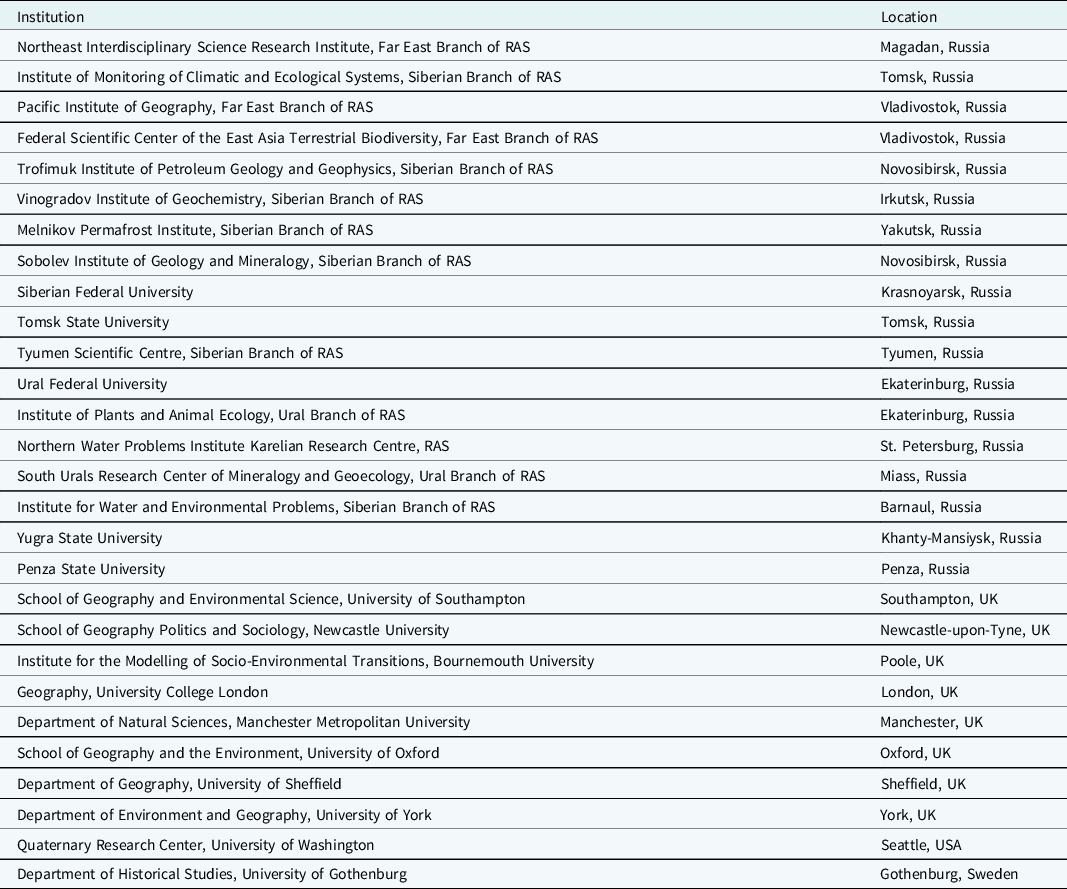
With the gathered momentum of the Magadan and Tomsk meetings, and further funding from the British Council, it was possible to host another meeting in Southampton in 2019, more than a decade after the initial workshop in 2008. After successfully involving 17 institutions in SRFE in the DIMA Network, one of the aims of this workshop was to include more UK institutions. This goal was achieved when researchers from 12 UK institutions participated. A list of institutions currently participating actively in the DIMA Network can be found in Table 1.
Institutions actively participating in the DIMA Network.
Small steps and snowballing
The DIMA Network is a good example of how a small amount of pump-priming (for the Magadan workshop) led to growing enthusiasm and plans for more extensive meetings and collaborative projects. Additional funding was secured for another workshop in Vladivostok and a summer school focused on sedimentary DNA in UK, but sadly these meetings had to be postponed due to COVID-19 and finally cancelled in 2022.
Furthermore, three groups of colleagues within DIMA have successfully applied for UK Arctic Office bursaries to have specialist meetings and training events in the UK and SRFE focusing on specific techniques. These include charcoal analysis (Krasnoyarsk/Southampton), stable isotope analysis (Tomsk/Tyumen/Manchester Metropolitan) and environmental archaeology (Newcastle/Tyumen). One of these exchanges has now produced a funding application to National Geographic. Another “spin-off” was a joint expedition by students from Newcastle University and the Institute for Geochemistry in Irkutsk to the Sayan Mountains in summer 2019, which paved the way to a successful application to the Joint initiative research projects competition of the Russian Foundation for Basic research and the Royal Society of London that will run in 2021-2023.
The “snowballing” effect in attracting funding, building trust and agreeing on joint approaches has led to the next phase, which is the involvement of the DIMA Network in a NERC Large grant application to study the interplay between climate, vegetation and wildfires and how these factors impact carbon storage (or release) from the vast peatlands of Western Siberia. An extensive 5-year funded project such as this can only be planned and realised by building on the wealth of local expertise, logistical experience and access to published and unpublished data provided by DIMA partners in SRFE. The strength of an approach covering such a vast climate-sensitive geographical area is that it addresses larger science questions which will be feeding into transnational policies including those related to the Intergovernmental Panel on Climate Change (Paris Agreement) and the Arctic Council. Future steps will also need to actively involve local communities and indigenous groups living in the research area as these groups can help to focus the research agenda as they are most strongly impacted by ongoing changes in their environment (Callaghan et al., Reference Callaghan, Kulikova, Rakhmanova, Topp-Jørgensen, Labba, Kuhmanen and Johansson2020).
Successful approaches and pitfalls
In the process of bringing together a UK-SRFE collaborative network and planning international workshops and meetings, several elements worked well to engage researchers, while other approaches were less successful. Below we list some of the recent experiences. Although these experiences do not provide a ready-to-use “road map” to building a successful international collaboration, these are important aspects to consider.
-
1) Many colleagues noted the great benefit of having a combination of presentations and hands-on activities. The more practical component can be either indoors (e.g. laboratory analysis, microscopy, statistics) or outdoors (e.g. vegetation surveys, sediment coring techniques, field processing of samples), as shown in Fig. 1. Doing these activities as a group not only provides opportunities for “bonding” via joint experiences but also ensures knowledge exchange at a very practical level. Only when actually doing the research activities together will it become clear if there are differences in approaches and discussions then can take place about protocols and best practice to be used within the different research groups. This approach also creates a better understanding of the challenges and limitations faced in different countries with regard to availability of equipment, infrastructure and technical support or to health and safety requirements.
-
2) In addition to large workshops, we have also organised short 1-2 week research visits for five ECRs from SRFE to UK for specific skills training (these took place before COVID-19). These exchanges allow for standardisation of laboratory techniques and more importantly encourage future collaborations and/or strengthen ties between research institutions. Such face-to-face contact also helps to better understand differences in practical and administrative hurdles that researchers encounter at different institutions and countries. These research visits have already contributed to three joint research projects and preparation of a manuscript for publication.
-
3) The DIMA Network has benefited immensely by having a mixture of early, intermediate and senior researchers. This combination blends the experience of more senior members with the energy of the younger generation and stimulates knowledge exchange. By helping senior scientists in organising such meetings, early and intermediate career researchers can develop their skills in planning and coordinating such international efforts and make new contacts for collaborative work.
-
4) The contacts established during workshops and research visits are followed up by continued mentoring of ECRs, ensuring that they continue to be supported back at the home institution when newly acquired skills are put in practise. An added benefit has been the establishment of contacts within countries that would not have been made were it not for DIMA Network.
-
5) We have also realised the importance of not overburdening the schedule during meetings that include programmed presentations and activities, but to set aside unscheduled time for one-on-one personal interactions or to include “leisure” activities like visiting a local touristic attraction. Building a collaborative network means building trust and this “human dimension” cannot be forced or planned.
-
6) Professional translators have formed an essential element of these meetings. Although synchronous translations (English-Russian and Russian-English) are not always necessary for all meeting attendees, often having a small group sitting together around the translator keeps all participants involved and guarantees that information from the presenters is being correctly conveyed. Several of the Russian colleagues have also provided excellent day-to-day translations. However, they should not be burdened with this, as they require space and time for participating in the events themselves.
-
7) Many excellent research results have been published in Russian and are not currently available in English. However, writing and publishing in English can form a significant barrier to many colleagues in the SRFE, not only as regards writing in a foreign language but also because a different style of writing is required. For example, English language journals tend to place more focus on hypothesis-driven questions and setting the work within a global context, rather than focusing only on the research results. Organising a special issue in a journal and providing substantial editorial input can overcome these challenges, and many colleagues in SRFE have indicated how useful the feedback has been from guest editors and reviewers. The result can be found in a special section of the journal Boreas (Edwards et al., Reference Edwards, van Hardenbroek, Anderson and Bigelow2021).
-
8) Working with existing networks and collaborations is very important so we are not reinventing the wheel. Excellent initiatives with which DIMA engages include FCO SIN (https://www.gov.uk/world/organisations/uk-science-and-innovation-network), Association of Polar Early Career Scientists (APECS https://www.apecs.is/), INTERACT field stations (https://eu-interact.org/) and SecNet (http://www.secnet.online/en; Kirpotin et al., Reference Kirpotin, Callaghan, Pokrovsky, Karlsson, Vorobiov, Kolesnichenko and Audry2018).
-
9) The focus of the DIMA Network has been on Siberia and the Russian Far East instead of European Russia, which is intellectually dominated by institutions in Moscow and St. Petersburg; these prestigious institutions generally receive more funding and international attention than their eastern counterparts. Connecting directly with local research groups in SRFE also importantly avoids a situation in which collaboration is sought only for access to field sites and samples without building up long-lasting joint research activity. This means it is crucial to build knowledge of new methods and analytical capacity within research groups in SRFE, instead of a “neocolonial” focus on the export of samples for analysis outside SRFE.
-
10) Travel restrictions (imposed by epidemics like COVID-19 or geopolitical crises) have made it impossible to organise in-person workshops, training visits and joint fieldwork for DIMA members. The lack of in-person meetings has certainly made it more difficult to stay in touch with all members. Via a mailing list, it has been possible to distribute newsletters and to invite members to relevant webinars held at the various DIMA members’ research groups. Especially, these more informal invitations and attendance to webinars have made it possible for colleagues to stay in touch on a more personal level. It has also been possible to organise a large bilingual webinar “Climate Change in the Urals” attended by 75 people (hosted by the Consulate in Ekaterinburg in April 2021).
Outlook
Practically, there has been for some time a barrier to the transfer of samples between countries, e.g. because of strict import/export rules to prevent biopiracy (Nagoya Protocol) and biocontamination. For this reason, it is crucial to have all possible analyses carried out within-country rather than assuming samples can be exported/imported. It is equally crucial to continue to build the capacity for sample analysis in the countries that are the focus of the scientific investigation. This has been one of the main aims of the DIMA workshops and training exchanges.
Acknowledgements
The authors represent a larger community of colleagues in UK and Russia and would like to thank all of these colleagues for their time and enthusiasm to date to make the DIMA Network a success.
Financial support
This work was supported by the Natural Environment Research Council (grant number NE/S008276/1) and the Foreign and Commonwealth Office.
Competing interests
The author(s) declare none.


 Open access

