




Introduction
When the Victoria Theatrical Company of Bombay departed for the princely state of Hyderabad in 1872, they started a new trend. The troupe took the southern railway as far as it would go, then heroically trekked overland. Following the success of this experiment, troupes travelled the length and breadth of the subcontinent. They hired special bogeys and even took over entire trains for their trappings and crew. Before long, parties of Indian actors, women included, ventured via steamship to port cities abroad: London, Rangoon, Singapore. In the 1910s, the Ripon Theatrical Company, with its leading actress Miss Sooshila, famously visited 50 cities.Footnote 1
The Hyderabad tour did more than confirm the viability of train travel. The company brought back four female performers when it returned to Bombay. Their appearance as the four fairies in the Indar Sabhā (Court of Indra) marked a bold turn in the Victoria Theatre on Grant Road.Footnote 2 In so doing, they replaced the boys who ordinarily played these parts. The troupe manager, Dadabhai Sohrabji Patel, was from a prominent family and was highly educated. He may have recruited the performers from the women’s quarters of the palace, where the company had been met with great acclaim. Whatever the circumstances, the foursome made history. The advent of the ‘Hyderabadi begams’ led to innovation in Bombay, and it opened a new chapter in four women’s lives.
Historical background
Beginning in the port cities, and influenced by contact with British colonial society, a thriving local entertainment economy evolved in South Asia in the nineteenth century, in consort with population growth and prosperity. By the early 1900s, ticketed performances of stage dramas were regularly held in Gujarati, Bengali, Marathi, Tamil, and other languages.Footnote 3 Playhouses constructed with proscenium stages offered spectators nightly shows with novel stage technologies and styles of drama. Music, dance, and poetic forms once restricted in circulation to aristocratic patrons were transformed into commodities for popular consumption.Footnote 4
Amidst this overall surge in Indian-language stage productions, the Parsi theatre played a central role as forerunner and enduring pan-regional institution. The Parsi community entered India from Iran from the eighth century, settling at first in Gujarat and later migrating to Bombay. Parsis maintained their distinct faith of Zoroastrianism while adopting Gujarati as their language and integrating into Indian society. In the colonial era, Parsi mercantile leaders achieved great financial success in collaboration with European traders and the British East India Company. Middle-class Parsis in Bombay sought English education, filling a disproportionate number of seats in the Elphinstone College. It was here that amateur theatricals became fashionable among Parsi students around 1850. These enthusiastic youths formed clubs and attracted sponsorship from wealthy citizens for their amateur presentations in Gujarati and Hindustani.Footnote 5
Theatrical activity enabled Parsis to buttress their economic position with an image of cultural distinction. Yet Parsi theatre, with its hybrid, middle-brow character, was never limited to one community or class. Affluent Parsis supplied the financial backbone, lending the rubric ‘Parsi theatre’ to the enterprise, whereas actors, musicians, writers, and stagehands came from diverse backgrounds. Audiences were heterogeneous too, ranging from British officialdom to Indian professionals to soldiers, traders, and labourers.Footnote 6
By the 1870s, Parsi drama companies were being restructured as profit-making concerns. Theatrical troupes grew in size and popularity and toured to Madras and Ceylon, Calcutta and Rangoon, Peshawar and Sind. Travelling by rail and ship, they spread the Parsi theatre’s impact far beyond its point of origin. For local spectators, a night at the theatre meant dazzling lights, glittering costumes, and startling trick effects. The catchy tunes from Parsi shows were reworked into every language and musical genre. By the end of the century, Parsi theatre had become a ubiquitous part of public culture across the subcontinent.Footnote 7
Approach and sources
Over several decades of research on Parsi theatre and other understudied dramatic forms, my constant attempt has been to document the personal lives of actors and actresses, to understand their world in the theatre, and to discover their subjectivity and self-definition.Footnote 8 In Stages of Life: Indian Theatre Autobiographies, I translated the life narratives of four actors and poets who flourished in the tumultuous times of the early twentieth century. Their insights shed much light on oral systems of knowledge and practices of performing gender. Similarly, I assembled the biography of actor–manager Dosabhai Hathiram from official records, family memorabilia, and newspaper sketches, in order to explore the personal dramas of individuals who shaped global theatrical circuits.Footnote 9 These projects showed the value of utilising trajectories of travel as an adjunct to traditional chronological charting. The itineraries of performers constitute primary organising principles in private memory and the narration of the self, in addition to their more widely acknowledged value as tools for mapping out the important histories connected to the circulation of public performances.
In this article, I extend these methods to the examination of female performers’ life stories. Extensive scholarship has shown that performing women, many of whose identities and legacies remain obscure, were collectively the keepers and preservers, as well as the creators, synthesisers, and innovators of cultural forms across a broad gamut. Without their stewardship, the worlds of Indian music, dance, drama, and affiliated arts would not have flourished and evolved.Footnote 10 Authentic information about individual women, however, is often difficult to find. To supplement the sparse autobiographical and biographical accounts from the nineteenth century, scholars have turned to court cases, official records, and oral history to reconstruct the lives and contributions of female poets, singers, and dancers.Footnote 11
In the case of women in the Parsi theatre, we are on somewhat firmer footing. Female troupe members who braved the stage often became objects of historical record. Indian newspapers publicised Parsi theatre shows, wrote reviews of performances, published letters to the editor, and provided a forum for public debate. Gujarati periodicals such as Rast Goftar and Kaiser-i Hind as well as a raft of English papers in Bombay, most notably The Times of India, were joined by newspapers from Lahore, Delhi, Allahabad, Calcutta, and elsewhere in documenting Parsi theatre history as it happened. The digitised holdings of these sources enables the accurate, if laborious, plotting of Parsi theatre troupes, their movements, and at least some of their personnel.
More specific focus on actors is available in the Gujarati-language history written by Dhanjibhai Patel, Pārsī Nāṭak Takhtānī Tavārīkh (History of the Parsi theatre). Patel was a playwright, actor, poet, and photographer who enjoyed personal friendships with many Parsi theatre figures. He penned approximately 100 profiles and published them in the daily newspaper Kaiser-i Hind in the first decade of the twentieth century. In 1931, 68 of his essays and 150 photographs were compiled and published as a book by Kaiser-i Hind Press. A similar set of 62 essays by Jahangir Khambata, a theatre director and performer himself, was published weekly in the journal Pārsī and anthologised as Māhro Nāṭakī Anubhav (My experiences in the theatre, 1914). The later scholarship on Parsi theatre, encompassing major works in Gujarati, Urdu, and Hindi, draws heavily from these contemporaneous sources.Footnote 12
Although there is no dearth of primary material, sources relating to female performers should be read with discernment. The employment of biological women to play women’s roles on stage was initially met with an outcry from journalists and reformers. Professional actresses were understood to be immoral and unruly, casting a stigma on the new form of entertainment, struggling for respectability. Yet female spectators were encouraged to attend the theatre in Bombay, and women-only shows or family performances with childcare were often arranged. As the appearance of Indian women in public became more acceptable, public opinion shifted in progressive circles, and opportunities for female performers increased. Nonetheless, anecdotes relating to actresses in contemporaneous accounts often betray broader anxieties associated with performing women. Episodes emphasising scandal, danger, discord, and sensation abound, raising questions of their truth value.Footnote 13
This article documents three performers in the first generation of actresses in the Parsi theatre. All born in the late 1850s and active in the 1870s and 1880s, they were each pioneers who enlarged the artistic landscape. Besides being among the very earliest women in Parsi theatre, these actresses undertook long journeys for work, and their travels can be verified from multiple sources. These case studies are highly appropriate for pinpointing the role of women in the initial phase of rapid expansion of Parsi theatre. By charting the itineraries of these female performers, we gain access to how mobility and selfhood were intertwined. How did travel enable women to occupy the world professionally, socially, and economically? How did they navigate the unfamiliar spaces they encountered? The trajectories of these individuals may reveal unexpected aspects of the experience of travelling while female.
From Iraq to India to Burma: Jamila Begam
Jamila Begam, also known as Miss Jamila, was said to be a Baghdadi Jew. No records exist of Jamila’s birth, death, or parentage. However, Dosabhai Hathiram, her companion, was born in 1859, which suggests that her birth date was around the same time. As the first yahūdī (Jewish) actress of the Parsi theatre, Jamila heads a long line of actresses considered foreign or ‘other’ who populated the Indian entertainment industry. Because of social taboos, respectable Indian women were forbidden to perform on stage in the 1870s. The gap was filled by outsiders, generally Anglo-Indian, Jewish, and European women. Jewish actresses like Patience Cooper, Ruby Myers (Sulochana), and Esther Abraham (Pramila) all got their start in travelling theatre companies before becoming film stars. Several Jewish actors and directors were prominent in the early years of motion pictures: Elizar, Joseph David, Daniel David, and Ezra Mir. Most of these leading lights belonged to the Baghdadi Jewish community.Footnote 14
Baghdadi Jews began coming to India in the eighteenth century. The community included Judeo-Arabic speakers from Iraq, Syria, Yemen, the Ottoman lands, Persia, and Afghanistan. While engaged in business ventures with the British East India Company and other trading partners, their diaspora spread eastwards with the opium, cotton, and jute markets. Religious persecution was also a reason for leaving Western Asia (the Middle East). The prominent leader David Sassoon fled Iraq during the reign of Daud Pasha and arrived in Bombay in 1833. His family became major industrialists in colonial India; most moved eventually to England.
The Baghdadi Jews of Bombay and Calcutta were deemed a prosperous, Anglophilic people, similar to the Parsis.Footnote 15 They were noted for their philanthropic work of establishing orphanages, hospitals, schools, and synagogues. These charitable institutions point to the less visible middle class and poor sector of Jews in their midst. In one estimate, fully half of the community in Calcutta were indigent and relied upon Jewish charities.Footnote 16 Overlooked as well is the contribution of women to the flourishing of the community. They too travelled the trade circuits and worked as householders, merchants, and entrepreneurs. Some were employed as actresses and singers. Performers like Jamila were working women who responded to employment opportunities in urban entertainment districts across the globe. They were able to make their way between Iraq, India, and Burma due to the networks that their forebears had already established over the course of a century.
Jamila’s theatrical circuit was the result of her personal initiative. She took junior artists with her from Baghdad to Bombay, and once there, she recruited additional employees and business partners. Her story is found in Dhanjibhai Patel’s Pārsī Nāṭak Takhtānī Tavārīkh. In this account, Jamila travelled from Iraq with two female companions. After reaching Bombay, the trio shared a third-storey flat near Grant Road. This area was home to several theatre halls utilised by dramatic troupes; the location enabled them to enter the profession easily. Jamila’s initial success in the theatre was as the Sabz Pari in the Indar Sabhā. This singing, dancing, and Urdu-reciting role became the vehicle of many a budding performer. She worked in the Ladies and Gentlemen Theatrical Club owned by Navroji Golvala. These activities place her in Bombay in the early to middle 1870s.Footnote 17
But Jamila’s horizons were wider. She wanted to form her own drama company and had come to Bombay with this ambition in mind. In addition to the two compatriots she brought from Baghdad, she sought out aspiring actors in Bombay and hired them to work for her. This involved signing contracts and issuing advances, standard practice in the professional Parsi theatre companies. Over and over again, her employees took advantage of her and disappeared with her money. The challenges of doing business convinced her eventually to seek an associate who could serve as her agent. The handsome young Dosabhai Hathiram caught her eye. Brought up around Parsi theatre people, he made his stage debut in the mid 1870s. His performances in the Parsi social drama Dukhī Gul (Unhappy Gul) brought him into the limelight. Jamila approached him with an attractive offer. She drew up a contract, hiring him as her company manager and director. Then the couple eloped and went to Rangoon.Footnote 18
The Parsi theatre had already made significant inroads in Burma. In 1881, the famous actor–manager K. M. Balivala led his troupe to Mandalay, King Thibaw’s capital. With a company of 27 members, Balivala agreed to perform 35 dramas, for which he received the hefty sum of 43,000 rupees. The splendour of the court and fondness of the Burmese for theatrical arts induced the players to return year after year.Footnote 19 When the British deposed Thibaw and annexed Burma in 1885, the tours of Balivala’s company ceased, although other troupes eventually came in their stead.
After the British takeover, Indian immigrants of all classes poured into Burma. The influx included capitalists and traders, professionals and administrators, and labourers and plantation workers. By the turn of the century, Indians in Rangoon outnumbered the Burmese. The Indian middle class created a public sphere in which English education and Indian-language newspapers, literary societies, and theatrical clubs flourished. Urdu/Hindustani became a lingua franca of sorts, used by colonial officials, Indian immigrants, and the Burmese. The Parsi–Urdu theatre was welcomed as a distinctive Indian pastime.Footnote 20
Jamila and Dosabhai arrived just as Rangoon was replacing Mandalay as the cultural capital of Burma. The period was full of opportunity for Indians, including entertainers. Riding on Balivala’s success, Jamila’s company from Bombay established itself amidst the Parsi, Baghdadi Jewish, and other Indian settlers in the city. The couple may well have married or presented themselves as such. Interracial unions were not unusual for Parsi men in Burma in the nineteenth century.Footnote 21 Jamila surely attracted many fans and realised her dream.
Then in a sudden twist, Jamila was murdered in Rangoon. In the ensuing court case, the accused was her leading man. Patel relates, ‘One evening, I got news that Dosabhai Hathiram had been sentenced to hang by the High Court in Rangoon … It was said that Dosabhai Hathiram had murdered the Jewish woman with whom he went to Rangoon as manager and director.’Footnote 22 Jamila’s murder attracted wide notice, and the news of Dosabhai’s trial reached Bombay. Yet details of the incident and its aftermath are absent. Patel only mentions that the Parsi community rallied on Dosabhai’s behalf and submitted a petition for clemency to the viceroy. As a result, his sentence was commuted to a prison term.
The thin traces of Jamila’s life disappear entirely after her death. Dosabhai’s story not only continued, it survived in the family archive maintained by his daughter, Homai Vyarawalla (1913–2012). A well-known figure in the history of photography in India, Homai came to fame in the 1940s and 1950s with her images of Gandhi, Nehru, Jinnah, and the Dalai Lama published in Life and other magazines. She preserved her father’s passport, publicity photographs, letters, and vivid memories of travelling together with him as a child.Footnote 23
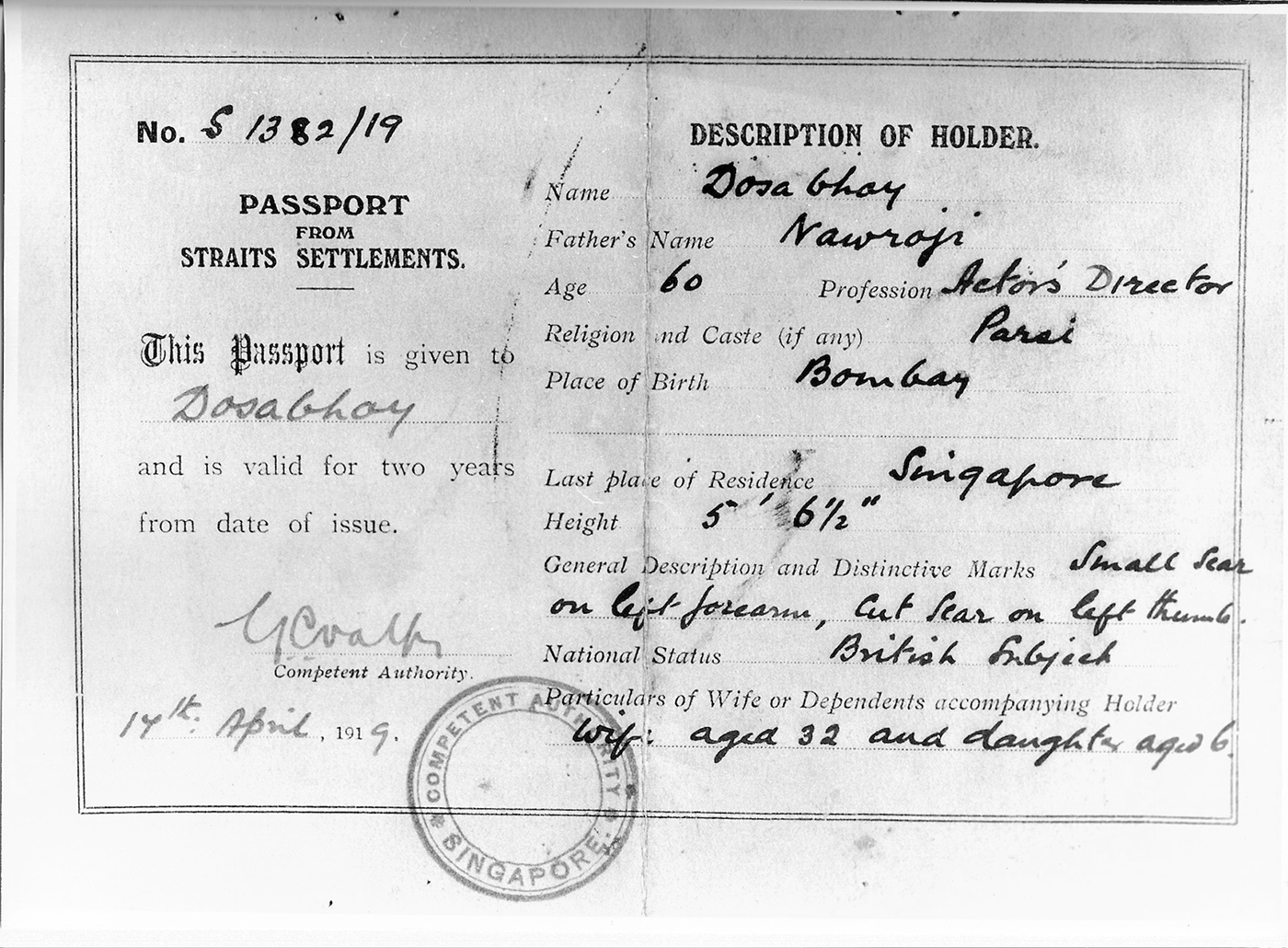
It appears that Dosabhai spent a decade or more in prison. Eventually he was pardoned and allowed to return to India. There he married a widow named Soonamai, and they had three children; the third was Homai. When Dosabhai set out for Southeast Asia with another drama troupe around 1916, his wife and daughter accompanied the drama party. In 1919, the Hathirams travelled back to India, on a passport issued in Singapore from the Straits Settlements. Under his name, spelled as ‘Dosabhoy Nawroji’, Hathiram’s profession is listed as ‘Actor’s Director’. His accompanying dependents’ particulars are ‘wife aged 32 and daughter aged 6’ (see Figure 1).
Passport of Dosabhoy Nawroji, aka Dosabhai Hathiram. Issued by Straits Settlements, 1919. Photograph by Homai Vyarawalla. Source: Author’s collection.
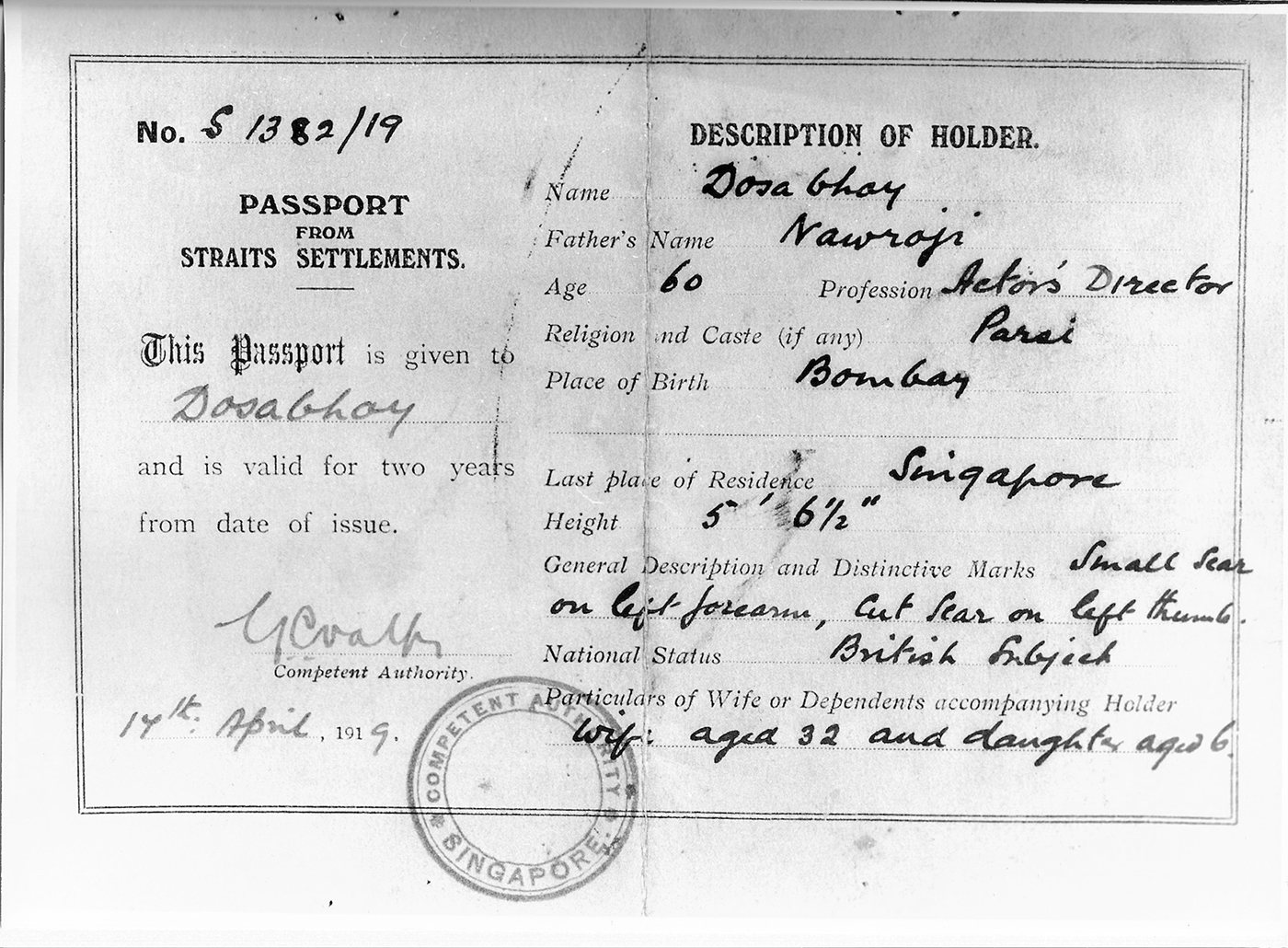
Figure 1 Long description
The passport from Straits Settlements, numbered 5 comma 1382 over 19, is issued to Dosabhoy Nawroji. It is valid for two years from the date of issue, 14th April 1919. Dosabhoy is described as an Actor's Director, aged 60, with a religion of Parsi and place of birth Bombay. His last place of residence was Singapore and his height is noted as 5 feet 6 and a half inches. The general description includes small ears, light eyebrows and a fair complexion. His dependents are listed as wife aged 32 and daughter aged 6. The document bears a stamp and signature from the issuing authority.
This journey marked the end of the nomadic life for Homai and her mother. Homai’s father, however, soon returned to Burma. He became the director of a Rangoon theatre company and continued to reside in Burma until overcome by indigence and ill health. He returned to Bombay and died there in 1931.
Jamila’s journey as a performer illustrates her remarkable courage and vision. She travelled the most extensive circuit of the three actresses under discussion. After transiting from far-off Iraq, she entered Bombay theatre networks as an outsider and quickly made a name for herself. Unusually for a woman at that time, she fostered young talent and utilised her entrepreneurial skills to start a new drama company. With a partner of her own choice, she moved on to Burma, a magnet for immigrants. Jamila springs to life as a dynamic personality, one who made space for herself among Indian and Burmese townspeople as a Baghdadi Jewish entertainer. She set a precedent for female performers of various origins and ethnicities to follow suit. In Rangoon as well as in Bombay, she was a pioneer in the early days of the Parsi theatre.
Jamila’s career also illustrates the dangers of travelling while female. The fact that she journeyed with two other women, and that they subsequently established a household together, suggests the hazards of going it alone. In her business affairs, she was repeatedly cheated, despite her efforts to engage her associates and employees with legally binding contracts. And then she was killed at the height of her fame by her stage partner and paramour. Although the circumstances are vague, one can speculate that fights over money and property, disagreements about the drama company’s management, and romantic jealousy, perhaps all mingled together, may have led to the murderous assault.
Tropes of ‘getting one’s just deserts’ and ‘coming to a bad end’ are often attached to tales of self-supporting women such as courtesans and actresses. Patel’s narrative converted the scandal that ended Jamila’s story into a celebration of Hathiram’s reputation, a reminder of misogynistic attitudes that turn accounts of women’s mobility and agency into cautionary lessons. But rather than pitying Jamila as one beset by obstacles or diminished by victimhood, it is incumbent upon us to recall her courage and accomplishments. Without knowing which precise gestures or genres she, as an Iraqi Jew, introduced into Indian theatrical culture, we can be sure of the pleasure she brought to others through her gifts of song and dance. Her role in cementing the popularity of Parsi theatre in Rangoon is indubitable.
English actress born in India: Mary Fenton
Mary Fenton was the first reigning diva of the Parsi theatre. In a career that spanned over 20 years, she enjoyed long runs at Bombay’s premier playhouses, the Gaiety and the Novelty, in the prestigious Fort zone. She toured Delhi, Lahore, Peshawar, Rawalpindi, Calcutta, Poona, Ahmedabad, and Hyderabad with professional drama companies. While cross-dressed men and boys dominated the stage, she enacted a different femininity, challenging taboos against women performing.Footnote 24 Her visible femaleness was not her only asset. She was a foreigner who displayed extraordinary mastery of Indian languages and music. Audiences thrilled to hear her speaking flawless Urdu and singing in touching Gujarati. Heralded as ‘the English actress’, her exotic allure created a unique sensation.
Mary Fenton’s travels with the Parsi theatre began in Delhi, shortly after Queen Victoria was proclaimed Empress of India. When the Imperial Assemblage of 1877 (the first Delhi Durbar) was held to honour the sovereign, it attracted massive crowds, and the revelry lasted for months. Indian rulers amassed to offer homage, as assorted groups from civil society came together to mingle and meet for the first time.Footnote 25 Alongside public leaders, journalists, and intellectuals from various regions, several Parsi theatre companies arrived from Bombay. They set up their pavilions along the parade route and near the encampments.Footnote 26 In the aftermath of the grand festivity, Mary Fenton crossed paths with a drama troupe.
Like Jamila, Mary Fenton was already working as an entertainer before entering the ranks of Parsi theatre. She was assisting her father in the magic lantern business.Footnote 27 In the nineteenth century, lanterns and lenses became powerful enough to illuminate images in large halls. The projection device known as the magic lantern was used to magnify painted glass slides and cast them onto a screen. Dissolving views and animation effects were added to appeal to audiences. The variety format of lantern shows included music, storytelling, and sometimes educational lectures to enhance the visual display. In India, magic lantern exhibitions occupied prime urban venues such as the Sans Souci Theatre in Calcutta from the 1840s.Footnote 28
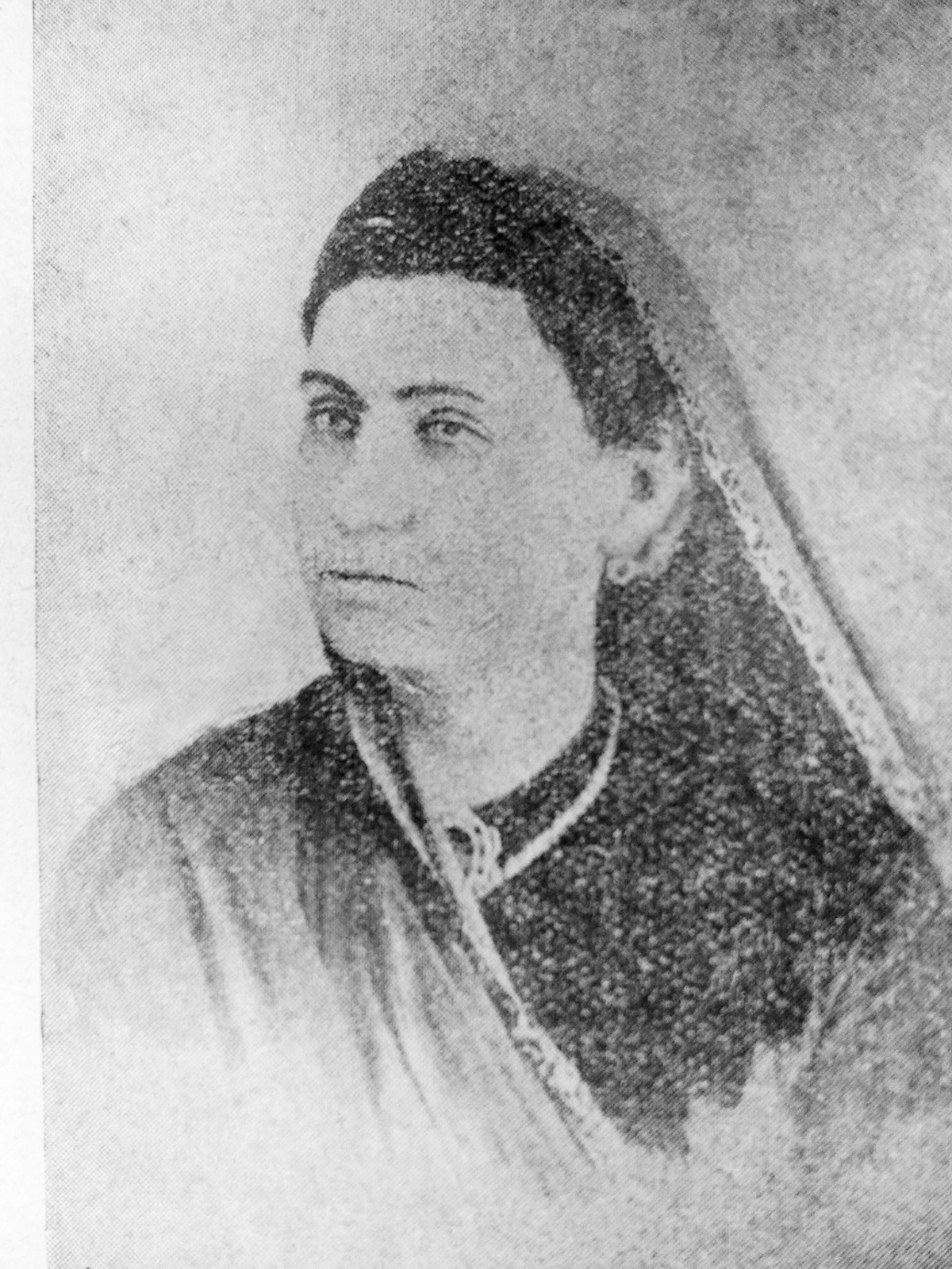
Mary Fenton’s figure in the archive is rather elusive. In one corruption, she was called Mary Fantom or Phantom.Footnote 29 The names of her parents, her birthplace, and birth date are unknown. Patel asserts that she had lived in India since she was a child, and that she spoke Urdu better than her mother tongue.Footnote 30 The best guess is that Fenton was born in 1857 or 1858, since she was said to have died at age 42.Footnote 31 A handbill dated December 1899 of a performance in Mhow Cantonment featuring Miss Mary Fenton is the last such document on record (see Figure 2).Footnote 32
Mary Fenton. Source: Dhanjibhai Patel, Pārsī Nāṭak Takhtānī Tavārīkh (1931). Copyright: Public domain.
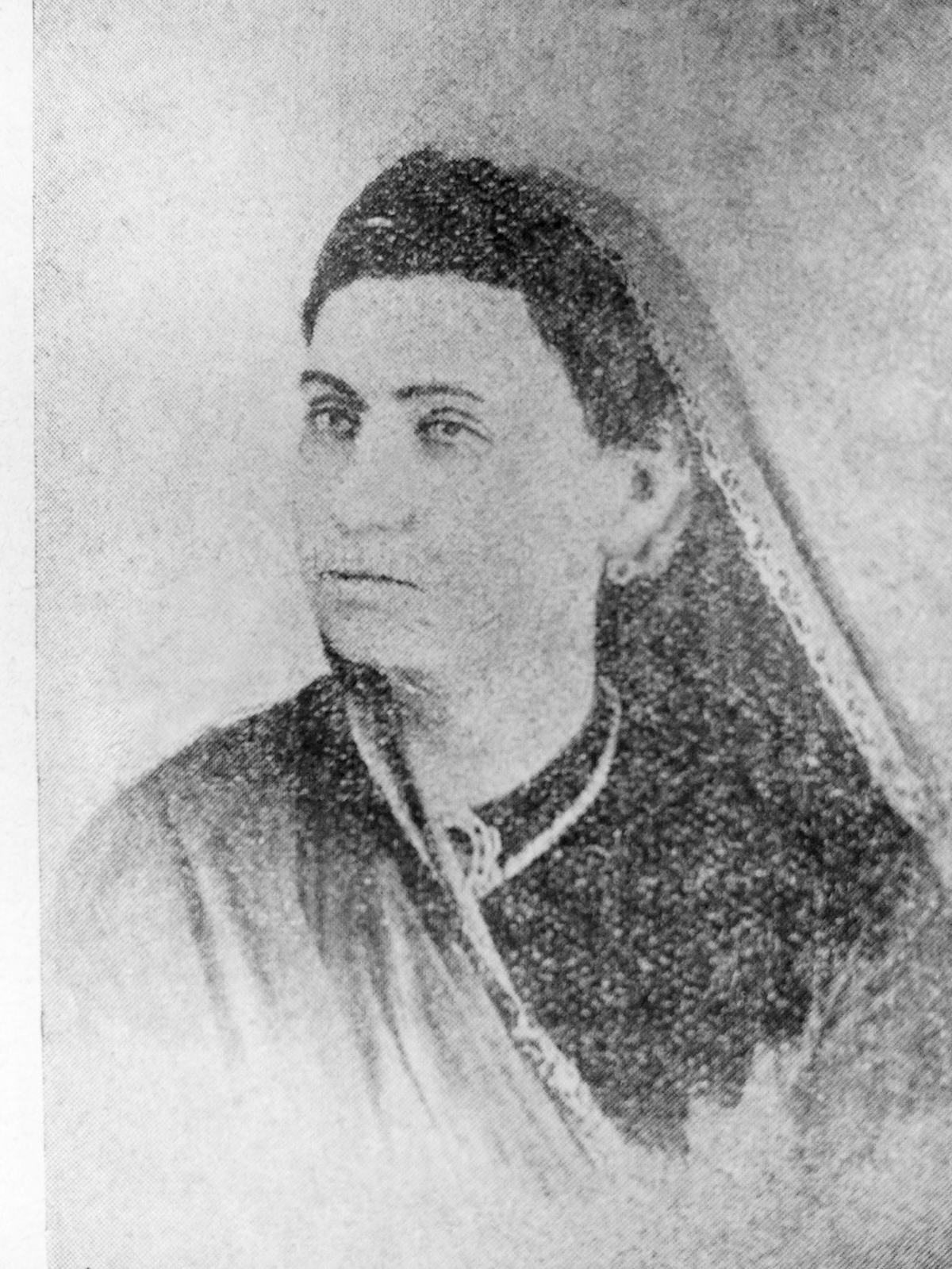
Figure 2 Long description
A woman is wearing traditional attire, including a draped garment and a head covering. Her face is blurred. She is adorned with earrings and a necklace. The image has a grainy texture, suggesting it might be an old photograph.
After she became an actress, Mary Fenton attracted abundant attention. Her performances were advertised and reviewed in the English and Indian-language newspapers. Her two contemporaries, Dhanjibhai Patel and Jahangir Khambata, both documented her career. In their accounts, she was the offspring of an Irish man, a retired non-commissioned officer. Irish soldiers, primarily the sons of landless agricultural workers and weavers, joined the British army in large numbers. Soldiers’ families, especially women, were the poor relations of the British community in India. Nearly half of the Europeans in India were impoverished, and soldiers and their families were one of the largest groups among them.Footnote 33 Before joining the stage, Mary’s position was that of a ‘white subaltern’.Footnote 34 To supplement her father’s pension, she worked as an entertainer, expending her labour. Most likely she narrated, sang, and danced, while he transported the bulky projection apparatus and operated it.
Magic lantern shows utilised a modern exhibition space with proscenium stage, lighting, curtains, and screens. They shared these requirements with contemporaneous Parsi theatrical productions. Both entertainments formed cornerstones of the new technologically mediated visual culture, forerunner of the Indian cinema. In search of a suitable exhibition space after the Delhi Durbar, Mary Fenton encountered the young Parsi actor Kavasji Palanji Khatau (1857–1916). He was rehearsing the Indar Sabhā with the Empress Victoria Theatrical Company. Mary began to attend his performances, and the two struck up a friendship. When the Empress Company left Delhi for Meerut, Mary went along as Khatau’s companion. Soon she was appearing on stage with him. After touring Lahore and Amritsar, she accompanied Khatau to Bombay, where the couple settled in 1880.
Mary Fenton’s decision to follow the travelling theatre troupe and join forces with a Parsi actor has the elements of a fairytale romance. Yet her choice was quite strategic. On the one hand, her action meant transgressing the colonial colour bar and defying the hierarchy of race. On the other, her newfound connection with the cosmopolitan world of Parsi theatre enabled her to move up the class ladder. Gradually she maneuvered out of the Anglo-Indian underclass and into urbane Parsi society. Cultivating the persona of a proper memsahib, she left her humble origins behind.
In her professional life, she retained her given name and foreign identity. From the start, she was billed as ‘the English actress’. See, for example, an early notice from Bombay: ‘Gaiety Theatre. Last Week of the English Actress. To-night. Empress Company perform….’Footnote 35 In Gujarati, she was called maḍam nāṭakkār, the gender-neutral term nāṭakkār meaning artist, performer, or dramatist, and maḍam designating a foreign lady of rank. The allure of a foreign actress appearing onstage with Indian troupe members was constructed to create particular excitement. The maḍam phenomenon added another layer of spectacle to the already abundant pleasures of Parsi theatre—its operatic singing, imported stage devices, sound effects, and painted scenery.
In conventional Parsi society, nevertheless, Fenton’s foreignness posed a threat. Racial purity was highly valued; hence, to mitigate her outcaste status, she strove to pass as Indian, as Gujarati, and as Parsi. Mary Fenton was well-versed in the codes that signalled the upper-class/caste Indian woman. She adopted the name Mehrbai, wore Parsi dress, spoke Indian languages, and carried herself with modest demeanour. Khatau for his part collaborated in the project of crafting her respectability. The couple married in Bombay, legalising their relationship and, even more importantly, ensuring legitimacy for their offspring. Their son Jahangir Kavasji Khatau (1882–1935) was raised as a Parsi. His son, Kavasji Jahangir Khatau (1918–1985), aka Rudy Cotton, a famous jazz musician, was also a Parsi.Footnote 36
Mary Fenton was as versatile on stage as she was off. In traversing the repertoire of Parsi theatre, she first essayed the roles of Shakuntala and Savitri, models of wifely devotion from the Hindu epics.Footnote 37 She then switched cultures to portray a modern Parsi girl, in the comedy Nāzān Shīrīn by N. R. Ranina. At the height of her career, she perfected roles that aligned with the new norms of Indian womanhood. She specialised in innocent daughters temporarily overpowered by forces of evil. Her longest run was as Gul (‘rose’ or ‘flower’), the heroine of Gāmrenī Gorī (Village beauty), written by B. N. Kabra around 1885. Set entirely within Parsi society, the drama juxtaposed the virtues of simple village living with the decadence of city ways. Gul is wooed by a villainous Bombayite for her inheritance; tempted, she takes to wearing Western-style shoes and socks, blouses and bracelets; eventually the family property is restored and she is united with her intended, a ‘gentleman rustic’. This hit, along with Dukhī Gul (another Fenton star vehicle) and Bholī Jān (an adaptation of The Colleen Bawn), popularised the new genre of ‘the social’, a spin-off of English domestic melodrama.Footnote 38
The achievement of Mary Fenton as an actress lay in imitating the signs of the virtuous married woman. The use of the sari border draped over the head, the jewellery, and the particular cut of the bodice earned her the highest esteem from the public. Her acting talent was widely admired, as was her fluency in Urdu, Gujarati, and their variants. ‘Miss Mary Fenton is a genuine artist and has a true conception of the histrionic art, and her mastery of the vernacular dialects and purity of elocution reflect great credit on her intelligence and industry.’Footnote 39 Reviews praised her touching singing as well: ‘Her sweet voice is another of her plus points; it captures the heart of the viewer, this is not an exaggeration.’Footnote 40
The partnership of Fenton and Khatau formed the backbone of the Alfred Theatrical Company, the most long-lived company in Parsi theatre history. Their artistic alliance sustained the Alfred’s reputation and carried it far from Bombay. Fenton’s name appeared in the entertainment columns of newspapers from Calcutta in 1885, Quetta in 1888, Hyderabad in 1890–1891, Lahore in 1878, 1883, and 1892, and many other locales. These published notices attest to Fenton’s celebrity as she travelled over all of India. She never went to England.
Fenton’s life as a travelling female performer entailed challenges and risks as well as glamour. Nothing is known of her everyday struggles and the resources she brought to bear on them. Animosity towards her presence in the theatre company is, however, a constant theme in the source material. Initially, Fenton’s father was opposed to her following Khatau; he tried to take her back home, but Khatau confronted him and reclaimed her. Then Khatau’s director wanted to separate the pair, but he gave in when Khatau threatened to leave his troupe.Footnote 41 Later, after Fenton came to Bombay and performed at the elite Framjee Cowasjee Institute, the newspaper Kaiser-i Hind published a virulent attack against her.Footnote 42 Within the Alfred Company, Khatau’s colleagues continuously voiced their hostility, holding Fenton accountable for discord in the ranks, despite (or perhaps due to) her high earning power.
Eventually the Alfred Company split into two. Several of Khatau’s partners broke away and formed an offshoot, the New Alfred Theatrical Company, around 1890. This new troupe under the leadership of Sohrabji Ogra was adamantly opposed to the participation of actresses; it made a strict policy of never permitting women on their stage. At about the same time, Mary Fenton was assaulted while riding in a covered carriage on a prominent Bombay street. After being struck with a stick, she led a pursuit and had the assailants arrested.Footnote 43 This incident occurred just before the opening of her most popular showpiece, Gāmrenī Gorī. Despite the violent attempt at sabotage, presumably by a rival company, Gāmrenī Gorī played continuously for two years, and the Alfred Company emerged the stronger for it.
Newspaper notices confirm that Fenton had engagements with other companies from time to time. Whether for professional or personal reasons (or both), she maintained her independence and instinct for self-preservation. Tensions entered her relationship with Khatau, and some accounts state that the couple separated. Fortunately, Fenton escaped the deadly fate of Jamila. She managed to stay with the Alfred, co-starring with Khatau, travelling with him, and taking on new roles as late as 1895.Footnote 44 Her final appearance in Mhow, if indeed it was the final one, was opposite Jahangir Khambata, the director who had almost banished her from the Empress Company, 22 years earlier.
The evolution of the Indian stage is indebted to Mary Fenton for breaking barriers and establishing new genres such as the social drama. Travelling with Khatau, her talented co-star, in a major drama company, she popularised Parsi theatre across a broad swathe of the subcontinent. She was the first European woman in Parsi theatre history to perform in Indian languages and sing and dance in North Indian style. As a public celebrity who challenged patriarchal strictures, she inaugurated the trend towards ‘real women’—actresses who were biological females. This novelty, understood as progressive but also risqué, assisted the commercial theatre in surviving for decades, well into the era of cinema.
Artist in the Jaipur court: Nanhi Jan Lashkarvali
Of the three performers, only Nanhi Jan Lashkarvali could truly be termed a courtesan, in the sense of a female artist attached to a royal court. Together with her older sister, Munna Jan, she entered the service of the ruler of Jaipur state, Maharaja Sawai Ram Singh II (r. 1835–1880), in 1874.Footnote 45 The pair were employed through the institution known as the gunījankhānā, the office or department of elite performing artists. This administrative unit was one of 36 such departments, modelled on the Mughal bureaucracy.
The sisters’ tenure at court did not limit their artistic and entrepreneurial engagements to the royal premises. Both enacted female roles in public performances in Parsi theatre style. Both were extensively photographed, by the king in the palace and by commercial photographers located in the bazaar. In the early years of the recording industry, Nanhi Jan recorded her voice on a number of phonographs. Even as her image as a so-called nautch girl travelled worldwide in postcard form, wax discs carried her singing of classical ragas into hundreds, if not thousands, of households across India.
Maharaja Ram Singh was a great lover of the arts and was himself well-trained in music. Under his patronage, the gunījankhānā grew to over 100 posts. His teacher and companion, the senior musician Behram Khan, founder of the Dagar lineage of dhrupad, was appointed as the department’s supervisor (dāroghā).Footnote 46 A large number of gunījankhānā employees were classed as bhagtan, originally a Hindi term for female temple-dancers, now applied to performers at court. In this period, they were also known as ţawā’if, the Urdu word for courtesan. Their posts were hereditary, and their salaries were supplemented by gifts, grants of land, and income from villages. The Lashkarvali sisters were among the highest paid performers, male or female, on the rolls in 1905–1906.Footnote 47
Nanhi Jan’s act of joining the gunījankhānā parallels the pattern of upward mobility seen in the early careers of Jamila and Mary Fenton. Her unusual sobriquet, lashkarvālī, hints at humble roots, if understood as a female of the camp (lashkar, from the Persian, meaning ‘camp’ or ‘army’). This interpretation fits with the observation that nineteenth-century courtesans were often descendants of entertainers in army cantonments.Footnote 48 Alternatively, Lashkar (or Laskar) could indicate a place, but no town of this name exists in the vicinity. In court records, Nanhi Jan was also linked to Patan and Karauli, two towns in eastern Rajasthan, and later, on her phonograph recordings, to Agra. Thus, her birthplace remains unknown. As for her caste or community, even though bhagtans may have once been Rajputs engaged in temple duties, female entertainers who joined royal households in this period were mostly Muslims.Footnote 49
The gunījankhānā offered possibilities for self-advancement and financial gain. It did not restrict mobility, as did the pāturkhānā. This was the department to which young girls were transferred as part of marital dowry and confined to sing and dance for life.Footnote 50 Women in the gunījankhānā were granted access to both the male and female quarters of the palace. Their routine duties encompassed performing in royal processions, temple rituals, darbārs for dignitaries, women’s entertainments and instruction, and private soirées. Gunījan artists kept residential quarters outside the palace in the city. The sisters shared a large bungalow in Ghat Darwaza Bazar near Nawab ke Chaurahe.Footnote 51 This gave them freedom of movement, as well as opportunities for earning income in their own quarters or travelling on contract to wealthy clients.Footnote 52
The Lashkarvali sisters also performed outside the court—in quite a different capacity. They were the principal actresses on the stage of the Ram Prakash Theatre, the theatre built by the maharaja.Footnote 53 Ram Singh II aspired to turn Jaipur into a cultural capital on the order of Calcutta, and to this end he constructed a public library, museum, hospital, theatre hall, and other significant edifices. The foundation plaque for the Ram Prakash Theatre read: ‘This Theatrical Institution was established in the year 1878 by His Highness … for the Entertainment and Instruction of His Highness’ Subjects, and for the Cultivation of Dramatic Literature in Jeypore.’Footnote 54
The Ram Prakash playhouse was equipped with the latest appurtenances: a broad platform stage, painted curtains, gas lights, and means of producing sound effects such as thunder. Musical instruments were ordered from Europe and stage props from Bombay. To supervise construction of the hall and lead the performances, Dadabhai Thunthi, a seasoned director affiliated with the Victoria Theatrical Company, was hired on a monthly salary. Thunthi was given a bungalow, horse carriage, two guards, and servants in addition to 700 rupees/month. Names and salaries of other theatre workers were recorded in the State Council reports of 1880.Footnote 55
The Parsi company’s inaugural show was a grand presentation of the Indar Sabhā before a group of Rajput nobles. At the pleasure of the maharaja, the troupe performed a series of five dramas over six nights in early 1880. The plays chosen were well-known: romances such as Lailā Majnūñ and Benazīr Badremunīr, the fairy fantasy Havā’ī Majlis, and the Mughal historical Jahāngīr. All were in Urdu. For this season, Ram Singh hosted Sajjan Singh, the Maharana of Mewar, along with the sons of Tukoji Rao Holkar of Indore and other dignitaries. Accompanying them was the Udaipur court poet and chronicler Kaviraj Shyamal Das (1836–1893). His account in Vīr Vinod, the Hindi-language history of the state of Mewar, provides a vivid portrait of the wondrous playhouse and the dramas performed therein.Footnote 56 It also provides a glimpse into the ‘joys of bonding’, as Dipti Khera terms it, the practices of pleasure that bind men engaged in courtly sociability.Footnote 57
The most extraordinary aspect of the affair was the appearance of women on the Ram Prakash stage in Jaipur. This innovation was understood as a sign of modernity, as was the arrival of the Parsi actors themselves. These educated and well-mannered gentlemen from Bombay were accorded due honours in Jaipur, but in one matter they were contravened. They were accustomed to allotting female roles to men or boys. Perhaps it was Ram Singh himself who, impressed by Calcutta’s actresses, suggested that the leading women of his gunījankhānā could take the women’s parts instead. In the event, Nanhi Jan and Munna Jan made their stage debuts and were roundly praised. Their painted portraits hung in the foyer of the theatre, which later was turned into a cinema hall.Footnote 58
For visual evidence of these defining moments, the photographic archive created by Ram Singh himself is indispensable. The maharaja had an intense passion for photography, which he pursued as both practitioner and collector. He maintained an atelier full of cameras, lenses, tripods, and darkroom equipment, and he kept a diary documenting his photographic activities. After his death, several thousands of his glass plate negatives were lost in the palace until rescued, preserved, and studied a century later.Footnote 59 Recent scholarship makes available a significant number of self-portraits of the king along with landscapes, British colonial figures, and images of women.Footnote 60
Importantly, theatrical subjects, scenes, and backdrops figure prominently in Ram Singh’s photographic output. One photo documents the visit of the Parsi thespians, portraying six members of the troupe seated in a semi-circle opposite seven representatives of the court, with four dignitaries standing behind them. In the background, several painted panels, a loosely strung curtain, and scaffolding of bamboo poles and thatch suggest a rehearsal or performance space.Footnote 61
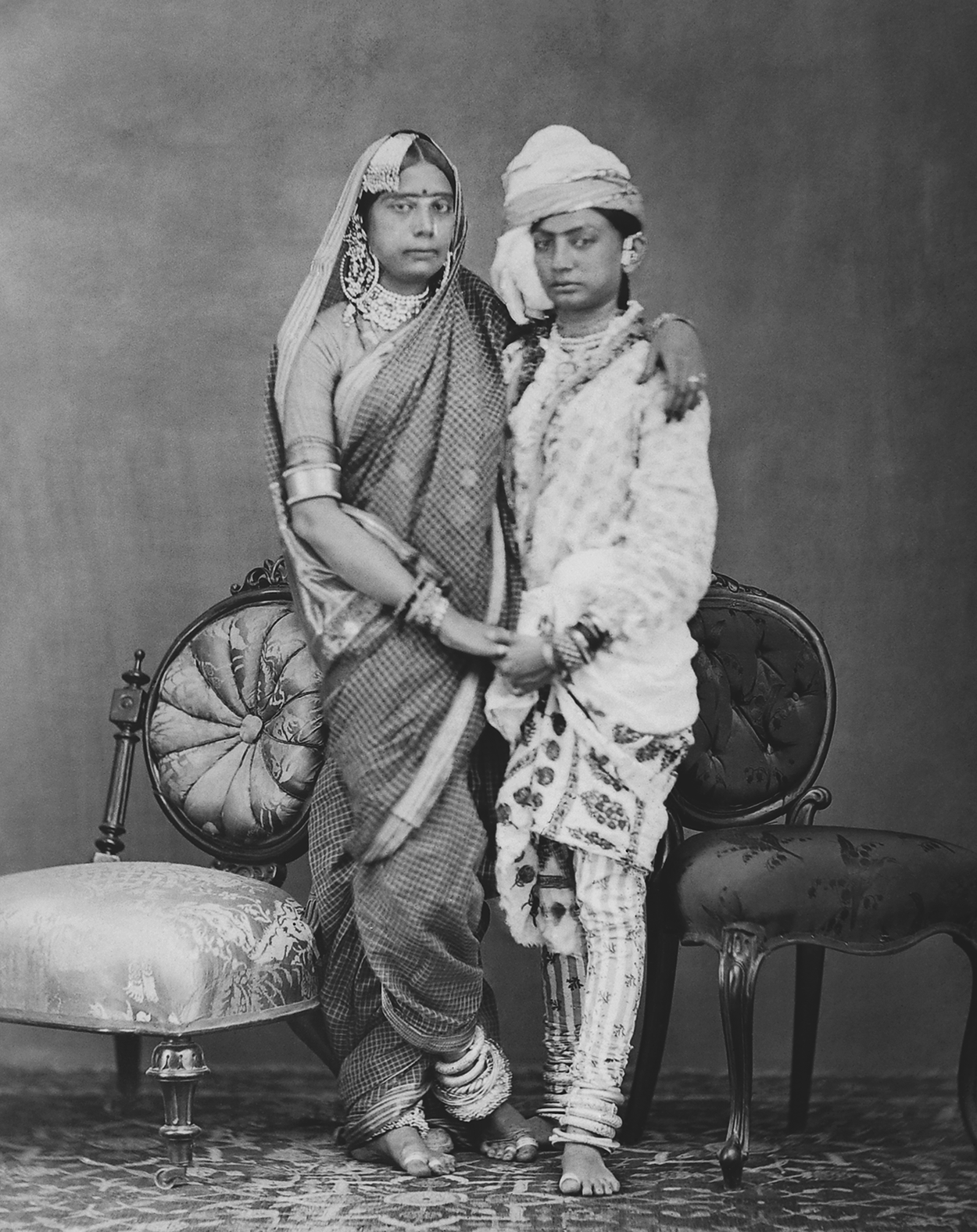
Nanhi Jan and Munna Jan were favourite subjects of the king’s camera. The multiple exposures made of them singly and together offer ample evidence of their theatrical proclivities. In his self-portraits, Ram Singh was fond of staging himself in diverse poses and attire, showing his various identities as Shaivite devotee, divinely anointed ruler, and Western-educated savant. The portraits of Nanhi Jan and Munna Jan similarly project different characters. The women wear assorted regional styles of dress and ornament and are pictured with different props and curtains. In one instance, the sitter is converted into an ascetic or widow draped entirely in white. The most striking image features them posing, arms intertwined, attired as a male–female couple, as if in reference to a drama they had recently performed. This composition merits consideration as a collaboration between photographer and subject. The performers are actively creating their identities as actresses and simultaneously glossing Ram Singh’s own self-invention before the camera (see Figure 3).
Nanhi Jan and her sister Munna Jan. Photograph attributed to Maharaja Sawai Ram Singh II. Source: Maharaja Sawai Man Singh II Museum, Jaipur. 2012.04.0019-0007. Copyright: Public domain.
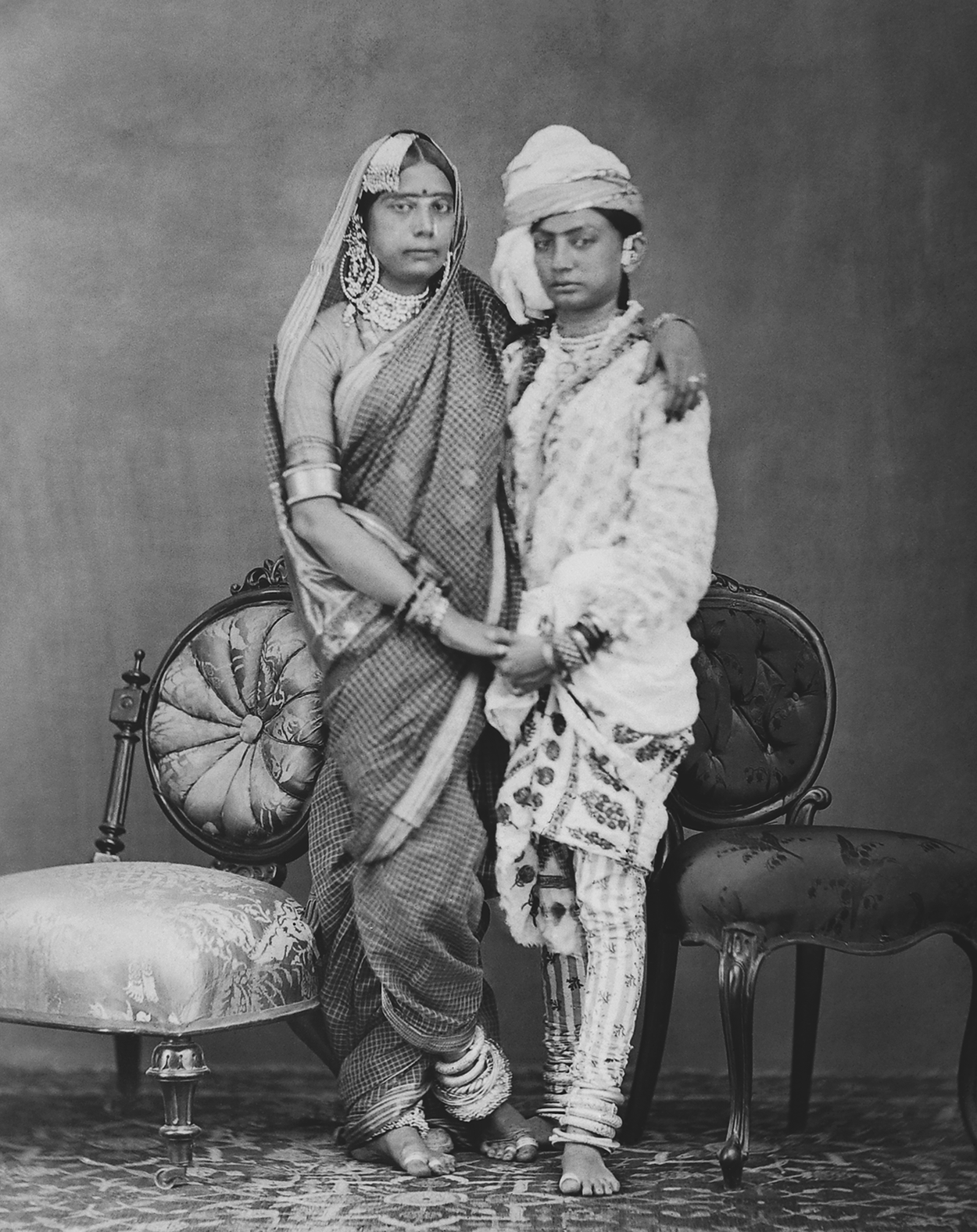
Figure 3 Long description
Nanhi Jan and Munna Jan are standing closely together, with their arms intertwined, between two ornate chairs. Nanhi Jan is wearing a traditional sari with jewelry, while Munna Jan is dressed in ceremonial attire with a turban. The setting includes a patterned carpet and a plain backdrop, suggesting a formal portrait environment.
Despite their frequent appearance, the Lashkarvali sisters are not identified by name in the literature on Ram Singh’s photographic oeuvre. They are grouped with the rest of the maharaja’s female subjects as ‘unidentified women of the zenana’.Footnote 62 The scholarly consensus characterises the photographed subjects as ‘in purdah’. Linked to this is the argument that the king was unusually modern in taking pictures of secluded women and exposing them to public view.Footnote 63 But to the contrary, Nanhi Jan and Munna Jan were not secluded women, were not ‘in purdah’, nor were they confined to an all-female quarter (zanānā). They performed in public and enjoyed a considerable degree of mobility and fame. They adorned the court of Ram Singh and enhanced his prestige through their accomplishments and companionship, even being introduced personally to Western visitors like Val Prinsep.Footnote 64
By means of a second visual channel, that of commercial photography, Nanhi Jan’s image was widely disseminated. She featured in a series of postcards issued by the studio of Gobind Ram and Oodey Ram of Jaipur, a firm operating in the bazaar, albeit with close connections to the court.Footnote 65 Picture postcards travelled from the local photographer’s studio to printing presses in Europe and back again to bookstores and dealers in India. Thence they were purchased and mailed, usually abroad, making them the most extensively circulated form of photography.Footnote 66 Most of the postcards picturing Nanhi Jan are captioned with the generic term ‘dancing girl’, but one includes the name Nani [sic]. This naming, plus the resemblance to photos made by Ram Singh, links her to the performer of the gunījankhānā.
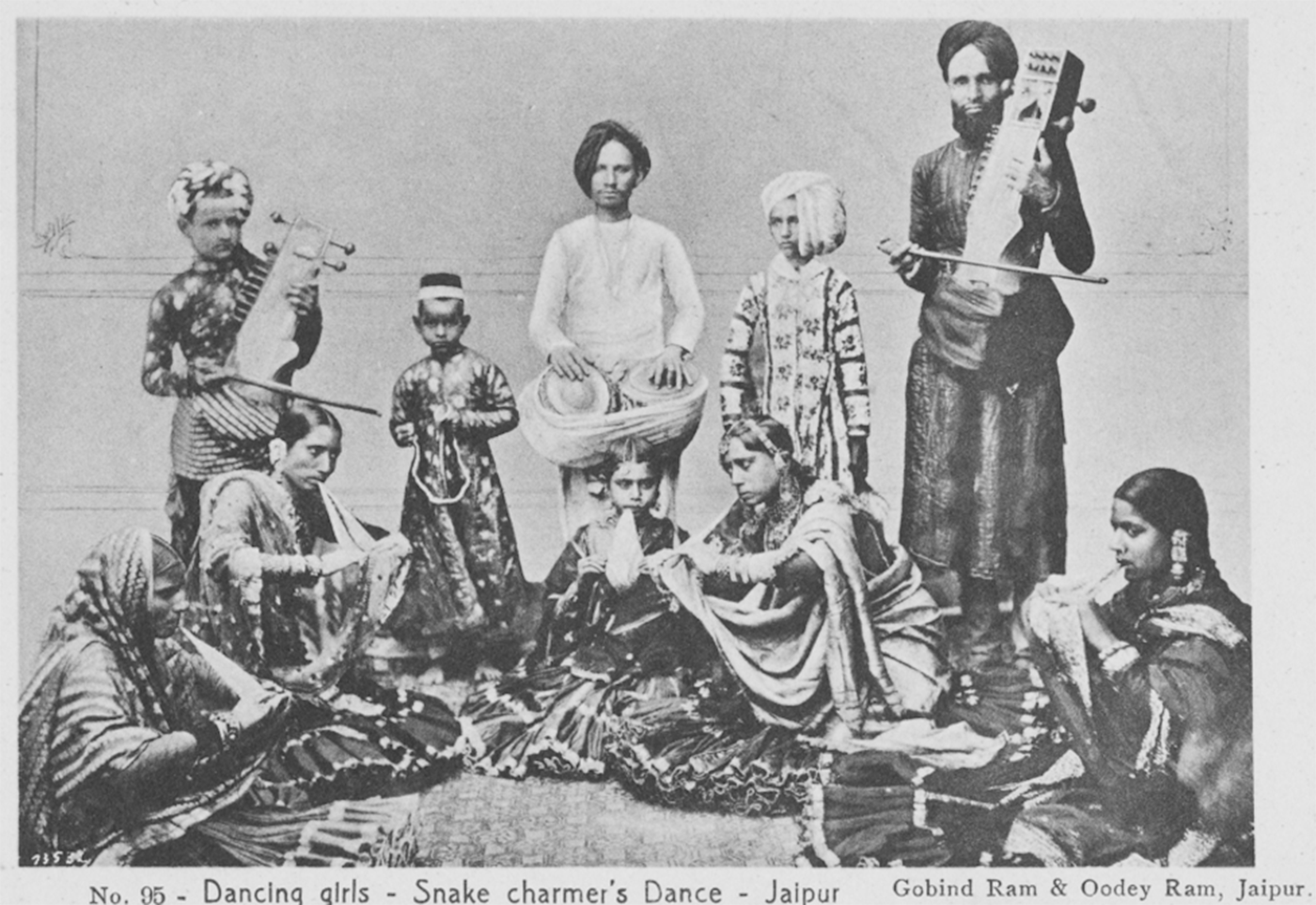
In her postcard avatar, Nanhi Jan’s image mutates to conform to colonial stereotypes for the largely European market. In several shots, she holds the back of her skirt in an arc above her head, imitating the peacock’s fan. In another, she takes on the role of a snake charmer. Accompanied by four other female performers, she waves a folk flute (bīn) in a sideways motion, producing a triangle of white in the time-lapse image. Men and boys playing musical instruments—probably offspring and accompanists—complete the ensemble. The creation of these pseudo-ethnographic scenes shows the appetite of the export market for exotica and the willingness of a Rajasthani firm like Gobind Ram and Oodey Ram to capitalise on their location and cater to the demand (see Figure 4).
Nanhi Jan with ensemble of male and female performers. Postcard no. 95, titled ‘Dancing girls—Snake charmer’s Dance—Jaipur’. Photograph by Gobind Ram and Oodey Ram. Source: Priya Paul Collection of Popular Art, Delhi, via Heidelberg University Library. Copyright: Public domain.
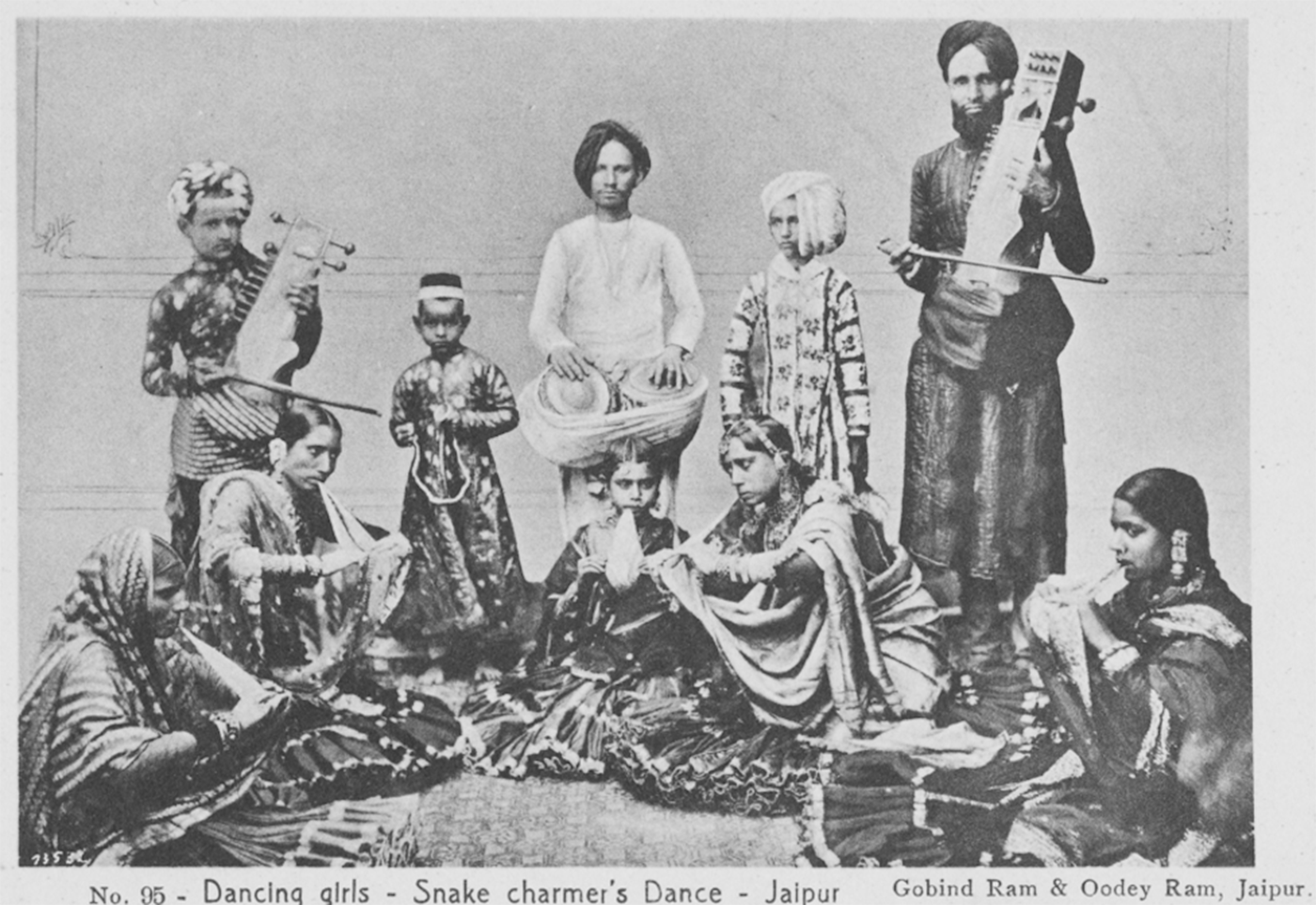
Figure 4 Long description
The postcard shows nine performers, including Nanhi Jan, in a staged scene. Five women are seated in the foreground. The woman in the center is holding her hands in front of her. The other women are positioned at either end and in between. Four men and boys are standing behind the seated women. The man on the right is holding a stringed instrument. The boy to the left of him is holding a stringed instrument. The man in the center is holding a drum. The boy to the left of the man is holding a small instrument. The text at the bottom reads 'No. 16 Dancing girls Snake charmer's Dance Jaipur Gobind Ram and Oodey Ram, Jaiper.'.
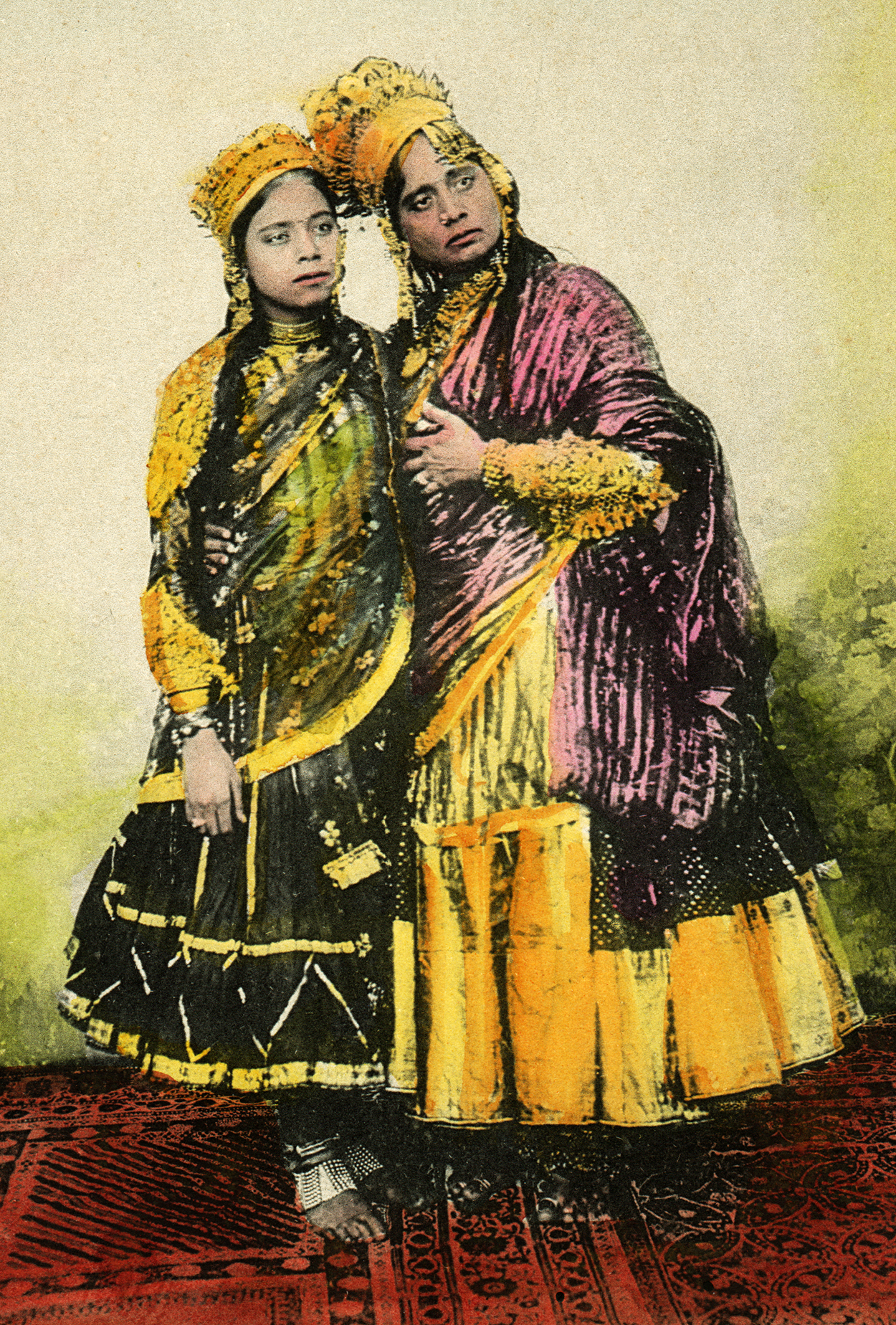
The stage career of Nanhi Jan continued beyond her debut in Jaipur. In one arresting image, she poses as a woman warrior (vīrānganā), gripping a sword at her side.Footnote 67 In another, a luxuriant colourised postcard, she is depicted with a younger woman, possibly her daughter. Both wear heavy theatrical crowns and incline in a stance that seems to allude to a stage narrative (see Figure 5).
Nanhi Jan with younger performer, both wearing crowns. Colourised postcard titled ‘Dancing Girls. Jaipur’. Photograph by Gobindram Oodeyram. Source: PaperJewels.org. Copyright: By permission.
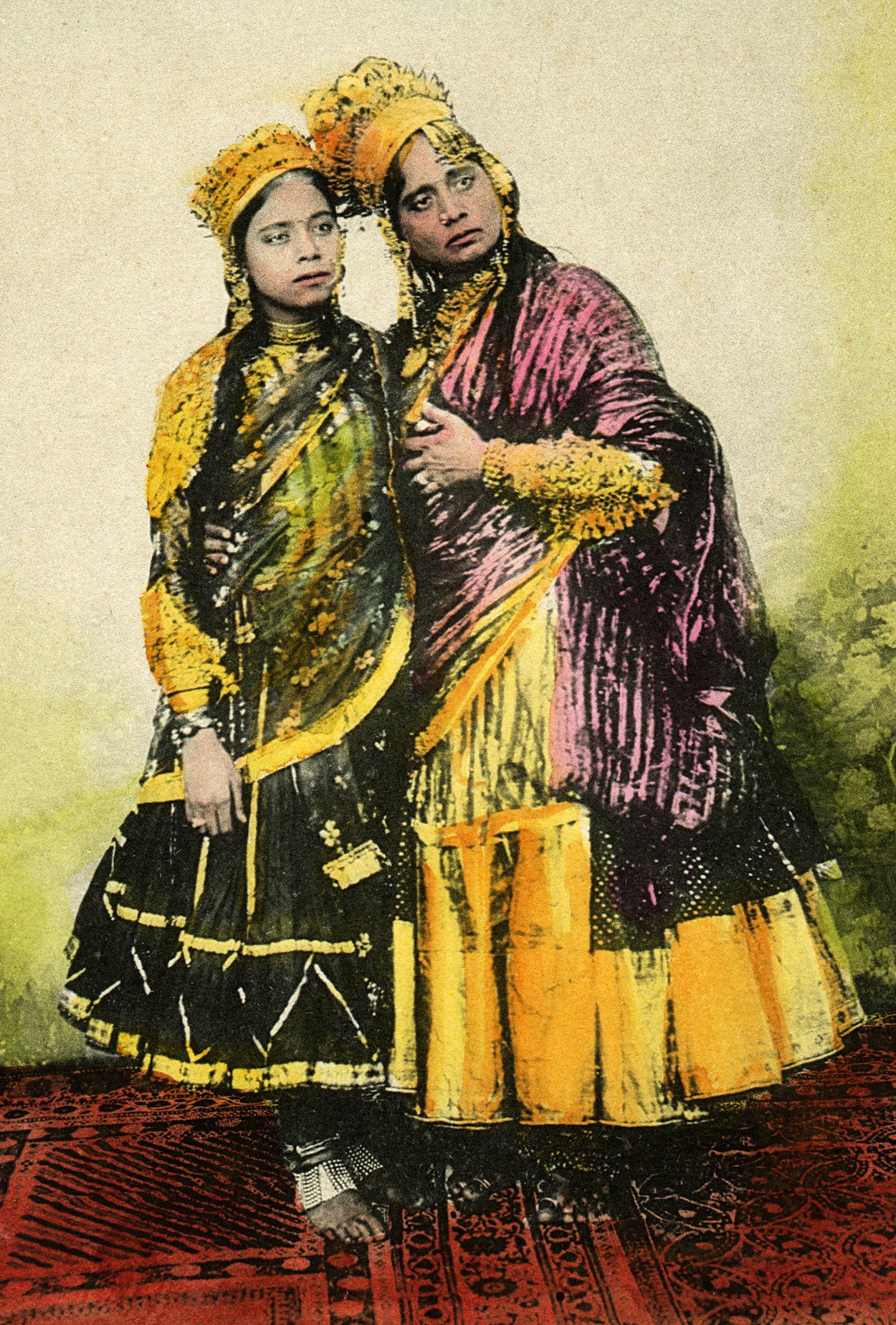
Figure 5 Long description
Nanhi Jan stands with a younger performer, both adorned in elaborate traditional attire and wearing theatrical crowns. They are positioned closely, with one arm around each other, suggesting a connection or shared performance. The setting includes a patterned carpet beneath them, adding to the theatrical or ceremonial atmosphere.
In 1913, Nanhi Jan participated in the Alfred Company production of Betāb’s landmark mythological, the Mahābhārat. Footnote 68 The performance was directed by Kavasji Khatau, who took on the role of the principal antagonist, Duryodhana. Nanhi Jan played Bhanumati, his wife. This stage pairing connected Nanhi Jan indirectly with Mary Fenton, Khatau’s former wife and leading actress. The cast also featured Jahangir Khatau, Mary Fenton’s son, in the role of Vikarna.Footnote 69 The play opened in Delhi and for three years travelled across India, playing in cities between Calcutta and Lahore.
In the early twentieth century, Nanhi Jan’s voice joined those of celebrity singers Gauhar Jan and Janaki Bai in spreading Hindustani art music into middle-class homes. She made a number of recordings for The Gramophone Company of London between 1904 and 1906, probably in studios located in Lahore, Delhi, or Lucknow. The compositions she recorded were in classical ragas: Basant, Bhairavi, Iman, Jhinjhoti, Kafi, Khamaj, and Tilak Kamod. All the leading vocal genres of the day were represented: thumri, khyal, dadra, ghazal, barahmasi, holi, qawali.Footnote 70 Her 1905 recording of Rag Basant is available on YouTube.Footnote 71 Since other European record companies were also operating in India, it is likely that additional recordings of her music were made and await discovery.
Although Jamila Begam, Mary Fenton, and Nanhi Jan were all born within a few years of each other, only Nanhi Jan lived long enough to engage with new technologies such as commercial photography and gramophone recording. This circumstance enabled her to transform herself from courtesan to stage actress, postcard icon, and recording artist. Her movements through the various media of her day were not singular. They were shared by numerous female performers who brought high levels of artistic skill into a rapidly expanding public sphere where taste and connoisseurship were in continuous formation.
Conclusions
The Parsi theatre archive provides unparalleled access to performing women’s lives through the lens of travel. The actresses profiled herein are verifiable historical subjects, documented in newspaper ads and reviews, memoirs by insiders, public handbills, gramophone record catalogues, postcard collections, and court account books. This wealth of evidence confirms that even in the first decade of the Parsi theatre’s commercial success, bold performers like Jamila and Mary Fenton were able to complete lengthy journeys with travelling theatre companies. Travel was intrinsic to their job, and they accomplished it, despite its discomforts and dangers.
Travel experiences embedded these performers in relationships. It integrated them within the social spaces that grew up around the entertainment industry, adding security and pleasure to the rigours of constant movement. The activities connected to moving about were often undertaken with the companionship of other female performers, or under the protection of male partners, and certainly aided by servants, staff, and company employees. Nonetheless, Parsi theatrical companies, whether in residence or on the go, were patriarchal structures dominated by a male authority figure. Gruelling daily schedules, rules of dress and behaviour, and strict obedience governed their functioning. In addition to the effort to please the public through exacting performances, female performers also had to contend with competition from boys and men playing women’s roles.
Nonetheless, travel expanded their identities. It led to new public personas, levels of mastery, and economic opportunity. Jamila moved across at least three linguistic zones, navigating from Judeo-Arabic into English, Urdu, Hindustani, and Gujarati, and then perhaps Burmese. Mary Fenton crossed the chasm of race when she partnered with Kavasji Khatau, left Delhi for Bombay, and became Mehrbai. Nanhi Jan challenged the gendered spatial divisions in the palace and co-created signature postcards that spanned the globe. Crossing the boundaries of class, race, and gender, as much or more than territorial movement, enabled female performers to occupy larger worlds.
As Parsi theatre circuits expanded, the demand for female performers increased. Opportunities in commercial photography and the recording industry and, later, early cinema created additional revenue streams. Negotiating the terms of their jobs, performers pursued their self-interest and exercised agency in their cultural, social, and economic transactions. In their alliances with men, some evidence suggests, they brought the same skills to bear. Although the subjective experience of travelling while female remains somewhat elusive, these women’s lives would not have been inscribed in history without it.
Conflicts of interest
None.

 Open access

