




Introduction
In contemporary audiovisual practice, the relationships among different media have become an important perspective for understanding the formation of works and the construction of meaning. ‘Intermediality’, as a significant theoretical category, is generally understood as a phenomenon that occurs between different media and involves the crossing of media boundaries (Rajewsky Reference Rajewsky2005). In the 1960s, Dick Higgins defined ‘intermedia’ as an artistic category that emerges from ‘falling between media’, used to refer to works that are difficult to classify within existing media categories. He also noted that this concept is often confused with ‘mixed media’, which refers to the use of multiple media within a single work while each medium remains distinguishable (Higgins and Higgins Reference Higgins and Higgins2001). Building on this, intermediality is further understood as a relational mechanism that establishes connections across media differences, with such connections premised on similarities between media (Elleström Reference Elleström2021: 5). This perspective further deepens the relationality among media: as Mieke Bal points out, the prefix ‘inter-’ itself signifies ‘relation’, indicating that media have moved beyond the mere accumulation of discrete elements and instead entered into an interactive, mutually responsive process of communication (Elleström Reference Elleström2021: vi). Related studies have likewise pointed out from different perspectives that the relationships among media are manifested as ongoing interaction and transformation (Peter Glaser Reference Glaser and Glaser2009) and that new meanings and experiences are generated in the process of crossing media boundaries (Spielmann Reference Spielmann2001; Ljungberg Reference Ljungberg2010). However, approaching the issue solely from the perspective of ‘relation’ is insufficient to explain how different media interact with one another in concrete processes of production.
In the context of electroacoustic audiovisual composition, Chiaramonte (Reference Chiaramonte2026) proposes the concept of ‘intermedial interference’ to describe the interaction of different medial characteristics within the ‘intermedial space’ and emphasises that regulating this relationship serves to maintain perceptual balance and coherence, thereby achieving aesthetic unity.
However, in systems jointly driven by animal agencies and generative algorithms, an understanding of intermedial interference oriented toward balance is no longer sufficient to fully account for such relationships. This assessment is based on practical observations arising from the development of the author’s multispecies–algorithmic audiovisual installation Astrofin. Within this system, the relations among different media characteristics remain in a state of continuous change, constantly producing differences and displacements, which further constitute the driving conditions through which audiovisual generation unfolds. This variability arises in part from the inherent unpredictability of multispecies behaviours and their differentiated perceptual manifestations, forming an associatively grounded yet incompletely synchronous condition in relation to algorithmic generative processes.
Accordingly, this study conceptualises this condition as conflict mechanisms and understands it as a possible manifestation of intermedial interference within a multispecies context. Within the operation of Astrofin, this state can be understood as a form of structural tension grounded in ongoing relations, shaped through the continuous interaction between multispecies behaviour and algorithmic processes.
Conflict mechanisms and audiovisual generation in Astrofin
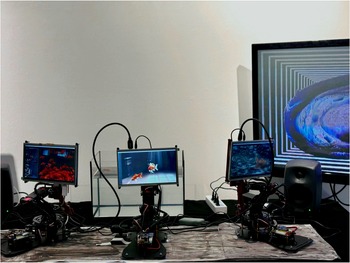
Astrofin is a multispecies–algorithmic audiovisual installation, first exhibited in January 2025 at the Glasgow School of Art (Figure 1).
Astrofin exhibited at the Re-generation Exhibition, The Glasgow School of Art, in January 2025.
© Bowen Wu.

Figure 1. Long description
The image features four screens and a large display. The first screen on the left shows a vibrant underwater scene with red coral and fish. The second screen displays a goldfish swimming in a blue environment. The third screen mirrors the first, showing another underwater scene with fish. The fourth screen on the right shows a different underwater scene with various marine life. The large display on the right shows a close-up of an aquatic creature with a blue and white pattern. The screens are mounted on stands with visible wiring and equipment, suggesting a technical setup for an exhibition.
The work can be understood as a structured system comprising multiple parallel processes. Within Astrofin, multispecies behaviours (primarily the movements of fish within the tank) are translated through different media pathways, contributing to the formation of an intermedial space through the interaction of media features. According to Chiaramonte (Reference Chiaramonte2026), this space is produced through the interaction of different media features, thereby exceeding a relation of simple juxtaposition. As the audiovisual generation in Astrofin likewise involves continually shifting relations among different media characteristics, this concept provides a useful point of reference for understanding the intermedial relations within the system. The differences among media characteristics continuously emerge within this structure and further participate in the formation of perceptual experience and meaning, thereby laying the foundation for the following discussion. As Cook (Reference Cook1998: 82–97) emphasises, multimedia is fundamentally predicated on difference. Meaning is not inherent in any single medium but instead emerges through the mutual contrast and transformation of properties among different media features.
Accordingly, these differences participate in the generation of meaning in different ways across different relations and appear at the analytical level as distinct organisational dimensions. This study approaches the discussion through three levels: translation, perception and the distribution of agency, corresponding respectively to the dimensions of generative structure, perceptual experience and the understanding of action. Within this framework, conflict is used as an analytical concept to denote the instability of relations manifested across these dimensions rather than a single unified mechanism.
Translational conflict
Within the research framework of Animal–Computer Interaction (ACI), attention is directed towards interactions between animals and computational technologies as mediated through technical systems (Mancini et al. Reference Mancini, Juhlin, Cheok, van der Linden and Lawson2014). Within such processes, animal behaviour can participate in computational generation through tracking and sensing technologies. In Astrofin, the movement of the fish is captured and transformed into data input, then simultaneously distributed across visual, sound and spatial installation pathways. Operating in parallel, these pathways unfold according to their respective temporal scales and modes of processing, forming independent yet interconnected generative frameworks grounded in a shared data source (Figure 2).
Block diagrams of the visual, sound and spatial installation pathways in Astrofin.
© Bowen Wu.

Within this structure, different translational processes establish cross-media connections through OSC on the basis of a shared behavioural data source, while unfolding independently within their respective generative frameworks. As a result, consistency at the level of association and misalignment at the level of process coexist in parallel during system operation, constituting what this study defines as translational conflict.
In the visual generation module, the movement of the fish is organised as a set of spatial variables, where its position within the tank, direction of movement and occupied region constitute the key conditions for visual generation. The fish’s movement is mapped onto the spatial distribution, generation density and flow direction of a particle system, allowing the motion of the particles to be continuously updated in response to the fish’s movement (Figure 3). When the fish enters specific spatial regions of the tank, the system triggers a shift in the visual generative state, transitioning from a baseline state dominated by the particle system to AI-generated virtual scenes (Figure 4) and visually processed footage of real-world landscapes in Glasgow (Figure 5). This process is characterised by the continuous generation and reconfiguration of spatial relations within the image.
Particle system visualisation in TouchDesigner used in Astrofin.
© Bowen Wu.

Figure 3. Long description
The composite image consists of two elements: a particle system visualization and a diagram. The particle system visualization on the right side shows a screen displaying a dynamic particle system with a single red particle moving against a blue background. The diagram on the left side is a complex flowchart with multiple nodes and connections, representing the interaction of different medial characteristics within the intermedial space. The nodes are connected by lines, and some nodes are highlighted with different colors. The diagram includes labels and annotations that describe the relationships and interactions between the nodes. The purpose of combining these images is to illustrate the concept of intermedial interference in electroacoustic audiovisual composition, emphasizing the regulation of relationships to maintain perceptual balance and coherence.
AI-generated virtual scenes displayed across three screens in Astrofin.
© Bowen Wu.

Digitally processed footage of Glasgow’s real-world environment displayed across three screens in Astrofin.
© Bowen Wu.

Figure 5. Long description
Three screens side by side displaying different visuals. The left screen shows a distorted view of a fish tank with a fish swimming. The middle screen displays a virtual scene with a reflection of buildings on water. The right screen shows a visually processed footage of real-world landscapes in Glasgow. The screens are connected with cables and mounted on stands.
In the sound generation module, the movement of the fish is organised as a set of temporal generative parameters and, under different temporal mechanisms, is structured into multiple layers of sound generation (Figure 6).
Max/MSP interface for sound generation in Astrofin.
© Bowen Wu.

First, the movement of the fish in the tank triggers sound units from an audio corpus organised using FluCoMa in a two-dimensional spectral feature space, producing instantaneous sonic events. These sound signals are recorded in real time into a buffer and subsequently enter a granular synthesis process, where they are segmented into short sound grains and rearticulated at different temporal positions and density conditions, thereby forming a continuously reconfigured granular sonic texture. This pathway is characterised by event triggering, with its sonic outcomes emerging on a short time scale and being continuously reorganised during system operation. At the same time, these sound events are persistently stored within the system and later retrieved and replayed as re-entrant material within the generative process.
Second, the instantaneous velocity and acceleration of the fish are used as continuous control parameters for low-frequency sound and are fed into a turntable-inspired synthesis engine, enabling continuous modulation of the amplitude and dynamic characteristics of the low-frequency source. As a result, the low-frequency sound exhibits fluctuations in intensity over time in relation to changes in movement, forming a low-frequency sound field that is continuously updated by behaviour.
On a longer time scale, the system captures the trajectory of the fish at fixed temporal intervals (approximately every ten seconds) and converts it into the basis for generating high-frequency looping patterns. These trajectory data are repeatedly recalled and continuously updated, allowing the high-frequency sound to unfold in a periodic structure and to form a stable yet evolving rhythmic contour through repetition.
At the same time, three robotic arms are each connected to an independent visual sensor, continuously tracking the fish’s movement in the water from different perspectives (Figure 7).
Camera system used for tracking fish movement in Astrofin.
© Bowen Wu.

The multi-view camera system forms a closed-loop tracking–following circuit, through which the fish’s spatial position and movement trajectory are continuously fed into the motion logic of the robotic arms. In this process, constrained by speed, turning range and physical inertia, the robotic arms respond to the fish’s movement with a certain degree of delay and postural deviation. As a result, their motion is not a direct reproduction of the fish’s trajectory but instead forms a spatial movement relation governed by their own physical constraints.
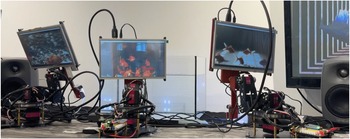
Building on this, the three displays mounted on the robotic arms constitute a spatial configuration system for visual output. As the robotic arms continuously adjust their movement, the position, orientation and relative relationships of the displays keep changing. Consequently, visual content is no longer confined to a single plane but instead unfolds in space through varying configurations such as expansion, inclination and enclosure (Figure 8).
Three robotic arms dynamically positioning screens to display visual content in Astrofin.
© Bowen Wu.

Accordingly, visual generation is manifested both in the real-time organisation of spatial relations within the image and in the dynamic configuration of display orientations during system operation.
On this basis, visual, sonic and spatial installation components each form generative structures characterised respectively by continuous spatial generation, temporal layering and physical configuration, resulting in multiple parallel yet heterogeneous modes of organisation across the system.
However, different pathways remain continuously connected through their shared behavioural data. This association is first manifested in the synchronous distribution and mapping of the same behavioural data across multiple systems. For example, in Max/MSP, the two-dimensional position of the fish in the tank is mapped onto a two-dimensional embedding space of the audio corpus, and a nearest-neighbour search is performed via a KD-tree (fluid.kdtree∼), thereby triggering the sound fragment closest to the current position and enabling the transformation from spatial position to sonic event.
At the same time, in TouchDesigner, the same set of two-dimensional coordinate data is mapped to the x and y parameters of the camera in the ParticlesGPU system, allowing the trajectory of the fish’s movement to be synchronously represented in the visual image and to maintain a corresponding relationship with particle motion.
In addition, the system establishes further associations between sound and vision through multi-layered parameter mapping. For example, the instantaneous velocity and acceleration of the fish are used as continuous control parameters for low-frequency sound, modulating the amplitude and dynamic variation of the low-frequency source. Subsequently, fluctuations in the amplitude of this low-frequency signal are further mapped onto motion parameters in the visual system, such as particle velocity in ParticlesGPU, with particle rotation triggered when the amplitude reaches a certain threshold.
In this way, the fish’s movement acts simultaneously on both auditory and visual systems through a multi-layered parameter mapping process, forming a continuous chain of responsive relations across different media.
Perceptual conflict
The discussion of perceptual conflict in this paper is not based on audience testing or user research but is primarily grounded in perceptual theory, the generative structure of the work and observations made during the creative process.
From a perceptual perspective, relationships among media are not determined solely by their structural configuration but are also shaped through the interaction of different media features during the unfolding of the work. As Chiaramonte (Reference Chiaramonte2026) points out, such interactions can generate tension and challenge expectations in perception, thereby rendering the formation of meaning to some extent unstable. In Astrofin, this state of instability is understood here as a form of perceptual conflict, manifested primarily as hesitation, displacement and uncertainty in the process of perceptual association.
In the process of audiovisual integration, whether auditory and visual signals are integrated into a single event depends on multiple conditions, including structural factors such as temporal and spatial correspondence and temporal correlation between signals. It is also influenced by cognitive factors such as semantic congruency and the observer’s unity assumption regarding the consistency of signal sources (Spence Reference Spence2007).
From this perspective, the perceptual instability observed in Astrofin arises, on the one hand, from the audiovisual tension generated by the parallel multi-path translation processes described above and, on the other hand, from the multispecies elements introduced into the system. The movement of the fish functions not only as a data source but also as a visible dynamic variable, causing the relationships among different media to continuously change during the generative process.
At the audiovisual level, the relationship between sound and image is established through perceptual processes. As Chion (Reference Chion1994: 64) proposes through the concept of ‘synchresis’, when sound and image occur simultaneously in time, they may form synchronised perceptual relations that constitute an integrated audiovisual structure. In Astrofin, the movement of the fish simultaneously triggers sonic and visual changes, allowing variations across different media to remain temporally connected and to emerge as synchronised structures derived from the same behavioural process.
This relationship does not always appear as a stable one-to-one correspondence. In Battey’s (Reference Battey2010) discussion of audiovisual isomorphism, the relationship between different media is understood not as relying on direct one-to-one correspondences between elements, but rather as emerging through structural similarities and associations within temporal dynamics. Although sound and image share the same behavioural source, the ways in which they unfold over time are not entirely consistent, causing their relationship to continuously shift. For example, when the fish suddenly slows down or briefly pauses in space, the high-frequency looping structures and granular textures in the sound system continue to unfold, while movement at the visual level is significantly reduced or even approaches stillness. At this moment, sound and image maintain their relation to the same behavioural process while simultaneously producing temporal deviations in their unfolding. This condition, in which connection and displacement coexist, may be understood within the framework of perceptual mechanisms. As Spence (Reference Spence2007) points out, audiovisual integration involves processes through which signals may be grouped as a single event or separated into distinct events, depending on variations in temporal and structural conditions. Accordingly, in Astrofin, audiovisual relations do not stably merge into a single event but instead continue to shift between connection and separation, leaving their common origin in a persistently unstable perceptual state.
At the level of causal perception, this instability is primarily manifested as a discrepancy between intuitive causal expectation and the outcomes generated by the system. Within the framework of causal perception, the movement of the fish may be organised perceptually as the source of audiovisual variation and tends to remain associated with temporal continuity and correspondences in behavioural features. According to Michotte (Reference Michotte1963), causal relations appear in perception in the form of a ‘causal impression’, whose formation depends on temporal continuity and on spatial and dynamic correspondence between events. Once this continuity is disrupted, for example by introducing a temporal gap between cause and effect, a relation previously experienced as causal no longer holds in the same way and is instead more likely to be perceived as a sequence of separate events.
Accordingly, within the concrete generative process, when algorithmic translation introduces delay, reduction or reconfiguration, creating deviations between the output and behavioural features, the movement of the fish can still be understood as the source of audiovisual variation. However, this causal relation is no longer presented in a direct and continuous manner, becoming unstable through processes of delay and reconfiguration.
At the level of generative mechanisms, in practices where sound is organised through random or statistical processes, the underlying generative relations are often perceptually compressed into an overall distribution of sound. What the listener experiences is the aggregation and variation of sound at a macro level rather than its specific generative process (Xenakis Reference Xenakis1971).
By contrast, in Astrofin, the introduction of multispecies elements renders the system’s indeterminacy perceptible as a dynamic variable marked by the characteristics of living movement. Accordingly, this difference is also reflected in the distinction between the perceptual attributes of biological behaviour and those of digital output.
In the observer’s perception, the movement of the fish, as embodied behaviour, is grasped as an animate form, that is, a living entity that moves and rests in particular ways and relates in specific ways to what is presently given (Sheets-Johnstone Reference Sheets-Johnstone2011: 315–317). As James J. Gibson points out, the perception of media such as images constitutes mediated perception, which differs from the direct perception of the real environment (Gibson Reference Gibson1979: 139).
Accordingly, although the audiovisual outcomes can be causally attributed to the behaviour of the fish, their perceptual form does not become a direct experience of the same real object, resulting in a persistent separation between behaviour and outcome. This condition may be further understood through McConachie’s discussion of the distinction between visual perception and visuomotor representation (Reference McConachie2008: 56–58). In this account, the viewing of inanimate environments and the viewing of action-oriented movement involve different modes of perceptual organisation. Although this discussion is primarily situated within the context of human performance, the distinction nevertheless provides a point of reference for understanding why the movement of the fish and its mediated output continue to remain perceptually differentiated.
Distributed agency conflict
The starting point of this section arises from a practical concern that emerged during the early stages of the creative process, namely whether human performance retains an irreplaceable role within a context in which contemporary performance is increasingly reconfigured by technological systems. As Simon Emmerson (Reference Emmerson2007: xiv) points out, the presentation of contemporary music often no longer directly manifests a clearly identifiable human presence, yet listeners continue to establish associations between sonic outcomes and action. In the practice of developing Astrofin, this question gradually shifted into another concern, namely whether ‘who is acting’ can still be clearly defined within a generative system jointly constituted by biological behaviour, algorithmic mechanisms and audiovisual structures. The present discussion is primarily grounded in practical observation and theoretical analysis of this specific generative structure, rather than attempting to formulate a universal definition of agency relations in performance.
Within related theoretical frameworks, Waters (Reference Waters2007) understands music and performance as dynamic systems composed of performer, instrument and environment, in which the generation of action depends on the interaction, feedback and ongoing adjustment among different elements. Enfield (Reference Enfield, Enfield and Kockelman2017) further suggests that different components of agency may be distributed, shared and transferred across multiple actants within the same course of action. Meanwhile, Latour (Reference Latour2005), in actor-network theory, proposes that agency is not an inherent property of the subject but emerges through the associations and relays among human and non-human elements in concrete action, in which technology, material and environment likewise participate in the process of action.
Accordingly, these theories collectively provide a point of reference for understanding how action unfolds across different subjects, media and technological conditions. However, within specific performance contexts, the ways in which action is understood and attributed still often depend on a relatively stable centre of interpretation. On the one hand, McConachie (Reference McConachie2008), in his cognitive theatre theory, points out that audiences, through the perception and simulation of stage action, continuously integrate action-related information and emotional cues at a cognitive level and on this basis form judgements regarding the intentions of the performing subject, such that the understanding of action still takes subject intention and responsive awareness as important points of reference. On the other hand, Morrison, Nyong’o and Roach (Reference Morrison, Nyong’o and Roach2019) suggest that within contemporary digital and algorithmic culture, ‘performance’ has gradually extended from a practice centred on liveness and creativity to a process of execution embedded within input–output and control logics, making action more readily understood as the result of system operation. These two approaches, respectively, take subject intention and system operation as the primary points of reference for action attribution. Within the generative structure of Astrofin, the identifiable centre of action dominance cannot be stably attributed to either of the two pathways of attribution outlined above. Fish behaviour is not configured as possessing clear performative intention or responsive awareness, yet at certain stages it directly affects the generated outcomes. Meanwhile, algorithmic mechanisms continuously participate in the generative process, allowing action to remain in a state of unfolding over time. Under the specific conditions of this work, the same action outcome can be understood both as a direct product of biological behaviour and as a continuing process of the system structure. In this context, within the generative process of Astrofin, different generative conditions participate in the formation of action effects at different moments, while continuously producing associations and transfers among biological behaviour, algorithmic mechanisms and audiovisual structures. As a result, action attribution cannot be stably fixed to a single source but instead forms an ongoing relation of tension across different generative conditions, which this study understands as a conflict in the distribution of agency.
Moreover, this instability in action attribution keeps performance continuously situated between different pathways of attribution, thereby giving rise to a state that may be understood as liminal. For example, in sound generation, fish movement can trigger sonic events, whereas when its activity diminishes, sound continues to unfold through the system structure. This mechanism is likewise present at the levels of visual presentation and mechanical movement. Liminality here no longer functions as a transitional stage towards a stable structure but instead becomes a persistent operational condition. As Ybema, Beech and Ellis (Reference Ybema, Beech and Ellis2011) propose through the notion of ‘perpetual liminality’, this state does not lead towards the completion or transformation of identity but instead continues to unfold through uncertainty and suspension. In the practice of Astrofin, this liminal state continuously accompanies the unfolding of its generative performance process, while also keeping the attribution of agency in constant circulation across different generative conditions.
Multispecies participation and ethical implications
When multispecies behaviour enters the media structure as a generative condition, its significance is no longer confined to perceptual and formal dimensions but also points to ethical questions related to interspecies relations. In this process, the relational instability discussed above not only affects the organisation of media and perceptual structures, but also shapes the ways in which multispecies relations are presented within the work.
In 2014, the Guardian published an article titled ‘Animals on stage – should we allow it?’ The article explores the ethical issues of using animals in stage performances. It begins with PETA’s protest against a scene in Jamie Lloyd’s staging of Richard III, which leads to a broader discussion: Is it appropriate to use animals in theatrical performances? Do they have a choice? Are we merely showcasing our control over animals for entertainment purposes (Gardner Reference Gardner2014)? While it is impossible to reach a definitive conclusion, the article tends to question and critique the way we treat animals, rather than simply advocating for or against their presence on stage.
This position can, to some extent, be compared with the normative approaches commonly found in animal protection law, which typically do not directly address widely debated ethical premises, such as the use of animals for food or medical experimentation. Instead, they focus on the ways in which humans treat animals in specific contexts. These topics have been extensively examined within the fields of animal ethics and food ethics and therefore fall beyond the scope of the present study.
Within the context of performance, the presence of animals constitutes a highly sensitive and complex ethical domain, and the ways in which they are presented often provoke critique and controversy. Against this backdrop, avoidance itself represents a non-neutral form of response, which may hinder discussions of cross-species coexistence and is unlikely to challenge prevailing human biases toward non-human beings. Plumwood (Reference Plumwood2002: 167) contends that the logic of ‘othering’ is rooted in anthropocentric species arrogance. By continually constructing animals as passive others, this logic reduces ethical questions to whether their presence is permitted, while evading reflection on structures of human observation, control and responsibility.
It is important to note that the label ‘non-human’ carries an implicit anthropocentric logic, defining other forms of life negatively in relation to ‘human’ through a process of negation, similar to the way terms such as ‘non-White’ construct difference (Haraway Reference Haraway2008; Kirksey and Helmreich Reference Kirksey and Helmreich2010). Based on this understanding, the present study adopts the concept of multispecies to emphasise the coexistence, interaction and co-generation of different life forms in concrete practices, rather than measuring them against human experience. Within this analytical framework, the formation and evolution of animal representations through long-term practice reveal a set of naturalised anthropocentric cognitive structures.
In the Western theatrical tradition, animals have evolved from metaphorical symbols in drama (such as in Ancient Greece and Shakespeare) to real performers (such as in circuses and contemporary experimental theatre). In this process, animal roles have been used as substitutes for humans, endowed with human emotions and symbolic representations of human issues, with ‘anthropocentric emotionalism’ at their core (Tait Reference Tait2020). Chaudhuri (Reference Chaudhuri2017) holds a similar view, arguing that animals in theatrical performances have always occupied a position of ‘boundary work’ and introducing the concept of ‘Interspecies Diplomacy’ to attempt to redefine the relationship between humans and marine life, advocating for a more inclusive ecological politics.
In recent years, there have been several art practices involving animals, such as Eduardo Kac’s 2000 creation GFP Bunny, in which a fluorescent rabbit was created through molecular biology. Maja Smrekar’s 2014–2016 work K-9_topology, which revolves around four artworks and challenges species boundaries and the concept of maternity, provoking deep reflections on human identity, animality and technological ethics. The Balthazar Project uses donkeys’ pragmatic individuality to disrupt theatrical control, exposing limits of interspecies identification through human–animal Umwelten and breaking the subject–object boundary through laughter (Haas Reference Haas, Stalpaert, van Baarle and Karreman2021). Admittedly, these works and creators have, to varying degrees, been subjected to questions about blurred theoretical boundaries and controversies regarding societal acceptance.
In the posthumanist perspective, animals are no longer merely passive artistic symbols but become subjects that actively challenge anthropocentrism. Wolfe (Reference Wolfe2021: 67-8) argues that when contemporary artists represent non-human animals, the artistic strategies involved do not merely convey content but also serve to challenge or resist anthropocentric modes of thought, thereby shaping our understanding of ethical relations with animals.
At the outset of the introduction to the ‘Animals’ issue of Performance Research, Read (Reference Read2000) posed the question: ‘What might it mean to practise, think and write theatre beyond the human?’ He further suggested that animals represent a ‘subtraction of sophistication’, compelling humans to reconsider their position within performance (Read Reference Read2000). Research has suggested that when animals are introduced as materially present participants in the performance space, their significance lies in the disruption of conventional structures of theatrical viewing and meaning-making, prompting audiences to reconsider the configurations of power and ethical relations in cross-species performance (Wilke Reference Wilke2017).
This theoretical orientation provides an important point of reference for understanding the motivations behind the creation of Astrofin.
Through algorithmic mediation, Astrofin transforms the movement of fish into perceptible visual and sonic events, bringing it into the field of viewing and experience within specific media forms. The work focuses on how multispecies behaviour is viewed and experienced in this process, while avoiding the attribution of symbolic, narrative or expressive interpretations to the animal behaviour itself.
Within this structure, the sense of performativity perceived by the viewer arises from the viewing relations constituted by algorithm, image and sound, rather than from any subjective intention of the animal itself. In this sense, viewing and mediation constitute a form of knowledge practice. As van Dooren et al. (Reference van Dooren, Kirksey and Münster2016) point out, in multispecies research, the practices employed, including media, performance, making and translation, are directly related to which questions are raised, which relationships are made visible and the ethical and political consequences that follow.
The behaviour of the fish, as a condition of system operation, triggers and modulates the rhythm of perception, making the structure of viewing itself a central concern of the work. Throughout the operation of the piece, the behaviour of the fish remains in its existing state, without the introduction of any form of training, guidance, control or experimental feedback.
Kirksey and Helmreich (Reference Kirksey and Helmreich2010), in defining the methodology of multispecies ethnography, explicitly adopt the position of Eduardo Kohn and accordingly reject ‘to give voice, agency or subjectivity to the non-human’ as a research aim, instead turning toward a reflexive examination of their own analytical categories and epistemological frameworks.
In Astrofin, the behaviour of the fish is treated as a form of life activity that exists alongside human systems of meaning. By maintaining this cognitive distance, the work avoids subsuming it into forms of substitutional expression or symbolic narration. Accordingly, the ethical question no longer centres on confirming animal intention but instead turns towards how a transparent mode of presentation might be constructed while acknowledging the unknowability of the animal as ‘other’.
Building on this understanding, Clover further translates it into perceptual strategies within artistic practice. Drawing on the creation and reflection on the sounds of urban wild birds, Clover frames cross-species communication as a relational practice that begins with listening rather than presupposing meaning and, through creative writing and performance, transforms Haraway’s concept of ‘becoming-with’ into an artistic process accessible to sensory experience and participation (Clover Reference Clover, Driscoll and Hoffmann2018). This artistic approach concretises cross-species interaction as a process of perception and engagement, allowing multispecies relationships to unfold at the experiential level. Olsen (Reference Olsen2022), in discussing multispecies co-creative art practices, emphasises that by reorganising modes of participation, perceptual structures and institutional stages, non-human entities can enter the co-creative process, thereby pointing toward potential pathways for human actors to undergo cognitive, ethical and practical transformations.
In summary, Astrofin employs algorithmic and audiovisual media structures to shift the ethical discussion surrounding animals in art away from the question of whether animals should be incorporated into artistic practice towards the modes of presentation, organisational logics and ethical implications involved in the mediation of multispecies relations. The work retains the structural differences embedded within interspecies relations throughout both the operation of the work and the viewing experience.
It should be noted that this mode of presentation, grounded in cognitive distance, does not imply a more equal distribution of power across species. In practical contexts, whether in artistic practice or everyday companion relations, humans continue to occupy a dominant position in the organisation of space, behaviour and conditions of living. Animals cannot determine whether they participate, nor can they actively negotiate the terms of their presence. As an artistic work, Astrofin does not aim to eliminate these structural asymmetries but rather to render them visible again through media structures after they have long been naturalised through everyday experience, bringing them back into critical discussion. In multispecies creative practice, the questions and discomfort arising around a work may at times constitute part of what the work itself seeks to articulate.
In this sense, the work emphasises the continued preservation of difference and unknowability. Under the acknowledgement of structural asymmetry, multispecies co-creation further considers how humans intervene in, observe and respond to the modes of existence of other forms of life, potentially suggesting an attitude of engagement grounded in caution, restraint and responsibility. Within this process, humans are situated within a more relational framework of action, in which decisions must respond simultaneously to multiple forms of life and environmental conditions. Multispecies artistic practice, therefore, constitutes an ethical practice centred on cautious intervention and relational responsibility while offering a possible pathway for reconsidering the position of the human within multispecies relations.
Discussion
In audiovisual installation practices involving multispecies participation, different works exhibit variations in how biological behaviour is incorporated into media-generative processes. Situating Astrofin within this broader context and examining it in comparison with Paul DeMarinis’s Al and Mary Do the Waltz and Céleste Boursier-Mougenot’s From Here to Ear further reveals how these differences shape the relationships among media. In Al and Mary Do the Waltz, DeMarinis alters the traditional mechanical reading process through laser scanning, thereby ‘reconfiguring’ the phonograph medium. As the laser beam propagates, it is randomly interrupted by the movement of goldfish in the tank. This interference with the media process intermittently disrupts the continuity of sound, producing what are described as ‘uncomposed musical pauses’. As a result, sound is no longer stably reproduced but instead takes on discontinuous and indeterminate characteristics under the effect of interference (Thoben Reference Thoben2020). By contrast, From Here to Ear introduces bird behaviour directly into a sound-generating apparatus, making biological activity a triggering condition for sound production. The birds’ movements, perching and pecking within the space, activate the electric guitar strings in real time, thereby producing audible events. Within this system, a relatively clear and immediate causal relation is established between behaviour and sound: discrete actions correspond to discrete sonic outputs, such that the connections among media are grounded in a point-by-point triggering mechanism. Unlike in Al and Mary Do the Waltz, where the movement of the fish interferes with a pre-existing system, multispecies behaviour here becomes a necessary condition for sound generation. However, this relationship largely remains at the level of a direct behaviour–sound correspondence, with its mode of connection relying on a single triggering pathway and remaining relatively simplified in both temporal and structural terms.
These two structures provide contrasting pathways for understanding how multispecies behaviour enters audiovisual systems: the former reveals intermedial relations through the interruption of existing signals, while the latter incorporates animal activity into sound generation through a behaviour-triggering mechanism. On this basis, Astrofin develops a different mode of media organisation.
In Astrofin, biological behaviour is transformed into cross-modal, multi-temporal generative conditions, such that relations among media appear as ongoing processes of differentiation and reconfiguration. In contrast to the first two cases, where intermedial connections are established through interruption or mapping, Astrofin operates through a distributed translation mechanism. As a result, intermedial relations no longer depend on instantaneous events or fixed correspondences but are continuously generated and adjusted during system operation.
However, it is precisely within this media organisation based on distributed translation that several limitations of the current system begin to emerge. Although Astrofin constructs a continuously changing structure of intermedial relations through multimodal translation, its generative process at the present stage still largely relies on the analysis of behavioural data and the execution of predefined mappings. In this sense, the system’s processing of fish movement data remains within a framework of analysis and response and has not yet developed into a genuinely co-constitutive process.
By contrast, the computational system employed by Donnarumma in Corpus Nil is able to learn the performer’s movement characteristics during performance and generate variation without human intervention. As a result, the system no longer depends solely on predefined rules but continuously adjusts its own state in the course of operation. Within this structure, an ongoing relationship of mutual interaction is formed between the body and the computational system, with both continuously influencing each other in processes of perception, response and generation, thereby constituting a ‘hybrid body’ state that extends beyond the cyborg (Donnarumma Reference Donnarumma2017). This emphasis on internally generated system dynamics also resonates with Di Scipio’s (Reference Di Scipio2003) critique of the linear control logic underlying traditional interactive music; the model in which ‘the agent acts, computer re-acts’ limits the possibility of genuinely emergent interaction, leading instead to his proposal of an ecosystemic sonic structure based on recursive feedback and environmental coupling.
From this perspective, a significant limitation of Astrofin lies in the fact that its system does not yet possess comparable adaptive or learning capabilities, making it difficult to achieve a deeper level of mutual shaping between multispecies behaviour and algorithms. Although the current media-generative process exhibits distributed and asynchronous characteristics, the allocation of movement parameters across different media and their translational pathways remain largely predefined during the system design stage.
In addition, although the system design takes into account the differences between animal–computer interaction and traditional human–computer interaction, its movement parameters and generative mechanisms are still largely based on general computational models and have not yet been developed in depth in relation to the specific behavioural patterns of fish. This means that, within the system, animals function more as quantifiable data sources rather than as agents with their own behavioural language.
Accordingly, future directions for development lie not only in introducing algorithmic systems with learning capabilities in order to enhance openness and indeterminacy in the generative process but also in developing computational approaches that more closely correspond to the behavioural characteristics of specific species, thereby constructing a more targeted mode of animal–computer interaction. In this sense, the aim of the system is no longer merely to generate audiovisual content but to gradually form a ‘hybrid performer’ constituted jointly by multispecies behaviour and algorithmic processes.
Nevertheless, how such a ‘hybrid performer’ may further be experienced by audiences as a socially performative presence remains an unresolved question. As Henderson (Reference Henderson2024) suggests in his discussion of audiovisual systems and ensemble performance, audience perception of non-human systems may not rely solely on structural correspondence or synchronisation but also on behavioural characteristics manifested during performance, such as gesture, timing, responsiveness and dynamic adjustment. These dynamic relations may produce forms of embodied association that contribute to the emergence of a shared performative state. Through this process, multiple acting entities may gradually emerge as a collaboratively operating whole, producing a sense of togetherness within the performance structure. From this perspective, how dynamic relations within multispecies–algorithmic systems might further develop into embodied forms of collective performance and how media may contribute to the emergence and articulation of such relations may constitute an important direction for future exploration.
Conclusion
This study, through an analysis of Astrofin, understands the intermedial relationships within multispecies–algorithmic audiovisual systems as a relational structure that remains continuously unstable. Within this structure, the conflict mechanisms proposed in this study do not manifest as explicit opposition or intense contradiction but unfold through forms such as misalignment, temporal shifts and ongoing changes in correspondence, all of which jointly participate in the formation of audiovisual experience.
At the same time, this structure also brings ethical questions into media practice. By incorporating biological behaviour into the generative process without transforming it into symbolic or expressive content, the work makes viewing, translation and presentation themselves objects of reflection. In this sense, multispecies audiovisual practice involves not only the organisation of form and technology but also how humans understand and respond to other forms of life within media structures.
In summary, this study tends to understand multispecies–algorithmic audiovisual systems as a relational process in which media, perception, action and ethical dimensions are intertwined and jointly constitute the conditions of generation through continuous change. This perspective offers a complementary approach to understanding contemporary audiovisual practice by focusing on how relationships are established, adjusted and experienced, rather than presupposing the formation of stable or coherent structures.
Acknowledgements
The author would like to thank Dr Zhao Taiyi for the design and fabrication of the mechanical arm during the creation of Astrofin. Part of the visual materials in Astrofin were created using AI tools: still images were generated with Stable Diffusion and subsequently transformed into video sequences using Jimeng AI. All conceptual decisions and final artistic integration were undertaken by the author.




 Open access

