


Introduction
Antibiotic resistance continues to be a major threat to public health. 1,Reference Sutton and Ashley2 In the United States, approximately 30% of all oral antibiotics prescribed to outpatients are inappropriate. 3,Reference Fleming-Dutra, Hersh and Shapiro4
Antibiotic stewardship guidance differs between freestanding outpatient care and hospital outpatient departments (HOPDs). In 2016, The Centers for Disease Control and Prevention (CDC) released Core Elements of Outpatient Antibiotic Stewardship (Core Elements), Reference Sanchez, Fleming-Dutra, Roberts and Hicks5 which provides guidance for outpatient care. The Joint Commission (TJC) adopted the Core Elements as the basis for requirements in the ambulatory accreditation program. 6 However, Centers for Medicare and Medicaid Service (CMS) mandates that HOPDs comply with hospital requirements. 7,8 Most hospitals have implemented Antibiotic Stewardship Programs (ASPs) that concentrate on inpatient antibiotic management. Reference Baker, Hyun, Neuhauser, Bhatt and Srinivasan9 This study focused exclusively on HOPDs. We examined implementation of antibiotic stewardship and alignment with the outpatient Core Elements and challenges that TJC accredited HOPDs face when implementing hospital-based interventions in outpatient settings.
Methods
Study design
For this qualitative study, we conducted in-depth telephone interviews with ASP leaders from 28 diverse hospitals. The study was guided by a scientific advisor and ten experts who helped develop the screening tool and interview guide, advised on inclusion and exclusion criteria, and preferred interview respondent(s). The project was reviewed by Ethical and Independent Review Services, Independence, MO and determined to be exempt from Institutional Review Board (IRB) review.
Hospital recruitment
The study population included 288 hospitals that had participated in a previous study conducted by the research team. Reference Stenehjem, Braun and Chitavi10 In July 2023, we sent an invitation email to the ASP leaders and requested additional information through a brief online screening questionnaire. We created a purposive sample that considered hospital system membership, size, location, and teaching status to foster recruitment of a diverse set of hospitals. Hospitals that had not implemented any antimicrobial stewardship in HOPDs were not eligible. Stewardship leaders were provided with an information sheet that explained the study was voluntary, confidential, and unrelated to accreditation. See Supplementary File 1 for a recruitment flow diagram. We discussed data saturation and stopped hospital recruitment activity after 28 interviews.
Interview guide
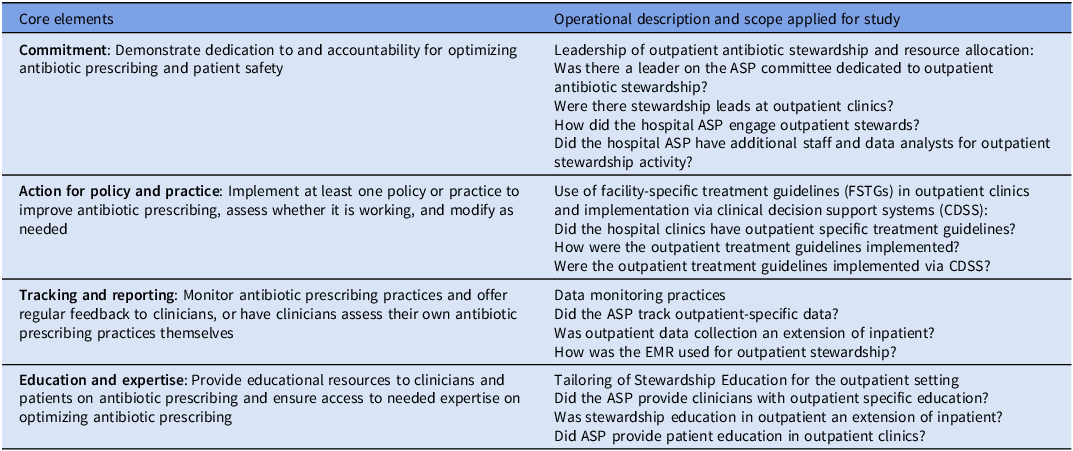
We developed and pilot tested an interview guide (Supplementary File 2) based upon the four CDC Core Elements of Outpatient Antibiotic Stewardship: (1) Commitment; (2) Action for Policy and Practice; (3) Tracking and Reporting; and (4) Education and Expertise. Reference Sanchez, Fleming-Dutra, Roberts and Hicks5 Table 1 provides a brief description and operational explanation of each element as it pertains to this study. Interview questions explored the extent to which hospitals implemented antibiotic stewardship practices tailored to HOPDs, or whether inpatient practices were implemented in HOPDs. The interview guide included probing questions related to funding for outpatient stewardship, and the role of existing guidance and requirements. Pilot test participants were not included as study participants.
Core elements for outpatient stewardship and operational descriptions

Table 1. Long description
The table presents core elements of outpatient antibiotic stewardship, including Commitment, Action for Policy and Practice, Tracking and Reporting, and Education and Expertise. It details operational descriptions and scope applied for the study. Commitment involves leadership and resource allocation for outpatient antibiotic stewardship, with questions about the presence of leaders and engagement of outpatient stewards. Action for Policy and Practice includes implementing facility-specific treatment guidelines and clinical decision support systems. Tracking and Reporting focuses on monitoring antibiotic prescribing practices and data monitoring. Education and Expertise involves providing educational resources and expertise on antibiotic prescribing. The table also includes interview questions to assess the implementation of these practices in hospital outpatient departments.
Qualitative interviews
A contracted PhD trained professional qualitative researcher (MK) conducted 28 interviews with ASP leaders from August to November 2023. Interviews were conducted virtually, lasted approximately 60 minutes and in addition to field notes, were recorded and professionally transcribed. To encourage open discussion, the interviewer started each interview remarking that he was an independent consultant and TJC maintains a firewall between its research department and accreditation programs, and no data would be shared with anyone outside the immediate study team.
Data analysis
We used MAXQDA 2022 (VERBI Software, 2021) for data analysis. 11 After independently reviewing three transcripts, two analysts (MK and SC) agreed on a system for indexing before dividing up remaining transcripts. We used the Framework Method Reference Spencer, Ritchie, Lewis and Dillon12 and organized participating hospitals into rows and categories of information into columns (Supplementary File 3). The categories used in the matrix evolved throughout analysis allowing for additional insights. While analyzing transcripts, researchers kept memos regarding themes and patterns. MK and SC met weekly to discuss the memos and content for each category, re-reviewed the data in cases of any differences and reached consensus for the final matrix. We summarized the findings in relation to hospital size and system membership and performed the Fisher’s exact test for count data as appropriate for small samples.
Results
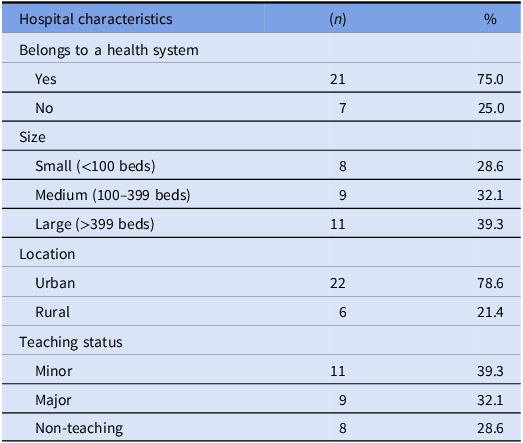
A total of 54 hospitals completed the screening questionnaire, 19 were ineligible, and 28 agreed to participate. Most participating hospitals (n = 22) belonged to a healthcare system and had an urban location (Table 2). We interviewed 42 ASP leaders. Most respondents were pharmacists with infectious disease (ID) specialization (n = 18), physicians with ID specialization (n = 11), or clinical pharmacists or physicians with no ID specialization (n = 11).
Characteristics of hospitals that participated in the study (N = 28 hospitals)

Table 2. Long description
The table presents data on the characteristics of 28 hospitals that participated in a study. It includes columns for hospital characteristics, the number of hospitals, and the percentage. The characteristics listed are whether the hospital belongs to a health system, its size, location, and teaching status. For health system affiliation, 21 hospitals (75 percent) belong to a health system, while 7 hospitals (25 percent) do not. In terms of size, 8 hospitals (28.6 percent) are small with fewer than 100 beds, 9 hospitals (32.1 percent) are medium-sized with 100 to 399 beds, and 11 hospitals (39.3 percent) are large with more than 399 beds. Location-wise, 22 hospitals (78.6 percent) are in urban areas, and 6 hospitals (21.4 percent) are in rural areas. Regarding teaching status, 11 hospitals (39.3 percent) have a minor teaching status, 9 hospitals (32.1 percent) have a major teaching status, and 8 hospitals (28.6 percent) are non-teaching.
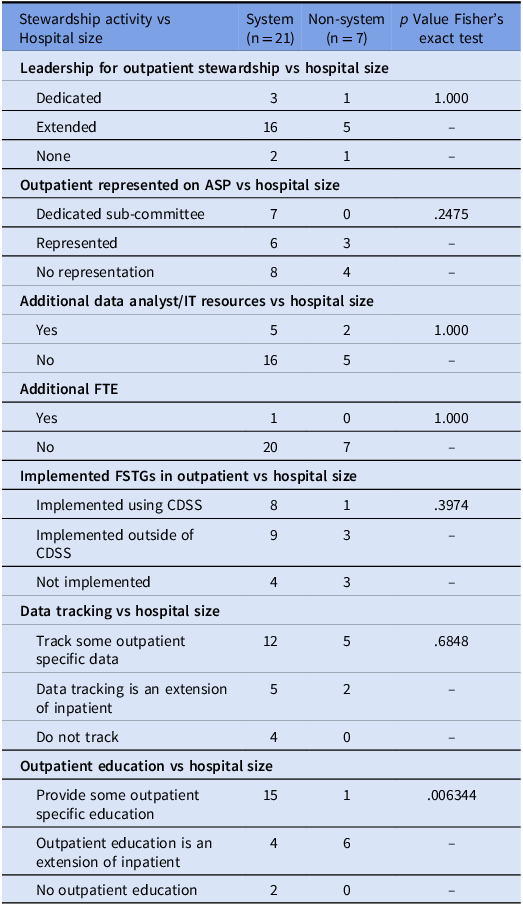
Study findings are organized based on the four Core Elements. For each, we focus findings on whether hospitals had developed practices specific to outpatient clinics or whether outpatient stewardship activities were extensions of inpatient efforts without accounting for relevant differences between inpatient and outpatient settings. A summary of findings is provided in Table 3, and findings according to hospital size and system membership are provided in Supplementary File 4 and Table 4. According to the Fisher’s exact tests, hospital size did not impact any stewardship activity examined (Supplementary File 4). We therefore do not emphasize hospital characteristics in describing findings related to each Core Element. System membership was significantly related to whether hospitals provided HOPDs with outpatient-specific education.
Summary findings

Table 3. Long description
The table presents study findings on outpatient stewardship activities in hospitals, structured around four core elements. It focuses on whether hospitals developed specific practices for outpatient clinics or extended inpatient efforts without considering relevant differences. The table includes a summary of findings and examines the impact of hospital size and system membership on these activities. Notably, hospital size did not significantly affect any stewardship activity, while system membership was related to the provision of outpatient-specific education. The table provides insights into the implementation and effectiveness of outpatient stewardship practices across different hospital settings.
a. CDC Center for Disease Control and Prevention.
b. ASP Antimicrobial Stewardship Program.
c. IT Information Technology.
d. FTE Facility-specific treatment guidelines.
e. ID Infectious Diseases.
f. CMO Chief Medical Officer.
g. HOPDs Hospital Outpatient Departments.
h. We operationalized ACTION to include only FSTG implementation. Other interventions including PAF, preauthorization, measuring days of therapy (DOT) or defined daily dose (DDD) per 1,000 patient days were addressed specifically as challenges to implementing hospital-based interventions in outpatient settings.
i. CDCC Clinical Decision Support System.
j. HER Electronic Health Record.
k. FSTG Facility Specific Treatment Guidelines.
l. Abx Antibiotic.
m. AHRQ Agency for Healthcare Research and Quality.
n. COPD Chronic Obstructive Pulmonary Disease.
Outpatient antibiotic stewardship by system membership

Table 4. Long description
A table comparing outpatient antibiotic stewardship activities between system and non-system hospitals, categorized by hospital size. The table includes data on leadership for outpatient stewardship, outpatient representation on ASP, additional data analyst resources, additional FTE, implementation of FSTGs in outpatient settings, data tracking, and outpatient education. It lists the number of system and non-system hospitals for each category and provides p-values from Fisher’s exact test to indicate statistical significance. Notable trends include significant differences in outpatient-specific education provided by system versus non-system hospitals.
Commitment: Leadership structure and commitment to antibiotic stewardship in HOPDs
ASP leadership and staffing for HOPDs
The same individuals typically led inpatient and outpatient stewardship activities (n = 21, 75%). Only four (14%) hospitals had a dedicated HOPD stewardship leader. In twelve (43%) hospitals, the ASP committee had no representation from HOPDs. In nine (32%) hospitals, the ASP committee included representative(s) from HOPDs, and seven (25%) hospitals had a dedicated HOPDs sub-committee (Table 3).
Nearly half (n = 13, 47%) of participating hospitals had a designated stewardship leader at any of their HOPDs. Only one respondent indicated that their hospital had an individual with a formal antibiotic stewardship role for HOPDs. In less than half of the hospitals (n = 12, 43%), ASP leaders collaborated with a “point person” from the HOPDs (eg, physician champion) to oversee and monitor outpatient antibiotic stewardship activities, disseminate educational information, provide physician report cards, and represent HOPDs on hospital ASP committee. Only one hospital (4%) provided additional FTE pharmacist staff for expansion into HOPD stewardship. Seven (25%) provided additional data analyst/IT staff who assisted in collecting and reporting outpatient data and dashboard development.
Drivers and funding for expansion to HOPDs
Key drivers for expansion of antibiotic stewardship into HOPDs included Joint Commission standards, CDC Core Elements, and the need for continuity of care. Clinical interest and recognition of the high volume of antibiotic prescribing in outpatient settings were also key drivers. Drivers influenced the design and implementation of stewardship activities, prioritization of initiatives, resource allocation, and development of targeted interventions. Several hospitals had received grant funding to expand stewardship efforts to HOPDs. Examples included health department funding for stewardship in pediatric HOPD, or to examine prescribing patterns, and a CDC funded grant for expansion of one hospital’s inpatient stewardship activities to all HOPDs. Some hospitals received “discretional and sporadic” internal funding to expand staffing to implement stewardship in HOPDs. This included executive support for IT/data analyst assistance to enable data collection via the electronic health record (EHR) for HOPDs in two hospitals.
Action: Antimicrobial stewardship activities implemented in HOPDs
Types of HOPDs involved in stewardship efforts
Hospitals implemented antibiotic stewardship activities in seven types of HOPDs: primary care (23), urgent care (15), emergency department ED (13), specialty care (12), surgery centers (8), wound care (3), and dental clinics (2). When ASPs focused on only one type of clinic, nearly all were primary care.
Implementation of facility-specific treatment guidelines (FSTGs) in outpatient settings
Nine (32%) hospitals implemented outpatient related facility-specific treatment guidelines (FSTGs) via clinical decision support systems (CDSS). Twelve (43%) hospitals had outpatient-specific FSTGs not integrated with CDSS, while seven (25%) lacked FSTGs entirely (Table 3). Hospitals used a variety of approaches to providing clinical support. In one instance, the ASP included separate antibiograms for HOPD sites, empiric therapy guidelines, and dosing guidelines for pediatrics embedded into the EHR. Conversely, other hospitals implemented organizationwide EHR pathways for both inpatient and outpatient care. Other HOPDs utilized different EHR systems where pathways extended only to EDs; in some cases, outpatient settings had pop-ups, alerts or non-mandatory CDSS, and certain hospitals relied on guideline booklets or information sheets provided by the ASP.
Tracking and reporting: Data collection and monitoring of antibiotic use
In seventeen (61%) hospitals, ASP leaders collected and reviewed data for specific HOPDs including ED, urgent care centers, and primary care settings. Data monitoring practices included tracking specific antibiotic use (eg, clindamycin, prescriptions related to specific common conditions) and developing clinician dashboards to facilitate report access and comparisons among clinicians or clinics. In seven (25%) hospitals, data tracking in HOPDs was an extension of inpatient data collection (Table 3). However, this tracking was sometimes based on inpatient FSTGs, or specific conditions considered priorities for inpatients, (eg, Clostridioides difficile or prescriptions for broad-spectrum antibiotics). In ten (36%) hospitals, prescribing clinicians were required to provide indications along with prescription orders, which enhanced monitoring of inappropriate prescriptions.
Education
In sixteen (57%) hospitals, ASP leaders provided clinicians with outpatient-specific education. Stewardship education for HOPDs was an extension of inpatient education in 10 (36%) hospitals, while two (7%) hospitals did not provide stewardship education for HOPDs (Table 3). Only one of seven non-system hospitals had implemented outpatient-specific education programs and hospital system membership was associated (p = .006) with providing outpatient-specific education (Table 4). Clinic-specific education efforts typically focused on antibiotic prescribing practices for common outpatient conditions. Online modules were commonly used, regardless of whether education was specific to outpatient or an extension of inpatient activity. outpatient-specific education efforts included newsletters, peer comparison emails or physician report cards, in-person presentations at clinics (sometimes using specific office data), grand rounds, and monthly meetings.
Challenges of implementing hospital antibiotic stewardship interventions in HOPDs
The most frequent challenges reported were clinical and operational differences between inpatient and outpatient settings (n = 23); staffing limitations (n = 23); interpreting inpatient requirements for outpatient implementation (n = 18); and EMR capability and availability of IT resources (n = 9).
Several participants mentioned they would like greater clarity on the requirements and expectations. For example, is it necessary to allocate separate staff for HOPD stewardship activities and if so, how much? Should investment in technology for HOPD stewardship be integrated with hospital ASP technology investments? Should HOPDs accredited under the hospital program have different FSTGs, goals, and adherence measurements unique to the HOPD?
Differences between inpatient and outpatient settings
Inherent workflow differences between the inpatient and outpatient settings presented a common challenge (n = 23, 82%) to extending hospital antibiotic stewardship in HOPDs. HOPD-specific factors that impacted effective implementation included fast-paced patient care processes, very high patient volumes, high numbers of antibiotic prescriptions, and involvement of community pharmacy and/or laboratories.
Staffing limitations
ASP staffing resources were often (n = 22, 80%) inadequate to effectively expand to HOPD stewardship and respondents highlighted the need for dedicated pharmacists and data analysts. In most cases, hospital ASPs had no staff in formal stewardship roles in HOPDs. To help alleviate resource limitations, some ASPs leveraged pharmacy students and volunteer clinician champions within HOPDs to implement interventions. In some cases, hospital ASP leaders delegated their inpatient stewardship roles to an inpatient clinician pharmacist to enable expansion of stewardship into HOPDs. Nevertheless, resource limitations for stewardship activities, while more dire for HOPDs, were not unique to outpatient settings with several respondents highlighting funding challenges in general.
Interpreting inpatient requirements for outpatient implementation
Many respondents expressed confusion related to whether and how ASPs were expected to implement stewardship interventions developed in response to hospital accreditation requirements in outpatient settings. Typically, ASPs do not differentiate stewardship activity in outpatient settings based on regulatory requirements between the hospital and specific clinics. In cases where HOPDs did not have outpatient-specific guidelines (n = 7, 25%), implementation of organizationwide guidelines typically reflected hospital priority conditions, yet antibiograms and priority conditions may differ between the hospital and its HOPDs. A similar concern related to instances where the stewardship education provided was an extension of inpatient clinician education (n = 11).
EHR and IT limitations
Some hospitals had an advanced outpatient EHR that required indications (n = 9, 32%). This applied to EDs (n = 2) or specific conditions (n = 2). In many cases, the HOPD EHR was separated from hospital EHR and did not require clinicians to provide diagnosis indications for prescriptions (n = 19, 68%). Hospital ASPs typically had no access to real-time data from HOPDs and no staff to assist with data monitoring and reporting (n = 21, 75%) resulting in failure to develop outpatient-specific data-driven initiatives.
Applicability of effective interventions related to inpatient requirements
Almost all respondents (n = 27, 96.4%) noted implementing prospective audit and feedback (PAF) and preauthorization in HOPDs (outside of the ED) was not feasible or very difficult due to fast-paced care, outpatient workflow, or lack of timely access to outpatient prescription data. Many ASPs instead retrospectively monitored antibiotic prescribing and provided quarterly feedback to clinicians. In some cases (n = 5), EHR alerts and preauthorization were implemented for specific medications and the ASP lead provided consultation when available. Almost all respondents noted that measuring days of therapy (DOT) or defined daily dose (DDD) per 1,000 patient days was relevant for inpatients but not applicable for outpatient settings.
Discussion
CMS requires HOPDs to adhere to hospital accreditation requirements for antibiotic stewardship. 7 Experts recommend that the CDC Core Elements serve as the foundation for developing and expanding antibiotic stewardship activities in outpatient settings. Reference Sanchez, Fleming-Dutra, Roberts and Hicks5,Reference Eudy, Pallotta and Neuner13 Our results suggest hospital ASPs typically do not receive additional funding for expansion into HOPDs.
The CDC Core Elements describe Commitment as demonstrating dedication to and accountability for optimizing antibiotic prescribing and patient safety. Reference Sanchez, Fleming-Dutra, Roberts and Hicks5 Our findings show most hospitals rely on the same individuals to manage both inpatient and outpatient stewardship. The absence of dedicated leadership and additional staffing often limits the implementation of effective practices in HOPDs. Other studies have noted staffing challenges Reference Nelson, Narayanan, Onguti, Stanley, Newland and Doernberg14,Reference Greene, Nesbitt and Nelson15 ; however, recommendations typically focus on acute care settings. Reference Doernberg, Abbo and Burdette16,Reference Echevarria, Groppi and Kelly17 Our findings underscore the necessity of dedicated staffing for HOPDs.
Current recommendations indicate that FSTGs should emphasize common disease-causing pathogens across various hospital units. Reference Sanchez, Fleming-Dutra, Roberts and Hicks5,Reference Trivedi, Seo and Samore18–Reference Amin, Dellinger and Harnett20 An equally important insight to note, however, is the nature of implementation. Implementation of FSTGs in HOPDs was typically not sophisticated yet use of CDSS can help improve adherence with treatment guidelines and enhance data collection. Reference Kuper, Nagel, Kile, May and Lee21–Reference Dzintars, Fabre and Avdic25 Developing and maintaining EHRs to effectively implement CDSS has significant financial implications in all settings; investment in outpatient EHRs and innovative methods for distributing guidelines in outpatient settings is crucial for expanding ASP activities effectively in these environments.
Regarding the Core Element on systematic monitoring of prescribing practices, our findings indicated that while most hospitals were collecting outpatient-specific antibiotic use data, there are concerns when outpatient data collection was an extension of inpatient activity despite differences in priority conditions. Including high-priority local conditions in goal setting and data tracking for HOPDs would positively impact performance improvement for HOPDs.
The practice of extending hospital-based stewardship activities to outpatient settings, without addressing specific outpatient needs, was also noted for education interventions. It is recommended that education on appropriate antibiotic use encompass patients and family members to enhance health literacy and support initiatives for optimizing antibiotic use. Reference Sanchez, Fleming-Dutra, Roberts and Hicks5 Clinician education tailored to FSTGs for common outpatient conditions, which also includes strategies for communicating with patients are important for fostering appropriate prescribing practices. Reference Sanchez, Fleming-Dutra, Roberts and Hicks5,Reference Butler, Simpson and Dunstan26–Reference Harris, MacKenzie and Leeman-Castillo28 The involvement of patient education in antimicrobial stewardship activities may be a more critical intervention component in outpatient settings. Our findings align with previous studies which highlighted the lack of fully functioning ASPs in HOPDs Reference Eudy, Pallotta and Neuner13 even among health systems with robust antibiotic stewardship activity. Reference Weinstein, Buckel, Stenehjem, Hersh, Hyun and Zetts29 Other experts outlined approaches for health system-led outpatient stewardship activities. Reference Rodzik, Buckel and Hersh30
It is important to understand our findings in context of existing guidance and requirements. Including HOPDs under hospital requirements, as required by CMS, may mask inadequate funding and suboptimal antibiotic management in HOPDs, particularly when activities are an extension of inpatient efforts. In addition to having a less sophisticated EHR, lack of funding for expansion of stewardship into outpatient settings affects the ability of ASPs to have additional FTE, access to data analysis and IT staff, and formalized stewardship leads at HOPDs. This further impacts the ability of ASPs to develop outpatient-specific guidelines, set outpatient-specific goals, and data tracking for performance improvement.
Limitations
There are several limitations associated with this study. First, while we included a cross section of hospital types and sizes, the results cannot be broadly generalized. The interviews were designed to provide information related to challenges associated with implementing antibiotic stewardship in HOPDs. Second, we only included hospitals that had implemented antibiotic stewardship in HOPDs, potentially introducing selection bias toward better resourced hospitals. The study design also relied on self-reported data, not independently verified. Third, only 54 out of 288 hospitals responded to the screening questionnaire. It is, however, notable that 28 out of 35 eligible hospitals agreed to participate and we reached saturation before stopping recruitment. Lastly, all hospitals were accredited by the Joint Commission; therefore, it is possible that some respondents may have been reluctant to candidly share information with the researchers.
Conclusion
This study underscores the importance of recognizing the unique attributes of HOPDs when developing and implementing ASPs. Our findings indicate the need for organizational investment in outpatient stewardship. Having outpatient stewardship leaders and staff, developing outpatient-specific FSTGs in the EHR, systematic monitoring of conditions local to HOPDs and providing outpatient-specific education would improve implementation of antibiotic stewardship in relation to each of the four Core Elements.
Supplementary material
The supplementary material for this article can be found at https://doi.org/10.1017/ash.2026.10417.
Acknowledgements
The authors are sincerely grateful to all hospital staff who pilot tested the interview guide or participated in the project. We thank members of the technical advisory panel: Lisa Davidson MD; Lauri Hicks DO; Katie Suda PharmD, MS; Sarah Keller MD, MPH, MSHP; Lisa Dumkow PharmD; Jeffery Gerber MD, PhD; Elizabeth Walters DNP; Michael J. Smith MD; Holly Frost MD; James Keegan MD. We also thank Tasha Mearday, BS, for data collection and editorial assistance, and Christina Cordero, PhD and Laura Smith, BSc for their insights related to accreditation requirements.
Financial support
This project was supported in part by The Pew Charitable Trusts. Contract ID: 36132
Competing interests
None.
Disclaimer
The findings and conclusions in this manuscript are those of the authors and do not necessarily represent the official position of The Joint Commission.



 Open access

