





Impact Statement
Decarbonization, clean energy and efficient land use are the areas that have major attention all over the globe, and FSPV is one of the most important systems that solve these problems. Analyzing the technological domain of FSPV can help in the deployment of correct type of FSPV structures and optimizing the energy generation per unit area. In addition, different environments demand different setups, and different challenges require different mitigation techniques. India has a large diversity of environmental conditions, and it is wise to tweak the system accordingly to get the optimized result. Major challenges include the stability of the FSPV system during harsh climatic conditions in open sea and long-lasting of the pivot system, reduced efficiency due to excessive heating and hotspots, corrosion due to high moisture content and transmission system stability connecting the FSPV system to the grid. FSPV system will affect the natural flora and fauna of the surroundings. Electrical components of FSPV system like combiner box and inverters contributes a lot in generating power efficiently and these components have a scope of delivering highly efficient power conversion.
Introduction
The sun is the prime source of our existence. All the energy sources available to us originate from the sun. In recent years, the huge potential of solar energy has been discovered and since then the development of solar photovoltaic (PV) has been on an exponential rise. The energy must be harnessed with the maximum capacity possible as it has numerous advantages over any conventional source. Fossil fuels are a long-term preserved solar energy, which the floral species of the planet stored within itself. The rate of depletion is gigantic when compared to the rate of formation, which will result in a complete depletion in a very short span of time. Besides, the dependency of humans on external resources is increasing at a pace. Nuclear power packs a large amount of energy in a small space. Secure and safe operation in nuclear power generation is challenging. Hydro power, despite being renewable and clean for the air, has a consequence in localized aquatic terrestrial lives. High-head dams pose a high risk of breakage, causing severe flood loss in low-lying areas. Although hydro has a high future scope, all the risky parameters cannot be neglected. With all the facts, it is feasible to use solar power for the generation of energy and increase its scope from a future perspective. This demands detailed research into the topic. For harnessing solar power directly, solar thermal and PV are the two generalized methods used commercially. Solar thermal technology uses the heat from the sun to convert water into steam, which is used to run turbines. The PV system uses a semiconductor material which produces free electrons when the light radiation is incident on it. Figure 1 shows the merits and demerits of floating solar photovoltaic (FSPV) systems. The most commercially used material is silicon in its monocrystalline form. Other materials used as a solar cell are III–V semiconductor (an alloy of group III and V of the periodic table in its zinc blend crystalline structure), copper indium gallium di-selenide (CIGS), amorphous-silicon (a-Si), cadmium telluride (CdTe), dye-sensitive solar cell (liquid dye placed in between titanium(IV) oxide with the principle analogous to conventional fuel cell except its activation process through light radiation), perovskite (a compound containing divalent and tetravalent elements as positive ions and halogens or oxygen as negative ions), organic solar cell and graphene solar cell. Researchers are still exploring the above options for enhanced efficiency of the cell (g2voptics.com, 2019).
Advantages and challenges associated with floating photovoltaic system,

The generation of electricity to meet most of the demand through solar energy requires large-scale installation of solar cells. Several different solar cell structures are being used based on their position and environment. These include land-based PV (LBPV), building-integrated PV (BIPV), concentrator PV (CPV), and floating solar PV (FSPV). LBPV is the installation of PV cells in a strong structure placed in the land where there is an ample amount of solar radiation throughout the year. LBPV can be on agricultural land, deserts, or mountain terrain. LBPV is easy to install and grid connection is easy, but it suffers from shading, rise in temperature and high cost of land (Kofi et al., Reference Kofi2024). BIPV is a more localized and discrete method to generate electricity. The solar cell is placed on the external surface of a building. A rooftop solar cell is a type of BIPV where the roof of the house or building, where the sun’s radiation is sufficient, is covered with solar cells. BIPV. Buildings can be utilized to achieve net zero electricity utilization by installing solar cells on roofs, balconies, external walls, shutters, awnings, keeping the slope or without the slope as per the requirement for optimization of output power (Bhattacharya et al., Reference Bhattacharya, Sadhu and Sarkar2023). FSPV is the integration of solar cells with the surface of water bodies. Unequivocally, the water bodies can be of any variant, whether it be fresh water, salt water, wastewater or even flowing water. FSPV can be placed either on the shore or away from the shore. It has several advantages over LBPV, but the most significant being no involvement of land. Also, efficiency is enhanced as the temperature of FSPV remains low compared to LBPV at the same location. Efficiency is inversely proportional to the ambient temperature (Dwivedi et al., Reference Dwivedi, Sudhakar, Soni, Solomin and Kirpichnikova2020).
This paper is an attempt to accumulate all the commercial and laboratory technology involved in FSPV. Several researchers have accumulated FSPV potential and its benefits vastly, based on some significant coordinates or the type of waterbody being used in the generation. A review on FSPV system utilization in India, where the land is mostly habitable and has a significant role in the day-to-day survival of huge population, has been elaborated in Sahu et al. (Reference Sahu, Yadav and Sudhakar2016). Onshore and offshore salt water FSPV has tremendous scope in India, but the arrangement must be tuned as per the environmental necessity. Crystalline-Si modules are more prone to degradation in high-moisture environments and extreme conditions. Another group of researchers have clearly mentioned all the trade-offs between decarbonization, scope of PV and FSPV, and limitations of their usage for sustainable natural ecosystem (Almeida et al., Reference Almeida, Schmitt, Grodsky, Flecker, Gomes, Zhao, Liu, Barros, Kelman and McIntyre2022). FSPV is preferable, despite its very low usage to date, as it omits all negative aspects of land, such as acquisition and high temperature. A sustainable band of trade-offs is developed between marine, aquatic and human lives getting benefited from low evaporation loss, low algae growth and increased power generation while preserving and keeping nearby ecosystems undisturbed. A 10% reservoir covering would increase power generation significantly and will not significantly alter the local or global ecosystem. Another similar review in FSPV is presented with a different perspective of Chinese researchers. It shows that FSPV is majorly developed in Southeast Asia including South and East Asia and Europe. China has seen a rapid boom in FSPV generation due to factors like rapid increase in energy demand, decarbonization and exponential development in technology (Xiong et al., Reference Xiong, Le, Zhang, Ding and Li2023). A review paper where all aspects of FSPV are considered separately by a collaboration of researcher from UK, Australia and Germany shows that there is an exponential rise in research publication recently as the clean energy demand shoots. The high energy demand demands the use of waterbodies for rapid results and latest modular approach to deploy FSPV setup with light and highly durable material, high-efficient semiconductor device and high energy generation per unit area with all necessary environmental protection devices that can enhance the productivity and reliability of FSPV system as well as keep a sustainable natural ecosystem (Wei et al., Reference Wei, Khojasteh, Windt and Huang2024). Besides, a researcher from Iran has published the FSPV advantage for arid and semi-arid regions in the reduction of evaporation loss from freshwater bodies and the generation of electricity with high efficiency due to natural cooling from the water beneath the array. It includes the consideration of electrical systems along with the more emphasized mechanical systems (Ranjbaran et al., Reference Ranjbaran, Yousefi, Gharehpetian and Astaraei2019). The interconnection of PV array must be done in a way that most of the electrical energy can be utilized. Several already known interconnection circuits such as series–parallel connection (SP), cross ties (CT), honeycomb (HC) and bridge link (BL) ties. Each circuit has different benefits for a small area PV array system, and proper choice must be made according to the conditions involved. A review paper of FSPV took extra care for proper grounding of the electrical system as the waterbodies are good conductors. The resistance of each layer of water must be calculated according to the temperature and then the total resistance will determine the grounding position of FSPV (Madhubabu and Rao, Reference Madhubabu and Rao2021). The review on the productivity of FSPV and the materials used to design a robust floating system is also discussed in detail. The floating structure made of plastic or stainless steel can last a long span of saltwater exposure as well as high temperature variation (Krishnaveni et al., Reference Krishnaveni, Anbarasu and Vigneshkumar2025).
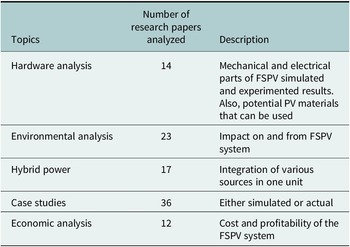
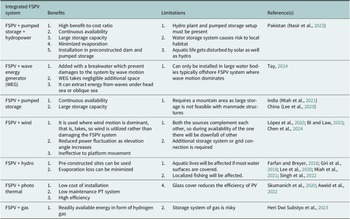
The tabular representation of the advantages and challenges of FSPV system shown in Table 1 can throw a brighter light in the technical demonstration of the system. The literature survey to develop the content of this paper has been done through all renowned publishers. A categorized list of research papers on all aspects of FSPV is shown below in Table 2. Bibliometrics study represents the well-defined concepts with cleaner and more arranged data, which is significant for paving a new path in any field (Jornsanoh et al., Reference Jornsanoh, Vorarat, Tantawat and Rittidatch2023).
Advantages and challenges of FSPV system

Topic-wise research paper weightage of bibliometrics present in this paper

The purpose of this paper is to accumulate all the information in this field and declutter to provide a better view of the subject to a reader. It is seen that very few papers all over the internet contain technical, economical as well as case studies and integration potential of renewable energy sources all at one place and compares different advancements in the field and provide a better understanding and optimal usage based on the location, availability and demand. A detailed review of the design of the FSPV system is discussed in Design overview on hardware setup section. The materials used for the conversion of energy, the structure to hold the panel in its place even in adverse environmental conditions, and electrical circuitry used in the system are attempted to assemble in one place. It is followed by the environmental impact on the FSPV system and the FSPV impact on the local ecosystem detailed in Environmental interaction with FSPV system section. Integration of other energy sources with FSPV section consists of increasing the productivity of FSPV by integrating it with different renewable sources and its benefits and drawbacks. The most suitable hybrid electricity generation system will be inferred based on data from several different sources. Further detailed case studies from various locations throughout the world will be analyzed in Case studies involved section for the complete study on the behavior of the FSPV system and scope of technological advancements. Lastly, a discussion followed by a conclusion will provide a clear picture of the whole analysis.
Design overview on hardware setup
The design of the FSPV system contains all the components involved for the generation of electricity. These components can be categorized as mechanical support, PV material, or electrical circuit for transmission of generated power to the desired location. First and foremost, the mechanical structure consists of a hard protective casing of PV, a frame in which it floats, the pivoting device by which it stays in position, interconnection of large array of PV with each other through various mechanical connectors and several other protective devices to increase the reliability of the system during harsh environmental condition. The PV material is the most significant part of any PV system design. Conventionally, a silicon crystalline structure is used, but all the possible materials and their pros and cons will be listed in this section.
Electrical components play a vital role in determining the system’s efficiency. As the irradiance of the sun varies in a wide range, electricity generation varies quite a lot. So, it must be converted to specific parameters to be utilized efficiently. The following is the list of possible hardwares involved in FSPV system:
-
1. PV module
-
2. Pontoon
-
3. Anchor
-
4. Mooring cable
-
5. Electric cable
-
6. Combiner box
-
7. Inverter
-
8. Lightning arrester
-
9. Storage system/Transformer
Figure 2 visualizes the components of FSPV systems. A PV module is a semiconductor material which converts light energy to electrical energy. Pontoons are frames which load PV modules in them so that they can float in the water. It has two main components, namely floaters (increases buoyancy) and connectors (to join other arrays together). Anchor points are necessary to keep the PV system in its place; else the winds and waves would flow them to ditch. Generally, freshwater anchor points are located on the land near the water body, but it can also be placed on the seabed. The cable which joins anchor points to the FSPV system is called mooring cables. It must have high tensile strength and long-lasting so that the reliability of the system is increased. It is the most important part of the mechanical strength of the system as it experiences continuous stress from the waves and tides.
FSPV system components (AFP, 2023; Huang et al., Reference Huang, Tang, Chen, Chen and Jiang2023).

The electricity produced at the PV panel must then be transmitted to the load location. But PV panel is a current source, and all the loads connected to the system are voltage dependent. So proper tuning of the generated power is required before the utilization of the load. This demands a converter circuit which converts DC voltage to stable AC voltage. This is done through an inverter circuit. It is the main part of the electrical system. If all the solar PV modules are connected directly to the inverter, it would make the circuit clumsy and turning off the system would be complicated. So, a combiner box is placed for each panel, which inputs from the panel and provides the combined electricity from one wire to the inverter. Also, devices for overcurrent protection like a fuse and other protective devices and monitoring sensors are placed to make the system more robust. Electric cables for the FSPV system are always exposed to water, so it must be highly insulated. Lightning arrester is a protective device that captures lightning arc and grounds it properly, keeping the system safe from this surge. Storage system is a necessity for the standalone FSPV as sun can provide energy only during daytime so unless we store the energy, the system cannot be considered independent.
Overview on PV materials
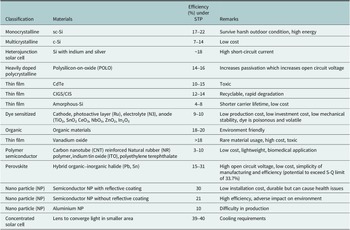
The conventional, non-conventional and potential materials that are being used for PV or can be used to enhance efficiency of the system are listed in Table 3 (Dada and Popoola, Reference Dada and Popoola2023).
Classification of different types of PV materials (inspired by Dada and Popoola, Reference Dada and Popoola2023)

Recent evolution in the type of material and its low cost of installation has played a significant role in advancement. The use of bifacial solar cells can help increase the efficiency of the c-Si cells up to 22%. It also captures the reflected light during active hours. Thus, productivity increases while using the same area (Avasthi et al., Reference Avasthi, Garg and Mahajan2024). The combination of conventional PV with a low-cost thin film on the backside of the rigid panel of FSPV system can be beneficial as the reflective property can enhance efficiency by a lot. A similar type of work is carried out where East–West bifacial panel is used in FSPV system and simulation results determine the accuracy of results (Amr Osama et al., Reference Amr Osama, Mannino, Cucuzza and Bizzarri2024).
Table 2 shows various materials that are being used as a PV cell. Conventional cells use multi-crystalline Si cells as they are inexpensive and have average efficiency. But it is seen that bifacial solar cells are by far the most advantageous as they generate more energy from the same area. According to the author, the most promising solar cell for FSPV system can be a bifacial PV where one side can be fitted with conventional multi-crystalline silicon and the back side can be fitted with perovskite layer or nano particle layer. Additionally, reflective surfaces can be installed for the backside. These materials can be used where the environmental temperature is on the higher side, that is, equatorial region. For high-altitude areas or polar regions, the best-suited solar cell is concentrated solar cell using focused converged sunlight to generate electricity.
Mechanical structural support system
The structure of the FSPV system varies a lot as compared to conventional LBPV. As land requires the structure to be properly aligned in the sun’s direction while protecting it from strong winds. The FSPV system is placed in water above the floating structure tied properly to the fixed anchor points. Mooring is a trivial word used in boats and ships, and this technique is replicated for the FSPV system. Extra care must be taken in case of FSPV mooring because the system is lightweight and should not flip or submerge in water. Moreover, mooring is quite easily done in freshwater or stagnant water, but it has proved to be the toughest challenge in seas and oceans. Figure 3 shows the adaptive mooring system for higher stability of the FSPV systems. The cable tied to the anchor points must be flexible enough to withstand high tide and low tide conditions. Mooring techniques have been studied by several researchers in different water bodies. In small lakes and even large lakes, wind load dominates the force exerted in the mooring system but for the offshore sea condition, wave load dominates the wind load. Another type of load exerted on the system is the current load. It is seen that offshore system experiences load way more than fresh water. The ratio of load to total capacity of the system would be breakeven for large projects offshore (Ikhennicheu et al., Reference Ikhennicheu, Danglade, Pascal, Arramounet, Trébaol and Gorintin2021). Mooring technique is determined by analyzing the load experienced by the system. For low loads, wires or cables can be used, or chains can be used otherwise.
Representation of the mooring system of FSPV (Zeng et al., Reference Zeng, Bi, Dharma Sree, Zhang and Law2023).

Module size and hinge coefficient are the two parameters that play a very vital role in determining the proper mooring technique for any FSPV system. Smaller module size experiences high pitch motion and the first floater dissipates most of the wave energy and more specifically, the first hinge connector comes under most pressure. Several accessories must be added to nullify the wave motion response in FSPV system (Zheng et al., Reference Zheng, Jin, Huang, Zhou, Xiang, Zhou and Huang2024). The module size impacts wave motion and can be devastating when pitch motion is at resonant frequency. The adaptive barrier mooring system is described as a method to withstand loads. This method uses flexible anchor points due to additional weights in the mooring cable which is placed at the front end of the floater. This technique will adjust mooring cable to retain the tight position at low tide and high tide and generate additional energy from wave energy converters (Zeng et al., Reference Zeng, Bi, Dharma Sree, Zhang and Law2023). Conventionally, pontoons are directly fixed to the anchor points by cables. This mooring technique provides rigidity but as the water level rises and falls, the cable experiences a lot of pressure. To design a more robust system, a pivot-less tracking-type mooring system is proposed in (Jee et al., Reference Jee, Noh, Kim and Lee2022). The pontoon is connected to the mooring floater, which is anchored to the fixed point under the waterbed through a buoy material to provide the necessary stretch to the cable. For increasing the stability of the floater, a sinker is attached to it. This restricts the movement of the system to confined area, hence increasing productivity.
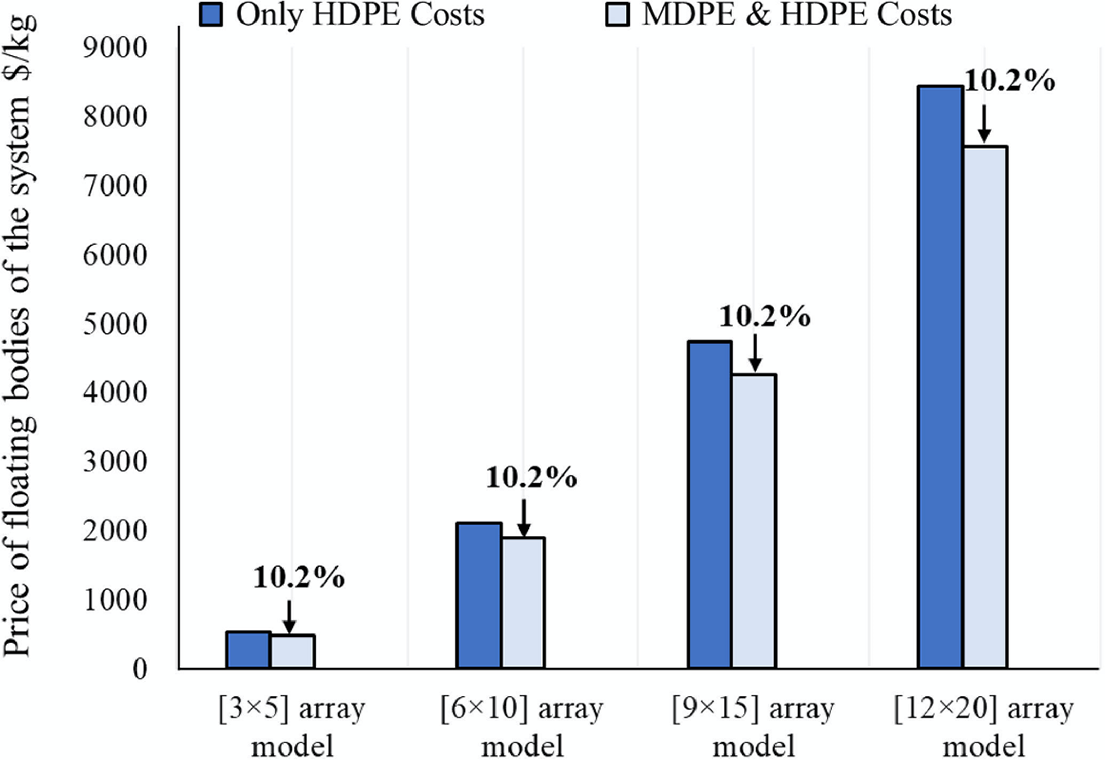
The best suited material for floaters is high-density polyethylene (HDPE) as it is low cost and can be easily manufactured. Moreover, due to excessive exposure to UV radiation, aging does not have a devastating effect on the material. The strength is reduced by a third after 1000 h of accelerated UV radiation (Sahu and Sudhakar, Reference Sahu and Sudhakar2019). Medium-density polyethylene (MDPE) with HDPE can also be used as an alternative to HDPE as it provides similar strength at a lower cost. Figure 4 compares HDPE with HDPE and MDPE cost for the floating body of the system. Another important component of the FSPV system is the breakwater. When the FSPV system is installed offshore or onshore location in the sea, the wave motion is predominant and can severely affect the system. For making a system motion proof, a breakwater is installed in the front portion of the system where the wave is hit first for the onshore condition and all around the circumference for the offshore FSPV system. This breakwater collides with the incoming waves resulting in the loss of kinetic energy in its direction. Several studies are done to simulate the result of the wave motion for better understanding of the necessity of breakwater. Breakwater can be beneficial for short waves, but it can be ineffective for long waves (Zou et al., Reference Zou, Wei, Ou, Zhang, Chu and Huang2024).
Economic effect of medium-density polyethylene in place of HDPE (Debnath et al., Reference Debnath, Hsieh, Huang, Barman and Kuo2025).

Electrical components
The electrical components are used to deliver power to the load at maximum efficiency. Cables are a very crucial part of the electrical part of the FSPV. Typically, rubber-insulated cables cannot be used in FSPV system as it will be submerged deep in the saltwater well at low temperatures, which reduces its insulation capacity and can rupture them. So, cross-linked polyethylene can provide higher durability under saltwater conditions (Rebelo et al., Reference Rebelo, Fialho and Novais2021). The cable from each module will be attached to the combiner box along with fuses to protect it from current faults. Then all the cables are bundled and then single cable with high insulation, particularly polyethylene, and connected to the central inverter. The control system of the FSPV automatically selects the requirement of generated power in the grid or for battery storage. For an intelligent control system design, a fuzzy logic controller is also used which allocates 35% extra energy for critical loads. This makes the FSPV system more independent (Mahmud et al., Reference Mahmud, Nahar, Aziz, Hasan and Uddin2021). The offshore FSPV system has modules located far away from the land. So, there are just a series parallel connection of the module in the site. From the combiner box, the cables are stretched to the shore and all the electrical components like inverter, storage system and grid connection are placed on the land. DC power is generated in solar cell which are converted to another DC level required for the smooth conversion of inverters. Also, another DC-DC conversion is required for the maximum power point tracking (MPPT) system (Hui et al., Reference Hui, Ho, Chan, Chan, Lo and Cheng2017). The MPPT system is the controlling technique to detect the parameters for generating maximum power from each module.
To achieve high reliability, the power system must have a strong monitoring system which can detect faults in a minimum time and comply with it. Internet of things (IoT) based supervisory control and data acquisition (SCADA) system is mentioned in (Abiagador et al., Reference Abiagador, Pie, Calimpusan, Dellosa and Mendoza2024). The monitoring system gathers every parameter from the solar panel, like voltage, temperature, roll, wind speed and wind direction. With the help of these monitoring systems, information is gathered which helps in the design of robust and reliable systems. The efficiency of FSPV can also be enhanced with the use of a tracking system which tracks the position of the sun and aligns the panel perpendicular to it. This can be achieved in the same way as it is done for LBPV or any PV. The one-axis and two-axis tracking system was analyzed in India and compared with the generation of fixed axis panel. It was found that one axis tracking generates 17.7% more power, and two axis tracking generates 26.5% more power than fixed tilt FSPV (Gurfude and Kulkarni, Reference Gurfude and Kulkarni2019). The lightning protection system is an important protective device as waterbodies are more prone to lightning discharge, especially salt water. Lightning arrester will keep the lightning surge away from destroying the system.
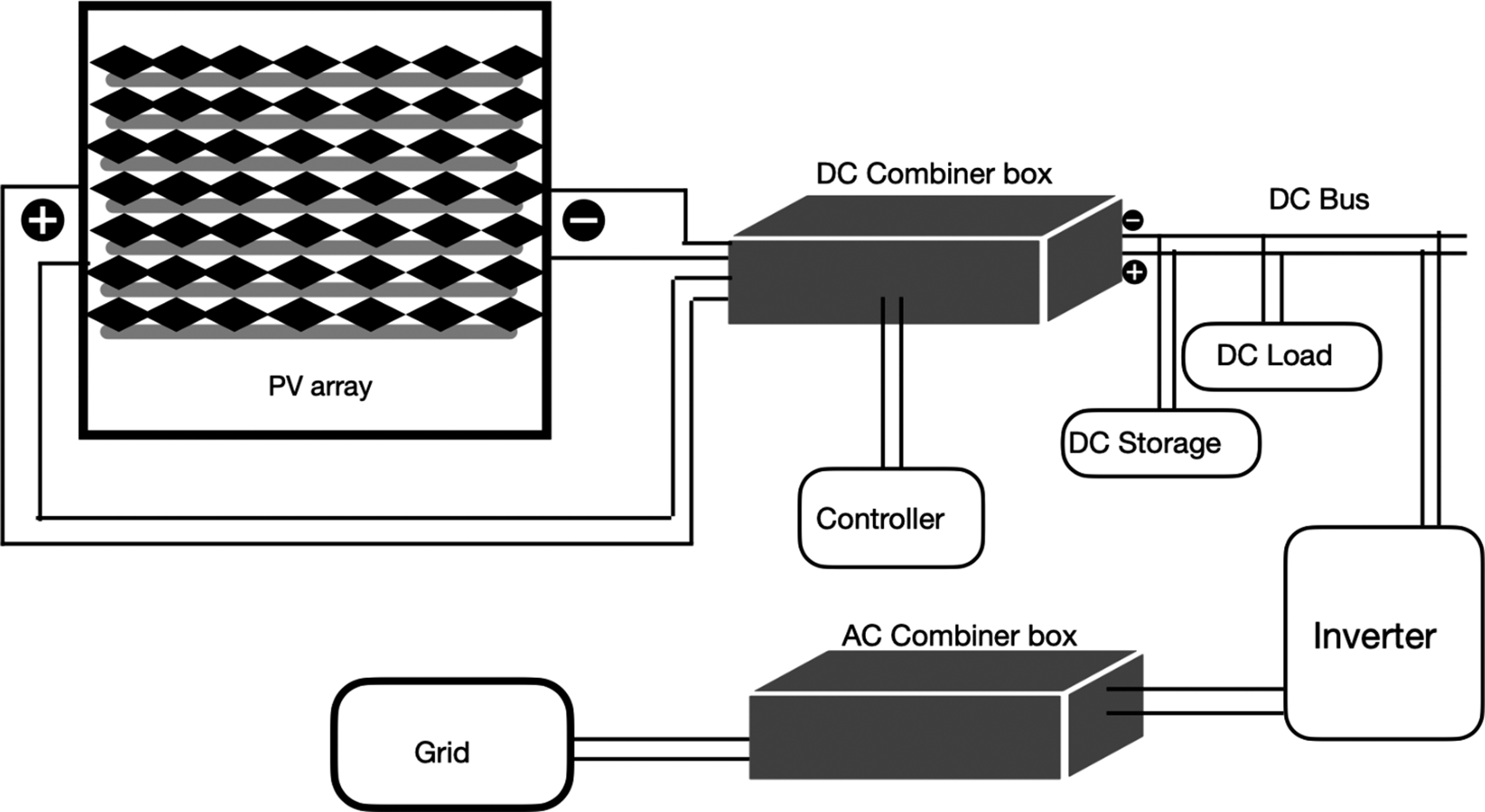
Figure 5 shows the electrical components of PV system. It consists of PV array, combiner box, controller, inverter and storage system. These components are described as follows:
-
• PV array: It is the series and parallel combination of PV modules to achieve a desired output voltage. Array is a combination of several modules and modules are the combination of several PV cells.
-
• Combiner box and controller: There are two combiner boxes in PV systems, namely DC combiner box and AC combiner box. The output of PV array is fed to DC combiner box. It gives the regulated DC output with the help of controller attached with it. It helps in getting maximum power that can be attained with the array. DC combiner box feeds power to DC bus, where all the DC storage systems and DC loads can be connected. AC combiner box is used to handle AC power from the inverter. Combiner boxes are used to combine power from different inputs and delivers a regulated output with maximum power.
-
• Inverter: It is a DC/AC converter which uses power electronic switches to get a single-phase or three-phase power supply. It is used to integrate PV power with the grid and feed power to AC loads.
-
• Storage system: It includes battery (Lead acid, Ni-Cd, Li-ion) to store DC power for future use. Generally, on-grid connected systems does not require additional storage system. But it is very helpful for local use.
Electrical components and its circuit.

Environmental interaction with FSPV system
For making the system sustainable, it should have the least impact on external surroundings, and it should be negligibly impacted from the surroundings. Here we will investigate both types with an analytical mindset backed by known research in the field.
Impact of environmental stress on FSPV system
“Environmental stress” refers to the act of environment which has impact on one or more parameters responsible for the generation of power in FSPV system. It includes wave motion, wind motion, hurricanes, thunderstorms, salinity of seawater and biofouling. Wave motion and wind motion is a continuous phenomenon which affect the efficiency of the system tremendously. Hurricanes and thunderstorms are occasional events and can impact adversely to the system. These stresses can even destroy the whole system. Salinity of water leads to corrosion in the metallic frame of the system and biofouling is birds dropping and algae growth, which requires intensive cleaning for normal functioning of FSPV systems. The ocean has a large area to accumulate FSPV system and generate huge amount of electricity which is never possible by exclusively using land resources. But oceans and seas are continuously disturbed by waves. So, a robust FSPV system must be designed if it can tackle the harshness of sea waves. There is a continuous deviation in tilt angle of the panel due to wave motion, which can drastically reduce efficiency. To gather information about the effect of waves in the FSPV system, a wave generator and solar simulator were set up with pre-defined parameters. It is observed that even a slight pitch motion of the amplitude of 6.7° can create a loss of 12.7% (Huang et al., Reference Huang, Yang, Khojasteh, Ou and Luo2024). The importance of tilt angle and ground coverage ratio (GCR) is mentioned in (Meeker et al., Reference Meeker, Brinck, Lang and Harrison2023). When tilt angle undergoes regular change, it reduces efficiency by a large amount. There are several mechanisms to reduce the tilt angle due to wave motion. The use of backwater can reduce the wave motion, but it is very difficult to nullify the effect. The solar panel of FSPV system is continuously degrading and the maintenance is not an easy task for offshore or even onshore condition and if the system degrades in short span, then replacement will make the system expensive and highly unreliable. A test is conducted where the degradation of the system is analyzed and comparative analysis between FSPV and LBPV is shown. It was found that FSPV degrades 1.18% per year while LBPV degrades 1.07% per year (Goswami and Sadhu, Reference Goswami and Sadhu2021).
Simulation tools available for studying the effect of different environmental conditions on FSPV does not produce correct results as several parameters does not match the original conditions, so the simulating tools of six different software are tested and PVSol and SolarGIS was found most accurate for FSPV system (Makhija et al., Reference Makhija, Bohra and Tiwari2024). Researchers can proceed with the simulation on FSPV on the above-mentioned software as their root mean square error was found to be minimum, that is, 2.13 to 5.20. A data collection from the researchers concluded that there is a nonlinear dependency of factors like wind, temperature, conductivity, and water depth on the efficiency of FSPV system (Peng et al., Reference Peng, He, Yang and Liu2024). The wind loads can put the whole system at risk of getting damaged. For every particular location and the size of FSPV, a study of the maximum bearing capacity must be done. A paper presented the data of the effect of wind and waves incident at different angles and their impact on the system (Choi et al., Reference Choi, Park, Cho and Lim2023). Also, the simulation model of FSPV when loaded with different wind conditions is also presented (Mignone et al., Reference Mignone, Inghirami, Rubini, Cazzaniga, Cicu and Rosa-Clot2021). For extreme condition of wind under hurricane can severely impact the system. The turbulence intensity of 0.1–0.3 with wind speed ranging from 35 to 75 m/s, it was found that first row of the FSPV system has the highest lift and drag coefficients. As it proceeds further, it gets diminished due to the sheltering effect (Choi et al., Reference Choi, Lee, Park, Cho and Lim2021).
Large waterbodies are also affected by tides up to 15–20 km from the shore. So proper care must be taken if the placement of the FSPV system is in the tide-influenced area. Similar study is performed in numerical and experimental simulation to analyze the turbulence in platform, mooring system for 2.5–5 m depth. The result indicated that under normal sea conditions the lift force may resonate in high frequency waves but in extreme conditions, wind will cause larger drift and may damage the system (Yang and Yu, Reference Yang and Yu2021). The structure of FSPV must have an accurate motion response to make the system stable. During regular low waves, the tilt angle can oscillate between certain values. During waves, the hinge connection also makes the movement more complicated. For the experimental analysis, a 2 × 2 matrix panel is taken with uniaxial hinges. Then the motion and stresses are captured, and a simulated model is also composed of similar waves. Result showed that the computational fluid dynamics (CFD) model and experimental determination are almost identical (Lee et al., Reference Lee, Paik, Lee, Hwangbo and Ha2022). The effect of wave motion has also been studied with numerical computation using fluid structure interaction (FSI) and the result is validated with the experimental data which is measured by ultrasonic radiation to quantify wave parameters and compute the drift in the FSPV setup (Sree et al., Reference Sree, Law, Pang, Tan, Wang, Kew, Seow and Lim2022). Wave motion in large lakes and seas also helps in regulating the temperature of the surface of the water. A simulation is carried out using CFD with finite volume approach to determine the effect on the FSPV system during co-current and counter currents. The simulation showed a co-current flow of water at 1.1 m/s causing a temperature drop of 0.68 °C (Ramanan et al., Reference Ramanan, Lim, Jundika Candra Kurnia, Bora and Medhi2024).
Marine ecosystems are different from freshwater ecosystems. The primary reason being hinge connector reliability. The marine ecosystem is in a harsh climatic condition, so a more robust system must be designed. The standards are still not defined for marine ecosystems, which restricts its commercial setup of large projects (Oliveira-Pinto and Stokkermans, Reference Oliveira-Pinto and Stokkermans2020). A researcher has surveyed 40 years of data on marine environments of the whole world. The survey comprises wind data as well as wave data. The result showed that the equatorial region is calmer than other regions. Indonesia and Southeast Asian Oceans and seas can be the most reliable location to setup huge power plants (Silalahi and Blakers, Reference Silalahi and Blakers2023). Another location consideration requires high solar irradiance, distance from the transmission lines and away from the protected or highly habitable area in the sea. Although no standardized regulation is developed for FSPV location but economically it must be cheap, the system must be reliable even in adverse conditions and most importantly, it should not affect aquatic lives (Forester et al., Reference Forester, Levin, Thorne, Armstrong, Pasquale, Vincenza di Blasi, Scott and Hernandez2025). The more localized optimum location search found that water bodies located at high altitude in Switzerland can be highly significant as FSPV system can work in high efficiency (Eyring and Kittner, Reference Eyring and Kittner2022). For Indian subcontinent, with the help of the Fuzzy technique, the optimum location is found to be five largest reservoirs. The most promising site could be Bhakra Nangal Dam (Ghose et al., Reference Ghose, Pradhan and Shabbiruddin2021). Also, FSPV systems suffer from biofouling and organic materials get attached to the structure. Birds also take shelter when FSPV is placed in freshwater.
Impact on environment due to the FSPV system
FSPV systems contribute a lot to reducing carbon emissions in the atmosphere. Figure 6 compares with a line graph a total saving of tons of carbon emissions throughout the course of lifespan of FSPV, LBPV, hydro and hybrid FSPV-hydro systems. A few researchers presented the paper on detailed analysis of every aspect of FSPV and laid emphasis on algae growth and dissolved oxygen of the water bodies. When water bodies get covered with the FSPV system, it blocks sunlight, waves and current motion. This affects the growth of algae, which plays a very vital role in thriving lives in the ocean. Algae production rate decreases exponentially as the percentage of cover of the surface increases. Dissolved oxygen content also gets reduced when the surface does not receive proper sunlight (Kumar et al., Reference Kumar, Niyaz and Gupta2021). So, a regulation must be made to restrict the area coverage of waterbodies with FSPV. The effect on coral reefs and seagrass should not be ignored while deploying the FSPV system near it. Also, societal considerations must be made as there could be a local population relying on fishing (Hooper et al., Reference Hooper, Armstrong and Vlaswinkel2020). Figure 7 shows the change in chlorophyll-a concentration of the lake with the change in percent coverage of the lake.
Carbon savings of FSPV, LBPV, hydel and hybrid hydro FSPV power plant (Singh et al., Reference Singh, Goswami and Sadhu2022).

Chlorophyll-a concentration (lake-averaged) and hydropower revenues for different FSPV scenarios.

The water quality monitoring must also be considered beneath the FSPV system. So, a few researchers monitored the parameters of water in two locations. One sensor is placed beneath the FSPV, and the other is placed on open water. It was seen that the water under the FSPV system has low temperature variation and remains cool. So, this can be used to develop Biodiversity Park (de Lima et al., Reference de Lima, Paxinou, Boogaard, Akkerman and Lin2021). Offshore FSPV in North Sea in three different coordinates representing shallow water, deeper water and seasonal location. It was found that if 20% of the surface is covered with FSPV, then there is less than 10% change, but as it increases there is a steep decrease in primary production. Also, phytoplankton are supposed to stay beneath the structure of FSPV for a very small time when the floating platform is distributed unevenly (Karpouzoglou et al., Reference Karpouzoglou, Vlaswinkel and van der Molen2020). Another study is done considering the effect of phytoplankton on the reservoir located in the UK. Simulation results show that temperature change of water bodies has major impact on the phytoplankton and biomass present in the reservoir (Exley et al., Reference Exley, Page, Thackeray, Folkard, Couture, Hernandez, Cagle, Salk, Clous, Whittaker, Chipps and Armstrong2022). Temperature distribution is also studied in China where the effect of installing FSPV can have impact on land surface temperature. It shows that there is a warming effect of the FSPV system in a nearby location under 200 m. Also, the average annual temperature increases due to the installation of FSPV (Yingjie et al., Reference Yingjie, Guoqing, Yelong and Zhe2022).
Integration of other energy sources with FSPV
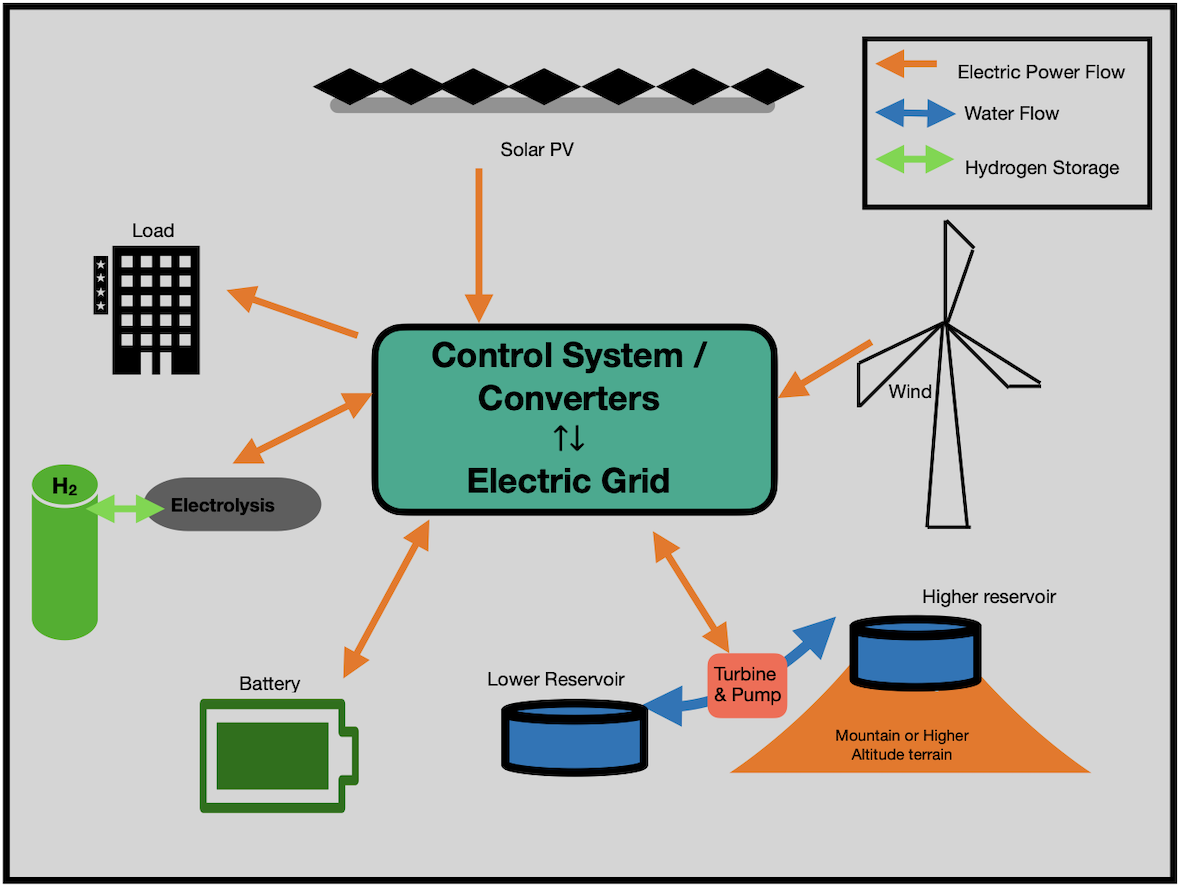
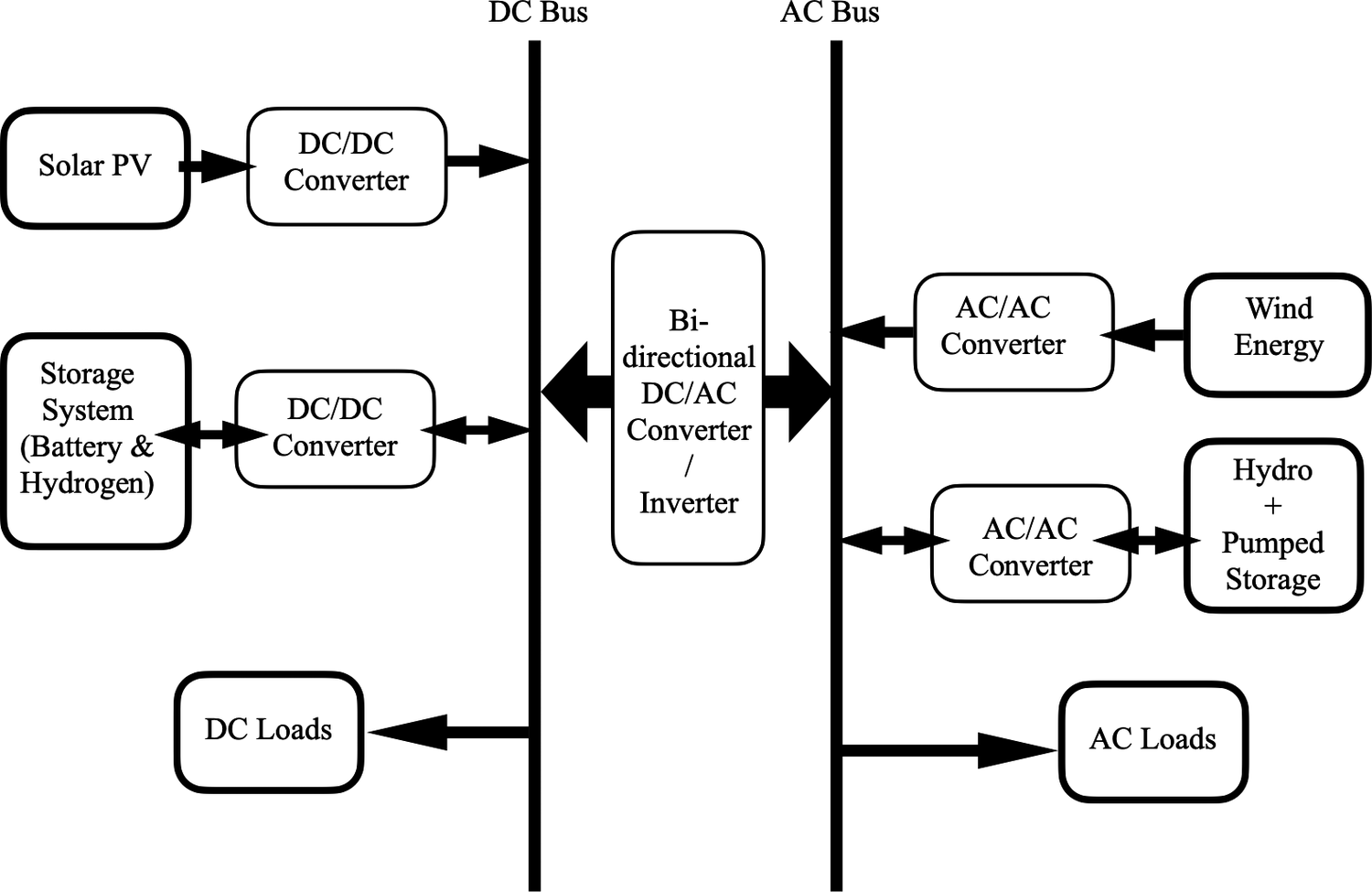
The FSPV system has a lot of advantages and can contribute uniquely to net zero emission and decarbonization. Although it has very low conversion efficiency, the huge area can mitigate the issues. To make the FSPV maintenance more effective and increase the energy generation per unit area, it is generally combined with different renewable sources. Figure 8 shows the hybrid model of power generation through FSPV, wind and hydro and their integration. Figure 9 shows the single-line diagram of hybrid model with PV system, wind and hydro + pumped storage and their integration with grid. Moreover, FSPV can generate electricity only during active sun hours. So, it must have a storage system to make the FSPV system independent. The battery storage system can be useful till certain upper threshold above which its installation and maintenance cost becomes too high. Then the natural method of storing energy as potential energy can be used. The water is pumped to higher altitude where it is stored and when there is a need for electricity, the water is used to run a turbine and generate instant electricity (Liu et al., Reference Liu, Sun, Li, Yin, Ren and Wennersten2019; Shyam and Kanakasabapathy, Reference Shyam and Kanakasabapathy2022). Other energy sources that can be integrated with FSPV system are wind energy (López et al., Reference López, Rodríguez and Iglesias2020; Bi and Law, Reference Bi and Law2023; Chen et al., Reference Chen, Yang and Lou2024), hydro energy (Farfan and Breyer, Reference Farfan and Breyer2018; Giri et al., Reference Giri, Kumar, Mishra and Shah2018; Lee et al., Reference Lee, Grunwald, Rosenlieb, Mirletz, Aznar, Spencer and Cox2020; Miah et al., Reference Miah, Rahman and Kabir2021; Singh et al., Reference Singh, Goswami and Sadhu2022), wave energy generator (WEG) (Tay, Reference Tay2024), FSPV/PT source (Skumanich et al., Reference Skumanich, Mints and Ghiassi2020; Aweid et al., Reference Aweid, Ahmed and Algburi2022), FSPV power to gas (Heri Dwi Sulistyo et al., Reference Heri Dwi Sulistyo, Purwanto and Kaharudin2023). Power to gas technique means that the power generated by FSPV is used to convert water to hydrogen gas and this hydrogen gas, being a clean fuel, can be used anytime to generate electricity. The most suitable and sustainable integration of energy sources is FSPV with hydro plants and pumped storage setup (Nasir et al., Reference Nasir, Javed, Ali, Ullah and Kazmi2023).
A hybrid model including PV, wind, hydro with pumped storage, battery storage and hydrogen fuel storage.

Single line diagram of hybrid system consisting of solar, wind, hydro and storage systems connected to AC grid.

Several review papers are presented by researchers showing the importance and benefits of integrating two or more sources of power to generate sustainable renewable resources. Solar and hydro were concluded to be the best suited hybrid source by (Solomin et al., Reference Solomin, Sirotkin, Cuce, Selvanathan and Kumarasamy2021). Another review paper is presented by the researcher where author inferred that renewable energy has a vast scope and particularly FSPV can be used extensively as it is evident that there must be a large freshwater lake where there is high population density. For efficient generation, FSPV must be used in hybrid mode with other renewable sources. But meanwhile, conventional sources should be kept in use unless renewable sources become independent (Cazzaniga and Rosa-Clot, Reference Cazzaniga and Rosa-Clot2020).
Table 4 consists of different hybrid models of power plants that are being used in different locations of the earth. Hydro power plants generally use huge reservoirs, and these locations can be favorable to install an FSPV system to produce enhanced cumulative energy. Besides, if the two reservoirs are located at higher and lower altitudes, then the hydro plant can be integrated with pumped storage. The pumped storage plant can be used to store the excess power generated by solar power during daytime in the form of potential energy of the water stored at high altitude and generate electricity when required.
Different integrated FSPV system

For offshore locations, more research progress is required in integration with WEG and wind energy. WEG can be beneficial in efficiency enhancement and stability of the system. In arid regions, PV/PT can be effectively used with several side benefits. The best suited hybrid model depends totally on geographic location and the power consumption of the locality. Hybrid FSPV–wind-pumped storage hydro plant has a high generation per unit area with high storage capacity. Offshore FSPV-wind-gas hybrid is better suited for the generation of power. Hydrogen storage tanks can be safely stored in the sea away from human interference and either gas can be supplied to the location of generation in land or electricity can be generated offshore using turbine and can be transmitted to the load inland.
Case studies involved
Several projects are being built across the globe, and many more are being planned. Many researchers have reviewed the parameters of the FSPV projects in detail and clearly pointed out the problems that are being faced. The main intent is to optimize the power generation per unit area so that minimum installation cost can yield high output. Other benefits of FSPV must also be taken into consideration while selecting a location for installing FSPV. Mediterranean Sea, Red Sea, South China Sea, Bay of Bengal, Gulf of Thailand, Sea of Japan, Gulf of Mexico, Gulf of California can be some of the promising locations for offshore FSPV installation.
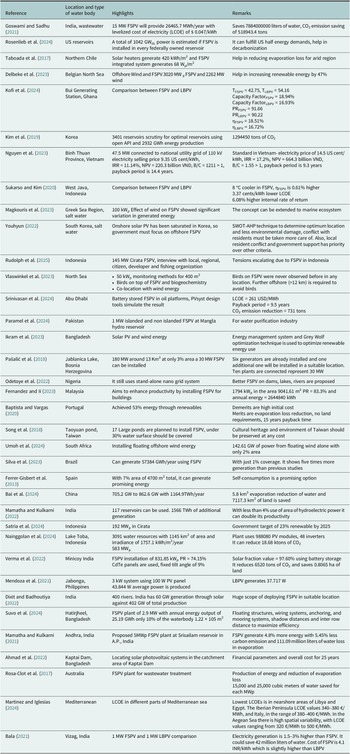
Table 5 contains case studies of several projects from different locations around the world. Different locations have different requirements and different environments. Clearly, in Southeast Asia, there are surplus offshore locations to install FSPV systems without disturbing the natural environment. China, India, Vietnam and Japan have already achieved heights working with FSPV system. In India, almost half of total energy of 452.67 GW energy is generated from renewable energy sources. India has vast coastal line and onshore and offshore integrated FSPV system can be deployed in large scale to meet all its demand from it. Additionally, high altitude hydro projects can contribute significantly to renewable generation by integrating it with FSPV System with concentrated solar cell. Several other sites like oil platforms and wastewater storage systems have all the setup already installed and can be economical sites for FSPV generation.
Case studies of the FSPV project or proposed project simulated by data collection

Economics of FSPV system
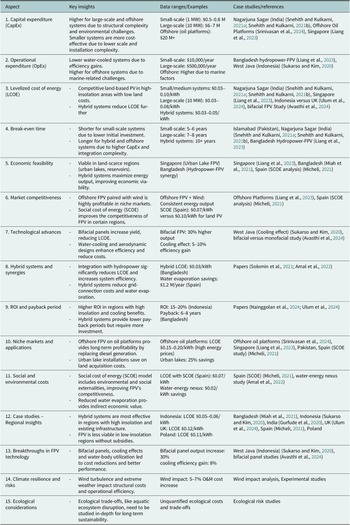
A system can be sustainable only if it is economically feasible. There are several parameters to determine the economic sustainability of the system. It includes break-even period, profitability, levelized cost of electricity (LCOE), capital expenditure (CapEx), operational expenditure (OpEx) and economic competitiveness. Terminologies related to economy are discussed as follows (Snehith and Kulkarni, Reference Snehith and Kulkarni2021a):
Break-even period – It is the time required to earn back the installation cost of infrastructure of FSPV system with minimum periodic investment in maintenance. It varies between 4 and 6 years. It depends on the scale of the system, availability of cheap workers and the life of the components of the system.
Profitability – The ability to earn from the system after a break-even period. Besides, profitability also depends on the efficiency of the system. The total life span of the FSPV system is approximately 25 years. So, after a considerable break-even period and annual service and maintenance charges, the system should be efficient enough to generate marginable profits.
Levelized cost of electricity (LCOE) – The total energy generated by the system over a lifetime per unit of average cost of the system in that lifetime is called LCOE.
Capital expenditure (CapEx) – It is the total amount invested in the installation of the FSPV system. It depends on the scale of the system. Generally, the load demand and budget determine the CapEx of the system.
Operational expenditure (OpEx) – It is the amount that is invested periodically into the system for its maintenance and servicing so that the efficiency of the system can be maintained. The period of OpEx can be one day, one month or one year.
Economic competitiveness – it is the comparative study of recent technological developments for increasing the productivity of any system and optimizing its efficiency to make it more feasible for growth.
Return on investment (ROI) – It is the ratio of total profit in each period to total investment in the system. Payback period – It is the capital cost of the system to an income in a fixed period. It can also be understood as the time to reach the break-even point.
Net present value (NPV) – It is the difference between the income and expenditure of a system discounted from the invested value. Figure 10 shows the comparison of NPV for FSPV, LBPV, hydro and hybrid hydro systems for 10 MWp taking 8 h of sunlight daily for an underestimate of 5 months annually (Singh et al., Reference Singh, Goswami and Sadhu2022). Figure 11 shows (a) change in NPV with an increase in DC loss (b) change in annual energy production with change in DC loss and annual DC loss and (c) effect of land cost in NPV and payback period.
Comparison of NPV for FSPV, LBPV, hydro and hybrid hydro for 10 MWp plant (Singh et al., Reference Singh, Goswami and Sadhu2022).

(a) Effect of increasing DC loss (%) on net present value and payback period. (b) Effect of DC loss (%) on annual DC energy production and annual change in annual DC loss. (c) Land cost versus NPV and payback period.

There are several direct factors which makes FSPV system more economically feasible than any of its counterparts like LBPV, BIPV or CPV as mentioned in the following points:
-
• The FSPV system is the most viable PV option where the land price is high. Densely populated areas require high electricity as well as more land. This causes spike in land prices and locating generating units away from the location, which in turn increases the maintenance cost and overall cost of electricity supply. FSPV uses the surface of waterbodies located near the population, making it the cheapest alternative for power generation. PV installations in tropical regions like Indonesia has low LCOE, so FSPV system is a viable generating unit in the area, while temperate regions have high LCOE making it viable only after proper subsidy (Snehith and Kulkarni, Reference Snehith and Kulkarni2021a; Snehith and Kulkarni, Reference Snehith and Kulkarni2021b; Ulum et al., Reference Ulum, Satria, Pramudito and Rizaldi2024).
-
• FSPV systems have additional benefits of natural cooling and reducing evaporation of freshwater contained in the pond or reservoirs. Natural cooling can help increase the efficiency of the system and make it a more reliable option than LBPV. Also, freshwater reservoirs are very important for sustaining lives in arid areas. Irrigation and consumption of freshwater by the local public can be enhanced by reduction in evaporation of water due to FSPV systems (Sukarso and Kim, Reference Sukarso and Kim2020).
-
• CapEx depends mainly on the size and location of the FSPV system. Offshore and large-scale projects are expensive due to large infrastructure and environmental challenges. Small-scale has low CapEx and more viable options than large projects. OpEx of offshore systems is higher than lakes and ponds FSPV systems (Micheli, Reference Micheli2021; Srinivasan et al., Reference Srinivasan, Soori and Ghaith2024).
-
• Profitability and return on investment (ROI) – Small-scale FSPV systems have shorter payback periods than large-scale FSPV systems due to low installation costs. Hybrid projects (FSPV + Hydro/Pumped Storage shows higher ROI than isolated FSPV systems. ROI depends on efficiency and FSPV shows higher efficiency than LBPV throughout the year with a margin of ~2%. Figure 12 shows a distinct comparison between LBPV and FSPV efficiency (Kofi et al., Reference Kofi2024).
Comparison between FSPV and LBPV efficiency (Kofi et al., Reference Kofi2024).

Table 6 segregates different case studies of different locations based on economic terminology. The key points and basic dataset of the references used are compared for optimal solutions.
Comparison table on an economical basis

Discussion and future aspects
The above survey shows that the offshore FSPV system has been found very beneficial in Southeast Asia and has huge potential to meet the energy crisis in the area. Also, it helps decarbonize the environment. China has been extensively using the technology to meet their demands. India has also set up several projects and has huge future scope in this field due to its large lakes, rivers and gulfs near heavily populated areas. Also, for arid region freshwater collection is of high significance. Setting up the FSPV system helps reduce the evaporation losses in the region. The integration of FSPV with hydro power plants fitted with pumped storage can prove effective as the energy generated by solar cells can be used to store water at higher altitudes and pump it whenever required. This can store energy in huge quantities in several MW ranges. Any battery storage system for the storage of these power sources would otherwise require high capital and suffer high losses as well. The impact of FSPV on global climatic conditions must be monitored. All the freshwater and onshore covering with FSPV may lead to imbalance precipitation and drought conditions. Precautions must be taken to trade between the adverse impact and benefit of FSPV.
Aquatic lives play a very crucial role in regulating the habitable environment around the globe. The role of phytoplankton cannot be ignored. So, the placement of solar panel on waterbodies has a lot of advantages but the balance must be maintained with the environment for sustainable development. Chlorophyll-a decreases in lakes when FSPV system is placed on it which can interfere negatively with natural habitat, and it must be avoided at any cost. Further, offshore FSPV systems suffer from corrosive environments and large wave and wind motion. So, the structure should be light but with high tensile strength and it should have high buoyant force.
The pontoon material can be a mixture of HDPE and MDPE to reduce the overall cost of the system. MDPE is just as effective as HDPE. The mooring system should be flexible so that it can adapt to the continuously changing environmental conditions while keeping the pontoon steady. The adaptive mooring technique with a set of buoys and a clump can increase stability with a high margin. Bifacial PV panel over pontoon with reflective surface can increase the per unit area energy generation by FSPV, and the increase in cost is marginally acceptable. Tilt angle must be given to the PV panel as per the latitude of the location. Electrical components like combiner and inverters must be located as close to the FSPV system as possible. The cables must have high insulation capacity, and AC should be preferred for transmitting power. Monocrystalline Si cells must be preferred over others, but perovskite and nanoparticles could be a better option in the near future. CPV systems show high efficiency but per area demonstrates almost the same behavior but with increased complexity of optical lenses. Also, it increases the temperature and makes it unfit for the equatorial regions. Polar regions are best for using CPV systems.
Future aspects of FSPV involves the following key points:
-
• Research in the field of PV materials for high efficiency and economic generation. Perovskites and nanoparticle solar PV have the potential to replace conventional silicon PV. Currently, mono crystalline produces ~22% efficient conversion, but it is expensive. Perovskite materials are both cheap and highly efficient. Also, NP are thin, flexible, easy to install and less expensive, but it is not being used commercially yet. Advancement in technology can easily surpass the upper limit of energy production through solar PV.
-
• To overcome harsh offshore conditions, more study of structural improvement is necessary. New technologies for tackling wind load and wave load separately are highly significant. Development of a structure that offers high buoyant force and stability is required in the field.
-
• HDPE or MDPE materials may not be sufficient in offshore conditions, so a material with high structural integrity must be developed. Some materials like carbon fiber or fiberglass can be used. Also, the design of the frame can make the system highly stable and resistant to large waves and wind motion. The addition of protective structures like breakwater and damper with new designs can be beneficial for FSPV systems.
-
• Choosing the FSPV sites near to high population area and integrating in pre-developed sites for other purposes like hydro generation, canal, wastewater treatment or oil platforms. Several optimization techniques are used which involve lots of parameters like average wind speed, tidal variation, disturbance due to passing of ships, solar irradiance, average temperature and so on.
-
• There is a vast scope in implementing the FSPV system at a commercial level in India. There is an exponential rise in energy consumption and extensive planning must be done at the national level to meet the needs through renewable energy. Site allocation with respect to economic feasibility and load demands can be done for future projects.
-
• In India, mountain region gets ample winds and sunlight. So, a hybrid FSPV-wind-pumped storage hydro plant in mountain lakes and dams can be very beneficial. Coastal regions with densely populated cities like Mumbai, Kachchh, Kolkata must be installed with large-scale onshore FSPV plant as heavy loads are in the region and land demand is high. FSPV systems near to the shore can feed the load with negligible existence, and these tropical regions receive sunlight almost throughout the year.
Conclusion
The deployment of FSPV is need of the hour. It must be thoroughly analyzed, and the setup should have a high energy yield per unit area. The aquatic ecosystem does not get affected by it unless excessive coverage of waterbodies occurs. Care must be taken so that both human needs and the natural ecosystem can thrive side by side. Arid and semi-arid areas require freshwater storage, and FSPV can provide cool and prolonged storage by reducing evaporation. These areas can cover 100% of waterbodies and generate energy on top of water conservation. While wetlands, mangroves and other biological habitat must not be used for FSPV installation. Phytoplankton count, chlorophyll-a should be monitored where FSPV systems are installed. On the other hand, birds and algae growth among other biofouling must be monitored and relocation of the system should be practiced if the generation is not optimal.
The hybrid model shown in Figures 8 and 9 will help build a reliable, clean renewable energy sources for the society. The dependency on fossil fuels is no longer reliable and as the time will pass, it will become thinner and thinner until there will be no fossils left to power human needs. This future direction is compelling new research in the field of renewable energy for enhancing the reliability to meet the future needs. Figure 5 shows the electrical components of PV system. To enhance the overall efficiency of the system, all the electrical components must be designed and tuned in such a way that no extra losses are incurred, and minimum usage of additional components must be practiced. The more the components involved in the system between generation and load, the more is the drop in efficiency. Future research can be made to minimize or combine the electrical components of the system.
Integrating FSPV with hydro and pumped storage is preferable in functional dams as the installation cost gets reduced due to the presence of a transmission system. For offshore regions, a hybrid wind-FSPV-gas storage can be preferred as it increases per unit area generation and gas storage is kept away from humans, making it safe and secure. Offshore challenges must be analyzed, and a calm location must be selected to set up the system. There is a lot of scope to improve the stability of offshore FSPV and make it more efficient. Recent technological upgrades and future research can help improve the efficiency of energy conversion and utilize it up to its full potential. FSPV can be proved to be very beneficial to the countries with a large number of waterbodies like Southeast Asia and Australia. There are several large projects built in China, Japan, Vietnam and India which confirms the viability and feasibility of the system.
The analysis of the best suited material for the location must be done for efficient generation. Polycrystalline and thin film (organic) bifacial PV panels are mostly preferred for small-scale systems while monocrystalline bifacial PV panels are suitable for large-scale systems. Perovskite and NP with reflective surfaces can enhance efficiency and it is cheaper as compared to commercially available materials. NP can attain an efficiency of up to 35%, and research must be conducted. Despite being efficient, materials must be eco-friendly, and easy for installation. Concentrated solar can be used in high-latitude locations as the climate is cooler side, and this can transform concentrated light to electricity with high efficiency keeping the panel cool. While the same cannot be used near the equator as it can lead to breakdown of the system due to high temperatures. Governments of all the countries should collectively investigate this matter for decarbonization, renewable energy generation, and sustainable growth of mankind.
Open peer review
To view the open peer review materials for this article, please visit https://doi.org/10.1017/etr.2025.10006.
Author contribution
Sagar Bhushan: Conceptualization, literature review, data curation, writing – original draft preparation. Sweta Pallavi: Literature survey, visualization, writing – original draft preparation. Sagnik Bhattacharya: Methodology, validation, writing – review and editing. Anik Goswami: Supervision, writing – final review and editing, Corresponding Author. Pradip Kumar Sadhu: Supervision, guidance on technical aspects, final approval of the manuscript.
Competing interests
The authors declare none.









 Open access


Comments
From,
Dr. Anik Goswami
Vellore Institute of Technology, Chennai
Chennai- 600127, India.
9th April, 2025.
Respected Sir,
We would like to submit a review research article by Sagar Bhushan, Sweta Pallavi, Sagnik Bhattacharya, Anik Goswami, Pradip Kumar Sadhu entitled “Technological Advancement of Floating Solar Photovoltaic Systems: Design, Efficiency, and Environmental Effects” to your esteemed journal ‘Energy Transitions’ for consideration and evaluation.
Photovoltaic (PV) is proved to be the one of the most compact, durable, economic power generating system developed by the mankind till date. The potential of solar energy is being used for sustainable development and meet the increasing power demand. Floating solar photovoltaic (FSPV) is comparatively newer concept of installing the PV system on the surface of waterbodies. Ever since the development of FSPV, several researchers have presented the ideas to tackle the challenges and enhance the productivity of the system. Major challenges include stability of the FSPV system during harsh climatic conditions in open sea and long lasting of the pivot system, reduced efficiency due to excessive heating and hotspots, corrosion due to high moisture content, transmission system stability connecting the FSPV system to the grid. The use of manmade system will definitely affect the natural flora and fauna of the surroundings. So, these are the most vital areas to take into consideration for sustainable generation of power. Sustainable development ensures that the energy production must have minimal or nil harmful impact on the nature and humankind. This paper will lay emphasis on all the technical aspects of the FSPV system and reliable ways to prevent and overcome it efficiently. Moreover, the integration of FSPV with other different non-conventional sources to boost the energy production is also analyzed. It is of interest to the readers of your journal as FSPV are gaining importance nowadays for clean and green energy generation.
The authors declare no conflict of interest.
Please address all correspondence concerning this manuscript to me at:
anik91_go@rediffmail.com, anik.goswami@vit.ac.in
We affirm that this manuscript is original, has not been published before and is not currently being considered for publication elsewhere.
Thank you very much for your attention to our paper.
Yours Sincerely,
Anik Goswami
Email: anik91_go@rediffmail.com
Phone : +91 8777383221