





1. Introduction
Modern definitions of business processes (see e.g., Weske Reference Weske2012b) go beyond the classical control-flow dimensions, by taking into account also other important perspectives related to organizational, data, and goal-oriented aspects. This has brought to a rapid growth of approaches and tools in the stream of multi-perspective business process modelling and mining (Mannhardt Reference Mannhardt2018), where perspectives such as resources, data, time, and so on, are exploited to augment the basic control-flow one. Such a hype on multiple aspects of business processes shows that the time is now ripe to focus on an investigation of multi-perspective process constructs and relations also at the conceptual level. A commonly agreed broad view on business processes, with clear and shared definitions of business process entities such as resources, data needed and produced by activities, different types of events, an so on, already at the conceptual level, would be crucial for instance to foster the communication and the data compatibility among information system procedures and data structures designed and described using different modelling paradigms and notations. Nonetheless, such commonly agreed broad view is still not present in the BPM literature. Instead, by looking at the business process meta-model literature, a number of different meta-models have been proposed. These meta-models vary greatly, ranging from very general ones to meta-models tailored to a specific business process modelling language and, as such, characterized by the language specificities. Moreover, they often present conflicting differences, for instance when the same term (or label) is used with radically different semantics.
As an example, in the meta-model introduced in Papavassiliou and Mentzas (Reference Papavassiliou and Mentzas2003) resource is considered a subclass of role, while in the meta-model introduced in Söderström et al. (Reference Söderström, Andersson, Johannesson, Perjons and Wangler2002) role is considered a subclass of resource (see Figure 1a). While this difference may not be necessarily a contradiction, it emphasizes the lack of clarity on the semantics of resource and role which makes the two different choices made in the two different meta-models possible. A second problematic example is the comparison between the meta-model presented in Haller et al. (Reference Haller, Oren, Kotinurmi, Carr, De Roure, Iyengar, Goble and Dahlin2006) and that presented in the works of Thom et al. (Reference Thom, Iochpe and Mitschang2005) and Bouchbout et al. (Reference Bouchbout, Akoka and Alimazighi2010) on the relation existing between organization and organization unit. In Haller et al. (Reference Haller, Oren, Kotinurmi, Carr, De Roure, Iyengar, Goble and Dahlin2006) organization unit is a (subclass of) organization, while in the remaining two papers organization is composed of organization unit(s) (see Figure 1b). Again this difference emphasizes the need of a clarification in order to build a comprehensive and unique reference meta model.
Two samples of different meta-model snippets.

Obviously, certain differences may be explained in terms of the different perspectives on business processes expressed by different meta-models. Nonetheless, conflicts and misalignments on core elements can be problematic for the community and should be clarified. As an example, if the definition (or the ontological nature) of what a resource is is so unclear that drastically different choices can be made, the risk is either to incur in inconsistencies or to have non informative models, depending on whether a strict or liberal view is taken on what a resource should be. Therefore, while we do not necessarily advocate the construction of a unique business process meta-model, we believe that different views on a business process should be represented by reference meta-models and, more important, the relations between these meta-models should be clear and well understood.
In Adamo et al. (Reference Di Francescomarino, GhidiniAdamo, Di Francescomarino, Ghidini, Dustdar, Yu, Salinesi, Rieu and Pant2020), we started investigating critical aspects emerging from different conceptualizations of business processes in business process meta-models and applying the ontological analysis tool to clarify them. The method we employed to identify these critical aspects was to extract business process elements and relations from papers gathered during a systematic literature review on business process meta-models, and combine them into a literature-based meta-model of business processes (hereafter, original LB meta-model) which was on purpose built by simply joining discovered elements and relations, so as to disclose problems and inconsistencies. One of the problems of that work was the limited number of primary studies (the papers selected via the Systematic Literature Review (SLR)) considered due to the explicit focus on the terms ‘business process’ or ‘process model’, neglecting terms such as ‘workflow’ or implicit meta-models contained in the definition of process oriented modelling languages (such as BPMN, Petri Nets, or Declare), and the possible biases originating from that. Luckily, a wider SLR on business process meta-models was recently published (Adamo et al. Reference Adamo, Ghidini and Di Francescomarino2021), which almost doubles the number of primary studiesFootnote 1 by widening the queries used to look for the primary studies.
In this paper we recap some definition of business processes and some popular business process modelling languages (Section 2), highlighting the main constructs and differences in their meta-models. Then, we start from the 65 meta-models proposed in this SLR, which is summarized in Section 3, to extend and consolidate the work done in Adamo et al. (Reference Di Francescomarino, GhidiniAdamo, Di Francescomarino, Ghidini, Dustdar, Yu, Salinesi, Rieu and Pant2020). In particular, we extract business process elements and relations from the single meta-models (Section 4) and combine them to build a more complete literature-based meta-model of business processes (Section 5), which is on purpose built by simply joining discovered elements and relations, so as to disclose problems and inconsistencies. Then we analyze and discuss the single elements/relations as well as the literature-based meta-model with a twofold goal: on the one hand we will look for new characteristics and problems originated from the addition of new elements and relations, on the other hand we will aim at consolidating or rectifying some of the issues identified in the analysis of the original LB meta-model (Section 5.1).
The results of this analysis are: (i) the under-investigation and under-specification of some of the relevant business process elements (e.g., the goal and value of a process), despite the widening of the SLR; (ii) the persistence of recursive subsumption cycles in the organizational and data components of the new meta-model; (iii) the unclear relations between elements of the control flow and in particular gateway, activity, and transition; and (iv) finally the presence of the subsumption and parthood relation between the same pairs of elements that might create confusion. In order to deal with such critical issues, an investigation has been carried out, also with the help of the ontological analysis method, and possible solutions for the identified issues are proposed in Section 6. Finally, related and future works are presented (Sections 7 and 8).
2. Business process modelling
This section introduces the most popular and recent definitions of business processes and some reference business process modelling languages used to produce business process models with the aim of illustrating typical process model elements and relations that are present in business process meta-models. The final part of the section is dedicated to an overview of meta-modelling in business process modelling.
2.1 On the definition of business process
The notion of what a business process is has changed over time according to the way business processes were understood both in research and in the actual organizations (Lindsay et al. Reference Lindsay, Downs and Lunn2003).
Davenport (Reference Davenport1993) defines a business process as:
a structured, measured set of activities designed to produce a specific output for a particular customer or market. [… ] A process is thus a specific ordering of work activities across time and space, with a beginning and an end, and clearly defined inputs and outputs.
Another definition is provided by Hammer & Champy (Reference Hammer and Champy1993) where business processes are:
a collection of activities that takes one or more kinds of input and creates an output that is of value to the customer.
A more modern and comprehensive definition is presented by Weske (Reference Weske2012b) where business processes are:
a set of activities that are performed in coordination in an organizational and technical environment. These activities jointly realize a business goal. Each business process is enacted by a single organization, but it may interact with business processes performed by other organizations.
By analysing these definitions we can divide them in two groups. The first two see a business process as composed of a set of (ordered) activities that aim to transform an input in an output which is of value for (or is desired by) a customer or market. The most recent definition replaces this notion of ‘output for someone’ with the stronger notion of business goal, thus better empowering and taking into account also the goals of the organization where the process is enacted together with the desires of the customer(s) and markets.
In line with recent work on business process modelling and analysis (Fahland Reference Fahland2022), we can observe how these definitions introduce different high level concepts, hereafter called ‘dimensions’, that belong to the notion of business process: the behavioural dimension related to the execution of a set of activities in time; the organizational dimension related to the environment in which the process is executed; and the goal dimension related to the objective/value realized by the business process. We also introduce here another dimension, the data dimension, which pertains the objects manipulated by the activities within processes. As the remaining of the paper will make clear, these are four fundamental dimensions that can be used to classify entities in a business process and will be used throughout the paper with this exact goal.
2.2 Business process modelling languages
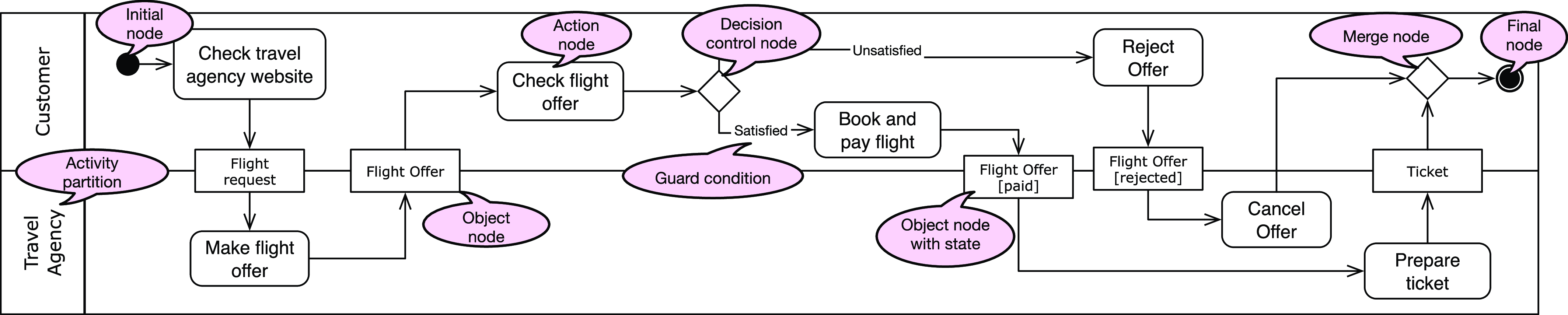
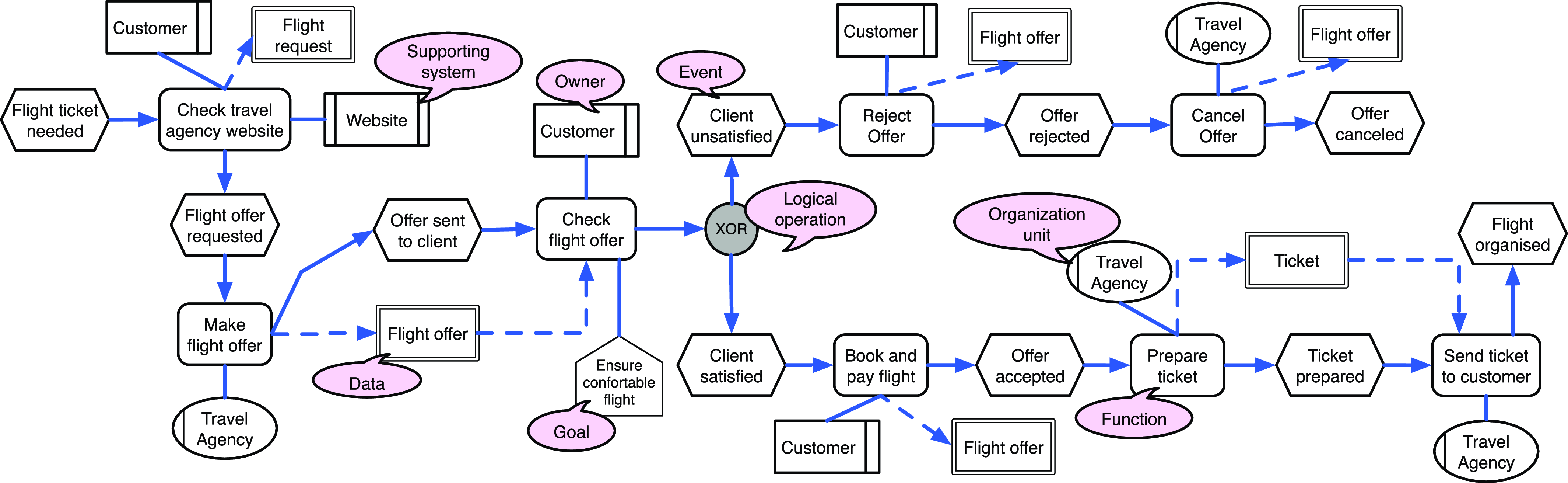
In this section 5, we illustrate four representative business process modelling languages introducing their main constructs and relating them to the behavioural, organizational, and goal dimensions introduced above. As the illustration of these languages will make clear, we also use here another dimension often used when describing business process modelling languages: the data dimension, which is related to the objects and data manipulated by the activities within the behavioural dimension. We have chosen these languages as they are a mixture between highly popular languages and languages that follow different approaches towards modelling. To support our brief description we make use of process diagrams illustrating a self explanatory scenario of a customer buying a flight ticket from a travel agency. Besides illustrating the scenario, the diagrams are ‘annotated’ with speech balloons indicating the type of entity denoted by the graphical constructs.
A Business Process Diagram in the BPMN language.
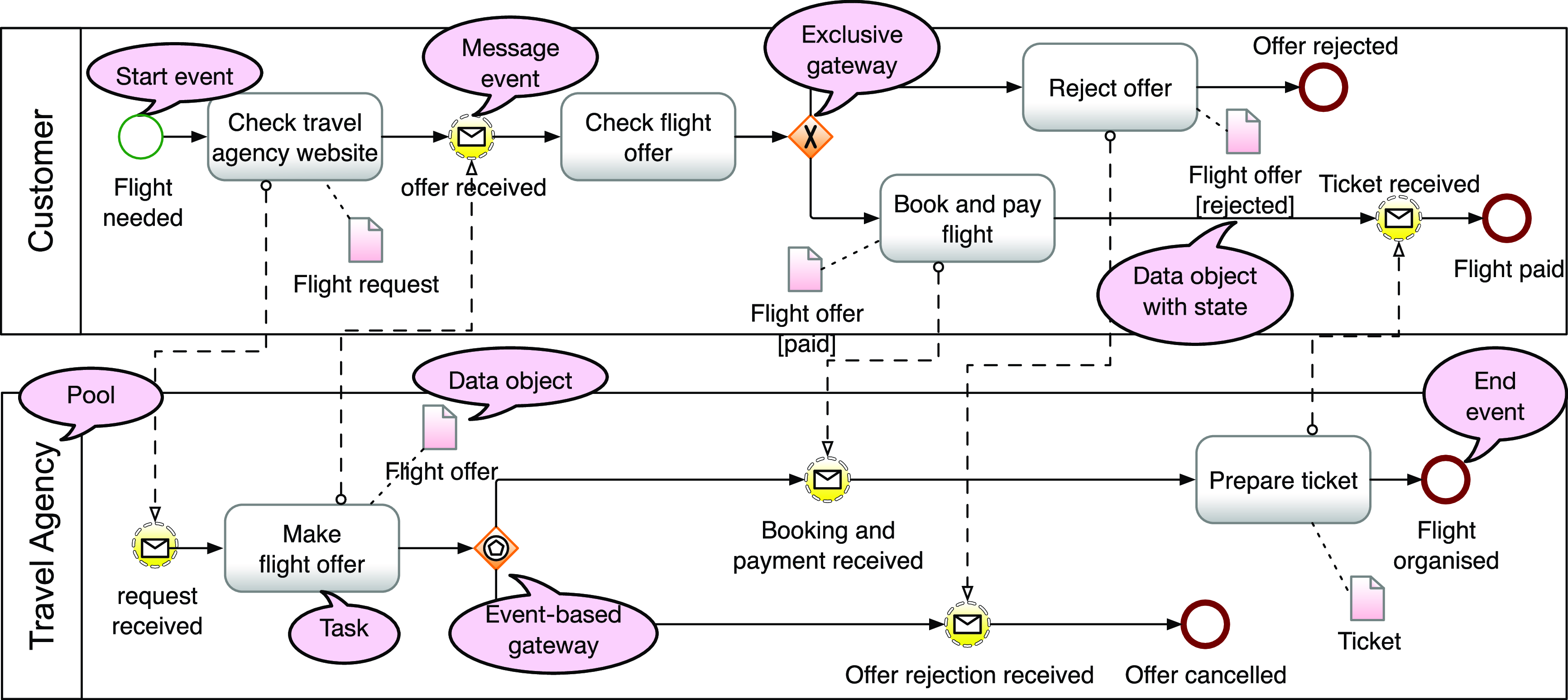
BPMN (2.0.) BPMN is a standard language, proposed by the Object Management Group (OMG), to design business processes. BPMN defines a Business Process Diagram (BPD) which includes a set of graphical elements divided in: (i) flow objects; (ii) data; (iii) connecting objects; (iv) swimlanes; and (v) artefacts. Flow objects define the behaviour of a business process, as the one reported in Figure 2. They are divided in events, activities, and gateways. Events represent things that happen during a process; they are classified into start, intermediate, and end events. An activity is a generic term that is used to indicate the work to be performed. It can be either atomic (task) or compound (sub-process). A gateway determines the forking, merging, and joining of paths. In BPMN 2.0, the data dimension include: data objects, data inputs, data output, and data stores. The various flow objects are linked to each other through connecting objects, other components of the behavioural dimension which are not further discussed here. Swimlanes represent organization units through pools and lanes, and they are usually used to answer the ‘who’ question. BPMN provides further elements, called artefacts, to describe the context (or information) of the process such as groups and text annotations. Groups are useful to graphically cluster elements belonging to the same category; text annotations are used to specify additional textual information that can be valuable to the user of the diagram.
A Business Process Diagram in the UML AD language.
A Business Process Diagram in the EPC language.
UML-AD. UML-AD is one of the diagram families of the OMG standardized UML languageFootnote 2, whose purpose is to describe the control and data flow as a sequence of activity nodes connected by activity edges (see Figure 3). The nodes responsible for describing the behavioural component of the process (the so-called control flow) are the action nodes and the control nodes. While the former represent atomic steps within an activity, the latter allow for controlling the execution flow by means of the AND, OR, or XOR logical operations. Additional control flow nodes are used to depict the initial and final nodes of process models. Object nodes and object flows are the main UML-ADs constructs describing the data dimension and how the data flow in the process. The former represent objects at a given point of the flow and, as such, they can also have an associated state. The latter are instead used for connecting object nodes to actions. Activity partitions are a mechanism for grouping activity nodes that have common characteristics. They are mainly used to define organizational units. Finally, the notation allows for specifying another behavioural detail which consists of activity pre- and post-conditions, for instance, by annotating activity edges with guards.
EPC. EPC is a modelling language developed in the early 1990s as part of the Architecture of Integrated Information Systems (ARIS) framework Scheer (Reference Scheer2002). Three types of nodes are responsible for describing the behavioural dimension of the control flow: function, event and logical operators Footnote 3 (see Figure 4). Function nodes represent atomic activities and can be considered as the ‘active’ part of the control flow; event nodes stand for the states in which a process happens to be and can be therefore considered as the ‘passive’ part of the control flow. Functions and events alternate, capturing the intuition that states lead to activities, while activities generate states. Finally, the XOR, AND, and OR logical operators allow for controlling the execution flow.
Functions within the control flow can be connected to objects belonging to the other views of an ARIS model, namely the organizational, data, function and product service views. While the number of objects differs from version to version, the core elements usually comprise: (i) input and output data, material, services or resource objects required or produced by a function; (ii) owners who are responsible for a specific function; (iii) organisation units (e.g., a department) responsible for a specific function; and (iv) supporting systems (e.g., a database) upon which the function acts. Depending on the version of the language, goals, denoted by house shaped pentagons, can be also connected to specific functions.
A Business Process Diagram in the CMMN language.
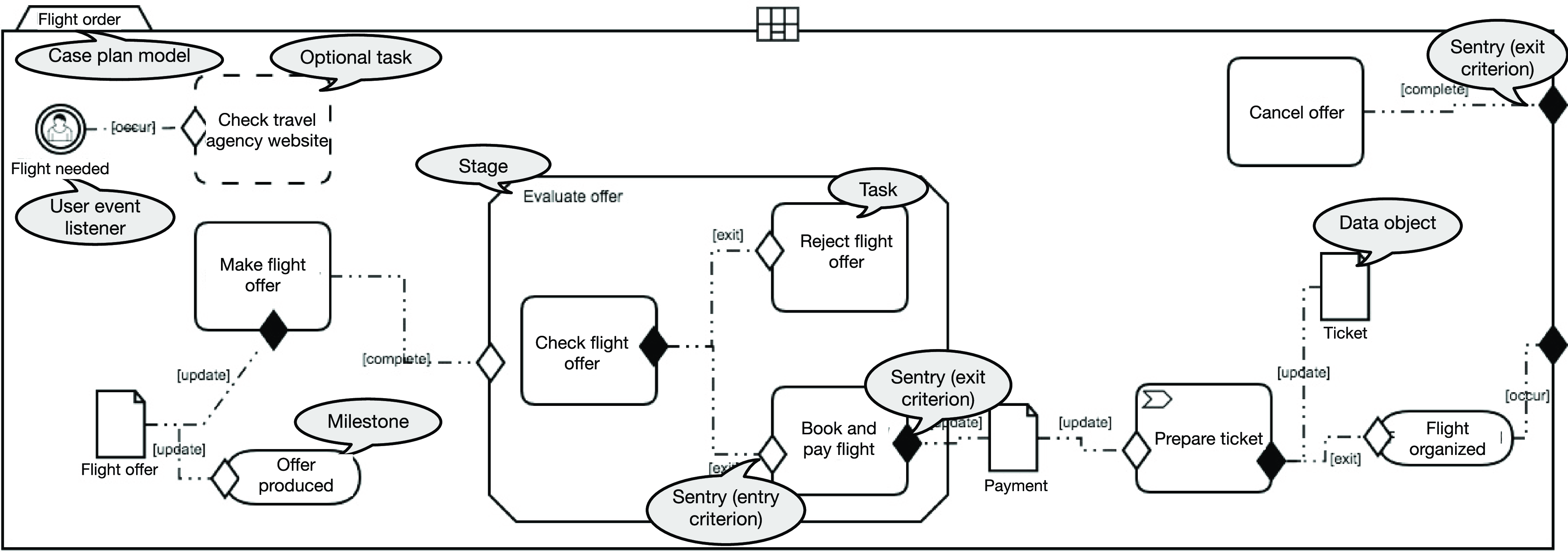
CMMN. CMMN is an OMG standard for the declarative representation of process models. Its main modelling construct is the case, which is described by a case diagram. Differently from the previous languages, CMMN follows a declarative approach. Thus, rather than describing all the allowed flows of a process from the start to the end, it models cases composed of process segments (called stages) and tasks. A case plan model contains: (possibly discretionary) tasks, stages, milestones, event listeners, connectors, and sentries. A task is a unit of work. Stages are plan fragments which can be composite or atomic. Events represent something that can happen to a plan construct (e.g., a task is cancelled) or in general (timer and user event listener). Connectors are used to link different plan items. Finally, sentries represent the entry/exit criteria for path items and can direct the control flow mimicking the AND and OR logical operators. All these elements mainly pertain the behavioural dimension. A milestone represents an accomplishment which occurs during the execution of a case and can therefore relate to the goal dimension. Data objects and and case file items are instead constructs used to model elements related to the data dimension.
2.3 Meta-models in business process modelling
Meta-models can be developed to describe specific modelling languages or can be independent from specific notations as a way to capture typical aspects of a domain. However, meta-models are very often associated with a specific modelling notation, and they allow us to capture general conceptual architectures rooted in the notations (Guizzardi Reference Guizzardi, Vasilecas, Eder and Caplinskas2006), by quoting Weske in Weske (Reference Weske2012a, pg. 76):
‘Models are expressed in metamodels that are associated with notations, often of graphical nature. For instance the Petri net metamodel consists of places and transitions that form a directed bipartite graph. The traditional Petri net notation associates graphical symbols with metamodel elements. For instance, places are represented by circles, transitions by rectangles, and the graph structure by directed edges.’
Thus, the business process modelling language of Petri net provides two constructs, places and transitions, and rules them to be used to create directed bipartite graphs. Circles, rectangles, and directed edges are instead the graphical elements that a specific notation employs to denote the available constructs and their relations.
Due to the number of business process modelling languages available in literature, a number of associated meta-models exist. These meta-models can vary greatly, reflecting the expressive power of the language, its characteristics in terms of the specific sub-domain it may focus on or the particular modelling paradigm and approach the business process modelling language adheres to. Meta-models are also defined in literature independently from specific business process modelling languages with the aim of ‘navigating’ across the different business process modelling languages, bridge the gap across them, foster a common ground across different notations, and promote interoperability, thus further increasing their overall number.
Take as an example the processes represented in Figures 2 and 4. By looking at the descriptions of the two languages presented above, and to the diagrams, we observe that both languages allow for representing the activities (e.g., make flight offer). The situation changes as soon as we move to the specification of the business goal or to the representation of the world’s states. EPC, indeed, allows for explicitly representing in the graphical language states (event entities) and somehow the goals. BPMN, instead, leaves implicit in the mind of the modeller and of the reader the goal the activities that contribute to realize it, as well as the effects of the activities and the state of the world. On the other hand, BPMN enables a detailed representation of the communication between different actors, by means of message events, which is left unspecified in EPC. These differences between modelling languages are reflected and represented in the meta-models of the two languages.
The SLR summarized in the next section aims at identifying, categorizing, and describing works related to business process meta-models with the goal of providing a first comprehensive review of business process modelling language meta-models in the BPM field.
3. A systematic literature review of meta-models in BPM
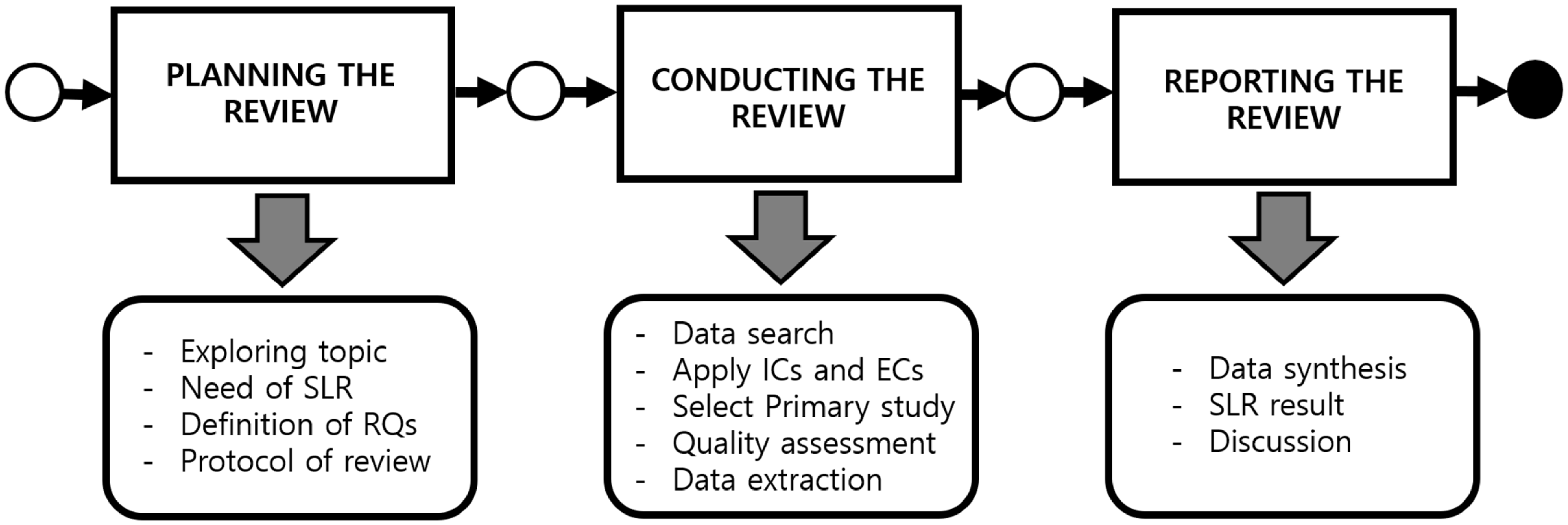
The SLR presented in Adamo et al. (Reference Adamo, Ghidini and Di Francescomarino2021) follows the guidelines for conducting an SLR proposed in Kitchenham (Reference Kitchenham2004), Kitchenham and Charters (Reference Kitchenham and Charters2007). Following these guidelines, an SLR is divided in three pivotal phases, graphically summarized in Figure 6: planning the review; conducting the review; and reporting the review. Additional documents, such as sources, tables, analysed entries, and results of analysis, can be found in Adamo (Reference Adamo2024) at the following Zenodo’s link: https://zenodo.org/records/10649652.
Method used for the SLR (from Adamo-Sosym).
For the sake of readability and space, the remainder of this section is mainly devoted to recall the most relevant steps of the SRL in order to select the set of papers, hereafter called primary studies, from which we extracted the elements illustrated in Section 4. This consists in presenting the research questions (RQs) that guided the SLR and the method that was followed to select the papers. The full description of the process followed to conduct the SLR can be found in Adamo et al. (Reference Adamo, Ghidini and Di Francescomarino2021).
3.1 The research questions
The SLR was motivated and guided by the following four research questions (RQs):
-
RQ1. What types of business process meta-models are being proposed in literature and how can we characterise and categorise them?
-
RQ2. What are the business process elements recurring across business process meta-models?
-
RQ3. What is the role of a business process meta-model?
-
RQ4. Are the proposed business process meta-models evaluated? How?
The research question more relevant to this paper is RQ2. This RQ is devoted to the identification of the elements and components of business processes that occur in meta-models. It provides a photograph of the different components and investigates which are the elements of a business process that are (more) often represented in meta-models. The answer to RQ2 is reported in Section 4.
3.2 The review protocol and its execution
We present here the three main steps of the review protocol and its execution: (i) data source and strategy; (ii) inclusion and exclusion criteria; and (iii) development of the quality assessment. For each step we also recall the data extraction strategy and analysis that was decided for that step, that is, the data fields of the papers that were used in order to perform a particular step and the exact procedure for analysing them.
Data source and strategy.
In this phase, we planned the paper repositories and search queries to be used in our SLR. In particular, we decided to perform (i) a keyword based search on the academic peer reviewed paper repositories DBLPFootnote 4, ScopusFootnote 5, and Web of ScienceFootnote 6 (WoS), and (ii) a manual search on the two reference conference venues in the BPM research area, namely the Business Process Management (BPM) conference seriesFootnote 7 and the Conference on Advanced Information Systems Engineering (CAiSE) seriesFootnote 8.
To formulate the keyword-based query, we queried the three paper repositories with the following query
 \begin{equation} \begin{split} & {\texttt{(metamodel OR meta-model) AND}} \\ & {\texttt{(business process OR process model OR}}\\ & {\texttt{petrinet OR petri-net OR workflow OR Declare)}} \end{split} \end{equation}
which contains several combinations of relevant keywords connected by the logical operators AND and ORFootnote 9.
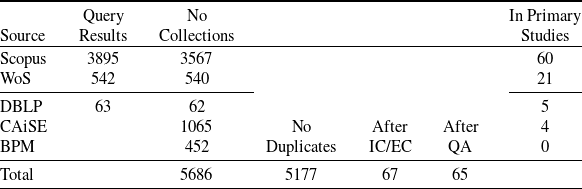
The keyword-based queries retrieved 3895 papers from Scopus, 542 papers from WoS, and 63 papers from DBLP as reported in the first column of Table 1. These papers were reduced to $4\,169$
in total after the deletion of collections (e.g., entire proceedings) which were not considered as a single item in this survey. All 452 papers from the BPM conferences (starting from 2003 to 2018) and all 1065 papers published in the CAiSE conferences (starting from 1990 to 2018) were also included in the initial set of papers to be considered. The resulting 5686 papers were manually pruned from duplicates (papers appearing more than once in the same data source or in at least two data sources) and retracted articles, thus reducing the total number of candidates to 5177
$4\,169$
in total after the deletion of collections (e.g., entire proceedings) which were not considered as a single item in this survey. All 452 papers from the BPM conferences (starting from 2003 to 2018) and all 1065 papers published in the CAiSE conferences (starting from 1990 to 2018) were also included in the initial set of papers to be considered. The resulting 5686 papers were manually pruned from duplicates (papers appearing more than once in the same data source or in at least two data sources) and retracted articles, thus reducing the total number of candidates to 5177
Query results and selection of Primary Studies
Inclusion and Exclusion criteria
The next step of the protocol was to define some relevant criteria, in the form of Inclusion (IC) and Exclusion (EC) criteria, in order to evaluate the appropriateness of the papers returned as query results. They are reported in Table 2. In order to be included, papers had to satisfy all inclusion criteria IC 1 – IC 3. Moreover, they were excluded if they did satisfy at least one of the exclusion criteria between EC 1 and EC 9. Basically, all these inclusion and exclusion criteria focus keeping good quality and highly relevant papers.
Inclusion and exclusion criteria
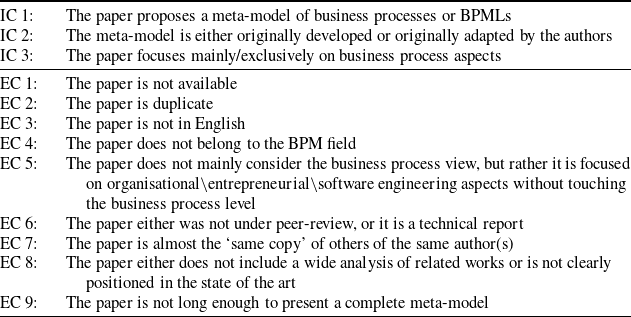
The application of the IC/EC described in Table 2 was done by manually inspecting 5177 papers that constituted our starting data collection, first by using only title, authors, abstract, and keywords (when present). The IC/EC were then evaluated more carefully on the remaining papers using the entire content of the paper. At the end of this process, 67 papers were retained (see column 4 of Table 1).
Quality assessment
The four quality assessment criteria used in this SLR are:
-
• QA1: Is a well-defined methodology used?
-
• QA2: Is the study clearly positioned within the state-of-the-art landscape?
-
• QA3: Is the goal of the study elucidated?
-
• QA4: Was the study evaluated/validated?
QA1–QA4 were used to mark papers with three possible scores: Yes (Y), No (N), and Partially (P), weighted 1, 0 and 0.5, respectively. A description of how QA1–QA4 were used to mark papers can be find in the file called ‘quality_assessment.pdf’ in the Zenodo folder.
The candidate primary studies were marked using the four quality assessment criteria using the entire content of the paper and were included in the primary studies whenever they score at least 2.5 out of the maximum possible score of 4.
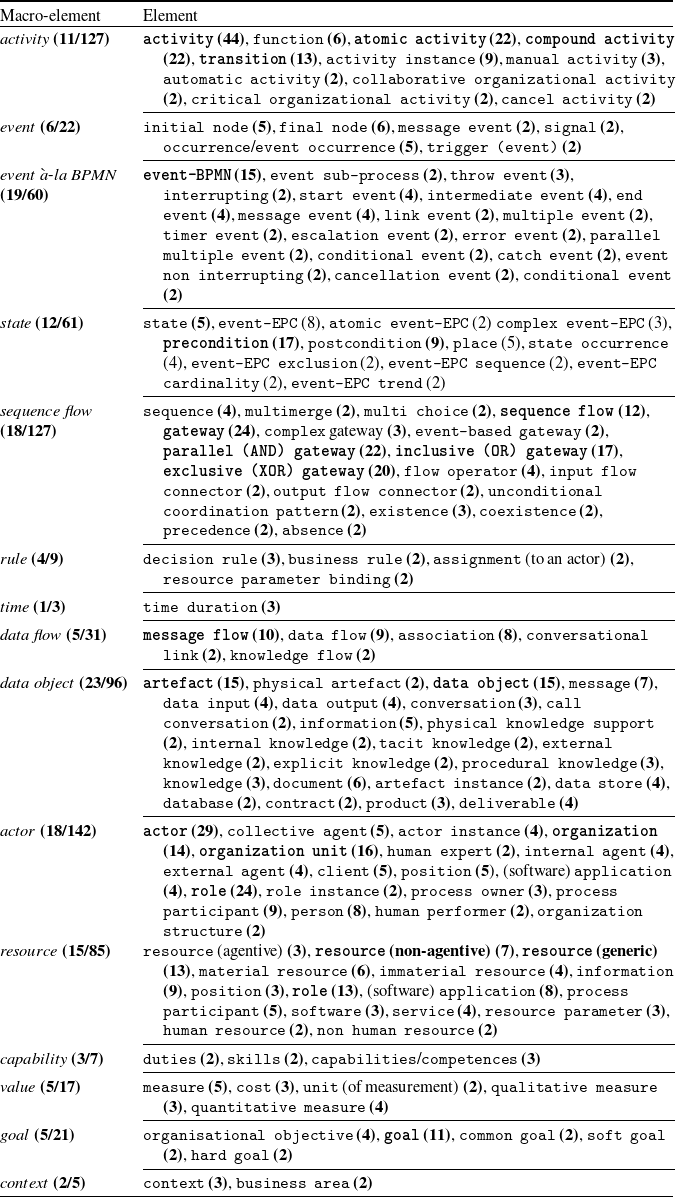
Meta-models’ elements extracted with the extended SLR
As a result of the quality assessment, the two papers scoring lower than the threshold (2.5) were removed and only 65 papers were retained (see columns 5 and 6 of Table 1). These papers constitute the primary studies and are listed in Table A1 in Appendix A classified as workshop, conference (symposium), and journal publications.
Recurring relations in meta-models
4. Extracting meta-model elements and relations from the primary studies
The literature-based-meta-model we propose is based on the elements and relations of the meta-models identified in Adamo et al. (Reference Adamo, Ghidini and Di Francescomarino2021). In Section 4.1 we recall the elements extracted from those meta-models and already presented in Adamo et al. (Reference Adamo, Ghidini and Di Francescomarino2021), while in Section 4.2 we complete the extraction process by adding the relations between the identified elements.
4.1 Extracting the elements
The aim of this step of the extraction process is to present an overview of the elements involved in the primary studies’ meta-models. This step was already described in Adamo et al. (Reference Adamo, Ghidini and Di Francescomarino2021) and constitutes the answer to RQ2 described in Section 3.1. To focus the analysis on central elements and relations of business processes, and exclude variants that were specific to a single meta-model, the extraction process focuses on the 142 elements that are considered in at least two meta-models. They are presented in Table 3, grouped in 15 macro-elements:Footnote 10 activity, event, event $\grave{a}$
-la BPMN, state, sequence flow, rule, time, data flow, data object, actor, resource, capability, value, goal, and context Footnote 11. The first 8 macro-elements pertain to the behavioural dimension, data object pertains to the data dimension. In this table all the syntactic variants have been classified under a single name. Moreover, for each element, we report in round brackets the number of primary studies’ meta-models in which it occurs and, for each macro-element, the number of elements classified under the specific macro-element together with the total number of occurrences of the elements in the macro-element. Finally, we use the boldface for denoting the elements that appear in at least the 15% of the inspected meta-models.
$\grave{a}$
-la BPMN, state, sequence flow, rule, time, data flow, data object, actor, resource, capability, value, goal, and context Footnote 11. The first 8 macro-elements pertain to the behavioural dimension, data object pertains to the data dimension. In this table all the syntactic variants have been classified under a single name. Moreover, for each element, we report in round brackets the number of primary studies’ meta-models in which it occurs and, for each macro-element, the number of elements classified under the specific macro-element together with the total number of occurrences of the elements in the macro-element. Finally, we use the boldface for denoting the elements that appear in at least the 15% of the inspected meta-models.
Before commenting Table 3, we need to specify that we are aware of the problems arising from a study in which the information from different sources is combined together in a cohesive view. Indeed a problem we had to overcome in extracting the elements and creating the table was the establishment of the semantics of its components (i.e., the labels’ semantics) or, at the very least, the clarification of their intended meaning. While this problem was somehow limited for the 34 papers that were explicitly referring to specific (mainly existing) business process modelling languages, it was particularly challenging for the 31 papers that described general meta-models not related to any concrete business process modelling language. Since our aim was to survey the elements present in the original meta-models and be faithful to the authors’ representations we relied as much as we could on the descriptions provided by the authors or used the standard Business Process Definition Metamodel adopted by the OMGFootnote 12 when similar/compatible with the semantics of the elements presented in the papers’ meta-models. We decided instead to exclude terms for which at least a basic understanding was not acquirable from the paper itself. One practical example of the work we did is the distinction between the same term ‘event’ used with different intuitive meanings which we discuss below. To keep track of the different semantics,we decided to classify them using two different labels. Similarly, we have grouped syntactic variants with the same or extremely similar meanings under a single nameFootnote 13.
As we can see from the table, five macro-elements stand up as distinctive both in terms of different elements and in terms of overall occurrence. They are: actor, sequence flow, activity, data object and resource. The most articulated and most popular macro element is that of actor, with 18 different elements appearing 142 times in total. This emphasizes the importance of the organizational aspects in business process models. Another relevant group is the one of activity, where we can notice a strong homogeneity in the variety of elements and a big presence of the activity element, which is the most recurring element in all the meta-models.
Further relevant macro-elements are the ones containing the ‘event’ related elements. As already discussed in Adamo et al. (Reference Adamo, Ghidini and Di Francescomarino2021), the term ‘event’ was used in some primary studies with a BPMN-like semantics and in others with a EPC-like semantics. To make these two different usages clear, we decided to keep the explicit distinction between them and to classify them into two different macro-elements: event $\grave{a}$
-la BPMN as something that happens during the course of a process, event as state describing pre- and and post-conditions.
$\grave{a}$
-la BPMN as something that happens during the course of a process, event as state describing pre- and and post-conditions.
Moving to the less frequent macro-elements, Table 3 consolidates what presented in Adamo et al. (Reference Di Francescomarino, GhidiniAdamo, Di Francescomarino, Ghidini, Dustdar, Yu, Salinesi, Rieu and Pant2020) (reported also in Appendix B, Table B1): the key elements of goal (or value) have a lower (or in some cases just implicit) presence in business process meta-models even though the element goal now appears at least in 15% of the meta-models. Another poorly populated macro-element, composed of elements that have recently gained importance in the BPM community, is the one of rule.
While most of the elements have been classified in terms of a single macro-element, this operation was not always possible. Indeed, there were few cases in which the same element had an unclear, and often overloaded meaning. Thus, certain elements do appear in more than a single macro-element. This phenomenon involves mainly elements that appear in the macro-element resource and in either actor or data object. This happens because elements such as information or process participant can indeed play different roles in a business process, acting for example, as an artefact (resp., actor) or as a resourceFootnote 14.
Focusing on single elements, we can notice the big presence of activity, and the fact that most of the meta-models present a distinction between atomic and compound activities. Similarly, for gateway and the different types of gateways. actor and role are two other elements recurring more than 20 times, together with organization, if we sum it up also with organization unit. Another frequent term is the one of ‘resource’. Similarly to what happened with the term ‘event’, different ways of referring to the element resource can be found in the primary studies’ meta-models: sometimes the term is associated with elements having only agentive characteristics (e.g., agents), other times with elements having only non-agentive characteristics (e.g., artefacts); sometimes a unique term is employed to refer to both resources with agentive and non-agentive characteristics, thus resulting in three different classes, that is, resource (agentive), resource (non agentive), and resource (generic), respectivelyFootnote 15.
Only few meta-models mentioned goal, rule, and value-related elements. Few are also the meta-models that specify the capabilities of the participants involved in the business processes. Another interesting observation is the fact that state does not appear very often in an explicit manner, but it appears more frequently in the form of pre- and post-conditions, event-EPC and places (of Petri Nets). Some meta-models include in their representation also instance elements, such as activity instance and occurrence/event occurrence, which have been documented for the sake of completeness of the extraction.
Focusing on the frequency of the elements in the meta-models, 20 elements appear in at least 15% of them and are: activity, atomic activity, compound activity, transition, event-BPMN, precondition, sequence flow, gateway, parallel (AND) gateway, inclusive (OR) gateway, exclusive (XOR) gateway, message flow, artefact, data object, actor, organisation, organization unit, role (both as an actor and as a resource), resource (generic) and goal. If we increase the threshold to ‘appearing in at least 25% meta-models’, then only 11 elements satisfy it: activity, atomic activity, compound activity, precondition, gateway, parallel (AND) gateway, inclusive (OR) gateway, exclusive (XOR) gateway, actor, organization unit and role as an actor(/organisation). A remark needs to be made here about the element resource=. Indeed if we consider it at a very abstract level, ignoring its agentive vs non agentive characterization, then it also appears in at least 15% and 25% of meta-models. Similarly, it happens for ‘event’ when considering together event-BPMN and event-EPC. Finally, only one element (activity) appears in more than 50% of the studies.
4.2 Extracting the relations
For the extraction of the relations among meta-model elements, we decided to focus on the elements that (i) either occurred in at least the 15% of the primary studies (i.e., the ones in bold in Table 3); or (ii) although separately are not able to overcome the threshold of 15% of occurrence in the meta-models, they are able to reach the threshold if considered together with the other semantically similar subcategoriesFootnote 16. We considered hence 23 elements in total: activity, atomic activity, compound activity, transition, event-BPMN, event-EPC, sequence flow, gateway, parallel gateway (AND), inclusive gateway (OR), exclusive gateway (XOR), precondition, message flow, artefact, data object, actor, role, organization, organization unit, resource (agentive), resource (non-agentive), resource (generic) and goal.
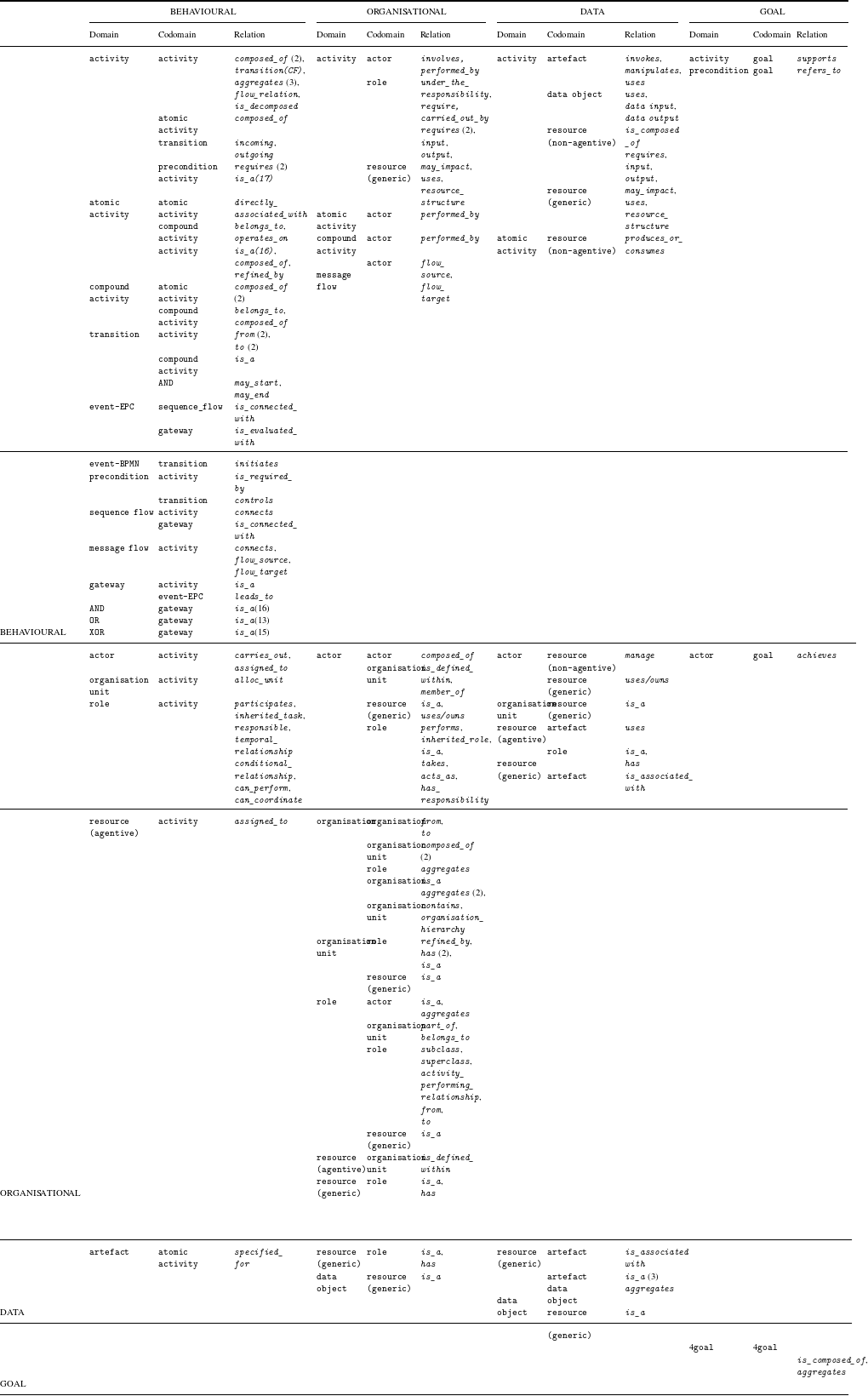
We identified in total 225 relations’ occurrences among these 23 elements and, after merging the ones with similar semantics and filtering the ones that are not very significant we obtained 121 unique relations. Table 4 Footnote 17 reports the 121 relations organized according to their domain and codomain. To ease the analysis, we grouped the elements of domain and codomain into the four dimensions introduced above: behavioural, data, organisational, and goal. The first column reports the category of the domain while the first row reports the category of the codomain.
Similarly to the extraction of elements, we need to remember here the challenge of extracting information from different sources and bringing it together into a single table. The strategy we used for relations is similar to the one used for elements; we relied as closely as possible on the semantics provided by the OMG Business Process Definition Metamodel. We also decided to exclude relations for which at least a basic understanding was not acquirable from the paper itself.
By looking at Table 4 we can observe that in general the elements of a dimension are mainly connected with the elements of the same dimension. This is especially true for the behavioural elements, which have relations mainly with other behavioural elements, and for the organizational elements, which are mainly connected with organizational elements. Apart from these two clusters, that can be visualized in Table 4 (left and center), we can identify some relations between behavioural and organizational elements and viceversa. The most isolated dimension is the goal one.
Focusing on the behavioural dimension, we can observe that it includes alone more than 50% of the considered elements (i.e., 13). Among them, activity is the most interconnected (as domain or codomain) element. Many of the behavioural elements are connected to activity through the is_a relation (atomic activity, compound activity and gateway) or through other relations (all the behavioural elements except for event-BPMN and event-EPC). Despite this high interconnection between behavioural elements and activity, most of them are still poorly interconnected with each other, except for atomic/compound activity and transition that is related (as domain or codomain) to several behavioural elements (i.e., activity, compound activity, AND and precondition). Comparing with the restricted scenario of Adamo et al. (Reference Di Francescomarino, GhidiniAdamo, Di Francescomarino, Ghidini, Dustdar, Yu, Salinesi, Rieu and Pant2020), whose relations are summarised in Appendix B, Table B2 the relations related to the organisational elements are more articulated. This is in part due to the introduction of the relations of organisation and organisation unit and to the different kinds of resources taken into account. Moreover the organizational elements are very connected with each other within the dimension. Many of these relations are is_a and composition/aggregation relations, as for instance actor, organisation unit and resource(generic) is_a role; role, actor and organisation unit is_a resource(generic); role part_of organisation unit and organisation aggregates role.
Focusing on the data elements, besides the elements resource (non-agentive) and resource (generic), we can notice the data object and artifact elements, the former being subclass of the latter as well as of the element resource (generic). While both elements show several relations with activity, only artefact seems to be well interconnected with the organisational elements, mostly as codomain. Note that the element resource (generic) and its relations are shared between the organizational and data categories.
Finally, the goal dimension, which is the only dimension composed of a unique element, is also the most isolated one exhibiting only??? couple of relations with the behavioural components, as well as one relation with the organisational elements and with itself.
To conclude, most of the relations appear in only one meta-model. Only 13% of the relations (a slight increase w.r.t., DBLP:conf/caise/AdamoFG20), are included in more than a meta-model: the is_a relation between atomic activity/compound activity and activity, as well as between the elements AND, OR, and XOR and gateway; the relations composed_of and aggregates between activity and activity, the relation requires between activity and precondition, the relation requires between activity and resource (generic), the relation composed_of between compound activity and atomic activity, the relations from and to between transition and activity, the relation is_a between data object and artefact, the relation composed_of between organization and organization unit, the relation aggregates between organization unit and organization unit and, finally, the relation has between organization unit and role.
Summing up the entire extraction process, activity is the most interconnected element, being involved—either as domain or codomain—in almost 49% of the relations. Almost 58% of the relations involve elements of the organisational dimension either as domain or codomain and only about 20% of the relations include data elements. Finally, a minimum percentage of the relations (i.e., 3%) involve the goal elements.
5. Building the enlarged meta-model
Tables 3 and 4 in Section 4 provide an overview of the elements and relations that are considered important for the modelling of business processes. In other words, they provide a list of basic components of a business process meta-model.
The elements and the relations extracted from the different papers allow us to outline those components of business processes (models) deemed most important by the scholars who have proposed the various business process meta-models in the literature. The goals of this section is to start from these individual components and combine them into a meta-model, the so called literature-based business process meta-model (LB meta-model). The method chosen to do that was to directly merge the extracted elements and relations in a unique meta-model. We use the same strategy we used for building Tables 3 and 4 for dealing with the semantics of the different components, that is, when possible, we followed the OMG descriptions used for the standard Business Process Definition Metamodel. The reason to adopt this method, rather than for example, adopt different methodologies as the one provided in López-Fernández et al. (Reference López-Fernández, Cuadrado, Guerra and de Lara2015) was to remain as much faithful as possible to the the authors’ (possibly different or conflicting) representations. Indeed, while the goal of typical methodologies such as the one of López-Fernández et al. (Reference López-Fernández, Cuadrado, Guerra and de Lara2015) is that of building well crafted reference meta-models that represent the agreed views of domain experts, our aim is to build a bottom up meta-model that provides a comprehensive picture of ‘what has been modelled’ in the reference literature, and is also able to highlight the critical issues that can arise by putting together different views on processes expressed by the different individual meta-models. Indeed, investigating and resolving critical issues, such as the lack of representation of certain elements, or the conflicting (unclear, different, …) representations of certain elements is a necessary step for the definition of expressive business process meta-models with a clear semantics. An example of this investigation is presented in Section 6 where we make an attempt to address some criticalities of the LB meta-model we are going to present here with the help of ontological analysis.
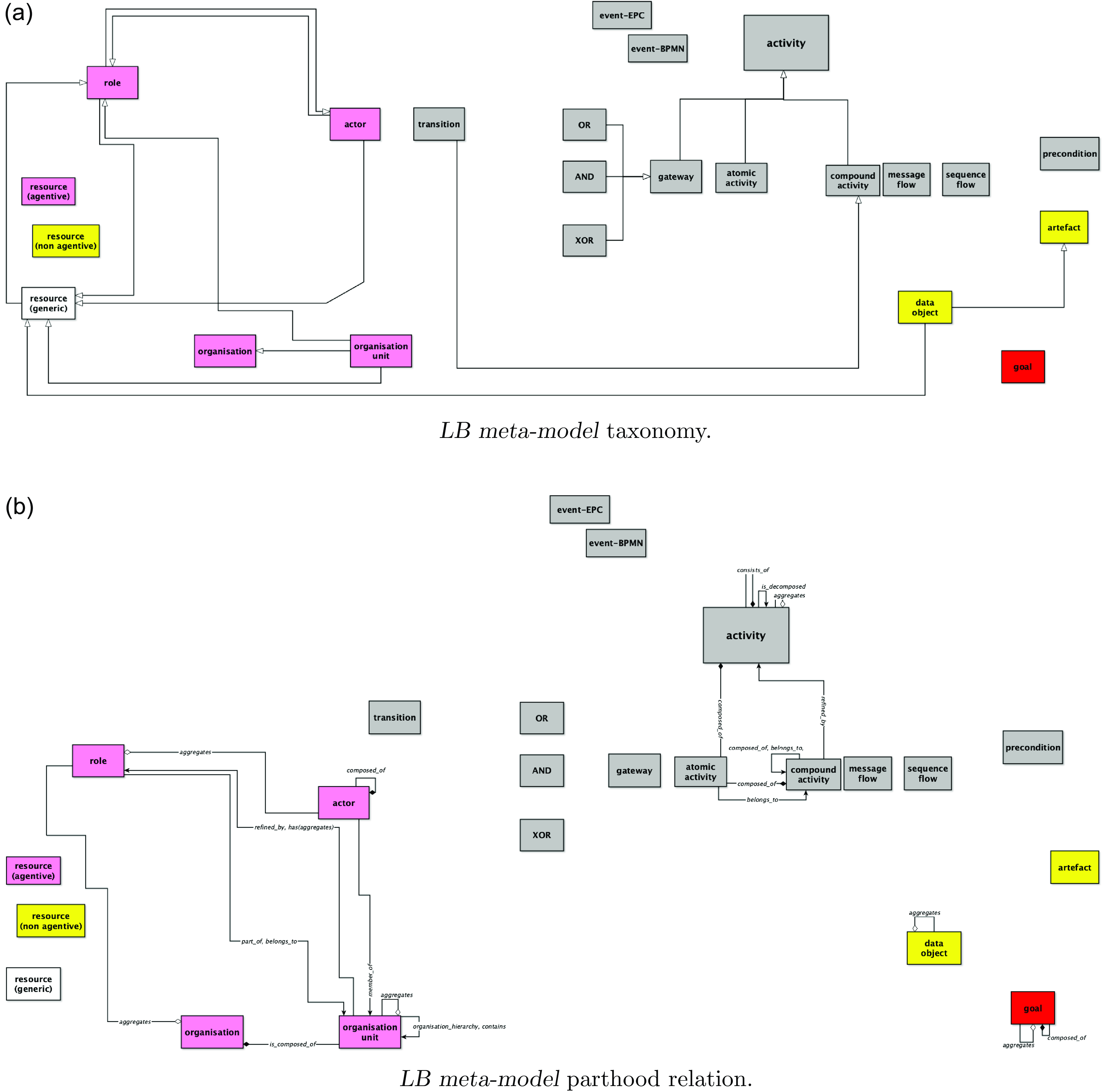
The complete LB meta-model is depicted in Figures 7 and 8: the former depicts the standard hierarchical relations of subsumption and parthood, the latter all the remaining relations. Grey is used for the behavioural elements, pink for the organizational elements, yellow for the data elements, red for the goal elements, and white for the elements at the intersection between the organizational and data dimension.
LB meta-model hierarchical relations.
The LB meta-model.
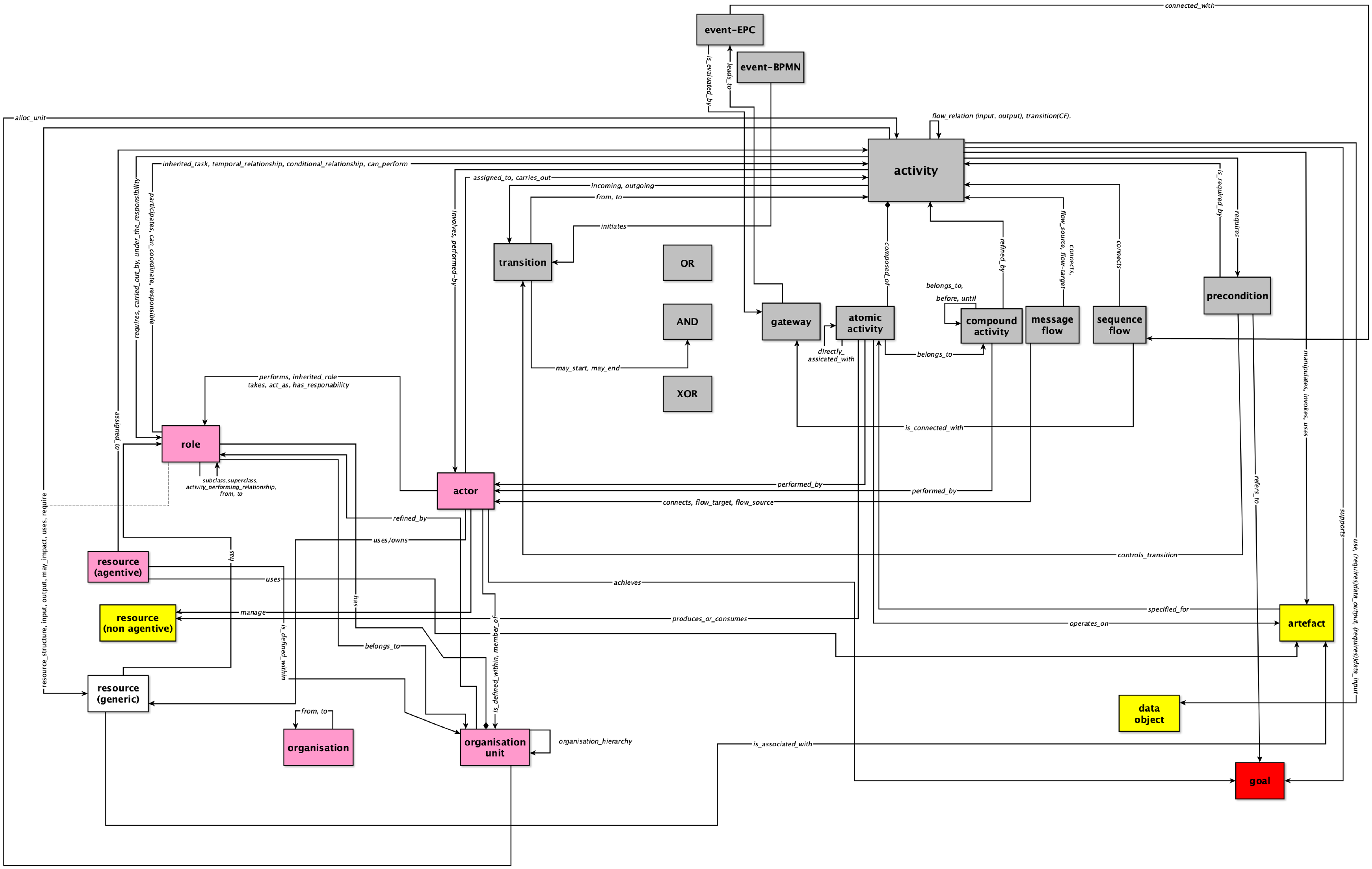
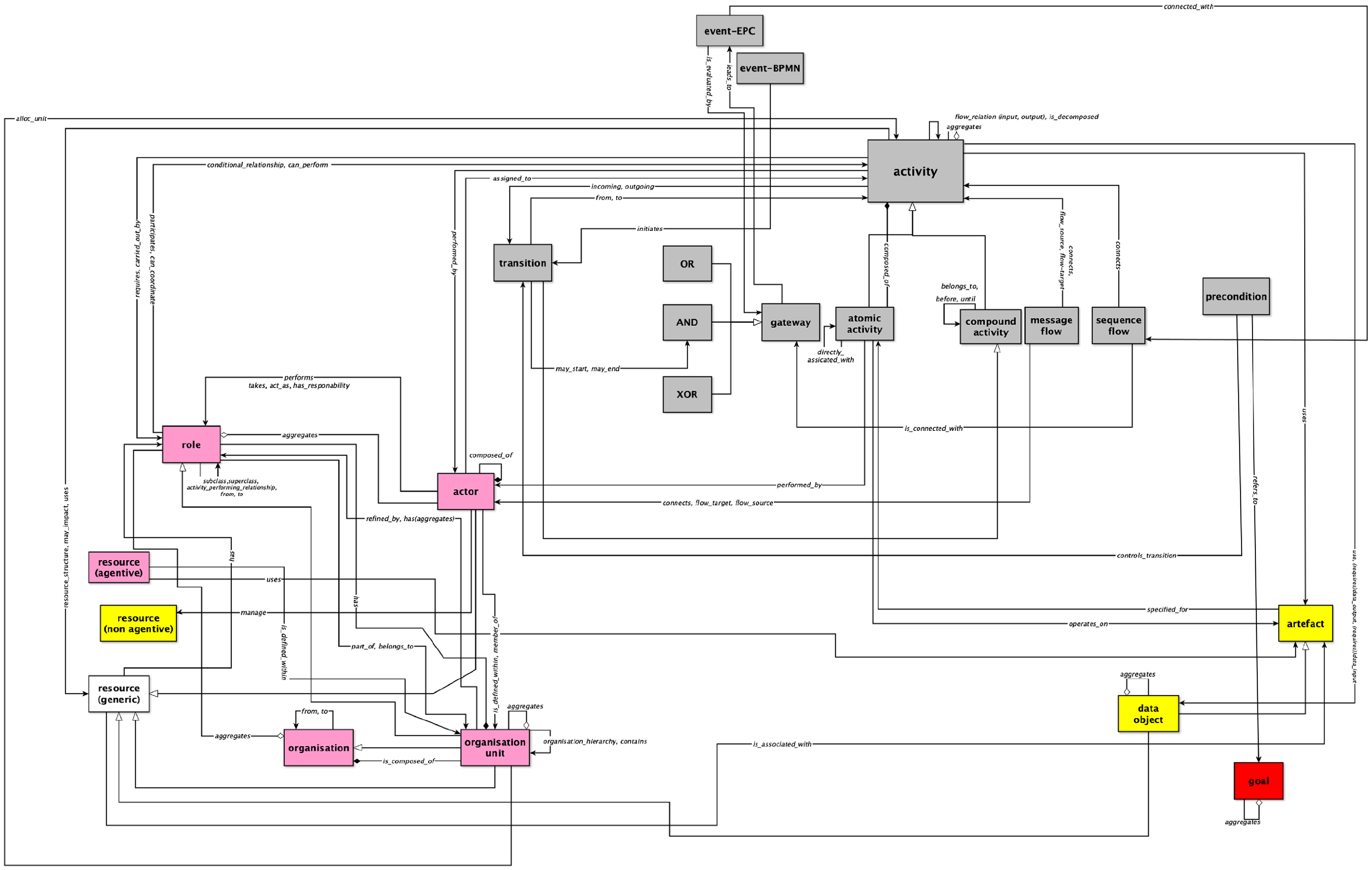
By comparing the diagrams in Figures 7–8 and the original meta-model proposed in Adamo et al. (Reference Di Francescomarino, GhidiniAdamo, Di Francescomarino, Ghidini, Dustdar, Yu, Salinesi, Rieu and Pant2020), here reported in Appendix B, Figure B1, we can easily see the greater complexity of the current meta-model, in terms of elements and especially in terms of relations (see Figure 9, which depicts the relations added in preparing the new version of the LB meta-model). The meta-model is built starting from the elements and relations presented in Tables 3 and 4 and therefore it emphasises—in a graphical manner—most of the characteristics that we have already observed in those tables. In particular, activity emerged as the most connected element, being related to the majority of the elements. However, as mentioned in the previous section, the other elements of the behavioural dimension are very rarely related with each other. Activity plays also a central role when we focus on the taxonomic and part-of relations. These two latter diagrams clearly show how activity is sometimes considered as a single unit of work and sometimes considered as a composite entity. With the exception of activity (or its atomic or compound variants) only few behavioural elements are connected with elements of the other dimensions, namely message flow (that includes several relations with the element actor) and precondition (that provides one relation with the element goal). The latter may support the importance of transaction goals (Adamo et al. Reference Adamo, Borgo, Di Francescomarino, Ghidini and Guarino2018a), that is, the notion of goal seen as the state that describes the output (effects) of the activities, including the final one.
The new relations of the LB meta-model
The organizational and data dimensions are the ones that have grown the most in this new version of the meta-model. In this part of the model, the elements that are mostly connected are actor and role. They are both widely linked with activity, in terms of ‘participation’, ‘assignment’, ‘involvement’, and ‘performance’. Actor is modelled as an entity with agentiveFootnote 18 characteristics. These characteristics are well described by relations such as:
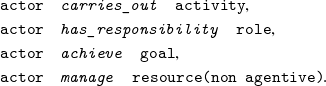 \begin{align*} \texttt{actor} \quad& \textit{carries_out} \quad\texttt{activity}, \\ \texttt{actor} \quad& \textit{has_responsibility} \quad\texttt{role}, \\ \texttt{actor} \quad& \textit{achieve} \quad\texttt{goal}, \\ \texttt{actor} \quad& \textit{manage} \quad\texttt{resource(non agentive)}.\end{align*}
The element role is represented as something that is ‘performed’ and ‘act as’ in relation with actor. However, the relations involving role, actor, and resource, suffer of problems similar to the ones already noted in Adamo et al. (Reference Di Francescomarino, GhidiniAdamo, Di Francescomarino, Ghidini, Dustdar, Yu, Salinesi, Rieu and Pant2020), which will be discussed in the next section. A notable expansion of the organizational part is also provided by the new elements organization and organization unit, and their relations with other organizational elements, which addresses in part the lack of organizational elements in the original LB meta-model.
The data dimension has grown in number of elements and relations. Nonetheless, artefact is almost the only element with a number of connections to the other dimensions. The relations describe artefact as something that is used and manipulated. Note also that data object is both an artefact and a resource (generic), so it is a subclass of the other two data elements.
Finally, the dimension of goal and its unique element are still under-represented, also in terms of relations. In particular, if we consider the five relations involving goal :
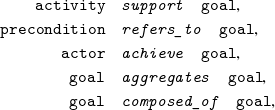 \begin{align*} \texttt{activity} & \quad \textit{support} \quad\texttt{goal}, \\ \texttt{precondition} & \quad \textit{refers_to} \quad\texttt{goal},\\ \texttt{actor} & \quad \textit{achieve} \quad\texttt{goal},\\ \texttt{goal} & \quad \textit{aggregates} \quad\texttt{goal},\\ \texttt{goal} & \quad \textit{composed_of} \quad\texttt{goal},\end{align*}
We can see that goal never appears as the domain of the relation, apart for the two reflexive ones.
5.1 Critical issues of the LB meta-model
In analysing the possible problematic aspects of the LB meta-model we start by discussing the issues described in Adamo et al. (Reference Di Francescomarino, GhidiniAdamo, Di Francescomarino, Ghidini, Dustdar, Yu, Salinesi, Rieu and Pant2020) to see whether they are still present.
First, the imbalance concerning goal and value is present also here, despite having almost doubled the primary studies and lowered the threshold related to the elements included in the LB meta-model. Few more elements appear in Table 3 in the goal and value categories, but they do not appear often enough to meet the threshold. This emphasizes the need of tackling the issue of a clear conceptualization of the notions of goal and value in a business process model.
Second, the observation that the LB meta-model captures mostly ‘standard’ aspects of business processes, and ignores elements related to, for example, the decision rules and collaboration aspects underlying process models, is still valid, despite the increased size of the study.
Third, it is easy to note that the problematic overlapping between role, actor, and resource remains also in the new version of the meta-model. Indeed, the model reveals subsumption cycles between actor, role, and resource, thus resulting in the equivalence of the three elements. Despite our attempt to distinguish between different types of resources (agentive, non agentive, and generic), the relation between resource and other organisational elements remains unclear, and it is mostly related to the resource (generic) element. While this is not a problem per se, the possibly generic manner in which a resource is treated, which neglects its very different characteristics, can generate problems. This is especially true for the is-a relation as observed earlier on.
Fourth, the explicit distinction between event-EPC and event-BPMN, together with the explicit introduction of the element functionFootnote 19, and the characterization of event-EPC as a state, have somehow eased the problematic overlapping between event-EPC, event-BPMN, and precondition illustrated in Adamo et al. (Reference Di Francescomarino, GhidiniAdamo, Di Francescomarino, Ghidini, Dustdar, Yu, Salinesi, Rieu and Pant2020). Nonetheless, a clarification of how event-EPC and event-BPMN relate with the other elements (and in particular with activity) is still needed. In fact, it is easy to see that event-EPC and event-BPMN are involved in very few relations in Figures 7 and 8. Also, the precise semantics of event-EPC, and its characterization in terms of a stative and a triggering component is still an interesting problem to addressFootnote 20, even if the problem was left out from this version of the meta-model.
In addition to the problems above, the LB meta-model shows new problematic aspectsFootnote 21. An example is the counterintuitive is_a relation between gateway and activity. According to a common-sense semantic, a gateway (see e.g., BPMN) can be seen either as a path or as a (decision) rule, and it is not clear whether or why a gateway can be seen as an activity. Among the new elements, clarifications would be needed on the usage of the term transition, which appears to have rather different intuitive meanings in the meta-model. On the one hand, it appears to convey a ‘transition between states’ meaning, witnessed by the relations:
 \begin{align*} \texttt{event-BPMN} & \quad \textit{initiates} \quad\texttt{transition},\\ \texttt{precondition} & \quad \textit{controls} \quad\texttt{transition},\end{align*}
and it is considered a specific type of activity:
 \begin{align*} \texttt{transition} & \quad {\textit{is_a}} \quad\texttt{activity}.\end{align*}
On the other hand, it also appears to convey the completely different meaning of a flow element connecting behavioural objects, witnessed by the relations:
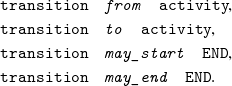 \begin{align*} \texttt{transition} & \quad \textit{from} \quad\texttt{activity},\\ \texttt{transition} & \quad \textit{to} \quad\texttt{activity},\\ \texttt{transition} & \quad {\textit{may_start}} \quad\texttt{END},\\ \texttt{transition} & \quad {\textit{may_end}} \quad\texttt{END}.\end{align*}
A further ambiguity regards the presence of both the subsumption and parthood relation between elements. For instance, when looking at organization unit and organization, we have that:
 \begin{align*} \texttt{organisation unit} & \quad {\textit{is_a}} \quad\texttt{organisation},\\ \texttt{organisation} & \quad {\textit{is_composed\_of}} \quad\texttt{organisation unit}.\end{align*}
A similar overlap happens between activity and atomic activity/compound activity. A discussion on whether this is a desirable or problematic aspect should be conducted.
In the next section, we will focus on some of these problematic issues and will propose some clarifications and solutions using the ‘tool’ of ontological analysis. In particular, we will focus on: (i) the problematic overlapping between role, actor and resource; (ii) the subsumption relation between gateway and activity; (iii) the presence of both the subsumption and parthood relations; and (iv) the concise description of the goal dimension in the LB meta-model.
6. Addressing the critical issues with ontological analysis
In this section, we address the critical aspects identified at the end of Section 5.1 trying to propose ontologically grounded solutions, when appropriate. In the diagrams that describe our refactoring we denote with light blue filled boxes concepts in the upper ontology DOLCE (Masolo et al. Reference Masolo, Borgo, Gangemi, Guarino and Oltramari2003) and its extensions, and with green filled boxes newly introduced business process elements.
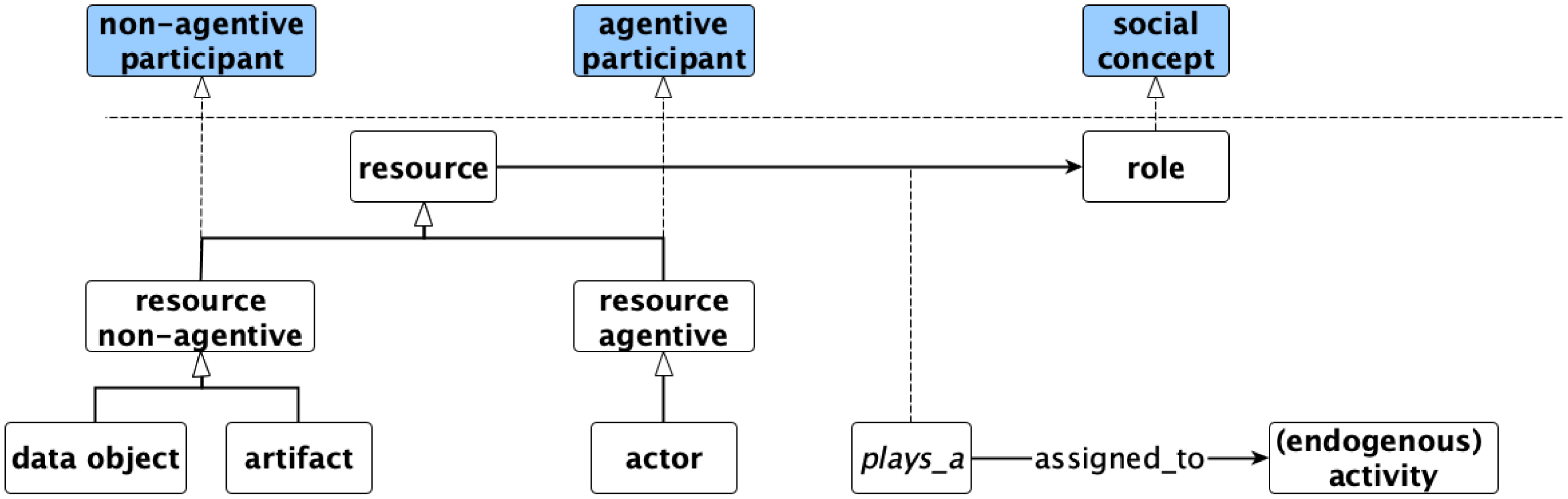
Meta-model of role, actor and resource.
6.1 Role, actor and resource
The first critical issue concerns the organisational and data dimensions and in particular the relation between role, actor and resource. This critical aspect was already identified in Adamo et al. (Reference Di Francescomarino, GhidiniAdamo, Di Francescomarino, Ghidini, Dustdar, Yu, Salinesi, Rieu and Pant2020) Therefore, in this paper, we have made an attempt to address this unclear interplay by explicitly disambiguating the notion of resource and specifying whether a resource presents agentive characteristics or not. This attempt was, nonetheless, unsatisfactory: the SRL identified a number of primary studies which use the notion of resource either in an unclear manner or with both meanings in a uniform way. This confusing usage generated again the subsumption loop between role, actor and resource.Footnote 22 For this reason, we stress here the importance of: (i) being aware of the complexity of the notion of resource; (ii) disambiguating this notion in meta-models; and (iii) specifying whether resource is used with agentive characteristics or not. Moreover, we propose again the solution illustrated in Adamo et al. (Reference Di Francescomarino, GhidiniAdamo, Di Francescomarino, Ghidini, Dustdar, Yu, Salinesi, Rieu and Pant2020) and depicted in Figure 10. This solution is based on a refactoring of the organisational and data dimensions based on the notion of ‘resource in terms of role it plays’. The light blue filled boxes denote reference concepts in the upper ontology DOLCE (Masolo et al. Reference Masolo, Borgo, Gangemi, Guarino and Oltramari2003) and its extension for roles as social concepts (Masolo et al. Reference Masolo, Vieu, Bottazzi, Catenacci, Ferrario, Gangemi and Guarino2004) and for the analysis of business process participants (Adamo et al. Reference Adamo, Borgo, Di Francescomarino, Ghidini, Guarino and Sanfilippo2017). In this diagram, a business process resource plays_a role when it is assigned_to (endogenous) activitiesFootnote 23. Note that we used association classes to reify the plays_a relation, to denote that the object that denotes a resource playing a role is assigned to an activity. An actor is an agentive business process participant and an artefact and a data object are non-agentive participants, and both can have physical and/or non-physical characteristics. Consider that the element actor includes agents in general, in this case both humans and cyber-physical systems. Finally, note that the association between resource (generic) and role occurs within the boundaries of activity, which somehow plays here the role of context in the definition of something as a resource (Azevedo et al. Reference Azevedo, Iacob, Almeida, van Sinderen, Pires and Guizzardi2015; Sanfilippo et al. Reference Sanfilippo, Benavent, Borgo, Guarino, Troquard, Romero, Rosado, Solano, Belkadi and Bernard2018).
6.2 Activity and gateway
The second critical issue involves the element gateway, and its subsumption relation with the element activity. To clarify whether a gateway can be considered a type of activity or not, we start from the analysis made in Santos Jr. et al. (Reference Santos, Almeida and Guizzardi2010), in which an ontological analysis of some elements of ARIS EPCs using UFO ontology (Guizzardi & Wagner Reference Guizzardi and Wagner2004) is provided. Although Santos Jr. et al. (Reference Santos, Almeida and Guizzardi2010) focus on a specific notation, the ontological analysis of the gateway element is general, since the semantic of the constructs AND, OR, and XOR, is widely shared among business process modelling languages.
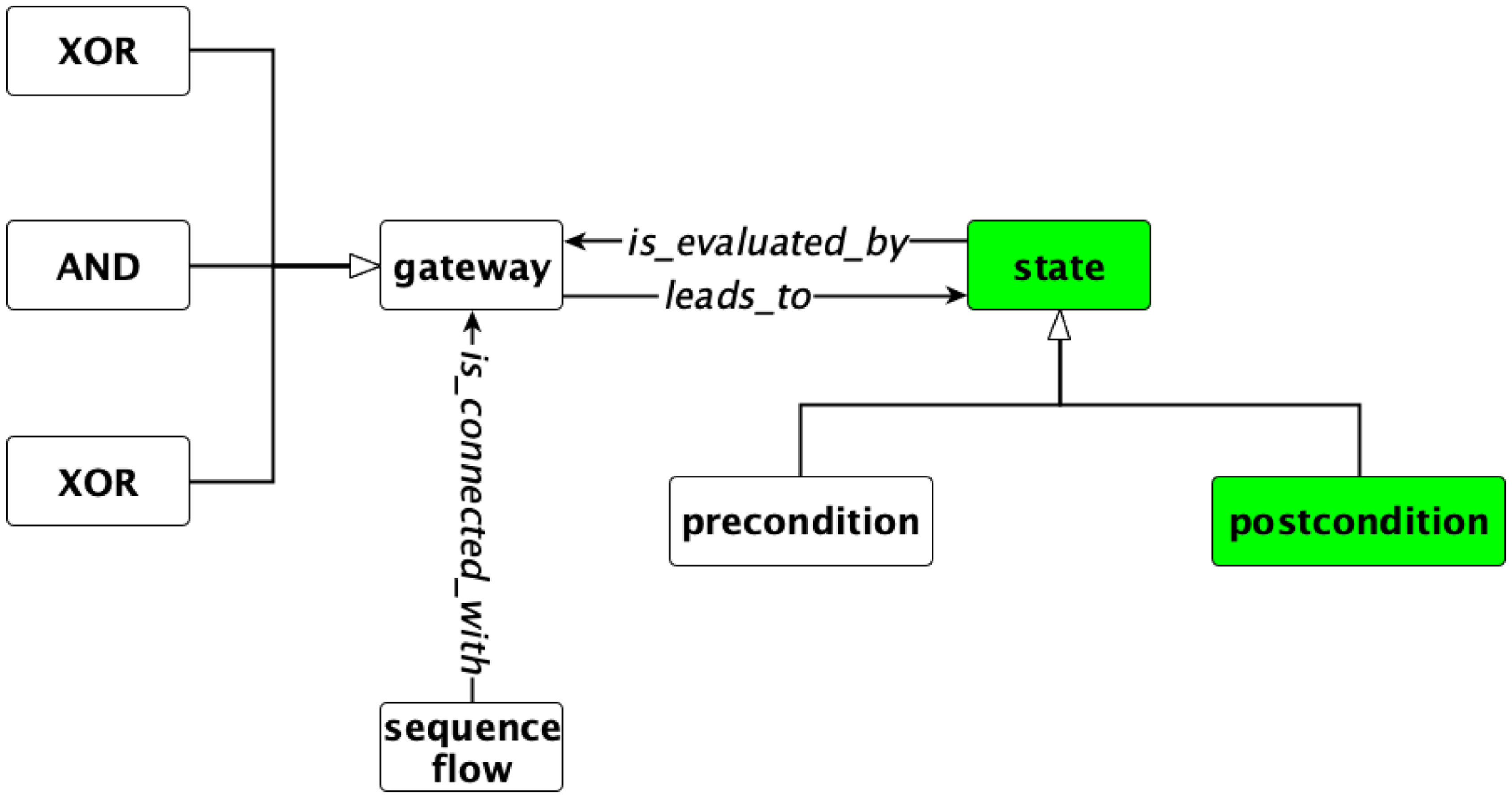
A gateway can be considered a relation that determines and mediates whether a specific state of the world is appropriate in order to execute the next business process steps (Santos Jr. et al. Reference Santos, Almeida and Guizzardi2010). Consider a simple business process model for selling a product: only after payment it is possible to proceed with the creation of the package’s label and the shipment. Thus, without realising a state of the world in which the product has been paid it is not possible to access another state of the world in which the product will be prepared and shipped. Gateways are used to relate these different states of the world when complex entities, that is multiple states of the world, are involved. For example, they can merge several activities and events in one possible state of the world, or viceversa they can fork one state in multiple (parallel or exclusive) outcomes.
In Figure 11, we propose a refactoring of the element gateway and its relations with other elements. The green boxes represent the newly introduced elements state and postcondition that did not meet the 15% threshold for being part of the LB meta-model. In this figure, we can observe that gateway is included in the temporal flow of a business process (model), and this aspect is captured by the relation sequence flow is_connected_with gateway. Relations is_evaluated_by and leads_to, originally involving gateway and event-EPC have been moved between gateway and state. This reflects the analysis of Santos Jr. et al. (Reference Santos, Almeida and Guizzardi2010) and also the observation, made in Adamo et al. (Reference Di Francescomarino, GhidiniAdamo, Di Francescomarino, Ghidini, Dustdar, Yu, Salinesi, Rieu and Pant2020), that events $\grave{a}$
-la EPC can be considered as a pre-postcondition, and therefore a state, having some triggering/causal characteristics (Adamo et al. Reference Di Francescomarino, GhidiniAdamo, Di Francescomarino, Ghidini, Dustdar, Yu, Salinesi, Rieu and Pant2020). For the sake of completeness, in Figure 8, we observe also the existence of two another unclear relations involving gateway, that is, the relations may_start, and may_end between transition and the AND gateway. These relations deserve an ad hoc analysis that we leave for future work, once we also analyse the relation between activity and transition and are therefore left out of our refactoring in Figure 11.
$\grave{a}$
-la EPC can be considered as a pre-postcondition, and therefore a state, having some triggering/causal characteristics (Adamo et al. Reference Di Francescomarino, GhidiniAdamo, Di Francescomarino, Ghidini, Dustdar, Yu, Salinesi, Rieu and Pant2020). For the sake of completeness, in Figure 8, we observe also the existence of two another unclear relations involving gateway, that is, the relations may_start, and may_end between transition and the AND gateway. These relations deserve an ad hoc analysis that we leave for future work, once we also analyse the relation between activity and transition and are therefore left out of our refactoring in Figure 11.
Meta-model of gateway.
6.3 Subsumption and parthood
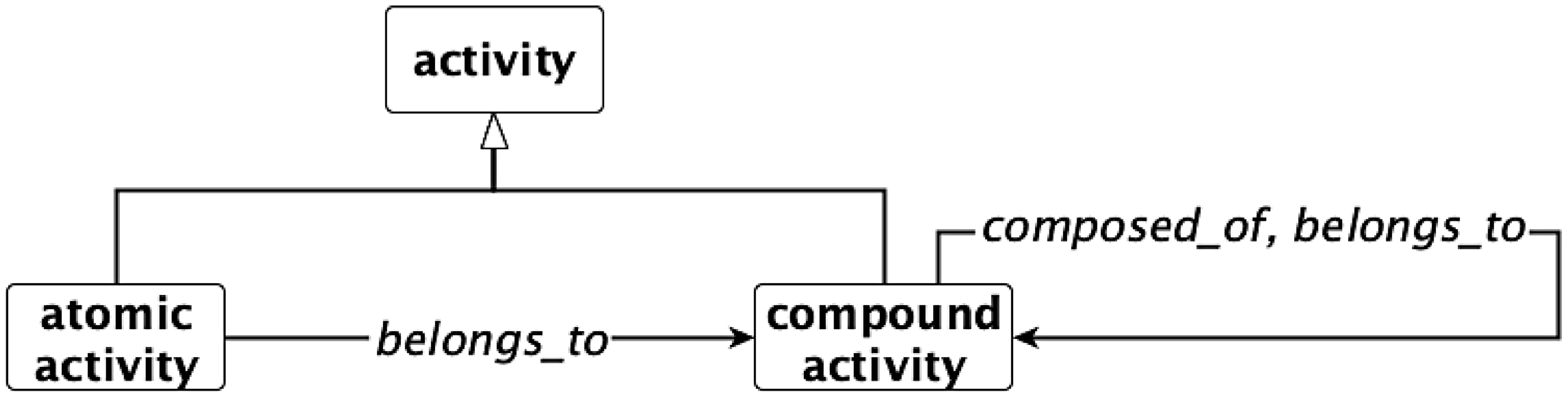
The LB meta-model contains several elements connected by different types of hierarchical relations, and in particular subsumption and parthood relations. Although this is not problematic per-se, it is something that can be related to different meanings given to the same elements and that needs to be verified. We focus here on two groups of elements: the pair organization unit and organization, and the triple activity, atomic activity, and compound activity.
Concerning organization and organization unit, the two relations may be connected to two slightly different notions of organization, namely a superkind with a specific identity, goal, mission and policy (e.g., company named X) and a kind of social structure composed of members playing roles that can decide and act as a unity. While the relation organization is_composed_of organization unit appears to be more related to the first meaning of organization, the organisation unit is_a organization appears to be related more to the second meaning of organization. While these two senses need to be further investigated (starting e.g., from Bottazzi & Ferrario Reference Bottazzi and Ferrario2009) we take here the view of the ontological characterization of an organization reported in the W3C The Organization Ontology (W3C Recommendation 16 January 2014)Footnote 24 in which a (sub-)organization can be recognized as standalone organization, and maintain the two co-existing relations.
Concerning activity, atomic activity, and compound activity, the overlapping relations seem to be originated by the different level of granularity at which activity is described. Indeed activity is sometimes considered an atomic piece of work (and therefore a synonym of atomic activity); sometimes it is explicitly used to express both the atomic and compound flavour; and sometimes it is considered just a generic part of the process disregarding the granularity aspect. To make the usage of these terms consistent we suggest to adopt the self explaining refactoring of Figure 12.
Refactoring subsumption and parthood—activity.
6.4 Goal
To enrich the notion of business process goal we decided to extend its subkinds and connect those with other elements of the meta-model. This analysis and the refactoring of the elements and relations are inspired by Adamo et al. (Reference Adamo, Borgo, Di Francescomarino, Ghidini and Guarino2018a), in which the investigation of goal is based on the notion of business process participant and not on specific modelling approaches/languages.
Meta-model of goal.
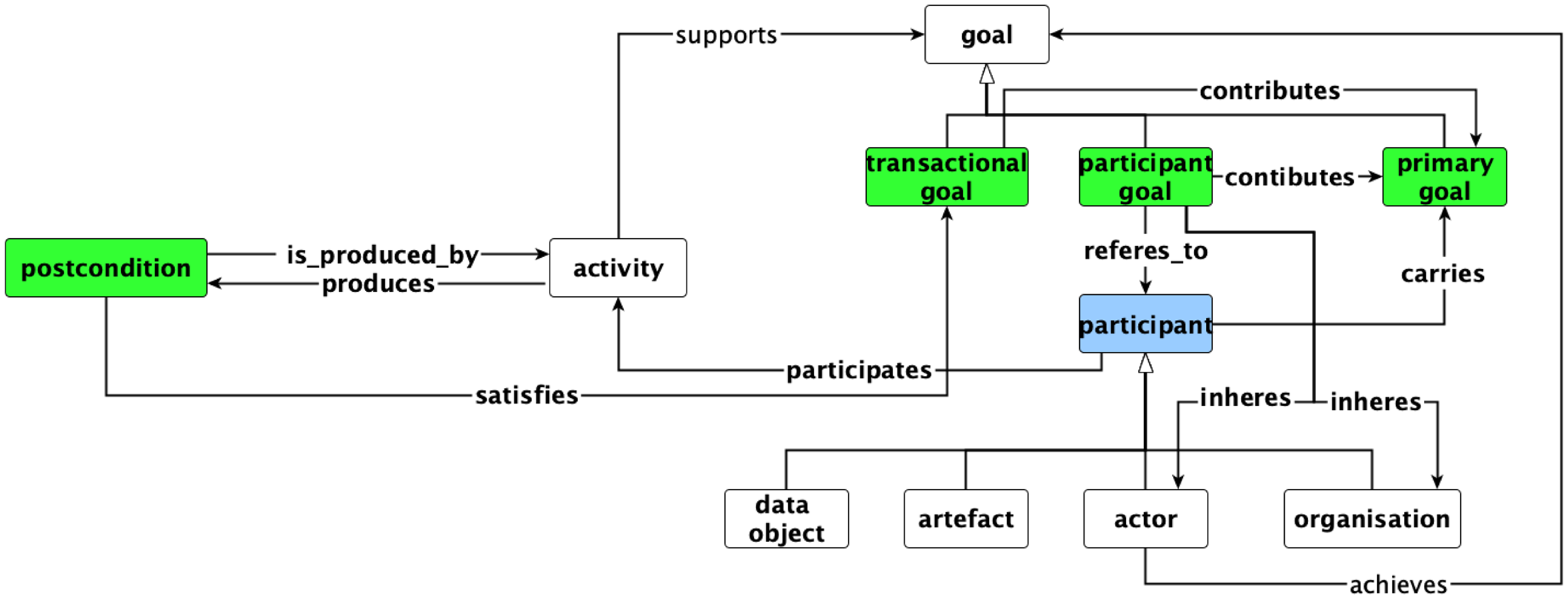
In a nutshell, we propose to extend the LB meta-model with three different notions of goal: primary goal, transaction goal, data and organisation oriented goal Footnote 25. The primary goal is the ‘reason to exist’ of a process and is related to an evolution of states of the world, or of a fragment of it, for some actors/organisations:
the goal of a business process is the realisation of a state of the world, starting from an initial condition, which is of value to one or more organisational participants (for whatever reason).
This definition is based on the work of Rolf and Asada presented in Rolf and Asada (Reference Rolf and Asada2015) modified to be applied to the business process context. The transaction goal explains the behavioural and procedural layout of the business process (model). More specifically transactional goals concern: (i) the final state reached after the last transaction, and (ii) the output (or effects) of each activity/sub-process. Finally, the data and organization oriented goals are those related to specific business process participants, such as actors and artefacts, who/which may have goals that are different from the global ones of the process.
Figure 13 represents the extension of the LB meta-model, which takes into account the goals’ definitions summarized above and the analysis of goals that has been carried out in Adamo et al. (Reference Adamo, Borgo, Di Francescomarino, Ghidini and Guarino2018a). For the sake of this refactoring we have introduced the element postcondition and some relations, in bold in the diagram. The meta-model is enriched by adding three sub-classes of goals, primary goal, transactional goal, and participant goal, which denotes data and organisation goals. The postcondition produced by the activity satisfies the transactional goal. The participant goal refers_to participants, actors, artefacts, data objects, and organisation, which participate in the activities. In particular, this kind of goals inheres in the actor and organisation business process participants. In this sense actors and organisations have intentions and the content of these intentions can be goals (Guizzardi et al. Reference Guizzardi, de Almeida Falbo, Guizzardi, Lencastre, e Cunha and Valecillo2008). Both transactional goal and participant goal contribute to the primary goal which is the realisation of a (desired) state of the world which is relevant for at least one participant of the process. Note that activity supports goal, and the latter is the super-class of the three more specific goals. This means that activities bear all three sub-goals.
6.5 Limitations of the paper
Part of the limitations of the study are related to the limitations of the SLR and include: (i) biases in the selection of the papers; (ii) imprecisions introduced in the extraction of data from the selected works. To mitigate these threats, we followed the guidelines reported in Kitchenham and Charters (Reference Kitchenham and Charters2007), Kitchenham (Reference Kitchenham2004) We applied the standard procedures reported in the guidelines for the correctness of the SLRs, such as the identification of the proper keywords to perform the data search, the selection of the appropriate sources and repositories for the field under investigation, the definition of clear inclusion and exclusion criteria, as well as of the quality assessment parameters. Specifically, we relied on the main literature sources and libraries in the information system field for the extraction of the works related to business process models and meta-models. Moreover, we expanded the search by manually inspecting the two main reference conferences in the field of BPM. To further improve the reliability of the review, we put some effort in guaranteeing the reproducibility of the search by other researchers, although ranking algorithms used by the source libraries could be updated and provide different results.
Another limitation is related to the fact that our search was limited to papers in English language, thus limiting the generalizability of the results. We indeed specified as part of the WoS query that papers should be in English language and we further applied an exclusion criteria to remove the non-English papers extracted from the other repositories. However, processing non-English papers would open the issues of which languages to include and of having the linguistic abilities to process non-English papers. Moreover, we expect that the literature in English is able to capture a significant picture of the scientific works carried out.
Similarly, the search method and the search query used for the automated paper extraction could have left out some relevant papers. In particular, we mainly focused on (i) manual search on two reference conferences, and (ii) database search using queries looking for explicit meta-models. This may have left out papers that could be obtained by other search methods, in particular snowball search, or by query terms looking for implicit meta-models such as the ones derived from formal representations. However, the first limitation is partly mitigated by exploiting two out of the three commonly used search methods for Systematic Literature Reviews (Brings et al. Reference Brings, Daun, Kempe and Weyer2018), that is, manual and database search, and the second limitation is mitigated by the fact that whenever an explicit meta-model reflecting the corresponding formal specification is available, we are anyway able to indirectly capture the elements of the formal representation.
A further limitation hampering the results of the SRL is related to potential inaccuracies due to the subjectivity of the analysis carried out. Indeed, (i) only one researcher selected the candidate primary studies; and (ii) only one researcher worked on the data extraction. Nevertheless, both aspects have been mitigated by the fact that (i) another researcher checked the inclusion and the exclusion of the studies; and (ii) another researcher checked the data extraction, as suggested in Brereton et al. (Reference Brereton, Kitchenham, Budgen, Turner and Khalil2007).
Some limitations regard the ontological analysis, which was grounded on specific formal ontologies, that is, DOLCE and UFO, and cognate literature. This may have influenced the way we analysed and proposed solutions for the issues presented in this section. This decision was taken because of the relevance of the aforementioned upper ontologies in the fields of information systems and BPM, which is evidenced by papers and existent applications.
Finally, we need to remember that the current version of the meta-model contains other business process components with an unclear semantics. Examples are the stative and triggering nature of event-EPC, or the relation between transition and activity. Nonetheless the current analysis focuses on elements such as activity, role, resource and goal which can be considered an important part of any business process definition.
7. Related works
To the best of our knowledge, very little work has been carried out so far specifically investigating and analysing the existing literature related to business process meta-models. However, a variety of sources exist that attempt to bring clarity to certain aspects of business process and modelling. Some of these papers are focused on the creation of business process meta-models and are indeed included in the list of the primary studies. For example, in both List and Korherr (Reference List and Korherr2006) and Söderström et al. (Reference Söderström, Andersson, Johannesson, Perjons and Wangler2002), conceptual frameworks of business process are proposed in order to evaluate or compare and translate modelling notations. In the work of Heidari et al. (Reference Heidari, Loucopoulos, Brazier and Barjis2013), a general meta-model is developed starting from the elements of seven business process modelling languages. The language independent meta-model is finally compared and analyzed with an ontology.
Several papers have been focusing on the ontological analysis of business process modelling and related fields. The works in Azevedo et al. (Reference Azevedo, Iacob, Almeida, van Sinderen, Pires and Guizzardi2015), Fadel et al. (Reference Fadel, Fox and Gruninger1994), Sanfilippo et al. (Reference Sanfilippo, Benavent, Borgo, Guarino, Troquard, Romero, Rosado, Solano, Belkadi and Bernard2018), Adamo et al. (Reference Adamo, Borgo, Di Francescomarino, Ghidini, Guarino and Sanfilippo2017) have been already discussed in reference to our work in Section 6 and are not described here for lack of space. In Sanfilippo et al. (Reference Sanfilippo, Borgo and Masolo2014) an ontological analysis of event and activity constructs in BPMN is presented. Santos Jr. et al. (Reference Santos, Almeida and Guizzardi2010) presented an ontological analysis of ARIS EPCs using the UFO ontology (Guizzardi & Wagner Reference Guizzardi and Wagner2010) for the semantic interpretation of the elements. In particular, they focused on the analysis of function, event and rule. Focusing on works independent from specific modelling languages, Guizzardi et al. (Reference Guizzardi, Wagner, de Almeida Falbo, Guizzardi and Almeida2013) propose an ontological analysis of events. The analysis is performed considering the UFO ontology and, although the paper is not committed with the specific representation of events in business process modelling, the research analyses conceptual models, reference frameworks and domain ontologies also in the area of business process modelling. Other works (e.g., Recker et al. Reference Recker, Rosemann, Indulska and Green2009) analyse business process modelling using the Bunge Wand and Weber ontology (Wand & Weber Reference Wand and Weber1990) as reference framework. In Adamo et al. (Reference Adamo, Borgo, Di Francescomarino, Ghidini, Guarino and Sanfilippo2018b) the authors offer an ontological inquiry of the relationships between activities. Concerning goals, the work in Adamo et al. (Reference Adamo, Borgo, Di Francescomarino, Ghidini and Guarino2018a) provides a classification of business process goals from the point of view of participants, while the work in Soffer and Wand (Reference Soffer and Wand2005) analyses and integrates notion of goal and soft-goal in business process modelling. A careful evaluation of how to complement our work with the ones listed here is left for future works.
The only work that makes an attempt to leverage the literature in order to investigate the meta-models proposed in papers so as to investigate commonalities, differences, and critical issues emerging from them is the one in Adamo et al. (Reference Di Francescomarino, GhidiniAdamo, Di Francescomarino, Ghidini, Dustdar, Yu, Salinesi, Rieu and Pant2020), which we revise and further extend here. The revision and extension concerns: (i) the number and type of meta-models taken into account for the analysis, which are extracted from papers retrieved using a wider set of keywords. This was made in order to correct possible flaws in the identification of the primary studies of the first study. This expansion has extended the number of meta-models from 36 to 65 and widened the area from which the meta-models were extracted, making an attempt to include the software engineering and the process oriented modelling languages ones; (ii) the elements and relations extracted from the 65 meta-models, which extend the ones extracted in the original study in a considerable manner so as to produce the wider literature-based meta-model of business processes presented in Section 5; (iii)a revised analysis and discussion of the single elements/relations as well as of the literature-based-meta-model. This analysis has enabled us to reinforce the validity of the problematic findings of the original LB meta-model concerning the organisational/data and goal/value categories. It has also pointed out new unclear elements and relations, especially in the behavioural category (see Section 6). In order to deal with such problems, an investigation was carried out, also with the help of the ontological analysis method, and possible solutions for the identified issues were proposed in Section 6. These, mostly novel solutions, include also the one to the problematic subsumption cycle between actor, role and resource, first proposed in Adamo et al. (Reference Di Francescomarino, GhidiniAdamo, Di Francescomarino, Ghidini, Dustdar, Yu, Salinesi, Rieu and Pant2020).
8. Conclusions
In this work, a significant extension of a business process meta-model extracted from state-of-the-art proposals through a systematic literature review is presented, together with a discussion of critical issues and possible solutions related to notions such as activity, gateway, organization, role, resource, and goal. Although the single meta-models proposed in literature were individually consistent, combining them into a unique LB meta-model, allowed us to identify critical issues, to carry on an analysis of these issues, and to propose possible solutions. In the future, we plan to further extend this work by addressing the unsolved issues highlighted in Section 6. For instance, we would like to investigate the notion of transition, and its relation to activity, as well as to further analyse business process elements neglected in the individual meta-models, such as goal and value.
These investigations can provide a significant step in the direction of a well-thought and agreed view on multi-perspective business process components at the conceptual level. This view would be beneficial not only for the development of new notations and systems but also for improving the interoperability of existing notations and information systems.
Competing interests
The authors declare that have no competing interests.
Appendix A The primary studies
The Primary Studies.
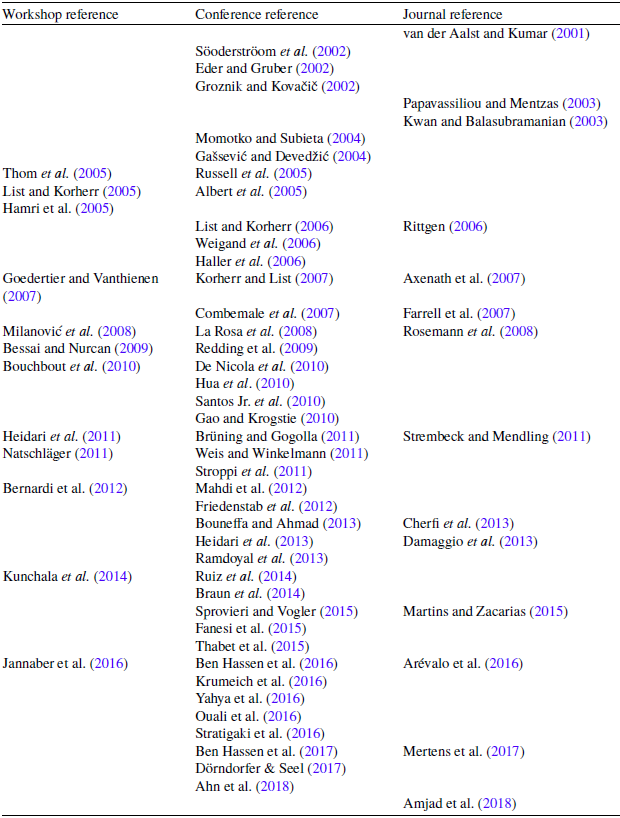
Appendix B The old meta-model
In this Appendix, we report the tables and diagrams referring to the limited Literature-based meta-model presented in Adamo et al. (2020). Tables B1 and B2 report the elements and relations extracted from the original 36 primary studies. Figure B1 instead presents the merge of the extracted elements and relations in a unique meta-model, depicted in UML, If particular, Figure B1a depicts the model taxonomy while Figure B1b depicts al the other relations.
Recurring elements in meta-models.
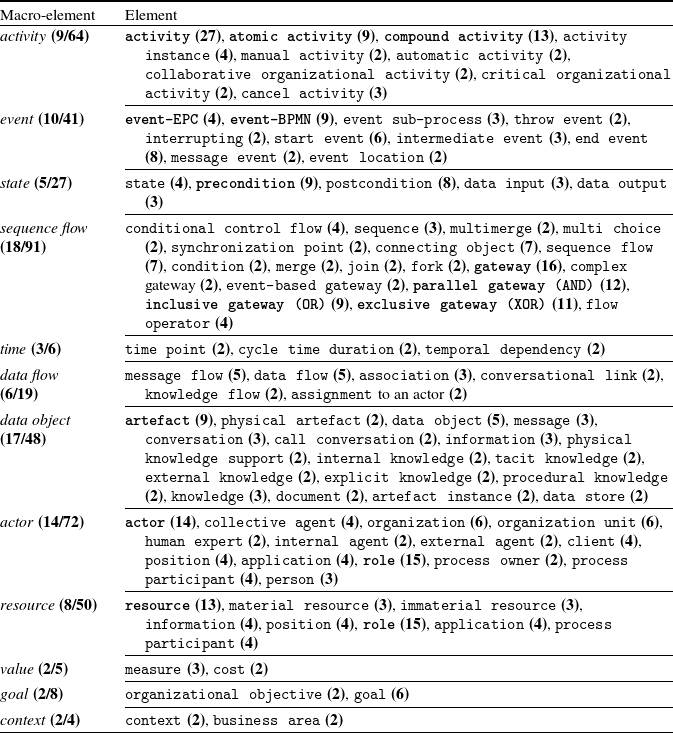
Recurring relations in meta-models.
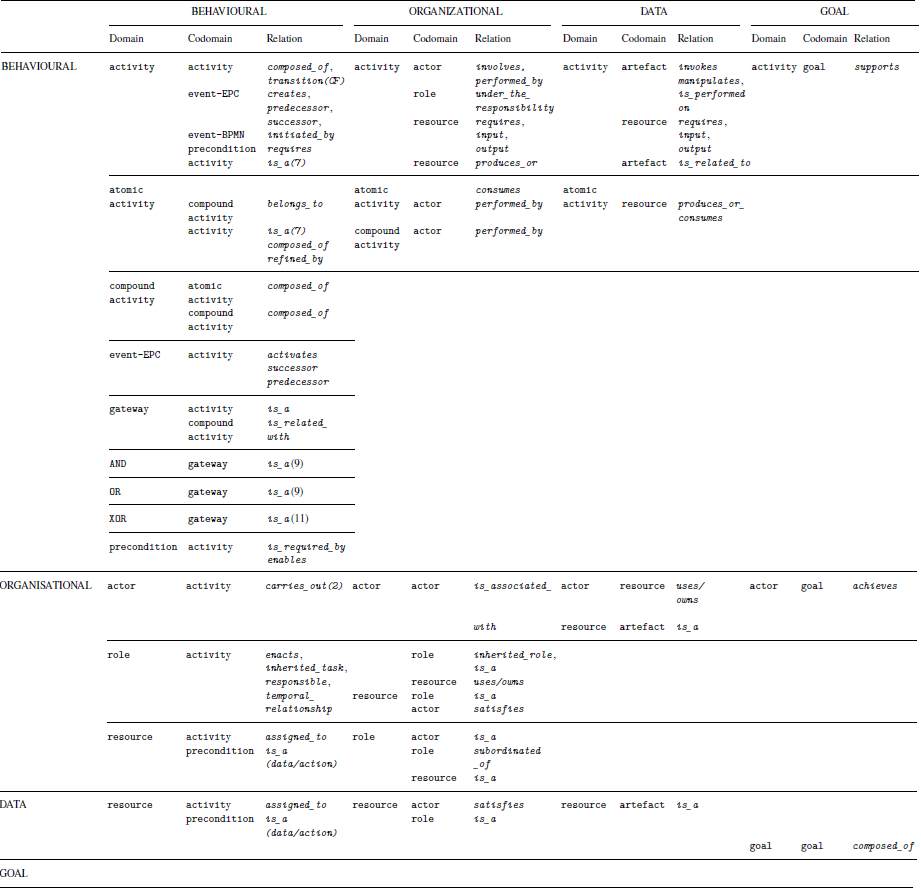
The original literature-based meta-model.
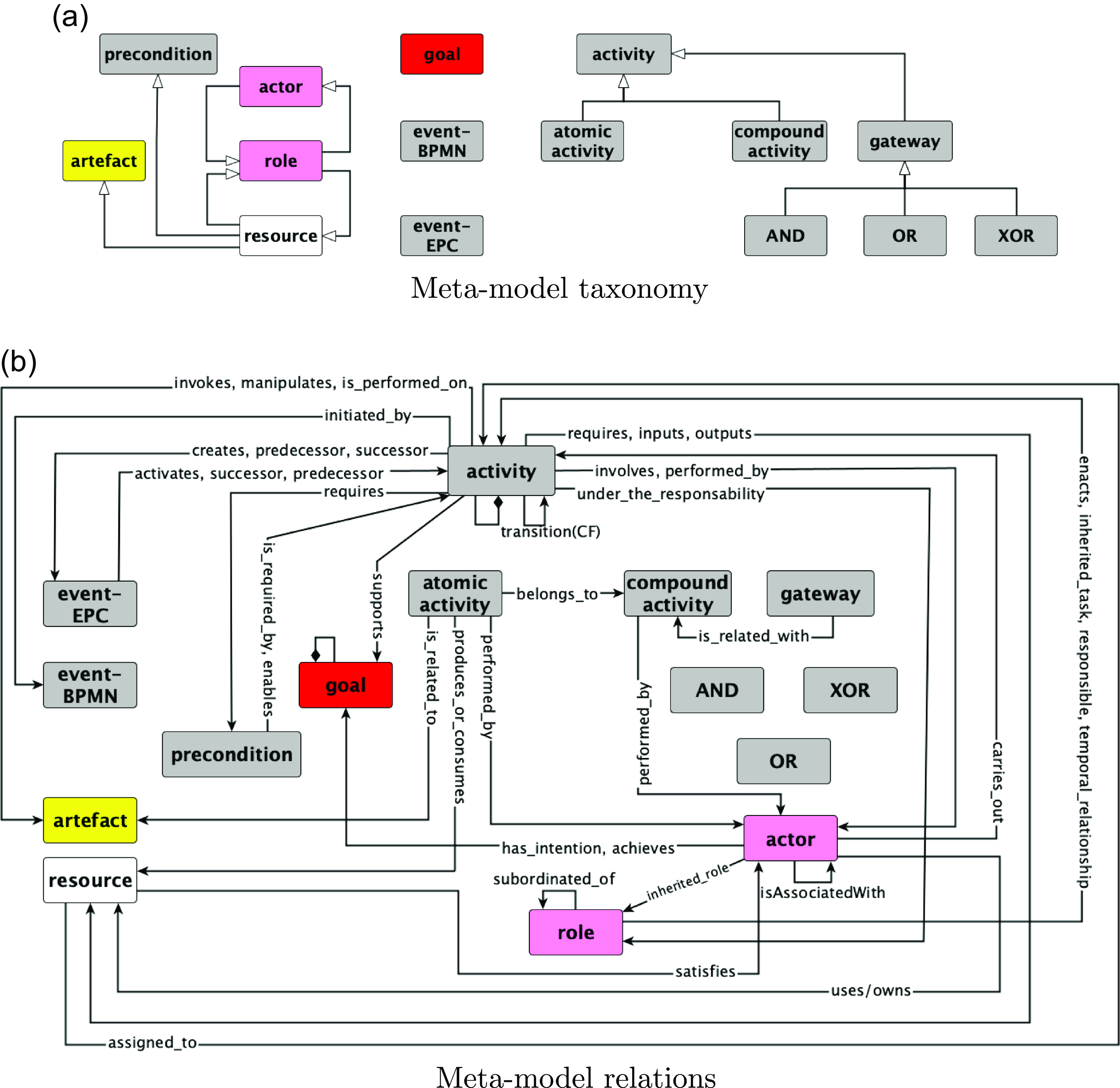


 Open access

