


1. Introduction
In recent years, the rapid digital transformation within industries and the integration of new technologies into organizations has significantly driven business expansion and economic growth (Reference BrownBrown, 2008; Reference Zhong and ZhangZhong & Zhang, 2025). The integration of Artificial Intelligence (AI) into various professional domains has rapidly accelerated which presents both opportunities and significant challenges. In the realm of user experience (UX) and product design, AI tools are increasingly being developed to streamline workflows, augment creative processes, and inform design decisions. This study focuses particularly on the role of AI in augmenting creative processes. One of the most widely recognized frameworks for guiding creative problem solving is design thinking, which emphasizes a human-centered, iterative approach to innovation. IDEO and the Stanford d.school, led by David Kelley and later popularized by Tim Brown, played a pivotal role in framing the five-stage design thinking model: Empathize, Define, Ideate, Prototype, and Test. This model provided a structured and flexible process for creative problem solving and was widely adopted across business, product innovation, and organizational contexts (Reference BrownBrown, 2008; Reference LiedtkaLiedtka, 2018).
However, the effective and responsible adoption of AI by designers, particularly those new to these technologies, remains a critical area requiring structured guidance. Some designers lack the foundational knowledge or practical frameworks necessary to leverage AI judiciously which may lead to potential misuse or underutilization of AI tools. To address this gap, a formative study is conducted through desk research, followed by a survey to gather empirical insights into how UX and product designers perceive and use AI tools within their design workflows. The insight from the survey was turned to a card-based toolkit. The survey aimed to understand designers’ levels of AI literacy, their confidence in using AI for specific tasks, the practical barriers that limit adoption, and their preferences for card-based guidelines.
The toolkit adopts a card-based format because cards are a well-established medium in design practice for supporting ideation, reflection, and collaborative exploration. Prior examples such as IDEO Method Cards (IDEO, 2003) and Inspiration Cards (Reference Halskov and DalsgaardHalskov & Dalsgaard, 2006) demonstrate how cards help designers externalize knowledge in a lightweight, modular way. Digital card-based toolkits have begun to emerge, extending the accessibility and adaptability of traditional card decks by enabling remote collaboration, real-time updates, and integration with digital design environments (Reference Obilo and SvanæsObilo & Svanæs, 2022). These developments highlight the potential of digital card-based formats to scaffold learning and experimentation in rapidly evolving domains such as AI.
The toolkit, presented as a card deck, is based on a Design Thinking approach in a digital product design context. It aims not only to introduce AI applications but also to foster a deeper understanding of AI’s capabilities and limitations. A distinguishing feature of this toolkit is the “Reusable Prompt” and “Reminder” tips, which highlight common pitfalls and ethical considerations, promoting responsible use of AI. The primary target users for this toolkit are UX and product designers seeking to explore and apply AI within their design methodologies, but it is not limited to other professionals. The ultimate goal of the ADT toolkit is to bridge the AI divide between those who expertly integrate AI into their workflows and those who are just beginners. This study offers mainly two contributions: (i) a formative research of how UX and product designers perceive and use AI within their workflows, (ii) the development of a card-based digital toolkit that integrates AI into the design thinking process.
2. Relevant work
2.1. Design thinking as a framework
Design thinking has attracted considerable interest from practitioners and academics alike, as it offers a novel approach to innovation and problem-solving. The five commonly recognized stages of design thinking includes Empathize, Define, Ideate, Prototype, and Test. It provides a structured but flexible framework that enables designers to deeply understand user needs, scope the problems, generate various ideas, and iteratively refine solutions (Reference Carlgren, Rauth and ElmquistCarlgren et al., 2016). Originating from the fields of design research and later popularized by IDEO and the Stanford d.school, design thinking emphasizes a human-centered and iterative process that balances analytical and creative modes of problem solving (Reference BrownBrown, 2008). As described by Brown and Katz (Reference Brown and KatzBrown & Katz, 2019), design thinking is a process for solving complex problems. It leverages “people-oriented” design principles to connect designers more closely with users’ needs, facilitating the discovery of appropriate solutions. Reference Plattner, Meinel and WeinbergPlattner et al. (2012) pointed out that design thinking is a way to find innovative solutions to complex problems, which requires incorporating human concerns, interests, and values into the design process. Reference DorstDorst (2015) believes that design thinking is “a process of exploration and creative strategies” in the whole field of design. Consequently, design thinking is both a cognitive process and a toolkit for innovation, integrating “thinking” and “design” the process is enhanced by diverse design tools and methodologies.
According to Reference Löwgren and StoltermanLöwgren and Stolterman (2004), there are two kinds of thinking: “divergence” and “convergence”. Divergent thinking refers to when the designer is broadening the design space by exploring multiple directions simultaneously. Activities often involve gathering information to uncover the design objective or generate ideas and solutions. Convergent thinking is the following process of assessing the gathered information or generated ideas to refine the design goal and to achieve the most optimal idea or solution (Reference CropleyCropley, 2006).
2.2. AI-augmented design thinking process
Generative Artificial Intelligence (GenAI) typically refers to a subset of AI techniques that use machine learning models (such as neural networks) to generate new content such as text, images and models by identifying patterns from existing training data (Reference Fui-Hoon Nah, Zheng, Cai, Siau and ChenFui-Hoon Nah et al., 2023). AI possesses the capacity to perform tasks that go beyond human capabilities, due to its unique ability to quickly process large volumes of data, identify patterns, and make highly accurate predictions.
The potential of GenAI to reshape the design process is extensive, with demonstrated applications across its key phases. During the early, divergent stages of design, these tools can act as catalysts for creativity. Utilizing extensive datasets and advanced algorithms, AI can understand more contextual information (Reference Jeon, Yang and KimJeon et al., 2021), perform user needs mining (Reference Han and MoghaddamHan & Moghaddam, 2021), assist in user research (Reference Pataranutaporn, Sra and MaesPataranutaporn et al., 2021), facilitate brainstorming (Reference DavisDavis et al., 2023), improve decision-making, creative idea generation (Reference BodenBoden, 1998) and design concept evaluation (Reference Camburn, Viswanathan, Linsey, Anderson, Jensen, Crawford, Otto and WoodCamburn et al., 2020; Reference Yuan, Marion and MoghaddamYuan et al., 2021). However, practitioners must balance and navigate a large amount of information and knowledge simultaneously, while continuously ensuring the quality and value of their work. Requirements for design can be complex, scope of the design becomes difficult to determine, and the representation of design knowledge cannot be easily simplified (Reference IchikoIchiko, 1989). Training machine learning (ML) and deep learning (DL) models for dynamic and multi-objective tasks can be difficult (Reference Cramer and KimCramer & Kim, 2019). Some argue that existing AI systems often fail to consider the complexity of human actions and behaviors and that human qualities and reasoning are still essential in scenarios where ML/DL is proposed (Reference ShneidermanShneiderman, 2020). Hence, using AI merely as a creative support during divergent tasks is suggested to be more appropriate as the designer in charge of setting specifications, defining goals, and providing governance and high-level creativity (Reference DoveDove et al., 2017).
Rather than viewing AI as a replacement for human creativity, scholars highlight its role as augmented intelligence, where computational systems enhance rather than substitute human capabilities (Reference Pataranutaporn, Sra and MaesPataranutaporn, Sra, & Maes, 2021). Within design contexts, this means positioning AI as a collaborator that supports designers, while human agency and judgment remain vital.
2.3. Digital card-based toolkit
Card-based tools are recognized as effective instruments in fields like design and education, valued for their ability to structure complex information, support collaborative ideation, and promote stakeholder participation (Reference Martin and HaningtonMartin & Hanington, 2012).
2.3.1. Design method cards
Early influential examples include the IDEO Method Cards, which codified human-centered design techniques (IDEO, 2003), and the Inspiration Cards, which combined domain-specific materials with design methods to foster creative exploration (Reference Halskov and DalsgaardHalskov & Dalsgaard, 2006). Following the shift toward distributed collaboration, digital method cards have become more prevalent, extending the accessibility of traditional decks by supporting remote teamwork and integration with digital design platforms (Reference Frisch, Ditting and WenderFrisch et al., 2021). These digital tools appear in various forms, from simple reference collections, such as the methods in “This is Service Design Doing” (Reference Stickdorn, Hormess, Lawrence and SchneiderStickdorn et al., 2018), to interactive single sets such as Laws of UX (Reference YablonskiYablonski, 2020). Others focus on workshop and collaboration frameworks, including the Hyper Island Toolbox and the Atlassian Team Playbook.
2.3.2. AI-augmented design method cards
The complexity of integrating AI has led to specialized toolkits for designers. Prominent industry examples include Microsoft’s HAX (Human-AI eXperience) Toolkit, for prototyping human-AI interaction, and Google’s People + AI Research (PAIR) Guidebook, which offers best practices for user-centric AI products. In academic research, many toolkits focus on ethical issues. Examples include the Guidelines for Human-AI Interaction for brainstorming ethical concerns in UX design (Reference AmershiAmershi et al., 2019); the Privacy Ideation Cards for focusing on privacy issues (Reference SchorchSchorch et al., 2016); and the Tarot Cards of Tech for reflecting on potential societal impacts. Other tools address specific ethical dilemmas in machine learning, uncover biases via the AntiBias Cards, and cultivate AI literacy through concepts such as the AI Audit or Model Card (Reference MitchellMitchell et al., 2019). Current digital decks remain narrow in focus, often addressing single aspects such as ethics, creativity, or inspiration, rather than offering structured guidance across the broader or whole design process.
3. Online survey study
To achieve the research aims on understanding how UX and product designers perceive and use AI tools within their design workflows, a survey was conducted. The insight from the survey was turned to a card-based toolkit, which integrates AI into the design thinking process to assist UX and product designers during the design processes.
204 participants were involved in the survey. Eligible participants were those who were currently working as UX or product designers, actively using or exploring AI tools in their design thinking or UX tasks, and occasionally or regularly applying the design thinking process in their professional practice. Participants also needed to demonstrate proficiency in English. The demographic information of participants is displayed in Figure 1. Most participants were in the 25–34 age group (44.1%, n=90), followed by those aged 18–24 (26.5%, n=54) and 35–44 (21.1%, n=43). Smaller proportions were observed for 45–54 (4.9%, n=10), 55 and above (2.0%, n=4), and under 18 (1.5%, n=3). This indicates that the sample was predominantly composed of young professionals in their mid-20s to early 30s. As for gender identity, participants self-reported as male (n=110, 53.9%), female (n=87, 42.6%), non-binary (n=4, 2.0%), or preferred not to say (n=3, 1.5%), which shows the sample comprised predominantly males and females.
Pie chart of demographic information

Among participants, UX Designers made up the largest group (38.7%, n=79), followed by Product Designers (35.3%, n=72). UX & UI Designers accounted for 25.5% (n=52). This distribution shows that the dataset is well balanced between UX-focused and product-oriented practitioners.
Nearly half of the participants had 1–3 years of professional experience (47.3%, n=96), highlighting the predominance of early-career professionals in the sample. About a quarter reported 4–6 years (25.1%, n=51), while smaller proportions had 7–10 years (11.3%, n=23) and more than 10 years (9.4%, n=19). Only a few participants reported less than one year of experience (6.9%, n=14). This distribution suggests that insights are most representative of junior to mid-level designers, with relatively fewer senior perspectives included. The survey comprised four main sections: (i) Demographic Data Collection: Gathering basic information about the participants. (ii) AI Exposure and Usage Patterns: Documenting how and where AI is utilized across each stage of the design thinking process. (iii) Confidence, Motivation, and Barriers: Assessing participants’ self-reported confidence levels, their motivation for AI adoption, and the obstacles they encounter. (iv) Preferences on Card-Based Guideline.
4. Results of online survey and discussion
4.1. AI Exposure and usage pattern
Stack bar graph of percentage of participants reported their AI familiarity across design thinking stages

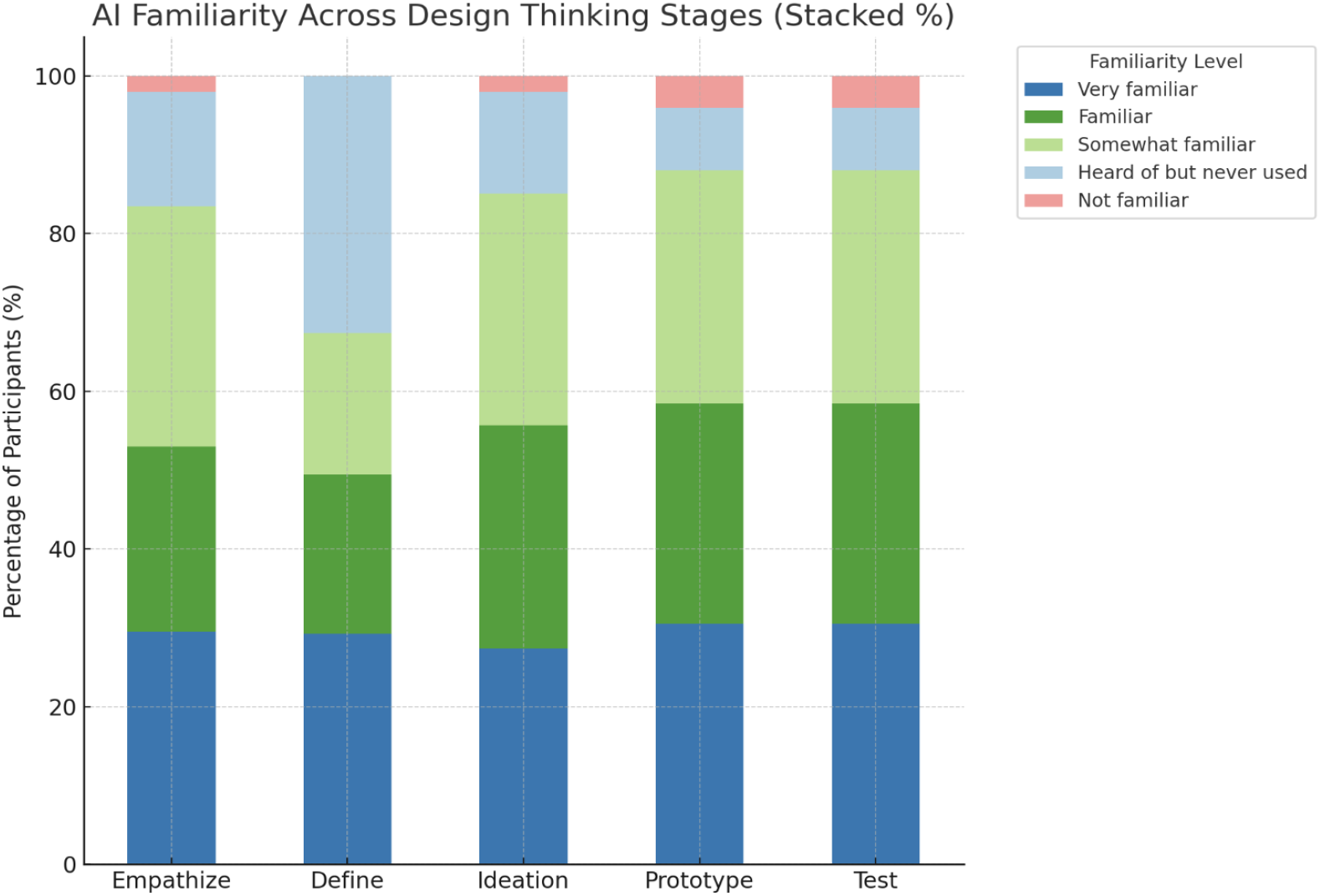
The analysis of AI familiarity across the five stages of the design thinking process reveals distinct patterns (Figure 2). Overall, most participants reported being very familiar (29%), familiar (23%), or somewhat familiar with using AI (31%), while only a small fraction indicated that they had merely heard of it (15%) or were not familiar at all (2%). These proportions suggest that more than four-fifths (83 %) of respondents have already incorporated AI into their design-thinking workflow to some extent. The Define stage showed the lowest overall familiarity (n=56), 68 % of respondents described themselves as at least familiar with AI, while about 12% indicated minimal exposure. The Empathize and Ideate stages also showed moderate engagement. Over two-thirds of respondents in these phases reported at least moderate familiarity with 66.9% and 66.7% respectively, fewer than 40% considered themselves very familiar. By contrast, the Prototype and Test stages recorded the highest overall familiarity with 71% of respondents in the Prototype stage and 72% in the Test stage rated themselves as at least familiar with using AI. These two phases thus suggested a strong AI adoption within the design-thinking process.
In summary, designers exhibit considerable but uneven AI familiarity across design-thinking stages. The later execution-oriented stages (Prototype and Test) show the highest engagement of respondents reporting at least moderate familiarity; while earlier interpretive stages (Empathize and Ideate) remain less developed. This distribution reflects the current maturity of AI tools, which excel in procedural or generative tasks but remain less adapted to empathic research and conceptual reasoning. Therefore, AI serves primarily as an enhancer of executional efficiency rather than a substitute for human insight, underscoring the need for toolkits such as ADT to scaffold AI’s integration into all stages of design thinking. These findings suggest that AI integration is progressing across all stages of design thinking.
4.2. Confidence, motivation, and barriers
In terms of confidence, 62% of respondents reported feeling moderately or highly confident using AI for routine design activities such as idea generation, content drafting, or wireframing. However, only 28% described themselves as very confident in structuring complex prompts or interpreting nuanced results. The remaining 38% expressed low confidence, primarily due to limited training, uncertainty about AI accuracy, and the lack of clear prompting strategies. Many participants mentioned difficulty in “knowing how to ask,” particularly when framing open-ended creative queries, revealing a broader gap between conceptual awareness of AI’s potential and practical literacy in applying it effectively.
Motivation to engage with AI was high. 74% reported being motivated or highly motivated to use AI to enhance productivity, explore creative directions, or streamline repetitive work. Respondents emphasized AI’s capacity to accelerate ideation (61%), automate documentation and formatting (49%), and inspire novel perspectives during brainstorming (46%). Several noted that AI tools served as valuable “sparring partners” that helped overcome creative blocks and refine early design concepts, particularly in idea synthesis and visualization.
Despite these motivations, several key barriers were identified. Nearly half of participants (48%) reported uncertainty about how to craft effective prompts or which AI system to choose for specific design tasks. Among these, 72% described relying on trial-and-error prompting, often rephrasing queries repeatedly until usable results were obtained. Such experimentation produced inconsistent or irrelevant outputs, increasing time costs and lowering workflow efficiency. A considerable portion (44%) also expressed doubts about the reliability or factual accuracy of AI-generated results. Many recounted instances where AI outputs appeared visually compelling but were technically infeasible, or where textual responses embedded misleading assumptions about users or contexts. These experiences contributed to skepticism and reinforced the need for continuous human oversight.
Ethical hesitation also emerged as a significant concern, cited by 32% of participants (n = 64). Within this group, 67% reported worries about algorithmic bias in training datasets, 55% (n = 35) raised concerns about copyright ownership of generated materials, and 47% (n = 30) feared automation and job displacement within creative industries. Participants emphasized the need for transparent data governance, ethical guidelines, and organizational policies that promote responsible AI adoption. Finally, 29% (n = 58) identified a lack of structured training or institutional support as a major limitation. Among these, 67% (n = 39) requested curated prompt libraries, 55% (n = 32) desired role-specific tutorials aligned with the design-thinking stages, and 45% (n = 26) suggested the inclusion of evaluation or ethical checklists to assess AI outputs. These findings highlight a pressing need for standardized, practice-oriented learning materials that can help designers build confidence, enhance prompting literacy, and integrate AI into their workflows with ethical awareness and methodological rigor.
4.3. Preferences on card-based guideline
A large majority (81%) participants reported that the guideline should prioritize ready-to-use materials rather than conceptual descriptions. Participants consistently favored cards that could be directly integrated into their workflow, describing them as “shortcuts to reliable AI use” or “templates that make experimentation easier without guesswork.” Only 19% (n = 38) preferred primarily conceptual or reflective content such as background theory or design-thinking definitions. When asked to rank the types of information most useful on each card (1 = most important, 5 = least important), participants prioritized pragmatic and example-based elements. The strong preference for reusable prompts (78%) and tool recommendations (64%) underscores designers’ desire for concrete guidance that bridges the gap between conceptual understanding and practical application. Comments suggested that designers value immediate productivity gains and role-relevant examples that illustrate “how to start” with AI tools for specific design-thinking tasks. Meanwhile, common mistakes and ethical reminders were viewed as essential but secondary elements, which was important for responsible practice but less central to immediate task performance. Several participants proposed that ethical prompts should remain visible but concise, such as “a short caution line per card” to maintain usability without overwhelming the design process. Others requested that each card include a short, role-specific scenario (such as “As a UX researcher preparing interviews…”) and a model output example to help visualize expected results.
5. Development and design
Based on the results from survey, the ADT was developed. The goal of the ADT card-based guideline is to bridge the AI divide and promote AI as augmented intelligence adoption in the creative industry. It can be used both for education, role-play and as a supporting tool during the professional design thinking process.
5.1. Deck structure
Deck structure

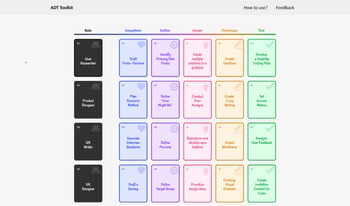
The ADT card-based guideline is designed as a digital and interactive deck (Figure 3) that visually maps the relationships between design roles and tasks across the five stages (Empathize, Define, Ideate, Prototype, and Test) of the Design Thinking process. The interface provides an overview of how different roles contribute to each stage and how AI can augment these activities in a structured, contextualized way. To be specific, the deck is divided into two interrelated components: (1) Role dimension (vertical axis) represents four core roles typically involved in digital product design, which are User Researcher, Product Designer, UX Writer, and UX Designer. Each role card encapsulates a specific professional perspective, set of responsibilities, and approach to human–AI collaboration. (2) Task dimension (horizontal axis) corresponds to the five iterative stages of Design Thinking. Each stage contains a series of AI-supported tasks that reflect how AI can be applied within that phase, from early-stage user exploration to late-stage testing and evaluation. By intersecting these two dimensions, the deck forms a 4 x 5 matrix (20 cards in total) that visually represents the complete AI-augmented Design Thinking workflow. Color coding reinforces both process order and stage identity—Empathize (blue), Define (violet), Ideate (pink), Prototype (orange), and Test (green).
This structure allows two primary modes of interaction: (i) Role-driven navigation, where a designer begins from their assigned role (such as User Researcher) and explores all tasks where AI can enhance their specific responsibilities across stages. (ii) Stage-driven navigation, where a facilitator or team selects a particular design stage (such as Ideate) and identifies the corresponding role–task combinations supported by AI. To apply the deck effectively, users match a role card with one or more task cards and follow the accompanying prompt-engineering guidance. Each card provides contextual cues so that the AI prompt reflects who is speaking (the designer’s role) and what the goal is (the design stage). This role-context alignment enables the AI system to generate more precise, relevant, and professional outputs, avoiding generic or misleading responses.
The ADT deck transforms abstract AI functionality into a structured and human-centered collaboration framework, bridging the gap between AI capability and design intent. It also encourages reflection. By viewing the entire matrix, designers can recognize how AI may augment ideation or prototyping and earlier analytical and empathic phases traditionally dominated by human reasoning.
5.2. Card content
Each card in the ADT deck is designed as a self-contained and actionable learning module that guides designers in engaging effectively with AI tools. The card content framework ensures that users not only receive functional instructions but also develop conceptual understanding and ethical awareness when incorporating AI into their design process. Two types of cards are provided: Role Cards and Task Cards, each serving distinct but complementary purposes.
5.2.1. Role cards
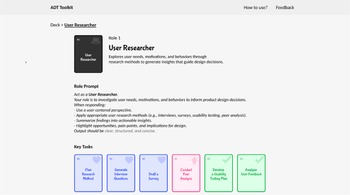
A Role Card defines the professional standpoint, tone, and method of reasoning that a designer should adopt when interacting with AI. Each role card begins with a concise description of that role’s focus within the design process. For example, the User Researcher card (Figure 4) describes how this role explores user needs, motivations, and behaviors to inform product decisions. Beneath the title, a Role Prompt specifies how the designer should “act as” this role when communicating with AI. It provides practical reminders such as: Use a user-centered and empathetic perspective; Apply appropriate research methods (such as interviews, surveys, usability testing, peer analysis); Summarize findings into actionable insights.
Role prompt: User Researcher

The Role Prompt thus ensures that the AI’s output mirrors the expected analytical depth and communication style of that profession. It helps standardize the “voice” of AI interactions, allowing generated responses to remain aligned with human design reasoning rather than drifting toward generic results. Each role card also lists key tasks commonly associated with that role, visually represented as linked task cards at the bottom of the interface. This supports intuitive navigation between professional perspective and corresponding design actions.
5.2.2. Task cards
Each Task Card represents a concrete activity within one of the five Design Thinking stages and contains six structured elements designed to scaffold AI-assisted practice (Figure 5): (i) Key Roles: Icons show which roles are most relevant to the task (such as User Researcher, UX Designer). (ii) Recommended AI Tools: Suggestions of suitable AI systems for that activity (such as ChatGPT, Claude, Gemini for text generation, or Midjourney for image-based prototyping). (iii) Task Prompt: A sample prompt template demonstrating how to formulate an AI query clearly and specifically. For example: “Draft a proto-persona for [product/service], including name, age, goals, frustrations, and daily habits.” (iv) Reusable Prompt Field: A copyable section that can be directly applied or adapted, enabling designers to experiment and refine their own prompts. (v) Result Example: A realistic AI-generated output illustrating the expected response format, tone, and level of detail. For example, a proto-persona named Daniel, 32, with background, goals, and pain points. (vi) Ethical Reminder: A concise caution note that promotes reflective and responsible use, such as “Always validate AI-generated assumptions with real user data before integrating them into design decisions.”
Task prompt: draft proto-persona

Together, these elements form a complete workflow template: the designer selects a role, chooses a task, adapts the provided prompt, observes the AI result, and reflects on the ethical note. This consistent structure ensures that each card can support execution and encourage critical thinking about AI reliability, human judgment, and contextual appropriateness.
6. Evaluation of the ADT toolkit
We evaluated the ADT toolkit through questionnaires across four dimensions: conceptual clarity, workflow rationality and real-world applicability, perceived effectiveness in supporting AI use, and intention for future use. Each dimension contains three items measured on a five-point Likert scale. Prior to completing the questionnaire, all participants should review a shared document introducing the toolkit’s structure and usage guidelines.
A total of 61 participants took part in the evaluation study. Among them, 35 identified as female, 25 as male, and one preferred not to disclose their gender. All participants had a design background, including UX designers (n = 20), UI designers (n = 14), UX & UI designers (n = 14), and product designers (n = 13), ensuring alignment with the intended user group of the toolkit. Participants represented diverse levels of professional experience, including less than 1 year (n = 11, 18%), 1–3 years (n = 14, 23%), 4–6 years (n = 14, 23%), 7–10 years (n = 11, 18%), and more than 10 years (n = 11, 18%), with no participants reporting zero years of experience.
Overall, the results indicate consistently positive evaluations. Conceptual clarity between the role cards and task cards received high ratings (M = 4.54, SD = 0.62), suggesting that participants clearly understood their distinction and interrelationship. The toolkit’s effectiveness in supporting designers’ use of AI was also rated highly (M = 4.52, SD = 0.65), reflecting its perceived utility in facilitating AI integration into the design process. The workflow’s rationality and applicability in real design contexts yielded similarly strong ratings (M = 4.50, SD = 0.66), indicating that the design-thinking-stage structure was perceived as appropriate for practical use. Finally, participants reported a high intention to use the toolkit in the future (M = 4.47, SD = 0.71), demonstrating strong adoption potential among professional designers.
7. Future application
The integration of Role Cards and Task Cards transforms the ADT Toolkit from a static reference resource into a dynamic interaction framework. By offering structured prompts and examples grounded in AI-augmented design thinking, the toolkit establishes common ground that encourages active participation among different members, which makes it has the potential to reduce communication barriers and facilitate collaborative co-creation. To support effective implementation, we recommend that workshops follow the guidelines outlined below:
Step 1: Preparation and Goal Setting: Before the workshop, it should clearly describe the central problem, goal or requirement. The workshop can scope just one task, one stage, or many stages. Then, the facilitator gathers participants and a primary role to each participant. Ensure the ADT Toolkit deck is accessible (either as physical cards or on a digital collaboration board). The facilitator should do the orientation of how to use the deck before getting started.
Step 2: Phase Selection and Task Distribution: The facilitator begins by announcing the starting Design Thinking Phase from the toolkit’s horizontal axis, typically starting with ‘Empathize.’ Each participant refers to the column for the active phase and identifies the specific Task Card corresponding to their assigned.
Step 3: Execute Tasks: The facilitator sets a timer (such as 30-45 minutes per task) for participants to work on their assigned tasks. This work can be performed individually or in small groups. The goal for each participant is to produce a tangible output or “artifact” based on their task card, such as a list of interview questions, a draft survey, or a proto-persona.
Step 4: Group Review: Once the time is up, the team regroup. Each participant (or role-based group) presents their completed artifact, shares key insights, and how they use AI as the assistant from their activity.
8. Conclusion
The growing integration of AI presents both opportunities and challenges for the design industry. Automation of the design process is hard to be achieved and humans are still needed to finish high level requirements. Our formative findings revealed that although designers recognized the potential of AI, they often lacked confidence in knowing which tools to use, how to frame their questions, or whether the outputs could be trusted. Ethical concerns and worries about bias further contributed to hesitation. These insights shaped the ADT’s design while ensuring that it provides practical prompts and fosters reflection and responsible engagement with AI. The toolkit provides a systematic framework that maps roles and tasks across the five stages of design thinking. With actionable prompts, reusable examples, and ethical reminders, it highlights the use of AI in a clear and responsible manner. The evaluation results demonstrate consistently positive outcomes across conceptual clarity, workflow rationality, perceived effectiveness, and future use intention. These findings indicate that ADT has successfully helped designers move from uncertainty to greater confidence, enabling them to utilize AI as an aid in the creative process. While the current evaluation provides encouraging evidence of the toolkit’s usability and practical relevance among professional designers, future work will extend its validation to broader design domains and explore technical enhancements. Planned developments include expansion to additional creative contexts, deeper integration with design platforms such as Figma and Miro. In addition, the evolution of ADT toward a more adaptive and intelligent system to sustain its relevance as AI-enabled design practices continue to evolve.



 Open access

