


“POSTGLACIAL” is a term with three different meanings. However, the term has been widely used without regard to these different meanings. This has lead to great confusion.
The only way of avoiding confusion is to make a clear definition of and distinction between the three meanings. This is easily done, and has consciously been done in papers and lectures by the author (e.g. Mörner, 1969).
-
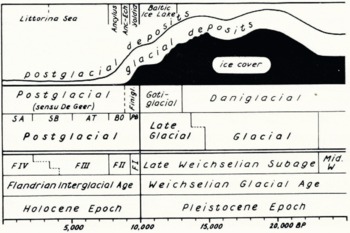
“Postglacial” is a chrono-stratigraphical unit starting with the Preboreal at 10 000 radiocarbon years B.P. This is the general usage in northern Europe of “Postglacial” today (e.g. Reference NilssonNilsson, 1965), and we may therefore add “sensu stricto”.
-
“Postglacial” is a chrono-stratigraphical unit used by De Geer (e.g. 1940) in his varve chronology of Sweden to denote the period after his zero varve, i.e. after about 8 900 years B.P. Today, “Postglacial” is very seldom used in this sense. This usage should be avoided, and if used, “sensu De Geer” has to be added.
-
“postglacial” (with a small “p”) is a genetic facies term saying (in contrast to glacial deposits) that the sediments were deposited without influence of the receding ice. This usage is commonly used in geotechnical literature.
Consequently, we have to distinguish clearly between “Postglacial” with a capital “P” and “postglacial” with a small “p”. This is the fundamental point, which has so often been neglected. If this distinction is not made, we cannot avoid a total confusion. Therefore, we should not start a sentence with “postglacial”, as it then might be impossible to know whether it is the facies term or the chrono-stratigraphical term.
In the Kattegatt sea, postglacial clay started to be deposited already in Late Glacial time. In the Baltic, glacial clay continued to be deposited in Postglacial time. Outside present glaciers, glacial sediments are still being deposited.
Similarly, small letters should be used on “glacial”, “late glacial” and “postglacial” when these words are used to describe the type of flora or fauna, and not the chrono-stratigraphical units (e.g. glacial and late glacial pollen floras of Postglacial age). The time transgressive change from late glacial to postglacial pollen flora in northern Europe has recently been discussed by Reference NeustadtNeustadt (1971).
In Figure 1, the global epoch, age and subage systems (e.g. Reference MörnerMörner, 1971) are compared to the north European chrono-stratigraphical systems here discussed and the facies usage of “glacial” and “postglacial”.
Summing up, there are three variants of “postglacial”:
-
“Postglacial” or “Postglacial (sensu stricto)”; a chrono-stratigraphical unit.
-
“Postglacial” (sensu De Geer)”; a chrono-stratigraphical unit.
-
“postglacial”; a facies term.
However, Postglacial is not an adequate chrono-stratigraphical term according to the stratigraphical nomenclature rules. The Flandrian Interglacial Age is an adequate chrono-stratigraphical term which covers the same period as Postglacial. Flandrian can therefore be used for preference instead of Postglacial.



