


Disasters, both natural and man-made, affect the lives of millions of people every year. Many are killed or injured and in the aftermath a large number are left homeless and suffer physical and psychological ill health. Reference Noji1
The impact of disasters upon suicide rates has been found to vary. Krug et al Reference Krug, Kresnow, Peddicord, Dahlberg, Powell and Crosby2 found no increase in suicide rates after natural disasters including floods, hurricanes and earthquakes. However, these findings were reported in a retraction following the publication of their original article Reference Krug, Kresnow, Peddicord, Dahlberg, Powell and Crosby3 in which they had claimed an increased suicide rate after disasters.
The Kobe earthquake, which struck Japan on 17 January 1995 significantly reduced the suicide rate in males in 1995, immediately after the disaster. Reference Shioiri, Nishimura, Nushida, Tatsuno and Tang4 The suicide rate, however, gradually returned to the previous average in the 2 years after the earthquake. However, after the 1999 Taiwan earthquake, victims of the disaster were 1.46 times more likely to die by suicide than non-victims. Reference Chou, Huang, Lee, Tsai, Tsay and Chen5
In 1995, Somasundaram & Rajadurai Reference Somasundaram and Rajadurai6 studied the effect of war on the suicide rates in northern Sri Lanka over 10 years from 1980 to 1989. They found a marked drop in the suicide rates during the war, particularly among males. Lester Reference Lester7 also found that suicide rates in France were lower during years of war than during years of peace (1826-1913), although the reduction was observed mainly in females.
On Boxing Day, 2004, Sri Lanka was one of the countries devastated by the 40 ft waves of the Indian Ocean tsunami in which more than 300 000 people died. The entire coastal belt of Sri Lanka except the north-western sector, which is partially shielded by the South Indian Peninsula, bore the brunt of the unprecedented disaster. Over 35 300 people died and more than 500 000 were made homeless. 8 We decided to investigate the effect of the tsunami on the number of deaths by suicide in Sri Lanka.
Method
Sri Lanka is divided into 25 districts. Data on suicide rates by district, recorded biannually from 1 January to 30 June and 1 July to 31 December each year, were obtained from the Sri Lanka Police Department.
Of the 25 districts, 13 were affected by the tsunami. However, records of the five districts in the north-eastern part of Sri Lanka were not available due to rebel activities in those areas.
We considered the number of deaths by suicide in the 2 years prior to and 1 year after the tsunami. Data reported from the districts that were affected by the tsunami were compared with those from the districts that were unaffected.
Results
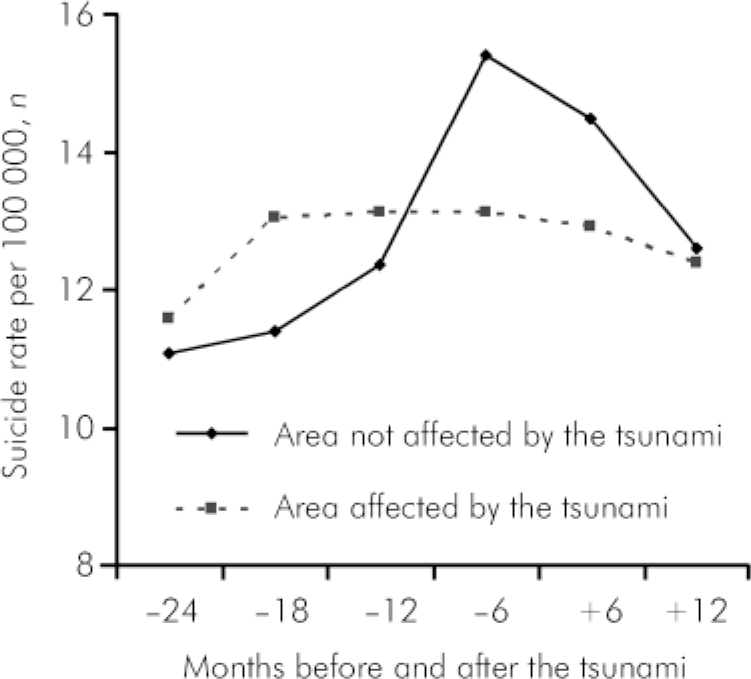
The mean number of deaths by suicide in the 2 years prior to the tsunami in the affected area was 2023 and 2718.5 in the unaffected area. The number of deaths by suicide in the year following the tsunami in the affected area was 2006 and 2736 in the unaffected area (Fig. 1). Using a logistic regression analysis of the data, no significant difference was found between the number of deaths by suicide in the affected and unaffected areas before and after the disaster (P =0.556, 95% CI 0.972-1.055).
The majority of the affected coastal districts that are being considered in this study are among the most densely populated in Sri Lanka. The mean mid-year population of the affected districts was 1.04 million (range 0.38-2.34) and 0.81 million (range 0.37-1.48) in the unaffected areas. 9 The coastal districts are relatively smaller in area (range 642-2984 km2) when compared to non-affected districts (range 1228-7133 km2).
Discussion
We found no significant differences between the mean number of deaths by suicide in the years prior to the tsunami and the year following the disaster. We also found no significant differences between the mean number of deaths by suicide in the first and second half of the year before the tsunami and the number of deaths by suicide in the first and second half of the year following the disaster.
One possible explanation for these findings is that we were only able to consider suicide rates of districts as a whole, although only a proportion, that is those on the coastal belt, were directly affected by the tsunami.
Suicide rates per 100 000 in an area affected by the 2004 tsunami and in the unaffected area.
Alternatively, it is possible that in the context of a country with one of the highest suicide rates in the world 10 and an ongoing civil war in certain regions, the tsunami disaster failed to have any profound effect on societal forces affecting suicide, famously described by Durkheim. Reference Durkheim11
Declaration of interest
None.
Acknowledgements
We thank the Director and staff of the Statistics Unit of the Sri Lanka Police Department and Robert Blizard of Mental Health Sciences, University College London Medical School.


 Open access


eLetters
No eLetters have been published for this article.