


Appendix C
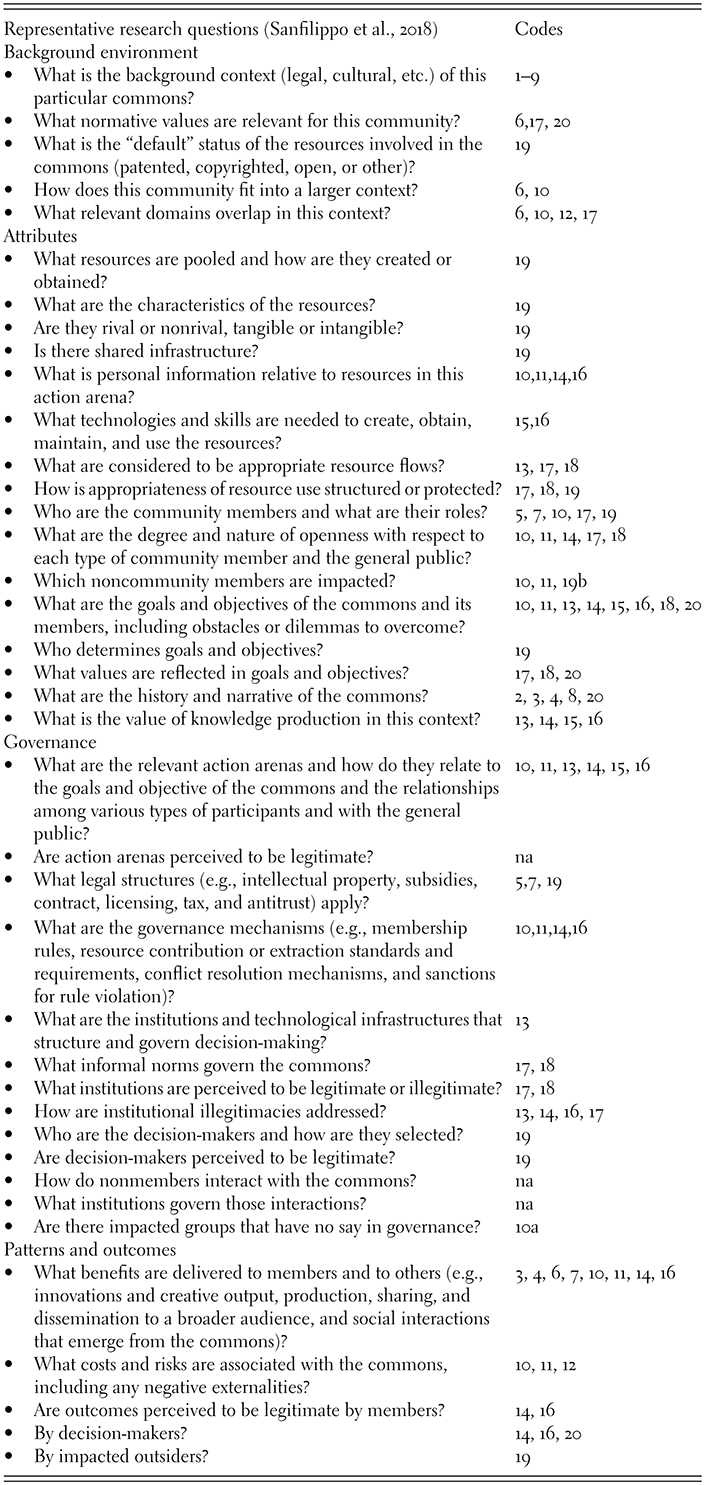
Table C.1 Long description
The table consists of two columns: Representative research questions (Sanfilippo et al., 2018) and Codes. It reads as follows.
Under Background environment.
1. What is the background context (legal, cultural, etc.) of this particular commons? 1 to 9.
2. What normative values are relevant for this community? 6, 7, 20.
3. What is the default status of the resources involved in the commons (patented, copyrighted, open, or other)? 19.
4. How does this community fit into a larger context? 6, 10.
5. What relevant domains overlap in this context? 6, 10, 12, 17.
Under Attributes.
6. What resources are pooled and how are they created or obtained? 19.
7. What are the characteristics of the resources? 19.
8. Are they rival or nonrival, tangible or intangible? 19.
9. Is there shared infrastructure? 19.
10. What is personal information relative to resources in this action arena? 10, 11, 14, 16.
11. What technologies and skills are needed to create, obtain, maintain, and use the resources? 15, 16.
12. What are considered to be appropriate resource flows? 13, 17, 18.
13. How is appropriateness of resource use structured or protected? 17, 18, 19.
14. Who are the community members and what are their roles? 5, 7, 10, 17, 19.
15. What are the degree and nature of openness with respect to each type of community member and the general public? 10, 11, 14, 17, 18.
16. Which noncommunity members are impacted? 10, 11, 19b.
17. What are the goals and objectives of the commons and its members, including obstacles or dilemmas to overcome? 10, 11, 13, 14, 15, 16, 18, 20.
18. Who determines goals and objectives? 19.
19. What values are reflected in goals and objectives? 17, 18, 20.
20. What are the history and narrative of the commons? 2, 3, 4, 8, 20.
21. What is the value of knowledge production in this context? 13, 14, 15, 16.
Under Governance.
22. What are the relevant action arenas and how do they relate to the goals and objective of the commons and the relationships among various types of participants and with the general public? 10, 11, 13, 14, 15, 16.
23. Are action arenas perceived to be legitimate? Na.
24. What legal structures (e.g., intellectual property, subsidies, contract, licensing, tax, and antitrust) apply? 5, 7, 19.
25. What are the governance mechanisms (e.g., membership rules, resource contribution or extraction standards and requirements, conflict resolution mechanisms, and sanctions for rule violation)? 10,11,14,16.
26. What are the institutions and technological infrastructures that structure and govern decision-making? 13.
27. What informal norms govern the commons? 17, 18.
28. What institutions are perceived to be legitimate or illegitimate? 17, 18.
29. How are institutional illegitimacies addressed? 13, 14, 16, 17.
30. Who are the decision-makers and how are they selected? 19.
31. Are decision-makers perceived to be legitimate? 19.
32. How do nonmembers interact with the commons? Na.
33. What institutions govern those interactions? Na.
34. Are there impacted groups that have no say in governance? 10a.
Under Patterns and outcomes.
35. What benefits are delivered to members and to others (e.g., innovations and creative output, production, sharing, and dissemination to a broader audience, and social interactions that emerge from the commons)? 3, 4, 6, 7, 10, 11, 14, 16.
36. What costs and risks are associated with the commons, including any negative externalities? 10, 11, 12.
37. Are outcomes perceived to be legitimate by members? 14, 16.
38. By decision-makers? 14, 16, 20.
39. By impacted outsiders? 19.

 Open access