

1. Introduction
Agricultural sectors have been vulnerable to chronic protectionist measures in many countries, especially in developing countries where food security issues easily gain political as well as social and economic support.Footnote 1 In this regard, Indonesia is one of the prominent examples as it has a very large import market for agricultural products. Due to the financial crisis during the late 1990s, protectionist measures have been regarded as even more politically desirable policies in Indonesia. The Indonesian government's series of import sanctions for agricultural products were imposed in order to promote food self-sufficiency.
The Indonesian import sanctions for agricultural products led to an increase in domestic market prices of affected productsFootnote 2 and disturbed significantly agricultural trade for many WTO members due to the large size of its import markets. In fact, many WTO members were engaged in legal disputes against Indonesia. But, interestingly, the largest exporter, Australia, that is supposed to be the most seriously affected country did not join the WTO dispute settlement procedure as a complainant, but merely as a third party. Instead, relatively smaller exporters, the United States and New Zealand, brought multiple cases against Indonesia.
A relatively small share of complainants’ exports and high share of third-party exports differentiates this dispute. The value of bilateral imports of disputed products from complainants reached 280 million USD in 2010, the year before the first bans came into force,Footnote 3 with a share in respondent's imports of 18%. This share is slightly below the average share for nondiscriminatory policies disputes, i.e. those that affect all exporters, as reported in Bown and Reynolds (Reference Bown and Reynolds2015). What puts this dispute in stark contrast with other disputes is the high share of third parties’ exports at 74.2% in 2010 (with Australia's share alone at 45.2%) while the average share of third party exporters at 5.8% and standard deviation 12.5% for nondiscriminatory policies disputes. Thus, a focus of our analysis is on understanding the high share of exporters acting as interested third parties rather than complainants.
We examined the underlying economic situations to explain legal disputes and consequent trade impacts. We found the nature of the import licensing regimes the major element causing the observed legal and trade phenomena. In other words, unlike other tariff barriers, the import licensing regimes operated as the fixed cost element for trade that induced strategically different reactions from exporters. We find that Indonesia's overall imports and imports from some of the largest bilateral import partners for the disputed goods did not experience a lasting decrease in trade value.
Disputes involving Argentina's import restricting measures that conditioned receiving import licensesFootnote 4 are probably closest to the disputes involving Indonesia's import licensing regime than any other dispute: the similarities include the initial motivation behind the import measures and the economic impact on exporting firms and countries. Conconi and Schepel (Reference Conconi and Schepel2017) analyse Argentina's disputed measures and find that Argentina's overall imports from complainants were not significantly affected. The measures regulating import licensing increased fixed costs of exporting and reduced trade policy certainty, much in line with those of Indonesia. The authors find that large firms were able to maintain previous export levels through agreements with government while smaller firms could experience shrinking exports. The analysis highlights trade policy uncertainty as a factor for increasing costs of exports. As export levels to Argentina were not significantly affected, authors argue that complainants were seeking to protect multilateral trading rules and predictability of trade policy.
Section 2 explains the factual background for agricultural market in Indonesia. Many relevant WTO disputes as well as FTA situations were also summarized. Section 3 analyzes the main legal rulings for the dispute. Section 4 examines the economic situations and presents economic rationales for the disputing parties. Section 5 concludes with the implication for future research.
2. Factual background for agricultural market in Indonesia
2.1 A series of legal disputes
After the Asian financial crisis of 1997–1998, the Indonesian government's economic policies became very protectionist due to ‘IMF stigma’.Footnote 5 The global financial crisis of 2008 fortified already rigid domestically oriented policies in many areas, especially agricultural sectors that raised politically controversial food security issues. Food security issues were even more highlighted when Australia, one of the major beef sources, banned live cattle exportation to Indonesia in 2011, on the basis of animal welfare concerns.Footnote 6 The Indonesian government and politicians pushed a series of agricultural policies that allegedly served to promote ‘self-sufficiency’ of food sectors, which was strongly supported by the general public.
On 10 January 2013, the US government requested consultation with Indonesia regarding import licenses and quotas imposed on importation of horticultural products, animals, and animal products.Footnote 7 Indonesia invited Australia, Canada, and the European Union to join the consultations. When the panel for this case was established, Argentina, Australia, Canada, China, European Union, Japan, Korea, New Zealand, Paraguay, Chinese Taipei, and Thailand reserved their third party rights.
On 30 August 2013, the US government brought another consultation request against Indonesia essentially on the same matter that included more measures as shown in Table 1.Footnote 8 The New Zealand government brought the consultation request on the same matter.Footnote 9 For both cases, Indonesia permitted Australia, Canada, European Union. and Thailand to join the consultations. But these cases did not reach to panel stage.
Indonesian laws and regulations addressed in WTO disputes
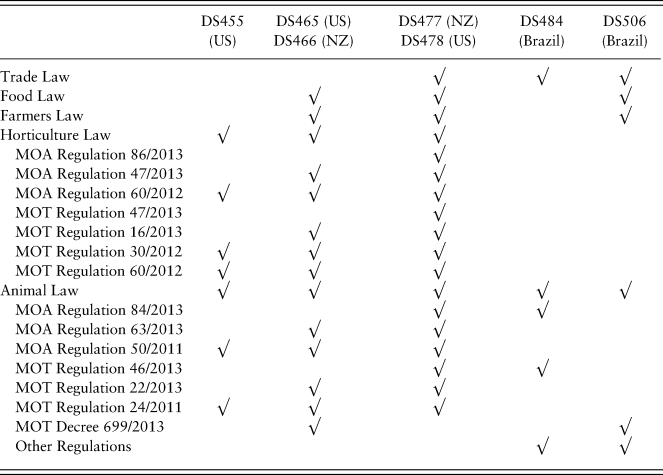
Notes: MOA stands for Ministry of Agriculture. MOT stands for Ministry of Trade. Other regulations include various laws and regulations by MOA and MOT as well as other ministries such as Ministry of Finance and Ministry of Religious Affairs.
On 8 May 2014, the New Zealand government brought the second consultation requests against Indonesia, addressing 18 laws and regulations related to importation of horticultural products, animals, and animal products.Footnote 10 On the same day, the US government brought the third consultation request on the same matter.Footnote 11 For these cases, Australia, Canada, European Union, Chinese Taipei, and Thailand were allowed to join the consultations. Argentina, Australia, Brazil, Canada, China, European Union, India, Japan, Korea, Norway, Paraguay, Singapore, Chinese Taipei, and Thailand joined the merged panel proceeding as the third parties.
As shown in Table 1, the later disputes raised by the US and New Zealand included more Indonesian measures since the Indonesian government continued to change relevant regulations. That was the main reason for the complainants to drop the previous cases and start the new disputes so as to include all relevant measures properly within the scope of the panel establishment.
Despite these series of disputes, the agricultural trade issues in the Indonesian market have not yet been settled in the WTO system. In fact, the Indonesian government's import constraints on chicken meatsFootnote 12 and bovine meatsFootnote 13 were challenged in the subsequent disputes raised by Brazil.Footnote 14 Considering the participation of many WTO Members as third parties in the disputes, it is still possible to have some more related disputes brought to the WTO DSB.
As of April 2018, Indonesia has been challenged in the WTO DSB 14 times. It is noted that half of those cases involved agricultural import bans arising from the same measures.
Table 2 summarizes the total 18 Indonesian measures as issues classified in terms of import licensing regimes.
Indonesian measures at disputes
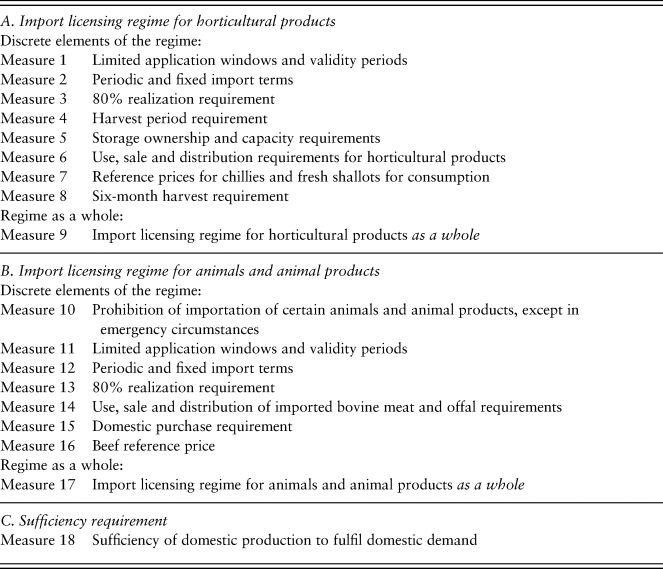
Note: Panel Report, Indonesia–Import Licensing Regimes, para. 2.32.
As shown in Table 2, import licensing regimes for horticultural products as well as animals and animal products are challenged in terms of ‘as a whole’, i.e., the entire system to limit importation. In addition, individual elements of those import licensing regimes are also challenged even if many of them are overlapped by measures concerning horticultural products and measures regarding animal products.
2.2 Economic background of Indonesian agricultural trade
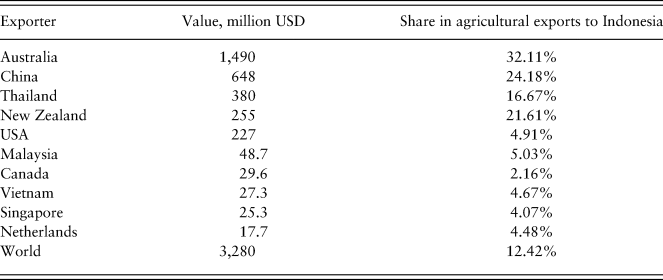
Table 3 presents the largest exporters to Indonesia of animal and horticultural productsFootnote 15 that were affected by the disputed measures. Australia, China, Thailand, the United States and New Zealand were the largest exporters to Indonesia of animals and animal products and horticultural products in the years immediately prior to the wave of protectionist agricultural measures; together they were responsible for more than 91.5% of world exports to Indonesia of all goods affected by the disputed measures. During the period between 2007 and 2009, Australia was the largest exporter of affected goods accounting for 45.5% of total Indonesian imports.
Indonesian imports of goods under disputes in 2007–2009, by exporters
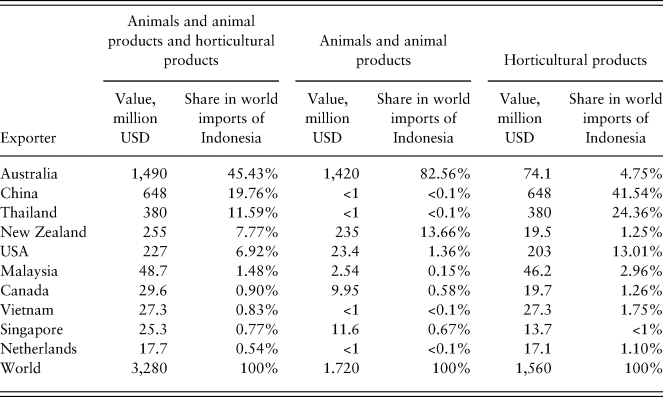
On the other hand, the two claimants were only the 4th and 5th largest exporters, together accounting for less than 15% of affected imports. The three largest exporters and remaining top-10 exporters of affected goods with WTO membership were represented in the disputes as third parties.
The total value of imports affected by the disputed measures was at 3.28 billion USD with roughly equal values of animal products and horticultural products. However, at the bilateral level, exports were concentrated in either type of products. Almost all exports from Australia and New Zealand were animal products, and these countries covered 82.56% and 13.66% of Indonesian imports of animal products, respectively.Footnote 16 Exports of China, Thailand, and the United States were largely in horticultural exports, and these countries had highest market shares in Indonesian imports of horticultural products. Overall, animal products imports were significantly more concentrated and dominated by Australia.
Import licensing measures affected the largest exporters the most, not only through exports value but also relative to total agricultural exports to Indonesia as can be seen in Table 4. For example, goods under dispute constituted 32.11% of Australia's agricultural exports to Indonesia for the period 2007–2009. Similarly, the share of disputed goods in agricultural exports constituted 24.18% for China, 16.67% for Thailand, and 21.61% for New Zealand. They were relatively unimportant for the remaining ten largest partners, including one of the claimants: the United States’ exports of disputed goods constituted only 4.91% of agricultural exports.
Importance of disputed goods in agricultural exports in 2007–2009, by exporters
2.3 Landscape of trade agreements
The disputes attracted a large number of third party participants, and many of them had a free trade agreement (FTA) with Indonesia. Australia, China, India, Japan, Korea, Singapore, Chinese Taipei, and Thailand all had an FTA with Indonesia through ASEAN or bilateral agreements, while Norway was in negotiation for the Indonesia–EFTA FTA.Footnote 17 One of the claimants, New Zealand, also had an FTA with Indonesia, while United States, the other claimant, did not have a trade agreement with Indonesia, making it the only country among the five largest partners of Indonesia by imports of affected goods without such an agreement.
It is noteworthy that so many FTA partners reserved their third-party rights in the disputes but did not act as claimants, and among them are three largest exporters to Indonesia: Australia, China, and Thailand. Unwillingness of these countries to participate as claimants is puzzling and deserves particular attention.Footnote 18 Indeed, Australia and China were affected the most both in terms of trade value and share of total agricultural exports. One possibility for this could be that trade agreement partners may be more inclined to resolve disagreements bilaterally. Partners benefiting from preferential treatment might value the long-run potential to deepen and strengthen such preferential position to resolve specific trade barriers. For example, Australia was negotiating a more comprehensive, relative to the ASEAN–Australia FTA, bilateral agreement with Indonesia, the Indonesia–Australia Comprehensive Economic Partnership Agreement, during the period when the import licensing measures were introduced.Footnote 19 The risk of unsuccessful negotiations due to a WTO dispute would hit Australia's preferential position while the costs of disputed measures were borne by all partners. Moreover, in the presence of the fixed costs of overcoming restrictive trade barriers, such as a licensing regime, the largest exporters can improve their relative position due to economies of scale.
3. Key legal rulings
3.1 General rules for GATT Article XI:1
The US and New Zealand challenged 18 separate measures shown in Table 2 under Article XI:1 of the GATT 1994. Article XI titled ‘General Elimination of Quantitative Restrictions’ stipulates, in relevant part:
1. No prohibitions or restrictions other than duties, taxes or other charges, whether made effective through quotas, import or export licences or other measures, shall be instituted or maintained by any Member on the importation of any product of the territory of any other Member or on the exportation or sale for export of any product destined for the territory of any other Member.
2. The provisions of paragraph 1 of this Article shall not extend to the following:
…
(c) Import restrictions on any agricultural or fisheries product, imported in any form, necessary to the enforcement of governmental measures which operate:
…
(ii) to remove a temporary surplus of the like domestic product, or, if there is no substantial domestic production of the like product, of a domestic product for which the imported product can be directly substituted, by making the surplus available to certain groups of domestic consumers free of charge or at prices below the current market level.
Following the WTO jurisprudence, Article XI:1 is applied under a two-step analysis: first (i) whether the complainant has demonstrated that the measure at issue is a measure of the type covered by Article XI:1, and if it has so demonstrated, then (ii) whether the complainant has demonstrated that the measure at issue constitutes a prohibition or restriction on importation. The Appellate Body in Argentina–Import Measures explained that the adverse trade effect of the measures need not be demonstrated by quantifying the trade flows. In other words, the limiting effects of the measures can be demonstrated ‘through the design, architecture, and revealing structure of the measure at issue considered in its relevant context’.Footnote 20
The US and New Zealand argued that all 18 measures at issue fall within the scope of Article XI:1 since they constitute a restriction on importation and are not ‘duties, taxes, or other charges’. Indonesia rebutted that the measures fall outside the scope of Article XI:1 because they are automatic import licensing regimes. The panel explained that automatic import licensing procedures do not fall per se outside the scope of GATT Article XI:1.
Furthermore, the Appellate Body ruled that GATT Article XI:1 and provisions of the Agreement on Agriculture (AOA) contain the same substantive obligations in relation to quantitative restrictions at dispute. In other words, since they apply cumulatively, it determined that ‘there is no mandatory sequence of analysis’ between GATT Article XI:1 and Article 4.2 of AOA and thus the decision as to whether to commence the analysis with Article XI:1 or Article 4.2 was within the panel's margin of discretion. Accordingly, the Appellate Body uphold the panel's decision to commence its examination with GATT Article XI:1.
In fact, Indonesia argued that AOA should prevail over GATT for the disputed matters because Article XI:1 and Article 4.2 concern the same matter, and Article 4.2 contains more detailed rules addressing specifically the measures from both a substantive and a procedural perspective. The Appellate Body explained that although Article 4.2 of AOA generally applies to: (i) a broader range of measures; and (ii) a narrower scope of products than GATT Article XI:1, both provisions prohibit members from maintaining quantitative import restrictions on agricultural products. Thus, it ruled that they apply cumulatively with no mandatory sequence of analysis.
This ruling appears to be reasonable when the relationship between GATT Article XI:1 and Article 4.2 of AOA is examined separately. But as discussed in Section 3.2, considering the fact that the other provision of GATT Article XI is found to be inoperative, it is not quite clear whether and when GATT provisions can apply cumulatively with no mandatory sequence of analysis as opposed to AOA concerning agricultural trade barriers.
3.2 GATT Article XI:2(c)(ii) versus Article 4.2 of AOA
Indonesia argued that Measures 4, 7, and 16 should be excluded from the scope of GATT Article XI:1 because they were necessary to remove a temporary surplus of horticultural products, animals and animal products in Indonesia's domestic market as stipulated in Article XI:2(c)(ii).
The panel, however, ruled that Article XI:2(c)(ii) is no longer available with respect to agricultural products following the entry into force of AOA. In fact, Article 21 of AOA provides that ‘[t]he provisions of GATT 1994 and of other Multilateral Trade Agreements in Annex 1A to the WTO Agreement shall apply subject to the provisions of this Agreement’. Article 4 of AOA, in relevant parts, provides:
2. Members shall not maintain, resort to, or revert to any measures of the kind which have been required to be converted into ordinary customs duties1, except as otherwise provided for in Article 5 and Annex 5.
1These measures include quantitative import restrictions, variable import levies, minimum import prices, discretionary import licensing, non-tariff measures maintained through state-trading enterprises, voluntary export restraints, and similar border measures other than ordinary customs duties, whether or not the measures are maintained under country-specific derogations from the provisions of GATT 1947, but not measures maintained under balance-of-payments provisions or under other general, non-agriculture-specific provisions of GATT 1994 or of the other Multilateral Trade Agreements in Annex 1A to the WTO Agreement.
Since GATT Article XI:2(c) applies explicitly to ‘import restrictions on any agricultural or fisheries product’, it is not a ‘general, non-agriculture-specific provision’ under footnote 1 to Article 4.2 of AOA. Thus, such measures are excluded from the types of measures which were required to be converted to ordinary customs duties under Article 4.2 of AOA. In other words, the panel ruled that Article XI:2(c) has been rendered inoperative with respect to agricultural measures by Article 4.2 of AOA.
The Appellate Body confirmed the conflict between Article XI:2(c) and Article 4.2 by explaining that quantitative import restrictions on agricultural products under the former provision cannot be maintained without violating the latter provision. Accordingly, it was ruled that Article XI:2(c) is inoperative with respect to agricultural measures by Article 4.2 of AOA.
This is a rare case in which the WTO DSB ruling renders certain GATT provision completely inoperative. In fact, the ‘General Interpretative Note to Annex 1A’ clarifies that in case of conflict between GATT and other trade agreements on goods in Annex 1A to the Agreement Establishing the World Trade Organization, the other agreements shall prevail to the extent of the conflict.Footnote 21 Article 21 of AOA stipulates a priority of the Agreement on Agriculture not only to the GATT but also to the other trade agreements in Annex 1A. Mavroidis (Reference Mavroidis2016) specifically raised the inconsistency problem between Article XI:2(c) and Article 4.2.Footnote 22 Whether Article XI:2(c) is the only provision of GATT to become inoperative in relation to the AOA remains to be seen. But the fact that a certain GATT provision turns out to be inoperative raises a doubt regarding the Appellate Body ruling of cumulative nature between GATT Article XI:1 and Article 4.2 of AOA, as discussed in Section 3.1.
3.3 Application of Article XI:1 of the GATT 1994
After reviewing individual measures, the panel concluded that Measures 1 through 7, 9, and 11 through 17 are inconsistent with GATT Article XI:1 because, by virtue of their design, architecture, and revealing structure, they constitute a restriction having a limiting effect on importation. In addition, it also ruled that Measure 18 is inconsistent as such with Article XI:1 for the same reasons. Regarding Measures 8 and 10, the panel found that they are inconsistent with Article XI:1 because, by virtue of their design, architecture, and revealing structure, they constitute squarely a prohibition on importation. These rulings were adopted without an appellate review.
(1) Private action versus measures taken by party
As a preliminary issue, Indonesia tried to exclude some measures – Measures 1, 2, 3, 5, 11, 12, and 13 – by arguing that they are not measures ‘instituted or maintained by Indonesia’, but instead the result of ‘decisions by private actors’. For example, Indonesia argued that the limited application windows and validity periods do not restrict imports at the beginning or end of the validity period and that importers decide of their own accord to limit their shipments after a certain date. Regarding Measures 2 and 12, Indonesia argued that any restriction on periodic and fixed import terms does not constitute measures ‘instituted or maintained by Indonesia’ because these terms are selected and can be freely altered by importers from one period to the other. The panel explained that the co-complainants did not challenge the results of the decisions of private actors. Instead, they challenged the measures that importers must respect in order to be able to import into Indonesia. Therefore, the panel concluded that those measures were ‘taken by Indonesia’.
(2) Sum of discrete measures versus measures as a whole
It is noted that the US and New Zealand brought the claims against the import licensing regime as a whole, separately from the claims on discrete elements of the regime. The co-complainants challenged Indonesia's import licensing regimes for horticultural products as well as animals and animal products as a whole on grounds that they were distinct from discrete measures, inasmuch as they related to the combined effects. They argued that discrete measures were cumulatively more restrictive than the mere sum of each individual requirements due to the way in which the requirements interacted with each other.
The key legal issue is whether the restrictive effect of each component of Indonesia's import licensing regimes is exacerbated when combined. The panel explained that, among many requirements and procedures, the importer has to comply with those encompassed in Measures 1 through 8 for horticultural products and those encompassed in Measures 10 through 16 for animals and animal products. The design, architecture, and revealing structure of Indonesia's import licensing regime as a whole was such that it was not enough for the importer to comply with one of the requirements; it had to comply with all of them to be able to import into Indonesia. Due to the various requirements and procedures constituting Indonesia's import licensing regime that were intrinsically related and intertwined, an importer's ability to import could be severely impaired, if not impeded. This situation might materially discourage an importer from undertaking any business in Indonesia. Therefore, the panel concluded that Indonesia's import licensing regimes were characterized by ‘an overall environment which is unfavorable to imports and importers, imposing strong disincentives for commercial operators to conduct importation and affect importer's investment plans’. This led to the ruling that the import licensing regimes as a whole – Measures 9 and 17 – were inconsistent with GATT Article XI:1 because, by virtue of its design, architecture, and revealing structure, it constituted a restriction having a limiting effect on importation.
(3) Sufficiency condition
This measure is implemented through Articles 36B of the Animal Law Amendment, Article 88 of the Horticulture Law, Articles 14 and 36 of the Food Law, and Article 30 of the Farmers Law. Pursuant to these provisions, importation of horticultural products and animals and animal products is contingent upon the sufficiency of domestic supply for consumption and/or government food reserves. Co-complainants, both separately and collectively, argued that the sufficiency requirement restricted imports of agricultural products (i) as such and independent of the import licensing regimes, and (ii) as applied through Indonesia's import licensing regimes for agricultural products. In response, Indonesia claimed that, only as Indonesia's commitment to food security, this measure did not have any adverse impact on trade flows.
The panel explained that the legislative provisions constituting Measure 18 set out a general condition on imports whereby they were restricted depending on the sufficiency of domestic production to fulfil domestic demand. By explicitly restricting importation, they created mandatory and enforceable obligations which directly prohibited certain products in certain circumstances. Moreover, the panel concluded that the mandatory language employed in the legislative instruments might also have the effect of limiting importation because it created uncertainty for importers as to when imports would be permitted or banned. Indeed, the lack of transparency and predictability derived from the language of the legislative instruments encompassing Measure 18 resulted in importers not being able to anticipate when certain products would be prohibited from importation on the basis that domestic production was deemed, or not deemed, sufficient by the government.
In this regard, the panel emphasized that WTO members are free to pursue food and farm development objectives as they deem appropriate, provided they are not implemented through WTO-inconsistent measures. Accordingly, the sufficiency of domestic production to fulfil domestic demand should not be achieved by restricting importation. The panel ruled that Measure 18 was inconsistent as such with Article XI:1 because, by virtue of its design, architecture, and revealing structure, it constitutes a restriction having a limiting effect on importation. It exercised judicial economy regarding as applied claims.
(4) Discrete elements of import licensing regimes
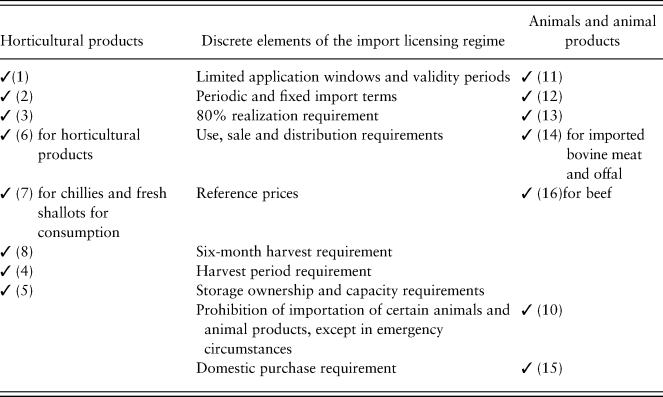
The US and New Zealand divided various elements of the import licensing regimes into eight measures for horticultural products and seven measures for animals and animal products. As shown in Table 5, five discrete elements among them are overlapped between horticultural and animal products.
Indonesian measures in terms of discrete elements
Note: *The number in parenthesis represents the designation for ‘Measure’ in Table 2.
All the above measures except for Measures 8 and 10 were found to be inconsistent with Article XI:1 because, by virtue of its design, architecture, and revealing structure, they constituted a restriction having a limiting effect on importation.
On the other hand, Measure 8 required that imported fresh horticultural products must have been harvested less than six months previously. Measure 10 prohibited the importation of bovine meat, offal, carcass. and processed products by allowing the importation only of those products listed in the appendices to its import licensing regulations. The panel explained that these were absolute bans on the pertinent products that fell squarely into the definition of a ‘prohibition’ under Article XI:1. Considering these measures’ nature of a straightforward import prohibition for products, the panel ruled that they were inconsistent with Article XI:1 because, by virtue of its design, architecture, and revealing structure, they constituted a prohibition on importation.
(5) Article XI versus Import Licensing Agreement
Regarding Measures 1 and 11 dealing with the limited application windows and validity periods, complainants argued that they were non-automatic import licensing procedures inconsistent with Article 3.2 of the Import Licensing Agreement (ILA). New Zealand claimed that these Measures were non-automatic licensing procedures, because applications for MOA Recommendations and Import Approvals were constrained during limited time periods, and thus not permitted on any working day prior to customs clearance. It argued that such administration of the licensing scheme had a restricting effect on imports. The United States also explained that applications for MOA Recommendations and Import Approvals should be submitted only during limited applications windows during the month prior to the start of an import validity period, i.e. in December or June for horticultural products and in December, March, June, or September, for animals and animal products. Indonesia rebutted that its import licensing regime was not ‘discretionary’ and thus automatic. Therefore, it argued that the pertinent measures were outside the scope of Article 3 of the ILA.
The ILA is one of the shortest – with only eight articles – and least controversial of the WTO Agreements in that there was no dispute ruling yet to find specific violation of ILA.Footnote 23 In fact, this agreement applies only to the procedures governing import licensing, but not to the underlying rules governing license allocation. Thus, most claims concerning ILA are focused on Article 3 that addresses non-automatic import licensing.Footnote 24 It is also noted that unlike other WTO Agreements, the respondents in disputes involving ILA are mostly developing country members except for the European Union. The fact that as of July 2018, complainants in the total 47 disputes cite ILA implies the importance of legal issues concerning import licensing systems that are still quite prevalent and controversial often in relation to agricultural importation, especially TRQ, of developing countries. In that regard, it is noteworthy that the panel in this dispute again declined to make specific rulings on ILA issues based on judicial economy. The lack of legal rulings rendered the Appellate Body with no chance to address relevant legal issue. Considering the consistent trend of WTO disputes citing ILA, the WTO DSB should exercise judicial economy more cautiously when dealing with legal issues on ILA.
4. Economic impact of disputed measures
4.1 Expected winners and losers: impact of fixed costs of import licensing
Non-tariff measures such as import licensing regimes appear as the fixed costs of exporting for producers. This is in contrast to the effects of traditional import tariffs that are paid in proportion to the value or quantity of imports. In the presence of significant fixed costs of exporting, increasing returns to scale also become important. Large producers are able to distribute the fixed cost of entering the market across larger number of output units. As a result, keeping everything else constant, a new trade protection measure in the form of a fixed cost will hurt the profitability of smallest exporters. Smaller exporters might shrink or even leave the market completely. Shrinking exports of smaller exporters in turn puts larger exporters in a beneficial position to expand their exports.
Largest exporters such as Australia (animals and animal products) and China (horticultural products) would thus be expected to be hurt less, or even benefit from, import protection measures: large exporters would face lower competition as smaller exporters shrink or exit. In other words, for large exporters, additional costs of compliance with the import licensing measures and worsened position relative to domestic producers are compensated by the improved position relative to smaller exporters.
In contrast, mid-size exporters are also expected to be impacted by Indonesia's licensing regimes as, on the one hand, their export values are large enough to be economically significant but, on the other hand, they are hurt more than the largest producers as fixed costs affect the unit costs of smaller producers more. These arguments can serve an explanation for why New Zealand (the 2nd largest exporter of animals and animal products with about 14% market share) and United States (3rd largest exporter of horticultural products with about 13% market share) decided to bring the disputes to the WTO. Australia and China (each largest exporter in either of the two affected product groups) or even Thailand chose to participate as third parties rather than complainants.
It is important to note that here the fixed cost of obtaining an import license applies to a firm rather than a country. However, in the case of the animal and horticultural trade of Indonesia, exports of each partner country are likely to be concentrated among a few large firms (e.g., Australian live cattle exporters to Indonesia such as Australian Agricultural Company and Consolidated Pastoral Company). Further, recent cross-country evidence suggests that bulk of export value is accounted for by few large firms (WTO, 2008). One can expect then that the size of large firms within a country is correlated with country's export value. Thus in our analysis we adopt a proxy where a country's export value is associated with firm export value.
Although the fixed costs arguments can be important in considering whether the negative impact of the import licensing regime is sufficiently large that it is worth bringing a complaint to the WTO, they may not be enough to explain the observed impact of Indonesia's measures. Subsequent sections describe the necessity for an additional explanation in understanding who the winners and losers are and propose special bilateral ties as such additional explanation.
4.2 Impact of Indonesia's import licensing regimes
Fixed costs arguments discussed above suggest that the largest export partner, Australia, should be the relative winner of the import licensing regime. This is confirmed by Figure 1 shown below. Figure 1 shows the imports of all products covered by the disputes starting from 2007 until 2016 for the five largest export partners. Imports were consistently growing across different exporters until 2010 when Indonesia started moving towards self-sufficiency oriented policies. The new measures had a trade depressing effect for almost all exporters at first. Exports from Australia and New Zealand, specialized in animal product exports, started declining in 2011 and took a further hit in 2012–2013. Exports of China and Thailand, large horticultural products exporters, were rising until 2012 but also started declining in 2013. US exporters were relatively unaffected.
Imports of Indonesia of animals and animal products and horticultural products, 2007–2016, USD
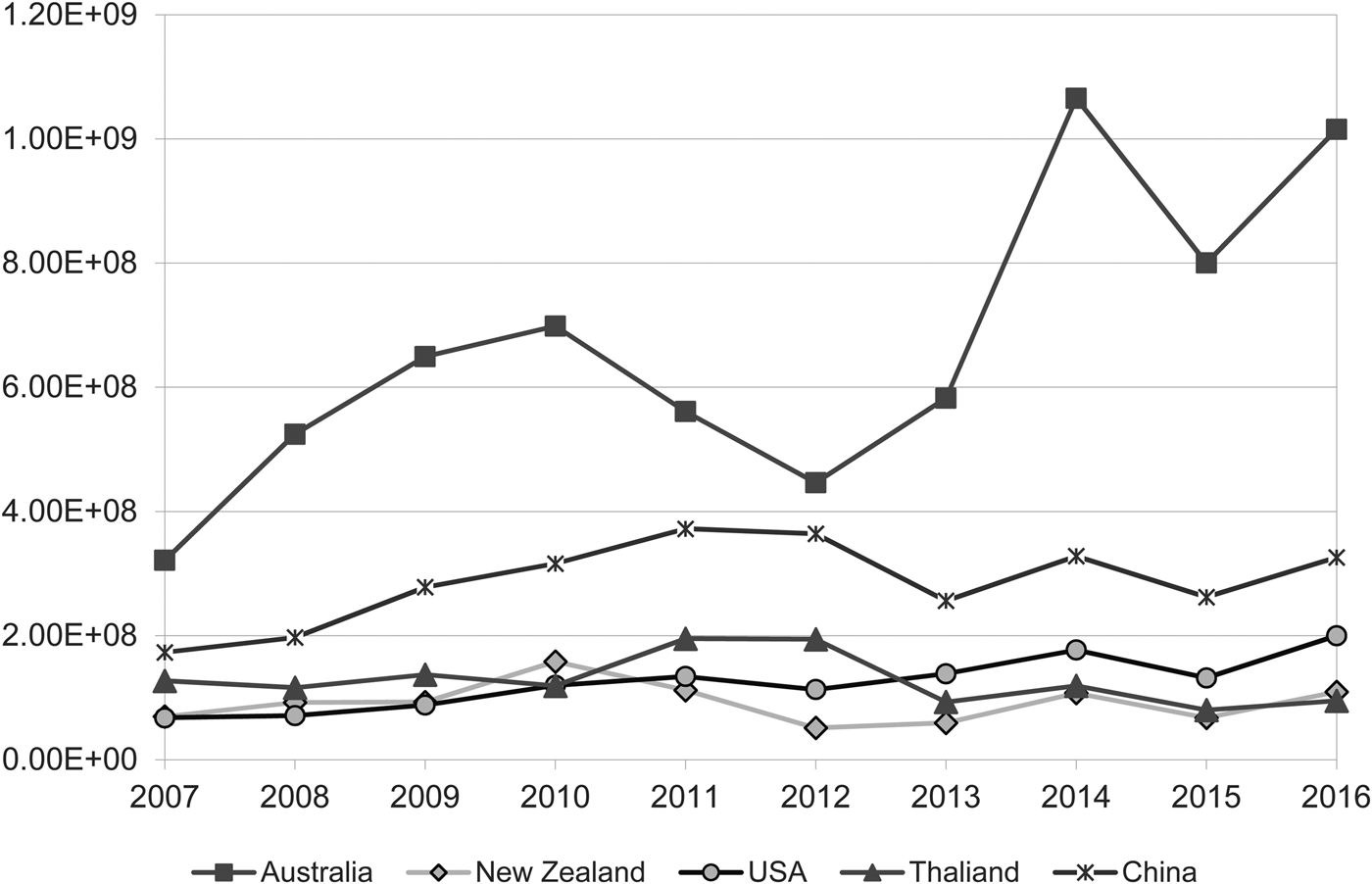
Following the initial overall decreases in trade values, all countries showed some recovery in 2014. However, Australia's performance was outstandingly high as its exports to Indonesia of affected products reached a new peak. This is in line with impact of the fixed costs of trade benefiting the largest exporter.
Australia turned out to be the unquestionable winner in terms of total exports to Indonesia. The remarkable trade recovery was driven by exports of animals and animal products where Australia held the dominant position. However, once we examine how countries performed relative to their initial position, the whole picture looks more complex. Imports of animals and animal products are explained relatively well by the fixed costs explanation but imports of horticultural products pose some challenges.
We investigate separately animals and animal products and horticultural products to assess how each country was affected relative to its exports prior to the introduction of measures. First, Indonesia applied different trade restricting measures for animals and animal and horticultural products; the key difference being the prohibition of importation of certain animals and animal products. Second, as shown in Section 2, the largest export partners specialized in either horticultural or animal products.
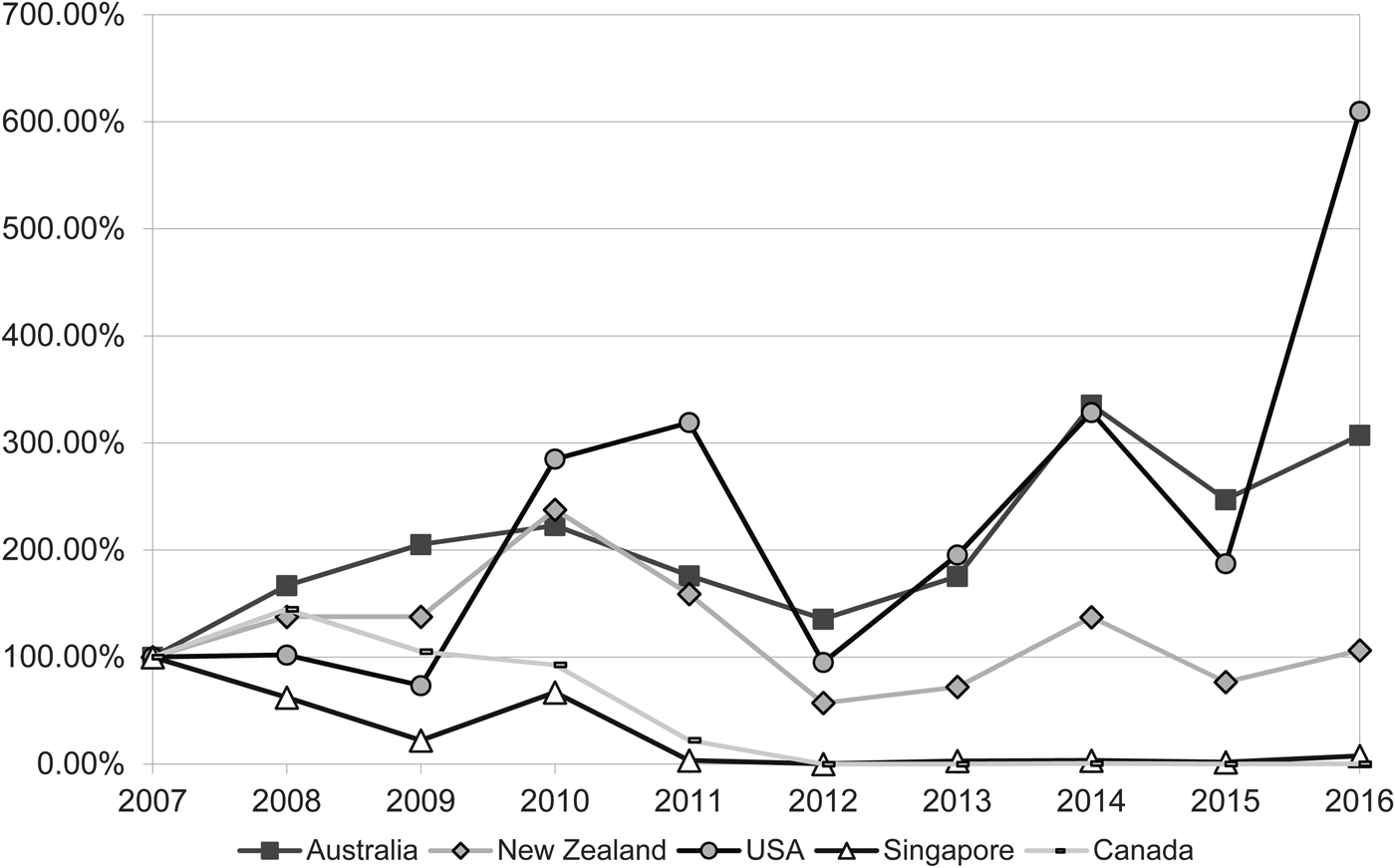
Figure 2 shows imports of animals and animal products of Indonesia from the five largest partners by trade value for the period 2007–2016. Imports from each trading partner are presented relative to 2007, which is set to 100%. Such presentation gives us growth rates over time for each exporter. It is noted that all exporters were initially, for the period 2011–2013, hit by the measures as shown in Figure 1. Further, we can see that, in line with the fixed cost arguments, Australia, the largest exporter of these products, already showed impressive growth in 2014, while exporters from Singapore and Canada, the 4th and 5th largest exporters, exited the Indonesian market. The export growth of New Zealand and the United States is less straightforward. New Zealand, the 2nd largest exporter, had to shrink its exports to Indonesia, while the United States showed growth rates similar to those of Australia. Although not perfect, the fixed cost arguments provide a relatively good explanation for the observed impact of the import licensing regime for animals and animal products.
Imports of Indonesia – animals and animal products relative to 2007
In contrast to trade in animals and animal products, the fixed costs argument is not able to provide a satisfactory explanation for trade in horticultural products. Analogous to Figure 2, Figure 3 presents Indonesian imports for horticultural products for the five largest partners by trade value. China and Thailand, the two largest exporters of horticultural products, saw their exports declining from 2013 as the strict import protection measures came into force. The United States and Australia, the 3rd and 4th largest exporters, instead demonstrated continuous export growth throughout the sample period.
Imports of Indonesia of horticultural products relative to 2007
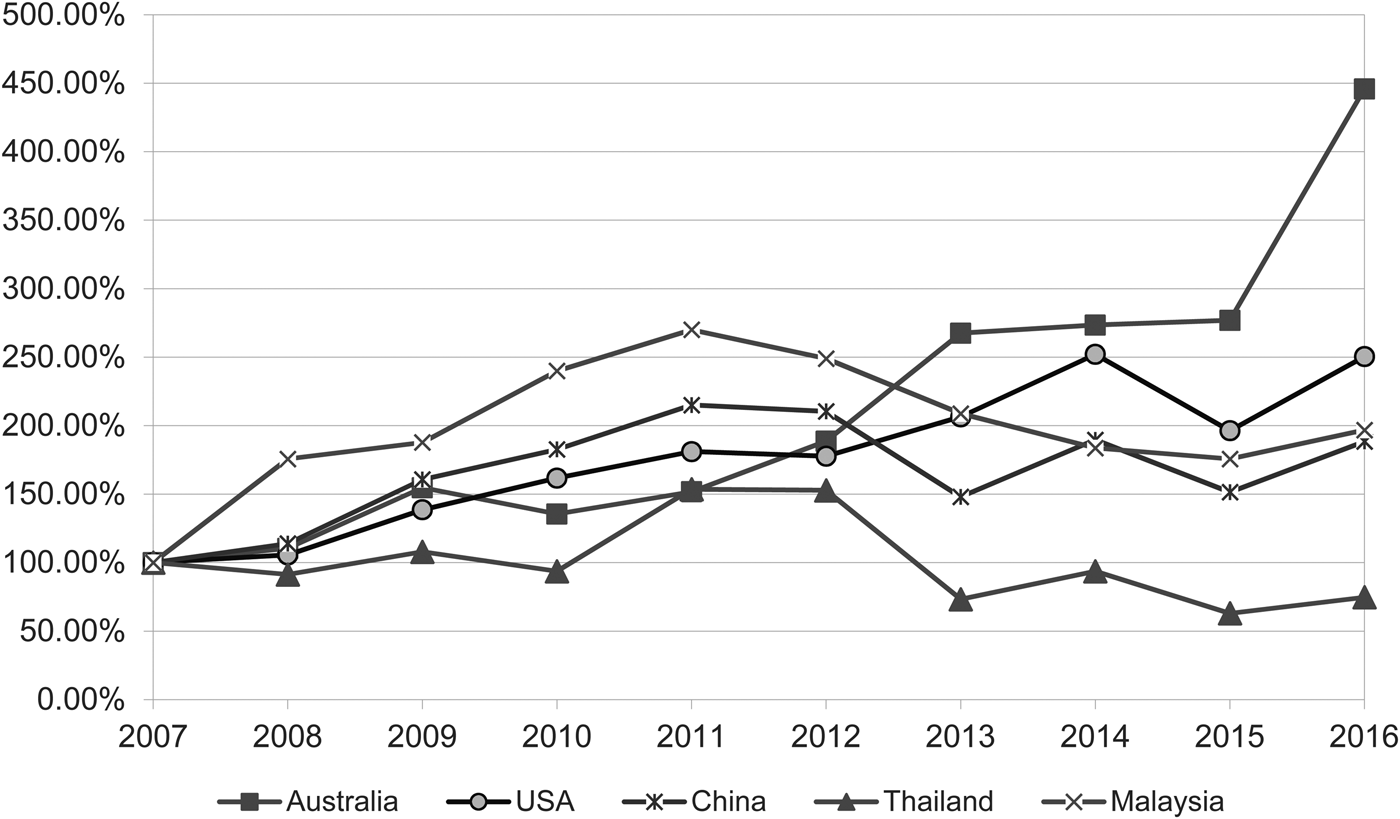
The growth rates of Australia's exports are highest across all exporters despite Australia's position as 4th largest exporter in the years before the measures were introduced. This is not explained well by the effects of a trade barrier in the form of a fixed cost. Indeed, as Indonesia introduced two different import licensing regimes, costs borne to obtain licenses for exporting animals and animal products should not significantly reduce the additional costs needed to export horticultural products. Thus we need another explanation for the observed gains of Australia in horticultural products.
4.3 The role of bilateral ties
Australia and the United States have experienced, relatively, a less negative impact of Indonesia's import licensing measures. After an initial drop, both countries substantially expanded their exports of affected products. The case of Australia is particularly impressive due to the large value and market share of Australian exports of products affected by the measures. Why does the performance of these two countries appear to differ from other exporters? Australia and the United States are the largest exporters of agricultural products to Indonesia, with comparable levels of total agricultural exports, but significantly larger than those of China, the third largest exporter.
The explanation that can account for the observed patterns is thus that the pre-existing trade and investment relationship allowed for better absorbtion of the import licensing measures. For example, an inquiry submission from the Australian Government Department of Agriculture and Water Resources (2017) highlights the role of establishing and nurturing government-to-government links, which support trade and investment relations with Indonesia, in the increase of agricultural exports of Australia since 2010–2011 against the backdrop of tightening self-sufficiency policies. Thus, the exporters could benefit from the existing institutional trade and investment framework when obtaining the required licenses. Such exporters can benefit from information sharing through trade associations, working with extended traders networks and investment structures (e.g., switching from meat exports to live cattle exports).
Indonesia's increased focus on self-sufficiency brought deterioration in trade for all partners, but Australian exporters were able to cease opportunities when they appeared. For example, when restrictions on chemical levels in horticultural imports blocked many products from China, Australia was ready to satisfy the freed demand and expand its exports to Indonesia in 2015, particularly for pears and lemons (Sampson, Reference Sampson2017). Australian exporters of live animals, the second largest export to Indonesia after wheat, have invested in feedlots, joint-venture partners, and distribution centres in Indonesia.Footnote 25 The model that involved breeding cattle in Australia and feeding in Indonesia proved to be successful when Indonesian regulation banned importation of slaughter bovine cattle but not of feeder cattle.Footnote 26
5. Conclusion
The data reveal an unexpected discovery that, although Indonesia's measures applied to all exporters, their impact was quite heterogeneous. While some exporters saw their exports falling sharply, Australia, the largest exporter of the affected products, was hurt much less. Australian exports, after a dip in 2011–2013, grew at very fast rates, unmatched by any other country.
We explained the observed gains of Australia in the presence of import licensing regimes by a combination of fixed cost trade barriers benefiting the largest exporters and the role of special bilateral ties. Although both arguments are related, as they both predict gains of largest trade partners, there is an important distinction between the two. The former implies that when each exporter has to pay a fixed cost to export a certain product the largest exporter's unit cost of exports will be affected the least, as the fixed cost is distributed across a larger number of exported units. The latter suggest that a more important trade partner, due to large trade values in a wider sector or with an existing investment relationshipn, might be better placed to overcome exporting costs than smaller exporters with weaker trade and investment ties.
Most frequently, WTO disputes challenge import-restricting measures that increase the marginal cost, rather than the fixed cost, of exporters. This is the case both for discriminatory policies that affect specific exporters (e.g., antidumping duties) and global policies that affect all exporters (e.g., safeguards). It is then expected that exporters with the largest economic stakes will challenge measures deemed to violate WTO rules, and indeed empirical evidence supports this expectation (Bown, Reference Bown2005). A similar argument of economic stakes applies to measures that ban imports outright. However as non-tariff measures acting as fixed (but not prohibitive) costs of exporting have proliferated, we should expect more WTO disputes that challenge these measures. It is then important to understand how such measures affect exporters of different sizes.


 Open access

