


Introduction
[S]He has discovered the art of making fire, by which hard and stringy roots can be rendered digestible, and poisonous roots or herbs innocuous. This discovery of fire, probably the greatest ever made by [hu]man[s], excepting language, dates from before the dawn of history. (Darwin Reference Darwin1874: 33)
Today, humans are the only obligatory fire makers and users. A technology—in this case pyrotechnology—becomes obligatory when it facilitates activities that are otherwise difficult or impossible to accomplish, and when it has considerable and immediate fitness consequences (Shea Reference Shea2017). This means that human individuals who do not use fire will quickly suffer adverse effects or even die. Burton (Reference Burton2009) distinguishes between the ability to use accidental or natural fire, the ability to control and maintain fire and the ability to make fire. We reinterpret these in causal terms as follows:
• A natural fire is a cause that hominins do not control. Instead, they use the effects of the fire such as access to food. For example, similarly to other animals that live in fire-prone ecologies, primates on the African Savanna take advantage of newly burned landscapes to forage for insects and cooked foods (Herzog et al. Reference Herzog, Keefe, Parker and Hawkes2016).
• A fire is a cause that is preserved and controlled by hominins to obtain desired effects. For example, although the Onges from Asia and the Yuquí from South America do not make fire, they collect and preserve natural fire for warmth, light, cooking and other activities. When someone's fire goes out, a firebrand is borrowed from a neighbour (McCauley et al. Reference McCauley, Collard and Sandgathe2020).
• The actions of hominins are causes that have a fire as effect. This implies that humans became the firemaking agents to control and use at will and according to need. For example, Marshall (Reference Marshall1976) describes how the !Kung of southern Africa do not want to kindle a new camp's fire on the same spot of an old one, because new fires are associated with a fresh chance for good fortune. As soon as they set up a camp, the first fire is made. Usually, the oldest man or men in the group will make it, and each family will then take a brand to start their own fires to maintain and manage for a multitude of tasks from cooking and warmth, making glues and poisons, to performing healing rituals. For a full ethnographic account, see the online Supplementary material ((SOM) Section 2).
Tattersall (Reference Tattersall2008) questioned whether firemaking requires a ‘more complex cognitive state’ than fire use, highlighting that whereas humans today are both fire makers and users, our closest living relatives are neither—leaving us without an observable model. He sees fire use by itself as evidence of a complex, flexible and elaborate behavioural response to conditions. Twomey (Reference Twomey2013; Reference Twomey, Henley, Rossano and Kardas2019) explored the cognitive implications of fire use more extensively. Our focus is on firemaking itself, based on ethnographic data that generally indicate two main hunter-gatherer firemaking technologies, namely, the strike-a-light or stone-percussion technique and the manual fire-drill as one of several wood-friction techniques (McCauley et al. Reference McCauley, Collard and Sandgathe2020; Table 1). Other wood-friction techniques would include:
• Fire-ploughs such as used in Africa among subsistence farmers and on the Tuamotu Islands (Lagercrantz Reference Lagercrantz1954; Sorensen Reference Sorensen2019);
• Fire-saws as used by agriculturalists in India and across the islands of southeast Asia (Lagercrantz Reference Lagercrantz1954);
• Different configurations of thong-driven techniques including cord-, mouth- or bow-drills as used by groups in Scandinavia, Russia and Alaska (Hough Reference Hough1890; Lagercrantz Reference Lagercrantz1954) (Table 1).
Some ethno-historical hunter-gatherer/mixed subsistence groups’ firemaking records.

The two basic techniques of hunter-gatherer firemaking
Strike-a-light
The strike-a-light technique involves the striking of two stones to create a spark, often involving a nodule of flint or other appropriate rock struck on iron pyrite. After encountering metal-producing peoples, many recent hunter-gatherers use pyrite with steel or iron (Brumm Reference Brumm2006; Lagercrantz Reference Lagercrantz1954). Runnels (Reference Runnels1994) suggested that the reliance on percussion firemaking was initially confined to Europe and countries in contact with Europeans over the last 500 years.
Possible early firemaking tools are known from the north of Europe where Upper Palaeolithic sites in France, Germany, Belgium, the Netherlands, Denmark, United Kingdom, northern Italy and Switzerland contain rocks and minerals that may have been used as strike-a-light kits. Sorensen et al. (Reference Sorensen, Roebroeks and Van Gijn2014) listed several more such artefacts in the context of the ‘expedient strike-a-light model’ wherein percussion firemaking remains largely invisible during the Middle Palaeolithic. Their model contends that early flint strike-a-lights were not formalized or specialized; instead any flakes or stone artefacts could have been used with pyrite or marcasite to spark expedient fires. Of 164 recent hunter-gather groups, only nine still use/d percussion firemaking exclusively, but 31 groups combined this method with wood-friction firemaking techniques (Table 1).
Fire-drill
The manual fire-drill technique is most often used on its own by recent and current hunter-gatherers. Of the 164 recorded groups, 112 use the fire-drill, 68 use this method only, and 96 use it in combination with other firemaking techniques (Table 1). In southern Africa, this method is still in use by the San and their descendants (own observation), and in earlier times it seems to have varied little among the different hunter-gatherer, herder and farmer groups of the region (Friede Reference Friede1978).
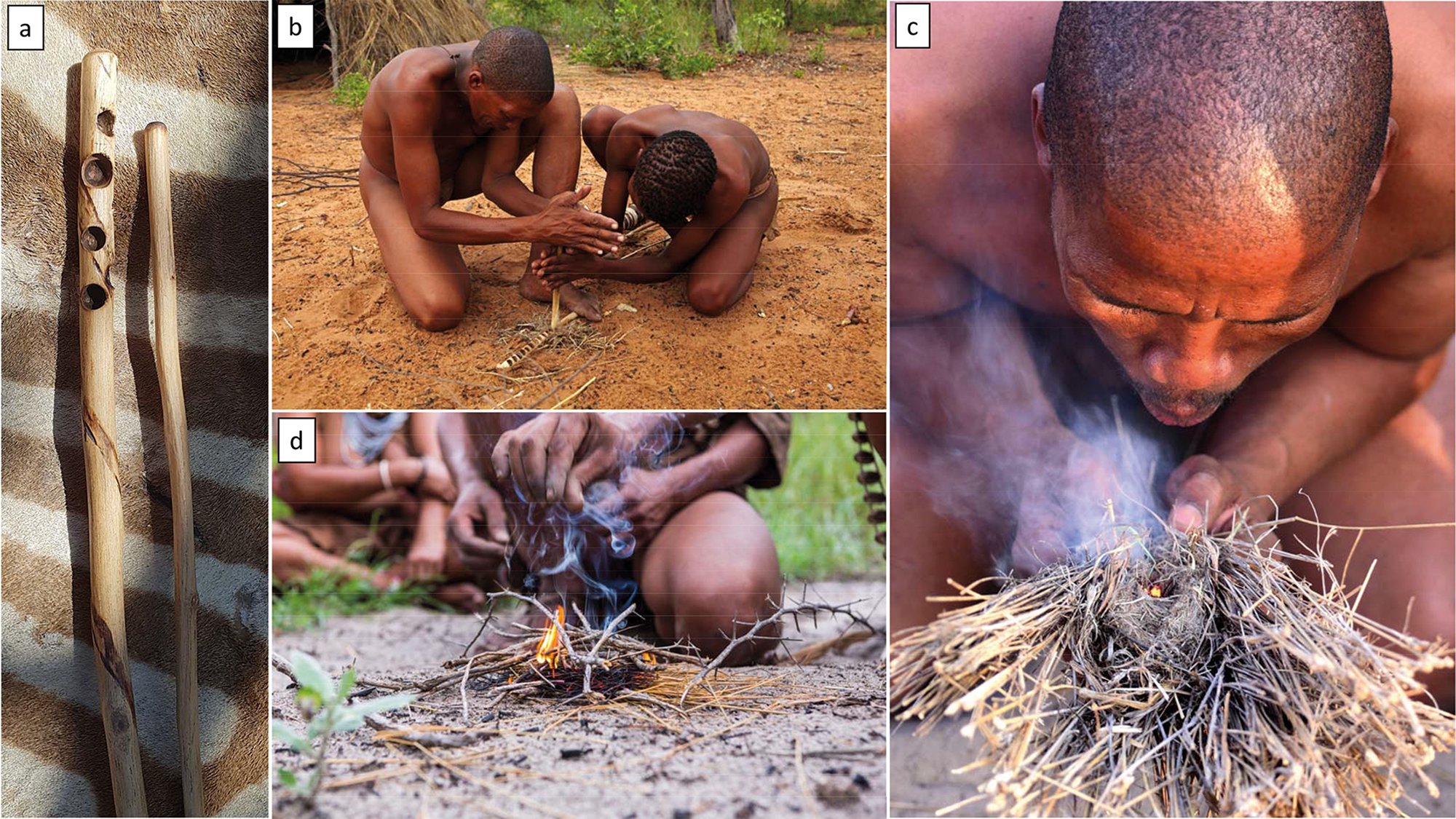
Marshall (Reference Marshall1976, 81) describes firemaking by Kalahari !Kung hunter-gatherers as follows (Fig. 1; see Supplementary material for range of fire behaviours):
The process of making fire requires two fire sticks, called male and female, and a bunch of woolly grass or tinder. The male stick, held vertically, is twirled rapidly in a small notch in the female stick, which is placed horizontally on the ground [held steady by pressing a foot on one end], till the fine wood dust produced by the twirling is ignited by friction. The smouldering wood dust is quickly tipped into the bunch of grass, which is picked up and gently blown till the grass bursts into flame. The grass is then placed on the ground. Small twigs ready at hand are placed on the grass for kindling, and as soon as they are ignited pieces of wood are added. The male stick is usually made of a hard wood, the female stick of a soft wood [with a notch cut into it]. The male stick must fit into the notch exactly. […] Frequently two men make fire together. As one pair of hands reaches the bottom of the stick, the second pair is ready at the top to keep the twirling continuous.
(a) Example of a fire-stick set. (Photograph: M. Lombard.) (b–d) Kalahari San wood-friction firemaking and kindling. (Copyright of images purchased by M. Lombard from Alamy.)
Our theoretical frameworks
Our exploration into the cognition of firemaking is part of a long-term project wherein we apply theoretical frameworks for causal and social cognition to the analysis of different evolutionary problems. Here we add prospective cognition and rehearsal. These frameworks have been published previously, so we do not discuss them here, but provide tabulated summaries and definitions in the supporting online material (SOM) for easy reference. In short, a basic question for a theory of causal cognition is what kind of entities can serve as causes. One can distinguish between agent causes (when some animate being exerts a force), natural causes (physical/chemical/biological causes where natural phenomena generate forces) and mental causes (psychological/social causes, where mental phenomena function as causes). It is widely thought that causal cognition underpins technical reasoning (McCormack et al. Reference McCormack, Hoerl and Butterfill2011; Osiurak et al. Reference Osiurak, Lesourd, Navarro and Reynaud2020). For example, Wynn and Coolidge (Reference Wynn and Coolidge2014, 47) argue that in addition to procedural drift, trial-and-error, managing immediate unexpected errors and adequate working memory, ‘folk theories of causation’ (‘significant conceptual structures that summarize and present basic understandings of the work’) are required for effective technical cognition. Causal cognition is therefore a suitable framework for applying to firemaking.
Causal cognition cannot, however, be separated from the social cognition that scaffolds cumulative technological culture (Pain & Brown Reference Pain and Brown2021). As causal cognition becomes more advanced, the more it becomes dependent on theory of mind (ToM) (this connection and the orders of ToM are explained in SOM table 1, and in Lombard & Gärdenfors Reference Lombard and Gärdenfors2021). Cultural transmission is largely dependent on various orders of ToM, and can be divided into emulation, imitation, and teaching (MacDonald et al. Reference MacDonald, Scherjon, van Veen, Vaesen and Roebroeks2021). Through imitation and emulation, individuals—human or non-human—learn by themselves through observing the behaviour of a knowledgeable individual—without being taught (Nielsen et al. Reference Nielsen, Subiaul, Galef, Zentall and Whiten2012). In terms of teaching, it is useful to distinguish between non-intentional and intentional teaching. Non-intentional teaching includes the facilitation/scaffolding and the approval/disapproval of learner behaviour. Gärdenfors and Högberg (Reference Gärdenfors and Högberg2017; Reference Gärdenfors, Högberg, Peters and Lock2021) present six levels of intentional teaching (SOM table 2), which involve increasing demands on ToM and communication. Different from imitation and emulation, all six levels of teaching assume that the teacher intends for the learner to learn something that s/he would not learn without the intervention of the teacher.
Two further forms of ToM that are relevant for the cultural transmission and sharing of firemaking are joint attention and joint intention. During joint attention the agents have eye contact while sharing attention to a target, signalling a mutual awareness and promoting communication about the target (Tomasello Reference Tomasello1999). Joint attention involves third-order ToM since the individuals must ensure that they attend to the same thing (‘I see that you see that I see’) (Gärdenfors & Warglien Reference Gärdenfors and Warglien2012). Joint intention requires that individuals share an intention to interact, react to each other's intentions to act, and to coordinate their intentions (Tomasello et al. Reference Tomasello, Carpenter, Call, Behne and Moll2005)—also an example of a third-order ToM.
Solving problems, imagining solutions and planning through time and outside the immediate sensory context have been shown to operate across a range of cognitive domains, such as mental representation of a temporally distant event and the ability to buffer current sensorial input in favour of a delayed or imagined goal (Kabadayi & Osvath Reference Kabadayi and Osvath2017). We define such prospective cognition (a.k.a. episodic foresight or mental time travel: Suddendorf & Moore Reference Suddendorf and Moore2011) as the capacity to envision future desires and organize current action accordingly (Gärdenfors & Osvath Reference Gärdenfors, Osvath, Larson, Déprez and Yamakido2010; Spreng & Grady Reference Spreng and Grady2010; Szpunar et al. Reference Szpunar, Spreng and Schacter2014). The main difference between immediate planning and prospective cognition is that immediate planning depends on current needs and desires, while prospective cognition presumes the capacity to predict future desires and to plan for them.
A key element of prospective cognition is the unmatched human capacity to shape and modify our future selves and our skillsets through deliberate rehearsal, i.e. through self-initiated or auto-cued repetitive behaviour or imaginings aimed at future improvement (Donald Reference Donald, Berntsen and Rubin2012; Suddendorf et al. Reference Suddendorf, Bulley and Miloyan2018). When we try to control the effect of our actions, we must learn how the actions map onto the consequences (Gärdenfors et al. Reference Gärdenfors, Jost and Warglien2018). For example, when cracking an egg, it is necessary to learn what is an appropriate force to apply to the egg: Too weak, and nothing happens to the egg; too strong, and the egg is destroyed. Rehearsal relies on a special case of conspecific ToM (SOM table 1), namely self-awareness in the form of autocuing (Donald Reference Donald, Berntsen and Rubin2012), which is self-triggered conscious memory retrieval, and involves imagining oneself in the future and in the past. Such behaviour—also known as praxis—enables us to synchronize ideas or concepts with motor planning and task execution by imagining future scenarios (May-Benson & Cermak Reference May-Benson and Cermak2007). This kind of thinking involves priority scheduling, planning depth, or extended perception-and-action sequences (Lombard et al. Reference Lombard, Högberg and Haidle2019).
The adaptive advantages gained from our capacity to imagine the future can hardly be overestimated. Bulley et al. (Reference Bulley, Redshaw, Suddendorf and Abraham2020) mention that the ancient Greeks believed that Prometheus, translated as ‘foresight’, stole fire from heaven to give to humans. They suggest that
The ability to harness fire is indeed a prime example of the future-oriented power of imagination. Controlled fires demand not only a stockpile of combustible materials, but also knowledge of techniques to start, maintain, and contain the flames. Mastery in this domain thus requires a suite of cognitive capacities that draws heavily on the imagination, such as deliberate practice and planning. (Bulley et al. Reference Bulley, Redshaw, Suddendorf and Abraham2020, 3)
Below we analyse the two key hunter-gatherer firemaking techniques in terms of the critical abilities enabled by such future-oriented imagination (SOM table 3).
Some cognitive aspects of firemaking
Because it is tool-set dependent, our hypothesis is that firemaking requires more complex cognitive processes compared to the ability to use natural fire or to control and maintain it. It is a prime example of prospective cognition, since it involves planning in several stages for the future goal of a fire. First, it requires a tool set for ignition. Secondly, burning materials of the right types must be collected. Finally, the fire is ignited, built and maintained with foresight on how it will be used or contained. Each of these phases involves different forms of causal thinking which we discuss below (also see SOM table 1), as well as cultural transmission (SOM table 2) and rehearsal (SOM table 3). Furthermore, cooperation, in the form of division of labour, may be involved since different persons with varying skills and experiences may take responsibility for different phases of firemaking and maintenance. Such cooperation requires ToM in the form of a joint intention to make a fire and trust that others will perform their roles appropriately (Goudsblom Reference Goudsblom1992; Twomey Reference Twomey2014). Twomey (Reference Twomey, Henley, Rossano and Kardas2019) further suggests that fire-keeping and its benefits affected the evolution of the human psyche in terms of emotion regulation, empathy and sympathy, and could have stimulated positive inter-group relations (see SOM Section 2, for !Kung example)—all of which require a combination of ‘common sense reasoning’ or causal cognition, appropriate emotional responses, and relatively advanced orders of ToM (Mameli Reference Mameli2004).
Collecting fuel
As described in the introduction, we focus on the two principal techniques for hunter-gatherer firemaking—strike-a-light and fire-drill (Table 1). Each of these techniques presumes that fuel for burning is collected in advance of, or separately from, the firemaking process. For example, Marshall (Reference Marshall1976, 84) describes how while an old !Kung man makes the fire, other group members ‘go about picking up dry wood to lay on the new fire’. This phase is similar regardless of igniting method and can be performed independently. The collection of fuel is also implied in the ability to control and maintain natural or borrowed fire, so that although it is necessary for firemaking it is not exclusive to it—instead it serves as baseline for fire use. We therefore treat fuel collection separately from the two firemaking methods below.
The burning material usually consists of at least three different kinds, each in their correct condition and quantity for the planned fire. First tinder such as dry grass, moss, amadou (derived from Fomes fomentarius or similar tree fungi), or some similar material is needed for igniting the fire. The resulting flames then require kindling, typically in the form of small twigs or sticks. Finally, different kinds of dry wood or other material (e.g. bone or dung) are needed as fuel to maintain and control the fire. This implies preparation for risk and threat in terms of prospective cognition (SOM table 3).
The cognition involved in collecting these materials involves inanimate causal cognition (Grade 6: SOM table 2) about the role of dryness and about the size and amount of material that is required. Such causal knowledge could perhaps be obtained by individual rehearsal (trial-and-error), but it is likely that cultural transmission is involved. To some extent, imitation will be a possible starting point for a quicker learning of the causal traits of the collected material. However, the learner may, for example, miss properties of the material that are important for assessing its dryness and flammability. Hence, if teaching by communicating concepts and relations between concepts (SOM table 2) are exploited, the learning can become more efficient. For example, learning concepts for materials will help finding suitable wood and how long it will burn. Another example is learning which properties signal dryness will also make the selection of material more efficient. A further cognitive factor is knowledge about where appropriate material can be found, for example, on which types of trees the best fungus for tinder grows.
Using a strike-a-light
To apply the strike-a-light technique (Fig. 2), an appropriate tool kit must be available. It typically consists of a piece of rock such as flint, and a piece of spark-generating material such as pyrite. The two pieces are struck together to produce a spark (see Sorensen Reference Sorensen2020). Before a strike-a-light can be used the necessary rocks/minerals must be sourced, which implies prospective cognition in the forms of affective forecasting, goal setting and risk preparation (SOM table 3). The knowledge of how to identify and find the right materials would be difficult to learn on an individual basis. Hence, it can be presumed that it is learnt by teaching about concepts, which relies on well-developed ToM wherein learners understand that their teachers are intentionally communicating about something that is not necessarily present or tangible in the immediate present (Level 4 teaching: SOM table 2).
A material-and-action sequence for strike-a-light firemaking representing planning depth and prospective cognition.
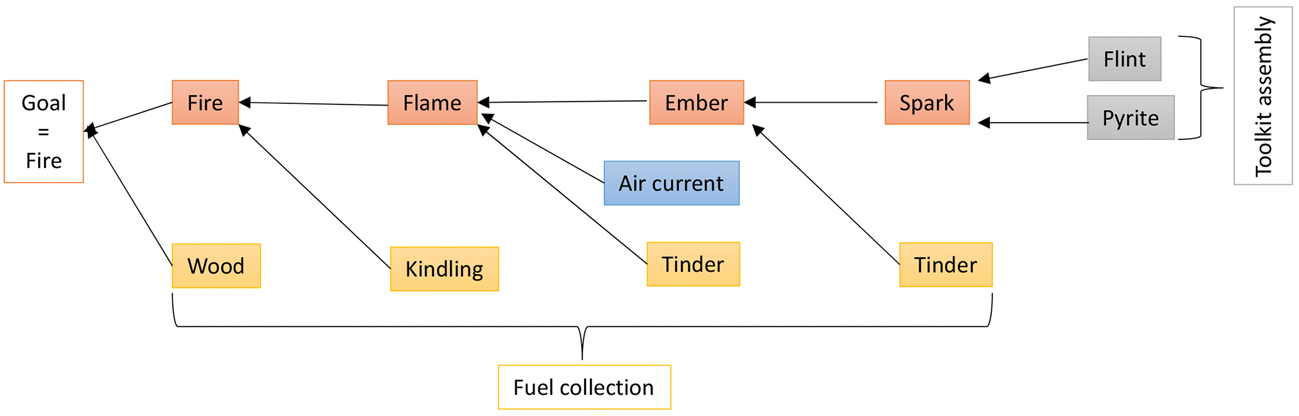
On the other hand, the causal knowledge that when the two pieces are struck together, sparks will appear, can be learnt by mere observation and imitation, not requiring explicit teaching (Gärdenfors & Högberg Reference Gärdenfors and Högberg2017; Reference Gärdenfors, Högberg, Peters and Lock2021). Using a strike-a-light to generate a spark is similar to simple freehand knapping which relies on the organization of certain motor and ideational elements (Lombard et al. Reference Lombard, Högberg and Haidle2019; Moore Reference Moore, Nowell and Davidson2010). To some, the likeness to knapping suggests that the strike-a-light technique was probably the earliest firemaking method (Sorensen Reference Sorensen2019). While the causal understanding for creating a spark may be limited (Grades 1 and 2: SOM table 1), deliberate rehearsal is required to learn how the striking is best performed and to achieve expertise (SOM table 3). Teaching by demonstration (Level 3: SOM table 2) is likely to speed up the practising process, which implies conspecific ToM in the second–third order (Grade 3 causal cognition: SOM table 1).
Cognitively, the most complex phase of strike-a-light firemaking is understanding how to turn the spark into a flame by first nurturing it into an ember with the right type and amount of tinder and by blowing on the ember with just the right intensity to coax it into a flame that can be fed with kindling. This requires flexible decision-making in terms of fine-tuning actions in relation to materials and conditions. It also requires Grade 6 causal understanding (SOM table 1), wherein causation is seen as force transmission or an extension of agency. For example, the ‘force’ or ‘agency’ of the spark need to be transferred to the ember and then to the kindling. Here, too, rehearsal will improve an individual's skill, but cultural transmission through demonstration and/or by communicating abstract concepts (SOM table 2) would dramatically speed up the learning process, and thus be of adaptive advantage.
Using a fire-drill
Different from a strike-a-light that uses naturally occurring minerals (that may or may not be altered before use), this technique depends on a manufactured toolkit (Fig. 3). For the manufacturing process the fire maker ideally needs at hand a round hard-wood branch for the male drilling stick and a flat piece of soft wood for the female base-stick. Both artefacts are prepared by debarking them, straightening them, cutting them to shape and size, and providing the male stick with a tapered end to fit snugly into a notch cut into the female stick. This can only be accomplished by using at least one other pre-manufactured cutting-and-scraping tool, such as a stone flake or knife.
A material-and-action sequence for fire-drill firemaking representing planning depth and prospective cognition.
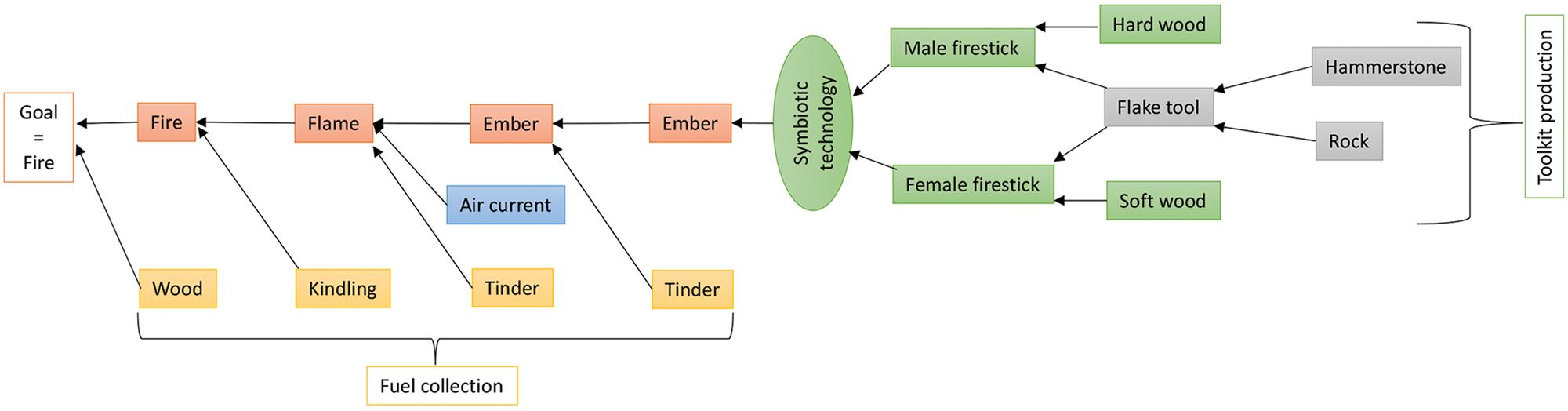
The prospective cognition, rehearsal and aspects of social transmission for flake production alone is already the same as for the use of a strike-a-light. The planning depth and prospective cognition as well as causal understanding for the fire-drill technique is thus considerably extended even before the firemaking process can start. We suggest that it requires at least Grade 6 causal cognition (SOM table 1), which is notably more than what is required for assembling a strike-a-light—but similar to fuel collection for fire use/maintenance. Knowledge about the types of wood that are most suitable—e.g. hard for the male and soft for the female—is also required. Again, the skills of how to identify and find the right materials would be difficult to learn on an individual basis. Hence, it can be presumed that they are learnt by teaching about concepts (Level 4, SOM table 2).
Once the fire-drill kit is available, the technique for its use must be learnt. This is also considerably more complicated than using a strike-a-light. Although firemaking by wood friction was probably invented and re-invented through time and across space (Sorensen Reference Sorensen2019), it is most likely that the use of fire-drills became widespread through cultural transmission. To some extent the handling can be learnt by imitation and rehearsal. Teaching by demonstration will help to speed up the practising process. The causal knowledge that is used concerns how friction, combined with pressure, generates heat. Learning the amount of force and speed to apply in drilling can be done by trial and error, but teaching through explaining relationships between the concepts (Level 5: SOM table 2) will make the learning more efficient.
While a manual fire-drill is not a composite technology, it is a basic form of a symbiotic technology (Lombard & Haidle Reference Lombard and Haidle2012; Scheiffele Reference Scheiffele2014). Such tool sets function as ‘machines’ wherein the properties of the one tool are actively augmented by the properties of the other through active focus on bimanual manipulation and control. Using a fire-drill requires both hands to work in synchronization, while the user steadies the female stick with a foot. Lombard and Haidle (Reference Lombard and Haidle2012) argued that the use of symbiotic technologies represents a cognitive increase in terms of planning depth/prospective reasoning, cognitive modularization (chunking-and-chaining) and episodic memory (see Coolidge et al. Reference Coolidge, Haidle, Lombard and Wynn2016), which enables a level of technological complexity and flexibility that is not possible with non-symbiotic technologies. More advanced forms of such technologies would include bow-drills (sometimes also used in firemaking) and bow-and-arrow sets, which represent causal network cognition with higher-order ToM (Grade 7: SOM table 1).
Firemaking with manual fire-drills sometimes also involves cooperation between two individuals. For example, one person will start twirling with both hands moving down the male stick and as soon as they reach the bottom, the second person will start from the top of the stick in a drilling relay. In this manner, continuous friction is applied and an ember can develop quickly (Marshall Reference Marshall1976; SOM Section 2). Such cooperation obviously involves joint attention and joint intention, as well as turn-taking and joint rehearsal. The ToM requirements of such behaviour are therefore also considerably higher compared to strike-a-light firemaking that can only be done by a single person.
Building up and maintaining a fire
While assembling and using the two techniques are different in terms of tool sets and cognition, the phase during which an ember is nurtured into flames is similar in both (as described above for the strike-a-light technique). The final phases of firemaking are also shared by both scenarios and consist of building up a fire by first using kindling, then adding longer-burning fuel and then maintaining or controlling the fire by managing the types and amounts of fuel added or removed. One type of causal knowledge that is special during this phase concerns the role of air flow. If the fuel is placed too densely, it will be difficult for the fire to catch on, and if placed too loosely, it may die out. Again, the right fuel density can be learnt by rehearsal, but teaching about air flow (Levels 4 and 5: SOM table 2) will improve inanimate causal understanding (Grade 6: SOM table 1) and make learning how to maintain and control a fire more efficient.
There are two further types of prospective planning involved here. One concerns when to add more material. A fire is made for one or several purposes. Making the fire too big for its purpose by adding excessive amounts of fuel will make the fire uneconomical. After all, collecting and/or preserving fuel may be costly (Henry et al. Reference Henry, Büdel and Bazin2018), especially in wood-poor or wet ecologies. The other concerns the long-term effects of fuel depletion and mobility in the environment (Sorensen Reference Sorensen2017). This is an advanced form of prospective cognition that summarizes a great deal of knowledge about the environment and causal reasoning that implies causal network understanding (SOM table 1), and which is known to be practised by current Kalahari hunter-gatherer groups (Marshall Reference Marshall1976; SOM Section 2).
Discussion: Pleistocene firemaking and dealing with the unknowable
Most researchers agree that fire use was a progressive, but not necessarily unilinear, evolutionary process during which hominins initially associated it with some benefits or rewards. We may associate this phase with Shea's (Reference Shea2017) ‘occasional tool use’ during which fire use was optional and could be accomplished without recourse to additional tools. Occasional fire use probably had minor fitness consequences, so that individuals who used it may have gained sporadic or short-lived fitness benefits, but not much more than conspecifics that did not use fire. This scenario is similar to current-day chimpanzee nut-cracking behaviour. While chimpanzees use hammerstones, sometimes with anvils, not all individuals in a group may engage in the behaviour, and not all chimpanzee groups practise nut-cracking, yet all remain relatively well nourished (Boesch & Boesch Reference Boesch and Boesch1984; Toth et al. Reference Toth, Schick, Savage-Rumbaugh, Sevcik and Rumbaugh1993).
The occasional fitness benefits of fire use possibly led to hominins starting to take advantage of naturally occurring fire, learning the skills to collect, maintain and control the phenomenon (for recent summaries, see Sorensen Reference Sorensen2019; Twomey Reference Twomey, Henley, Rossano and Kardas2019). This represents a phase of habitual fire use wherein individuals who used fire reaped fitness rewards that meaningfully surpassed those who did not—not only individually in the short-term, but also for the group in the long run. The benefits may, however, still vary among groups and through time. Shea (Reference Shea2017, 209), for example, sees cooking in current human populations as ‘habitual tool use’ in that people do it
more or less constantly with variable periodicity and intensity. One can microwave, roast, fry, or boil pretty much any foodstuff or eat it raw, but the costs of using one or another such method and the calories one obtains by doing so vary situationally.
An increasing awareness of the protective, gastronomic, physical, social and technological advantages of habitual fire use probably prompted the development of firemaking techniques in different human groups until we became obligatory fire users. In theory, we can survive without cooking: for example, a few handfuls of the nutritious, sweet-tasing raw corms of the yellow nut sedge (Cyperus esculentus) easily fulfils the current daily requirement for energy, protein and fat/lipids in adult humans (Lombard Reference Lombard2022). If such foods were supplemented by access to fatty termites, meat and marrow through tool use (Assaf et al. Reference Assaf, Caricola and Gopher2020; Backwell et al. Reference Backwell, Parkinson, Roberts, d'Errico and Huchet2012; Lesnik Reference Lesnik2014; McPherron et al. Reference McPherron, Alemseged and Marean2010)—in addition to a variety of leafy greens, fruits, grains and nuts (Lombard & van Aardt Reference Lombard and van Aardt2022; Paine et al. Reference Paine, Koppa and Henry2018), surviving on a raw-food diet is not impossible as suggested by Wrangham and Conklin-Britain (Reference Wrangham and Conklin-Brittain2003) who relied heavily on two studies, i.e.:
• Koebnick et al. (Reference Koebnick, Strassner, Hoffmann and Leitzmann1999) who observed nutritional deficiencies in a few urban German individuals preferring a raw-food diet (without reporting on underlying conditions or reasons for diet choice);
• Brace et al. (Reference Brace, Rosenberg and Hunt1987, 713) who suggested that the adoption of earth-oven cooking allowed the use of frozen food ’in the northerly parts of the Old World’.
Wrangham and Conklin-Britain (Reference Wissler2003) use these WEIRD-sample observations to argue that cooking was obligatory, not considering African proxies for the eating of sun/wind-dried meat or the nutritional value of the many African insects and plant foods that can be consumed/digested raw. It is true that recent hunter-gatherers usually consume at least one cooked meal daily (Wrangham & Conklin-Britain Reference Wrangham and Conklin-Brittain2003), but this is far from ‘obligatory’ behaviour, and has almost certainly as much to do with the safety, warmth and social cohesion of fire use as it has to do with an absolute need to cook food.
We have, however, become fully dependent for our survival on ‘fire’ in terms of heat, energy and technology, among other things. Yet whereas we are increasingly able to trace fire use in the archaeological record (Bentsen Reference Bentsen2014; Sorensen Reference Sorensen2019), it remains almost impossible to know when firemaking may have emerged. Even the habitual and controlled use of fire remains contentious. For example, some favour an early date from ~2 million to ~800,000 years ago (Alperson-Afil & Goren-Inbar Reference Alperson-Afil and Goren-Inbar2010; Gowlett Reference Gowlett2016; Hlubik et al. Reference Hlubik, Cutts, Braun, Berna, Feibel and Harris2019), others a ‘late emergence’ at 400,000–200,000 years ago at most (Roebroeks & Villa Reference Roebroeks and Villa2011; Shimelmitz et al. Reference Shimelmitz, Kuhn, Jelinek, Ronen, Clark and Weinstein-Evron2014), whereas some place it only at the end of the late Pleistocene (Sandgathe et al. Reference Sandgathe, Dibble, Goldberg, McPherron, Turq, Niven and Hodgkins2011).
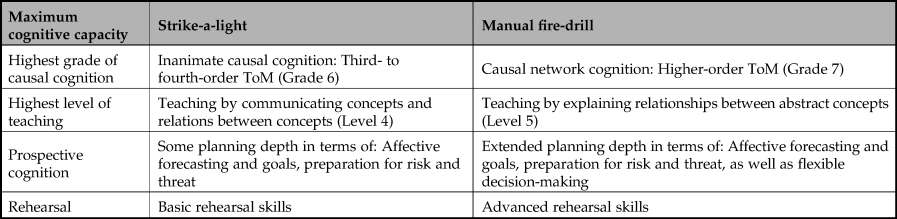
We cannot resolve these questions here, but we do want to hypothesize about the possible origins of the two fire-making techniques. As witnessed by our analysis above, and summarized in Table 2, we have shown that the strike-a-light technique requires slightly different cognitive capacities than the fire-drill technique, specifically in terms of causal cognition, social cognition and prospective cognition. Sorensen (Reference Sorensen2019, 32) argues that percussive or strike-a-light firemaking ‘is all but unknown from Africa, both ethnographically and archaeologically, with the adoption of flint and steel percussive firemaking only making an appearance on the continent after being introduced by European colonists’.
Summary of maximum cognitive capacities potentially expressed in strike-a-light vs fire-drill firemaking.
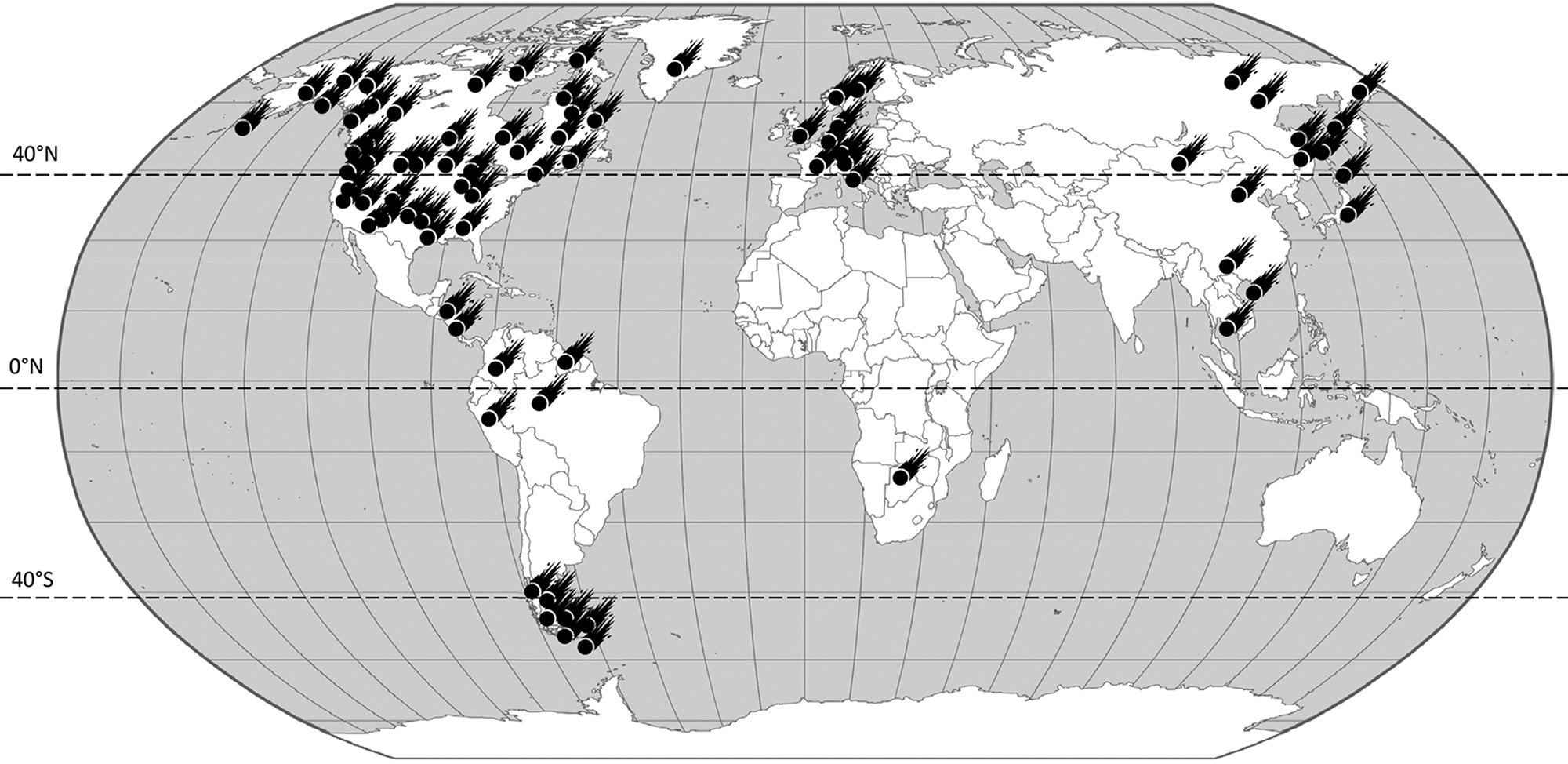
Cumulatively, these outcomes and observations may have several explanations, but it is also obvious that strike-a-light firemaking is/has been used primarily in high latitudes (Table 1), and archaeologically throughout Upper Palaeolithic Europe (Sorensen Reference Sorensen2019). In Figure 4 we map these observations roughly, showing that strike-a-light firemaking is mostly recorded close to or above 40°N and close to or below 40°S. In these high-latitude regions, extending the day with firelight and creating warmth during the winter months would have been advantageous for humans (Twomey Reference Twomey2014)—probably obligatory. What is more, natural fires may not have been as regular here as on the warm, dry African savanna so that there would have been an adaptive push towards the ability to make fire at will, as well as towards retaining the skill.
Rough distribution of strike-a-light firemaking as recorded by us (Table 1), McCauley et al. (Reference McCauley, Collard and Sandgathe2020), Sorensen (Reference Sorensen2019) and other authors cited in the text.
Neanderthals as strike-a-light inventors
Archaeological verification of fire becomes relatively regular in Europe throughout Marine Isotope Stage 5e–3 (~130,000–35,000 years ago), during the later Neanderthal phase (Sorensen et al. Reference Sorensen, Claud and Soressi2018). Expedient flint and pyrite strike-a-light firemaking was a skill mastered by Neanderthals (Sorensen Reference Sorensen2017; Reference Sorensen2019), and microwear analysis demonstrated that Neanderthal groups used strike-a-light sets during the late Mousterian in France about 50,000 years ago (Sorensen et al. Reference Sorensen, Claud and Soressi2018). Sorensen (Reference Sorensen2019) further suggests that the skill may have been introduced and practised by some Neanderthal groups, and that it may have been independently adopted by Homo sapiens arriving from Africa, or through cultural diffusion through contact with the Neanderthals.
We have previously suggested that there is evidence for the evolution of non-conspecific theory of mind (Grade 5 causal cognition) in African hominin populations before their split with the Neanderthals (Gärdenfors & Lombard Reference Gärdenfors and Lombard2018; Reference Gärdenfors and Lombard2020), which would facilitate aspects of cultural diffusion (MacDonald et al. Reference MacDonald, Scherjon, van Veen, Vaesen and Roebroeks2021). There also seems to have been a gradual development between and within inanimate causal cognition and causal network cognition (Grades 6 and 7) over the last 500,000 years of our evolution, wherein Neanderthals and H. heidelbergensis possessed some forms of executive functions connected to prospective thinking, and evolved at least some (in the case of H. heidelbergensis), if not all (in the case of Neanderthals) of the capacity for Grade 6 causal reasoning (Gärdenfors & Lombard Reference Gärdenfors and Lombard2018; Reference Gärdenfors and Lombard2020; Lombard & Gärdenfors Reference Lombard and Gärdenfors2021).
We therefore contend that, based on cognition, there is no reason to argue against Neanderthals being the inventors of the strike-a-light technology. What is more, we speculate that the overlap in teaching abilities between Neanderthals and Homo sapiens as discussed by Lombard and Högberg (Reference Lombard and Högberg2021), and that may have facilitated cultural exchange and learning between the two populations, may also have enabled Neanderthals to transfer their strike-a-light firemaking skills to groups arriving in their northern clime with its long, cold, wet and dark winters. Based on the archaeological record, other authors such as Sorensen (Reference Sorensen2019) and MacDonald et al. (Reference MacDonald, Scherjon, van Veen, Vaesen and Roebroeks2021) provided similar interpretations for strike-a-light fire production and transmission.
Such scenarios are especially likely since genetic research indicates multiple admixture events between Neanderthal and Homo sapiens populations, from as early as ~120,000 years ago in the Near East (Kuhlwilm et al. Reference Kuhlwilm, Gronau and Hubisz2016), most likely in western Asia from ~60,000–50,000 years ago (Nielsen et al. Reference Nielsen, Akey, Jakobsson, Pritchard, Tishkoff and Willerslev2017), and in present-day Romania at ~42,000–37,000 years ago (Fu et al. Reference Fu, Hajdinjak and Moldovan2015; Gokcumen Reference Gokcumen2019), so that cultural exchange was possible at different times and over many thousands of years. Even if interaction or co-existence was limited to 1400–2900 years during the Châtelperronian (~43,000–40,000 years ago) in France and northern Spain (Djakovic et al. Reference Djakovic, Soressi and Key2022), it still spans 56–116 human generations at 25 years per generation—more than enough time for people to exchange ideas and skill sets. During the subsequent Upper Palaeolithic, strike-a-light firemaking spread throughout the northern populations either through transmission or re-invention (McCauley et al. Reference McCauley, Collard and Sandgathe2020).
Early African Homo sapiens as fire-drill inventors
Lagercrantz's (Reference Lagercrantz1954) survey shows that manual fire-drills are/were widely used across Africa by indigenous hunter-gatherer, pastoralist and farming populations. As Sorensen (Reference Sorensen2019) points out, however, the preservation problems associated with the wood-friction firemaking techniques make it difficult or impossible to assess their origins and antiquity. That said, there is a suite of socio-technical behaviours evidenced in African Homo sapiens populations during the Middle Stone Age that demonstrates their socio-cognitive capacity for causal network cognition and higher-order ToM (Gärdenfors & Lombard Reference Gärdenfors and Lombard2018; Reference Gärdenfors and Lombard2020; Lombard & Gärdenfors Reference Lombard and Gärdenfors2021). It is therefore feasible to suggest that such populations had the cognitive capacity to invent, produce and use a rudimentary symbiotic toolset such as the fire-drill, perhaps as forerunner to other multi-part machines such as thong-driven firemaking techniques and bow-drills (see Scheiffele Reference Scheiffele2014).
Bentsen's (Reference Bentsen2014) summary of Middle Stone Age evidence of fire use at 34 sites in southern Africa dating roughly between 280,000 and 30,000 years ago shows that combustion features may yield much information about technical skill, spatial structuring, site maintenance, wood preference, cooking and social activities, among other things. Fire, for example, played an important role in sophisticated technological processes such as the heat treatment of rocks to improve their knapping ability in southern Africa since ~160,000 years ago (Brown et al. Reference Brown, Marean and Herries2009); ochre may have been roasted to alter its colour by ~100,000 years ago (Watts Reference Watts2010), and carefully controlled heat from fire was an essential part of manufacturing ochre-loaded adhesives since at least 70,000 years ago (Wadley Reference Wadley2005). Recent reports from the region show sheaves of grass placed near the back of a cave on ash layers that were probably the remnants of bedding burned for site maintenance at 200,000 years ago (Wadley et al. Reference Wadley, Esteban and de la Peña2020a), and charred Hypoxis rhizomes at 170,000 years ago currently serve as oldest known evidence of cooked starchy plant corms (Wadley et al. Reference Wadley, Backwell, d'Errico and Sievers2020b).
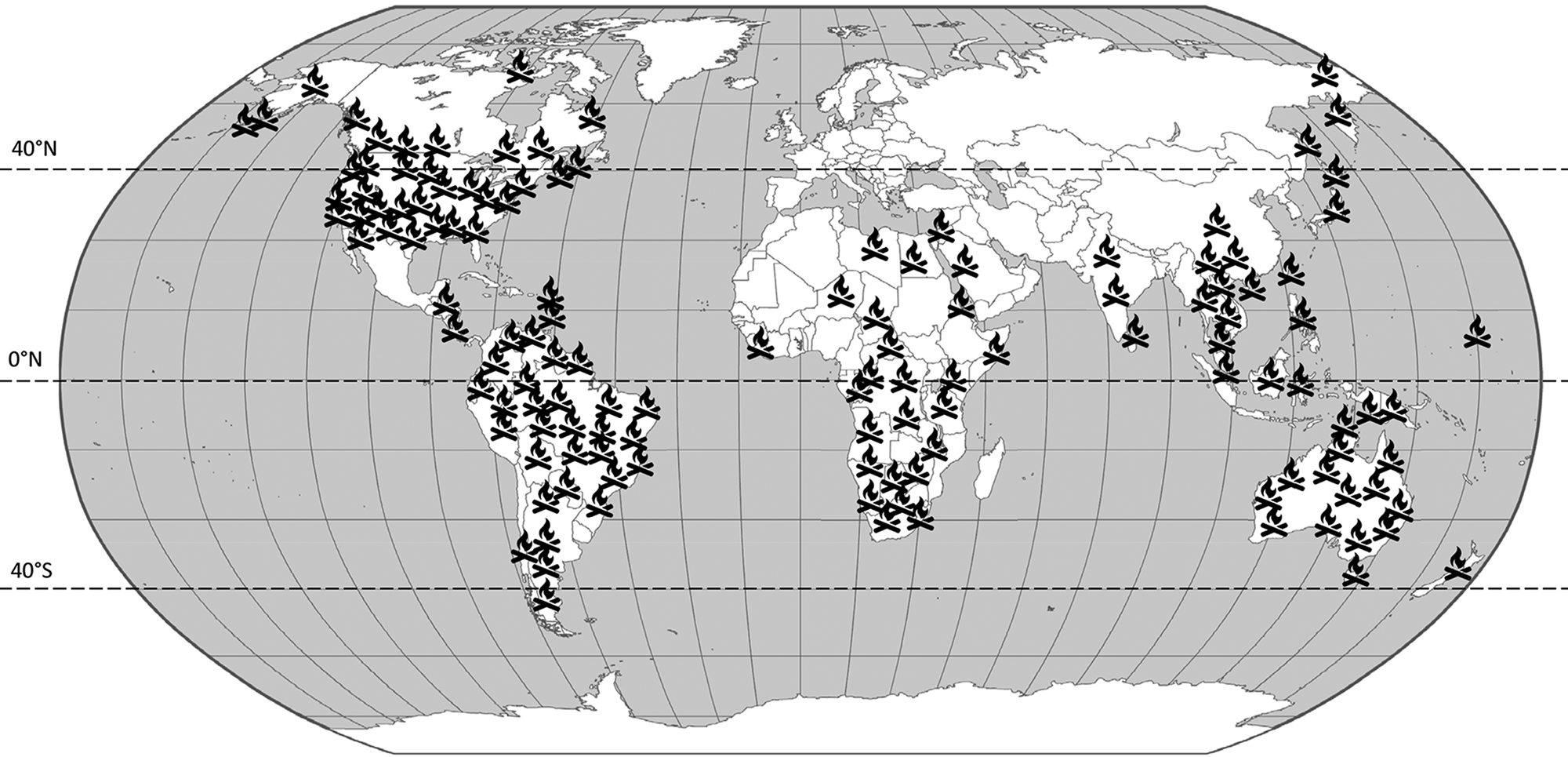
Cumulatively, the southern African evidence supports Bentsen's (Reference Bentsen2014) conclusion that Middle Stone Age pyrotechnology was an integral part of the socio-economy, and our previous analyses of broadly contemporaneous Homo sapiens socio-cognitive capacities (Gärdenfors & Lombard Reference Gärdenfors and Lombard2020; Lombard & Högberg Reference Lombard and Högberg2021), indicate that the invention, production and use of fire-drills may well have been within the scope of African populations before they spread across the globe successfully. Having developed the necessary causal cognition, teaching capacity and prospective cognition for inventing, re-inventing and transmitting such a technology by the time people started to settle across Eurasia may explain why the fire-drill technique became so widespread and why it is still practised by most hunter-gatherer groups in tropical and temperate regions between 40°N and 40° S (Table 1; Fig. 5).
Rough distribution of fire-drill firemaking as recorded by us (Table 1), McCauley et al. (Reference McCauley, Collard and Sandgathe2020) and other authors cited in the text.
In conclusion
Up to now, most other researchers have written about fire use because the antiquity of firemaking is so difficult to trace. Few, however, dispute its importance in our evolutionary history, and Twomey (Reference Twomey, Henley, Rossano and Kardas2019) suggests that the domestication of fire probably had a considerable impact on the evolution of human cognition. Here we have hypothesized about some aspects of the cognition of early firemaking based on ethnographic and archaeological observations. We have also demonstrated that the distribution maps for strike-a-light versus fire-drill firemaking techniques support a hypothesis wherein the strike-a-light method may have been more successful in high-latitude regions, and fire-drills best suited for drier, warmer areas. The distribution could further link to the seeming rarity of pyrite outcrops in Africa, which remains to be investigated (Sorensen Reference Sorensen2019). We focused on only two firemaking techniques, but exploring others, such as fire-ploughs and different configurations of thong-driven techniques, could add nuance to our interpretation (e.g. Scheiffele Reference Scheiffele2014). We limited our cognitive testing of firemaking to our models of causal and social (teaching) cognition, integrating it with aspects of prospective cognition and rehearsal. Future work testing firemaking techniques against theoretical models of expert cognition or creativity (e.g. Coolidge et al. Reference Coolidge, Haidle, Lombard and Wynn2016; Wynn & Coolidge Reference Wynn and Coolidge2014), could prove equally informative.
Our main take-away is two-fold. First, from a cognitive perspective, it is likely that Neanderthal groups independently discovered expedient strike-a-light firemaking. Because of probable shared levels of intentional teaching in Homo sapiens and Neanderthals such as demonstrating and communicating concepts (Levels 3–4 as described above and in SOM table 2, discussed in Gärdenfors & Högberg Reference Gärdenfors and Högberg2017; Reference Gärdenfors, Högberg, Peters and Lock2021; Lombard & Högberg Reference Lombard and Högberg2021), we may speculate about teaching and learning as well as cultural exchange between the populations when they encountered each other—perhaps also exchanging skills and knowledge about firemaking technologies and where to locate the necessary materials (also see MacDonald et al. Reference MacDonald, Scherjon, van Veen, Vaesen and Roebroeks2021; Sorensen Reference Sorensen2019). Secondly, the fire-drill technique that requires extended causal, social and prospective understanding, compared to the strike-a-light technique (Table 2), may have been invented by Homo sapiens in Africa where populations show early signs of such cognition before spreading across the globe.
Acknowledgements
We are indebted to Dennis Sandgathe for sharing his unpublished data regarding hunter-gatherer firemaking that contributed to information contained in Table 1 of this manuscript. We thank two anonymous reviewers for taking the time to read and comment on our work. Support from the Stellenbosch Institute for Advanced Study was received for aspects of this research. Mistakes or omissions, however, remain our own.
Supplementary material
Supporting Online Material (SOM) is at https://doi.org/10.1017/S0959774322000439


 Open access

