


Impact statement
Microplastics (MPs) have entered the terrestrial food chain, posing potential health risks to humans through trophic transfer. Currently, our understanding of MP transfer and surface weathering characteristics in terrestrial food chains remains incomplete. This study employed luminescent polystyrene MPs to quantify MP transfer along a terrestrial “earthworm-chicken” food chain, identifying poultry gastrointestinal tracts as active sites for MP fragmentation and surface changes. Our results demonstrate the gizzard’s important role in mechanical MP degradation and confirm chickens as biovectors that generate secondary MPs while enhancing environmental MP mobility.
Introduction
Plastics are widely utilized across diverse industries due to their cost-effectiveness and convenience. Global plastic production reached 414 million tonnes in 2023 (Plastics Europe, 2024), and cumulative production is projected to reach 33 billion tonnes by 2050 (Sharma et al., Reference Sharma, Elanjickal, Mankar and Krupadam2020). Without intervention, an estimated 12 billion tonnes of plastic waste will persist in the environment by 2050 (Geyer et al., Reference Geyer, Jambeck and Law2017), contributing to a global plastic pollution crisis that has garnered extensive attention. In 2022, the resumed fifth session of the United Nations Environment Assembly adopted a historic resolution to end plastic pollution and established an Intergovernmental Negotiating Committee (INC) to develop the Global Plastics Treaty. Following multiple rounds of consultations, states continue to work toward a consensus. Improperly disposed plastics undergo long-term weathering and degradation to form microplastics (MPs; particle size ≤5 mm). Terrestrial environments are important sinks for MPs. In soils, these particles can alter soil physicochemical properties, disrupt nutrient cycling, affect microbial communities, impair the survival and growth of fauna and flora, and pose potential risks to human health (Yang et al., Reference Yang2025; Sun et al., Reference Sun, Deng, Li, Song, Ye and Niu2026).
To date, research has concentrated mainly on aquatic food chains (e.g., plankton-fish) (Miller et al., Reference Miller, Hamann and Kroon2020; Gao et al., Reference Gao, Xu, Li, Wang, Huang, Jiang, Gong and Yang2025), and the mechanisms and extent of MP transfer in terrestrial food chains remain poorly understood. A field study reported higher concentrations of MPs in higher animals (birds, snakes and voles) than in invertebrates, with finer MPs (20–500 μm) being more abundant (Zheng et al., Reference Zheng, Wu, Zheng, Mai and Qiu2023). Faecal analyses indicate that MPs are ubiquitous in livestock and poultry (Wu et al., Reference Wu, Cai, Chen, Yang, Xing and Liao2021; Yang et al., Reference Yang2023; Haddy et al., Reference Haddy, Sing’Oei, Kosore, Lewis, Bowyer and Proops2025), and several investigations have shown MP ingestion by poultry (Huerta Lwanga et al., Reference Huerta Lwanga, Mendoza Vega, Ku Quej, Chi, Sanchez del Cid, Chi, Escalona Segura, Gertsen, Salánki, van der Ploeg, Koelmans and Geissen2017; Susanti et al., Reference Susanti, Yuniastuti and Fibriana2021; Bilal et al., Reference Bilal, Taj, Ul Hassan, Yaqub, Shah, Sohail, Rafiq, Atique, Abbas, Sultana, Abdali and Arai2023). For example, Susanti et al. (Reference Susanti, Yuniastuti and Fibriana2021) detected pervasive MP debris in the intestines of ducks from five Indonesian cities and Chen et al. (Reference Chen, Chen, Peng, Qi, Zhang, Nie, Zhang and Luo2023) found MP residues in chickens’ intestines, liver and skeletal muscles. Nevertheless, studies characterizing MP distributions and surface characteristics within the gastrointestinal tract are limited. In vitro gastrointestinal degradation experiments have shown that microplastics readily adsorb organic matter onto their surfaces (Tamargo et al., Reference Tamargo, Molinero, Reinosa, Alcolea-Rodriguez, Portela, Bañares, Fernández and Moreno-Arribas2022). Observations of surface morphology led Adhikari et al. (Reference Adhikari, Astner, DeBruyn, Yu, Hayes, O’Callahan and Flury2023) to conclude that PBAT particles underwent degradation during passage through the earthworm gut. Ingested MPs can affect poultry growth, development and reproduction (Ryan, Reference Ryan1988; You et al., Reference You, Zhang, Tian, Zhang, Pei, Wu, Li, Wang and Yang2025), thereby creating a potential exposure pathway to humans via consumption. Overall, the understanding of MP transfer and surface changes within terrestrial food chains remains inadequate.
Earthworms are key model species for studying MP impacts on soil fauna and also serve as natural prey for poultry such as chickens; consequently, they can act as vectors for MP translocation to higher trophic levels. This study selected an “earthworm-chicken” food chain as a representative terrestrial food chain. Polystyrene MPs, which are among the polymers detected in agricultural soils and are commonly used in daily life (Yang et al., Reference Yang, Li, Li, Xu, Shen, Li, Tu, Wu, Christie and Luo2021; Palazot et al., Reference Palazot, Soccalingame, Froger, Jolivet, Bispo, Kedzierski and Bruzaud2024; Zhang et al., Reference Zhang, Ding, Wang, Ha, Zhang, Zhao, Wu, Zhao, Zou and Chen2024a), were used to investigate MP transfer, distribution, quantification and surface changes in this food chain. This study provides a basis for future research on the environmental processes of MPs in terrestrial food chains.
Materials and methods
Organisms and growth conditions
The earthworms (Eisenia foetida) were purchased from Sanbaimu Earthworm Ecological Farm (Kunming, China). The purchased earthworms were pre-cultured in clean soil, and adult earthworms with a healthy body shape and fully developed rings (weighing 400–600 mg) were selected for the experiment. Chickens (Gallus gallus domesticus) were purchased from Jietong Poultry Business Department (Anqing, China) and were all 60-day-old chickens with an average weight of 580.9 ± 54.4 g. Under laboratory conditions, the chickens were first fed for one week to adapt to the new environment, and then the MP exposure experiment was conducted. The research protocol for this experiment has been approved by the Ethics Committee of the Medical Department of Qingdao University (Approval No. QDU-AEC-2024669). Chicken feed and quartz sand were purchased from the local market. Pepsin was purchased from Solabao Technology Co., Ltd. (Beijing, China). NaCl (guaranteed reagent), 30% H2O2 (analytical reagent), KOH (analytical reagent) and other experimental reagents were purchased from Sinopharm Chemical Reagent Co., Ltd. (Shanghai, China).
Characterization of polystyrene particles
Luminescent SrAl2O4: Eu2+, Dy3+ doped PS particles were purchased from Suzhou Icolor Materials Technology Co., LTD. SrAl2O4: Eu2+, Dy3+ exhibits an emission peak at 480 nm and two main excitation peaks at 325 nm and 365 nm (Jiang et al., Reference Jiang2009). Scanning electron microscopy (S-4800, Hitachi, Japan) with energy-dispersive X-ray spectroscopy (EX-350, Horiba, Japan) (SEM-EDS) results indicated that the particles contained high contents of Al and Sr (Supplementary Figure S1A, B). Fourier transform infrared (Nicolet iS5, Thermo Scientific, USA) in attenuated total reflection (ATR) mode was used to identify the functional groups of PS particles. The spectral acquisition range was 650 cm−1 to 4,000 cm−1, with a resolution of 4.0 cm−1 and 32 scans per spectrum (Supplementary Figure S1C, D). Plastic particles were frozen in liquid nitrogen and mechanically crushed, then sieved through 40-mesh (380 μm) and 60-mesh (250 μm) sieves to obtain particles with a uniform size range. PS MPs were divided into large-sized PS MPs (LPS) and small-sized PS MPs (SPS). Luminescent PS MPs were dispersed in anhydrous ethanol followed by sonication for 30 min. A small amount of the mixed liquid was dropped onto a glass slide. MPs exhibited good luminescence properties under a stereomicroscope (Model S9i, Leica, Wetzlar, Germany) after irradiation with a UV lamp. The sizes of LPS and SPS were measured by ImageJ. The average particle sizes of LPS and SPS were 603.5 ± 102.1 μm and 120.6 ± 51.8 μm, respectively (Supplementary Figure S1E, F).
Stability of luminescent PS MPs
The digestion protocols were evaluated to avoid potential disturbances to the surface morphology of PS MPs. H2O2 (30%), KOH (10%) and HNO3 (65%) were preliminarily selected to evaluate the stability of luminescent MPs during the disintegration of organic matter. Aliquots of PS MPs were subjected to the digestion solutions for 36 h. PS MPs were recovered through a mixed cellulose ester filter membrane (5 μm) and dried for subsequent analysis. SEM was used to evaluate the effects of digestion reagents on the surface of MPs (Supplementary Figure S2).
Simulated gastrointestinal fluid was prepared according to the method mentioned by Xu et al. (Reference Xu, Li, Ding, Wang, Liang, Xie, Zhang, Fu, Yu and Zhan2023). Specifically, 1 g of pepsin (3,000 USP units/g solid) was dissolved in 100 mL of a 0.9% sterile NaCl solution (pH 2.5). Luminescent PS MPs were added to the simulated gastrointestinal fluid in a constant-temperature shaker (39°C, 180 rpm). A 1-mL solution was collected at each time point (3, 12, 24, 48 and 72 h). After centrifugation, MPs were imaged via a confocal laser scanning microscope (CLSM, FV1000, Olympus, Japan) under 405 nm excitation. CLSM revealed that the PS MPs maintained strong fluorescence intensity compared to pristine MPs not exposed to the simulated gastrointestinal fluid (Supplementary Figure S3), indicating the stability of the luminescent PS MPs. These results confirmed the suitability of these MPs for investigating their trophic transfer along the food chain and their transformation within chicken tissues.
MPs transfer in the “earthworm-chicken” food chain: Experimental procedures
SPS MPs (1%, w/w) were mixed with silt loam soil (organic matter, total nitrogen (N) and total phosphorus (P) contents were 21.63, 1.09 and 0.79 g/kg, respectively; particle-size distribution: 16.69% clay (<2 μm), 55.67% silt [2–50 μm] and 27.64% sand [50–2000 μm]). Soil moisture was maintained at 25%–30% by daily replenishment with deionized water. Twenty-four cleaned earthworms were introduced into the soil and incubated in the laboratory for 7 days based on preliminary tests and previous studies (Ding et al., Reference Ding, Li, Qi, Jones, Liu, Liu and Yan2021). Then, all earthworms were collected. Half of the earthworms were rinsed with deionized water, and their guts were depurated for 24 h to collect earthworm casts, which were then oven-dried and weighed (Jiang et al., Reference Jiang, Chang, Zhang, Qiao, Klobučar and Li2020). The remaining earthworms were rinsed, cut into pieces and offered to chickens. Chickens were fed for 6 h and fasted for 6 h, after which faeces were collected. All samples were immediately stored at −4°C. This entire sampling procedure was performed with three biological replicates.
MPs in chicken gastrointestinal tract: Experimental procedures
LPS MPs were selected and directly administered to each chicken via oral gavage (100 mg/individual). Chickens were euthanized at 3, 6, 12, 18, 24 and 48 h post-administration. Carcasses were rinsed with deionized water before dissection. The crop, proventriculus, gizzard and intestines were carefully excised and incised along the epithelium, followed by thorough rinsing with water and ultrasonication to ensure complete recovery of MPs from the gastrointestinal tract. Gastrointestinal contents and faeces were collected throughout the experiment.
Extraction of MPs from soil, earthworm casts, chicken faeces and gastrointestinal tract
MPs were extracted from soil, earthworm casts and chicken faeces using density separation (Xiang et al., Reference Xiang2023). Briefly, soil samples were transferred into a glass beaker after being air-dried. Saturated NaCl solution (ρ = 1.20 g/cm3) was added, and the mixture was stirred with a glass rod for 10 min to ensure thorough mixing. The supernatants were filtered through a nylon fibre membrane after standing for 12–24 h. Then, the fibre membrane was washed into a 250 mL glass beaker with 30% (v/v) H2O2. The beakers were placed on an electric hotplate at 60°C for 36 h to dissolve the organic matter, after which the solution was filtered. Gastrointestinal contents were also transferred to beakers and digested with 30% (w/ v) hydrogen peroxide (H₂O₂) at 60°C for 36 h. After complete digestion, a saturated sodium chloride (NaCl) solution was added to the digested filtered sample. The mixture was thoroughly stirred, allowed to settle for phase separation, and the supernatant was collected and filtered through a pre-weighed filter membrane. The filter membrane was dried to constant weight in an oven, inspected under a stereomicroscope to remove visible non-plastic debris, and the final dry weight was recorded. The mass of MPs was calculated as the difference between the dry mass of the filter membrane in the treatment and that in the control. Each treatment was performed in triplicate. CLSM revealed that the extracted PS MPs from the gastrointestinal tract and faeces maintained strong fluorescence intensity compared to pristine MPs (Supplementary Figure S4).
The MP concentration ratio of soil/earthworm casts was calculated as the concentration of MPs in earthworm casts divided by that in soil; the MP concentration ratio of earthworm casts/chicken faeces was calculated as the concentration of MPs in chicken faeces divided by that in earthworm casts (Huerta Lwanga et al., Reference Huerta Lwanga, Mendoza Vega, Ku Quej, Chi, Sanchez del Cid, Chi, Escalona Segura, Gertsen, Salánki, van der Ploeg, Koelmans and Geissen2017). PS MPs were imaged under a stereomicroscope after UV irradiation and measured using Image J.
Weathering characteristics of PS MPs in earthworm casts, chicken faeces and gastrointestinal tract
The stability and surface changes of luminescent PS MPs were visualized and assessed using CLSM and SEM. μ-FTIR (Nicolet iS5, Thermo Scientific, USA) spectroscopy was used to evaluate changes in functional groups on the surface of PS MPs. The spectral acquisition range was 650 cm−1–4,000 cm−1, with a resolution of 4.0 cm−1 and 32 scans. The carbonyl index (CI) value of PS MPs was determined by the ratio of the peak area of carbonyl (C=O stretching vibration, 1711 cm−1) to the C − H stretching vibration of aromatic rings (1,451 cm−1) (Rodrigues et al., Reference Rodrigues, Abrantes, Gonçalves, Nogueira, Marques and Gonçalves2018).
Statistics
Experimental data were processed and organized using Microsoft Excel 2010. Statistical analyses were subsequently performed with SPSS 22. One-way analysis of variance (ANOVA) with the LSD test (for homogeneous variances) or the Dunnett’s T3 test (for heterogeneous variances) was employed to assess significant differences (p < 0.05). All quantitative results are expressed as mean ± standard deviation (SD). Graphical representations of data were generated using OriginPro 2022.
Results and discussion
Transfer and distribution of MPs in the “earthworm-chicken” food chain
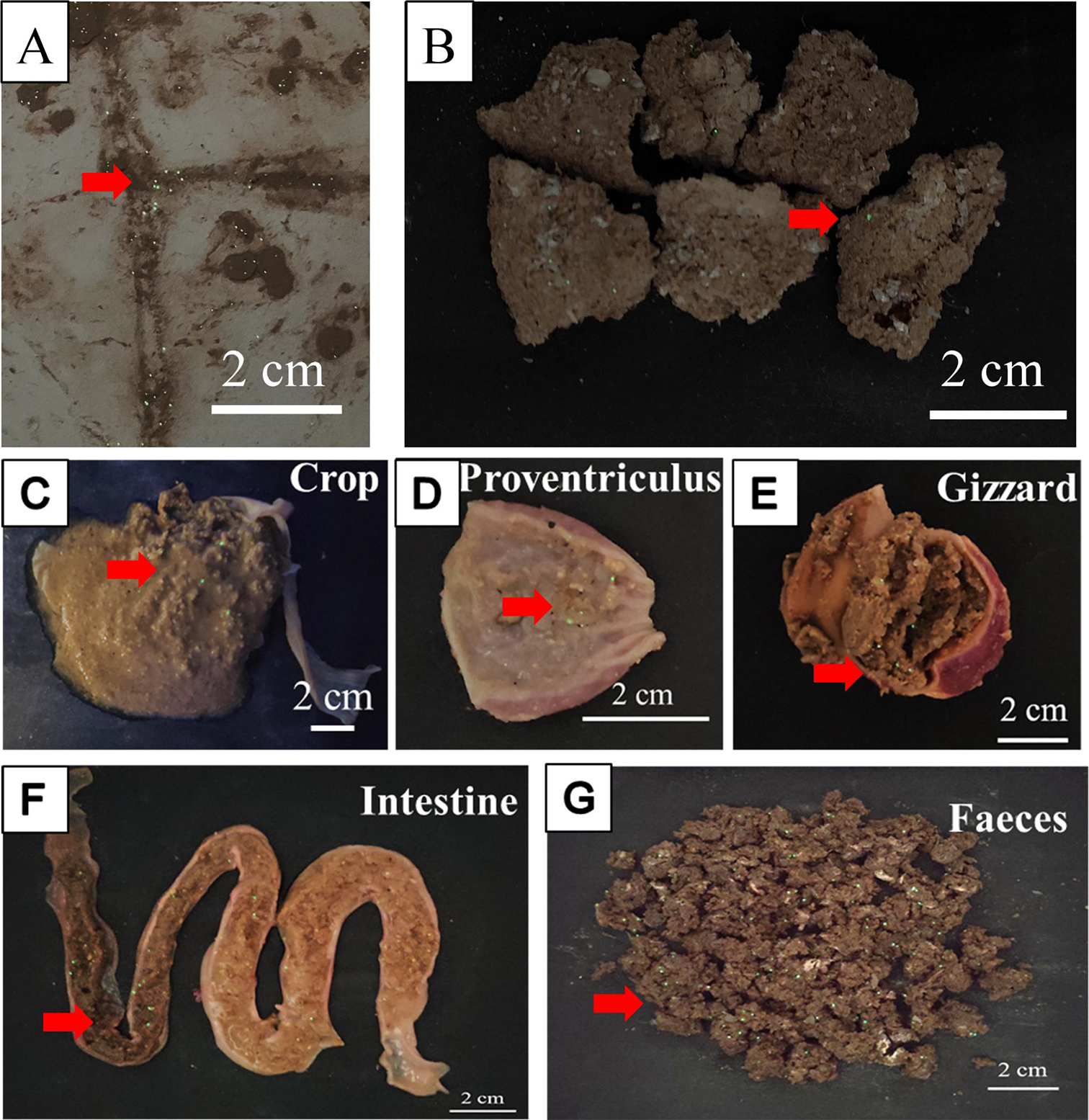
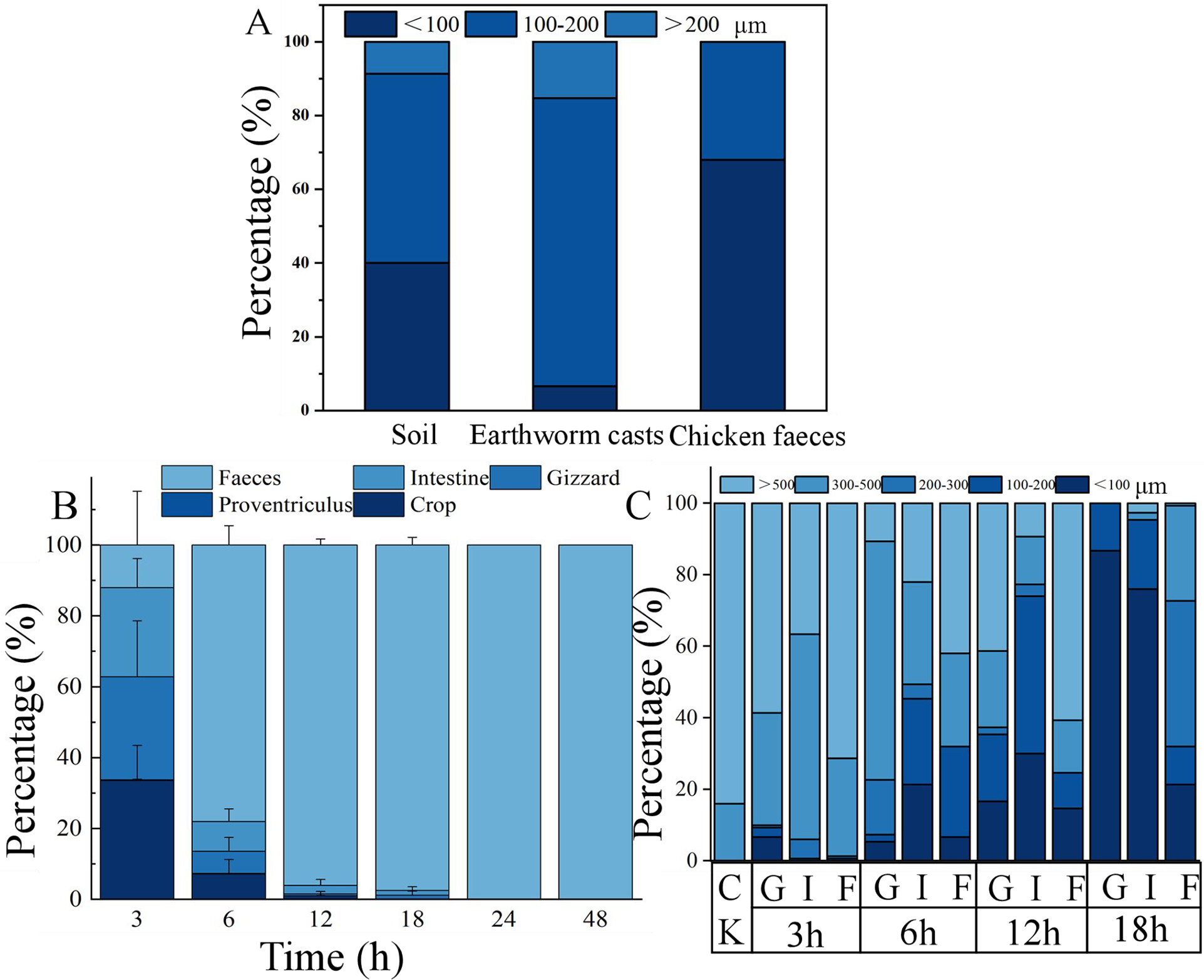
Earthworms were cultivated in soil spiked with luminescent SPS MPs, and subsequently fed to chickens. SPS MPs were imaged by a stereomicroscope after irradiation with a UV lamp. Results confirmed the presence of MPs in both earthworm casts and chicken faeces (Figure 1A,B), demonstrating trophic transfer along the earthworm-chicken food chain. The particle size distribution of MPs differed significantly among soil, casts and faeces (Figure 2A). In the soil, 91.3% of the MPs were ≤200 μm, while 84.7% of the MPs were ≤200 μm in casts. Chicken faeces showed a distinct size shift: 68.0% of particles were <100 μm and 32.0% were 100–200 μm. MP heterogeneity in soil distribution may occur, with smaller MPs preferentially sequestered within soil aggregates (Zhang et al., Reference Zhang, Qin and Zhang2023), potentially biasing earthworm ingestion toward larger particles. Field studies indicate that 72% of soil MPs associate with aggregates, while 28% remain dispersed (Zhang and Liu, Reference Zhang and Liu2018). MP retention in earthworms depends on particle properties (size/type). Small MPs (<100 μm) exhibit prolonged gut retention due to intestinal invagination entrapment (Huerta Lwanga et al., Reference Huerta Lwanga, Gertsen, Gooren, Peters, Salánki, van der Ploeg, Besseling, Koelmans and Geissen2016; Wang et al., Reference Wang, Peng, Xu, Zhang, Liu, Tang, Lu and Sun2022; Xiao et al., Reference Xiao, He, Jiang, Li, Yang, Ruan, Zhao, Qiu and Tang2022). Wang et al. (Reference Wang, Peng, Xu, Zhang, Liu, Tang, Lu and Sun2022) reported elimination half-lives of 9.3 h for polyethylene terephthalate and 45 h for polylactic acid, showing polymer-dependent retention. Although most MPs are excreted, residual accumulation occurs. Huerta Lwanga et al. (Reference Huerta Lwanga, Gertsen, Gooren, Peters, Salánki, van der Ploeg, Besseling, Koelmans and Geissen2016) observed size-selective retention: while 50% of soil PE MPs were <50 μm, 90% of cast MPs fell in this range, suggesting gut fragmentation via enhanced enzymatic/microbial activity (Meng et al., Reference Meng, Lwanga, van der Zee, Munhoz and Geissen2023). The absence of >200 μm MPs in chicken faeces indicates further size reduction during gastrointestinal transit.
To further understand the transfer and distribution of MPs in the gastrointestinal tract of chickens, the dynamic transport process of LPS MPs was analysed. MPs were detected in the gastrointestinal tract (including crop, proventriculus, gizzard and intestine) and faeces (Figure 1C–G). The residence time of MPs varied among different segments of the gastrointestinal tract of chickens (Figure 2B). At 3 h post-feeding, MP distribution was as follows: crop (33.6 ± 9.9%), proventriculus (0.16 ± 0.14%), gizzard (29.0 ± 15.8%), intestine (25.2 ± 8.2%) and faeces (12.0 ± 15.2%). Within 12 h, MPs were detected throughout the gastrointestinal tract and faeces; by 18 h, MPs were found only in the gizzard (1.2 ± 1.1%), intestine (1.3 ± 1.1%) and faeces (97.5 ± 2.2%). Complete faecal excretion occurred by 24 h. Digestive passage times vary among species. Chickens typically process food in 3–4 h (Ricke et al., Reference Ricke, Wythe, Scheaffer, Callaway and Ricke2023), whereas rodents excrete most MPs within 48 h (Keinänen et al., Reference Keinänen, Dayts, Rodriguez, Sarrett, Brennan, Sarparanta and Zeglis2021). The avian digestive system’s unique architecture, including crop storage, rapid proventriculus transit and mechanical gizzard breakdown, creates distinct MP processing patterns compared to mammals (Ricke et al., Reference Ricke, Wythe, Scheaffer, Callaway and Ricke2023; Yin et al., Reference Yin, Wang, Zhang, Lu, Wang and Xing2023).
Pictures of polystyrene MPs in earthworm casts (A), chicken faeces (B) and the gastrointestinal tract of chicken (C: crop, D :proventriculus, E: gizzard, F: intestine) and faeces (G) after exposure MPs.

Figure 1. Long description
Panel A at top left shows a close-up of an earthworm cast surface with a red arrow pointing to a cluster of small luminescent particles near the center. Panel B to the right displays several clumps of chicken faeces, with the red arrow indicating a particle within one clump. Panel C at bottom left shows the crop, labeled ‘Crop’, with a red arrow marking a region containing visible particles. Panel D, labeled ‘Proventriculus’, presents a cross-section of the organ with a red arrow pointing to a cluster of particles in the tissue. Panel E, labeled ‘Gizzard’, shows a bisected gizzard with the red arrow highlighting embedded particles. Panel F, labeled ‘Intestine’, displays a coiled intestinal segment with the red arrow indicating a region with visible particles. Panel G, labeled ‘Faeces’, shows a pile of faecal material with the red arrow marking a cluster of particles. All panels include a 2 cm scale bar for reference.
.Size distribution of MPs in soil, earthworm casts, and chicken faeces (A).Distribution of MPs in chicken gastrointestinal tract (crop, proventriculus, gizzard, intestine) and faeces at different times (B). Size distribution of MPs in chickengastrointestinal tract and faeces at different times (C).

Figure 2. Long description
Panel A shows stacked bars for Soil, Earthworm casts, and Chicken faeces on the x-axis, with percentage on the y-axis. Each bar is divided by particle size: less than 100 micrometers, 100 to 200 micrometers, and greater than 200 micrometers. Soil is dominated by less than 100 micrometers, earthworm casts by 100 to 200 micrometers, and chicken faeces by greater than 200 micrometers. Panel B shows percentage on the y-axis and time in hours (3, 6, 12, 18, 24, 48) on the x-axis. Bars are divided by anatomical region: Crop, Proventriculus, Gizzard, Intestine, and Faeces. At 3 hours, most is in Crop and Proventriculus, shifting to Intestine and Faeces by 12 hours and later. Panel C shows percentage on the y-axis and sample/time combinations on the x-axis (K, C, G, I, F at 3, 6, 12, 18 hours). Bars are divided by particle size: greater than 500, 300 to 500, 200 to 300, 100 to 200, and less than 100 micrometers. At early times, larger particles are more prevalent in Crop and Gizzard, shifting to smaller sizes in Intestine and Faeces over time.
Temporal size evolution of MPs in gastrointestinal tracts revealed progressive fragmentation (Figure 2C). Pristine MPs (603.46 ± 102.06 μm) comprised >500 μm (84%) and 300–500 μm (16%) fractions. At 3 h post-feeding, the particle sizes were 501.85 ± 177.84, 472.93 ± 110.40 and 540.04 ± 92.34 μm in the gizzard, intestine and faeces, respectively. The fraction of MPs >500 μm was significantly reduced. Continuous size reduction occurred, reaching 66.71 ± 26.28 μm (gizzard), 86.69 ± 106.47 μm (intestine) and 229.68 ± 116.30 μm (faeces) (all <500 μm) by 18 h. The gizzard drove an 88.95% size reduction (from 603.46 to 66.71 μm), confirming mechanical fragmentation. Huerta Lwanga et al. (Reference Huerta Lwanga, Mendoza Vega, Ku Quej, Chi, Sanchez del Cid, Chi, Escalona Segura, Gertsen, Salánki, van der Ploeg, Koelmans and Geissen2017) also found that the size of MPs in chickens followed the sequence: crop > gizzard > chicken faeces. Small MPs (≤100 μm) account for a higher proportion of MPs in gastrointestinal tracts of wildlife taxa (Kim et al., Reference Kim, Kim, Jeong, Kim, Kim, Jung, Seo, Han, Lee and Choi2023; Zheng et al., Reference Zheng, Wu, Zheng, Mai and Qiu2023). Most orally ingested MPs undergo complete gastrointestinal passage without retention (Hu et al., Reference Hu, Zhou, Wang, Zhang and Pan2022). This study elucidates the temporal and spatial distribution patterns of MPs within the chicken gastrointestinal tract.
Quantitative characterization of MPs in the “earthworm-chicken” food chain
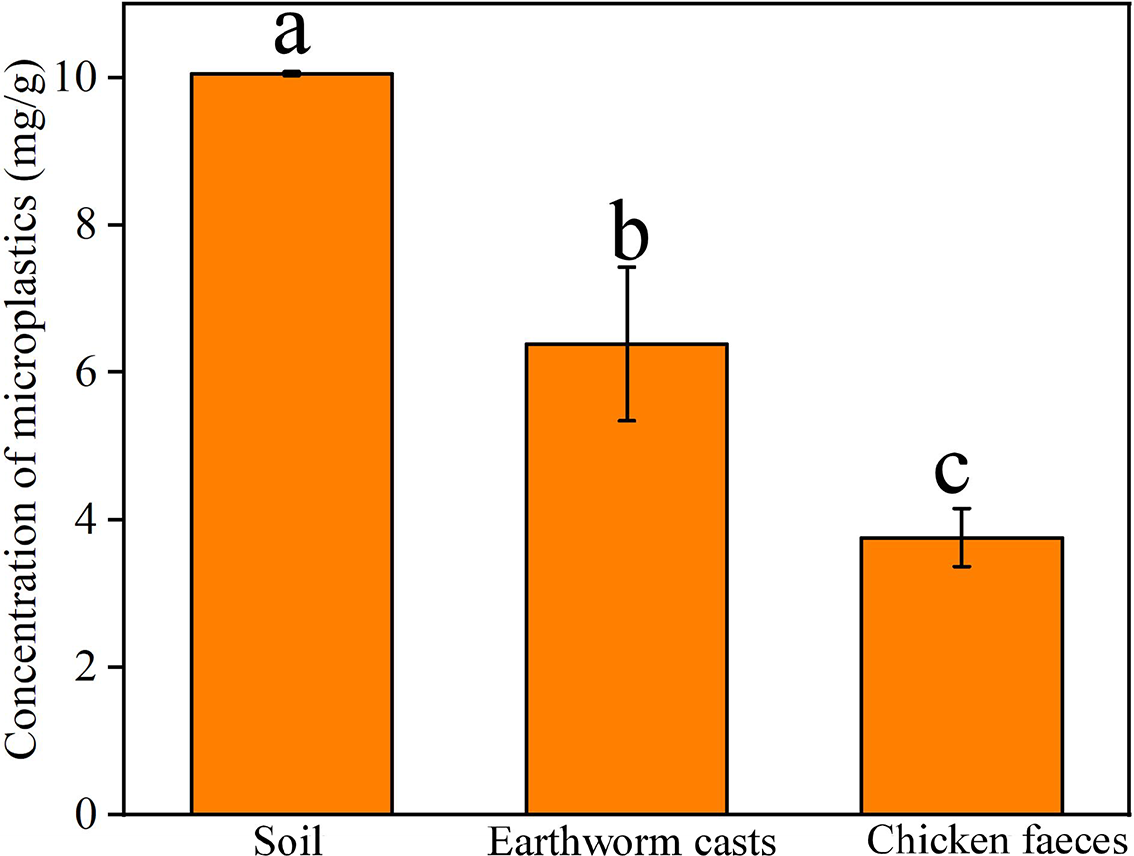
The concentration of MPs in soil, earthworm casts and chicken faeces decreased in the following order: soil (10.06 ± 0.03 mg/g) > earthworm casts (6.39 ± 1.05 mg/g) > chicken faeces (3.76 ± 0.39 mg/g) (Figure 3). The concentration ratios of MPs were 0.64 ± 0.10 (earthworm casts/soil) and 0.59 ± 0.05 (chicken faeces/earthworm casts). The earthworm ingestion rate (mg cast g−1 worm d−1) was calculated based on the weight of the ejected casts. The observed ingestion rate of 0.91 mg cast g−1 worm d−1 for PS MPs was significantly lower than rates reported for PE MPs (5.2–9.3 mg cast g−1 worm d−1 at 0.2%–1.2% soil concentrations over 60 days) (Huerta Lwanga et al., Reference Huerta Lwanga, Gertsen, Gooren, Peters, Salánki, van der Ploeg, Besseling, Koelmans and Geissen2016). This difference may reflect shorter exposure duration and/or polymer-specific characteristics. Although no significant MP accumulation occurred in earthworms or chickens under these experimental conditions, the transfer along the soil-earthworm-chicken chain was confirmed. Notably, a field study reported higher MP particle counts in casts (14.8 ± 28.8 particles g−1) and faeces (129.8 ± 82.3 particles g−1) compared to soil (0.87 ± 1.9 particles g−1) (Huerta Lwanga et al., Reference Huerta Lwanga, Mendoza Vega, Ku Quej, Chi, Sanchez del Cid, Chi, Escalona Segura, Gertsen, Salánki, van der Ploeg, Koelmans and Geissen2017). The lower MP ingestion and excretion observed in this study likely resulted from controlled conditions and short-term exposure. Additionally, long-term environmental weathering may promote MP fragmentation and generate smaller particles. We demonstrate that while fragmentation generates numerous smaller particles (increasing particle count), the overall polymer mass transferred is attenuated. Li et al. (Reference Li, Lin, Wang, Xu and Yu2023) used metal-labelled NPs to quantify nanoplastics in a “lettuce-snail” food chain under controlled conditions, reporting concentration ratios of MPs ranging from 0.31 to 0.69 from lettuce to snail faeces. This mass-based perspective provides a more robust estimate of the actual plastic load transferred to higher trophic levels.
Concentration of MPs in soil, earthworm casts, and chicken faeces.

Morphological characteristics of MPs in the “earthworm-chicken” food chain
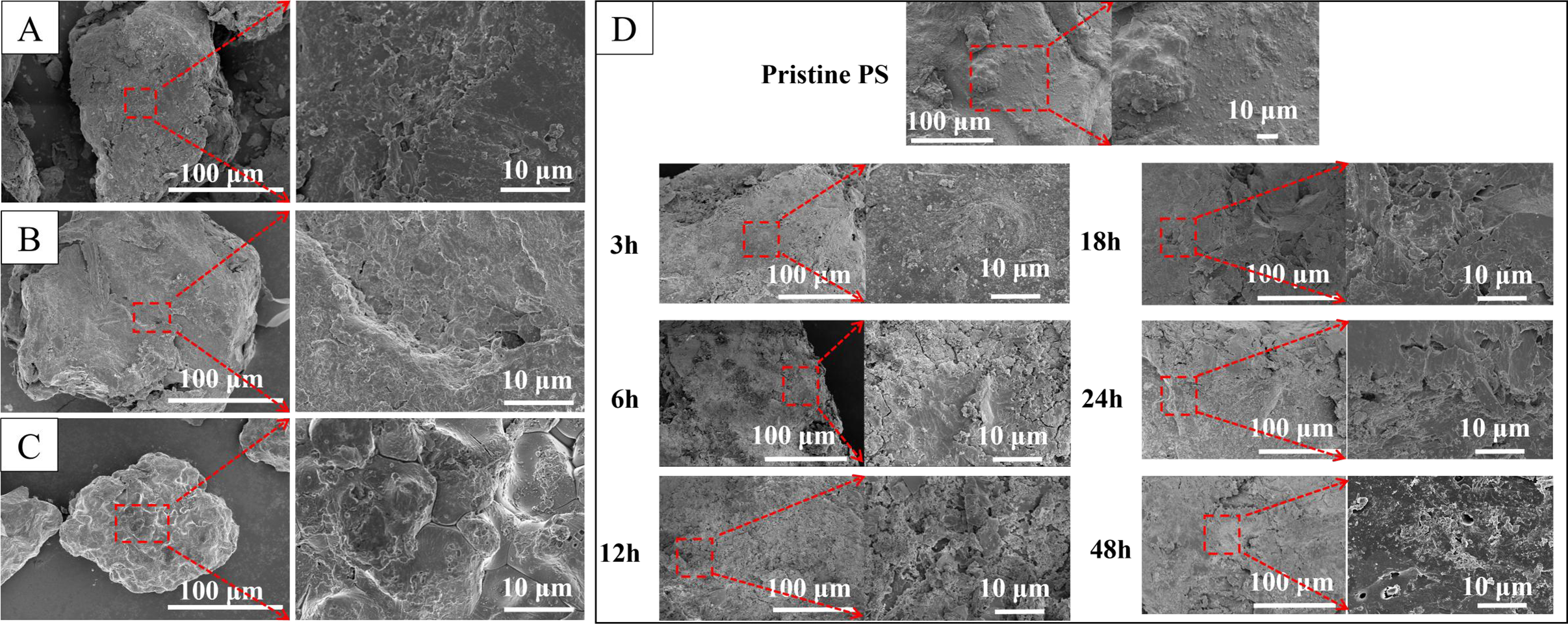
The morphological changes of MPs in casts, faeces, and the gastrointestinal tract were characterized by SEM. In the food chain study, pristine PS MPs exhibited irregular shapes with rough surfaces, featuring cracks, uneven protrusions and grooves (Figure 4A–C). While MPs in earthworm casts showed no significant morphological alterations, those in chicken faeces developed surface cracks and smoothed edges. In gastrointestinal tract analyses, PS MPs from chicken gizzard, intestine and faeces displayed significant surface weathering (increased scratches, cracks and fractures), particularly after 12 h post-feeding (Figure 4D, Supplementary Figure S5–S6). This surface modification during gastrointestinal digestion results from mechanical grinding and interactions with digestive enzymes and microbial communities. Smaller-sized micro/nanoplastics may be released from these fragmented MPs (Krasucka et al., Reference Krasucka, Bogusz, Baranowska-Wójcik, Czech, Szwajgier, Rek, Ok and Oleszczuk2022). MPs extracted from mouse faeces demonstrated substantial size reduction (from micrometre to nanometre scale) following 1 or 4 week gavage periods (Wang et al., Reference Wang, Li, Shi, Lv, Xu, Yang, Chua, Jia, Chen, Liu, Huang, Huang, Chen and Fang2023; Fan et al., Reference Fan, Qu, Qu, Shen, Liu and Nie2025). Such incomplete degradation exacerbates MP neurotoxicity via oligomer and nanoplastics formation (Liang et al., Reference Liang, Deng, Zhong, Chen, Huang, Li, Huang, Yang, du, Ye, Xian, Feng, Bai, Fan, Yang and Huang2024).
SEM images of pristine PS (A) and PS MPs excreted from earthworm casts (B) and chicken faeces (C). SEM images of pristine PS and PS MPs excreted intochicken faeces at different time (D).

Figure 4. Long description
Panels A, B, and C each display two SEM micrographs, with the left showing a larger field at 100 micrometers scale and the right a zoomed region at 10 micrometers. In A, the surface appears rough and fractured; the zoomed view reveals fine granular texture. In B, the surface is more compact with fewer fractures, and the zoomed view shows smoother regions with some cracks. In C, the surface is irregular and porous, with the zoomed view highlighting interconnected pores. Panel D contains a grid of SEM micrographs for pristine PS and samples at 3, 6, 12, 18, 24, and 48 hours, each at 100 micrometers (left) and 10 micrometers (right). Pristine PS shows a smooth, dense surface. At 3 hours, the surface begins to roughen. At 6 and 12 hours, increased roughness and microcracks are visible. At 18 and 24 hours, the surface becomes more porous and fragmented. At 48 hours, the surface is highly porous with visible cavities and network-like features. All scale bars and timepoints are labeled.
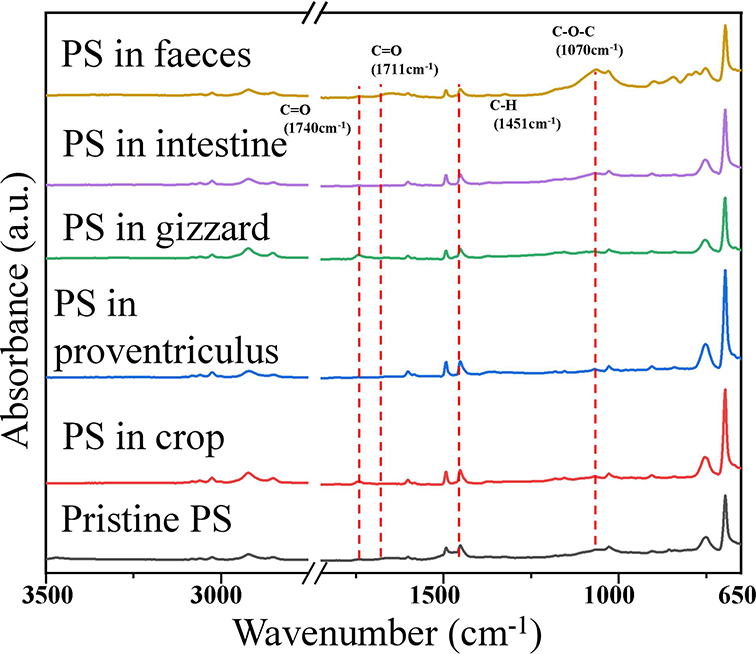
FTIR analysis revealed functional group characteristics of PS MPs across different gastrointestinal segments (Figure 5). The characteristic peaks of pristine PS corresponding to C–H stretching vibrations of the aromatic ring were observed at 3024 cm−1, 3,059 cm−1, 3,082 cm−1, The characteristic peaks of 2,922 cm−1 and 2,852 cm−1 correspond to –CH2– stretching vibrations. The characteristic peaks of C=C and C–H aromatic ring are at 1602, 1492 cm−1, 1,451 cm−1, 751 cm−1 and 695 cm−1 (Zhang et al., Reference Zhang, Hunter, Ullah, Shao and Shi2024b; Wang et al., Reference Wang, Shi, Liu, Bai and Qu2025). A carbonyl peak (–C=O, 1711 cm−1) emerged in gastrointestinal-tract-exposed MPs. The carbonyl index (CI) quantified PS MP degradation. The CI values for pristine PS MPs were 0.03 ± 0.02. However, the CI values of MPs from different gastrointestinal segments showed high variability, indicating the influence of the gastrointestinal conditions on MP surface weathering. The CI values of PS MPs in crop, proventriculus, gizzard, intestine and faeces were 0.18 ± 0.13, 0.19 ± 0.20, 0.22 ± 0.02, 0.57 ± 0.22, 2.45 ± 1.79, respectively. Elevated CI values may enhance MP adsorption capacity and associated environmental risks (Krasucka et al., Reference Krasucka, Bogusz, Baranowska-Wójcik, Czech, Szwajgier, Rek, Ok and Oleszczuk2022). Despite pervasive weathering, only gizzard MPs showed statistically significant differences from pristine MPs, potentially due to residual biomolecules or heterogeneous MP-tract interactions. New peaks at 1070 and 1740 cm−1 appeared in MPs from the gastrointestinal tract. The peak at 1740 cm−1 corresponds to C=O stretching in lipids, triglycerides, cholesterol esters or phospholipids, while the peak at 1070 cm−1 corresponds to C–O–C stretching in phospholipids or glycogen (Staniszewska et al., Reference Staniszewska, Malek and Baranska2014; Depciuch et al., Reference Depciuch, Stanek-Widera, Khinevich, Bandarenka, Kandler, Bayev, Fedotova, Lange, Stanek-Tarkowska and Cebulski2020; Velmurugan et al., Reference Velmurugan, Devaraj Stephen, Karthikeyan and Binu Kumari2022). These results provide direct evidence of biomolecule adsorption on the surface of MPs within the gastrointestinal tract. This surface condition may critically influence subsequent environmental fate. This coating could alter their aggregation behaviour and bioavailability to soil organisms when the faeces enter the environment, potentially enhancing MP migration and altering their ecological impact (Dang et al., Reference Dang, Wang, Huang, Wang and Xing2022).
FTIR images of pristine PS MPs and PS MPs in crop, proventriculis, gizzard, intestine, and faeces of chicken.

Figure 5. Long description
From bottom to top, six absorbance spectra are plotted against wavenumber from 3500 to 650 centimeters to the minus one. The bottom line, labeled Pristine P S, shows baseline peaks. Above, PS in crop, proventriculus, gizzard, intestine, and faeces are plotted in red, blue, green, purple, and yellow, respectively. Red dashed vertical lines mark wavenumbers at 1740, 1711, 1451, and 1070 centimeters to the minus one. Peaks at C=O (1740 and 1711 centimeters to the minus one), C-H (1451 centimeters to the minus one), and C-O-C (1070 centimeters to the minus one) are labeled. The spectra for faeces and intestine show increased absorbance at C =O and C-O-C regions compared to pristine P S, indicating chemical changes during digestion. All spectra share a prominent peak near 1070 centimeters to the minus one, but the intensity and presence of other peaks vary by digestive section.
Conclusions
This study demonstrated the distribution, transfer and surface change characteristics of polystyrene microplastics (MPs) along a terrestrial “earthworm-chicken” food chain. Our results indicate that MPs did not undergo biomagnification in the food chain and were excreted within 24 h. Instead, their transfer was characterized by continuous fragmentation, particularly in the chicken gizzard. MPs exhibited significant surface weathering, including increased scratches, cracks, fractures and oxygen-containing functional groups. This work confirms poultry as biovectors that generate secondary MPs through digestive fragmentation, thereby altering the form and potentially the mobility of MPs entering the environment. The findings highlight the need to monitor MP contamination in feed sources and provide fundamental data and theoretical guidance for future research on MPs in terrestrial food chains.
Open peer review
To view the open peer review materials for this article, please visit http://doi.org/10.1017/plc.2026.10051.
Supplementary material
The supplementary material for this article can be found at http://doi.org/10.1017/plc.2026.10051.
Acknowledgements
We thank our editors and anonymous reviewers for their valuable comments and suggestions on this article.
Author contribution
J. Y: Formal analysis, methodology, writing – original draft, writing – review & editing. L. X.: Investigation, data curation. L. L.: Writing – review & editing, C. T.: Writing – review & editing, Y. L.: Supervision, conceptualization, writing – review & editing.
Financial support
This research was supported by the National Natural Science Foundation of China (42530717, 42177040), Natural Science Foundation of Jiangsu Province (BK20241704) and Natural Science Foundation of Shandong Province (No. ZR2024MD074).
Competing interests
The authors declare that they have no competing interests.


 Open access


Comments
Dear Editor,
On behalf of my co-authors, I am pleased to submit our manuscript entitled “Transfer quantification and surface changes of microplastics along the earthworm-chicken food chain” for consideration by Cambridge Prisms: Plastics.
Microplastic (MP) pollution in terrestrial ecosystems has emerged as a critical threat to global food security, yet the transfer and transformation of MPs along terrestrial food chains, particularly in poultry, remain poorly understood. Our study addresses this critical knowledge gap by quantitatively tracking luminescent polystyrene MPs through a representative “earthworm-chicken” food chain and characterizing their surface weathering and fragmentation processes.
In this study, we quantified MP transfer along a terrestrial “earthworm-chicken” food chain and demonstrated that poultry gastrointestinal tracts are active sites for MP fragmentation and surface changes. Our results demonstrate the gizzard’s important role in mechanical MP degradation and confirm chickens as biovectors that generate secondary MPs while enhancing environmental MP mobility.
We conclude that MPs did not undergo biomagnification in the food chain. Instead, their transfer was characterized by continuous fragmentation, particularly in the chicken gizzard. MPs exhibited significant surface weathering, including increased scratches, cracks, fractures, and oxygen-containing functional groups. This work highlights the need to consider MP fragmentation in poultry, as it may facilitate food chain transport and enhance environmental MP mobility. The findings provide fundamental data and theoretical guidance for future research on MPs in terrestrial food chains.
None of the material has been published, nor is it under review with any other journal.
Thank you for considering our submission. I look forward to the opportunity to discuss our research further.
Best wishes,
Prof. Dr. Yongming Luo
Institute of Soil Science (ISSAS), Chinese Academy of Sciences (CAS)