
Hostname: page-component-6766d58669-bp2c4 Total loading time: 0 Render date: 2026-05-18T15:02:37.076Z Has data issue: false hasContentIssue false

Hydroxylbastnäsite-(La), an ‘old new’ bastnäsite-group mineral

Published online by Cambridge University Press:  12 November 2024

Igor V. Pekov*
Affiliation:
Faculty of Geology, Moscow State University, Vorobievy Gory, 119991 Moscow, Russia
Natalia V. Zubkova
Affiliation:
Faculty of Geology, Moscow State University, Vorobievy Gory, 119991 Moscow, Russia
Anatoly V. Kasatkin
Affiliation:
Fersman Mineralogical Museum of the Russian Academy of Sciences, Leninsky Prospekt 18-2, 119071 Moscow, Russia
Nikita V. Chukanov
Affiliation:
Federal Research Center of Problems of Chemical Physics and Medicinal Chemistry of the Russian Academy of Sciences, 142432 Chernogolovka, Moscow region, Russia
Natalia N. Koshlyakova
Affiliation:
Faculty of Geology, Moscow State University, Vorobievy Gory, 119991 Moscow, Russia
Dmitry A. Ksenofontov
Affiliation:
Faculty of Geology, Moscow State University, Vorobievy Gory, 119991 Moscow, Russia
Radek Škoda
Affiliation:
Department of Geological Sciences, Faculty of Science, Masaryk University, Kotlářská 2, 611 37, Brno, Czech Republic
Sergey N. Britvin
Affiliation:
St. Petersburg State University, University Emb. 7/9, 199034 St. Petersburg, Russia
Anatoly S. Kirillov
Affiliation:
St. Petersburg State University, University Emb. 7/9, 199034 St. Petersburg, Russia
Anatoly N. Zaitsev
Affiliation:
St. Petersburg State University, University Emb. 7/9, 199034 St. Petersburg, Russia
Aleksey M. Kuznetsov
Affiliation:
Independent researcher, 454071 Chelyabinsk, Russia
Dmitry Yu. Pushcharovsky
Affiliation:
Faculty of Geology, Moscow State University, Vorobievy Gory, 119991 Moscow, Russia
*
Corresponding author: Igor V. Pekov; Email: igorpekov@mail.ru

Abstract

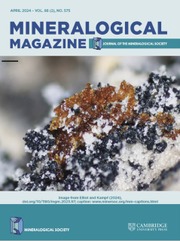
Hydroxylbastnäsite-(La), the OH- and La-dominant member of the bastnäsite group, in fact known for many years, was studied in detail and has been approved by the IMA–CNMNC as a new mineral species with the ideal, end-member formula La(CO3)(OH). The holotype originates from the Vuoriyarvi (another spelling: Vuorijärvi) alkaline-ultrabasic complex, Northern Karelia, and the cotype from the Mochalin Log REE deposit, Potaniny Mts, South Urals, both in Russia. At Vuoriyarvi, hydroxylbastnäsite-(La) occurs as clusters (up to 1 mm) of light brown, honey-yellow or colourless hexagonal tabular to short-prismatic crystals up to 0.15 mm associated with fluorite and ancylite-(Ce) in cavities of calcite–dolomite carbonatites. At Mochalin Log, hydroxylbastnäsite-(La) forms light brown grains up to 0.2 mm included in massive aggregates of other LREE minerals: bastnäsite-(Ce), bastnäsite-(La), percleveite-(Ce), percleveite-(La), biraite-(Ce), biraite-(La), törnebohmite-(La), ferriperbøeite-(Ce), allanite-(Ce), etc. Dmeas is 4.75(2) and Dcalc is 4.778 g cm–3 (holotype). Hydroxylbastnäsite-(La) is optically uniaxial (+), ω = 1.76(1) and ε = 1.86(1) (holotype). The chemical composition (wt.%, electron microprobe, CO2 and H2O calculated: holotype/cotype) is: CaO 0.23/0.00, SrO 0.07/0.00, La2O3 39.47/39.58, Ce2O3 33.51/31.99, Pr2O3 1.03/1.51, Nd2O3 1.95/2.38, F 0.76/3.33, CO2 20.49/20.34, H2O 3.77/2.58, –O=F 0.32/1.40, total 100.96/100.31. The empirical formulae, calculated based on the sum of metal cations of 1 apfu and one CO3 group pfu, are (La0.52Ce0.44Nd0.02Pr0.01Ca0.01)Σ1.00(CO3)[(OH)0.90F0.09]Σ0.99 (holotype) and (La0.53Ce0.42Nd0.03Pr0.02)Σ1.00(CO3)[(OH)0.62F0.38]Σ1.00 (cotype). Hydroxylbastnäsite-(La) is hexagonal, P6̅, unit-cell parameters (from powder XRD data, holotype/cotype) are: a = 12.537(3)/12.533(1), c = 9.968(2)/9.908(1) Å, V = 1356.8(5)/1347.9(3) Å3 and Z = 18. Strong reflections of the powder XRD pattern [d,Å(I)(hkl)] are (holotype): 4.98(39)(002), 3.616(88)(300), 2.926(100)(302), 2.089(41)(330), 2.052(46)(304) and 1.927(40)(332). The crystal structure of holotype hydroxylbastnäsite-(La) was refined by the Rietveld method, Rwp = 0.0071, Rp = 0.0050, Robs = 0.0466. It is isostructural to hydroxylbastnäsite-(Ce) and synthetic bastnäsite-type hydroxyl-carbonates REE3+(CO3)(OH) (REE = La–Er), but differs from fluorine-dominant bastnäsites which adopt the space group P6̅2c.

Information

Type
Article
Copyright
© The Author(s), 2024. Published by Cambridge University Press on behalf of The Mineralogical Society of the United Kingdom and Ireland.

Access options

Get access to the full version of this content by using one of the access options below. (Log in options will check for institutional or personal access. Content may require purchase if you do not have access.)

Article purchase

Temporarily unavailable

Supplementary material: File

Pekov et al. supplementary material

Pekov et al. supplementary material
Download Pekov et al. supplementary material(File)
File 751.1 KB