


Scholars and policy makers point with concern to declining support for democracy worldwide, linking this trend in public opinion to creeping autocratization (Diamond Reference Diamond2008; Reference Diamond2015; Foa and Mounk Reference Foa and Mounk2016). Yet, most widely used surveys simply ask respondents about their support for democracy, implicitly positing that everyone understands pertinent concepts in the same way (Carlin Reference Carlin2018). This assumption—that individuals share equal (and equally accurate) conceptualizations of democracy—potentially introduces bias into studies that posit (or reject) mass political opinion as a key mechanism in macro-level outcomes such as democratic backsliding. Without a rigorous empirical analysis of what these concepts mean to different individuals in diverse contexts, we cannot answer questions about the link between public opinion on democracy and regime-level outcomes. In this article, we demonstrate that variance in how individuals understand abstract concepts such as democracy is associated with significant and substantive differences in support and preference for democracy. Thus, to better understand current trends in democratic support worldwide, scholarship must first pay greater attention to the meaning that people grant to the term “democracy.”
Although several studies have examined the variability and reliability of measures of support for democracy in specific countries and regions (Ariely Reference Ariely2015; Ariely and Davidov Reference Ariely and Davidov2011; Bratton Reference Bratton2010; Canache Reference Canache2012; Carnaghan Reference Carnaghan2011; Gerber and Chapman Reference Gerber and Chapman2018), they leave open key questions. Which conceptualizations of democracy are associated with stronger support for democracy? How do they compare to universal socioeconomic variables, such as education and income? Do links between the conceptualization of democracy and support for it hinge on country-specific factors or regime type? Addressing these questions matters if we are to understand how autocrats come to power through the ballot box (or fall due to mass protests), as well as other topics in which support for democracy is a driving mechanism. Our study contributes to this emerging scholarship by analyzing the correlation between specific conceptualizations of democracy and democratic support. We find that understandings of democracy vary in important ways, and the significance of these understandings as a driving factor in support for democracy holds across country context, regime type, and individual characteristics.
What constitutes democracy and how expansive its definition should be have been the subject of protracted academic discourse (Schmitter and Karl Reference Schmitter and Karl1991). Given the complexity of this concept, we may expect that ordinary individuals also have complex understandings that may influence their support for democracy. Yet, in scholarly work focused on how individuals acting collectively drive regime change, this debate is often sidestepped entirely. We demonstrate that support for democracy is heavily contingent on individuals’ understanding of the concept. Specifically, we examine the relationship between the complexity and content of individuals’ conceptualizations of democracy and their support of it. To analyze the relationship between conceptual complexity and self-reported normative commitment to democracy, we use indicators from the World Values Survey that ask which attributes respondents consider “essential” for democracy (Chapman et al. Reference Chapman, Hanson, Dzutsati and DeBell2023). We find that greater conceptual complexity predicts greater support.
We also investigate several substantive conceptualizations central to how scholars approach the study of democracy, including electoral, liberal, and redistributive democracy. Specific conceptualizations emphasizing procedures such as elections (electoral or minimalist conceptualization) and the protection of rights and liberties (liberal conceptualization) increase the likelihood of support for democratic rule, according to our findings. Viewing democracy in terms of redistribution, in contrast, has a weak and inconsistent relationship with democratic support. This implies that electorates holding the latter view may be more susceptible to populist appeals and, consequently, backsliding via the ballot box. Moreover, equating democracy with inherently antidemocratic characteristics such as military or religious rule decreases the likelihood of democratic support. These findings suggest that, to understand how democratic support influences outcomes such as democratic backsliding or the rise of populist and authoritarian leaders, scholars must probe the specifics of how individuals think about democracy. Democratic support is contingent on democratic conceptualization, and the failure to differentiate among these definitions can have important consequences for our understanding of macro-level outcomes.
In taking this approach, we build on Zaller and Feldman (Reference Zaller and Feldman1992) and acknowledge that survey participants may have multiple, often conflicting, associations with abstract concepts such as democracy. This seminal vein of survey response research demonstrates that, when asked to evaluate an abstract concept or issue, participants draw on their previous exposure to the concept while also being influenced by incidental stimuli in their environment. Accordingly, we derive a series of prevalent conceptualizations of democracy in elite and academic discourse that survey participants are likely to have encountered and analyze how and whether these competing conceptualizations are associated with variation in self-reported normative commitment to and preference for democratic rule.
Finally, we find that these relationships hold across diverse political contexts and alternative explanations. Although the relative importance of democratic conceptualizations varies somewhat among regime types, holding electoral and liberal definitions of democracy has a strong, positive relationship with support for democracy, regardless of the regime under which people live; this is an intriguing finding given that contemporary autocrats commonly position themselves as “democrats.” We also find that differences in conceptualization are substantively important to a normative commitment to democracy, in addition to variables such as education, social trust, and economic situation that are commonly posited as causal mechanisms linking political circumstance, public opinion, and regime outcomes. In short, individual conceptualization of democracy is a critical and consistent predictor of variation in democratic support worldwide.
This article demonstrates that a strong relationship between different substantive conceptualizations of democracy and support for democratic rule holds both globally and in the face of common alternative explanations. In doing so, it highlights the need for scholars to pay greater attention to what democracy means in the eyes of citizens. Failure to do so risks overlooking underlying causes of democratization and democratic backsliding. It also suggests a research agenda focused on the ways in which individuals develop beliefs surrounding the term “democracy.”
Conceptualization and Understanding of Democracy
Scholars broadly agree that democracy hinges on popular sovereignty. However, the simple idea of rule by the people belies enormous complexity and a diversity of ideas about what it looks like in practice. Democracy is an inherently multifaceted concept, and thus, its precise contents and operationalization have long invited debate. Contemporary understandings of democracy range from the minimalist, or electoral, version that simply requires “free and fair elections” to more expansive definitions that associate this term with ideas of liberty, participation, contestation, and accountability, among others. Conversely, there is broad consensus among scholars on what democracy is not: because it hinges on the notion of popular sovereignty, rule by nonelected military or religious officials is excluded from scholarly definitions or referred to by the oxymoron “authoritarian democracy” (König, Siewert, and Ackerman Reference König, Siewert and Ackermann2022). Drawing this line ensures that democracy retains its core meaning as a distinct governing ideal.
At the same time, given robust debate among scholars as to what specific characteristics are critical for democracy, it should come as no surprise that ordinary people around the world have wide-ranging views of democracy that do not necessarily align neatly with scholarly definitions (Baviskar and Malone Reference Baviskar and Malone2004). There is significant variation in the ability of citizens to define democracy. For example, some may include exactly those attributes, such as military involvement, that scholars agree contradict democracy, whereas others may be unable to offer any definition at all (Gerber and Chapman Reference Gerber and Chapman2018). Furthermore, respondents may not completely understand the meaning of the questions themselves that ask about democracy (Carnaghan Reference Carnaghan2011). Yet, Carlin (Reference Carlin2018) finds that the most common survey questions on democratic support simply ask respondents whether they prefer democracy over other regime types—despite a lack of consensus about what dimension of political support this question measures and the likely inconsistency of the underlying conceptualization of regime type across individuals, countries, or regions.
Rather than assuming that democracy is viewed similarly across individuals and societies, scholars would do well to approach democratic understanding as an empirical matter (Canache Reference Canache2012). Several studies have found that being able to provide a definition for democracy increases demand for democratic governance, as does holding a broader, more multifaceted democratic conceptualization (Baviskar and Malone Reference Baviskar and Malone2004; Bratton, Mattes, and Gyimah-Boadi Reference Bratton, Mattes and Gyimah-Boadi2005; Canache Reference Canache2012; Carrión Reference Carrión and Seligson2008; Dalton, Sin, and Jou Reference Dalton, Sin and Jou2007; Gerber and Chapman Reference Gerber and Chapman2018; Huang, Chu, and Chang Reference Huang, Chu and Chang2013; Mattes and Bratton Reference Mattes and Bratton2007; Miller, Hesli, and Reisinger Reference Miller, Hesli and Reisinger1997). For example, in their study of democratic support in Africa, Mattes and Bratton (Reference Mattes and Bratton2007, 202) find that “simply being able to provide any definition of what democracy means … independently increases demand.” Similarly, in his study of the Americas, Carrión (Reference Carrión and Seligson2008, 25) claims that “the ability to define democracy is found to increase support for it.”
Previous research has demonstrated that, in general, the more information individuals have about a specific political institution or idea, the more likely they are to pay attention to it and build a biased framework in favor of it (Canache Reference Canache2012; Cho Reference Cho2014; Gibson and Caldeira Reference Gibson and Caldeira2009). The stronger the framework surrounding an idea, Cho (Reference Cho2014, 480) argues, the more likely those individuals are to support the idea and reject its alternatives: “To know about democracy is a positive bias to endorse democracy” (emphasis in original). This implies that individuals who embrace a broader and therefore more complex understanding of democracy should be more likely to express support for democracy. At the same time, certain definitions of democracy—such as those that are redistributive in nature—may attract differing levels of support.
For those respondents who provide a definition of democracy, we must therefore uncover the complexity and the content of their conceptualization. We approach this in two ways, examining (1) the conceptual complexity of respondents’ democratic concepts (i.e., holding a multifaceted as opposed to a unidimensional understanding of democracy) and (2) the substantive distinctions among different conceptualizations.Footnote 1 Regarding the first approach, individuals in different country contexts have different experiences with the concept of democracy that may affect both the characteristics they consider to be part of it and the expansiveness of their definitions. Those definitions are not necessarily configurations that coincide with the substantive content of social scientists’ approaches but may still include characteristics that are widely accepted by scholars to be “in play” in the debate over what democracy entails. We therefore propose this hypothesis:
H1: Individuals with greater conceptual complexity will express greater support for democracy than those with less multifaceted definitions.
We also expect that support for democracy varies according to different substantive conceptualizations. As Canache (Reference Canache2012) demonstrates in her study of democratic support in Latin America, it is not only the complexity of individuals’ understanding but also the specific, substantive content that shapes political attitudes and behaviors. Scholars widely use definitions of democracy that focus on minimal procedural requirements, such as competitive elections (Przeworski et al. Reference Przeworski, Alvarez, Cheibub and Limongi2000; Schumpeter Reference Schumpeter1942). In this tradition, economic and social outcomes that may result from democracy, such as redistributive social policies, are viewed as outcomes—not central components—of democracy (Collier and Levitsky Reference Collier and Levitsky1997). However, many citizens may not differentiate between democratic procedures and potential outcomes of democracy (Knutsen and Wegmann Reference Knutsen and Wegmann2016). Indeed, Lu and Chu (Reference Lu and Chu2021) find that, when prompted to rank various aspects of democracy in a trade-off, many individuals, especially those in the developing world, rate concrete potential benefits as more central to their notion of democracy than electoral processes or rights protection. This matters because an individual may expect democracy to bring economic security through redistributive social policies; if their experience with democracy has failed to deliver those benefits, this may undermine their support for it even if the political process in the country continues to adhere to democratic procedural principles. In contrast, for many individuals in the United States, redistributive democracy retains a close association with communism and resonates differently than it does in parts of Europe, where more extensive social policies are considered mainstream.
As such, we must untangle the most common conceptualizations of democracy to understand if and how they influence support. We specify three: electoral, liberal, and redistributive. Electoral democracy refers to Schumpeter’s (Reference Schumpeter1942) minimalist criterion of the presence of free and competitive elections as a sufficient condition for a country to be considered democratic. Liberal democracy is more expansive. Drawing on the classic work of John Locke and elements of the polyarchy principle articulated by Dahl (Reference Dahl1971), liberal democracy includes the protection of civil liberties and rights, in addition to the presence of competitive elections. In this definition, a country could have competitive elections but would not be considered democratic if these rights were not protected.
Our final substantive classification, redistributive democracy, contrasts with the prior conceptualizations because it is concerned primarily with the outcome of the democratic process. Redistributive democracy inherently requires redistribution from wealthier individuals to the rest of society and a host of social and economic provisions from the state. Because such policies are controversial, we might expect individuals with electoral and liberal notions of democracy—in other words, for whom democratic governance rests on procedural foundations—to express more consistent support for democracy than those with redistributive-focused conceptualizations. Moreover, those who hold a view that democracy hinges on the redistribution of resources may be disappointed and their support for democracy undermined when those benefits do not materialize—as is virtually inevitable in any democratic political system at some points. We therefore propose our second hypothesis:
H2: Electoral and liberal conceptualizations of democracy will be more robustly correlated with normative commitment to democracy than a redistributive conceptualization.
As Mattes and Bratton (Reference Mattes and Bratton2007, 202) argue, a focus on the processes that characterize democracy “sensitizes people to the rights and freedoms they can expect and increases the probability they will reject those regimes that cannot provide such guarantees.” That understanding makes it possible for them to disassociate democracy from specific economic or social outcomes. In doing so, it avoids delegitimizing democracy when those outcomes or expectations are not realized.
Furthermore, citizens’ substantive understanding of democracy underpins theories that focus on the relationship between regime change and inequality. Literature in this area has focused on inequality as a driver for democratization, and debates among leading scholars over the accuracy of these claims have hinged on the level of inequality at which a transition to democracy is more likely (Acemoglu and Robinson Reference Acemoglu and Robinson2005; Ansell and Samuels Reference Ansell and Samuels2014; Boix Reference Boix2003). The shared mechanism in these accounts, however, is demand from different socioeconomic classes for (or against) redistribution, with different scholars assigning varying preferences to each group. This approach closely corresponds with a redistributive understanding of democracy, rather than one based on processes such as elections. Ceka and Magalhaes (Reference Ceka and Magalhaes2020) argue that the rich tend to support the political status quo, regardless of regime type, because they benefit from it, whereas the poor are less supportive of the existing status quo because it does not benefit them. This suggests that in autocracies, the rich will be less supportive of democracy than the poor, whereas in democracies, they will switch roles, with the rich being more supportive of democracy than the poor.
Letsa and Wilfahrt (Reference Letsa and Wilfahrt2018) push back against this class-based approach, arguing that even though different socioeconomic classes in autocratic regimes support democracy for different reasons—with the poor supporting it for redistributive reasons and wealthier individuals supporting it for political freedoms and voice—both groups will prefer democracy to the status quo. Indeed, North, Wallis, and Weingast (Reference North, Wallis and Weingast2009, 26) claim that the establishment of the rule-based political system for the elites is the first stage in the transition to democracy (an open-access society). Most extant theories that equate democracy with redistribution argue that the prospect of democratization will generate resistance among some socioeconomic groups but support among others. Because our approach distinguishes between individuals who construe democracy as redistributive and those who view it through a more procedural lens, it allows us to contribute to this debate. Specifically, we expect that as a group, individuals who conceptualize democracy as redistributive in nature will express less consistent support for democracy. In other words, on average, individuals who take a redistributive view of democracy will be less supportive of it than those who prioritize democratic procedures.
Finally, we examine how holding notions about democracy that logically contradict the idea of popular sovereignty, central to shared understandings of democracy, influences support for it. Although it may appear surprising that, in the age of democracy, some individuals are confused about what it entails, Gerber and Chapman (Reference Gerber and Chapman2018) find that this lack of clarity is far from uncommon: 31% of respondents from a national survey in Russia were unsure what it meant, and 5% found the question difficult to answer. Thus, we argue that if studies include respondents who do not adhere to “textbook” definitions of democracy, it is unclear what findings regarding support for democracy are actually measuring. This logic emphasizes the need to check respondents’ definitions of democracy and to examine individuals who hold “antidemocratic” definitions (i.e., those that contradict the core notion of popular sovereignty and do not follow “textbook” definitions) separately from those who hold more conventional definitions of democracy.
Whether and how individuals define democracy in accordance with those conceptualizations prevalent in scholarly and public discourse have direct consequences for the expansive scholarship on support for democracy and its correlates. Even though democracy includes multiple components, sometimes characteristics are attributed to it that scholars agree are clearly not democratic, such as direct military or religious intervention in politics; some individuals may include these “antidemocratic” characteristics in their conceptualization. At a minimum, these non-attitudes or antidemocratic conceptualizations increase the noisiness of measures, and they may bias results where they are systematic. This is especially true in cases where respondents’ understanding is driven by support for, or opposition to, characteristics that are either opposed to democracy or unrelated to it.
For example, people may conflate democracy as a process with economic systems (e.g., capitalism), policies (e.g., neoliberal economics), or outcomes (e.g., economic growth or retrenchment)—and their view or experience with those is likely to affect their response to questions about democracy. In other words, there are associations with democracy that those who have little information about democracy are more likely to hold. We expect those associations to trend negative, especially in light of existing studies finding a positive relationship between the ability to define democracy and support for democracy (Carrión Reference Carrión and Seligson2008; Mattes and Bratton Reference Mattes and Bratton2007). This leads to our third hypothesis:
H3: Individuals who hold “antidemocratic” conceptualizations will express lower support for democratic rule.Footnote 2
Measuring and Mapping Support for Democracy
To test these hypotheses, we use data from the World Values Survey (WVS), which includes widely used measures of democratic support along with questions that specifically address survey respondents’ conceptualizations of democracy. We draw on data from Waves 5–7, which feature the same questions on support for and conceptualization of democracy.Footnote 3 The WVS has been widely used in the literature on democratic support and includes measures of democratic support in more than 90 countries over multiple decades, allowing us to examine our hypotheses in the largest possible sample of countries over time.Footnote 4
We analyze two indicators commonly used to measure support for democracy as a system of governance. We focus on what Easton (Reference Easton1965) famously refers to as diffuse support, which involves commitment to the ideals of a regime; in other words, it reflects a normative stance. It differs from specific support for the perceived performance of a country’s real and existing political system. Although there is some disagreement over the precise line between these concepts, diffuse support is widely seen to be more central to regime outcomes than the more fleeting and instrumental specific support. Thus, we focus on common measures of diffuse support, investigating which democratic conceptualizations drive this normative commitment.
Measuring diffuse support for democracy is difficult and has been the topic of a great deal of scholarly debate (see Norris Reference Norris2011 for a comprehensive overview of this debate). We build on several other scholarly contributions that tap respondents’ ratings of how normatively desirable democracy is for their country and how important it is to them to live in a democracy (Cordero and Simón Reference Cordero and Simón2016; Dalton and Weldon Reference Dalton and Weldon2010; Van Beek Reference Van Beek2010). Our first measure of diffuse support for democracy is a four-step ordinal variable that evaluates the degree to which respondents rate democracy as “a good system for governing this country.”Footnote 5 Our second measure taps respondents’ beliefs regarding the importance of democracy. The question reads, “How important is it for you to live in a country that is governed democratically?” Respondents rate how important democracy is to them on an ordinal scale from 1 to 10, with 1 being “not at all important” and 10 being “absolutely important.”Footnote 6 We conduct exploratory factor analysis and principal component analysis that allow us to determine a close relationship between the two indicators of diffuse support for democracy. Next, we extract two factors that account for 100% of total variability and take their mean to create our dependent variable of diffuse support for democracy. We add 3 to the resultant indicator to transform it into a positive continuous variable.Footnote 7
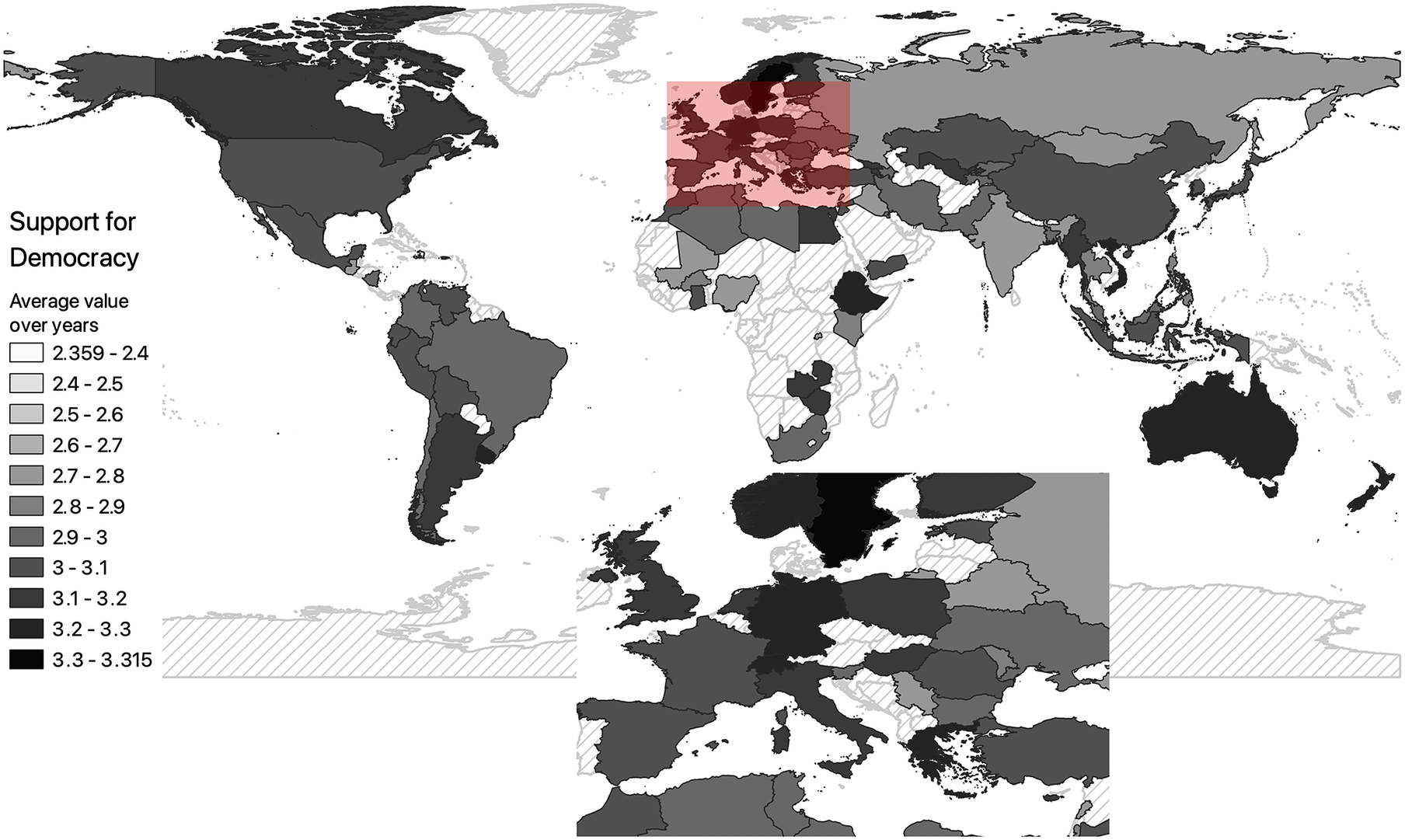
Figure 1 provides descriptive statistics for support of democracy worldwide, which shows that most respondents state that they support democracy.Footnote 8 Figure 2 maps the average support for democracy by country, revealing a great deal of variation in the normative commitment to democracy and the extent to which citizens view their states as democratic. As previous research suggests, support for democracy does not break down neatly along countries’ existing level of democracy, a point that we return to later in the article (cf. Claassen Reference Claassen2020; Lu and Chu Reference Lu and Chu2021).
Distribution of the Dependent Variable

Average Support for Democracy by Country
Measuring Conceptualizations of Democracy
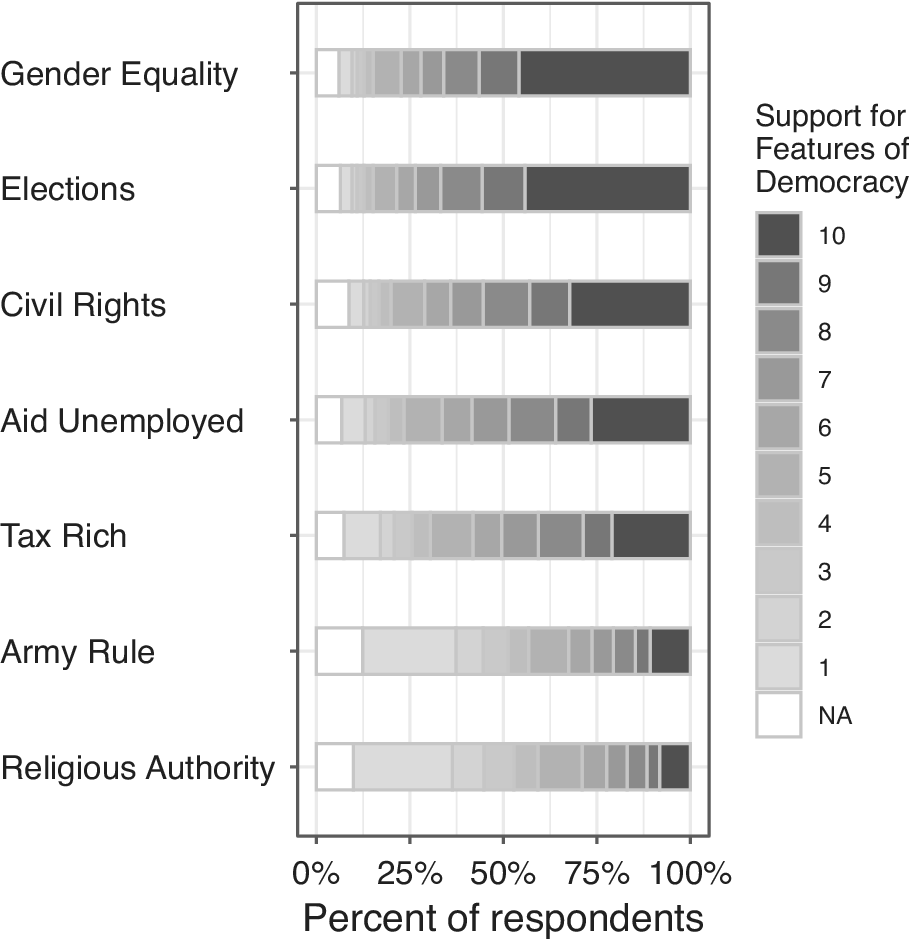
To construct variables that measure understanding of democracy, we take advantage of a closed-ended question in the WVS that asks respondents to evaluate principles associated with democratic rule (McIntosh et al. Reference McIntosh, Abele, Iver, Abele and Smeltz1994; Schedler and Sarsfield Reference Schedler and Sarsfield2007). The questionnaire asks, “Many things are desirable, but not all of them are essential characteristics of democracy. Please tell me for each of the following things how essential you think it is as a characteristic of democracy.” Respondents are then asked to rank each of the following seven properties from 1 (“not at all an essential characteristic of democracy”) to 10 (“an essential characteristic of democracy”):
Figure 3 depicts the indicators of understanding of democracy. Interestingly, overall, gender equality is the measure most readily associated with democracy: almost half of respondents rated gender equality at 10, as an essential feature of democracy. Slightly fewer respondents rated elections at the same level. Army and religious rule received the lowest support on average.
Essential Characteristics of Democracy
We use these measures to construct our explanatory variables designating respondents’ conceptual complexity and substantive understanding of democracy. Following Shin and Kim (Reference Shin and Kim2018), we use the measures in figure 3 to create three potentially overlapping groups, each holding a different conceptualization of democracy (table 1). First, to measure conceptual complexity, we compute an indicator that measures the number of characteristics a respondent sees as essential to democracy on an increasing scale from 1 (no identification of any of the five characteristics of democracy) to 10 (all potential characteristics of democracy in the survey are picked). We take the mean of five indicators that scholars frequently associate with democracy—free elections, civil rights, gender equality, and redistribution (taxation and state aid for the unemployed).Footnote 9 The more characteristics that respondents are able to identify as essential to democracy, the higher their conceptual complexity score.Footnote 10 Importantly, we exclude the two characteristics that scholars agree do not constitute democracy: religious and military rule.
Support for Democracy: Linear Models with Country and Time Fixed Effects

*** p <0.001;
** p <0.01;
* p <0.05
One potential concern with this measurement approach is whether acquiescence bias (i.e., a tendency to check the affirmative on survey questions), is driving this measure and any associated results. We believe that this is unlikely. If acquiescence were to play a significant role, we would see approximately the same support for all essential characteristics of democracy. Instead, we observe a significant variation in figure 3. We also control for several variables such as political trust that can help counter this concern.Footnote 11
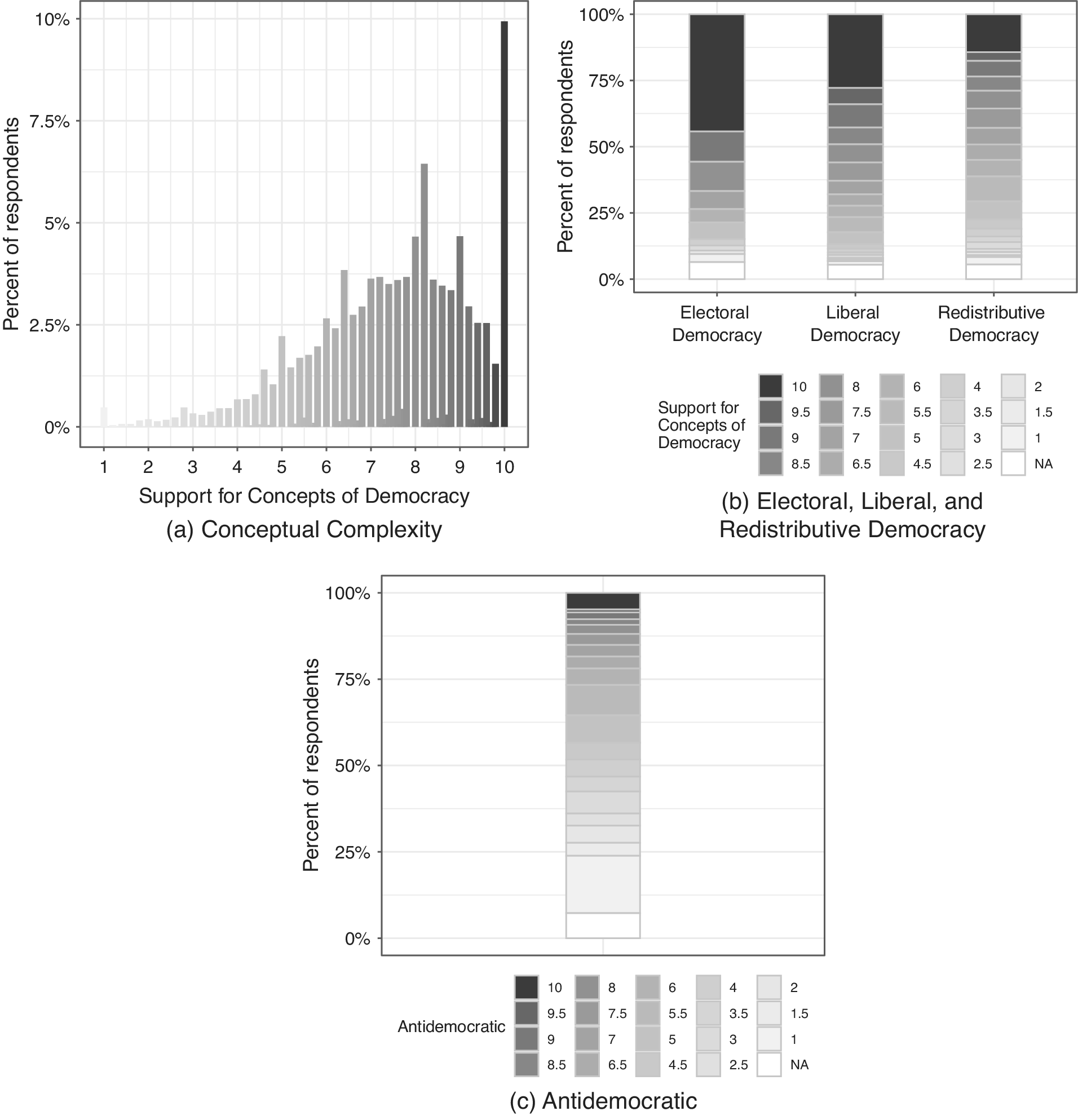
As shown in figure 4a, about 10% of respondents think all five features are essential characteristics of democracy. Most respondents score 6 and above when identifying free elections, gender equality, civil rights, taxation, and state help for the unemployed as essential characteristics of democracy.
Groupings of Understanding Democracy
Second, we create a group of variables to test whether different substantive conceptualizations help account for variation in normative commitment to democracy (H2). Electoral democracy is an ordinal variable that measures respondents’ view of free elections as an essential characteristic of democracy on an increasing scale. For liberal democracy, we take the mean of two indicators of respondents’ commitment to civil liberties: the extent to which respondents recognize gender equality and civil rights as essential characteristics of democracy. Finally, redistributive democracy represents the mean of both redistributive questions—“taxing the rich” and “helping the unemployed”—and the extent to which respondents rate these characteristics as essential to democracy.Footnote 12 We are left with three main substantive conceptualizations of democracy: electoral, liberal, and redistributive.Footnote 13
As figure 4b shows, most respondents identify elections as an important characteristic of democracy: approximately 45% of respondents rate elections as highly essential to democracy (score 10 for electoral democracy). Liberal democracy has a somewhat lower profile among respondents, whereas redistributive democracy concept is even further down on the scale of respondents’ perceptions: approximately 27% of respondents select civil liberties as highly essential to democracy (score 10 for liberal democracy), whereas about 13% of respondents select redistributive characteristics as highly essential.
Finally, we test our third hypothesis by identifying individuals who characterize religious or military interventions or both as being essential to democracy, even though they do not follow “textbook” definitions of democracy (Gerber and Chapman Reference Gerber and Chapman2018) and are antithetical to the democratic ideal of popular sovereignty. We take the mean of the two variables that measure respondents’ association of army rule and religious rule with democracy to form an “antidemocratic” conceptualization indicator. The resulting variable measures, on an increasing scale, respondents’ endorsement of antidemocratic practices as central to democracy. As figure 4c shows, only a small portion (about 5%) of respondents identify these characteristics as highly essential to democracy (score 10).
To isolate the importance of democratic conceptualization on democratic support in relation to common determinants, we include several individual-level control variables that scholars often argue influence support for democracy. We control for education (Acemoglu et al. Reference Acemoglu, Johnson, Robinson and Yared2005), income (Ceka and Magalhaes Reference Ceka and Magalhaes2020), religious attendance (Kuran Reference Kuran2012; Vlas and Gherghina Reference Vlas and Gherghina2012), societal trust, confidence in the government (Putnam Reference Putnam1993), evaluation of human rights in their country (Besson Reference Besson2011), party membership (Van der Meer and Van Ingen Reference Van der Meer and Van Ingen2009), gender, and age. Finally, we include country-level controls often viewed as influencing overall support for democracy in a country, including the country’s level of democracy,Footnote 14 GDP per capita, and the household Gini index (Przeworski Reference Przeworski, Mansfield and Sisson2004; Solt Reference Solt2020).
Analysis: What Predicts Support for Democracy?
To understand what characteristics drive support for democracy, we estimate a series of regressions to analyze general trends while accounting for variation at the country level and across time.Footnote 15 Table 1 shows the results of linear regressions with country and time fixed effects of our indexed support for democracy variable on our conceptual variables and controls. We consecutively add each of the democracy conceptualization groupings to the model, keeping control variables consistent across all specifications. Following Gerber and Chapman (Reference Gerber and Chapman2018), we treat the antidemocratic group separately from those who hold electoral, liberal, or redistributive conceptualizations of democracy.
We find strong support for our hypotheses across the various model specifications and definitions of our dependent variable.Footnote 16 First, results indicate that greater conceptual complexity is positively associated with support for democracy (H1). Similarly, in line with our third hypothesis regarding the centrality of popular sovereignty to all conceptualizations of democracy, the inclusion of nondemocratic elements, such as military or religious intervention, as a central feature of democracy reduces the normative commitment to democracy.
We then turn to our second hypothesis, which posits that the content of democratic conceptualizations affects people’s support for democracy. Across all model specifications, electoral and liberal democracy independently predict support for democracy and democratic preference. Although redistributive democracy is generally positively associated with support for democracy, these results are, as expected, less robust than those for electoral and liberal democracy. This is especially true when we explore marginal effects and interactions. Substantively, redistributive democracy accounts for less variation in support for democracy across models. In short, democratic conceptualizations including free and fair elections and the protection of rights are consistently stronger predictors of democratic support than a conceptualization that centers social and economic outcomes. As previous scholarship has demonstrated, redistributive definitions of democracy are controversial and inherently linked to social and economic outcomes and issues of inequality. Because redistribution can be interpreted in many ways by different groups and in different contexts, these findings suggest that receiving material benefits from democracy constitutes an unstable basis for regime support.
To ascertain the reliability of the test results, we execute several robustness checks. As with most survey datasets, ours has a substantial number of missing responses. We provide an analysis of missing data and find no evidence of systematic missingness (see Supplemental Appendix 2).Footnote 17 To account for possible bias, we conduct multiple imputations of missing data and estimate models with country and time fixed effects as robustness checks (Lee, Harring, and Stapleton Reference Lee, Harring and Stapleton2019). The results are essentially the same as in the main analysis (Supplemental Appendix 8). To account for possible bias introduced by the presence of large clusters of observations, we exclude seven countries with the largest number of observations from the dataset and repeat the analysis.Footnote 18 We also conduct ordinal models because both underlying terms of our index dependent variable are ordinal indicators.Footnote 19 The results of all our robustness checks are consistent with our findings in the main analysis.
Marginal Effects
The results in table 1 provide initial support for our hypotheses. However, it is important to further examine the substantive impact of democratic conceptualization on support for democracy; a variable can have a statistically significant relationship with the dependent variable but at the same time account for little of its variation. We therefore calculate the marginal impact of holding a specific understanding of democracy on the level of normative commitment for democracy (figure 5).
Marginal Effects: Support for Democracy in Linear Fixed Effect Models

First, let us consider the marginal effect of conceptual complexity on support for democracy (H1; figure 5a). When respondents do not identify any of the five characteristics of democracy provided in the survey as essential, their support for democracy is centered at about 2.4 on the indexed dependent variable scale, which ranges from 0.26 to 3.96. However, when respondents’ understanding of democracy includes the greatest number of facets—when they identify all five characteristics as highly essential—their support increases to 3.35: a 40% increase in support for democracy. These results demonstrate that the multifacetedness or complexity of individuals’ democratic understanding is substantively important for democratic support above and beyond other factors traditionally seen as central to support.
The type of conceptualization that individuals hold also has an important substantive impact on support (H2; figure 5b–5d). Among those who adhere to an electoral definition of democracy—who view free elections as an essential component of democracy—average support for democracy is 3.2 compared to 2.5 for individuals who do not adhere to this conceptualization, a difference of about 28%. We find similar results for liberal democracy: the difference between individuals who state that gender equality and civil rights are essential characteristics of democracy (3.3 support level) versus those who do not (2.5 support level) is roughly 32%. Lastly, individuals who adhere to the redistributive conceptualization of democracy express support for democracy at about 3.3, compared to 2.9 for individuals for those who do not—about a 14 percentage point difference.
Finally, the more that individuals include antidemocratic characteristics in their definition of democracy, the lower their support for democracy (H3; figure 5e). Individuals who hold an antidemocratic conceptualization express an average level of support for democracy of 3.03 compared to 3.12 on a four-level scale for those who do not mention these features—a difference of about 3%.
The results in this and the previous section indicate that how individuals conceptualize democracy—not just whether they are able to do so—has important implications for democratic support. Results demonstrate that conceptual complexity is positively correlated with diffuse support for democracy: the more multifaceted or complex an individuals’ understanding of democracy, the more likely they are to support it. Similarly, attributing antidemocratic practices to democracy reduces support for it. Furthermore, adherence to electoral and liberal definitions of democracy has the greatest impact on normative commitment to democracy compared to definitions that hinge on redistribution. This draws attention to the importance of public dialogue surrounding regime concepts such as democracy, as well as individual-level factors that condition how those narratives are processed and understood, in understanding the dynamics of regime support.
Regime-Level Results
This study examined how conceptualization of democracy affects support for it. But this naturally raises the question: What factors influence individuals’ conceptualization of democracy in the first place? Chief among these is the political context in which people live and, specifically, the country’s level of democracy. Some scholars find that direct experience with democracy is likely to increase demand for it (Huang, Chu, and Chang Reference Huang, Chu and Chang2008; Putnam Reference Putnam1993). At the same time, most contemporary authoritarian leaders refer to their systems as democratic, and this public rhetoric may influence private understandings of what democracy entails. Indeed, individuals in authoritarian countries often express higher support for and satisfaction with democracy than those who live under democratic rule (Latana 2022). At the same time, as figure 2 illustrates, support for democracy does not appear to neatly break down according to regime type.
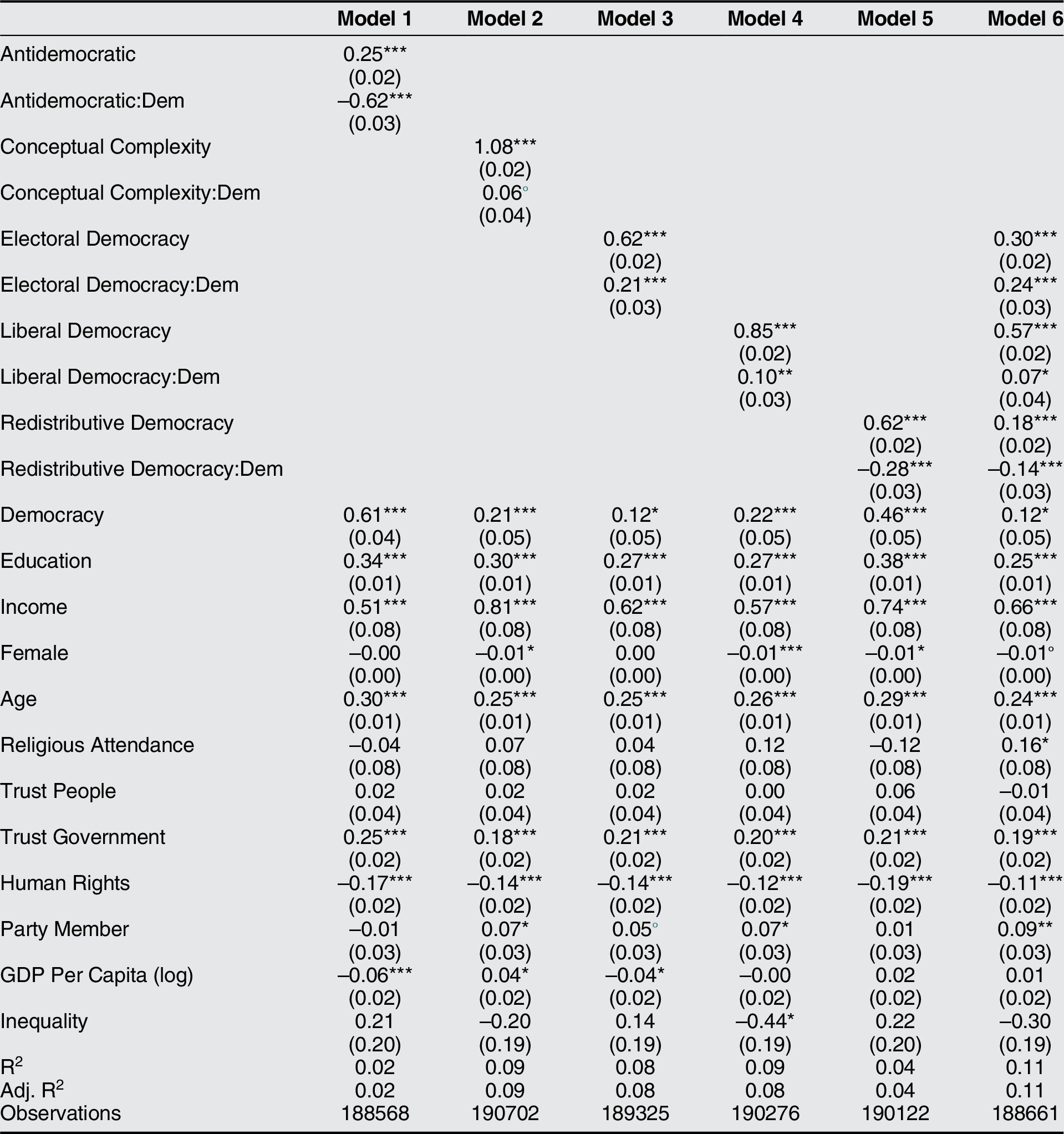
This begs another question: Does the importance of democratic conceptualization for support vary significantly by regime type? Although extant literature shows that regime type can condition how individuals understand democracy, does the importance of democratic understanding vary across different regimes? Our analysis suggests that regime type has an impact on individual support for democracy, but individual-level indicators appear to be a consistently important predictor of democratic support, regardless of regime type. To investigate this question, we interact individual-level indicators of democratic conceptualization with country-level democracy. We then explore the multiplicative effects of different definitions of democracy and regime type on individual support for democracy. Table 2 displays results of the analysis with interaction terms.Footnote 20 Figure 6 shows the marginal effects of the interactions of individual-level predictors of support and country-level indicator of democracy. These results tell an interesting story about the relationship between regime type, conceptualization of democracy, and democratic support.
Linear Models with Country and Time Fixed Effects: Interactions
*** p < 0.001;
** p < 0.01;
* p < 0.05;
° p < 0.1.
Marginal Effects: Support for Democracy. Linear Fixed Effects Models with Interactions

Model 2 (table 2) examines the relationship between conceptual complexity and support for democracy by countries’ level of democracy. Results suggest that both conceptual complexity and countries’ level of democracy have a positive effect on individual support for democracy. The more features of democracy the individual recognizes as essential characteristics and the higher the democracy score of the country they live in, the greater the support for democracy. The constitutive terms of the interaction are both positive and statistically significant. In other words, even when the country’s democracy score is at its lowest value, identifying more characteristics of democracy will be associated with higher individual support for democracy.
Model 3 indicates that, on average, individuals who regard free and fair elections as an essential characteristic of democracy hold higher support for democracy the higher the democracy score of the country where they live. At the same time, even when the country’s democracy score is at its minimum, individual recognition of elections as an essential characteristic of democracy is still positively related to support for democracy. Model 4 shows the same type of relationship among liberal democracy, country’s democracy score, and support for democracy.
However, this relationship is less clear and consistent for individuals who conceptualize democracy in terms of redistribution. As figure 5 indicates, redistributive conceptualization of democracy has the weakest relationship with democratic support. This becomes even more evident when disaggregating this relationship by the level of democracy. Results from the interaction suggest that the more respondents define democracy under redistributive terms and the more democratic the country in which they live, the lower their support of democracy (figure 6d). Living in a more democratic country softens democratic support for those who hold redistributive conceptualizations. However, as countries become less democratic, individuals who understand democracy as redistributive in those countries express higher levels of democratic support. The constitutive term of redistributive democracy has a positive and statistically significant relationship with support for democracy when the country’s democracy level is at its lowest values. This finding is in line with our expectations that redistributive conceptualizations will have a less consistent relationship with democratic support than conceptualizations based on elections and civil liberties.
Model 1 (table 2) examines the relationship between level of democracy and antidemocratic conceptualizations on support for democracy. Results suggest that, as the level of democracy in a country increases, holding antidemocratic conceptualizations is negatively related to support for democracy. However, this relationship does not hold across all regime types: in countries with the absolute lowest level of democracy, holding antidemocratic conceptualizations may actually increase support for democracy. There are several possible interpretations of this finding. In highly authoritarian societies (e.g., with personalist rule), transition to a regime governed by religious or military groups may be perceived as a step forward toward a more, rather than less, participatory regime type. Alternatively, this finding could imply that people who live in consolidated authoritarian regimes think they live in a democracy and also support their regime. It may even just be evidence of preference falsification known to be widespread in repressive regimes (Kuran Reference Kuran1997). These divergent interpretations draw attention to the need for greater research into how people in authoritarian regimes perceive their political systems relative to governing ideals such as democracy.
The marginal effects in figure 6 provide further evidence that our individual-level predictors are the primary drivers of support for democracy. Democratic conceptualizations account for greater variation in support for democracy than does a country’s level of democracy. However, the relative impact of democratic conceptualizations on support for democracy does vary by regime type in interesting ways. In all instances shown in figure 6, we observe that, on average, a higher democracy score in the country (from a low- to high-democracy level) predicts a higher individual support for democracy. This indicates that regime type does affect respondents’ attitudes and reaffirms Lu and Chu’s (Reference Lu and Chu2021) findings that the highest levels of intrinsic support exist in more established democratic systems. At the same time, the pattern of support for democracy among individuals who live in countries with differing levels of democracy stays the same. Even though respondents who live in countries with a lower democracy score on average report weaker support for democracy, their normative commitment to democracy grows at about the same rate as the support of individuals who live in countries with a high democracy score.
In short, results suggest that although individual support for democracy does vary somewhat by regime type, individuals’ conceptualization of democracy affects support for democratic rule even under highly repressive regimes. Moreover, electoral and liberal conceptualizations of democracy remain among the strongest predictors of democratic support. These findings have important implications for studies that examine how diffuse support for democracy and regime type interact to explain political participation (cf. Lu and Chu Reference Lu and Chu2021) and other important outcomes. Although a country’s level of democracy does matter somewhat for how individuals conceptualize democracy, this relationship is hardly deterministic. Rather, holding definitions of democracy that center popular sovereignty and civil liberties strongly influences democratic support, regardless of the regimes under which people live. This finding highlights the need for further research that not only probes what factors drive individuals’ understandings of democracy but also how they use those conceptualizations when evaluating democracy and their relationship to diffuse support for democratic rule.
Discussion and Conclusion
For many, the end of the Cold War and the spread of liberal democracy to much of the world appeared to herald a lasting shift toward democratic hegemony. Only two decades later, researchers began to sound the alarm that this post–Cold War optimism was premature, pointing to the erosion of democracy in many countries that had made the transition from authoritarianism (Diamond Reference Diamond2008). Today, the number of authoritarian regimes continues to rise, and many of these—Russia, Turkey, and Venezuela among the most prominent examples—were once established or promising democracies. Elsewhere, such as in Hungary and Poland, there has been substantial democratic backsliding characterized by the undermining of rule of law and the rise of hardened identity politics (Jacques Reference Jacques2016). The current scholarly and public consensus holds that we are in the midst of a global “democratic recession” that threatens even the most established democracies long considered to be safe from the threat of democratic backslide (Foa and Mounk Reference Foa and Mounk2016; Levitsky and Ziblatt Reference Levitsky and Ziblatt2018).
Worryingly, this new generation of authoritarian and authoritarian-leaning rulers has largely come to power through the ballot box (Mainwaring and Bizzarro Reference Mainwaring and Bizzarro2019). At the same time, dictators have increasingly been deposed by masses taking to the streets with calls for democratic change (Geddes, Wright, and Frantz Reference Geddes, Wright and Frantz2014). In this “age of protest” (Aytaç and Stokes Reference Aytaç and Stokes2019), a critical mass of individuals who share a commitment to democracy can threaten even long-standing, seemingly untouchable dictators. In both scenarios, individual attitudes toward democracy play a key explanatory role: a normative commitment to democratic governance (or lack thereof) is generally thought to underpin people’s actions both in the streets and at the ballot box. Individuals’ support for democracy is, in short, a necessary condition for engaging collectively in ways that contribute to democratization; conversely, a lack of support conditions the willingness to participate in collective actions that undermine democracy where it exists. Scholars concerned with regime dynamics like these must therefore consider how individual attitudes in their aggregate affect these macro-level outcomes.
Yet, this article has demonstrated that our understanding of what determines those attitudes still lacks clarity. Surveys that measure individual-level support for democracy are essential for testing many of the key mechanisms in theories of regime transition and sustainability; however, examining support for “democracy” matters little if we as researchers do not know what ordinary citizens believe the term means. This lack of clarity has important implications. As our analysis shows, having little or “antidemocratic” information about democracy is strongly and substantively correlated with lower support for democratic rule. Those with greater conceptual complexity and an understanding of democracy closer to the ideal of popular sovereignty, in contrast, express significantly higher support. Moreover, people whose conceptualizations of democracy emphasize democratic procedures and liberal protections of individual rights and liberties predict endorsement of democratic governance over and above definitions that prioritize potential outcomes of democracy such as redistribution. In short, our findings confirm that, to understand why people do (or do not) support democracy, we must carefully consider how they understand democracy in the first place.
Although we draw attention to the crucial interplay of micro- and macro-level processes in explaining contemporary regime dynamics, we do not claim that extant democratic support measures such as those we analyzed in the World Values Survey can be used to accurately forecast regime outcomes. Rather, we maintain that these measures can show us systematic variation that in turn opens a wider field of empirical questions regarding the dynamics of regime support. Specifically, it suggests a much broader research agenda to uncover not just how much individuals claim to support democracy but also how they understand democracy and why they developed this conceptualization. In other words, instead of assuming that individuals hold “correct” scholarly definitions of democracy, future research must dive deeper into the factors that shape how ordinary citizens actually understand this concept and what variables affect how someone embedded in a particular context understands democracy.
Our confirmation that existing measures are often problematically abstract should not be equated with a dismissal of the importance of mass public attitudes for understanding regime dynamics. Even though critics of democratic support survey indicators maintain they are too amorphous to matter for regime outcomes (Kiewiet de Jonge Reference de Jonge and Chad2016; Przeworski Reference Przeworski2019), we cannot simply dismiss the important role of the public, especially because even elite-driven models of regime transition and sustainability such as those proposed by Acemoglu and Robinson (Reference Acemoglu and Robinson2000) and Przeworski (Reference Przeworski2019) depend on public preferences and actions in important ways. Moreover, recent research suggests that support for democracy is a causal factor that contributes to demands for democratic transition and is particularly important for the survival of democratic regimes by imbuing them with legitimacy that helps them weather economic and other crises (Claassen Reference Claassen2020). Instead, more research is needed to understand the particulars of how public opinion affects regime transitions and outcomes. Our analysis suggests that many widely used measures of democratic support are a starting rather than an ending point for understanding this important topic. Future research should include more careful consideration of how best to capture this variation in individual conceptualizations.
Our findings here highlight how meaning-making processes used by citizens in diverse contexts drive their support for abstract regime concepts. In doing so, they raise questions about the way democracy is discussed in public discourse: how this discourse unfolds likely has a strong impact on public understanding and endorsement of democracy. Our analysis also suggests that these narratives do not neatly coincide with regime type; instead, we need to examine other contextual factors and how they may add (or fail to add) resonance to specific types of public discourse regarding democracy. Moreover, the strength of certain conceptualizations in predicting regime support highlights the extent to which public discussions, elite messages, and factors that mediate how people internalize them may matter a great deal for regime outcomes. In this respect, our findings also point to a path forward, suggesting that if we better understand how to educate individuals about what democracy entails, it may independently increase their support for democratic rule, regardless of the political context in which they live.
Cumulatively, this suggests that going forward, scholars will need to investigate factors that shape how individuals receive and react to the information they get about democracy and democratic rule. An increased focus on these discursive qualities of popular conceptualization will help us construct more comprehensive and constructive paradigms of how public opinion matters for regime outcomes—including how to check the current global trend toward authoritarianism.
Supplementary Materials
To view supplementary material for this article, please visit http://doi.org/10.1017/S1537592722004157.
Acknowledgements
The authors thank the Center for the Study of Economic Liberty for postdoctoral fellow support and the Institute for Social Science Research at Arizona State University for financial support for this project.


 Open access

