


Background
Severe mental illness (SMI) includes diagnoses that typically involve psychosis (losing touch with reality or experiencing delusions) such as schizophrenia or bipolar disorder. This group of patients should receive an annual physical health check because they have a higher rate of cardiovascular, metabolic and other long-term physical co-morbidities (eg, respiratory disease, HIV; Hennekens, Reference Hennekens, Hennekens, Hollar and Casey2005; NICE, 2006; 2009). Rates of cardiovascular disease may be increased because of a combination of the side effects of antipsychotic medication and lifestyle factors (Marder et al., Reference Marder, Essock, Miller, Buchanan, Casey, Davis, Kane, Lieberman, Schooler, Covell, Stroup, Weissman, Wirshing, Hall, Pogach, Pi-Sunyer, Bigger, Friedman, Kleinberg, Yevich, Davis and Schon2004). People with SMI often eat unhealthy diets, have lower levels of physical activity and are twice as likely to smoke compared with the general population (McCreadie, Reference McCreadie2003). They also tend not to volunteer symptoms readily, and as a consequence many physical co-morbidities go unrecognised and untreated (Saha et al., Reference Saha, Chant and McGrath2007).
The annual health check
Osborn et al. (Reference Osborn, Nazareth, Wright and King2010) have argued that practice nurses would be more effective than mental health workers in secondary care in carrying out physical health checks for people with SMI. In England, government guidance supports this view by recommending that health checks be carried out in primary care unless patients have no contact with these services (NICE, 2006; 2009); accordingly, GPs are remunerated for this work (British Medical Association (BMA) and National Health Service (NHS) Employers, 2011). In the health check, there should be evidence that patients have been offered health promotion and lifestyle advice appropriate to their age, gender and health status; this should include body mass index, blood pressure, glucose and cholesterol monitoring (BMA, 2008). In April 2011, the requirements for remuneration changed to payment for specific interventions that should be completed instead of a health check (BMA and NHS Employers, 2011).
Inviting patients
Many clinicians believe that patients with SMI will not attend primary care for a health check (Lester et al., Reference Lester, Tritter and Sorohan2005), yet there is little evidence to demonstrate that they are actually poor at attending in response to an invitation. Consequently, there is limited guidance on how best to promote attendance. Most primary care practices invite their patients to long-term condition clinics by way of an invitation letter, which asks the patient to make an appointment at their convenience (Brown et al., Reference Brown, Williams and Groom1992; NICE, 2010). A study carried out in a primary care centre in England showed that letters offering patients (without a particular diagnosis) an appointment (with a specific date and time) for a health check produced a much higher attendance rate (70%) than letters containing an open invitation (37%) (Norman and Connor, Reference Norman and Conner1993). To date only one study by Harvey et al. (Reference Harvey, Newton and Moye2005) has tested whether an invitation letter (requesting the patient to make an appointment to attend the practice) is an effective method of increasing the level of attendance of patients with schizophrenia for a primary care physical health check. Carried out in an inner-city setting, fewer than one in five patients, half the number who responded in the general population, made an appointment and actually saw a Practice Nurse.
Our aim was to explore whether a letter offering an appointment with a predetermined date and time would be effective in prompting patients with SMI to attend a primary care health check.
Method
A retrospective comparison of the response rate of patients with SMI and diabetes to an invitation appointment letter to attend a primary care health check.
Criterion: All patients with SMI should have a physical health check at least once a year.
Audit standards: From published guidelines (NICE, 2006; 2009; De Hert et al., Reference De Hert, Dekker, Wood, Kahl, Holt and Möller2009), we produced the audit standard that all patients with SMI should, as a minimum, be given the opportunity to have a physical health assessment and be offered preventative lifestyle advice annually.
The patients were identified from the SMI and diabetes disease registers. GP practices are required to have disease registers for long-term conditions in order that they can offer preventative treatment (DOH, 2002). Patients with SMI were sent an appointment at a predetermined time and date to have their physical health reviewed. A letter was sent out 10 days before the appointment (Figure 1); a copy of the letter was placed in the patients’ notes. For patients with diabetes, letters were sent out two to three weeks ahead of the fixed appointment. The gap between the letter being sent out and the appointment was shorter for the SMI group because of the cognitive problems (eg, poor memory and planning) associated with their condition (Stahl, Reference Stahl2003; Martínez-Arán et al., Reference Martínez-Arán, Vieta, Reinares, Colom, Torrent, Sánchez-Moreno, Benabarre, Goikolea, Comes and Salamero2004). The letter gave the patient an option to contact the surgery if they had any questions or concerns about or wanted to change the date or time of the appointment.
The invitational appointment letter for people with severe mental illness (SMI)

The annual health check for patients with SMI followed guidance from the Health Improvement Profile for Primary Care (Hardy and Gray, Reference Hardy and Gray2011; Hardy et al., Reference Hardy, White, Deane and Gray2011) and consisted of:
• review of any preexisting co-morbid physical health problems;
• screening for emergent diabetes, hypertension and dyslipidaemia;
• initiation of appropriate treatment for newly diagnosed conditions;
• providing information about co-occurring physical health problems;
• lifestyle advice: diet, exercise, smoking, alcohol, sex;
• guidance about self-examination (breast, testicles);
• a prompt that eyes and teeth have been tested/checked;
• review of psychotropic medication and side effect check.
We carried out an audit of all patients with SMI or diabetes who were offered an appointment by letter between 1 January 2010 and 31 December 2010. A list of who had/had not attended a health check and basic demographic information (age category, gender) was extracted from the practice computer database. Individual patient records were reviewed to identify possible reasons for why patients had not attended. We also checked the computer records of patients with SMI to discover whether they were in contact with secondary care services.
We submitted the protocol to the GP practice Caldicott guardian and it was given written approval. The study follows the principles set out in the Declaration of Helsinki.
Results
There were 112 patients listed on the SMI register (1.11% prevalence); the majority (n = 64, 57%) were male patients. Of the 534 patients on the diabetes register (5.3% prevalence), 289 (54%) were male patients (there was no significant difference in the gender ratio of patients). A small number (n = 11) of patients were on both registers. Patients with SMI were significantly younger than those with diabetes (P < 0.01; see Table 1). Letters were not sent to the 138 patients who were currently inpatients, in residential care or in prison. In total, invitation letters offering an appointment were sent to 508 patients – 92 with SMI and 416 with diabetes. The majority of patients from both groups attended at the date and time specified in the letter (see Table 2). Patients with diabetes were 2.2 times more likely to attend a health check compared with those with SMI (OR = 2.20, 95% CI = 1.13–3.62). Patients with SMI who did not attend were followed up where possible by a telephone call either to the patients themselves and/or to their carer or community mental health worker. A letter was also sent offering another appointment. An additional four (4%) SMI patients attended a health check in response to the follow-up, increasing the total number who attended to 65 (70%). Fifty-three percent of patients with SMI had no contact with secondary care.
Age groups of participants in the audit
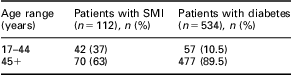
SMI = severe mental illness.
Attendance for health checks
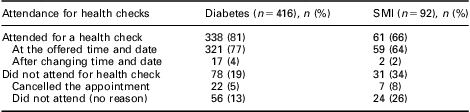
SMI = severe mental illness.
Discussion
The prevalence rate for SMI in this practice was slightly higher than the United Kingdom national average of 0.5–1% (National Audit Office, 2007); the diabetes incidence equates to that of England (Diabetes UK, 2011).
The aim of this audit was to examine whether an invitation letter with a predetermined appointment is effective in enabling patients with SMI to attend a physical health check in primary care. Although we have demonstrated patients with SMI are less likely to attend than patients with diabetes, it is striking that the proportion of the SMI patients who attended in our audit was so much higher than those in a similar study by Harvey et al. (Reference Harvey, Newton and Moye2005). It could be that patients in a suburban area (as in this study) are more likely to attend than those in an urban area (as in Harvey et al.'s study). Alternatively, Harvey et al. required patients to make an appointment, we sent them one. Given that people with schizophrenia can have cognitive problems (Stahl, Reference Stahl2003) and people with bipolar disorder may have impairment regarding daily functioning, even during remission (Martínez-Arán et al., Reference Martínez-Arán, Vieta, Reinares, Colom, Torrent, Sánchez-Moreno, Benabarre, Goikolea, Comes and Salamero2004), the complexity of the task might have been a barrier. Offering a set time and date removes steps in the process and may explain our enhanced response rate. It is also possible that our response rate was higher because our letter gave details about who would be doing the health check rather than asking them to make an appointment with an unnamed person.
The results revealed that patients with SMI responded to an additional invitation after non-attendance. As this group experiences fluctuating symptoms, there is a need to develop an alternative strategy when they are in an acute phase of illness (Iyer et al., Reference Iyer, Rothmann, Vogler and Spaulding2005). This could be inviting them again in a few months rather than a few weeks.
The difference in attendance rates between the two groups may have been affected by age; patients with diabetes were older and it is possible that they may be more likely to adhere to a letter from their doctor asking them to attend a clinic. An Australian health survey (Deeks et al., Reference Deeks, Lombard, Michelmore and Teede2009) ascertained that younger participants are less likely to have annual health checks, seek advice or attend educational sessions. However, another study has shown that age is not a factor affecting response to an invitation to attend a health check (Thorogood et al., Reference Thorogood, Coulter, Jones, Yudkin, Muir and Mant1993). It is perhaps also worth noting that patients with diabetes generally seem to be much better at attending health checks compared with those with other long-term conditions. This may be because, as a population, patients with diabetes have been educated to recognise the importance of health checks from diagnosis through courses such as DESMOND (Davies et al., Reference Davies, Heller, Skinner, Campbell, Carey, Cradock, Dallosso, Daly, Doherty, Eaton, Fox, Oliver, Rantell, Rayman and Khunti2008). Our sample of SMI patients in fact compares very favourably with the attendance rates observed in other long-term conditions.
It is difficult to assess whether our audit reflects the wider population. As health checks for people with SMI have been offered for the past six years in this practice by the same practitioner, the response rate to invitation letters is likely to be higher than that of a practice offering a new service. It does, however, highlight what can be achieved over time.
Conclusion
We recommend that in primary care, patients with SMI are sent an invitation appointment letter with a predetermined time and date for a health check.
Acknowledgements
We acknowledge the assistance of Dr Samuel Harvey in providing comments on an earlier version of this manuscript.
Declaration of interest
Sheila Hardy has received honoraria from Bristol-Myers Squibb and educational support from Takeda, Jannsen Cilag and Novonordisk. Richard Gray has provided consultancy work to AstraZeneca, Bristol-Myers Squibb, Jannsen Cilag, Eli Lilly and Co. Otsuka Pharmaceutical Europe Ltd, Pfizer, received honoraria from AstraZeneca, Bristol-Myers Squibb, Jannsen Cilag, Eli Lilly and Co. Otsuka Pharmaceutical Europe Ltd, Pfizer, Wyeth and had research support from AstraZeneca.



