



Crossref Citations

This article has been cited by the following publications. This list is generated based on data provided by Crossref.
Angeoletto, Fabio
Leandro, Deleon da Silva
and
Fellowes, Mark D. E.
2019.
The consequences of Brazil’s lack of transport planning is written in the blood of sparrows.
Urban Geography,
Vol. 40,
Issue. 8,
p.
1191.
Santos, Igor Soares dos
and
Silva, Marcos José da
2020.
O gênero Galeandra Lindl. (Orchidaceae, Epidendroideae) no Distrito Federal e no Estado de Goiás, Brasil.
Hoehnea,
Vol. 47,
Issue. ,
Angeoletto, Fabio
Tryjanowski, Piotr
Santos, Jeater
Martinez-Miranzo, Beatriz
Leandro, Deleon
Bohrer, João
Johann, Juciane Maria
and
Fellowes, Mark D. E.
2022.
Will Brazilian City Dwellers Actively Engage in Urban Conservation? A Case Study with the Charismatic Neotropical Blue-and-Yellow Macaw (Ara ararauna).
Birds,
Vol. 3,
Issue. 2,
p.
234.
Rajão, Raoni
Nobre, Antonio Donato
Cunha, Evandro L.T.P.
Duarte, Tiago Ribeiro
Marcolino, Camilla
Soares-Filho, Britaldo
Sparovek, Gerd
Rodrigues, Ricardo R.
Valera, Carlos
Bustamante, Mercedes
Nobre, Carlos
and
Santos de Lima, Letícia
2022.
The risk of fake controversies for Brazilian environmental policies.
Biological Conservation,
Vol. 266,
Issue. ,
p.
109447.
Forti, Lucas Rodriguez
Travassos, Magno Lima de Oliveira
Coronel-Bejarano, Diana
Miranda, Diego Fernandes
Souza, David
Sabino, José
and
Szabo, Judit K.
2023.
Posts Supporting Anti-Environmental Policy in Brazil are Shared More on Social Media.
Environmental Management,
Vol. 71,
Issue. 6,
p.
1188.
de Oliveira Cabral, Lohane Madalena Pires
Martínez-Miranzo, Beatriz
Luna, Álvaro
Johann, Juciane Maria
da Silva, Normandes Matos
Richard, Enrique
Flutter, Ellie
de Jesus Oliveira, Jaiane
and
Angeoletto, Fabio
2025.
Ecology of Tropical Cities, Volume II.
p.
491.
Vieira, Jaqueline Silva
de Almeida, Dailane Amaral
Pessoa, Rodrigo Oliveira
Borges, Magno Augusto Zazá
Valério, Henrique Maia
and
Dilarri, Guilherme
2025.
Phylogenetic Diversity and Extracellular Enzymatic Activities of Yeasts and Yeast‐Like Fungi Isolated From Qualea grandiflora (Vochysiaceae) in Cerrado Areas in Northern Minas Gerais, Brazil.
International Journal of Microbiology,
Vol. 2025,
Issue. 1,
Santos, Jeater W. M. C.
Vacchiano, Marcelo C.
Souza, Marco Antonio M. de
Oliveira, Cathiane M. de
Negri, Sergio S.
Silva, Normandes Matos da
Perehouskei, Nestor Alexandre
and
Fellowes, Mark D. E.
2025.
Ecology of Tropical Cities, Volume I.
p.
399.
Gonzaga, Cláudio Angelo Corrêa
Roquette, José Guilherme
Angeoletto, Fabio
and
da Silva, Normandes Matos
2025.
Ecology of Tropical Cities, Volume I.
p.
361.
Angeoletto, Fabio
Sanz, Juan Pedro Ruiz
Goddard, Mark A.
Loverde-Oliveira, Simoni
Tryjanowski, Piotr
Sinani, Thomaz Ricardo Favreto
Mardaraj, Prakash
Essy, Camila
Carmona, Diego
Rija, Alfan A.
and
Locke, Dexter H.
2025.
Ecology of Tropical Cities, Volume II.
p.
135.
Angeoletto, Fabio
Gauer, Aline
Sturmer, Adroaldo
Barbosa, Domingos Sávio
Finck, Franciele
Sturmer, Clarisse Hendges
Locatelli, Aline
Alnoch, Alana Vanoni
Schons, Bruna Luísa Bervian
Zohler, Davi Otávio
Sturmer, Emily
Angeoletto, Flora Essy
Binsfeld, Gabriel
Berwig, Gabriela Catto
Soares, Haiana Luisa Mai
Polla, Izadora Steffen
Tramontina, Maria Clara Zandoná
Rockenbach, Théo Bernardo
Pinto, Valentina Antônia Kohlrausch
Giacomelli, Victória Schneider
Drechsler, Vinícius
and
Fellowes, Mark D. E.
2026.
Between Soy and Pumas: The Future of Brazilian Biodiversity Is in the Hands of Farmers.
Diversity,
Vol. 18,
Issue. 5,
p.
268.
Brazil is one of the most important global players in agribusiness and one of the main exporters of commodities such as soybean and animal protein (Suzigan & Albuquerque Reference Suzigan and Albuquerque2011). Today, Brazil has c. 5 500 000 rural properties (INCRA 2016) in six different biomes, namely Amazon, Pantanal, Pampa, Caatinga, Atlantic Forest and Cerrado; the last two are global biodiversity hotspots. Together, these rural properties comprise c. 605 million hectares, or 71% of the Brazilian territory (INCRA 2016), besides hosting 53% of Brazilian native vegetation. The native forests in these properties store 105 ± 21 GtCO2e (billions of tonnes of CO2 equivalent) and play a vital role in maintaining a wide range of ecosystem services. Thus, these private forests must be properly managed to ensure that global efforts focused on mitigating climate changes can be successful (Soares-Filho et al. Reference Soares-Filho, Rajão, Macedo, Carneiro, Costa and Coe2014, Silva et al. Reference Silva, Angeoletto, Santos, Paranhos Filho, Vacchiano, Bohrer and Cândido2017).
The current Brazilian Forest Code (FC) limits the deforestation and economic exploitation of native vegetation located in rural properties. These forest fragments, the so-called Legal Reserves (LRs), should occupy 20–80% of these properties, depending on where they are located. LRs provide relevant ecosystem services and play a significant role in biodiversity conservation (Soares-Filho et al. Reference Soares-Filho, Rajão, Macedo, Carneiro, Costa and Coe2014, Silva et al. Reference Silva, Angeoletto, Santos, Paranhos Filho, Vacchiano, Bohrer and Cândido2017). Permanent Preservation Areas (PPAs), which comprise riparian forests and hillsides, are another spatial category to be preserved in these properties, since they are primarily focused on protecting water resources and maintaining geological stability (Vacchiano Reference Vacchiano2017).
The FC launched the Cadastro Ambiental Rural (CAR; Rural Environmental Registry) in order to enable the environmental regulation of rural properties. It is managed by the Ministry of the Environment and by state and local environmental agencies. The CAR is a digital database, the data resulting from the interpretation of satellite images that indicate areas of agricultural use, PPAs and LRs inside properties. It is focused on the georeferenced identification of rural properties, as well as on the location and quantification of environmentally protected areas. In addition, landowners in these areas must report whether there are degraded environments, such as riverbanks and springs lacking riparian vegetation. The CAR provides the first transparent mechanism capable of assessing land-use compliance with the FC in the history of Brazilian environmental legislation, since it links property owners to responsible land use in rural properties (Gibbs et al. Reference Gibbs, Rausch, Munger, Schelly, Morton and Noojipady2015).
Up until December 2016, a group of Embrapa researchers analysed all rural properties registered in the CAR. Approximately 71% of the 5 498 505 Brazilian rural properties were registered in the CAR (Miranda et al. Reference Miranda, Carvalho, Oshiro and Martinho2017). These areas corresponded to 20.5% of Brazilian territory, whereas protected vegetation areas in Conservation Units, which were managed by public authorities, totalled 13% of the national territory (Miranda et al. Reference Miranda, Carvalho, Oshiro and Martinho2017).
Subsequently, Miranda (Reference Miranda2017a) – the director of the Embrapa research centre Embrapa Territorial – published an article in the journal Ciência & Cultura (academic journal of the Brazilian Society for the Advancement of Science, which is the most important non-profit scientific organization in Brazil), whose suggestive title ‘Environment: the salvation through crops’ indicated it summarized Embrapa’s research results. According to Miranda (Reference Miranda2017a), the native vegetation preservation rate reached by rural producers is higher than that required by the FC in rural properties. Miranda (Reference Miranda2017a) ended with a rhetorical question: “When it comes to native vegetation preservation, what country in the world allocates so much of its agricultural territory for preservation purposes or demands a contribution of such magnitude as the one required from Brazilian farmers?” He concluded that “there is no Brazilian professional category capable of preserving the environment as much as farmers.”
Embrapa is not a trivial institution. It is a public research institute with 10 000 employees; c. 2500 of these are scientists. The institute has been playing a key role in Brazilian agribusiness success in international markets. Its efforts have enabled the development of new soybean cultivars with different photoperiods and that are better adapted to luminosity variations in the southern hemisphere. Consequently, Embrapa’s researchers have become able to produce cultivars adapted to zero latitude, as well as to transform soybean into a tropical plant (Suzigan & Albuquerque Reference Suzigan and Albuquerque2011). When it comes to environmental preservation, the favourable position of the institution towards agribusiness – which is seen in its scientific research and in articles published by its researchers – produces what might be called ‘creative statistics’: these data are biased by an ideological narrative that distorts the Brazilian environmental reality. Embrapa researchers have evidently sought to disclose and popularize these statistics, as well as the image of Brazilian agriculture as a great benefactor of Brazilian biodiversity conservation.
National circulation newspapers such as O Estado de São Paulo (2017a, 2017b) and O Estado de Minas (2017) published reports echoing Embrapa’s assertions about the role played by agriculture in biological conservation. According to the article by Miranda published in O Estado de São Paulo on World Environment Day, the CAR data “show the unique role played by agriculture in environmental preservation” (Miranda Reference Miranda2017b). The Embrapa scientist was interviewed by the AgroANALYSIS Journal (published by Getúlio Vargas Foundation, which is one of the most important higher education institutions in Brazil) and stated that “Brazil is the world champion in preservation” due to agribusiness (Roque Reference Roque2014).
The CAR has a significant Achilles’ heel; namely, it is ‘self-declaring’ (i.e., rural property owners are exempt from validating the information they record in the CAR). Thus, they only need to declare what area allocated in the property they believe fulfils their socio-environmental function. Competent environmental bodies are in charge of checking and validating the information provided by rural landowners. However, data validation is a very slow process; for example, we accessed the CAR database in Mato Grosso State (SIMCAR Database) and found that only 952 (0.73%) out of the 128 663 properties registered in SIMCAR had their CAR data validated by the State Department of the Environment up to August 2018.
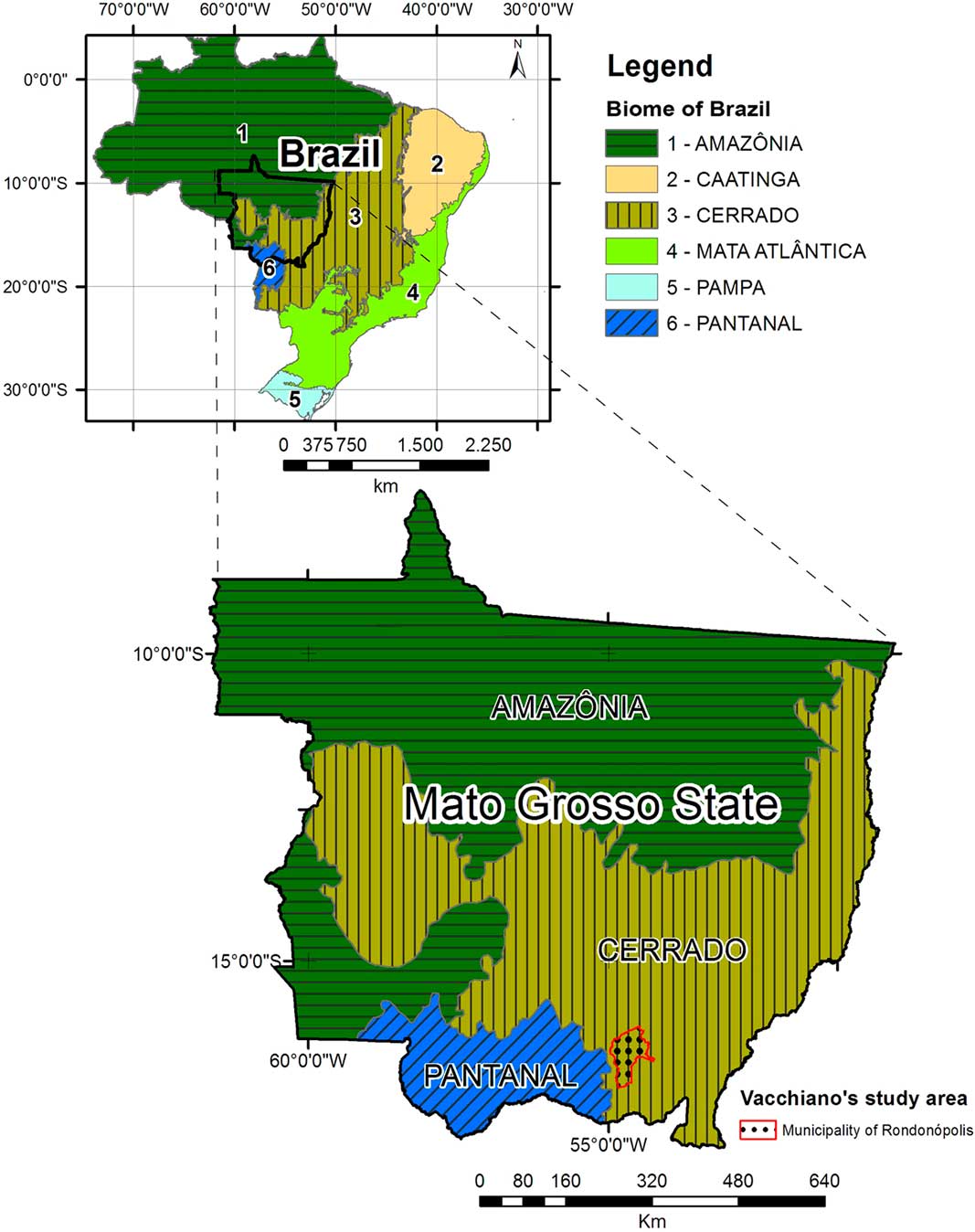
Vacchiano (Reference Vacchiano2017) compared the CAR data on 75 large (>900 ha) rural properties that together cover 187 000 ha in the rural area of Rondonópolis County (Mato Grosso State). Mato Grosso State is the main soybean, cotton and beef producer in Brazil and its 903 357 km2 area hosts three of the six Brazilian biomes, namely Amazon, Pantanal and Cerrado, in the last at which Rondonópolis County is located (Fig. 1). Using geoprocessing techniques to map the effective LRs and PPAs in the 75 assessed rural properties and to compare them to areas declared in the CAR, 85% of the owners declared having larger preserved LR areas than they actually had in their properties (Vacchiano Reference Vacchiano2017). In addition, according to what was declared in the CAR, the total degraded PPA extent comprised 29.78 ha; however, Vacchiano (Reference Vacchiano2017) measured the area and found that it was 21 times bigger than the reported area. The protected areas may be smaller than the ones declared in CAR; in addition, the mere existence of these areas is not itself a reliable indicator of biodiversity conservation. In the Atlantic Forest, 88% of the remaining Atlantic Forest fragments are completely deprived of the four largest neotropical mammal species native to that biome (Jorge et al. Reference Jorge, Galetti, Ribeiro and Ferraz2013). Given the importance of their ecological functions, the disappearance of such species has impacts on biodiversity; for instance, decreased plant diversity and numbers of insectivorous birds.
Biomes of Brazil and Mato Grosso State, and Vacchiano’s study area.
Gibbs et al. (Reference Gibbs, Rausch, Munger, Schelly, Morton and Noojipady2015) emphasized that the CAR per se does not protect the native flora in rural properties. In 2014, almost 25% of Amazon deforestation happened in Mato Grosso State rural properties registered in the CAR, and most of such deforestation was illegal.
Vacchiano (Reference Vacchiano2017) highlighted the low level of effectiveness of the CAR and pointed out the need to validate data declared by farmers in order to allow the use of these data as indicators of real compliance with FC in rural properties. The lack of validated CAR information makes biodiversity in Brazilian biomes, mainly in the Cerrado biome, quite vulnerable. The Cerrado biome is a neotropical savanna covering more than 208 Mha (c. 26% of the Brazilian territory). Virtually unchanged before 1970, Cerrado has experienced rapid agricultural expansion in recent decades, at a much higher rate than in the Amazon. Cerrado has become the most important agricultural frontier in Brazil due to its large-scale soybean and beef production for export purposes (Lambin et al. Reference Lambin, Gibbs, Ferreira, Grau, Mayaux and Meyfroidt2013, Silva et al. Reference Silva, Angeoletto, Santos, Paranhos Filho, Vacchiano, Bohrer and Cândido2017); c. 55% of the biome has been transformed into agricultural soils in the last 50 years. Despite its more than 12 000 plant, 1200 fish, 837 bird and 199 mammal species, only 2.2% of the Cerrado biome is legally protected. At least 137 animal species in the biome are endangered due to large-scale agricultural expansion (Silva & Bates Reference Silva and Bates2002). If the 3% annual expansion rate of agricultural activities in the Cerrado continues, this biome could be confined to legally protected areas only by 2030 (Aquino & Miranda Reference Aquino and Miranda2008). A new challenge is coming: according to the FC, public authorities now must deploy an environmental repair mechanism to be applied to degraded areas in PPAs and LRs (the Environmental Regularization Program). It is essential to have Brazilian scientists proposing efficient indicators capable of attesting to the environmental quality of the recovery recorded in these areas. The scientific community should avoid ideological narratives concealed in ‘creative statistics’. On the contrary, Brazilian environmental agencies have limited technical capacity and must necessarily build partnerships with universities and scientific research institutions that are seriously engaged in CAR data validation. This is the only way to make Brazilians aware of the real preservation status of most biomes in the country.
Acknowledgements
We would to thank Flora Essy Angeoletto for her support and encouragement.