


1. Introduction
Within the field of organizational design, change is a challenge that most organizations have faced at some point in their history, whether driven by internal strategic decisions or external forces such as market dynamics, technological shifts, or regulatory changes. Yet, approximately 50% to 70% of organizational change initiatives are reported to fail (Reference Tabrizi, Lam, Girard and IrvinTabrizi, 2019). Although this number has been disputed (Reference HughesHughes, 2011), the difficulty of managing change at the individual, team, organizational or social level has been the object of extensive research since the 1940s.
Since then, an important portion of researchers’ efforts has been focused on the “How” of organizational change. Some of the more widely used approaches in industry, although several decades old, include Kurt Lewin’s three step “Unfreeze, Change, Refreeze” model (Reference LewinLewin, 1947). John Kotter’s 8 steps (Kotter, 1996), and Jeffrey Hiatt’s ADKAR (Hiatt, 2006).
Conversely, the subject of how to control for “Resistance to Change” (Reference LewinLewin, 1947) has been recognized as a major condition of success (Bartunek et al., 2006). To this day however, these notions seem to have been mostly analyzed through psychological or behavioral lenses (Reference Sverdlik and OregSverdlik & Oreg, 2023), with a focus on the personal disposition of the actors involved in the change process, the “Who”.
While extensive research has focused on the “How” of change management and the “Who” involved in the process, we find that there is a research gap in properly choosing the sequence “What”. With strategists facing a near infinity of choices as to “what to change next” in their organization, and given an organizational goal, we are looking for a way to find a contextual sequence of design steps which minimizes the risk of change failure towards this goal.
Research question
“Can Phylogenetic Analysis, applied to Organizational forms, be applied to guide an efficient organizational design sequence, in order to minimize the risk of implementation failure?”
This paper starts by establishing a theoretical framework highlighting the need for methodologies which better account for organizational complexity and the non-linearity of organizational design initiatives. We then address this gap by proposing PhylOrg, a novel methodology that applies phylogenetic analysis to organizational design. By modelling organizations as complex adaptive socio-technical systems, we leverage evolutionary principles to map out coherent sequences of design changes which aim to minimize incompatibilities, thus decreasing the risk of failure.
2. Theoretical framework
In this section, we establish the theoretical foundation of our proposed methodology. We view organizations as complex, dynamic, evolving systems for which widely used tools such as maturity assessments are ill suited. Organizational design refers to the target structure of an organization, while organizational change focuses on the process of achieving it starting from an existing organizational structure. The terms are closely linked, as design often requires iterative changes.
2.1. Organizations as Complex Adaptive Systems (CAS)
Organizations can be viewed as Complex Adaptive Systems (CAS) (Prigogine & Stengers, Reference Prigogine and Stengers1989; Kauffman, Reference Kauffman1990), characterized by dynamic networks of interactions among diverse agents. Key features of CAS relevant to organizational design include:
-
Non-linearity: Small changes in design can lead to significant outcomes, making the impact of design decisions unpredictable.
-
Emergence: New organizational behaviors and structures emerge from interactions among agents, not from centralized control.
-
Adaptability: Organizations evolve by adapting their design in response to internal and external changes.
We propose that understanding organizations as CAS means that effective organizational design should foster the organic emergence of new structures and processes, rather than relying solely on top-down directives.
2.2. Organizations as socio-technical systems
Organizations are socio-technical systems (Reference TristTrist, 1981), integrating social components (people, culture, roles) and technical components (technology, processes). The interdependence of these elements necessitates a co-evolutionary approach in process design, where changes in one domain influence and require adjustments in the other (Reference Aras and BüyüközkanAras & Büyüközkan, 2023).
We propose that any successful organizational design effort must consider both social and technical aspects as interdependent, evolving together to achieve alignment and effectiveness.
2.3. The non-linearity of organizational design
Traditional approaches to organizational design often fail to account for the complexity and nonlinear nature of organizations. Organizational change involves non-linear processes with feedback loops, making linear design approaches insufficient (Reference SydowSydow, 2021).
As an example of these non-linear dynamics happening in organizational design, our experience has often led to the observation of a feedback loop from of failed changes. It starts with the arrival of external consultants with a mandate to transform the organization. The object of this organizational re-design does not matter here, but for the sake of example we can cite the implementation of process improvements such as Lean and Agile, see (Reference Bader, Antony, Jayaraman, Swarnakar, Goonetilleke, Maalouf and LindermanBader et al., 2024). These consultants, as brilliant as they are, fail to properly integrate the organizational context, including the existence of past traumatic failures, missing technical or dynamic capabilities (Reference Wang and AhmedWang & Ahmed, 2007), leading to prerequisite change steps being skipped or forgotten about, eventually resulting in the failure of the overall attempt. With each failed attempt, the level of cynicism and fatigue rises (Reference de Vries and de Vriesde Vries & de Vries, 2023), making the job even harder for the inevitable next batch of consultants, organizational silence (Reference Morrison and MillikenMorrison & Milliken, 2000) sets in, and the cycle continues and worsens. Even though this feedback loop has not been described as such that we know of, each of its components is supported by the literature:
-
Change failures as a predictor of increased resistance to change (Reference Ford and FordFord & Ford, 2009),
-
Increased resistance to change as a predictor of increased change delays - in particular through Change Cynicism, (Durrah et al., Reference Durrah, Chaudhary and Gharib2019, Wanous et al., Reference Wanous, Reichers and Austin2000) - as overcoming this resistance requires more time and effort
-
Increased change delays as a predictor of future change failures, due to the erosion of momentum and the perpetual state of change generating Change Fatigue (Cox et al., Reference Cox, Gallegos, Pool, Gilley and Haight2022; de Vries & de Vries, Reference de Vries and de Vries2023)).
2.4. Maturity assessments
Maturity assessments (MA) have become the standard tool used by management and consulting firms to address the question of the “What” in organizational and process design initiatives and their popularity in industry has only been growing since the 2010s (Figure 1 ).
Google trends data from 2011 to March 2025 - worldwide searches for keywords “digital maturity” (blue, dotted) and “maturity assessment” (red, solid) as sample terms to illustrate growing interest in these methodologies

To speak only of the digital/technology space, most consulting firms will have a version of these MA, on hot-button topics such as Agile, DevOps, Cybersecurity, Cloud adoption, Data governance or AI, to name a few. As a technology management consultant, the main author of this paper has had extensive experience using this methodology for over 10 years, with roughly 75% of consulting mandates involving some form of MA. These engagements typically consist of assessing a client firm’s operating model against a MA, identifying the gaps between the current and targeted states, and constructing a roadmap designed to bridge those gaps to reach the desired organizational and process design. The specific MA selected is often determined by the client’s immediate needs (e.g., improving Agile practices) as well as the consulting firm’s areas of expertise (or available bench of resources).
In their survey, Aras & Büyüközkan (Reference Aras and Büyüközkan2023) have identified no less than 60 of these models, across a variety of academic and consulting sources.
Maturity assessments, widely used by consultancies to assess the state of an organization in relation to claimed best practice, are often employed to generate “to-do lists for improvement”. They are highly sector-specific (Reference Aras and BüyüközkanAras & Büyüközkan, 2023) and fail to provide prescriptive, non-linear guidance on the order and priority of change, fail to take account of organizational context and fail to incorporate the non-linear nature of continuous organizational design.
2.5. Evolutionary approaches to culture and organizational design
Applying evolutionary theory to organizational and process design offers a way to understand and navigate the complex dynamics of an organizational design initiative. Evolutionary economics and cultural evolution studies have shown that organizations and cultures evolve through mechanisms analogous to natural selection, adaptation, and path dependency (Cavalli-Sforza & Feldman, 1971, Richerson & Boyd, Reference Richerson and Boyd1978, Nelson & Winter, 1982; Hodgson & Knudsen, Reference Hodgson and Knudsen2010, Derex & Mesoudi, Reference Derex and Mesoudi2020, Miton & Morin, Reference Miton and Morin2021) demonstrating that cultural change can often be visualized as a branching, evolutionary process (Reference Collard, Shennan and TehraniCollard et al., 2017). By viewing organizational traits—such as structures, processes, and cultural elements—as “morphological traits”, we can apply Phylogenetic Analysis to map out possible evolutionary pathways for organizations. This approach helps identify sequences of design changes that are coherent with the organization’s current state and evolutionary history.
In Industrial Engineering, researchers also attempted to understand how certain types of manufacturing systems seemed to have emerged and been selected for. (Rose-Anderssen et al. 2009) used it to reconstruct the evolution of Aerospace supply chains using a Maximum Parsimony approach and conclude that “the managerial implications of its use are as a strategic tool for discussing policy development and future scenarios”. (Reference LeseureLeseure, 2015) applied it to the study of the ‘Machines Spéciales’ Industry in France. (Reference Baldwin, Anderssen and RidgwayBaldwin et al., 2013) used it to draw an evolutionary tree of manufacturing systems. (Reference Kortam and GadKortam et al, 2019) proposed a generalized Darwinian view of Marketing research, while (Reference LeaskLeask, 2002) applied it to the UK Pharmaceutical Industry. (Reference Lee, Jeong, Jung, Kim, Kim, He and ChoiLee et al., 2022) applied Phylogenetic Analysis in a Product Design context, by analyzing the evolutionary trees of mobile products.
2.6. Maximum Parsimony
Parsimony (sometimes referred to as Occam’s razor) is the principle of favoring the simplest adequate explanation, solution, or design when confronted with multiple possibilities. This concept is widely applied across disciplines. In biology, parsimony is a guiding principle in evolutionary and phylogenetic analysis, where it is used to infer the most likely evolutionary relationships among species (Reference Coelho, Diniz-Filho and RangelCoelho et al., 2019). In software development, it guides the creation of lean, maintainable systems by reducing redundant code and unnecessary dependencies (Reference TambassiTambassi, 2023). In decision-making and organizational strategy, it aids in resource allocation and process improvement by identifying the most straightforward path to achieving objectives (Reference Palmatier and CreceliusPalmatier & Crecelius, 2019). While simplicity alone is not always the best criterion—since overly simplistic solutions can ignore important nuances—parsimony serves as a heuristic to balance sufficiency and efficiency, ensuring that complexity is justified rather than arbitrary.
2.7. “Exclusion of the incompatible”
We find the phrase “exclusion of the incompatible”, which seems to have been coined by (Reference Longo and MontévilLongo, 2013) particularly enlightening when applied to the context of organizational design. It frames its process not as an active selection of optimal solutions but as the elimination of traits which fail to align with the evolving environment. This concept, usually referred to as “negative selection”, underscores the idea that evolutionary adaptation often results from the passive decay, or active removal of dysfunctional, misaligned or incoherent traits rather than a positive choice of the best absolute option.
Consultants would urge software developers to deploy code into production daily, adhering to what they call “Agile and DevOps best practices.” However, the organization’s existing technical infrastructure is built on a highly coupled, monolithic architecture, where even small changes carry significant risks of introducing regressions into the system. Faced with this situation, developers resort to creative but superficial workarounds—such as simulating deployments in staging or test environments—designed to appease consultants and upper management, while continuing to rely on time-consuming regression testing and architecture change approval processes behind the scenes. This disconnect between the prescribed solution and the organization’s actual constraints leads to a culture of façade. Developers, under pressure, “fake” adherence to continuous deployment practices, but in reality, the organization remains constrained by its legacy architecture. Once the consultants leave, the inevitable happens: the trait of “continuous deployment” falls victim to exclusion of the incompatible. The practice fades into obscurity because it was never truly viable in the first place, and the organization remains rooted in its more conservative release methods.
In this way, the exclusion of the incompatible is not merely about individual resistance but about the system’s inability to adapt without addressing foundational misalignments, such as modularizing the architecture first. In (Reference KauffmanKauffman, 1990), the notion of the Adjacent Possible is also close to what we are getting at, with only a limited set of sensible “next possible states” a system has at any given time.
This theoretical framework establishes a critical foundation for addressing the challenge of non-linearity in complex organizational design. Our discussion of non-linear feedback loops, which are linked to organizational change failures, shows the insufficiency of traditional linear approaches to design and transformation. Maturity assessments, as a widely used tool to address the “What” of organizational design, are a prime example of this linear approach. While they can be efficient in providing a broad view of organizational gaps, they lack the contextual specificity and prescriptive guidance necessary for navigating the complex interplay of traits within evolving organizations.
Recognizing these limitations, we turn to evolutionary theory as a compelling lens through which to understand and influence organizational design. The next section outlines the methodology we propose to address this methodological gap.
3. Proposed methodology: the phylogenetic approach to organizational design
In this section, we propose PhylOrg: a methodology for applying Phylogenetic Analysis to organizational design.
3.1. Basics of Phylogenetic Analysis
Phylogenetic Analysis is used in evolutionary biology to reconstruct the evolutionary relationships among organisms based on shared traits (Reference Lemey, Salemi and VandammeLemey et al., 2009). The core concepts include:
-
Evolutionary Distances: Quantifying differences between entities based on trait variations.
-
Tree Construction: Creating phylogenetic tree depicting evolutionary lineages
-
Taxon: A unit of classification in phylogenetic analysis, representing an individual entity, such as a species, organism, or in our context, an organization, characterized by a unique combination of traits.
3.2. Adaptation to organizational and process design
In this paper, modeling organizations are seen as entities possessing socio-technical traits (STTs), such as communication practices, decision-making structures, and technological infrastructures. These traits can be coded and analyzed similarly to genetic traits in biological organisms. By applying Phylogenetic Analysis to organizations, we can uncover efficient paths of design evolution, guiding the selection of next best steps in organizational and process design.
3.3. Methodology steps for PhylOrg
In this section, a method for discovering paths of least change resistance is proposed, taking into account the propositions we have developed throughout this paper.
Our methodology goes as follows, with organizations viewed as taxa:
1. Data Collection: We gather socio-technical trait data from organizations, focusing on specific attributes such as communication practices, decision-making structures, technological infrastructure, and cultural markers. The data is collected through surveys, interviews, and organizational records, ensuring a comprehensive capture of both social and technical characteristics.
2. Trait Coding: Each trait is coded into a binary or gradual scale, reflecting its presence, absence, or a more subtle variation. A 1-4 A Lickert scale (Reference Joshi, Kale, Chandel and PalJoshi et al., 2015) can be used to capture more nuance than a simple binary coding.
3. Distance matrix calculation: We compute an organizational distance matrix where two organizations are closer together if they share more traits in common. Since traditional phylogenetic methods are typically designed for discrete changes, not gradual variations, a Euclidean distance (square root of the sum of square pairwise differences) is better suited for this context.
4. (optional) δ score computation: A Phylogenetic network such as NeighborNet is generated, and the corresponding δ Scores, which help intuit the tree-likeness of the data at our disposal and identify the major clades.
5. Tree Construction: A phylogenetic tree is generated from the distance matrix. This tree visually represents the evolutionary relationships and the sequence of trait adoption among the organizations.
6. Labeling bifurcations: We give meaning to the bifurcations in the tree by labeling them according to the major changes along the STTs. Similar to Ancestral State Reconstruction (Reference Holland, Ketelaar-Jones, o’Mara, Woodhams and JordanASR, see for example Holland et al., 2020) but we are more interested in the changes in traits rather than the shape of the hypothetical common ancestors.
7. Interpretation and Guidance: The resulting tree is analyzed to identify evolutionary pathways and bifurcations from one branch to the other. The order in which parsimonious trait modifications appear on the tree or network is of particular interest in understanding the space of adjacent possibles for each step in the organizational evolutionary process.
4. Pilot study
In this section, results from a first application of PhylOrg are presented with their initial interpretations to be enriched further in future research.
4.1. Data collection and trait coding
A pilot study was conducted using data from Agendashift’s Adaptive Organization Assessment (Reference BurrowsBurrows, 2021). The assessment collected responses on 34 STTs, presented as statements on subjects such as coordination effectiveness, decision-making autonomy, and information flow reliability, with a scale or responses from 1 to 4 indicating level of agreement with the statement (4 meaning the highest possible level of agreement). From this data, the procedure described in 3.3 was followed. An additional question to all respondents concerned the size of their organization. We didn’t use this question as an STT but hypothesized that it would be a worthwhile piece of information once the tree would be built.
4.2. Phylogenetic Analysis
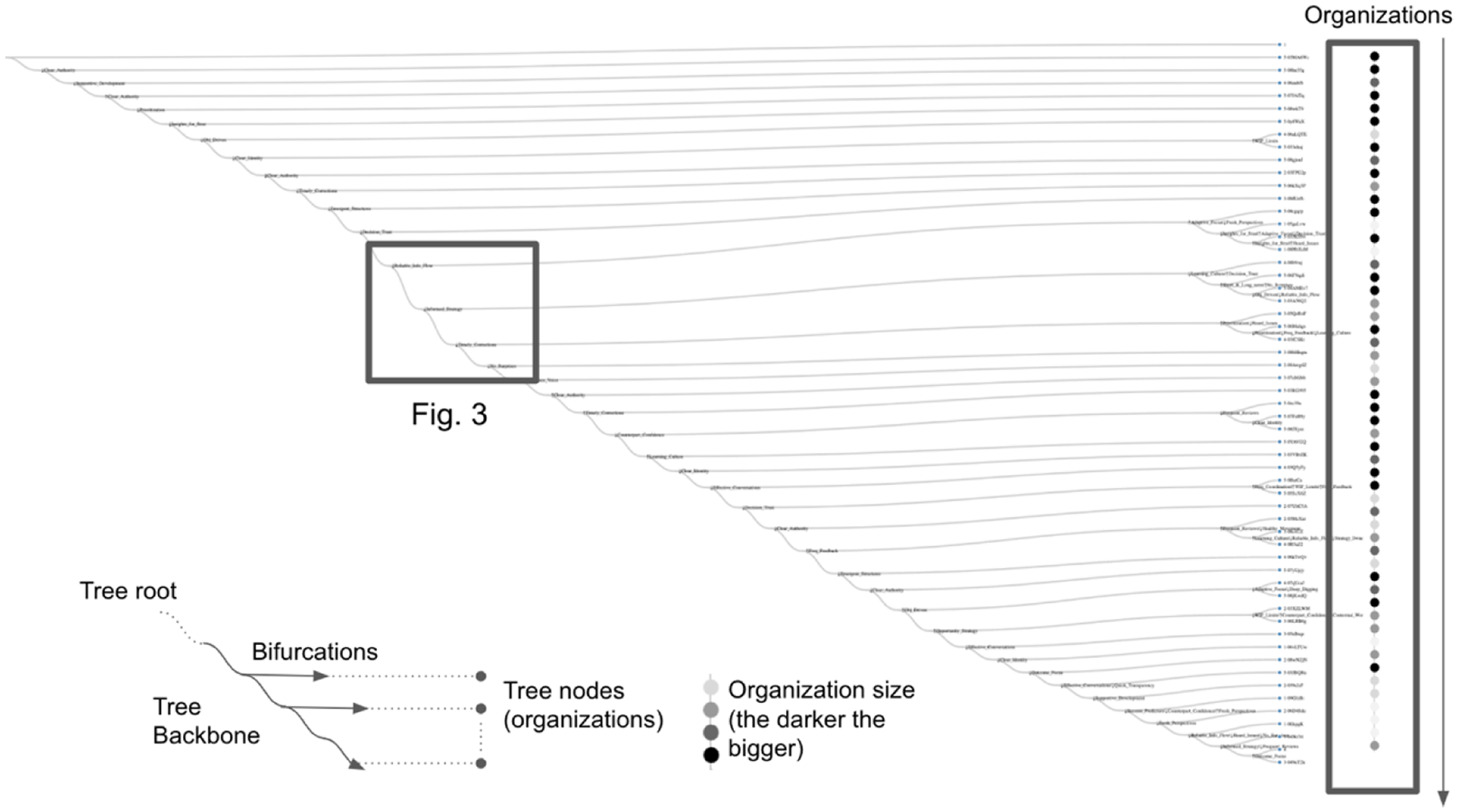
We calculated the distance matrix based on the coded traits of 57 organizations and constructed a phylogenetic tree using BioPython (Reference Chapman and ChangChapman & Chang, 2000). The obtained average δ score is : 0.27, indicating reasonable tree-likeness (Reference Syrjänen, Maurits, Leino, Honkola, Rota and VesakoskiSyrjänen et al., 2021), from which we can proceed with the construction of a phylogenetic tree as seen in Figure 2 . Bifurcations in the tree were identified and labeled according to significant trait differences.
PhylOrg tree produced using Maximum Parsimony with BioPython (Reference Chapman and ChangChapman & Chang, 2000), displayed as a dendrogram in TidyTree (https://github.com/CDCgov/TidyTree) with organizational size represented as shades of grey. In number of employees : Size 1 : 0-10, Size 2 : 10-50, Size 3 : 50-250, Size 4 : 250-1000, Size 5 : more than 1000
4.3. Findings and interpretation
We draw particular attention to the backbone of this phylogenetic tree, by this we mean the shortest path to the root to its more derived taxon. The order of these bifurcations tells us the most parsimonious story of continuous improvements on the STT measurements.
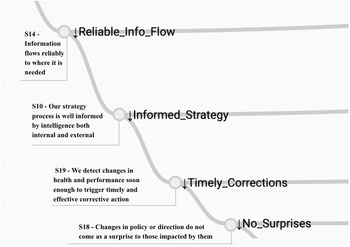
While we won’t detail the whole order of appearance of those traits here, we note for illustrative purposes the following sub-sequence, seen in Figure 3 .
Focus on a specific sequence of bifurcations in the PhylOrg tree, for context of where this sequence is found in the overall tree, see Figure 2

We observe the appearance of a sequence of exclusions of the incompatible, for example the ability to make timely corrections on errors can only fully develop once the flow of information has been improved to a sufficient level (it is harder to know where the issue lies that needs to be fixed, if your system is black box of information). A second example emerges further along the evolutionary tree at a bifurcation marked by [S17 - We are confident in our counterparts’ ability to deliver against shared goals with competence, transparency, and integrity]. This suggests that trust in others’ decision-making capabilities is likely to develop only after sufficient progress has been made in ensuring reliable communication flows and the integration of objective data into strategic decisions. Reversing this order—trusting others before establishing a foundation of informed communication—would imply placing trust in decisions made in the absence of essential information.
Additionally, the study observed that smaller organizations tended to appear further along the evolutionary pathways, indicating that organizational size might influence adaptability and the capacity for design changes (see vertical rectangle on the right of Figure 2 ), which is consistent with (Reference Bader, Antony, Jayaraman, Swarnakar, Goonetilleke, Maalouf and LindermanBader et al., 2024).
This approach aligns with the need for context-specific guidance in process design, offering a tailored roadmap that considers the organization’s unique socio-technical configuration. By following evolutionary pathways identified through PhylOrg, organizations can introduce parsimonious design changes incrementally and coherently. This minimizes disruption and resistance, as each change builds upon established traits, fostering a smoother organizational design process.
5. Limitations and opportunities for future research
While we find the prospects of this work promising, we recognize several limitations which may temper the applicability of our proposed approach to organizational design initiatives through PhylOrg, as well as some exciting future directions we could take this research.
-
In natural evolution, a species rarely “de-evolves” to regain ancestral traits (Reference Goldberg and IgićDollo’s Law of irreversibility; Goldberg & Igić, 2008). In contrast, organizations retain the capacity to “reverse course” by abandoning certain traits, due to the agency of decision-makers. This distinction highlights that our proposal should not be seen as an exact parallel to biological evolution, and future research must further define the limits of this analogy, particularly regarding organizational “de-evolution.”
-
Phylogenetic trees represent a fixed snapshot of traits, while organizations evolve continuously in response to shifting conditions. Conclusions from any given tree are thus time-bound. Rather than viewing a single tree as a comprehensive guide, we recommend using it to identify the next few evolutionary steps, followed by reassessment. Paths may lose relevance as the market and technology landscape evolve.
-
Cultural and organizational evolution also involve substantial horizontal transmission, or reticulation, which can complicate tree-based analysis. Greenhill et al. (Reference Greenhill, Currie and Gray2009) note that realistic levels of reticulation in cultural contexts do not invalidate a phylogenetic approach, which we acknowledge through δ score calculations, with additional tree-likeness assessments to be explored.
-
Phylogenetic analysis is sensitive to character selection, as emphasized by McCarthy (Reference McCarthy2005): “using only the single character ‘presence of stripes’ can yield the flawed observation that tigers and zebras are more closely related than tigers and lions.” We recognize the need for diverse socio-technical traits (STT) in PhylOrg datasets, though future research must define the optimal character scope.
-
Lastly, we would like to address the risk that PhylOrg could inadvertently promote “sheep behavior,” encouraging organizations to follow trends without critical analysis. We stress that PhylOrg does not prescribe convergence toward any “advanced” branch; rather, it aims to visualize diverse, context-specific pathways. It should be noted that the ubiquitous use of Maturity Assessments, which are based on the contextless adoption of “industry best practices”, already does away with any assumption that following in the footsteps of others is inherently problematic.
Real-world PhylOrg applications will follow the outlined methodology, using the resulting evolutionary tree as a structured framework for “next best action” recommendations. As of February 2025, several potential case studies are under discussion, including post-M&A cultural integration in the media industry, business model transformation in the cultural sector, and organizational evolution in the agro-food industry. These discussions span both industry and non-governmental bodies, exploring PhylOrg’s adaptability to diverse organizational contexts and its ability to guide strategic transformation with a data-driven, evolutionary approach. These case studies will include comparative evaluations of PhylOrg against alternative methods (quantitative and qualitative), assessing its cost-benefit ratio.
6. Main outputs and conclusion
We propose a method for guiding organizational design initiatives using phylogenetic analysis, called PhylOrg. This proposal came as an answer to our initial research question on how to guide a coherent and efficient organizational design processes. Phylogenetic Analysis then came in as a natural tool to invoke, once we considered our founding propositions, recapped here:
-
Organizations are Complex Adaptive Systems (CAS)
-
Organizations are Socio-Technical Systems
-
Traditional approaches using Maturity Models are insufficient in capturing non-linear dynamics in organizations
-
Selecting the right next step is key in avoiding negative feedback loops, and ultimately failure due to the accumulation of Resistance to Change
-
Organizations are subject to cultural selection, wherein certain combinations of Socio-Technical Traits (STT) are selected for via an exclusion of the incompatible
-
Trait coding of STT enables the creation of organizational distance matrices
-
Phylogenetic Analysis offer powerful methodologies for analyzing and visualizing coherent sequences of evolutionary steps for CAS
These emergent evolutionary paths provide Organizational Designers with a clear framework for prioritizing the most coherent initiatives, guiding them through an efficient sequence of change. We argue that the sequences identified through PhylOrg can help mitigate the risks of change fatigue and change cynicism by ensuring that each incremental step not only improves the organization’s current state but also paves the way for future opportunities. By focusing on the right next step—the appropriate change at the right time—leaders can avoid imposing initiatives that fall into the exclusion of the incompatible. This prevents situations where efforts, such as asking teams to address issues swiftly, are hindered by the absence of foundational structures like transparent information-sharing systems. These incompatibilities, we contend, are under-appreciated in numerous organizational design initiatives. Without a structured approach like the one we propose with PhylOrg, leaders may overlook critical foundational elements, resulting in efforts that misalign with the organization’s readiness or capacity for change. This oversight can lead to failed initiatives and the reinforcement of existing barriers.
While the particular findings in part 4 should be interpreted as initial conceptual explorations rather than definitive analyses, as both the method and data collection are subject to refinement in future studies, we believe there is enough interest here to pursue this novel way of uncovering logical sequences of design changes within organizations.



 Open access

