

Introduction
Against the backdrop of various economic and social crises, coupled with the global rise of right-wing populism in recent years, public and scholarly interest in analysing democratic support has grown significantly (e.g. Ahrendt et al., Reference Ahrendt, Consolini, Mascherini and Sandor2022; Foa et al., Reference Foa, Klassen, Slade, Rand and Williams2020). Political alienation – characterised by an attitude of distrust towards the prevailing political system and its actors – is often fuelled by experiences of socio-economic deprivation. Previous studies have demonstrated associations between political alienation and factors such as low-wage employment, perceived financial insecurity and unemployment (Fervers, Reference Fervers2019; Friedrichsen and Zahn, Reference Friedrichsen and Zahn2014; Giustozzi and Gangl, Reference Giustozzi and Gangl2021; Kroknes et al., Reference Kroknes, Jakobsen and Grønning2015; Polavieja, Reference Polavieja and Gallie2014; Schäfer, Reference Schäfer, Gabriel and Keil2014; Schraff, Reference Schraff2018; Reference Schraff2019).
However, relatively few studies have explored the role of welfare state institutions in shaping the political alienation of socio-economically disadvantaged groups (Fervers, Reference Fervers2019), particularly in relation to people’s personal experiences with welfare state institutions (Kumlin, Reference Kumlin2004; Shore and Tosun, Reference Shore and Tosun2019). The present study contributes to this literature by addressing the following research questions: Are recipients of basic income support (BIS) more strongly politically alienated than non-recipients? How do experiences of social exclusion and direct contact with welfare institutions affect this relationship?
We examine these questions in the context of Germany. In the early 2000s, structural reforms shifted the existing system of unemployment benefits and social assistance towards an activation paradigm with stricter conditionality for BIS receipt (Knotz, Reference Knotz2018). Research has shown that these structural reforms not only affected the socio-economic well-being of BIS recipients and their experience with the welfare system but also shaped their perception of the (welfare) state and its institutions (Fervers, Reference Fervers2019; Fohrbeck et al., Reference Fohrbeck, Hirseland and Lobato2014). Our analysis is based on large-scale household data from the Panel Study Labour Market and Social Security (PASS), which includes measures of political alienation for the years 2019–2021. The PASS is particularly suitable for this research due to its dual-frame sampling design, combining a large and regularly refreshed sample of BIS recipients with a sample of Germany’s residential population (Trappmann et al., Reference Trappmann, Bähr, Beste, Eberl, Frodermann, Gundert, Schwarz, Teichler, Unger and Wenzig2019).
Our study makes two key contributions to the existing literature. First, making use of a rich set of indicators, we analyse the interplay between multidimensional socio-economic disadvantages as processes of social exclusion. BIS recipients have limited financial resources, which increases their vulnerability to material deprivation and social exclusion (Beste et al., Reference Beste, Bethmann and Gundert2014). Material and social exclusion can foster subjective social exclusion – an individual’s feeling of not fully belonging to society (Djouadi et al., Reference Djouadi, Rössel and Seifert2021; Gundert and Hohendanner, Reference Gundert and Hohendanner2015). We assume that the aforementioned structural welfare state reforms can have policy feedback effects in that BIS recipients hold welfare state institutions and the state responsible for their high risk of social exclusion. To examine this assumption empirically, we analyse the relationship between BIS receipt, social exclusion and political alienation.
Second, we address a striking research gap: the role of direct experiences with state services for the emergence of political alienation. While earlier studies have often concentrated on the effects of socio-economic deprivation, there is growing recognition of the importance of non-economic factors shaping political attitudes of people who are unemployed (Giustozzi and Gangl, Reference Giustozzi and Gangl2021, p. 268). We use unique survey data on the degree to which BIS recipients perceive their interactions with job centre officials as trustful and supportive. Depending on the level of trust and support experienced, direct contact with welfare officials could either exacerbate political alienation or foster political trust (Kumlin, Reference Kumlin2004; Shore and Tosun, Reference Shore and Tosun2019). By examining these interactions, our study sheds light on the mechanisms through which welfare institutions impact political attitudes.
Focusing on BIS recipients and their experiences of welfare services, our study on political alienation addresses the role of social policy institutions and actors and draws attention to the shared responsibility of politics and the welfare state for maintaining social cohesion. Thus, it highlights the importance of designing social policy in a way that is conducive to political trust.
In short, our study shows that recipients of BIS have a higher risk of political alienation than non-recipients – a finding which is particularly pronounced in the case of long-term BIS receipt. Further results suggest that social exclusion is a relevant mechanism behind this relationship. Our analysis confirms previous research by showing that BIS recipients’ subjective sense of social integration is weaker than that of non-recipients, which is largely due to a higher risk of material deprivation and lower levels of social participation and civic engagement. Subjective social exclusion in turn contributes substantially to political alienation. An analysis of the role of interactions with welfare officials shows that political alienation is less pronounced among BIS recipients who perceive these encounters to be trustful and supportive than among recipients with less positive experiences.
Drivers of political alienation at the macro and micro level
Political alienation has been defined as the basic estrangement of an individual from the prevailing political system (Citrin et al., Reference Citrin, Mcclosky, Shanks and Sniderman1975). It is reflected in fundamental distrust of the political system, its institutions and its actors (Schraff, Reference Schraff2019). Therefore, satisfaction with democracy and trust in political institutions are frequently used as indicators of people’s acceptance and support for political systems (Friedrichsen and Zahn, Reference Friedrichsen and Zahn2014; Giustozzi and Gangl, Reference Giustozzi and Gangl2021; Schraff, Reference Schraff2018; Reference Schraff2019; Sirovátka et al., Reference Sirovátka, Guzi and Saxonberg2019).
Research suggests that individual socio-economic deprivation on the one hand and macro level country characteristics on the other hand contribute to alienation from democracy and politics. At the micro level, political alienation is related to sociodemographic and other individual characteristics, such as education, age and the degree of urbanisation of people’s places of residence (e.g. Giustozzi and Gangl, Reference Giustozzi and Gangl2021). Most relevant to the present paper are studies which found that individual unemployment, low-wage work and financial insecurity are negatively related to satisfaction with democracy and political trust (Fervers, Reference Fervers2019; Friedrichsen and Zahn, Reference Friedrichsen and Zahn2014; Giustozzi and Gangl, Reference Giustozzi and Gangl2021; Kroknes et al., Reference Kroknes, Jakobsen and Grønning2015; Polavieja, Reference Polavieja and Gallie2014; Schäfer, Reference Schäfer, Gabriel and Keil2014; Schraff, Reference Schraff2018; Reference Schraff2019). The effect of unemployment on political alienation is subject to temporal dynamics, with existing evidence suggesting that long-term unemployment effects are more significant for political alienation than short-term effects (Azzollini, Reference Azzollini2021; Bauer, Reference Bauer2018).
Political alienation is also related to macro-level factors, notably to a country’s economic performance and welfare state policies. For example, satisfaction with democracy and political trust are less pronounced in countries with higher (or increasing) levels of unemployment and lower (or decreasing) GDP rates (Friedrichsen and Zahn, Reference Friedrichsen and Zahn2014; Kroknes et al., Reference Kroknes, Jakobsen and Grønning2015; Schäfer, Reference Schäfer, Gabriel and Keil2014; Sirovátka et al., Reference Sirovátka, Guzi and Saxonberg2019). Political trust is greater in countries with more generous welfare systems (Giustozzi and Gangl, Reference Giustozzi and Gangl2021).
However, previous research indicates that to fully understand the relationship between unemployment, deprivation and political alienation, it is essential to consider the role of policies and institutions as intermediaries between the macro and micro level. Focusing solely on individual socio-economic deprivation may overlook critical aspects of this relationship (Bussi et al., Reference Bussi, Dupuy and van Ingelgom2022; Fervers, Reference Fervers2019; Giustozzi and Gangl, Reference Giustozzi and Gangl2021). A prominent channel in this context is explored in the policy feedback literature, which suggests that political attitudes can result from citizens’ evaluations of policies (e.g. Kumlin and Stadelmann-Steffen, Reference Kumlin and Stadelmann-Steffen2014). A large section of the literature has shown that individual satisfaction with the services provided by state authorities can affect political trust and satisfaction with democracy (Kumlin and Haugsgjerd, Reference Kumlin, Haugsgjerd, Zmerli and van der Meer2017; Zhang et al., Reference Zhang, Li and Yang2022). This is particularly true with regard to welfare state evaluations, as citizens come into direct contact with the state through public employment services (Kumlin, Reference Kumlin2004; Marx, Reference Marx, Clegg and Durazzi2023). A recent study from Norway found that individuals who perceive greater procedural fairness in their interactions with welfare state institutions exhibit higher levels of political trust (Blok and Kumlin, Reference Blok and Kumlin2022). In a study on the experiences that young adults who were unemployed had with employment services in Germany, Shore and Tosun (Reference Shore and Tosun2019) found that individuals who felt treated in a fair and helpful way by welfare officials were more likely to perceive politicians as responsive to citizens’ needs.
In light of these findings, we turn our focus to recipients of basic income support as a vulnerable group in which socio-economic deprivation coincides with personal experiences and direct interactions with welfare state institutions. A focus on BIS recipients – instead of a somewhat broader focus on the socio-economically disadvantaged – allows us to acknowledge the role of social policy institutions and actors in the emergence of political alienation. Our study thus contributes to the literature by examining the experiences of individuals receiving BIS, both in terms of objective socio-economic conditions and as a political experience shaped by direct contact with ‘the state’ through welfare institutions.
Institutional background: basic income support in Germany
The welfare system in Germany has undergone fundamental changes in the last decades. The political economy of the German welfare state has shifted from a conservative model, focused on protecting citizens’ social status, to a more liberal welfare economy (Bothfeld and Rosenthal, Reference Bothfeld and Rosenthal2018; Seeleib-Kaiser, Reference Seeleib-Kaiser2016). In this transition, the role of recipients of welfare benefit as political agents in the provision and consumption of public services and social transfers has evolved from one of social citizenship to individual responsibility and activation (Fohrbeck et al., Reference Fohrbeck, Hirseland and Lobato2014; Lessenich, Reference Lessenich, Bröckling, Krasmann and Lemke2010). These welfare state reforms have had a particularly significant impact on BIS recipients.
In the course of the reforms, receiving BIS has become more strongly conditional in various ways (Knotz, Reference Knotz2018). Receiving support is conditional on intense work search efforts (Hughes, Reference Hughes2024), participation in measures of active labour market policies (ALMP) and accepting a wide range of jobs. Person-related sanctions such as cuts in economic support can penalise recipients when violating their duties against the employment agency by temporarily increasing the material deprivation of the sanctioned (Löwe and Unger, Reference Löwe and Unger2023). Opponents of the reforms have criticised them for imposing pressure and stress on BIS recipients (Raffass, Reference Raffass2017) and fostering stigmatisation (Bolton et al., Reference Bolton, Whelan and Dukelow2022).
In the period considered in this article, Unemployment Benefit II (Arbeitslosengeld II) was the official name for the BIS scheme available to people who are unemployed but capable of working and cannot make a living from other sources of income, including small side jobs. In the years under study (2019–2021), a single adult covered by Unemployment Benefit II received between €424 and €446 plus the cost of accommodation per month. Between 2019 and 2021, the yearly average proportion of working-aged individuals receiving Unemployment Benefit II was between 7.0 per cent and 7.17 per cent (Statistik der Bundesagentur für Arbeit, 2023). Approximately 40 per cent of these individuals had received benefits for four years or longer, and approximately 10 per cent for six months or less (Statistik der Bundesagentur für Arbeit, 2021). Research based on data on recipients of Unemployment Benefit II from 2005 to 2014 has shown that 55 per cent of recipients managed to end benefit receipt within one year (Hohmeyer and Lietzmann, Reference Hohmeyer and Lietzmann2020). While a relatively small proportion of recipients are employed or self-employed (e.g. 24 per cent in 2020), the majority are unemployed or economically inactive. For ease of reading, we mainly use the term ‘BIS’ when we refer to ‘Unemployment Benefit II’ in the present article.
Political alienation of BIS recipients: the role of social exclusion and policy feedback
In this article, we argue that BIS recipients are particularly vulnerable to political alienation. First, drawing on the social exclusion literature, we assert that BIS recipients are more likely to experience objective and subjective social exclusion than other population groups. Second, building on the literature on policy feedback, we propose that social exclusion fosters political alienation, as BIS recipients are likely to attribute responsibility for their socio-economic disadvantages to the government and even the broader political system.
Social exclusion has been defined in various ways (Kronauer, Reference Kronauer and Andreß1998; Room, Reference Room2004; Silver and Miller, Reference Silver and Miller2003). In general, it denotes situations in which individuals cannot participate adequately in social life due to a lack of material or other resources. Social exclusion can be understood as a dynamic process that unfolds in multiple interrelated dimensions over time, including employment, material resources, social resources and cultural resources (for an overview, see Labonte et al., Reference Labonte, Hadi and Kauffmann2012; Levitas, Reference Levitas, Pantazis, Gordon and Levitas2006; Mathieson et al., Reference Mathieson, Popay, Enoch, Escorel and Hernandez2008). Unemployment not only fosters material deprivation but also increases the risk of social exclusion, as it limits people’s opportunities for social and cultural participation (Dieckhoff and Gash, Reference Dieckhoff and Gash2015; Gallie et al., Reference Gallie, Paugam and Jacobs2003; Paugam and Russell, Reference Paugam, Russell and Gallie2004). Often, the receipt of BIS coincides with long-term unemployment. Therefore, the risks of social exclusion can be expected to increase with ongoing duration of BIS receipt (Gallie et al., Reference Gallie, Paugam and Jacobs2003; Pohlan, Reference Pohlan2024).
Social exclusion also has a subjective dimension. The experience of objective exclusion can foster feelings of social disintegration, in particular for individuals lacking internal or external resources to buffer against these challenges (Bude and Lantermann, Reference Bude and Lantermann2006). For instance, Djouadi et al. (Reference Djouadi, Rössel and Seifert2021) found that individuals with lower economic resources and weaker social networks are more likely to feel excluded from society.
Building on the policy feedback literature (for an overview, see Kumlin and Haugsgjerd, Reference Kumlin, Haugsgjerd, Zmerli and van der Meer2017) we argue that the experience of being a BIS recipient – particularly the experience of social exclusion – shapes recipients’ broader attitudes towards the political system as a whole. It is likely that individuals whose livelihoods depend on BIS attribute responsibility for their material and social deprivation to governing politicians or the political system itself and interpret their hardships as symbols of political elites’ failure to represent their interests (see also Marx, Reference Marx, Clegg and Durazzi2023, p. 530). As a result, they may become increasingly dissatisfied with political actors and institutions. This seems even more plausible given the structural changes in welfare state policies, where stricter conditionality of benefit eligibility introduced heightened pressure on recipients. In fact, the announcement of the German welfare reform in 2005 alone reduced satisfaction with democracy among people who were unemployed (Fervers, Reference Fervers2019), who have been shown to be less in favour of the demanding measures of ALMP than other social groups (Fossati, Reference Fossati2018).
In this context, the quality of interactions that BIS recipients have with local welfare agencies is expected to play an important role. Personal experiences with welfare institutions can significantly shape political attitudes (Kumlin, Reference Kumlin2004). In his landmark study, Soss (Reference Soss1999, p. 368) found that personal encounters with welfare services can influence individuals’ perceptions of the political system as a whole:
The primary reason for the spill-over effect, however, is simply that welfare participation provides so many clients with their most direct connection to a government institution. In these cases, the welfare agency serves as clients’ most proximate and reliable source of information about how government works.
It is important to note that welfare officials exercise a certain degree of discretion in their interactions with BIS recipients. Thus, the quality of interactions with welfare officials and BIS recipients’ perception thereof is likely to vary. Studies by Larsen and Caswell (Reference Larsen and Caswell2022) suggest that, under certain conditions, co-creation between clients and caseworkers is possible also in the context of strong welfare conditionality, potentially mitigating political alienation. Research by Senghaas (Reference Senghaas2021) on German welfare practices highlights how frontline workers in job centres have some discretion in choosing harsh, routine or more supportive treatment when working with BIS recipients.
Based on our theoretical considerations, we expect that political alienation is more pronounced among BIS recipients than among other population groups (Hypothesis 1) and that political alienation is more pronounced as the duration of BIS increases (Hypothesis 2) owing to intensifying processes of social exclusion over time. Moreover, we expect that the relationship between receipt of BIS and political alienation is partly explained by objective and subjective social exclusion (Hypothesis 3). Furthermore, we hypothesise that political alienation is less pronounced among recipients of BIS who report strong support and trust in their interactions with caseworkers than among BIS recipients who report little support and trust (Hypothesis 4).
Data and methodology
Measures of BIS receipt, social exclusion and political alienation
For the empirical analysis, we used the representative yearly German Panel Study Labour Market and Social Security (PASS)Footnote 1 , which provides detailed individual- and household-level information about respondents’ economic and social living conditions (Altschul et al., Reference Altschul, Bähr, Beste, Collischon, Coban, Dummert, Frodermann, Gleiser, Gundert, Küfner, Mackeben, Malich, Müller, Schwarz, Stegmaier, Teichler, Trappmann, Unger, Wenzig, Berg, Cramer, Dickmann, Gilberg, Jesske and Kleudgen2022; Trappmann et al., Reference Trappmann, Bähr, Beste, Eberl, Frodermann, Gundert, Schwarz, Teichler, Unger and Wenzig2019). The PASS combines a sample of Germany’s residential population with an oversampling of BIS recipients. Questions on welfare benefit receipt, poverty and transitions into and out of unemployment are a particular focus of the survey. In addition to objective indicators, the PASS contains information on how respondents subjectively assess their material and social situation. Political attitudes were available in three panel waves (2019–2021) at the time of our study.
In accordance with the literature (Gidron and Hall, Reference Gidron and Hall2020; Schraff, Reference Schraff2018; Reference Schraff2019), we operationalised the dependent variable, political alienation, with three indicators: trust in political parties, trust in the government and satisfaction with democracy. Each is measured on an eleven-point scale on which higher values indicate higher levels of political trust and satisfaction with democracy.
The key independent variables refer to BIS receipt, social exclusion and experiences in job centres. We distinguished BIS recipients from non-recipients by a categorical variable that differentiates recipients by the duration of benefit receipt up to the interview date, i.e. less than two years, two to five years and more than five years. The categorical variable is based on spell data. In cases where the period between two separate spells of benefit receipt by an individual was two months or less, we merged these two spells into one consecutive spell. Thus, we avoid underestimating the duration of current BIS receipt owing to measurement error and misreporting.Footnote 2
Social exclusion is captured by several objective and subjective indicators. The material dimension is operationalised by a deprivation index that measures the number of basic goods and activities a household forgoes for financial reasons even though they are commonly considered essential for a decent living standard. This includes basic goods and technical equipment, basic needs (e.g. the possibility of having a hot meal every day) and leisure activities (e.g. going to the movies or going on vacation). Higher values reflect a greater degree of deprivation. The social dimension is measured by two indicators of social participation – the frequency of going out with friends and visiting friends or neighbours at home – and a binary variable that indicates civic engagement in social organisations and clubs. Finally, to assess subjective social exclusion, we included a variable measuring respondents’ self-perceived affiliation with society on a ten-point scale. Lower values reflect higher levels of subjective social exclusion.
The PASS provides information on the quality of interactions with job centre agents as perceived by BIS recipients. The degree of supportive, trustful interactions with job centre agents was assessed by three items, each measured on a four-point scale of (dis-)agreement (‘The job centre employees helped me to develop a new perspective’; ‘The job centre employees discussed in detail with me how I can improve my chances in the labour market’; ‘I have the feeling that I can trust the employees’). We created a summary index ranging from three to twelve, with higher values reflecting higher degrees of supportive, trustful interactions. For the analysis, we used a dichotomised variable where index values of nine or higher are considered to indicate interactions in which strong support and trust were experienced. We set the threshold at nine because this value represents the minimum point at which respondents agree with at least two of the aforementioned items.
In addition, the regression analysis includes control variables: gender (binary variable), age, years of education, migration background (no background, first-generation migrants, and second- and third-generation migrants), household type (categorical variable distinguishing singles, couples with children, couples without children, single parents and other), region (East/West Germany), employment status (categorical variable distinguishing employed, unemployed and inactive). Furthermore, a dummy variable captures whether respondents ever received BIS prior to their current episode of benefit receipt. To account for macro trends, we included dummies for observation waves (2019, 2020 and 2021). A descriptive summary of all variables is shown in Table 1.
Descriptive statistics
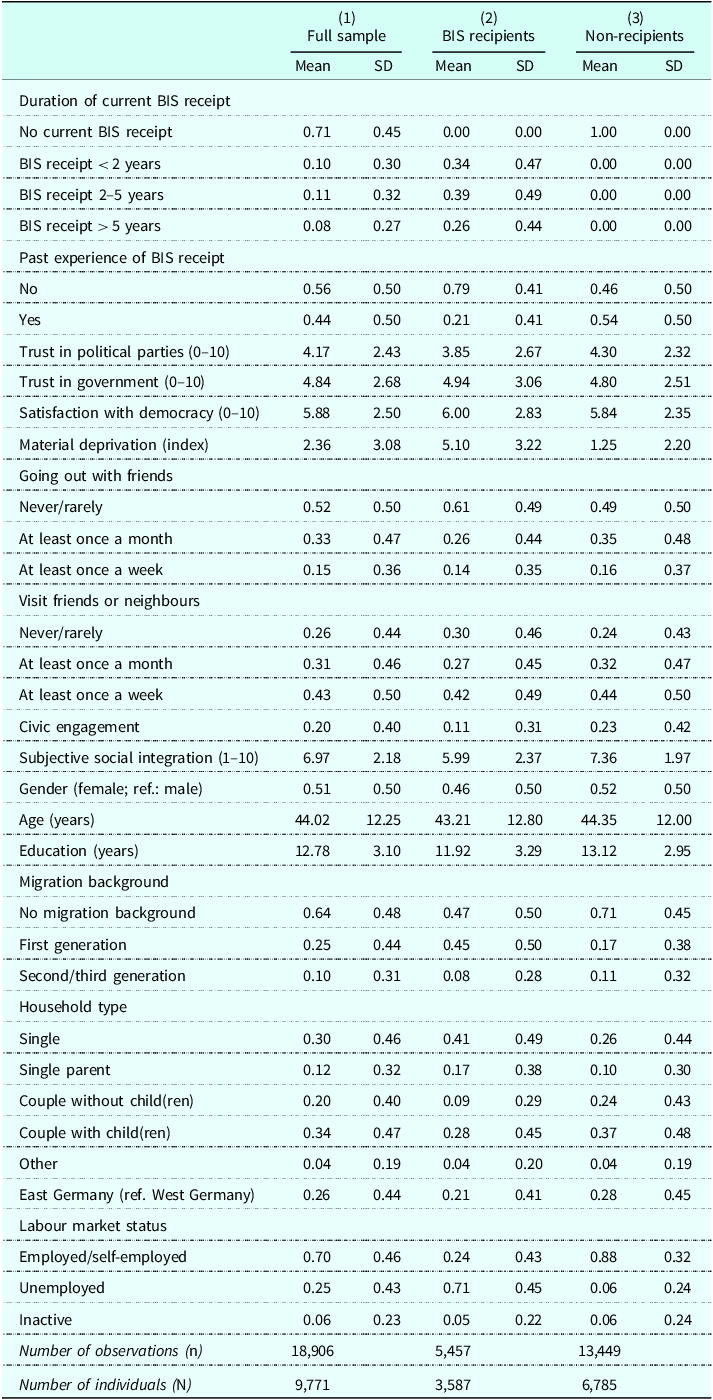
Notes: PASS 0621 v1 (2019-2021); author’s own calculation; SD = standard deviation.
Sample and model specification
We used pooled data from the panel waves 2019–2021 and restricted the sample to individuals between 18 and 64 years of age, excluding pensioners, respondents in apprenticeship training and those with unclear employment status. Thus, the main sample consists of 18,906 observations (9,771 individuals), 29 per cent of which are observations of BIS recipients (Table 1).
We conducted ordinary least squares (OLS) regression analyses in four steps. In the first step, we regressed each indicator of political alienation on BIS receipt and differentiated by the duration of receipt, including control variables (Models 1a–c).
In the second step, we ran two models (Models 1d and 2d) with subjective social integration as the dependent variable. These models aim to establish the relationship between receiving BIS and subjective social exclusion, as well as to demonstrate how objective exclusion risks account for this association.
In the third step, we turned to analysing political alienation and included the objective and subjective indicators of social exclusion in a stepwise manner to investigate whether the relationship between BIS and political alienation would become weaker once we accounted for experiences of social exclusion (Models 2a–c and Models 3a–c). If so, this would suggest an explanatory role of social exclusion. We utilised the KHB command in Stata (Kohler et al., Reference Kohler, Karlson and Holm2011) to report on the statistical significance and size of the mediation.
In the fourth step, we examined whether direct experiences with welfare state institutions affect political alienation of BIS recipients. We included an interaction term of BIS duration and the dichotomised indicator for supportive, trustful interactions with job centres (without the main effects) in the OLS regression models with control variables and objective social exclusion (Models 4a–c). In these models, we excluded the measure of subjective social integration to avoid overcontrol bias since the relationship between experiences in job centres and political alienation might be mediated through subjective social integration.
Empirical results
In the first step of the pooled OLS analysis, we examined the relationship between the duration of BIS receipt and political alienation. Each regression model includes the set of control variables described above.
In accordance with Hypothesis 1, political alienation is more pronounced among BIS recipients than among non-recipients (Figure 1; Models 1a–c). Moreover, the duration of BIS receipt clearly matters. The relationship displayed in Figure 1 is not linear but is overall compatible with Hypothesis 2. Compared with the reference group, trust in political parties is 0.13 of the standard deviation (SD) of trust in political parties lower (b = −0.321; SD = 2.43) for BIS recipients who had been receiving benefits for less than two years (short-term recipients) at the time of the interview (Model 1a). BIS recipients who had been receiving benefits for five years or more (long-term recipients) exhibit 0.33 standard deviations lower trust in political parties compared with non-recipients (b = −0.804). Likewise, with regard to trust in government (Model 1b) and satisfaction with democracy (Model 1c), long-term recipients show stronger signs of political alienation than short-term recipients and non-recipients. Surprisingly, however, recipients with shorter durations of BIS receipt do not differ significantly from the reference group regarding trust in government and satisfaction with democracy (except for short-term recipients and trust in government). Thus, long-term BIS recipients differ most clearly in their democratic attitudes from non-recipients in that they have less trust in political parties and the government and are less satisfied with democracy.
Duration of BIS receipt and political alienation (pooled OLS analysis).
Source: PASS 0621 v1 (2019-2021); authors’ own calculation.
Note: Regression coefficients with 95 per cent confidence intervals; n = 18,906; cluster-robust standard errors (person level).

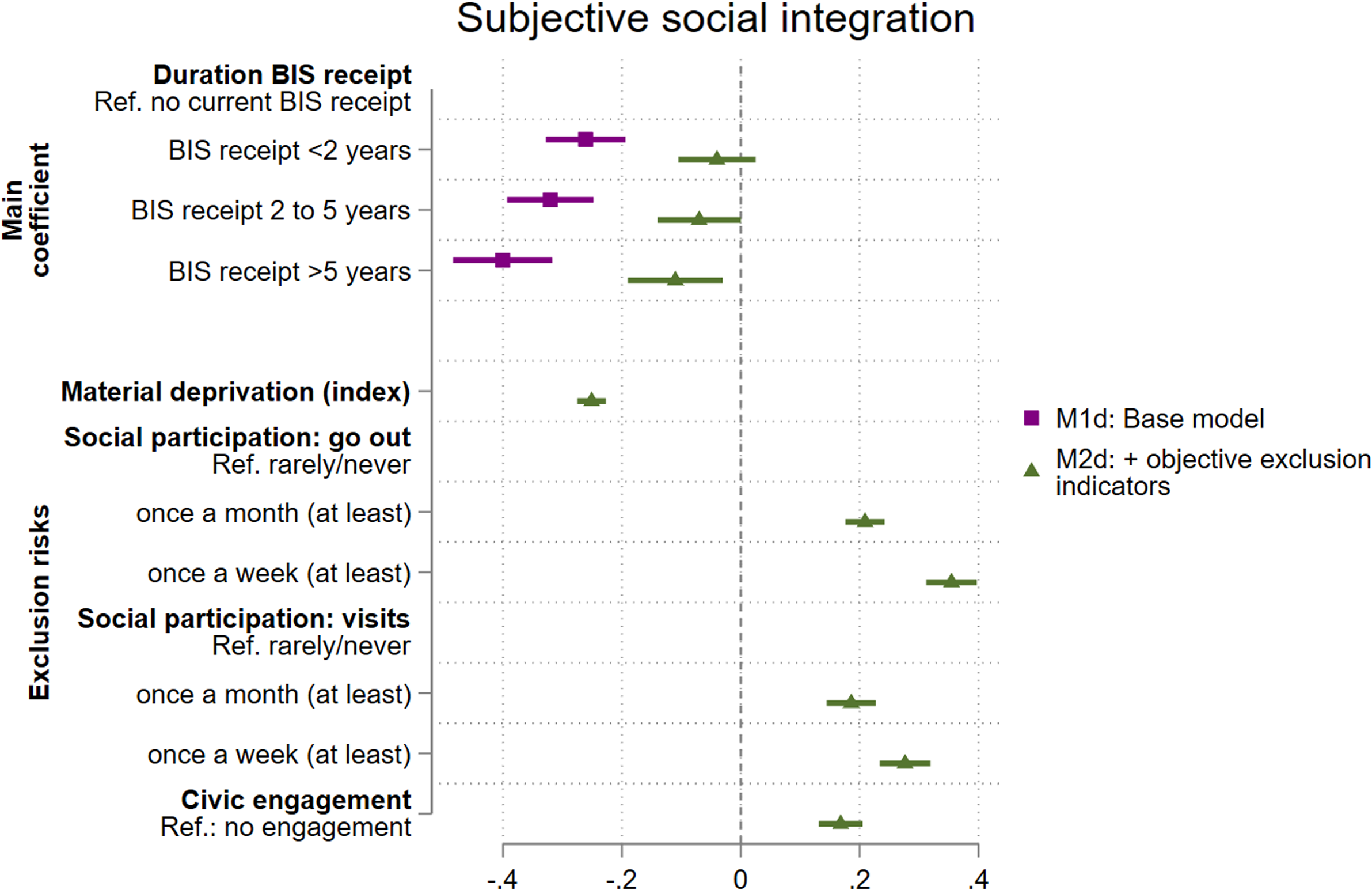
In the second step, in preparation of the mediation analysis following in the third step, we demonstrate that BIS recipients are more likely to experience social exclusion than non-recipients (Figure 2, Models 1d and 2d). The dependent variable measures the degree of subjective social integration. Our findings indicate that BIS recipients feel less integrated into society than non-recipients, a sentiment that intensifise with longer durations of benefit receipt. This sense of exclusion is largely explained by the objective risks of material and social exclusion BIS recipients face. Objective exclusion risks significantly account for the relationship between BIS receipt and subjective integration, accounting for 85 per cent of the total difference in subjective integration between short-term BIS recipients and non-recipients (two to five years: 78 per cent; more than five years: 72 per cent; see Table A1 in the Appendix for details on the KHB analysis).
Duration of BIS receipt and subjective social integration (pooled OLS analysis).
Source: PASS 0621 v1 (2019-2021); authors’ own calculation.
Note: Regression coefficients with 95 per cent confidence intervals; n = 18,906; cluster-robust standard errors (person level).
In the third step, having established that BIS recipients feel less socially integrated than non-recipients owing to objective exclusion risks, we examined whether these exclusion risks contribute to political alienation. In the following models, we introduced in a stepwise manner objective (Models 2a–c) and subjective (Models 3a–c) exclusion indicators into the models which included the indicators of political alienation as outcome variables. This allowed us to assess the impact of material and social exclusion on the political alienation of BIS recipients. We display only the results for trust in political parties (Figure 3) because the analyses of trust in government and satisfaction with democracy yielded similar key findings (Figures A1 and A2 in the Appendix; regression tables are displayed in Table A4).
The role of social exclusion in BIS recipients’ trust in political parties (pooled OLS analysis).
Source: PASS 0621 v1 (2019-2021); authors’ own calculation.
Note: Regression coefficients with 95 per cent confidence intervals; n = 18,906; cluster-robust standard errors (person level).
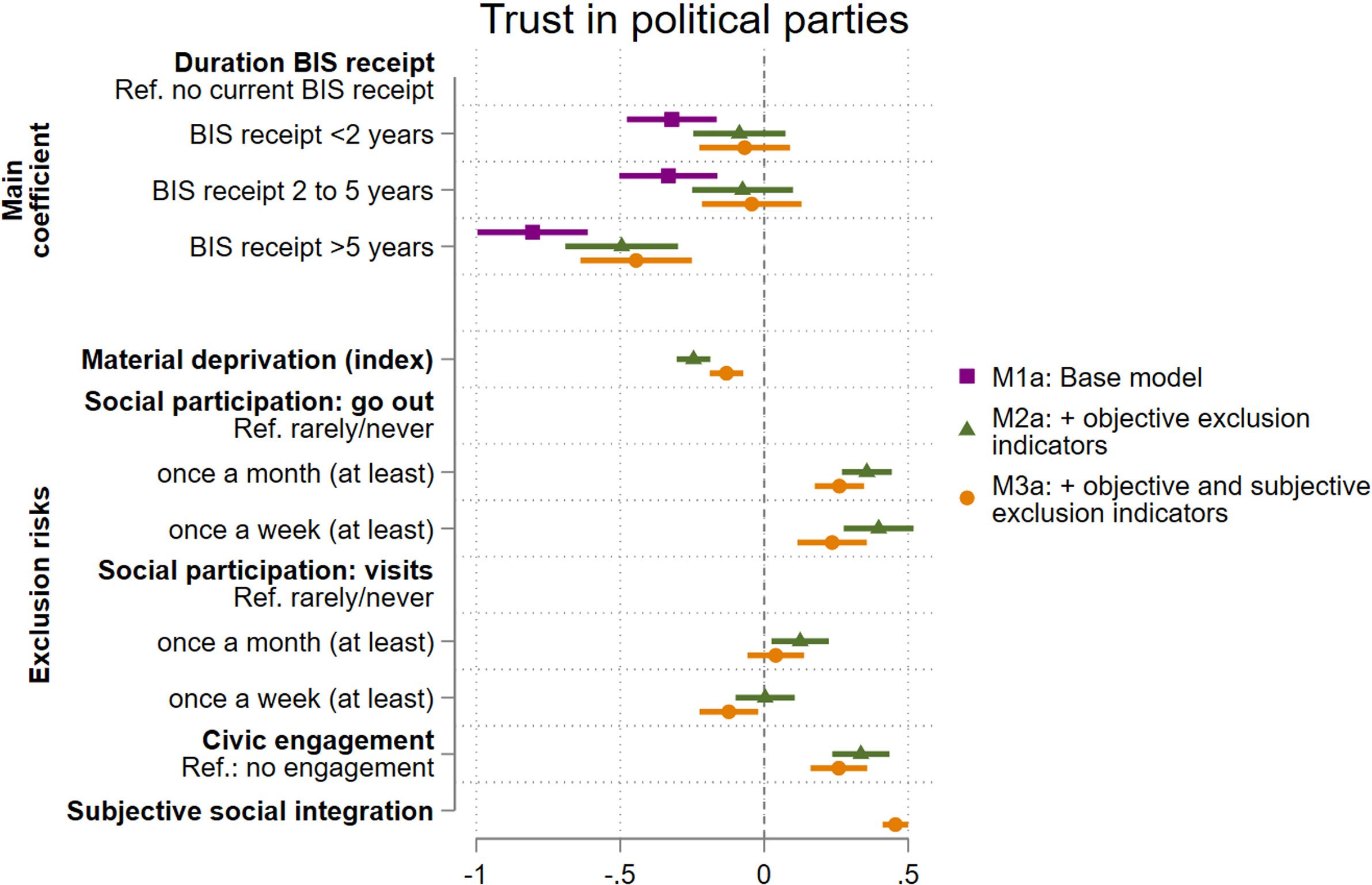
As illustrated in Figure 3, the differences in political trust between BIS recipients and non-recipients found in the base model (Model 1a) decrease when controlling for the indicators of objective exclusion (Model 2a), i.e. material deprivation, social participation and civic engagement. This holds across all groups differentiated by duration of BIS receipt. The differences between non-recipients and short-term or medium-term (two to five years) recipients even become non-significant.Footnote 3
Adding the indicator of subjective social integration revealed the expected association: The more people feel that they are part of society, the greater their level of political trust (Model 3a). While the coefficients for the duration of BIS receipt remained more or less unchanged, the coefficients for objective exclusion decreased. With regard to Hypothesis 3, we conclude that subjective social exclusion mediates the relationship between objective exclusion risks and differences in political trust and satisfaction with democracy observed between BIS recipients and non-recipients. In other words, exposure to material deprivation and social exclusion contributes to a heightened sense of social exclusion, which, in turn, exacerbates political alienation of BIS recipients.
Overall, the social exclusion indicators account for approximately 70–80 per cent of the total difference in trust in political parties between short- and medium-term BIS recipients and non-recipients (Table A2 in the Appendix). In the case of long-term recipients, social exclusion accounts for 30–45 per cent of the difference in political alienation across all three indicators.
We found that differences in political alienation between long-term BIS recipients and non-recipients persist even after controlling for social exclusion risks. In the fourth step, to explore this further, we introduced an interaction between BIS recipient groups and a dummy variable that differentiates between recipients who reported highly supportive and trustful experiences at job centres and those who reported less supportive and trustful experiences (Models 4a–c). The results show the interaction coefficient for each group as the statistical difference relative to the reference group of non-recipients (Figure 4). The sample sizes for each group are provided in Table A3 in the Appendix.
Experiences in job centres and political alienation of BIS recipients (pooled OLS analysis).
Source: PASS 0621 v1 (2019-2021); authors’ own calculation.
Note: Regression coefficients with 95 per cent confidence intervals; n = 18,625; cluster-robust standard errors (person level).
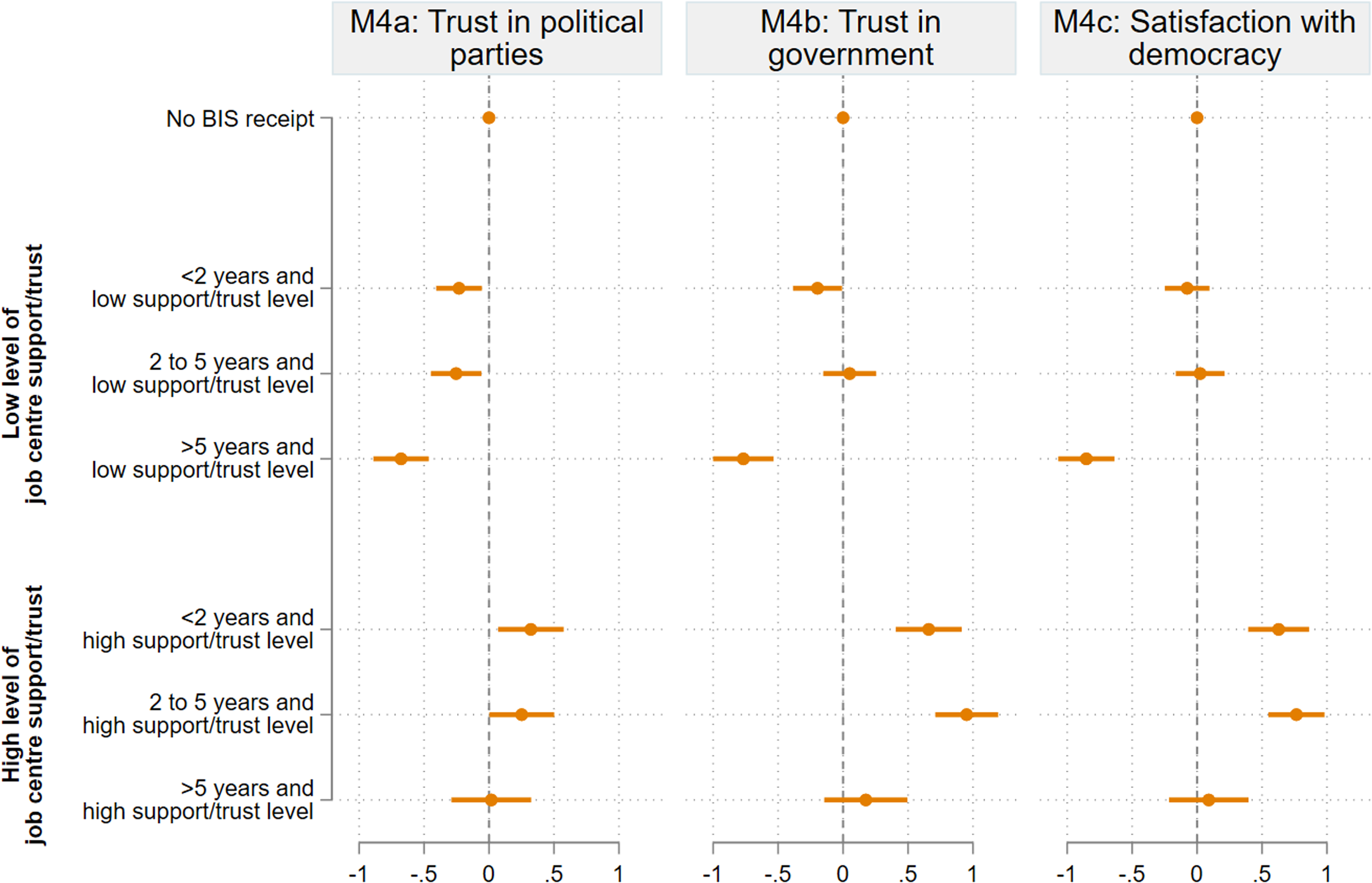
The analysis reveals a notable pattern. Among BIS recipients, those who reported low levels of support from job centre agents exhibit significantly lower trust in political parties compared with non-recipients, with this effect being particularly strong for long-term recipients (Model 4a). For trust in government and satisfaction with democracy (Models 4b and 4c), similar negative effects are observed for long-term recipients who reported low levels of support. All other coefficients for short- and medium-term recipients who reported low support levels are non-significant and/or close to zero.
In contrast, for recipients who reported receiving high levels of support and trust from their job centres, there is an opposing pattern. Short-term and medium-term BIS recipients show higher levels of political trust (Models 4a–b) and satisfaction with democracy (Model 4c) than non-recipients. These differences are both statistically significant and substantive in size; for example, short-term BIS recipients score a quarter of the respective standard deviation higher in satisfaction with democracy than non-recipients (b = 0.63; SD = 2.50). For long-term recipients, the previously observed negative relationship across all political alienation indicators, controlling for exclusion risks, appears to be mitigated if recipients perceive their job centre agents as supportive.
Overall, these findings indicate that the experiences BIS recipients have in job centres matter for political alienation. While BIS recipients with positive experiences exhibit equal or even better levels of political trust and satisfaction with democracy than non-recipients, people with negative experiences show stronger tendencies of political alienation. Positive encounters with welfare institutions seem to offset some of the alienation effects associated with long-term benefit receipt. These findings strongly speak in favour of Hypothesis 4 and the idea that personal experiences with welfare institutions shape political attitudes of BIS recipients.
Robustness tests
Next, we performed tests to rule out whether the results presented above were driven solely by selectivity. It is possible that unobserved or insufficiently observed characteristics simultaneously affected political alienation and the probability of ending BIS receipt and thus biased the coefficients. Furthermore, the results on job centre experiences do not necessarily imply a causal relationship, and selectivity or reverse causality is possible. In fact, a recent study suggests a reciprocal relationship between political trust and performance evaluations of welfare state services (Haugsgjerd and Kumlin, Reference Haugsgjerd and Kumlin2020).
We estimated fixed-effects (FE) regression models to eliminate potential bias from unobserved heterogeneity and to explore the longitudinal relationship between the phenomena studied. We accounted for group-specific trends in political alienation that were markedly volatile in the period of observation (Figure A3 in the Appendix) due to the COVID-19 pandemic (e.g. Schraff, Reference Schraff2021). Accordingly, we controlled for an interaction effect between years affected by the pandemic (2020 or 2021 versus 2019) and a time-constant dummy variable separating individuals who received BIS and those who never reported BIS receipt between 2019 and 2021. It is thus possible to identify within-person changes in political alienation that occur as the duration of BIS receipt increases, while controlling for general trends in political attitudes that affected all BIS recipients similarly. We ran one set of models without the social exclusion indicators (Models 5a–c), one set with the indicators for objective and subjective exclusion (Models 6a–c) and one set that excluded non-recipients but included the dummy indicator for supportive experiences in job centres (Models 7a–c).
The results are presented in Table A4 in the Appendix. Overall, while the longitudinal analysis confirms a pronounced relationship between BIS receipt and trust in political parties (Models 5a and 6a), it does not provide clear evidence of such a relationship in the case of trust in government (Models 5b and 6b) and satisfaction with democracy (Models 5c and 6c). However, for satisfaction with democracy, the direction of the coefficients aligns with our hypotheses and the results of the pooled OLS regression models. The lack of statistical significance might be due to the fact that, in a dataset with only three panel waves, within-person variance is limited. With all due caution, we evaluate the overall pattern of results from the pooled OLS and FE models as an indication of a negative relationship between BIS receipt and trust in political parties and satisfaction with democracy, which needs to be corroborated by future studies based on longer panel data. Moreover, within-person changes in perceived trust and support in job centres are weakly significantly (p < 0.10) associated with within-person increases in trust in government and satisfaction with democracy (Models 7b and 7c).
On the whole, our results do not seem to be solely driven by selectivity and unobserved heterogeneity. They point to a substantial association between political alienation and BIS receipt, highlighting the critical role of both social exclusion and personal experiences with welfare institutions in shaping these dynamics.
Conclusion
Research on political alienation has shown that socio-economic deprivation is associated with relatively low levels of political trust and dissatisfaction with democracy (e.g. Friedrichsen and Zahn, Reference Friedrichsen and Zahn2014; Kroknes et al., Reference Kroknes, Jakobsen and Grønning2015; Schraff, Reference Schraff2018; Reference Schraff2019). The policy feedback literature suggests that a comprehensive understanding of the relationship between unemployment, deprivation and political alienation requires examining the role of policies and institutions as intermediaries between macro-level and micro-level dynamics (Bussi et al., Reference Bussi, Dupuy and van Ingelgom2022; Fervers, Reference Fervers2019; Giustozzi and Gangl, Reference Giustozzi and Gangl2021; Kumlin and Stadelmann-Steffen, Reference Kumlin and Stadelmann-Steffen2014).
The present study contributes to research on political alienation with a focus on BIS recipients in Germany, a social group that encounters the welfare state and its institutions in many ways and is also exposed to multiple risks of economic deprivation and social exclusion. The empirical analysis shows that political alienation is more apparent among long-term BIS recipients (more than five years of receipt) than among non-recipients. Objective social exclusion risks, such as material deprivation and relatively low levels of social participation and civic engagement, mediate part of the relationship between BIS receipt and political alienation through the channel of subjective social exclusion. The results from our analysis of job centre interactions suggest that supportive and trust-based interactions with welfare authorities can mitigate – or, when absent, intensify – the adverse effects of social and material exclusion on BIS recipients’ attitudes towards the political system.
We interpret our findings as an indication of policy feedback in the sense that BIS recipients attribute the responsibility for their experienced exclusion to political actors or the political system itself. With the data at hand, we cannot provide clear evidence for this mechanism. However, it is made plausible by the results showing that BIS recipients who experience supportive, trustful interactions with welfare authorities in job centres are less politically alienated than BIS recipients who lack these experiences. In sum, our study provides initial evidence that the experience of social exclusion and negatively perceived encounters with welfare officials can undermine the political trust and satisfaction with democracy of BIS recipients. Future studies based on longer time series or alternative indicators of political alienation could help to corroborate these findings.
Despite its country-specific focus, our study holds relevance beyond the German context. Welfare state paradigms, levels of benefit generosity and degrees of conditionality vary across countries (Knotz, Reference Knotz2018). Our findings suggest that, in welfare states more generous than Germany – where social exclusion may be mitigated through higher levels of financial BIS or where BIS is less conditional on work search efforts – recipients might experience their relationships with welfare officials as more supportive and trustful. Consequently, we would expect BIS recipients in such contexts to be less likely to become politically alienated or even to develop political trust and satisfaction with democracy through their interactions with welfare institutions. Future research could explore this through comparative studies, contributing to the question of how welfare states can help stabilise democratic values and foster political trust.
Furthermore, future research could determine whether and how political alienation among long-term welfare benefit recipients translates into voting preferences for right-wing populist and extremist parties or a withdrawal from political participation. While existing research with a focus on people who are unemployed points to a withdrawal and reduced political involvement (Azzollini, Reference Azzollini2021; Marx and Nguyen, Reference Marx and Nguyen2016), these dynamics might have changed in the context of populist mobilisation strategies and the major electoral successes of right-wing parties in recent years.
The results of this study have important implications for social policy. First, a promising approach to enhance social integration and mitigate political alienation could be to improve the economic conditions of BIS recipients, for example, by adjusting the level of BIS. Financial resources are considered a fundamental prerequisite for participating in social life and a sense of belonging within society. Second, another implication involves the importance of positive and trustful personal interactions between BIS recipients and welfare state officials and authorities. In 2023, the German government passed a legislative reform of the welfare benefit scheme previously known as Arbeitslosengeld II and introduced a new scheme, Bürgergeld, with the goal of fostering social integration. The application and consultation processes at the job centre were reformed to enable trustful and respectful relationships between welfare claimants and the respective authorities (Deutscher Bundestag, 2022). Our analysis implies that such a reform, if implemented effectively, might have a positive impact on BIS recipients’ political trust and satisfaction with democracy. Future research using longitudinal data and gathering qualitative evidence could be a fruitful avenue for furthering our understanding of these processes.
Supplementary material
For supplementary material accompanying this paper visit https://doi.org/10.1017/S0047279425100913
Acknowledgments
We thank the participants of the Spring Conference of the German Sociological Association (DGS) Section ‘Social Inequality and Social Structure Analysis’ 2023 and Paul Marx for valuable comments on our project, as well as Sophie Potts and Sophie Altschul for assisting with the literature research. The author Nils Teichler acknowledges that parts of this work were conducted while holding a position funded by the Federal Ministry of Education and Research (BMBF) as part of the Research Institute Social Cohesion (RISC), funding code 01UG2050CY. The views expressed in this article are those of the authors alone.
Competing Interests
The authors declare none.


 Open access

