





Multidimensional item response theory (MIRT) models have been widely used since their inception. The so-called multidimensional two-parameter logistic (M2PL; McKinley & Reckase, Reference McKinley and Reckase1983) model is among the most important and widely used ones. This is partly due to its close relationship with the common factor model (McDonald, Reference McDonald1999) but also to the formal tractability of its formulation. It consists of a generalization of the two-parameter logistic model (Birnbaum, Reference Birnbaum, Lord and Novick1968) to more than one latent trait (McKinley & Reckase, Reference McKinley and Reckase1983). Its usefulness lies in describing the variability of the population when the correct response does not depend on a single trait, more specifically, when a deficit in one trait and a surplus in another cancel out their effects. Because of this property, it is sometimes referred to as a compensatory model.
Reckase (Reference Reckase1985) argues for the need to take dimensionality into account when characterizing the statistical properties of multidimensional items. As such, he outlines a general procedure for determining their difficulty. Following this procedure, he also derives a multidimensional difficulty (MID) parameter for M2PL items. This parameter consists of two parts: the first is a scalar value representing the distance from the origin of the multidimensional latent space to the maximally discriminating locus of the item, and the second is the direction of the vector from the origin to that same locus. Following a similar rationale, Reckase and McKinley (Reference Reckase and McKinley1991) derive a multidimensional discrimination (MDISC) parameter definition for that model.
A crucial assumption that leads to those formulations is that the axes of the latent space are orthogonal (Ackerman, Reference Ackerman1994b, Reference Ackerman2005b; see also Reckase, Reference Reckase1985, p. 404, Equation (7)). Of course, orthogonality is a property of a geometrical space instead of a latent trait space. Thus, nothing prevents a researcher from interpreting an abstraction such as a latent trait space, regardless of its structure, as an orthogonal space—exploratory factor analysis software, such as SPSS (IBM Corp., 2022) or the R package psych (Revelle, Reference Revelle2024), graphically represents factor loadings on orthogonal axes even after an oblique rotation. Nevertheless, the assimilation of correlated latent traits to non-orthogonal axes is prevalent in the common factor literature (see, e.g., Harman, Reference Harman1976). Indeed, the cosine between any two axes (or, more generally, vectors) is considered the geometrical equivalent of the correlation between the variables they represent. This assumption is not easily found in the MIRT literature though, which mostly deals with uncorrelated dimensions (see Reckase, Reference Reckase2009, for a comprehensive treatment of the topic). This fact is probably due to the different aspects that these two theoretical programs focus on; factor analysis aims at a clear interpretation of the latent covariance structure and thus focuses on finding a structure matrix as simple as possible. The MIRT literature, on the other hand, intends to model responses to certain stimuli and estimate person scores, with model interpretation secondary in relevance. Nevertheless, the confluence of the two theoretical approaches into a common modern measurement theory (McDonald, Reference McDonald1999) requires the relaxation of traditional constraints on both approaches. It is not uncommon to find recent examples of MIRT models where the correlation matrix of the latent dimensions is freely estimated (see, e.g., Reckase, Reference Reckase2009, pp. 224–228). Despite this, the correspondence between correlated latent traits and orthogonal coordinate axes is usually implicit in the MIRT literature without further consideration (see Zhang & Stout, Reference Zhang and Stout1999, for a notable exception). Moreover, disregarding this geometrical interpretation may lead to critical misconceptions about the measurement model.
Take the following as an example: a hypothetical complex item measures two latent traits with equal validity—that is, its discrimination parameters are equal with value $a$
. Applying Reckase and McKinley’s (Reference Reckase and McKinley1991) formula, we would find that
$a$
. Applying Reckase and McKinley’s (Reference Reckase and McKinley1991) formula, we would find that $MDISC=\sqrt{2}a$
. Assume that we apply this item in two groups where, taken to the extreme, the two measured dimensions are orthogonal in the first group and perfectly correlated in the second one. While the previous formula seems correct in the first group, one can intuitively say that, because the two dimensions are perfectly aligned in the second group, the item MDISC should be the algebraic sum of both components, that is,
$MDISC=\sqrt{2}a$
. Assume that we apply this item in two groups where, taken to the extreme, the two measured dimensions are orthogonal in the first group and perfectly correlated in the second one. While the previous formula seems correct in the first group, one can intuitively say that, because the two dimensions are perfectly aligned in the second group, the item MDISC should be the algebraic sum of both components, that is, $2a$
. Similarly, the correlation between two simple items, each one measuring a distinct dimension, should be uncorrelated in the first group, but perfectly correlated in the second one. As the cosine between variables is usually understood as the geometrical representation of their correlation, the cosine between the two items should be 1 in the second group. However, using an orthogonal representation would yield null cosines in both cases.
$2a$
. Similarly, the correlation between two simple items, each one measuring a distinct dimension, should be uncorrelated in the first group, but perfectly correlated in the second one. As the cosine between variables is usually understood as the geometrical representation of their correlation, the cosine between the two items should be 1 in the second group. However, using an orthogonal representation would yield null cosines in both cases.
Therefore, the representation of a latent space where the traits are correlated is more accurate on a geometrical coordinate system with non-orthogonal axes (Ackerman, Reference Ackerman, Maydeu-Olivares and McArdle2005a, p. 16, fn 1) and (possibly) nonstandard units, often referred to as general Cartesian coordinates (Harman, Reference Harman1976, p. 60). Such a space has the advantage that the basis vectors and the axes they yield have a meaningful interpretation (albeit counterintuitive, as we will see) in a multivariate statistical sense. The general case of MIRT model estimation implies estimating possibly nonstandard latent dimensions and nonnull covariances among them (a more realistic case than an identity matrix). Assuming orthonormality among traits is usually unrealistic, whether in the cognitive domain (e.g., Reckase, Reference Reckase2009) or in the noncognitive domain (e.g., Thielmann et al., Reference Thielmann, Moshagen, Hilbig and Zettler2022). Moreover, certain applications impose the estimation of nonidentity latent covariance matrices (e.g., multigroup equating) even when interpreting the latent dimensions as substantive constructs is not a goal (for multidimensional linking and equating procedures, see Chapter 9 in Reckase, Reference Reckase2009). As we will argue, the usual definitions of the MID and MDISC parameters do not generalize to the non-orthonormal geometry necessary to accurately represent correlated latent spaces.
Negative loadings/discrimination parameters are often irrelevant in MIRT applications in the cognitive testing domain. It has been argued that discrimination parameters “are constrained to be positive” (Ackerman, Reference Ackerman1996, p. 315) or that “in an [independent-clusters] solution, the loadings can always be selected to be positive” (McDonald, Reference McDonald2000, p. 110). However, when such instances of negative parameters appear, literature often dismisses them as “particularly puzzling” (p. 109) or implicitly assumes item malfunctioning without further discussion (e.g., Ackerman, Reference Ackerman, Maydeu-Olivares and McArdle2005a). In the noncognitive domain, however, the use of so-called negatively keyed items—items that tap the negative pole of a certain trait and thus usually reverse-scored—is widespread (consider, e.g., the statement “Neglect my duties” in the Conscientiousness item of the Big-Five Factor Markers; International Personality Item Pool, n.d.). Instruments that combine positively and negatively keyed items are relatively common, and complex indicators may even have discrimination parameters with opposite signs for different latent dimensions (see, e.g., McLarnon et al., Reference McLarnon, Goffin, Schneider and Johnston2016, for item parcels with both positive and negative loadings, on method factors in the case of the negative ones). Following Ackerman (Reference Ackerman, Maydeu-Olivares and McArdle2005a), one can easily note that a monotonically decreasing probability for a certain dimension is given by a nonpositive discrimination parameter (and an unchanging probability by a null discrimination parameter, which also applies to cognitive instruments), contrary to the constraints imposed by Reckase (Reference Reckase1985, p. 411) for determining the MID. However, the multidimensional item parameters can also be defined for items with monotonically nonincreasing probabilities, as we will see.
The main objective of this paper is thus to provide a generalization of the MIRT parameters in two aspects: first, in an oblique coordinate system that can be soundly applied to the correlated trait case, and second, to items that yield monotonic response probabilities, but in the broader sense of unchanging monotonicity. Additionally, we aim to provide a method for graphically representing these items in the fashion of Ackerman (Reference Ackerman1994a) but taking the non-orthogonality of the coordinate axes into account. To pursue these objectives, we first define the generalization of the M2PL model and describe its scope of application, which will require introducing some linear algebra concepts and results. Then, we follow the method outlined by Reckase (Reference Reckase1985) and Reckase and McKinley (Reference Reckase and McKinley1991) to obtain the formulation of the multidimensional parameters. We will introduce three different versions, showing that either the original or one of the new ones is obtained as a function of how we define and interpret the latent space. (Interestingly, we will show that, when the latent space basis is defined as a geometric mapping of the covariance structure, we arrive at a definition of the norm that is given by the Mahalanobis, Reference Mahalanobis2018, distance.) Next, we discuss their properties, propose a graphical representation method based on the new formulation, and present two examples of the application of our results. These examples, from the cognitive and noncognitive domains, respectively, are taken from the MIRT literature: one of them is a classic dataset, often used to exemplify the use of the M2PL model (Reckase, Reference Reckase2009), and the other one is an application in marketing research (Tezza et al., Reference Tezza, Bornia, De Andrade and Barbetta2018). We conclude with a discussion about the applicability and generalization of our results.
1 Model formulation
Consider a basis $\mathcal{B}=\left\{{\mathbf{b}}_1,\dots, {\mathbf{b}}_n\right\}$
, with
$\mathcal{B}=\left\{{\mathbf{b}}_1,\dots, {\mathbf{b}}_n\right\}$
, with $\mathcal{B}$
not necessarily orthonormal. Let
$\mathcal{B}$
not necessarily orthonormal. Let $\boldsymbol{\Theta}$
be an
$\boldsymbol{\Theta}$
be an $n$
-dimensional latent space in basis
$n$
-dimensional latent space in basis $\mathcal{B}$
(with
$\mathcal{B}$
(with $n$
any positive integer), where a respondent is represented by vector
$n$
any positive integer), where a respondent is represented by vector $\boldsymbol{\unicode{x3b8}} \in \boldsymbol{\Theta}$
. According to the M2PL model, the probability of a positive response to item
$\boldsymbol{\unicode{x3b8}} \in \boldsymbol{\Theta}$
. According to the M2PL model, the probability of a positive response to item $i$
is
$i$
is
 $$\begin{align}P\left({X}_i=1|{\mathbf{a}}_i,{d}_i,\boldsymbol{\unicode{x3b8}} \right)={P}_i=\frac{1}{1+\exp \left[-\left({\mathbf{a}}_i^T\boldsymbol{\unicode{x3b8}} +{d}_i\right)\right]},\kern2.00em\end{align}$$
where ${\mathbf{a}}_i$
is an
${\mathbf{a}}_i$
is an $n$
-dimensional vector of discrimination parameters and
$n$
-dimensional vector of discrimination parameters and ${d}_i$
is an intercept parameter related to the location of the item in the latent space.
${d}_i$
is an intercept parameter related to the location of the item in the latent space.
We pause here for a few remarks. First, as we are not constraining ourselves to cognitive traits, we speak of positive instead of correct responses. This may imply giving a correct response indeed, if we are talking about a cognitive test. However, it may mean endorsing an item (or a certain response option) in a noncognitive domain. Second, as responses are not necessarily interpreted as correct or incorrect, parameter ${d}_i$
is said to be related to the item location instead of the item difficulty. Third, although not explicitly stated,
${d}_i$
is said to be related to the item location instead of the item difficulty. Third, although not explicitly stated, ${\mathbf{a}}_i$
is a vector of nonnegative real numbers in Reckase (Reference Reckase1985)—a decrease in the probability of a correct response with an increase in ability makes little sense. In our case,
${\mathbf{a}}_i$
is a vector of nonnegative real numbers in Reckase (Reference Reckase1985)—a decrease in the probability of a correct response with an increase in ability makes little sense. In our case, ${\mathbf{a}}_i$
is a vector of real numbers; the value of the
${\mathbf{a}}_i$
is a vector of real numbers; the value of the $k$
-th component
$k$
-th component ${a}_{ik}$
can be negative if the item is negatively keyed for latent dimension
${a}_{ik}$
can be negative if the item is negatively keyed for latent dimension $k$
. Fourth,
$k$
. Fourth, ${\mathbf{a}}_i$
is expressed in some algebraic basis, which the MIRT literature implicitly assumes to be the canonical basis (and also the same as
${\mathbf{a}}_i$
is expressed in some algebraic basis, which the MIRT literature implicitly assumes to be the canonical basis (and also the same as $\mathcal{B}$
; we will show that neither of these assumptions is necessary, though). Finally, it is worth highlighting that this model generally assumes within-item multidimensionality, which will be present whenever more than one component of
$\mathcal{B}$
; we will show that neither of these assumptions is necessary, though). Finally, it is worth highlighting that this model generally assumes within-item multidimensionality, which will be present whenever more than one component of ${\mathbf{a}}_i$
is nonnull. However, the model can also account for between-item multidimensionality if the
${\mathbf{a}}_i$
is nonnull. However, the model can also account for between-item multidimensionality if the ${\mathbf{a}}_i$
parameter only has one nonnull component.
${\mathbf{a}}_i$
parameter only has one nonnull component.
Following Reckase’s (Reference Reckase1985) procedure, we must find in the first place the point of maximum slope of ${P}_i$
in
${P}_i$
in $\boldsymbol{\Theta}$
. Because the slope is dependent on the direction considered, we need to reparameterize Equation (1) in polar coordinates, as in Reckase (Reference Reckase1985). However, Reckase’s Equation (3) implicitly assumes orthogonality. To contemplate the general case, we need to introduce a few linear algebra results before proceeding further.
$\boldsymbol{\Theta}$
. Because the slope is dependent on the direction considered, we need to reparameterize Equation (1) in polar coordinates, as in Reckase (Reference Reckase1985). However, Reckase’s Equation (3) implicitly assumes orthogonality. To contemplate the general case, we need to introduce a few linear algebra results before proceeding further.
2 Linear algebra of non-orthogonal coordinates
Let us consider an orthonormal basis $\mathcal{U}=\left\{{\mathbf{u}}_1,\dots, {\mathbf{u}}_n\right\}$
in
$\mathcal{U}=\left\{{\mathbf{u}}_1,\dots, {\mathbf{u}}_n\right\}$
in $\boldsymbol{\Theta}$
with the dot product as inner product. Let
$\boldsymbol{\Theta}$
with the dot product as inner product. Let ${\boldsymbol{\unicode{x3b8}}}^{\mathcal{B}}={\mathrm{coord}}_{\mathcal{B}}\left(\boldsymbol{\unicode{x3b8}} \right)$
and
${\boldsymbol{\unicode{x3b8}}}^{\mathcal{B}}={\mathrm{coord}}_{\mathcal{B}}\left(\boldsymbol{\unicode{x3b8}} \right)$
and ${\boldsymbol{\unicode{x3b8}}}^{\mathcal{U}}={\mathrm{coord}}_{\mathcal{U}}\left(\boldsymbol{\unicode{x3b8}} \right)$
be the coordinates of any
${\boldsymbol{\unicode{x3b8}}}^{\mathcal{U}}={\mathrm{coord}}_{\mathcal{U}}\left(\boldsymbol{\unicode{x3b8}} \right)$
be the coordinates of any $\boldsymbol{\unicode{x3b8}} \in \boldsymbol{\Theta}$
in
$\boldsymbol{\unicode{x3b8}} \in \boldsymbol{\Theta}$
in $\mathcal{B}$
and
$\mathcal{B}$
and $\mathcal{U}$
, respectively, such that
$\mathcal{U}$
, respectively, such that $\boldsymbol{\unicode{x3b8}} =\sum_{k=1}^n{\theta}_k^{\mathcal{B}}{\mathbf{b}}_k=\sum_{k=1}^n{\theta}_k^{\mathcal{U}}{\mathbf{u}}_k$
. That is, the geometric representation of the algebraic vector
$\boldsymbol{\unicode{x3b8}} =\sum_{k=1}^n{\theta}_k^{\mathcal{B}}{\mathbf{b}}_k=\sum_{k=1}^n{\theta}_k^{\mathcal{U}}{\mathbf{u}}_k$
. That is, the geometric representation of the algebraic vector $\boldsymbol{\unicode{x3b8}}$
in each of the two bases is given by the linear combination of the element vectors of the basis, scaled by the coordinates of
$\boldsymbol{\unicode{x3b8}}$
in each of the two bases is given by the linear combination of the element vectors of the basis, scaled by the coordinates of $\boldsymbol{\unicode{x3b8}}$
in that basis. However, note that, as
$\boldsymbol{\unicode{x3b8}}$
in that basis. However, note that, as $\boldsymbol{\Theta}$
is originally represented in
$\boldsymbol{\Theta}$
is originally represented in $\mathcal{B}$
, the geometric coordinates
$\mathcal{B}$
, the geometric coordinates ${\boldsymbol{\unicode{x3b8}}}^{\mathcal{B}}$
of
${\boldsymbol{\unicode{x3b8}}}^{\mathcal{B}}$
of $\boldsymbol{\unicode{x3b8}}$
in
$\boldsymbol{\unicode{x3b8}}$
in $\mathcal{B}$
are equal to the algebraic ones, that is, in Equation (1), we identify
$\mathcal{B}$
are equal to the algebraic ones, that is, in Equation (1), we identify $\boldsymbol{\unicode{x3b8}} ={\boldsymbol{\unicode{x3b8}}}^{\mathcal{B}}$
.
$\boldsymbol{\unicode{x3b8}} ={\boldsymbol{\unicode{x3b8}}}^{\mathcal{B}}$
.
Let $\mathbf{P}={}_{\mathcal{U}}{(I)}_{\mathcal{B}}$
be the change-of-basis matrix between the two bases; then, we have that
$\mathbf{P}={}_{\mathcal{U}}{(I)}_{\mathcal{B}}$
be the change-of-basis matrix between the two bases; then, we have that
 $$\begin{align}{\boldsymbol{\unicode{x3b8}}}^{\mathcal{U}}=\mathbf{P}{\boldsymbol{\unicode{x3b8}}}^{\mathcal{B}}.\kern2.00em\end{align}$$
The $k$
-th column of
$k$
-th column of $\mathbf{P}$
is given by the coordinates of
$\mathbf{P}$
is given by the coordinates of ${\mathbf{b}}_k$
in basis
${\mathbf{b}}_k$
in basis $\mathcal{U}$
; formally, if
$\mathcal{U}$
; formally, if ${\mathbf{b}}_k^{\mathcal{U}}={\mathrm{coord}}_{\mathcal{U}}\left({\mathbf{b}}_k\right)$
, then
${\mathbf{b}}_k^{\mathcal{U}}={\mathrm{coord}}_{\mathcal{U}}\left({\mathbf{b}}_k\right)$
, then
 $$\begin{align}\mathbf{P}=\left[{\mathbf{b}}_1^{\mathcal{U}},\dots, {\mathbf{b}}_n^{\mathcal{U}}\right].\kern2.00em\end{align}$$
As the norm of $\boldsymbol{\unicode{x3b8}}$
must be invariant (i.e.,
$\boldsymbol{\unicode{x3b8}}$
must be invariant (i.e., ${\parallel \boldsymbol{\unicode{x3b8}} \parallel}_{\mathcal{B}}={\parallel \boldsymbol{\unicode{x3b8}} \parallel}_{\mathcal{U}}$
), we need to define
${\parallel \boldsymbol{\unicode{x3b8}} \parallel}_{\mathcal{B}}={\parallel \boldsymbol{\unicode{x3b8}} \parallel}_{\mathcal{U}}$
), we need to define $\mathcal{B}$
in
$\mathcal{B}$
in $\boldsymbol{\Theta}$
with inner product
$\boldsymbol{\Theta}$
with inner product ${\left\langle, \right\rangle}_{\mathcal{B}}$
as
${\left\langle, \right\rangle}_{\mathcal{B}}$
as
 $$\begin{align}{\parallel \boldsymbol{\unicode{x3b8}} \parallel}^2={\left({\boldsymbol{\unicode{x3b8}}}^{\mathcal{U}}\right)}^T{\boldsymbol{\unicode{x3b8}}}^{\mathcal{U}}={\left({\boldsymbol{\unicode{x3b8}}}^{\mathcal{B}}\right)}^T{\mathbf{P}}^T\mathbf{P}{\boldsymbol{\unicode{x3b8}}}^{\mathcal{B}}.\kern2.00em\end{align}$$
Thus, inner product ${\left\langle, \right\rangle}_{\mathcal{B}}$
has
${\left\langle, \right\rangle}_{\mathcal{B}}$
has $\mathbf{M}={\mathbf{P}}^T\mathbf{P}$
as its Gram matrix, that is,
$\mathbf{M}={\mathbf{P}}^T\mathbf{P}$
as its Gram matrix, that is, ${\left\langle {\boldsymbol{\unicode{x3b8}}}_j,{\boldsymbol{\unicode{x3b8}}}_k\right\rangle}_{\mathcal{B}}={{\boldsymbol{\unicode{x3b8}}}_j^{\mathcal{B}}}^T\mathbf{M}{\boldsymbol{\unicode{x3b8}}}_k^{\mathcal{B}}$
, with
${\left\langle {\boldsymbol{\unicode{x3b8}}}_j,{\boldsymbol{\unicode{x3b8}}}_k\right\rangle}_{\mathcal{B}}={{\boldsymbol{\unicode{x3b8}}}_j^{\mathcal{B}}}^T\mathbf{M}{\boldsymbol{\unicode{x3b8}}}_k^{\mathcal{B}}$
, with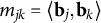 ${{m}_{jk}=\left\langle {\mathbf{b}}_j,{\mathbf{b}}_k\right\rangle}$
as the
${{m}_{jk}=\left\langle {\mathbf{b}}_j,{\mathbf{b}}_k\right\rangle}$
as the $j,k$
-th element of
$j,k$
-th element of $\mathbf{M}$
.
$\mathbf{M}$
.
2.1 Test space definition
Let $\mathbf{A}$
be the vector space made up by the set of
$\mathbf{A}$
be the vector space made up by the set of ${\mathbf{a}}_i$
vectors, with the operations sum and product by a scalar as in
${\mathbf{a}}_i$
vectors, with the operations sum and product by a scalar as in ${\mathbb{R}}^n$
. We want Reckase’s (Reference Reckase1985) definition of the multidimensional parameters in rectangular coordinates to be a particular case of our more general definition; we can thus consider an orthonormal basis
${\mathbb{R}}^n$
. We want Reckase’s (Reference Reckase1985) definition of the multidimensional parameters in rectangular coordinates to be a particular case of our more general definition; we can thus consider an orthonormal basis ${\mathcal{U}}^{\ast }$
in
${\mathcal{U}}^{\ast }$
in $\mathbf{A}$
such that
$\mathbf{A}$
such that ${\mathbf{a}}_i^{{\mathcal{U}}^{\ast }}={\mathrm{coord}}_{{\mathcal{U}}^{\ast }}\!{\left({\mathbf{a}}_i\right)}$
corresponds in the model to
${\mathbf{a}}_i^{{\mathcal{U}}^{\ast }}={\mathrm{coord}}_{{\mathcal{U}}^{\ast }}\!{\left({\mathbf{a}}_i\right)}$
corresponds in the model to ${\boldsymbol{\unicode{x3b8}}}^{\mathcal{U}}$
. Since the response probability to the M2PL, given by Equation (1), must be invariant with respect to the change of basis expressed in Equation (2),
${\boldsymbol{\unicode{x3b8}}}^{\mathcal{U}}$
. Since the response probability to the M2PL, given by Equation (1), must be invariant with respect to the change of basis expressed in Equation (2), ${\mathbf{a}}_i^T\boldsymbol{\unicode{x3b8}} ={{\mathbf{a}}_i^{{\mathcal{U}}^{\ast}}}^T{\boldsymbol{\unicode{x3b8}}}^{\mathcal{U}}={{\mathbf{a}}_i^{{\mathcal{U}}^{\ast}}}^T\mathbf{P}{\boldsymbol{\unicode{x3b8}}}^{\mathcal{B}}$
. Therefore, we find a basis
${\mathbf{a}}_i^T\boldsymbol{\unicode{x3b8}} ={{\mathbf{a}}_i^{{\mathcal{U}}^{\ast}}}^T{\boldsymbol{\unicode{x3b8}}}^{\mathcal{U}}={{\mathbf{a}}_i^{{\mathcal{U}}^{\ast}}}^T\mathbf{P}{\boldsymbol{\unicode{x3b8}}}^{\mathcal{B}}$
. Therefore, we find a basis ${\mathcal{B}}^{\ast }=\left\{{\mathbf{v}}_1,\dots, {\mathbf{v}}_n\right\}$
in
${\mathcal{B}}^{\ast }=\left\{{\mathbf{v}}_1,\dots, {\mathbf{v}}_n\right\}$
in $\mathbf{A}$
defined by
$\mathbf{A}$
defined by
 $$\begin{align}{\mathbf{a}}_i^{{\mathcal{U}}^{\ast }}={\left({\mathbf{P}}^{-1}\right)}^T{\mathbf{a}}_i^{{\mathcal{B}}^{\ast }},\kern2.00em\end{align}$$
where ${\mathbf{a}}_i^{{\mathcal{B}}^{\ast }}={\mathrm{coord}}_{{\mathcal{B}}^{\ast }}\left({\mathbf{a}}_i\right)$
and
${\mathbf{a}}_i^{{\mathcal{B}}^{\ast }}={\mathrm{coord}}_{{\mathcal{B}}^{\ast }}\left({\mathbf{a}}_i\right)$
and ${\left({\mathbf{P}}^{-1}\right)}^T$
is a change-of-basis matrix. Note that
${\left({\mathbf{P}}^{-1}\right)}^T$
is a change-of-basis matrix. Note that ${\left({\mathbf{P}}^{-1}\right)}^T$
determines
${\left({\mathbf{P}}^{-1}\right)}^T$
determines ${\mathcal{B}}^{\ast }$
and, as
${\mathcal{B}}^{\ast }$
and, as ${\mathbf{a}}_i$
is expressed in this basis, its geometric coordinates in
${\mathbf{a}}_i$
is expressed in this basis, its geometric coordinates in ${\mathcal{B}}^{\ast }$
are equal to its algebraic ones, that is, in Equation (1), we identify
${\mathcal{B}}^{\ast }$
are equal to its algebraic ones, that is, in Equation (1), we identify ${\mathbf{a}}_i={\mathbf{a}}_i^{{\mathcal{B}}^{\ast }}$
.
${\mathbf{a}}_i={\mathbf{a}}_i^{{\mathcal{B}}^{\ast }}$
.
As we did with $\mathcal{U}$
before, we can conveniently assume that the inner product in
$\mathcal{U}$
before, we can conveniently assume that the inner product in ${\mathcal{U}}^{\ast }$
is the dot product. Then, as both
${\mathcal{U}}^{\ast }$
is the dot product. Then, as both ${\mathcal{U}}^{\ast }$
and
${\mathcal{U}}^{\ast }$
and $\mathcal{U}$
are orthonormal in
$\mathcal{U}$
are orthonormal in ${\mathbb{R}}^n$
, to make Reckase’s (Reference Reckase1985) definition a particular case of ours, we can, without loss of generality (i.e., applying an arbitrary rotation), consider that
${\mathbb{R}}^n$
, to make Reckase’s (Reference Reckase1985) definition a particular case of ours, we can, without loss of generality (i.e., applying an arbitrary rotation), consider that $\mathcal{U}={\mathcal{U}}^{\ast }$
. As
$\mathcal{U}={\mathcal{U}}^{\ast }$
. As $\mathbf{P}$
(and consequently
$\mathbf{P}$
(and consequently ${\mathbf{P}}^T$
) is invertible,
${\mathbf{P}}^T$
) is invertible, $\mathbf{M}$
is also invertible, and
$\mathbf{M}$
is also invertible, and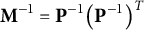 ${\mathbf{M}}^{-1}={\mathbf{P}}^{-1}{\left({\mathbf{P}}^{-1}\right)}^T$
. The norm of
${\mathbf{M}}^{-1}={\mathbf{P}}^{-1}{\left({\mathbf{P}}^{-1}\right)}^T$
. The norm of ${\mathbf{a}}_i$
thus fulfills
${\mathbf{a}}_i$
thus fulfills
 $$\begin{align*}{\parallel {\mathbf{a}}_i\parallel}^2={{\mathbf{a}}_i^{{\mathcal{U}}^{\ast}}}^T{\mathbf{a}}_i^{{\mathcal{U}}^{\ast }}={{\mathbf{a}}_i^{{\mathcal{B}}^{\ast}}}^T{\mathbf{P}}^{-1}{\left({\mathbf{P}}^{-1}\right)}^T{\mathbf{a}}_i^{{\mathcal{B}}^{\ast }}={{\mathbf{a}}_i^{{\mathcal{B}}^{\ast}}}^T{\mathbf{M}}^{-1}{\mathbf{a}}_i^{{\mathcal{B}}^{\ast }}.\end{align*}$$
Therefore, an inner product ${\left\langle, \right\rangle}_{{\mathcal{B}}^{\ast }}$
with Gram matrix
${\left\langle, \right\rangle}_{{\mathcal{B}}^{\ast }}$
with Gram matrix ${\mathbf{M}}^{-1}$
can be defined, such that
${\mathbf{M}}^{-1}$
can be defined, such that $\left\langle {\mathbf{a}}_i,{\mathbf{a}}_k\right\rangle ={{\mathbf{a}}_i^{{\mathcal{B}}^{\ast}}}^T{\mathbf{M}}^{-1}{\mathbf{a}}_k^{{\mathcal{B}}^{\ast }}$
keeps the norm of
$\left\langle {\mathbf{a}}_i,{\mathbf{a}}_k\right\rangle ={{\mathbf{a}}_i^{{\mathcal{B}}^{\ast}}}^T{\mathbf{M}}^{-1}{\mathbf{a}}_k^{{\mathcal{B}}^{\ast }}$
keeps the norm of ${\mathbf{a}}_i$
invariant. Following Zhang and Stout (Reference Zhang and Stout1999), we shall refer to space
${\mathbf{a}}_i$
invariant. Following Zhang and Stout (Reference Zhang and Stout1999), we shall refer to space $\mathbf{A}$
as the test space, as it is the space where the items (i.e., the test elements) are represented.
$\mathbf{A}$
as the test space, as it is the space where the items (i.e., the test elements) are represented.
2.2 Direction cosines in the latent space
The cosine between two vectors
 $$\begin{align}\cos {\gamma}_{jk}=\frac{\left\langle {\boldsymbol{\unicode{x3b8}}}_j,{\boldsymbol{\unicode{x3b8}}}_k\right\rangle }{\parallel {\boldsymbol{\unicode{x3b8}}}_j\parallel \parallel {\boldsymbol{\unicode{x3b8}}}_k\parallel}\kern2.00em\end{align}$$
is independent of whether the inner product is standard or not. Therefore, to compute the direction cosine $\cos {\gamma}_k^{\mathcal{B}}$
of vector
$\cos {\gamma}_k^{\mathcal{B}}$
of vector $\boldsymbol{\unicode{x3b8}}$
along dimension
$\boldsymbol{\unicode{x3b8}}$
along dimension $k$
, we plug it into Equation (6) along with the corresponding basis vector
$k$
, we plug it into Equation (6) along with the corresponding basis vector ${\mathbf{b}}_k$
:
${\mathbf{b}}_k$
:
 $$\begin{align}\cos {\gamma}_k^{\mathcal{B}}=\frac{{\left\langle {\mathbf{b}}_k,\boldsymbol{\unicode{x3b8}} \right\rangle}_{\mathcal{B}}}{\parallel {\mathbf{b}}_k\parallel \parallel \boldsymbol{\unicode{x3b8}} \parallel }=\frac{1}{\parallel {\mathbf{b}}_k\parallel}\frac{1}{\parallel \boldsymbol{\unicode{x3b8}} \parallel }{\mathbf{b}}_k^{\mathcal{B}}\mathbf{M}{\boldsymbol{\unicode{x3b8}}}^{\mathcal{B}}.\kern2.00em\end{align}$$
Let us consider now the vector $\cos {\boldsymbol{\unicode{x3b3}}}^{\mathcal{B}}$
, made up by the
$\cos {\boldsymbol{\unicode{x3b3}}}^{\mathcal{B}}$
, made up by the $n$
direction cosines of
$n$
direction cosines of $\boldsymbol{\unicode{x3b8}}$
with the basis vectors of
$\boldsymbol{\unicode{x3b8}}$
with the basis vectors of $\mathcal{B}$
.
$\mathcal{B}$
.
Proposition 1. Under the previously defined conditions, for all $\boldsymbol{\unicode{x3b8}} \in \boldsymbol{\Theta}$
,
$\boldsymbol{\unicode{x3b8}} \in \boldsymbol{\Theta}$
,
 $$\begin{align}\cos {\boldsymbol{\unicode{x3b3}}}^{\mathcal{B}}=\frac{{\mathbf{D}}^{-\frac{1}{2}}\mathbf{M}{\boldsymbol{\unicode{x3b8}}}^{\mathcal{B}}}{\parallel \boldsymbol{\unicode{x3b8}} \parallel}\end{align}$$
with
 $$\begin{align*}\mathbf{D}=\left(\begin{array}{ccc}{\parallel {\mathbf{b}}_1\parallel}^2& & \\ {}& \ddots & \\ {}& & {\parallel {\mathbf{b}}_n\parallel}^2\end{array}\right).\end{align*}$$
Therefore,
 $$\begin{align}{\boldsymbol{\unicode{x3b8}}}^{\mathcal{B}}={\mathbf{M}}^{-1}{\mathbf{D}}^{\frac{1}{2}}\cos {\boldsymbol{\unicode{x3b3}}}^{\mathcal{B}}\parallel \boldsymbol{\unicode{x3b8}} \parallel . \end{align}$$
Proof.
For every $k$
,
$k$
, $k=1,\dots, n$
,
$k=1,\dots, n$
,
 $$\begin{align*}\cos {\gamma}_k^{\mathcal{B}}=\frac{{\left\langle {\mathbf{b}}_k,\boldsymbol{\unicode{x3b8}} \right\rangle}_{\mathcal{B}}}{\parallel {\mathbf{b}}_k\parallel \parallel \boldsymbol{\unicode{x3b8}} \parallel }=\frac{{\mathrm{coord}}_{\mathcal{B}}^T\left({\mathbf{b}}_k\right)\mathbf{M}{\boldsymbol{\unicode{x3b8}}}^{\mathcal{B}}}{\parallel {\mathbf{b}}_k\parallel \parallel \boldsymbol{\unicode{x3b8}} \parallel }=\frac{{\mathbf{e}}_k^T\mathbf{M}{\boldsymbol{\unicode{x3b8}}}^{\mathcal{B}}}{\parallel {\mathbf{b}}_k\parallel \parallel \boldsymbol{\unicode{x3b8}} \parallel }=\frac{{\mathbf{M}}_k{\boldsymbol{\unicode{x3b8}}}^{\mathcal{B}}}{\parallel {\mathbf{b}}_k\parallel \parallel \boldsymbol{\unicode{x3b8}} \parallel },\end{align*}$$
with ${\mathbf{e}}_k$
is the
${\mathbf{e}}_k$
is the $k$
-th standard unitary vector and
$k$
-th standard unitary vector and ${\mathbf{M}}_k$
is the
${\mathbf{M}}_k$
is the $k$
-th row of
$k$
-th row of $\mathbf{M}$
.
$\mathbf{M}$
.
Therefore,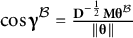 $\cos {\boldsymbol{\unicode{x3b3}}}^{\mathcal{B}}=\frac{{\mathbf{D}}^{-\frac{1}{2}}\mathbf{M}{\boldsymbol{\unicode{x3b8}}}^{\mathcal{B}}}{\parallel \boldsymbol{\unicode{x3b8}} \parallel }$
and
$\cos {\boldsymbol{\unicode{x3b3}}}^{\mathcal{B}}=\frac{{\mathbf{D}}^{-\frac{1}{2}}\mathbf{M}{\boldsymbol{\unicode{x3b8}}}^{\mathcal{B}}}{\parallel \boldsymbol{\unicode{x3b8}} \parallel }$
and ${\boldsymbol{\unicode{x3b8}}}^{\mathcal{B}}={\mathbf{M}}^{-1}{\mathbf{D}}^{\frac{1}{2}}\cos {\boldsymbol{\unicode{x3b3}}}^{\mathcal{B}}\parallel \boldsymbol{\unicode{x3b8}} \parallel$
.
${\boldsymbol{\unicode{x3b8}}}^{\mathcal{B}}={\mathbf{M}}^{-1}{\mathbf{D}}^{\frac{1}{2}}\cos {\boldsymbol{\unicode{x3b3}}}^{\mathcal{B}}\parallel \boldsymbol{\unicode{x3b8}} \parallel$
.
We can also obtain a result that relates the direction cosines of any two bases.
Proposition 2. Let us consider another basis $\mathcal{C}=\left\{{\mathbf{w}}_1,\dots, {\mathbf{w}}_n\right\}$
in
$\mathcal{C}=\left\{{\mathbf{w}}_1,\dots, {\mathbf{w}}_n\right\}$
in $\boldsymbol{\Theta}$
and the inner product
$\boldsymbol{\Theta}$
and the inner product ${\left\langle, \right\rangle}_{\mathcal{C}}$
that keeps the norm of the space invariant.
${\left\langle, \right\rangle}_{\mathcal{C}}$
that keeps the norm of the space invariant.
Let $\cos {\boldsymbol{\unicode{x3b3}}}^{\mathcal{U}}$
and
$\cos {\boldsymbol{\unicode{x3b3}}}^{\mathcal{U}}$
and $\cos {\boldsymbol{\unicode{x3b3}}}^{\mathcal{C}}$
be the vectors of direction cosines of
$\cos {\boldsymbol{\unicode{x3b3}}}^{\mathcal{C}}$
be the vectors of direction cosines of $\boldsymbol{\unicode{x3b8}}$
in
$\boldsymbol{\unicode{x3b8}}$
in $\mathcal{U}$
and
$\mathcal{U}$
and $\mathcal{C}$
, respectively.
$\mathcal{C}$
, respectively.
Then,
 $$\begin{align}\cos {\boldsymbol{\unicode{x3b3}}}^{\mathcal{C}}={\mathbf{H}}^{-\frac{1}{2}}{\left({\mathbf{P}}^{-1}\mathbf{L}\right)}^T{\mathbf{D}}^{\frac{1}{2}}\cos {\boldsymbol{\unicode{x3b3}}}^{\mathcal{B}},\end{align}$$
where
 $$\begin{align*}\mathbf{H}=\left(\begin{array}{ccc}{\parallel {\mathbf{w}}_1\parallel}^2& & \\ {}& \ddots & \\ {}& & {\parallel {\mathbf{w}}_n\parallel}^2\end{array}\right)\end{align*}$$
and $\mathbf{L}={}_{\mathcal{U}}{(I)}_{\mathcal{C}}$
.
$\mathbf{L}={}_{\mathcal{U}}{(I)}_{\mathcal{C}}$
.
Proof.
Let us call ${\boldsymbol{\unicode{x3b8}}}^{\mathcal{C}}={\mathrm{coord}}_{\mathcal{C}}\left(\boldsymbol{\unicode{x3b8}} \right)$
, and let
${\boldsymbol{\unicode{x3b8}}}^{\mathcal{C}}={\mathrm{coord}}_{\mathcal{C}}\left(\boldsymbol{\unicode{x3b8}} \right)$
, and let $\mathbf{L}={}_{\mathcal{U}}{(I)}_{\mathcal{C}}$
be the change-of-basis matrix, such that
$\mathbf{L}={}_{\mathcal{U}}{(I)}_{\mathcal{C}}$
be the change-of-basis matrix, such that ${\boldsymbol{\unicode{x3b8}}}^{\mathcal{U}}=\mathbf{L}{\boldsymbol{\unicode{x3b8}}}^{\mathcal{C}}$
.
${\boldsymbol{\unicode{x3b8}}}^{\mathcal{U}}=\mathbf{L}{\boldsymbol{\unicode{x3b8}}}^{\mathcal{C}}$
.
Then, we have that ${}_{\mathcal{B}}{(I)}_{\mathcal{C}}={}_{\mathcal{B}}{(I)}_{\mathcal{UU}}{(I)}_{\mathcal{C}}={\mathbf{P}}^{-1}\mathbf{L}$
.
${}_{\mathcal{B}}{(I)}_{\mathcal{C}}={}_{\mathcal{B}}{(I)}_{\mathcal{UU}}{(I)}_{\mathcal{C}}={\mathbf{P}}^{-1}\mathbf{L}$
.
The inner product ${\left\langle, \right\rangle}_{\mathcal{C}}$
that keeps the norm invariant is defined by
${\left\langle, \right\rangle}_{\mathcal{C}}$
that keeps the norm invariant is defined by ${\left\langle {\boldsymbol{\unicode{x3b8}}}_j,{\boldsymbol{\unicode{x3b8}}}_k\right\rangle}_{\mathcal{C}}={{\boldsymbol{\unicode{x3b8}}}_j^{\mathcal{C}}}^T{\mathbf{L}}^T\mathbf{L}{\boldsymbol{\unicode{x3b8}}}_k^{\mathcal{C}}$
, and we define
${\left\langle {\boldsymbol{\unicode{x3b8}}}_j,{\boldsymbol{\unicode{x3b8}}}_k\right\rangle}_{\mathcal{C}}={{\boldsymbol{\unicode{x3b8}}}_j^{\mathcal{C}}}^T{\mathbf{L}}^T\mathbf{L}{\boldsymbol{\unicode{x3b8}}}_k^{\mathcal{C}}$
, and we define $\mathbf{K}={\mathbf{L}}^T\mathbf{L}$
.
$\mathbf{K}={\mathbf{L}}^T\mathbf{L}$
.
By Proposition 1, for each case, we have
-
i. ${\boldsymbol{\unicode{x3b8}}}^{\mathcal{U}}=\cos {\boldsymbol{\unicode{x3b3}}}^{\mathcal{U}}\parallel \boldsymbol{\unicode{x3b8}} \parallel$
.
${\boldsymbol{\unicode{x3b8}}}^{\mathcal{U}}=\cos {\boldsymbol{\unicode{x3b3}}}^{\mathcal{U}}\parallel \boldsymbol{\unicode{x3b8}} \parallel$
. -
ii.
${\boldsymbol{\unicode{x3b8}}}^{\mathcal{B}}={\mathbf{M}}^{-1}{\mathbf{D}}^{\frac{1}{2}}\cos {\boldsymbol{\unicode{x3b3}}}^{\mathcal{B}}\parallel \boldsymbol{\unicode{x3b8}} \parallel$
. -
iii.
${\boldsymbol{\unicode{x3b8}}}^{\mathcal{C}}={\mathbf{K}}^{-1}{\mathbf{H}}^{\frac{1}{2}}\cos {\boldsymbol{\unicode{x3b3}}}^{\mathcal{C}}\parallel \boldsymbol{\unicode{x3b8}} \parallel$
.



Given i,
 $$\begin{align*}{\boldsymbol{\unicode{x3b8}}}^{\mathcal{U}}=\mathbf{P}{\boldsymbol{\unicode{x3b8}}}^{\mathcal{B}}=\cos {\boldsymbol{\unicode{x3b3}}}^{\mathcal{U}}\parallel \boldsymbol{\unicode{x3b8}} \parallel\end{align*}$$
and
 $$\begin{align*}{\boldsymbol{\unicode{x3b8}}}^{\mathcal{U}}=\mathbf{L}{\boldsymbol{\unicode{x3b8}}}^{\mathcal{C}}=\cos {\boldsymbol{\unicode{x3b3}}}^{\mathcal{U}}\parallel \boldsymbol{\unicode{x3b8}} \parallel .\end{align*}$$
Using ii and iii, we get that
 $$\begin{align*}\mathbf{P}{\mathbf{M}}^{-1}{\mathbf{D}}^{\frac{1}{2}}\cos {\boldsymbol{\unicode{x3b3}}}^{\mathcal{B}}\parallel \boldsymbol{\unicode{x3b8}} \parallel =\cos {\boldsymbol{\unicode{x3b3}}}^{\mathcal{U}}\parallel \boldsymbol{\unicode{x3b8}} \parallel\end{align*}$$
and
 $$\begin{align*}\mathbf{L}{\mathbf{K}}^{-1}{\mathbf{H}}^{\frac{1}{2}}\cos {\boldsymbol{\unicode{x3b3}}}^{\mathcal{C}}\parallel \boldsymbol{\unicode{x3b8}} \parallel =\cos {\boldsymbol{\unicode{x3b3}}}^{\mathcal{U}}\parallel \boldsymbol{\unicode{x3b8}} \parallel .\end{align*}$$
Therefore,
 $$\begin{align*}\mathbf{P}{\mathbf{M}}^{-1}{\mathbf{D}}^{\frac{1}{2}}\cos {\boldsymbol{\unicode{x3b3}}}^{\mathcal{B}}=\mathbf{L}{\mathbf{K}}^{-1}{\mathbf{H}}^{\frac{1}{2}}\cos {\boldsymbol{\unicode{x3b3}}}^{\mathcal{C}},\end{align*}$$
and thus $\cos {\boldsymbol{\unicode{x3b3}}}^{\mathcal{C}}={\mathbf{H}}^{-\frac{1}{2}}{\left({\mathbf{P}}^{-1}\mathbf{L}\right)}^T{\mathbf{D}}^{\frac{1}{2}}\cos {\boldsymbol{\unicode{x3b3}}}^{\mathcal{B}}$
.
$\cos {\boldsymbol{\unicode{x3b3}}}^{\mathcal{C}}={\mathbf{H}}^{-\frac{1}{2}}{\left({\mathbf{P}}^{-1}\mathbf{L}\right)}^T{\mathbf{D}}^{\frac{1}{2}}\cos {\boldsymbol{\unicode{x3b3}}}^{\mathcal{B}}$
.
3 Model recasting into polar coordinates
Applying Proposition 1 to the model formulation in Equation (1), the M2PL model is expressed in polar coordinates as
 $$\begin{align}{P}_i=\frac{1}{1+\exp \left[-\left({\mathbf{a}}_i^T{\mathbf{M}}^{-1}{\mathbf{D}}^{\frac{1}{2}}\cos {\boldsymbol{\unicode{x3b3}}}^{\mathcal{B}}\parallel \boldsymbol{\unicode{x3b8}} \parallel +{d}_i\right)\right]}.\kern2.00em\end{align}$$
As Equation (11) shows, the inner product matrix is involved in the expression of the model in polar coordinates. Importantly, this shows that the orthogonality of the latent space in Reckase (Reference Reckase1985) is assumed as early as in Equation 3 (p. 403), as we stated before.
4 Point of maximum slope
Following the procedure outlined by Reckase (Reference Reckase1985) and Reckase and McKinley (Reference Reckase and McKinley1991), we first compute the point of maximum slope by finding the root(s) of the second derivative with respect to $\parallel \boldsymbol{\unicode{x3b8}} \parallel$
.
$\parallel \boldsymbol{\unicode{x3b8}} \parallel$
.
The slope in direction ${\boldsymbol{\unicode{x3b3}}}^{\mathcal{B}}$
is given by
${\boldsymbol{\unicode{x3b3}}}^{\mathcal{B}}$
is given by
 $$\begin{align}\frac{\delta {P}_i}{\delta \parallel \boldsymbol{\unicode{x3b8}} \parallel }={P}_i\left(1-{P}_i\right){\mathbf{a}}_i^T{\mathbf{M}}^{-1}{\mathbf{D}}^{\frac{1}{2}}\cos {\boldsymbol{\unicode{x3b3}}}^{\mathcal{B}}\kern2.00em\end{align}$$
and
 $$\begin{align}\frac{\delta^2{P}_i}{\delta {\parallel \boldsymbol{\unicode{x3b8}} \parallel}^2}={\left({\mathbf{a}}_i^T{\mathbf{M}}^{-1}{\mathbf{D}}^{\frac{1}{2}}\cos {\boldsymbol{\unicode{x3b3}}}^{\mathcal{B}}\right)}^2{P}_i\left(1-{P}_i\right)\left(1-2{P}_i\right),\kern2.00em\end{align}$$
The root we are interested in is found for ${P}_i=.5$
(the other ones occur when
${P}_i=.5$
(the other ones occur when ${P}_i$
equals 0 and 1, which result in improper values of
${P}_i$
equals 0 and 1, which result in improper values of $\parallel \boldsymbol{\unicode{x3b8}} \parallel$
).
$\parallel \boldsymbol{\unicode{x3b8}} \parallel$
).
The slope in direction ${\boldsymbol{\unicode{x3b3}}}^{\mathcal{B}}={\boldsymbol{\unicode{x3b3}}}_i^{\mathcal{B}}$
when
${\boldsymbol{\unicode{x3b3}}}^{\mathcal{B}}={\boldsymbol{\unicode{x3b3}}}_i^{\mathcal{B}}$
when ${P}_i=.5$
is given by
${P}_i=.5$
is given by
 $$\begin{align}{\left.\frac{\delta {P}_i}{\delta \parallel \boldsymbol{\unicode{x3b8}} \parallel}\right|}_{P_i=.5}=\frac{1}{4}{\mathbf{a}}_i^T{\mathbf{M}}^{-1}{\mathbf{D}}^{\frac{1}{2}}\cos {\boldsymbol{\unicode{x3b3}}}_i^{\mathcal{B}}.\kern2.00em\end{align}$$
Notation aside, these equations differ from Reckase’s (1985) Equations (3)–(6) only in the term ${\mathbf{M}}^{-1}{\mathbf{D}}^{\frac{1}{2}}$
.
${\mathbf{M}}^{-1}{\mathbf{D}}^{\frac{1}{2}}$
.
To compute the direction of the maximum slope, Reckase leverages the property that the sum of the squared direction cosines equals 1 (see Equation 7 therein, p. 404). However, this assertion implicitly assumes orthogonal coordinates, so it does not apply in general to $\cos {\boldsymbol{\unicode{x3b3}}}^{\mathcal{B}}$
. Instead, we may consider the direction cosine vector with an orthonormal basis
$\cos {\boldsymbol{\unicode{x3b3}}}^{\mathcal{B}}$
. Instead, we may consider the direction cosine vector with an orthonormal basis $\mathcal{U}$
. Now, applying Proposition 2 (with both
$\mathcal{U}$
. Now, applying Proposition 2 (with both $\mathbf{L}$
and
$\mathbf{L}$
and $\mathbf{H}$
equal to the identity matrix), we obtain
$\mathbf{H}$
equal to the identity matrix), we obtain
 $$\begin{align}\begin{array}{rl}\cos {\boldsymbol{\unicode{x3b3}}}^{\mathcal{U}}&={\left({\mathbf{P}}^{-1}\right)}^T{\mathbf{D}}^{\frac{1}{2}}\cos {\boldsymbol{\unicode{x3b3}}}^{\mathcal{B}},\\{\mathbf{P}}^{-1}\cos {\boldsymbol{\unicode{x3b3}}}^{\mathcal{U}}&={\mathbf{M}}^{-1}{\mathbf{D}}^{\frac{1}{2}}\cos {\boldsymbol{\unicode{x3b3}}}^{\mathcal{B}}.\end{array}\end{align}$$
Therefore, substituting in (14),
 $$\begin{align}{\left.\frac{\delta {P}_i}{\delta \parallel \boldsymbol{\unicode{x3b8}} \parallel}\right|}_{P_i=.5}=\frac{1}{4}{\mathbf{a}}_i^T{\mathbf{P}}^{-1}\cos {\boldsymbol{\unicode{x3b3}}}_i^{\mathcal{U}}\kern2.00em\end{align}$$
and, by Equation (5),
 $$\begin{align}{\left.\frac{\delta {P}_i}{\delta \parallel \boldsymbol{\unicode{x3b8}} \parallel}\right|}_{P_i=.5}=\frac{1}{4}{{\mathbf{a}}_i^{{\mathcal{U}}^{\ast}}}^T\cos {\boldsymbol{\unicode{x3b3}}}_i^{\mathcal{U}}.\kern2.00em\end{align}$$
We are thus considering the direction cosines with respect to the orthonormal axes, so we can just apply Reckase’s (Reference Reckase1985) results, obtaining
 $$\begin{align}\cos {\boldsymbol{\unicode{x3b3}}}_i^{\mathcal{U}}=\frac{{\mathbf{a}}_i^{{\mathcal{U}}^{\ast }}}{\sqrt{{{\mathbf{a}}_i^{{\mathcal{U}}^{\ast}}}^T{\mathbf{a}}_i^{{\mathcal{U}}^{\ast }}}}.\kern2.00em\end{align}$$
Substituting $\cos {\boldsymbol{\unicode{x3b3}}}_i^{\mathcal{U}}$
(Equation (15)) and
$\cos {\boldsymbol{\unicode{x3b3}}}_i^{\mathcal{U}}$
(Equation (15)) and ${\mathbf{a}}_i^{{\mathcal{U}}^{\ast }}$
(Equation (5)) by their respective expressions results in the expression for the direction cosine vector of item
${\mathbf{a}}_i^{{\mathcal{U}}^{\ast }}$
(Equation (5)) by their respective expressions results in the expression for the direction cosine vector of item $i$
in
$i$
in $\boldsymbol{\Theta}$
,
$\boldsymbol{\Theta}$
,
 $$\begin{align}\cos {\boldsymbol{\unicode{x3b3}}}_i^{\mathcal{B}}=\frac{{\mathbf{D}}^{-\frac{1}{2}}{\mathbf{a}}_i^{{\mathcal{B}}^{\ast }}}{\sqrt{{{\mathbf{a}}_i^{{\mathcal{B}}^{\ast}}}^T{\mathbf{M}}^{-1}{\mathbf{a}}_i^{{\mathcal{B}}^{\ast }}}},\kern2.00em\end{align}$$
which gives the direction from the origin to the point where the slope is maximum. Finally, to determine the signed distance ${D}_i$
from the origin to that point, we solve Equation (11) for
${D}_i$
from the origin to that point, we solve Equation (11) for ${P}_i=.5$
to get
${P}_i=.5$
to get ${\parallel \boldsymbol{\unicode{x3b8}} \parallel =-{d}_i{\left({\mathbf{a}}_i^T{\mathbf{M}}^{-1}{\mathbf{D}}^{\frac{1}{2}}\cos {\boldsymbol{\unicode{x3b3}}}_i^{\mathcal{B}}\right)}^{-1}}$
. Using Equation (19),
${\parallel \boldsymbol{\unicode{x3b8}} \parallel =-{d}_i{\left({\mathbf{a}}_i^T{\mathbf{M}}^{-1}{\mathbf{D}}^{\frac{1}{2}}\cos {\boldsymbol{\unicode{x3b3}}}_i^{\mathcal{B}}\right)}^{-1}}$
. Using Equation (19),
 $$\begin{align}{D}_i=\frac{-{d}_i}{\sqrt{{{\mathbf{a}}_i^{{\mathcal{B}}^{\ast}}}^T{\mathbf{M}}^{-1}{\mathbf{a}}_i^{{\mathcal{B}}^{\ast }}}}.\kern2.00em\end{align}$$
The slope ${S}_i$
at the point defined by Equations (19) and (20) is given by Equation (14). Substituting Equation (19) in Equation (14), (Reckase & McKinley, Reference Reckase and McKinley1991),
${S}_i$
at the point defined by Equations (19) and (20) is given by Equation (14). Substituting Equation (19) in Equation (14), (Reckase & McKinley, Reference Reckase and McKinley1991),
 $$\begin{align}{S}_i=\frac{1}{4}\sqrt{{{\mathbf{a}}_i^{{\mathcal{B}}^{\ast}}}^T{\mathbf{M}}^{-1}{\mathbf{a}}_i^{{\mathcal{B}}^{\ast }}},\kern2.00em\end{align}$$
and thus, we have that
 $$\begin{align}\cos {\boldsymbol{\unicode{x3b3}}}_i^{\mathcal{B}}&=\frac{{\mathbf{D}}^{-\frac{1}{2}}{\mathbf{a}}_i}{\parallel {\mathbf{a}}_i\parallel },\nonumber\\{D}_i&=\frac{-{d}_i}{\parallel {\mathbf{a}}_i\parallel },\\{S}_i&=\frac{1}{4}\parallel {\mathbf{a}}_i\parallel .\nonumber \end{align}$$
5 Relationship between test space and latent space
Before presenting the results about the parameters, we make a few remarks regarding the vector space $\mathbf{A}$
. As shown before, this space is an entity by itself, distinct from the latent space
$\mathbf{A}$
. As shown before, this space is an entity by itself, distinct from the latent space $\boldsymbol{\Theta}$
. Despite this, the dot product in the exponent of Equation (1) induces a bijective relationship between their two sets of respective bases. Explicitly, if
$\boldsymbol{\Theta}$
. Despite this, the dot product in the exponent of Equation (1) induces a bijective relationship between their two sets of respective bases. Explicitly, if $\boldsymbol{\unicode{x3b8}}$
is represented in basis
$\boldsymbol{\unicode{x3b8}}$
is represented in basis $\mathcal{B}$
with inner product Gram matrix
$\mathcal{B}$
with inner product Gram matrix $\mathbf{M}$
,
$\mathbf{M}$
, ${\mathbf{a}}_i$
is represented in basis
${\mathbf{a}}_i$
is represented in basis ${\mathcal{B}}^{\ast }$
with inner product Gram matrix
${\mathcal{B}}^{\ast }$
with inner product Gram matrix ${\mathbf{M}}^{-1}$
, for any pair of bases
${\mathbf{M}}^{-1}$
, for any pair of bases $\mathcal{B}$
and
$\mathcal{B}$
and ${\mathcal{B}}^{\ast }$
. Only when the two bases are orthonormal, the two spaces share a common inner product (i.e., the dot product), and thus can be mistaken. However, it is worth noting that, although their representation can be superimposed in this case, they are still two different spaces.
${\mathcal{B}}^{\ast }$
. Only when the two bases are orthonormal, the two spaces share a common inner product (i.e., the dot product), and thus can be mistaken. However, it is worth noting that, although their representation can be superimposed in this case, they are still two different spaces.
We make a few observations here. First, the transformation to the orthonormal bases of the two spaces allows mapping the $M2 PL$
parameters interchangeably in the two spaces, by projecting one space onto the other; that is, we can set
$M2 PL$
parameters interchangeably in the two spaces, by projecting one space onto the other; that is, we can set
 $$\begin{align}{\boldsymbol{\unicode{x3b8}}}^{\mathcal{U}}={\boldsymbol{\unicode{x3b8}}}^{{\mathcal{U}}^{\ast }}\kern2.00em\end{align}$$
for any point, $\boldsymbol{\unicode{x3b8}}$
or
$\boldsymbol{\unicode{x3b8}}$
or ${\mathbf{a}}_i$
. This allows representing the coordinates of the latent space vectors in the test space and, conversely, the coordinates of the discrimination vectors in the latent space: by Equations (2), (5), and (23), any coordinate vector
${\mathbf{a}}_i$
. This allows representing the coordinates of the latent space vectors in the test space and, conversely, the coordinates of the discrimination vectors in the latent space: by Equations (2), (5), and (23), any coordinate vector ${\boldsymbol{\unicode{x3b8}}}^{\mathcal{B}}$
in
${\boldsymbol{\unicode{x3b8}}}^{\mathcal{B}}$
in $\mathcal{B}$
can be expressed in
$\mathcal{B}$
can be expressed in ${\mathcal{B}}^{\ast }$
as
${\mathcal{B}}^{\ast }$
as
 $$\begin{align}{\boldsymbol{\unicode{x3b8}}}^{{\mathcal{B}}^{\ast }}={\mathbf{P}}^T\mathbf{P}{\boldsymbol{\unicode{x3b8}}}^{\mathcal{B}}=\mathbf{M}{\boldsymbol{\unicode{x3b8}}}^{\mathcal{B}},\kern2.00em\end{align}$$
and vice versa. As we can see, the invariance of the model holds, regardless of the space in which we represent the coordinates.
Second, and most importantly, given that the test space is defined as the set of item parameters (see Section 2.1), then they should be represented in this space, and not in the latent space. Therefore, we may find the direction angles of ${\mathbf{a}}_i$
in the test space: applying Proposition 1, if
${\mathbf{a}}_i$
in the test space: applying Proposition 1, if ${\boldsymbol{\unicode{x3b1}}}_i$
is the vector of direction angles of
${\boldsymbol{\unicode{x3b1}}}_i$
is the vector of direction angles of ${\mathbf{a}}_i$
, in the test space
${\mathbf{a}}_i$
, in the test space $\mathbf{A}$
, we get
$\mathbf{A}$
, we get
 $$\begin{align}\cos {\boldsymbol{\unicode{x3b1}}}_i^{{\mathcal{B}}^{\ast }}=\frac{{\left(\mathbf{D}\prime \right)}^{-\frac{1}{2}}{\mathbf{M}}^{-1}{\mathbf{a}}_i^{{\mathcal{B}}^{\ast }}}{\parallel {\mathbf{a}}_i\parallel },\kern2.00em\end{align}$$
with $\mathbf{D}^{\prime }$
a diagonal matrix where
$\mathbf{D}^{\prime }$
a diagonal matrix where $d{\prime}_k={m}_{kk}^{-1}={\parallel {\mathbf{v}}_k\parallel}^2$
. As we will see later, this representation is very convenient, as the direction of the item vectors with respect to the coordinate axes has a direct, meaningful interpretation.
$d{\prime}_k={m}_{kk}^{-1}={\parallel {\mathbf{v}}_k\parallel}^2$
. As we will see later, this representation is very convenient, as the direction of the item vectors with respect to the coordinate axes has a direct, meaningful interpretation.
6 Generalized multidimensional parameters
The multidimensional item location $(MIL)$
is defined as the distance and direction from the origin to the point of maximum slope (Reckase, Reference Reckase1985). By analogy with the unidimensional case,
$(MIL)$
is defined as the distance and direction from the origin to the point of maximum slope (Reckase, Reference Reckase1985). By analogy with the unidimensional case, $MDISC$
is defined as
$MDISC$
is defined as $4{S}_i$
(Reckase & McKinley, Reference Reckase and McKinley1991). Hence, we may define the
$4{S}_i$
(Reckase & McKinley, Reference Reckase and McKinley1991). Hence, we may define the $MIL$
and
$MIL$
and $MDISC$
using Equations (20), (21), and (25). However, as they depend on the inner product matrix
$MDISC$
using Equations (20), (21), and (25). However, as they depend on the inner product matrix $\mathbf{M}$
, the choice we make of this matrix will lead us to different definitions of the parameters.
$\mathbf{M}$
, the choice we make of this matrix will lead us to different definitions of the parameters.
6.1 Agnostic version
Up to this point, we have derived the maximum slope and its location in the latent space $\boldsymbol{\Theta}$
independently of its basis
$\boldsymbol{\Theta}$
independently of its basis $\mathcal{B}$
. If we assume that
$\mathcal{B}$
. If we assume that $\mathcal{B}$
is orthonormal, that is,
$\mathcal{B}$
is orthonormal, that is, $\mathcal{B}\equiv \mathcal{U}$
,
$\mathcal{B}\equiv \mathcal{U}$
, $\mathbf{P}$
will also be orthonormal, and thus
$\mathbf{P}$
will also be orthonormal, and thus $\mathbf{M}={\mathbf{P}}^T\mathbf{P}=\mathbf{I}$
. In such a case, the multidimensional item location and discrimination simplify to the expressions derived by Reckase (Reference Reckase1985) and Reckase and McKinley (Reference Reckase and McKinley1991). As these expressions implicitly assume the orthonormality of
$\mathbf{M}={\mathbf{P}}^T\mathbf{P}=\mathbf{I}$
. In such a case, the multidimensional item location and discrimination simplify to the expressions derived by Reckase (Reference Reckase1985) and Reckase and McKinley (Reference Reckase and McKinley1991). As these expressions implicitly assume the orthonormality of $\mathcal{B}$
, which bears no meaning besides its pure algebraic purpose, we shall refer to them as the agnostic version of the parameters:
$\mathcal{B}$
, which bears no meaning besides its pure algebraic purpose, we shall refer to them as the agnostic version of the parameters:
 $$\begin{align*} MDIS{C}_{ag}&:= \sqrt{{\mathbf{a}}_i^T{\mathbf{a}}_i},\\MI{L}_{ag}&:= \left\{\frac{-{d}_i}{MDIS{C}_{ag}},\frac{{\mathbf{a}}_i}{MDIS{C}_{ag}}\right\}.\end{align*}$$
6.2 Covariance-based version
On the other hand, we can let the geometrical representation of the latent space $\boldsymbol{\Theta}$
account for its covariance structure, thus giving
$\boldsymbol{\Theta}$
account for its covariance structure, thus giving $\mathcal{B}$
a statistical meaning in the context of our MIRT modeling approach. To do that, we may assume that
$\mathcal{B}$
a statistical meaning in the context of our MIRT modeling approach. To do that, we may assume that ${\boldsymbol{\unicode{x3b8}}}^{\mathcal{B}}$
is a random vector distributed with covariance
${\boldsymbol{\unicode{x3b8}}}^{\mathcal{B}}$
is a random vector distributed with covariance $\boldsymbol{\Sigma} ={\boldsymbol{\Sigma}}^{\mathcal{B}}=\mathbf{SRS}$
, being
$\boldsymbol{\Sigma} ={\boldsymbol{\Sigma}}^{\mathcal{B}}=\mathbf{SRS}$
, being $\boldsymbol{\Sigma}$
an
$\boldsymbol{\Sigma}$
an $n$
-dimensional positive definite matrix,
$n$
-dimensional positive definite matrix, $\mathbf{R}$
its corresponding correlation matrix (also positive-definite), and
$\mathbf{R}$
its corresponding correlation matrix (also positive-definite), and $\mathbf{S}$
a scaling diagonal matrix with
$\mathbf{S}$
a scaling diagonal matrix with ${s}_{kk}^2={\sigma}_{kk}^2$
(i.e., the variances).
${s}_{kk}^2={\sigma}_{kk}^2$
(i.e., the variances).
To make the representation of $\boldsymbol{\Theta}$
meaningful, the axes in
$\boldsymbol{\Theta}$
meaningful, the axes in $\mathcal{B}$
must have an interpretation in terms of the latent space structure. Although we do not know, in principle, what the interpretation of a latent space basis should be, we may assume that it must be somewhat related to the covariance structure. Therefore, an orthonormal basis should represent independent, standard coordinates. Formally, if
$\mathcal{B}$
must have an interpretation in terms of the latent space structure. Although we do not know, in principle, what the interpretation of a latent space basis should be, we may assume that it must be somewhat related to the covariance structure. Therefore, an orthonormal basis should represent independent, standard coordinates. Formally, if ${\boldsymbol{\Sigma}}^{\mathcal{U}}$
is the covariance matrix of
${\boldsymbol{\Sigma}}^{\mathcal{U}}$
is the covariance matrix of ${\boldsymbol{\unicode{x3b8}}}^{\mathcal{U}}$
, then
${\boldsymbol{\unicode{x3b8}}}^{\mathcal{U}}$
, then ${\boldsymbol{\Sigma}}^{\mathcal{U}}=\mathbf{I}$
, which implies that Equation (2) actually represents a whitening transformation (Fukunaga, Reference Fukunaga2013). Given this,
${\boldsymbol{\Sigma}}^{\mathcal{U}}=\mathbf{I}$
, which implies that Equation (2) actually represents a whitening transformation (Fukunaga, Reference Fukunaga2013). Given this, ${\boldsymbol{\Sigma}}^{\mathcal{U}}=\mathbf{P}\boldsymbol{\Sigma } {\mathbf{P}}^T$
, and thus
${\boldsymbol{\Sigma}}^{\mathcal{U}}=\mathbf{P}\boldsymbol{\Sigma } {\mathbf{P}}^T$
, and thus
 $$\begin{align*}\begin{array}{l}\mathbf{P}\boldsymbol{\Sigma } {\mathbf{P}}^T=\mathbf{I},\\ {}\boldsymbol{\Sigma} ={\mathbf{P}}^{-1}{\left({\mathbf{P}}^{-1}\right)}^T={\mathbf{M}}^{-1}.\end{array}\end{align*}$$
Therefore, we may define $\mathbf{P}$
such that
$\mathbf{P}$
such that $\mathbf{M}={\boldsymbol{\Sigma}}^{-1}$
; in this case,
$\mathbf{M}={\boldsymbol{\Sigma}}^{-1}$
; in this case, $\mathbf{D}^{\prime }={\mathbf{S}}^2$
, resulting in the direction cosines defined by
$\mathbf{D}^{\prime }={\mathbf{S}}^2$
, resulting in the direction cosines defined by
 $$\begin{align}\cos \boldsymbol{\unicode{x3b1}} =\frac{{\mathbf{S}}^{-1}\boldsymbol{\Sigma} {\mathbf{a}}_i}{MDIS{C}_{\boldsymbol{\Sigma}}}.\kern2.00em\end{align}$$
Along with the expressions for the $MDISC$
and the signed distance, this results in a covariance-based version of the parameters:
$MDISC$
and the signed distance, this results in a covariance-based version of the parameters:
 $$\begin{align*} MDIS{C}_{\boldsymbol{\Sigma}}&:= \sqrt{{\mathbf{a}}_i^T\boldsymbol{\Sigma} {\mathbf{a}}_i,}\\MI{L}_{\boldsymbol{\Sigma}}&:= \left\{\frac{-{d}_i}{MDIS{C}_{\boldsymbol{\Sigma}}},\frac{{\mathbf{S}}^{-1}\boldsymbol{\Sigma} {\mathbf{a}}_i}{MDIS{C}_{\boldsymbol{\Sigma}}}\right\}.\end{align*}$$
According to Reckase and McKinley (Reference Reckase and McKinley1991), the multidimensional parameters must meet three conditions for being regarded as a valid generalization of the (unidimensional) item response theory (IRT) parameters:
-
1. If an item measures only dimension
$k$
, then
$MDISC={a}_{ik}$
. -
2. The distance
${D}_i$
has the same relationship with the intercept as
${b}_i$
in the unidimensional case, that is,
${d}_i=-{D}_i MDISC$
. -
3.
$MDISC$
is four times the maximum slope
${S}_i$
.







The second property derives straightforwardly from Equation (20), and the third one is implicit in the definition of the $MDISC$
. However, when an item measures only dimension
$MDISC$
. However, when an item measures only dimension $k$
, simple arithmetic can show that
$k$
, simple arithmetic can show that $MDISC={m}_{kk}^{-1}{a}_{ik}$
. In the covariance-based case, this means that
$MDISC={m}_{kk}^{-1}{a}_{ik}$
. In the covariance-based case, this means that $MDIS{C}_{\boldsymbol{\Sigma}}={\sigma}_{kk}{a}_{ik}$
and, as
$MDIS{C}_{\boldsymbol{\Sigma}}={\sigma}_{kk}{a}_{ik}$
and, as ${\sigma}_{kk}$
is generally different from 1,
${\sigma}_{kk}$
is generally different from 1, $MDIS{C}_{\boldsymbol{\Sigma}}$
does not fulfill the first property (we shall refer to this property as scale invariance, henceforth). Nevertheless,
$MDIS{C}_{\boldsymbol{\Sigma}}$
does not fulfill the first property (we shall refer to this property as scale invariance, henceforth). Nevertheless, $MDIS{C}_{\boldsymbol{\Sigma}}$
can be interpreted as a scaled version of the parameter, with the standard deviation of the corresponding dimension as a scaling factor. This transformation may be made in the unidimensional case as well, thus finding a standard-metric discrimination parameter (i.e., referred to a unitary variance space). Moreover, it is important to notice that, when the latent trait inner product Gram matrix is defined as
$MDIS{C}_{\boldsymbol{\Sigma}}$
can be interpreted as a scaled version of the parameter, with the standard deviation of the corresponding dimension as a scaling factor. This transformation may be made in the unidimensional case as well, thus finding a standard-metric discrimination parameter (i.e., referred to a unitary variance space). Moreover, it is important to notice that, when the latent trait inner product Gram matrix is defined as $\mathbf{M}={\boldsymbol{\Sigma}}^{-1}$
, the norm of a trait vector in the latent space is given by the Mahalanobis distance, that is,
$\mathbf{M}={\boldsymbol{\Sigma}}^{-1}$
, the norm of a trait vector in the latent space is given by the Mahalanobis distance, that is, $\parallel \boldsymbol{\unicode{x3b8}} \parallel =\sqrt{{\boldsymbol{\unicode{x3b8}}}^T{\boldsymbol{\Sigma}}^{-1}\boldsymbol{\unicode{x3b8}}}$
(Mahalanobis, Reference Mahalanobis2018).
$\parallel \boldsymbol{\unicode{x3b8}} \parallel =\sqrt{{\boldsymbol{\unicode{x3b8}}}^T{\boldsymbol{\Sigma}}^{-1}\boldsymbol{\unicode{x3b8}}}$
(Mahalanobis, Reference Mahalanobis2018).
6.3 Correlation-based version
Despite $MDIS{C}_{\boldsymbol{\Sigma}}$
not being scale-invariant, we have argued that it is still a valid generalization of the IRT parameters. However, it may be convenient to find yet another generalization, one that accounts for the latent space structure while still fulfilling this property. To do this, let us assume a matrix
$MDIS{C}_{\boldsymbol{\Sigma}}$
not being scale-invariant, we have argued that it is still a valid generalization of the IRT parameters. However, it may be convenient to find yet another generalization, one that accounts for the latent space structure while still fulfilling this property. To do this, let us assume a matrix $\mathbf{Q}=\mathbf{P}{\mathbf{S}}^{-1}$
, such that
$\mathbf{Q}=\mathbf{P}{\mathbf{S}}^{-1}$
, such that $\mathbf{I}=\mathbf{Q}\boldsymbol{\Sigma } {\mathbf{Q}}^T$
. Then, we have that
$\mathbf{I}=\mathbf{Q}\boldsymbol{\Sigma } {\mathbf{Q}}^T$
. Then, we have that
 $$\begin{align*}\mathbf{P}{\mathbf{S}}^{-1}\boldsymbol{\Sigma} {\mathbf{S}}^{-1}{\mathbf{P}}^T=\mathbf{P}{\mathbf{S}}^{-1}\mathbf{SRS}{\mathbf{S}}^{-1}{\mathbf{P}}^T=\mathbf{P}\mathbf{R}{\mathbf{P}}^T.\end{align*}$$
That is, defining $\mathbf{P}$
as
$\mathbf{P}$
as $\mathbf{QS}$
can be interpreted as re-scaling the transformed parameter back to its original metric. In this case, we get that
$\mathbf{QS}$
can be interpreted as re-scaling the transformed parameter back to its original metric. In this case, we get that ${\mathbf{M}}^{-1}={\mathbf{P}}^{-1}{\left({\mathbf{P}}^{-1}\right)}^T=\mathbf{R}$
. Therefore, we can also define a correlation-based version of the multidimensional parameters as
${\mathbf{M}}^{-1}={\mathbf{P}}^{-1}{\left({\mathbf{P}}^{-1}\right)}^T=\mathbf{R}$
. Therefore, we can also define a correlation-based version of the multidimensional parameters as
 $$\begin{align*} MDIS{C}_{\mathbf{R}}&:= \sqrt{{\mathbf{a}}_i^T\mathbf{R}{\mathbf{a}}_i,}\\MI{L}_{\mathbf{R}}&:= \left\{\frac{-{d}_i}{MDIS{C}_{\mathbf{R}}},\frac{\mathbf{R}{\mathbf{a}}_i}{MDIS{C}_{\mathbf{R}}}\right\}.\end{align*}$$
As we can see, this version also fulfills the scale invariance property, as the ${m}_{kk}^{-1}$
elements are the diagonal elements of
${m}_{kk}^{-1}$
elements are the diagonal elements of $\mathbf{R}$
, which are always equal to 1. It is important to note, though, that this transformation does not have another desirable property, which we have used to justify the covariance-based version: the
$\mathbf{R}$
, which are always equal to 1. It is important to note, though, that this transformation does not have another desirable property, which we have used to justify the covariance-based version: the ${\boldsymbol{\unicode{x3b8}}}^{\mathcal{U}}$
coordinates resulting from transforming
${\boldsymbol{\unicode{x3b8}}}^{\mathcal{U}}$
coordinates resulting from transforming ${\boldsymbol{\unicode{x3b8}}}^{\mathcal{B}}$
to the orthonormal basis
${\boldsymbol{\unicode{x3b8}}}^{\mathcal{B}}$
to the orthonormal basis $\mathcal{U}$
are not generally uncorrelated, as one would expect (save some exceptions, e.g., when all the variances are equal). Nevertheless, it is important to note how the
$\mathcal{U}$
are not generally uncorrelated, as one would expect (save some exceptions, e.g., when all the variances are equal). Nevertheless, it is important to note how the $MDIS{C}_{\mathbf{R}}$
accounts for the correlation structure of the latent space while still being scale invariant. This will be very useful for the purpose of representing the items graphically, as we will see later.
$MDIS{C}_{\mathbf{R}}$
accounts for the correlation structure of the latent space while still being scale invariant. This will be very useful for the purpose of representing the items graphically, as we will see later.
7 Vector representation
According to Ackerman (Reference Ackerman1994a), the most appropriate way of representing multidimensional items is in vector form. This allows representing several items altogether and analyzing them in terms of their multidimensional parameters (Ackerman, Reference Ackerman1996). An item vector will be applied at a direction and (signed) distance from the origin of the coordinate system given by its $MIL$
parameter, and will have a length equal to its
$MIL$
parameter, and will have a length equal to its $MDISC$
parameter. Its direction will also be given by the direction component of
$MDISC$
parameter. Its direction will also be given by the direction component of $MIL$
, so its orientation will always pass through the origin. Based on these conditions, we need to compute the origin and end coordinates of the vector, denoted by
$MIL$
, so its orientation will always pass through the origin. Based on these conditions, we need to compute the origin and end coordinates of the vector, denoted by ${\mathbf{o}}_i^{{\mathcal{B}}^{\ast }}$
and
${\mathbf{o}}_i^{{\mathcal{B}}^{\ast }}$
and ${\mathbf{e}}_i^{{\mathcal{B}}^{\ast }}$
, respectively.
${\mathbf{e}}_i^{{\mathcal{B}}^{\ast }}$
, respectively.
In an orthogonal basis, it is easy to compute the coordinates, as they are simply the orthogonal projections onto the corresponding axis. In the oblique case, it is not so simple, though, but we can take advantage of the orthonormalization introduced above. In basis ${\mathcal{U}}^{\ast }$
, the origin and end coordinates are
${\mathcal{U}}^{\ast }$
, the origin and end coordinates are ${\mathbf{o}}_i^{{\mathcal{U}}^{\ast }}={D}_i\cos {\boldsymbol{\unicode{x3b1}}}_i^{{\mathcal{U}}^{\ast }}$
and
${\mathbf{o}}_i^{{\mathcal{U}}^{\ast }}={D}_i\cos {\boldsymbol{\unicode{x3b1}}}_i^{{\mathcal{U}}^{\ast }}$
and ${\mathbf{e}}_i^{{\mathcal{U}}^{\ast }}={\mathbf{o}}_i^{{\mathcal{U}}^{\ast }}+ MDIS{C}_i\cos {\boldsymbol{\unicode{x3b1}}}_i^{{\mathcal{U}}^{\ast }}$
, respectively, and they correspond to the coordinates in
${\mathbf{e}}_i^{{\mathcal{U}}^{\ast }}={\mathbf{o}}_i^{{\mathcal{U}}^{\ast }}+ MDIS{C}_i\cos {\boldsymbol{\unicode{x3b1}}}_i^{{\mathcal{U}}^{\ast }}$
, respectively, and they correspond to the coordinates in ${\mathcal{B}}^{\ast }$
transformed according to Equation (5), that is,
${\mathcal{B}}^{\ast }$
transformed according to Equation (5), that is,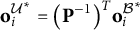 ${\mathbf{o}}_i^{{\mathcal{U}}^{\ast }}={\left({\mathbf{P}}^{-1}\right)}^T{\mathbf{o}}_i^{{\mathcal{B}}^{\ast }}$
and
${\mathbf{o}}_i^{{\mathcal{U}}^{\ast }}={\left({\mathbf{P}}^{-1}\right)}^T{\mathbf{o}}_i^{{\mathcal{B}}^{\ast }}$
and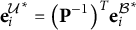 ${\mathbf{e}}_i^{{\mathcal{U}}^{\ast }}={\left({\mathbf{P}}^{-1}\right)}^T{\mathbf{e}}_i^{{\mathcal{B}}^{\ast }}$
. Applying Proposition 2 in the test space, we have that
${\mathbf{e}}_i^{{\mathcal{U}}^{\ast }}={\left({\mathbf{P}}^{-1}\right)}^T{\mathbf{e}}_i^{{\mathcal{B}}^{\ast }}$
. Applying Proposition 2 in the test space, we have that
 $$\begin{align*}{\mathbf{P}}^T\cos {\boldsymbol{\unicode{x3b1}}}_i^{{\mathcal{U}}^{\ast }}=\mathbf{M}{\left(\mathbf{D}\prime \right)}^{\frac{1}{2}}\cos {\boldsymbol{\unicode{x3b1}}}_i^{{\mathcal{B}}^{\ast }}.\end{align*}$$
Therefore, the coordinates result in
 $$\begin{align}{\mathbf{o}}_i^{{\mathcal{B}}^{\ast }}={D}_i\mathbf{M}{\left(\mathbf{D}\prime \right)}^{\frac{1}{2}}\cos {\boldsymbol{\unicode{x3b1}}}_i^{{\mathcal{B}}^{\ast }}\kern2.00em\end{align}$$
and
 $$\begin{align}{\mathbf{e}}_i^{{\mathcal{B}}^{\ast }}={\mathbf{o}}_i^{{\mathcal{B}}^{\ast }}+ MDIS{C}_i\mathbf{M}{\left(\mathbf{D}\prime \right)}^{\frac{1}{2}}\cos {\boldsymbol{\unicode{x3b1}}}_i^{{\mathcal{B}}^{\ast }}.\kern2.00em\end{align}$$
Equations (27) and (28) express the item coordinates in terms of their multidimensional parameters. However, it is worth noting that the latent space Gram matrix also plays a role in computing these coordinates and will therefore have an effect on the representation. Of course, from Equations (27) and (28), it is easy to express the coordinates in terms of the parameters in the original model formulation. Given ${\mathbf{a}}_i={\mathbf{a}}_i^{{\mathcal{B}}^{\ast }}$
, we can express the coordinates in terms of the model parameters as
${\mathbf{a}}_i={\mathbf{a}}_i^{{\mathcal{B}}^{\ast }}$
, we can express the coordinates in terms of the model parameters as
 $$\begin{align}{\mathbf{o}}_i^{{\mathcal{B}}^{\ast }}& =\frac{-{d}_i{\mathbf{a}}_i}{{\parallel {\mathbf{a}}_i\parallel}^2} \end{align}$$
and
 $$\begin{align}{\mathbf{e}}_i^{{\mathcal{B}}^{\ast }}& ={\mathbf{o}}_i^{{\mathcal{B}}^{\ast }}+{\mathbf{a}}_i. \end{align}$$
However, formulating them in terms of the multidimensional parameters allows studying the items in terms of their multidimensional properties. In the following, we see how to geometrically interpret these multidimensional parameters.
7.1 Geometric properties of the items
We have seen how the two new versions of the parameters fulfill the three conditions proposed by Reckase and McKinley (Reference Reckase and McKinley1991) for valid generalizations of the IRT parameters to the multidimensional case, being the scale invariance of the $MDIS{C}_{\boldsymbol{\Sigma}}$
the only exception. From a geometrical perspective, the item
$MDIS{C}_{\boldsymbol{\Sigma}}$
the only exception. From a geometrical perspective, the item $MDISC$
is simply interpreted as the length of its corresponding vector. Regarding the
$MDISC$
is simply interpreted as the length of its corresponding vector. Regarding the $MIL$
parameter, we will consider now two more properties related to each of its two components: the distance to the origin and the measurement direction.
$MIL$
parameter, we will consider now two more properties related to each of its two components: the distance to the origin and the measurement direction.
The (signed) distance to the origin, given by the first component of $MIL$
, has an interesting property: by the definition of the inner product,
$MIL$
, has an interesting property: by the definition of the inner product, $MDISC$
is strictly positive for nonnull vectors. Therefore, the sign of
$MDISC$
is strictly positive for nonnull vectors. Therefore, the sign of ${D}_i$
is the opposite of the sign of
${D}_i$
is the opposite of the sign of ${d}_i$
. The implication is that the item is displaced along its measurement direction forward or backward with respect to the origin, depending on whether
${d}_i$
. The implication is that the item is displaced along its measurement direction forward or backward with respect to the origin, depending on whether ${d}_i$
is negative or positive, respectively. As the
${d}_i$
is negative or positive, respectively. As the $MDISC$
appears in the denominator of
$MDISC$
appears in the denominator of ${D}_i$
, that displacement will be inversely proportional to the discrimination of the item. That is, the less discriminating the item is, the further away it will be from the origin. Of course, it is also directly proportional to the intercept parameter
${D}_i$
, that displacement will be inversely proportional to the discrimination of the item. That is, the less discriminating the item is, the further away it will be from the origin. Of course, it is also directly proportional to the intercept parameter ${d}_i$
. This implies that, if
${d}_i$
. This implies that, if ${d}_i=0$
,
${d}_i=0$
, ${D}_i=0$
as well, regardless of the MDISC.
${D}_i=0$
as well, regardless of the MDISC.
The measurement direction is given by the signs of $\cos {\boldsymbol{\unicode{x3b1}}}_i^{{\mathcal{B}}^{\ast}}$
, which, also due to the strict positiveness of
$\cos {\boldsymbol{\unicode{x3b1}}}_i^{{\mathcal{B}}^{\ast}}$
, which, also due to the strict positiveness of $MDISC$
, are equal to the signs of
$MDISC$
, are equal to the signs of ${\mathbf{a}}_i$
. This property leads directly to generalizing the parameters to the monotonically nonincreasing case: the measurement direction relative to dimension
${\mathbf{a}}_i$
. This property leads directly to generalizing the parameters to the monotonically nonincreasing case: the measurement direction relative to dimension $k$
will be negative when
$k$
will be negative when ${P}_i$
is monotonically decreasing with respect to variations along
${P}_i$
is monotonically decreasing with respect to variations along ${\theta}_k$
. When
${\theta}_k$
. When ${P}_i$
is constant with respect to variations along
${P}_i$
is constant with respect to variations along ${\theta}_k$
,
${\theta}_k$
, $\operatorname{sign}\left(\cos {\alpha}_{ik}\right)=0$
, which means that
$\operatorname{sign}\left(\cos {\alpha}_{ik}\right)=0$
, which means that $MIL$
is orthogonal to the
$MIL$
is orthogonal to the $k$
-th axis. However, note that this does not necessarily imply that the vector is parallel to any other axis (or strictly contained in the hyperplane formed by other axes, for that matter); this will always be true for the
$k$
-th axis. However, note that this does not necessarily imply that the vector is parallel to any other axis (or strictly contained in the hyperplane formed by other axes, for that matter); this will always be true for the $MI{L}_{ag}$
due to the orthogonality assumption, but it will depend on the correlation matrix
$MI{L}_{ag}$
due to the orthogonality assumption, but it will depend on the correlation matrix $\mathbf{R}$
for the other two versions of the parameter.
$\mathbf{R}$
for the other two versions of the parameter.
8 Graphical representation
The geometric properties are easier to apprehend with a visual representation of the items. To do that, we need to choose a version of the parameters that yields their most faithful representation. We have already seen that the agnostic version disregards the latent space structure. Therefore, it will only be useful in the unlikely case that we have no information of such structure. When we have an estimate of the latent space covariances, we may use either the covariance-based version or the correlation-based version. However, we have already seen how the distance to the origin depends on the $MDISC$
. In addition, in the covariance-based version, the term
$MDISC$
. In addition, in the covariance-based version, the term $\mathbf{M}{\left(\mathbf{D}^{\prime} \right)}^{\frac{1}{2}}$
becomes
$\mathbf{M}{\left(\mathbf{D}^{\prime} \right)}^{\frac{1}{2}}$
becomes ${\boldsymbol{\Sigma}}^{-1}\mathbf{S}={\mathbf{S}}^{-1}{\mathbf{R}}^{-1},$
which, as we have argued before, implies a change of scale. In the case of the correlation-based version, however,
${\boldsymbol{\Sigma}}^{-1}\mathbf{S}={\mathbf{S}}^{-1}{\mathbf{R}}^{-1},$
which, as we have argued before, implies a change of scale. In the case of the correlation-based version, however, $\mathbf{M}{\left(\mathbf{D}^{\prime} \right)}^{\frac{1}{2}}$
is simply
$\mathbf{M}{\left(\mathbf{D}^{\prime} \right)}^{\frac{1}{2}}$
is simply ${\mathbf{R}}^{-1}$
, being the coordinates scale-invariant. For graphical representation purposes, the correlation-based version will thus be preferred.
${\mathbf{R}}^{-1}$
, being the coordinates scale-invariant. For graphical representation purposes, the correlation-based version will thus be preferred.
Plotting on a display usually requires providing coordinates in a rectangular Cartesian system. Therefore, we must compute the equivalent rectangular coordinates of our general, possibly nonrectangular coordinates. Coordinates in a rectangular Cartesian system are commonly assumed to be simply represented in the canonical basis. To represent an item in the test space properly, however, we must use its basis ${\mathcal{B}}^{\ast }$
, which implies pre-multiplying its coordinates by
${\mathcal{B}}^{\ast }$
, which implies pre-multiplying its coordinates by ${\left({\mathbf{P}}^{-1}\right)}^T$
to find the equivalent coordinates in the canonical basis. Hence, we will need a convenient value for
${\left({\mathbf{P}}^{-1}\right)}^T$
to find the equivalent coordinates in the canonical basis. Hence, we will need a convenient value for ${\left({\mathbf{P}}^{-1}\right)}^T$
that allows us to represent the test space structure and the items in a rectangular Cartesian system.
${\left({\mathbf{P}}^{-1}\right)}^T$
that allows us to represent the test space structure and the items in a rectangular Cartesian system.
The general procedure for plotting an item $i$
consists of the following steps:
$i$
consists of the following steps:
-
1. Compute
$MDIS{C}_{\mathbf{R}i}$
and
$MI{L}_{\mathbf{R}i}$
, the item
$MDIS{C}_{\mathbf{R}}$
and
$MI{L}_{\mathbf{R}}$
parameters, respectively. -
2. Compute the origin coordinates
${\mathbf{o}}_i^{{\mathcal{B}}^{\ast }}={D}_{\mathbf{R}i}{\mathbf{R}}^{-1}\cos {\boldsymbol{\unicode{x3b1}}}_{\mathbf{R}i}$
, with
${D}_{\mathbf{R}i}$
and
$\cos {\boldsymbol{\unicode{x3b1}}}_{\mathbf{R}i}$
the distance and direction component, respectively, of
$MI{L}_{\mathbf{R}i}$
. -
3. Compute the end coordinates
${\mathbf{e}}_i^{{\mathcal{B}}^{\ast }}={\mathbf{o}}_i+ MDIS{C}_{\mathbf{R}i}{\mathbf{R}}^{-1}\cos {\boldsymbol{\unicode{x3b1}}}_{\mathbf{R}i}$
. -
4. Define
${\left({\mathbf{P}}^{-1}\right)}^T$
such that
${\mathbf{P}}^{-1}{\left({\mathbf{P}}^{-1}\right)}^T=\mathbf{R}$
. -
5. Compute the rectangular coordinates
${\mathbf{o}}_i^{{\mathcal{U}}^{\ast }}$
and
${\mathbf{e}}_i^{{\mathcal{U}}^{\ast }}$
by pre-multiplying
${\mathbf{o}}_i^{{\mathcal{B}}^{\ast }}$
and
${\mathbf{e}}_i^{{\mathcal{B}}^{\ast }}$
, respectively, by the transformation matrix
${\left({\mathbf{P}}^{-1}\right)}^T$
(
${\mathbf{o}}_i^{{\mathcal{U}}^{\ast }}={\left({\mathbf{P}}^{-1}\right)}^T{\mathbf{o}}_i^{{\mathcal{B}}^{\ast }}$
;
${\mathbf{e}}_i^{{\mathcal{U}}^{\ast }}={\left({\mathbf{P}}^{-1}\right)}^T{\mathbf{e}}_i^{{\mathcal{B}}^{\ast }}$
).







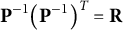


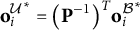
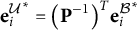
Instead of Steps 1–3, one can alternatively compute ${\mathbf{o}}_i^{{\mathcal{B}}^{\ast }}$
and
${\mathbf{o}}_i^{{\mathcal{B}}^{\ast }}$
and ${\mathbf{e}}_i^{{\mathcal{B}}^{\ast }}$
directly from Equations (29) and (30). Note, however, that these equations are not independent of
${\mathbf{e}}_i^{{\mathcal{B}}^{\ast }}$
directly from Equations (29) and (30). Note, however, that these equations are not independent of $\mathbf{R}$
, as it is used in the computation of
$\mathbf{R}$
, as it is used in the computation of $\parallel {\mathbf{a}}_i\parallel$
, and thus this matrix is necessary in any case to compute the coordinates.
$\parallel {\mathbf{a}}_i\parallel$
, and thus this matrix is necessary in any case to compute the coordinates.
8.1 Graphical representation example
Up to now, all our derivations have considered $n$
-dimensional spaces, that is, multidimensional parameters and item vector coordinates can be computed in an arbitrary large number of dimensions. However, as plotting more than two dimensions is difficult on a bidimensional display (and hardly possible at all for more than three dimensions with the currently available technology), we limit ourselves to the bidimensional case here. The example in
Figure 1
showcases the test space representation of a set of items under two different latent trait distributions. In formal terms, the proper axis labeling of this figure should correspond to the vectors that make up basis
$n$
-dimensional spaces, that is, multidimensional parameters and item vector coordinates can be computed in an arbitrary large number of dimensions. However, as plotting more than two dimensions is difficult on a bidimensional display (and hardly possible at all for more than three dimensions with the currently available technology), we limit ourselves to the bidimensional case here. The example in
Figure 1
showcases the test space representation of a set of items under two different latent trait distributions. In formal terms, the proper axis labeling of this figure should correspond to the vectors that make up basis ${\mathcal{B}}^{\ast }$
, in this case,
${\mathcal{B}}^{\ast }$
, in this case, ${\mathbf{v}}_1$
and
${\mathbf{v}}_1$
and ${\mathbf{v}}_2$
; the coordinates represent the coefficients that multiply each basis vector to obtain the corresponding coordinate in the test space. However, these coefficients correspond to the values of a vector in the test space, whether
${\mathbf{v}}_2$
; the coordinates represent the coefficients that multiply each basis vector to obtain the corresponding coordinate in the test space. However, these coefficients correspond to the values of a vector in the test space, whether ${\mathbf{a}}_i^{{\mathcal{B}}^{\ast }}$
for
${\mathbf{a}}_i^{{\mathcal{B}}^{\ast }}$
for ${\mathbf{a}}_i$
or
${\mathbf{a}}_i$
or ${\boldsymbol{\unicode{x3b8}}}^{{\mathcal{B}}^{\ast }}$
for
${\boldsymbol{\unicode{x3b8}}}^{{\mathcal{B}}^{\ast }}$
for $\boldsymbol{\unicode{x3b8}}$
(as given by Equation (24)). For the sake of simplicity, we label the axes as
$\boldsymbol{\unicode{x3b8}}$
(as given by Equation (24)). For the sake of simplicity, we label the axes as ${\theta}_1$
and
${\theta}_1$
and ${\theta}_2$
, highlighting the comparison of the items with the latent trait vectors. However, note that these coordinates actually correspond to the components of
${\theta}_2$
, highlighting the comparison of the items with the latent trait vectors. However, note that these coordinates actually correspond to the components of ${\boldsymbol{\unicode{x3b8}}}^{{\mathcal{B}}^{\ast }}$
, that is,
${\boldsymbol{\unicode{x3b8}}}^{{\mathcal{B}}^{\ast }}$
, that is, ${\theta}_1^{{\mathcal{B}}^{\ast }}$
and
${\theta}_1^{{\mathcal{B}}^{\ast }}$
and ${\theta}_2^{{\mathcal{B}}^{\ast }}$
.
${\theta}_2^{{\mathcal{B}}^{\ast }}$
.
Item vector plots with uncorrelated (a) and correlated latent dimensions. The latter coordinates are computed with (b) the agnostic multidimensional parameters or with the correlation-based ones, which are then plotted either (c) in an oblique basis, appropriate for the covariance structure, or (d) in the canonical basis.
Note: The items are represented along with a bivariate standard normal distribution, with null correlation (a) or correlation $\rho =.5$
(b–d). The contour plots represent (from outer to inner) 10%, 50%, and 90% of the maximum density.
$\rho =.5$
(b–d). The contour plots represent (from outer to inner) 10%, 50%, and 90% of the maximum density.

The parameters of the items in Figure 1 are shown in Table 1, both in the original M2PL metric and in the multidimensional metric under the two cases, which differ in the latent trait correlation. In the first case (columns $\rho =0$
), the two latent dimensions are independent; in the second one (
$\rho =0$
), the two latent dimensions are independent; in the second one ( $\rho =.5$
), the correlation between them is .5. The same M2PL parameters are used in both cases, but their (correlation-based) multidimensional parameters change with the correlation. (If we used the agnostic version instead, the multidimensional parameters, given by the values under
$\rho =.5$
), the correlation between them is .5. The same M2PL parameters are used in both cases, but their (correlation-based) multidimensional parameters change with the correlation. (If we used the agnostic version instead, the multidimensional parameters, given by the values under $\rho =0$
, would be the same in both cases.)
$\rho =0$
, would be the same in both cases.)
Item parameters for the graphical representation example.

Note: M2PL = multidimensional two-parameter logistic model; $\rho$
= correlation;
$\rho$
= correlation; ${a}_{ik}$
= item discrimination parameter (in dimension
${a}_{ik}$
= item discrimination parameter (in dimension $k$
);
$k$
); ${d}_i$
= item intercept parameter;
${d}_i$
= item intercept parameter; $MDIS{C}_i$
= multidimensional item discrimination parameter;
$MDIS{C}_i$
= multidimensional item discrimination parameter; ${D}_i$
= distance component of the multidimensional item location parameter;
${D}_i$
= distance component of the multidimensional item location parameter; ${\alpha}_{ik}$
= direction component of the multidimensional item location parameter (in dimension
${\alpha}_{ik}$
= direction component of the multidimensional item location parameter (in dimension $k$
). The multidimensional components are the correlation-based version.
$k$
). The multidimensional components are the correlation-based version.
Panel (a) of Figure 1 shows the item representation in the uncorrelated case, whereas the $\rho =.5$
case is shown in panels (b)–(d) under different conditions: with item coordinates computed from the agnostic version of the parameters (panel [b]) or from the correlation-based version, either using an appropriate oblique basis (panel [c]) or plotting them directly in the canonical basis (panel [d]). Keeping the horizontal axis invariant in panel (c) allows for a better comparison with the other plots; therefore, we have chosen a
$\rho =.5$
case is shown in panels (b)–(d) under different conditions: with item coordinates computed from the agnostic version of the parameters (panel [b]) or from the correlation-based version, either using an appropriate oblique basis (panel [c]) or plotting them directly in the canonical basis (panel [d]). Keeping the horizontal axis invariant in panel (c) allows for a better comparison with the other plots; therefore, we have chosen a ${\left({\mathbf{P}}^{-1}\right)}^T$
that only rotates the vertical axis (Harman, Reference Harman1976):
${\left({\mathbf{P}}^{-1}\right)}^T$
that only rotates the vertical axis (Harman, Reference Harman1976):
 $$\begin{align*}{\left({\mathbf{P}}^{-1}\right)}^T:= \left[\begin{array}{cc}1& \rho \\ {}0& \sqrt{1-{\rho}^2}\end{array}\right].\end{align*}$$
In all four panels, the contours of a bivariate standard normal density with the corresponding correlation are plotted along with the items (from outer to inner, the contours represent 10%, 50%, and 90% of the density at the mode). The stretched ellipses in panel (c) are the result of transforming the distribution in the latent space to the test space, according to Equation (24). This implies that the covariance matrix of the distribution projected into the test space is transformed inversely as in the latent space, that is, ${\boldsymbol{\Sigma}}^{{\mathcal{B}}^{\ast }}={\left({\mathbf{Q}}^{-1}\right)}^T\boldsymbol{\Sigma} {\mathbf{Q}}^{-1}$
.
${\boldsymbol{\Sigma}}^{{\mathcal{B}}^{\ast }}={\left({\mathbf{Q}}^{-1}\right)}^T\boldsymbol{\Sigma} {\mathbf{Q}}^{-1}$
.
Panels (a) and (b) of Figure 1 show that, even if the agnostic coordinates are the same in both cases, their relative position with respect to the latent trait distribution is not—illustrating the effect of disregarding the covariance structure. The correlation-based coordinates, plotted in panels (c) and (d), are also different in general from their agnostic counterpart (panel [b]). Although they do not vary in some cases (items 1 and 4), the difference is especially salient in the location of items 2 and 3, which are close to the 90% contour in the agnostic version but almost on the 50% contour in the correlation-based one. Panel (d) also illustrates the effect of plotting the coordinates directly on the canonical basis; the item locations and their positions relative to the distribution are correctly represented (which makes comparing with panel [b] easier), but their discrimination parameters and angles with the axes are distorted. For example, items 4 and 5 appear equally discriminating, when Table 1 and panel (c) of Figure 1 show they are not, and item 1 forms 45-degree angles with both axes instead of the 30-degree ones shown in Table 1.
A comparison of panels (a) and (c) allows understanding the effect of a positive correlation on the $MDIS{C}_{\mathbf{R}}$
(and consequently the
$MDIS{C}_{\mathbf{R}}$
(and consequently the $MI{L}_{\mathbf{R}}$
) value of an item: the components of the discrimination parameters tend to sum up in the same direction as they get more aligned. Thus, if the discrimination parameters have the same sign, as in items 1 and 5, the
$MI{L}_{\mathbf{R}}$
) value of an item: the components of the discrimination parameters tend to sum up in the same direction as they get more aligned. Thus, if the discrimination parameters have the same sign, as in items 1 and 5, the $MDIS{C}_{\mathbf{R}}$
value tends to increase; on the contrary, when the discrimination parameters have opposite signs, they tend to cancel each other out, and
$MDIS{C}_{\mathbf{R}}$
value tends to increase; on the contrary, when the discrimination parameters have opposite signs, they tend to cancel each other out, and $MDIS{C}_{\mathbf{R}}$
decreases, as happens with items 2 and 3. This effect can be especially noticed by comparing the
$MDIS{C}_{\mathbf{R}}$
decreases, as happens with items 2 and 3. This effect can be especially noticed by comparing the $MDIS{C}_{\mathbf{R}}$
values of items 3 and 5: their discrimination parameters are equal in absolute value, so their
$MDIS{C}_{\mathbf{R}}$
values of items 3 and 5: their discrimination parameters are equal in absolute value, so their $MDIS{C}_{\mathbf{R}}$
values are equal in the orthogonal space; however, the effect of the correlation shrinks the former and stretches the latter. Finally, note that item 4 has one discrimination parameter equal to 0, so its
$MDIS{C}_{\mathbf{R}}$
values are equal in the orthogonal space; however, the effect of the correlation shrinks the former and stretches the latter. Finally, note that item 4 has one discrimination parameter equal to 0, so its $MDIS{C}_{\mathbf{R}}$
is unaffected by the correlation.
$MDIS{C}_{\mathbf{R}}$
is unaffected by the correlation.
We can also see how the sign of ${d}_i$
affects the distance to the origin: an item vector is applied at the origin when its value is null (item 1) and tends to be shifted against the item direction when its value is positive (items 2 and 4) and towards the item direction when it is negative (items 3 and 5). Finally, we can see how the direction is determined by the discrimination parameters and the correlation; the sign of the discrimination parameters determines where the item will point at; thus, an item with two positive (negative) discrimination parameters will point at the first (third) quadrant, whereas an item with opposite-sign discrimination parameters will be in the second or fourth quadrant. The direction relative to the axes will be given by the relative absolute value of the two parameters, but also by the correlation: items 2 and 3 especially illustrate this effect, as each of them is orthogonal to one of the axes in the oblique space, even when they are not parallel to the other one.
${d}_i$
affects the distance to the origin: an item vector is applied at the origin when its value is null (item 1) and tends to be shifted against the item direction when its value is positive (items 2 and 4) and towards the item direction when it is negative (items 3 and 5). Finally, we can see how the direction is determined by the discrimination parameters and the correlation; the sign of the discrimination parameters determines where the item will point at; thus, an item with two positive (negative) discrimination parameters will point at the first (third) quadrant, whereas an item with opposite-sign discrimination parameters will be in the second or fourth quadrant. The direction relative to the axes will be given by the relative absolute value of the two parameters, but also by the correlation: items 2 and 3 especially illustrate this effect, as each of them is orthogonal to one of the axes in the oblique space, even when they are not parallel to the other one.
9 Application to examples from the literature
In the following, we apply our results to two instances taken from the MIRT literature. The first one draws from a classic example by Reckase (Reference Reckase2009), who presents a three-dimensional instrument made up of 30 items. It is supposed to be a cognitive test (it is unclear whether the item parameters are estimated from actual empirical data, or they are a fictional example, created ad hoc for simulation purposes), so all the discrimination parameters are positive. The second example, taken from Tezza et al. (Reference Tezza, Bornia, De Andrade and Barbetta2018), is an application of the M2PL to assess the quality of e-commerce websites. Besides being an empirical example, applied to actual test data, it pertains to the noncognitive domain and contains items with negative discrimination parameters. This is convenient for exemplifying our results with items with opposite-sign discrimination parameters.
The two examples are represented in Tables 2 and 3, respectively. Each of these tables shows the original M2PL parameters (the estimation errors in Tezza et al., Reference Tezza, Bornia, De Andrade and Barbetta2018 are omitted for clarity), along with the agnostic version of the multidimensional parameters; the $MDIS{C}_{ag}$
and the
$MDIS{C}_{ag}$
and the ${D}_{ag}$
are coincident with their respective original sources (see Table 6.1 in Reckase, Reference Reckase2009, p. 153, and Table 5 in Tezza et al., Reference Tezza, Bornia, De Andrade and Barbetta2018, p. 926). In the first case, the direction angles are also coincident with the values provided in the original (Tezza et al., Reference Tezza, Bornia, De Andrade and Barbetta2018 do not provide these results). In order to facilitate the comparison, the covariance-based version of each parameter is provided in the column next to its corresponding agnostic version. The interested reader can explore the complete code for these examples in the indexed Software Heritage repository for this paper, specifically: swh:1:cnt:fd94bc78c3443fa0207429a4aa3098b2961fc75e;anchor=swh:1:dir:6195936c6e16023c4a0b6a4500b81a34469d64f1;path=/src/Empirical_example.R.
${D}_{ag}$
are coincident with their respective original sources (see Table 6.1 in Reckase, Reference Reckase2009, p. 153, and Table 5 in Tezza et al., Reference Tezza, Bornia, De Andrade and Barbetta2018, p. 926). In the first case, the direction angles are also coincident with the values provided in the original (Tezza et al., Reference Tezza, Bornia, De Andrade and Barbetta2018 do not provide these results). In order to facilitate the comparison, the covariance-based version of each parameter is provided in the column next to its corresponding agnostic version. The interested reader can explore the complete code for these examples in the indexed Software Heritage repository for this paper, specifically: swh:1:cnt:fd94bc78c3443fa0207429a4aa3098b2961fc75e;anchor=swh:1:dir:6195936c6e16023c4a0b6a4500b81a34469d64f1;path=/src/Empirical_example.R.
Agnostic and covariance-based multidimensional item parameters in Reckase (Reference Reckase2009), with a (rank-complete) three-dimensional covariance matrix.

Note: M2PL = multidimensional two-parameter logistic model; ${a}_{ik}$
= item discrimination parameter (in dimension
${a}_{ik}$
= item discrimination parameter (in dimension $k$
);
$k$
); ${d}_i$
= item intercept parameter;
${d}_i$
= item intercept parameter; $MDIS{C}_i$
= multidimensional item discrimination parameter;
$MDIS{C}_i$
= multidimensional item discrimination parameter; ${D}_i$
= distance component of the multidimensional item location parameter;
${D}_i$
= distance component of the multidimensional item location parameter; ${\alpha}_{ik}$
= direction component of the multidimensional item location parameter (in dimension
${\alpha}_{ik}$
= direction component of the multidimensional item location parameter (in dimension $k$
); ag. = agnostic version;
$k$
); ag. = agnostic version; $\boldsymbol{\Sigma}$
= covariance-based version.
$\boldsymbol{\Sigma}$
= covariance-based version.
Agnostic and covariance-based multidimensional item parameters in Tezza et al. (Reference Tezza, Bornia, De Andrade and Barbetta2018).

Note: M2PL = multidimensional two-parameter logistic model; ${a}_{ik}$
= item discrimination parameter (in dimension
${a}_{ik}$
= item discrimination parameter (in dimension $k$
);
$k$
); ${d}_i$
= item intercept parameter;
${d}_i$
= item intercept parameter; $MDIS{C}_i$
= multidimensional item discrimination parameter;
$MDIS{C}_i$
= multidimensional item discrimination parameter; ${D}_i$
= distance component of the multidimensional item location parameter;
${D}_i$
= distance component of the multidimensional item location parameter; ${\alpha}_{ik}$
= direction component of the multidimensional item location parameter (in dimension
${\alpha}_{ik}$
= direction component of the multidimensional item location parameter (in dimension $k$
); ag. = agnostic version;
$k$
); ag. = agnostic version; $\boldsymbol{\Sigma}$
= covariance-based version.
$\boldsymbol{\Sigma}$
= covariance-based version.
9.1 Reckase (Reference Reckase2009)
Table 2 shows the parameters of the 30-item test in the Reckase (Reference Reckase2009) example: there are three 10-item blocks assumed to approximate a simple structure: items 1–10 measure dimension 1, items 11–20 dimension 3, and items 21–30 dimension 2 (see Table 6.1 in Reckase, Reference Reckase2009, p. 153). In his example, Reckase tests the estimation of these items on two simulated datasets: in the first one, the latent trait distribution is standard with null correlations; however, the second one has
 $$\begin{align*}\left(\begin{array}{ccc}1.210& 0.297& 1.232\\ {}0.297& 0.810& 0.252\\ {}1.232& 0.252& 1.960\end{array}\right),\end{align*}$$
as a covariance matrix, which corresponds to a correlation matrix of
 $$\begin{align*}\left(\begin{array}{ccc}1& 0.3& 0.8\\ {}0.3& 1& 0.2\\ {}0.8& 0.2& 1\end{array}\right).\end{align*}$$
As we can see in Table 2, the agnostic versions of the multidimensional parameters (columns labeled ag.) coincide with Reckase’s columns A, B, and ${\alpha}_1$
–
${\alpha}_1$
– ${\alpha}_3$
. However, when we consider the latent space structure (columns labeled
${\alpha}_3$
. However, when we consider the latent space structure (columns labeled $\boldsymbol{\Sigma}$
), we notice several differences. First, the
$\boldsymbol{\Sigma}$
), we notice several differences. First, the $MDIS{C}_i$
parameters tend to be larger than their agnostic counterparts. This happens because all the discrimination parameters and the latent space correlations are positive; in this respect, these items are similar to item 1 in Table 1 and Figure 1. However, for the items mostly aligned with dimension 2 (items 21–30), as the
$MDIS{C}_i$
parameters tend to be larger than their agnostic counterparts. This happens because all the discrimination parameters and the latent space correlations are positive; in this respect, these items are similar to item 1 in Table 1 and Figure 1. However, for the items mostly aligned with dimension 2 (items 21–30), as the $MDIS{C}_i$
parameters are also scaled by a standard deviation smaller than 1, their values decrease, being some of them smaller than the agnostic versions. The
$MDIS{C}_i$
parameters are also scaled by a standard deviation smaller than 1, their values decrease, being some of them smaller than the agnostic versions. The ${D}_i$
parameters decrease or increase, consequently (see Equation (11)), thus being most of them smaller than the agnostic ones (again, with the exceptions only happening in the items aligned with dimension 2). Finally, we see that the direction angles are not as clearly separated as one might expect from the agnostic versions. This effect is more pronounced among the items aligned with dimensions 1 and 3, which are strongly correlated. In this situation, we notice that the angles tend to be much smaller, as the high correlation induces an alignment between the two dimensions (compare item 1 in the two test spaces in Table 1 and Figure 1).
${D}_i$
parameters decrease or increase, consequently (see Equation (11)), thus being most of them smaller than the agnostic ones (again, with the exceptions only happening in the items aligned with dimension 2). Finally, we see that the direction angles are not as clearly separated as one might expect from the agnostic versions. This effect is more pronounced among the items aligned with dimensions 1 and 3, which are strongly correlated. In this situation, we notice that the angles tend to be much smaller, as the high correlation induces an alignment between the two dimensions (compare item 1 in the two test spaces in Table 1 and Figure 1).
The latter effect can be better noticed in another case, in which Reckase uses the same item parameters to demonstrate the over-specification of dimensions (see p. 183). In that example, he uses a covariance matrix that practically has rank 1, implying that the (alleged) three latent dimensions collapse into a single one. This makes the latent space unidimensional in practice, which in turn restricts the dimensionality of any response dataset generated from a test measuring those traits. Therefore, “the data could be well fit by a unidimensional IRT model” (Reckase, Reference Reckase2009, p. 189). In such a case, when all the items are strictly aligned with the one dimension being measured, we should expect the direction angles to be extremely close to 0 for all items. The reader interested can check that this is the case for the covariance-based version of the direction angles in the table in the Supplementary Material.
9.2 Tezza et al. (Reference Tezza, Bornia, De Andrade and Barbetta2018)
Tezza et al. (Reference Tezza, Bornia, De Andrade and Barbetta2018) provide us with another example that showcases the effect of correlated dimensions on negative discrimination parameters. In their model, dimensions 1 and 4 are estimated to have a correlation of .4. With this latent space structure, items that strongly discriminate in either or both of these two dimensions drastically change their multidimensional parameters from the agnostic to the covariance-based version (see Table 3)—this happens, for example, with items 57 and 60. These items also have different-sign discrimination parameters in dimensions 1 and 4, so their situation is similar to items 2 and 3 in Table 1 and Figure 1, thus the decrease in their $MDIS{C}_i$
parameter. The effect on the direction is also apparent in the angles these items make with these dimensions, which change up to almost 20°, compared with at most 7° in the other two dimensions, and around 1° in most cases.
$MDIS{C}_i$
parameter. The effect on the direction is also apparent in the angles these items make with these dimensions, which change up to almost 20°, compared with at most 7° in the other two dimensions, and around 1° in most cases.
On the other hand, cases such as items 12 and 59, which have relatively low discrimination parameters on those two dimensions (compared with the ones in dimensions 2 and 3, respectively), are barely affected. The most extreme change in these two examples occurs in the direction of item 12 with respect to dimension 4. We see how the large discrimination in dimension 1, when combined with the correlation with dimension 4, induces a decrease in the angular direction with that dimension. In this case, because the discrimination in dimension 4 is so low, the situation is very similar to item 4 in Table 1 and Figure 1.
10 Discussion
Reckase (Reference Reckase1985) proposed a definition of the $MIL$
parameter general enough to “be used with any model that yields probabilities that increase monotonically with an increase in ability on any dimension” (p. 411). However, this definition implicitly assumes the orthonormality of the latent space. Applying the general procedure outlined by Reckase (Reference Reckase1985), and later extended by Reckase and McKinley (Reference Reckase and McKinley1991), we have obtained a set of multidimensional parameters that generalize the original results in two aspects: (1) to a non-orthonormal space that accounts for the covariance structure of the multivariate latent variable and (2) to any case of unchanging monotonicity. The latter may seem superfluous, given that several examples in the literature already make use of this generalization (e.g., the one we have used to illustrate it; Tezza et al., Reference Tezza, Bornia, De Andrade and Barbetta2018). However, this generalization has never been formalized until now. Therefore, we highlight here the interest of showing how the item psychometric properties are paralleled by their geometrical properties, and how this holds for any case of unchanging monotonicity of the item response function. Regarding the first generalization, it is worth noting that Zhang and Stout (Reference Zhang and Stout1999) already proposed a formulation of the
$MIL$
parameter general enough to “be used with any model that yields probabilities that increase monotonically with an increase in ability on any dimension” (p. 411). However, this definition implicitly assumes the orthonormality of the latent space. Applying the general procedure outlined by Reckase (Reference Reckase1985), and later extended by Reckase and McKinley (Reference Reckase and McKinley1991), we have obtained a set of multidimensional parameters that generalize the original results in two aspects: (1) to a non-orthonormal space that accounts for the covariance structure of the multivariate latent variable and (2) to any case of unchanging monotonicity. The latter may seem superfluous, given that several examples in the literature already make use of this generalization (e.g., the one we have used to illustrate it; Tezza et al., Reference Tezza, Bornia, De Andrade and Barbetta2018). However, this generalization has never been formalized until now. Therefore, we highlight here the interest of showing how the item psychometric properties are paralleled by their geometrical properties, and how this holds for any case of unchanging monotonicity of the item response function. Regarding the first generalization, it is worth noting that Zhang and Stout (Reference Zhang and Stout1999) already proposed a formulation of the $MDISC$
equivalent to our covariance-based version, but for a more general, semi-parametric formulation (although constrained to nondecreasing monotonicity). However, they provided no formal proof for this result either. Our results provide this formal derivation, although only for the specific case of the M2PL model.
$MDISC$
equivalent to our covariance-based version, but for a more general, semi-parametric formulation (although constrained to nondecreasing monotonicity). However, they provided no formal proof for this result either. Our results provide this formal derivation, although only for the specific case of the M2PL model.
With that purpose in mind, we have defined two new versions of these parameters: one that takes into account the whole covariance structure and another that considers only the correlations among latent dimensions. The covariance-based parameters have the drawback of not fulfilling the first of Reckase and McKinley’s (Reference Reckase and McKinley1991) properties, namely, the scale invariance property. However, we have provided a rationale for the violation of this property, arguing that it is also paralleled in unidimensional IRT. Given its equivalence to the inner product definition in a space with an identity covariance matrix, it also refers the item parameters to an orthonormal metric, comparable across different latent spaces. More importantly, the covariance-based version of the multidimensional parameters is invariant to changes of the latent-space basis. This is especially relevant in applications where potentially different bases are involved (e.g., multigroup IRT, equating, and linking). Furthermore, we have found that using this version yields a norm in the latent space given by the Mahalanobis distance. This statistical distance not only takes the latent covariance structure into account but also makes the latent space norm invariant to changes of basis. Given these considerations, we propose adopting the covariance-based version of the multidimensional parameters as the most general definition and refer to them simply as the $MDISC$
and
$MDISC$
and $MIL$
parameters. The correlation-based version, on the other hand, has the advantage of being scale-invariant, which is convenient for fidelity when representing the items. However, as it has been defined ad hoc to fulfill this specific property, it lacks the other desirable ones the covariance-based version has (i.e., norm invariance and yielding a diagonal latent covariance matrix in the corresponding orthogonal basis). Therefore, we recommend its use for graphical representation purposes only, although in many applications, both versions will fortunately be coincident. As for the agnostic version, we recommend it only in the (unlikely) case of having no information about the latent space structure or when such structure is irrelevant (e.g., plotting the discrimination parameters for interpretation purposes).
$MIL$
parameters. The correlation-based version, on the other hand, has the advantage of being scale-invariant, which is convenient for fidelity when representing the items. However, as it has been defined ad hoc to fulfill this specific property, it lacks the other desirable ones the covariance-based version has (i.e., norm invariance and yielding a diagonal latent covariance matrix in the corresponding orthogonal basis). Therefore, we recommend its use for graphical representation purposes only, although in many applications, both versions will fortunately be coincident. As for the agnostic version, we recommend it only in the (unlikely) case of having no information about the latent space structure or when such structure is irrelevant (e.g., plotting the discrimination parameters for interpretation purposes).
One may consider that the formal derivations presented here are overly complicated, when one might simply transform the space to rectangular Cartesian coordinates with Equations (2) and (5) and then compute the parameters in the transformed space using the procedure of Reckase (Reference Reckase1985) and Reckase and McKinley (Reference Reckase and McKinley1991). After all, interpreting the axes of this space as substantive latent traits depends on “the distinction between coordinate axes and the constructs that are the target of the instrument” (Reckase, M. D., personal communication, April 28, 2015). Such a procedure will, of course, yield identical results, given the invariance of $MDIS{C}_{\boldsymbol{\Sigma}}$
to a change of basis. However, the representation in the test space allows us to obtain the direction cosines relative to the original latent trait axes, which may be useful if they represent actual, substantive traits. Computing the parameters in the orthonormalized (or just orthogonalized) space, by contrast, would require transforming the cosines back to the original, non-orthonormal basis. Nevertheless, most available MIRT software solutions, such as flexMIRT (Cai, Reference Cai2024), IRTPRO (Cai, Reference Cai2017), or the R package {mirt} (Chalmers, Reference Chalmers2012), initially estimate an uncorrelated solution (at least in the exploratory case) and apply an oblique rotation afterward. Taking advantage of the invariance property, we may compute the parameters in the orthogonal space (in fact, this is exactly what {mirt} functions MDISC() and MDIFF() do). Then, we may compute the direction cosines in the rotated solution by applying Equation (26). What a test practitioner should be aware of, however, is that applying Reckase and McKinley’s (Reference Reckase and McKinley1991) formula after any non-orthonormal transformation will yield an
$MDIS{C}_{\boldsymbol{\Sigma}}$
to a change of basis. However, the representation in the test space allows us to obtain the direction cosines relative to the original latent trait axes, which may be useful if they represent actual, substantive traits. Computing the parameters in the orthonormalized (or just orthogonalized) space, by contrast, would require transforming the cosines back to the original, non-orthonormal basis. Nevertheless, most available MIRT software solutions, such as flexMIRT (Cai, Reference Cai2024), IRTPRO (Cai, Reference Cai2017), or the R package {mirt} (Chalmers, Reference Chalmers2012), initially estimate an uncorrelated solution (at least in the exploratory case) and apply an oblique rotation afterward. Taking advantage of the invariance property, we may compute the parameters in the orthogonal space (in fact, this is exactly what {mirt} functions MDISC() and MDIFF() do). Then, we may compute the direction cosines in the rotated solution by applying Equation (26). What a test practitioner should be aware of, however, is that applying Reckase and McKinley’s (Reference Reckase and McKinley1991) formula after any non-orthonormal transformation will yield an $MDIS{C}_{ag}$
value specific to that basis, unlike the invariant value of
$MDIS{C}_{ag}$
value specific to that basis, unlike the invariant value of $MDIS{C}_{\boldsymbol{\Sigma}}$
.
$MDIS{C}_{\boldsymbol{\Sigma}}$
.
On the other hand, establishing the relationship between the original basis and the orthonormalized basis has provided us with an important insight: the distinction between the latent space and the test space. Our derivations show that, to properly represent the items, we need to define a vector space that has the latent covariance (or correlation) matrix as its inner product matrix. The latent space, where the person parameters are represented, has the inverse of the covariance (correlation) matrix as its inner product matrix, though. (Note that in the original derivations by Reckase, Reference Reckase1985, and Reckase & McKinley, Reference Reckase and McKinley1991, both matrices simplify to the identity matrix, so there was no need to make this distinction.) This implies that the axes defined by the test space basis, and not the ones defined by the latent space basis, are a geometrical representation of the covariance structure. Indeed, the cosines of the angles among the test space axes are the geometric equivalent of the correlations. This result is both surprising and counterintuitive; several instances in the MIRT literature suggest that “the angle between the axes [of the latent ability space] represents the degree of correlation” (Ackerman, Reference Ackerman, Maydeu-Olivares and McArdle2005a, p. 16). In fact, we have only defined the latent space as a geometrical artifact for obtaining the multidimensional parameters. Interpreting the items in the latent space could only lead researchers to wrong conclusions. We hope our results help shed a clearer light on this often misunderstood topic.
It is worth noting that a similar relationship exists in the common factor literature between the primary factors and Thurstone’s reference axes (Harman, Reference Harman1976, p. 276). Nevertheless, one must not make the mistake of assimilating the test space and the common-factor space. Their parameterization, albeit related (McDonald, Reference McDonald1999), is different, and we do not mean to imply that the derivations made here are directly generalizable to the common factor model. Those relationships deserve further exploration on their own.
Making a distinction between the two spaces can also have a significant impact on our understanding of multigroup MIRT applications, which involve several latent spaces. Although the usual transformations among coordinate systems still apply under this consideration (see Chapter 8 in Reckase, Reference Reckase2009, for an exhaustive discussion on the topic), the different geometric bases on which each of the two spaces is represented must be considered. However, as they are mutually dependent, any transformation in any of them will imply the inverse transformation in the other one, thus preserving their relationship. Nevertheless, using non-orthogonal rotation matrices for aligning the items (in a common-item design procedure) or persons (in a common-person one; see Chapter 9 in Reckase, Reference Reckase2009) may have additional implications; for example, besides a rescaling and an origin translation, a transformation as defined, for instance, in Equation (8.31) of Reckase (Reference Reckase2009), may imply a rotation that can be non-orthogonal, thus affecting the relative alignment among the test space axes, and subsequently among the latent space ones. Moreover, even if the transformation in one space is scale-invariant (i.e., the transform matrix has unitary diagonal elements), it may induce a rescaling in the other one, given by the diagonal elements of the inverse transform matrix. These implications will require future exploration of the relationships between the latent and test spaces as mathematically separate entities.
We have seen that taking the latent space structure into account may have a substantial effect on the resulting values and interpretation of the parameters, something not contemplated by the original (hereby referred to as agnostic) version. Interpreting the item properties correctly requires a solid understanding of their relationship with the latent covariance structure, and we have shown that this can only be achieved with a proper geometrical representation. Simple items are not affected much by this issue, but as MIRT evolves and converges with the common factor psychometric tradition, we find MIRT models applied more often to new problems, involving complex multidimensional item structures (even including items with opposite-signed loadings). Our results will be especially relevant in those cases where the interpretation of the items may be affected more drastically. For example, using the agnostic version of the parameters and/or an orthogonal plot, the alignment of an item with the trait axes could be easily misinterpreted. Then, the information it provides about each of those traits (and, subsequently, its quality for assessing them) could be either downplayed or exaggerated. Once again, this is paramount in multigroup applications, where differences in the latent space structure are critical and the agnostic version could overlook relevant differences in the values of the multidimensional parameters. Different covariance structures across groups may significantly affect them due to differences in either the variances or the correlation structure. Therefore, even when the model parameters are equal across groups, the multidimensional parameters may not be the same if the covariance structures differ. Conversely, the same multidimensional parameters may correspond to different parameter models. The subsequent invariance of either the M2PL parameters or the multidimensional ones may lead to different interpretations of the same model when applied to different groups. Although this is an empirical question that requires further research, it could have significant implications for future theoretical developments in the understanding of MIRT theory.
Finally, we must also warn against generalizing these results to other IRT models without further consideration. First, we have only considered the case of dichotomous items, whereas noncognitive applications often (and sometimes cognitive ones as well) require modeling several response categories. Although proposals such as the graded-scale (Samejima, Reference Samejima1968) and the nominal response (Bock, Reference Bock1972) models are closely related to the two-parameter logistic model, it would be hasty to assume that these parameters generalize in any way to the multidimensional versions of those models without a formal proof. The same can be said for the multidimensional parameters of other models for dichotomous items different from the M2PL model. We expect this work to help set the foundations for investigating those generalizations. Hopefully, this will contribute to a better understanding of the underlying multidimensional measurement theory, its implications, and its interpretation.
Supplementary material
To view supplementary material for this article, please visit http://doi.org/10.1017/psy.2025.10063.
Data availability statement
All the materials and code of this paper are available as a Software Heritage repository, under the following SWHID persistent identifier:
Acknowledgements
The authors would like to thank Patricia Recio-Saboya for her guidance regarding multidimensional estimation in IRT software packages, Jay Verkuilen for his comments and suggestions regarding covariance whitening, and David Thissen and three additional anonymous reviewers for their valuable comments on early drafts of this manuscript.
Funding statement
This research received no specific grant funding form any funding agency, commercial, or not-for-profit sectors.
Competing interests
The authors declare no competing interests.


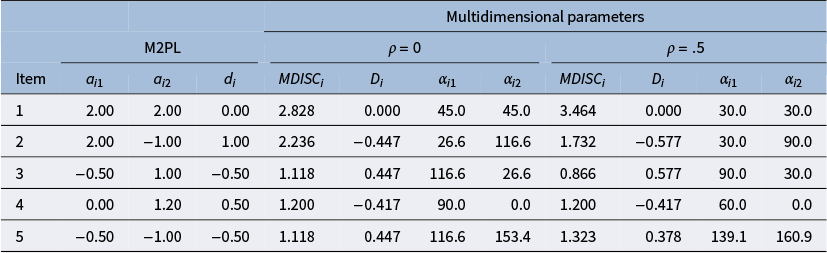
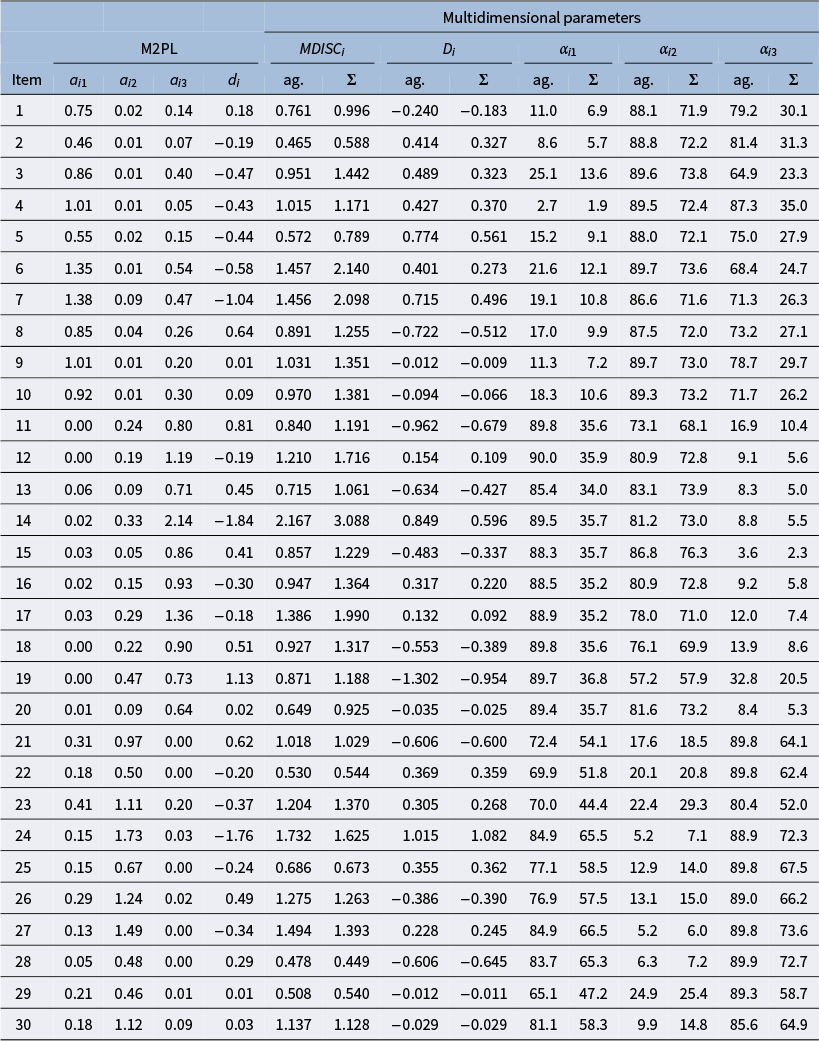
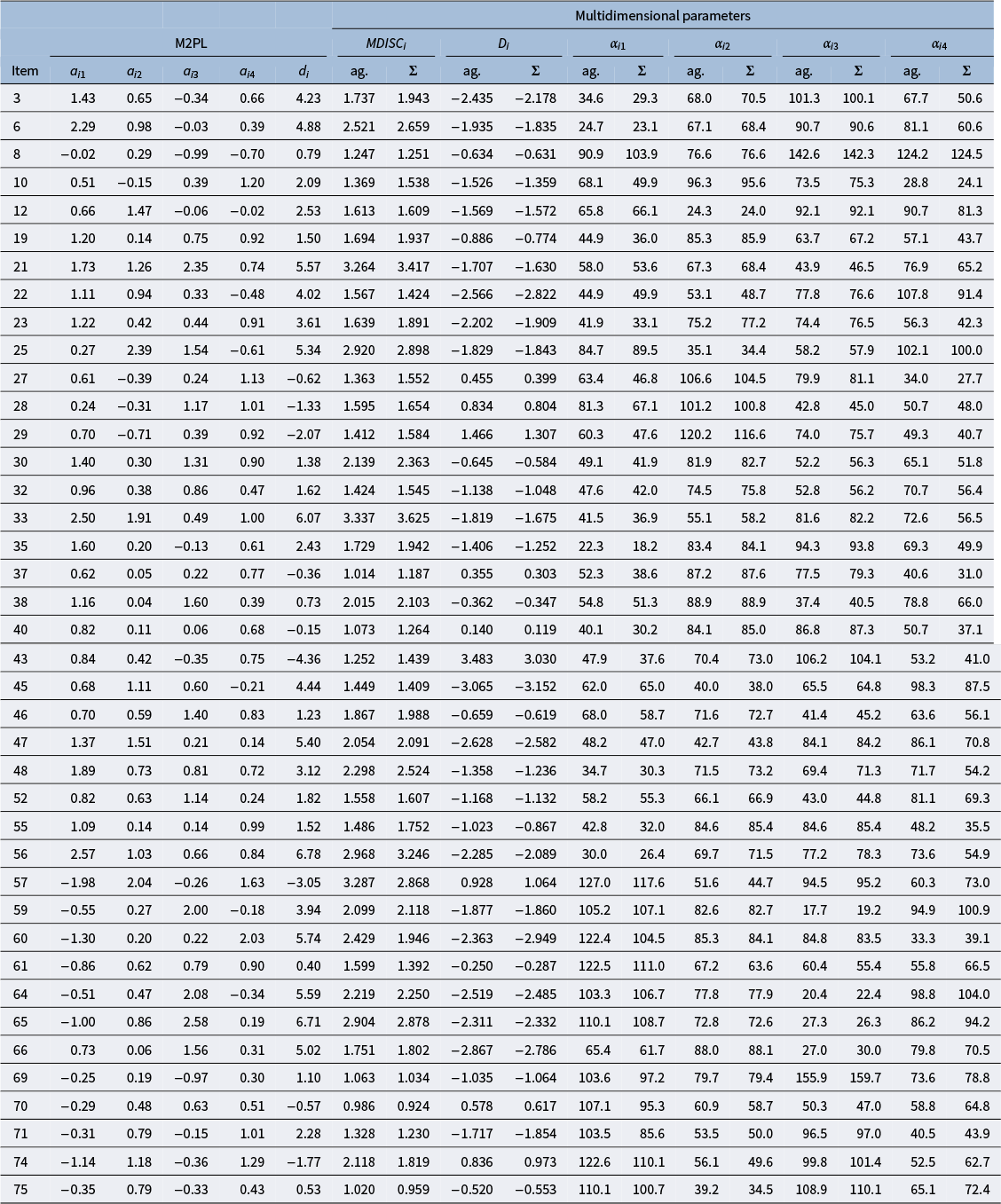


 Open access

