





Management Implications
Basal bark application with triclopyr is an effective approach to managing many woody invasive species. The current paradigm suggests that successful control is predicated on good coverage of the trunk from the groundline to a height of 30 to 45 cm, including the root collar and any exposed lateral roots. However, an elevated band height could be useful to better retain triclopyr on the treated stems and reduce herbicide inputs into the environment. Three triclopyr concentrations were applied as basal bark applications at low (0 to 45 cm) or elevated (61 to 107 cm) band heights to the woody invasive Schinus terebinthifolia (Brazilian peppertree) in Florida, USA. Triclopyr application to elevated band heights controlled juvenile rootstocks at 17, 34, and 69 g L−1 but was not as effective on larger, mature rootstocks at the 17 g L−1 concentration. Elevated band heights generally required less herbicide mix for optimal coverage but also required greater application time. This research suggests that triclopyr applied at an elevated band height can effectively control S. terebinthifolia. Future research should determine whether this approach can reduce non-target injury potential in seasonally flooded wetlands while maintaining S. terebinthifolia control.
Introduction
Brazilian peppertree (Schinus terebinthifolia Raddi) is an invasive species in Florida that has infested more than 280,000 ha (Cuda et al. Reference Cuda, Ferriter, Manrique and Medal2006). This shrub or small tree occupies coastal strands, marshes, swamps, wet flatwoods, and mangrove forests in central and southern Florida and requires aggressive management (Cuda et al. Reference Cuda, Ferriter, Manrique and Medal2006; Hiatt et al. Reference Hiatt, Serbesoff-King, Lieurance, Gordon and Flory2019). Schinus terebinthifolia is adapted to a wide range of environmental conditions, including prolonged inundation, which facilitates its spread in wetlands (Cuda et al. Reference Cuda, Ferriter, Manrique and Medal2006; Ewel et al. Reference Ewel, Ojima, Karl and DeBusk1982; Ferriter and Clark Reference Ferriter and Clark1997; LaRosa et al. Reference LaRosa, Doren and Gunderson1992). Chemical control is considered the most feasible management approach for dense stands of S. terebinthifolia, and basal bark treatment is widely used (Cuda et al. Reference Cuda, Ferriter, Manrique and Medal2006; Langeland et al. Reference Langeland, Ferrell, Sellers, Macdonald and Stocker2009). The basal bark herbicide application technique is conducted by spraying an oil-soluble herbicide in an oil carrier to the lower 30 or 45 cm (12 or 18 in.) of a tree trunk around its circumference until the bark is covered (Campbell and Peevy Reference Campbell and Peevy1950; Langeland et al. Reference Langeland, Ferrell, Sellers, Macdonald and Stocker2009). Triclopyr, applied as the butoxyethyl ester formulation, is the most common herbicide used for basal bark treatment and effectively controls many woody species, including S. terebinthifolia (Miller et al. Reference Miller, Manning and Enloe2015). While it is labeled for use in uplands and seasonally dry wetlands (Anonymous 2015), it cannot be used when standing water is present. This has hindered applicators, especially during the summer rainy season in Florida. Variations in basal bark application have included a “streamline” application, wherein narrow bands of triclopyr ester mixed with an adjuvant and diesel oil are applied to stems typically less than 4 cm in diameter (Miller Reference Miller1990). However, there are few published studies examining this technique, and the treatment band heights and application methods tested have varied (Miller Reference Miller1990; Nelson et al. Reference Nelson, Ezell and JL2006). Furthermore, it was not effective when used on the bush honeysuckle complex (Amur honeysuckle [Lonicera maackii (Rupr.) Herder], Morrow’s honeysuckle [Lonicera morrowii A. Gray], and Tatarian honeysuckle [Lonicera tatarica L.]) (Rathfon and Ruble Reference Rathfon and Ruble2006).
An alternative acid formulation of triclopyr (Trycera®, Helena Agri-Enterprises, Collierville, TN 38017) was recently labeled for use on both upland and aquatic sites (Anonymous 2016). The acid formulation exhibits an intermediate solubility and can be mixed with water for foliar or cut stump treatments and oil for basal bark treatments. Previous research indicates this formulation controls S. terebinthifolia when applied as a basal bark treatment at concentrations as low as 34 g ae L−1 (Bell et al. Reference Bell, Enloe, Leary and Lauer2023a, Reference Bell, Enloe, Leary and Lauer2023b). The aquatic label permits applicators to apply the triclopyr acid formulation as a basal bark treatment in wetlands when standing water is present. However, previous studies indicated that non-target injury may increase when triclopyr is applied as a basal bark treatment in flooded conditions (Oberweger et al. Reference Oberweger, Enloe, Wilson, Prince, Sperry and Hinz2023). Basal bark applications typically require thorough coverage of the root collar (Enloe et al. Reference Enloe, Langeland, Ferrel, Sellers and MacDonald2018; Ferrell et al. Reference Ferrell, Enloe and Sellers2006), which is not feasible in inundated sites. In addition, herbicide loss from treated stems following flooding or precipitation may occur shortly after application (Holmes and Berry Reference Holmes and Berry2009; Norris et al. Reference Norris, Marvin and Warren1987; Nowak and Ballard Reference Nowak and Ballard2005; Wilcock et al. Reference Wilcock, Costley, Cowles, Wilson and Southgate1991). Therefore, conventional basal bark techniques likely pose significant risk for triclopyr wash-off and non-target injury in sites prone to seasonal flooding.
A potential alternative technique would be to elevate the treated band height above typical high-water marks. This could potentially reduce triclopyr losses to flooding and facilitate triclopyr penetration through the thinner outer bark that is present higher up on the stems. Although both species and site dependent, the thickness of the outer bark of a woody species is generally correlated with tree height and stem size, with thicker outer bark toward the base of the trunk where stems are older and more developed and thinner outer bark toward the canopy as stem size decreases (Graves et al. Reference Graves, Rifai and Putz2014; Leite and Pereira Reference Leite and Pereira2017; Rosell Reference Rosell2019). However, the concentration of triclopyr needed for effective control when treating an elevated band height is unknown. Given the increased distance from the root collar and a lack of direct treatment of exposed lateral roots, a higher herbicide concentration might be necessary; however, the treatment of thinner bark and subsequent improved triclopyr uptake might offset this.
Given these issues, the objective of this study was to compare conventional and elevated band heights and triclopyr concentrations for control of S. terebinthifolia. We hypothesized that elevated band height treatments would control S. terebinthifolia but would require higher concentrations of active ingredient compared with treatment at the standard band height. Knowledge of this could improve triclopyr herbicide stewardship in natural areas, where protection of native plant communities is critical.
Materials and Methods
A field study was conducted from 2022 to 2024 to evaluate the effectiveness of two band heights and three triclopyr concentrations for basal bark treatment of S. terebinthifolia. The study was conducted at two locations in Florida. The first location was near Melbourne, FL (27.93286°N, 80.49732°W). The site was originally a mix of salt marsh, mangrove swamp, and coastal hammock but was previously drained and converted to grapefruit (Citrus × aurantium L.) production. Agricultural operations were abandoned in 2004, and the site was rapidly invaded by S. terebinthifolia. Soils were a mix of Canaveral (Hyperthermic, uncoated Aquic Quartzipsamments)-Anclote (Sandy, siliceous, hyperthermic Typic Endoaquolls) complex and Paola fine sand (Hyperthermic, uncoated Spodic Quartzipsamments) (USDA- NRCS 2022a). The site is currently a near monotypic stand of S. terebinthifolia, with few other species present (Figure 1A).
Schinus terebinthifolia typical of the (A) Melbourne site and (B) Wimauma site in Florida. Additionally, note the low band treatment applied in (B), as indicated by the deep red color of the lower stems.
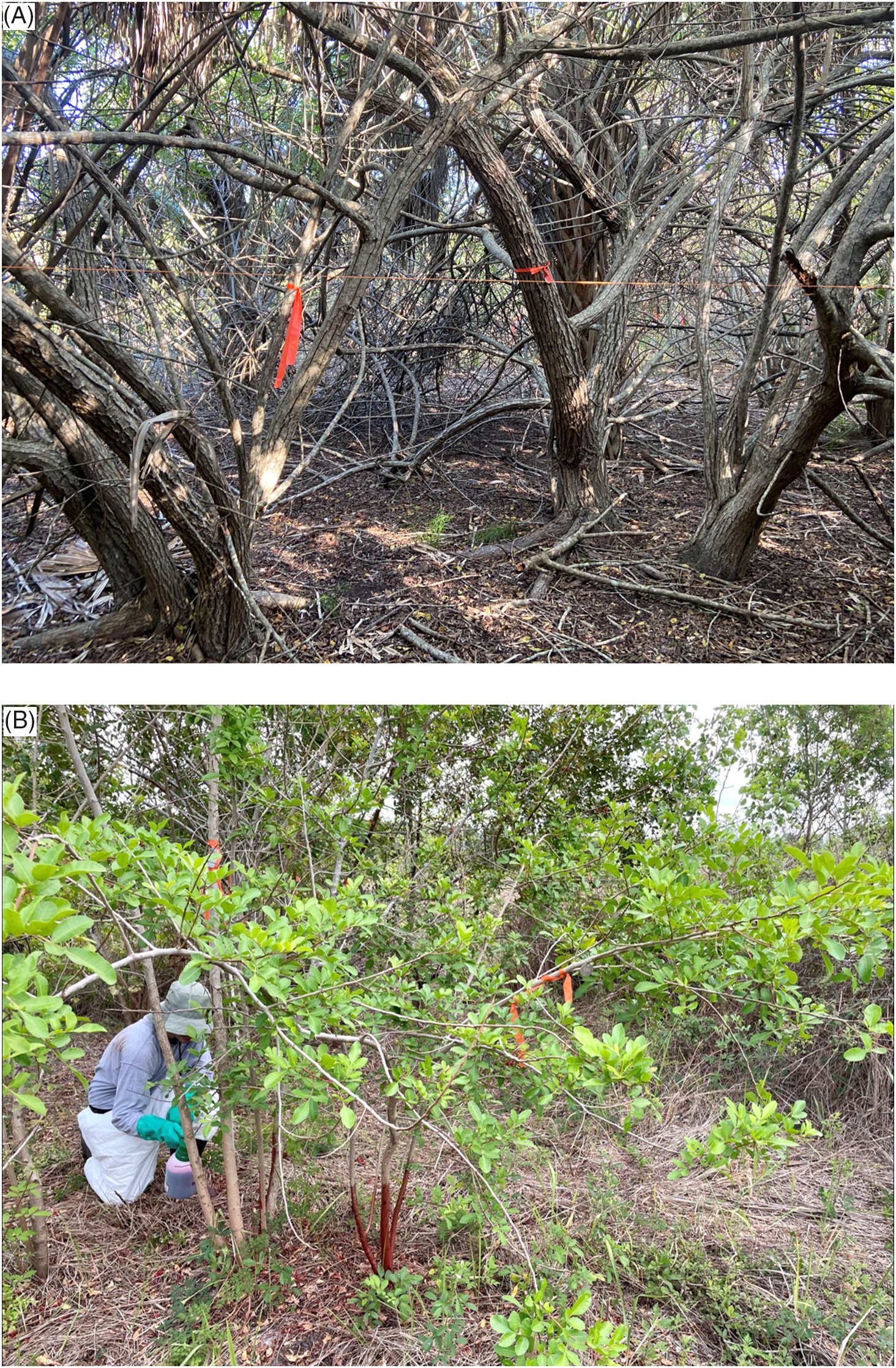
The second location was near Wimauma, FL (27.68767°N, 82.34916°W) in an open field historically converted from upland hardwood hammock to agriculture (Figure 1B). The site was a mix of S. terebinthifolia and an understory of Imperata cylindrica (L.) Beauv. (cogongrass). Soils were a mix of Archbold fine sand (Hyperthermic, uncoated Typic Quartzipsamments), Myakka fine sand (Sandy, siliceous, hyperthermic Aeric Alaquods), and Pomello fine sand (Sandy, siliceous, hyperthermic Oxyaquic Alorthods) (USDA-NRCS 2022b).
Twenty-eight (8 by 8 m) plots were established at each location. Each plot contained at least five independent S. terebinthifolia rootstocks. The experiment was set up as a randomized complete block design with four replicates and a factorial arrangement of treatments. Factors consisted of treated band height (low: 0 to 45 cm from the ground; elevated: 61 to 107 cm from the ground) and triclopyr (Trycera®, Helena Agri-Enterprises) concentrations (17, 34 or 69 g ae L−1, equivalent to 5%, 10%, and 20% v/v on a product basis). A nontreated control treatment was also included. All herbicide treatments were mixed with an oil carrier (Impel™ Red, Helena Agri-Enterprises).
Treatments were applied to all trees in each plot at the Melbourne site on March 20, 2022, and at the Wimauma site on April 17, 2022. All treatments were made by the same applicator with a handheld 2-L spray bottle (Multi-Purpose Sprayer, Harbor Freight Tools Company, 26541 Agoura Road, Calabasas, CA 91302). The low band applications were performed by treating in a downward manner from the top of the band (45 cm above groundline) around the entire circumference of each individual in a spray-to-wet manner. The elevated band applications were made by starting at 107 cm above the base of the trunk and carefully treating down to the bottom of the band at a height of 61 cm in a spray-to-wet manner. Applications were deliberately and carefully made to prevent runoff or movement of the herbicide below the target band. For each rootstock, all stems present within each target band height were treated.
During treatment application, herbicide mix volume applied per rootstock was measured and recorded by weighing spray bottles before and after each application. Root collar diameter at 10 cm was used to calculate the amount of herbicide applied per centimeter of stem diameter for all plots receiving the low band treatment. The stem diameter measured at 91 cm was used to calculate the amount of herbicide applied per centimeter of stem diameter for all plots receiving the elevated band treatment. Time spent per application was recorded with a stopwatch.
Visual estimations of percent canopy defoliation on a 0% (no foliage loss) to 100% (complete foliage loss) scale were made on an individual rootstock and plot basis at 60, 180, 360 and 660 d after treatment (DAT). For each rootstock, epicormic sprouts on the lower 1 m of each stem were also counted at 660 DAT. Percent mortality was calculated by the number of trees in each treatment that had 100% defoliation, no epicormic sprouts, and no live cambium at the base of the tree.
Statistical Analysis
All statistical analyses were conducted in RStudio (v. 1.4.1717). Percent defoliation data were arcsine square-root transformed for analysis to meet normality assumptions and back-transformed for presentation (Snedecor and Cochran Reference Snedecor and Cochran1967). Data were subject to ANOVA to test for main effects and interactions (α = 0.05). Means were separated using Fisher’s protected LSD test (α = 0.05) under the agricolae package in RStudio (v. 1.3-5; de Mendiburu Reference de Mendiburu2023). Epicormic shoot data collected at 360 DAT were fit to a linear regression model using the generalized linear model function in RStudio and Equation 1:
 $${\rm{\;}}{Y_1} = {\beta_0} + {\beta_1}X$$
where Y is the response variable (epicormic shoots insert unit), X is the explanatory variable (treatment concentration by band height), β0 is the y-intercept, and β1 is the slope. Means for epicormic shoot data at other time points were separated by Fisher’s protected LSD test using package agricolae in RStudio (v. 1.3-5; de Mendiburu Reference de Mendiburu2023).
Results and Discussion
Significant differences between locations were detected; therefore, data were analyzed independently for each location. At the Melbourne site, an interaction between triclopyr concentration and band height was detected for total herbicide mix applied (Table 1). The low concentration (17 g L−1) at the low band height treatment received roughly 1.5 times less herbicide mix per centimeter than other concentrations applied at the low band height, but was similar to herbicide mix amounts in the elevated band height applications. Aside from the low concentration at low band height treatment, elevated band height treatments required approximately half the herbicide mix per centimeter than low band height treatments for acceptable coverage. This was likely due to thicker bark at the base of each tree and the presence of exposed lateral roots in many low band height treated individuals. All exposed lateral roots around the root collar were treated in low band height applications as is common practice (Enloe et al. Reference Enloe, Langeland, Ferrel, Sellers and MacDonald2018; Ferrell et al. Reference Ferrell, Enloe and Sellers2006). Additionally, lateral roots were not accounted for in measurements of stem diameter. This was not an issue at Wimauma, where individuals were smaller, as root collar diameter averaged 11.0 cm and minimal lateral roots were exposed (Table 2).
Rootstock and herbicide application parameters at the Melbourne, FL, site a

a Means within columns followed by the same letter are not different (α = 0.05).
b Means are based on a total of 20 rootstocks per treatment.
c Total stem diameter is expressed as the actual diameter at the treated band height, which was 10 cm for the low band and 91 cm for the elevated band.
Rootstock and herbicide application parameters at the Wimauma, FL, site a

a Means within columns followed by the same letter are not different (α = 0.05).
b Means are based on a total of 20 rootstocks per treatment.
c Total stem diameter is expressed as the actual diameter at the treated band height, which was 10 cm for the low band and 91 cm for the elevated band.
The lower volume of herbicide mix applied per centimeter in elevated band applications was due to the intent of keeping herbicide mix retained in the target treatment band and preventing herbicide solution from running down below the band. Furthermore, tree bark appeared smoother at the elevated band height compared with the low band height, which is a bark surface characteristic that results in lower surface area (Konôpka et al. Reference Konôpka, Pajtík, Šebeň and Merganičová2022) and likely herbicide retention potential. Given these results, we acknowledge that two low band treatments (34 and 69 g L−1 triclopyr) received a higher herbicide dose than the elevated band treatments (7.2 to 7.4 ml cm−1 vs. 3.3 to 3.9 ml cm−1).
At Melbourne, the elevated band height application required almost 2.5 times longer to perform than application at the low band height (Table 1). Likewise, the elevated band height application required approximately 2.2 times longer to perform than application at the low band height at Wimauma (Table 2). Differences in application time between sites were attributed to the much larger and more complex branching pattern of individuals at Melbourne compared with Wimauma (Figure 1A and 1B). Despite the potential benefits of elevated band applications (e.g., reduced runoff and off-target deposition), increased and variable application time based on the maturity of individual invasive plants to be treated could be a disadvantage for some land managers and applicators.
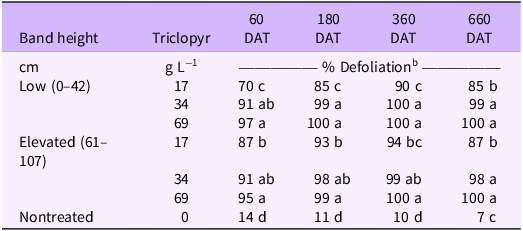
An interaction between main effects was detected for defoliation data at Melbourne (Table 3). At 60 DAT, defoliation was at least 87% in all treatments, except triclopyr at 17 g L−1 applied at low band height (70%). By 180 DAT, defoliation was at least 93% in all treatments, except triclopyr at 17 g L−1 applied at low band height (85%). Defoliation at both 60 and 180 DAT intervals increased at least 8% when triclopyr at 17 g L−1 was applied at the elevated band height compared with the low band height. However, at 360 and 660 DAT, defoliation levels (ranging from 85% to 100%) were similar among band heights for each triclopyr concentration.
Schinus terebinthifolia percent defoliation response to treatment band height and triclopyr concentration at Melbourne, FL a
a DAT, days after treatment.
b Means within columns followed by the same letter are not different (α = 0.05).
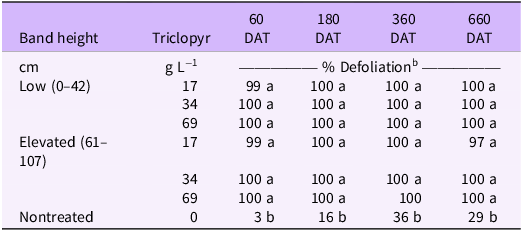
At Wimauma, no interactions were detected, and all treatments resulted in 97% to 100% defoliation across all time points (Table 4). There was marked defoliation in the nontreated control at 360 DAT (36%), which was due to a severe storm with high winds that stripped many leaves off the trees.
Schinus terebinthifolia percent defoliation response to treatment band height and triclopyr concentration at Wimauma, FL a
a DAT, days after treatment.
b Means within columns followed by the same letter are not different (α = 0.05).
These results indicate that a shift in triclopyr band height can result in substantial impacts on short-term defoliation, especially for larger treated individuals. Logically, a higher band height might be expected to result in faster canopy defoliation from a proximity standpoint. However, source–sink relationships and phloem translocation patterns are expected to be the primary driver in triclopyr herbicide movement. Late spring phloem translocation patterns are not well understood for S. terebinthifolia, which flowers and sets fruit in the late fall. However active canopy growth occurs throughout the spring and summer. Despite the rapid canopy defoliation with an elevated band height, the longer-term data collected at 660 DAT indicated defoliation was generally similar between the two band heights. Triclopyr is highly mobile, and translocation was eventually sufficient from either band height to result in comparable defoliation.
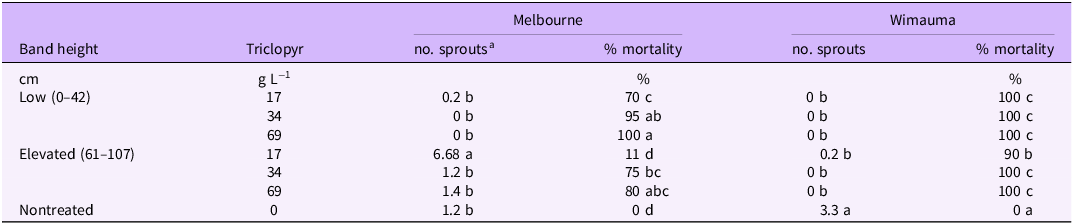
Additionally, longer-term data on epicormic sprouting and mortality collected at 660 DAT at Melbourne indicated the elevated band triclopyr treatment at the 17 g L−1 concentration resulted in greater sprout counts than all other treatments, including the nontreated controls (Table 5). This was in contrast to Wimauma, where epicormic sprout counts were greater in the nontreated than in all other treatments. Despite greater defoliation and low sprout counts, final mortality at Melbourne varied across treatments. In the low band, mortality was 95% to 100% for the 34 and 69 g L−1 triclopyr treatments, respectively, and these were greater than mortality in the 17 g L−1 treatment (Table 5). The same pattern was evident for the elevated band treatments, with the exception of the 17 g L−1 triclopyr treatment, which resulted in much lower mortality (11%) compared with the low band (70%). Mortality was 100% for all treatments at Wimauma, except the 17 g L−1 triclopyr treatment in the elevated band, which was 90%.
Schinus terebinthifolia epicormic sprouting and tree mortality at 660 d after treatment at Wimauma and Melbourne, FL a
a Means within columns followed by the same letter are not different (α = 0.05).
For systemic herbicides like triclopyr to be effective, maximum recommended stem size for basal bark applications is generally in the range of 15- to 20-cm diameter at breast height due to the thinner outer bark of younger trees (Anonymous 2011; Ferrell et al. Reference Ferrell, Enloe and Sellers2006; Leite and Pereira Reference Leite and Pereira2017; Miller et al. Reference Miller, Manning and Enloe2015). In our studies, the average root collar diameter of S. terebinthifolia was 28.1 cm at Melbourne, compared with only 11.0 cm at Wimauma. Concomitantly, the average stem diameter at 91 cm for S. terebinthifolia was 12.0 cm at Melbourne, compared with only 7.6 cm at Wimauma. These results indicate basal bark treatment effectiveness for rootstocks with individual stems much greater in size than typical recommendations. Our results also support the hypothesis that elevated basal bark applications may require higher triclopyr concentrations to achieve mortality, especially for larger individuals. Our results also indicated that herbicide output is less for elevated band applications than applications to the low band height, while the time required to conduct applications is more than two times greater for elevated band applications than low band applications. Future research should examine the time implications of elevated bark applications and assess the environmental fate of triclopyr between the two treatment band heights.
Basal bark treatments for the management of dense S. terebinthifolia stands can often be limited by maximum herbicide label rates (Bell et al. Reference Bell, Enloe, Leary and Lauer2023a; Holmes and Berry Reference Holmes and Berry2009; Nowak and Ballard Reference Nowak and Ballard2005). Overapplication may increase the risk of runoff, off-site deposition, and non-target injury (Holmes and Berry Reference Holmes and Berry2009). Nowak and Ballard (Reference Nowak and Ballard2005) reported that off-target deposition of triclopyr ester during basal bark treatments constituted an average of 6% of total herbicide output during applications and that observable non-target injury occurred within the vicinity of treated trees. While we recommend further research in this area that better accounts for herbicide output to the roots, applications to bark at an elevated band height appear to hold strong potential for decreasing herbicide output and may provide a means of reducing herbicide runoff and off-site deposition, which may be of particular benefit for applicators managing S. terebinthifolia.
Acknowledgments
The authors would like to thank Ben Tuttle, Jonathan Glueckert, Coral Foster, and Chad Rose for assistance in conducting these studies. We would also like to thank Kate Smithson, Tina Miller, and Alyssa Anderson at the Wimauma site (Little Manatee State Park) and Jerry Gust for use of the Melbourne site.
Funding statement
We would like to thank Helena Agri-Enterprises for partial funding of this research.
Competing interests
The authors declare no conflicts of interest.


 Open access

