

Learning to speak two languages in one's personal or professional life is always a possibility, but never a given. Proof of the possibility is all around us. More than half of the world's population is estimated to be bilingual, so learning and speaking more than one language is clearly within the bounds of the human language capacity. However, it cannot be taken for granted, because not all people in potentially bilingual environments become bilingual. What creates these different outcomes? What are the circumstances in which people, particularly children, are most likely to become bilingual?
What do we know about the factors that promote bilingual learning from infancy through early elementary school? Since the early 1950s (Haugen, 1953) we have known that the key to raising childhood bilinguals is securing and establishing the minority language. The language of the broader community, the language of commerce, education, and the mass media, is a given. In every culture, children learn the majority language, even when their parents do not. However, how does a family or a school system “grow” both a majority language and another one? Another “minority” language may be a heritage language that parents or grandparents have brought from another country, or it could be another language chosen by the parents for a variety of reasons. It might be a second official language that children are expected to learn, as in Canada or Switzerland. Sometimes speakers of a country's official language opt to educate their children in a language that they consider will have strategic importance later in the child's life (Saunders, 1988), or it could be that the individual seeks to communicate in another modality, as with an oral and a signed language.
For any given individuals, we cannot predict their language future any more than we can say whether they will settle in a particular city, win the lottery, or have two cats. However, what are the odds? What are the key factors that help establish bilingualism in children? Under what circumstances do children and parents achieve a balance between the sometimes opposing factors that support each language?
To answer these questions, the University of Miami Bilingualism Study Group (BSG) recruited 25 babies in bilingual families before they were born and followed them monthly or more often until age 3. We collected language samples, did standardized testing, and had parents fill out MacArthur Communicative Development Inventories (Fenson et al., 1994) and other surveys at each visit. Over the years of the families' visits, we observed all of the children learning words and phrases in both English and Spanish, but by the age of 3 years several of them had essentially stopped using Spanish (or in one case English). They were not comfortable enough in the second language to respond to remarks by their parents or our research assistants in that language, much less initiate an interaction in that language themselves. As it happens, there were 6 such children out of 25, or 25% (Pearson, Fernandez, Lewedag, & Oller, 1997). That is precisely the percentage of nonbilingual children that de Houwer and colleagues found in a study of 18,000 Flemish families in Belgium (de Houwer, 2003). Because 75% of the children in our sample were reported to be bilingual, it is clear that that it does not take an exceptional family to raise a bilingual child. By the same token, we see that it is not an exceptional case when a child in a bilingual context does not become bilingual.
What is the difference? What factors help families fall into the three-quarters of the population that manage to make children bilingual, and which circumstances put families in the category of the remaining one-quarter where childhood bilingualism is harder to achieve? The remainder of this article will present evidence from our work and others' that describes five key factors: input, language status, access to literacy, family language use, and community support.
INPUT
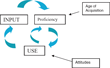
Of all the relevant factors that parents or communities have some control over, quantity of input is the largest. Without it, no learning takes place. Without enough of it, learning can take place, but children do not reach a comfort level in the language so that they will willingly use it (Pearson, Fernandez, Lewedag, & Oller, 1997). If children use a minority language, they invite more input so the cycle is self-reinforcing as in Figure 1. A greater amount of input leads to greater proficiency, which leads to more use, which invites more input and the cycle starts again. If children do not use the heritage language, then they are using a different language and thereby getting less input in the heritage language; they develop less proficiency, which leads to using it even less, and that in turn, leads to getting even less input in that language.

The input–proficiency–use cycle. [A color version of this figure can be viewed online at www.journals.cambridge.org]
However, the system does not exist in a vacuum. Other factors play a role in how much input is delivered and how much is taken up. The age at which a child is first exposed to a language will affect proficiency (in general, the earlier the better). Greater proficiency will contribute to greater use. Similarly, attitudes of parents, siblings, and peers can add value to the language and accelerate its use and thus add to the effectiveness of the cycle. However, if parents, siblings, or peers share negative attitudes toward a language, they will subtract value, which will lead to less enthusiasm for using the language, attract less input, decrease proficiency, and so on. In some cases, quantity of input alone will make the difference between successful bilingual learning or not (de Houwer, 2003, 2004; Pearson et al., 1997). In a study of trilinguals by de Houwer (2004), parental input patterns accounted for 84% of the variation in the children's language patterns. This finding revealed that although input factors are key, attitudes, values, and social circumstances may modulate the amount of input available and the amount needed.
There is not always a direct relationship between amount of exposure and amount of learning in either a first or second language. Rather, there seems to be a threshold; that is, a relatively direct relationship up to a certain point, what some have called a “critical mass,” after which, more exposure does not matter (Gathercole, 2002; Gathercole & Hoff, 2007). If this were not the case, then bilingual learning should indeed be subtractive, as children with 100% of their language experience in one language would have twice as much knowledge of that language as a child with only 50% of his language learning effort devoted to it. This is not what is observed to happen.
Gathercole (2002) has provided us with several clear examples of thresholds for mastering the complexity associated with specific grammatical constructions. For example, knowing when to use much or many in English requires children (and second language learners) to have analyzed whether the head of the phrase is a mass noun (like “water”) or a count noun (like “tree”). “Much water” is good, but “much trees” and “much waters” are not; “many trees,” but not “many tree” or “many waters.” This English distinction does not play a role in the grammar of Spanish. Monolingual English-learning children have been shown to work out the intricacies of the much/many distinction, which is never explicitly taught, through hearing many, many instances of the relevant constructions over a long period of time. Once it has been figured out, though, more input will have no effect. Thus, adequate input must be provided at the stages when things are being worked out, and it is less crucial at later points. Gathercole has found, with a variety of constructions, that bilingual and monolingual children go through the same progression, but different bilingual learning groups take a shorter or longer time to work out all the details. Those with more input from home and school in the target language matched the monolinguals of that language sooner than those with less, in a rough proportion to the quantitative differences in their input. In all of her studies, there has been a time when the groups with less daily input catch up, when more input will cease to show an effect.
LANGUAGE STATUS
In general, children need a greater percentage of their input in the minority language than in the majority language for the same measure of learning (Pearson et al., 1997; Vihman, Lum, Tierry, Nakai, & Keren-Portnoy, 2006). Part of this asymmetry may derive from the background presence of dominant languages such as English in the environment through television, neighbors, advertisements, and so forth. In addition, input from bilingual speakers cannot be counted as 50% in each language. Individuals are not always aware of which language they are speaking in (Goodz, 1987), and circumstantial evidence points to less minority use when there are no monolingual speakers in the equation (Eilers, Pearson, & Cobo-Lewis, 2006). In conversations where everyone is bilingual, there is little chance that all or even half of the interactions will be in the minority language.
Further, the natural attraction of the majority language for the child is very powerful. In fact, the dynamic described in Figure 1 works better for minority languages than for the majority language. The link between proficiency and use of a language in the input cycle in the figure seems like common sense: if one does not speak a language well, one will not use it. If one reports using a language often, we can infer the person has some skill in that language. The principle does not always hold in the majority language. For example, Hakuta and d'Andrea (1992) report that among Mexican teenagers in California, skill in Spanish predicted use of Spanish, but the teenagers' use of English was better predicted by their attitude toward English than their objectively measured skill in the language. In fact, most of them tended to overestimate their skill in English (which may be one way that they were motivated to use a language they did not command well).
The BSG also witnessed this attraction of the majority language in Miami (Oller & Eilers, 2002). We studied children at three ages, kindergarten, second, and fifth grade, to ascertain the separate and the combined effects of linguality (bilingual vs. monolingual), socioeconomic status (SES), language(s) of the home, and language(s) of the school as measured by standardized and nonstandardized tests in English and Spanish. One aspect of the study was “deep description,” where we confirmed that the stated language policies of the two types of schools studied, those that were “one-way” English-only or “two-way” dual language programs in English and Spanish, were actually being followed by the teachers and students. The language used in remarks by the teacher to the whole class, the teacher to an individual student, the students to the teacher, and students to each other were tallied in classrooms, lunch rooms, and waiting in line for the school buses (Eilers, Oller, & Cobo-Lewis, 2002).
From more than 250 observations, we confirmed that within the classes, the teachers and the students followed the programs exactly. Except for a little more Spanish spoken by children to the teacher or the teacher to an individual student in the early part of kindergarten, English was spoken in the English-medium classes more than 95% of the time. In the Spanish-medium classes Spanish was spoken more than 95% of the time. When the children spoke among themselves, however, in private unregulated conversations at their desks or in the cloakroom, they spoke in English more than half of the time, even with 90 to 95% Hispanic populations in the schools, and even in kindergarten and first grade when many children were just being introduced to English for the first time. In the two-way classrooms from second grade on, children's private conversations in the English-medium classrooms were at least 90% in English, and in Spanish-medium classrooms around 50% in English. In the halls, we consistently observed more than 80% English in the one-way schools, rising to near 100% among the fifth graders. It was more surprising that, in the two-way schools, 80% of the second graders' utterances and about 70% of the kindergartners' and fifth graders' utterances were overheard to be in English. The only other classes besides the two-way Spanish classes where we heard as much as 50% Spanish in child-to-child conversations were the basic English as a second language (ESL) classes, made up of children who tested with no academic skills in English. Even so, by the time the children were in advanced ESL classes one or two semesters later, the percent of English in child-to-child conversations was higher than 80%, almost like the mainstream classes (Eilers et al., 2002).
LANGUAGE FACTORS
Written materials in a language, whether in children's literature or mass media, can extend input even in the absence of many language speakers. For slightly older children, reading is an important consolidator of their language skills, and contributes to both greater proficiency and retention of a language. Some bilingual programs hesitate to introduce reading in two languages for fear of confusing the child, but the research evidence is just the opposite. Reading skills transfer from one language to another. Even when the scripts are different, there is evidence of carryover, not interference (Bialystok, 2006). The child does not have to learn the basic process all over again, just the particular details of a second spelling system or a second script. In the study reported in Language and Literacy in Bilingual Children (LLBC; Cobo-Lewis, Eilers, Pearson, & Umbel, 2002), children who learned to read in both English and Spanish scored significantly higher in reading in English as well as Spanish.
Literacy is not a necessary part of knowing a language: people across centuries and around the world can speak very well in languages they do not read. However, with literature and popular culture the value of a language can be enhanced so that the child will seek more input through that medium.
FAMILY FACTORS
In addition to aspects of the language itself that enhance its chance of being learned, factors closer to home make a difference in how likely it is that there will be enough minority language interaction to support learning that language. In our research and in the work of others (Eilers et al., 2006; Hakuta & D'Andrea, 1992), the most potent family predictors of child outcomes were immigrant status, which related to parents' beliefs about dual language learning and their own patterns of language use.
The popular wisdom about immigrants' language shift, sometimes called “the three-generation rule” (Veltman, 1988), suggests that the first generation (those who were born abroad) are somewhat bilingual, but they remain strongly dominant in their native language. Their children, the second generation, are fluently bilingual, and their grandchildren, the third generation, will be monolingual in the new language with just a few words in the heritage language. “Generation” here is a simplifying generalization that describes a complex picture, efficiently, if not completely.
Hakuta and d'Andrea (1992) provided a graphic illustration of this classic progression, as well as some indications of how the term “generation” may be refined to capture more of the relevant stages. Instead of generation, they defined the term “depth” as follows: Depth 1—born abroad, children came to the United States after age 10; Depth 2—born abroad, came to the United States between 5 and 10; Depth 3—born abroad, came to the United States under age 5; Depth 4—born in the United States, both parents born abroad; Depth 5—born in the United States, at least one parent born in the United States; and Depth 6—at least one grandparent (and parent) born in the United States.
When Hakuta and d'Andrea (1992) graphed the scores different depths of bilingual teenagers earned on a language task they did in English and in Spanish, the generations did not behave strictly according to the rule. Depth 3 (a subset of the first generation) and Depth 4 (a subset of the second generation) were the strongest bilinguals: the most balanced with the highest scores in both languages. These are the first generation children who came to the United States before age 5 and the second-generation children who were born here, but whose both parents were born abroad. What do these two depths have in common? The common features are early exposure to English (begun by age 5), which produces strong English, and parents who speak mostly Spanish in the home, which produces strong Spanish.
It is crucial to have contact with monolingual speakers of the minority language. With two speakers of the minority language in the home, especially if they have limited ability in the community language, there will almost always be sufficient interaction in that language to support minority language learning. With only one speaker of the minority language, or two fluently bilingual parents, the language environment of the home is more variable (and uncertain) and is less likely, on its own, to provide a bilingual learner with enough input. Children at Depths 5 and 6, with one parent and a grandparent respectively who are born in the United States, appeared in the Hakuta and D'Andrea (1992) study to have insufficient exposure to the minority language.
This illustration from Hakuta and D'Andrea (1992, p. 81) makes a strong case for additive bilingualism. Depths 1, 5, and 6 seem to show that either the Spanish or the English scores can be high, but not both. If we looked only at those three groups we might want to agree with those who say that one language takes away from the other. However, Depths 3 and 4 strongly contradict that view. The children in Depth 3 and especially Depth 4 had identical scores in English and Spanish, and they were both high. When one looks at the relation between English and Spanish, we see that the children's English skills rose very quickly within the first generation, at a time when Spanish skills were still at a peak. English did not wait for Spanish to disappear to come to native or near-native levels. It was well established along with strong competency in Spanish. The sharp decline in Spanish came after the rise of English. In this illustration, the decline of Spanish came two “depths” later at Depth 5. It was not coincidental that, after Depth 4, Hakuta and d'Andrea (1992) found a strong shift in the parents' language from using mostly Spanish (just under 2 on a 5-point scale: 1 = Spanish to 5 = English) to using mostly English at Depth 5 (almost 4 on the scale). Depth 4 parents also had stronger ties to the country of origin and went back there or had visitors from there more often than Depth 5 and 6 families.
Beyond generation or immigration depth, social class and economic status have a demonstrated effect on learning a majority language, but their role in minority language maintenance is less consistent. High SES is consistently associated with higher academic performance (cf. Deutsch, 1960; Oller & Eilers, 2002). Most indications are that higher SES levels are associated with greater economic independence and more assimilation into a new culture (Boswell & Curtis, 1984). One might therefore expect more orientation toward the majority language. However, studies have shown that parents from higher economic and social classes may value the minority language more. Lambert and Taylor (1996) interviewed junior high school students and their families. They found that for working-class (low SES) mothers, the emphasis was on encouraging their children to learn English to succeed in America, especially in school. For these mothers there was little explicit concern that emphasizing English would diminish Spanish use and Spanish identity. It seems that they had implicitly accepted a decline in Spanish or what Lambert (1977) described as a situation of subtractive bilingualism. In contrast, middle-class (high SES) mothers' conception of success for themselves and their children was associated more with the encouragement of Spanish competence, along with English. They showed a concern that the heritage language and culture be protected in the process of Americanization. In their interviews, they articulated an additive form of bilingualism as a goal.
In the LLBC study (Oller & Eilers, 2002) when we kept SES constant and varied language(s) of the home and language(s) of the school independently (and vice versa), children of professionals did better on average on all tests of academic performance, including English language measures, than did the children from working class families. The effect was especially clear among the monolingual control groups, but we also found it in all the bilingual groups, at all levels of bilingual home language and bilingual school language.
The same effect was not found in Spanish. Instead, there was almost no difference between the socioeconomic groups on overall Spanish scores. Any small differences that there were in oral language (skills associated with speaking as opposed to reading and writing) where the working class children are favored over the children from professional families.
There is a certain irony that the working class children did relatively better in Spanish than the professional class children, even in homes where the professionals had made the commitment to speak only the heritage language. The input patterns appear to be more potent than attitudes. The high-SES parents valued Spanish more highly, but provided more input in English and thus their children learned English better, whereas the low-SES parents valued English more highly, but provided more input in Spanish and so the children learned Spanish better.
COMMUNITY FACTORS
A cohesive community of heritage language speakers can make a difference in the vigor of that language and its ability to motivate and create opportunities for young speakers. By community we can mean a formal structure like the Welsh Language Board, which recognizes a role for government intervention to help insure their national identity through the heritage language (Gathercole, 2005). Alternatively, we can mean a single parish church or social agency that shelters new immigrants, provides services in the minority language, and in many ways keeps the culture of the old country vibrant. By creating an ethnic enclave, or “ghetto,” a context is created for maintaining the minority language and culture (Lambert & Taylor, 1996).
Geographers Boswell and Curtis (1984) describe two opposing consequences of language enclaves, or ghettoes, for example, the strong Hispanic enclaves in the American Southwest or in Florida. On the one hand, such enclaves make life in the minority language viable. As Maurice Ferre, a former mayor of Miami, is quoted as saying, “You can go through life [and die] in Miami without having to speak English at all” (Morgan, 1983). In communities like these, children are exposed to the majority language in school and through the commercial culture that markets aggressively to them, but the minority language is prominent and available. People speak it freely and without social stigma.
In contrast, a language ghetto is also a stepping stone to assimilation. It provides language minority newcomers with an economy where they can achieve financial success in the heritage language. Ironically, that very financial success supports mobility out of the ghetto: it opens up paths into majority neighborhoods and promotes intermarriage and other signs of assimilation. Assimilation may not be the death knell of a minority language, but language choice generally means “going with the flow,” and the flow is toward the majority language.
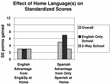
A key element of community support provided to a minority language is through education. In the LLBC study (Oller & Eilers, 2002), we found that by fifth grade (age 11, the oldest age tested) the effect of language of instruction at school could more than counterbalance the effect of less Spanish in the home on the children's Spanish scores. For the graph in Figure 2, overall scores at fifth grade on nine standardized tests were averaged in each language separately for the children with only Spanish in the home versus those with English and Spanish in the home from birth. The respective difference scores are shown in the bars on the left (English) and the bars on the right (Spanish). The differences attributed to home language are relatively small. The English scores for the children with English as well as Spanish in the home were just over two standard score points higher than the children with no English in the home. The Spanish scores for the children with only Spanish in the home were about four points higher on average than those with English and Spanish (with most of the Spanish home language effect coming from children who had no Spanish in school).
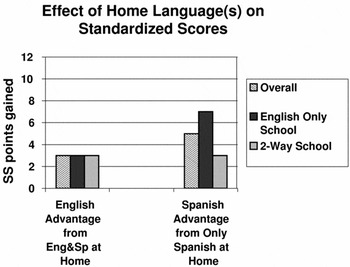
The relative advantage of speaking English and Spanish in the home on English scores and speaking only Spanish in the home on Spanish scores.
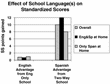
For the graph in Figure 3, the same procedure was followed, but this time the difference scores reflected as “gain in English standard score (ss)” (the three bars on the left) and “gain in Spanish standard score (ss)” (on the right), were averaged separately for those in English-only schools versus those in two-way schools. In this calculation, by fifth grade the English-only policy gave rise to an average gain of about one point to English scores, whereas the two-way schools gave an average gain of 10 standardized points to the children's Spanish scores. The effect in Spanish was somewhat greater for children with less Spanish at home, but it was substantially higher for all children in the two-way schools. In sum, English-only in the school was an advantage to no one, whereas Spanish and English in school profited all groups (Figure 3).
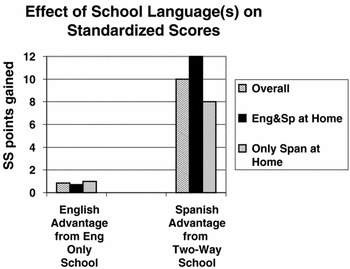
The relative advantage of English-only schooling for English scores and two-way schooling for Spanish scores.
LESSONS LEARNED: GOOD AND BAD NEWS
Forty percent of the world's populations speak one (or more) of 8 major languages; 80% speak 1 or more of only 83 languages, a small fraction of the more than 6,000 languages catalogued in Ethnologue (Gordon, 2005). Thus, the shift to the major languages is very strong (and not of recent origin). Inertia now does the work of maintaining the shift, and it takes strong measures to reverse it, if indeed it can be reversed (Fishman, 2001). In Ethnologue, Gordon (2005) called a language “vigorous” if it is being passed on to children; it is called “positive” if there are large numbers of second language speakers, and “waning” if it is not being passed on as either a first or second language. We cannot count adults out, but it would seem that the most practical path to sustaining language diversity is through bilingualism as a first-language or early second-language learning in children.
This is good news and bad news. It is good because as we said at the outset, for children to learn two languages is certainly possible. For children to learn two languages well is not only possible, but also commonplace. It is also good because there are cognitive, social, and affective benefits for the child from being bilingual (Bialystok, 2001; Bialystok & Senman, 2004; Cummins, 1976; Pearson, in press).
However, one cannot be too optimistic. Few people are aware of the consequences of the linguistic choices that they make for themselves and their families. In the years of active research by the BSG, we kept an ongoing survey of students in our classes and projects. We routinely asked them, “Do you plan to teach your child Spanish [or another minority language]?” Almost everyone said “yes” to that question, but then in other parts of the same questionnaire they gave evidence against the possibility. Nearly all said that the language they spoke with their siblings was “mostly English with a few words of Spanish” (Eilers et al., 2006; Pearson & McGee, 1993). The very students who wanted their children to speak Spanish did not recognize how little they chose it for themselves. When they spoke to their parents they were most likely to speak at least half in Spanish, especially as we have seen if both their parents were recent arrivals in the United States. Only a tiny minority spoke “just a few words of Spanish” to their parents. When it was their own choice what language to use, with siblings (and friends), fewer than one-quarter spoke as much as 50% Spanish. Language choice with parents changed dramatically from the first generation to the third, but this pattern of dominant English language use with siblings began within the first generation, within their first years in this country (Pearson & Andrews de Flores, unpublished data; Pearson & McGee, 1993).
In addition, communities are not taking the steps they need to create additive bilinguals. Despite their research support, it is rare in the United States to find non-English language immersion education of young children in the schools. The Center for Applied Linguistics keeps a directory of two-way immersion programs nationwide, both public and private (Center for Applied Linguistics, 2006). The number is barely 300, a tiny fraction of 1% of all elementary schools. According to school officials there, it is even less available in Miami now than it was during the time of data collection for LLBC (L. Rovira, Dade County Public Schools, personal communication).
Even in Miami, where the Latin community holds great economic and political power, where the “Coral Way” two-way model originated, there are almost no schools that offer dual language education. In fact, most indications are that Spanish is being lost in Miami even faster than the three-generation rule would predict, but the loss is being masked by the continuing immigration of native Spanish speakers. Therefore, the community does not seem to recognize the level of threat to the minority language. There is every indication that when parents and grandparents pay attention and do what is well within their power to ensure activities for their children in the minority language, the children respond by learning it. When they do not pay attention, the invisible hand of the majority language takes charge.
This research was supported in part by Grant R01 HD 030762 and other grants to D. Kimbrough Oller (Principal Investigator). I express my appreciation to the members, students, and colleagues of the University of Miami Bilingualism Study Group who participated in the work.