




Introduction: The End of Print
Nadja Durbach and Tammy Proctor
The “chains of habit, as [Samuel Johnson] says, are scarcely ever heavy enough to be felt, till they are too strong to be broken.” —Maria Edgeworth
This Roundtable marks the beginning of a new era for the Journal of British Studies. Volume 63, issue 4, October 2024, was the last traditional issue printed on paper. No longer will members of the North American Conference on British Studies receive a bound volume quarterly in the mail. We fully understand that for many of our readers the end of print is emotionally wrought, and it constitutes a loss that is tangible and personal. We recognize the “chains of habit” that bind us to past practices. We know that many people enjoy reading the journal from cover to cover, or dipping in and out, and then archiving it on their bookshelves for future use. We too remember sitting in the stacks and pulling seemingly endless copies of JBS off the shelves, searching for both old and new research. In using the journal in this way, our readers have cherished JBS as a material object. As scholars born into an age of mass communication, cheap print, long distance shipping, and widespread literacy, we have taken the format of the academic journal for granted. But as historians we know better than anyone that the only thing constant is change. Not only have our reading practices shifted—university libraries are also transforming, and their budgets increasingly support massive journal databases rather than the purchasing and storage of print journals. We feel now is the time to break the chains and do so on our own terms so that JBS can be at the forefront of innovative journal publishing.
Starting in 2025, the journal has moved to continuous publication, to fully Open Access (OA) for original research articles at no charge to authors, and to online-only delivery. We made these decisions in consultation with the NACBS Executive and with our publisher Cambridge University Press (CUP) so that we might safeguard the sustainability of JBS and expedite the delivery of new knowledge to our readership in the most accessible form possible. By sustainability we mean two things. First, it no longer feels environmentally responsible to continue to print on paper and then ship paper copies of the journal around the world. Many of us have faced the painful decision to put old paper copies of journals in landfills because of lack of recycling or reuse options. Equally important is the long-term viability of the journal, whose production relies on the labor of individuals committed to the British Studies community. In order to make it possible for a range of scholars at different types of institutions to edit the journal in the future, the financing needs to be in place for course release and editorial assistance. The move to both online-only and continuous publication saves money, and these savings have allowed CUP to support the work involved in delivering the innovative, original scholarship that our readers expect from JBS.
This new format also has considerable benefits for authors and readers: articles and reviews will be released more quickly, a digital version of an article will be the only copy and thus will always be correctly cited, color images can be reproduced at no additional charge, and multi-media materials such as playlists can be easily embedded within articles (see this example). Online-only, continuous publication, and fully OA original research articles will make new scholarship in British Studies more widely and easily available to those without library subscriptions to major databases. Although we recognize that access to the internet is a limiting factor, paying for a subscription or accessing hard copies of a journal kept in the bowels of libraries is arguably more difficult. OA digital articles will reach audiences beyond academia, ensuring that British Studies scholarship has an impact within the communities our research engages. We trust that our core readers will continue to subscribe to the journal as this will allow them access to book reviews, which remain behind a paywall, and because their financial support will also help sustain JBS long into the future.
In thinking about what a journal is, and what ours means to the British Studies community, we consider it above all else a forum for sharing fresh knowledge and analysis. Historically this has happened in many ways, from published correspondence to public lectures to the printed, peer-reviewed word. In each case, people have grappled with both the limits and the possibilities of technologies in order to access and disseminate new ideas. As the authors in this Roundtable argue, print can, and should, be a focus of historical analysis, and these essays help us to think about the histories of print in relation to a range of themes. The power of the written word takes on particular forms with print—petitioning, preserving, policing—and it both conceals and discovers. Technology does not eliminate the need for laboring bodies nor does it ensure equitable access. This Roundtable demonstrates that print—what it is, what it enables, what it means—has always been both capacious and contentious. As editors, we hope these essays spark a critical consideration of the age of print and encourage us to move forward into the new era together, innovating in the ways we produce, disseminate, and consume knowledge.
Britain's Encounters with Print in the First Century of the European Press
James G. Clark
The printed book arrived in Europe as a sensation, suddenly, and was accepted by readers at speed. Not for more than a thousand years—in fact, since the Latin church's preference for the codex over the scroll for the presentation of the sacred text—had new technology so transformed the book world. Paper, the purpose-built library, reading aloud, and spectacles had presented the same potential for sweeping cultural, intellectual, and social change, but they had edged their way into the established patterns of producing and receiving the written word only by degrees.Footnote 1 Print was an instant success precisely because its capacity to transform culture was not immediately apparent. The new books looked the same as the old. The only novelties of the first European presses were the pace of their output and its scale. Both held the promise of strengthening the prevailing authority of Church and State.
The mechanical press and its movable, reusable type travelled far from Gutenberg's Mainz before the print run of his 42-line Bible had sold out.Footnote 2 It prompted an immediate continental diaspora of artisans unmatched in any other craft before the industrialization of textile production in the eighteenth century. Machine mass production was welcomed by the guardians of Christendom's book culture in ItalyFootnote 3 and France.Footnote 4 Scarcely a decade after the Mainz bible, psalter, and Catholicon (a popular Latin grammar and glossary) had found a European readership, the printed page matched the parchment leaf as an arena for aesthetic and intellectual innovation: in Venice in 1470 the French craftsman, Nicolas Jenson (ca.1420–80), published editions of the early Christian and classical authorities—Eusebius of Caesarea and Cicero—in a new Roman type of his own design.Footnote 5
The first response to print in the British Isles, however, lacked the excitement apparent on the mainland. Nor did it cause any comparable stirring of the corporate or commercial gears. No grand old abbey gave up its precinct to a printing press for another seventy-five years, and there was no official operation of a press at any of the universities until the very end of the sixteenth century.Footnote 6
Britain did boast a rich heritage of book production and much of its energy, artistry, and skill endured as the writing-rooms of monasteries gave way in the later Middle Ages to freelance professionals, workshops, and a supply chain commanded by trade bodies. But from here there was no organic growth of a print industry. The presiding geniuses of the first presses to operate in England (1476) and Scotland (1507) were general merchants; their cast type and the operatives that set them for the press were both cross-Channel imports.Footnote 7
The British society that entered the first age of print was undoubtedly bookish. The conspicuous legacy of generations of home-grown book production in kingdoms crammed with clerical institutions was countless collections of books, communal and personal, both chained for reference and in constant circulation to support independent study.Footnote 8 These schools, colleges, churches, and convents of clerks and clergy had adopted the dedicated library building earlier than some of their European counterparts and using it had begun to advance the science of the catalogue. Britain—England especially—charted new horizons in bibliography.Footnote 9
There can be no meaningful estimate of the proportion of the population of the four polities (ca. four million) capable of reading the written word.Footnote 10 But sources suggest that by 1400 personal ownership of books was no longer the preserve of those whose status assured them some formal education. It was not the advent of print that placed primers, commonplace books of practical knowledge, and devotional texts in the household and personal inventories of tithingmen and tradesmen. Rather, it was the values attached to the written record, as a recourse for practical reference and a resource for personal reading, which had been cultivated for generations. Of all the book customs of the Church and clergy, perhaps what most captured the imagination of the fifteenth-century laity who were disposing of personal income or dispensing charity was the circulating library, whether within a household or family circle, or in a public, parish, or wider civic setting.Footnote 11 These were generations increasingly inclined to place books at the center of their professional and their domestic lives.
Yet British society responded to print not with a widespread entrepreneurial spirit nor any creative invention but with a powerful impulse to consume. The comparatively low number of surviving printed books dating from the first two decades of the European presses that carry a certain British provenance is surely misleading. Their vulnerability, surviving as often as not in fragments, and sometimes out of their original context, as the backing of a textile or the lining of a trinket box, should be weighed as evidence of their ready absorption into the established patterns of daily life.Footnote 12
There may be no copy of the Gutenberg Bible bearing an original British ex libris, but samples of the press at Mainz made their way to England in the 1450s and 1460s in the saddle bags of those who journeyed across the continent.Footnote 13 Monks of Durham Cathedral Priory added German and Italian imprints of textbooks to their personal libraries before 1475.Footnote 14 Although hardly an objective witness as England's pioneer printer, William Caxton's 1480 description of a bookshop represented the new medium as a familiar commodity: “bookes bene had grete chepe and in grete nombre by cause of the [printing] crafte,”Footnote 15 and “George the booke sellar hath moo books than all they of the toune. He byeth them alle such as they ben … enprinted or othirwyse.”Footnote 16
Early consumption of print in Anglo Ireland, Scotland, and Wales can be traced only faintly since there are very few surviving incunabula (books printed before 1501, when the technology was still in its infancy) of proven provenance, and equally limited evidence of their purchase or placement in libraries. This is not necessarily a sign of a significant lag behind England. Booksellers trading in Ireland at the end of Henry VIII's reign were so confident of sales of cheap and disposable volumes that they shipped alphabets and grammars in substantial lots, an indication of a mature market that had long since made a place for print.Footnote 17 William Scheves, promoted to the Scottish archiepiscopal see of St Andrew's in 1478,Footnote 18 acquired a vast personal library built deliberately, incrementally, and, where possible, soon after a given text or edition of a text became available to him. Of the Welsh bishops, Hugh Pavy (1485–96) of St. David's seems to have shown a preference for print. From his personal library he bequeathed a canon law commentary in four volumes and a two-volume bible that may have been printed, both of them passing to Welsh clerks, together with a “prynted masboke” to a local parish church.Footnote 19
There can be no doubt that throughout the British Isles the dominant consumers of print were the clergy. Typically, they turned to print not to discover a new work but to take personal possession of some of the most familiar, the essential, sources of reference for their roles as priest and pastor. The first printed books in their hands were the tools of their trade: manuals of liturgy, canon law, doctrine, and oratory. Monks made personal purchases of print—and were permitted to do so in spite of their customary prohibition on property—precisely because they chose the textbooks of the academic curricula to which they were committed as part of their preparation for conventual service. There were countless manuscript copies of these staple resources for the clerical office, but most of them (and virtually all that existed in multiple copies) were kept (chained) in the key-holder libraries of clerical institutions, cathedrals, monasteries, and university colleges, the number of which doubled in the century before the Tudor break with Rome. Many were poor copies, unreliable because incomplete or otherwise defective by wear and tear. An increasing variety of clerical career paths, and steadily rising numbers reaching higher education outstripped the supply of books available to view in a library, to borrow, or to buy second-hand.Footnote 20 Print was an immediate answer to a universal clerical need. The textbooks imported from mainland European presses arrived in large quantities and with a novel assurance of completeness, cleanliness, and an affordable cost.
It was print's potential as a prop for the clergy's core curriculum that first prompted Britain's authors to look to the press. From their first encounter the new medium seemed tailormade for their profession: its verbal and visual forms as well as its agents of production and transmission were anchored inside their own ancient, yet still ascendent, establishment. So, they sent to a printer their liturgy, canon law code, conventional theology, and sermons. Print was the voice of vocation. Bishop John Alcock of Ely (1480–1500), preaching on the Gospel of Luke, punned his message to this new congregation, “here the worde of god, here it devoutly & prynte it in your soules.”Footnote 21
Here technology did not threaten the traditional agents of academic culture, as Mar Hicks observes in this Roundtable. On the contrary, the first effect of the entry of European print in Britain was to extend the monopoly of formally educated male clergy on the resources of learning. For generations, manuscript culture had carried a bandwidth that enabled alternative and unauthorized communication of curriculum knowledge. By this means, women readers, for instance, reached around the barriers of education and ordination. Print, which was in the incunable period the possession of the clerical profession, acted to raise these barriers higher still. A new separation is apparent in the low number of early printed books that can be connected to women, even those living under vows and themselves a constituency of the clergy. There are few of them, and most emerge from a single high-society house, Syon Abbey, which is located close to the royal palace of Richmond. These date largely from later than 1500 and were often the gifts of men.Footnote 22
The treatment of their books suggests the first clerical readers appreciated the special properties of print. Where annotations appear on these printed pages, it is possible to detect an alteration in reading practice. Often one of the most frequent marks is underlining. Manuscripts made for study and reference in monasteries and universities are commonly crammed with texts and commentaries accrued over time, written in cramped, cursive scripts that limited line space. Readers relied on the margins for their response. A finely drawn finger-point—a “manicule”—was used to lead the eye from the edge of the page into the writing space and a passage of note. By the mid-fifteenth century, these pointers had become as elaborate as the pen flourishes that traditionally a text writer would add to the top writing line. The regular alignment of a typeset page and the paper's ready acceptance of ink opened a text to continuous underlining. It diminished the dependence on the margin. If not abandoned at once, the manicule was no longer the mainstay of the studious reader.Footnote 23
These responses may have been previously rehearsed in their adoption of paper, which among clerks in England came almost a century-and-a-half before the arrival of print. The properties of the new material—on which Richard Menke also reflects—inspired innovation in the execution of a script, the presentation of a text, and, perhaps above all, in the performance of reading.Footnote 24 Britain's first consumers of print may have been unused to uniform and reliably authoritative curriculum textbooks, but with paper they were old hands. Printers strained to pass off their products as a match for parchment but their readers recognized the paper beneath the unfamiliar typeface, and they knew its worth.
These same readers also recognized that print extended opportunities for personal expression. In these early years of the trade, the printed text was as often acquired as an unbound booklet, wrapped in a paper cover. If not, then the circumstances of sale from a print shop or a wholesale dealer enabled the new owner to determine the binding for themselves. Print then came into the hands of the clerical reader generally without the crowd of inscriptions and scribbles accruing from past generations. Uncluttered white space offered scope for more than a routine ex libris. The book might become a personal effect, aligned to the owner's stage in life and status by their name, title, and even their place of residence. It could also be inventoried with the price or value and the date of acquisition. Robert Reid, Cistercian abbot of Kinloss, commissioned his own blind-stamp bearing his personal arms. By the end of his life, he had even persuaded a printer to provide his own, distinctive book plate.Footnote 25
The personal stamp of the first readers reinforced the separation of print from Britain's public and institutional book collections. Print passed with other personal effects among family and friends. Even monastics, in principle living without property of their own, diverted their printed books from the convent library to be shared between their individual brethren. By contrast, the institutions of the old clerical establishment held back from print. This may have been pragmatic. Cathedrals and monasteries had built their collections across centuries past. There was neither the need nor the disposable income to systematically restock. Print passed perhaps more readily only into those academies new at the turn of the century, such as Aberdeen University, chartered in 1495, and Corpus Christi College, Oxford, that followed in 1519.Footnote 26 Even so it was the personal printed books of founders and patrons—such as Aberdeen's Bishop Elphinstone—that were the principal source.Footnote 27
The diffidence of clerical institutions towards print was more than a matter of domestic economy. Machine-made script had amplified the aesthetic value of the manuscript already championed by humanist scholars. The exponential growth of the print industry and book trade, which rapidly raised print-runs of pamphlets and single sheets into the thousands, turned a matter of taste into a movement for reform. Notwithstanding their own investment in the new technology, German Benedictines of the Bursfelde congregation urged their brethren not to abandon the ancient custom of copying sacred texts as an act of service to God. “Learning,” argued Abbot Johann Trittenheim of Sponheim in 1494, “will not last for posterity without the skill of the scribe … He enriches the Church and preserves faith.”Footnote 28 Although Britain's monks made no public calls for the preservation of manuscripts, they did show a renewed commitment to the art and craft of the handmade book. To them the new technology of print was a welcome tool for scholarship but it would not displace the deep-seated pillars of their clerical tradition.Footnote 29
It was with an awareness of this attitude that commercial printers expanded their production of elementary and ephemeral works aimed at a consumer whose relationship with the written word was not predetermined.Footnote 30 Alphabets, almanacs, indulgences, pro-forma indulgences, grants of confraternity, and votive images of the Virgin Mary or the Five Wounds of Christ were the first imprints to be dominant in Britain.Footnote 31 The first tentative commercial involvement of the English monasteries in printing may have been the production of these eminently saleable single sheets.Footnote 32 The opening of this extra-clerical channel assured access to print for lay readers, particularly women. Even so, any alternative agency in the production and publication of books was slow in coming. In this respect the appearance, at the turn of the new century, of accessible translations under the authority and authorship of women such as Margaret Beaufort and Margaret Roper were hardly signs of a seismic shift.Footnote 33 The king's mother and the daughter of Sir Thomas More may have been independent actors but in arenas that were ultra-clerical.
Print first replaced manuscript in social settings where the possession of books, the practice of reading, and the preoccupations of the clergy held no monopoly. Where levels of literacy were driven primarily by practical need, a printed primer, or, for those with deeper pockets, a Legenda sanctorum (Legends of the saints), became the first bound books to be accepted as permanent features of the household furnishings.
By contrast, the advance of the new medium into the institutional environment of the clergy was very gradual. Only in 1532 did the cataloguer of All Souls College, Oxford, turn from identifying the handful of books that were “impressus” to those still remaining there that were “scriptus.”Footnote 34 Ironically, some of the earliest evidence that monasteries were committing conventual income to the purchase of printed books comes only in response to the royal injunctions of 1535, the first step in their subjection to a process of reform that would ultimately sweep them away altogether.Footnote 35 Change was generational. By 1500, donations to institutional libraries—cathedrals, colleges, monasteries, parish churches—included at least a handful of printed volumes. In the wake of the Tudor break with Rome (1534), almost all of them were.
It was the external force of the state's reformation that proved decisive in the triumph of print. In 1535 the English crown's visitation of churches, colleges, and schools purged the scholastic authorities perceived to be the seedbed of papist creed. Suddenly, systematically, multiple manuscript copies of philosophy, theology, and canon law were removed, broken up for waste, or burned.Footnote 36 Scrutiny with the opposite motive of rooting out Reformation novelty resumed in 1557 and may have pruned both late manuscript and early print acquisitions.Footnote 37 By degrees the same pattern of destruction was visited on the institutional libraries of Anglo-Ireland. A generation later the purges were repeated in Scotland. There, what was preserved of the medieval collections was almost exclusively their first printed volumes.Footnote 38 A culture of print emerged in Britain from the ground up but in communities of learning, its ultimate takeover was a decision that came from the top down.
Revolutionary Presses: Radical Uses of Printed Texts in Early Modern Britain
Verônica Calsoni Lima
The invention of the movable-type press is often described as revolutionary. Like other more modern communication technologies, such as the telegraph, telephone, computer, and internet, it had a profound impact on society, the economy, politics, and culture. However, as scholars have emphasized over the past four decades, and as James Clark discussed above, the printing press itself was not an independent agent of change. No device alone can change the world; its transformative potential depends on how people employ it.Footnote 39 Movable-type press technology was deeply involved in transformative and disruptive events. This was because authors, printers, and booksellers used their pamphlets, books, and broadsides explicitly to reshape social, political, and religious realities by mobilizing public opinion in powerful ways.
Since the fifteenth century, authors, printers, and booksellers have explored the potential of the printing press to inform and debate various subjects. Previously, written culture had been largely confined to educated elites due to the high costs and limited availability of manuscripts. The printing press, however, made texts more accessible by enabling faster and more affordable production, also leading to the emergence of new genres and formats of publication. Short, ephemeral pamphlets, broadsides, and newsbooks flooded the streets, engaging the public in discussions on contentious topics, particularly politics and religion. These “pamphlet wars” played a crucial role in shaping public opinion.
A notable example of the press's revolutionary use is the case of the Marprelate Tracts. In the late 1580s, seven short but provocative religious texts were issued under the pseudonym Martin Marprelate. Using colloquial prose in a satiric style, these works sparked a prolific debate in Elizabethan England and set a precedent for pamphleteering against church and state. Marprelate's name and works were repeatedly invoked throughout the sixteenth and seventeenth centuries, as anonymous authors and groups adopted Marprelate's persona to express dissent and to experiment with rhetorical and print conventions. In fact, “Martinism” became a well-known genre utilized to challenge the status quo. Richard Overton, who became a leading Leveller during the 1640 Revolution, published tracts under similar pseudonyms, such as Martin Mar-Priest or Margery Mar-Prelat, drawing on the Martinist satirical tradition to critique both church and state. Overton's witty pen and clandestine press attacked Charles I's government and William Laud's orthodoxy, demanding toleration and freedom in a period of increased political and social agitation.
The Marprelate polemic began with An Epistle to the Terrible Priests of the Confocation House, published in October 1588. The pamphlet aimed to expose the corruption within the Anglican Church, while demanding a radical reform towards Presbyterianism.Footnote 40 Although the pamphlet was styled as an epistle, which traditionally implies a respectful tone, the author subverts the decorum by insulting its recipients—the kingdom's “right puissant and terrible Priests.”Footnote 41 Marprelate specifically targets John Bridges, Dean of Salisbury, in response to his verbose 1,401-page treatise on religious orthodoxy, Defence of the Government Established in the Church of Englande for Ecclesiastical Matters (1587). Marprelate critiqued both the content and format of Bridges's work, focusing on its wordiness, which he saw as a sign of the dean's dishonesty. In contrast to the Defence's massive size, the Epistle, a 56-page quarto, was deliberately concise, portable, and cheap in order to share Marprelate's positions with a wide audience.Footnote 42
The polemical style, format, and content of the Epistle alarmed authorities, prompting a search for Marprelate. While the pseudonym was intentionally misleading, it also carried symbolic weight. The name “Martin” suggests a nod to German reformer Martin Luther, but its power went beyond this Reformation reference. “Martin” had been a common name in Britain since the Middle Ages; thus, it could represent anyone. The surname “Marprelate” combined “mar,” meaning “to obstruct” or “hinder,” with “prelate,” referring to a high-ranking church official. Therefore, “Martin Marprelate” indicated a hindrance to the ecclesiastical hierarchy posed by an ordinary person.Footnote 43 This signified a radical shift in theological debate, which had traditionally been the domain of the clergy. Marprelate claimed the layperson's right to address religious matters, inviting others to do the same and to use the press as a platform to express their views.
Such a powerful message unsettled both church and government. They quickly began investigations to identify the author. As long as the pamphlet remained anonymous, there was no one to hold accountable, detain, or punish. Within weeks of the Epistle's release, Marprelate's distinctive writing style was scrutinized by authorities to find who was behind the persona. Although Nonconformist theologians like Job Throckmorton and John Perry were suspects, the pamphlet's authorship was never conclusively established.Footnote 44 The difficulties in attribution underscore one of the defining features of the Marprelate Tracts: collectivity. The pseudonym did not conceal a single individual but several authors, stationers, and collaborators.
The Martinists established a solid network of allies to protect their project. Because their pamphlets posed an ongoing threat to the authorities, their survival depended on constantly hiding or moving their base of work. Therefore, their movable-type press was, literally, movable. It was relocated multiple times to avoid censorship. Initially, the secret press of London stationer Robert Waldegrave was lodged at the manor of Elizabeth Crane, a widow from Surrey. It was later moved to a house in Northamptonshire owned by Sir Richard Knightley, a politician with strong Puritan ties, where the second tract, The Epitome, was printed. The printing materials were then transferred to Knightley's nephew's manor in Coventry, where the broadsheet Certain Mineral and Metaphysical Schoolpoints and the pamphlet Hay any Work for Cooper were produced.Footnote 45
At the beginning of 1589, Waldegrave left the Martinist project due to his religious reservations about its polemical style. John Hodgkins, a saltpeterman by trade rather than a printer, took over the role with the help of stationers Valentine Simmes and Arthur Thomlin.Footnote 46 Together, they issued pamphlets signed by Martin Junior (Theses Martinianae) and Martin Senior (The Just Censure and Reproofe of Martin Junior). These new pseudonyms defiantly responded to the increasing censorship efforts by suggesting that even if Martin Marprelate himself were captured, his “descendants” would continue the project. In August, as the Martinists attempted to transport their printing materials to Manchester, authorities uncovered them, destroying the press and sheets of an unreleased pamphlet, More Work for the Cooper. The following month, authorities arrested Henry Sharpe, who frequently stitched the sheets, and his confession led to the apprehension of the other collaborators. Despite the crackdown, the group successfully published the final tract, The Protestatyon of Martin Marprelate, before being dismantled soon after.Footnote 47
The narrative surrounding Martin Marprelate shows how the project relied on multiple agents who took significant risks to spread radical ideas. The term “radical” here carries a dual meaning. First, Marprelate was radical in his desire to purge the established church of its “papist” remnants, advocating for a deeper reformation that went beyond Henry VIII's decision to sever ties with the Catholic Church in 1534. As Protestantism remained a contentious issue during the Tudor period, Presbyterians, like the persona embodied by Marprelate, sought to undermine the bishops’ power and elevate the Bible as the sole authority on religious matters, rejecting the Book of Common Prayer. Marprelate also used radical methods. Unlike traditional theological debates, typically in lengthy and decorous treatises, Marprelate's arguments appeared in brief, clandestine, and satirical pamphlets. Their humorous style subverted rhetorical norms, textual genres, and printing formats, making them both innovative and disruptive.
Marprelate's persona fueled the public debate by mocking his adversaries and provoking them into issuing increasingly witty and caustic responses. Even anti-Martinist writers adopted Marprelate's tone, using insults and sharp humor that escalated the conflict into a roguish pamphlet war. Furthermore, Marprelate developed a style that was conscientious and playful with typographical conventions.Footnote 48 For instance, The Epitome features a humorous errata apologizing for mistakes such as: “Whersoeuer the prelats are called my Lords / either in the epistle to the confocatiou house / or in this Epitome / take that for a fault. Because they are none of M. Martins Lords.”Footnote 49 This self-awareness of printing norms and the book trade allowed Marprelate to directly address the conditions of his tracts’ publication. The Just Censure and Reproofe, for example, mentions the need to frequently relocate the printing press to evade persecution, while The Protestatyon reflects on the grip of censorship, referring to the recent investigations and imprisonments.
The Martinists, who were acutely aware of the power of Maprelate's name and style, continued to challenge authorities even amid intense persecution. As they declared in Hay any Work for Cooper, they intended their project to be collective and enduring: “the day that you hange Martin / assure your selues / there wil 20. Martins spring in my place.”Footnote 50 The Marprelate press was a shared responsibility, with Martinists anonymizing themselves, hiding behind the cause, while relying on a network of printers, funders, and authors who could rotate in and out to keep the project alive. This approach prevented the movement from being easily shut down, as it was not tied to a single individual.
Martin Marprelate started a textual genre and pamphleteering strategy that influenced other radical and revolutionary efforts. Although the original project ended in the 1590s, its spirit persisted into the seventeenth century. The pseudonym “Martin Marprelate” evolved into a genre classification, akin to authorial personas like Gregório de Mattos e Guerra in colonial Brazil.Footnote 51 No longer solely associated with a clandestine network producing Puritan propaganda, “Martin Marprelate” came to denote a satirical writing style used to engage in religious disputes. Both proponents and opponents of the Martinist approach recognized this distinctive style, either emulating or disparaging it. The influence of Marprelate's name proved valuable during the early civil wars period as it evoked a tradition of both jest and critique directed at established authorities. Marprelate's works were reprinted in the 1640s, repurposed to address contemporary issues.
Alongside these, other “Martins” emerged. The preface to Vox Borealis (1641), printed and authored by Margery Mar-Prelat, states: “Martin Mar-Prelat was a bonny Lad, / His brave adventures made the Prelats mad: / Though he be dead, yet he hath left behind / A Generation of the Martin kind.”Footnote 52 While men often adopted female pseudonyms, Margery's character is notable. Her persona reflects the increasing involvement of women in the book trade as writers and publishers. Margery resembles (and even represents) the many women who petitioned Parliament and the king at the civil wars’ outbreak. The female pseudonym also challenged the patriarchal order that excluded women from the public sphere, especially in religious and political matters.Footnote 53 Women as “Margery Mar-Prelat, of renowed fame” were now invited into discourses on religion and politics, threatening to “Print whole Volumes till they [Prelates] roare, / And laugh to see them strangled in their goare.”Footnote 54
Like the original Marprelate Tracts, Vox Borealis relied on a clandestine network of authors and stationers. It was printed in a secret press in Southwark operated by Richard Overton and the bookseller William Larner, who produced Nonconformist and radical political writings, including works by future Leveller leaders such as William Walwyn and John Lilburne.Footnote 55 Between 1645 and 1646, Overton issued seven works under the pseudonym Martin Mar-Priest, broadening the critique initiated by Martin Marprelate. While Marprelate was a Presbyterian who targeted the “papist” elements within the church, Mar-Priest addressed the emerging Presbyterian orthodoxy. As the takeover of Parliament in the 1640s rendered Puritanism the established faith, Mar-Priest began to voice the critiques of the new radicals of the time. Mar-Priest wanted more than the purifying of a corrupt clergy; he called for religious toleration and freedom of conscience. He aimed to discredit the Presbyterians while fiercely defending “the individual rights of citizens and the entire separation of church and state.”Footnote 56 In Arraignment of Mr. Persecution, Mar-Priest insisted that liberty of conscience was a birthright. Other pamphlets, such as Martin's Eccho, reinforced this argument, demanding “the just Liberties and freedom of the People.”Footnote 57
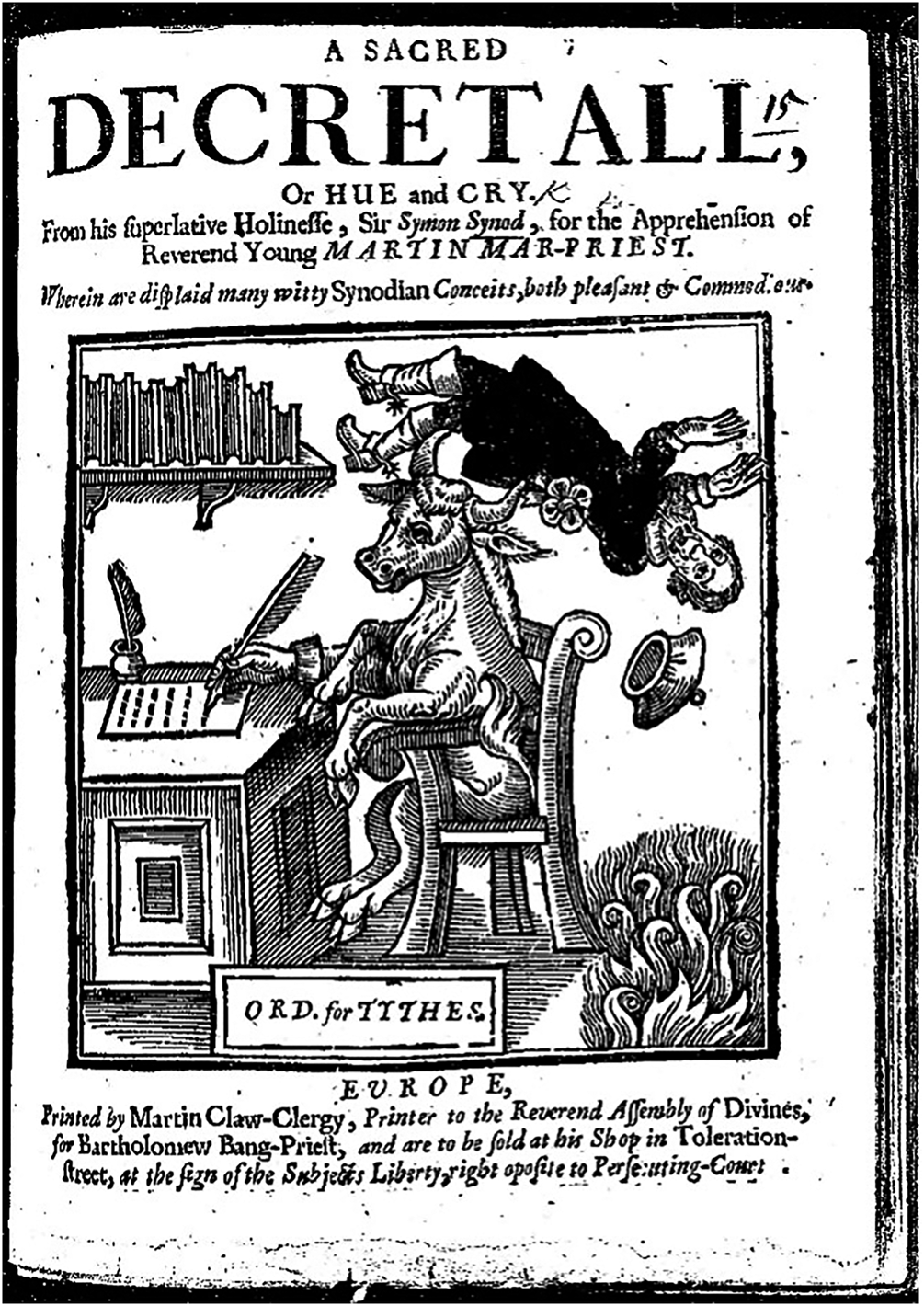
Like Marprelate, Mar-Priest played with typographical conventions to enhance his satire. A notable example is the engraved title page of A Sacred Decretall (1645), which humorously depicts Mar-Priest as a bull at a desk, tossing a presbyter into the fire (Figure 1). The picture visually complements the pamphlet's parody of the Assembly of Divines’ debates. Such a visual aid would certainly have affected the audience, amplifying the text's humorous potential. The title page also features a mock imprint, calling for religious freedom, purportedly printed by Martin Claw-Clergy, at the sign of the Subjects Liberty in Toleration Street.Footnote 58
Title page of A sacred decretall. Early English Books Online (EEBO).
Overton's revolutionary intentions emerged from the same clandestine press that published Martinist works. In fact, the press became one of his primary tools to express discontent with the authorities and advocate for radical change. As a revolutionary force, the printing press provided a platform for disaffected voices to push for religious, social, and political transformation, and Overton made extensive use of it. He often exploited anonymity and wide distribution of print to advance provocative ideas. For instance, he anonymously issued The Last Warning to All the Inhabitants of London in the spring of 1646, calling for the abolition of the monarchy. Amid the conflict between king and Parliament, the pamphlet argued that monarchs had committed “thousands of Oppressions, Murthers, and other tyrannyes.”Footnote 59 As Parliament's army was vanquishing the king's forces, Overton's Warning pointed out the dangers of negotiating peace with Charles I, suggesting that Parliament risked being deceived by the king's tyrannical ambitions. This marked a radical shift, advocating for a transformation in British politics from monarchical rule (with the sovereignty of the king-in-Parliament) to republicanism (with the sovereignty of the people).Footnote 60
Larner and Overton were arrested for The Last Warning. But even while imprisoned, Overton continued to disseminate his ideas, frequently invoking Martinism. He referred to himself as “little Martin” even in works published under his own name, indicating Marprelate's importance to and influence on his rhetoric. From jail, he authored another tract condemning “Kings, Lords, and Clergy-men” for usurping “the naturall Rights, properties, and freedoms of the people of this Nation.”Footnote 61 At the end, he declared his commitment to expressing radical views, despite the authorities’ desire that “Little Martin come not into the number.”Footnote 62
Martinism thus exemplified how historical actors harnessed the printing press as a revolutionary instrument to promote radical agendas. As a textual, satirical genre, Martinism proved a valuable radical tool. The combination of jest, humor, and incisive political and religious critique in short pamphlets was central to the British revolutions of the seventeenth century and to the empowerment of dissidents. These episodes underscored the enduring importance of the press. While movable-type technology did not incite revolutions on its own, it provided a crucial means for people to articulate their political and religious viewpoints and advocate for radical societal changes. The press was so integral to these efforts that it became a literal battleground for pamphlet wars and petitions, not just in Britain but throughout the Atlantic world.Footnote 63
Political Rights and the Printed Word
Ramesh Mallipeddi
In 1823, Jean-Baptiste Philippe traveled to London to submit a petition to Lord Bathurst, Colonial Secretary of State, on behalf of the free people of color in Trinidad.Footnote 64 Growing up in a family of affluent sugar planters and a physician by vocation, Philippe's memorial complained about the civil and political disabilities faced by educated people of color in the colony.Footnote 65 In the British Caribbean, the number of racially mixed persons had grown considerably by the early nineteenth century. In Trinidad, they constituted nearly forty percent of the total population.Footnote 66 These “free people of color” outnumbered whites in most colonies except Barbados. Few or none of them labored in cane fields. Residing primarily in towns, many were highly educated property owners, yet they were socially excluded because of their African ancestry. For instance, they were barred from juries and disallowed from occupying government positions. They could neither vote nor stand for office.
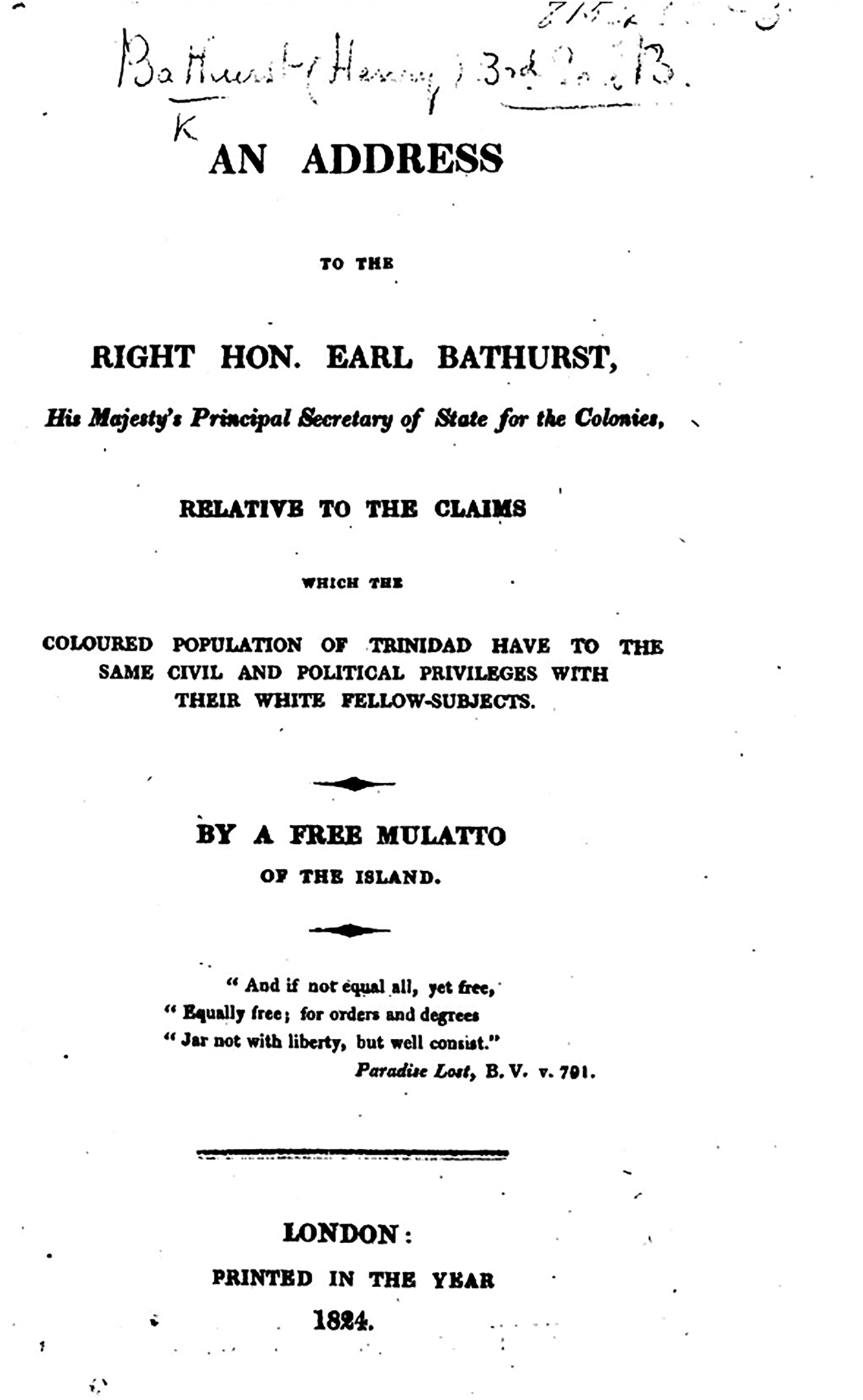
But the situation in Trinidad was also unique. When the British captured the island from the Spanish in 1797, they promised to honor existing Spanish laws vis-à-vis people of color. The Capitulation of 1797, a foundational document concerning the status of free people of color in Trinidad, granted rights of admission to the militia and civil service, and promised to honor existing economic and political rights.Footnote 67 Yet, as Philippe complained to Bathurst in his petition, as well as in a 300-page appeal he wrote in 1824, the British governors systematically disenfranchised people of color (see Figure 2). Such petitionary campaigns were not limited to Trinidad. In the 1820s, thousands of free people of color submitted memorials to the Colonial Office, to King George IV, and to the British Parliament for redress. In a petition submitted in 1823, for instance, free people of color from Grenada declared themselves “true and loyal Englishmen committed to the same values as the whites” and urged the king to abolish discriminatory laws and grant civic equality.Footnote 68
Title page of Jean-Baptiste Philippe's An Address to the Right Hon. Earl Bathurst (London, 1824). Image in the public domain (Google Books).
The right to express grievance through petition has a long, venerable legacy that is situated as well in the earlier printed dissent that Verônica Calsoni Lima discussed. In medieval times, corporate groups such as municipalities and guilds often petitioned the king for exemptions because the right to confer or withhold privileges was the prerogative of the sovereign. During the early modern period, petitions became a principal means of communication for individual appeals for favors as well as expressions of collective grievance. David Zaret notes that, by the seventeenth century, the right of individuals and corporate groups to petition over wrongs came to be regarded as “the indisputable right of the meanest subject.”Footnote 69 By engaging in petitioning, free people of color were, therefore, not only claiming rights but demonstrating that they too were British subjects. More significantly, historians distinguish between two forms of petition: petitions of grace and petitions of right. The former, supplicatory in tone, comprised an appeal to the generosity of the king, while the latter, shorn of the implications of subjection, was a request for the redressal of wrongs enacted in contravention of the law. The transition in the locus of political authority from absolute monarchy to the collectivity of citizens is reflected in the growing divergence between petitions of grace and petitions of right.Footnote 70
We associate the Age of the Democratic Revolution with a burgeoning print culture: the Declaration of American Independence and the French Declaration of the Rights of Man and of the Citizen were foundational documents of democracy that posited rights as natural, equal, and inalienable, but also instituted popular sovereignty. The Declarations originated in highly stratified, deeply hierarchical societies, where sexual, racial, and social divisions were taken for granted, if not deemed natural. While proclaiming that all men are equal and that all human beings are endowed with inalienable rights to life, liberty, and the pursuit of happiness, the architects of universal rights also deemed some classes of people—children, the insane, enslaved persons, free Blacks, and the propertyless—to be incapable of participating in the new political society.Footnote 71 The newly established American Republic denied voting rights to women, the propertyless, Indigenous people, and African Americans. Just as Calsoni Lima's Martins challenged prevailing powers, not surprisingly, printed petitions emerged as a countervailing or supplemental force against the exclusionary logic of these Declarations. This was especially true for those deemed neither citizens nor subjects who were thus left out of the social contract of the new republics, a contract no longer merely assumed to exist but printed for all to see.
The attempt to use petition as a vehicle of public opinion and political advocacy, and as a means to influence legislative proceedings, is evident in the British antislavery campaigns, which were quintessentially petitionary undertakings. The 1788 abolitionist campaign in England delivered a hundred petitions to Parliament; four years later in 1792, over five hundred petitions were submitted, with over four hundred thousand signatures. On the basis of such collective petitions signed by thousands of women and people from the laboring class, William Wilberforce introduced two bills in 1791 and 1792 to outlaw the slave trade. Although both bills were defeated, his widely publicized speeches in the House of Commons made chattel slavery a topic of national concern. Likewise, the British Anti-slavery Society (1823) mobilized mass petitions in support of abolition. Between 1828 and 1832, the British Parliament received more than 5,000 petitions calling for emancipation. As Daniel Carpenter has argued, in struggles against racial discrimination and slavery, women, free Blacks, and enslaved people “turned to petitions first as an instrument of law and justice, and later as a tool of organization, advocacy, and legislative process.”Footnote 72 On 21 March 1788, Olaudah Equiano presented the British queen with “a petition on behalf of [his] African brethren,” in which he appealed to “her majesty's pity and compassion for millions of my African countrymen who groan under the lash of slavery in the West Indies.”Footnote 73
It was not only literate freedmen like Equiano but enslaved Blacks in the Caribbean who appealed to royal authority in their bids for freedom. For instance, during Matthew Lewis's visit to Jamaica in 1817, Black people on his estate spread the rumor that he was the king's emissary, carrying the emancipation proclamation. As Lewis recalled, “‘good King George and good Mr. Wilberforce’ are stated to have ‘given me a paper’ to set the negroes free (i.e. an order), but white people in Jamaica will not suffer me to show the paper.”Footnote 74 Enslaved people's invocation of the “paper” as a legal instrument of freedom is surprising because the laboring populations in the plantation colonies were overwhelmingly non-literate. As Lewis himself admits, “there is not a single negro among my whole three hundred who can read a line.”Footnote 75 However, written documents conveyed power and legitimacy.
Historians have argued that, in the absence of literacy and hence access to printed sources, rumor became a principal means of disseminating information. As Miles Ogborn has observed, “the process of passing and parsing rumors—a form of speech ‘poised between an explanation and an assertion’—was an active political engagement with the power-laden worlds the enslaved inhabited and a way of collectively imagining and assessing the possibilities for freedom.”Footnote 76 Yet, speech and writing, verbal communication and printed texts, seem to have worked in concert because the “rumor” being circulated on Lewis's plantation in fact concerns a “paper.” Indeed, Black people's faith in the authority of written documents, in the power of “paper” to confer emancipation testifies to the centrality of the printed word to political struggles in the Atlantic world.
Where free people of color like Jean-Baptiste Philippe and freedmen like Equiano submitted petitions and memorials to appeal for rights, ordinary slaves turned to complaints to voice their disaffection and constitute themselves as claimants. The term “complaint” etymologically refers to an utterance or expression of grief, an outcry against injury. The genre of complaint—oral and written—in the form of prayers and lamentations has a long genealogy. But the term also refers to a formal statement of injury placed before a judicial authority for redress. Under slavery, slaves could not be complainants. As Elsa Goveia has written, the legal disability of slaves is encapsulated in the principle of “law of evidence,” according to which “any free person could give evidence for or against a slave,” yet “the evidence of slaves [could not be] admitted for or against free persons in the British islands.”Footnote 77 From the earliest days of slavery, Black people were barred from lodging complaints against their masters.
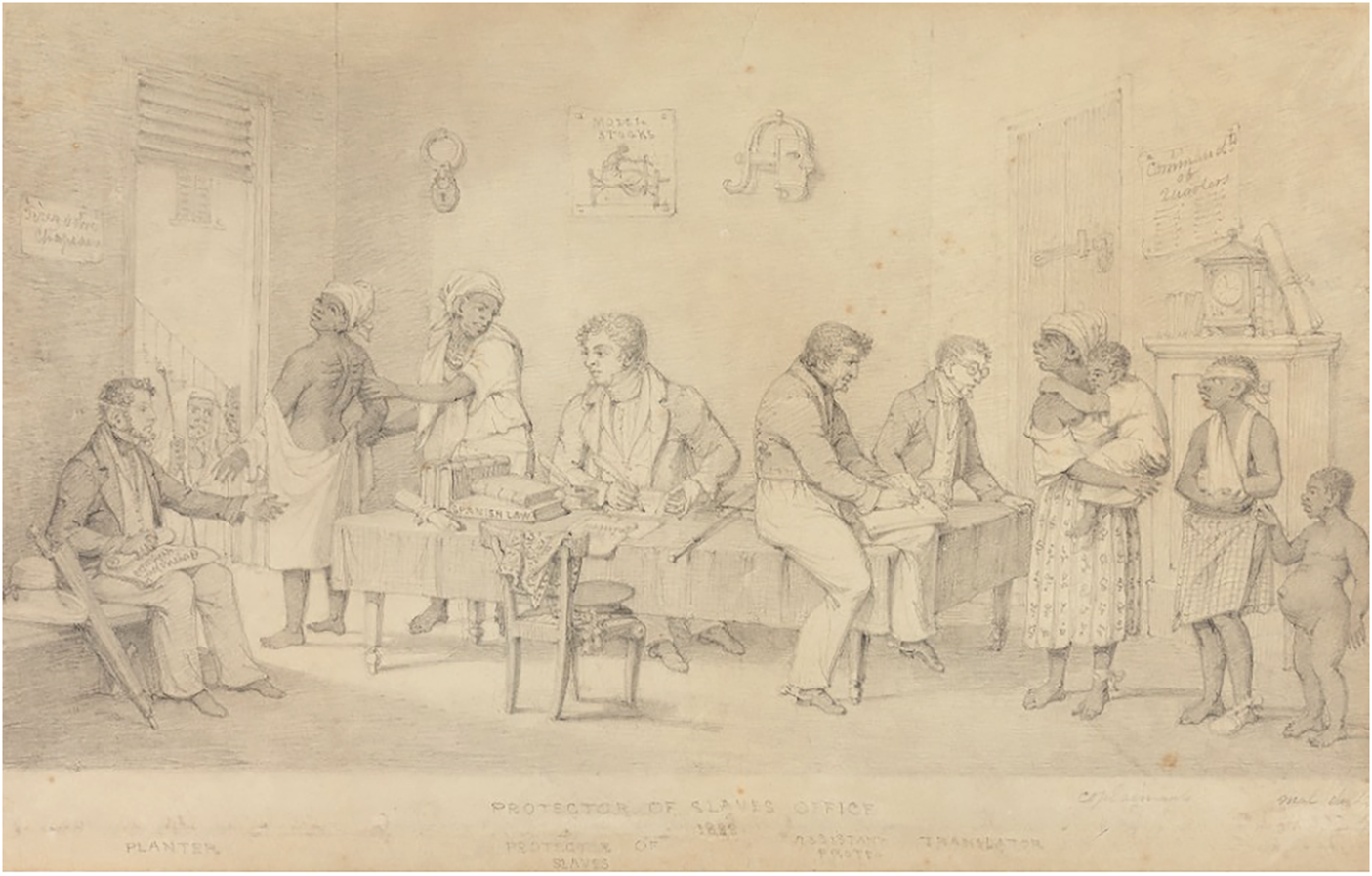
However, in 1826, the British government appointed, as part of its ameliorative measures, Protectors of Slaves, who, like the Fiscal in Dutch colonies, were metropolitan representatives, tasked with receiving and adjudicating complaints from slaves (see Figure 3). The managers of estates were also required to provide a list of the number and type of punishments administered, as well as information about the nature of offenses, on each estate. The complaints, transcribed by the Protectors, attest to the innumerable privations of enslaved people: destructive work routines; meager food and clothing allowances; illness and bodily infirmities caused by neglect; excessive, undeserved punishments; separation from family members; violation of customary rights; and sexual abuse. Black people often walked considerable distances to register their grievances. For instance, in June 1822, a woman named Jenny from the Litchfield plantation in Berbice traveled eighteen miles by foot to complain that she was being made to do fieldwork, despite informing the manager that she “has had a pain in her breast for near two or three months, which makes her weaker daily.”Footnote 78 Sara Ahmed observes that “to make a complaint is often to find a gap, a gap between what is supposed to happen, in accordance with policy and procedure, and what does happen.”Footnote 79 In laying bare the gap between customary or legal provisions and their violations, the oral testimonies transcribed by colonial officials constitute one of the most important archival resources for reconstructing the quotidian struggles of enslaved people. “From the complaints,” Trevor Burnard has recently observed, “a reasonably clear picture emerges of what slaves thought was the minimum due to them as slaves.”Footnote 80
Richard Bridgens, Protector of Slaves Office (Trinidad), ca. 1833. Yale Center for British Art, Paul Mellon Collection.
The voluminous documentary evidence gathered by the Office of the Protector of Slaves not only exposed the abuses of power and violation of slaves’ rights, it also galvanized public opposition to slavery in the metropolis. While the British government had successfully introduced, since 1815, reforms in territories under the Crown's jurisdiction (Trinidad, British Guiana, and St Lucia), self-legislating colonies (Barbados, Antigua, Jamaica, Nevis, and St Kitts) opposed reformist measures as unconstitutional, an infringement of the rights of colonial assemblies. In this context, the evidence transmitted by the Protector of Slaves to the Colonial Office, based on complaints of enslaved people, proved vital, as Henry Taylor, one of the principal architects of British emancipation, recalled:
If the Assemblies refused to enact the “meliorating” code, there was no power in the Crown to coerce them. We tried everything. Many a conciliatory dispatch was written; not a single Assembly was conciliated … But in the Colonial Office we knew what we were about. We had established protectors of slaves in the few colonies in which we had legislative power; they made their half-yearly reports in which every outrage and enormity perpetrated on the slaves was duly detailed, with the usual result of trials and acquittals by colonial juries, and perhaps a banquet given by the principal colonists in honour of the offenders; we wrote despatches in answer, careful and cautious in their tone, but distinctly marking each atrocity, and bringing its salient points into the light; we laid the reports and despatches before Parliament as fast as they were received and written; Zachary Macaulay forthwith transferred them to the pages of his “Monthly Anti- Slavery Reporter,” by which they were circulated far and wide through the country; the howlings and wailings of the saints were seen to be supported by unquestionable facts officially authenticated; the cry of the country for the abolition of slavery waxed louder every year.Footnote 81
News of discussions in Parliament and public controversies over slavery quickly reached the colonies. As Alison Carmichael, who lived in Trinidad and St Vincent between 1816 and 1823 lamented, although “few slaves can read,” they learned about the “very memorable debates in parliament upon the subject of slavery” from literate free people of color and became increasingly defiant.Footnote 82
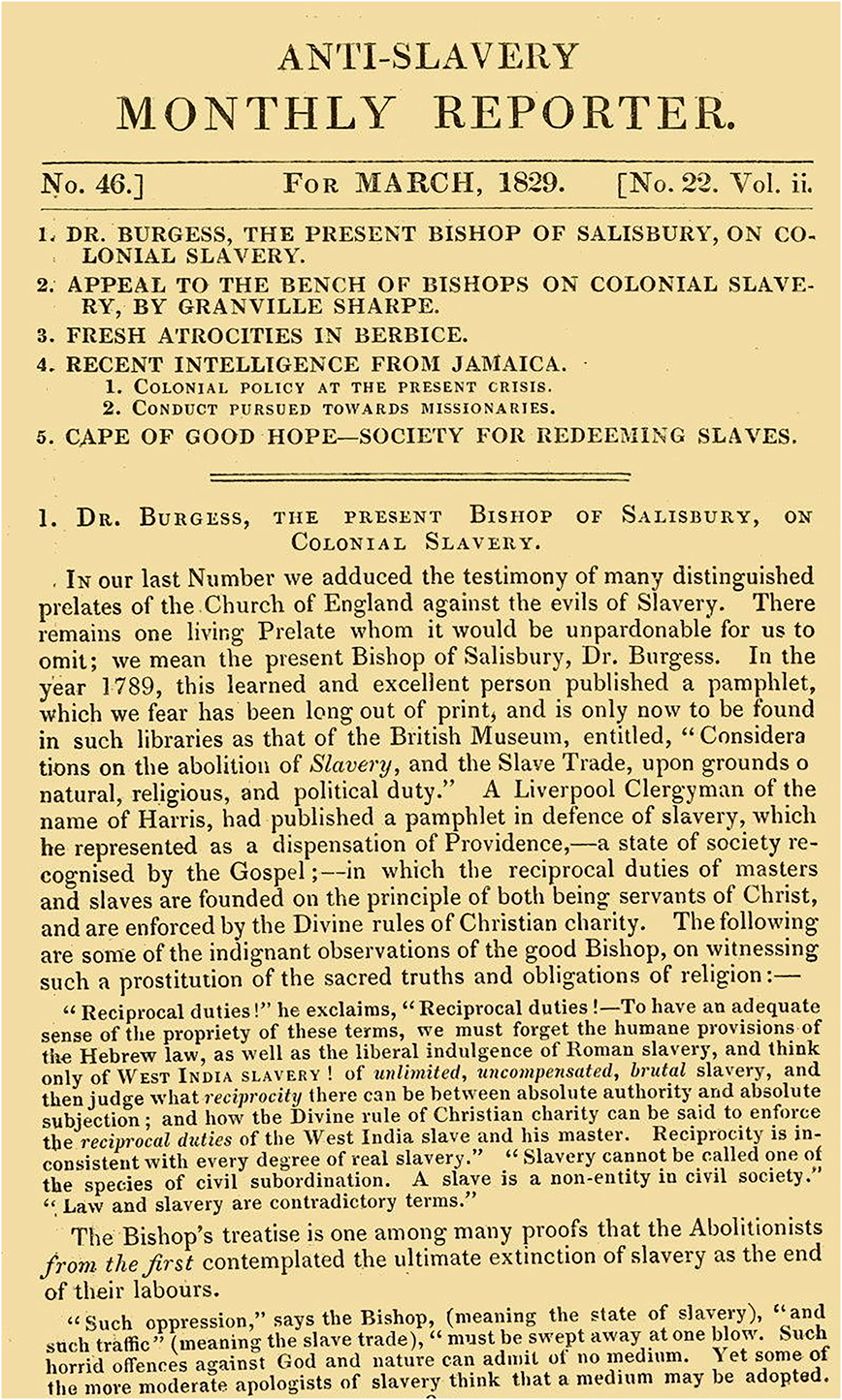
Cognizant of mounting support for their cause in the metropolis, Black people in the Caribbean redoubled their efforts to secure privileges under slavery and for emancipation, invoking the abolitionists and the king as their allies. On Matthew Lewis's Jamaica estate, enslaved people even composed a song, “Song of the King of the Eboes,” framed as a supplication, calling on Wilberforce to set them free. As Governor D'Urban from British Guiana reported to Bathurst in 1824, “the slaves still believe that measures for their advantage have been ordered by the King, but are withheld from them here.”Footnote 83 At the same time, the complaints that enslaved people lodged with the Protectors found their way into Parliament and the British public via antislavery magazines. Thus, the March 1829 issue of Anti-Slavery Monthly Reporter, edited by Zachary Macaulay, contained a section on “fresh atrocities in Berbice,” compiled from reports of the Office of the Protector of Slaves (see Figure 4). Likewise, in 1831, the Anti-Slavery Reporter printed complaints from seventeen enslaved persons, including Friday, Georgiana, Jan Zwart, and Christiana (see Figure 5). These circuits of transatlantic communication—and the newspapers, petitions, complaints, reports, periodicals, and other printed documents that flowed through them—were vital to shaping the political imaginations of enslaved people and free people of color in the era of democratic revolutions.
Anti-Slavery Monthly Reporter, March 1829. Image in the public domain (Project Gutenberg).
The Anti-Slavery Reporter, 25 July 1831. In The Anti-Slavery Monthly Reporter (London Society for the Abolition of Slavery, 1831), 4: 349. Image in the public domain (Wikimedia Commons).

Current work on democracy and rights tends to focus primarily on declarations and bills because they are documents that challenged monarchical authority in the name of collective autonomy, and royalist prerogative in the name of collective right. They are texts of self-authorization. In contrast, the rhetoric of petitions and memorials is one of deference, humility, supplication, and submission. For enslaved people whose condition was often one of rightlessness—a condition generated by their statelessness—the Revolutionary era did not render royal generosity obsolete, but made it all the more important. They invoked King George as their defender and protector. Indeed, they believed they had been manumitted by royal decree. Their appeals to Crown and Parliament drew simultaneously on the discourses of grace and right, royalism and republicanism, monarchic authority and popular sovereignty. Thus, whereas declarations and bills are the paradigmatic genres of procedural democracy, petitions, memorials, prayers, appeals, supplications, and complaints are the quintessential forms of fugitive democracy.Footnote 84 It is by attending to such neglected print genres as petitions and complaints that we can trace how disenfranchised Black people sought to translate grief into socially recognized claims of grievance in the revolutionary Atlantic.
What Print Conceals: Structural Trauma and the House at 17 Gough Square
Cynthia Richards
To tour Dr. Johnson's House is to be reminded of what print, or for that matter any mediated communication, conceals: the bodies from which it originates. At the four-story house, now a museum, at 17 Gough Square, London, it is 73 steps to the attic room or garret where Johnson, along with six amanuenses, composed the two-volume Dictionary of the English Language (1755),Footnote 85 the first of its kind in English history and to this day considered one of the most monumental events in English print production. Johnson was quite an avid walker, but the climb couldn't have been easy. The steps tip noticeably to one side and are shallow even for someone of my height (5′3″), much less Johnson's, reportedly six foot tall. Moreover, W. Jackson Bate, the second most famous of Johnson's biographers, reports that the floors of that home were often littered with booksFootnote 86 and Johnson, as is well known, suffered both from physical tics and poor eyesight, having lost vision in one eye as the result of a childhood illness.Footnote 87 His amanuenses couldn't have fared much better, given their living conditions. Hired, at least according to Bate, “as much out of compassion as skill,” they struggled to feed and house themselves. Bate's description of them as “ragamuffins and waifs” suggests that they were thin, malnourished, and poorly clothed. Two died within the nine years it took to produce Johnson's testament to the value of being able to put things down in print.Footnote 88
The transition of the Journal of British Studies to online-only publication, I can say, without any risk of offense being taken, is a far lesser event in print history than the production of the first English dictionary, yet we can draw some parallels. Just as the calculation was made by seven booksellers in the mid-eighteenth century to finance the production of an English dictionary (after some initial hesitation on both their part and Johnson's), the editors of this journal have made the calculation that the value of this endeavor outweighs the risks. This includes the risk that some of its readership will experience this advancement in making information retrievable and accessible as profound loss, even possibly as traumatic loss.Footnote 89 Nor is this switch to digital production likely to rectify the problem of what print conceals. If anything, digital communication only further removes us from the means of production, so to speak, or obscures the bodies that originate its text, and, with the growing use of artificial intelligence, even eliminates sentient bodies altogether. Mediated communication rarely acknowledges the human conditions that shape its meaning, especially when those environments are not designed to accommodate bodily needs.
That this essay is making this case is also to be expected. This narrative of loss in the face of technological advancement is an old one, and one that repeats itself with each new technological change. Plato is most cited as having first made this case, referencing the shift from an oral culture to a scribal one. In Phaedrus, Plato's teacher Socrates, rather than celebrating the invention of writing, uses a story to cast doubt on its value instead. Writing will not promote “memory and wisdom,” the Egyptian god Theuth, the mythic originator of writing, argues in Socrates's tale, but rather their opposites: “forgetfulness” and “ignorance.” Speaking in the voice of script's human beneficiary—the Egyptian king—Socrates makes the case that “writing is a receipt for recollection, not for memory” and that this new medium will substitute “quantity of information” for quality, and “without proper instruction” perpetuate the user's “ignorance” rather than the acquisition of true knowledge.Footnote 90
Not surprisingly, then, in the eighteenth century, when the shift from scribal to print culture was reaching its apex in Great Britain, these same arguments were made again, perhaps most forcibly by Alexander Pope in The Dunciad (1743). Here, he imagines the writers of Grub Street, the geographic center of print publication in England, as a cadre of dull schemers, deceiving their readers for pay and relying on the public's shallow comprehension or “ignorance” to further their trade. Print allows them to expand their kingdom on a hitherto unimagined scale.Footnote 91 In both these stories, advancements in technology leave individuals vulnerable to misapprehension, and “forgetful” of the realities of their lives. Each time, we lose knowledge of ourselves.
The repetition of this trope alone could suggest that we experience technological change not just as loss, but rather as trauma. Trauma is best known from both a popular and psychoanalytic standpoint as a form of reenactment. Unable to process or assimilate a shocking event, the event itself returns not as memory or knowledge, but rather as an unconscious action or involuntary recollection, such as might occur in a dream or a flashback. That we repeat this narrative of loss whenever new technology assumes dominance suggests that we have yet to fully assimilate or understand the meaning of this mediation and its impact on our consciousness. We experience it as an unwanted reenactment rather than an organic change. Moreover, the mediation of communication in these narratives serves as the original wounding or aporia in the text, and the discussion of this loss resembles how we frame trauma today. Mediated communication disconnects us from ourselves and makes knowledge of ourselves inaccessible and unassimilable. Plato's and Pope's stories differ, in this regard, only in how they ascribe motive: in one case, it is well meaning and in the other mercenary. The effects on human consciousness remain the same.
Johnson's response to the shift from scribal culture to print culture is famously ambivalent, as is the reading of his role in making print respectable. His letter to Lord Chesterfield (1755) declaring his writerly independence that accompanied the publication of the dictionary is read as nearly “single-handed[ly]” ending the practice of patronage associated with scribal culture. The Dictionary itself is credited with being instrumental in “dignify[ing]” the practice of so-called hack writing while “heroically” facilitating the shift in the eighteenth century from the more elite “letters” to the more democratic “literature.”Footnote 92 Johnson himself quipped that “no man but a blockhead ever wrote, except for money,” and his most famous biographer, James Boswell, dutifully recorded what was a radical sentiment at the time as the height of wisdom.Footnote 93 Yet Hester Thrale Piozzi, arguably the biographer who knew him best, notes that when faced with illness or his habitual melancholia, Johnson turned to script or oral recitation to reassure himself of his self-possession, or that he had not “stagnat[ed]” in his thinking.Footnote 94 He may have furthered the fixity of print culture, but he also never quite trusted the medium that paid his bills. Even his greatest admirers point to his written works as a lesser version of the man. To read Boswell's Life of Johnson is to wish for Johnson's company, and to experience his written work, no matter how monumental, is a kind of retrospective loss. What he produced in print does not quite measure up to who he was in person. This language returns us not to the shift from scribal to print culture, but rather to the “original” trauma of oral culture being replaced with the written word. Even as Johnson is acknowledged as doing more to legitimize print than any English writer before him, we lament the loss of what it meant to be literally in his presence.
To tour the house at 17 Gough Square is to seek some remnant of what it meant to be in his presence.Footnote 95 I went looking for his walking stick, both the original given him by his former student and theatrical great, David Garrick, and the facsimile of the one he carried on his tour of the Scottish Hebrides. I wondered how these artifacts accommodated him, and the needs of his body on that famous journey to the Western Islands.Footnote 96 What I found were more clues about what grounded him. For one, the layout of the house where he compiled the dictionary seems more about what he was trying not to lose rather than what he was commissioned to produce. Natural light, and an abundance of it in a large garret room that still hovers over the other buildings in the square, was certainly a factor in his having chosen this site for the drudgery of underlining and copying prose, yet constitutionally Johnson needed company even more, and visiting the four-story house on Gough Square makes this need the more apparent of the two.
For one, the house is capacious and could accommodate many. Bate argues that in leasing the house, Johnson's chief concern was accommodating his wife's needs and maintaining their relationship. Hence, he situated the chaos of the dictionary workroom far from her lodgings on the first floor.Footnote 97 She, to Johnson's regret, never quite found the place to her liking, but the rest of the house was soon filled up with what Piozzi calls “whole nests of people,” and it is to this domestic configuration that the museum currently pays homage.Footnote 98 The room of Dr. Levet, who offered medical care free of charge to London's poor, is showcased on the third floor; that of Anna Williams, the blind poet with whom Johnson shared a nightly tea on the second. A picture of Johnson's heir, nominally his valet, the formerly enslaved Francis Barber, hangs on the first floor. Francis, we are told, lived in the basement. What Johnson did not want to lose during the nine years it took him to produce the first English dictionary were his connections to the real world, to the people that gave structure to his daily life. In fact, when I note how loath one would be to repeat the 73-step climb during the day, the director of the museum readily points out how easy it would be to call down for help. In other words, the virtues of oral culture continued in this place where historically both it and scribal culture were formally displaced. To this day, the house continues that dual tradition, serving as both a museum honoring Johnson's contribution to English literature, and as space one can book for social events and communal gatherings. It preserves both print culture and the oral origins of communication that the written word is said to have superseded.
The same can be said for any switch from one medium to another. They rarely, if ever, fully displace each other, but rather coexist. The eighteenth century not only saw the rise of print but could also be described as the age of diaries. Johnson never could sustain his own journal keeping, but Boswell, upon his recommendation, did. Another of his proteges, Frances Burney, rivaled Boswell in the quantity of journal writing produced, and arguably exceeded him in the quality of what she recorded in script. Ironically, given Plato's account, script in the age of print became the primary tool for truly coming to know oneself. Furthermore, history has shown that “literacy does not drive out oral patterns of thought, and certainly does not do so immediately.”Footnote 99
So, although this switch can be read as traumatic, it does not readily fit Cathy Caruth's much cited definition that characterizes this “event” as “happening too soon, too unexpectedly.”Footnote 100 It took three hundred years from the invention of the printing press for Johnson's dictionary to be compiled, and for British print culture to come into its own. By the same token, there is nothing unexpected in the decision of the editors of the Journal of British Studies to switch to a digital format, and few would argue that it is “happening too soon.” And although this change will have “everyday effects” on the lives of its readers—such as no tactile edition of the journal arriving in the mail or no set time for its delivery—these stressors do not fully accord with how Ann Cvetkovich defines “everyday trauma” either. For one, as readers, we are likely to adjust without too much trouble to these changes, but more importantly, the shift from print to digital is too seismic, too orchestrated, too formal to be called “everyday.”Footnote 101 Even those scholars, for example, who celebrate Johnson's role in legitimizing print culture are quick to state that the shift to electronic communication will prove different from these earlier iterations of change. Memory will truly be effaced: “At which stage, no one will need to remember anything, except how to turn on the computer,” argues Tankard.Footnote 102
Thus, if we experience this technological advancement as traumatic loss, it is best characterized as what Dominick LaCapra calls “structural trauma.” It is mythic, existential. Like LaCapra's description of original sin, it is what separates us from a wholeness of experience where all our bodily needs are met, and where our relationships with others are not mediated and distant but immediate and direct. “Structural trauma” is how we choose to remember our collective human experience of being cast from a paradise of which none of us has had direct and unmediated experience. For this trauma, there is no historical remedy.Footnote 103
That is what Samuel Johnson learned in putting together the dictionary, and throughout his exceptional career in print. Yet we can “palliate what we cannot cure,” he writes in the Preface to the Dictionary. Although he intended to “fix” language when he first embarked on this project, by the time he completed it, he was left instead with the knowledge of the inevitability of change, particularly in how it manifests in form, and that, at best, we can but slow change and consider its many meanings. There are “causes of change,” he writes, that are “superiour [sic] to human resistance.” Footnote 104 Yet even as he acknowledges this inevitability, he remains equally committed to not concealing what is lost in this process, and how reliant all meaningful communication is on the human relationships that precede it. Johnson lost both his wife and his mother shortly before the dictionary's publication, and prior to that a dear friend, and he concludes its preface by lamenting that he no longer has a direct connection to the bodies that made this work significant: “I have protracted my work till most of them whom I wished to please have sunk into the grave, and success and miscarriage are empty sounds.”Footnote 105 He reminds us of what print conceals and then refuses to conceal those losses. As the Journal of British Studies moves to exclusively digital production, it can do the same, as it is doing in this series of interconnected essays: explore both the meaning of this achievement and the loss it inevitably represents. That loss does not have to be traumatic—or it need only be as traumatic as life itself. We can climb the 73 steps and acknowledge the bodies, even ones as “peculiar” as Johnson's, which remain hidden behind the written text.Footnote 106
Issues of Paper
Richard Menke
This launch of a now paperless Journal of British Studies offers an apt forum for considering the entwinement of scholarly journals with paper as matter, platform, and interface. Through the late twentieth century, the material affordances and availability of paper not only made forms of writing on paper essential sources for much historical, literary, or cultural research but also made printed paper the logical medium for disseminating that research in written form—to the point that a scholarly article or essay is also a paper. Paper exemplifies the dynamic in which our media become both sites for creativity and conditions for our knowledge, and the histories of periodicals and modern scholarship have intersected with the history of print on paper. A review of the properties and affordances of paper, and of the relationships of serial journals and scholarship to printed paper, can illuminate our sense of what scholarship after paper might look like.
The printed page may be “flat” in comparison to the layers of code behind texts on electronic platforms, but paper has three dimensions, as anyone who has winced at a paper cut can attest.Footnote 107 The same substance on which we inscribe handwriting or printer's ink can contain our groceries, conceal a birthday present, hold a dose of tobacco. Shaped into the cartridge for an 1853 Enfield rifle-musket, a piece of paper might contain a ball projectile and gunpowder, as well as the tallow, lard, or beeswax that lubricated the gun barrel—an incendiary combination, it would transpire. Paper is a medium three times over, with the potential to bear text or images inscribed upon it, material objects enclosed within it, substances infused into it. Paper folds, encloses, tears, burns. Digital media have encroached on paper's roles as a medium for texts, images, documents, or money, but they will hardly usurp its abilities to line a birdcage or a pie dish, to provide confetti or kindling.
Papermaking begins with cellulose-bearing material from plants, plant-based textiles, or wastepaper, which is beaten into a slurry in water so that the cellulose fibers form a suspension. Next, the papermaker or papermaking machine draws off a thin layer of this “stuff.” As the new sheet of paper dries, its fibers form a tightly interlaced mesh based on hydrogen bonds, yielding a substance that is light but flexible and strong. The chemistry of paper also makes it unusually easy to customize or fine-tune for specific applications (for instance, by adding sizing agents during production that improve its ability to take up ink). Traditional European papermaking used cloth rags as its raw material. Indeed, a classic argument in the history of technology treats the arrival of the spinning wheel in medieval Europe, which expanded the supply of linen rags, as a crucial context for Gutenberg's work to develop a mechanism for inscribing large quantities of paper with text.Footnote 108
By the nineteenth century, the papermaking trade in Great Britain had established a diffuse system for rag collection, including ragpickers and rag-and-bone men. Still, as rising literacy, the end of the taxes on knowledge, and technical innovations in papermakingFootnote 109 and printingFootnote 110 dramatically increased the demand for paper and the means of using it, the supply of rags presented a bottleneck for paper production. While British papermakers turned to Mediterranean esparto grass for producing book paper, the real breakthrough was the late nineteenth-century invention of industrial processes to create wood pulp for paper production. The era's surge of paper mass media and specialized journals alike was fueled by the wholesale extraction of living forest biomass to create cheap paper, a change with critical consequences for global ecologies, for the culture and commerce of print, for bureaucracy and record-keeping, and even for literary aesthetics.Footnote 111 In a painful irony, the chemistry of the new paper made from sturdy forest trees (and later from harvesting plantation forestry's monocultures) would turn out to render it exceptionally liable to degradation and disintegration.
The Gutenbergian complex of paper and movable type dominated textual dissemination for centuries. The publishing and proliferation of paper periodicals began in the seventeenth century, a marker of print's ubiquity and reach into everyday life. Synchronizing the formal rhythms of print production with the march of calendar time, the phenomenon of print periodicals has been treated by scholars from a variety of disciplines as a vehicle of that hazy but far-reaching condition, modernity itself.Footnote 112 The first scholarly journals were published within decades of the earliest print periodicals, but such journals multiplied and specialized rapidly throughout the nineteenth and twentieth centuries. Often affiliated with learned societies or academic institutions, they not only communicated research but also sustained intellectual communities and helped to define disciplines, fields, and research programs. A journal printed on paper also materially represented the collective labor, expenditure, and infrastructure necessary to produce and disseminate such a recurrent and regularized media object—a physical expression of intellectual and professional capital, and a signifier of quality control.
Even the parceling of a journal into discrete issues reflects the distribution of information on paper, which made it convenient to bundle sets of articles for printing and mailing.Footnote 113 Eliminating the codex-like unit of the paper issue, a digital scholarly journal becomes something like a date-stamped, subject-specific repository of digital files certified to have undergone a particular mix of collection, editing, and evaluation. The Journal of British Studies has published its last traditional, quarterly issue, although it has hardly reached its endpoint; indeed, the immediate release of new articles and reviews will keep the journal fresh and up to date.
While paper journals gave academic production both a floor and a ceiling, electronic media can promote a sense of proliferation without limits. The rapid growth of online-only publishing in the twenty-first century—including new digital publishers that rapidly accept and publish hundreds of thousands of articles annually (MDPI) and single “mega-journals” that publish thousands of articles a year (Public Library of Science's PLOS ONE, Springer's Scientific Reports)—suggests how paper publication once helped to restrain such proliferation, even as it gave every issue a page count to be filled. As Mar Hicks argues below, open-access electronic publication in particular makes scholarly writing available “as disembodied informational storehouses” of potential training material for large language models, which is permitting a circular system in which the semi-automated publication of semi-automated texts helps to generate still more such texts. For all its fascination with gadgets and technologies, media studies sometimes tends to argue that there is nothing new under the sun, a reflex that probably supports the association of media change with traumatic repetition, as Cynthia Richards's contribution to this Roundtable explores. The threat of large-scale algorithmic text generation—especially to periodicals and their beleaguered editors—belies that pose.Footnote 114
Even after a generation not only of born-digital articles and journals but also of electronic database projects, blogs, and big data, printed paper has retained a position as a vehicle of scholarship. As long ago as 2007, a report from the Association of Research Libraries complained that “publishers and libraries” were caught “in an extended transition zone between print-only and e-only journals,” a state epitomized by the tendency of established journals to offer both paper and digital formats.Footnote 115 For two decades, humanities scholarship especially has seemed locked in a peculiar communication circuit in which academic research has been composed on computers, vetted and edited electronically, and sent as digital files to a printer for electronic compositing, only to yield a final output on paper—which would nevertheless have an e-text as its digital doppelgänger.
The transitions to remote work, institutional budget cuts, and closures of public buildings compelled by Covid-19 appear to have precipitated a notable shift from paper to digital monographs.Footnote 116 The parallel process for scholarly journals may be less noticeable because many libraries began moving from paper journals to digital subscription packages years ago. Still, paper scholarship has left its imprint in the electronic forms that reiterate and remediate its appearance and properties. Much digital scholarship still follows conventions established to suit print and paper, including norms of length and presentation, of linear argument, of the self-contained article as unit. Digital standards such as the PDF permit and perhaps encourage such imitation or skeuomorphism, and for the most part, digital journals seem to have made few explorations of, or concessions to, the electronic norms of streaming or screen-reading, with the different media affordances and forms of readerly attention they entail. Indeed, as Mar Hicks's essay in this Roundtable suggests, the ever-wider dissemination of digitized text “may parallel an increasing decline of people's ability to engage with it.”
Some scholarly functions once fulfilled by journals on paper have already proved obsolete or redundant. For instance, printed paper long served not merely as a medium for disseminating new content but also as a repository for compiling, organizing, and disseminating databases and metadata—telephone books, card catalogs, bibliographies. A regular feature of the journal Victorian Studies into the early twenty-first century—the annual publication of a field-spanning, interdisciplinary “Victorian Bibliography”—in fact predated the establishment of the journal itself by decades. The “Victorian Bibliography for 1999” printed in its Summer 2001 issue includes 3,680 entries and spans nearly 150 pages, filling more paper than the articles or book reviews alongside it. The next year, the Victorian Bibliography underwent a transition from paper to pixels, the first department of the journal to go digital-only. The move promised not only to save paper but also to add ease of access. Offering a history of the Victorian Bibliography up to that point, explaining how a network of compilers contributed to it by recording citations on paper index cards to be physically mailed to the editor, and describing its millennial transition to the internet, its veteran editor exulted that “Each citation contributes to our understanding of Victorian cultural history and reifies VB's position as the locus of Victorian studies.”Footnote 117
Although the published link to the Bibliography's original website is long dead, the Victorian Bibliography for 2000 remains available as a supplementary electronic issue of the journal on Johns Hopkins University Press's Project MUSE, as does the Bibliography for 2001. For nearly a decade afterwards, the journal continued to sponsor the production of digital versions of the annual Bibliography. It seems to have been discontinued when the elaborate compilation of a bespoke field bibliography no longer seemed justified in light of the power and increasing comprehensiveness of electronic searching. Yet in a dialectical inversion or McLuhan-style reversal, after some shifts of electronic platform or publisher, the digital Victorian bibliographies for the years after 2001 seem no longer to be accessible at all, at least as of 2024.Footnote 118 On the other hand, anyone can still find their paper predecessors on the shelves of a research library.
For those who wrote for print on paper, the serial accumulation of paper journal issues into a regular, orderly archive could become entwined with a vision of futurity itself. On the first page of its 1817 inaugural issue, The Literary Gazette and Journal of Belles Lettres, a weekly journal published in London, boldly looked forward not merely to disseminating the progress of literature, art, music, science, and invention in Great Britain but also to “exhibiting a clear and instructive picture of the Moral and Literary Improvement of the Times, forming at the end of each year, a complete and authentic Chronological Literary Register for general reference.”Footnote 119 With this future anterior view, the journal's editor anticipates its becoming an ordered, cumulative record on the shelf. A generation later, struck by the journal's attainment of its 1,234th issue, the Literary Gazette's editor playfully “looked forward to” the publication of issue “number 12345!!”—on schedule to appear, in his calculation, “somewhere around the middle of the year 2054.” But such a deep time of serial media also raises a vision of radical change. After all, by 2054 “Paternoster Row may be a railroad, with St. Paul's as a booking-place … and the site of [the Literary Gazette's] office, near Waterloo Bridge (supposing the Thames not to have been drained), a balloon station.” By then, he acknowledges, the Literary Gazette may long have ceased publication (in fact, it only lasted until issue number 2360, published in 1862). Yet as a counter to this rueful narrative of mutability and obsolescence, the writer foresees the persistence and availability of the journal's paper copies in the twenty-first century; their capacity to withstand “the ravages of time”: “Perhaps some antiquary, fond of old trifles, may fall in with this page, and illustrate it with notes in some little read repository; or even, wondering at his discovery, print an essay … on the subject.”Footnote 120
Ideas about our media readily come to reiterate the properties of those media. The Literary Gazette's image of a persistent, stable archive of printed paper contrasts with the late-Victorian vision of decaying industrial paper made of wood pulp. While celebrating paper's unexpected or experimental uses (as a building material, or for manufacturing furniture or dentures), a writer in All the Year Round contrasts the durability of old books on “genuine linen rag paper” with the rapid deterioration of “the wood-pulp paper now largely used,” a problem just then becoming recognized by scientists, librarians, and publishers. Cheap wood-pulp paper “is so flimsy that the very ink corrodes it, and time alone, with the most careful handling, will bring on rapid decay.” The tenuous lifecycle of pulp paper inspires a view of the future, and of the twenty-first-century scholar, that contrasts with The Literary Gazette's earlier vision of the endurance of paper in an uncertain world:
Only remnants of present day literature will survive for the information of future generations, and great national collections, such as that in the British Museum Library, formed at great expense, and intended to be complete and permanent, will offer to the literary historian of, say, the twenty-first century, but a heterogeneous mass of rubbish, physical laws thus consigning to oblivion a literature of which but a tithe is intellectually worthy to survive. The paper-maker thus unwittingly assumes the function of the great literary censor of the age. His criticism is mainly destructive, and it is too severe. Without the power of selective appreciation, he condemns to destruction good and bad alike.Footnote 121
This wry fin-de-siècle vision of piecemeal disintegration parallels today's threats of electronic content loss—whether through technological obsolescence; corporate cost-cutting; commercial ownership changes or bankruptcies; cyberattacks on great libraries, publishing houses, or open electronic archives; loss of institutional support; or inadvertent neglect. For one thing, as the writer notes, accessing and handling paper archives degrades them. In contrast, consultation and use do not harm electronic documents; indeed, “electronic memories become more permanent the more they are constantly refreshed.”Footnote 122
Like phonograph records or digital discs, printed paper also encourages a distribution model in which individuals or institutions own copies of media and may choose to store and retain them indefinitely. Over the past fifteen or twenty years, digital media content has become more and more bound up with distribution via streaming, in which subscribers pay not for ownership of a media object but for a period of access to media content. The very same centralization and control that will let Cambridge University Press offer open digital access to research articles in the Journal of British Studies—a policy shift that is often part of the online-only transition for academic journals—allow commercial video streaming services to depublish content that their subscribers once paid to access. Media transitions draw special attention to the economics as well as the affordances of media infrastructures. And once again, a larger sense of cultural sustainability, or of cultural precarity, may follow from the properties of our media.
In the late nineteenth century, when wood-pulp paper made old forests into yesterday's news, the tradeoff between environmental destruction and access to periodicals (at least before they fell apart) might have seemed clear. But today, virtually any detailed examination of the ecological implications of the transition from paper publication to fully electronic journal production and distribution concludes feebly that comparative life-cycle assessments are subject to many variables and difficult to make.Footnote 123 The environmental impact of printed paper depends not only upon how it has been sourced, produced, distributed, and consumed but also on whether it is retained, how it is stored, and what happens to it when and if it is not kept. As they repose on the shelf, paper books and journals might seem like carbon sinks, but their production and distribution actually entail significant carbon emissions. Small changes in the thickness and composition of paper and even in the size and compactness of a typeface can have environmental implications.Footnote 124 The components of the footprint of streaming digital files include the powering of the data centers that store them and the production of the electronic devices for accessing them, factors that change over time. A mega-journal run by MDPI will have a different environmental profile from an established journal from a university press operating under climate directives. To the keenest critics of an “internet complex” they view as allied with ecocide, end-stage capitalism, and the denial of the rhythms and spaces of community, however, any differences may be nugatory: “that every service or product should be available ‘on demand’ presupposes a reality unmoored from spatial, material, or temporal constraints.”Footnote 125
Even amid moves from print to electronic texts, the production of paper itself is in little danger of winding down, despite a long-term decline of “graphic paper” intended for printing.Footnote 126 Indeed, beyond the persistent importance of paper for packaging or personal hygiene, the present century has seen a continuing revival of interest in both papercraft and letterpress printing, artisanal responses to the eclipse of printed paper as the default medium for cheap dissemination.Footnote 127 The transition of learned journals from dual media to electronic-only will continue to expose paper-derived norms and workflows as they are reassessed to suit another medium. As paper publication ceases to be the default, this changeover may even free publishers, editors, and researchers to try out newer—and older—approaches to scholarship on paper.Footnote 128
Friction and Scale: How Digital Networked Technologies Have Changed the Way We Read, and Think
Mar Hicks
Over a decade ago, I stood before a frowning immigration officer in the heat of July, sweaty and tired after a long flight from the US.
What is the purpose of your visit?
Research.
What is the topic?
British computing history.
I was attempting to enter the UK to do research at The National Archives and the British Library for a book about the history of computing, but when I said this, it was met with a scoff: “Computer history? Then why can't you research it online?” I froze, steeling myself to explain as politely as possible how that misunderstood so much about how history is written and how archives are kept, in order to justify why I should be let in to the UK. Thankfully I didn't have to. After reflecting for few seconds, the passport officer said, “I guess not everything is online yet,” or something to that effect, and let me through.
This incident at the UK border has stayed with me. It seems to cut to the heart of how digital, networked technologies have changed the way we read and think. This conflation of the medium with the message betrays a fundamental misunderstanding of text. It positions text as information that can be easily separated from its physical containers—not just the paper that it is printed on but also the filing folders and boxes those papers reside in, the deep library and archive shelves where those files, boxes, and books are carefully ordered and contained, and indeed the way it has been culled from a much larger pool of material by people who have trained and worked for years to steward, organize, and make legible massive and unwieldy troves of information. The information, most of it text-based, that is so carefully sifted, sorted, cataloged, and preserved by archivists is not separate from the media and cataloging systems that enable it. It cannot easily be digitized without leaving behind important aspects of what it is, both materially and as part of a larger system of physical ordering that allows it to be understood in relation to what is near it, and even the institutions and people that produced it.
Yet, to many people who do not work with archives, the idea that all information can—and should—be made digital (seen as synonymous with being “put online”) remains a handy fiction. The underlying idea is presumably that by making it more accessible to more people this will democratize information, and the benefits of any analyses that come from it. When these items are pored over by historians and other writers trying to transform a firehose of information into a tidy volume of prose, we create order through elision and selection, in order to tell people something new about the world and the past that they otherwise wouldn't know. The flipside, that machines can abolish the need for culling and ordering through cheap and fast hard drives, and—through things like keyword searching—destroy the need for synthesis or careful reading, lurks uncomfortably around the edges of these conversations, never more so than now with the widespread release of large language models (LLMs) and their creators’ voracity for other people's text and ideas.Footnote 129
This hunger of machines for human-made information is not new, but it may seem so because today it looks quite different than it did when computing was younger. In the 1960s, for example, as the UK computerized, thousands of women workers punched millions of characters onto hundreds of thousands of miles of punched paper tape.Footnote 130 This was the price of fast, digital manipulation of information for UK businesses and government, and the setting up of such systems sometimes took years, specifically because the step of entering the data accurately and in a form that made sense for the anticipated workflow was so important and so immense. Although the women who punched these tapes were seen as doing rote, menial work, the truth was that they were often more educated than their counterparts who were promoted up and out to the “better” and eventually more white-collar jobs in programming. Blazingly fast and shockingly accurate, good punchers could punch six holes per second, and hundreds of punched cards per hour.Footnote 131
The women (and it was largely women at the beginning) who did the work of programming the machines to act upon this data were similarly seen as not very important or skilled at the outset of the electronic era (Figure 6). When these jobs did become seen as more important, women were largely replaced by men, sometimes directly training their own replacements, who would go on to earn more than they had, and be given more control and agency over the process of digitization of which they were a part.Footnote 132
A 1958 photograph shows a woman programmer and technical expert named Andrina Wood at the console of an early commercial electronic computer. Tabacus: The Magazine of the British Tabulating Company, August 1958, 8.
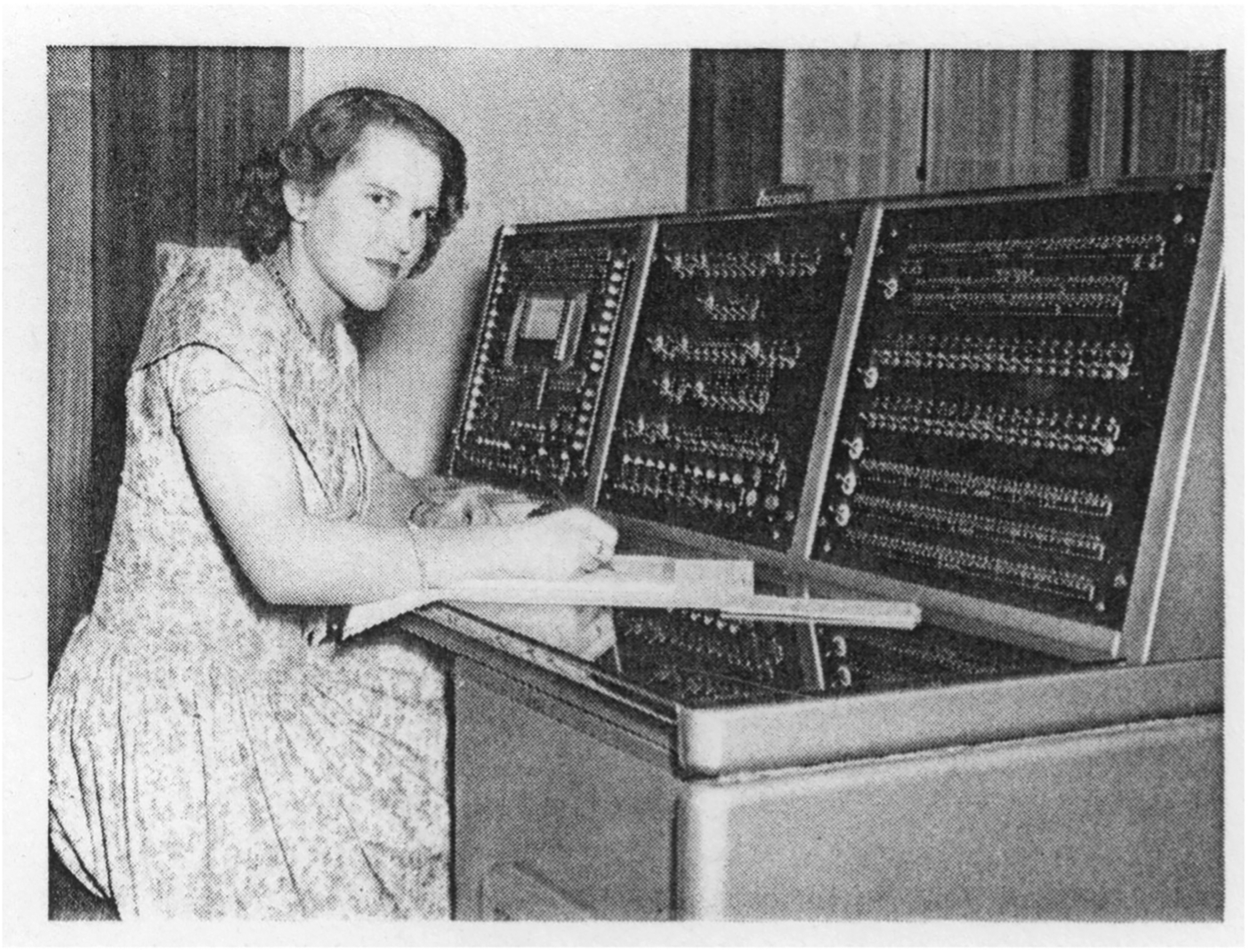
This labor history of information, as the UK transitioned into the digital era, is important because the history of text is bound up with the history of paper, but also with other technologies that mark and replicate that paper in different ways. To publish is not simply to create a book or a pamphlet but to scale that text (and therefore information) through creating a number of copies large enough, or distributed well enough, that it causes the physical object to transform: to recede in a material sense while becoming more valuable as information. With some exceptions, the driving motivation behind modern, commercially printed text has long been to scale up the number of copies. At the same time, the goal is to hold down the price of printing and distribution in order to make the physical vessel of information fade into the background and become as quiet as possible, letting the text become disembodied information absorbed by person after person who each in turn becomes a new vessel not for the text itself but for the information contained. And, through this process, the information likely becomes replicated again in different forms—through speech, or art, or used as evidentiary support in another piece of writing.
The digital has shifted this relationship. It has not revolutionized text, reading, or publishing in that it has not overthrown the power structures that preceded digitization and online dissemination of text. We still buy books in “book” form even when they are digital, and we still structure the containers for most text in ways that hearken back to older norms and continue to reinforce existing power structures. This is necessary for both legibility and for the continuation of how text has traditionally been a tool of power. For every technologist claiming that a microblogging site can cause a revolution, there are a thousand examples of how this change has kept the same classes of people in control. These technologies have not been a revolution but rather a scaling up and speeding up of textual information dissemination in ways that may have unintended consequences, echoing previous historical situations and power relations. Even though we have seen much more pronounced examples of media and communication shifts over the course of the past decade, these do not represent a revolution in the truest sense: power is not changing hands from top to bottom.Footnote 133
The processes of digitization and networked availability of text have often proceeded in ways that make sense for the distribution of information but not necessarily for its careful creation. The speed of distribution, matched with the relative slowness of creation—especially in the case of academic texts—has impelled a new class of technologies that are designed to speed production of text, from messageboards, to blogging, to microblogging, to social media, to the final, ultimate speeding up of text creation: generative AI systems that rely on LLMs to produce statistically likely series of words and sentences. But the fast output of ChatGPT ironically requires the slow creation of human-written texts: it and other LLMs quickly break down if they ingest themselves, leading to gibberish when they are fed their own outputs instead of original human writing.Footnote 134 Ironically, in order for automated text generation to scale up, it needs ever more human writing; in fact, it requires more than is, or ever will be, readily available. This is the paradox of automation: systems that seek to automate out not just people but the very concept of humanity itself will almost always fail, all the while claiming victory.
As more academic writing has gone online, often behind paywalls that traditional publishers use to profit, and sometimes through Open Access platforms, we have gradually seen shifts in who does the labor that allows us to have the enlightenment that textual, digital information is meant to provide. The long period during which text became increasingly digitized has also corresponded to a change in the labor of academia; no longer are most academics in the US white men, or fully employed, for instance. Instead, the labor in our fields skews increasingly towards women, and disproportionately women of color in many humanities fields, and towards adjunct workers who are asked to teach and write at the same level for a fraction of the pay and usually no benefits or job security.Footnote 135 In the digital age, the “free market” buoyed by high tech venture capital, and by management thinking concerned with cost-cutting and short-term profits, asks us to believe that information supersedes not only the medium but also the messenger. And that neither information nor knowledge is rooted in and influenced by context. We know who benefits from this willful misunderstanding of how information is contextual and usually created by hundreds of people and dozens of institutions, even for something as seemingly compact and individual as an academic paper or monograph.
As text creation (by human writers) has gone more and more online, so too has the process of archiving. Archiving the digital might seem initially to be an easier task, because digital information is arguably more malleable and more reconfigurable than information locked in linear feet of paper. But, the people and institutions creating this textual information are increasingly diffuse and chaotic—not because they themselves are chaotic but because however lucid or organized they may be, they are entering into larger informational systems that are being pulled in many different directions by different profit motives, political desires, and infrastructural constraints. In many cases this means that important text—history-making and history-changing text—can be erased or lost on the whim of a CEO, or by an internet platform changing ownership, or even by malicious hacking and ransomware attacks.Footnote 136 Citizen and academic archivists struggle to keep up, as in the case of the dedicated scholars studying and archiving Black Twitter, while institutions that once thought they could collect everything realize that digitality does not mean completionist archiving impulses are any more likely to be fulfilled now than they have ever been.Footnote 137
Historically, as the format of textual information changes, the meaning does too. Our concept of reading and writing has already been reconfigured by countless technologies, with ubiquitous networked computing being only the latest, but our consumption of information has also changed in relation to the digital availability of text. As the digital age has matured we have been encouraged to shift from looking at language and text as tools that people create and use institutionally and individually, to seeing collections of writing as disembodied informational storehouses that have properties that could be unlocked by machines or people working with machines—from keyword searching to training LLMs.
As all the essays in this Roundtable make clear, the power implications of the changes in writing and text over time are conjoined with changes in form and content, but not necessarily in ways that are obvious, expected, or in line with what was initially promised by those seeking to usher in these changes. Many of these examples are therefore instructive for our current moment and for what may be to come. As text becomes more computable, and more potentially useful to machines and those who seek profit and control through them, the idea now in fashion is to make it easier to take the average human out of the loop more and more—not just in terms of labor but also, perhaps unintentionally, in terms of learning. Unfortunately, the ever-wider dissemination and manipulation of digitized text may parallel an increasing decline of people's ability to engage with it.
Nadja Durbach is Professor of History at the University of Utah (USA); Tammy M. Proctor is Distinguished Professor of History at Utah State University (USA); James Clark is Professor of Archaeology and History at the University of Exeter (UK); Verônica Calsoni Lima is Professora de História Moderna at the Universidade Federal do Triângulo Mineiro (Brazil); Ramesh Mallipeddi is Associate Professor of English Language and Literature at the University of British Columbia (Canada); Cynthia Richards is the Richard P. Veler Endowed Chair in English at Wittenberg University (USA); Richard Menke is Professor of English at the University of Georgia (USA); and Mar Hicks is Associate Professor of Data Science at the University of Virginia (USA).


 Open access

