





Introduction
Surgical hand antisepsis refers to the use of antiseptic solutions to remove temporary skin flora and reduce the permanent flora of the hands. Surgical hand antisepsis may involve use of a waterless, alcohol-based hand rub or an antiseptic handwash solution, typically chlorhexidine gluconate or povidone-iodine, with or without the use of a brush. When antiseptic handwash solutions are used, the hands are rinsed and then dried with a sterile towel. 1
The rationale for surgical hand antisepsis is to reduce the risk of transmission of microorganisms from surgeons’ hands to the surgical field through micropunctures that may occur in the sterile gloves worn during surgical procedures. Reference Tanner, Dumville and Norman2 We sought to determine if rubbing the hands with an antiseptic solution and drying them without rinsing after completing a traditional surgical handwashing protocol could delay regrowth of flora on surgeons’ hands compared to use of a traditional surgical hand washing protocol.
Methods
Study design
This study was approved by the Yüzüncü Yıl University Faculty of Medicine Clinical Research Ethics Committee (Decision no: 03, date: 25.11.2020). In this prospective study, only the first surgical procedures of the day performed in the orthopedics and traumatology operating room were included. Since some surgeons participated in more than one procedure during the study period, a total of 14 individual surgeons were included in the final analysis. The study included operations lasting at least 2 hours and excluded trauma surgeries. Surgical procedures performed for active infections were also excluded. There were 14 surgeons in total in our clinic, and at least two surgeons participated in each operation.
Surgical hand washing protocols
Surgeons were randomly divided into two groups by tossing a coin in the operating room. All jewelry on the hands and arms of participating surgeons was removed. The hands and arms were examined for disruptions in skin integrity by one of the study investigators before surgical hand antisepsis. Those with suspicious findings were excluded from the study. The surgeons in both groups used 10% povidone-iodine solution (Pharma Nobis LLC, Tbilisi, Georgia) as the antiseptic solution. The amount of solution (5 ml) recommended by the manufacturer was placed into the palm, and surgical hand antisepsis was performed by rubbing the fingertips, interdigital areas, hands, and forearms up to approximately four fingerbreadths above the elbow. 1 No brush was used for scrubbing. Washing and rinsing was done starting from the fingertips up to the elbows. The hands were rubbed and rinsed three times with antiseptic solution and rinsed after 3–5 minutes of washing. Reference Tanner, Dumville and Norman2,Reference Pittet, Allegranzi and Boyce14 Surgeons in Group 1 (the traditional surgical handwash group) dried their hands with a sterile towel after rinsing. In Group 2, surgeons applied an additional 5 ml of povidone-iodine solution to the still-wet hands and forearms immediately after rinsing and then dried their hands without further rinsing. Representative photographs of the surgical handwashing protocols used in Groups 1 and 2 are presented in Supplementary Figures S1 and S2. Participants were monitored for local adverse skin reactions, including dermatitis, skin irritation, and allergic reactions, throughout the study period.
Culture samples
Samples for culture were collected by swabbing the interdigital areas, palms, and fingertips using sterile cotton-tipped swabs with plastic or wooden shafts (Medpoint, Turkey) that had been moistened once with physiological saline solution. No neutralization agent was used. No hand cultures were obtained before surgical hand antisepsis because superficial flora was expected to be removed during surgical handwashing and therefore was not considered likely to affect the study results. Representative images of the culture sampling procedure are presented in Supplementary Figure S3. In both groups, culture samples were obtained immediately after completion of the assigned surgical handwashing antisepsis protocol and prior to donning sterile gloves (t0). Additional samples were collected at 1 hour (t1) and 2 hours (t2) after completion of surgical hand antisepsis. Surgeons’ gloves were removed aseptically before sample collection, and the operation continued after a new pair of sterile gloves had been donned.
Processing of culture samples
After the swab samples were taken, they were inoculated into 5% sheep blood agar and Eosin Methylene Blue agar media in the operating room and immediately delivered to the microbiology laboratory (Supplementary Figure S4). Cultures were incubated at 37°C and assessed within 24–48 hours according to the routine microbiology laboratory protocol. All culture samples were processed under standardized incubation conditions in order to minimize potential bias related to incubation duration. When no growth was detected, the colony count was recorded as 0. Colonies were identified by conventional microbiologic methods.
Statistical analysis
Statistical analyses were conducted on the number of CFUs counted on the agar plates. Descriptive statistics were expressed as median, mean, standard deviation, minimum and maximum value. The Wilcoxon signed-rank test was used to compare bacterial growth between different sampling time points within each group. The Mann–Whitney U test was used to compare bacterial growth between the two groups at each sampling time point. Also, Spearman correlation coefficient was calculated separately for the groups in order to determine the association between microbial growth at 0, 1, and 2 hours after hand antisepsis. Statistical significance level was considered as P < .05. Analyses were conducted using SPSS version 21 statistical software (IBM Corp., Armonk, NY, USA). Because this was an exploratory prospective pilot study, a formal sample size calculation was not performed. The sample size was determined by the number of eligible surgical procedures meeting the predefined inclusion and exclusion criteria during the study period.
Results
Three surgical procedures were excluded because the operative duration was less than 2 hours. Additionally, six surgeons were excluded because intraoperative breaches in sterile technique that could have resulted in hand contamination were observed. After applying the inclusion and exclusion criteria, 32 surgical procedures were included in the study, with 16 procedures assigned to each group. Samples were obtained from 14 surgeons (7 in each group). Colony counts ranged from 0 to >300 CFU per plate. In Group 1 (traditional surgical handwashing), no bacterial growth was detected in 5/16 samples (31.3%) at 0 hours and in 3/16 samples (18.8%) at 1 and 2 hours after surgical handwashing. In Group 2, no bacterial growth was detected in 7/16 samples (43.8%) at 0 hours, 15/16 samples (93.8%) at 1 hour, and 12/16 samples (75.0%) at 2 hours after surgical handwashing. The most commonly identified bacteria in both groups were coagulase-negative staphylococci, followed by gram-positive bacilli, Streptococcus spp., and Staphylococcus aureus.
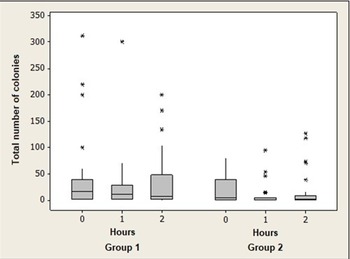
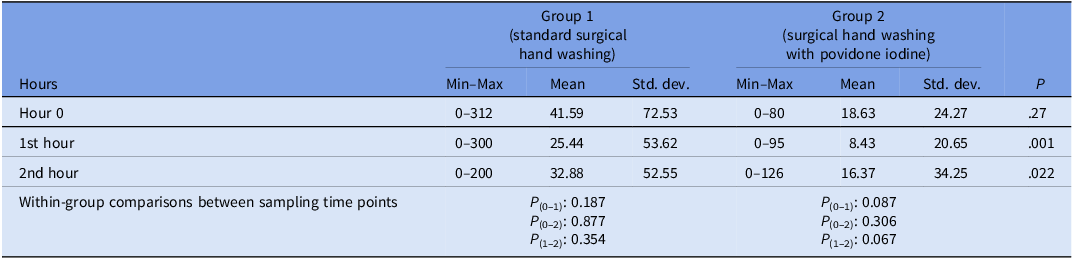
Comparison of bacterial growth between groups at each period is shown in Table 1 and Figure 1. There was no difference between groups at 0 hours. Bacterial growth was significantly higher in group 1 than group 2 at hours 1 and 2. Within groups, there were no significant differences in bacterial growth at the three time points.
Comparison of the groups in terms of bacterial growth count.

Bacterial growth expressed as colony-forming unit counts according to study group and results of between-group and within-group comparisons

Table 1. Long description
The table compares bacterial growth expressed as colony-forming unit counts between two groups over three time points. It has 5 rows and 10 columns. The columns are labeled Hours, Group 1 (standard surgical hand washing) Min-Max, Group 1 Mean, Group 1 Std. dev., Group 2 (surgical hand washing with povidone iodine) Min-Max, Group 2 Mean, Group 2 Std. dev., and P. The rows are labeled Hour 0, 1st hour, 2nd hour, and Within-group comparisons between sampling time points. Row 1: Hour 0, Group 1 Min-Max 0-312, Group 1 Mean 41.59, Group 1 Std. dev. 72.53, Group 2 Min-Max 0-80, Group 2 Mean 18.63, Group 2 Std. dev. 24.27, P 0.27. Row 2: 1st hour, Group 1 Min-Max 0-300, Group 1 Mean 25.44, Group 1 Std. dev. 53.62, Group 2 Min-Max 0-95, Group 2 Mean 8.43, Group 2 Std. dev. 20.65, P 0.001. Row 3: 2nd hour, Group 1 Min-Max 0-200, Group 1 Mean 32.88, Group 1 Std. dev. 52.55, Group 2 Min-Max 0-126, Group 2 Mean 16.37, Group 2 Std. dev. 34.25, P 0.022. Row 4: Within-group comparisons between sampling time points, Group 1 P(0-1) 0.187, P(0-2) 0.877, P(1-2) 0.354, Group 2 P(0-1) 0.087, P(0-2) 0.306, P(1-2) 0.067.
Min: minimum, Max: maximum, Std. dev: Standard deviation.
Discussion
SSIs remain an important cause of postoperative morbidity and healthcare burden. One potential source of contamination is the transfer of microorganisms from surgeons’ hand flora to the surgical field through glove micropunctures occurring during surgery. Previous studies have demonstrated an association between glove perforation and bacterial contamination during surgical procedures. Reference Tanner, Dumville and Norman2,Reference Boyce and Pittet3,Reference Parienti, Thibon and Heller12,Reference Hagen and Arntzen15,Reference Kralj, Beie and Hofmann16
In the present study, reapplication of povidone-iodine without rinsing following conventional surgical hand antisepsis significantly reduced bacterial regrowth on surgeons’ hands at 1 and 2 hours after handwashing compared with the traditional protocol alone. Prolonged contact of povidone-iodine with the skin surface may contribute to delayed recolonization of microbial flora. Previous studies have reported variable residual antimicrobial activity of iodophors after hand antisepsis. Reference Paulson24–Reference Wade and Casewell26
This study has several limitations. The sample size was relatively small, and only orthopedic surgical procedures were included. In addition, the study evaluated microbiological outcomes rather than clinical outcomes such as surgical site infection rates. Although significant reductions in bacterial growth were observed, the clinical relevance of these findings remains uncertain. Another limitation is that cultures were evaluated within 24–48 hours according to routine laboratory protocols, which may have introduced potential bias despite standardized incubation conditions.
In conclusion, reapplication of povidone-iodine without a final rinse after conventional surgical hand antisepsis reduced bacterial recolonization on surgeons’ hands during surgery. Larger prospective studies evaluating both microbiological and clinical outcomes are needed to determine the potential role of this modified protocol in reducing surgical site infections.
Supplementary material
The supplementary material for this article can be found at https://doi.org/10.1017/ice.2026.10509.
Acknowledgements
We would like to thank the healthcare professionals working in the operating room for their support during the sample collection process.
Financial support
None.
Competing interests
The authors declare no conflict of interest related to this article.
Ethical standard
The ethics committee approval of the study was obtained from the Clinical Research Ethics Committee of Yüzüncü Yıl University Faculty of Medicine (Dated 25.11.2020 and number 03).


 Open access

