


On March 11, 2011, an earthquake of magnitude 9.0 struck the northeast coast of Japan and triggered a tsunami. Waves of up to 39 m travelled inland as far as 6 miles and flooded approximately 217 sq miles of mainland Japan. The cooling system at the Fukushima Daiichi Nuclear Power Plant (150 miles northeast of Tokyo) failed as a result. This failure led to a nuclear meltdown, a series of explosions, and the release of radioactive materials. Approximately 18 500 people were believed to have died from the earthquake and tsunami (mainly by drowning), although no deaths resulting from short-term radiation exposure have been reported. The disaster also caused extensive damage to buildings and infrastructure, and resulted in widespread concern about the possible spread of radioactive contamination in groundwater.
The nuclear emergency led the Japanese authorities to issue an evacuation order for everyone living and working within a 20-km radius of the Fukushima power plant to prevent exposure to radiation. Thousands of people were asked to leave their homes and businesses immediately, in a chaotic and ultimately controversial evacuation. Other countries, such as the United Kingdom and France issued their own advice to their nationals who were in Japan.
The British Foreign and Commonwealth Office (FCO) advised British nationals to stay at least 60 km away and to consider leaving the country, while local FCO staff distributed potassium iodide tablets to individuals choosing to remain in northeastern Japan. They also provided regular updates from British scientific authorities, attempted to check on the well-being of all British nationals in affected regions, and provided assistance to nationals requiring relocation or emergency travel documents. These activities were undertaken by staff already in Japan, who were supplemented by rapid deployment teams (RDTs) of staff trained to provide additional support during a crisis. While many studies have examined the needs of members of the public who are caught up in a disaster, few have considered the impact on staff providing consular assistance. Previous research has shown that many aspects of humanitarian work might affect psychological well-being,Reference Bültmann, Kant, Kasl, Schröer, Swaen and van den Brandt 1 - Reference Thoresen, Tønnessen, Lindgaard, Andreassen and Weisaeth 6 although emergency workers responding to a disaster overseas often have viewed their work positively.Reference Thoresen, Tønnessen, Lindgaard, Andreassen and Weisaeth 6 , Reference Hibberd and Greenberg 7 In this study, we sought to understand the experiences of FCO staff in Japan after the 2011 earthquake. Our objective was to identify factors that increased or alleviated their stress.
Methods
Design
We conducted telephone interviews during November and December 2011. By this stage, all RDT personnel had returned to their usual places of work, while work within the British Embassy in Tokyo was returning to normal.
Participants
People were eligible for this study if they were employed by the FCO and had worked in Japan in the weeks immediately following the tsunami (approximately 137 people).
Interview Schedule
Interviews typically lasted at least 1 hour. (The interview schedule is given in the online data supplement.) Symptoms of distress were measured using the 12-item General Health Questionnaire (GHQ-12),Reference Goldberg and Williams 8 with cases defined as individuals scoring 4 or more out of 12 items. Symptoms of posttraumatic stress disorder (PTSD) were measured using the 17-item PTSD Checklist-Civilian Version Questionnaire (PCL-C) using a cut-off score of 50.Reference Weathers, Litz, Keane, Palmiari, Marx and Schnurr 9 - Reference Blanchard, Jones-Alexander, Buckley and Forneris 11 We used a 14-item scale to identify whether participants had experienced any potentially upsetting events.Reference Roussos, Goenjian and Steinberg 12 , Reference Rubin, Amlôt, Wessely and Greenberg 13
Procedure
The FCO sent a letter explaining our study to all staff meeting our criteria. Those who wished to take part were asked to contact us directly. Three team members (RA, BJ, GJR) conducted interviews, using the interview schedule and probing for additional information, where relevant.
Ethics
This study was approved by the Psychiatry, Nursing and Midwifery Research Ethics Subcommittee at King’s College London.
Analysis
We inductively analyzed interview transcripts using the principles of thematic analysis. We looked for quotes within each transcript that related to our objective. We grouped quotes from different interviews that reflected the same themes (eg, organizational factors) and identified subthemes as appropriate (eg, perceived overstaffing). The process was iterative, and we reorganized themes and subthemes until we reached a stable framework.
Two team members (SB, GJR) worked on this independently for all of the data. A third (RLN) independently coded the subset of data relating to radiation-related factors. Where minor differences existed between coders, these were resolved through discussion. As an additional quality check, all participants were sent a draft of this manuscript and asked for feedback. This resulted in one minor change of emphasis for one subtheme.
Results
Of the 36 people took part in the study; 22 were men (61%). They ranged in age from 29 to 63 years (mean age, 38 y). Forty-two percent (n=15) were in Japan at the time of the disaster and 58% (n=21) were part of an RDT.
Nine participants (25%) were experiencing distress at the time of the interviews and 1 had probable PTSD. Sixteen (44%) felt scared that they would be seriously injured during the crisis and 8 (22%) feared that they would die. A minority felt scared that a loved one or friend would be seriously injured (n=12; 33%) or killed (n=12; 33%), saw a close friend or relative threatened with death or serious injury (n=3; 8%), or saw someone seriously injured or killed (n=2; 6%). Damage to homes (n=4; 11%) and loss of personal belongings (n=2; 6%) also occurred.
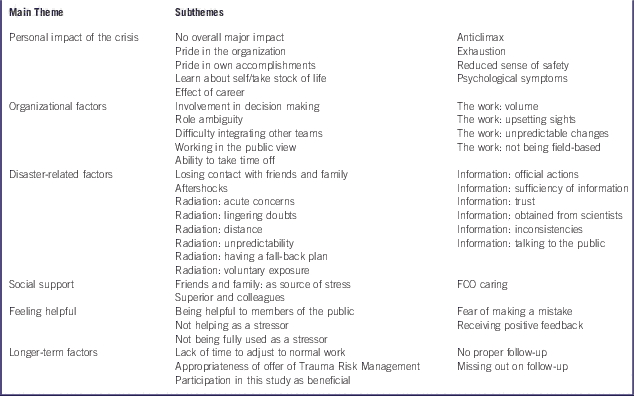
Themes and subthemes have been summarized in the Table . Main themes and larger subthemes became saturated; that is, adding data from the final few interviews did not result in any changes to their basic structure. The main themes reflected the personal impact of the crisis; organizational factors affecting stress; disaster-related factors; social support; the importance of feeling helpful; and longer-term factors affecting well-being. These themes are described here, with subthemes highlighted in italics. Some issues that were highly specific to the FCO or the situation in Japan have not been reported (eg, e-mail policies).
Summary of Themes Identified From Foreign and Commonwealth Office (FCO) Staff
Personal Impact of the Crisis
Many participants identified stress as a characteristic of their crisis work. This was not true for all, however, and some participants (particularly those from RDTs) described their emotions more in terms of excitement, perhaps reflecting their motivations for volunteering for disaster work.
Several participants noted that their work had had no major long-term impact on them. Nonetheless, almost all described some more minor effect. Most commonly, participants felt proud of the organization or of their own accomplishments. Participants also learned about themselves or took stock of their life. Several participants reported a positive effect on their careers. Others reported a sense of anti-climax, which sapped their motivation after returning to normal work. As one participant reported, “I suppose what was most difficult was actually getting back to normal life….There was an element of wanting to keep it going, because it was a really tangible contribution that you were making.”
Negative effects were also described. Exhaustion was common, as was a reduced sense of safety. A range of psychological symptoms also occurred, including sadness, guilt, poor sleep, and remembering upsetting images.
Organizational Factors
Participants described 6 aspects of organizational function that affected stress. Their personal involvement in decision making was largely described in positive terms, with staff being “trusted to use our judgement and do what we thought was best.”
Role ambiguity was more of a problem, particularly in the early stages of the crisis. Most participants acknowledged that an initial degree of “chaos” was inevitable and that roles soon fell into place. A more persistent issue was a sense that internal communication could have been improved, particularly in terms of communicating decisions and changes.
For some participants, a difficulty integrating RDTs caused stress. Two smaller themes were apparent within this. First, participants commented that the initial influx of staff “swamped” the embassy’s usual management and administration processes. Second, we identified a lack of trust and frustration among some embassy staff about the ability of RDT staff to support administrative roles (eg, “the people they were giving us weren’t [appropriately] trained”).
As the crisis progressed, the work being undertaken inevitably contributed to stress. First, the volume was “just vastly, vastly more work than we could handle.” For RDT members, upsetting sights were an issue: “The fact that you're driving through towns that no longer exist, it's pretty sobering.” For other staff, unpredictable changes in their work added to the pressure, although this change was often described as unavoidable.
Among RDT members, a common theme was a desire to provide direct assistance to members of public “in the field.” However, many were asked to remain in the embassy, providing support for office duties. This led to frustration, with some RDT members describing this assignment as being “under-used,” “sidelined,” or “not what I went there to do.”
Attention from the British press and parliament left some participants feeling that they were working in the public view. Three smaller issues were found within this. First, participants were concerned by a perception that some of their work was motivated more by a desire to “make sure we got good press,” rather than the needs of the public. Second, criticism from the media was highlighted as “really [taken] to heart.” Third, some participants felt that the wider interest directly increased their workload, as a result of “insatiable” demands for information.
Finally, many participants reported that their ability to take time off affected their well-being. Simply scheduling breaks was not always enough, as someone noted, it “felt as though I was just killing time waiting for my next shift.” Finding a “release valve” was important. Examples included taking the children to the park, eating at a favorite restaurant or “just watch[ing] something on television that wasn't anything to do with tsunamis and earthquakes.” For RDT staff, good-quality time off sometimes involved experiencing the local culture. This activity was harder for those in heavily affected regions or those who had practical problems in taking time away from their base. Organizational issues were also cited as preventing staff from taking time off, particularly during the early stages, as was a desire to be helpful; some participants reported informally helping out or feeling guilty during their time off.
Disaster-Related Factors
Numerous disaster-related stressors were reported. The earthquake was distressing for many of those who experienced it, primarily because they were worried about friends or family with whom they lost contact on that day. The powerful aftershocks which continued for weeks afterward were also described by almost everyone as “unsettling” and “disconcerting.”
The risk from radiation provoked mixed feelings. For some it was a central concern (“a bit sort of, ‘Oh my God, am I living through a moment of history here.”). For others, radiation appeared to have been almost a non-issue. By the time our interviews were being conducted, although most participants reported no persisting concerns, a minority expressed lingering doubts about their exposure (“Do I wonder whether I drank too much Japanese water at the time?”).
Several subthemes were identified that helped to explain the difference between people’s perspectives about the radiation risk. First, distance from the power plant was an important factor, although people differed in terms of how far away was far enough. As might be expected, personnel sent to the main disaster region were usually more concerned. Second, the unpredictability of developments caused concern. As one participant noted, “every day you wake up [to find that] something else exploded.” In the face of this uncertainty, having a fall-back plan was important. For some, their plan seemed relatively secure (“Even the worst case scenario to me didn’t seem that frightening, there was clear advice that you had to stay indoors for about a 48-hour period and take your iodine tablets.”) For others, thinking about worst case scenarios was unsettling, especially for those working nearer to Fukushima (“I didn’t really get the feeling that there was any kind of […] contingency plan in place for getting us out if things got a lot worse”).
Viewing one’s exposure to the radiation risk as voluntary was a fourth subtheme that moderated concern. For staff given the option of reducing their level of risk by leaving the area around Fukushima, Tokyo, or Japan, simply having this opportunity appeared to reduce their worry. For instance, according to one RDT member, “once it was clear that we were going to leave on a certain date all the concerns of my team actually disappeared.”
Information about the radiation was another important factor. This theme split into multiple smaller subthemes. Many participants noted that the actions of the FCO, Japanese government, or other official agencies served as indicators as to how worried to be. For example, sending RDTs to the disaster zone was taken as a sign that the situation could not be that serious, while a sudden increase in the radius of the exclusion zone around Fukushima, the authorization for the evacuation of non-essential staff and families, the evacuation of other embassies, and the decision to issue iodine tablets were all viewed as signals that the situation was worsening.
Information about the situation provided via the FCO was generally seen as helpful. In general, it was perceived that the FCO provided more trustworthy information than the Japanese government or the company in charge of the Fukushima power plant, who were seen as being “dishonest” or “covering something up.” Information from the FCO was also rated as more credible than that from British media reports, which were universally dismissed as providing “unhelpful,” “irresponsible,” and “completely unfounded speculation.” The fact that FCO information was demonstrably based on evidence from respected scientists was a key factor increasing its credibility. Informational inconsistencies remained troubling for some, including changes in the advice or information provided by the scientists, differences between the advice issued by British government and by other governments, and discrepancies between official information and that found on the Internet.
Also, participants frequently described the teleconferences held by the Chief Scientific Advisor as beneficial for members of the public. In part this reflected a complexity of this crisis, with FCO staff sometimes providing information to members of the public, in spite of having little if any technical background or training in radiation-related issues. When asked whether they found this task easy or difficult, a common issue was that they did not always know what to say to people. In terms of communication problems for staff distributing iodine tablets, we identified only a few minor instances in which the staff member unwittingly contradicted advice given in the accompanying leaflet or felt unable to answer questions.
Social Support
Discussion of social support revealed issues relating to friends and family, colleagues, and the FCO. In terms of friends and family, a common notion was having loved ones in Britain as a source of stress. Many participants described relatives who seemed overly concerned about their well-being. Participants blamed the British media for this (“The press reports from the UK … were stoking up feeling and that was getting us from behind…I had my mother-in-law leaving a message on my answering machine which more or less said we were irresponsible parents for not flying the children home…that pressure from home was unwelcome, and really, really corrosive”). Consequently, several staff limited their interactions with family and friends in the United Kingdom. For participants with family in Japan, the situation was often worse. It was generally accepted that these family members were a source of worry, which led many to weigh the pros and cons of asking them to leave the country. Some who arranged for this to happen then reported “isolation” and being “very stressed by the separation,” but many also reported it was a relief and enabled them to carry on with their work undistracted by concerns for their family’s safety.
In terms of support from colleagues, many comments were made regarding the support from immediate superiors. These comments were largely positive, although some felt that their superiors were too busy to provide adequate emotional support or that they would not feel comfortable opening up to them. Social support from peers was frequently mentioned, with the “camaraderie” being widely praised. Three specific aspects to this were singled out. First was a sense that people could be open with each other. Feeling that you could share your emotions and finding out that others, even at senior levels, admitted to occasionally feeling upset or demotivated was seen as “refreshingly honest.” Second was a reassuring feeling that others were keeping an eye on you. Third was the practical support that was received, including accommodation within the embassy and refreshments. Being physically close to one’s team facilitated social support. Splitting teams into different shifts, having isolated individuals working night shifts, or dividing teams across different rooms were all criticized.
While participants generally praised the willingness of colleagues to care for their well-being, they were mixed about their perceptions of the FCO’s sincerity in doing this. While some had faith in the FCO’s level of care for them, others were less certain.
Feeling Helpful
One consistent theme that helped participants cope was feeling helpful to others. Being helpful to members of the public was a crucial aspect of their work (“it was quite a stressful experience but perversely quite enjoyable because you knew you were doing some good and helping people”). Not helping the public was a stressor in its own right (“you get a bit stressed to be honest… about not being able to help people to the level that I would like”) as could not being fully used or worrying about making a mistake that could adversely affect others. Receiving positive feedback from members of the public was cited as a boost to morale. A degree of stoicism was identified among those who received negative feedback, although it was clear that people were still affected by this.
Long-Term Issues
We identified several themes relating to how people coped following their return from Japan or during the normalization of work.
For RDT members, one issue was the lack of sufficient time to adjust, with many feeling that they “hadn't really been able to take any time out.” The timing of this deployment, in a period when international tensions required multiple deployments in quick succession, exacerbated this.
Several participants said that they had been offered the chance to talk with a colleague who had been trained in trauma risk management (TRiM: a psychological support technique used by the FCO to help staff). Almost everyone who received this offer saw it as appropriate, and those who took up the offer reported it as useful. However, not everyone received the offer. Instead, several participants identified a sense of no proper follow-up. For example, one reported that “there was no talk if you feel like you had a difficult time, a crisis, or if there's anything you want to talk about or if there's anything you want to feed in then please feel free to do that.” Another reported “a kind of feeling of having been thrown against the rocks and being forgotten shortly afterwards.” Several participants felt that they must have missed out on follow-up, slipping through the net for one reason or another. While official follow-up was described as needing improvement, most personnel reported that, in practice, informal peer support met most of their needs. This support ranged from “a cup of tea and a natter” to “a couple of bottles of wine and a chat.” For many participants, this amount was as much as they expected or wanted. The positive aspect of talking through the incident was also reflected by 6 participants who spontaneously reported participation in this study as “cathartic.”
Discussion
Current Evidence and Recommendations
Governments often need to respond to crises overseas. While previous research has suggested that humanitarian workers are at risk of distress and psychological disorder,Reference Connorton, Perry, Hemenway and Miller 14 little attention has been paid to diplomatic staff. Within our sample, levels of distress and disorder were low, although still of concern; 25% experienced distress and 1 participant suffered symptoms consistent with PTSD. The crisis also had an emotional impact for many more, in terms of stress, feelings of excitement or fulfilment during the incident, and a changed perspective on life.
Many factors contributed to these responses, suggesting several areas that diplomatic organizations might consider when providing support to staff. Our findings that less involvement in decision making, higher role ambiguity, greater volume of work, unpredictability, and encountering upsetting sights all increase stress and are consistent with the literature concerning organizational stress management.Reference Karasek 15 , Reference Paton and Flin 16 While altering some of these factors would be difficult, ensuring that roles and objectives are communicated well by a supportive leadership is one measure that organizations could achieve.Reference Jones, Seddon, Fear, McAllister, Wessely and Greenberg 17
The importance of taking time off was also unsurprising. Simply providing scheduled breaks may be insufficient for this. While many members of staff reported relaxing by spending time with their family, socializing, or experiencing the local culture, this break may not always be possible, and managers should consider how to ensure that all individuals are provided with ways of relaxing during future crises.Reference Thomas, Sing and Belenky 18
Understanding the motivations of staff is also important. Our results suggest that diplomatic staff are highly motivated to help members of the public. While this provides an overarching team ethos, it also creates psychological vulnerabilities, including difficulties when handing over tasks to others perceived as less experienced, frustration when dealing with requests that are seen as politically-driven, and stress when staff members feel that they are not being directly helpful to the public. Encouraging staff to consider a more holistic view of what activities benefit the public, communicating the rationale for activities that might not be viewed as directly beneficial, and encouraging the integration of new teams so that existing staff identify the benefits of fresh personnel may be helpful.
Dealing with radiation was an unusual feature of the Japanese crisis. Although radiation is commonly discussed as a “dread” fear,Reference Bromet 19 the issue is nuanced,Reference Rubin, Amlôt, Wessely and Greenberg 13 , Reference Rubin, Page and Morgan 20 and our participants were split in terms of their anxiety. Receipt of trusted information can be an important factor determining the perceived risk from radiation,Reference Rubin, Amlôt, Wessely and Greenberg 13 and this was true in the current context. A novel aspect of the FCO response to Fukushima was the direct communication between staff members, members of the public, and scientists specializing in radiation protection. Previous work by our team found that this approach was largely welcomed by British nationals in Japan,Reference Rubin, Amlôt, Wessely and Greenberg 13 and our current results reinforce that finding. Not only was information from British scientific experts viewed as credible and relevant by FCO staff, it also helped them to communicate with the public.
Participants described support from their peers as helpful. In particular, positive comments were made about the use of TRiM, a peer support program used by a number of diplomatic organizations including the FCO.Reference Greenberg, Langston and Everitt 21 In future crises, organizations should encourage social support among colleagues, particularly for people who may otherwise feel isolated due to their work patterns, geographic isolation, or other reasons. Interactions with family members were more complex; many participants had to weigh the pros and cons of asking their family to leave Japan or of restricting communication with family in Britain. The issues involved in interacting with one’s family during a crisis deserve further research.
Finally, while most participants coped well with their experiences, a minority of staff will inevitably require extra support after any future incident. Predicting who will require support is not always possible, and watchful waiting is therefore appropriate. This attention requires staff who work in crises, and those who manage them, to be aware of the signs of possible mental health disorders and to know how to access appropriate services. Some staff members in this incident felt that they had insufficient follow-up or monitoring. A standardized post-incident welfare policy, which includes a message of thanks and a reminder of how to access support and a routine check on well-being should be formalized and adhered to.
Limitations
Several limitations were noted in this work. First, our analysis was limited to identifying the themes and subthemes that participants believed were important. Future quantitative work may help to identify how prevalent each issue is and to test the impact of interventions designed to improve welfare.
Also, for pragmatic reasons, our data collection was limited to telephone interviews. Different methods of interviewing may have yielded different findings. Face-to-face interviews usually have been preferred for sensitive topics, allowing interviewers to build rapport with the respondents and take note of body language.Reference Opdenakker 22
In addition, identifying the correct time period for research of this nature is difficult. Interviewing participants nearer to the event may have allowed us to access fresher memories relating to their work. At the time our interviews took place, work at the embassy had begun to normalize and many of the uncertainties surrounding the Fukushima incident had begun to resolve. A degree of recall bias is therefore likely, with participants recollecting their experiences as less stressful or less worrisome than they really were. Conversely, allowing an interval of several months to pass ensured that only the more salient issues were reported and allowed us to assess medium-term well-being.
Finally, although we took care to assure participants that their responses would remain anonymous, organizational norms, such as using diplomacy when dealing with outsiders or showing solidarity with colleagues, may have inhibited participants from being frank in their interviews. It is possible that participants hid or downplayed some criticisms of how the crisis was managed.
Conclusions
In spite of experiencing periods of physical and psychological difficulties, FCO staff were rightly proud of their accomplishments after the 2011 Japanese earthquake. The work had a positive impact for many, including a recognition of their own accomplishments, feelings of learning more about themselves, and perceiving the event as having a positive effect on their careers. Nonetheless, lessons were identified that may help to reduce the stress and negative psychological effects of future crises for diplomatic staff. The positive steps that should be considered were better explanation of roles, facilitating breaks from work, helping staff consider how their work affects the bigger picture, and ensuring that appropriate follow-up is received.
Disasters involving a potential hazardous exposure pose additional challenges for staff, managers, and organizations. Under such circumstances, facilitating direct access between members of staff and senior scientists is worthwhile, allowing the staff to receive credible information and to ask questions about potentially troubling developments.
Funding and Support
This work was funded as part of a National Institute for Health Research Career Development Fellowship awarded to G. James Rubin and through the National Institute for Health Research Health Protection Research Unit (NIHR HPRU) in Emergency Preparedness and Response at King’s College London in partnership with Public Health England (PHE).
Disclaimer
The views expressed in this publication are those of the authors and not necessarily those of the National Health Service, the National Institute for Health Research, the Department of Health or Public Health England.
Supplementary material
To view supplementary material for this article, please visit http://dx.doi.org/10.1017/dmp.2014.98


 Open access

