





Introduction
In the United States, 53 million adults rely on unpaid family caregivers to provide in-home assistance with tasks related to disease management and day-to-day living (Deng Reference Deng2017; The National Alliance for Caregiving 2020). Caregiving exists on a continuum which includes positive aspects of caregiving and challenging aspects of caregiving (Yu et al. Reference Yu, Cheng and Wang2018). Positive aspects of caregiving include personal and social role fulfillment, effective cognitive emotional regulation, and contexts which favor finding meaning in the caregiving experience (Yu et al. Reference Yu, Cheng and Wang2018).
Yet caregiving is considered to be a major stress factor for caregivers, and family caregivers often report high levels of caregiver burden (Carretero et al. Reference Carretero, Garcés and Ródenas2009; Li and Loke Reference Li and Loke2013; DeGregory Reference DeGregory2014; Ho et al. Reference Ho, Collins and Davisn.d.; Miyawaki Reference Miyawaki2015). Caregiver burden’s effect on health outcomes has been shown to be mediated by the caregiver’s level of preparedness, which can be understood as the perceived level of readiness for the tasks of the caregiving role, including physical care, emotional support, and dealing with stress of caregiving (da Rocha et al. Reference Rocha, Perrenoud and Ramelet2022). As caregiver preparedness grows, caregiver burden’s effect on outcomes decreases (Andrén and Elmståhl Reference Andrén and Elmståhl2008; Archbold et al. Reference Archbold, Stewart and Greenlick1990; Magasi et al. Reference Magasi, Buono and Yancy2019). Lack of preparedness has also been connected to caregiver physical and mental health outcomes including increased fatigue, feelings of failure, and role strain (Magasi et al. Reference Magasi, Buono and Yancy2019; Petruzzo et al. Reference Petruzzo, Biagioli and Durante2019). Other studies have reported that caregivers who have a better understanding of their care recipient’s diagnosis and treatment plan are more prepared, better able to cope, and have reduced psychological stress (Bratches et al. Reference Bratches, Scudder and Barr2021; Toye et al. Reference Toye, Parsons and Slatyer2016).
The clinic visit is a critical point of engagement for the patient, caregiver, and clinician triad (Makoul Reference Makoul2001; Wolff and Roter Reference Wolff and Roter2011). Clinic visits are the main setting for triadic communication, or the communication between clinicians, patients, and caregivers. Patients and caregivers both prefer the caregiver to be informed about their tasks (Beisecker et al. Reference Beisecker, Brecheisen and Ashworth1996), and caregivers often provide informational support to patients during clinic visits, like asking questions regarding patient care and explaining clinician instructions (Wolff and Roter Reference Wolff and Roter2008). Clinicians find caregivers helpful to facilitate decision-making in clinic visits (Shepherd et al. Reference Shepherd, Tattersall and Butow2008), and caregivers prefer to get information for their caregiving from clinicians: a study of 200 family caregivers found that clinicians were the preferred information source for 98% of those surveyed (James et al. Reference James, Daniels and Rahman2007).
When caregivers cannot attend visits in-person, a systematic review of studies that communicate information from clinic visits to family caregivers found 2 main methods of communication: speaking with the patient and reading after-visit materials like doctor’s notes or the after-visit summary (AVS) (Bratches et al. Reference Bratches, Scudder and Barr2021). Speaking with the patient was defined as asking the patient what information they remember from the clinic visit and was associated with improvements to caregiver happiness. Receiving information from after-visit materials was associated with higher engagement in clinic visits, defined by the number of questions that were asked by the caregiver at visits before and after receiving the information.
Communicating the information from clinic visits is recognized by the Caregiver Advise, Record, and Enable (CARE) Act (Reinhard et al. Reference Reinhard, Young and Ryan2019). This requires health systems to ask patients whether they have a caregiver, record the name of the caregiver, and enable the caregiver with the information they need to provide care. However, a scan of health systems in the 42 participating states found that our understanding of the means of sharing information with caregivers is lacking (Reinhard et al. Reference Reinhard, Young and Ryan2019).
Understanding how family caregivers receive clinic visit information and whether this is connected to caregiver outcomes would help to improve the delivery of information and improve the health-care experience for both patients and caregivers (Glanz et al. Reference Glanz, Rimer and Viswanath2008; Schubart et al. Reference Schubart, Kinzie and Farace2008). To date, little is known about whether the method or format of visit information is associated with key caregiver outcomes like caregiver preparedness, caregiver burden, or the positive aspects of caregiving: while improvements to caregiver preparedness and caregiver happiness have been identified, the systematic review of interventions that communicate information to family caregivers found only 4 eligible studies for inclusion (Bratches et al. Reference Bratches, Scudder and Barr2021).
The aims of this study were to (1) describe the prevalence of receiving different modes of communicating visit information and (2) explore associations between different modes of communication and caregiver preparedness, caregiver burden, and the positive aspects of caregiving. We conducted a national survey of family caregivers of patients with chronic and acute medical conditions. This study advances the understanding of the current knowledge gap in how providing information to family caregivers may be associated with 3 important caregiver outcomes, helping health systems optimize the ways they communicate with family members. Ultimately, this may improve the effectiveness of family caregivers, minimize the burden of family caregiving, and improve how caregivers feel about their caregiving. We hypothesized that receiving with visit information through attending the visit, speaking with patients, and using an AVS would be associated with decreases in caregiver burden, increased caregiver preparedness, and increased positive aspects of caregiving.
Methods
Overview
Following the Checklist for Reporting the Results of Internet E-Surveys (Supplemental File A) (Eysenbach Reference Eysenbach2004), we conducted a cross-sectional online survey of family caregivers in the United States. “Family caregiver” was defined as an English-speaking adult (18 years or older) living in the United States who self-identified as being the person most responsible for caring for the health of another adult (18 years or older). This study was deemed exempt from Institutional Review Board review by Dartmouth College’s Committee for the Protection of Human Subjects.
Survey design
The survey was developed in consultation with the Open Recordings group, a group of researchers, physicians, patients, and caregivers at Dartmouth College, and the National Alliance for Caregiving (NAC), a national leader in conducting policy analysis and tracking legislation dealing with family caregiving issues. The survey was pilot-tested and refined based on feedback from a 6-member NAC panel including patients, caregivers, and advocacy leaders.
Survey procedures
The survey was distributed through the NAC’s newsletter and social media accounts on June 1, 2020. On July 27, 2020, we analyzed the demographics of this initial sample and supplemented this sample with an additional sample through Qualtrics Panels, an online survey platform which draws broad participant demographics (Ibarra et al. Reference Ibarra, Marie Agas and Lee2018). Quotas were applied to create a demographic profile by race and ethnicity in our sample similar to the national caregiver demographics described in the 2020 Caregiving in the U.S. Report, a 5-year report that seeks to understand the demographics and experiences of caregivers nationally (The National Alliance for Caregiving 2020). To ensure completeness, all questions were forced response, though respondents were reminded they could opt-out of the survey at any time by closing their webpage. Participants viewed 31–36 questions, depending on their answer selections. There was no “back” button on the survey and all questions were delivered in English only. We excluded “speeders,” respondents who completed the survey under half the piloted median time to completion (Greszki et al. Reference Greszki, Meyer, Schoen, Callegaro, Baker and Bethlehem2014). Surveys were analyzed if they were more than 97% complete, which indicated they reached the final page of the survey. Finally, we used the “Ballot Box Stuffing” feature in Qualtrics to ensure a participant only took the survey once, though we allowed respondents to resume responses up to 1 week after starting the survey.
Participants
The NAC newsletter was sent to 5,986 people and the survey section was viewed by 449. The social media post received 676 unique views. Of the 1,125 potential participants who saw the survey link from the NAC sample, 268 visited the survey introduction page, and 113 fully completed the survey. Through Qualtrics, we received an additional 227 respondents to fill quotas based on race and ethnicity. This resulted in a total of 340 respondents.
Measures
Caregiver demographics collected included age, gender, race, ethnicity, time spent caregiving, relationship to the care recipient (spouse or partner, parent or grandparent, or adult child), household income, experience as a caregiver (less than 1 year or 1 year+), and number of patient comorbidities.
Participants completed 3 validated scales (Archbold et al. Reference Archbold, Stewart and Greenlick1990; Li and Loke Reference Li and Loke2013; Pendergrass et al. Reference Pendergrass, Malnis and Graf2018):
(1) The Preparedness for Caregiving Scale, an 8-item scale measuring perceived preparedness for physical and emotional aspects of caregiving, with scores ranging from 0 to 32 and higher scores indicating higher preparedness and decreased anxiety (Petruzzo et al. Reference Petruzzo, Paturzo and Buck2017);
(2) The Burden Scale for Family Caregivers-Short Form, a 10-item scale measuring level of perceived caregiver burden, with scores ranging from 0 to 30 and higher scores indicating higher levels of burden and loneliness (Graessel et al. Reference Graessel, Berth and Lichte2014); and
(3) The Positive Aspects of Caregiving Scale, a 9-item scale measuring how positive a caregiver feels about their caregiving, with scores ranging from 9 to 45 with higher scores indicating higher positivity and improved relationship quality (Yong Ming Siow et al. Reference Siow, Chan and Østbye2017). Specific positive aspects of caregiving measured in the Positive Aspects of Caregiving Scale include overall positive aspects of caregiving, self-affirmation, and outlook on life.
Mode of communication
Respondents were presented with different methods by which they receive information from their visits (attending the visit, speaking with the patient, and reading the AVS, either printed on paper or accessed through the patient portal) and were asked to indicate the frequency of receiving information from each method on a 4-point Likert scale. Participants were asked about their general visit habits, rather than specific visits they did or did not attend. Possible answers included Never, Sometimes, Often, or Always. In the sensitivity analysis, printed paper summaries and patient portal-based summaries were combined into “Any Method of Receiving Information.”
Statistical analysis
Descriptive statistics were used to describe respondent demographic characteristics.
Multiple linear regression
Separate linear regression models were performed, adjusting for covariates, to determine the association of different visit information communication methods on caregiver preparedness, burden, and the positive aspects of caregiving. We also performed a sensitivity analysis by stratifying based on the source of the sample (NAC or Qualtrics) to see if there were differences between our sampling sources.
Statistical analyses were conducted in R v4.0.3 (Boston, MA). All models were tested for collinearity between variables by using the variance inflation factor, where a factor greater than 5.0 indicates strong collinearity (Fox and Monette Reference Fox and Monette1992). If collinearity occurred, the research team met to discuss the variables in question to determine which should be included in the model. A pre-defined alpha level of 0.05 or less was chosen for statistical significance.
When included as covariates, caregiver burden, caregiver preparedness, and caregiver positivity were dichotomized as high or low based on previously established, clinically significant cutoffs to aid interpretability (Allen Reference Allen2017): a score greater than or equal to 15 on the Burden Scale for Family Caregivers – Short indicating high burden (Archbold et al. Reference Archbold, Stewart and Greenlick1990), a score of 20 or higher on the Preparedness for Caregiving Scale indicating high preparedness (Magasi et al. Reference Magasi, Buono and Yancy2019), and a score of 35 or higher on the Positive Aspects of Caregiving Scale indicating high positivity (Affinito and Louie Reference Affinito and Louie2018). When used as outcome variables, the continuous scales for caregiver burden, caregiver preparedness, and caregiver positivity were used as continuous variables to allow for more power to detect associations (Ragland Reference Ragland1992). Linear regression models were used to estimate the association of mode of visit communication on caregiver outcomes. Two additional models were run to examine the association between using any method of communication and using both AVSs and speaking with the patient, on caregiver burden, caregiver preparedness, and caregiver positivity.
Results
Descriptive results
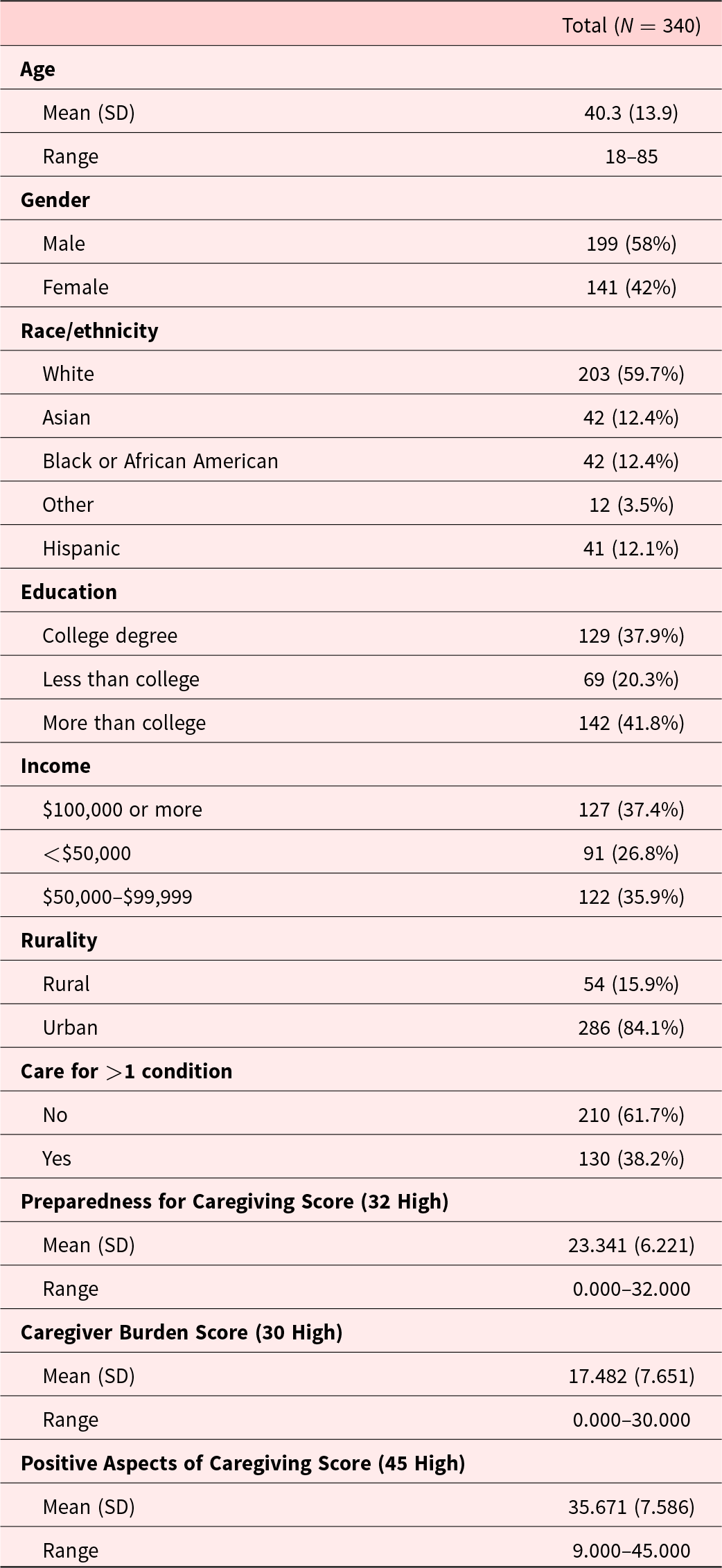
Respondents were primarily male (58.1%) and White (59.7%), and most performed between 1 and 3 hours of caregiving-related tasks per day (40.6%) (Table 1). Most caregivers had been providing care to a patient for more than 1 year (60.7%). Most caregivers cared for patients with diabetes (33%), dementia (17%), developmental disabilities (11%), or cancer (10%). The majority of respondents reported receiving visit information (defined by selecting a choice other than “Never”) by attending the clinic visit with their care recipient (77.4%), relying on the patient’s memory (74.7%), using a written AVS (63.2%), or using the patient portal (61.2%).
Participant characteristics

The mean Caregiver Burden Scale score was 17.48 (SD 7.65), the mean Preparedness for Caregiving Scale score was 23.34 (SD 6.22), and the mean Positive Aspects of Caregiving score was 35.67 (SD 7.59), indicating the sample had a high level of preparedness, high level of burden, and a high positive aspects of caregiving sample based on our established cutoffs (Affinito and Louie Reference Affinito and Louie2018; Archbold et al. Reference Archbold, Stewart and Greenlick1990; Magasi et al. Reference Magasi, Buono and Yancy2019).
Regression analyses
Burden Scale for Family Caregivers
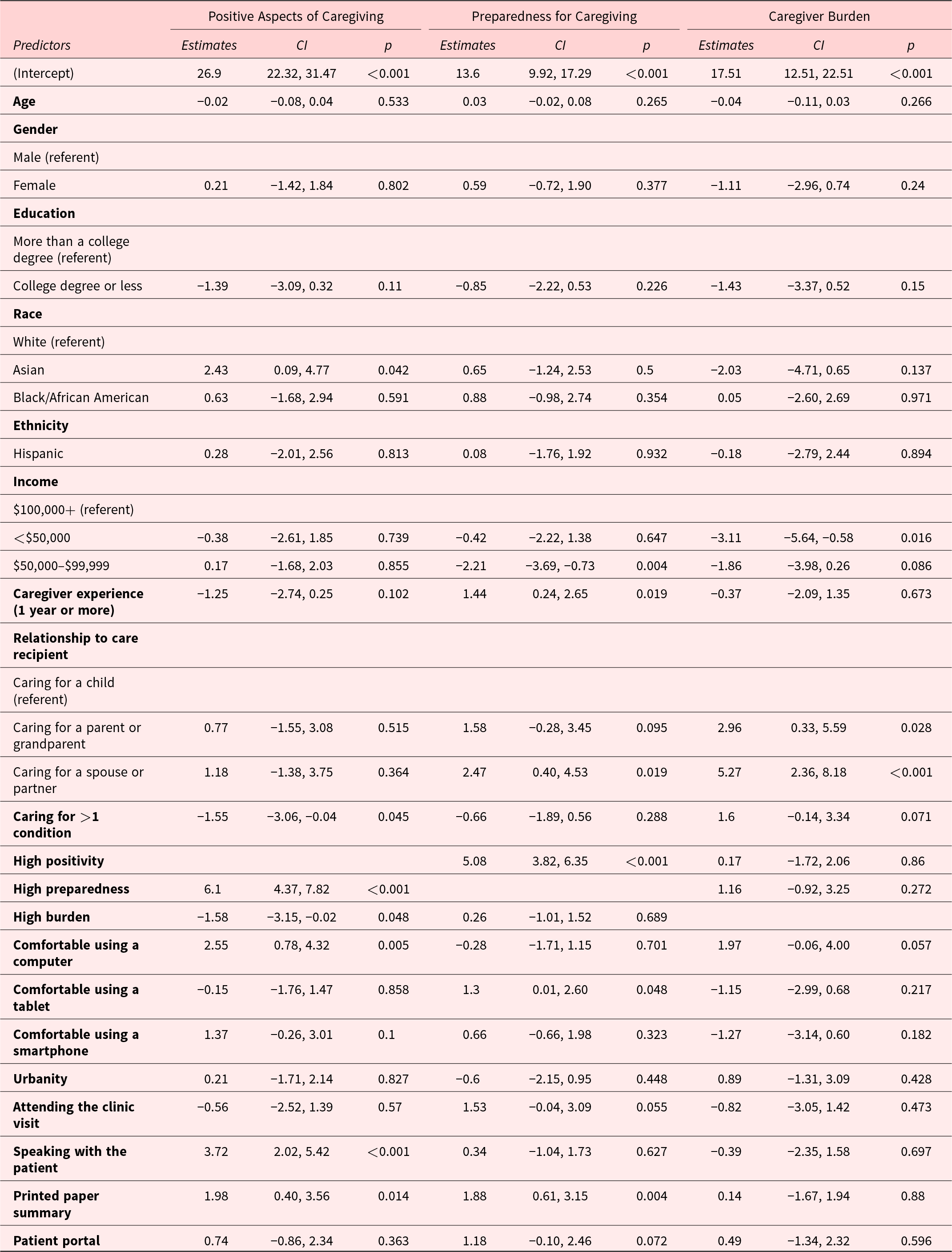
In the fully adjusted analysis, no methods of visit communication were significantly associated with caregiver burden. Caring for a spouse or partner (ß = 5.27; 95% CI = 2.36, 8.18; p = <0.01) and caring for a parent or grandparent (ß = 2.96; 95% CI = 0.33, 5.59; p = 0.041) were associated with increased burden scores. A household income of greater than $50,000 was associated with a decrease in burden (ß = −3.11; 95% CI = −5.64, −0.58; p = 0.02).
In the sensitivity analysis, we found no statistically significant association between using any method of visit communication with caregiver burden or using both AVS and speaking with the patient with caregiver burden.
Caregiver Preparedness Scale
In the fully adjusted analysis, a printed paper summary (ß = 1.88; 95% CI = 0.61, 3.15; p = 0.01), high Positive Aspects of Caregiving Scale score (ß = 5.08; 95% CI = 3.82, 6.35; p = <0.01), caring for a spouse or partner (ß = 2.47; 95% CI = 0.40, 4.53; p = 0.02), and caregiver experience of 1 year or more (ß = 1.44; 95% CI = 0.24, 2.65; p = 0.02) were associated with increases in preparedness scores. Compared to an income greater than $100,000, an income between $50,000 and $99,999 (ß = −2.21; 95% CI = −3.69, −0.73; p = 0.01) was associated with decreases in preparedness scores.
There was a statistically significant association between the interaction term for caregiver preparedness, relationship to the care recipient, and gender (p = 0.021). After stratifying by relationship to the care recipient, we found that when caring for a spouse or partner, patient portal use was associated with an increase (ß = 3.12; 95% CI = 0.49, 5.74; p = 0.02) in preparedness for caregiving, while female caregiver gender was associated with a decrease (ß = −2.6; 95% CI = −5.11, −0.08; p = 0.02). Among those who cared for a parent or grandparent, using a printed paper summary was associated with an increase (ß = 2.01; 95% CI = 0.37, 3.65; p = 0.02) in preparedness for caregiving.
In the sensitivity analysis, we found that the effect of using any method of communication was associated with an increase (ß = 6.15; 95% CI = 3.31, 9.00; p = <0.001) in preparedness score. We also found that using both an AVS and speaking with the patient was associated with additional improvements (ß = 2.97; 95% CI = 1.63, 4.32; p = <0.001) to preparedness scores, compared to using just an AVS or just speaking with the patient.
Positive Aspects of Caregiving Scale
In the fully adjusted analysis, speaking with the patient (ß = 3.72; 95% CI = 2.02, 5.42; p = <0.01); receiving information from a printed paper summary (ß = 1.98; 95% CI = 0.40, 3.56; p = 0.01); identifying as Asian compared to identifying as White (ß = 2.43; 95% CI = 0.09, 4.77; p = 0.04); higher preparedness (ß = 6.10; 95% CI = 4.37, 7.82; p = 0.04); and comfort using a computer (ß = 2.55; 95% CI = 0.78, 4.32; p = 0.01) were associated with increases in positive aspects of caregiving scores. Caregiving for a patient with more than 1 condition (ß = −1.55; 95% CI = −3.06, −0.04; p = 0.05) and high caregiver burden (ß = −1.58; 95% CI = −3.15, 0.02; p = 0.05) were associated with decreases in positive aspects of caregiving.
In the sensitivity analysis, we found the effect of using any method of communication was associated with an increase (ß = 6.62; 95% CI = 3.10, 10.14; p = <0.001) in positive aspects of caregiving score. We also found that using both an AVS and speaking with the patient was associated with an increase (ß = 3.8; 95% CI = 2.15, 5.45; p = <0.001) in positive aspects of caregiving scores, compared to using just an AVS or just speaking with the patient.
Unadjusted models, sensitivity analysis, and subgroup analysis can be found in Supplemental File B. Fully adjusted models can be found in Table 2.
Adjusted linear regression analysis

Discussion
Our study aimed to understand whether mode of clinic visit communication to family caregivers was associated with caregiver preparedness, caregiver burden, or the positive aspects of caregiving. In our sample, we found caregivers who receive information from printed paper summaries reported higher levels of preparedness to provide care. When caregivers receive information from patients or from AVS, we found improvements to the positive aspects of caregiving. Mode of communicating information from clinic visits was not associated with caregiver burden.
Comparison with prior work
Our sample displays characteristics that are comparable to published literature for family caregivers regarding their caregiver burden, caregiver preparedness, and caregiver positivity. A study of 386 family caregivers found that the mean score (SD) on the “Burden Scale for Family Caregivers – Short” was 16.8 (7.1), while our study was 17.4 (7.6) (Pendergrass et al. Reference Pendergrass, Malnis and Graf2018). A pre/post-study of 78 family caregivers found that preparedness for caregiving at baseline was 24.0, compared to our sample of 23.3 (Archbold et al. Reference Archbold, Stewart and Greenlick1990). A large study of 1,219 caregivers found a baseline positivity of 36.0, compared to our 35.7, though that sample was focused on dementia caregivers (Tarlow et al. Reference Tarlow, Wisniewski and Belle2016). These baseline similarities suggest our sample was similar to samples included in previous literature.
Our study found that methods of communication, including the printed paper AVS and receiving information directly from the patient, were associated with caregiver preparedness and the positive aspects of caregiving. A study of 252 patient–caregiver dyads where caregivers were given access to shared visit notes and after-visit materials found that caregivers were using visit notes because they were unable to attend doctor visits and wanted to know what was discussed (Wolff et al. Reference Wolff, Darer and Berger2017). They hypothesized that shared note access reduces uncertainty regarding the clinician-recommended plan of care (Wolff et al. Reference Wolff, Darer and Berger2017). Our results expand this hypothesis by indicating an association between the printed AVS and caregiver preparedness. The printed AVS could be reducing uncertainty regarding care planning by providing caregivers with valuable information that prepares them for caregiving. Despite the benefits of the AVS, awareness of and access to AVS remains a challenge (Wolff et al. Reference Wolff, Darer and Berger2017).
Improvements in knowledge through receiving visit information, and by extension caregiver outcomes, could be due to the shared sense of partnership between patients and caregivers. A study of 164 patient–caregiver dyads found that dyads with greater interaction between family members observed improvements to caregiver positivity (Park et al. 2012). It is notable that speaking with patients about their visit was not associated with perceived improvements to caregiver preparedness, as patients tend to recall more information about diagnosis, while caregivers find information about treatment to be more useful in preparing them for their caregiving tasks (Kessels Reference Kessels2003; Washington et al. Reference Washington, Meadows and Elliott2011). Further, that we observed a positive association between positive aspects of caregiving and preparedness when using both an AVS and speaking with the patient about their visit speaks to the potential benefit of multiple information sources: caregivers may find utility from both patient and after-visit materials. The human connection that occurs when speaking with the patient could be influencing the positive association we found, while more technical information may come from the after-visit materials. Multimodal methods of communicating visit information should be explored to further understand whether a compounding effect exists.
We found less support for an association between method of visit communication and caregiver burden. While the effect could be smaller and thus perhaps detectable with a higher-powered study, further work is needed to determine if an association exists. It is possible that burden is independent of information, and more closely tied to the behavior of the patient and stress levels of the caregiver (Lillo et al. Reference Lillo, Mioshi and Hodges2012).
While not the primary focus of our analysis, we found differences in caregiver outcomes when considering sociodemographic and contextual factors including caregiver gender, relationship type, race, and ethnicity. Prior literature has found that these factors are associated with different communication in caregivers: for instance, spouses communicate differently than children and parents or grandparents (Fenton et al. Reference Fenton, Keating and Ornstein2022), and communication has been shown to be affected by gender (Carmel et al. Reference Carmel, Singer and Yosef-Sela2020), and cultural factors (Starr et al. Reference Starr, Bullock and Washington2022). While we controlled for these factors in our modeling, indicating that an association between method of visit communication and caregiver outcomes exists that is robust to these factors, future work could consider understanding the visit communication needs of these groups.
Strengths and limitations
This project is not without limitations. The study occurred in the summer of 2020, after the first surge of the COVID-19 pandemic: most caregivers usual routines were interrupted and changed. We asked questions about both usual routines and caregiving during the COVID-19 pandemic and to minimize confusion, we split the survey into clear sections that delineated what aspect of caregiving the questions related to. Because we used online panels and social media to recruit members of the general public, it is not possible to create an overall response rate as there is no defined population denominator (Callegaro and Disogra Reference Callegaro and Disogra2008). However, studies have shown probability sampling methods and online panel-based sampling produce comparable estimates for self-reported physical and mental health outcomes (Riley et al. Reference Riley, Ron and Kaplan2013). While our sample had more male respondents than female respondents, research has called for understanding the experience of caregivers identifying as male. We could not determine the overall number of participants removed for failing Qualtrics quality checks, and Qualtrics participants may receive compensation from Qualtrics for completing surveys. However, we found no statistically significant differences between the Qualtrics sample and the NAC sample in our modeling.
While we considered the potential issues associated with multiple testing, the tendency for common adjustment methods such as the Bonferroni Correction or the Benjamini–Hochberg Procedure to inflate the Type 2 error rates is less ideal for studies of an exploratory nature (Rothman Reference Rothman1990). While we cannot explore causation in this cross-sectional survey, we explored possible associations between mode of receiving information and caregiver outcomes including preparedness, burden, and the positive aspects of caregiving scale. As such, our conclusions should be viewed tentatively and require further directed studies to help determine whether causal relationships exist. Additionally, caregivers self-selected their mode of receiving with clinic visit information, so these results could be based on variation in the needs, conditions, or limitations of patients. While we controlled for multiple methods of receiving with visit information in the regression modeling, methods of receiving information were not mutually exclusive in the survey; thus, a possibility exists that receiving information from multiple modes could have influenced caregiver outcomes.
We also did not specify in the survey that caregivers should respond based on visits they did not attend. As such, we are unable to comment on the potential effect of triadic communication on their survey responses. We are limited in our ability to examine the details of patient–caregiver illness communication due to the phrasing of our survey. Patients could have chosen to disclose or not disclose information based on factors including stigma, relationship quality, and anticipated caregiver reaction (Greene Reference Greene, Afifi and Afifi2009). Future studies could include examination of the effect of triadic communication on caregiver information-seeking behavior. Future work should consider the differences in needs of specific caregiver populations, though our results provide a useful overview on caregiving more generally. We also did not specify between general primary care visits and specialty visits addressing specific concerns, which could have impacted caregiver informational needs.
Implications
Given our primary findings, the implementation of accessible AVS for family caregivers may improve caregiver preparedness and the positive aspects of caregiving. While the CARE Act requires participating hospitals to enable family caregivers with information from the clinic visit (Griffin et al. Reference Griffin, Kaufman and Bangerter2022), our results indicate that states who have yet to introduce the CARE Act could optimize after-visit communication to family caregivers and positively impact caregiver preparedness and the positive aspects of caregiving.
When taken in context with prior literature, it is clear that communication of information from visits has benefits to family caregivers but implementation is poor (Reinhard Reference Reinhard2019). Health systems should focus efforts on improving the implementation of after-visit materials by understanding what caregivers value most and facilitating access to this information to improve patient and caregiver outcomes (Wolff et al. Reference Wolff, Darer and Berger2017).
Conclusions
This study provides preliminary evidence for an association between higher preparedness and positive aspects of caregiving and provision of clinic visit information, so health systems should consider how to leverage technological advancements to facilitate the sharing of information with family caregivers. Additional effort should be given to understand and address the drivers of burden among caregivers, which may be independent of information-sharing.
Supplementary material
The supplementary material for this article can be found at https://doi.org/10.1017/S1478951524000427.
Funding
This work was supported by the Ethics Institute at Dartmouth College’s Sayles’ Grant (Grant Number 021920).
Competing interests
None.


 Open access

