




Background and Purpose
Globally, head and neck cancers (HNC) account for over 660,000 new cases and 325,000 deaths annualy Reference Sung, Ferlay and Siegel1,Reference Johnson, Burtness, Leemans, Lui, Bauman and Grandis2 . HNC is the seventh most common cancer worldwide Reference Gormley, Creaney, Schache, Ingarfield and Conway3 , with incidence continuing to rise Reference Johnson, Burtness, Leemans, Lui, Bauman and Grandis2 . External beam radiotherapy (RT) is a primary treatment modality for HNC Reference Lin4 , and treatment is guided by recommendations from the Royal College of Radiologists (RCR) 5 .
Patients undergoing RT for HNC face several side effects, with osteoradionecrosis (ORN) being a well-documented risk Reference Hentz, Diaz, Borrowdale, Emami, Kase and Choi6,Reference Chopra, Kamdar and Tulunay Ugur7 . The incidence of ORN in HNC patients receiving RT is estimated to be 3.1% Reference Treister, Brennan and Sollecito8 . Pre-RT extraction of teeth with poor prognosis has been shown to reduce ORN incidence Reference Lajolo, Rupe and Gioco9 . In addition, teeth in high-dose regions are at an increased risk of ORN Reference Jae Lee, Sub Koom and Lee10 . Decisions regarding tooth extraction are based on individual tooth prognosis and estimated radiation dose. It is recommended that patients with teeth in high-risk areas for ORN should be offered either extraction Reference Clough, Burke, Daly and Scambler11 or other alternatives (e.g., root canal, crowns or fillings) Reference Peterson, Koyfman and Yarom12 .
Despite existing research, clear guidelines on dental extractions and high-risk teeth for specific HNC sites remain limited. Accurate radiation dose estimates are essential for assessing ORN risk to prevent unnecessary extraction. Various studies have identified dose thresholds that have critical implications for teeth health and increase the risk of ORN Reference Iqbal and Kyzas13,Reference Patel, Humbert-Vidan and Thomas14 . However, in the absence of precise data on radiation exposure to individual teeth across different HNC subsites, dentists lack clear guidance on which teeth are at high risk due to elevated radiation doses.
This retrospective study aims to provide insights into which categories of teeth are located within high-dose regions for different HNC subsites across various T-stages. In this study, HNC subsites include malignancies of the oral cavity, oropharynx, hypopharynx, nasopharynx, larynx, parotid, tongue, base of tongue (BoT) and tonsil. The goal is to guide dental extraction decisions for teeth most likely to receive radiation doses associated with an increased risk of ORN. Given the limited research identifying teeth within high-dose regions for various HNC sites, this study will aim to identify and evaluate correlations between patients with the same staging for specific HNC sites and teeth located in high-dose regions for each site. The findings will contribute to the current knowledge on dental doses, potentially assisting dentists in making informed decisions about teeth extractions before RT.
Methods
This was a retrospective observational study analysing RT treatment plans of HNC patients to evaluate dental dose exposure.
This study investigated the radiation dose received by individual teeth in 158 patients with different HNC diagnoses, who received RT at the South West Wales Cancer Centre between November 2020 and November 2022. All eligible patients with available RT treatment plans were selected. Patients were excluded if the subsite sample equated to less than 10 patients. Additional exclusions were applied where the individual tooth dose for a given subsite did not exceed 25Gy, with the criteria shown in Figure 1. Exclusion criteria were applied to ensure meaningful subgroup analysis.
A flow chart demonstrating the inclusion criteria of this study.

Patients were scanned using a Philips Big Bore CT scanner, using 2mm slices and immobilised with a thermoplastic head and neck shell.
The teeth were outlined in subsections using MedCom ProSoma v4.2, using a window width of 1793HU and a centre of 507HU as illustrated in Figure 2. For edentulous patients, the gaps where teeth would normally be located were outlined and verified by a dentist.
Example of contoured teeth in ProSoma.

All planning treatment volumes (PTV) were outlined as per the RCR recommendations for HNC 15 . Patients’ radiation treatment plans were generated using volumetric arc therapy (VMAT) in Philips Pinnacle v16.2. The dose was calculated with an adaptive convolve algorithm. Plans were created using either a dual half arc from 0-180˚ on the ipsilateral side, or a dual full arc from +181 to −179˚ for cases with bilateral treatment volumes. As this was a retrospective study, plans were not optimised to reduce teeth doses further.
The mean radiation doses were extracted from the treatment planning system for each individual’s tooth region, and categorised by site, staging and tooth. Data sets were separated for upper and lower teeth. The mean doses and standard deviations were calculated for each site and tumour stage. Data was then stratified by risk level: medium-risk mean dose ≥40Gy Reference Gomez, Estilo and Wolden16 and high-risk mean dose at ≥50Gy Reference Tsai, Hofstede and Sturgis17,Reference Gomes-Silva, Morais-Faria and Rivera18 . Outliers were retained in the results due to variations in patient anatomy and tumour volumes.
T-tests were conducted to assess whether the same upper and lower teeth and increasing T-staging showed statistically significant differences, with a p-value < 0.05 indicating significance.
Results and Discussion
Mean doses for all larynx stages did not exceed 25Gy, and this study concludes that patients of all stages of larynx diagnosis are low risk for ORN, aligning with the finding of Manzano et al Reference Manzano, Santaella, Oliveira, Rubira and Santos19 , who reported no cases of ORN in larynx patients after RT. This supports their exclusion from further analysis.
Table 1 shows the remaining 107 patients included in the final analysis of this study. There was a 71.0% male to 29.0% female ratio of patients, with an average age of 63.4 years. 76.5% of patients received 66Gy in 30#, with the majority of the remaining individuals (15.0%) receiving 60Gy in 30#. About 73.8% received treatment with a bilateral arc, indicating that the same proportion likely had bilateral treatment volumes. However, this may include prophylactic treatment at a lower dose of 54Gy and is supported by 81.2% of patients having lateralised cancer.
Patients included in the final numbers of this study, broken down into site, TN staging (tumour and node staging), prescription of high-dose PTV, laterality and type of treatment arc used

BoT had no T-staging exceeding the 40Gy or 50Gy tolerance for all incisors, and both ipsilateral and contralateral canines. Since no patients had T3 staging in this study, T3 data are not included in Table 2.
Mean teeth doses (Gy) for BoT subsite and their associated standard deviation (S.D) for the patients assessed in this study. Teeth with a medium-risk mean dose >40Gy are highlighted as orange and any exceeding the high-risk mean dose of >50Gy are highlighted in red. Any S.D exceeding 10Gy is highlighted in yellow

Therefore, while T4 BoT cases suggest a low ORN risk for all incisors and both ipsilateral and contralateral canines, it cannot be definitively concluded that T3 patients have low risk. For T4 staging, the lower ipsilateral molar exceeded 40Gy, placing it in the medium ORN risk category, but remained below 40Gy in all other stages and contralaterally. The lower ipsilateral molars received the highest doses for this subsite, exceeding 40Gy in all stages and 50Gy in T4 staging. The upper ipsilateral molar only exceeded the 40Gy tolerance in T4 staging and was within tolerance at lower staging in this subsite, as well as being in tolerance in the upper and lower regions across all staging in the contralateral region. Given the lack of T3 data, it is recommended that these patients are assessed individually.
The oral cavity presented the largest number of patients within the high-risk category for ORN in stages above T1 (Table 3). In T1 cases, all teeth remained below the 40Gy medium-risk threshold; however, this cohort included only two patients, with the ipsilateral molar within tolerance at 39.0Gy ± 8.5Gy. ORN risk assessment for T1 patients should therefore be individualised based on tumour volumes and location, warranting further investigation. Upper teeth doses showed increased variability, with a standard deviation exceeding 10Gy, highlighted in Table 3. This is likely due to a low patient sample. Lower teeth had smaller standard deviation values. For T2 and higher stages, all lower teeth had mean doses within the medium or high-risk range.
Mean teeth doses (Gy) for oral cavity subsite and their associated standard deviation (S.D) for the patients assessed in this study. Teeth with a medium-risk mean dose >40Gy are highlighted as orange, and any exceeding the high-risk mean dose of >50Gy are highlighted in red. Any S.D exceeding 10Gy is highlighted in yellow
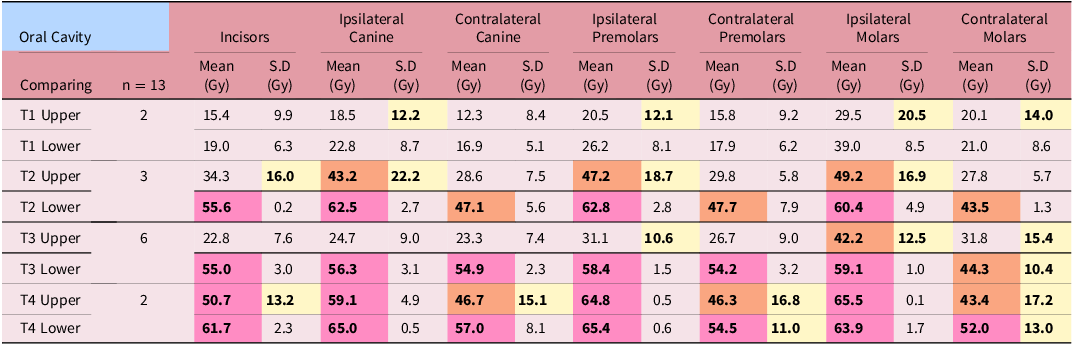
Among oral cavity patients, 84.6% had lateralised tumours and 53.8% received unilateral arc treatment. However, this did not result in the ipsilateral lower teeth being within the medium risk dose tolerance.
Table 3 shows a significant difference in mean dose between upper and lower teeth. T-tests confirmed this, revealing lower p-values when comparing contralateral upper and lower teeth, with notable differences between upper and lower, ipsilateral and contralateral canines. This supports the hypothesis that upper and lower teeth receive significantly different doses in oral cavity cases.
Oral cavity treatments exceeded the high-risk threshold of 50Gy for almost all teeth, except the contralateral molar, which still exceeded the medium-risk dose. These findings place oral cavity patients at the highest risk for ORN. Due to the small sample size, particularly in the T2 and T4 stages, with only 2 patients per stage, further research is needed to better assess ORN risk in this group.
Oropharynx showed varying ORN risk based on tooth position and staging (Table 4). Oropharynx had the highest patient numbers (n = 62), with 6 patients in T3. Incisors, ipsilateral and contralateral canines and contralateral premolars remained below risk thresholds. However, all lower ipsilateral incisors exceeded 40Gy across all stages, with both upper and lower incisors exceeding 50Gy in T4. Upper and lower ipsilateral premolars and contralateral molars were at medium risk only in T4.
Mean teeth doses (Gy) for oropharynx subsite and their associated standard deviation (S.D) for the patients assessed in this study. Teeth with a medium-risk mean dose >40Gy are highlighted as orange and any exceeding the high-risk mean dose of >50Gy are highlighted in red. Any S.D exceeding 10Gy is highlighted in yellow

A significant difference (p ≤ 0.001) was observed in doses between T1 and T4 across all teeth, confirming that higher staging correlates with higher doses. Generally, oropharynx tooth doses increase with staging, except for T3, where doses dropped from T2 but rose again in T4. This anomaly may result from the small T3 patient cohort.
Tonsil had no T3 patients and two patients in T1. Table 5 shows that for T1, all teeth were low risk, with the highest dose recorded at 36.2Gy (lower ipsilateral molar). Accounting for standard deviation (36.2 ± 5.3Gy), this falls within medium risk and has the highest uncertainty in T1. Given the low patient numbers, individual monitoring of ipsilateral molars is recommended.
Mean teeth doses (Gy) for tonsil subsite and their associated standard deviation (S.D) for the patients assessed in this study. Teeth with a medium-risk mean dose >40Gy are highlighted as orange and any exceeding the high-risk mean dose of >50Gy are highlighted in red. Any S.D exceeding 10Gy is highlighted in yellow

Ipsilateral molars were at medium risk in T2 and high risk in T4, with no for T3. As higher staging correlates with increased tooth dose, T3 ipsilateral molars should be assessed case by case. Upper and lower contralateral molars showed medium risk only in T4, while T4 ipsilateral molars were at high risk.
Across all subsites, the ipsilateral molar consistently exceeded the 40Gy medium-risk threshold, particularly in advanced stages. The oral cavity posed the highest ORN risk, with nearly all teeth surpassing 50Gy from T2 onwards. The oropharynx also demonstrated elevated risk for ORN, with significant dose increases in T4 and substantial dose variability across teeth. In contrast, the tonsil, BoT and larynx subsites generally showed lower doses across T-stages.
This study confirms a general trend of lower teeth receiving higher doses than their upper counterparts. The difference was significant (p ≤ 0.01) for all teeth except contralateral molars in oropharynx staging and all teeth in the tonsil subsite except the incisors. This study identifies tooth areas at increased radiation exposure during HNC treatments, supporting the development of a standardised system for prospectively extracting at-risk teeth based on dose stratification across HNC tumour types and stages. These dose thresholds suggest increased ORN risk but do not confirm certainty. This study does not track ORN incidence, and therefore conclusions are based on inferred risk from dose levels. The findings aim to inform pre-emptive tooth extraction decisions and highlight opportunities for dose optimisation during RT planning, as well as minimising the time to start RT.
Conclusion
This study demonstrates that individual teeth can be delineated, with doses reported and risk-stratified, providing an indicative tool for guiding pre-RT dental management. Cancer centres may consider reporting these doses locally or optimising treatment plans to minimise doses to at-risk teeth, reducing the likelihood of ORN incidence. The data reinforce the need for pre-treatment assessment to balance unnecessary extractions with ORN risk reduction, supporting more individualised, evidence-based dental strategies. This approach aims to improve patient comfort and satisfaction while reducing unnecessary tooth extractions.
The authors consider the applicability of the work to be valid across patient demographics, prescriptions and treatment planning algorithms.
To enhance the clinical application, future research should assess the long-term impact of radiation dose on ORN incidence and evaluate dose-optimisation techniques to preserve teeth without compromising oncological outcomes. Expanding the study to larger, multi-centre cohorts would strengthen findings and refine risk stratification across different HNC subsites.
This study had several limitations. Some patients were edentulous, requiring estimations of tooth locations, which may introduce minor inaccuracies. In addition, a single operator outlined all teeth; so, inter-observer variability was not assessed, potentially affecting consistency in outlining. No follow-up was conducted to confirm ORN incidence, though existing literature provides insights into this area. This study included a limited sample size, particularly in certain staging groups. Further research with larger cohorts would strengthen findings and further statistical analysis could help assess dose-risk categorisations. As this is a simple decision-making tool conducted as a local audit, no further statistical analysis addition to standard deviations and t-testing was conducted. More in-depth statistical analysis combined with larger patient cohorts could help to strengthen the conclusions of this study. Finally, as dose optimisation for teeth was not implemented in this cohort, future studies should explore its potential role in reducing ORN risk while maintaining treatment efficacy.
Acknowledgements
None.
Financial support
No financial support to declare.
Competing interests
The author(s) declare none.


 Open access

