


1. Introduction
Defining appropriate problems is central to user-centred design. However, identifying user needs is complex, as users often lack full awareness of their goals and constraints, and designer-user communication often suffers from misalignment and interpretive bias (Reference Hu, Nanjappan and GeorgievHu et al., 2021). Consequently, empathic design approaches encourage designers to engage deeply with users’ lived experiences to uncover latent needs (Reference Koskinen, Koskinen, Battarbee and MattelmäkiKoskinen, 2003; Reference Kouprie and VisserKouprie & Visser, 2009; Reference Leonard and RayportLeonard & Rayport, 1997), with design process models positioning empathy early to help designers embrace user perspectives.
However, the methodological rigor of this empathizing stage is contentious. It is difficult to bridge the experiential gap between designer and user, and traditional empathy often requires substantial projection when experiences diverge. This reliance on imagination has led researchers to question the accuracy of empathy and its subsequent impact on design outcomes (Reference Chang-Arana, Piispanen, Himberg, Surma-aho, Alho, Sams and Hölttä-OttoChang-Arana et al., 2020; Reference Robertson and AllenRobertson & Allen, 2018). Amid these challenges, Virtual Reality (VR) has emerged as a promising medium for more grounded forms of “experience-driven” empathy.
As an immersive “life simulator,” VR allows operators to gain virtual proxies for shared experiences, suggesting its potential as an empathic instrument. By reconstructing a user’s context from a first-person perspective, empathic VR is expected to enable designers to confront user challenges directly, gaining experiential insights that are otherwise difficult to articulate (Reference Hu, Nanjappan and GeorgievHu et al., 2021). Furthermore, VR can modulate operator perception (Reference Banakou, Groten and SlaterBanakou et al., 2013) and elicit realistic social responses (Reference Slater, Guger, Edlinger, Leeb, Pfurtscheller, Antley, Garau, Brogni and FriedmanSlater et al., 2006), holding considerable promise as a medium for empathic design.
While early efforts are encouraging (Reference Grech, Wodehouse, Brisco, Särestöniemi, Keikhosrokiani, Singh, Harjula, Tiulpin, Jansson, Isomursu, van Gils, Saarakkala and ReponenGrech et al., 2024; Reference Hu, Casakin and GeorgievHu et al., 2023), the underlying mechanisms remain unclear. Key questions persist: What forms of empathy are elicited, and how do they influence design decisions? Does enhanced empathy reliably improve design outcomes? To what extent are these effects driven by the immersive technology itself versus the framing of the design prompts? Answering these questions requires systematic empirical investigation.
To bridge this gap, the present study investigates how an immersive VR simulation impacts empathic understanding and design ideation. We employed a controlled, pre-post experimental paradigm to examine participants’ empathic experience, problem identification, and design solutions before and after a brief VR scenario depicting the daily challenges of essential tremor (i.e., a neurological condition characterized by involuntary and rhythmic shaking). The results show that the VR experience significantly enhanced participants’ empathic understanding of challenges associated with tremor, particularly in relation to the target users’ daily constraints and frustrations. Notably, many participants intuitively adopted core principles of design thinking (e.g., user-centered problem reframing), even though these concepts were not explicitly introduced. This finding is surprising given that none of the participants had formal design education or were identified as designers. These results highlight the practical value of VR for empathic design and suggest its potential as a pedagogical instrument for supporting design thinking, with implications for design education and future tool development.
2. First level heading
2.1. Empathy
Empathy is a multifaceted construct whose conceptualization varies across disciplines. Contemporary neuroscience identifies five primary neural mechanisms that support empathy (Reference Hu, Casakin and GeorgievHu et al., 2025): (1) affective empathy—emotional resonance with others’ feelings, (2) cognitive empathy—the capacity for perspective-taking and mental state inference, (3) somatic responses—automatic embodied mirroring of observed states, and (4) compassion—prosocial concern emerging from affective and cognitive processes. These mechanisms are modulated by (5) emotion regulation, which operates at a meta-level to maintain contextual appropriateness.
In design contexts, empathy is primarily conceptualized in terms of its affective and cognitive dimensions. Affective empathy enables designers to resonate emotionally with users’ experiences, while cognitive empathy supports accurate interpretation of users’ situational contexts, goals, and constraints. Although compassion and prosocial motivation may accompany empathic design practice, they are sometimes considered distinct from the core empathic processes that inform design practice.
2.2. VR
Virtual Reality (VR) commonly refers to computer-generated, three-dimensional environments designed to simulate real-world experiences through immersive and interactive engagement. (Reference Hu, Casakin and GeorgievHu et al., 2025). VR’s capacity to reshape perceptual and interactive experience makes it uniquely suited for empathic engagement. Through immersive embodiment and multimodal interaction, VR can alter spatial, bodily, and social perceptions. Research demonstrates that embodying users in different-sized avatars directly influences spatial perception (Reference Banakou, Groten and SlaterBanakou et al., 2013; Reference Hoort, Guterstam and EhrssonHoort et al., 2011) and that avatar characteristics can modulate behaviors and attitudes beyond the virtual experience (Reference Bailenson, Blascovich and BeallBailenson et al., 2003; Reference RatanRatan, 2013). Moreover, virtual humans can elicit social responses comparable to real interactions, including authentic emotional responses such as public-speaking anxiety (Reference Bombari, Schmid Mast, Canadas and BachmannBombari et al., 2015). These features collectively establish the basis for using VR to support empathic engagement.
2.3. Empathic VR
Empathic VR is grounded in a simple premise: by simulating the challenges faced by a target group, it provides first-person experience that reveals difficulties users often struggle to articulate, establishing experiential grounding that enables more accurate understanding and meaningful perspective-taking (Reference Hu, Nanjappan and GeorgievHu et al., 2021).
Early explorations have shown encouraging results. VR simulations of unfamiliar social groups can reduce stereotypes and misconceptions, and may foster lasting prosocial tendencies (Reference Yee and BailensonYee & Bailenson, 2006). Over the past decade, empathic VR has been adopted in diverse domains, including immersive journalism (Reference Bujić, Salminen, Macey and HamariBujić et al., 2020), healthcare training (Reference Trevena, Paay and McDonaldTrevena et al., 2024), prosocial social simulation (Reference Muller, Van Kessel and JanssenMuller et al., 2017), and educational applications for historical and ecological understanding (Reference Hargrove, Sommer and JonesHargrove et al., 2020; Reference Lucifora, Schembri, Poggi, Grasso and GangemiLucifora et al., 2023). More recently, in user-centered design, empathic VR has shown potential to deepen designers’ ability to identify and contextualize user challenges (Reference Grech, Wodehouse, Brisco, Särestöniemi, Keikhosrokiani, Singh, Harjula, Tiulpin, Jansson, Isomursu, van Gils, Saarakkala and ReponenGrech et al., 2024; Reference Hu, Casakin and GeorgievHu et al., 2023).
2.4. Toward effective empathic VR for design
Despite this potential, the practical use of empathic VR in design remains challenging. Creating an effective scenario requires reconstructing a user group’s context with sufficient fidelity, which, in turn, depends on knowing how VR influences empathic experience and contextualization. However, this mechanistic understanding is still limited, leaving designers without a clear basis for deciding what to represent, how to represent it, or which aspects of the experience matter most. More specifically, the following key questions persist: What forms of empathy are elicited through immersive experience, and how do these affect downstream design decisions? How accurate are the resulting empathic interpretations, and to what extent do they mirror users’ lived realities? Critically, in what ways will the heightened empathic understanding improve the design process?
Addressing this gap, the present study employs a VR-mediated empathic design task guided by the following research questions:
RQ1 : How does an empathy-oriented VR scenario influence designers’ empathic experience?
RQ2 : How does VR experience affect the quality and focus of designers’ design practice?
RQ3 : How does the VR experience affect designers’ strategies?
3. Methods
3.1. Participants
Twenty participants (17 male, 3 female) were recruited from a Northern European university, whose ages ranged from 18 to 34, falling into two groups: 18–24 (n=5) and 25–34 (n=15). Educational backgrounds varied, with 40% (n=8) holding a master’s degree, 40% (n=8) a bachelor’s degree, and 20% (n=4) reporting a high school diploma or current undergraduate enrollment. None of the participants identified as designers, with most of them affiliated to engineering disciplines. Regarding prior VR experience, 11 reported low familiarity, 7 reported high familiarity (using VR >12 times per year), and 2 did not respond. In terms of baseline knowledge about tremor, 11 reported marginal to no prior knowledge, while 9 reported moderate or greater prior knowledge, primarily through personal acquaintance with individuals affected by similar conditions. All were fluent in English and broadly represented the local university’s demographics.
3.2. Study design
3.2.1. Scenario design
To investigate the effects of immersive VR on empathic understanding and design ideation, this study employed a scenario simulating the everyday challenges faced by individuals living with essential tremor, a neurological condition characterized by involuntary rhythmic movements, primarily affecting the hands. The primary functional impact of essential tremor is impaired motor precision and control in daily activities. The virtual environment depicted a contemporary home setting, including a living room and kitchen designed to reflect spaces familiar to the local community, as shown in Figure 1. This theme was selected because it represents a user group whose needs are unfamiliar and are often mistaken for out-group members.
Virtual environments and tasks

3.2.2. Task design
In the VR scenario, participants took on the role of an individual living with essential tremor who is preparing for an upcoming home visit. This narrative framing prompted a series of everyday tasks such as writing greeting cards, stacking items on a counter, and organizing household objects. The effects of essential tremor are conveyed through embodied motor disruption: the participant’s virtual hands exhibit continuous involuntary trembling, which directly interferes with task performance by inducing spatial imprecision and unintended movement offsets. This mechanism was intended to simulate the motor challenges experienced in daily life and to immerse participants in the physical constraints that shape the daily experience of tremor. The design of these tasks and interactions was informed by individuals with direct familiarity and professional experience related to tremor conditions.
3.2.3. Paradigm design
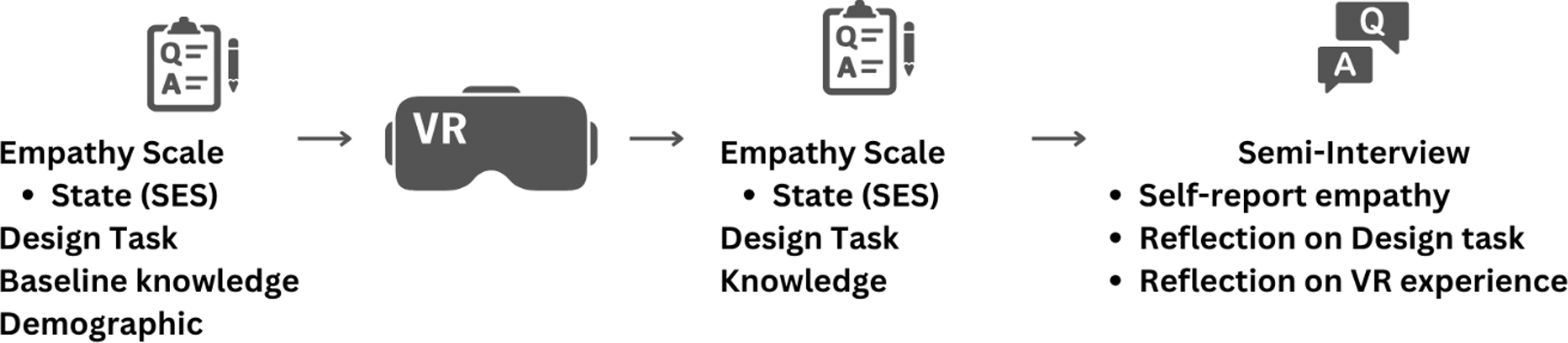
The study employed a mixed-model design using a pre-post comparison paradigm (Figure 2).
Experiment procedure

After providing informed consent, all participants completed a pre-VR assessment consisting of empathy measures, demographic questions, prior knowledge inquiries, and an initial design task requiring them to identify user challenges and propose potential solutions. Participants then received a brief training session on VR controls and navigation until they demonstrated comfortable operation. This was followed by approximately 15 minutes of interaction with the VR scenario. After the interaction with VR, they completed a post-VR assessment consisting of the same empathy measures and design tasks, with a subsequent semi-structured interview exploring their design rationale and eliciting qualitative reflections on the VR experience.
3.3. Instruments
3.3.1. Apparatus
This study employed a Meta Quest 2 VR system comprising a head-mounted display and two handheld controllers.
3.3.2. Measurements
Empathy Scale
As recommended in recent literature (Reference Hu, Casakin and GeorgievHu et al., 2025), this study distinguishes between trait empathy (a stable dispositional characteristic) and state empathy (a momentary, context-specific response). Given that the single-session VR intervention was designed to elicit a transient, scenario-based reaction, state empathy was the focal construct. The State Empathy Scale (SES; Reference ShenShen, 2010) was therefore selected and adapted from its original media-viewing context to align with an embodied, interactive VR experience.
Questionnaire
A questionnaire was implemented in both the pre- and post-VR assessments to examine changes in participants’ understanding and design strategy. It asked students to (1) evaluate their understanding of essential tremors, (2) identify the main challenges faced by individuals with the condition, and (3) propose design solutions to address these challenges. Additionally, demographic information was collected as part of the pre-test, including age group, gender, and education level.
Semi-structured interview
Following the post-VR questionnaire, participants took part in a semi-structured interview designed to elicit deeper insights into their VR experience and design strategies. The interview focused on four key areas: (1) participants’ perspectives and experiences within the virtual environment, (2) their empathic responses during the simulation, (3) their approaches to problem identification and design ideation, and (4) their reflections on the overall design and effectiveness of the VR scenario.
3.4. Data analysis
Quantitative analysis: A paired-samples t-test was conducted to assess changes in empathy by comparing SES scores before and after the VR experience.
Qualitative analysis: Interview transcripts and open-ended questionnaire responses were analyzed using thematic coding by two researchers. One researcher conducted a comprehensive initial review and developed a preliminary codebook. A second researcher independently applied this codebook to the dataset to assess its clarity and applicability. The two researchers then compared coding results, discussed discrepancies, and iteratively refined the codebook until complete consensus was reached.
4. Results
For clarity, participants are denoted as “P” followed by their ID (for example, P1). The results are organized around three outcome domains: empathic understanding, problem framing, and design ideation, followed by an analysis of participants’ design processes.
4.1. Empathy enhancement
Empathy enhancement was consistently observed across all forms of measurement. Both quantitative assessments and qualitative reflections converged on an enhanced understanding and emotional connection following the VR experience.
Standardized Measure (SES): SES scores increased significantly from pre to post assessment (t = 5.91, df = 19, p < 0.001, Cohen’s d = 0.90), indicating a substantial improvement in empathy toward people with essential tremor. Internal consistency was excellent in both pre-test (Cronbach’s α = 0.94, average inter-item r = 0.57) and post-test (α = 0.97, average inter-item r = 0.75), supporting the reliability of the measure.
Types of empathy: Participants were also introduced to the distinction between cognitive and affective empathy and asked to rate each separately. Post-VR scores averaged 3.9 for cognitive empathy and 3.8 for affective empathy, indicating moderate to high engagement across both domains. These parallel increases suggest that the VR scenario elicited both emotional resonance and contextual understanding, consistent with participants’ rationales for their empathic experience.
Rationale of empathic experience: Post-VR interviews provided insight into the mechanisms underlying empathy enhancement. Nine participants attributed their increased empathy to a greater ability to relate to lived experiences of individuals with tremor. Five emphasized compassionate feelings. Others referred to dispositional empathy (n = 2), new perspectives on family conditions (n = 1), or prosocial motivation (n = 1).
4.2. Design task performance
4.2.1. Problem framing
Participants’ problem framing evolved substantially following the VR experience, shifting from broad misconceptions to specific, design-actionable challenges, as shown in Figure 3.
Pre-VR: Patterns of misunderstandings were evident across participants’ responses. Thirteen of the 20 participants identified irrelevant problems, with signs of conflating essential tremor with Parkinson’s disease or other conditions. Even relevant responses tended to emphasize abstract or extreme concerns that were difficult to address through design (e.g., social pressure).
Post-VR: Both the post-VR questionnaire and interview responses demonstrated a clear reframing of the design problem. Most participants (n=19) shifted from abstract and misinformed concerns to specific, design-actionable challenges embedded in everyday activities: difficulties with cooking, handling household items, writing, and typing. This transformation represents what empathic design aims to achieve: problem framing that is contextually accurate, personally grounded, and directly addressable for design intervention.
Methodological Observation: An interesting divergence emerged between post-VR questionnaire and interview responses. While both assessments emphasized daily functional challenges, irrelevant concerns and overestimated difficulties persisted in some questionnaire responses; however, they were notably absent from the interviews. Given that the questionnaire and interview were conducted sequentially, this pattern suggests that the interview process facilitated deeper reflection, enabling participants to filter out less accurate or relevant problem framings.
Notably, one participant articulated a meta-level design problem during the interview, pointing out the lack of public awareness that individuals with tremors require differentiated ergonomic support. This observation suggests a developing shift toward a designer’s perspective—a tendency further supported by several participants’ later rationales.
On the other hand, no salient differences in problem framing were observed based on participants’ prior familiarity with VR or with tremor. While participants with previous exposure to individuals with tremor tended to draw on these experiences as reference points during the interview, problem framing remained comparable in specificity and design-actionability across all participants.
Problem framing in pre-VR, post-VR, and interview measurements

Figure 3 Long description
The table is divided into three main sections: Pre-VR Questionnaire, Post-VR Questionnaire, and Interview. Each section lists different categories of problems and the number of participants (n) who reported each issue. The Pre-VR Questionnaire section includes categories like Irrelevant, Emotional Impact, Daily inconvenience, Overestimated Challenges, and Motor Control. The Post-VR Questionnaire section includes Daily inconveniences, Irrelevant, Overestimated Challenges, Emotional Impact, and Motor Control. The Interview section includes Daily inconveniences, Overestimated Challenges, Emotional Impact, Motor Control, and Insufficient support. Each category lists specific problems and the participants who reported them. For example, under Daily inconveniences in the Pre-VR Questionnaire, participants reported issues like pain, exams, transportation, and more. The table provides a detailed comparison of the problems framed by participants before and after VR, as well as during interviews.
4.2.2. Design ideations
As illustrated in Figure 4, participants’ design ideation shifted from misconception-driven, misaligned solutions to more targeted, contextually grounded concepts following the VR experience. Although the strategic dimension of their designs improved substantially, the overall design quality and creativity of output remained limited by participants’ baseline design capabilities. Consistent with the problem framing findings, no salient differences emerged based on prior VR familiarity. Participants with prior experience with tremor showed slightly greater attention to less functional aspects of the design (e.g., social or emotional considerations), though this difference did not reach notable significance for overall design quality.
Pre-VR design ideation predominantly reflected irrelevant or misinformed problem framing. Seven participants proposed solutions unrelated to the target challenges (e.g., providing a walking stick [P6, P20] or keeping a pet [P7]), while five participants were unable to generate any solutions. Among the remaining relevant and potentially viable proposals, students suggested assistive automation, stabilizing devices, and tool redesigns, although most lacked implementation detail and contextual specificity.
Post-VR assessments demonstrated a marked reduction in misconception-driven solutions, with more participants (n=18) proposing ideas aligned with relevant functional challenges. Solution categories remained largely consistent: assistive automation, stabilizing devices, and tool redesign, with more contextually appropriate and actionable ideas. However, the technical feasibility and creative quality of solutions did not increase substantially. This pattern suggests that the VR experience primarily enhanced participants’ empathic understanding and problem identification rather than their design implementation capabilities.
Categorization of design ideation

4.3. VR’s impact on the design process
When explaining how the VR experience influenced their design thinking, most participants emphasized its impact on early-stage design processes, particularly in fostering a contextualized understanding that enabled more accurate problem identification. This pattern aligns with the observed improvements in problem framings and the comparatively modest gains in design solution quality.
As shown in Figure 5, 16 of the 20 participants reported that the VR scenario supported their early design process by offering shared experiential grounding and deeper user-context awareness. These insights enabled them to more precisely frame problems, identify overlooked design opportunities, and acquire new contextual knowledge. For participants who entered the study with preliminary design directions, the VR experience served as a refinement mechanism—helping them confirm assumptions, sharpen their focus, and solidify early concepts. Two participants further noted that the scenario heightened their recognition of the need for tremor-specific design considerations and increased their motivation to pursue such solutions. One participant highlighted VR’s value in later-stage design activities, particularly for testing and validating concepts within an immersive, simulated environment. Three participants reported that the VR experience did not substantially influence their design process, noting that they were already familiar with the problem space or that their design approach would have remained similar without the intervention. These cases illustrate the boundary condition for VR’s impact: when participants possess pre-existing knowledge or established mental models, the marginal benefit of experiential immersion appears more limited.
Design Thinking
Notably, participants’ rationales suggested that they intuitively applied core design thinking principles, particularly experiential understanding to define problems more accurately and generate solutions grounded in authentic user contexts. Several participants explicitly described how the VR scenario enabled them to move beyond initial, surface-level assumptions and uncover the actual problems that required design attention. As shown in Figure 5, multiple participants (n=12) emphasized that the VR experience offered a shared point of reference and a clearer sense of what users encounter, effectively narrowing the perspective gap between themselves and people with tremor [P2, P5, P9, P12].
This pattern suggests that empathic VR scenarios may provide experiential scaffolding to support the early stages of design thinking. The immersive experience appeared to create conditions in which participants naturally internalized and applied foundational design thinking practices, such as reframing problems, refining early concepts, and grounding ideas in user contexts. In this sense, the VR experience did not merely inform participants’ understanding of the problem space; it subtly cultivated the habits of mind that underline thoughtful and contextually attuned design.
Rationale of VR’s impact on the design process

5. Discussion
5.1. Key findings: enhanced empathy and problem grounding
This study examined how an empathy-oriented VR scenario, simulating the motor challenges of essential tremor, shapes empathic experience and design ideation. The findings demonstrate that VR primarily supports empathic design by enhancing a contextually grounded understanding of users’ challenges, which in turn improves early-stage design.
Multiple forms of evidence converged to demonstrate that the VR scenario reliably enhanced participants’ empathic understanding of tremor-related constraints. Both standardized SES scores and self-reported empathy ratings increased significantly following the VR scenario. Designers’ qualitative reflections substantiated this pattern, indicating heightened relatability, clearer awareness of everyday difficulties, and improved ability to interpret the target user’s situation. Together, these indicators show that the immersive simulation reliably enhanced empathic engagement, consistent with prior work suggesting that first-person experiential grounding can deepen empathy (Reference Grech, Wodehouse, Brisco, Särestöniemi, Keikhosrokiani, Singh, Harjula, Tiulpin, Jansson, Isomursu, van Gils, Saarakkala and ReponenGrech et al., 2024; Reference Hu, Nanjappan and GeorgievHu et al., 2021). This shift is particularly noteworthy given that participants lack formal design training, suggesting that the VR experience itself facilitated a more situated understanding of the design problem space.
5.2. Design process impact
The VR scenario’s primary influence was on how designers framed user problems. Post-VR responses showed substantial gains in problem framing specificity, relevance, and situational accuracy. Designers shifted from abstract or misinformed-driven interpretations to a concrete, design-actionable understanding of motor challenges in tasks like writing or object handling.
However, this enhanced problem articulation did not automatically translate to higher design quality or technical enhancement. This suggests that while empathic understanding enhances designers’ ability to articulate meaningful and well-grounded problems, solution generation remains constrained by existing design capabilities and domain knowledge. This aligns with expectations that VR may be especially effective for user study and problem framing (Reference Hu, Nanjappan and GeorgievHu et al., 2021), although it contrasts with earlier findings that observed gains in idea accuracy and usefulness (Reference Hu, Casakin and GeorgievHu et al., 2023). The discrepancy may stem from variations in its development strategy, specifically, whether the VR experience communicates only user challenges or also implies potential design directions.
5.3. Methodological implications
Two methodological considerations emerged. First, the benefits of the VR experience were identified mainly in the front end of the design process (empathizing, framing, and ideating). This suggests empathic VR, at least in this form, may best be positioned as a tool for initial problem-space exploration rather than a full-cycle solution. The generalizability of this observation requires further research.
Second, an interesting difference in performance emerged between the post-VR questionnaire and interview responses. While some designers retained misconceptions in the questionnaire, these were notably absent in the subsequent interviews. Given the temporal proximity, this is likely to reflect how each format accesses knowledge. It suggests that different inquiry methods may elicit different knowledge structures, a critical consideration for selecting and interpreting measurement instruments in empathic design research.
5.4. Limitations and future directions
This study has several limitations that inform opportunities for future work. First, the sample comprised only 20 participants due to recruitment constraints during the summer period and included substantially more males than females, which may limit the generalizability of the findings. A larger more balanced sample would allow a clearer understanding of how empathic responses and design reasoning may vary across demographic groups.
Second, this study employed only a single VR scenario to establish a controlled foundation. Replicating these findings across a wider range of empathic VR themes and user contexts is necessary to explore if the observed patterns extend beyond the specific case of essential tremor. Together, these limitations suggest the need to broaden the participant pool and the diversity of VR scenarios to strengthen the external validity of the findings and better understand how empathic VR can support design practice across different domains.
6. Conclusion
Overall, this study demonstrates that immersive VR can effectively strengthen early-stage user understanding in empathic design. By placing designers within the everyday challenges associated with essential tremor, the VR experience deepened their empathy and improved the accuracy and contextual grounding of problem framing. Designers’ explanations further indicate that the experience supported intuitive engagement with core principles of design thinking, even though the development of their design solutions remained aligned with their baseline capabilities. Taken together, these findings suggest that VR is well-suited to supporting the formative stages of empathic design. Future work should investigate how to bridge this gap and help designers implement findings on empathic understanding into better design outcomes.
Acknowledgement
We appreciate the contributions of Tino Marttila, Miro Sirviö, and Akseli Ahonperä to this research.



 Open access

