


Introduction
Parties and interest groups are alternative intermediaries in democracy and both play a vital role in incorporating societal interests into democratic decision‐making (Almond & Powell Reference Almond and Powell1966). A growing number of studies therefore address the intersection between party and interest group politics in contemporary political science (e.g., Beyers Reference Beyers2008; Beyers et al. Reference Beyers, Eising and Mahoney2008; Binderkrantz Reference Binderkrantz2015; Heaney Reference Heaney, Maisel and Berry2010; Koger et al. Reference Koger, Masket and Noel2009; Witko Reference Witko2009; Rasmussen & Lindeboom Reference Rasmussen and Lindeboom2013; Holyoke & Cummins Reference Holyoke and Cummins2014; Marshall, Reference Marshall2015; Fraussen & Halpin Reference Fraussen and Halpin2016; Eichenberger & Mach Reference Eichenberger and Mach2017; Klüver Reference Klüver2018). The degree to which the contact between parties and interest groups is structured or regularised is likely to play a key role in determining the access interest groups enjoy to decision‐makers on specific issues. How parties choose to interact with interest groups may matter for the quality of political representation and public policy outputs. In this paper, we focus on political parties and argue that the strategic electoral context in which they operate is key to understanding their relationship to interest groups. We analyse how variation in the pattern of party competition in different policy spaces affects whether organisational ties to specific categories of interest groups are maintained or established.
Parties often need input from interest groups in the policy‐making process, but not all choose to forge highly structured interactions with particular groups. Indeed, formalised relations do not seem widespread (Allern & Verge Reference Allern, Verge, Poguntke, Scarrow and Webb2017). As parties and interest groups will have to deal with many different parties/groups in government, interacting on an ad‐hoc basis is probably the default position in order to retain freedom of manoeuvre. Highly institutionalised relationships go back to the early days of party politics in modern democracies – like those between social democratic parties and trade unions – and they tend to have decayed over time along with old social cleavages (e.g., Kirchheimer Reference Kirchheimer, LaPalombara and Weiner1966; Thomas Reference Thomas2001). Poguntke (Reference Poguntke and van Deth1998, pp. 176–178; Reference Poguntke, Luther and Müller‐Rommel2002, p. 59) finds that external collateral organisations have generally declined over time. In particular, their access to the parties’ national executive committee has weakened.
Even so, empirical studies suggest that structured interactions and organisational ties between particular parties and groups still exist, with new cases emerging (Allern & Bale Reference Allern and Bale2017). The predominant explanation for why party‐group relationships differ relies on what the two sides individually and mutually offer each other in terms of tangible resources (e.g., Quinn Reference Quinn2002), like votes and financial support for parties and access to government and favourable legislation for groups (McLean Reference McLean1987, p. 70; Howell et al. Reference Howell, Daley and Vale1992, p. 5; Warner Reference Warner2000, p. 29, 99; Schwartz Reference Schwartz, Römmele, Farrel and Ignazi2005, p. 44). Historically, close party–group relationships were deeply rooted in a shared ideology (Lipset & Rokkan Reference Lipset and Rokkan1967), but in many cases, they soon evolved into more pragmatic alliances (Taylor Reference Taylor1993, p. 134). By institutionalising interactions, parties and interest groups ensure that the exchange of resources between them becomes stable (Allern et al. Reference Allern, Aylott and Christiansen2007).
While the exchange model is certainly useful, we argue that it suffers from one important limitation: a tendency to study party–group relationships in isolation from interactions with other parties and interest groups rather than consider the characteristics of the strategic context in which they interact (but see Thomas Reference Thomas2001, p. 275–276; Berry Reference Berry1997, p. 47; Allern & Bale Reference Allern and Bale2017). Instead, we choose a party‐centred perspective and investigate the extent to which core features of programmatic party competition can account for variation in party–group ties in different policy spaces.
We concentrate on organisational ties, as measured by regularised meetings between top leaderships of parties and groups. By doing so, we move beyond the conventional focus on old parties and groups that have traditionally maintained relationships with each other. Instead, we study the interaction between the entire universe of significant major and minor parties operating in diverse institutional contexts with interest groups relevant for major partisan conflict dimensions. We define party competition as an issue‐based struggle, taking place in a multidimensional policy space. Unlike interest groups, parties often have positions on a wide range of issues, and thus, on multiple ideological dimensions. This means that they need to consider potential relationships with a high number of actors when deciding whether to engage with particular types of interest groups. Furthermore, the pattern of party competition might vary within and across policy dimensions, both in terms of fragmentation (the number of relevant parties) and polarisation (the ideological distance between parties). The key question is to what extent parties’ approach to interest groups varies systematically with these contextual characteristics of party competition along different policy dimensions.
Our argument is twofold. First, parties that compete with (multiple) other parties in a dimensional policy space have stronger reasons to fear voter loss (to a neighbouring party), and thus, have a greater incentive to nurture organisational ties to the groups occupying this space, than parties facing (fewer or) no competitors. Second, high polarisation – that is, large positional distance between the furthest parties along a given policy dimension – may have a negative effect on the strength of organisational ties between parties and interest groups. When the level of conflict increases, ties to interest groups associated with non‐centrist policy positions will in particular involve a higher risk of repelling centrist voters for most parties.
To test our hypotheses, we examine whether patterns of party competition along nine different policy dimensions, extracted from the Chapel Hill Expert Survey (CHES), are associated with ties between political parties and relevant interest groups in 13 mature European democracies. We use a new data set, which links responses from an organisational survey of 116 party units (central party organisations (CPOs) and legislative party groups (LPGs)) and 78 unique parties in these countries, together with other data sources. The design allows us to study parties facing comparable but different national patterns of party competition and it provides within‐country variation at the policy dimension level on issues including redistribution, deregulation, environment as well as social lifestyle. Relying on party survey data, we limit ourselves to addressing parties’ relationships with groups at the aggregate level. We focus on ties between parties and group categories assumed to be dominated by clear, non‐centrist policy positions on a given core policy dimensions – like trade unions being left‐of‐centre on the redistribution dimension or religious groups at the conservative end of the social life‐style dimension.
The results from logistic regression models with country fixed effects provide support for our expectations. We find that party competition (whether policy–specific fragmentation or polarisation among parties) plays an important role for the shape of party‐interest group ties. First, parties competing with many other parties on a given policy dimension are more likely to hold organisational ties to the interest group category in the relevant policy space. Second, high polarisation – that is, large positional distance between the furthest parties along a given policy dimension – is negatively associated with ties between parties and non‐centrist interest groups. These results also hold when we control for the tangible resources provided by groups to parties.
We offer two important caveats. First, both party policy positions and the particular emphases placed on certain dimensions might be endogenous to party competition for votes. However, we address the policy choices already made and parties’ subsequent and current ties to interest groups. Hence, we do not consider how parties move in the policy space to gain more votes (due to changes in the distribution of voter preferences). This simplifying assumption sharpens our analytical focus on the competition from other parties at a given point in time and matches our use of cross‐sectional data. Since organisational routines are by definition institutionalised, we also assume that they are less sensitive to minor adjustments in party positions and fluctuations in electoral support than short‐term electoral strategies. Second, we cannot preclude the possibility that ties to groups have previously affected parties’ and groups’ policy positions. That said, we have measured party positions and competition prior to measuring their ties to interest groups. As a robustness test, we also try to control for the possible third factor of particularly strong historical ties making both ideological proximity and organisational ties more likely.
Our results have important implications for the study of party and interest group politics more broadly. Above all, they underline the value of taking contextual aspects into account when analysing party–group relationships and suggest that changes in party competition patterns – particularly in terms of increased party system fragmentation – may have incentivised the establishment of ties, in terms of routinised leadership contact, between parties and interest groups despite the weakening of traditional cleavages and historically strong party–group ties.
Basic assumptions
Existing party–group relationships range from including formally integrated organisational structures to only informal but regularised interactions. The basic question is therefore what makes parties institutionalise – routinise – their interaction with interest groups? Our main assumption is that party leaders pursue access to office and maximisation of policy goals by means of votes (Strøm & Müller Reference Strøm and Müller1999), while interest groups are primarily policy‐seekers. Thus, party leaders, we assume, assess the costs and benefits of relationships with interest groups in light of these party goals (Allern & Bale Reference Allern and Bale2017, p. 13), that is, whether interest groups help parties to win elections to maximise their office‐ and policy‐seeking – for instance, by donating money or providing policy expertise. However, ties to interest groups are not cost‐free. They imply a loss of freedom to manoeuvre, and include possible drawbacks such as repelling other voter groups, limiting coalition options and the risk of making policy promises that collide with other policy preferences. Thus, in line with the resource exchange model, we assume that a party is more likely to establish or maintain organisational ties to groups that provide both significant material resources and electoral support than to groups that do not (McLean Reference McLean1987, p. 70; Warner Reference Warner2000, pp. 29, 99; Poguntke Reference Poguntke, Luther and Müller‐Rommel2002, pp. 44–46; Quinn Reference Quinn2002; Allern et al. Reference Allern, Aylott and Christiansen2007).
That said, we acknowledge that this resource‐centred approach has two important limitations: (1) a tendency to ignore parties’ own policy‐seeking purposes and (2) a tendency to study particular relationships in isolation from the strategic context in which different parties and interest groups interact. While ideological differences between parties are in some cases less clear‐cut than they used to be, parties still have distinct ideological profiles (Volkens & Klingemann Reference Volkens, Klingemann, Luther and Müller‐Rommel2002), and when choosing how to approach the national population of interest groups, parties are contesting (or collaborating) with other parties for electoral support. While citizen preferences underlie the issue composition of political space, political parties translate these issues into political conflict. Political competition becomes ‘a struggle over the dimensional configuration of political space’ (Rovny & Edwards Reference Rovny and Edwards2012, p. 53). Parties’ behaviour – positioning – within the party competition/party system is a basic strategic choice of importance for parties’ goal seeking. The possible association between party competition, on the one hand, and party–group ties, on the other hand, is therefore the major analytical focus of this article.
For a long time, (electoral) party competition was commonly studied as being one‐dimensional along the left‐right axis (Cox Reference Cox1990; Dalton Reference Dalton2008). In the more recent literature on party competition, party strategies are often theorised in multidimensional policy spaces (Laver & Schofield Reference Laver and Schofield1990; Albright Reference Albright2010; Rovny & Polk Reference Rovny and Polk2019). To this end, spatial models and saliency theory are brought together (for an overview, see Elias et al. Reference Elias, Szöcsik and Zuber2015) by assuming that party competition involves strategic choices on both issue salience and issue positions. We build on this literature by assuming that multiple (latent) policy dimensions exist, that parties position themselves along these dimensions and that they attach higher priority to some policy dimensions than others. In the next section, we derive the hypotheses to be explored empirically in this paper.
Parties, interest groups and party competition
When addressing whether the contest between parties can impinge on party–interest group relationships, the question first is how parties’ ideological policy positions are individually likely to affect their approach to interest groups. A party's placement in the policy space is the reference point for the competition with other parties. Evaluating possible ties in light of the party's basic ideological orientation is useful for parties’ goal‐seeking in several ways.
First, parties’ policy profiles are relevant when it comes to assessing the value of the information interest groups provide as specialists in their domain (e.g., Bouwen Reference Bouwen2004; Bernhagen Reference Bernhagen2013). Obviously, it can be useful to learn what groups with non‐aligned preferences know and think, but by establishing ties to groups with similar policy preferences parties will more likely gain access to information helping them to develop and promote their policies and to identify potentially sympathetic voters. To the extent that ties to such groups get known in public and thereby provide a cue to voters, such ‘reputational signals’ are probably most helpful if the groups are relatively near the party's general policy positions: they may underline a party's policy profile and credibility on specific dimensions and issues (i.e., contribute to ‘issue ownership’). This mechanism will be reinforced by interest groups using parties’ ideological profiles to estimate likely policy gains in the future, as such positions are based on general ideas and previous policy records (Otjes & Rasmussen Reference Otjes and Rasmussen2017). This view is consistent with studies, suggesting that interest groups target legislators who are their presumed allies rather than likely opponents: Successful lobbying is often not about changing the mind of legislators but about subsidising likeminded legislators, with, for example, information (e.g., Hall & Deardorff Reference Hall and Deardorff2006).
Second, ideological distance is relevant for parties’ estimations of what they have to ‘pay’ for support over time (Warner Reference Warner2000, p. 184). Having ties to ideologically distant interest groups, we assume, will generally increase costs in terms of future policy‐related compromises (Howell, Daley & Vale Reference Howell, Daley and Vale1992, p. 4; Warner Reference Warner2000, p. 184). This also applies to interest groups as they might have the preferences of their own (and potential) members to take into consideration. Thus, there are several reasons why parties will hesitate to commit to groups with a very different policy profile and why organisational ties are more likely when the party has a policy position that is proximate to the interest group's (group category's) position on the relevant dimension. Obviously, a group might be close to a party on one issue and distant on another, but not all groups have positions on multiple dimensions, and if in conflict, parties’ issue salience will probably decide. On this basis, we can now address how the policy‐based competition from other parties, or between all parties, is likely to constrain the calculus. To do this, we draw on the literature on party systems, defined as the pattern of interaction between parties, disaggregated to the level of policy dimensions.
First, we address fragmentation. On the one hand, a high number of parties could make it more difficult to predict future benefits/costs of specific party‐group links by increasing the need for flexibility and diminishing the value of firm ties to particular groups. On the other hand, fragmented party systems might render parties less concerned with maximising votes and more policy‐seeking than would be the case in two‐party systems (Thomas Reference Thomas2001, pp. 275–276). As Berry (Reference Berry1997, p. 47) points out, Green parties have emerged in Europe, whereas environmentalists in the United States have found themselves left with the option of engaging as a non‐party actor in elections (see also Thomas Reference Thomas2001, pp. 275–276). Accordingly, the advantage of a ‘catch‐all’ approach to voters – and interest groups – seems more limited in such contexts, especially if the threshold of representation is low and the degree of fragmentation high. In such an environment, parties risk splinter movements among ideologically motivated members and losing voters at the poles (Rokkan Reference Rokkan and Dahl1966, p. 92). Thus, having only weak links or ad hoc contact with more interest groups appears less useful when the number of parties increases.
What does this imply for the degree of competition parties face on different policy dimensions? If parties close to positions associated with a particular set of interest groups face competition from other parties competing in the same space, parties will fear voter loss to neighbouring parties in this part of the policy space. As a result, they will have a greater incentive to nurture ties to the relevant group type. Hence, a high number of parties make nurturing relatively strong ties to selected groups a more fruitful approach. For example, if a party near the ‘green’ pole of an environmental policy dimension faces competition from other parties in that space, it might have even greater incentive to maintain relationships with environmental organisations, than a party being the only really ‘green party’ in their system. For interest groups, fragmented party competition might make it rational to put the organisation's eggs in several baskets, and not institutionalise interaction with a particular party. However, given that parties are gatekeepers to power, we assume that groups tend to not reject invitations to get regular access to parties.Footnote 1 Hence, we hypothesise:
Party Fragmentation Hypothesis (H1): The higher the number of parties competing close to a party's policy position, the more likely the party is to hold organisational ties to the interest groups occupying the same policy space.
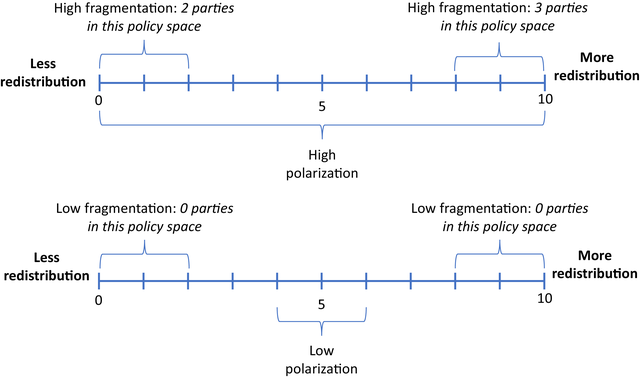
The nature of party competition is not only about party numbers, but also about ideological polarisation (Dalton Reference Dalton2008, p. 900). The direction of competition and ideological distances vary across systems and are keys to understanding how party systems work (Downs Reference Downs1957; Sartori Reference Sartori1976). Paraphrasing Dalton (Reference Dalton2008, p. 900), ‘party system polarisation reflects the degree of ideological differentiation among political parties in a system’ – how widely dispersed parties are along political continuums. A high degree of polarisation means centrifugal tendencies: that is, parties are pushed to competing (also) for votes closer to the ideological extremes. Polarisation and fragmentation in a party system may be positively correlated but are still distinct aspects of competition.Footnote 2 The difference (from centripetal competition where parties converge on the centre to compete for the median voter) is likely to apply at the level of individual policy dimensions as well. Thus, the question is how parties’ total ideological dispersion along different policy dimensions will affect party strategies. Figure 1 visualises two examples of different degrees of polarisation and fragmentation along a given policy dimension (here labelled ‘redistribution’ for illustrative purposes).
High and low polarisation and fragmentation in different policy spaces: Two examples based on the redistribution dimension. [Color figure can be viewed at wileyonlinelibrary.com]
Note: The number of parties in the middle is not shown.

Greater distance between the furthest parties (most ‘left‐wing’ and ‘right‐wing’ party) along a dimension means that essentially centrist parties risk losing voters to the ‘extremes’, and will thus perhaps be more likely to take the associated interest groups into account as well. If so, polarisation incentivises ties to a wider spectrum of groups. However, divergence of political attitudes also implies a higher level of conflict: large distance between parties’ preferred policy measures means division and probably a harsher political debate. As a result, we assume that ties to groups associated with a polarised policy dimension will be more controversial and thus costly for centrist parties: they will involve a higher risk of repelling voter groups in the middle than in less polarised settings if contact is exposed in public. To illustrate, a centre‐left party considering structuring its interaction with business groups to secure policy‐relevant information on economic issues despite a certain ideological distance, runs a higher risk of repelling its centre‐left core voters if ‘extreme’ right‐wing and left‐wing parties exist than if the competition is restricted to the centre‐right and centre‐left along the economic deregulation dimension. Even for non‐centrist parties, located on or adjacent to the relevant pole, the increased level of conflict implied by having an adversary on the other pole can make ties to associated groups costlier. For example, an anti‐immigration party may hesitate to associate closely with anti‐immigration groups if there is a pro‐immigration party delegitimising such ties on the other side of the spectrum.
Thus, we assume that policy‐specific polarisation will temper the incentives for most parties to establish organisational ties to, in particular, non‐centrist interest groups. Therefore, our second hypothesis is:
Party Polarisation Hypothesis (H2): The larger the positional distance between the furthest parties along a given policy dimension, the less likely parties are to have organisational ties to interest groups occupying the policy space on or adjacent to the poles.
Research design and data
When testing our hypotheses, we focus on political parties in mature European democracies. The regional concentration limits the extent to which we may include various regime variables and generalise, but it enables us to compare parties operating in systems with similar historical roots and ideological dimensions at a less abstract and more detailed level than we could in a cross‐regional study.
We primarily rely on a new, original cross‐national survey data set, from a project named ‘Political Parties and Interest Groups in Contemporary Democracies’ (PAIRDEM), including data on party interactions with interest groups in multiple mature democracies in Europe. So when we refer to ‘survey items’ in the descriptions of variables, the PAIRDEM party survey data set is the one used.Footnote 3 We also utilise the 2014 Chapel Hill Expert Survey (Polk et al. Reference Polk, Rovny, Bakker, Edwards, Hooghe, Jolly, Koedam, Kostelka, Marks, Schumacher, Steenbergen, Vachudova and Zilovic2017) to map parties’ policy positions. The following 13 European countries are part of both data sets and thus included in the study: Austria, Belgium, Denmark, Finland, Germany, Ireland, Italy, Luxembourg, Norway, Sweden, Switzerland, The Netherlands and United Kingdom.
The party populations covered include both major and minor parties.Footnote 4 The main party data set is based on two organisational party surveys conducted in 2016–2017 at the national level.Footnote 5 One survey was sent to the central party organizations (CPOs) and the other to the legislative party groups (LPGs), with partly overlapping questions. The combined response rate across the two PAIRDEM party surveys is 68 per cent (104/154). Data on party statutes and party finances were also collected for all countries, in collaboration with the Political Party Database Project (PPDB) (Poguntke et al. Reference Poguntke, Scarrow and Webb2016; Poguntke et al. Reference Poguntke, Scarrow and Webb2017). In addition, we rely on party data from the MARPOR and PARLGOV data sets (Volkens et al. Reference Volkens, Lehmann, Matthieß, Merz, Regel and Weßels2018; Döring & Manow Reference Döring and Manow2016).
We analyse CPOs and LPGs as separate party units in what follows (nested in different party structures). In the survey, some of the questions asked the parties about their relations with specific categories of interest groups:
-
• employers’/business/industry/manufacturing groups (excluding companies),
-
• agricultural/farm/fisheries/forestry groups,
-
• trade unions and labour groups,
-
• occupational/professional groups,
-
• religious groups,
-
• environmental/nature conservation/climate/animal welfare/wildlife groups,
-
• humanitarian/development/foreign aid groups (both domestic ones and national branches of international organisations),
-
• anti‐immigration groups (including those working on integration issues) and
-
• pro‐immigration groups (including those working on integration issues).
These questions enable us to use pairings of individual party units and selected interest group categories as units of analysis in this article. This dyadic data structure makes it possible to test our different hypotheses. The analysis includes data on the possible relationships of 116 different party units (CPOs and LPGs from 78 different unique parties) with nine different categories of interest organisations (N = (116*9 = 1,044)).
Hence, we focus on party relations with groups that have clear relevance for party political discourse and exclude groups without roots in the ideological landscape. Moreover, we focus on party ties to categories of groups rather than specific individual interest groups. Asking key party informants about relationships with thousands of individual organisations is, of course, an impossible task. The selected group categories are politically relevant across all countries and are associated with conflicting interests in policy fields rooted in both old and new cleavages (be they economic, cultural or value‐based). Both sectional, specialist groups and public interest groups are represented, and the group categories are far from homogenous. Hence, we study parties’ possible ties to a variety of interests, with or without a historical relationship with particular political parties.
Finally, we study parties’ general routines and not policy‐specific behaviour, and therefore, limit the analysis to one policy dimension and position area per group category. This means that no group category shares a core policy interest with another group category in the dataset (see details below and in Online Appendix 1). Thus, we provide a first test of whether party competition matters, but cannot necessarily generalise our findings to relations involving groups positioned on other parts of the dimension in question. The focus on groups strongly associated with particular policy dimensions probably makes ties based more likely due to the policy‐ and vote‐seeking relevance of ties. Yet, the variation we study may also reflect group category‐party positions on other dimensions than the one in question, the effects of which is to raise the hypothesis testing bar.
Dependent variables
We operationalise organisational ties between parties and groups with a binary variable Leadership ties to group category (1 = yes). This dependent variable is based on a survey question measuring regular leadership contact between parties and group categories: ‘Have representatives of the party leadership/leading members of the legislative/parliamentary party informally been in contact with leaders of one or more specific interest groups to discuss current issues of political relevance on a regular basis in the last 12 months?’ The instruction was either: ‘By leadership/leaders we mean the elected top leaders and other executive members in the national party organization/interest groups (including CEOs and other executives of companies)’ or ‘By leading members of the legislative/parliamentary party we mean the party's legislative/parliamentary leader(s) and spokespersons’ in different policy fields, and by group leaders we mean the top leaders and other executive members of interest groups (including the CEOs and other executives of companies)’. Moreover, ‘regular basis’ was defined as ‘meetings have been numerous and normalised’. If the parties answered yes to this question, they were asked to tick off whether this applied to the different group categories in question. The item emphasised contact outside organisational bodies but note that it is positively and strongly correlated with a survey item measuring perceptions of parties’ overall formal and informal organisational connections with the different interest group categories. Thus, many of the parties reporting regular top‐leadership contact are probably also connected to the interest group category in question by means of organisational measures at a higher level of institutionalisation (see Online Appendix 3 for robustness tests).
Descriptive statistics of the dependent and independent variables are included in the Online Appendix 2. Of the party‐group category combinations, 36.2 per cent have regularised contact at the leadership level with one or more organisations within the category in question. Hence, the descriptive figure does not imply that parties have ties to 36 per cent of the total interest group population. Moreover, there is variation across group categories.
Independent variables
To construct our independent variables on policy‐specific fragmentation and polarisation, we use data from the 2014 round of the Chapel Hill Expert Survey (Polk et al. Reference Polk, Rovny, Bakker, Edwards, Hooghe, Jolly, Koedam, Kostelka, Marks, Schumacher, Steenbergen, Vachudova and Zilovic2017). Since our theoretical argument is based on the assumption that policy proximity matters, we begin by calculating this as a baseline measure for the model.
As noted above, we first assigned all the nine group categories to a unique policy dimension emphasising their assumed core interest. Concentrating on groups with clear policy profiles, we furthermore assume that they are not positioned in the centre, but tend to be rather close to or at one of the poles of the relevant policy dimension. For instance, we assign ‘environmental/nature conservation/climate/animal welfare/wildlife groups’ to the ‘Environment’ policy dimension and position them in the space rather close to or at the environmentalist pole.Footnote 6 Note that this coding of a predominant position is supported by empirical tests relying on an interest group survey with self‐placement of groups on policy dimensions from seven countries (see Online Appendix 1 for details). Second, we take the party position on every dimension from the CHES data. Put together, we are able to calculate the absolute distance between the group category position and each party's position on the policy dimension tapping the group category's core interest. Finally, as the group category position is a simplified proxy for actual position within this category, we define ideological proximity between party and group category as being < = 3 points from each other on the 0–10 scale in the CHES data. The result of this process is a binary variable we label Policy proximity (between party and group category on the core policy dimension for the group category in question), which takes the value 1 if the preferences ‘align’ (i.e., are < = 3) and 0 if this is not the case. Note, however, that a ‘non‐centrist’ party to the left or right on one policy dimension can be located in the middle on another dimension. Similarly, parties that receive a centrist position on an aggregated left‐right dimension can be ‘non‐centrist’ on particular policy dimensions in the CHES data.Footnote 7 We include Policy proximity in all statistical models as a reference point in accordance with our baseline assumption (rather than as a control).
To test the Party Fragmentation Hypothesis (H1), we rely on these policy‐specific positions in the CHES (2014) data. Policy‐specific fragmentation is measured as the number of parties within a party system that compete in the same positional space (on a policy dimension) as a given group category. For instance, in Norway, there are two parties with an especially pro‐environmentalist position (the Greens and the Socialist Left Party). Party fragmentation on this policy dimension in Norway is thus ‘2’. If there are no parties occupying this positional space on a policy dimension, party fragmentation in this particular country on this dimension would be ‘0’. Note, that the number of CHES coded parties in the 13 countries varies from 6 (UK) to 13 (Belgium and Italy) with a mean of 9 in the merged dataset.
Policy‐specific polarisation (Party System Polarisation Hypothesis (H2)) is the positional distance between the most distant parties on the group category's core policy dimension within a party system. The observed distribution on this variable ranges from 0 to almost 10 (see Table A2.1 in Online Appendix 2) and shows that some policy dimensions in some countries are more polarised than others. For instance, on the pro‐immigration dimension in Ireland, all parties are attributed a mean position of ‘5’ on the 0–10 scale in the CHES data. This means that, for the Irish party‐pro‐immigration group category observations in our analysis of policy‐specific polarisation is particularly low (0). On other dimensions, Irish parties are more polarised (the maximum value is 7.5). United Kingdom, Italy and Norway also have particular dimensions that are substantially less polarised than others (≤2.75 points difference between parties) and there is sizeable variation in polarisation across policy dimensions in all countries. In some countries, the religious dimension is the most polarised, while in others, environment and/or immigration are.
In existing studies of polarisation on a general left‐right dimension, the measure is often weighted by the size of the parties to avoid disproportional influence by smaller parties with extreme positions (Dalton Reference Dalton2008; Vegetti Reference Vegetti2019). Given our analytical unit (party–group category pairings) and multiple policy dimensions, a weighted measure makes less sense here. Different parties drive polarisation on different policy dimensions, and weighting parties by their seat or vote shares may reduce the amount of this variation that possibly accounts for differences in our dependent variable (but see Online Appendix 3 for robustness tests including a weighted policy‐specific polarisation variable in accordance with the conventional approach in the literature).
We include several control variables. Rooted in a cost‐benefit resource model (Quinn Reference Quinn2002; Allern & Bale Reference Allern and Bale2017), we assume that tangible resources from interest groups provide incentives for parties to institutionalise relationships with them. Our analysis of leadership ties thus first controls for the impact of the material support flowing from groups to parties and endorsements at the party–group category (dyadic) level. To measure Financial/material support from a given group category to a party unit, we have calculated a simple additive index based on survey items indicating if group categories have contributed to the party nationally during the last 5 years by: (1) direct financial contribution to the party, (2) offering labour during election campaigns, (3) offering the party material resources during election campaigns and (4) offering to lend the party premises during election campaigns. Hence, this variable measures how many types of resource a party received from the group category in question and varies from 0 (none) to 4.Footnote 8 We also use a survey item indicating endorsement from the group category in recent years (1 = yes). We argue that this variable measures latent vote potential. Note that these two variables are post‐treatment in relation to policy proximity; groups that share preferences with a particular party are also more likely to provide resources and/or endorsements. Thus, we show the results with only these two control variables included together with the substantive variables in addition to full models. We include both variables to control for whether groups (embedded in the group category) can deliver critical resources to parties for their vote‐ and office‐seeking.
To account for the importance that parties attach to the different dimensions, we use the ‘most important issue’ included in CHES (2014) but this question was not asked in Luxembourg and Norway. When we include this variable in the regression models, the number of observations is reduced accordingly. We thus show the results with and without this variable in Table 1. The issues are very similar to the policy dimensions, so they were straightforward to match. If the party was coded as having an issue embedded in the relevant policy dimension as the most important issue over the course of 2014, Most important issue on this dimension = 1 (and 0 if not). As this variable also captures issue ownership to some extent, it also serves as a control of how issue ownership affects party competition on each dimension.
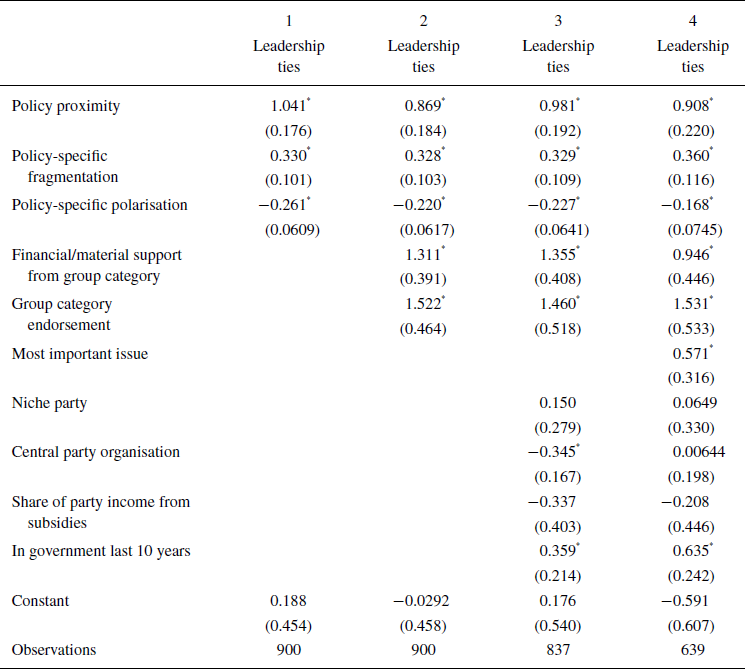
The effect of policy proximity, fragmentation and polarisation on the probability of leadership ties between party and interest group category

Notes: Model 4 with ‘party's most important policy issue’ (from CHES 2014) included. This CHES question was not asked in Norway and Luxembourg (N thus reduced). Standard errors in parentheses. Country fixed effects.
Table 1. p < 0.10, **p < 0.05, ***p < 0.01.
Furthermore, at the party level, we control for niche party, party unit type (LPG/CPO), size of public subventions to parties as share of total income and whether the party has been in government in the last 10 years. Niche party is coded on the basis of work by Wagner (Reference Wagner2012) and Meyer and Wagner (Reference Meyer and Wagner2013). It measures whether a party concentrates on topics which other parties cover relatively little and is based on three criteria: A party needs to (1) emphasise non‐economic policy area(s) more than the average party in its country, (2) pay significant attention to this policy area in the party manifesto and (3) de‐emphasise economic policy. Parties fulfilling all three criteria have a niche status ( = 1). We use the most recent version of party manifesto data from the MARPOR project that predates our dependent variable to identify such a profile (Volkens et al. Reference Volkens, Lehmann, Matthieß, Merz, Regel and Weßels2018) and the same detailed variable construction code as Meyer and Wagner (Reference Meyer and Wagner2013).Footnote 9 The variable is included to verify that our findings are not just ‘a niche party story’, since niche parties often articulate one specific interest and can be assumed to be stronger ‘policy seekers’ than other parties (unless the niche‐strategy is purely vote‐seeking behaviour).
In addition, we include fixed effects to control for possible heterogeneity in the type of party unit examined. The variable CPO takes the value 1 if the party unit of the dyad is the CPO and 0 if it is the LPG that answered the survey. We also control for Share of party income from public subsidies. The information is taken from the PPDB and measures the share of the national party income that stems from public subsidies. As Katz and Mair (Reference Katz and Mair1995) suggest, the size of public subventions may create various incentive structures for party relations to civil society. Parties that receive generous support may be less enthusiastic about strong ties to (selected) interest groups than parties that operate in systems where public subventions are more modest (cf. Thomas Reference Thomas2001, p. 276). Finally, we control for government participation since parties with (the prospect of) access to office are more likely to get interest groups to commit to establishing or maintaining leadership ties. In government in the last 10 years (1 = yes) is based on the PARLGOV data (Döring & Manow Reference Döring and Manow2016). Note that a majority (61 per cent) of the parties in our analysis have been in government within the last 10 years (predating our dependent variable).
Methodology
Due to the binary nature of the dependent variable Leadership ties, we employ logistic regression. Multilevel modelling to account for the nested structure of the data is problematic due to the low number of countries. We use country fixed effects to account for unobserved heterogeneities, such as cultural or institutional differences, across countries. On variables such as share of population/electorate affiliated to non‐party organisations, state structure, executive‐legislative relations and government alternation patterns, there is limited variation between the 13 countries included in our analysis but country fixed effects can still control for the differences that do exist. Model diagnostics look good and there are no particularly strong influential observations or outliers.Footnote 10 The full model (model 3 in Table 1) correctly classifies 85.1 per cent of the actual leadership contacts. There is no evidence of multicollinearity. A probit specification and two‐level random‐intercept models produce similar results.
Results
The results from the logistic regression models with country fixed effects are reported in Table 1 and Figure 2 plots the substantive effects. Models 1–3 are full sample models and model 4 includes Most important issue (for party) and thus a reduced N. The substantive results hold across specifications.
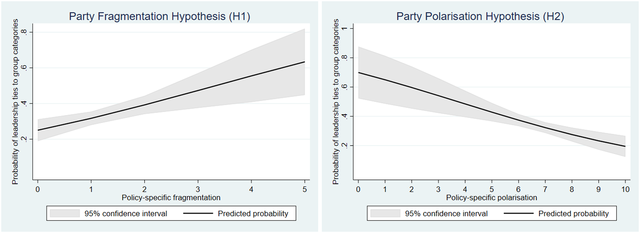
Main effects: Fragmentation and polarisation: Predicted probabilities (estimates from Model 3, other variables fixed at mean). [Color figure can be viewed at wileyonlinelibrary.com]

Our hypotheses H1 (Party Fragmentation Hypothesis) and H2 (Party Polarisation Hypothesis) are supported. The more parties, in a country, that compete in the same positional space as the (assumed) position of the group category, the greater the probability of leadership ties between the party and the groups in question. Policy‐specific polarisation, on the other hand, has the opposite effect. When the positional distance between the most left‐wing and right‐wing party, within a country, along the relevant (group category) policy dimension is large, the probability of party‐group leadership ties is reduced. This indicates that parties generally avoid leadership ties with groups whose non‐centrist core interest belongs to a controversial policy dimension. Note that this finding also holds if we omit the immigration dimension from the analysis, which is particularly polarised and controversial in many countries. Results are also robust when excluding the other dimensions – one by one – from the analysis.
Regarding our baseline assumption, we see that leadership ties between a party and a specific interest group type are more likely when the party has a policy position on the side of the axis associated with the given interest group category. In model 3, the probability of leadership ties increases from 0.3 to 0.51 when the preferences of the party and the group category are aligned on the group category's core policy dimension.
Of the control variables, financial/material support from group category, group category endorsement, most important issue (for party), CPO and in government last 10 years are significant. The more financial and organisational support an interest group type has provided to a party in recent years, the more likely it is that the party will have leadership ties to this category. In model 3, the predicted probabilities increase from 0.33 to 0.65 if we compare no resources received to at least one type of resource received from groups within the particular category. Similarly, if the party has received an endorsement, the predicted probability of ties is 0.5 compared to 0.34 when it has not. Clearly, then, the resources provided by groups have a positive effect on the level of ties between party leaders and interest group leaders. Also, if a party found a particular issue embedded in the policy dimension to be the most important (in 2014), it was more likely to have had contact with groups whose core interest lay in this dimension.
Furthermore, CPOs are less likely to have leadership contact than parliamentary party groups. This is not surprising, since parliamentary parties are responsible for drafting and deciding on legislative policy proposals. As expected, being in government has a positive effect. A party that has been in government in the last 10 years is more likely to have leadership contact with groups than parties that have been exclusively in opposition.
Figure 2 shows the effects of policy‐specific fragmentation and polarisation on particular policy dimensions. With regard to fragmentation (left), the probability of leadership ties increases from around 0.25 to 0.63 when five parties have policy positions clustered around the same positional space as the group category in question. Policy‐specific party polarisation (right), on the other hand, reduces the probability of leadership ties; from 0.7 when there is no polarisation to 0.2 at the maximum possible level of polarisation.
Further robustness tests
Extensive robustness tests are included in the Online Appendices. Online Appendix 1 shows how all nine group categories have been assigned to different policy dimensions and provides information about robustness tests to verify these assignments, including positional data at the individual level of interest groups in multiple countries. Second, online Appendix 3 shows that the results are robust in a variety of additional tests, including for example different cut‐points for policy proximity and controlling for centripetal party competition (i.e., number of parties in the middle), as well as weighted measures of polarisation and fragmentation, and split sample analyses of dimensions pertaining to old and new politics. The most important lesson from these tests is that the finding of policy‐specific polarisation is, to a large extent, driven by polarisation on dimensions embedded in ‘new politics’ (value‐based) dimensions. Moreover, it is worth noting that the results hold irrespective of whether or not we look at parties and group types with particularly strong ties historically (e.g., social democrats and trade unions), a possible third factor making both ideological proximity and organisational ties today more likely, or if we replace government participation with party size (mean seat share last three periods) as a more general measure of party strength.
Conclusion
A common way to explain variation in parties’ organisational ties to interest groups is to look at the extent to which institutionalising party–group relations is beneficial in terms of resource provision. We argue that while the resource exchange model is certainly useful, it tends to study relationships in isolation from the strategic context they occur, in which other parties and interest groups interact. To contribute to filling this gap, we have focused on the party side in this paper and examined whether party ties to different categories of interest groups vary systematically with the pattern of party competition at the level of policy dimensions, using a novel data set on parties’ interactions with interest groups in 13 mature democracies in Europe.
In line with our expectations, our analyses show that the pattern of party competition, along the various policy dimensions, varies systematically with parties’ ties to relevant interest groups. The findings suggest that the higher the number of parties competing close to a party's policy position, the more likely parties are to maintain organisational ties to interest groups occupying the same policy space. This is likely due to fear of losing out to other parties vying for support and information from the groups in question. Second, we found that polarisation among parties has the opposite effect: when the positional distance between the most distant parties along a relevant policy dimension is large, the probability of leadership ties between parties and non‐centrist groups is reduced. This indicates that parties tend to avoid leadership ties with groups within categories whose core interests relate to policy dimensions and positions that are controversial – particularly when these dimensions are embedded in new politics such as immigration, social lifestyle and the environment.
Our baseline assumption that parties are more likely to establish ties to interest groups with which they are aligned, as this is likely to help them win elections, to maximise their time in office and to realise policy preferences, is also supported. Empirically, it is important to note that this does not simply equate to a model emphasising historical normative roots, as per classical cleavage theory (Lipset & Rokkan Reference Lipset and Rokkan1967). Parties’ ties to different group categories vary within ideological ‘party families’, according to individual parties’ placement along relevant policy dimensions today and the salience they attach to these dimensions. It is also important to point out that our findings with respect to party competition hold when controlling for other control variables, such as financial/material support and endorsement from group category, niche party orientation, share of party income from public subsidies and whether a party has been in government during the last 10 years.
There are numerous ways for future research to expand on our study. We mapped each group category to a ‘unique’ policy dimension assigning our nine categories interest groups to different policy dimensions. Instead, future research may be able to identify individual groups’ positions, along a higher number of policy dimensions, and also centrist group positions. We have measured party positions and competition prior to measuring parties’ approach to interest groups in order to study the effect of the former on the latter. Yet, it cannot be excluded that the different relationships between policy positions and emphasis, party competition and parties’ relationships with interest groups go both ways. If data on parties’ relations with interest groups over time become available, it will become possible to examine these dynamics in more detail. Moreover, one may investigate what happens if party and group incentives collide and incorporate the effect of competition between groups into the research design. Finally, future studies should expand to address the distinction between ideological and non‐ideological interest groups (Beyers et al. Reference Beyers, De Bruycker and Baller2015). This study has focused on groups with high relevance for the conflict dimensions structuring party competition. Are groups unable to place themselves in the partisan policy space, less likely to have structured interaction with parties?
The findings have a number of possible implications. Above all, they suggest that changes in party competition patterns have incentivised the establishment of structured interaction with interest groups, despite the weakening of traditional cleavages and historically strong party–group ties over time. Our findings imply that as European party systems have become more fragmented since the 1970s (Best Reference Best2013), interest groups should have become more likely to find parties that are interested in some structured interaction, like routinised leadership contact, today than they were 50 years ago. Moreover, until the last few years, at least, evidence has pointed to a general reduction in left–right polarisation (Caul & Gray Reference Caul, Gray, Dalton and Wattenberg2000), giving further reason to expect certain party–group ties to have increased over time.
Our study also offers possible insights into how parties and interest groups together affect electoral and legislative politics, given that organisational ties may constrain who gets access to parties in specific decision‐making processes. Above all, the findings suggest that party fragmentation stimulates representation of certain group interests via competing parties, while polarisation tempers parties’ incentives for such representation. Another possible takeaway is related to how party–group relations materialise over time. Existing studies demonstrate that parties change policy positions in response to environmental incentives, but the focus has been on voter shifts and competition from other parties, not input from organised interests (but see Klüver Reference Klüver2018). What if ideologically proximate groups linked to specific parties suddenly move in the policy space? In such cases, organisational group–party ties might constrain parties’ responsiveness to voters on political issues. Hence, our study contributes to a new research agenda connecting interest group research with studies of parties’ policy positions and responsiveness. Taking party–group relationships into account in studies of electoral and legislative politics will advance our understanding of how democracy works.
Acknowledgements
The research for this article was generously supported by the Research Council of Norway and the University of Oslo (FRIPRO, YRT, grant no. 231755/F10). We would like to thank Maiken Røed and Eirik Hildal for excellent research assistance. We are also grateful to the numerous country supervisors, and their locally recruited research assistants, who helped us when preparing and fielding the PAIRDEM party surveys on which this study builds (see Allern et al. Reference Allern, Hansen, Røed and Rødland2020). We are grateful for feedback from participants at the APSA, ECPR and EPSA's annual conferences in 2018, the Annual Norwegian Political Science Conference 2019, the research seminar of the CIR Research Group, UiO, and the 2019 PAIRDEM project conference. We would, in particular, like to thank Steven Eichenberger, Zoltán Fazekas, Henning Finseraas, Raimondas Ibenskas, Kaare Strøm, Tore Wig and the three anonymous referees for valuable comments.
Online Appendix
Additional supporting information may be found in the Online Appendix section at the end of the article:
Appendix 1. Mapping and coding of group category associated with various policy dimensions (CHES data from 2010/2014)
Appendix 2. Descriptive statistics
Appendix 3. Robustness tests (see also further explanations included in relation to the specific tables)


 Open access

