

I. Introduction
Every day, more than 8,200 workers lose their lives due to occupational accidents and diseases worldwide – a staggering human toll that exceeds deaths from wars, homicides and natural disasters combined.Footnote 1 With three million work-related deaths annually, representing a 5% increase since 2015, workplace safety has emerged as one of the most pressing yet under-addressed policy challenges of our time. Beyond the immeasurable human cost, occupational accidents impose devastating economic burdens, with estimates suggesting losses equivalent to 3.9% of GDP annually.Footnote 2
The fundamental question facing policymakers is deceptively simple yet empirically complex: how can societies effectively incentivise employers to invest in workplace safety? The design of occupational safety regulations and their enforcement mechanisms represents a critical policy challenge, particularly in developing economies where institutional capacity, compliance mechanisms and judicial enforcement may be severely constrained.
The theoretical foundations for occupational safety regulation rest on well-established market failure arguments. When employers bear the full costs of occupational accidents, they possess optimal incentives to invest in safety measures, providing clear justification for regulatory intervention.Footnote 3 However, the behavioral responses to safety regulations reveal a more nuanced and potentially counterintuitive reality.
Workers may respond to enhanced protection by engaging in riskier behaviour – the so-called Peltzman effect.Footnote 4 If employees perceive that regulation provides better protection in the event of an accident, they may reduce their precautionary efforts, potentially offsetting the intended safety improvements. Moreover, more generous compensation schemes may increase reported accidents without necessarily increasing actual injury rates, particularly for minor incidents. This dual moral hazard problem – encompassing both risk-taking behaviour and claims reporting – renders the theoretical impact of occupational safety regulation fundamentally ambiguous.
The empirical literature on occupational safety regulations presents a remarkably heterogeneous picture, with effectiveness varying dramatically across contexts, sectors and regulatory designs. Andersen et al.Footnote 5 conduct a systematic review of occupational health and safety interventions, finding moderate evidence that legislation can reduce workplace injuries. However, their analysis emphasises that effectiveness varies considerably across different contexts and implementation approaches, highlighting the importance of careful policy design and robust enforcement mechanisms.
Arocena et al. provideFootnote 6 compelling evidence that innovative prevention practices and worker empowerment significantly reduce accident rates in Spanish industrial establishments. Their analysis reveals that participatory safety management systems, combined with technological improvements, can achieve substantial reductions in occupational injuries. Wilson et al. examineFootnote 7 the relationship between International Labour Organization (ILO) convention ratification and occupational fatality rates, finding that countries with stronger commitments to international safety standards tend to experience lower workplace death rates. This suggests that institutional commitment to safety principles may translate into tangible improvements in worker protection.
Arocena and NúñezFootnote 8 demonstrate the existence of heterogeneous effects using Spanish data, showing that new occupational safety legislation significantly reduced injuries in advanced manufacturing sectors while having no discernible impact in traditional manufacturing industries. This finding suggests that regulatory effectiveness may depend critically on firms’ technological capabilities and organisational structures.
Delgado-Cubillo and Martín-RománFootnote 9 findings reveal the sophisticated nature of regulatory effects: while the Spanish regulation successfully reduced overall accident rates by approximately 18%, the impact varied dramatically by injury type. Most notably, they document a significant 33–35% increase in hard-to-diagnose accidents while observing substantial decreases in more severe, easily verifiable injuries. This pattern suggests that moral hazard effects – both risk-bearing behavioural changes and increased claims reporting – partially offset the intended safety improvements, particularly for subjective injury types.
Recent empirical evidence highlights how other external factors can also significantly influence workplace safety outcomes. Drescher and JanzenFootnote 10 demonstrate that extreme temperatures in Switzerland increase occupational accidents by 7.4% on hot days (≥30°C) and 6.3% on cold days (<0°C), generating approximately 2,600 additional accidents annually. This evidence suggests that climate change may pose growing challenges for workplace safety management.
Economic competition presents another crucial dimension. McManus and SchaurFootnote 11 find that import competition from China significantly increased injury rates in US manufacturing, particularly affecting smaller plants where accident risk rose by 13%. This finding suggests that competitive pressures may lead to cost-cutting behaviors that compromise worker safety, potentially undermining the effectiveness of regulatory measures. The relationship between economic conditions and occupational safety has also been examined in Davies and NúñezFootnote 12 and Asfaw et al.Footnote 13
Despite extensive research on occupational safety regulation, the literature has paid surprisingly limited attention to how judicial decisions shape workplace safety outcomes. This gap is particularly important in civil law systems where court rulings can establish broad policy precedents with far-reaching implications for employer behaviour.
The theoretical importance of judicial institutions in safety regulation stems from their role in defining liability rules and compensation standards. When courts expand employer liability for workplace accidents, they effectively increase the expected costs of safety failures, potentially creating stronger incentives for preventive investment. However, empirical evidence on this mechanism remains scarce, particularly in developing country contexts where judicial systems may face capacity constraints.
Argentina’s experience provides a unique and compelling natural experiment to examine how judicial decisions affect workplace safety outcomes. The country’s occupational safety framework has undergone a fundamental transformation, offering exceptional research opportunities for understanding liability-based safety incentives.
Argentina’s Occupational Risk Law (Law 24.557), enacted in 1995 during the country’s comprehensive economic reforms, established an innovative system delegating accident management to private insurers (ARTs – Aseguradoras de Riesgo de Trabajo). This system’s most controversial feature was Article 39(1), which exempted employers with insurance coverage from civil liability, effectively limiting worker compensation to predetermined insurance benefits regardless of actual damages or employer negligence.
The system operated under this liability exemption for nearly a decade until 2004, when Argentina’s Supreme Court issued its landmark Aquino ruling (Aquino, Isacio v. Cargo Servicios Industriales S.A. Footnote 14 This decision declared Article 39(1) unconstitutional, fundamentally altering employer incentives by allowing workers to sue employers directly in civil courts for full compensation. The ruling created immediate legal uncertainty and dramatically increased potential employer liability for workplace accidents.
This judicial intervention represents an ideal natural experiment for several reasons. First, the timing was unexpected and exogenous to individual firm safety investments. Second, the ruling created a sharp variation in legal liability while leaving other institutional features unchanged. Third, the reform affected all employers simultaneously, minimising concerns about selective application or gradual implementation effects.
This study aims to provide the first rigorous causal evidence on how judicial decisions affect workplace safety outcomes by examining the impact of Argentina’s landmark Aquino ruling on occupational accidents. We address fundamental questions that have remained empirically unexplored: Can judicial decisions that increase employer liability meaningfully improve workplace safety? How do these effects vary across different types of regional contexts? Do liability-based incentives generate moral hazard responses similar to those observed with regulatory interventions?
Our empirical strategy employs an innovative event study design using a comprehensive provincial panel dataset spanning 1997–2021. We exploit the differential effects of the Aquino ruling on workplace accidents versus commuting accidents (in itinere) as our identification strategy, building on the methodological innovation introduced by Guadalupe.Footnote 15 This approach leverages the key insight that while employers can influence safety conditions within their workplace in response to increased liability, they have limited control over worker safety during daily commutes between home and workplace. Our analysis incorporates multiple robustness checks, regional heterogeneity analysis and examination of different accident types to test for moral hazard effects.
Our results provide compelling evidence that judicial decisions can serve as powerful catalysts for enhancing workplace safety. We find that workplace accidents decreased significantly by 16–27% following the Aquino ruling, with larger reductions observed in provinces with higher initial number of accidents.
Importantly, our analysis reveals no evidence of increased moral hazard following the judicial intervention. When we examine accidents due to causes that are hard to detect and verify – such as excessive physical exertion or false movements – we find no systematic increase that might suggest strategic reporting behavior. This finding contrasts with some regulatory studies and suggests that liability-based incentives may generate fewer perverse behavioral responses than comprehensive insurance schemes.
The temporal dynamics of our results indicate that safety improvements materialised relatively quickly after the ruling, suggesting that employers responded promptly to increased legal exposure. This rapid response pattern supports the interpretation that liability changes created immediate incentives for enhanced safety investment rather than gradual cultural shifts or regulatory compliance effects.
This paper makes several specific contributions to the literature on liability, judicial institutions, and workplace safety. First, we provide evidence from a developing country context – Argentina – where institutional capacity, judicial enforcement, and labour market characteristics differ substantially from the high-income settings (primarily the United States) that dominate existing research on tort reform and employer liability. Understanding whether liability-based incentives operate similarly in such contexts has important policy implications for developing economies seeking effective workplace safety strategies.
Second, unlike the legislative tort reforms examined in much of the existing literature, the Aquino ruling represents a judicial reinterpretation of existing law that created immediate, largely unanticipated liability exposure. This distinction matters because judicial decisions may generate different behavioral responses than announced legislative changes that allow for anticipation and adjustment. Third, our analysis uses administrative data covering the universe of registered workplace accidents in Argentina, avoiding selection issues common in survey-based or firm-reported data.
II. Institutional background
Argentina’s occupational safety regulatory framework has undergone significant transformation since the mid-1990s, evolving through legislative reforms and landmark judicial decisions that fundamentally altered the balance of responsibilities between employers, insurers and workers. This section provides essential context for understanding how the Aquino ruling created a natural experiment in employer liability for workplace accidents.
The Occupational Risk Law (Ley de Riesgos del Trabajo, LRT) No. 24,557, enacted in September 1995, represented a comprehensive reform of Argentina’s occupational safety system. The law established a mandatory insurance scheme managed by private insurance companies (Aseguradoras de Riesgos del Trabajo, ARTs), fundamentally restructuring how workplace accidents and occupational diseases were prevented, reported and compensated.
The LRT pursued two main objectives: (1) reducing occupational accident and disease rates through prevention programs and (2) providing timely and adequate compensation to injured workers. The system operated through mandatory employer contributions to ARTs, which assumed responsibility for accident prevention, medical treatment and compensation payments.
The law established a comprehensive institutional framework, including medical commissions (comisiones médicas), responsible for determining the severity of injuries and disability levels, as well as standardised compensation schedules based on the type of injury and the worker’s characteristics. Employers were required to implement safety programs and submit to periodic inspections, while ARTs provided technical assistance and training services.
The most controversial aspect of the LRT was Article 39(1), which exempted employers with ART coverage from civil liability toward workers. This provision, known as the opt-out clause, prevented workers from pursuing additional compensation through civil courts except in cases of deliberate employer misconduct (dolo), which required proving intentional harm – a tough legal standard to meet.
Under this system, injured workers could only claim standardised benefits defined by law, including medical treatment, temporary disability payments, and lump-sum compensation for permanent disabilities. These benefits, while providing certainty and avoiding lengthy litigation, were often insufficient to cover the full economic and non-economic damages suffered by workers, particularly for severe injuries involving moral and psychological harm.
The landmark case Aquino v. Cargo Servicios Industriales S.A. originated from a workplace accident involving Isacio Aquino, a worker who suffered severe injuries while performing his duties. Following standard procedure under the LRT, Aquino received compensation through the ART system but sought additional damages through civil courts, arguing that the standardised benefits inadequately compensated his losses.
The case presented a direct challenge to Article 39(1) of the LRT, raising fundamental constitutional questions about workers’ rights to adequate compensation and access to justice. Lower courts initially dismissed the case based on the opt-out provision, but appeals eventually brought the matter before the Supreme Court of Justice of the Nation.
On 21 September 2004, Argentina’s Supreme Court ruled that Article 39(1) of the LRT was unconstitutional. The Court ruled that preventing workers from seeking full compensation through civil courts violated multiple constitutional principles, including the right to comprehensive reparation (Article 14 bis), equal treatment under law (Article 16), and access to justice (Article 18).
The Court’s reasoning centered on three key arguments. First, the constitutional guarantee of fair compensation for workplace accidents required comprehensive reparation covering all damages, including non-economic losses such as moral and psychological harm. Second, limiting workers to standardised compensation while allowing employers to escape civil liability created an unconstitutional inequality before the law. Third, mandatory arbitration through medical commissions without guaranteed judicial review violated due process rights.
The Aquino ruling fundamentally altered the legal landscape for employer liability in workplace accidents. Employers could no longer rely on ART coverage to shield them from civil lawsuits, creating immediate exposure to potentially unlimited damages beyond the standardised LRT benefits. This change created powerful economic incentives for safety investment, as employers now faced the full expected costs of workplace accidents.
The decision established joint liability between ARTs and employers, meaning workers could pursue compensation from both sources simultaneously. Employers became liable not only for economic damages (such as medical expenses, lost wages and reduced earning capacity) but also for non-economic damages, including pain and suffering, moral harm and family impact – categories excluded from LRT standardised benefits.
This liability expansion created asymmetric incentives aligned with our empirical strategy. While employers gained strong motivations to improve safety within their facilities, they retained limited ability to influence worker safety during commutes, creating the differential impact we exploit for identification.
Growing criticism of the post-Aquino system, including concerns about litigation costs, lengthy court proceedings, and inconsistent compensation awards, prompted legislative reform. Law 26.773, enacted in 2012, attempted to modernise the workers’ compensation system while addressing both worker advocacy concerns and employer complaints about legal uncertainty.
The reform pursued multiple objectives: increasing benefit adequacy to reduce litigation incentives, streamlining dispute resolution procedures, and providing greater predictability for employers while preserving workers’ constitutional rights established in Aquino.
Law 26.773 introduced substantial improvements to worker compensation. Benefit amounts increased significantly across all injury categories, with some increases exceeding 100% over previous levels. The law established automatic indexation mechanisms linking benefits to wages, preventing erosion of absolute compensation values due to inflation – a critical concern in Argentina’s macroeconomic context.
The reform eliminated the controversial double pathway restriction, explicitly allowing workers to choose between LRT benefits and civil litigation without losing entitlement to either option. This change formalised the Aquino principle while providing greater procedural clarity.
Despite these improvements, Law 26.773 had a limited impact on the fundamental liability structure created by Aquino. Employers remained subject to civil liability for workplace accidents, and the joint liability system continued operating unchanged. The reform primarily affected benefit levels and administrative procedures rather than the underlying economic incentives for safety investment that drive our empirical results.
This institutional evolution provides crucial context for understanding our empirical results. The Aquino ruling brought about immediate and substantial changes in employer incentives, while subsequent reforms primarily affected administrative procedures and benefit levels, without fundamentally altering the liability structure.
III. Sources of information and methodology
1. Sources of information
The primary source of information for this study is the annual bulletins of the Occupational Risk System.Footnote 16 From these data, it is possible to construct an annual panel of provinces (1997–2021) with information on the number of workplace accidents and commuting accidents. This source of information contains the universe of registered accidents suffered by Argentine workers during the period examined.
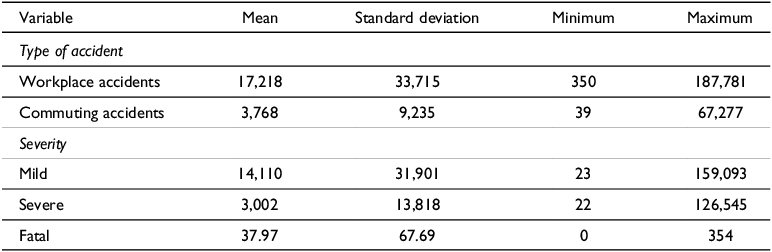
Table 1 presents descriptive statistics that reveal several important patterns in our occupational accident data. Workplace accidents substantially outnumber commuting accidents, with mean annual rates of 17,218 versus 3,768, respectively, supporting our identification strategy that relies on the differential impact of employer liability on these two categories. The severity distribution shows that mild accidents dominate the data (mean: 14,110), followed by severe accidents (mean: 3,002), while fatal accidents are relatively rare but still significant, with an average of 38 cases annually. The large standard deviations across all categories – often exceeding the means – reflect substantial heterogeneity across Argentine provinces. This variation is consistent with differences in economic activity, employment levels and industrial composition across provinces, providing the necessary cross-sectional variation for our empirical analysis.
Descriptive statistics of occupational accidents.

Source: own elaboration based on Occupational Risk System.
Figure 1 reveals several important patterns in the evolution of accident growth rates before and after the Aquino ruling. The pre-2004 period is characterised by high volatility in both series, with workplace accidents showing particularly dramatic swings, including growth rates exceeding 40% in the late 1990s. At the time of the Aquino ruling (2004), workplace accidents grew at an average rate of five percentage points higher than the number of commuting accidents. This situation was subsequently reversed. Following the Aquino ruling in 2004, marked by the vertical red line, workplace accidents notably moderate their growth rate, with the series converging toward zero, consistent with our hypothesis that increased employer liability incentivised greater safety investment in facilities under direct employer control. Commuting accidents continued to show growth after 2004. In 2007, the growth rate of commuting accidents exceeded that of workplace accidents by more than ten percentage points, thus reversing the trend observed at the time of the Aquino ruling. The sharp decline (rise) in both series around 2020 (2021) likely reflects the extraordinary circumstances of the COVID-19 pandemic rather than regulatory effects.
Annual growth rate (in %) of workplace and commuting accidents.
Source: own elaboration based on Occupational Risk System.

2. Empirical strategy
Our identification strategy exploits the differential impact of the Aquino ruling on workplace versus commuting accidents. Employers can influence safety within facilities, but not during worker commutes. Therefore, commuting accidents in each province and year serve as a control group for workplace accidents in the same province and year. We implement an event study design as follows: ${y_{it}} = \mathop \sum \limits_{\scriptstyle{\matrix{ {s = - 4} \cr {s \ne - 1}} } }^{s = 4} {\beta _s}I\left[ {{E_{it}} = s} \right] + {\alpha _i} + {\partial _t} + {X_{it}} + {\mu _{it}}$
where ${y_{it}}$
represents the number of accidents in province i in year t,
${y_{it}}$
represents the number of accidents in province i in year t, ${E_{it}}$
indicates time relative to the Aquino ruling (
${E_{it}}$
indicates time relative to the Aquino ruling ( ${E_{it}} = - 1$
means the year prior to the Aquino ruling).
${E_{it}} = - 1$
means the year prior to the Aquino ruling). ${\alpha _i}$
and
${\alpha _i}$
and ${\partial _t}$
are province and year fixed effects, and
${\partial _t}$
are province and year fixed effects, and ${\mu _{it}}$
is the model error term. Fixed effects allow us to control for unobserved heterogeneity (e.g., the national business cycle, prices of major export commodities, among others). In our main specification, we define a four-year time window before and after the Aquino ruling. This window ensures that any medium-term effects that may arise are captured and avoids capturing potential effects of subsequent labour reforms (e.g., the reform passed in 2012 but discussed in 2011).
${\mu _{it}}$
is the model error term. Fixed effects allow us to control for unobserved heterogeneity (e.g., the national business cycle, prices of major export commodities, among others). In our main specification, we define a four-year time window before and after the Aquino ruling. This window ensures that any medium-term effects that may arise are captured and avoids capturing potential effects of subsequent labour reforms (e.g., the reform passed in 2012 but discussed in 2011).
It is important to note that the universe of workers is the same in workplace and commuting accidents. That is, we are comparing the same group of people. Second, both types of accidents are subject to the same administrative registration procedure and have the same legal and medical coverage. Third, by comparing workplace accidents with commuting accidents, we mitigate concerns about a possible improvement in accident records (i.e., an increase in the number of accidents due to better record-keeping, rather than a genuine increase in accidents). Even if such an improvement in records existed during the period analysed, this does not create bias, considering that the improvement was similar in both types of accidents (workplace accidents and commuting accidents).
To address potential concerns about identification, we implement several robustness checks. First, we run placebo tests using pre-2004 dates to verify no spurious effects exist before the actual ruling. Second, we use an alternative outcome – hard-to-detect accidents – to ensure effects are not driven by reporting changes.
Our identification relies on the assumption that, absent the Aquino ruling, workplace and commuting accidents would have evolved similarly. We test this using pre-treatment trends and find no evidence of differential trends prior to 2004. We also address potential concerns about concurrent policies by examining the timing of other labour market reforms and showing that no major workplace safety regulations were implemented simultaneously with the Aquino ruling. Specifically, the most recent labour reform dates to 2012 (Law 26.773).
In our main specification, we define a four-year time window before and after the Aquino ruling (2000–2008). This window choice balances several considerations. First, it ensures that we capture medium-term effects while avoiding contamination from the 2012 reform (Law 26.773), which was publicly debated starting in 2010–2011 and could generate anticipation effects. Second, extending the pre-treatment period before 2000 introduces data quality concerns, as the ART system was only implemented in 1996 and shows considerable volatility during its initial years as reporting procedures stabilised. Third, the four-year window provides sufficient pre-treatment periods to test the parallel trends assumption while maintaining adequate statistical power.
To address concerns about window sensitivity, we present an extended specification in Appendix Table A1, using a window of ±6 years. Results remain qualitatively similar across specifications, though precision decreases with longer windows – consistent with the inclusion of more volatile periods and potential contamination from anticipation of subsequent reforms.
A potential concern with our identification strategy is differential reporting incentives across accident types. Specifically, employers might have stronger incentives to under-report workplace accidents after the Aquino ruling to avoid liability exposure, while commuting accidents (often documented by traffic authorities or external witnesses) may be less susceptible to manipulation. We address this concern in several ways. First, any under-reporting of workplace accidents would bias our estimates toward zero, making our findings conservative. Second, Argentina’s ART system creates countervailing incentives: workers must report accidents to access medical treatment and compensation, and ARTs independently verify reported incidents. Third, we present disaggregated results for fatal accidents – the category least susceptible to reporting manipulation (see Figure A1).
IV. Results
From Figure 2, we can see that the coefficients for the years prior to the Aquino ruling do not systematically differ from 0 (the p-value for the joint significance test is 0.19). This suggests the absence of differential pre-trends and reinforces our hypothesis that the observed change is a consequence of the Aquino ruling, rather than a preexisting event. Following the Aquino ruling (period 0 and later), a persistent decline in the number of workplace accidents is observed. That is, the Aquino ruling contributed significantly to reducing the number of accidents recorded within workplaces, compared to commuting accidents. The observed reduction (from 2,381 to 4,030 fewer accidents) is equivalent to 16% to 27% of the average for previous years.
Aquino ruling impact on workplace accidents.
Source: own elaboration based on Occupational Risk System.
Note: the p-value for differential pre-trends is 0.19, confirming the absence of differential trends before the event of interest (Aquino ruling). Confidence intervals at 95%.

To provide more transparent evidence on the parallel trends assumption, Table A1 reports the individual pre-treatment event-study coefficients along with a formal joint significance test. The joint F-test yields a p-value of 0.32, confirming that we cannot reject the null hypothesis of no differential pre-trends between workplace and commuting accidents prior to the Aquino ruling.
Figure 3 shows two interesting results. First, it confirms that the absolute reduction in accidents was greater in provinces that initially (in 2003) had an accident frequency higher than the median. This is expected given that this group of provinces had greater room for reduction in their workplace accidents. Second, it lends credibility to this study’s identification strategy by demonstrating that the absolute reduction was greater where expected and that the estimated effect (i.e., reduction) is consistent across subgroups.
Impact of the Aquino ruling on provinces with high (left panel) and low (right panel) number of accidents in 2003.
Source: own elaboration based on Occupational Risk System.
Note: the p-value for differential pre-trends is 0.20 (left panel) and 0.02 (right panel). Confidence intervals at 95%. Provinces with a high number of accidents are those with values above the median in 2003 (includes Salta, Tucuman, Neuquén, Chubut, Entre Rios, Misiones, Rio Negro, Mendoza, Córdoba, Santa Fe, Capital Federal and Buenos Aires). Provinces with a low number of accidents are those with values below the median in 2003 (includes La Pampa, Formosa, Santa Cruz, Santiago del Estero, Catamarca, La Rioja, Tierra del Fuego, Jujuy, Chaco, San Juan, Corrientes and San Luis).

Figure 4 shows no evidence of increased moral hazard (i.e., increased accident rates due to higher benefits after the Aquino ruling). To test this point, we use the most likely type of accident to be used in these situations: those that are hard to detect (excessive physical exertion or false movements). The coefficients indicate no increase in these types of accidents immediately after the Aquino ruling.
Impact of the Aquino ruling on hard-to-detect accidents.
Source: own elaboration based on Occupational Risk System.
Note: the p-value for differential pre-trends is 0.96. Confidence intervals at 95%. Hard-to-detect accidents include excessive physical exertion and false movements.

Our findings of a 16–27% reduction in workplace accidents following the Aquino ruling align well with the international literature on occupational safety regulation effectiveness. Andersen et al.’s systematic review of occupational health and safety interventions found that legislation effectively reduces workplace risks with an odds ratio of 0.73 (95% CI: 0.62–0.86), corresponding to approximately a 27% reduction in the odds of workplace injuries. This meta-analytic evidence, drawn from studies across multiple countries and time periods, provides strong support for the plausibility of our estimated effects. This comparison provides important context for evaluating both the external validity of our results and the relative effectiveness of liability-based versus traditional regulatory approaches.
While our research design identifies the causal effect of the Aquino ruling on workplace accidents, understanding the mechanisms through which this effect operates provides important context for policy implications. We discuss two potential channels, drawing on available secondary evidence.
Litigation Channel. Prior to Aquino, the Workers’ Compensation Law (Ley 24.557) effectively shielded employers from civil lawsuits by channeling all claims through the Workers’ Risk Insurance (ART) system. The 2004 ruling eliminated this protection, enabling workers to pursue full civil damages. The litigation response was substantial. In the Province of Buenos Aires (the only province with available data for the period prior to 2004), labour court filings rose 51% between 2003 and 2007, and 68% by 2008 – see Figure 5.Footnote 17 This surge in litigation created immediate financial incentives for employers to invest in accident prevention.
Labour court cases initiated (2003–2011).
Source: own elaboration based on Asociación Judicial Bonaerense.

Prevention Investments. The heightened liability exposure prompted behavioral responses across multiple margins. Employers faced direct incentives to improve workplace safety conditions to reduce accident frequency. ARTs, facing increased claims costs, intensified their prevention oversight activities. The combination of these responses contributed to a structural break in accident trends: while accident rates had previously moved procyclically with economic activity (1997–2004), after 2005 they declined steadily despite continued economic growth.Footnote 18 This decoupling of accident rates from economic activity suggests that the Aquino ruling triggered genuine safety improvements rather than merely redistributing existing accident costs.
Disentangling the precise contribution of each channel – litigation threat, insurer responses and direct employer investments – remains an important avenue for future research with access to firm-level safety expenditure data.
V. Conclusions
This study provided causal evidence that a judicial decision expanding employer liability generated substantial improvements in workplace safety in Argentina. The Aquino ruling reduced workplace accidents by 16–27% through enhanced liability exposure, with effects materialising rapidly and persisting over our study period. Importantly, we found no evidence of moral hazard effects typically associated with expanded worker compensation, suggesting that liability-based mechanisms may achieve safety improvements without generating perverse incentives. A key feature of our identification strategy is that commuting accidents are legally unaffected by the Aquino ruling under Argentina’s Occupational Risk Law (LRT), as employers cannot influence safety during workers’ commutes – this legal distinction is precisely what justifies their use as a control group and underpins the exclusion restriction of our empirical design. A key feature of our identification strategy is that commuting accidents are legally unaffected by the Aquino ruling under Argentina’s Occupational Risk Law (LRT), as employers cannot influence safety during workers’ commutes – this legal distinction is precisely what justifies their use as a control group and underpins the exclusion restriction of our empirical design.
Our findings extend the existing literature on tort reform and employer liability – predominantly focused on US legislative changes – to a developing country context where judicial enforcement operates under different institutional constraints. The results suggest that judicial institutions can serve as effective complements to regulatory approaches, particularly where traditional inspection and enforcement capacity remains limited.
Our findings offer critical insights for policymakers, particularly in developing countries seeking effective workplace safety solutions with limited regulatory resources. First, strengthening employer liability frameworks creates immediate, decentralised enforcement mechanisms that operate through private litigation rather than requiring extensive regulatory bureaucracies. This approach may prove especially valuable where traditional inspection and enforcement capacity remains constrained.
Second, the heterogeneous regional effects underscore that institutional context fundamentally shapes policy effectiveness. Policymakers should design implementation strategies that account for differential judicial capacity, potentially providing targeted support in regions with weaker legal infrastructure. Investment in judicial system quality may be a prerequisite for effective liability-based safety policies, highlighting the importance of viewing safety regulation as part of broader institutional development strategies rather than isolated interventions.
Our study opens several promising research avenues that would advance understanding of occupational safety regulation and institutional effectiveness. A critical priority is comprehensive welfare analysis of increased employer liability. Our findings point to three analytically distinct dimensions that should be assessed separately. First, the first-order effect of accident reduction delivers direct welfare gains through reduced worker injuries, fatalities and associated human and economic costs. Second, the litigation channel entails a redistributive effect: the Aquino ruling transferred accident costs from workers to employers and insurers via civil liability, altering the distribution of surplus without necessarily creating net welfare gains or losses in the aggregate. Third, potential general equilibrium labour-market effects – on employment levels, wages, labour formality and firm dynamics – remain beyond the scope of our design and represent a critical avenue for future research. Future work should develop frameworks for quantifying these trade-offs and identifying optimal liability levels.
Direct replication in other developing countries experiencing similar judicial or legislative changes would strengthen external validity and illuminate which institutional contexts favour liability-based approaches. Comparative analysis across different liability regimes could reveal design principles for maximising safety improvements while minimising economic distortions.
Supplementary material
The supplementary material for this article can be found at https://doi.org/10.1017/err.2026.10095
Data availability statement
All data is derived from public domain resources.
Acknowledgments
None.
Authors’ contributions
All authors have contributed equally.
Financial support
There is no funding to declare.
Competing interests
The author(s) declare none.
Consent for publication
All authors have provided their consent.


 Open access

