




1. Introduction
Talking about sonic experimentalism in Latin America is a complex task, difficult to tackle without falling into reductionism that leaves out more than it includes. On the one hand, concepts such as experimental music and sound experimentation lend themselves to all kinds of inaccuracies, as demonstrated by the fact that it is impossible to define where the realm of ‘music’ ends and where sonic practices that do not fit into this framework begin. This ties in with what Ana Alonso Minutti, Eduardo Herrera and Alejandro Madrid suggest when they point out that ‘there is no such thing as a universal experimental sonic experience’, so that ‘the sonic result of experimentalism is always contingent to specific music traditions and shared habits of listening, an aural habitus, so to speak’ (Alonso-Minutti et al. Reference Alonso-Minutti, Herrera, Madrid, Alonso-Minutti, Herrera and Madrid2018: 3).
On the other hand, talking about Latin America as an integrated and culturally unified region implies a geopolitical fiction, rooted in a colonial history that overlooks the enormous diversity of languages, worldviews, migrations and mestizaje that exist in the territory stretching from the Rio Grande to Cape Horn, passing through the islands of the Caribbean Sea and which, from some perspectives, should include both English-speaking countries, such as Belize and Jamaica, as well as the millions of people who, while being Latin American, have emigrated to different parts of the world (Bohoslavsky Reference Bohoslavsky, Bohoslavsky, Geoghegan and González2009).
If we add to this the fact that sonic experimentalism practices in this vast territory have a wide aesthetic diversityFootnote 1 and occur in equally varied circumstances and cultural environments, we might think that the most sensible way to approach them is based on their particular characteristics, without the need to bring them together under a single umbrella concept. But this position overlooks the fact that concepts, however limited and reductionist they may be, affect the way cultural practices are legitimised, valued, and shared in a given social context.
Thus, the systematic marginalisation of Latin American sonic experimentalism in academic discourse has reinforced the Western-centric cultural canon, perpetuating the narrative that experimental music or other forms of sound art produced in this region are not worthy of scholarly attention. As a matter of fact, most of the best-known studies on sonic experimentalism published in recent decades do not contain references to Latin American artists, or if they do, they are minimal in proportion and usually correspond to artists who, although born in Latin American countries, have developed a significant part of their work in Europe or the United States (Landy Reference Landy1991; Wishart Reference Wishart1996; Nyman Reference Nyman1999; LaBelle Reference LaBelle2015; Gottschalk Reference Gottschalk2016).
This pattern of exclusion extends beyond this and includes not only research carried out in countries of the so-called Global NorthFootnote 2 but also much of the research conducted in the mentioned region itself. A preliminary review of the databases of libraries specialising in music research, the catalogue of academic journals, or theses written in Latin American countries reveals that there is very little work addressing these types of practices. In addition, most of this limited research, even when it addresses topics related to sonic experimentalism, focuses on the analysis of works by composers belonging to the so-called ‘academic music’ tradition, who work or have worked in prestigious institutions and are primarily white or mixed-race men, presumably heterosexual and belonging to the upper classes.Footnote 3
However, it is interesting to note that this occurs mainly in environments associated with the conservatory model, historical musicology, and research within university departments; things look somewhat different when we leave these environments. While there is still significant diversity in ways of understanding and practising sound experimentation, many initiatives have emerged in recent decades, primarily self-managed and far removed from traditional musicology, that seek to create spaces for exchange, discussion and collaboration around experimentalism developed in this part of the world, and which respond to two principles that are fundamental to the ideas this article seeks to uphold: firstly, they start from an intention to give space to those voices that have historically been excluded from the official histories of music; secondly, they seek to generate a sense of unity which, while recognising internal differences, identifies with the idea that there is a movement of sonic experimentalism that shares interests, needs, and sensibilities among people working in different regions of Latin America.
Based on a review of artistic projects that have been active in recent years, the objective of this article is to discuss whether there are features that can be conceived as characteristic of Latin American sonic experimentalism, whether it is relevant to define issues that affect the people and communities that practice it in a cross-cutting manner, and, if so, whether it is feasible to talk about strategies that bring together people and groups who, although they work in different countries and conditions, consider themselves as part of the same community.
To this end, the first section will propose a review of different aesthetic approaches to the search for a sound specific to Latin America; the second section will focus on the role of technology in the practices mentioned above; and the third section will review the role of community networks and platforms in the Latin American field of sonic experimentalism.
A cross-cutting argument throughout the article is that cultural identity cannot be thought of in purely exoticising, reifying, or essentialist terms; rather, it undergoes complex processes of identification that are not exempt from contradiction and dynamism. The concluding section will address this issue, emphasising the importance of thinking about identity not as an attribute inherent to certain practices, but as a relational, performative and situated phenomenon that can only be valued within specific situations.
2. Situated sounds in Latin American sonic experimentalism
A common question when discussing sonic experimentalism in Latin America is whether there are specific stylistic features, musical resources and/or distinct sounds that give this practice its own unique sonority, distinct from what occurs in other parts of the world.
To open a discussion regarding this question, it is relevant to analyse how different artists relate to the intention of reflecting the identifying characteristics of the territory to which they belong, and how this manifests not only in a sound result, but also in a political stance and a connection to the social environment they conceive as their own. To illustrate this, it is worth reviewing a series of projects that address the issue of sound identity from very different perspectives.
Luis Navarro del Ángel, a Mexican artist and programmer, has been developing for several years a project called Seis8s – 6/8 in Spanish – which he defines as ‘a web-based live coding language that allows real-time interaction with digital audio and localized musical knowledge, which is particularly oriented towards Latin American dance music, where the commands and their resulting sounds revolve around instruments from that music’ (Navarro del Ángel and Ogborn Reference Navarro del Ángel, Ogborn and García Castilla2023: 40).Footnote 4
As Seis8s is a programming environment and not a musical piece in itself, it reflects a trend present in live coding and computer music projects, where thinking about programming as a creative act is emphasised, with media and works being inseparable. It is also an example of the search to fuse electronic music with rhythms and styles from Latin American popular music. This gives rise to a hybrid expression that can be used for dancing in a style inspired by Mexican ‘sonideros’, but can also be appreciated in academic experimental music contexts. It’s worth noting that the project website (Seis8s, n.d.) includes documentation such as tutorials, music examples, videos about musical styles like cumbia, and other useful resources for exploring this creative tool.
Another case worth mentioning is that of Ecuadorian artist Tamya Morán, who developed a vocal method and technique based on the identity and musical heritage of the Andean peoples. Among the aspects contemplated in her proposal are the use of ‘wooden aerophone instruments, ceramics, and animal remains, but also the sound of the sea and the particular sonority of indigenous peoples,’ including ‘the phonetics of the Kichwa language’ (Morán Reference Morán and García Castilla2023: 71).
It should be noted that her work reveals the interest several artists have in experimenting with sound, not only in their own artistic production but also in the field of education. To share her exercises, Tamya Moran maintains a TikTok profile (tamyamoranvocalcoach, n.d) where it is possible to appreciate how she combines the sounds of Andean instruments, such as traditional flutes, with synthesisers and various other instruments, all channelled into a vocal technique that seeks to reflect the sounds of Ecuador, as can be heard in the wide vocal register and the range of articulations she uses in her singing.
On another note, a trend that appears in many projects is that of allowing places to express themselves not through their musical genres or traditions, but through the recording and listening to the sounds that exist in a given place. This can be seen in the work of Chilean artist and educator Valentina Villarroel, who ‘explores sound as a testimony to history’ and as ‘a highlighting of the spaces of nature, flora, fauna, and southern geography, a fundamental part of eco-social conflicts’ (Villarroel Reference Villarroeln.d.).
In her album Mares (Villarroel Reference Villarroel2018), she utilises recordings of the sea from various locations in the Biobío Region, situated in central Chile, where she resides and develops most of her projects. Each of the album’s eleven tracks presents different sounds from the Chilean seas, utilising various recording techniques to achieve immersive listening experiences of diverse marine ecosystems, ranging from the calm movement of still waters to the energetic movements of waves in open seas.
From Central America, Panamanian artist Mar Alzamora focuses on sound walking as a way of dialoguing with the space she inhabits, not to generate field recordings, but rather to practice attentive listening. In her work Songlines, she spent four days walking the route of a tramway that stopped running in 1940 but still holds the memory of the city and its ancestors. In her words, ‘[o]n this route are the vestiges of the tramway, and therefore also the remains of the paths walked by my migrant great-grandparents and the stories told by my grandparents’ (Alzamora Reference Alzamora2021: 352).
Mar Alzamora does not share her work by disseminating sound recordings, but rather by generating ethnographic scores, sound walking methodologies in which the city’s sounds can be heard as walking through it, and research texts in which she shares the processes and reflections generated by her walks, calling on the imagination and inner listening. An additional way to disseminate his work is through videos where he records part of his sound walks (Alzamora Reference Alzamora2016), not as a soundscape composition but rather as a testimony to an experience that can only occur through personal contact with the place.
One last piece to be mentioned is the radio opera Cita a ciegas para no soltarnos (Blind Date So We Don’t Let Go) by Colombian composer Ana María Romano, which was presented in June 2024 as part of the radio series Sonar y conspirar (Sound and Conspire), hosted by the composer herself and dedicated to dialogue between women and dissidents experimenting with sound in Latin America. This series was broadcast on the radio station of the Centro de Arte Sonoro (CASo), based in Buenos Aires, which ceased operations at that time due to financial cuts by the government of Javier Milei. Faced with this situation, Ana María Romano collected voice messages from 131 people belonging to the sonic experimentalism community, who sent a hug of solidarity to the CASo community (Romano Gómez Reference Romano Gómez2024).
The sonic environment of Cita a ciegas para no soltarnos is thus made up of voices that share a space-time, a joint project, and a communal territory that transcends physical space but is also linked to the particular space in which each of the voice messages was recorded. Listening to the composition, it can be appreciated how the instrumental sounds blend with human voices, primarily those of women artists, sometimes heard clearly and other times with electronic processes and intertwined in complex sound textures, perhaps as a metaphor for the different dimensions of communication and solidarity that exist in the Latin American experimental scene.
Of course, this brief review does not exhaust the possible approaches to expressions of identity in sound practices. Still, it does offer a glimpse of a diversity of positions and concrete creative strategies. It is also an example of a shared intention to connect artistic practice with various social issues. On this point, it is relevant to mention that Luis Navarro, Tamya Morán, Valentina Villarroel, Mar Alzamora and Ana María Romano are concerned with discussing their ideas not only through their sound production, but also through academic and non-academic publications, conferences, radio podcasts, teaching methodologies and other media in which sound coexists with verbal reflection and in which art dialogues with other fields of knowledge, reflection and criticism.
To this, we must add the ongoing collaboration that artists maintain with people who are mainly dedicated to research and who discuss the need to conceive sonic experimentalism from a situated perspective.
A noteworthy mention is the Ecuadorian researcher Mayra Estévez Trujillo, who, more than fifteen years ago, asked herself: ‘What does it mean to think about sound geopolitically? What dilemmas do we face when establishing forms of sound representation?’, to which she replied that ‘thinking about symbolic sound production – or what we have called sonic experimentalism – its forms of circulation and social uses implies that sound is an epistemological place, that is, a place of knowledge’ (Reference Estévez Trujillo2009: 36). Mayra Estévez currently coordinates the first Latin American Sound Studies Network, which brings together a group of researchers from different countries working on the construction of ‘critical theory of sound and listening culture and arts from the South’,Footnote 5 and is the author of a recently published book that discusses, precisely, the urgency of thinking about Latin American sounds from a situated perspective (Estévez Trujillo Reference Estévez Trujillo2023).
Equally significant is the scholarly contribution of Costa Rican composer and musicologist Susan Campos-Fonseca, who, over the past few decades, has been promoting a debate on the coloniality of knowledge as manifested in sound practices. Faced with the preponderance of certain sounds linked to systems of power, she asks: ‘How many images of worlds are we capable of constructing? How many world sonorities are possible? And which ones can we hear?’ (Campos Fonseca Reference Campos Fonseca and Espejo2019: 239). For her, the decolonial struggle does not only take place at the level of large political movements, but also within our own experience, within our bodies and our sensibilities as individuals. In her words, ‘if we are really going to work on sound studies from a decolonial activism, we need to think about disciplined bodies, about how bodies are disciplined through sound’ (ibid: 240).
In Mexico, it is worth mentioning the work of researchers such as Lara Velázquez (Reference Lara Velázquez2016), who has created various projects related to sound art, experimental music and political ecology; and Gutiérrez (Reference Gutiérrezn.d.), who develops work linked to techno-political activism with a feminist focus. Needless to say, in other countries, scholars are investigating sound experimentation from diverse points of view, although generally far from the traditional frameworks of historical musicology.
With all these perspectives, it is clear that the concern for thinking about sound from a situated approach cuts across different fields of creation and research in Latin American sonic experimentalism. However, it is essential to note that sound production is closely linked to the instrumental media that make it possible.
3. Music technology from the logic of the South
In the opening talk of the Transferencias Aurales 2021 conference, Colombian composer, programmer and researcher Celeste Betancur raises an idea that is fundamental to the discussion to be held in this section. After discussing the economic conditions and access to technology that exist in Latin America, she proposes that precariousness pushes artists from the South to take the tools used in the North, ‘to ruin them, to ruin these algorithms and put our stamp on them from the ground up’ (Facultad de música UNAM 2021: [29:16]), using open-source tools that involve ‘learning about technology from the ground up’ (Ibid: [29:08]).
The idea of thinking about technology from a logic of ‘ruined algorithms’ strikes as powerful, as it alludes to the adaptation of inaccessible devices to suit the possibilities of their own context. This has economic implications, as it enables the production of music and sound art that could not be created without open-source tools; however, it also has aesthetic consequences. As Ecuadorian artist, manager, and researcher Emilia Bahamonde points out, ‘just as technology is not the same in every region, neither are the aesthetics of experimental music’ (Bahamonde Noriega Reference Bahamonde Noriega2024: 21).
Two considerations arise from this: on the one hand, the technological diversity of each country, city, neighbourhood or town has an impact on the music of each artist or group, so it would be a fallacy to speak of homogeneous conditions across the continent. At the same time, on the other hand, it is possible to recognise conditions of inequality and lack of access that exist, even with all their nuances, across a territory as vast as Latin America, which leads us to wonder whether there are shared positions regarding the technological media used in this context.
A common stance among artists and collectives in the region is to promote self-managed technological development, whether through programming their own digital tools or by building analogue instruments, as a way of reviving technology that in other contexts would be considered obsolete, but also of generating a personal, aesthetic and political link with the media and materials used to produce sound.
In the digital sphere, the work carried out by live coding communities in Latin America is a clear example of the development taking place in software and code writing, based on a logic inspired by the principles of the free software movement. As Mexican artist and developer Hernani Villaseñor points out, there is a particular hallmark in the way these practices operate in the region: ‘there is a marked interest in the themes of hackfeminism, cyberfeminism, decolonialism, and ancestral computing’, in an environment where discussions ‘take place outside established conferences, or in the process of being established, and generally privilege oral conversation over academic writing’ (Villaseñor Reference Villaseñor2022: 90).
One point that I find fundamental in the above comment is the predominant role of women and sex-gender diversity within the creative programming scene in different Latin American countries. Artists such as Marianne Teixido and Libertad Figueroa in Mexico, Celeste Becantur and Feli Cabrera in Colombia (both trans woman artists), and Iris Saladino and Flor de Fuego in Argentina, to name but a few, demonstrate a drive to ‘ruin algorithms’ beyond the use of specific tools. This results in a different view of creative practices in relation to care and forms of socialisation. As Marianne Teixido points out, ‘sharing code and processes in live coding is not just a technical issue. It is also a socio-political commitment and a struggle to build and strengthen communities with open processes, exchange, non-hierarchical production, based on personal and collective care’ (Teixido Guzmán Reference Teixido Guzmán and García Castilla2023: 67).
Moving on to analogue technologies and physical devices, there are relevant projects in different regions of the continent. DE LA PUTA electronics, for example, is a duo formed by Bolivian artist Cristina Collazos and Argentine producer Ricardo Schnidrig, who for ten yearsFootnote 6 dedicated themselves to building analogue synthesisers that they used to play experimental electronic music, as well as giving instrument-building workshops based on a DIWO (Do-It-With-Others) approach and running a shop where their synthesisers could be purchased to order (DE LA PUTA electronics n.d.).
Also featured in this section is Chilean artist Constanza Piña, whose work combines contemporary technologies with artisanal techniques that dialogue with Andean cultural traditions. Among her projects, Corazón de Robota stands out, which ‘presents a retro-technological and techno-manual perspective on the creation of low-cost sound devices, built with low technology, waste, chocolate boxes, and recycled electronics’ (Piña Reference Piñan.d.[A]). Also noteworthy is her participation as founder of Cyborgrrrls, a techno-feminist gathering that was active from 2017 to 2021 and brought together dozens of women working with sound technologies (CYBORGIRRRLS n.d).
Constanza Piña is also researching Inca khipus, conceived as ‘ancestral computers that were lost in time’, but which ‘nevertheless are part of the technological development of our first nations on the South American continent’ (Piña Reference Piñan.d.[B]). Other artists, such as Torres Núñez del Prado (Reference Torres Núñez del Pradon.d.) from Peru and Patricia Cadavid (Reference Cadavid2019) from Colombia, have conducted their own investigations into the khipu as a catalyst for reflections on coloniality, information processing and sonic experimentalism.
It can then be observed that artists have emerged in different countries who share an interest in approaching sound and musical technology from three related perspectives: first, through the use of accessible tools that are intervened from a logic of self-management, inspired by the principles of open source and free software; second, from the insistence on creating inclusive spaces where women and members of sex-gender diversity have access to forums, technologies and possibilities for action and expression that had historically been exclusive to cisgender male communities, thus opening up places of enunciation that question patriarchy, exclusion and violence in broad terms; and thirdly, from the intention to engage in dialogue with ancestral practices and knowledge that reconfigure the way we understand both art and technology from a Western perspective.
It is worth mentioning a project that is closely related to the three perspectives mentioned above. Asimtria is an initiative developed and managed by Marco Valdivia in collaboration with a vast network of people who share similar interests and are dedicated to organising workshops, exhibitions, meetings and research in different regions of Peru. Asimtria’s activities are varied, but they all promote free culture and the Andean values of Iskay Yachay and Sumaq Kawsay, which refer, respectively, to knowledge generated through dialogue and a life of fulfilment that balances the different dimensions of being (ASIMTRIA n.d.).
One fundamental aspect of this initiative is that it brings debates and creative spaces around technology to very diverse regions, carrying out intercultural translation work that recognises the existence of other languages, other ways of seeing and feeling the world, and other ways of creating that are different from those that operate in the art circuit. It is essential to mention that Asimtria is not conceived as an individual project or a space belonging to specific people, but rather one that belongs to the community as a whole and aims to circulate collective knowledge. Initiatives like this hold significance not only for producing works, developing alternative technologies and generating training workshops, but also for weaving networks of exchange that bring diverse people into contact with each other.
4. Networks of experimentation and community platforms
Similar to what is observed in the case of Asimtria, there are other platforms linked to sonic experimentalism that focus their work on generating projects that keep community knowledge and practices in circulation, rather than promoting individual artistic production or responding to the demands of the music industry and the art circuit.Footnote 7
Musexplat, for example, is a platform for Latin American experimental music that defines itself as ‘a meeting point for creation, management, and criticism’ (MUSEXPLAT n.d.). It was created in 2019 by the aforementioned Emilia Bahamonde, but she does not consider herself the owner, author or director of the project, but rather as an editor who moderates the website and coordinates the work of more than 15 contributors and over 180 active members. Despite the strategic use of internet tools, the aim here is not to create a purely virtual environment for exchange, but to strengthen existing physical-world networks. As Emilia Bahamonde mentions, ‘it is important to emphasize that Musexplat does not seek to simulate relationships in the virtual world, but rather acts as a medium through which an existing but potentially fragmented music scene in the physical world can connect and get to know each other in the Latin American region’ (Bahamonde Noriega Reference Bahamonde Noriega2024: 167).
Another outstanding platform, in which Emilia Bahamonde also participates alongside other collaborators such as Mariana Carvalho (Brazil), Alma Laprida (Argentina), Vanessa de Michelis (Brazil), Ana María Romano (Colombia), Jessica Rodríguez (Mexico) and Marianne Teixido (Mexico), is Género Experimentación Latinoamérica, abbreviated as Gexlat. On its website, it is presented as a ‘database that includes women, lesbians, trans, intersex, gender-fluid, and other dissidents who experiment with sound in Latin America’ (GEXLAT n.d.), whose objectives include ‘collaborating in connecting artists’ and ‘promoting the generation of open and collaborative knowledge’ (Ibid n.d.). Although it has a team of developers, it is considered an ‘open and collective survey’, which is reflected in the fact that it has an open copyright licence, under the GNU licence scheme created by the free software community, ‘so that anyone can freely use, modify, and share the information contained therein’ (Ibid. n.d.).
An important precedent for projects such as Musexplat and Gexlat is Feminoise Latinoamérica, an initiative that began in 2016 as a ‘compilation of Latin American women experimenting with sound’ (Feminoise Latinoamérica Vol1 2016), which gave rise to various nodes in different countries, leading to the formation of a collective in 2018, the drafting of a manifesto in 2019, and a face-to-face meeting that took place in Buenos Aires that same year. Although Feminoise Latinoamérica suspended its activities after that meeting, several concerts, workshops and compilations took place in the previous years. Most importantly, it allowed many women experimenting with sound in Latin American countries to connect with each other, weaving networks that remain active to this day.Footnote 8
Another project that has been dedicated to weaving collaborative networks in recent years is TRAMAS, which defines itself as a space ‘focused on the creation, performance, and recording of unconventional scores and sound proposals, as well as on dynamics of listening, experimentation, and collective improvisation’. Its Bandcamp page mentions that ‘it has featured the participation of Astrid RuNa, Daniel Arista, Jorche Martínez, Manuel Chacón, Roberto De León-Ortiz, Rubiel Osiris, Sandra Muciño, David López Luna, and Aldo Lombera’, (TRAMAS n.d.). Still, a review of their archives and social media reveals that many other artists have collaborated on this project.
In addition to these initiatives, festivals such as En Tiempo Real in Colombia, Sur Aural in Bolivia, Festival Tsonami in Chile, Festival Ruido in Argentina, and the online event Wasi Fest, among others, have taken place in recent years.Footnote 9 It is also worth mentioning the work of independent record labels such as Buh Records in Peru, Pueblo Nuevo and Sello Modular in Chile, Oris Label and Otoño in Mexico,Footnote 10 among many others that are dedicated not only to the dissemination of sonic experimentalism practices, but also to the consolidation of exchange and self-managed production networks in different cities and countries in this part of the world.
There are also spaces that, although housed within university institutions and not self-managed, maintain a permanent dialogue with the events that take place outside them. In Mexico, the Visiones Sonoras festival stands out, organised by the National School of Higher Studies of the UNAM, Morelia campus, in collaboration with the Mexican Center for Music and Sound Arts – CMMAS, as well as the Latin American Meeting of Music and Technology Transferencias Aurales, organised by the Faculty of Music of the same UNAM, which to date has organised two international events in which more than 100 people from more than ten countries in the region have participated. In Argentina, meanwhile, the Master’s Degree in Art and Sound Studies at the National University of Tres de Febrero (UNTREF), which has close ties to independent artistic experimentation communities in Buenos Aires, stands out.Footnote 11 To these cases, we could add several others, in these and other countries, where educational institutions collaborate with self-managed projects.
The platforms, spaces, festivals and collectives mentioned above share similarities in their concerns, and it is also worth noting that all of them, including those held in university institutions, operate under tight budget constraints. In many cases, the people behind the projects do not receive a salary, and they often even fund them with their own resources, which implies a precarious situation that adds difficulty to sustaining each of the initiatives. However, it is essential to reflect on what is understood by precarity in different contexts related to sonic experimentalism. As Celeste Betancur pointed out, precarity exists in the lack of access to technologies used in the Global North; but other types of limitations compromise the most basic aspects of survival, such as the inability to afford food, transportation or rent.
Peruvian artist Alejandra Borea points out that ‘the term precarity alludes to the flexibilisation of labour under neoliberal logic, where bodies that need to produce their livelihoods do so by navigating unstable material and sensorial conditions’ (Borea Reference Borea2025); based on this definition, she questions the effects this has on sensory experience, and specifically how a precarious listening can be conceived in which ‘the conditions of fragility and indeterminacy become audible in and between bodies’ (Ibid. 2025). This leads to considering the relationship between the economic and social difficulties that the platforms mentioned above face, the type of artistic production, and the modes of listening and musical circulation that each of them entails.
A final issue to consider is the migration that many artists experience throughout their careers. As stated in the introduction, Latin America is not only a geographical territory, but one that transcends political and cultural borders. Many people born in this region currently reside on other continents, but they remain part of networks of artistic exchange and production. This complicates, but at the same time strengthens, the notion of an international community that shares values around Latin American sonic experimentalism.
5. Latin American identities in experimental music
In October 2020, Musexplat launched a series of conversations on various topics related to music creation, management and music production in the region. This series, called La sobremesa de Musexplat, consists of nine programmes hosted by researcher, pianist and manager Ana Alfonsina Mora Flores. In the second of these conversations, the host opened with a question that sums up the topic to be discussed in this section:
[I]n the experimental music scene [of Latin America], with this multiplicity of sound proposals, do you think that a brand or identity is being created that unites us and in some way differentiates us from proposals from other latitudes such as North America, Asia, and Europe? And if so, what elements do you think are shaping it? (MUSEXPLAT 2020: [05:22–6:06]).
This question was addressed to three artists from different countries, of varying ages and with different aesthetic approaches, although all brought together by the unifying notion of experimental music. It is interesting to share some of the answers given in this discussion, as they serve as an example of the diversity of positions and viewpoints that can arise when discussing identity in this type of practice.
The first to respond was Camo, an Argentine producer, DJ, digital designer and programmer, who believes that ‘we are trying to form an identity of resistance and visibility that we have been sustaining for some time’, which generates networks and developments that give rise to ‘new voices’, and which is emerging in response to adverse political circumstances such as the coups d’état that countries such as Chile, Bolivia, and Peru have experienced in recent years (Ibid: [06:51–07:04]).
Secondly, Costa Rican sound artist, producer, and activist Eve Cordero believes that the Latin American music scene responds ‘to many changes and many hybridizations, because we are a fairly hybrid region’, as can be seen in the use of cumbias rebajadas in experimental music, as well as various hybridisations with danceable and non-danceable genres (Ibid: [07:12–08:05]).
Finally, Mexican artist Valis OrtizFootnote 12 argues that ‘Latin America is a vast territory’, a kind of matrix that, despite the diversity of its ‘sound gradient’, is united by a generalised condition of precariousness, a ‘jodidez’ that, beyond the difficulties it brings, is also a driving force that marks us at the Latin American level and gives us regional strength (Ibid: [08:56–11:50]).
These three perspectives lead to the argument that speaking of identity can refer to very different aspects of artistic practice: from the use of stylistic resources from musical genres to the sense of unity generated by sharing precarious conditions or adverse political circumstances. This is in line with the position of British scholar Simon Frith, who considers that ‘the experience of identity describes at once a social process, a form of interaction, and an aesthetic process’ (2003: 186), all of which are linked to a sense of belonging to a community that is both real and imagined.
In a text analysing identity processes in electroacoustic music and sound art, Argentine composer Raúl Minsburg asks ‘whether it is possible to conceive of a type of experimental music that reflects a certain sonic identity’ (Reference Minsburg2016: 45). In light of the various considerations and examples reviewed in the previous sections, the answer to these questions seems obvious. However, Minsburg notes that the answer is not so simple when taking into account that electroacoustic music, and in broader terms experimental music, are associated with the creation of new sounds and a ‘cosmopolitan or universal’ tradition that is distinct from ‘folk’ popular music, which is ‘recognized as a local, national expression of each country’ (Ibid: 49). From his perspective, it is not so clear whether the local sound of experimental music can be ‘recognized by the listener and considered part of an identity, in this case a sound identity’, and ‘what musical and sound factors can positively or negatively influence a listener’s recognition of certain sounds’ (Ibid: 49).
The intention of introducing these ideas to the discussion is to highlight an issue noted in the introduction to this text: the fact that the notions that arise in academic music do not necessarily correspond to those that occur within experimental collectives working outside of musical institutions. The idea, for example, that experimental music is associated with the creation of new sounds and the suggestion that there is a kind of universal tradition responds to a line of creation with European roots that is a pillar of electroacoustic composition in conservatories and universities, but which does not carry the same weight for those who experiment with sound outside these institutions.
However, the most important thing to highlight in Minsburg’s ideas is the contrast between thinking about identity based on a listener’s recognition of certain sounds and thinking about it, again in Frith’s terms, as an articulation of group relationships, ethical codes, and social ideologies that do not exist beforehand, but arise in the sonic experimentalism itself (Frith Reference Frith, Hall and du Gay2003: 186–7). From this perspective, it is not sounds that give identity to certain sonic practices; rather, it is the practices, in their situated circumstances, under the criteria of the communities that produce them, that give identity to certain sounds. From this conception, the most relevant question is not what the identifying features of Latin American sonic experimentalism are, but rather what produces the idea that such features exist: what do people who make music and art with sound conceive as their own, and what effects does this conception have within specific circuits?
Through the three axes chosen to structure this article (sonority, technology and collaborative platforms), several aspects have been addressed that link a significant number of sound and experimental music artists in different locations within the territory in question. This, of course, does not exhaust the axes of analysis nor does it assume that the communities and artists mentioned represent the totality of approaches to sonic experimentalism that exist in Latin America. Rather, the bias of this text is symptomatic of the author’s place within the communities with which he dialogues, making it clear that discourses on identity, with their respective studies and critical analyses, are also agents that perform the ideologies, codes, and frameworks of inscription and legibility that emerge within the practice itself.
In other words, there is no experimental art scene that precedes its own study. Through analysis, as well as through artistic practice and dialogue between artists and researchers, the circuits, frameworks, and relationships that are the subject of any conclusions drawn from the above are generated. There are differences, but there is also a sense of unity that refers to Benedict Anderson’s ‘imagined communities’ (Reference Anderson1993: 25), which are conceived from a notion of deep camaraderie, fraternity and horizontality that transcends the inequalities that exist within them.
In a personal conversation between the author of this article and Ecuadorian musician Andrés Bracero, he raised an idea that effectively summarises the arguments presented. Speaking of his relationship with Kichwa culture, he said that despite not speaking the language and having a musical project permeated by different external influences, there is a kind of ‘DNA’ that links him to the land of his ancestors, to the memory of his grandmother, to the songs he heard on the radio as a child (Bracero Reference Bracero2025). This is important because it reminds us, again, that identity and a sense of belonging do not depend solely on where one lives, but also on the space where one coexists and the networks one weaves with other people.
To conclude this article, it is essential to note that focusing on the productive aspects of the ‘imaginary community’ of sound experimentalism in Latin America does not mean ignoring the conflicts and contradictions at play in this context. Discussing identity in such a vast territory, with so much social and cultural inequality, necessarily implies that any discussion related to aesthetic affinities, precariousness or access to artistic opportunities requires all kinds of nuances.
As suggested before, talking about a lack of resources is not the same for someone who has had access to university education, professional training in foreign countries, or scholarships awarded by cultural institutions, as it is for someone who lives in communities far from the economic centres of their country or who lives in situations of poverty. Likewise, exploring the characteristic sonorities of a region doesn’t have the same impact on someone working on independent projects as it does on a transnational record label or a famous artist who uses so-called ‘world music’ as an appropriationist resource for commercial purposes.
For reasons such as the above, readers are invited to view this article not as a conclusive, finished, and merely affirmative study of the current state of sonic experimentalism in Latin America, but rather as a window onto a rich diversity of projects, platforms, discourses, and experiences that are taking place at this very moment. Through the examination of situated and diverse praxis, technological subversions, and collaborative networks, it reveals an epistemic community actively demystifying the North-South binary in the experimental sound and music discourse, but also a community that is not free from internal contradictions and inequalities, as is the case with sound experimentalism communities in any other territory on the planet.
The projects presented here demonstrate how sound artists in Latin America are ‘ruining the algorithm’ of colonial knowledge production not through oppositional negation, but by constructing alternative sonic epistemes and practices that demand recognition on their own terms. This requires the construction of their own discourses and critical analyses to address the inherent problems, while also enhancing their own creative and technological possibilities. This article aims to contribute to both of these purposes.
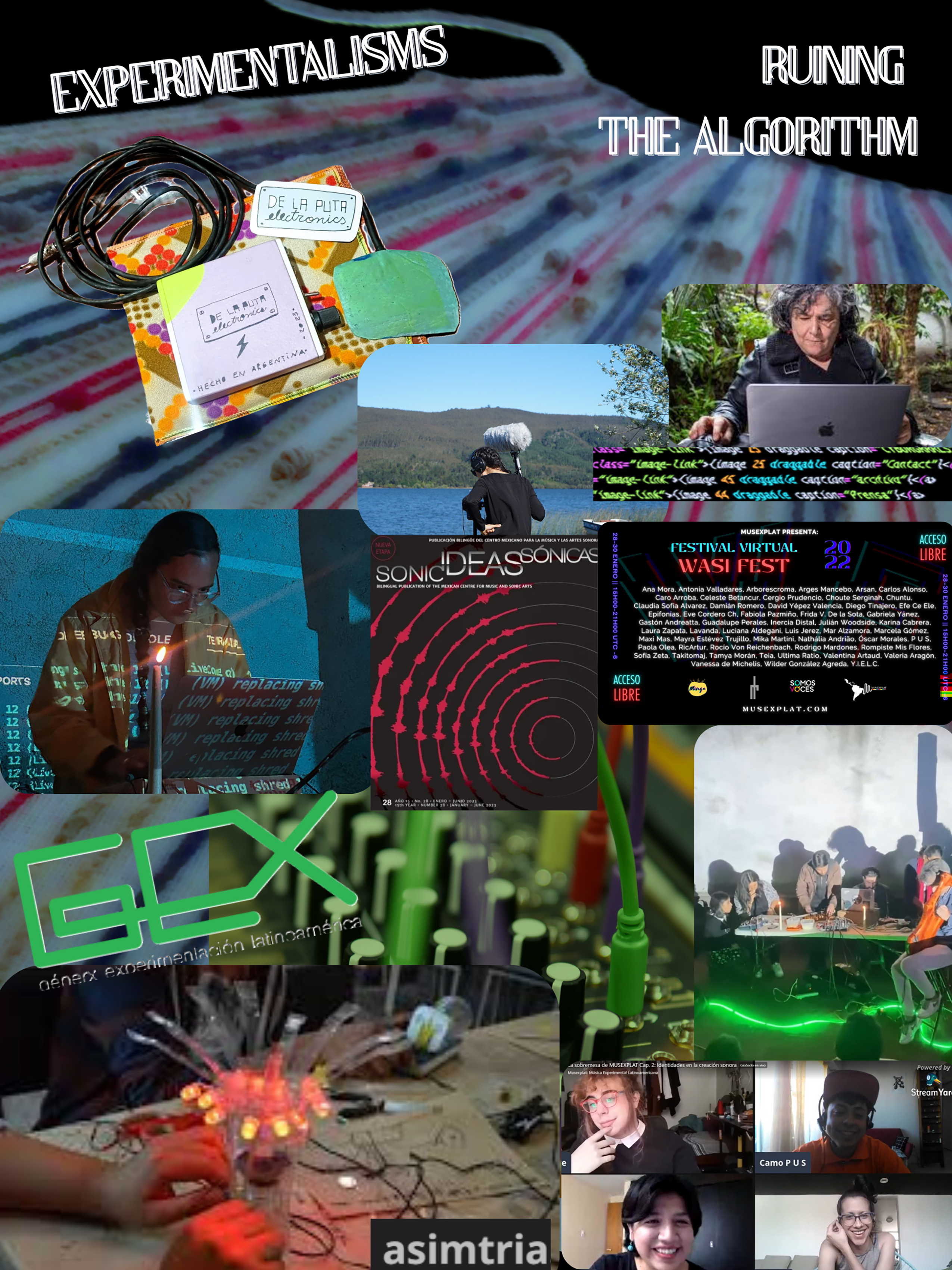
To make my position within this artistic framework clear, I have deliberately used the first person in this last paragraph, with the sole purpose of presenting a collage (Figure 1) that shows the diversity of proposals and the faces of some of the people who are part of this broad community. With this, I seek to emphasise that speaking of sound experimentalism in Latin America is speaking of people who connect with sound and who work to create a highly collaborative and creative environment, despite the contradictions, difficulties, and challenges the region experiences.
Collage made by Ana Alfonsina Mora with photographs, posters and screenshots of projects and people belonging to the Latin American sonic experimentalism community. The image was taken from (Mora Flores and García Castilla Reference Mora Flores and García Castilla2025), and is composed of images published with free copyright licences that allow their reproduction without profit.

 Open access

