Walk into most large organisations and you’ll notice two distinct knowledge cultures – one fluent in human insight, the other fluent in data. This is a persistent divide – sometimes historical, sometimes epistemological – between two influential groups: behavioural scientists and data scientists. In the past, this divide was more visible, even physical. During the early data analytics era of the 1990s and early 2000s, data scientists were often ‘tucked away’ in back offices or lower floors – an arrangement at one point satirised by the British comedy The IT Crowd, where technical experts were literally hidden in the basement. Meanwhile, behavioural scientists – those working on organisational culture, consumer insights and human-centred design – tended to sit closer to the executive suite, advising leadership on strategy and the ‘why’ behind behaviour.
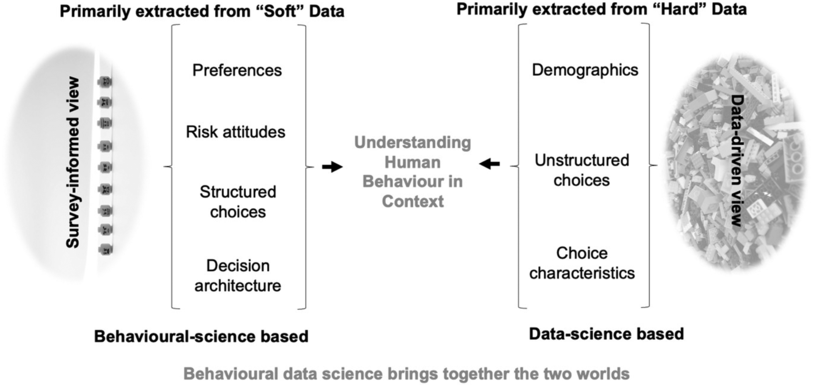
Today, this picture has shifted. With the rise of AI and the growing centrality of data to organisational strategy, data scientists are no longer hidden from view. Their models shape everything from hiring algorithms to pricing systems and their dashboards are frequently consulted in the boardroom. They are increasingly respected and heard. Yet, despite this recognition, a different kind of divide sometimes remains – not architectural, but conceptual (see Figure I.1). Each group tends to approach the world with different assumptions. Behavioural scientists are trained to think in terms of theory, context, causality and cognitive nuance. They ask questions about motivations, biases and meaning. Data scientists, by contrast, are trained to detect structure in noisy data. They build models that learn from behavioural traces, seeking patterns that can scale. Both are solving related problems – why people (customers, citizens, patients, users, etc.) act the way they do, and how we might predict or influence that behaviour – but they often use different vocabularies and tools.
The integrative role of behavioural data science
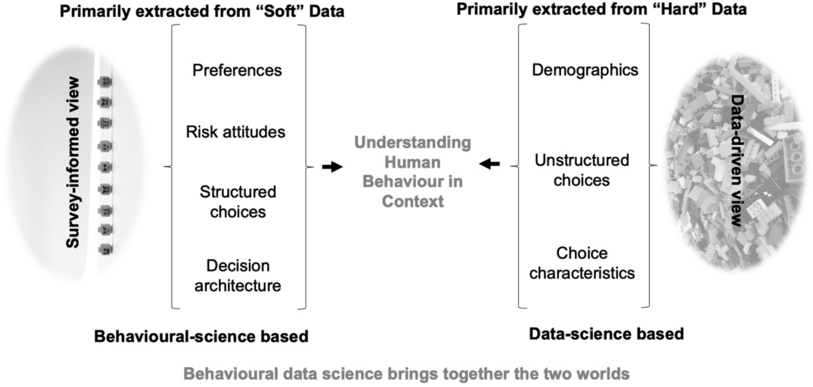
Figure I.1 Long description
Two columns side by side list the contrasting elements of behavioural and data sciences. The left column, labelled “Behavioural Science,” lists structured experiments, hypotheses, and theory-driven inquiry. The right column, labelled “Data Science,” lists messy, large-scale, real-time behavioural traces. A double-headed arrow points from both columns to the middle, labelled “Behavioural Data Science: integrating experimental theory and data-driven methods.”
Figure I.1 illustrates this distinction. On the left is a structured, survey-informed or experimentation-informed view of decisions: preferences elicited through design; hypotheses tested through experiments. On the right is a data-driven perspective: messy, often unstructured behavioural traces that emerge in real time from data platforms and digital ecosystems. These are not opposing views, but complementary ones – each with unique strengths and limitations.
When we (as behavioural data scientists) begin working with an organisation, our first move is often quite simple: we get these two groups in the same room. At first, they may talk past each other. Behavioural scientists may worry that the data team is indifferent to theoretical nuance or causal inference. Data scientists may question the scalability or external validity of controlled experiments. But, as the conversation evolves, each side begins to see the value of the other. Behavioural experts realise how large-scale data can validate or challenge longstanding assumptions. Data experts discover that interpretability and domain insight are vital to drawing actionable meaning from even the most sophisticated models.
That moment – when curiosity outweighs scepticism, and when the questions of why meet the patterns of what – is where Behavioural Data Science begins. This handbook is designed to cultivate precisely that encounter. It is a meeting ground for methods, for disciplines and, above all, for people who are working to understand human behaviour in a world increasingly shaped by data and algorithms.
The Cambridge Handbook of Behavioural Data Science is not a book to be consumed in a single sitting, nor is it designed for linear reading from cover to cover. Rather, it is an intellectual map – a curated atlas of the emerging terrain that lies at the intersection of behavioural science, data analytics, artificial intelligence, engineering, systems theory and other fields. Each chapter is a waypoint in this landscape, authored by senior and emerging experts across disciplines and situated within one of several thematic clusters. Reading this book is as much about following the contours of your own curiosity as it is about absorbing a definitive account of the field.
Behavioural Data Science is, by nature, a hybrid discipline. It sits between theory and application, between human-centred analysis and machine-driven inference. This handbook respects that hybridity. It is structured to reflect the tripartite scaffolding of the field – Human Behaviour, Algorithmic Behaviour and Systems Behaviour – while also showcasing how these domains intersect in practical, sometimes unexpected ways. The reader will find that the book is organised into parts that mirror this taxonomy, moving from foundational definitions to nuanced explorations and, ultimately, to applied case studies and future directions.
We suggest that new readers begin with Part I: Introduction to Behavioural Data Science, especially Chapters 1–3, which establish the historical and conceptual groundwork of the field. These chapters are deliberately designed to be accessible to a broad audience, including social scientists unfamiliar with machine learning, data scientists seeking behavioural context and policy-makers navigating the real-world implications of algorithmic systems. This opening section is particularly useful for orienting oneself to the language, assumptions and scope of Behavioural Data Science as a scholarly and applied practice. Following this, readers are encouraged to treat the handbook as a modular toolkit rather than a sequential textbook. Each subsequent part delves deeper into one of the core domains. Part II: Human Behaviour explores the empirical study of human decisions, preferences and cognitive biases through the lens of data. These chapters are ideal for readers with backgrounds in psychology, behavioural science, experimental economics, public health and education, particularly those interested in how machine learning and large-scale datasets can complement or challenge established theories. Part III: Algorithmic Behaviour invites readers to examine algorithms not only as tools capable of explaining human behaviour and systems behaviour but as entities with behavioural properties. These chapters ask difficult questions: Can we trust algorithmic decision-making? How should we interpret algorithmic ‘choices’? What does it mean to model the behaviour of a system that learns? Scholars, practitioners and students in AI ethics, software engineering or law may find this section especially resonant. Part IV: Systems and Culture turns the lens toward macro-level dynamics – social networks, organisational systems, infrastructure and collective behaviour. Here, Behavioural Data Science is deployed to understand and sometimes shape the behaviour of whole systems, with implications for sustainability, governance and global challenges. This section benefits readers working in public policy, urban design, environmental systems, engineering and complex modelling.
If you are looking for compelling use cases of how Behavioural Data Science could be applied in a variety of contexts, check out Part V: Applications. This part offers rich examples of how Behavioural Data Science can be used in practice, spanning finance, health, mobility, digital platforms and beyond. These chapters are particularly valuable for practitioners looking to implement insights from Behavioural Data Science in real-world contexts or for educators seeking to bring case studies into the classroom.
Some chapters are deeply conceptual; others are rich with methods, experiments or visualisations. Several chapters have supplementary materials and online appendices, which can be accessed via www.behavioraldatascience.org/. All chapters are grounded in the idea that behavioural data, when responsibly collected and carefully analysed, can help us better understand the world and ourselves. Yet readers will also find cautionary tales – of bias, of opacity, of ethical dilemmas that arise when data are used to predict behaviour or to encourage behavioural change. These tensions are not swept aside; they are part of what makes this field both powerful and precarious. If you are a behavioural scientist or an experimental economist, this book may challenge you to rethink the scale and granularity of your analyses. If you are a data scientist, it will invite you to embed your models within theories of cognition, culture and social interaction. If you are a practitioner or a policy-maker, it may offer new tools for intervention but also warn of the unintended consequences of acting on predictive insights without understanding their provenance or limitations. Given the pace of technological change, it is tempting to treat Behavioural Data Science as a set of tools to be deployed. This handbook argues for a different view: that Behavioural Data Science is a discipline-in-formation, one whose normative and epistemological foundations are still under construction. Accordingly, many chapters are as much about asking good questions as about offering clear answers. Readers are encouraged to engage with the handbook dialogically, to mark disagreements, to cross-reference between chapters and to bring their own disciplinary perspectives to bear on the ideas presented.
A few practical suggestions for engaging with the text:
Follow your research interests: Use the Table of Contents to identify chapters that speak to your domain – whether it’s AI systems, education analytics, behavioural nudges or ethics in data governance.
Use the chapters as entry points: Each chapter includes current references and methodological notes that can guide further exploration or research design.
Read with a critical eye: The handbook does not offer a single definition or vision of Behavioural Data Science; it presents multiple voices, occasionally in tension with one another. This diversity is by design.
Think across levels: Many of the most pressing problems in Behavioural Data Science are not confined to one scale. Consider how human-level insights connect to algorithmic decisions and systemic outcomes.
Above all, this book should not be treated as a static reference but as a generative space – an invitation to contribute to a field still in the making. Behavioural Data Science is an area defined not only by technical sophistication but also by a willingness to confront ambiguity, wrestle with values and adapt to an ever-changing landscape of technologies and behaviours. The hope is that this handbook offers not only knowledge but also inspiration – and perhaps even a sense of ethical responsibility – for navigating this complex terrain.
Welcome to The Cambridge Handbook of Behavioural Data Science. Read it not just to learn, but to think with, and beyond, its pages.