


Introduction
Flatbed trucks carried tombstones and caskets. A hearse, a color guard, and a marching band followed. This deliberate blend of the somber and the symbolic set the tone for a striking procession of clergy, union officials, community organizations, corrections officers, auxiliary police, and youth groups. The march began at St. Albans Park in Queens, New York, culminating in the “People vs. Crack” anti-drug rally on September 6, 1986. Organized by People Against Crack—a coalition of church, labor, and civic groups—the march and rally sought to dramatize the growing devastation wrought by the crack epidemic in New York City and to press local leaders and institutions for urgent action.
James Butler, the African American president of Hospital Workers Local 420, American Federation of State, County, and Municipal Employees, one of the event’s sponsors, emphasized that the coalition was appealing to “everyone concerned about this new drug problem” to join in “the fight against this drug which is bringing death and destruction to our communities.” Charles Hughes, African American president of Board of Education Employees Local 372, AFSCME, underscored the political stakes. He expressed hope that the rally would send “a clear message to our elected officials” and demand “an end to the [heyday] that CRACK dealers have enjoyed until now.” Hughes was unequivocal: “Penalties must replace profits for those who are trafficking in drugs, and the high-level drug [kingpins] must be apprehended and brought to justice as well as the street-level pushers.”Footnote 1
People vs. Crack was just one of several grassroots efforts residents and activists launched to confront “crack” head-on. Outraged by the drug’s suffocating grip on their streets, New York’s Black churches—drawing on both the memory and the model of the civil-rights movement—threw themselves into aggressive, citywide campaigns. They forced the crisis into public view and demanded action by the police, City Hall, and even the president. In July 1986, Wendell Foster, an African American council member and pastor of Christ Church in the Bronx, stood before a crowd outside City Hall and declared, “We are engaged in a new form of genocide.” Flanked by Ossie Davis, Senator Alfonse M. D’Amato, Dick Gregory, and other Black leaders, Foster—speaking for sixty predominantly African American congregations—insisted, “As devastating as drugs may be in the white community, they are 10 times worse in the black community.”Footnote 2 He described dealers as “slimy, sleazy, scum-of-the-earth animals” who should be “caged” or “chained to fences or streetlights on the street corners or wherever apprehended.” According to Foster, the urgency of confronting a “genocide” and reclaiming the streets from users and dealers had reignited the organizational spirit of the civil rights movement. As he put it, “We have not seen this much concern and activity in our churches since the [1960s].” Tapping the movement’s old fire, he declared: “We’re going to be out there every week, screaming, exposing, raising hell.”Footnote 3
The eruption of local activism and moral outrage captured in early crack protests did not unfold in a political or intellectual vacuum; they collided with—and were quickly overtaken by—larger political and academic narratives about drugs, disorder, and urban decline. “Disorder” itself was contested, both interpretive and empirical, a term that—as Wesley Skogan notes—described violations of “widely shared values,” norms governing public behavior and the condition of social spaces. Disorder could be physical, marked by “visual signs of negligence and unchecked decay,” including “abandoned or ill-kept buildings, broken streetlights, trash-filled lots, and alleys, strewn with garbage and alive with rats.” It could also be social, encompassing “public drinking” or “prostitution,” or behaviors like graffiti and vandalism that blurred the line between the physical and the behavioral.Footnote 4 Crack sat squarely at this nexus: the drug’s use, sale, and visible consumption transformed both the social order and the physical environments—buildings, hallways, playgrounds, and streets—that residents depended on and cherished. Likewise, the violence surrounding the crack trade implicated both behavior and place, signaling a deeper breach of shared values and ushering in a new, more chilling register of fear. For some, terror.
Although seared into the memories of those who lived through it,Footnote 5 the crack era—its meanings, consequences, and political aftershocks—remain fiercely contested. Academic and journalistic battles over experience and interpretation, over fact and value, helped set the stage for the larger explanatory wars that soon came to define how we understand this period. And it is to those clashes that the story now turns: to competing claims about crack’s rise, the growth of the carceral state, and the hyper-policing of Black urban neighborhoods—and the question of whether these developments reflected, as some insist, the logic of neoliberal governance or, as others argue, the asserted necessity of state authority and the seductive promise of social order. The task of this article is to hold these frameworks in view while centering the aspirations, anxieties, and activism of Black communities themselves. In doing so, it shows how a careful reconstruction of Black urban responses to crack—and to disorder more broadly—both clarifies the era and forces a reconsideration of the theoretical lenses through which it has long been interpreted.
For many observers, the near-simultaneous rise of “crack,” the hyper-policing of urban neighborhoods, and the explosion of mass incarceration looked anything but accidental. Michelle Alexander argues that the Reagan administration’s drug policies “had little to do with public concern about drugs and much to do with public concern about race,” giving Reagan political cover to “crack down on the racially defined ‘others.’” In this account—like other “backlash” theories of mass incarceration and modern policing—the war on drugs and the broader criminal justice apparatus function as a new “system of control,” engineered in the aftermath of civil rights gains to contravene change and preserve a racial caste order.Footnote 6 From this vantage point, disorder and violence are, at best, marginal to the story of crime policy and, at worst, political constructions designed for the work of racial domination.
Others have tied the convergence of crack, aggressive policing, and punitive policy to the rise of neoliberal governance in the United States. Neoliberalism, as David Harvey reminds us, is not merely an economic ideology but a governing logic. It is, he writes, “a theory of political economic practices that proposes that human well-being can best be advanced by liberating individual entrepreneurial freedoms and skills” within a framework built on “strong private property rights, free markets, and free trade.”Footnote 7 From this perspective, the crack era unfolded amid a broader political transformation. The neoliberal turn hollowed out the welfare state even as it strengthened the carceral arm of government. As social supports shrank, policing and punishment expanded—becoming the primary tools for managing the very inequalities and forms of disorder that market fundamentalism intensified. Dismantling the New Deal order—its social welfare programs, housing regulations, and labor protections—deepened economic and social dislocation in urban Black communities. Problems that once demanded social investment were recast as pathologies to be contained through surveillance and incarceration. Loïc Wacquant captures this shift with characteristic force. The modern state, he argues, became a “centaur state, guided by a liberal head mounted upon an authoritarian body.” At one end, it embraces “laissez-faire et laissez-passer,” allowing the “free play of capital,” the “dere-legitimation of labor law,” and the “retraction or removal of collective protections.” At the other, however, the state becomes “brutally paternalistic and punitive … when it comes to coping with [the] consequences on a daily level.”Footnote 8
Debates over order-maintenance policing, which holds that confronting minor quality-of-life offenses can head off more serious crime, capture these larger theoretical and interpretative battles. Nowhere is this clearer than in the enduring dispute over James Q. Wilson and George Kelling’s broken windows theory. They argued that visible signs of disorder—broken windows, graffiti, litter—and the absence of clear social or legal sanctions for such behavior left a community “vulnerable to criminal invasion” and invited more serious offenses.Footnote 9 Broken windows has, in turn, attracted sustained critique, most notably from Bernard Harcourt, who argues that the very category of “disorder” is subjective, elastic, and routinely racialized. Police and residents alike come to see the poor, youth of color, and the homeless as embodiments of disorder, rendering them the primary targets of aggressive enforcement. In Harcourt’s account, broken windows policing functions less as a tool for preventing violence than as a mode of governing marginalized communities, creating what he calls an “illusion of order”—a superficial calm that masks deep structural inequities while speeding the machinery of mass incarceration.Footnote 10
Several scholars link order-maintenance policing squarely to New York City’s neoliberal turn. In the wake of the 1970s fiscal crisis, they argue, quality-of-life crackdowns became an instrument for reshaping the city into a disciplined, market-ready landscape—order for the affluent, surveillance and exclusion for everyone else. Echoing arguments of Loïc Wacquant and others, this critique holds that tough quality-of-life policies were never simply a response to genuine public-safety concerns. They were a top-down political project, crafted to satisfy the demands of neoliberal governance and to contain the very social fallout that project helped produce. In short, through aggressive enforcement, political and economic elites fashioned a city fixated on investment while shunting the vulnerable to the margins.Footnote 11
One recent intervention shifts the focus from neoliberalism’s structural imperatives to the political theory that animates order-maintenance policing. As Milo Ward argues, while neoliberalism explains much, it cannot fully account for the support these strategies draw from those most intensely policed—as campaigns like The People vs. Crack make clear. In his intellectual history of James Q. Wilson’s “conservative political science,” Ward contends that order-maintenance tactics are not designed simply to respond to crime per se but to confront a deeper crisis of authority communicated by the emergence of violence and disorder.Footnote 12 This logic is unmistakable in Wilson and Kelling’s “Broken Windows” article. While they acknowledged that people are “primarily” frightened by violence, they insisted that focusing solely on violent crime overlooks “another source of fear—the fear of being bothered by disorderly people,” such as “panhandlers, drunks, addicts, rowdy teenagers, prostitutes, loiterers, [and] the mentally disturbed.” In well-resourced communities, they admitted, “many aspects of order maintenance … can probably best be handled in ways that involve the police minimally, if at all.” But in poor neighborhoods hollowed out by disinvestment and the flight of “respectable” residents, police are called upon to “reinforce the informal control mechanisms of the community itself.”Footnote 13 Here, policing becomes less about solving discrete crimes and more about preserving and reasserting a fragile and threatened social order.
Ward’s intervention offers the conceptual tools to refine what Timothy P. R. Weaver calls New York City’s “conservative political order,”Footnote 14 which ushered in a new era of law-and-order politics. Too often, discussions of conservatism in this literature lack the theoretical depth routinely afforded to neoliberalism. The task, then, is to understand conservatism not simply as Republican strategy or racial backlash, but as a coherent ideology and mode of governance—one embraced by political and social actors whose responses to disorder reflect its normative commitments to authority and social order.
Integrating Ward’s account with sociological theories of disorganization helps outline a hypothesis about the origins, nature, and consequences of conservative crime politics. The degree of community organization—including the strength of social ties—shapes a neighborhood’s capacity to exert informal social control; when such organization collapses, disorder and violence rise.Footnote 15 As these conditions intensify, including the emergence of violence, punitive responses—police, in particular—are mobilized not only to sanction offenders but also to reassert social authority and restore community norms. Yet those norms are never neutral. They reflect the values, priorities, and anxieties of those who hold power. This is precisely how the racial and class contours of punishment emerge: enforcement concentrates on those at the margins, whose marginality—and the social and physical repercussions of it—is cast as a threat to the prevailing order.
To adjudicate among these contending interpretive and theoretical perspectives, this article traces indigenous anti-crack mobilization within Black neighborhoods in New York City and Atlanta. It challenges Harcourt’s “illusion of disorder” thesis by centering the lived experiences and actions of Black and Brown residents who confronted the harsh realities of the crack epidemic. Rather than privileging the views of white political elites or law enforcement officials, we reveal how these residents articulated a very real sense of disorder and played an active role in demanding order maintenance. Their concerns were not abstract; they emerged from the tangible threats of violence, addiction, and the erosion of community authority. As Wilson and Kelling suggested, these residents called on the police not only to stop shootings and robberies but also to help reinforce the fragile and fraying informal control mechanisms of their neighborhoods.
Accordingly, this article builds on the work of David Farber and James Forman Jr. Farber, for example, insists that “Americans’ fear of crack was not all in their heads.” In the poorest Black communities, the destructive impact of crack was undeniable; residents “watched crack users tear apart their neighborhoods and destroy families,” as addiction fueled theft, violence, and disorder.Footnote 16 This reality was not simply the product of political manipulation but rooted in lived experience. Likewise, the policy response was not driven solely by top-down racial control. As Forman demonstrates in Locking Up Our Own, Black leaders and voters—desperate to stem the chaos engulfing their communities—actively supported punitive measures in the hope of restoring safety and stability.Footnote 17
Effectively exploring these questions poses serious analytical and interpretative challenges. Both neoliberalism and conservatism predict the rise of aggressive law-and-order politics, making it difficult to determine whether punitive policing emerged primarily from elite ideological projects or from grassroots demands for authority and order. To evaluate these claims, this article turns to the ground level. Recent scholarship, however, has shown that neoliberalism itself can be embraced from below—visible in everything from privatized security to neighborhood vigilantism—raising neoliberalism governmentality might have influenced everyday understandings of disorder and violence and the desirable solutions to them.Footnote 18 At the same time, correlation is not causation: the coincidence of Black residents’ demands for greater safety and the expansion of aggressive policing does not necessarily mean one produced the other; the imperatives of neoliberal governance may have driven enforcement regardless of community sentiment.
To respond to these challenges, this article examines the grassroots politics of the crack era through a comparative study of New York City and Atlanta. It examines whether and how Black grassroots calls for aggressive policing influencing actual policing strategies. New York—where Black residents are a minority—has long been central to the evolution of order-maintenance theory and to debates over the policing of Black communities. Atlanta, by contrast, as a majority-Black city with a strong tradition of Black political leadership, offers a critical counterpoint. If Harcourt’s “illusion of disorder” thesis is correct—if disorder reflects primarily white desires to regulate marginalized communities—then Atlanta’s war on drugs should have taken a radically different path. Yet Atlanta’s Black political elites were themselves constrained by metropolitan growth imperatives and, at times, motivated by their own class-based interests, making it plausible that the demands of capital and the logic of growth politics pushed them toward order-maintenance policing as well.Footnote 19 In both cities, this study examines the substance of grassroots activists’ claims to assess whether they reflect free-market impulses or an effort to restore social norms and authority. It then considers whether shifts in neighborhood-level policing strategies aligned with resident demands or were driven primarily by elite interests. In the end, comparing these two cities allows us to explore whether and how popular pressures, racial and class politics, and political economy shaped the adoption of order-maintenance regimes and how communities constructed “disorder,” mobilized against crime, and became entangled with the governing logics of both neoliberalism and conservatism.
To execute this design, this study draws on a geographically wide-ranging set of archival collections, spanning municipal, state, and federal repositories in New York, Atlanta, Boston, Baltimore, and Washington, DC, as well as major research libraries and community-based archives across the Northeast and the South. We supplement these materials with documents obtained through a Freedom of Information Act request to the Atlanta Police Department, along with oral histories, policing statistics, newspaper coverage, and testimony before state and federal committees. Collectively, these sources allow us to break new theoretical, interpretative, and empirical ground and to reassess the origins, meanings, and consequences of urban policing strategies during the crack era. They reveal how the devastating consequences of urban decline and crack sparked grassroots movements for not only greater public safety but also a reassertion of traditional norms and authority. Finally, they help establish a causal connection between these community-driven demands and the emergence of aggressive policing strategies.
Tactical Narcotics Teams, Community Mobilization, and the Politics of Urban Order in New York City
By the 1980s, powdered cocaine was well-established in the United States—popular, profitable, and glamorized, but largely limited to the wealthy. As one study noted, “the prohibitively high price of cocaine contributed to its status as a glamor drug” used by those in “higher … socioeconomic strata.”Footnote 20 Crack, however, was something altogether different: “cheap, simple to produce, ready to use, and highly profitable.”Footnote 21 Its affordability brought cocaine into poor neighborhoods, fueling addiction and violence. The low barriers to entry flooded the trade with new dealers, intensifying competition and sparking fierce, often deadly, conflict.
Crack cocaine first appeared in New York City in 1984 and, by 1985, had captured the attention of Police Commissioner Benjamin Ward and law enforcement leaders nationwide.Footnote 22 By early 1986, the New York State Division of Substance Abuse Services reported that crack use was “widespread,” no longer confined to isolated parts of the Bronx but present in all five boroughs, nearby counties, and parts of upstate New York. “Base houses,” places used “mainly for the smoking of crack,” were “springing up everywhere.”Footnote 23 By the summer of 1986, law enforcement began linking rising crime to crack. In May, Police Commissioner Benjamin Ward cited the “troublesome variable” of crack as driving increases in robbery and warned Deputy Mayor Stanley Brezenoff that “the indications are mounting” of its role in escalating criminal activity.Footnote 24 That same month, Mayor Edward Koch and Ward announced a Special Anti-Crack Unit focused on identifying “crack houses” and arresting dealers.Footnote 25
Community members, including users and dealers, described crack as uniquely destructive. One Bronx resident recalled, “Crack hit the … communities of Harlem, South Bronx, South Jamaica, Bed-Stuy, [Brownsville] like no other drug before. No other drug before.”Footnote 26 A Brooklyn mother testified in 1986 that her daughter—who had been using crack for almost three years—had gone from a “nice lovely person to a monster.”Footnote 27 A welder admitted at the same hearing that his $400-a-day habit left him unable to work.Footnote 28 Azie Faison, a Harlem dealer, lamented that when crack arrived, Harlem “suffered from a flood of drug-related crime and violence.”Footnote 29 Another dealer was even more blunt: crack “brought the whole neighborhood down… . It made a lot of people money, don’t misunderstand me. But look what problems it brought… . It made kids kill their mothers for a ‘hit.’ It just fucked up everything for everybody.”Footnote 30
By the time crack arrived in New York City, Black and Brown neighborhoods had already been grappling with the physical and social repercussions of the city’s economic decline. A 1979 survey commissioned by the Community Service Society of New York and conducted by Louis Harris and Associates made unmistakably clear that residents in the Bronx and Harlem experienced their neighborhoods through the dual lens of physical decay and social disorder—and that these conditions were inseparable from their fears of crime. When asked to identify the most important problems facing their community, respondents ranked “bad housing and slum conditions” first (29% overall, rising to 32% in Harlem). This was not a peripheral worry; it was the single most frequently cited concern, capturing deep anxieties about the built environment and the shared spaces of everyday life. Close behind were “drugs” (25%) and “crime/criminals” (22%), with both concerns slightly more pronounced in Harlem. Following “drugs,” respondents listed “robberies, muggings, and purse-snatching.”
Respondents were not blind to structural problems—16% cited “jobs, unemployment” as a major neighborhood issue. But additional concerns reveal how thoroughly physical and behavioral disorder had come to dominate residents’ perceptions: “abandoned or burned-out housing” (11% overall, 15% in the Bronx), “littered or dirty streets” (6%), and “vandalism” (4%). Behavior was also a pressing issue: “juvenile delinquency and lack of discipline” (7%) and “alcoholism/drunks” (2%) signaled an erosion of social norms. Notably, only 4% cited “insufficient police protection,” and another 4% said it was “not safe to walk the streets.” These survey results show that residents were not solely preoccupied with violence; they were alarmed by the breakdown of order—both in the physical spaces they inhabited and in the social interactions they navigated daily. The arrival of crack and the concomitant violence only exacerbated and crystallized these concerns.Footnote 31
Faced with mounting crime and despair, residents took matters into their own hands, informing on their neighbors and demanding action. In April 1986, the Concerned Citizens of West 141st Street, a group formed specifically in response to the area’s drug problem, wrote to Congressman Charles Rangel, describing a community under siege by relentless noise and open-air drug dealing. “The drugs are running and ruining our lives.” “The decent people of this block are scared to complain to the Police,” they wrote. “This atrocity to our people must be stopped NOW.” The group listed exact addresses they identified as hubs of drug activity and even accused building superintendents of serving as lookouts for dealers.Footnote 32 Rangel responded quickly, writing to Police Commissioner Benjamin Ward. He echoed the residents’ sense of urgency, calling them “good people” who were “afraid to leave their homes” and “live in constant fear.” He urged the commissioner to “look into these allegations and to intensify your anti-narcotics efforts in this area.”Footnote 33
In the South Bronx, Councilman Rev. Wendell Foster was inundated with complaints and responded with a “Drug Complaint Form” that directed residents to report “time of day of drug sales; building address and apartment number; description of people; automobile license numbers.” The responses were raw:
“We are afraid to leave the apartment for fear of being broken in.”
“Please help us. We need help.”
“Nothing is being done about it.”
Their demands were blunt: “I do not think the cops are doing enough to correct this problem.” and “We need a police car on the corner … around the clock until this condition is cleared up.”Footnote 34
In June 1986, parishioners from Holy Tabernacle Church wrote to Captain Harkins of the 23rd Precinct describing how East 114th Street residents had formed the “114th Street Drug Crackdown” to fight open-air dealing. Nearly fifty neighbors rallied, declaring, “YOU CAN’T DEAL DRUGS ON 114TH STREET!” They picketed corners, organized strategy meetings at the church, and set up a block watch—but demanded police support, asking pointedly, “We want our block back. What are you going to do to help us?”Footnote 35 Two months later, the Federation of Laurelton Block Association organized a CRACK Rally in Southeast Queens, drawing 1,500 residents who were determined to reclaim their community.Footnote 36
Residents did more than march and rally; they petitioned for relief. In July 1986, tenants of 186 Ten Eyck Walk in Williamsburg, Brooklyn, pleaded with housing management to address conditions they called intolerable. Fear ruled their daily lives, with loiterers occupying hallways and rooftops during “peak mugging hours,” and repeated calls to police met with little response. Their frustration was clear: “How can anyone live like this, being afraid to walk out of your apartment or walk in the building.” These were rent-paying tenants demanding what should have been basic—“We would like very much to live in a safe and clean building.”Footnote 37
In August 1986, the Crystal Tenants Association wrote to the 103rd Precinct in Jamaica Queens, exposing the crisis consuming their neighborhood. President Arthur Smith described streets overrun by dealers and users, with storefronts, basements, and residential blocks turned into drug hubs. Frustrated, he asked, “why when we report a crime or drug house in our area we can’t get any results?” Dismissing the routine excuse of “no cars available,” Smith made clear the cost of inaction: robberies, harassment, and daily danger for women and children. His message was both plea and warning: “We as a community will not stand for our women and children to be abused.”Footnote 38
On September 16, 1986, the Parkview Gardens Apartments Tenants Association sent a desperate plea to Mayor Edward Koch. Describing themselves as “mostly women with children,” along with seniors and working families, they spoke of living in a “perpetual state of siege” for over three years. Their buildings had become war zones of knife fights, gunfire, vandalism, and public defecation, with broken doors and picked locks turning hallways into corridors of fear. “It is dangerous for women, children and the elderly to meet these undesirables in the hallways,” they wrote, describing women harassed for money and children too afraid to go outside. Despite countless letters, petitions, and meetings—including sessions with the Flatbush Development Corporation—they had been met with “deaf ears.” They named known dealers and apartments operating as “CRACK DEN[s]” and demanded the city “clean house.” The danger was escalating; dealers threatened to burn down buildings with tenants inside. “Our situation is desperate,” they warned, offering “enduring loyalty and gratitude” to anyone who would help end what they called a tragedy unfolding in real time.Footnote 39
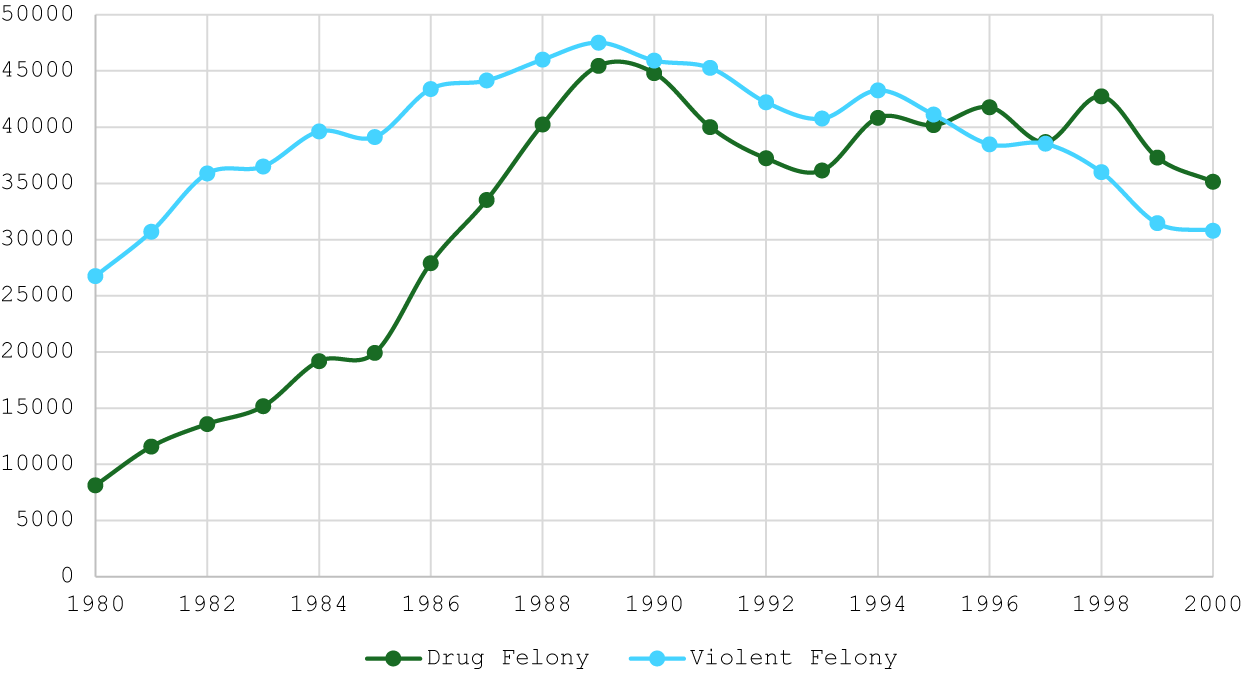
This surge in grassroots mobilization—through marches, rallies, petitions, and letters—was not merely symbolic protest but a call for action that coincided with a marked shift in law enforcement priorities. Figure 1 captures this inflection point with precision. Before 1985, arrests for drug felonies in New York City rose steadily, increasing from approximately 7,500 in 1980 to just under 20,000 by 1985. Although notable, this growth was incremental and mirrored rising concerns about crime more generally. During the same period, violent felony arrests climbed more sharply, from 27,000 to over 40,000. But after 1986—the year crack became a visible and destabilizing presence in urban neighborhoods—these trajectories diverged dramatically. Drug felony arrests surged, more than doubling from around 20,000 in 1986 to over 45,000 by 1989. The data reveal a clear pivot: enforcement priorities shifted from violent crime to street-level drug offenses, reflecting the growing political and social demand for immediate action against the crack epidemic.
Adult Drug and Violent Felony Arrests, 1980 to 2000.
Source: New York State Government.

Figure 1. Long description
The X axis represents years from 1980 to 2000 in two-year increments. The Y axis represents the number of arrests, ranging from 0 to 50000 in increments of 5000.
* Violent Felony (blue line): Starts at approximately 27000 in 1980. It shows a steady increase, peaking at roughly 48000 in 1989. After 1990, it enters a gradual decline, ending at approximately 31000 in 2000.
* Drug Felony (green line): Starts significantly lower at approximately 8000 in 1980. It shows a sharp, steep increase throughout the 1980s, peaking at approximately 45000 in 1989. From 1990 to 2000, it fluctuates between 35000 and 43000, eventually surpassing violent felony arrests around 1996 and ending at approximately 35000 in 2000.
The two lines converge around 1989 to 1990 and again around 1995 to 1996.
Increased arrests did little to ease public fear; if anything, anxiety—especially in Black and Hispanic communities—deepened. A June 1988 Gallup poll showed that while one-third of all New Yorkers cited drug-related crime as a serious neighborhood problem, that number jumped to 46% among Black respondents and 47% among Hispanics. These communities, living with daily violence and decline, felt beleaguered. Sixty-one percent of Black and 5% of Hispanic respondents said drug-related crime had worsened in their neighborhoods. Permissive solutions found little support: 74% of all respondents opposed drug legalization, with opposition even stronger among Black (77%) and Hispanic (80%) New Yorkers; 72% supported crack house seizures.Footnote 40 By March 1989, fear had reached a new peak. A Gallup poll found 55% of New Yorkers naming drugs as the city’s most serious problem—up from just 16% fifteen months earlier. Sixty-three percent of Black and 60% of Hispanic respondents named drugs as the top issue, alongside 67% of high school dropouts and 61% of those earning under $15,000, versus only 40% of those earning over $50,000 and 41% of college graduates.Footnote 41
Residents continued to mobilize, with public housing emerging as a central concern. In August 1987, African American Congressman Floyd Flake sent a sharply worded letter to Housing Authority Chairman Emanuel Popolizio, demanding action to protect seniors at the Colon Senior Citizen Housing Complex in Jamaica, Queens. Two crack houses operated in plain sight across the street, leaving elderly residents vulnerable to robberies and assaults. Flake pressed the Housing Authority to uphold its duty to protect those in its care. He called for immediate action and accountability. Two years later, the Melrose Community Against Crack, representing tenants from multiple South Bronx housing developments, echoed these concerns. “Many projects are overrun with crack dealers and crack addicts,” they wrote, with crime soaring and tenants too afraid to leave their apartments at night. While they called for after-school programs, more counselors, and drug treatment efforts, their message was unequivocal: “More police protection by the local precincts,” “More convictions of drug dealers and no plea bargains,” and “Raids on crack houses.”Footnote 42
By early 1988, sustained community pressure reached the state’s highest levels. In January, Governor Mario Cuomo met with leaders from Laurelton, Queens, pledging the state was “committed to doing all that it can to eradicate drug trafficking.” Soon after, Cuomo’s Director of Criminal Justice, John F. Poklemba, wrote to Michael Carter of the Federation of Laurelton Block Association, outlining a “comprehensive strategy for combatting the drug menace in Queens.” This strategy emerged from meetings with NYPD Commissioner Benjamin Ward, Judge Milton Williams, Special Narcotics Prosecutor Sterling Johnson, and Queens District Attorney John Santucci and resulted in the creation of Tactical Narcotics Teams (TNT). As Poklemba described, TNT was “designed to evict the drug traffickers from Southeast Queens by concentrating on street-level enforcement,” signaling a new, coordinated show of force in communities that had long felt neglected.Footnote 43
The TNT quickly became the centerpiece of New York City’s war on drugs. In November 1988, Mayor Ed Koch declared, “We have deployed special police units—most notably TNT, the Tactical Narcotics Team—to regain control of the streets in areas where drug activity had been running rampant.” Early successes, he said, encouraged expansion into other neighborhoods, framing TNT as a coordinated effort between government and community groups and “a major step toward confronting the drug plague in the city.”Footnote 44 Manhattan District Attorney Robert Morgenthau called TNT “the most ambitious police effort that any city has mounted to stem illegal drug dealing,” noting record arrests in neighborhoods that “most desperately need our attention.”Footnote 45
The TNT introduced a new model of street-level enforcement. As the September 1989 Mayor’s Management Report explained, TNT employed “a unique approach to low-level drug enforcement,” saturating targeted areas with undercover “buy and bust” operations lasting 30 to 90 days. Afterward, precinct officers conducted “maintenance” days to keep dealers from returning. The strategy extended beyond arrests; TNT coordinated 24 city, state, and federal agencies through the New York City Anti-Drug Task Force, using property seizures, drug house closures, and every available tool to dismantle trafficking networks.Footnote 46
Some communities did not just wait for TNT; they demanded it. The Northwest Bronx Community and Clergy Coalition (NWBCCC) mobilized residents from eleven neighborhoods, marching to demand that the NYPD deploy TNT to “help end the drug plague.” Tired of “crack and the violence it brings,” they called on police to “clean-up drug ‘hot-spots,’” pursue dealers as they moved elsewhere, and establish “foot patrols” to show the community had not been abandoned. But enforcement alone wasn’t enough; the coalition also pushed for coordinated efforts in “drug prevention and education, law enforcement, and treatment.” Their message was clear and direct: residents should call Commissioner Ward and “demand ‘TNT’ for the community.”Footnote 47
Still, there were hard limits—and a growing gap between what residents demanded and what the city could realistically deliver. Residents valued the collaboration that TNT fostered between communities and city agencies, and they appreciated tangible results. On July 21, 1988, Jonathan Poole of Jamaica Housing Improvement, Inc., praised the “swift” and “commendable” response by Parks Commissioner Henry J. Stern after residents raised alarms about drug activity in Haggerty Park, Hollis, Queens. Parks officials met with neighbors, removed benches that served as dealer hangouts, coordinated with police, and physically divided the ball field from the rest of the park to disrupt drug operations.Footnote 48
But structural and legal constraints persisted. When pressed to act in Southeast Queens, the Fire Department reminded the mayor’s office that, as they had told the NYPD, they had “no statutory authority to inspect one and two family (sic) private dwelling[s].” Assistant Bureau Chief William M. Feehan made the limits plain: “While we will continue to cooperate to the fullest extent possible I would not want to mislead you or Commissioner Ward concerning our very limited capacity to conduct inspections in private dwellings.”Footnote 49 Budget realities also strained capacity. When in September 1988 the Director of the Office of Management and Budget asked Police Commissioner Ward to cut $7.3 million from his department to help fund TNT expansion, Ward pushed back, urging OMB to find “new revenue sources” to avoid “disruption” in services. The political reality was unmistakable: the desire for more policing outpaced what the city could easily afford—and what departments could legally or practically deliver.Footnote 50
The rollout of New York City’s TNT and the varied community responses offer critical insight into the politics of order maintenance in the crack era. One of the few detailed evaluations, a 1992 Vera Institute of Justice study conducted with the NYPD, sought to assess whether TNT disrupted drug markets, reduced fear, improved public spaces, and helped neighborhoods “regain control” of their streets. Drawing on interviews with officers, community leaders, residents, users, and dealers, along with household surveys and panel discussions, the study painted a complex picture of modest successes, unmet expectations, and persistent frustration. Civically engaged panelists generally understood TNT’s mission to target street-level dealers, but many missed its broader goal of reducing fear. One panelist dismissed TNT as “a public relations program for the police department,” offering hope without real change. Still, others reported dramatic short-term relief. A resident from the 70th Precinct recalled, “One week I couldn’t go out on the street without being accosted … the following week that was all gone … five months later, it is still wonderful out there.”
Household surveys, however, told a more restrained story. Awareness of TNT was low—only 39% in the 70th Precinct and 12% in the 67th knew of its presence. Improvements in drug activity were modest, with only 33% in the 70th and 24% in the 67th reporting progress. While reported crime perceptions dipped—notably, a 29-point drop in the 70th Precinct—fear levels and perceptions of disorder barely budged. Residents remained anxious, with some noting that crackdowns merely pushed drug activity indoors.
Although perceptions of police aggression declined slightly, satisfaction with police services stayed flat. Police-community relations remained fraught. Although perceptions of police aggression declined slightly, overall satisfaction with police services did not improve. Panelists pointed to the absence of engagement from uniformed officers, citing either indifference or cultural barriers, particularly with immigrant communities. Residents wanted more than temporary task forces; they called for permanent TNT presence but, more importantly, for visible, consistent beat officers who knew their neighborhoods. Survey results made this clear: communities sought police not just for arrests but as consistent partners in maintaining order.Footnote 51
Over time, law enforcement officials grew disillusioned with TNT. By August 1992, former Police Commissioner Lee Brown announced a shift away from street-level sweeps toward targeting mid- and high-level traffickers, acknowledging that TNT had been “only marginally effective.” Arrest data told the same story, with overall drug arrests—particularly misdemeanors—declining since 1989. A survey of judges echoed this skepticism: only 34% believed TNT reduced street crime, and just 37% found it effective by arrest numbers alone. Even these tepid endorsements came with caveats. Judges described TNT as a “balm,” “eye wash,” or “cosmetic”—a show of action rather than real change. Many pointed to its temporary nature, noting that once officers left, conditions quickly reverted. Others criticized its focus on low-level dealers, with one judge bluntly stating, “The real sellers are unaffected and unintimidated.” In the end, TNT embodied a larger failure: an emphasis on arrest counts over lasting solutions, satisfying political pressure but falling short of addressing the deeper roots of the city’s drug crisis.Footnote 52
The story of TNT underscores what New Yorkers living through the crack era already knew: the disorder was not an illusion, not media hype, and not just elite political manipulation. It was visceral—felt in hallways turned into open-air drug markets and in neighborhoods where retreat was not an option. The letters, petitions, and marches reflect a clear, ground-level understanding of crisis that policy debates often missed. Residents weren’t misled by headlines; they saw neighbors fall into addiction, endured constant danger, and feared for their children’s safety. TNT’s rise and fall was less about public gullibility than public desperation. Communities demanded arrests and crackdowns, but, more than anything, they wanted control—the power to reclaim and protect their own streets.
Crack, Crime, and Community Demands in 1980s Atlanta
Crack arrived in Atlanta in early 1985, and by the summer of 1986, it was everywhere.Footnote 53 That July, The Atlanta Sentinel, the city’s Black newspaper, sounded the alarm on this “new and highly disturbing drug,” expressing both frustration and disbelief: “Its street name is Crack,” the paper noted, “constantly amazed at the number of fools who risk their happiness, wealth, and health by starting to use drugs.”Footnote 54 It arrived alongside sharp spikes in crime. In 1986, homicides surged 20% to their highest levels since 1979, robberies rose 21%, aggravated assaults climbed 18%, and auto theft soared 69% from the level in 1984.Footnote 55 Larceny alone occurred at a rate of 4,134 incidents per 100,000 residents, nearly one in 24 people. The toll on public health was just as severe. By the late 1980s, “stab and gunshot wounds constituted more than 60 percent of the trauma injuries” at Grady Memorial Hospital, and cocaine-related emergencies had skyrocketed by 1,214%, from 125 cases in 1985 to 1,643 by 1989.
At a June 1989 congressional hearing, Major Derico of the Atlanta Police Department exposed the depth of the crisis: drug-related homicides, tracked only since 1985, had risen from 5% to 17% by 1988—figures he admitted likely understated reality. “Unofficial estimates by members of the Bureau,” he noted, “sometimes go as high as 60 to 75 percent of the homicides we have now are drug related, or the result of a person being under the influence of drugs.” The proliferation of firearms only worsened matters. “‘More and more powerful weapons are on the street,’ Derico warned, noting that they were increasingly used in drug activity. In 1988 alone, officers seized 3,326 weapons, a 20% increase from the year before, and made 2,485 weapons arrests, with nearly 10% involving juveniles. Firearm assaults on officers surged by 182% over four years, and three officers were killed in 1988—stark evidence of how dangerous Atlanta’s streets had become.Footnote 56
By 1987, Atlanta’s housing projects had become the epicenter of the crack trade. The Atlanta Journal-Constitution warned that crack traffic threatened to engulf these communities “in a wave of street shootings and warring street gangs.” Residents described hearing the “intermittent pop of gunfire” day and night, sleeping on floors or hiding in closets to avoid stray bullets, too afraid to let their children play outside. Public service workers hesitated to enter. The toll was brutal: six-month-old Latice Hambrick was beaten to death in a crack house, 60-year-old Emma Lois Johnson was killed in gang crossfire, and 17-year-old football star Gary Cametreas Williams was gunned down after allegedly trying to sell baking soda as cocaine. Testifying before Congress, Major Derico confirmed the grim reality: “Random shootings are one of the most frequent complaints” from residents in drug-plagued housing projects, with victims often “young people, teenagers, and young kids.”Footnote 57
As crack overwhelmed Atlanta, so did grassroots activism. In August 1986, Dr. Joseph Lowery, president of the Southern Christian Leadership Conference, led a “People’s Rally Against Drugs and Thugs” at Carver Homes. He urged residents to “take Atlanta’s communities back from thugs and drugs,” comparing the crack epidemic to a modern-day Klan: “You’re getting whipped by a new enemy … it’s Killer Krack and Koke. The new lynch mob is the pushers and dealers.” The crowd’s chants of “Fired up … we don’t want no drugs” echoed as they marched through the streets.Footnote 58
Unable to live safely or raise their children in peace, Atlanta residents grew increasingly vocal. By March 1988, frustration had reached a boiling point. At a packed community meeting, Public Safety Commissioner George Napper, joined by Deputy Chief W. J. Taylor and Major Eldrin Bell, outlined plans to combat open-air drug dealing and violence. But when residents demanded 23 more officers and a new precinct in one of the hardest hit areas, Napper flatly said it wasn’t going to happen. The crowd’s anger was immediate. Douglas Dean, chair of Neighborhood Planning Unit V, shot back: “That’s not enough. You need to send a message to the thugs and hoodlums that you’re going to get tough.”Footnote 59
By April, frustration in Atlanta’s housing projects was boiling over—but not everyone agreed on the solution. At Bowen Homes, Idella Gibson banged on a police cruiser’s hood as officers beat a handcuffed suspect. “I know drugs is a bad problem around here, but that doesn’t mean we should be treated like animals,” she said, still haunted by her own son’s fatal police shooting years earlier. At McDaniel-Glenn, tenant leader Marie Rashid voiced a different exhaustion: “People who have jobs can’t get a good night’s sleep because there is gunfire all night long, every night.” Her message to police was blunt: do whatever it takes to “get the boys off the corner.”Footnote 60
By late April 1988, facing relentless pressure from residents, George Napper launched his own war on drugs. His first move: stationing uniformed officers and marked patrol cars outside known crack houses, sending what he called a “crystal clear” message to dealers. “It is our intention to reclaim [the streets],” he declared.Footnote 61 Days later came Operation Red Dog—an aggressive crackdown on street-level dealers, focused less on kingpins and more on overwhelming presence. As Napper admitted, “We realize we’re hitting the little guy … But what we’re trying to achieve is high visibility… . We want these people looking over their shoulders. We want to make it inconvenient and uncomfortable.”Footnote 62
Under Lieutenant H. B. Goldhagen, the Red Dog Section was built to “meet and challenge the drug dealer on the dealer’s own terrain.” This wasn’t just a task force—it was a militarized street operation, designed to hit Atlanta’s public housing complexes with force and precision. Officers selected for Red Dog had to meet strict standards: top-level firearms skills, peak physical fitness, and “an acceptable disciplinary history.” They received specialized training in search procedures and arrest protocols to “avoid the risk of evidence suppression in court [and] … decrease the risk of civil litigation.” The unit operated with military precision: ten teams of four, each with defined roles—team leader, runner, cover runner, and shotgun officer, the latter providing concealed protection during arrests. Supporting them were day and night plainclothes units gathering intelligence and dedicated K-9 teams focused solely on backing Red Dog’s street-level operations.Footnote 63
Once embedded in the Atlanta Police Department, the Red Dog Unit quickly made its mark—not just on the streets, but in the city’s culture. Their mission was blunt: “Run Every Drug Dealer Out of Georgia.” Known for aggressive tactics, they “shove[d] suspects against cars and buildings, search[ed] them, handcuff[ed] them,” and moved through housing projects with military precision. When Red Dog rolled up, everyone hit the ground and was searched. Their reputation even made its way into hip-hop, with Goodie Mob rapping in Dirty South: “Dem dirty Red Dogs done hit the door / And they got everybody on they hands and knees.” Raids came with force and no warning—just a door blast and the command: “Get on the ground! Get your god damn hands across your head!”Footnote 64
The Red Dog Unit’s early impact was undeniable. In just seven months, they arrested 721 suspected dealers. By the end of 1989, they had processed 6,982 cases, made 2,915 arrests, and seized over $150,000 in drug money and $213,000 worth of narcotics.Footnote 65 Their aggressive tactics reflected a broader escalation. From 1980 to 1985, drug arrests in Atlanta barely moved—up just 0.2%. But between 1985 and 1989, with crack flooding the streets, arrests exploded by nearly 294%, showing both the scale of the crisis and the city’s resolve to crush it with force.Footnote 66
Not everyone applauded Red Dog’s rise. The socialist Vanguard Weekly delivered a scathing critique, charging that “Black mayor Young is straining to keep the lid on Atlanta’s Black majority. But the racist cops are chomping at the bit.” The paper argued that labeling Zone 3 “drug infested” had turned a once-proud Black working-class neighborhood—home to union halls and a GM plant—into “something resembling a free-fire war zone for the cops.” It pointed to fear and heavy-handed policing as the reason an anti-drug march, led by Black political heavyweights Maynard Jackson and Michael Lomax, drew only a few hundred supporters. The paper’s conclusion was stark: “walls are covered with slogans of ‘Stop Police Brutality,’” while “the cops smear all protesters as nothing but Uzi-toting drug dealers.”Footnote 67
A May 1988 Atlanta Journal-Constitution poll revealed how deeply crack had shaken Black Atlantans. For 51%, drugs were the city’s top problem, with crime a distant second at 17%. White Atlantans saw it differently—only 17% named drugs as the top issue, and 19% pointed to crime. The fear among Black residents was palpable: 66% said crime had worsened in the past 2 years, compared with 49% of whites. Yet distrust of police was not widespread. Sixty percent of Black respondents were satisfied with police protection, and majorities rejected the idea that officers routinely abused power—54% disagreed that police “rough up people unnecessarily,” and 59% disagreed that they “frisk/search without good reason.” Fear was high, but faith in policing, for many, still held.Footnote 68
Even with aggressive policing in place, the persistence of crack made clear that residents wanted more enforcement, not less. In June 1988, Atlanta Journal-Constitution columnist Jeff Dickerson was blunt: “Wise Atlantans will put no leash on Red Dog.”Footnote 69 By December, he pushed harder, asking, “Will Atlanta pay for a strengthened police presence? It must pay for that, or mayhem.” He acknowledged the limits of Red Dog’s blitz tactics: they could “suspend the drug trade for an hour or so … But the drug dealers slither from their cracks once the police turn the corner.” The trade, he concluded, “never stops.”Footnote 70 Public housing residents shared that frustration. In December 1988, Louise Watley, writing for Bankhead Courts tenant leader Hattie Scales, sent a blunt message to city leaders: “We cannot allow the situation to continue,” and demanded an emergency meeting to confront the crisis head-on.Footnote 71
In January 1989, Michael Lomax, newly elected as the first Black leader of a major Georgia county, launched the Fulton County Drug and Crime Task Force with a stark warning: “Decent citizens” were “afraid to walk the street” or even risk “being visible of being hit by a stray bullet.” He admitted, “We are at a crisis level,” noting that drug pushers were now confronting law enforcement with their own weapons. While the Task Force included Atlanta’s political elite, the message from community hearings was unmistakable: ordinary residents demanded action. The report captured their priorities—“drug-free neighborhoods,” concern over “the use of drugs by family members” and teens, and a clear call for “increasing police presence” alongside prevention and treatment programs.Footnote 72 But tenant leader Louise Watley’s proposals for public housing were more telling: “Place mini-precincts in public housing” and “Assign police officers to public housing full time.” Still, her vision went beyond crackdowns: she also demanded crime prevention programs, more recreational facilities, summer jobs for youth, and stronger drug education in schools.Footnote 73
A May 1989 poll laid bare the deep racial divide in Atlanta’s drug crisis. Nearly 60% of Black respondents named drugs as the city’s top problem, compared with just 19% of white respondents. Whites were more likely to point to crime, with almost 40% naming it as the biggest issue—nearly double the 22% of Black respondents who did the same.Footnote 74 For Black Atlantans, drugs weren’t just part of the crime problem; they were the crisis, overwhelming their neighborhoods. Nowhere was this more acute than in public housing. At a June 1989 congressional hearing, Major Derico underscored the severity: “Random shootings are one of the most frequent complaints” from residents in low-income areas where drug activity thrived. Most chilling, many of the victims were children—“ages 8, 10, 12”—caught in crossfires between violent drug gangs. Some shootings were random, but many were intentional, “directed toward an intended victim.”Footnote 75
By December 1989, the patience of many residents had worn thin. At a heated meeting with Public Safety Commissioner George Napper, tenants of Atlanta’s housing projects were furious, exhausted, and desperate for relief. The Atlanta Journal-Constitution captured the scene: “The meeting was punctuated by tenants outshouting each other, pounding their fists and applauding. For many of the drug-weary tenants it was catharsis that at times took on the tone of a revival.” Facing 50 angry tenant leaders at the Atlanta Housing Authority, Napper laid out a 30-day emergency plan: an anonymous drug hotline, increased Red Dog patrols, two-man police teams, a mail drop for reporting dealers, and a plan to tow cars without visitor permits. But the tenants weren’t satisfied. They demanded a 24-hour security force, a professional lobbyist, and drug treatment centers. And they weren’t willing to wait. “If it was in your community and one of your children, the National Guard would be there,” Gail Hall told Jane Fortson, chair of the Housing Authority board. The tenants gave Napper not 30 days but 72 hours to show progress before they said they’d take their case to the governor.Footnote 76
By January 1990, tenant leaders’ pleas for help—from calls for the National Guard to demands for more police—reached a breaking point. “Our children have suffered a good bit. It’s been going on too long with nobody trying to help,” said Susie LaBord, president of the Grady Homes Tenants Association. In response, Mayor Jackson ordered Public Safety Commissioner George Napper to act. Napper announced a 60-day deployment of 200 officers to patrol drug-ravaged public housing, with round-the-clock coverage in places like Techwood, Herndon Homes, and University Homes. Barricades would control traffic, and officers would be a visible presence across 27 low-rise projects. Napper promised that it would address “both the fear of crime and the reality of crime itself.” But tenant leaders like Louise Watley weren’t buying it. “We’re not fools,” she said. “The drug pushers will know they have to change their strategy for 60 days, and in 60 days they’ll be back. Ain’t no way I can get excited about it at all.”Footnote 77
Frustration with both the drug crisis and Napper’s cautious approach fueled growing political pressure. Napper himself admitted the city had been slow to act, describing Atlanta’s crime response as little more than “unleash the police, kick butts, and take names.” He voiced doubts about the scale of police involvement, saying, “I do have some concerns about how many police should be involved in this kind of area.” But in a city moving swiftly toward aggressive enforcement, hesitation became a liability. His position was soon eliminated in a government shake-up. Stepping into the vacuum was Major Eldrin Bell, the no-nonsense commander of the Red Dog Unit. Where Napper wavered, Bell pushed forward. Tenant leaders rallied behind him. “Major Bell is Atlanta’s finest, and we truly desire his consideration for the position of Top Cop,” declared a letter from Councilman Jared Samples and 18 tenant leaders. Hattie Harrison of the Martin Street Plaza tenants’ association summed up Bell’s appeal: “He comes out to see what he can do. He doesn’t mind coming out to where you live.”Footnote 78
With Major Bell at the helm, tenant activism finally found a police department ready to meet its demands. In September 1990, Project CLEAN (Communities and Law Enforcement Against Narcotics) launched with $766,000 in city and state funding. Herndon Homes and Eagan Homes became the first test sites. The plan was bold: Red Dog squads would clear out dealers within two weeks, and the Atlanta Housing Authority hired off-duty officers and private security for 24-hour patrols. The effort extended beyond policing—MACAD provided counseling for families, and theater groups were funded to engage at-risk youth. Skepticism gave way to hope. Annie Mae Dallas, a 30-year resident of Eagan Homes, said what many were feeling: “I really believe it’s going to work. It’s getting nicer now—we’re seeing a difference,” pointing to Red Dog’s presence and the arrest of Luwan “Big Wheel” Johnson as evidence the city was serious.Footnote 79
Atlanta’s crack-era crisis, like New York’s, left no doubt: the disorder was real, not imagined. The fear was lived daily—with the crack of gunfire outside bedroom windows, children kept indoors, and routine errands meant risking confrontation with dealers. Their calls were blunt: more arrests, more officers, more raids. Yes, they certainly advocated for drug treatment programs and recreational opportunities for young people, but behind those demands was a deeper plea for control—over their streets, stairwells, and futures. Their efforts produced results. As with the spread of TNT in New York City, the rise of Red Dog and Project CLEAN was not imposed from city hall—it was hammered into existence by relentless grassroots pressure. The tragedy was that the response, although forceful, was often short-term and reactive, no match for the complex structural crises they faced. Residents understood all too well: when the police left, the dealers would return. What they wanted—and what remained elusive—was enduring safety, sustained authority, and the power to reclaim their communities for good.
Conclusion
The literature on mass incarceration and contemporary criminal justice policy has undergone a significant revision. In the first wave of scholarship, African Americans appeared primarily as victims of history, moral panics, partisan realignment, or the inexorable advance of neoliberalism.Footnote 80 When Black preferences or anti-crime politics entered the frame at all, they were often invoked either to highlight the relative punitiveness of whitesFootnote 81 or to portray Black elected officials as complicit in projects driven by forces larger than themselves rather than as full political agents acting on their own terms.Footnote 82 Over the past several years, however, a growing body of work has complicated this picture by demonstrating that Black politics was not incidental to the rise of the carceral state but central to it.Footnote 83 Building on these insights, this study of grassroots anti-crack activism in Black neighborhoods in New York City and Atlanta further confirms the causal significance of that activism, showing how ordinary residents mobilized, articulated demands, and reshaped policy outcomes in ways that existing accounts have too often obscured.
In fairness to earlier scholarship, this mobilization was not always easy to see. It is entirely possible that the erasure of grassroots Black anti-crime activism was the result of inadvertence rather than design. Recovering it required moving beyond familiar secondary accounts and into sources that capture how ordinary residents understood and negotiated questions of public safety in real time. Community surveys were essential for reconstructing how neighborhood residents framed fear, disorder, and violence. Newspaper coverage helped link local organizations and everyday concerns to broader political debates. But it was the papers of community groups—their mission statements, internal correspondence, and mobilization plans—alongside the papers of public officials, that ultimately revealed what had remained largely invisible. These documents expose a remarkable degree of civic energy. Residents and activists consciously drew on the moral language, tactical repertoire, and organizational discipline of earlier civil rights movements to press for greater police presence in their neighborhoods. Letters to elected officials are especially revealing. Again and again, residents organized collectively and pleaded directly with mayors, council members, and commissioners for sustained police attention in response to the crack epidemic and the disorder it unleashed. Collectively, these materials show not passivity but purposeful political action—one rooted in lived experience and animated by a demand for order, protection, and dignity.
Placing this grassroots activism at the center of the story also helps clarify what much of the existing literature has only partially captured. While some analysts have dismissed the influence of actual crime on crime policy,Footnote 84 others have marshaled compelling evidence linking rising violence to the post–civil rights prison boom, often foregrounding the experiences and mobilization of Black communities.Footnote 85 What these accounts tend to miss, however, is the central role of disorder in the expansion of carceral remedies. The history reconstructed here suggests a more fundamental connection between violence and disorder—one grounded in lived experience and political mobilization in disadvantaged neighborhoods. Urban violence and behavioral and physical forms of disorder were not experienced as distinct phenomena but as varying degrees of the same causal dynamic: the erosion of informal mechanisms of social control. For residents of New York City, Atlanta, and many other cities, disorder and violence were inseparable: opposite ends of a single continuum of pain.
Indeed, surveys taken just before crack hit New York City reveal that even as violence began to rise, residents of the poorest neighborhoods were often more fearful of everyday encounters—with rowdy teenagers, homeless people, and drug users—than of being murdered. This helps explain the distinctive social consequences and political salience of crack. The drug’s sale, its attendant violence, and its corrosive effects on social and physical space effectively collapsed that continuum, folding heightened violence into already pervasive fears about safety and access to public and private spaces. In this sense, the emergence of violence intensified preexisting anxieties rather than replacing them. This dynamic helps explain the rise of robust anti-crack movements in cities like New York and Atlanta. Crack—much like the heroin epidemic of the late 1960s and early 1970s—brought both the physical and behavioral dimensions of urban decline, and the resulting sense of powerlessness, into sharp and politically consequential relief. What emerges most clearly from the substance of these reactions is a fundamentally conservative impulse. In both New York City and Atlanta, Black residents did not simply demand an end to violence or drug use; they called for the reclamation of public space and the restoration of informal social control that had once made everyday life livable. Disorder was experienced not only as danger but also as dispossession—the loss of streets, parks, stairwells, and transit spaces that had once belonged to the community.
To that end, residents did not place their faith exclusively in community-based anti-crime efforts, although many experimented with them. Instead, they repeatedly and emphatically appealed to the state for intervention—above all, for a sustained police presence to help reclaim social space and reestablish order. These demands were not issued lightly, nor were they naïve about the risks of policing. Indeed, calls for greater police presence were often paired with appeals for rehabilitative services for drug users and expanded recreational and educational opportunities for young people vulnerable to the drug trade. But this coupling is precisely the point. The insistence on police presence—sometimes even inside residential buildings—alongside social provision reveals a more basic concern with order as a precondition for community life. Progressive remedies, then, were not imagined as alternatives to order but as complements to it. Treatment programs, youth services, and educational investments were valued not only for their capacity to improve individual outcomes but also for their role in restoring collective peace and stability. What residents sought was not punishment for its own sake, but the reconstitution of a moral and social environment in which informal norms could once again function and public life could resume. Order, in this vision, was not antithetical to care; it was its necessary foundation.
With all that said, it remains plausible that these grassroots demands for greater policing ultimately did not determine policy outcomes on their own. But what is striking about the narratives and evidence assembled here is how consistently Black activists forced public officials to act in ways they would not otherwise have chosen absent sustained pressure from below. Far from being passive objects of elite law-and-order projects, residents mobilized through churches, tenant associations, labor unions, and block groups to place crack, disorder, and street-level violence squarely on the political agenda—naming dealers, identifying addresses, staging rallies, and demanding visible, continuous police presence. These efforts constrained the choices of mayors, police commissioners, and governors, compelling them to deploy resources, create new enforcement units, and publicly justify their actions in the language of community reclamation and order restoration. In New York, this pressure was instrumental in the creation and expansion of TNT; in Atlanta, it shaped the timing, scope, and intensity of Operation Red Dog. Officials frequently expressed ambivalence, cited fiscal and legal limits, or worried privately about efficacy—but they nonetheless acted, repeatedly and publicly, in response to organized Black demands. The archival record thus reveals not a seamless imposition of top-down punitive governance but a fraught and uneven process in which grassroots activism helped move the state toward more aggressive policing than it would have otherwise pursued.
None of this serves as a grand refutation of neoliberal claims about American and urban political development. The dismantling of social welfare protections, the retraction of labor and housing supports, and the expansion of punitive state capacities clearly shaped the terrain on which the crack crisis unfolded. But rather than treating neoliberalism as a totalizing explanation—or positioning conservatism as its simple counterpoint—this study advances what Timothy P. R. Weaver terms intercurrence: the overlapping and simultaneous operation of multiple, partially contradictory political orders within the same institutional space. Seen through this lens, the crack era was not governed by a single neoliberal logic but by the uneasy coexistence of market retrenchment, punitive authority, and grassroots demands for order. Indeed, Weaver’s framework gives conceptual and empirical substance to Loïc Wacquant’s image of the “centaur state”—liberal and laissez-faire at the top, coercive and disciplinary at the bottom—by showing how these governing logics were not merely imposed from above but activated, legitimated, and at times intensified through popular mobilization. Black residents confronting violence, disorder, and the collapse of informal social controls did not experience neoliberalism as an abstract regime of market governance; they encountered it as the absence of protection, authority, and order. Their calls for aggressive policing and state intervention thus emerged not in opposition to neoliberalism, nor wholly reducible to it, but within an intercurrent political order in which punitive state power expanded precisely as other forms of state responsibility receded.
The parallel trajectories of New York City and Atlanta clarify what is at stake in this history—and where some influential interpretations fall short. Although the political configurations of the two cities differed in important respects, the outcome was strikingly similar: sustained calls from Black residents for government action, and specifically for police intervention, to curb the violence and disorder that crack brought into their daily lives. This convergence complicates accounts, such as Bernard Harcourt’s, that interpret order maintenance primarily as an elite project designed to manufacture an “illusion of disorder” in order to criminalize the poor and racial minorities for the benefit of affluent, often white, interests. Atlanta, as a majority-Black city governed by Black political leadership, poses a direct challenge to this thesis. If disorder were merely an illusion imposed from above, it is difficult to explain why Black officials in Atlanta would adopt enforcement strategies so similar to those pursued elsewhere—or why Black residents would demand them so forcefully. As James Forman Jr. has argued, the war on drugs was often one in which Black communities found themselves “locking up our own.” To take this history seriously is not to celebrate its outcomes but to acknowledge the agency, constraints, and tragic choices that shaped them—and that continue to haunt debates over crime, policing, and justice today.
Acknowledgment
The authors thank the Dreier Roundtable and the Rose Institute of State and Local Government for their research support, and Caleb Settles for his excellent research assistance.

 Open access

