


1. Introduction
The constitutive idea centres on the proposition that, as a matter of social fact, law and wider social life each make up and, over time, dynamically shape, the other. Working primarily from the bottom up, scholars of everyday legal consciousness have shown how, on the one hand, law ‘pulls’ us to think and behave in particular ways; and, on the other hand, our everyday thoughts and behaviours ‘push’ the content, scope, and meaning of law.Footnote 1 Working primarily from the top down, scholars of Law and Political Economy have investigated similar pushes and pulls between overarching rationalities, including ideology, and law.Footnote 2 Some of us have sought to bring those two perspectives together to gain a more holistic view (bottom-to-top-to-bottom and side-to-side), using the terminology of Economic Sociology of Law.Footnote 3
This paper highlights a challenge that is relevant to all of these approaches: how to make these, constitutive idea more available to scholars, as well as to the wider world. It argues that we can draw upon designerly ways – mindsets, process and strategies that are distinctive of design-based disciplines – to address that challenge.Footnote 4 It first highlights the empirical, conceptual and normative dimensions of the constitutive idea, and some general problems associated with them. Next it introduces designerly ways, and some examples of how they have already been used at the intersections of legal and economic life. Finally, it identifies three specific problems (one empirical, one conceptual and one normative) arising out of scholarship that attends to the constitutive idea, and explains how we might adapt existing designerly practices to address them.
2. Conceptual, empirical and normative challenges
The proposition that law and social life are co-constitutive throws up a multitude of challenges for those interested in the interplay between legal and economic life. I will focus on three broad categories: conceptual, empirical and normative.
First, how can we make the constitutive idea conceptually available to ourselves and to others – that is, express its characteristics, and locate it in a wider epistemological landscape? My preference is to think in terms of the ‘econo-socio-legal’,Footnote 5 rather than ‘society’, ‘economy’ and ‘law’; and to think in terms of complex econo-socio-legal systems. By complex system I mean an ‘interconnected’ array of ‘elements’ that is ‘organised’ towards a particular ‘purpose’ or ‘function’.Footnote 6 I find it useful to conceptualise econo-socio-legal-systems being formed of the following primary elements: human actions, interactions, regimes and rationalities; and more-than-human materialities. This approach can help us to maintain vertically holistic (bottom-to-top) sensitivity, because it accommodates the empirical reality that econo-socio-legal life occurs at different scales – from micro-level actions to meta-level rationalities (shared ways of ‘apprehending the world’).Footnote 7 This approach can also help us to maintain horizontally holistic (side-to-side) sensitivity because it accommodates the empirical realities of our diversity – the multiple values, interests, perceptions and experiences that inform actions, interactions, regimes and rationalities; and of our entanglement with the wider material world.Footnote 8 I think of these primary elements as generating secondary elements in the econo-socio-legal system – namely, issues around which scholarly and lay publics gather because they ‘matter’. I think of these secondary elements as (to adopt Bruno Latour’s capacious terminology) constitutive ‘matters of concern’ and of their mattering as potentially conceptual, empirical and/or normative.Footnote 9 Finally, I think of these primary and secondary elements of the econo-socio-legal system as ‘interconnected’ in the sense that they are co-constitutive – they make up and shape each other. So far so tidy. However, ‘[a]t a time when the world is messy, more interconnected, more interdependent and more rapidly changing than ever before, the more ways of seeing it the better’.Footnote 10 The conceptual problem on which I want to focus here is how to collaborate with those who think differently about the intersections of law and economy and/or about the constitutive idea.
Second, how can we make the constitutive idea empirically available to ourselves and to others – that is, investigate manifestations of the constitutive idea in the real world, and communicate what we find? As political economist Yuen Yuen Ang puts it, ‘living, complex, adaptive social systems’ are ‘irregular’ and ‘messy’, following ‘hidden order[s]’, akin to the fractal geometry we see in ‘the veins on a leaf, the jagged relief of a mountain, or the curves of a face’.Footnote 11 The empirical problem on which I want to focus here is how to surface and communicate such ‘hidden’, ‘messy’, ‘irregular’ realities.Footnote 12
Third, how can we make the constitutive idea normatively available to ourselves and to others – that is, surface its moral implications for scholarship, and for the wider world? One moral implication of the constitutive idea is that econo-socio-legal systems and their human impacts are not written in the stars. They are the result of choices – including choices around what information to take into account, as well as what to do with it. As pioneering systems theorist Donella Meadows (1941–2001) put it, we cannot ‘contro[l]’ a complex system, we can ‘listen to what [it] tells us’, and we can try to combine its ‘properties’ with ‘our values’, it in order ‘to bring forth something much better than could ever be produced by our will alone’.Footnote 13 But ‘we’ are not always good at listening, especially to those whose values may differ from ‘our’ own. Indeed, philosopher Miranda Fricker has used the term ‘epistemic injustice’ to highlight patterns of exclusion in the production, distribution and consumption of knowledge. She argues that such exclusion occurs when we cannot access knowledge, when we are not listened to, and when we are not heard.Footnote 14 Epistemic exclusion is harmful to individuals and communities who are not listened to, and/or not heard; to epistemic communitiesFootnote 15 which remain ignorant and/or misguided; and to the general well-being of econo-socio-legal systems.Footnote 16 As Fricker observes, where the causes of epistemic injustice are systemic, it can only be tackled through collectively-driven systemic transformation.Footnote 17 The normative problem on which I want to focus here is how to ensure that we prompt and listen to a diversity of insights around when and how the constitutive potential of law ought to be activated or resisted.
My core argument is that designerly ways can help us to address each of these problems.
3. Designerly ways
Innovation specialist Kees Dorst writes of ‘the emergence of a radically new species of problem: problems that are so open, complex, dynamic and networked that they seem impervious to solution’. There can be no doubt that some of the problems – matters of concern – thrown up by econo-socio-legal systems fall into this category. Such problems, Dorst argues, ‘require a radically different response’, for which he and others are increasingly ‘turning to “design”’.Footnote 18 In so doing he echoes Horst Rittell and Melvin Webber who observed, in 1973, that some problems are ‘wicked’ – that is, they involve uncertain information, multiple perceptions and experiences and competing values and interests. Such problems are, they argued, resistant to ‘reductionist’ scientific approaches; and can be more productively addressed through what Nigel Cross later termed ‘designerly ways’.Footnote 19
Lawyers have been reaching for design to enhance their practice for at least 20 years. This trend has accelerated dramatically in the last 5 years thanks to ‘legal design’ practitioners working in both public and commercial contexts.Footnote 20 More recently, heterodox economists have begun embedding design techniques and knowledge in their scholarly thinking and in their public practice, as well as promoting it in their policy prescriptions.Footnote 21 Mariana Mazzucato and her colleagues at the Institute for Innovation and Public Purpose argue that state-backed attempts to generate econo-socio-legal change ought to be approached as ‘complex design problems’; and ought to draw directly on knowledge and techniques from design, especially service-design with its focus ‘on user experience and co-creation practice’.Footnote 22 For example, they have welcomed the European Union’s commitment to a ‘New European Bauhaus’ which aims to promotes the use of designerly ways to create ‘a space of encounter’ in which members of the public can co-‘imagine’ and then ‘build’ a ‘beautiful’, ‘sustainable and inclusive future’.Footnote 23
I use the term designerly ways specifically to refer to the mindsets, processes and strategies that are together characteristic of design-based disciplines – broadly construed to include everything from architecture to product, service, system, social and transformation design.Footnote 24 First, a designerly mindset tends to simultaneously direct attention towards practical questions around how to make things happen, critical questions around what is wrong with how things are, and imaginative questions around how things might be. Second, this practical–critical–imaginative mindset is expressed in, and nurtured by, a designerly emphasis on experimental processes – that is, iterative sequences of relatively open or ‘creative’ activities focused on ideation; and relatively closed or ‘scientific’ activities focused on testing, adapting and discarding.Footnote 25 Third, designerly ways promote communication by making ideas visual and tangible both in formal designs such as diagrams, and in drafts and prototypes which are generated as part of experimental processes; and this in turn can prompt and facilitate collaboration among teams of designers, among those who will use, or otherwise be affected by, their designs, and between designers and the wider world. Crucially, these designerly ways are mutually reinforcing. For example, by making ideas visible and/or tangible we can make them more, or at least differently, available. As painter Paul Klee observed, ‘[i]t is not easy to arrive at a conception of a whole which is constructed from parts belonging to different dimensions’, and it is ‘still more difficult to help another to such a comprehensive view’, especially when we limit ourselves to ‘conveying’ such a view using the inherently ‘consecutive’ and ‘temporal’ medium of the ‘spoken word’.Footnote 26 By making ideas visible and/or tangible, we make them available not only to ourselves, but also to others. And we make them available not only to be understood, but also to be experimented with and, therefore, challenged and, perhaps, changed, so we become better able to individually and collaboratively generate, gather, and integrate diverse perspectives and data sources. So, I find it helpful to think of designerly ways as creating ‘structured-yet-free ecosystems’ which can enable us, individually and collectively, to sense and make sense of the world, in preparation for making meaningful change.Footnote 27
We can get an integrated sense of the key contributions that designerly ways can make to exploring matters of econo-socio-legal concern by looking to the work of heterodox economist Kate Raworth. She has forcefully demonstrated how contemporary economic thinking is rhetorically empowered, and its substantive weaknesses are hidden, by its vocabulary and imagery.Footnote 28 She proposes a range of designed rebuttals, of which I will explore two. First, Raworth critiques the dominant vision of economies as closed, ‘self-contained’ systems, comprised of exchanges between households and businesses, and argues instead for a Polanyian vision of economies ‘embedded’ in wider social life, which is in turn embedded in wider planetary life. She activates that imagery through a diagram (Figure 1a) in which she presents ‘the economy’ as including not only (private) households and businesses but also (public) states and commons, and as embedded in a wider social and ecological context. Second, Raworth proposes that economics ought to discard its traditional target of endless growth, and instead aim for the doughnut-shaped ‘safe and just space’ that remains when we take seriously the need to secure a minimum ‘social foundation of well-being’, and a maximum ceiling of ecologically damage (Figure 1b). It is noteworthy that neither of these diagram mentions law. A 2023 version of the embedded economy diagram includes ‘legal’ (along with ‘cultural’, ‘political’ and ‘social’) as part of ‘society’,Footnote 29 but law’s original absence is an important reminder that we ignore the visual at our peril. The Doughnut Economics Action Lab (DEAL) runs hands-on workshops – enabling ecosystems – in which corporate employees, civil servants, and members of the public engage in hands-on designerly experiments with the graphic to generate shared understandings of what those constraints might mean in practice. So, we can think of the doughnut as a design which can make a particular matter of concern empirically, conceptually, and normatively available; and in so doing can activate a wider public to gather around, and engage with, it.Footnote 30
(a) The Embedded Economy. Image: Kate Raworth and Marcia Mihotich. CC-BY-SA 4.0. Raworth, K. (2017), Doughnut Economics: seven ways to think like a 21st-century economist. Penguin Random House. (b) The Doughnut of social and planetary boundaries. Image: Kate Raworth and Christian Guthier. CC-BY-SA 4.0 Raworth, K. (2017), Doughnut Economics: seven ways to think like a 21st-century economist. London: Penguin Random House.

4. Making the constitutive idea conceptually available
As part of a wider argument in favour of ‘legal institutionalism’ – that is, of placing law and legal thinking at the centre of debates at the intersection of the legal, the economic, and the social – Simon Deakin and co-authors have suggested that economists and sociologists must take more care with legal concepts. First, economists need to understand that ‘property’ is about more than the possession by individuals of things. It refers to a multiplicity of intersecting and overlapping rights, that are held by owners, whether individually or collectively, and that are recognised by public authorities, to ‘exploit assets to the exclusion of everyone else, and to dispose of them by sale or otherwise’.Footnote 31 Second, sociologists need to understand that a ‘contract’ is more than a mere transaction, it is ‘an agreement, entered into voluntarily, by two or more parties with the shared intention of creating legal obligations’ (and rights) – that is, rights and obligations that are enforceable through state law.Footnote 32 Economists and sociologists might retort that property and contract are ‘boundary’ concepts – that is, they ‘inhabit several intersecting social worlds’, they ‘satisf[y] the informational requirements of each of them’, and as such they are open to different interpretations.Footnote 33 To this lawyers might reply that legal conceptualisations must take priority, because law is fundamentally constitutive of real world economic relations: without law property does not exist, and transactions are insecure.Footnote 34 Debates about conceptual literacy are common in multi-disciplinary research, which sees experts working in parallel on the same problem, perhaps failing to communicate effectively, and sometimes even seeing themselves as in competition, with each other.Footnote 35 As computer scientist Danny Hillis put it, in the Age of the Enlightenment it was possible to approach problems analytically, by ‘taking things apart’; but in this ‘Age of Entanglement’ we need to approach problems ‘synthetic[ally]’, by ‘putting things together’.Footnote 36 And this necessitates cross-disciplinary, even ‘antidisciplinary’, ways because knowledge itself is ‘entirely entangled’.Footnote 37 Although we regularly sing the praises of cross-disciplinarity, we often have less say about how to make it happen.Footnote 38
How might we draw on designerly ways to collaborate across different conceptualisations of the intersections of law and economy? Specifically, can the designerly strategy of experimental, collaborative, prototyping enhance our ability to expose, resolve and/or accept conceptual divergence?
The idea that designerly ways can contribute to collaborative cross-disciplinary thinking has a long intellectual history. For example, political scientist and cognitive psychologist Herbert A. Simon declared in 1969 that design is/ought to be a problem-solving ‘science’, and could serve as a ‘glue’ to hold the social sciences together.Footnote 39 And in 2007, interaction designer and researcher John Zimmerman and co-authors argued that designers can contribute to cross-disciplinary investigations by reframing problems, and by making material representations of possible solutions, as well as of the research process.Footnote 40
More recently, the ProtoPublics project (2016), led by Guy Julier and Lucy Kimbell, demonstrated how a designerly approach might support cross-disciplinary research with a social impact focus. As part of the project, five multi-disciplinary academic teams gathered to co-design social science proto-projects through rough physical prototypes. For example, the ProtoPolicy team created a prototype of a fictitious wristwatch-style device which would allow the wearer to control their death in order to provoke a discussion about euthanasia among politicians and civil servants at the Palace of Westminster.Footnote 41 They found that collaborative prototyping enabled diverse participants to develop interpersonal trust, ‘to share information and perspectives’ and to ‘engage in sense-making together’.Footnote 42
The potential of collaborative prototyping to enhance pragmatic conceptual experimentation among social activists was further explored in two projects to which I contributed, both of which aimed to test, adapt and/or promote the use of internationally recognised concept of ‘hate crime’ to address targeted violence. The first was a policy-led project in which prototyping – here with card and string – was used to bring together diverse, often hostile, workshop participants. For example, activists, police, prosecutors, and bureaucrats were invited to co-conceptualise the actual–potential system for reporting hate crime in their jurisdiction.Footnote 43 The second project was an academic-initiated online training programme. Activists, lawyers, journalists and others who undertake the increasingly dangerous task of working against targeted violence in India were invited to experiment with the concept of hate crime. For example, they used a Google.doc to collaboratively prototype where we are (here) in terms of conceptualising and responding to targeted violence; to imagine where we should be (there); and to identify how, practically, we might get from ‘here’ to ‘there’.Footnote 44
In the Sociolegal Model-Making project (2017) I explored the potential of model-making (a form of prototyping) to enhance legal research. I identified three modes of model making. In ‘modular’ mode we use a prefabricated system of components, such as sticky notes on a wall, or building blocks on a table, usually for the practical purpose of explaining a concept, and thereby making it available for discussion. In ‘found’ mode we use something that we have come across, such as an artefact in a museum, usually for the critical purpose of disrupting established understandings of a concept. In ‘bespoke’ mode we can use basic ingredients such as modelling clay for the imaginative purpose of conjuring a more tentative or indeterminate aspect of particular interpretation of a concept, thereby making it open to elaboration in the here and now.Footnote 45
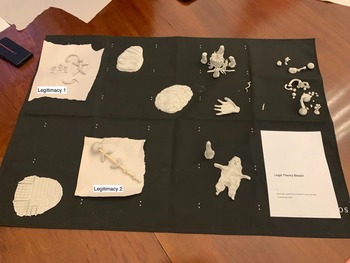
I have since tested the potential of bespoke model-making to enhance scholarly conceptual experimentation with the Edinburgh Legal Theory Research Group.Footnote 46 The experiment was inspired by The Futures Bazaar, a collaboration between futurists Filippo Cutica and Stuart Candy, Situation Lab and BBC User Experience and Design.Footnote 47 It began with an invitation to ‘picture a Legal Theory Bazaar: a wild and wonderful place where all alternative [concepts] co-exist at once, and can be physically encountered in real life; a kind of multi-dimensional exchange, where tangible objects are put on offer from countless possible [theoretical] worlds’.Footnote 48 Participants first made a clay model that captures some aspect of a Concept of Concern – that is, concepts to which we ought to draw attention because, for example, they are foundational, contested, productive or flawed; or indeed because they are needed, but do not yet exist. They then performed their model to themselves and to others, refining it along the way. Finally, they exhibited their models in relation to each other (Figure 2). Two participants, Sara Canduzzi and George Dick, chose to work collaboratively with the concept of ‘legitimacy’, focusing on ‘how legitimacy works “relationally” in both a top-down and a bottom-up manner’. They made ‘separate models’ so that they could explore ‘how different people represent the same idea’, and they were surprised by how different their models were. Making was an ‘anxious’ process for George: ‘I am not skilled at creative arts’. However, he found his model ‘was a perfectly sufficient conduit for imagination and rumination’. Performing the model was the most generative stage of the process for both participants. For Sara: ‘It helped me see how I understand the relational aspect of legitimacy’, and ‘clarified why I chose to represent the concept in the way I did, why I tend to think “in concepts”, and how [this] serves me in my research’. For George: ‘It led me to appreciate how my unrefined little model could relate to my research on methodology’, as well as to Sara’s on legitimacy. ‘It had more value than I initially assigned it. Perhaps it was not so inelegant after all!’. On the exhibit stage he remarked that: ‘it was neat to see what others had come up with, and how the concepts could be connected with each other’.
Exhibition of alternative models of legitimacy created by Sara Canduzzi (legitimacy 1) and George Dick (legitimacy 2). Edinburgh Legal Theory Research Group seminar. Image: Amanda Perry-Kessaris, 2023.

The above examples suggest that the designerly practice of prototyping can make the constitutive idea more conceptually available by promoting collaborative conceptual experimentation; thereby opening up possibilities for the transformation of scholarly and practitioner relations, and perhaps for wider systemic transformation.
5. Making the constitutive idea empirically available
As part of a wider critical genealogy of the regulation of labour, Diamond Ashiagbor has observed that law tends to see race and racism taking the ‘form’ of ‘prejudice or harassment between individuals or within institutions’ – that is, as associated with atomistic actions and interactions. In the context of work, ‘economic relations can only be “seen” by legal discourse when they take the form of legal relations between individual subjects’, such as a bilateral contract of employment. ‘Much else – the inequality of bargaining power between the parties, the broader structures within which the bilateral relationship exists, the unpaid work of social reproduction or the colonial extraction which makes the paid work possible – is invisible’.Footnote 49 Ashiagbor argues that we can make those crucial constitutive factors more visible if we also understand ‘race and racism as a rationality’ – that is, as ‘an epistemic category that organises our perceptions and evaluations of reality’, and which manifests in specific econo-socio-legal regimes, increasingly referred to as ‘racial capitalism’. Furthermore, she argues that it is only by taking such a scalar, micro-to-meta, view that we can gain a sense of how contemporary econo-socio-legal life may be constituted by – ‘owe [its] legal infrastructure’, ‘rules’ and ‘form’ to – ’histories of racial thinking’.Footnote 50
As philosopher and social and political theorist Amia Srinivasan explains, critical genealogy is often done for the purpose of ‘epistemic revelation’ – that is, to expose the ‘causal origins’ of the systems within which we operate, and to ‘undermine, destabilize, or cast doubt on the legitimacy or standing of those’ systems. However, critical genealogy can also be used for the more ‘creative’ purpose of world-making – that is, to prompt a ‘transformation of the world through a transformation of our representational practices’. This is because an effective critical genealogy ‘not only diagnoses our representations in terms of the oppressive function they serve, but moreover shows us the role that agential powers – individuals, groups and institutions – have played in the emergence and continued dominance of those representations’. Armed with these insights we can ‘exercise our own agential powers to make our representations, and thus our world, anew’.Footnote 51
How might we draw on designerly ways to surface, communicate about, and respond to empirical evidence of the constitutive idea? Specifically, can a designerly way with visualisation enhance our ability to see, as a matter of empirical fact, the roles of race and racism (as rationalities) and racial capitalism (as regime) in constituting contemporary econo-socio-legal relation; and to use the resulting insights to make our world anew?
Here, we can look to the practice of Forensic Architecture, a research agency based at Goldsmiths, University of London which uses architectural methods to hold states and corporations to account for breaches of human rights. A 2021 investigation conducted by Forensic Architecture, and commissioned by community group RISE St. James, identified two econo–socio–legal regimes that have generated and sustained racial capitalism in the air and on the ground of Death Alley, Louisiana between 1718 and the present day. First, they combined optical gas imaging, meteorological data, fluid dynamics, and data from emission permits to show how contemporary regimes for regulating industrial pollution have facilitated the ‘chemical gassing’ of majority-Black communities (Figure 3a). Second, they used a cartographic regression – overlaying historical surveys, land registries, tax records, archaeological reports, ariel and satellite imagery – to track changes to territory over time. By this method they revealed how planning regimes have allowed contemporary industrial facilities to be located on Black ancestral sites, including Black cemeteries, continuing practices of disregard for Black lives and culture that began in the context of plantations (Figure 3b).Footnote 52 Through these designerly ways, the Death Alley investigation generated detailed empirical evidence of racial capitalism – that is, of Ashiagbor’s argument that race and racism can operate as rationality, which manifests in particular econo-socio-legal regimes, which go on to constitute economic and wider social relations over time.
(a) Fluid dynamics simulations showing concentrations of the pollutant PM2.5 in Death Alley on 23 May 2020; (b) ‘Topological anomalies’ in Death Alley, many of which could be cemeteries. (c) Digital reconstruction of a ‘typical’ plantation in 3D. Images: Forensic Architecture 2021.

Forensic Architecture also used insights from these designerly processes, as well as interviews with local activists and experts, to generate an interactive 3D digital model of a typical sugar cane plantation (Figure 3c). This model serves both an ‘analytic space’ and ‘a narrative device for communicating the operational logics of a plantation, its structures of labour, and the spatial patterns through which it extract[ed] value, manage[d] death and la[id] the ground for future occupation by petrochemical facilities’.Footnote 53 In this way the project also created opportunities for experiential explorations of racial capitalism in the past and the distant present.
As the Death Alley project moves into its second phase, RISE and Forensic Architecture, in collaboration with a ‘broad coalition of activists, archaeologists, people’s historians, and scholars’, are building on these insights and devices to develop ‘a path forward’ – one which will be ‘guided by a locally imagined reconceptualization of “historical preservation” that recognizes ecological reparations as an impediment to petrochemical development’.Footnote 54
The work of Forensic Architecture, in Death Alley and elsewhere,Footnote 55 suggests that the designerly device of digital modelling can help us to make available the ‘hidden’, ‘messy’, ‘irregular’ empirical realities of the constitutive idea; and in so doing open up opportunities for wider systemic transformation.
6. Making the constitutive idea normatively available
As part of a manifesto calling for politics and political thinking to be centred in debates at the intersection of the legal, the economic and the social, Law and Political Economy advocates Jedediah Britton-Purdy and co-authors argue that since law ‘creat[es]…economic order’, it ought to ‘be accountable to those who live in that order’. This moral imperative ought, they argue, to be ‘expressed in [the] procedures’ that ‘structur[e] our shared life’, which ought to ‘accord equal weight to all members’.Footnote 56 They suggest that one way of fulfilling that moral imperative might be ‘to bring representatives of affected communities to participate in administrative decision-making’.Footnote 57 Here Britton-Purdy and co-authors are echoing calls of a rapidly expanding community of ‘open democracy’ advocates, among them political scientist Hélène Landemore. She favours democracy ‘on the basis of its “epistemic” properties’ – that is, ‘its ability to generate and aggregate the knowledge necessary to the pursuit of the common good as well as, in some sense, to track the factual and moral truth about the world’. But Landemore sees traditional ‘representative’ democracy as ‘no longer, not sufficiently, or not at all responsive to the wishes of the population’.Footnote 58 She argues for democracy, and especially ‘legislative agenda-setting’, to be more open, both in the ‘spatial’ sense of ‘being accessible’, and in the ‘temporal’ sense of being always susceptible to ‘adaptati[on] and revi[sion]’.Footnote 59 Advocates of open democracy often recommend a turn towards ‘collective intelligence’ – that is, towards sourcing and synthesising insights from diverse peoples and data, usually with the aid of digital technology.Footnote 60 Such advocates also tend to suggest that those insights are best gathered in the context of deliberative processes, such as citizens assemblies.Footnote 61 These recommendations are grounded in the practical (epistemic) reasoning that insights generated collectively, especially after deliberation, are generally more robust, and better suited to addressing complex and entangled contemporary social problems, than traditional, individualistic, and atomised alternatives. They are also grounded in the moral (epistemic) reasoning that those insights are likely to reveal something of, as Landemore puts it, the ‘moral truth of the world’.
How might we draw on designerly ways to prompt, facilitate, and listen to a diversity of insights from across econo-socio-legal systems, including around when and how the constitutive potential of law ought to be activated or resisted? Specifically, can designerly ways with participation help to widen meaningful engagement between policymakers and publics around the shaping of econo-socio-legal norms?
The emergent field of ‘collective intelligence design’ uses designerly ways specifically to gather, analyse and synthesise a diversity of inputs (information and ideas) from a diversity of peoples (scholarly and otherwise).Footnote 62 It draws upon a long tradition of policy design which sees designers prompting and facilitating ‘processual, materialised and local understanding[s] of problems and solutions’;Footnote 63 focusing attention on what ‘is attractive, functional and meaningful to people in practice’;Footnote 64 and ‘engendering collaboration between different parties and by making policy tangible and graspable’.Footnote 65 One example is the Collective Intelligence Design Playbook produced by Nesta – an influential independent innovation agency based in the UK. Like many design toolkits, the Nesta Playbook centres on a project ‘canvas’ – a designed space within with outcomes from activities completed at each stage of the project can be communicated and tracked (Figure 4a). The Playbook sets out a range of designed activities, often supported by designed artefacts, to prompt and facilitate participants to achieve their particular purpose (Figure 4b). For example, if that purpose is to understand a problem (Column 1), then participants might begin by mapping the stakeholders that influence and/or are affected by the problem (Activity A3); and by generating personas (Activity C4) to represent the key characteristics of those stakeholders.Footnote 66 Design approaches similar to those posited by Nesta exert a strong influence on the development of deliberative principles and processes.Footnote 67
(a) Collective Intelligence Design Project Canvas (b) Extract from Collective Intelligence Design Activities. Images: Nesta Collective Intelligence Design Playbook v. 1.0 available under CC A-NC-SA 4.0 International License.

However, there are concerns that collective intelligence and deliberative approaches can be ill-suited to systemic challenges. First, they may be too narrowly focused to tackle the ‘scale, interdependence and complexity’ of systems-level challenges.Footnote 68 Second, they tend to be designed to feed into, rather than to disrupt, prevailing systems.Footnote 69 For example, a recent report for the Design Council argued that designers ought to work more ‘systemically’ – that is, they must both develop ‘an awareness of the wider system context’, and be more willing and able to engage in ‘system-shifting’ transformation.Footnote 70 Third, some, such as strategic designer Cassie Robinson, argue that collective and deliberative approaches have limited transformative potential because they generally pay inadequate attention to imagination. There is, she argues, a need to ‘pull’ participants ‘away from the status quo’ – to prompt and facilitate them to consider alternative, possibly non-yet-existent, information, perspectives, purposes, and outcomes.Footnote 71 So it is noteworthy that a guide to citizens assemblies produced by research and action institute Democracy Next suggests that assemblies can be designed to include, among other things, collective imagination.Footnote 72
The work of Dark Matter Labs offers some insights into how designerly ways might contribute to more systemically attuned and imaginative approaches to collective intelligence and deliberation. Dark Matter Labs is a transnational team of designers, economists, linguists, urban planners and other specialists who are focused on social change. In 2020, in partnership with a number of civil society organisations, it launched #BeyondtheRules, a ‘practice-orientated inquiry’ ‘into what governance structures’, ‘organising methods’, and ‘underlying rules’ might be ‘required to re-craft organising and governance practices within current structures towards a deep appreciation for our entanglement and civic agency’.Footnote 73 One element of that project has been an investigation, entitled ‘contracting between the rules’, into how we might collectively reimagine employment contracts, which the team perceive as ‘a powerful site of imagination at the intersection of culture, compliance, risk, possibility and hope’, because they ‘create’, ‘codify and ‘reinforce’ ‘relationships’ and ‘work culture’. The process centred on a ‘peer group’ formed of eight non-profit organisations, supported by a facilitator as well as by experts in law, legal design and strategic design. The group explored the proposition that if employment contracts were ‘coded as a shared endeavour’, rather than in the terms of ‘power and control’, the result might be more productive working relations and outcomes. Participation was enabled through the use of a bespoke structured-yet-free online space (Miro) within which the team generated, adapted and debated ideas. Outputs from the project to date include an example of an alternative employment contract to ‘reflec[t] a generative, equitable employment relationship’. That alternative contract is underpinned by a detailed breakdown of typical employment contract terms, the standard rationale underpinning them, as well as ideas for how they might be reimagined to be ‘more relational, transparent, mutually respectful, trauma, risk-informed, and legible’; and by a database of typical contracting processes, as well as ideas for how they might be reimagined with an emphasis on reciprocity, transparency and relationship-building.Footnote 74
For additional insights into how designerly ways might make collective intelligence and deliberation approaches more systemically attuned and imaginative to we can look to designerly projects which emphasise artistic and creative practice. The empirically-grounded CreaTures Framework (2023) has identified nine ‘dimensions’ along which creative practices already do, and might yet further, contribute to policy-making and to systemic transformation more generally: by changing meanings, through embodying, learning and imagining; changing connections, through caring, organising and inspiring; and changing power, through co-creating, empowering and subverting.Footnote 75 We can see evidence of this finding in the recent work of Policy Lab, a design-driven unit within the civil service in the United Kingdom.
In 2022, Policy Lab launched a new programme of work exploring ‘experimental policy design methods’.Footnote 76 Among the methods highlighted in that programme is Legislative Theatre – a practice in which ‘audience members from the impacted community (“spect-actors”) act out solutions and collaborate with decision-makers to turn them into new laws and policies’.Footnote 77 For example, in 2020, the Greater Manchester Combined Authority collaborated with artist and civic change practitioner Katy Rubin to ‘open up some of the decision-making for a locally planned homelessness prevention strategy’. People with experience of homelessness and local government officials rehearsed for several months to co-create scenes that captured interactions between service providers and users. These scenes were performed for a live audience, who then discussed the problems raised and created policy proposals to address them (Figure 5). A selection of those proposals were then pitched to decision-makers, and discussed in detail in a follow-up meeting.Footnote 78 An independent evaluation of the project found that the Legislative Theatre process ‘humanises data-driven and abstracted conversations in otherwise bureaucratic and technocratic settings. It brings the person fully back into the conversation’.Footnote 79
‘Spect-actors’ representing a job-seeker, a job centre employee, a computer and a security guard as part of the Greater Manchester Legislative Theatre event. Image: Katy Rubin (practitioner), the Greater Manchester Combined Authority (commissioning body) and the participants (Greater Manchester residents) 2020. Reproduced with permission.

A second example of recent Policy Lab work that emphasises creative practice is the MANIFEST project, which began in 2023, which saw artists Christopher Samuel, Semiconductor, and Dryden Goodwin each ‘embedded in a different government policy team’, and ‘produced work in response to that placement’. Here artists can be thought of as being prompted and facilitated, as a part of a policy design intervention, to serve as a conduit between policymakers and the wider public. Policymakers involved in the project reportedly felt that it had generated a range of improvements to their processes, including encouraging ‘engagement in policy issues by representing them visually and materially’, ‘[d]rawing attention to’ that which ‘might otherwise go unnoticed’, ‘[b]ringing out human elements in the policy system’, ‘[m]aking space for and prompting reflection’, and enhancing the ‘wellbeing’ of ‘policy professionals and stakeholders’.Footnote 80 As one policy professional put it, engagement between artists and policymakers ‘can be such a powerful tool for exposing and exploring hard to pin down issues and communicating based on perception, emotion and personal reflection which I think can often be the best way to digest and understand really complex issues’.Footnote 81 Others ‘spoke of the role that artists can play, in effect, as critical friends, helping policy professionals reflect upon their practice to improve outcomes for citizens’.Footnote 82
The work of Dark Matter Labs, Katy Rubin, and Policy Lab suggests that a designerly emphasis on digital interaction and/or on multi-sensory experiences can help us to prompt, facilitate and listen to a diversity of insights from across econo–socio–legal systems, including around when and how the constitutive potential of law ought to be activated or resisted.
7. Conclusion
There are, of course, limits to what designerly ways can do. Some of those limits, and ways of overcoming them, have been noted in this paper. Many other general limits have been identified in design discourse. There are limits to our ability to visualise ‘the contradictory and controversial nature of matters of concern’.Footnote 83 As Bruno Latour observed in 2009, even ‘four hundred years after the invention of perspective drawing, three hundred years after projective geometry, fifty years after the development of CAD computer screens’, we remain ‘utterly unable to draw together, to simulate, to materialize, to approximate, to fully model to scale, what a thing in all of its complexity, is’.Footnote 84 There are questions around to what extent creative interventions are scalable (and, indeed, whether scalability is desirable).Footnote 85 There are concerns that collaborative activities such as prototyping may ‘reinforce existing power structures’.Footnote 86 There will always be those to whom a creative approach is inherently inaccessible – unintelligible, unattractive, unedifying. And there is always the risk that any design input, process or output might be ‘bad’ – ineffective, immoral, harmful.
Nevertheless, I hope to have persuaded you that it is worth exploring the proposition that techniques and knowledge from design can enhance our individual and collective abilities to sense, make sense of, and communicate sensibly about the constitutive idea as a matter of (conceptual, empirical, normative) concern.
Competing interests
None.



 Open access

