





Highlights
What is already known?
-
• People with lived or living experience of health conditions or accessing healthcare services (PWLE), such as patients and their families or friends, can offer valuable insights when planning and conducting knowledge syntheses in health research.
What is new?
-
• There is limited practical guidance on how to meaningfully engage PWLE in knowledge syntheses. Drawing on our team’s lived, living, and learned experiences, we provide hands-on strategies for supporting PWLE engagement across every stage of a knowledge synthesis.
Potential impact for RSM readers
-
• This tutorial paper offers concrete, experience-based recommendations and tools that researchers and PWLE can use to collaborate more effectively throughout knowledge syntheses, helping to improve the relevance of synthesized evidence to PWLE’s needs and priorities.
1 Background
Whether you are making a policy decision, creating clinical guidelines, or navigating your own health journey, having a clear picture of the evidence matters. Knowledge synthesis, also known as evidence synthesis, is a way of bringing together and making sense of findings from individual research studies that focus on a specific question or topic, often on a global scale.Reference Tricco, Tetzlaff and Moher1 Over time, this field has grown and taken on many forms, such as systematic reviews, meta-analyses, rapid reviews, scoping reviews, and umbrella reviews (also called overviews of reviews).Reference Tricco, Tetzlaff and Moher1, Reference Graham, Logan and Harrison2 While each type of knowledge synthesis uses slightly different methods, they all follow a structured and transparent process that helps ensure the results are reliable and accurately reflect the combined evidence.Reference Whittemore, Chao, Jang, Minges and Park3, Reference Harden and Thomas4 These syntheses are valuable for shaping future research and are key tools for sharing knowledge. They help connect research with real-world decision-making by informing policy briefs, creating tools to support patient decisions, developing clinical guidelines, or improving how health services are planned and delivered.Reference Tricco, Tetzlaff and Moher1, Reference Graham, Logan and Harrison2, Reference Graham and Tetroe5
As these methods have continued to evolve, so too has the recognition that bringing a wide range of perspectives into the process is essential.Reference Pollock, Campbell and Struthers6, Reference Merner, Lowe and Walsh7 People with lived or living experience of health conditions and/or accessing healthcare services (PWLE)—such as patients and their care partners (e.g., family and friends who support their care)—can offer important insights when planning and conducting research, including knowledge syntheses.Reference Dumez and L’Espérance8 There is a growing global movement, often called patient engagement, public involvement, or community and consumer involvement, that focuses on ensuring PWLE are meaningfully and actively involved in research through shared decision-making in the research process.9– Reference Harrison, Auerbach and Anderson11
Within this movement, PWLE input is applied in tandem with research evidence, theory, and clinical or professional expertise to guide research planning, conduct, decision-making, and outputs.Reference Rycroft-Malone, Seers, Titchen, Harvey, Kitson and McCormack12 This process can help ensure that research findings are relevant to the individuals and groups they impact.Reference Agyei-Manu, Atkins and Lee13, Reference Oravec, Annette and Bjorklund14 While recognizing the value of PWLE engagement to gain insight into lived experiences, it is also important to acknowledge that individual perspectives can vary widely. Therefore, while PWLE share valuable personal experiences that may resonate with others, they do not necessarily speak for entire groups or communities.15, Reference Casey16
Several studies have looked at how PWLE have been involved in knowledge syntheses, whether through shared reflections,Reference McCarron, Clement, Rasiah, Moffat, Wasylak and Santana17– Reference Barwick, Dubrowski and Petricca19 calls for greater involvement,Reference Merner, Lowe and Walsh7, Reference McCarron, Clement, Rasiah, Moffat, Wasylak and Santana17 or papers focused on methods.Reference Agyei-Manu, Atkins and Lee13 What this work shows is that when the right supports are in place, and barriers are addressed, PWLE add meaningful insights to knowledge syntheses that are unique and complementary to the perspectives of other research team members.Reference Agyei-Manu, Atkins and Lee13, Reference McCarron, Clement, Rasiah, Moffat, Wasylak and Santana17 These contributions often stem from thoughtful discussions about what matters most to them and how they would like to be involved. Still, there is little practical guidance available on how to support meaningful PWLE engagement in these projects. That is where our article comes in. Building on the findings of Agyei-Manu et al.,Reference Agyei-Manu, Atkins and Lee13 our team (comprised of PWLE, researchers, and an academic librarian) offer our own lived, living, and learned experiences of engaging together across the stages of a knowledge synthesis. Our goal with this tutorial paper is to offer hands-on ideas for supporting engagement and tackling the challenges that can come up along the way.
2 Methods
We used the supports and challenges to patient engagement in knowledge syntheses identified by Agyei-Manu et al.,Reference Agyei-Manu, Atkins and Lee13 as a structural framework that guided our conversations and reflections when writing this article. To this framework, we add our experiences of collaborating as a group of academic researchers and PWLE to suggest practical strategies for facilitating engagement in knowledge syntheses and mitigating barriers.
2.1 Terminology
When patients and care partners join a research team, it is essential for the entire team to collectively determine the language used to describe those engaged and the nature of their engagement.Reference Chudyk, Stoddard and McCleary20 In this work, we use the term PWLE to refer to members of our research team who represented the patient and care partner perspective. This terminology was chosen by PWLE because it acknowledges their diverse experiences of health, healthcare systems, and research engagement. However, we recognize that research partners in other contexts may prefer different terminology.
2.2 Team composition
Our team consisted of two academic researchers (AMC and ACT), two PhD Students (SK and JV), an academic librarian (CM), and four PWLE—three of whom chose to be listed as co-authors (JG, JK, and TS). This article is a secondary output of an ongoing scoping review of patient engagement in pharmacy practice research.Reference Villarba, Monnin and Turcotte21 The PWLE were actively involved in the scoping review and drew from this and other experiences to inform our present work. Our scoping review is currently at the data analysis stage.
Our PWLE collaborators were intentionally selected because they represented a diversity of perspectives. Specifically, they lived in four provinces (two in urban settings and two in rural), represented a mix of patient and care partner perspectives, had different levels of experience with knowledge syntheses and patient engagement (ranging from very experienced to just getting started) and represented a variety of age groups, including one youth PWLE. Beyond this project, all PWLE were actively involved in provincial or national patient and public advisory groups, bringing valuable experience in patient-oriented research.
Our team conducted this research at a Canadian academic institution, and our experiences and recommendations are framed within that context. Engaging PWLE in research is a rapidly growing practice in Canada and is supported by research funders, such as the Canadian Institutes of Health Research, through its Strategy for Patient-Oriented Research (SPOR).9 Canada is also home to many rich networks of patients, families, and PWLE who are engaged in shaping research and building capacity for engagement. Within this context, our institution and the colleagues with whom we collaborate are generally receptive to engaging PWLE in research, and our work is supported. We encourage readers to reflect on the similarities and differences in their individual research contexts as they engage with our recommendations, and to assess whether additional capacity building is needed before implementation.
2.3 Engagement in the present work
The PWLE who co-authored this article were engaged at the level of “collaborate,” meaning they were equal members of the research team and had an active role in decision-making.22 Specifically, they co-developed and refined this article through virtual meetings where they provided verbal input on each section. They also provided written feedback on each draft. PWLE roles and responsibilities were mutually established through the co-development of a terms of reference at the outset of our research (Supplementary File 1).Reference Oravec, Annette and Bjorklund14 Through this process, we ensured our engagement practices followed the core principles set out by the Canadian Institutes of Health Research Strategy for Patient-Oriented Research, our nation’s major funder and champion of patient engagement in research. These principles are mutual respect, inclusiveness, co-building, and support.9 PWLE were compensated at a rate of $25 per hour for their time spent on study-related activities, including training, meeting preparation, and document review or revision, in accordance with the agreed-upon terms.Reference Richards, Jordan, Strain and Press23
3 Results
This tutorial paper outlines key considerations and strategies for engaging PWLE in knowledge syntheses across each stage of the research process (summarized in Figure 1). We hope researchers and PWLE can use this document as a practical guide in their work. Throughout the next sections, we encourage the reader to reflect on the following questions adapted from Richards et al.Reference Richards, Poirier, Mohabir, Proulx, Robins and Smith24 to help internalize key takeaways: Have you seen these situations in your own work? Have you spoken to someone with lived/living experience about similar situations? What have you done or would you do to mitigate these challenges or avoid them in the future? Who has the power and privilege in this situation?
Overview of key considerations for meaningful and active engagement of PWLE across the stages of a knowledge synthesis.

Figure 1 Long description
Circular infographic titled “Meaningful and Active Engagement of PWLE in knowledge syntheses.” At the center is the title inside a circle. Surrounding it are six color‑coded steps connected in a loop. Step 1 is “Create an Engagement Plan,” including deciding who and when to engage and planning compensation. Step 2 is “Recruit People With Lived/Living Experience,” including creating recruitment materials, promotion, and communication with applicants. Step 3 is “Build Rapport and Establish the Team,” including designating an engagement liaison and co‑creating team terms of reference. Step 4 is “Build Capacity for Engagement,” including identifying training needs, sharing resources, and evaluating training impact. Step 5 is “Conduct the Review,” including managing expectations, creating meaningful engagement opportunities, tracking engagement, and establishing timelines. Step 6 is “Mobilize Findings,” including engaging PWLE in identifying and sharing ways to mobilize review findings with leaders and decision‑makers. A footnote explains that PWLE means People With Lived/Living Experience.
4 Stage 1: Creating an engagement plan
Deciding to engage PWLE in a knowledge synthesis begins with a clear and thoughtful plan, which should be revised with PWLE once they join the study if the project is researcher-initiated or there is a change in PWLE membership over time. This plan should consider who will be engaged, when the opportune moments to engage are, and how PWLE will be compensated for the time and expertise they bring to the research.Reference Agyei-Manu, Atkins and Lee13 In our scoping review of patient engagement in pharmacy practice research, we developed an initial engagement plan based on our team’s previous experiences engaging with PWLE on a scoping review.Reference Chudyk, Horrill and Waldman25, Reference Oravec, Arora and Bjorklund26 We then refined this plan in collaboration with PWLE once the research team was assembled.
4.1 Deciding who to engage
Researchers should think carefully about which groups, communities, or individual PWLE could bring meaningful and unique perspectives to their knowledge synthesis. Some important questions to consider are: Who cares about this research and its results? Who will be affected by the findings? Who has personal experience that could provide valuable insight? Are there voices that are often overlooked but should be included? When recruiting PWLE, the goal should be to bring in perspectives from those directly impacted by the research.Reference Richards, Poirier, Mohabir, Proulx, Robins and Smith24
In our scoping review, we sought to engage PWLE who had navigated the Canadian healthcare system, either as patients or care partners. We chose to recruit PWLE from across Canada to gain a range of perspectives on the state of patient engagement in pharmacy practice research. However, this decision required PWLE to be able to meet virtually, which could have unintentionally excluded some perspectives. Prior experience partnering on pharmacy practice research was preferred, but optional, and prior knowledge synthesis experience was not a prerequisite for engagement. These criteria were chosen with intention, as it is important to create opportunities for PWLE who are new to engagement to engage.Reference Chudyk, Stoddard and Duhamel27 We recruited four PWLE team members to foster peer mentorship and support, which can enhance the engagement experience.Reference Kullman, Bird and Clark28

4.2 Deciding when to engage
Many PWLE value being involved early in research, during the idea generation stage, when they can help shape its direction before major decisions are made.Reference Chudyk, Stoddard and McCleary20 Early collaboration also supports one of the central goals of patient engagement: to advocate for research that focuses on priorities and outcomes that matter to PWLE.9 When we began working with PWLE, some initial planning had already been completed, including a preliminary protocol for our scoping review of patient engagement in pharmacy practice research. Through PWLE engagement, we aimed to optimize the protocol. We also hoped the PWLE involved would remain engaged throughout the process of conducting the scoping review.

4.3 Planning for compensation and reimbursement
Recent studies highlight the importance of compensating PWLE for their time and reimbursing expenses like transportation, childcare, or respite costs.Reference Fox, Fergusson and Sadeknury29 Before engaging, researchers should assess whether their existing research funding can support this compensation or dedicate specific budget lines toward it when preparing new grant applications. Planning for PWLE compensation should follow existing guidelines to ensure fairness.Reference Richards, Jordan, Strain and Press23, 30
Ideally, compensation planning is done in partnership with PWLE. However, we recognize that some research teams may not yet be collaborating with PWLE at the proposal stage. In these cases, it is important to revisit the proposed compensation model with PWLE after they have been recruited onto the study team. This helps ensure that everyone agrees with and understands the compensation approach. It is also important to discuss what kinds of compensation might be best suited to the needs of PWLE on the team. Some may prefer an hourly rate, lump sum, or request a donation be made on their behalf. Others may wish to be compensated through access to equipment (e.g., being provided with a laptop) or educational opportunities. With this information in hand, researchers can develop compensation plans that meet PWLE’s needs, while also balancing the policies of the institutions where they work. Having these conversations early is key, as compensation issues take time to resolve and can potentially strain relationships between researchers and PWLE.
In our scoping review, PWLE team members were compensated at a rate of $25 CAD per hour. The compensation rate was clearly communicated from the beginning of the engagement process, and we encouraged PWLE to contact the research team if they preferred an alternative form of compensation. All PWLE on our team were comfortable with the stated compensation, and we agreed on the maximum billable hours for each research task to promote transparency and ensure project sustainability.
A challenge to compensating PWLE was that, under our department’s newly revised regulations, we were required to hire PWLE as staff members. The hiring process created an administrative burden for all team members and delayed the disbursement of compensation. Further, hiring PWLE was not common practice in our department, and we were learning to facilitate this process alongside administrative staff. We now have systems in place to streamline this process in the future.


5 Stage 2: Recruiting people with lived experience
After the initial planning described above is complete, research teams can move forward with recruiting PWLE who would like to co-conduct the knowledge synthesis.Reference Agyei-Manu, Atkins and Lee13 Key considerations at the recruitment stage include creating materials, promoting the opportunity, and maintaining clear communication with applicants.
5.1 Creating recruitment materials
To help PWLE make informed decisions about getting involved, recruitment materials should clearly describe the desired PWLE role, estimated time commitments, activities, any technological requirements (e.g., access to the internet and a webcam), available accessibility supports, and compensation and reimbursement details. Providing this information upfront helps streamline the recruitment process and attracts PWLE who are both interested and able to engage. As an example, Supplementary File 2 contains the recruitment letter we used when inviting PWLE to join our scoping review of patient engagement in pharmacy practice research.
5.2 Promoting the opportunity
Research teams should tailor their recruitment strategy to reach the specific groups they want to engage. When recruiting PWLE it is important to take deliberate steps to ensure a diversity of perspectives are represented on the research team. However, in many projects, PWLE tend to represent a narrow demographic groupReference Bombak and Hanson31—typically retired, educated, White, middle-class women with prior research engagement experienceReference Abelson, Canfield and Leslie32. This lack of diversity can occur because common recruitment strategies used by researchers (e.g., online advertisements shared through universities or professional networks) may be more likely to reach these individuals.Reference Michalak, Cheung and Willis33 While all PWLE offer valuable lived experiences to a knowledge synthesis, it is important to create space for diverse groups impacted by the research topic to shape the research directions and outcomes. To reach more diverse or underrepresented groups, researchers should explore targeted advertisement methods, such as distributing physical copies of recruitment materials at local community centers and building trusting connections with community leaders who can help recruit in culturally appropriate and accessible ways.Reference Michalak, Cheung and Willis33
5.3 Communicating with applicants
When recruiting PWLE, there may be more applicants than available positions, meaning some will not be selected. To ensure transparency, researchers should clearly explain the selection process. If possible, they should specify how many PWLE they plan to recruit and any criteria they will use to make their selection. In our research, we found it helpful to ask PWLE applicants to complete a brief introductory meeting before joining the team. This meeting helped us learn about their motivations for getting involved, the lived or living experiences they brought to the team, how they typically worked in a group setting, how they might contribute to the diversity of perspectives in the project, and whether they were available to engage in the study activities. When communicating with PWLE applicants, researchers should share details about the recruitment timeline, including the application deadline and when applicants can expect to be notified with the results, regardless of whether they were successful or not. From the PWLE perspective, not hearing back after applying to join a research project (sometimes called “getting ghosted”) can be discouraging and creates hesitation around applying to engagement opportunities in the future.
6 Stage 3: Building rapport and establishing the team
The four principles of PWLE engagement endorsed by the Canadian Institutes of Health Research SPOR—mutual respect, inclusiveness, co-building, and support9—are only achievable with strong working relationships. At the beginning of a knowledge synthesis, it is important to plan activities that help build team cohesion and foster rapport between all members of the research team.Reference Agyei-Manu, Atkins and Lee13 We describe some of these actions and activities below, as well as how we applied them in our own work.
6.1 Designate an engagement liaison
One step research teams can take to promote meaningful engagement is to designate a team member who ensures that the integrity of the engagement process is upheld.Reference Agyei-Manu, Atkins and Lee13 This person, often called a “patient engagement liaison” (or PWLE engagement liaison), focuses on building trust and fostering positive relationships with PWLE, serving as their main point of contact for questions, comments, and concerns. Most importantly, the liaison should advocate for the voice of PWLE in the research process and facilitate communication and the co-creation of PWLE roles. In our research, two team members served as engagement liaisons. As a patient-oriented researcher, AMC oversaw all aspects of engagement in our scoping review. As a research trainee working under AMC, SK later served as the primary point of contact for PWLE during the development of the present article.
6.2 Lay the groundwork: Creating a terms of reference
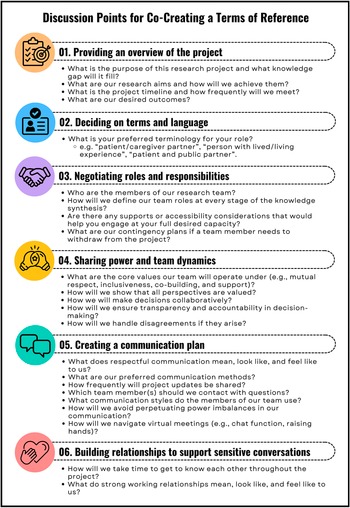
To determine whether positive relationships are developing within the research team, the team must define what these relationships mean, look like, and feel like. One effective way to do this is by co-creating a Terms of Reference document, also known as “guidelines of conduct” or a “team charter.”Reference Agyei-Manu, Atkins and Lee13 This document typically outlines the planned workflow and the team’s needs, roles, and expectations around respectful and inclusive collaboration, constructive conflict resolution, and accessibility or accommodations.Reference Oravec, Annette and Bjorklund14 The Terms of Reference is meant to be a living document, revisited periodically as relationships evolve throughout the knowledge synthesis. Below and in Figure 2, we outline six considerations that could be discussed within a Terms of Reference Document, based on our own work with PWLE.
Considerations when co-creating a terms of reference.

Figure 2 Long description
Vertical infographic titled “Discussion Points for Co‑Creating a Terms of Reference.” The image presents six numbered discussion areas, each with guiding questions.
-
[1] Providing an overview of the project, including the project purpose, knowledge gap, research aims, timeline, meeting frequency, and desired outcomes.
-
[2] Deciding on terms and language, focusing on preferred terminology for roles, such as patient or caregiver partner or person with lived or living experience.
-
[3] Negotiating roles and responsibilities, including defining team members, clarifying roles across stages of the knowledge synthesis, addressing accessibility or support needs, and planning for contingencies if a team member withdraws.
-
[4] Sharing power and team dynamics, addressing core values, valuing all perspectives, collaborative decision‑making, transparency and accountability, and handling disagreements.
-
[5] Creating a communication plan, covering respectful communication, preferred methods, frequency of updates, points of contact, communication styles, addressing power imbalances, and navigating virtual meetings.
-
[6] Building relationships to support sensitive conversations, including taking time to get to know one another and defining what strong working relationships mean to the team.
6.2.1 Providing an overview of the study
Before creating a Terms of Reference with PWLE, it is important that all team members are grounded in a similar understanding of the purpose, aims, scope, timeline, and desired outcomes of the knowledge synthesis. Opening the terms of reference meeting with a big-picture overview of the study can be helpful for this reason. We also recognize that the specific details of the study might not be determined at this stage, especially if a research team is building a knowledge synthesis from the ground up with PWLE. Still, it is good practice for the team to answer the question “how did we get here?” before moving forward with their work together.
6.2.2 Deciding on terms and language
There are differing opinions within the patient and care partner community about preferred terms for their role. Some feel that labels such as “lived/living experience,” “patient,” or “care partner” are limiting and do not fully capture the complexity of their experiences. Others may prefer terms like “persons with lived experience,” or “patients and the public.”Reference Chudyk, Stoddard and McCleary20 Rather than assuming what people prefer to be called, it is better for the team to establish a shared language together in their Terms of Reference. Through group discussions, we determined that the individuals engaged in our scoping review preferred the term PWLE, as reflected in the language used throughout this article.
6.2.3 Negotiating roles and responsibilities
PWLE cannot engage to their full desired potential when there is a lack of feedback and support from researchers, leading to disengagement.Reference Agyei-Manu, Atkins and Lee13 Creating a Terms of Reference at the start of the study gives every team member an opportunity to cocreate and clearly define their roles and responsibilities. Team roles should be informed by the strengths and preferences of PWLE, the study’s requirements, and available funding to ensure fair compensation.Reference Agyei-Manu, Atkins and Lee13 It can also be helpful to agree on roles based on different stages of the knowledge synthesis and what training and other capacity building efforts are required by each team member. These conversations are especially important when PWLE have had negative past experiences with engagement and may feel hesitant to work with researchers again. It is helpful to address these experiences directly when developing the terms of reference and to reflect on how similar experiences can be prevented in the current project.
Relatedly, it is important to consider how much time is needed for study-related tasks. As the study progresses, teams should track the time PWLE spent on research tasks and eventually publish these details to improve future planning. An additional consideration is the timing of meetings; researchers may need to hold meetings outside of business hours to accommodate the schedules of PWLE. Preferred meeting times should be identified as a group, and alternative participation options for missed meetings should be discussed.
In our scoping review of patient engagement in pharmacy practice research, we utilized the IAP2 Spectrum of Public Participation22 to define the roles of PWLE. Specifically, when seeking PWLE’s input on the review protocol, we classified their engagement as “Involve” on the spectrum,22 meaning we aimed to incorporate their ideas into the final protocol draft and clearly explain how their input influenced decision-making. When engaging PWLE in the conduct of the scoping review itself, we framed this process within the IAP2 level of “collaborate,”22 as PWLE would be involved in scoping review activities and decision-making to the fullest extent they desired throughout the research process. In developing our Terms of Reference, we outlined PWLE’s preferred level of engagement, identified necessary training for engagement, and discussed contingency plans for missed meetings (e.g., one-on-one meetings, watching recordings of the group meeting, and providing written input on what was discussed).
6.2.4 Sharing power and team dynamics
Sharing power in a research team requires a deliberate effort to move beyond traditional academic hierarchies and to value the perspectives that all team members bring.9, Reference Agyei-Manu, Atkins and Lee13, Reference Chudyk, Stoddard and McCleary20 In the Terms of Reference, researchers and PWLE should collaborate to clearly define how decisions will be made within the team and how PWLE will influence the knowledge synthesis at different stages of the research process. An engagement liaison can help facilitate this power-sharing by advocating for the PWLE voice and ensuring their input is heard and acted upon. Other processes for intentionally sharing power could include rotating facilitation between researchers and PWLE team members, inviting PWLE to lead agenda items, and encouraging the entire team to be vocal and identify when processes need to change.
In our work, we shared power by clearly documenting and discussing, as a group, how PWLE feedback was incorporated into the scoping review protocol and the development of the present article. To facilitate this approach and ensure PWLE input actively shaped the research, we designated a member of the academic research team as the note-taker during each meeting. As all of our meetings were conducted via videoconferencing, this person shared their screen with the entire team and took notes on PWLE feedback and updated study documents in real time. This process allowed PWLE to verify that their comments were correctly understood and see how their feedback was being incorporated. When reflecting on our team dynamics, one PWLE noted that we fostered genuine co-construction and created space for questions and dialogue between researchers and PWLE as the projects evolved.
In any discussion of power and team dynamics, it is also essential to talk about trauma-informed, intersectional approaches to engagement.Reference Shimmin, Wittmeier, Lavoie, Wicklund and Sibley34 PWLE bring not only stories of resilience into research spaces but can also recount experiences of grief, pain, being silenced, or being harmed. This reality must be acknowledged throughout the engagement process. For some, sharing their lived experience can be empowering, but it may also reopen emotional wounds. Importantly, PWLE perspectives are shaped not only by personal experiences but also by their intersecting identities. Factors such as race, ethnicity, ability, gender, socioeconomic status, geography, Indigeneity, and language, among many others, influence how included they may feel. Thus, engagement strategies must be intentionally designed with these intersecting identities in mind.Reference Shimmin, Wittmeier, Lavoie, Wicklund and Sibley34 In our research, we reflected on the prompts provided in the Readiness to Engage WorkbookReference Shimmin and Roche35 supplied by our local CIHR SPOR SUPPORT organization to reflect on our positionality as a team before engaging with PWLE.

6.2.5 Creating a communication plan
PWLE and other research team members often have different expectations about communication methods, frequency, and what they consider respectful dialogue.Reference Agyei-Manu, Atkins and Lee13 The Terms of Reference should define how often study updates are shared with the group and how these updates are communicated (e.g., via email or meetings). The team should also establish standards for respectful dialogue and develop approaches to handle group conflicts that are mindful of potential power imbalances, ensuring all members feel safe to share their perspectives. Additionally, with virtual meetings becoming more common, research teams should discuss their policies on chat functions and how ideas are shared (e.g., whether team members interject or raise their hands) to make sure everyone can effectively engage. During our initial meetings with PWLE team members, we discussed their preferred communication methods and mutually agreed that email and Zoom videoconferencing were acceptable. In our first group session, we collaboratively established guidelines for respectful communication during videoconferencing.

6.2.6 Building relationships to support sensitive conversations
To inform a knowledge synthesis or contextualize their perspectives, PWLE may choose to recount personal experiences as patients or care partners. Building strong relationships within the research team is key to creating safe spaces for PWLE to share these sensitive stories.Reference Richards, Poirier, Mohabir, Proulx, Robins and Smith24 In a Terms of Reference, researchers and PWLE can decide how to allocate time to relationship-building throughout the knowledge synthesis. In our research group, we typically reserved the first 10 to 15 minutes of our meetings for informal check-ins and incorporated some informal discussion throughout each meeting. Other teams may choose to share meals together (if working in person) or have informal “coffee calls” throughout a project. From the PWLE perspective, when members of a research team know each other on a personal level, sharing their insights and experiences feels easier and safer.
7 Stage 4: Building capacity for engagement
Capacity refers to an individual or group’s ability to complete a task given available skills, abilities, and resources. Successfully co-conducting a knowledge synthesis requires capacity building for both PWLE and researchers alike. When PWLE do not receive the tools or support needed to engage meaningfully in a knowledge synthesis, they may feel frustrated or unable to express their opinions or concerns.Reference Agyei-Manu, Atkins and Lee13 When researchers do not receive the training needed to meaningfully engage PWLE, they may encounter roadblocks in the project or challenges within the team dynamic. As described below, research teams should consider the training needs of all team members when embarking on a knowledge synthesis that incorporates PWLE engagement and the impacts of training should be evaluated regularly.Reference Agyei-Manu, Atkins and Lee13
7.1 Building capacity among PWLE
PWLE are a diverse group with experiences that go beyond just their lived and living experiences of health conditions or interactions with the healthcare system. Like the rest of the research team, they may also have different levels of experience with knowledge syntheses.Reference Agyei-Manu, Atkins and Lee13 Instead of assuming what everyone knows, it can be helpful to provide the same resources and training to the whole group. This ensures no one feels singled out for knowing less and gives everyone the same opportunity to build on their existing knowledge. Given that the PWLE members of our team had varying levels of experience with knowledge syntheses, our group found that workshops focused on skill development boosted confidence and competence for contributing to the knowledge synthesis. Offering educational materials in various formats, such as videos and written documents, also helped accommodate multiple learning styles.
Building capacity among youth PWLE is especially important, as they are emerging leaders in patient advocacy and may be engaging in research projects for the first time. From the perspective of the youth PWLE on our team, youth face unique pressures, such as navigating the healthcare system at a young age, balancing school or caregiving responsibilities with engagement, voicing their thoughts among adults who may speak over them, and feeling the need to represent their generation as the youngest voice at the table. To support youth PWLE effectively, it helps to involve more than one youth whenever possible, schedule dedicated check-in sessions to foster relationship-building and skill development, collaborate with a youth-friendly patient engagement liaison, avoid jargon, and ensure communication and activities are tailored to youth. Although we engaged only one youth PWLE on our research team, appointing a PhD student as the PWLE engagement liaison, who was similar in age, helped facilitate strong communication and relationship-building.

7.2 Building capacity among researchers
Education and training should not be limited to PWLE; researchers also need the skills and resources to engage PWLE meaningfully and effectively.Reference Agyei-Manu, Atkins and Lee13 For example, a team might seek training on how to create culturally safe, trauma-informed engagement experiences,Reference Shimmin, Wittmeier, Lavoie, Wicklund and Sibley34 take a course on PWLE engagement, or read articles (like this one) on how to engage PWLE in different research settings. From the PWLE perspective, facilitating engagement is a skill that develops with practice; the more researchers engage, the more confident and effective they become. Researchers, especially those new to engagement, should remember that mistakes are part of the learning process and what matters most is being open to receiving feedback and improving over time. Within our team, SK completed a graduate-level course on patient engagement in research taught by AMC. SK then received experience-based training as the PWLE engagement liaison in preparing this article. The skills SK gained through these experiences will be carried forward to future PWLE engagement initiatives as part of an ongoing learning process.
7.3 Evaluating the impact of training
When the training resources shared with PWLE are publicly reported and evaluated, future capacity-building efforts can be improved.Reference Agyei-Manu, Atkins and Lee13 However, there is limited guidance on which resources are helpful for researchers and PWLE engaging on a knowledge synthesis together. The field would benefit from research teams sharing training materials and evaluations of these materials alongside academic publications or other research outputs. Although our team did not formally evaluate our capacity-building resources, we have included the materials offered to PWLE in Supplementary File 3. In addition, we provided PWLE with key articles related to our knowledge synthesis topic: patient engagement in pharmacy practice research.
8 Stage 5: Conducting the review
The way a research team approaches engagement plays a key role in building a shared vision with PWLE. From the outset, it is essential to create a safe and welcoming space where PWLE feel comfortable sharing their ideas and actively participating. Effective engagement during the planning and execution of a knowledge synthesis involves setting clear expectations, offering meaningful opportunities to contribute, and establishing realistic timelines that respect everyone’s capacity and commitments.Reference Agyei-Manu, Atkins and Lee13 Our scoping review is currently in the data analysis phase. Consequently, our insights on analyzing data and mobilizing findings are based on existing literature,Reference Agyei-Manu, Atkins and Lee13 our prior research experiences,Reference Chudyk, Horrill and Waldman25, Reference Oravec, Arora and Bjorklund26 and our future plans for collaboration.
8.1 Managing expectations
Researchers and PWLE may initially have different expectations about the scope of the knowledge synthesis and what it can achieve.Reference Agyei-Manu, Atkins and Lee13 In our own work, we faced an expectation mismatch when we received feedback from PWLE that it was unclear why our scoping review focused only on patient engagement in pharmacy practice research (defined as research about pharmacy practice or pharmacist-led care), rather than on all types of pharmacy research. To address this, we held a group discussion on the need to balance comprehensiveness with specificity in designing a knowledge synthesis research question. Through this conversation, we reached alignment on the review’s scope. Collaborating as a team to discuss and renegotiate the scope of a knowledge synthesis to balance enthusiasm with feasibility has been discussed in a previous review of patient engagement in knowledge syntheses.Reference Agyei-Manu, Atkins and Lee13

8.2 Creating and tracking meaningful engagement opportunities
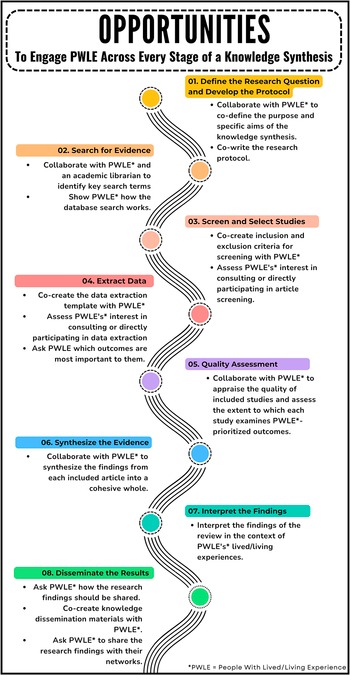
Researchers have voiced concerns about limited opportunities for PWLE to shape knowledge syntheses.Reference Agyei-Manu, Atkins and Lee13 Similarly, PWLE might feel uncertain about how their input will actually influence the research.Reference Agyei-Manu, Atkins and Lee13 These concerns can be addressed by following the engagement plans set out in the Terms of Reference while maintaining an open dialogue with PWLE. In our work, we identified opportunities to engage PWLE in every stage of the knowledge synthesis, as described in Figure 3.
Opportunities to engage PWLE throughout a knowledge synthesis.

Figure 3 Long description
Vertical infographic titled “Opportunities to Engage PWLE Across Every Stage of a Knowledge Synthesis.” A winding pathway connects eight sequential stages, each describing ways to engage people with lived or living experience.
-
[1] Define the Research Question and Develop the Protocol, including collaborating with PWLE to define purpose and aims and co‑write the research protocol.
-
[2] Search for Evidence, including working with PWLE and an academic librarian to identify key search terms and demonstrating how database searches work.
-
[3] Screen and Select Studies, including co‑creating inclusion and exclusion criteria and assessing PWLE interest in consulting or participating in article screening.
-
[4] Extract Data, including co‑creating data extraction templates, assessing interest in participating in data extraction, and identifying outcomes most important to PWLE.
-
[5] Quality Assessment, including collaborating with PWLE to appraise study quality or assess how well studies address PWLE‑prioritized outcomes.
-
[6] Synthesize the Evidence, including working with PWLE to combine findings from included articles into a cohesive synthesis.
-
[7] Interpret the Findings, including interpreting review findings in the context of PWLE lived and living experiences.
-
[8] Disseminate the Results, including asking PWLE how findings should be shared, co‑creating dissemination materials such as plain‑language summaries, and inviting PWLE to share findings within their networks. A footnote defines PWLE as People With Lived/Living Experience.
In our scoping review of patient engagement in pharmacy practice research, PWLE co-defined the review’s purpose and objectives and co-developed the protocol, including the search terms and screening criteria. The PWLE on our team served in an advisory capacity during article screening and data extraction due to the volume of articles being processed. Nonetheless, we shared information about these processes, including a tutorial on using the Covidence platform (https://www.covidence.org/) for screening articles and managing data extraction. Although we have not yet completed the data analysis stage, as co-established in our terms of reference document, we plan to collaborate with PWLE on interpreting and synthesizing findings, and disseminating the review’s results.
8.3 Promoting accessibility
A key role for PWLE engaged in knowledge syntheses is providing feedback on research plans and study documents. Asking for written feedback is common in research, but some PWLE may prefer other ways of giving feedback that better suit their comfort or accessibility needs—taking into consideration digital literacy, sensory safety, cognitive load, and screen fatigue. Researchers and PWLE should decide on their preferred ways of providing feedback together.Reference Agyei-Manu, Atkins and Lee13 In our work, we shared both editable text files and PDFs, allowing team members to choose the format most accessible on their devices. PWLE also had the option to provide feedback directly within the documents, send an email with comments, or schedule an individual meeting with the patient engagement liaison to share their input verbally. We also found it useful to share a checklist of accommodation options with PWLE at the research outset so we could identify helpful supports together (see Supplementary File 4). PWLE emphasized the importance of ensuring all team members—including researchers—could work meaningfully together without having to mask or apologize for their needs.
8.4 Establishing timelines
8.4.1 Timelines for people with lived experience
PWLE report time-related barriers to engaging in knowledge syntheses such as projects taking longer than anticipated, unrealistic deadlines, inadequate time to prepare for meetings and provide input, and the time-consuming nature of projects leading to a loss of interest in the work.Reference Agyei-Manu, Atkins and Lee13 We experienced some of these barriers in our own work.
A challenge our team faced was that the timeline for our pharmacy practice scoping review extended beyond our initial expectations. Based on previous experience, we expected that descriptions of engagement, or whether it even occurred, would be missing from the vast majority of article abstracts. As a result, we screened the full texts of all identified articles, which was even more time-consuming than we initially projected. Further, after applying exclusion criteria, we included substantially more articles than we expected based on previous reviews of patient engagement in pharmacy practice research.Reference Adesanoye and Guirguis36, Reference Cantarero-Arevalo, Kaae and Jacobsen37 This delay necessitated ongoing communication to explain the situation and plan for next steps. Fortunately, the delay also allowed us to continue collaborating with PWLE and resulted in the development of the present article. Although our collaboration was extended, it provided us with a valuable opportunity to advance the practice of patient engagement in knowledge syntheses.
Practices that helped us respect PWLE’s time included establishing regular, predictable meetings during the most active phases of the knowledge synthesis, being mindful of time zone differences, using scheduling polls, and working together to set guidelines on the maximum time to be spent on various study tasks. A lesson we have learned through engagement is to ask, rather than assume, about PWLE’s preferences for meeting times and their competing responsibilities (e.g., work, volunteering, childcare, health appointments). If schedules vary, offering multiple meeting options (e.g., weekday and weekend) or recording meetings for asynchronous participation can help ensure inclusive engagement. In our project, asynchronous options were available when PWLE could not attend full group meetings.

8.4.2 Timelines for researchers
Knowledge syntheses involving PWLE may take more time from conceptualization to publication compared to those conducted solely by researchers. One time-related barrier for researchers includes having few opportunities to build rapport with PWLE and plan meaningful engagement throughout the knowledge synthesis. For some, interactions with PWLE are often confined to the busy phases of the project, which can make relationships feel rushed.Reference Agyei-Manu, Atkins and Lee13 Engaging PWLE in more complex tasks, such as data synthesis, can also be challenging due to the time demands of training and compiling feedback from multiple team members.Reference Agyei-Manu, Atkins and Lee13 In our scoping review of patient engagement in pharmacy practice research, we found it helpful to establish realistic and flexible timelines that accounted for training, relationship-building, and iterative feedback cycles. It was also helpful to appoint an engagement liaison to provide dedicated support to PWLE throughout the project. Ultimately, the additional time required to engage PWLE is an investment in conducting a review with enhanced quality, relevance, and potential for translation into practice.Reference Agyei-Manu, Atkins and Lee13

9 Stage 6: Mobilizing findings
At the conclusion of the knowledge synthesis, the research team has produced a set of findings that they hope will influence future research, decision-making, policy, clinical practice, or other real-world outcomes. For these outcomes to be realized, the findings must be effectively shared with the world and with key knowledge user groups. PWLE can play a crucial role in mobilizing knowledge by leading the creation of plain-language summaries and reports tailored to specific audiences, sharing research findings within their networks, and helping connect decision-makers and practitioners with the research.Reference Agyei-Manu, Atkins and Lee13 To maximize impact, knowledge mobilization should be planned from the outset of the review and integrated throughout each stage.Reference Graham, Logan and Harrison2

Although our scoping review is still in progress, we discussed knowledge mobilization plans when co-creating our terms of reference with PWLE. These plans included academic publications, infographics that educate researchers on how to engage with PWLE, and infographics for PWLE outlining how they can be engaged in pharmacy practice research. We will continue these conversations as the project progresses, including collaboration with PWLE to identify additional creative knowledge mobilization outputs, as well as with patient and family engagement networks where the findings of the scoping review can be shared.
10 Concluding thoughts
In this tutorial paper, we have drawn on the collective experiences of four PWLE, two patient-oriented researchers, two research trainees, and one academic librarian to highlight both the opportunities and challenges of meaningfully engaging PWLE in knowledge syntheses. By working together, research teams and PWLE can synthesize knowledge to address real-world priorities and have a meaningful impact on patients, care partners, clinicians, decision-makers, and the broader research, practice, and policy landscapes. This all starts with the decision to engage, to say an enthusiastic “yes!” to working together. We hope our article serves as a valuable resource in making that decision more accessible and actionable.
Author contributions
Conceptualization: A.M.C., J.V., C.M., J.G., J.K., T.S., A.C.T.; Investigation: A.M.C., S.M.K., J.V., C.M., J.G., J.K., T.S.; Methodology: A.M.C.; Project administration: A.M.C., S.M.K.; Resources: A.M.C., A.C.T.; Supervision: A.M.C.; Visualization: S.M.K.; Writing—original draft: A.M.C., S.M.K., J.V., C.M., J.G., J.K., T.S.; Writing—review and editing: A.M.C., A.C.T.
Competing interest statement
The authors have no competing interests to declare.
Data availability statement
There is no dataset associated with this tutorial paper. However, our supplementary materials contain the key documents that our research team used to engage with PWLE. These materials have been provided as examples upon which future research teams can build.
Funding statement
Dr. Chudyk and this study were supported by a Canadian Institutes of Health Research Patient-Oriented Research Awards—Transition to Leadership Stream—Phase 2 award (reference number 188352). Dr. Tricco is supported by a Tier 1 Canada Research Chair in Knowledge Synthesis for Knowledge Users. The research team had full autonomy in all aspects of the study.
Use of generative AI
During the preparation of this work, the authors used Grammarly to improve clarity and identify grammatical errors. The authors have reviewed and edited the content as needed and take full responsibility for the publication.
Supplementary material
To view supplementary material for this article, please visit http://doi.org/10.1017/rsm.2026.10099.



 Open access

